

IEC 60350-2:2017
(Main)Household electric cooking appliances - Part 2: Hobs - Methods for measuring performance
General Information
- Abstract
IEC 60350-2:2017 defines methods for measuring the performance of electric hobs for household use.
Appliances covered by this document can be built-in or designed to be placed on a work surface. The hob can also be a part of a cooking range.
This document does not apply to portable appliances for cooking, grilling and similar functions (see IEC 61817).
This document defines the main performance characteristics of hobs which are of interest to the user and specifies methods for measuring these characteristics.
This document does not specify a classification or ranking for performance.
This edition includes the following significant technical changes with respect to the previous edition:
a) terms and definitions revised and new definitions added (see 3);
b) following the new market trend, requirements related to so-called flexible and free induction zones - in this document named as cooking areas - are added;
c) specification for standardized and alternative cookware is introduced (see 5.6);
d) measurement procedure reflecting a household-like cooking process for measuring the energy consumption is introduced (see Clause 7 and Annex A);
e) revision of measurement procedure for determining the accuracy of control (see Clause 8);
f) new reproducible measurement procedure for assessing the heat distribution (see Clause 9);
g) additional requirements (according to IEC 62301:2011) on how to measure low-power modes.
- Status
- Published
- Publication Date
- 17-May-2021
- Technical Committee
- SC 59K - Performance of household and similar electrical cooking appliances
- Drafting Committee
- MT 1 - TC 59/SC 59K/MT 1
Buy Documents
iec60350-2{ed2.0}en - IEC 60350-2:2017 - Household electric cooking appliances - Part 2: Hobs - Methods for measuring performance Released:8/30/2017 Isbn:9782832247679

iec60350-2{ed2.1}b - IEC 60350-2:2017+AMD1:2021 CSV - Household electric cooking appliances - Part 2: Hobs - Methods for measuring performance Released:5/18/2021
Overview - IEC 60350-2:2017 for household electric hobs
IEC 60350-2:2017 specifies standardized methods for measuring the performance of household electric hobs (built‑in or countertop, and as part of a range). It defines reproducible test procedures and the main performance characteristics of interest to users and manufacturers. This document is about measurement methods - it does not provide performance classifications or rankings, and it excludes portable cooking appliances (see IEC 61817).
Key topics and technical requirements
The standard sets out procedures, instrumentation and test conditions for consistent performance evaluation:
- Terms and definitions: revised and expanded terminology for modern hob features (Clause 3).
- Cooking zones and cooking areas: includes new requirements for flexible or free induction zones (referred to as cooking areas).
- Standardized and alternative cookware: specifications for cookware used in tests to ensure repeatability (Clause 5.6).
- Energy consumption & heating-up time: household‑like cooking process measurements and calculation methods (Clause 7 and Annex A).
- Control accuracy: procedures to determine the accuracy and stability of temperature or power control (Clause 8).
- Heat distribution: reproducible test for assessing how heat is delivered across a pan or disc (Clause 9).
- Low‑power modes: measurement requirements for standby/low power consistent with IEC 62301:2011.
- Other measurements: smallest detected diameter for induction detection, spillage capacity, dimensions/mass, and heating performance of cooking zones.
Significant technical changes in this edition include additions for cooking areas, new cookware specs, revised measurement procedures (energy, control accuracy, heat distribution), and low‑power mode testing.
Practical applications and users
IEC 60350-2:2017 is used for:
- Manufacturers - product development, internal benchmarking and performance claims.
- Test laboratories - reproducible lab procedures for type testing and performance verification.
- Certification bodies and regulators - technical method reference for conformity assessment and regulatory testing (note: the standard itself does not set pass/fail criteria).
- R&D and quality assurance teams - evaluating energy consumption, control behaviour, and heat distribution to improve design.
Practical outcomes include validated energy consumption figures, heating times, control stability data, induction detection thresholds, and comparable heat distribution tests.
Related standards
- IEC 61817 - portable cooking appliances (excluded from IEC 60350-2).
- IEC 62301:2011 - measurement of standby and off‑mode power, referenced for low‑power mode testing.
Keywords: IEC 60350-2:2017, household electric hobs, hob performance measurement, induction cooking areas, energy consumption testing, heat distribution, cookware standards.
Relations
- Effective Date
- 05-Sep-2023
- Effective Date
- 05-Sep-2023
- Effective Date
- 05-Sep-2023
Buy Documents
iec60350-2{ed2.0}en - IEC 60350-2:2017 - Household electric cooking appliances - Part 2: Hobs - Methods for measuring performance Released:8/30/2017 Isbn:9782832247679
iec60350-2{ed2.1}b - IEC 60350-2:2017+AMD1:2021 CSV - Household electric cooking appliances - Part 2: Hobs - Methods for measuring performance Released:5/18/2021
Frequently Asked Questions
IEC 60350-2:2017 is a standard published by the International Electrotechnical Commission (IEC). Its full title is "Household electric cooking appliances - Part 2: Hobs - Methods for measuring performance". This standard covers: IEC 60350-2:2017 defines methods for measuring the performance of electric hobs for household use. Appliances covered by this document can be built-in or designed to be placed on a work surface. The hob can also be a part of a cooking range. This document does not apply to portable appliances for cooking, grilling and similar functions (see IEC 61817). This document defines the main performance characteristics of hobs which are of interest to the user and specifies methods for measuring these characteristics. This document does not specify a classification or ranking for performance. This edition includes the following significant technical changes with respect to the previous edition: a) terms and definitions revised and new definitions added (see 3); b) following the new market trend, requirements related to so-called flexible and free induction zones - in this document named as cooking areas - are added; c) specification for standardized and alternative cookware is introduced (see 5.6); d) measurement procedure reflecting a household-like cooking process for measuring the energy consumption is introduced (see Clause 7 and Annex A); e) revision of measurement procedure for determining the accuracy of control (see Clause 8); f) new reproducible measurement procedure for assessing the heat distribution (see Clause 9); g) additional requirements (according to IEC 62301:2011) on how to measure low-power modes.
IEC 60350-2:2017 defines methods for measuring the performance of electric hobs for household use. Appliances covered by this document can be built-in or designed to be placed on a work surface. The hob can also be a part of a cooking range. This document does not apply to portable appliances for cooking, grilling and similar functions (see IEC 61817). This document defines the main performance characteristics of hobs which are of interest to the user and specifies methods for measuring these characteristics. This document does not specify a classification or ranking for performance. This edition includes the following significant technical changes with respect to the previous edition: a) terms and definitions revised and new definitions added (see 3); b) following the new market trend, requirements related to so-called flexible and free induction zones - in this document named as cooking areas - are added; c) specification for standardized and alternative cookware is introduced (see 5.6); d) measurement procedure reflecting a household-like cooking process for measuring the energy consumption is introduced (see Clause 7 and Annex A); e) revision of measurement procedure for determining the accuracy of control (see Clause 8); f) new reproducible measurement procedure for assessing the heat distribution (see Clause 9); g) additional requirements (according to IEC 62301:2011) on how to measure low-power modes.
IEC 60350-2:2017 is classified under the following ICS (International Classification for Standards) categories: 97.040.20 - Cooking ranges, working tables, ovens and similar appliances. The ICS classification helps identify the subject area and facilitates finding related standards.
IEC 60350-2:2017 has the following relationships with other standards: It is inter standard links to IEC 60350-2:2017/AMD1:2021, IEC 60350-2:2011, IEC 60350-2:2025. Understanding these relationships helps ensure you are using the most current and applicable version of the standard.
IEC 60350-2:2017 is available in PDF format for immediate download after purchase. The document can be added to your cart and obtained through the secure checkout process. Digital delivery ensures instant access to the complete standard document.
Standards Content (Sample)
IEC 60350-2 ®
Edition 2.0 2017-08
INTERNATIONAL
STANDARD
colour
inside
Household electric cooking appliances –
Part 2: Hobs – Methods for measuring performance
All rights reserved. Unless otherwise specified, no part of this publication may be reproduced or utilized in any form
or by any means, electronic or mechanical, including photocopying and microfilm, without permission in writing from
either IEC or IEC's member National Committee in the country of the requester. If you have any questions about IEC
copyright or have an enquiry about obtaining additional rights to this publication, please contact the address below or
your local IEC member National Committee for further information.
IEC Central Office Tel.: +41 22 919 02 11
3, rue de Varembé Fax: +41 22 919 03 00
CH-1211 Geneva 20 info@iec.ch
Switzerland www.iec.ch
About the IEC
The International Electrotechnical Commission (IEC) is the leading global organization that prepares and publishes
International Standards for all electrical, electronic and related technologies.
About IEC publications
The technical content of IEC publications is kept under constant review by the IEC. Please make sure that you have the
latest edition, a corrigenda or an amendment might have been published.
IEC Catalogue - webstore.iec.ch/catalogue Electropedia - www.electropedia.org
The stand-alone application for consulting the entire The world's leading online dictionary of electronic and
bibliographical information on IEC International Standards, electrical terms containing 20 000 terms and definitions in
Technical Specifications, Technical Reports and other English and French, with equivalent terms in 16 additional
documents. Available for PC, Mac OS, Android Tablets and languages. Also known as the International Electrotechnical
iPad. Vocabulary (IEV) online.
IEC publications search - www.iec.ch/searchpub IEC Glossary - std.iec.ch/glossary
The advanced search enables to find IEC publications by a 65 000 electrotechnical terminology entries in English and
variety of criteria (reference number, text, technical French extracted from the Terms and Definitions clause of
committee,…). It also gives information on projects, replaced IEC publications issued since 2002. Some entries have been
and withdrawn publications. collected from earlier publications of IEC TC 37, 77, 86 and
CISPR.
IEC Just Published - webstore.iec.ch/justpublished
Stay up to date on all new IEC publications. Just Published IEC Customer Service Centre - webstore.iec.ch/csc
details all new publications released. Available online and If you wish to give us your feedback on this publication or
also once a month by email. need further assistance, please contact the Customer Service
Centre: csc@iec.ch.
IEC 60350-2 ®
Edition 2.0 2017-08
INTERNATIONAL
STANDARD
colour
inside
Household electric cooking appliances –
Part 2: Hobs – Methods for measuring performance
INTERNATIONAL
ELECTROTECHNICAL
COMMISSION
ICS 97.040.20 ISBN 978-2-8322-4767-9
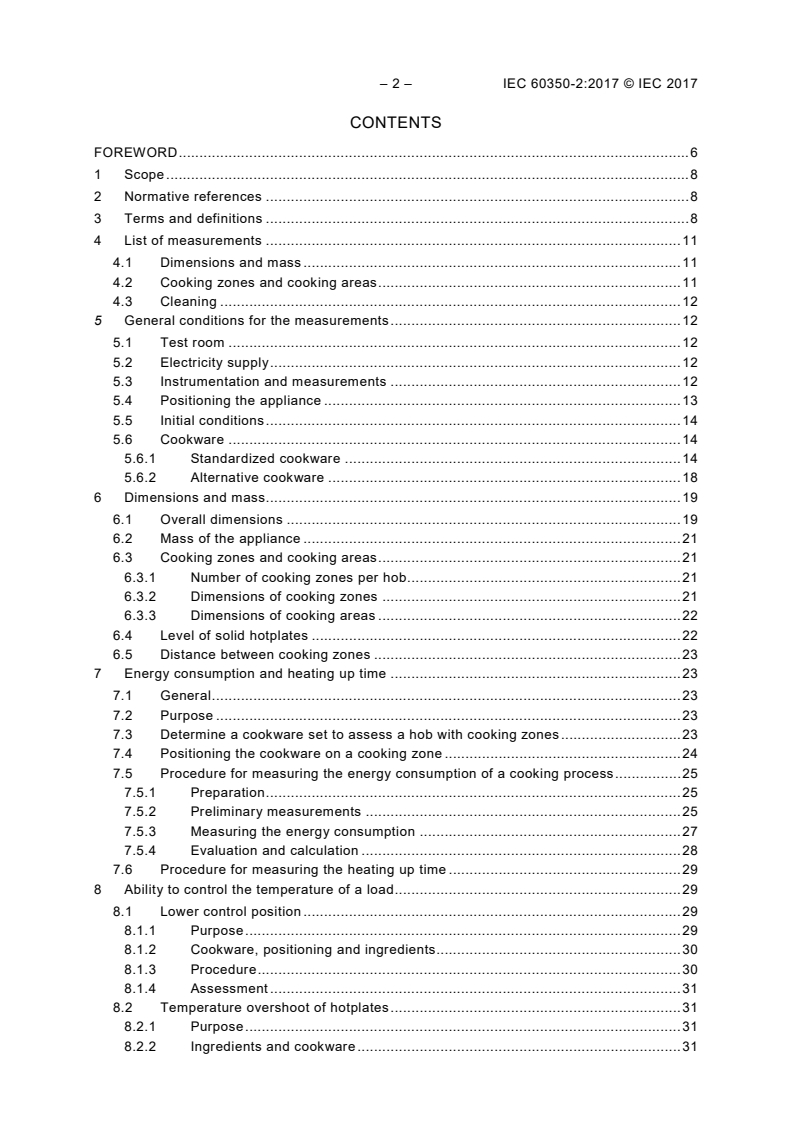
– 2 – IEC 60350-2:2017 © IEC 2017
CONTENTS
FOREWORD . 6
1 Scope . 8
2 Normative references . 8
3 Terms and definitions . 8
4 List of measurements . 11
4.1 Dimensions and mass . 11
4.2 Cooking zones and cooking areas . 11
4.3 Cleaning . 12
5 General conditions for the measurements . 12
5.1 Test room . 12
5.2 Electricity supply . 12
5.3 Instrumentation and measurements . 12
5.4 Positioning the appliance . 13
5.5 Initial conditions . 14
5.6 Cookware . 14
5.6.1 Standardized cookware . 14
5.6.2 Alternative cookware . 18
6 Dimensions and mass . 19
6.1 Overall dimensions . 19
6.2 Mass of the appliance . 21
6.3 Cooking zones and cooking areas . 21
6.3.1 Number of cooking zones per hob . 21
6.3.2 Dimensions of cooking zones . 21
6.3.3 Dimensions of cooking areas . 22
6.4 Level of solid hotplates . 22
6.5 Distance between cooking zones . 23
7 Energy consumption and heating up time . 23
7.1 General . 23
7.2 Purpose . 23
7.3 Determine a cookware set to assess a hob with cooking zones . 23
7.4 Positioning the cookware on a cooking zone . 24
7.5 Procedure for measuring the energy consumption of a cooking process . 25
7.5.1 Preparation . 25
7.5.2 Preliminary measurements . 25
7.5.3 Measuring the energy consumption . 27
7.5.4 Evaluation and calculation . 28
7.6 Procedure for measuring the heating up time . 29
8 Ability to control the temperature of a load . 29
8.1 Lower control position . 29
8.1.1 Purpose . 29
8.1.2 Cookware, positioning and ingredients. 30
8.1.3 Procedure . 30
8.1.4 Assessment . 31
8.2 Temperature overshoot of hotplates . 31
8.2.1 Purpose . 31
8.2.2 Ingredients and cookware . 31
8.2.3 Procedure . 31
8.2.4 Assessment . 31
9 Heat distribution and heat supply . 32
9.1 Measuring the heat distribution . 32
9.1.1 Test purpose . 32
9.1.2 Discs . 32
9.1.3 Pre-test for determining the setting . 33
9.1.4 Preparation of the disc for the main test . 34
9.1.5 Main test . 35
9.1.6 Assessment . 35
9.2 Measuring the continuous frying. 39
9.2.1 Purpose . 39
9.2.2 Specification of the frying pan . 40
9.2.3 Recipe for pancakes . 40
9.2.4 Procedure . 41
9.2.5 Assessment . 41
10 Heat performance of cooking zones . 41
10.1 Purpose . 41
10.2 Procedure . 41
11 Smallest detected diameter for induction cooking zones . 43
11.1 Purpose . 43
11.2 Procedure . 43
12 Power measurement of low power modes . 44
13 Spillage capacity of hobs . 44
Annex A (normative) Further requirements for measuring the energy consumption and
heating up time for cooking areas . 46
A.1 General . 46
A.2 Hob with cooking area . 46
A.2.1 General . 46
A.2.2 Cooking area without limitative marking . 46
A.2.3 Hob with cooking area with limitative marking . 47
A.2.4 Hob with cooking zones and cooking areas . 48
A.3 Positioning on a cooking area . 48
A.3.1 General . 48
A.3.2 Positioning on a cooking area without limitative markings . 48
A.3.3 Positioning on a cooking area with limitative markings . 49
Annex B (informative) Aids for measuring the energy consumption according to Clause 7 . 53
B.1 Fixing the temperature measurement instrument to the lid – Example . 53
B.2 Marking the lowest possible simmering power setting . 53
Annex C (informative) Examples how to select and position the cookware for
measurements according to Clause 7 and Annex A . 55
C.1 Example 1 – Cooking zones . 55
C.2 Example 2 – cooking zones combined with cooking area with limitative
markings . 56
C.3 Example 3 – cooking area with limitative markings > 3 controls with the area
of control in front . 59
C.4 Example 4 – cooking area with limitative markings > 3 controls with the area
of control at the side . 62
Annex D (normative) Shade chart . 65
– 4 – IEC 60350-2:2017 © IEC 2017
Annex E (informative) Data and calculation sheet: energy consumption of a cooking
process (see Clause 7 and Annex A) . 67
Annex F (informative) Addresses of suppliers . 68
F.1 General . 68
F.2 Disc material (C45) for measuring the smallest detected diameter . 68
F.3 Stainless steel for bottom material of the standardized cookware . 68
F.4 Cookware for measuring the energy consumption and heating up time. 68
F.5 Disc for measuring the heat distribution . 68
F.6 Lamp for digital measurement systems . 68
F.7 Digital measurement system . 69
F.8 Testcharts for checking the resolution of the imaging system . 69
Annex G (informative) Example for assessing the lower control position . 70
G.1 General . 70
G.2 Criteria . 70
Bibliography . 71
Figure 1 – Standardized cookware . 18
Figure 2 – Dimensions of appliances. 20
Figure 3 – Dimensions of built-in hobs . 21
Figure 4 – Device for checking the level of solid hotplates . 22
Figure 5 – Overshoot measurement . 25
Figure 6 – Energy consumption measurement process for a cooking process . 27
Figure 7 – Diametral lines . 39
Figure 8 – Disc to determine the smallest detected diameter . 44
Figure A.1 – Layout for a hob with cooking area without limitative marking – Example . 46
Figure A.2 – Layouts for a hob with a cooking area with limitative marking – Examples . 47
Figure A.3 – Drawing layer . 49
Figure A.4 – Position a cookware set on a cooking area with limitative markings ≤ 3
controls – Example . 50
Figure A.5 – Position a cookware set on a cooking area with limitative markings > 3
controls – Example . 52
Figure B.1 – Position of the temperature measurement instrument . 53
Figure B.2 – Polar coordinate paper – Example . 54
Figure C.1 – Example 1: tubular hotplates, solid hotplates, radiant cooking zone or
induction cooking zone . 55
Figure C.2 – Example 1: selecting and positioning of cookware . 56
Figure C.3 – Example 2: induction or radiant cooking zones combined with a cooking
area with limitative markings . 57
Figure C.4 – Example 2: selecting and positioning of cookware . 58
Figure C.5 – Example 3: Cooking area with limitative markings > 3 controls with the
area of the control in front . 59
Figure C.6 – Example 3: procedure how to shift the cookware into the correct position
– Step 1 . 60
Figure C.7 – Example 3: Procedure how to shift the cookware into the correct position
– Step 2 . 61
Figure C.8 – Example 4: Cooking area with limitative markings > 3 controls with the
area of the control at the side . 62
Figure C.9 – Example 4: procedure how to shift the cookware into the correct position
– Step 1 . 63
Figure C.10 – Example 4: procedure how to shift the cookware into the correct position
– Step 2 . 64
Table 1 – Instruments . 13
Table 2 – Measurements . 13
Table 3 – Sizes of standardized cookware and water amounts . 15
Table 4 – Criteria for selecting the cookware set regarding cooking zones . 24
Table 5 – Amount of oil . 30
Table 6 – Specifications for discs used for measuring the heat distribution . 33
Table 7 – maximum time t for each size of disc . 37
max
Table 8 – Ingredients and cooking durations . 40
Table 9 – Quantities for heat performance test . 42
Table 10 – Frying times for potato chips . 42
Table A.1 – Criteria for the cookware set for measuring cooking areas without
limitative marking . 47
Table A.2 – Criteria for the cookware set for measuring cooking areas with limitative
marking. 48
Table D.1 – Classification of shade numbers regarding R . 65
y
Table D.2 – Examples for the shade charts regarding L*, R and the specification of
y
the limiting samples H and H . 66
limit lower
– 6 – IEC 60350-2:2017 © IEC 2017
INTERNATIONAL ELECTROTECHNICAL COMMISSION
____________
HOUSEHOLD ELECTRIC COOKING APPLIANCES –
Part 2: Hobs – Methods for measuring performance
FOREWORD
1) The International Electrotechnical Commission (IEC) is a worldwide organization for standardization comprising
all national electrotechnical committees (IEC National Committees). The object of IEC is to promote
international co-operation on all questions concerning standardization in the electrical and electronic fields. To
this end and in addition to other activities, IEC publishes International Standards, Technical Specifications,
Technical Reports, Publicly Available Specifications (PAS) and Guides (hereafter referred to as “IEC
Publication(s)”). Their preparation is entrusted to technical committees; any IEC National Committee interested
in the subject dealt with may participate in this preparatory work. International, governmental and non-
governmental organizations liaising with the IEC also participate in this preparation. IEC collaborates closely
with the International Organization for Standardization (ISO) in accordance with conditions determined by
agreement between the two organizations.
2) The formal decisions or agreements of IEC on technical matters express, as nearly as possible, an international
consensus of opinion on the relevant subjects since each technical committee has representation from all
interested IEC National Committees.
3) IEC Publications have the form of recommendations for international use and are accepted by IEC National
Committees in that sense. While all reasonable efforts are made to ensure that the technical content of IEC
Publications is accurate, IEC cannot be held responsible for the way in which they are used or for any
misinterpretation by any end user.
4) In order to promote international uniformity, IEC National Committees undertake to apply IEC Publications
transparently to the maximum extent possible in their national and regional publications. Any divergence
between any IEC Publication and the corresponding national or regional publication shall be clearly indicated in
the latter.
5) IEC itself does not provide any attestation of conformity. Independent certification bodies provide conformity
assessment services and, in some areas, access to IEC marks of conformity. IEC is not responsible for any
services carried out by independent certification bodies.
6) All users should ensure that they have the latest edition of this publication.
7) No liability shall attach to IEC or its directors, employees, servants or agents including individual experts and
members of its technical committees and IEC National Committees for any personal injury, property damage or
other damage of any nature whatsoever, whether direct or indirect, or for costs (including legal fees) and
expenses arising out of the publication, use of, or reliance upon, this IEC Publication or any other IEC
Publications.
8) Attention is drawn to the Normative references cited in this publication. Use of the referenced publications is
indispensable for the correct application of this publication.
9) Attention is drawn to the possibility that some of the elements of this IEC Publication may be the subject of
patent rights. IEC shall not be held responsible for identifying any or all such patent rights.
International Standard IEC 60350-2 has been prepared by subcommittee 59K: Performance of
household and similar electrical cooking appliances, of IEC technical committee TC 59:
Performance of household and similar electrical appliances.
This second edition cancels and replaces the first edition published in 2011. This edition
constitutes a technical revision.
This edition includes the following significant technical changes with respect to the previous
edition:
a) terms and definitions revised and new definitions added (see 3);
b) following the new market trend, requirements related to so-called flexible and free
induction zones – in this document named as cooking areas – are added;
c) specification for standardized and alternative cookware is introduced (see 5.6);
d) measurement procedure reflecting a household-like cooking process for measuring the
energy consumption is introduced (see Clause 7 and Annex A);
e) revision of measurement procedure for determining the accuracy of control (see Clause 8);
f) new reproducible measurement procedure for assessing the heat distribution (see
Clause 9);
g) additional requirements (according to IEC 62301:2011) on how to measure low-power
modes.
In this document, terms in bold characters are defined in Clause 3.
This standard contains attached files in the form of a spreadsheet. These files are intended to
be used as a complement and do not form an integral part of the standard.
The text of this International Standard is based on the following documents:
FDIS Report on voting
59K/293/FDIS 59K/294/RVD
Full information on the voting for the approval of this International Standard can be found in
the report on voting indicated in the above table.
This document has been drafted in accordance with the ISO/IEC Directives, Part 2.
A list of all parts in the IEC 60350 series, published under the general title Household electric
cooking appliances, can be found on the IEC website.
The committee has decided that the contents of this document will remain unchanged until the
stability date indicated on the IEC website under "http://webstore.iec.ch" in the data related to
the specific document. At this date, the document will be
• reconfirmed,
• withdrawn,
• replaced by a revised edition, or
• amended.
A bilingual version of this publication may be issued at a later date.
IMPORTANT – The 'colour inside' logo on the cover page of this publication indicates
that it contains colours which are considered to be useful for the correct
understanding of its contents. Users should therefore print this document using a
colour printer.
– 8 – IEC 60350-2:2017 © IEC 2017
HOUSEHOLD ELECTRIC COOKING APPLIANCES –
Part 2: Hobs – Methods for measuring performance
1 Scope
This part of IEC 60350 defines methods for measuring the performance of electric hobs for
household use.
Appliances covered by this document can be built-in or designed to be placed on a work
surface. The hob can also be a part of a cooking range.
This document does not apply to portable appliances for cooking, grilling and similar functions
(see IEC 61817).
This document defines the main performance characteristics of hobs which are of interest to
the user and specifies methods for measuring these characteristics.
This document does not specify a classification or ranking for performance.
NOTE 1 Some of the tests which are specified in this document are not considered to be reproducible since the
results can vary between laboratories. They are therefore intended for comparative testing purposes only.
NOTE 2 This document does not deal with safety requirements (IEC 60335-2-6 and IEC 60335-2-9).
2 Normative references
The following documents are referred to in the text in such a way that some or all of their
content constitutes requirements of this document. For dated references, only the edition
cited applies. For undated references, the latest edition of the referenced document (including
any amendments) applies.
IEC 62301:2011, Household electrical appliances – Measurement of standby power
IEC 60364-5-54, Low-voltage electrical installations – Part 5-54: Selection and erection of
electrical equipment – Earthing arrangements and protective conductors
ISO 80000-1:2009, Quantities and units – Part 1: General
3 Terms and definitions
For the purposes of this document, the following terms and definitions apply.
ISO and IEC maintain terminological databases for use in standardization at the following
addresses:
• IEC Electropedia: available at http://www.electropedia.org/
• ISO Online browsing platform: available at http://www.iso.org/obp
3.1
cooking range
appliance having a hob and at least one oven and which may incorporate a grill
Note 1 to entry: Methods for measuring performance of ovens are described in IEC 60350-1.
3.2
hob
appliance or part of an appliance which incorporates one or more cooking zones and/or
cooking areas including a control unit
Note 1 to entry: A hob is also known as a cooktop.
Note 2 to entry: The control unit can be included in the hob itself or integrated in a cooking range.
3.3
cooking zone
limitative marking on the surface of a hob where one cookware is placed and heated or an
attached area to the surface
EXAMPLE
A cooking zone can be:
– a single zone or a multiple zone (see 3.4 and 3.5);
– a solid hotplate (see 3.6);
– a tubular hotplate (see 3.7);
– a radiant cooking zone (see 3.8);
– an induction cooking zone (see 3.9).
Note 1 to entry: Cooking zones which are used without cookware but by positioning the food directly on the
surface are not included.
Note 2 to entry: Sometimes there is a decoration symbol, e.g. a cross, to mark the centre of the cooking zone
additionally.
3.4
single zone
cooking zone marked for one cookware size
3.5
multiple zone
cooking zone marked for more than one cookware size and shape which can be circular,
elliptical or a combination
EXAMPLE 1 Circular multiple zone for three different cookware sizes:
[IEC 60417-Pr17-001]
EXAMPLE 2 Circular and elliptical multiple zone:
[IEC 60417-5492:2002-10]
– 10 – IEC 60350-2:2017 © IEC 2017
3.6
solid hotplate
cooking zone having a closed surface, which is usually constructed from cast iron, with an
integrated heating element
3.7
tubular hotplate
cooking zone having a surface which is formed by the configuration of a tubular heated
heating element in a substantially flat plane
3.8
radiant cooking zone
cooking zone on which the pan is heated by means of a radiant heating element below the
glass ceramic which could have a heating ribbon, heating spiral or a tungsten wire which is
located in a quartz glass bulb or combination of these
3.9
induction cooking zone
cooking zone on which the pan is heated by means of an induction element below the glass
ceramic or similar where the eddy currents are inducted in the bottom of the pan by a
magnetic field
3.10
cooking area without limitative markings
area where cookware is placed and heated by an inducted magnetic field without limitative
markings
EXAMPLE See Figure A.1
Note 1 to entry: Cooking areas which are used without cookware but by positioning the food directly on the
surface are not included.
Note 2 to entry: Sometimes there are one or more decoration symbols, e.g. a cross, on the cooking area to mark
the centre position where the cookware is placed.
3.11
cooking area with limitative markings
area where cookware is placed and heated by an inducted magnetic field where the area is
marked to show the limits where more than one cookware can be used simultaneously while
the cookware pieces can be used and controlled separately from each other at the same time
EXAMPLE See Figure A.2
Note 1 to entry: Cooking areas which are used without cookware but by positioning the food directly on the
surface are not included.
Note 2 to entry: The cooking area is also used combined for one cookware, even if there is more than one
control.
3.12
control
part of the hob for adjusting the power or temperature respectively of a cooking zone or a
cooking area for one piece of cookware, independent from technical solution (e.g. knobs,
touch controls etc.)
Note 1 to entry: The power is generally indicated as numbers, but also temperature values and symbols are
possible.
Note 2 to entry: Controls integrated outside of the hob in a separate device or as part of a built-in-oven are also
included.
3.13
warming zone
area used for keeping food warm usually not used for cooking
Note 1 to entry: Normally one power setting exists – on and off.
3.14
maximum power
maximum possible power setting while only one cookware is used
Note 1 to entry: Boost function is considered.
3.15
standardized cookware
cookware that is in accordance with the specification of 5.6.1
3.16
alternative cookware
commercially available cookware that is in accordance with the requirements given in 5.6.2
3.17
set to off mode
action where the product is switched off using appliance controls or switches that are
accessible and intended for operation by the user during normal use to attain the lowest
power consumption that may persist for an indefinite time while connected to a main power
source and used in accordance with the manufacturer’s instructions
Note 1 to entry: All actions required to set to off mode like for example remove the cookware etc are considered.
Note 2 to entry: For definition of off mode IEC 62301 is relevant.
3.18
set to standby mode
action where the product is switched to standby using appliance controls or switches that are
accessible and intended for operation by the user during normal use to attain the lowest
power consumption that may persist for an indefinite time while connected to a main power
source and used in accordance with the manufacturer’s instructions
Note 1 to entry: For definition of standby mode IEC 62301 is relevant.
4 List of measurements
4.1 Dimensions and mass
– overall dimensions (see 6.1);
– cooking zones per hob (see 6.2);
– level of solid hotplates (see 6.3);
– distance between the cooking zones (see 6.4);
– mass of the appliance (see 6.5).
4.2 Cooking zones and cooking areas
– energy consumption and time for heating (see Clause 7 and Annex A);
– ability to control the temperature of a load (see Clause 8);
– heat distribution (see Clause 9);
– heat performance of hobs (see Clause 10);
– smallest detected diameter for induction cooking zones (see Clause 11);
– 12 – IEC 60350-2:2017 © IEC 2017
4.3 Cleaning
– spillage capacity for hobs (see Clause 13).
5 General conditions for the measurements
5.1 Test room
The tests are carried out in a substantially draught-free room in which the laboratory ambient
temperature is maintained at (20 ± 5) °C.
Only for the measurements described in Clause 7 shall an ambient temperature of (23 ± 2) °C
be maintained throughout the entire test.
This ambient temperature is measured at a point that is at the same height as the hob
positioned at working height and at a distance of 0,5 m diagonally from one of the front edges
of the appliance.
NOTE The working height is normally between 800 mm and 1 000 mm.
The measurement of the ambient temperature shall not be influenced by the appliance itself
or by any other appliance.
The absolute air pressure shall be between 913 hPa and 1 063 hPa.
5.2 Electricity supply
The appliance is supplied at rated voltage with a relative tolerance of ±1 %.
If the appliance has a rated voltage range, the tests are carried out at the nominal voltage of
the country where the appliance is intended to be used.
For the test described in Clause 7, the supply voltage shall be maintained at the main terminal
at 230 V with a relative tolerance of ±1 % or at 400 V with a relative tolerance of ±1 % as
defined by the manufacturer’s installation guide, while the heating elements are switched on.
The supply voltage shall be essentially sinusoidal.
NOTE In case of a fixed cable, the plug (or the end of the cable) is the reference point to maintain the voltage.
The supply frequency shall be at the rated frequency ±1 % throughout the test. If a frequency
range is indicated, then the test frequency shall be the nominal frequency of the country in
which the appliance is intended to be used.
5.3 Instrumentation and measurements
Instruments used and measurements made for this document shall comply with the
specifications in Table 1 and Table 2.
Table 1 – Instruments
Parameter Unit Minimum Minimum Additional
resolution accuracy requirements
Mass (clause 7) g 0,5 g ≤ 1 000 g ± 1 g
> 1 000 g ± 3 g
Temperature
– ambient temperature °C 0,1 °C ± 1 K
– temperature of the °C 0,1 °C ± 0,5 K 3 mm steel tube
water load (clause 7)
– temperature of the oil °C 0,1 °C ± 0,5 K
(clause 8)
Time s 1 s ± 1 s
Energy Wh - ± 1 % Very quick electronic
on/off periods shall be
taken into account by
measurement
techniques.
Air pressure hPa 1 hPa ± 1 %
Table 2 – Measurements
Parameter Unit Minimum Minimum Additional
resolution accuracy requirements
Voltage V - ± 0,5 % -
Temperature and - - Sampling rate ≤ 1 s
energy consumption (digital measurement
measurement (Clause 7) data)
For Clause 12, the power - - According to
measurement IEC 62301
requirements shall be in
accordance with
IEC 62301
The required accuracy of temperature measurement in the water load (Clause 7) can be
fulfilled by calibrating the temperature measurement or, for instance, by a PT100 sensor
according to IEC 60751.
If numbers have to be rounded, they shall be rounded to the nearest number according to
ISO 80000-1:2009, B.3, Rule B. If the rounding takes place to the right of the comma, the
omitted places shall not be filled with zeros.
5.4 Positioning the appliance
The hob or the cooking range is installed in accordance with the instructions for its
installation.
If no instructions for its installation are given, a cooking range is positioned between kitchen
cabinets with its back to the wall and tabletop hobs are positioned away from sidewalls.
– 14 – IEC 60350-2:2017 © IEC 2017
5.5 Initial conditions
The appliance shall be at the laboratory's ambient temperature at the beginning of each test.
Forced cooling may be used to assist in reducing the temperature.
All tests are carried out with the default factory settings. Ensure that no network is connected
to the appliance for the duration of the measurement.
5.6 Cookware
5.6.1 Standardized cookware
5.6.1.1 General
Cookware is an integral part of the cooking process; it affects different process parameters
such as the adaptation of a cooking zone, the required settings and the needed cooking time.
A sufficient degree of reproducibility is only guaranteed if a piece of standardized cookware
and lid is used as described in 5.6.1.
Hobs working exclusively with a piece of supplied cookware and not with household-like
cookware shall be tested with its supplied cookware, but it shall be covered with a lid in
accordance with Table 3.
NOTE Suppliers for the stainless steel and for the cookware are indicated in Clauses F.3 and F.4.
5.6.1.2 Standardized cookware – bottom material and construction
– Material: stainless steel AISI type 430, non-shiny surface;
– Thickness: 6 mm ± 0.2 mm (see Figure 1);
– Dimensions as specified in Table 3;
– Flatness of bottom plate as specified in Table 3;
A convex shaped bottom plate is not allowed. The flatness of the base has to be checked
before starting a measurement.
– Annealing required.
For a sufficient permeability of the cookware bottom, the disc has to be annealed. The
annealing should be done for approximately 2 h at approximately 650 °C in a nitriding-
furnace.
Grinding for adjustment after alteration is allowed within the given tolerances of (6 ± 0,2) mm.
5.6.1.3 Standardized cookware – sidewall
– Material: stainless steel AISI type 304;
– Thickness: 1 mm ± 0,05 mm;
– Shape: cylindrical without handles or protrusions (see Figure 1).
The sidewall is fixed to the bottom plate with heat resistant glue.
The sidewall of the cookware can be built up of a metal sheet. The metal sheet is rolled and
welded to a sheet-metal jacket. The sidewall can be fixed additionally by three welding points
to the bottom, but the required bottom flatness has to be checked.
5.6.1.4 Standardized cookware – lid with temperature sensor
– Material: aluminium;
– Thickness: 2 mm ± 0,05 mm;
– Dimensions as specified in Table 3;
– With holes, where each hole on the circle of the lid has diameter of (16 ± 0,1) mm; the
holes shall be evenly distributed on the circle (see Figure 1).
NOTE 1 The thermal energy which is needed to keep the water boiling for a real cooking process, including
evaporation and the energy absorption of the food during the simmering phase, is considered for the holes.
The flat lid is adapted to accommodate a temperature sensor in the centre. The temperature
sensor is positioned (15 ± 1) mm above the inner cookware bottom. To achieve this, place a
(15 ± 1) mm reference block on the bottom of the cookware. Mark the sensors and tighten the
screws.
NOTE 2 An example how to fix the temperature sensor to the lid is shown in Annex B.
In order to reduce measurement noise generated by the electromagnetic field of an induction
cooking zone or cooking area, the lid of the cookware shall be connected to ground through
a clamp (see Figure 1 d)). The ground connection of the electric installation of the testing
laboratory shall be according to IEC 60364-5-54.
NOTE 3 An earthed wire of 2 mm cross section and a maximum length of 2 m is welded to the metallic clamp.
5.6.1.5 Standardized cookware – dimensions and water amounts
The standardized cookware sizes and water amounts are defined in Table 3.
Table 3 – Sizes of standardized cookware and water amounts
Diameter Diameter Lid hole Number Total Flatness Water Cooking Standardised
of the of the lid circle of cook
...
IEC 60350-2 ®
Edition 2.1 2021-05
CONSOLIDATED VERSION
INTERNATIONAL
STANDARD
NORME
INTERNATIONALE
colour
inside
Household electric cooking appliances –
Part 2: Hobs – Methods for measuring performance
Appareils de cuisson électrodomestiques –
Partie 2: Tables de cuisson – Méthodes de mesure de l'aptitude à la fonction
All rights reserved. Unless otherwise specified, no part of this publication may be reproduced or utilized in any form
or by any means, electronic or mechanical, including photocopying and microfilm, without permission in writing from
either IEC or IEC's member National Committee in the country of the requester. If you have any questions about IEC
copyright or have an enquiry about obtaining additional rights to this publication, please contact the address below or
your local IEC member National Committee for further information.
Droits de reproduction réservés. Sauf indication contraire, aucune partie de cette publication ne peut être reproduite ni
utilisée sous quelque forme que ce soit et par aucun procédé, électronique ou mécanique, y compris la photocopie et
les microfilms, sans l'accord écrit de l'IEC ou du Comité national de l'IEC du pays du demandeur. Si vous avez des
questions sur le copyright de l'IEC ou si vous désirez obtenir des droits supplémentaires sur cette publication, utilisez
les coordonnées ci-après ou contactez le Comité national de l'IEC de votre pays de résidence.
IEC Central Office Tel.: +41 22 919 02 11
3, rue de Varembé info@iec.ch
CH-1211 Geneva 20 www.iec.ch
Switzerland
About the IEC
The International Electrotechnical Commission (IEC) is the leading global organization that prepares and publishes
International Standards for all electrical, electronic and related technologies.
About IEC publications
The technical content of IEC publications is kept under constant review by the IEC. Please make sure that you have the
latest edition, a corrigendum or an amendment might have been published.
IEC publications search - webstore.iec.ch/advsearchform IEC online collection - oc.iec.ch
The advanced search enables to find IEC publications by a Discover our powerful search engine and read freely all the
variety of criteria (reference number, text, technical publications previews. With a subscription you will always have
committee, …). It also gives information on projects, replaced access to up to date content tailored to your needs.
and withdrawn publications.
Electropedia - www.electropedia.org
IEC Just Published - webstore.iec.ch/justpublished
The world's leading online dictionary on electrotechnology,
Stay up to date on all new IEC publications. Just Published
containing more than 22 000 terminological entries in English
details all new publications released. Available online and once
and French, with equivalent terms in 18 additional languages.
a month by email.
Also known as the International Electrotechnical Vocabulary
(IEV) online.
IEC Customer Service Centre - webstore.iec.ch/csc
If you wish to give us your feedback on this publication or need
further assistance, please contact the Customer Service
Centre: sales@iec.ch.
A propos de l'IEC
La Commission Electrotechnique Internationale (IEC) est la première organisation mondiale qui élabore et publie des
Normes internationales pour tout ce qui a trait à l'électricité, à l'électronique et aux technologies apparentées.
A propos des publications IEC
Le contenu technique des publications IEC est constamment revu. Veuillez vous assurer que vous possédez l’édition la
plus récente, un corrigendum ou amendement peut avoir été publié.
Recherche de publications IEC - Découvrez notre puissant moteur de recherche et consultez
webstore.iec.ch/advsearchform gratuitement tous les aperçus des publications. Avec un
La recherche avancée permet de trouver des publications IEC abonnement, vous aurez toujours accès à un contenu à jour
en utilisant différents critères (numéro de référence, texte, adapté à vos besoins.
comité d’études, …). Elle donne aussi des informations sur les
projets et les publications remplacées ou retirées. Electropedia - www.electropedia.org
Le premier dictionnaire d'électrotechnologie en ligne au monde,
IEC Just Published - webstore.iec.ch/justpublished
avec plus de 22 000 articles terminologiques en anglais et en
Restez informé sur les nouvelles publications IEC. Just
français, ainsi que les termes équivalents dans 16 langues
Published détaille les nouvelles publications parues.
additionnelles. Egalement appelé Vocabulaire
Disponible en ligne et une fois par mois par email.
Electrotechnique International (IEV) en ligne.
Service Clients - webstore.iec.ch/csc
Si vous désirez nous donner des commentaires sur cette
publication ou si vous avez des questions contactez-nous:
sales@iec.ch.
IEC online collection - oc.iec.ch
IEC 60350-2 ®
Edition 2.1 2021-05
CONSOLIDATED VERSION
INTERNATIONAL
STANDARD
NORME
INTERNATIONALE
colour
inside
Household electric cooking appliances –
Part 2: Hobs – Methods for measuring performance
Appareils de cuisson électrodomestiques –
Partie 2: Tables de cuisson – Méthodes de mesure de l'aptitude à la fonction
INTERNATIONAL
ELECTROTECHNICAL
COMMISSION
COMMISSION
ELECTROTECHNIQUE
INTERNATIONALE
ICS 97.040.20 ISBN 978-2-8322-9826-8
IEC 60350-2 ®
Edition 2.1 2021-05
CONSOLIDATED VERSION
REDLINE VERSION
VERSION REDLINE
colour
inside
Household electric cooking appliances –
Part 2: Hobs – Methods for measuring performance
Appareils de cuisson électrodomestiques –
Partie 2: Tables de cuisson – Méthodes de mesure de l'aptitude à la fonction
– 2 – IEC 60350-2:2017+AMD1:2021 CSV
© IEC 2021
CONTENTS
FOREWORD . 6
1 Scope . 8
2 Normative references . 8
3 Terms and definitions . 8
4 List of measurements . 12
4.1 Dimensions and mass . 12
4.2 Cooking zones and cooking areas . 12
4.3 Cleaning . 12
5 General conditions for the measurements . 12
5.1 Test room . 12
5.2 Electricity supply . 12
5.3 Instrumentation and measurements . 13
5.4 Positioning the appliance . 14
5.5 Initial conditions . 14
5.6 Cookware . 14
5.6.1 Standardized cookware . 14
5.6.2 Alternative cookware . 19
6 Dimensions and mass . 20
6.1 Overall dimensions . 20
6.2 Mass of the appliance . 22
6.3 Cooking zones and cooking areas . 22
6.3.1 Number of cooking zones per hob . 22
6.3.2 Dimensions of cooking zones . 22
6.3.3 Dimensions of cooking areas . 23
6.4 Level of solid hotplates . 23
6.5 Distance between cooking zones . 24
7 Energy consumption and heating up time . 24
7.1 General . 24
7.2 Purpose . 24
7.3 Determine a cookware set to assess a hob with cooking zones . 24
7.4 Positioning the cookware on a cooking zone . 25
7.5 Procedure for measuring the energy consumption of a cooking process . 26
7.5.1 Preparation . 26
7.5.2 Preliminary measurements . 26
7.5.3 Measuring the energy consumption . 28
7.5.4 Evaluation and calculation . 29
7.6 Procedure for measuring the heating up time . 30
8 Ability to control the temperature of a load . 31
8.1 Lower control position . 31
8.1.1 Purpose . 31
8.1.2 Cookware, positioning and ingredients. 31
8.1.3 Procedure . 31
8.1.4 Assessment . 32
8.2 Temperature overshoot of hotplates . 32
8.2.1 Purpose . 32
© IEC 2021
8.2.2 Ingredients and cookware . 32
8.2.3 Procedure . 32
8.2.4 Assessment . 33
9 Heat distribution and heat supply . 33
9.1 Measuring the heat distribution . 33
9.1.1 Test purpose . 33
9.1.2 Discs . 33
9.1.3 Pre-test for determining the setting . 34
9.1.4 Preparation of the disc for the main test . 35
9.1.5 Main test . 36
9.1.6 Assessment . 36
9.2 Measuring the Continuous frying . 40
9.2.1 Purpose .
9.2.2 Specification of the frying pan .
9.2.3 Recipe for pancakes .
9.2.4 Procedure .
9.2.5 Assessment .
9.2.1 Purpose . 42
9.2.2 Specification of the frying pan . 42
9.2.3 Recipe and amounts . 43
9.2.4 Pre-test . 44
9.2.5 Main test . 44
9.2.6 Assessment . 45
10 Heat performance of cooking zones . 46
10.1 Purpose . 46
10.2 Procedure . 47
11 Smallest detected diameter for induction cooking zones . 48
11.1 Purpose . 48
11.2 Procedure . 48
12 Power measurement of low power modes . 49
13 Spillage capacity of hobs . 50
Annex A (normative) Further requirements for measuring the energy consumption and
heating up time for cooking areas . 51
A.1 General . 51
A.2 Hob with cooking area . 51
A.2.1 General . 51
A.2.2 Cooking area without limitative marking . 51
A.2.3 Hob with cooking area with limitative marking . 52
A.2.4 Hob with cooking zones and cooking areas . 53
A.3 Positioning on a cooking area . 53
A.3.1 General . 53
A.3.2 Positioning on a cooking area without limitative markings . 53
A.3.3 Positioning on a cooking area with limitative markings . 54
Annex B (informative) Aids for measuring the energy consumption according
to Clause 7 . 58
B.1 Fixing the temperature measurement instrument to the lid – Example . 58
B.2 Marking the lowest possible simmering power setting . 58
Annex C (informative) Examples how to select and position the cookware for
measurements according to Clause 7 and Annex A . 60
– 4 – IEC 60350-2:2017+AMD1:2021 CSV
© IEC 2021
C.1 Example 1 – Cooking zones . 60
C.2 Example 2 – cooking zones combined with cooking area with limitative
markings . 61
C.3 Example 3 – cooking area with limitative markings > 3 controls with the area
of control in front . 64
C.4 Example 4 – cooking area with limitative markings > 3 controls with the area
of control at the side . 67
Annex D (normative) Shade chart . 70
Annex E (informative) Data and calculation sheet: energy consumption of a cooking
process (see Clause 7 and Annex A) . 72
Annex F (informative) Addresses of suppliers . 73
F.1 General . 73
F.2 Disc material (C45) for measuring the smallest detected diameter . 73
F.3 Stainless steel for bottom material of the standardized cookware . 73
F.4 Cookware for measuring the energy consumption and heating up time. 73
F.5 Disc for measuring the heat distribution . 73
F.6 Lamp for digital measurement systems . 73
F.7 Digital measurement system . 74
F.8 Testcharts for checking the resolution of the imaging system . 74
Annex G (informative) Example for assessing the lower control position . 75
G.1 General . 75
G.2 Criteria . 75
Annex H (informative) Pre-test for determining the simmering setting regarding the
measurement of energy consumption . 76
H.1 Purpose . 76
H.2 Procedure to determine an adequate simmering setting . 76
Bibliography . 78
Figure 1 – Standardized cookware . 19
Figure 2 – Dimensions of appliances. 21
Figure 3 – Dimensions of built-in hobs . 22
Figure 4 – Device for checking the level of solid hotplates . 23
Figure 5 – Overshoot measurement . 26
Figure 6 – Energy consumption measurement process for a cooking process . 28
Figure 7 – Diametral lines . 40
Figure 8 – Disc to determine the smallest detected diameter . 49
Figure A.1 – Layout for a hob with cooking area without limitative marking – Example . 51
Figure A.2 – Layouts for a hob with a cooking area with limitative marking – Examples . 52
Figure A.3 – Drawing layer . 54
Figure A.4 – Position a cookware set on a cooking area with limitative markings ≤ 3
controls – Example . 55
Figure A.5 – Position a cookware set on a cooking area with limitative markings > 3
controls – Example . 57
Figure B.1 – Position of the temperature measurement instrument . 58
Figure B.2 – Polar coordinate paper – Example . 59
Figure C.1 – Example 1: tubular hotplates, solid hotplates, radiant cooking zone or
induction cooking zone . 60
© IEC 2021
Figure C.2 – Example 1: selecting and positioning of cookware . 61
Figure C.3 – Example 2: induction or radiant cooking zones combined with a cooking
area with limitative markings . 62
Figure C.4 – Example 2: selecting and positioning of cookware . 63
Figure C.5 – Example 3: Cooking area with limitative markings > 3 controls with the
area of the control in front . 64
Figure C.6 – Example 3: procedure how to shift the cookware into the correct position
– Step 1 . 65
Figure C.7 – Example 3: Procedure how to shift the cookware into the correct position
– Step 2 . 66
Figure C.8 – Example 4: Cooking area with limitative markings > 3 controls with the
area of the control at the side . 67
Figure C.9 – Example 4: procedure how to shift the cookware into the correct position
– Step 1 . 68
Figure C.10 – Example 4: procedure how to shift the cookware into the correct position
– Step 2 . 69
Table 1 – Instruments . 13
Table 2 – Measurements . 13
Table 3 – Sizes of standardized cookware and water amounts . 16
Table 4 – Criteria for selecting the cookware set regarding cooking zones . 25
Table 5 – Amount of oil . 31
Table 6 – Specifications for discs used for measuring the heat distribution . 34
Table 7 – maximum time t for each size of disc . 38
max
Table 8 – Ingredients and cooking durations .
Table 8 – Ingredients . 43
Table 9 – Quantities for heat performance test . 47
Table 10 – Frying times for potato chips . 47
Table 11 – Quantity of batter per pancake . 44
Table 12 – Example for the assessment of pancakes . 46
Table A.1 – Criteria for the cookware set for measuring cooking areas without
limitative marking . 52
Table A.2 – Criteria for the cookware set for measuring cooking areas with limitative
marking. 53
Table D.1 – Classification of shade numbers regarding R . 70
y
Table D.2 – Examples for the shade charts regarding L*, R and the specification of
y
the limiting samples H and H . 71
limit lower
– 6 – IEC 60350-2:2017+AMD1:2021 CSV
© IEC 2021
INTERNATIONAL ELECTROTECHNICAL COMMISSION
____________
HOUSEHOLD ELECTRIC COOKING APPLIANCES –
Part 2: Hobs – Methods for measuring performance
FOREWORD
1) The International Electrotechnical Commission (IEC) is a worldwide organization for standardization comprising
all national electrotechnical committees (IEC National Committees). The object of IEC is to promote
international co-operation on all questions concerning standardization in the electrical and electronic fields. To
this end and in addition to other activities, IEC publishes International Standards, Technical Specifications,
Technical Reports, Publicly Available Specifications (PAS) and Guides (hereafter referred to as “IEC
Publication(s)”). Their preparation is entrusted to technical committees; any IEC National Committee interested
in the subject dealt with may participate in this preparatory work. International, governmental and non-
governmental organizations liaising with the IEC also participate in this preparation. IEC collaborates closely
with the International Organization for Standardization (ISO) in accordance with conditions determined by
agreement between the two organizations.
2) The formal decisions or agreements of IEC on technical matters express, as nearly as possible, an international
consensus of opinion on the relevant subjects since each technical committee has representation from all
interested IEC National Committees.
3) IEC Publications have the form of recommendations for international use and are accepted by IEC National
Committees in that sense. While all reasonable efforts are made to ensure that the technical content of IEC
Publications is accurate, IEC cannot be held responsible for the way in which they are used or for any
misinterpretation by any end user.
4) In order to promote international uniformity, IEC National Committees undertake to apply IEC Publications
transparently to the maximum extent possible in their national and regional publications. Any divergence
between any IEC Publication and the corresponding national or regional publication shall be clearly indicated in
the latter.
5) IEC itself does not provide any attestation of conformity. Independent certification bodies provide conformity
assessment services and, in some areas, access to IEC marks of conformity. IEC is not responsible for any
services carried out by independent certification bodies.
6) All users should ensure that they have the latest edition of this publication.
7) No liability shall attach to IEC or its directors, employees, servants or agents including individual experts and
members of its technical committees and IEC National Committees for any personal injury, property damage or
other damage of any nature whatsoever, whether direct or indirect, or for costs (including legal fees) and
expenses arising out of the publication, use of, or reliance upon, this IEC Publication or any other IEC
Publications.
8) Attention is drawn to the Normative references cited in this publication. Use of the referenced publications is
indispensable for the correct application of this publication.
9) Attention is drawn to the possibility that some of the elements of this IEC Publication may be the subject of
patent rights. IEC shall not be held responsible for identifying any or all such patent rights.
This consolidated version of the official IEC Standard and its amendment has been
prepared for user convenience.
IEC 60350-2 edition 2.1 contains the second edition (2017-08) [documents 59K/293/FDIS
and 59K/294/RVD] and its amendment 1 (2021-05) [documents 59K/329/FDIS and
59K/332/RVD].
In this Redline version, a vertical line in the margin shows where the technical content
is modified by amendment 1. Additions are in green text, deletions are in strikethrough
red text. A separate Final version with all changes accepted is available in this
publication.
© IEC 2021
International Standard IEC 60350-2 has been prepared by subcommittee 59K: Performance of
household and similar electrical cooking appliances, of IEC technical committee TC 59:
Performance of household and similar electrical appliances.
This second edition constitutes a technical revision.
This edition includes the following significant technical changes with respect to the previous
edition:
a) terms and definitions revised and new definitions added (see 3);
b) following the new market trend, requirements related to so-called flexible and free
induction zones – in this document named as cooking areas – are added;
c) specification for standardized and alternative cookware is introduced (see 5.6);
d) measurement procedure reflecting a household-like cooking process for measuring the
energy consumption is introduced (see Clause 7 and Annex A);
e) revision of measurement procedure for determining the accuracy of control (see Clause 8);
f) new reproducible measurement procedure for assessing the heat distribution (see
Clause 9);
g) additional requirements (according to IEC 62301:2011) on how to measure low-power
modes.
In this document, terms in bold characters are defined in Clause 3.
This standard contains attached files in the form of a spreadsheet. These files are intended to
be used as a complement and do not form an integral part of the standard.
The French version of this standard has not been voted upon.
This document has been drafted in accordance with the ISO/IEC Directives, Part 2.
A list of all parts in the IEC 60350 series, published under the general title Household electric
cooking appliances, can be found on the IEC website.
The committee has decided that the contents of the base publication and its amendment will
remain unchanged until the stability date indicated on the IEC web site under
"http://webstore.iec.ch" in the data related to the specific publication. At this date, the
publication will be
• reconfirmed,
• withdrawn,
• replaced by a revised edition, or
• amended.
IMPORTANT – The 'colour inside' logo on the cover page of this publication indicates
that it contains colours which are considered to be useful for the correct
understanding of its contents. Users should therefore print this document using a
colour printer.
– 8 – IEC 60350-2:2017+AMD1:2021 CSV
© IEC 2021
HOUSEHOLD ELECTRIC COOKING APPLIANCES –
Part 2: Hobs – Methods for measuring performance
1 Scope
This part of IEC 60350 defines methods for measuring the performance of electric hobs for
household use.
Appliances covered by this document can be built-in or designed to be placed on a work
surface. The hob can also be a part of a cooking range.
This document does not apply to portable appliances for cooking, grilling and similar functions
(see IEC 61817).
This document defines the main performance characteristics of hobs which are of interest to
the user and specifies methods for measuring these characteristics.
This document does not specify a classification or ranking for performance.
NOTE 1 Some of the tests which are specified in this document are not considered to be reproducible since the
results can vary between laboratories. They are therefore intended for comparative testing purposes only.
NOTE 2 This document does not deal with safety requirements (IEC 60335-2-6 and IEC 60335-2-9).
NOTE 3 This document is also applicable for portable appliances with similar functionality that were previously
covered by the withdrawn IEC 61817.
2 Normative references
The following documents are referred to in the text in such a way that some or all of their
content constitutes requirements of this document. For dated references, only the edition
cited applies. For undated references, the latest edition of the referenced document (including
any amendments) applies.
IEC 62301:2011, Household electrical appliances – Measurement of standby power
IEC 60364-5-54, Low-voltage electrical installations – Part 5-54: Selection and erection of
electrical equipment – Earthing arrangements and protective conductors
ISO 80000-1:2009, Quantities and units – Part 1: General
3 Terms and definitions
For the purposes of this document, the following terms and definitions apply.
ISO and IEC maintain terminological databases for use in standardization at the following
addresses:
• IEC Electropedia: available at http://www.electropedia.org/
• ISO Online browsing platform: available at http://www.iso.org/obp
© IEC 2021
3.1
cooking range
appliance having a hob and at least one oven and which may incorporate a grill
Note 1 to entry: Methods for measuring performance of ovens are described in IEC 60350-1.
3.2
hob
appliance or part of an appliance which incorporates one or more cooking zones and/or
cooking areas including a control unit
Note 1 to entry: A hob is also known as a cooktop.
Note 2 to entry: The control unit can be included in the hob itself or integrated in a cooking range.
3.3
cooking zone
limitative marking on the surface of a hob where one cookware is placed and heated or an
attached area to the surface
EXAMPLE
A cooking zone can be:
– a single zone or a multiple zone (see 3.4 and 3.5);
– a solid hotplate (see 3.6);
– a tubular hotplate (see 3.7);
– a radiant cooking zone (see 3.8);
– an induction cooking zone (see 3.9).
Note 1 to entry: Cooking zones which are used without cookware but by positioning the food directly on the
surface are not included.
Note 2 to entry: Sometimes there is a decoration symbol, e.g. a cross, to mark the centre of the cooking zone
additionally.
3.4
single zone
cooking zone marked for one cookware size
3.5
multiple zone
cooking zone marked for more than one cookware size and shape which can be circular,
elliptical or a combination
EXAMPLE 1 Circular multiple zone for three different cookware sizes:
[IEC 60417-Pr17-001]
EXAMPLE 2 Circular and elliptical multiple zone:
[IEC 60417-5492:2002-10]
– 10 – IEC 60350-2:2017+AMD1:2021 CSV
© IEC 2021
3.6
solid hotplate
cooking zone having a closed surface, which is usually constructed from cast iron, with an
integrated heating element
3.7
tubular hotplate
cooking zone having a surface which is formed by the configuration of a tubular heated
heating element in a substantially flat plane
3.8
radiant cooking zone
cooking zone on which the pan is heated by means of a radiant heating element below the
glass ceramic which could have a heating ribbon, heating spiral or a tungsten wire which is
located in a quartz glass bulb or combination of these
3.9
induction cooking zone
cooking zone on which the pan is heated by means of an induction element below the glass
ceramic or similar where the eddy currents are inducted in the bottom of the pan by a
magnetic field
3.10
cooking area without limitative markings
area where cookware is placed and heated by an inducted magnetic field without limitative
markings
EXAMPLE See Figure A.1
Note 1 to entry: Cooking areas which are used without cookware but by positioning the food directly on the
surface are not included.
Note 2 to entry: Sometimes there are one or more decoration symbols, e.g. a cross, on the cooking area to mark
the centre position where the cookware is placed.
3.11
cooking area with limitative markings
area where cookware is placed and heated by an inducted magnetic field where the area is
marked to show the limits where more than one cookware can be used simultaneously while
the cookware pieces can be used and controlled separately from each other at the same time
EXAMPLE See Figure A.2
Note 1 to entry: Cooking areas which are used without cookware but by positioning the food directly on the
surface are not included.
Note 2 to entry: The cooking area is also used combined for one cookware, even if there is more than one
control.
3.12
control
part of the hob for adjusting the power or temperature respectively of a cooking zone or a
cooking area for one piece of cookware, independent from technical solution (e.g. knobs,
touch controls etc.)
Note 1 to entry: The power is generally indicated as numbers, but also temperature values and symbols are
possible.
Note 2 to entry: Controls integrated outside of the hob in a separate device or as part of a built-in-oven are also
included.
© IEC 2021
3.13
warming zone
area used for keeping food warm usually not used for cooking
Note 1 to entry: Normally one power setting exists – on and off.
3.14
maximum power
maximum possible power setting while only one cookware is used
Note 1 to entry: Boost function is considered.
3.15
standardized cookware
cookware that is in accordance with the specification of 5.6.1
3.16
alternative cookware
commercially available cookware that is in accordance with the requirements given in 5.6.2
3.17
set to off mode
action where the product is switched off using appliance controls or switches that are
accessible and intended for operation by the user during normal use to attain the lowest
power consumption that may persist for an indefinite time while connected to a main power
source and used in accordance with the manufacturer’s instructions
Note 1 to entry: All actions required to set to off mode like for example remove the cookware etc are considered.
Note 2 to entry: For definition of off mode IEC 62301 is relevant.
3.18
set to standby mode
action where the product is switched to standby using appliance controls or switches that are
accessible and intended for operation by the user during normal use to attain the lowest
power consumption that may persist for an indefinite time while connected to a main power
source and used in accordance with the manufacturer’s instructions
Note 1 to entry: For definition of standby mode IEC 62301 is relevant.
3.19
open loop control
mode of operation in which the value of the power output is set at a desired value, without
taking into account the difference between the actual and desired values
EXAMPLE A cooking zone with an electronic, electromechanical, or mechanical control of the power input, which
is controlled independently of the actual temperature in the cookware.
[SOURCE: IEC 60050-314:2001, 314-05-02, modified – In the term itself, "stabilization" has
been replaced by "control"; in the definition, "output" has been replaced by "power output",
the words "by external means" have been removed and the example has been added.]
3.20
closed loop control
mode of operation in which the value of the output is influenced by comparing of a reference
value by the measured value and using the difference between those values, directly or
indirectly, to maintain the output quantity at the desired value with a given uncertainty
EXAMPLE The value can be a measured temperature at the cookware or under the glass ceramic.
– 12 – IEC 60350-2:2017+AMD1:2021 CSV
© IEC 2021
[SOURCE: IEC 60050-314:2001, 314-05-01, modified – In the term itself, "stabilization" has
been replaced by "control"; in the definition, "is compared with a reference value and in which
the difference between those values is used" is replaced by "is influenced by comparing of a
reference value by the measured value and using the difference between those values" and
the example has been added.]
4 List of measurements
4.1 Dimensions and mass
– overall dimensions (see 6.1);
– cooking zones per hob (see 6.2);
– level of solid hotplates (see 6.3);
– distance between the cooking zones (see 6.4);
– mass of the appliance (see 6.5).
4.2 Cooking zones and cooking areas
– energy consumption and time for heating (see Clause 7 and Annex A);
– ability to control the temperature of a load (see Clause 8);
– heat distribution (see Clause 9);
– heat performance of hobs (see Clause 10);
– smallest detected diameter for induction cooking zones (see Clause 11);
4.3 Cleaning
– spillage capacity for hobs (see Clause 13).
5 General conditions for the measurements
5.1 Test room
The tests are carried out in a substantially draught-free room in which the laboratory ambient
temperature is maintained at (20 ± 5) °C.
Only for the measurements described in Clause 7 shall an ambient temperature of (23 ± 2) °C
be maintained throughout the entire test.
This ambient temperature is measured at a point that is at the same height as the hob
positioned at working height and at a distance of 0,5 m diagonally from one of the front edges
of the appliance.
NOTE The working height is normally between 800 mm and 1 000 mm.
The measurement of the ambient temperature shall not be influenced by the appliance itself
or by any other appliance.
The absolute air pressure shall be between 913 hPa and 1 063 hPa.
5.2 Electricity supply
The appliance is supplied at rated voltage with a relative tolerance of ±1 %.
If the appliance has a rated voltage range, the tests are carried out at the nominal voltage of
the country where the appliance is intended to be used.
---------------------
...