


IEC 60079-33:2012
(Main)Explosive atmospheres - Part 33: Equipment protection by special protection 's'
Explosive atmospheres - Part 33: Equipment protection by special protection 's'
IEC 60079-33:2012 gives the specific methodology for the assessment and testing, and requirements for marking of electrical equipment, parts of electrical equipment and Ex components with special protection "s". This part of IEC 60079 applies to electrical equipment employing a method of protection not covered by any existing standard in the IEC 60079 series, electrical equipment employing one or more recognized types of protection where the design and construction is not fully compliant with the standard for the type of protection, electrical equipment where the intended use is outside the parameters of the scope of the standard for the type of protection. Key words: requirements for marking of electrical equipment, Ex components with special protection "s".
Atmosphères explosives - Partie 33: Protection du matériel par mode de protection spéciale "s"
La CEI 60079-33:2012 donne la méthodologie spécifique relative à l'évaluation et aux essais, ainsi que les exigences de marquage des matériels électriques, des parties de ceux-ci et des composants Ex dotés de la protection spéciale "s". La présente partie de la CEI 60079 s'applique aux matériels électriques utilisant une méthode de protection non couverte par une norme existante, quelle qu'elle soit, dans la série CEI 60079, matériels électriques utilisant un ou plusieurs modes de protection reconnus, pour lesquels la conception et la construction ne sont pas complètement conformes à la norme couvrant le mode de protection, aux matériels dont l'utilisation prévue est hors des paramètres du domaine d'application de la norme couvrant le mode de protection. Mots Clés: exigences de marquage des matériels électriques, composants Ex dotés de la protection spéciale "s".
General Information
- Status
- Published
- Publication Date
- 26-Sep-2012
- Technical Committee
- TC 31 - Equipment for explosive atmospheres
- Drafting Committee
- PT 60079-33 - TC 31/PT 60079-33
- Current Stage
- PPUB - Publication issued
- Start Date
- 27-Sep-2012
- Completion Date
- 30-Sep-2012
Relations
- Effective Date
- 10-Feb-2026
Overview
IEC 60079-33:2012 is an international standard established by the International Electrotechnical Commission (IEC) that addresses equipment protection in explosive atmospheres. Specifically, it outlines the methodology for assessing, testing, and marking electrical equipment, parts, and Ex components utilizing the special protection method designated as "s". This standard is applied when typical protection methods covered by the IEC 60079 series are not fully applicable. It also covers equipment designs that do not fully comply with traditional standards or are intended for uses outside the normal scope of recognized protection types.
This standard is essential for manufacturers, testing bodies, and certifying agencies involved with electrical apparatus intended for potentially explosive environments. IEC 60079-33 helps ensure safety, reliability, and regulatory compliance by defining clear requirements for special protection techniques.
Key Topics
- Scope and Application: Covers electrical equipment using protection methods not fully covered by existing IEC 60079 standards or equipment with designs outside recognized protection scopes.
- Assessment and Testing Methodology: Defines systematic procedures for hazard identification, ignition source assessment, and evaluation of protective measures.
- Equipment Protection Levels (EPL): Provides guidance on EPL classification with respect to equipment groups and temperature classes to maintain safe operation in explosive atmospheres.
- Verification and Independent Assessment: Details criteria for the competence and duties of independent verifiers responsible for ensuring compliance with the special protection requirements.
- Marking Requirements: Specifies mandatory marking protocols for electrical equipment and components employing the special protection "s" to facilitate identification and traceability.
- Documentation and Certification: Clarifies the documentation standards, certification processes, and instructions essential for users and certification authorities to verify equipment safety.
- Innovative Protection Techniques: Accommodates novel or adapted protective methods beyond traditional recognized types, encouraging innovation while maintaining safety.
- Ignition Hazard Assessment: Includes detailed procedures for analyzing potential ignition sources to mitigate risks associated with electrical equipment in hazardous zones.
Applications
IEC 60079-33:2012 is widely applicable in industries where explosive atmospheres may occur, including:
- Oil & Gas: Protection of electrical equipment used on offshore platforms, refineries, and drilling rigs.
- Chemical Manufacturing: Equipment safety in environments with flammable gases or dust.
- Mining Operations: Ensuring safe electrical components in underground and surface mining activities.
- Pharmaceutical Industry: Safe operation of specialized equipment where combustible dust or vapors might be present.
- Food Processing: Particularly in environments with combustible dust generated from powders or grain handling.
- Innovative & Custom Equipment: Specialized or non-standard devices employing unique protection concepts not covered by other IEC 60079 parts.
By applying IEC 60079-33, manufacturers and users can demonstrate compliance with international best practices for explosion safety, supporting global market acceptance and reducing risk to personnel and assets.
Related Standards
IEC 60079-33 complements and interacts with multiple standards within the IEC 60079 series, including but not limited to:
- IEC 60079-0: General requirements for electrical apparatus in explosive atmospheres.
- IEC 60079-1: Equipment protection by flameproof enclosures "d".
- IEC 60079-11: Equipment protection by intrinsic safety "i".
- IEC 60079-7: Equipment protection by increased safety "e".
- IEC 60079-31: Equipment dust ignition protection by enclosure "t".
- IEC 60079-26: Equipment protection by restricted breathing "p".
These standards collectively address the overall spectrum of explosion protection techniques, ensuring comprehensive safety in hazardous locations. IEC 60079-33 fills critical gaps for equipment using special or innovative protection strategies not fully described in other parts.
Keywords: IEC 60079-33, explosive atmospheres, special protection "s", electrical equipment safety, equipment protection level, ignition hazard assessment, Ex components marking, explosion-proof equipment, IEC standards, hazardous locations, equipment certification.
Get Certified
Connect with accredited certification bodies for this standard

Intertek Testing Services NA Inc.
Intertek certification services in North America.

UL Solutions
Global safety science company with testing, inspection and certification.

ANCE
Mexican certification and testing association.
Sponsored listings
Frequently Asked Questions
IEC 60079-33:2012 is a standard published by the International Electrotechnical Commission (IEC). Its full title is "Explosive atmospheres - Part 33: Equipment protection by special protection 's'". This standard covers: IEC 60079-33:2012 gives the specific methodology for the assessment and testing, and requirements for marking of electrical equipment, parts of electrical equipment and Ex components with special protection "s". This part of IEC 60079 applies to electrical equipment employing a method of protection not covered by any existing standard in the IEC 60079 series, electrical equipment employing one or more recognized types of protection where the design and construction is not fully compliant with the standard for the type of protection, electrical equipment where the intended use is outside the parameters of the scope of the standard for the type of protection. Key words: requirements for marking of electrical equipment, Ex components with special protection "s".
IEC 60079-33:2012 gives the specific methodology for the assessment and testing, and requirements for marking of electrical equipment, parts of electrical equipment and Ex components with special protection "s". This part of IEC 60079 applies to electrical equipment employing a method of protection not covered by any existing standard in the IEC 60079 series, electrical equipment employing one or more recognized types of protection where the design and construction is not fully compliant with the standard for the type of protection, electrical equipment where the intended use is outside the parameters of the scope of the standard for the type of protection. Key words: requirements for marking of electrical equipment, Ex components with special protection "s".
IEC 60079-33:2012 is classified under the following ICS (International Classification for Standards) categories: 29.260.20 - Electrical apparatus for explosive atmospheres. The ICS classification helps identify the subject area and facilitates finding related standards.
IEC 60079-33:2012 has the following relationships with other standards: It is inter standard links to EN 61800-2:2015. Understanding these relationships helps ensure you are using the most current and applicable version of the standard.
IEC 60079-33:2012 is available in PDF format for immediate download after purchase. The document can be added to your cart and obtained through the secure checkout process. Digital delivery ensures instant access to the complete standard document.
Standards Content (Sample)
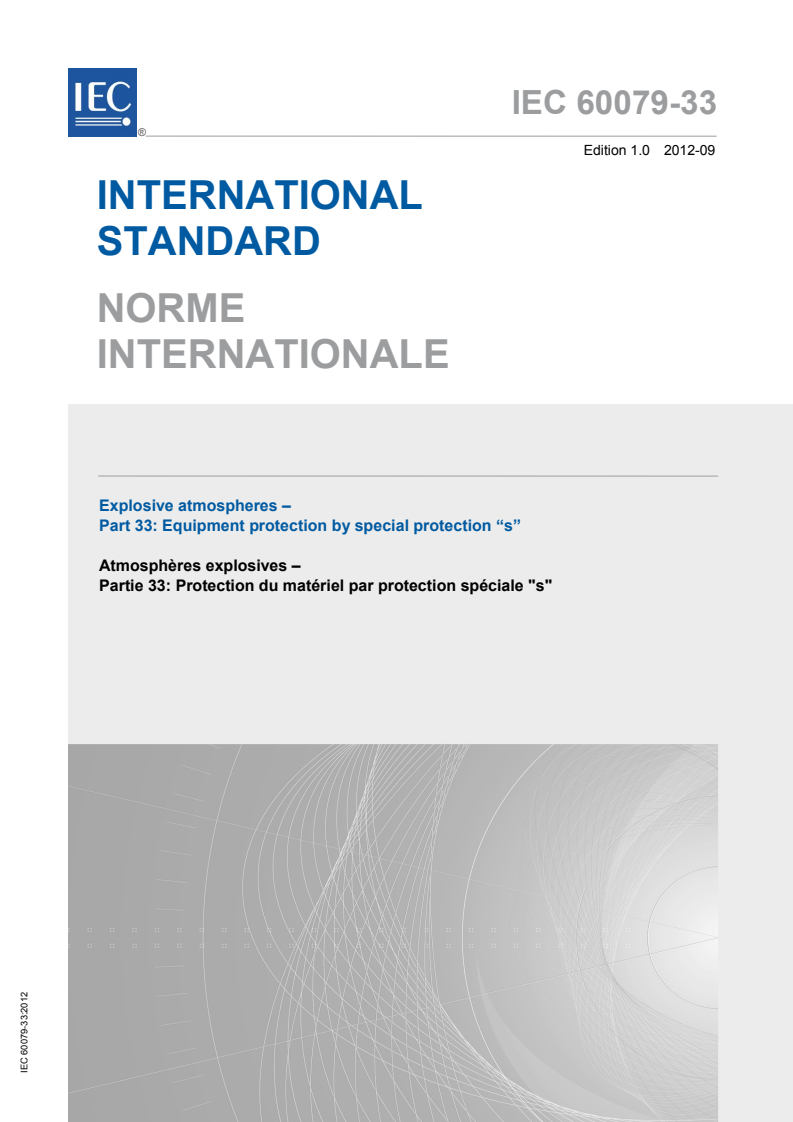
IEC 60079-33 ®
Edition 1.0 2012-09
INTERNATIONAL
STANDARD
NORME
INTERNATIONALE
Explosive atmospheres –
Part 33: Equipment protection by special protection “s”
Atmosphères explosives –
Partie 33: Protection du matériel par protection spéciale "s"
All rights reserved. Unless otherwise specified, no part of this publication may be reproduced or utilized in any form
or by any means, electronic or mechanical, including photocopying and microfilm, without permission in writing from
either IEC or IEC's member National Committee in the country of the requester.
If you have any questions about IEC copyright or have an enquiry about obtaining additional rights to this publication,
please contact the address below or your local IEC member National Committee for further information.
Droits de reproduction réservés. Sauf indication contraire, aucune partie de cette publication ne peut être reproduite ni
utilisée sous quelque forme que ce soit et par aucun procédé, électronique ou mécanique, y compris la photocopie et les
microfilms, sans l'accord écrit de la CEI ou du Comité national de la CEI du pays du demandeur.
Si vous avez des questions sur le copyright de la CEI ou si vous désirez obtenir des droits supplémentaires sur cette
publication, utilisez les coordonnées ci-après ou contactez le Comité national de la CEI de votre pays de résidence.
IEC Central Office Tel.: +41 22 919 02 11
3, rue de Varembé Fax: +41 22 919 03 00
CH-1211 Geneva 20 info@iec.ch
Switzerland www.iec.ch
About the IEC
The International Electrotechnical Commission (IEC) is the leading global organization that prepares and publishes
International Standards for all electrical, electronic and related technologies.
About IEC publications
The technical content of IEC publications is kept under constant review by the IEC. Please make sure that you have the
latest edition, a corrigenda or an amendment might have been published.
Useful links:
IEC publications search - www.iec.ch/searchpub Electropedia - www.electropedia.org
The advanced search enables you to find IEC publications The world's leading online dictionary of electronic and
by a variety of criteria (reference number, text, technical electrical terms containing more than 30 000 terms and
committee,…). definitions in English and French, with equivalent terms in
It also gives information on projects, replaced and additional languages. Also known as the International
withdrawn publications. Electrotechnical Vocabulary (IEV) on-line.
IEC Just Published - webstore.iec.ch/justpublished Customer Service Centre - webstore.iec.ch/csc
Stay up to date on all new IEC publications. Just Published If you wish to give us your feedback on this publication
details all new publications released. Available on-line and or need further assistance, please contact the
also once a month by email. Customer Service Centre: csc@iec.ch.
A propos de la CEI
La Commission Electrotechnique Internationale (CEI) est la première organisation mondiale qui élabore et publie des
Normes internationales pour tout ce qui a trait à l'électricité, à l'électronique et aux technologies apparentées.
A propos des publications CEI
Le contenu technique des publications de la CEI est constamment revu. Veuillez vous assurer que vous possédez
l’édition la plus récente, un corrigendum ou amendement peut avoir été publié.
Liens utiles:
Recherche de publications CEI - www.iec.ch/searchpub Electropedia - www.electropedia.org
La recherche avancée vous permet de trouver des Le premier dictionnaire en ligne au monde de termes
publications CEI en utilisant différents critères (numéro de électroniques et électriques. Il contient plus de 30 000
référence, texte, comité d’études,…). termes et définitions en anglais et en français, ainsi que
Elle donne aussi des informations sur les projets et les les termes équivalents dans les langues additionnelles.
publications remplacées ou retirées. Egalement appelé Vocabulaire Electrotechnique
International (VEI) en ligne.
Just Published CEI - webstore.iec.ch/justpublished
Service Clients - webstore.iec.ch/csc
Restez informé sur les nouvelles publications de la CEI.
Just Published détaille les nouvelles publications parues. Si vous désirez nous donner des commentaires sur
Disponible en ligne et aussi une fois par mois par email. cette publication ou si vous avez des questions
contactez-nous: csc@iec.ch.
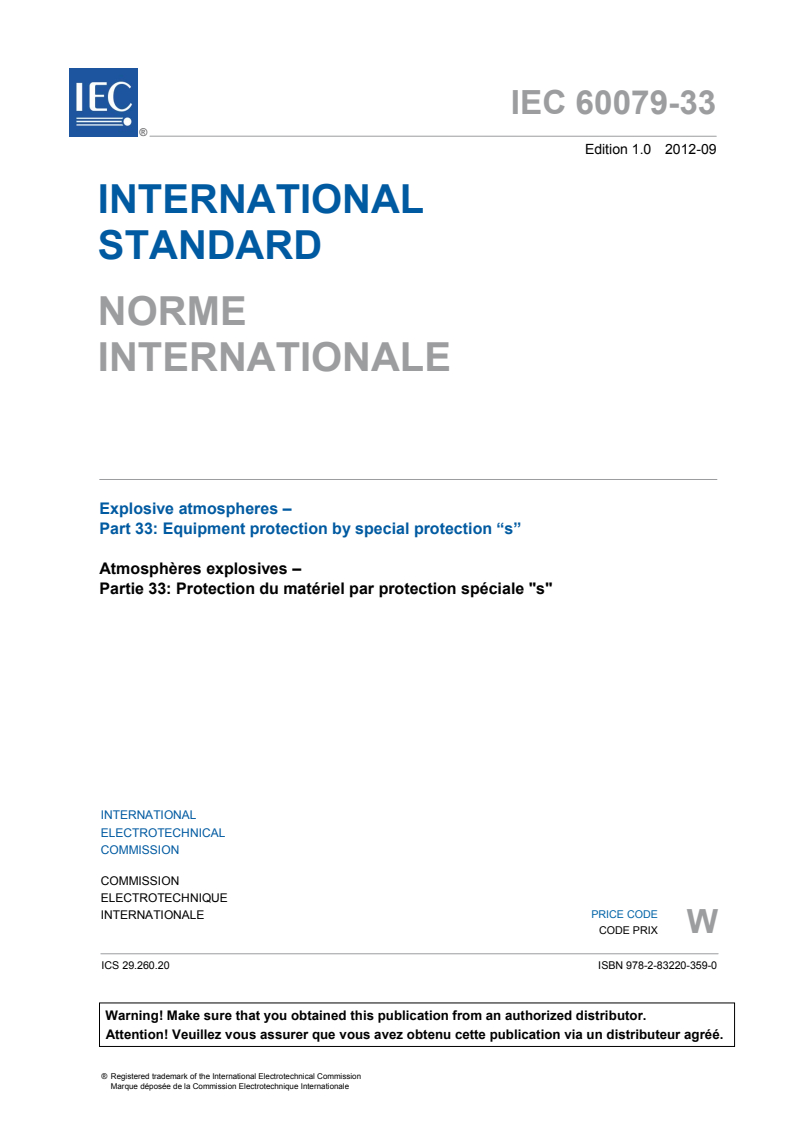
IEC 60079-33 ®
Edition 1.0 2012-09
INTERNATIONAL
STANDARD
NORME
INTERNATIONALE
Explosive atmospheres –
Part 33: Equipment protection by special protection “s”
Atmosphères explosives –
Partie 33: Protection du matériel par protection spéciale "s"
INTERNATIONAL
ELECTROTECHNICAL
COMMISSION
COMMISSION
ELECTROTECHNIQUE
PRICE CODE
INTERNATIONALE
CODE PRIX W
ICS 29.260.20 ISBN 978-2-83220-359-0
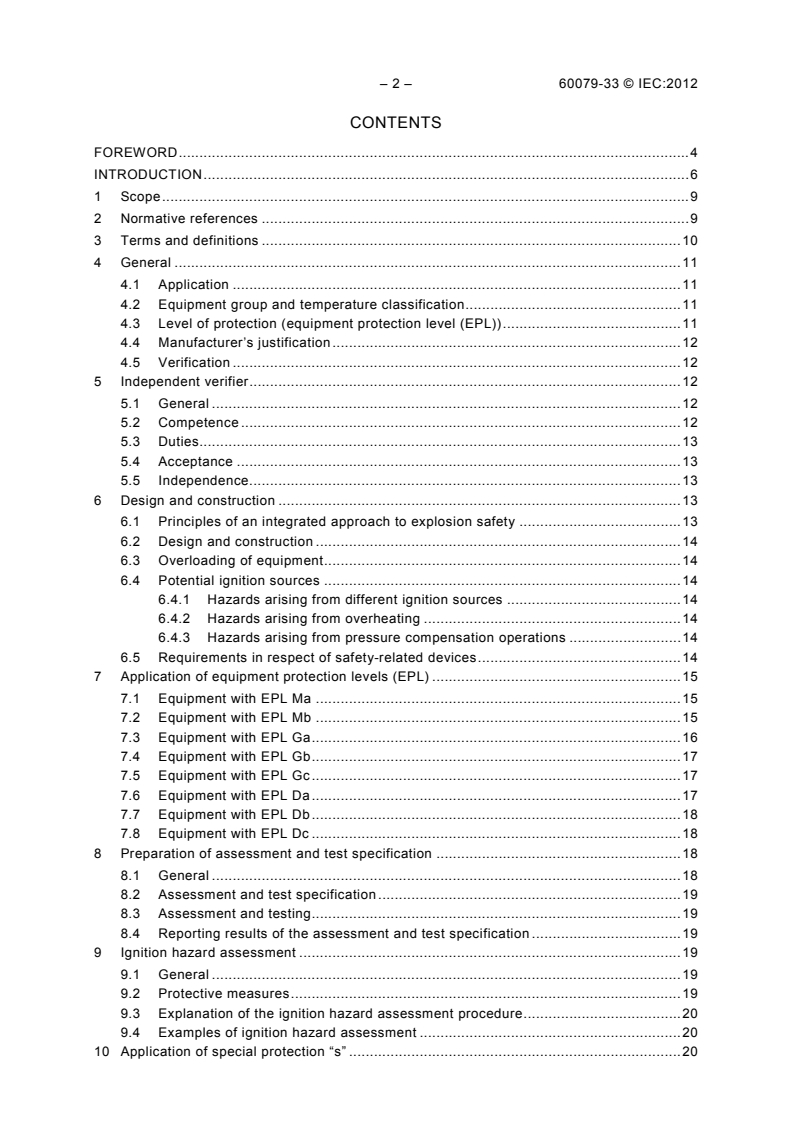
– 2 – 60079-33 © IEC:2012
CONTENTS
FOREWORD . 4
INTRODUCTION . 6
1 Scope . 9
2 Normative references . 9
3 Terms and definitions . 10
4 General . 11
4.1 Application . 11
4.2 Equipment group and temperature classification . 11
4.3 Level of protection (equipment protection level (EPL)) . 11
4.4 Manufacturer’s justification . 12
4.5 Verification . 12
5 Independent verifier . 12
5.1 General . 12
5.2 Competence . 12
5.3 Duties. 13
5.4 Acceptance . 13
5.5 Independence. 13
6 Design and construction . 13
6.1 Principles of an integrated approach to explosion safety . 13
6.2 Design and construction . 14
6.3 Overloading of equipment . 14
6.4 Potential ignition sources . 14
6.4.1 Hazards arising from different ignition sources . 14
6.4.2 Hazards arising from overheating . 14
6.4.3 Hazards arising from pressure compensation operations . 14
6.5 Requirements in respect of safety-related devices . 14
7 Application of equipment protection levels (EPL) . 15
7.1 Equipment with EPL Ma . 15
7.2 Equipment with EPL Mb . 15
7.3 Equipment with EPL Ga . 16
7.4 Equipment with EPL Gb . 17
7.5 Equipment with EPL Gc . 17
7.6 Equipment with EPL Da . 17
7.7 Equipment with EPL Db . 18
7.8 Equipment with EPL Dc . 18
8 Preparation of assessment and test specification . 18
8.1 General . 18
8.2 Assessment and test specification . 19
8.3 Assessment and testing. 19
8.4 Reporting results of the assessment and test specification . 19
9 Ignition hazard assessment . 19
9.1 General . 19
9.2 Protective measures . 19
9.3 Explanation of the ignition hazard assessment procedure . 20
9.4 Examples of ignition hazard assessment . 20
10 Application of special protection “s” . 20
60079-33 © IEC:2012 – 3 –
10.1 General . 20
10.2 Justification for the application of special protection “s” . 20
10.2.1 Application . 20
10.2.2 Equipment substantially meeting the requirements for the recognized
types of protection . 21
10.2.3 Equipment outside the scope of recognized types of protection . 21
10.2.4 Protection technique with no alignment to the recognized types of
protection . 21
10.2.5 Enhanced EPL through additional means of protection . 22
10.2.6 Combination of approaches . 22
10.3 Adaption of recognized types of protection . 22
10.4 Other innovative means of ensuring safety . 22
10.5 Connection of conductor and cables . 22
11 Type verification and tests . 23
11.1 General . 23
11.2 Temperature measurement test . 23
12 Routine verification and test . 23
13 Documentation . 23
14 Ex components . 23
15 Marking . 23
15.1 General . 23
15.2 Marking for Ex “s” only . 23
15.3 Marking for Ex “s” with other recognized types of protection . 23
16 Certificate information . 24
16.1 Certificate for Ex “s” only . 24
16.2 Certificate for Ex “s” with other recognized types of protection . 24
16.3 Specific conditions of use . 24
16.4 Schedule of limitations . 24
17 Instructions . 24
Annex A (informative) Explanation of the ignition hazard assessment procedure. 25
Annex B (informative) Examples of ignition hazard assessment . 31
Bibliography . 37
Figure A.1 – Relationship between ignitions source definitions . 26
Table A.1 – Recommended documentation of initial assessment of equipment related
ignition sources. 27
Table A.2 – Example for reporting identification of ignition hazards (step 1) and first
assessment (step 2). 28
Table A.3 – Example for reporting determination of preventive or protective measures
(step 3) and concluding estimation and EPL assignment (step 4) . 29
Table B.1 – Common cases demonstrating the use of the reporting method –
Electrostatic discharge . 33
Table B.2 – Ignition hazard assessment report for a linear motor with permanent
magnets in the table-track, EPL Gb, in addition to the basic requirements of
IEC 60079-0 (for example material characteristics, electrostatic, earthing). 35
– 4 – 60079-33 © IEC:2012
INTERNATIONAL ELECTROTECHNICAL COMMISSION
____________
EXPLOSIVE ATMOSPHERES –
Part 33: Equipment protection by special protection “s”
FOREWORD
1) The International Electrotechnical Commission (IEC) is a worldwide organization for standardization comprising
all national electrotechnical committees (IEC National Committees). The object of IEC is to promote
international co-operation on all questions concerning standardization in the electrical and electronic fields. To
this end and in addition to other activities, IEC publishes International Standards, Technical Specifications,
Technical Reports, Publicly Available Specifications (PAS) and Guides (hereafter referred to as “IEC
Publication(s)”). Their preparation is entrusted to technical committees; any IEC National Committee interested
in the subject dealt with may participate in this preparatory work. International, governmental and non-
governmental organizations liaising with the IEC also participate in this preparation. IEC collaborates closely
with the International Organization for Standardization (ISO) in accordance with conditions determined by
agreement between the two organizations.
2) The formal decisions or agreements of IEC on technical matters express, as nearly as possible, an international
consensus of opinion on the relevant subjects since each technical committee has representation from all
interested IEC National Committees.
3) IEC Publications have the form of recommendations for international use and are accepted by IEC National
Committees in that sense. While all reasonable efforts are made to ensure that the technical content of IEC
Publications is accurate, IEC cannot be held responsible for the way in which they are used or for any
misinterpretation by any end user.
4) In order to promote international uniformity, IEC National Committees undertake to apply IEC Publications
transparently to the maximum extent possible in their national and regional publications. Any divergence
between any IEC Publication and the corresponding national or regional publication shall be clearly indicated in
the latter.
5) IEC itself does not provide any attestation of conformity. Independent certification bodies provide conformity
assessment services and, in some areas, access to IEC marks of conformity. IEC is not responsible for any
services carried out by independent certification bodies.
6) All users should ensure that they have the latest edition of this publication.
7) No liability shall attach to IEC or its directors, employees, servants or agents including individual experts and
members of its technical committees and IEC National Committees for any personal injury, property damage or
other damage of any nature whatsoever, whether direct or indirect, or for costs (including legal fees) and
expenses arising out of the publication, use of, or reliance upon, this IEC Publication or any other IEC
Publications.
8) Attention is drawn to the Normative references cited in this publication. Use of the referenced publications is
indispensable for the correct application of this publication.
9) Attention is drawn to the possibility that some of the elements of this IEC Publication may be the subject of
patent rights. IEC shall not be held responsible for identifying any or all such patent rights.
International Standard IEC 60079-33 has been prepared by IEC technical committee 31:
Equipment for explosive atmospheres.
The text of this standard is based on the following documents:
FDIS Report on voting
31/997/FDIS 31/1011/RVD
Full information on the voting for the approval of this standard can be found in the report on
voting indicated in the above table.
This publication has been drafted in accordance with the ISO/IEC Directives, Part 2.
A list of all parts in the IEC 60079 series, published under the general title Explosive
atmospheres, can be found on the IEC website.
60079-33 © IEC:2012 – 5 –
The committee has decided that the contents of this publication will remain unchanged until
the stability date indicated on the IEC web site under "http://webstore.iec.ch" in the data
related to the specific publication. At this date, the publication will be
• reconfirmed,
• withdrawn,
• replaced by a revised edition, or
• amended.
– 6 – 60079-33 © IEC:2012
INTRODUCTION
This part of IEC 60079 was created in response to a request from the IECEx certification
system to provide a set of requirements to be used for certification within the IECEx product
certification scheme when the standards for existing types of protection were not applicable.
The present standard refers to the use of one or more independent verifiers, in accordance
with ISO/IEC rules on the writing of standards that mitigate against specifying particular forms
of conformity assessment. The IECEx system will specify how the term "independent verifier"
will be interpreted for the purposes of the scheme. For example, it may specify that in the
case of three independent verifiers they shall all be certification body members of the
scheme, each accepted specifically for the purpose of assessing special protection
applications and each from a separate member country of the system.
The purpose of IEC 60079-33 special protection “s” for any equipment protection level (EPL)
is to allow design, assessment and testing of equipment or parts of equipment that cannot be
fully assessed within a recognized type of protection or combination of recognized types of
protection because of functional or operational limitations and where the desired equipment
protection level can be achieved by the use of this standard.
Special protection “s” allows a design concept that cannot comply in full with recognized types
of protection, or where the design concept is not covered by recognized types of protection.
When specification for the equipment includes aspects as given above, additional information
and data may be required from
• technical research,
• evaluation of existing data and information.
Manufacturers should first consider the possibilities for design to the recognized types of
protection, or to combinations of recognized type of protection, before proceeding to special
protection “s”.
This standard is intended to provide a framework to demonstrate how essential safety
requirements can be met if not covered by established standards, thus allowing for innovation
and dealing with unknowns.
When equipment intended to meet a recognized type of protection does not comply with all
the provisions of the relevant standard, it is not to be considered under this standard unless:
• it can be clearly demonstrated that complete compliance with the type of protection is not
practicable; and
• additional measures have been applied to establish an equivalent protection level.
Special protection “s” is based on identification of failure modes and ignition hazard
assessment in the identified modes. In this regard, the assessed safety of the assigned EPL
of the equipment will satisfy the EPL requirements and, where appropriate, be at least
equivalent to the EPL provided by the defined levels for the recognized types of protection.
provides for requirements for equipment with EPL Ga and Ga/Gb but
IEC 60079-26 [1]
depends on combining types of protection already described in other parts of the IEC 60079
series.
The responsibility of initially demonstrating the need to design for special protection “s” and
establishing the criteria for verification lies with the manufacturer. The specification defines
—————————
Figures in square brackets refer to the Bibliography.
60079-33 © IEC:2012 – 7 –
the safety concepts and shows how the essential safety requirements are to be achieved. It is
likely this will be done in consultation with experts in the assessment of explosion protection
techniques.
The requirements in this standard take into account:
• allowance for first, second or third party verification;
• the use of EPLs;
• the use of equipment groups for mining, gas and dust;
• alignment with existing temperature requirements;
• compatibility with the marking requirements given in IEC 60079-0.
Where requirements for a product/design concept are developed and intended for repeated
use in subsequent designs, they should be reviewed and, provided the manufacturer is
prepared to release the intellectual property, be included initially in an annex of this standard
with the intention of being removed and relocated to an appropriate place at a later time, e.g.
in an existing or new type of protection standard.
Unlike other recognized types of protection, special protection “s” may require the application
of reliability engineering tools and procedures such as failure modes and effects analysis
(FMEA), fault tree analysis (FTA) and failure modes, effects and criticality analysis (FMECA)
to identify the failure modes of the equipment being tested. This type of analysis will ensure
that the failure modes and corresponding mitigation designs are addressed by the most
appropriate testing strategies, which simulate the environment in which the equipment will be
operated, with appropriate factors of safety applied.
The probability of failure of the identified failure modes may need to be demonstrated to be of
a similar likelihood as the failures expected in recognized types of protection.
Full life cycle conditions may need to be considered and any restrictions may form part of the
mandatory directions for use of the equipment to ensure EPLs are maintained during the
operational life of the equipment.
By its very nature, assessment and testing to special protection “s” cannot be as prescriptive
as for the recognized types of protection. It is anticipated that considerable dialogue is
required between the manufacturer and an independent verifier. Additional assessment and
testing may be identified by the independent verifier to ensure the relevant EPL is achieved.
When undertaking verification, it is strongly recommended the guidance provided in this
standard is followed including:
• applying different levels of verification to match the EPL (similar in concept to the
approach given in the IEC 61508 series);
• always involving at least one independent person/organization (an independent verifier);
• not using personnel who have had any involvement in research or determining the criteria
for establishing the essential safety requirements in conjunction with the manufacturer.
Where it is intended to apply the requirements of this standard within a certification
system/scheme, the following recommendations are made:
• the requirements laid down in EN 50495 [2] for safety devices are observed;
• an assessment should be performed by independent certification bodies (as the
independent verifier) according to the requirements in this standard before issuing a
certificate of conformity;
• a certification body performing an assessment for equipment not covered by recognized
types of protection should have demonstrated expertise in the field under question.
– 8 – 60079-33 © IEC:2012
The need for a standard to address special protection “s” can be justified on the basis that:
• provision has been in IEC 60079-0 for many years with reference Ex “s” in a note in the
marking requirements or elsewhere. This reference goes back to IEC standards that pre-
date 1957;
• there have been standards used on a national basis for many years for certification to
special protection “s”. Examples are SFA 3009 in the UK and AS/NZS 1826 in Australia
and New Zealand;
• it is necessary to have an international approach that is consistent;
• there is an identified need and has been a request for a special protection “s” standard
from IECEx.
Support for the approach in the standard:
• the approach draws on the experience of the use of verifiers already in other IEC
standards.
60079-33 © IEC:2012 – 9 –
EXPLOSIVE ATMOSPHERES –
Part 33: Equipment protection by special protection “s”
1 Scope
This part of IEC 60079 gives the specific methodology for the assessment and testing, and
requirements for marking of electrical equipment, parts of electrical equipment and Ex
components with special protection “s”.
This part of IEC 60079 applies to
• electrical equipment employing a method of protection not covered by any existing
standard in the IEC 60079 series,
• electrical equipment employing one or more recognized types of protection where the
design and construction is not fully compliant with the standard for the type of protection,
• electrical equipment where the intended use is outside the parameters of the scope of the
standard for the type of protection.
This part of IEC 60079 is not intended for equipment that is covered by the scope of other
IEC 60079 equipment standards unless
• it is clearly demonstrated that compliance with the type of protection is not feasible, and
• additional measures are applied to establish an equivalent equipment protection level.
This part of IEC 60079 for special protection “s” is applicable to Group I, Group II and
Group III and for equipment protection levels Ma, Mb, Ga, Gb, Gc, Da, Db and Dc, as defined
in IEC 60079-0.
Certain specific guidance for assessment and testing are provided in the annexes to this
standard.
This standard supplements and modifies the general requirements of IEC 60079-0. Where a
requirement of this standard conflicts with a requirement of IEC 60079-0, the requirement of
this standard shall take precedence.
NOTE 1 This standard may be used where equipment requires a higher EPL than the underlying protection
techniques provide. Additional control measures or additional design and test requirements would be applied.
NOTE 2 Parts of equipment that can be designed and tested to standardized techniques should be so designed.
Only those parts where conformance with essential safety requirements is achieved through alternative controls
should be considered for special protection “s”. Equipment similar in attributes and performance to other equipment
within a particular type of protection should be reviewed first to that method of protection prior to being considered
for the use of Ex ”s”’. Some parts of IEC 60079 allow a degree of variance from the equipment requirements and
where determined to be close enough by independent verifiers, then it is preferable to prescribe to the original type
of protection.
2 Normative references
The following documents, in whole or in part, are normatively referenced in this document and
are indispensable for its application. For dated references, only the edition cited applies. For
undated references, the latest edition of the referenced document (including any
amendments) applies.
IEC 60079 (all parts), Explosive atmospheres
– 10 – 60079-33 © IEC:2012
IEC 60079-0, Explosive atmospheres – Part 0: Equipment – General requirements
IEC 60079-29-1, Explosive atmospheres – Part 29-1: Gas detectors – Performance
requirements of detectors for flammable gases
IEC 60079-29-2, Explosive atmospheres – Part 29-2: Gas detectors – Selection, installation,
use and maintenance of detectors for flammable gases and oxygen
IEC 61508 (all parts), Functional safety of electrical/electronic/programmable electronic
safety-related systems
IEC 61508-1, Functional safety of electrical/electronic/programmable electronic safety-related
systems – Part 1: General requirements
IEC 61511 (all parts), Functional safety – Safety instrumented systems for the process
industry sector
IEC 62061, Safety of machinery – Functional safety of safety-related electrical, electronic and
programmable electronic control systems
ISO 13849-1:2009, Safety of machinery – Safety-related parts of control systems – Part 1:
General principles for design
ISO 13849-2, Safety of machinery – Safety-related parts of control systems – Part 2:
Validation
3 Terms and definitions
For the purposes of this document, the terms and definitions given in IEC 60079-0, as well as
the following, apply.
3.1
hybrid mixture
mixture of a flammable gas with a combustible dust
3.2
special protection “s”
concept to allow design, assessment and testing of equipment that cannot be fully assessed
within a recognized type of protection or combination of recognized types of protection
because of functional or operational limitations, but which can be demonstrated to provide the
necessary equipment protection level (EPL)
3.3
recognized type of protection
type of protection, other than special protection “s”, as listed in IEC 60079-0 and with defined
design, construction, assessment and test requirements
3.4
independent verifier
person or organization, with the appropriate competency in the applied explosion protection
methodology, responsible for the verification of design calculations, assessment and testing
who are separate and distinct by management and other resources including financial, from
the person or organizations responsible for all the activities associated with the design,
manufacture or sales of the equipment
Note 1 to entry: This may be a second or third party assessor, a test laboratory, a certifying body, etc.
60079-33 © IEC:2012 – 11 –
4 General
4.1 Application
Special protection “s” allows for the design of a product that cannot comply in full with
recognized types of protection or where the standards for the recognized types of protection
do not cover the required operating conditions such as:
• outside normal atmospheric pressure given in the IEC 60079 series;
• above normal oxygen content;
• outside the temperature ranges given in IEC 60079 series;
• hybrid mixtures (gas and dust).
NOTE Additional consideration and additional testing related specifically to the intended conditions of use could
be necessary. This is particularly important when the types of protection “d” (flameproof enclosure – IEC 60079-1
[3]) and '”i” (intrinsic safety – IEC 60079-11 [4]) are applied. Such conditions might include hypobaric, hyperbaric
and oxygen enriched atmospheres.
The IEC 60079 series for types of protection provide multiple methods to design products for
use in explosive atmospheres and is recommended as a first consideration. Where equipment
design contains innovative, unique or alternative explosion protection which does not align
with the recognized types of protection, the equipment design may be evaluated as special
protection “s”.
When equipment is designed with the intention of meeting a recognized type of protection, but
does not or cannot comply with all the provisions of the relevant standard it shall not be
considered under this standard unless:
• it is clearly demonstrated that compliance with the type of protection is not feasible; and
• additional measures are applied to establish an equivalent equipment protection level.
4.2 Equipment group and temperature classification
The equipment grouping and temperature classification defined in IEC 60079-0 for the use of
equipment in explosive gas atmospheres apply to special protection ”s” equipment. The
subdivisions A, B and C for equipment of Group II and Group III also apply.
For temperature classification, the limiting parameters, including external influences, shall be
specified such that the maximum permissible temperature is not exceeded taking into account
the relevant level of protection “sa”, “sb” or “sc” as required by Clause 7.
Equipment that comprises special protection “s” parts combined with parts with different
protection techniques should generally be designed, tested and marked for the equipment
grouping, temperature classification and EPL appropriate to the other techniques.
4.3 Level of protection (equipment protection level (EPL))
Electrical equipment with special protection “s” shall be either
• level of protection “sa” (EPL“Ma, Ga, Da”), or
• level of protection “sb” (EPL “Mb, Gb, Db”), or
• level of protection “sc” (EPL “Gc, Dc”).
The requirements of this standard shall apply to all levels of special protection “s” (EPLs)
unless otherwise stated.
– 12 – 60079-33 © IEC:2012
4.4 Manufacturer’s justification
The documented justification shall be prepared and provided to the independent verifier for
the application of special protection “s” and shall include:
• the details of considerations given to the possibilities for design to the recognized types of
protection, or to combinations of recognized types of protection, before proceeding to
special protection “s”;
• aspects that are covered by the standards for any recognized type of protection applied;
and
• those aspects that are not covered by verification to recognized types of protection.
The limiting parameters shall be specified, including all relevant ratings.
The documentation shall provide the evidence to support the claimed level of protection and
shall include the proposed schedule of assessment and tests.
NOTE Documentation may take the form of a safety file defined in the IEC 61508 series and could include FMEA,
HAZOPS, etc. As an example, in an FMEA, a fault may result from a failure of the component parts of the
electrical equipment or from anticipated externally applied influences. Two independent malfunctions which may
occur more frequently and which, separately, would not create an ignition hazard but which, in combination, could
create a potential ignition hazard, should be regarded as occurring together to form a single fault.
4.5 Verification
Explosion protection of electrical equipment is generally achieved through one or more of the
following methods of protection:
• containment of internal explosion;
• exclusion of explosive atmosphere;
• avoidance of ignition source;
• energy limitation, both sparking and thermal;
• dilution.
Special protection “s” uses one or a combination of these methods, and the verification shall
identify the methods of protection used and how the implementation for each has been
achieved.
The independent verifier/s (see Clause 5) shall ensure all applicable requirements of
IEC 60079-0 and those other parts of the IEC 60079 series relating to the recognized types of
protection identified for the equipment are met, except as varied in Clauses 8, 9, 10 and 11.
5 Independent verifier
5.1 General
By its very nature, testing and assessment to special protection “s” cannot be as prescriptive
as for other techniques. It is anticipated that considerable dialogue is required between the
manufacturer and an independent verifier. Additional tests may be required by an independent
verifier to ensure the relevant level of safety is achieved.
NOTE An independent verifier may be an individual or an organization.
5.2 Competence
The process of verification is critical to the correct application of special protection “s” and
this requires that the independent verifier shall be able to demonstrate the following
knowledge and skills:
60079-33 © IEC:2012 – 13 –
a) a broad knowledge of Ex philosophies including an understanding of
i) the ignition properties of flammable and combustible materials,
ii) the properties, mechanisms and control of ignition, and
iii) the full range of protection techniques in the IEC 60079 series;
b) access to or involvement in
i) IEC or national standards such that there is assured access to knowledge of all
current activities related to the equipment being assessed, and
ii) research related to the proposed method of protection;
c) in-depth specific knowledge of the technique or method being assessed;
d) knowledge of and experience in the assessment of test facilities, equipment, procedures
and personnel;
e) documentation and reporting skills.
5.3 Duties
The independent verifier shall
a) obtain a detailed knowledge of the technique or method being proposed,
b) review the proposed test specification and verification protocol,
c) assess the information presented against the appropriate standards and available data,
d) assess the test facilities, equipment, procedures and personnel,
e) document the findings in a report detailing how the equipment complies with the objective
of this standard,
f) conduct other duties as assigned.
5.4 Acceptance
Within a certification scheme, the endorsement of the independent verifier shall be included in
the scheme rules
Outside of certification, the applicant shall select an independent verifier (1) and, where
required, the independent verifier (1), in conjunction with the applicant, shall select the
independent verifier (2) and (3), taking into account the stated qualifications and summary of
experience of the independent verifier(s).
NOTE An independent verifier can be an individual but more likely will be an organization such as a certification
body with total ‘corporate’ knowledge. The IECEx Equipment Certification Scheme has a protocol to recognize the
competence of ExCBs operating to this standard.
5.5 Independence
Independent verifiers shall be independent from the applicant and any organization that is
involved in the design, manufacture or sale of the equipment. They shall be separate and
distinct from those organizations by management and financial or other resources, so that any
influence or pressure on the decision-making process, the assessment and the results can be
excluded.
6 Design and construction
6.1 Principles of an integrated approach to explosion safety
Electrical equipment intended for use in explosive atmospheres shall be designed from the
point of view of an integrated approach to explosion safety. In this connection, the design
shall take into account in order of priority:
– 14 – 60079-33 © IEC:2012
(1) avoidance of the formation of explosive atmospheres which may be produced or released
by equipment;
(2) avoidance of the ignition of explosive atmospheres, taking into account the nature of every
electrical source of ignition;
(3) effects of an explosion occurring which could directly or indirectly endanger persons and
property
i) by halting the explosion, or
ii) by limiting the consequences of the explosion.
Equipment design shall be analysed for malfunctions in order to avoid, as far as possible,
dangerous situations. Any misuse that can reasonably be anticipated shall be taken into
account.
NOTE 1 Many of the essential requirements are contained in IEC 60079-0.
NOTE 2 Point 6.1 (3) is not covered in the scope of this standard.
6.2 Design and construction
It is intended that equipment be designed and constructed with due regard to the latest
technological knowledge of explosion protection so that the EPL can be maintained
throughout its anticipated lifetime.
Components to be incorporated into, or used as replacements in equipment, are to be
designed and constructed in such a way that they fulfil their intended purpose of explosion
protection when they are installed in accordance with the manufacturer's instructions.
6.3 Overloading of equipment
Where appropriate for the EPL, protection from overloading the equipment shall be provided
and should be considered at the design stage.
NOTE This may be achieved by the use of over-current cut-off switches, temperature limiters, differential
pressure switches, flow-meters, time-lag relays, over-speed monitors and/or similar types of monitoring devices.
6.4 Potential ignition sources
6.4.1 Hazards arising from different ignition sources
Protection from potential ignition sources such as sparks, flames, electrical arcs, high surface
temperatures, acoustic energy, optical radiation, electromagnetic waves and other ignition
sources shall be provided, see Figure A.1.
6.4.2 Hazards arising from overheating
Protection from overheating caused by friction or impacts occurring, for example, between
materials and parts in contact with each other while
...
Questions, Comments and Discussion
Ask us and Technical Secretary will try to provide an answer. You can facilitate discussion about the standard in here.
Loading comments...