

ISO/IEC 29341-4-14:2008
(Main)Information technology - UPnP Device Architecture - Part 4-14: Audio Video Device Control Protocol - Level 2 - Scheduled Recording Service
General Information
- Abstract
ISO/IEC 29341-4-14:2008(E) allows control points to schedule the recording of content, such as bradcast content. The series of ISO/IEC 29341 publications defines an architecture for pervasive peer-to-peer network connectivity of intelligent appliances, wireless devices and PCs. It is designed to bring easy to use, flexible, standards-based connectivity to ad-hoc or unmanaged networks whether in the home, in a small business, public spaces or attached to the Internet.
- Status
- Published
- Publication Date
- 27-Nov-2008
- Technical Committee
- ISO/IEC JTC 1 - Information technology
- Current Stage
- DELPUB - Deleted Publication
- Start Date
- 14-Sep-2011
- Completion Date
- 28-Aug-2026
Overview
ISO/IEC 29341-4-14:2008 addresses the need for standardized, interoperable control of audio and video device recording schedules within networked environments. As part of the UPnP Device Architecture (Universal Plug and Play), this standard provides a protocol for Scheduled Recording Service (Level 2). It allows control points-such as PCs, smart home devices, or set-top boxes-to schedule, modify, and manage the recording of broadcast or streamed content on compatible devices.
Developed by the International Electrotechnical Commission (IEC) and ISO/IEC, this standard is a component of a larger series aimed at enabling seamless, peer-to-peer connectivity within home, business, public, or ad-hoc networks.
Key Topics
- Scheduled Recording Management: Defines how control points can create, browse, enable, disable, and delete recording schedules and tasks on AV devices.
- Service Architecture: Details the interaction model, including state variables, actions, eventing, and service priority management.
- XML-based Protocols: Utilizes XML for describing service capabilities, requests, and responses, ensuring interoperability across diverse platforms.
- Vendor Extensions: Supports manufacturer-defined additions while preserving base protocol compatibility.
- Error Handling and Conflict Resolution: Specifies standardized error codes and mechanisms for handling schedule and resource conflicts.
Applications
ISO/IEC 29341-4-14:2008 is primarily used in:
- Home Entertainment Networks: Facilitates smart TVs, digital video recorders (DVRs), set-top boxes, and media servers to be scheduled for content recording via centralized or distributed user interfaces.
- Small Business and Hospitality Solutions: Enables multi-room video systems in hotels or offices to allow scheduled content recording on shared or personal devices.
- Internet of Things (IoT): Integrates with smart home platforms, allowing automation routines (e.g., voice-activated "record this show" commands) via standardized protocols.
- Device Interoperability: Ensures that devices from different manufacturers within a UPnP environment can discover each other and uniformly cooperate for scheduled recording services.
Related Standards
The Scheduled Recording Service is built upon and closely connects with several other international standards:
- ISO/IEC 29341 Series: The overall UPnP Device Architecture family, defining device control protocols for a wide range of smart appliances and networked devices.
- ISO/IEC 29341-4 (AV Device Control Protocol): The parent standard covering management and control of audio/video devices on UPnP networks.
- UPnP ContentDirectory Service: Often used alongside scheduled recording to manage, browse, and retrieve recorded or stored media content.
- UPnP AV Architecture: The broader framework enabling device discovery, control, and media transfer in consumer and professional AV environments.
Practical Value
By implementing ISO/IEC 29341-4-14:2008, manufacturers and developers achieve:
- Streamlined User Experience: Consistent, user-friendly interfaces for setting up and managing recordings.
- Reduced Integration Costs: Standardized protocols mean less custom development for compatibility among devices.
- Future-Proof Design: Support for evolving user requirements and flexible extensions without breaking interoperability.
- Market Expansion: Easy deployment in global markets by adhering to international standards for networked AV device control.
Keywords: UPnP device architecture, scheduled recording service, AV device control, ISO/IEC 29341-4-14, interoperable home networking, digital video recording, XML protocol, audiovisual standardization, IEC standards, peer-to-peer connectivity.
Relations
- Effective Date
- 05-Sep-2023
Get Certified
Connect with accredited certification bodies for this standard

BSI Group
BSI (British Standards Institution) is the business standards company that helps organizations make excellence a habit.

NYCE
Mexican standards and certification body.
Sponsored listings
Frequently Asked Questions
ISO/IEC 29341-4-14:2008 is a standard published by the International Electrotechnical Commission (IEC). Its full title is "Information technology - UPnP Device Architecture - Part 4-14: Audio Video Device Control Protocol - Level 2 - Scheduled Recording Service". This standard covers: ISO/IEC 29341-4-14:2008(E) allows control points to schedule the recording of content, such as bradcast content. The series of ISO/IEC 29341 publications defines an architecture for pervasive peer-to-peer network connectivity of intelligent appliances, wireless devices and PCs. It is designed to bring easy to use, flexible, standards-based connectivity to ad-hoc or unmanaged networks whether in the home, in a small business, public spaces or attached to the Internet.
ISO/IEC 29341-4-14:2008(E) allows control points to schedule the recording of content, such as bradcast content. The series of ISO/IEC 29341 publications defines an architecture for pervasive peer-to-peer network connectivity of intelligent appliances, wireless devices and PCs. It is designed to bring easy to use, flexible, standards-based connectivity to ad-hoc or unmanaged networks whether in the home, in a small business, public spaces or attached to the Internet.
ISO/IEC 29341-4-14:2008 is classified under the following ICS (International Classification for Standards) categories: 35.200 - Interface and interconnection equipment. The ICS classification helps identify the subject area and facilitates finding related standards.
ISO/IEC 29341-4-14:2008 has the following relationships with other standards: It is inter standard links to ISO/IEC 29341-4-14:2011. Understanding these relationships helps ensure you are using the most current and applicable version of the standard.
ISO/IEC 29341-4-14:2008 is available in PDF format for immediate download after purchase. The document can be added to your cart and obtained through the secure checkout process. Digital delivery ensures instant access to the complete standard document.
Standards Content (Sample)
ISO/IEC 29341-4-14
Edition 1.0 2008-11
INTERNATIONAL
STANDARD
Information technology – UPnP Device Architecture –
Part 4-14: Audio Video Device Control Protocol –
Level 2 – Scheduled Recording Service
All rights reserved. Unless otherwise specified, no part of this publication may be reproduced or utilized in any form
or by any means, electronic or mechanical, including photocopying and microfilm, without permission in writing from
either IEC or IEC's member National Committee in the country of the requester.
If you have any questions about ISO/IEC copyright or have an enquiry about obtaining additional rights to this
publication, please contact the address below or your local IEC member National Committee for further information.
IEC Central Office
3, rue de Varembé
CH-1211 Geneva 20
Switzerland
Email: inmail@iec.ch
Web: www.iec.ch
About the IEC
The International Electrotechnical Commission (IEC) is the leading global organization that prepares and publishes
International Standards for all electrical, electronic and related technologies.
About IEC publications
The technical content of IEC publications is kept under constant review by the IEC. Please make sure that you have the
latest edition, a corrigenda or an amendment might have been published.
ƒ Catalogue of IEC publications: www.iec.ch/searchpub
The IEC on-line Catalogue enables you to search by a variety of criteria (reference number, text, technical committee,…).
It also gives information on projects, withdrawn and replaced publications.
ƒ IEC Just Published: www.iec.ch/online_news/justpub
Stay up to date on all new IEC publications. Just Published details twice a month all new publications released. Available
on-line and also by email.
ƒ Electropedia: www.electropedia.org
The world's leading online dictionary of electronic and electrical terms containing more than 20 000 terms and definitions
in English and French, with equivalent terms in additional languages. Also known as the International Electrotechnical
Vocabulary online.
ƒ Customer Service Centre: www.iec.ch/webstore/custserv
If you wish to give us your feedback on this publication or need further assistance, please visit the Customer Service
Centre FAQ or contact us:
Email: csc@iec.ch
Tel.: +41 22 919 02 11
Fax: +41 22 919 03 00
ISO/IEC 29341-4-14
Edition 1.0 2008-11
INTERNATIONAL
STANDARD
Information technology – UPnP Device Architecture –
Part 4-14: Audio Video Device Control Protocol –
Level 2 – Scheduled Recording Service
INTERNATIONAL
ELECTROTECHNICAL
COMMISSION
PRICE CODE
XC
ICS 35.200 ISBN 978-2-88910-856-5
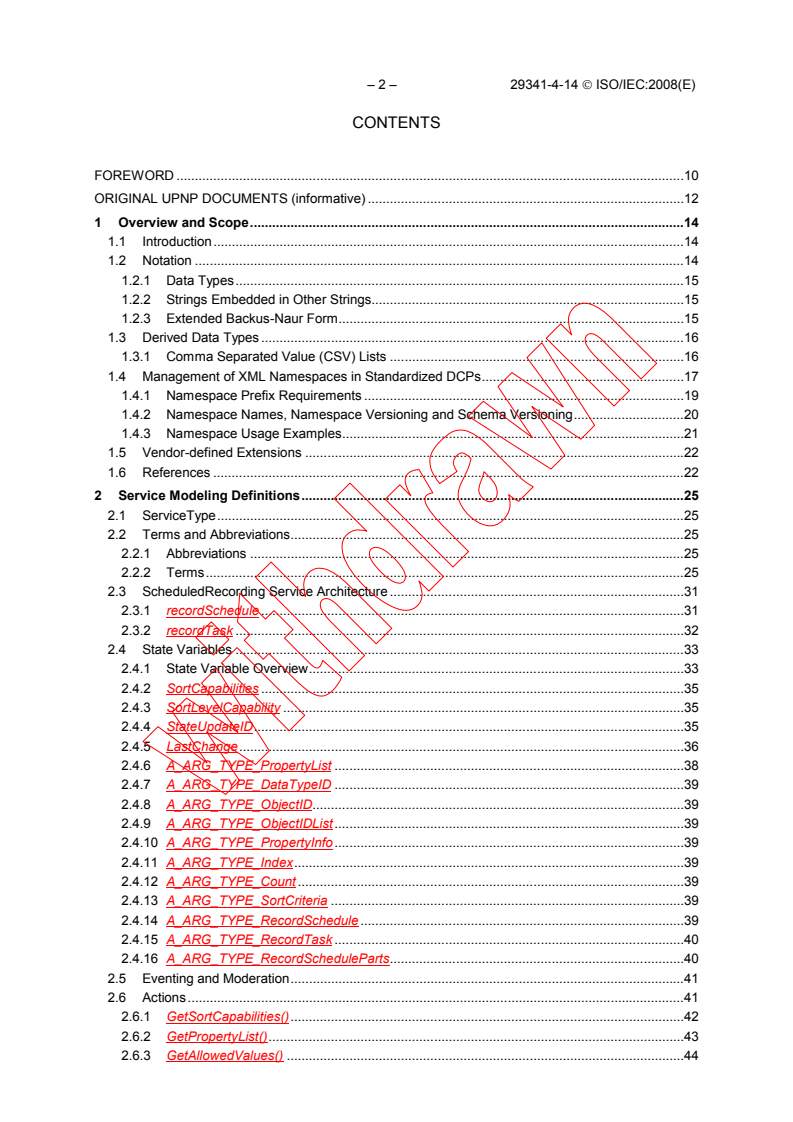
– 2 – 29341-4-14 © ISO/IEC:2008(E)
CONTENTS
FOREWORD .10
ORIGINAL UPNP DOCUMENTS (informative) .12
1 Overview and Scope.14
1.1 Introduction.14
1.2 Notation .14
1.2.1 Data Types.15
1.2.2 Strings Embedded in Other Strings.15
1.2.3 Extended Backus-Naur Form.15
1.3 Derived Data Types.16
1.3.1 Comma Separated Value (CSV) Lists .16
1.4 Management of XML Namespaces in Standardized DCPs.17
1.4.1 Namespace Prefix Requirements .19
1.4.2 Namespace Names, Namespace Versioning and Schema Versioning.20
1.4.3 Namespace Usage Examples.21
1.5 Vendor-defined Extensions .22
1.6 References .22
2 Service Modeling Definitions.25
2.1 ServiceType.25
2.2 Terms and Abbreviations.25
2.2.1 Abbreviations .25
2.2.2 Terms.25
2.3 ScheduledRecording Service Architecture .31
2.3.1 recordSchedule.31
2.3.2 recordTask .32
2.4 State Variables .33
2.4.1 State Variable Overview.33
2.4.2 SortCapabilities .35
2.4.3 SortLevelCapability .35
2.4.4 StateUpdateID.35
2.4.5 LastChange.36
2.4.6 A_ARG_TYPE_PropertyList .38
2.4.7 A_ARG_TYPE_DataTypeID .39
2.4.8 A_ARG_TYPE_ObjectID.39
2.4.9 A_ARG_TYPE_ObjectIDList.39
2.4.10 A_ARG_TYPE_PropertyInfo.39
2.4.11 A_ARG_TYPE_Index.39
2.4.12 A_ARG_TYPE_Count .39
2.4.13 A_ARG_TYPE_SortCriteria .39
2.4.14 A_ARG_TYPE_RecordSchedule.39
2.4.15 A_ARG_TYPE_RecordTask .40
2.4.16 A_ARG_TYPE_RecordScheduleParts.40
2.5 Eventing and Moderation.41
2.6 Actions.41
2.6.1 GetSortCapabilities().42
2.6.2 GetPropertyList().43
2.6.3 GetAllowedValues() .44
29341-4-14 © ISO/IEC:2008(E) – 3 –
2.6.4 GetStateUpdateID() .45
2.6.5 BrowseRecordSchedules() .46
2.6.6 BrowseRecordTasks() .50
2.6.7 CreateRecordSchedule() .52
2.6.8 DeleteRecordSchedule().54
2.6.9 GetRecordSchedule() .56
2.6.10 EnableRecordSchedule().57
2.6.11 DisableRecordSchedule() .58
2.6.12 DeleteRecordTask().59
2.6.13 GetRecordTask() .60
2.6.14 EnableRecordTask() .61
2.6.15 DisableRecordTask() .62
2.6.16 ResetRecordTask().63
2.6.17 GetRecordScheduleConflicts().63
2.6.18 GetRecordTaskConflicts().65
2.6.19 Common Error Codes.66
2.7 State Diagram of recordTask.67
2.7.1 A Full-Featured State Diagram .67
2.7.2 A Minimal-Implementation State Diagram .72
2.7.3 recordTask State Example.75
2.8 ScheduledRecording Service Priority Model .76
2.8.1 Introduction of the ScheduledRecording Service Priority Model .76
2.8.2 Ordered Priority within Each Priority Level.77
2.8.3 Setting the Initial Priority Level of a recordSchedule.78
2.8.4 Sorting recordSchedule Instances Based on their Current Priority Settings.80
2.9 Theory of Operation.80
2.9.1 Introduction .80
2.9.2 Checking the Capabilities of a ScheduledRecording Service .80
2.9.3 Adding a Scheduled Recording Entry to the List.90
2.9.4 Deleting a recordSchedule.103
2.9.5 Browsing recordSchedule and recordTask instances.103
2.9.6 Rating System.109
2.9.7 Conflict Detection and Resolution.110
3 XML Service Description.111
4 Test.120
Annex A (normative) srs XML Document .121
A.1 A_ARG_TYPE_RecordSchedule AVDT XML Document .121
A.2 A_ARG_TYPE_RecordTask AVDT XML Document .122
A.3 A_ARG_TYPE_RecordScheduleParts AVDT XML Document.122
Annex B (normative) AV Working Committee Extended Properties.124
B.1 Base Properties .124
B.1.1 @id.124
B.1.2 title.125
B.1.3 class .125
B.1.4 additionalStatusInfo.125
B.1.5 cdsReference.126
B.2 Priority Properties .126
B.2.1 priority .127
– 4 – 29341-4-14 © ISO/IEC:2008(E)
B.2.2 desiredPriority .128
B.2.3 desiredPriority@type.129
B.3 Output Control Properties.130
B.3.1 recordDestination.130
B.3.2 desiredRecordQuality.132
B.4 Content Identification Related Properties .134
B.4.1 scheduledCDSObjectID .134
B.4.2 scheduledChannelID.135
B.4.3 scheduledStartDateTime.136
B.4.4 scheduledDuration .136
B.4.5 scheduledProgramCode .137
B.5 Matching Content Criteria Properties.137
B.5.1 matchingName .138
B.5.2 matchingID .139
B.6 Matching Qualifying Criteria Properties .140
B.6.1 matchingChannelID.140
B.6.2 matchingStartDateTimeRange.140
B.6.3 matchingDurationRange .141
B.6.4 matchingRatingLimit.141
B.6.5 matchingEpisodeType.143
B.7 Content Control Properties .144
B.7.1 totalDesiredRecordTasks.144
B.7.2 scheduledStartDateTimeAdjust.145
B.7.3 scheduledDurationAdjust .145
B.7.4 activePeriod .145
B.7.5 durationLimit.146
B.7.6 channelMigration.147
B.7.7 timeMigration.147
B.7.8 allowDuplicates .147
B.8 Storage Related Properties .148
B.8.1 persistedRecordings .148
B.9 Schedule State Properties.149
B.9.1 scheduleState .149
B.9.2 abnormalTasksExist.151
B.10 Statistics Properties.151
B.10.1 currentRecordTaskCount.151
B.10.2 totalCreatedRecordTasks .151
B.10.3 totalCompletedRecordTasks.152
B.11 Task General Properties.152
B.11.1 recordScheduleID .152
B.11.2 recordedCDSObjectID .152
B.12 Task Content Identification Properties.153
B.12.1 taskCDSObjectID.153
B.12.2 taskChannelID.154
B.12.3 taskStartDateTime .154
B.12.4 taskDuration.154
B.12.5 taskProgramCode .155
B.12.6 recordQuality.155
B.13 Task Matched Content Criteria Properties .157
29341-4-14 © ISO/IEC:2008(E) – 5 –
B.13.1 matchedName.157
B.13.2 matchedID.158
B.14 Task Matched Qualifying Criteria Properties .158
B.14.1 matchedRating .158
B.14.2 matchedRating@type.159
B.14.3 matchedEpisodeType .159
B.15 Task Matched Content Control Properties .159
B.15.1 taskStartDateTimeAdjust .159
B.15.2 taskDurationAdjust.160
B.15.3 taskDurationLimit .160
B.15.4 taskDurationLimit@effect.160
B.15.5 taskChannelMigration .160
B.15.6 taskTimeMigration.161
B.16 Task State Properties.161
B.16.1 taskState .161
B.17 ContentDirectory Service Imported Properties .169
Annex C (normative) AV Working Committee Class Definitions.174
C.1 Class Hierarchy .174
C.1.1 Relationships between Classes and Properties.175
C.1.2 recordScheduleParts Properties .176
C.1.3 recordSchedule Properties.180
C.1.4 recordTask Properties.183
C.2 Class Definitions.187
C.3 object Base Class.187
C.3.1 object.recordSchedule Class .189
C.3.2 object.recordTask Class .198
Annex D (normative) EBNF Syntax Definitions.200
D.1 Priority Syntax.200
D.2 Date&time Syntax.200
D.3 Class Name Syntax .201
Annex E (informative) ScheduledRecording Service Relationship to
ContentDirectory Service.202
Annex F (informative) ScheduledRecording Service Relationship to EPG.203
Annex G (informative) AVDT Examples .204
G.1 A_ARG_TYPE_RecordSchedule AVDT Example.204
G.2 A_ARG_TYPE_RecordTask AVDT Example.220
G.3 A_ARG_TYPE_RecordScheduleParts AVDT Example .238
– 6 – 29341-4-14 © ISO/IEC:2008(E)
LIST OF TABLES
Table 1-1: EBNF Operators .16
Table 1-2: CSV Examples .17
Table 1-3: Namespace Definitions.18
Table 1-4: Schema-related Information .19
Table 1-5: Default Namespaces for the AV Specifications.20
Table 2-1: Abbreviations.25
Table 2-1: Properties in XML .27
Table 2-2: State Variables .33
Table 2-3: allowedValueList for the DataTypeID argument.35
Table 2-4: Allowed Elements in Element.36
Table 2-5: Eventing and Moderation.41
Table 2-6: Actions.41
Table 2-7: Arguments for GetSortCapabilities().42
Table 2-8: Error Codes for GetSortCapabilities().43
Table 2-9: Arguments for GetPropertyList() .43
Table 2-10: Error Codes for GetPropertyList() .44
Table 2-11: Arguments for GetAllowedValues() .44
Table 2-12: Error Codes for GetAllowedValues() .45
Table 2-13: Arguments for GetStateUpdateID() .46
Table 2-14: Error Codes for GetStateUpdateID() .46
Table 2-15: Arguments for BrowseRecordSchedules() .46
Table 2-16: Error Codes for BrowseRecordSchedules() .50
Table 2-17: Arguments for BrowseRecordTasks() .51
Table 2-18: Error Codes for BrowseRecordTasks() .52
Table 2-19: Arguments for CreateRecordSchedule() .53
Table 2-20: Error Codes for CreateRecordSchedule() .54
Table 2-21: Arguments for DeleteRecordSchedule() .55
Table 2-22: Error Codes for DeleteRecordSchedule().55
Table 2-23: Arguments for GetRecordSchedule() .56
Table 2-24: Error Codes for GetRecordSchedule() .56
Table 2-25: Arguments for EnableRecordSchedule().57
Table 2-26: Error Codes for EnableRecordSchedule().57
Table 2-27: Arguments for DisableRecordSchedule().58
Table 2-28: Error Codes for DisableRecordSchedule().58
Table 2-29: Arguments for DeleteRecordTask().59
Table 2-30: Error Codes for DeleteRecordTask().59
Table 2-31: Arguments for GetRecordTask() .60
Table 2-32: Error Codes for GetRecordTask() .60
Table 2-33: Arguments for EnableRecordTask().61
29341-4-14 © ISO/IEC:2008(E) – 7 –
Table 2-34: Error Codes for EnableRecordTask().61
Table 2-35: Arguments for DisableRecordTask().62
Table 2-36: Error Codes for DisableRecordTask() .62
Table 2-37: Arguments for ResetRecordTask().63
Table 2-38: Error Codes for ResetRecordTask().63
Table 2-39: Arguments for GetRecordScheduleConflicts() .64
Table 2-40: Error Codes for GetRecordScheduleConflicts() .64
Table 2-41: Arguments for GetRecordTaskConflicts() .65
Table 2-42: Error Codes for GetRecordTaskConflicts() .65
Table 2-43: Common Error Codes .66
Table 2-44: recordTask State Timeline.76
Table 2-45: Example 1: Fewer recordSchedule instances than the Number of Supported Priority
Levels. .77
Table 2-46: Example 2: More recordSchedule instances than the Number of Supported Priority
Levels. .78
Table 2-47: Existing recordSchedule Priorities.79
Table 2-48: desiredPriority Property Set to “RS-C”.79
Table 2-49: desiredPriority Property Set to “HIGHEST”, “L1_HI”, or “RS-A”.79
Table 2-50: desiredPriority Property Set to “LOWEST”, “L3_LOW”, or “RS-B” .80
Table 2-51: desiredPriority Property Set to “RS-C”.80
Table B-1: Base Properties Overview .124
Table B-2: allowedValueList for the class Property.125
Table B-3: Priority Properties .126
Table B-4: allowedValueList for the priority Property .127
Table B-5: Primary allowedValueList for the desiredPriority Property.128
Table B-6: Additional allowedValueList for the desiredPriority Property .129
Table B-7: allowedValueList for the desiredPriority@type Property.130
Table B-8: Output Control Properties.130
Table B-9: desiredRecordQuality Example.132
Table B-10: allowedValueList for the desiredRecordQuality Property .133
Table B-11: allowedValueList for the desiredRecordQuality@type Property.134
Table B-12: Content Identification Related Properties .134
Table B-13: allowedValueList for the scheduledChannelID@type Property .136
Table B-14: Matching Content Criteria Properties .137
Table B-15: allowedValueList for the matchingName@type Property .138
Table B-16: allowedValueList for the matchingID@type Property .139
Table B-17: Matching Qualifying Criteria Properties .140
Table B-18: allowedValueList for the matchingRatingLimit Property Using the MPAA Rating
= “MPAA.ORG”) .142
System (matchingRatingLimit@type
Table B-19: allowedValueList for the matchingRatingLimit Property Using the RIAA Rating
System (matchingRatingLimit@type = “RIAA.ORG”) .142
– 8 – 29341-4-14 © ISO/IEC:2008(E)
Table B-20: allowedValueList for the matchingRatingLimit Property Using the ESRB Rating
System (matchingRatingLimit@type = “ESRB.ORG”).142
Table B-21: allowedValueList for the matchingRatingLimit Property Using the TVGUIDELINES
Rating System (matchingRatingLimit@type = “TVGUIDELINES.ORG”).142
Table B-22: allowedValueList for the matchingRatingLimit@type Property.143
Table B-23: allowedValueList for the matchingEpisodeType Property .144
Table B-24: Content Control Properties .144
Table B-25: allowedValueList for the durationLimit@effect Property.147
Table B-26: Storage Related Properties .148
Table B-27: Schedule State Properties.149
Table B-28: allowedValueList for the scheduleState Property .150
Table B-29: allowedValueList for the scheduleState@currentErrors Property .150
Table B-30: Statistics Properties.151
Table B-31: Task General Properties.152
Table B-32: Task Content Identification Properties.153
Table B-33: recordQuality Example .156
Table B-34: allowedValueList for the recordQuality Property.157
Table B-35: Task Matched Content Criteria Properties .157
Table B-36: Task Matched Qualifying Criteria Properties.158
Table B-37: Task Matched Content Control Properties .159
Table B-38: State Related Properties.161
Table B-39: allowedValueList for the taskState Property.162
Table B-40: allowedValueList for the taskState Property.163
Table B-41: allowedValueList for the taskState@phase Property.164
Table B-42: allowedValueList for the taskState@xxx Properties.167
Table C-1: Class Properties Overview for recordScheduleParts usage.177
Table C-2: Class Properties Overview for recordSchedule usage.180
Table C-3: Class Properties Overview for recordTask usage .184
Table C-4: object Base Class Properties .188
Table C-5: object.recordSchedule Base Class Properties .189
Table C-6: object.recordSchedule.direct Class Properties.190
Table C-7: object.recordSchedule.direct.manual Class Properties.191
Table C-8: object.recordSchedule.direct.cdsEPG Class Properties .192
Table C-9: object.recordSchedule.direct.cdsNonEPG Class Properties.193
Table C-10: object.recordSchedule.direct.programCode Class Properties.193
Table C-11: object.recordSchedule.query Class Properties .194
Table C-12: object.recordSchedule.query.contentName Class Properties.195
Table C-13: object.recordSchedule.query.contentID Class Properties.197
Table C-14: object.recordTask Base Class Properties .199
29341-4-14 © ISO/IEC:2008(E) – 9 –
LIST OF FIGURES
Figure 1: Creating a new recordSchedule .31
Figure 2: Capability check. .32
Figure 3: Browse recordSchedule. .32
Figure 4: Delete a recordSchedule.32
Figure 5: A Full-Featured State Diagram.68
Figure 6: A Minimal-Implementation State Diagram.73
Figure 7: Class hierarchy for the ScheduledRecording service.174
– 10 – 29341-4-14 © ISO/IEC:2008(E)
INFORMATION TECHNOLOGY –
UPNP DEVICE ARCHITECTURE –
Part 4-14: Audio Video Device Control Protocol – Level 2 –
Scheduled Recording Service
FOREWORD
1) ISO (International Organization for Standardization) and IEC (International Electrotechnical Commission) form
the specialized system for worldwide standardization. National bodies that are members of ISO or IEC
participate in the development of International Standards. Their preparation is entrusted to technical
committees; any ISO and IEC member body interested in the subject dealt with may participate in this
preparatory work. International governmental and non-governmental organizations liaising with ISO and IEC
also participate in this preparation.
2) In the field of information technology, ISO and IEC have established a joint technical committee, ISO/IEC JTC
1. Draft International Standards adopted by the joint technical committee are circulated to national bodies for
voting. Publication as an International Standard requires approval by at least 75 % of the national bodies
casting a vote.
3) The formal decisions or agreements of IEC and ISO on technical matters express, as nearly as possible, an
international consensus of opinion on the relevant subjects since each technical committee has representation
from all interested IEC and ISO member bodies.
4) IEC, ISO and ISO/IEC publications have the form of recommendations for international use and are accepted
by IEC and ISO member bodies in that sense. While all reasonable efforts are made to ensure that the
technical content of IEC, ISO and ISO/IEC publications is accurate, IEC or ISO cannot be held responsible for
the way in which they are used or for any misinterpretation by any end user.
5) In order to promote internation
...