


IEC TS 62941:2016
(Main)Terrestrial photovoltaic (PV) modules - Guideline for increased confidence in PV module design qualification and type approval
Terrestrial photovoltaic (PV) modules - Guideline for increased confidence in PV module design qualification and type approval
IEC TS 62941:2016(E) provides more confidence in the ongoing consistency of performance and reliability of certified PV modules. The requirements of this technical specification are defined with the assumption that the quality management system of the organization has already fulfilled the requirements of a quality management system. By maintaining a manufacturing system in accordance with this guideline, PV modules are expected to maintain their performance as determined from the test sequences in IEC 61215, IEC 61646, or IEC 62108. This technical specification is applicable to all PV modules independent of design and technology i.e. flat panel, concentrator photovoltaic (CPV). This technical specification lays out best practices for product design, manufacturing processes, and selection and control of materials used in the manufacture of PV modules that have met the requirements of IEC 61215, IEC 61646, or IEC 62108.
General Information
- Status
- Replaced
- Publication Date
- 26-Jan-2016
- Technical Committee
- TC 82 - Solar photovoltaic energy systems
- Drafting Committee
- WG 2 - TC 82/WG 2
- Current Stage
- DELPUB - Deleted Publication
- Start Date
- 12-Dec-2019
- Completion Date
- 29-Jun-2018
Relations
- Revised
IEC 62941:2019 - Terrestrial photovoltaic (PV) modules - Quality system for PV module manufacturing - Effective Date
- 05-Sep-2023
Get Certified
Connect with accredited certification bodies for this standard

DNV
DNV is an independent assurance and risk management provider.

Lloyd's Register
Lloyd's Register is a global professional services organisation specialising in engineering and technology.
DNV Energy Systems
Energy and renewable energy certification.
Sponsored listings
Frequently Asked Questions
IEC TS 62941:2016 is a technical specification published by the International Electrotechnical Commission (IEC). Its full title is "Terrestrial photovoltaic (PV) modules - Guideline for increased confidence in PV module design qualification and type approval". This standard covers: IEC TS 62941:2016(E) provides more confidence in the ongoing consistency of performance and reliability of certified PV modules. The requirements of this technical specification are defined with the assumption that the quality management system of the organization has already fulfilled the requirements of a quality management system. By maintaining a manufacturing system in accordance with this guideline, PV modules are expected to maintain their performance as determined from the test sequences in IEC 61215, IEC 61646, or IEC 62108. This technical specification is applicable to all PV modules independent of design and technology i.e. flat panel, concentrator photovoltaic (CPV). This technical specification lays out best practices for product design, manufacturing processes, and selection and control of materials used in the manufacture of PV modules that have met the requirements of IEC 61215, IEC 61646, or IEC 62108.
IEC TS 62941:2016(E) provides more confidence in the ongoing consistency of performance and reliability of certified PV modules. The requirements of this technical specification are defined with the assumption that the quality management system of the organization has already fulfilled the requirements of a quality management system. By maintaining a manufacturing system in accordance with this guideline, PV modules are expected to maintain their performance as determined from the test sequences in IEC 61215, IEC 61646, or IEC 62108. This technical specification is applicable to all PV modules independent of design and technology i.e. flat panel, concentrator photovoltaic (CPV). This technical specification lays out best practices for product design, manufacturing processes, and selection and control of materials used in the manufacture of PV modules that have met the requirements of IEC 61215, IEC 61646, or IEC 62108.
IEC TS 62941:2016 is classified under the following ICS (International Classification for Standards) categories: 27.160 - Solar energy engineering. The ICS classification helps identify the subject area and facilitates finding related standards.
IEC TS 62941:2016 has the following relationships with other standards: It is inter standard links to IEC 62941:2019. Understanding these relationships helps ensure you are using the most current and applicable version of the standard.
IEC TS 62941:2016 is available in PDF format for immediate download after purchase. The document can be added to your cart and obtained through the secure checkout process. Digital delivery ensures instant access to the complete standard document.
Standards Content (Sample)
IEC TS 62941 ®
Edition 1.0 2016-01
TECHNICAL
SPECIFICATION
Terrestrial photovoltaic (PV) modules – Guidelines for increased confidence in
PV module design qualification and type approval
All rights reserved. Unless otherwise specified, no part of this publication may be reproduced or utilized in any form
or by any means, electronic or mechanical, including photocopying and microfilm, without permission in writing from
either IEC or IEC's member National Committee in the country of the requester. If you have any questions about IEC
copyright or have an enquiry about obtaining additional rights to this publication, please contact the address below or
your local IEC member National Committee for further information.
IEC Central Office Tel.: +41 22 919 02 11
3, rue de Varembé Fax: +41 22 919 03 00
CH-1211 Geneva 20 info@iec.ch
Switzerland www.iec.ch
About the IEC
The International Electrotechnical Commission (IEC) is the leading global organization that prepares and publishes
International Standards for all electrical, electronic and related technologies.
About IEC publications
The technical content of IEC publications is kept under constant review by the IEC. Please make sure that you have the
latest edition, a corrigenda or an amendment might have been published.
IEC Catalogue - webstore.iec.ch/catalogue Electropedia - www.electropedia.org
The stand-alone application for consulting the entire The world's leading online dictionary of electronic and
bibliographical information on IEC International Standards, electrical terms containing more than 30 000 terms and
Technical Specifications, Technical Reports and other definitions in English and French, with equivalent terms in 15
documents. Available for PC, Mac OS, Android Tablets and additional languages. Also known as the International
iPad. Electrotechnical Vocabulary (IEV) online.
IEC publications search - www.iec.ch/searchpub IEC Glossary - std.iec.ch/glossary
The advanced search enables to find IEC publications by a More than 60 000 electrotechnical terminology entries in
variety of criteria (reference number, text, technical English and French extracted from the Terms and Definitions
committee,…). It also gives information on projects, replaced clause of IEC publications issued since 2002. Some entries
and withdrawn publications. have been collected from earlier publications of IEC TC 37,
77, 86 and CISPR.
IEC Just Published - webstore.iec.ch/justpublished
Stay up to date on all new IEC publications. Just Published IEC Customer Service Centre - webstore.iec.ch/csc
details all new publications released. Available online and If you wish to give us your feedback on this publication or
also once a month by email. need further assistance, please contact the Customer Service
Centre: csc@iec.ch.
IEC TS 62941 ®
Edition 1.0 2016-01
TECHNICAL
SPECIFICATION
Terrestrial photovoltaic (PV) modules – Guidelines for increased confidence in
PV module design qualification and type approval
INTERNATIONAL
ELECTROTECHNICAL
COMMISSION
ICS 27.160 ISBN 978-2-8322-3134-0
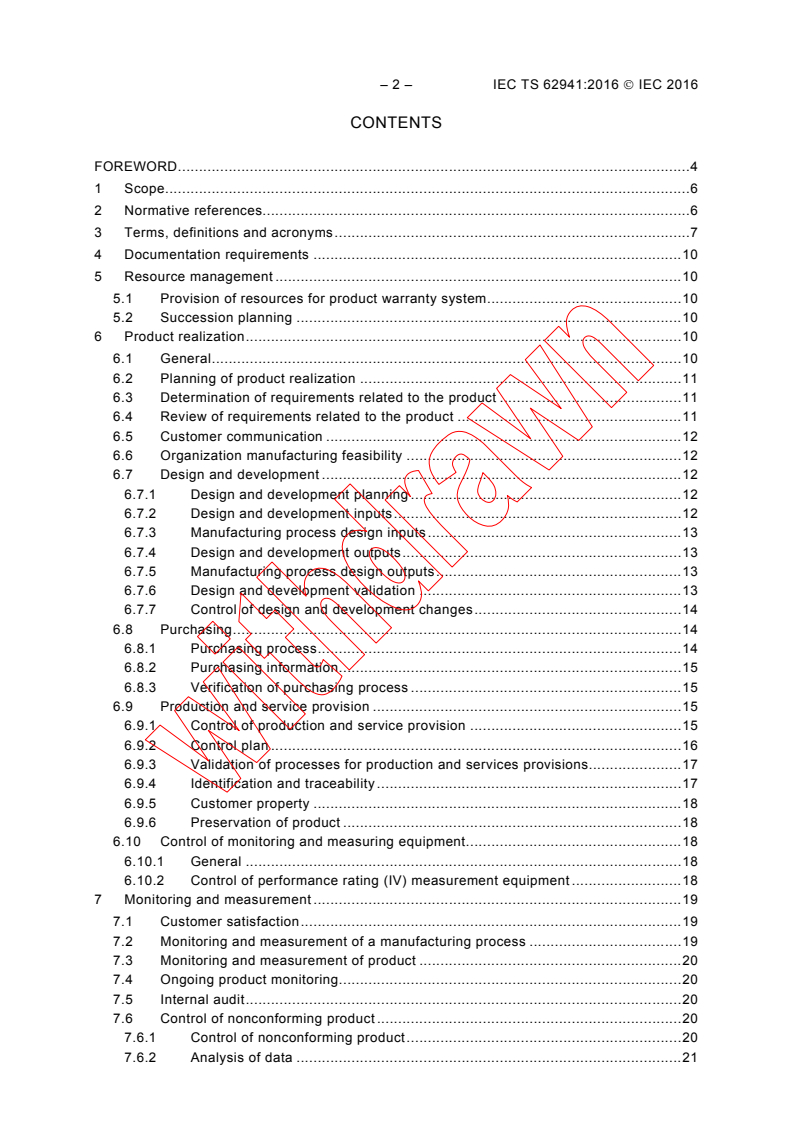
– 2 – IEC TS 62941:2016 IEC 2016
CONTENTS
FOREWORD . 4
1 Scope . 6
2 Normative references. 6
3 Terms, definitions and acronyms . 7
4 Documentation requirements . 10
5 Resource management . 10
5.1 Provision of resources for product warranty system . 10
5.2 Succession planning . 10
6 Product realization . 10
6.1 General . 10
6.2 Planning of product realization . 11
6.3 Determination of requirements related to the product . 11
6.4 Review of requirements related to the product . 11
6.5 Customer communication . 12
6.6 Organization manufacturing feasibility . 12
6.7 Design and development . 12
6.7.1 Design and development planning . 12
6.7.2 Design and development inputs . 12
6.7.3 Manufacturing process design inputs . 13
6.7.4 Design and development outputs . 13
6.7.5 Manufacturing process design outputs . 13
6.7.6 Design and development validation . 13
6.7.7 Control of design and development changes . 14
6.8 Purchasing . 14
6.8.1 Purchasing process . 14
6.8.2 Purchasing information . 15
6.8.3 Verification of purchasing process . 15
6.9 Production and service provision . 15
6.9.1 Control of production and service provision . 15
6.9.2 Control plan . 16
6.9.3 Validation of processes for production and services provisions . 17
6.9.4 Identification and traceability . 17
6.9.5 Customer property . 18
6.9.6 Preservation of product . 18
6.10 Control of monitoring and measuring equipment . 18
6.10.1 General . 18
6.10.2 Control of performance rating (IV) measurement equipment . 18
7 Monitoring and measurement . 19
7.1 Customer satisfaction . 19
7.2 Monitoring and measurement of a manufacturing process . 19
7.3 Monitoring and measurement of product . 20
7.4 Ongoing product monitoring . 20
7.5 Internal audit . 20
7.6 Control of nonconforming product . 20
7.6.1 Control of nonconforming product . 20
7.6.2 Analysis of data . 21
7.7 Continual improvement . 21
7.8 Corrective and preventive action. 21
Annex A (informative) Correspondence between ISO 9001:2008 and IEC TS 62941 . 22
Bibliography . 25
– 4 – IEC TS 62941:2016 IEC 2016
INTERNATIONAL ELECTROTECHNICAL COMMISSION
____________
TERRESTRIAL PHOTOVOLTAIC (PV) MODULES –
GUIDELINES FOR INCREASED CONFIDENCE IN PV
MODULE DESIGN QUALIFICATION AND TYPE APPROVAL
FOREWORD
1) The International Electrotechnical Commission (IEC) is a worldwide organization for standardization comprising
all national electrotechnical committees (IEC National Committees). The object of IEC is to promote
international co-operation on all questions concerning standardization in the electrical and electronic fields. To
this end and in addition to other activities, IEC publishes International Standards, Technical Specifications,
Technical Reports, Publicly Available Specifications (PAS) and Guides (hereafter referred to as “IEC
Publication(s)”). Their preparation is entrusted to technical committees; any IEC National Committee interested
in the subject dealt with may participate in this preparatory work. International, governmental and non-
governmental organizations liaising with the IEC also participate in this preparation. IEC collaborates closely
with the International Organization for Standardization (ISO) in accordance with conditions determined by
agreement between the two organizations.
2) The formal decisions or agreements of IEC on technical matters express, as nearly as possible, an international
consensus of opinion on the relevant subjects since each technical committee has representation from all
interested IEC National Committees.
3) IEC Publications have the form of recommendations for international use and are accepted by IEC National
Committees in that sense. While all reasonable efforts are made to ensure that the technical content of IEC
Publications is accurate, IEC cannot be held responsible for the way in which they are used or for any
misinterpretation by any end user.
4) In order to promote international uniformity, IEC National Committees undertake to apply IEC Publications
transparently to the maximum extent possible in their national and regional publications. Any divergence
between any IEC Publication and the corresponding national or regional publication shall be clearly indicated in
the latter.
5) IEC itself does not provide any attestation of conformity. Independent certification bodies provide conformity
assessment services and, in some areas, access to IEC marks of conformity. IEC is not responsible for any
services carried out by independent certification bodies.
6) All users should ensure that they have the latest edition of this publication.
7) No liability shall attach to IEC or its directors, employees, servants or agents including individual experts and
members of its technical committees and IEC National Committees for any personal injury, property damage or
other damage of any nature whatsoever, whether direct or indirect, or for costs (including legal fees) and
expenses arising out of the publication, use of, or reliance upon, this IEC Publication or any other IEC
Publications.
8) Attention is drawn to the Normative references cited in this publication. Use of the referenced publications is
indispensable for the correct application of this publication.
9) Attention is drawn to the possibility that some of the elements of this IEC Publication may be the subject of
patent rights. IEC shall not be held responsible for identifying any or all such patent rights.
The main task of IEC technical committees is to prepare International Standards. In
exceptional circumstances, a technical committee may propose the publication of a technical
specification when
• the required support cannot be obtained for the publication of an International Standard,
despite repeated efforts, or
• the subject is still under technical development or where, for any other reason, there is the
future but no immediate possibility of an agreement on an International Standard.
Technical specifications are subject to review within three years of publication to decide
whether they can be transformed into International Standards.
IEC TS 62941, which is a technical specification, has been prepared by IEC technical
committee 82: Solar photovoltaic energy systems.
The text of this standard is based on the following documents:
FDIS Report on voting
82/994/DTS 82/1049/RVC
Full information on the voting for the approval of this technical specification can be found in
the report on voting indicated in the above table.
This publication has been drafted in accordance with the ISO/IEC Directives, Part 2.
The committee has decided that the contents of this publication will remain unchanged until
the stability date indicated on the IEC web site under "http://webstore.iec.ch" in the data
related to the specific publication. At this date, the publication will be
• Transformed into an International standard
• reconfirmed,
• withdrawn,
• replaced by a revised edition, or
• amended.
A bilingual version of this publication may be issued at a later date.
– 6 – IEC TS 62941:2016 IEC 2016
TERRESTRIAL PHOTOVOLTAIC (PV) MODULES –
GUIDELINES FOR INCREASED CONFIDENCE IN PV
MODULE DESIGN QUALIFICATION AND TYPE APPROVAL
1 Scope
This Technical Specification is applicable to sites manufacturing photovoltaic (PV) modules
certified to IEC 61215 or IEC 61646 for design qualification and type approval. The design
qualification and type approval of PV modules depend on appropriate methods for product
and process design, as well as appropriate control of materials and processes used to
manufacture the product. This technical specification lays out best practices for product
design, manufacturing processes, and selection and control of materials used in the
manufacture of PV modules that have met the requirements of IEC 61215, IEC 61646, or
IEC 62108. These guidelines also form the basis for factory audit criteria of such sites by
various certifying and auditory bodies.
The object of this technical specification is to provide more confidence in the ongoing
consistency of performance and reliability of certified PV modules. The requirements of this
technical specification are defined with the assumption that the quality management system of
the organization has already fulfilled the requirements of ISO 9001 or equivalent quality
management system. By maintaining a manufacturing system in accordance with this
guideline, PV modules are expected to maintain their performance as determined from the
test sequences in IEC 61215, IEC 61646, or IEC 62108.
This technical specification is applicable to all PV modules independent of design and
technology i.e. flat panel, concentrator photovoltaic (CPV). Quality controls for CPV and
nonconventional flat-plate manufacturing will differ somewhat from those of more conventional
designs; this technical specification has not considered these differences.
2 Normative references
The following documents, in whole or in part, are normatively referenced in this document and
are indispensable for its application. For dated references, only the edition cited applies. For
undated references, the latest edition of the referenced document (including any
amendments) applies.
IEC 60812, Analysis techniques for system reliability –Procedure for failure mode and effects
analysis (FMEA)
IEC 60891, Photovoltaic devices – Procedure for temperature and irradiance corrections to
measured I-V characteristics
IEC 60904-1, Photovoltaic devices – Part 1: Measurement of photovoltaic current-voltage
characteristics
IEC 60904-2, Photovoltaic devices – Part 2: Requirements for photovoltaic reference devices
IEC 60904-3, Photovoltaic devices – Part 3: Measurement principles for terrestrial
photovoltaic (PV) solar devices with reference spectral irradiance data
IEC 60904-4, Photovoltaic devices – Part 4: Reference solar devices – Procedures for
establishing calibration traceability
IEC 60904-7, Photovoltaic devices – Part 7: Computation of the spectral mismatch correction
for measurements of photovoltaic devices
IEC 60904-9, Photovoltaic devices – Part 9: Solar simulator performance requirements
IEC 61215, Crystalline silicon terrestrial photovoltaic (PV) modules – Design qualification and
type approval
IEC 61646, Thin-film terrestrial photovoltaic (PV) modules – Design qualification and type
approval
IEC 61730-1, Photovoltaic (PV) module safety qualification – Part 1: Requirements for
construction
IEC 61730-2, Photovoltaic (PV) module safety qualification – Part 2: Requirements for testing
IEC TS 61836, Solar photovoltaic energy systems – Terms, definitions and symbols
IEC 61853-1, Photovoltaic (PV) module performance testing and energy rating – Part 1:
Irradiance and temperature performance measurements and power rating
IEC 62108, Concentrator photovoltaic (CPV) modules and assemblies – Design qualification
and type approval
IEC 62759-1, Photovoltaic (PV) modules – Transportation testing – Part 1: Transportation and
shipping of module package units
IEC TS 62915, Photovoltaic (PV) modules – Retesting for type approval, design and safety
qualification
IEC TS 62916, Bypass diode electrostatic discharge susceptibility testing for PV modules
ISO/IEC Guide 98-3:2008, Uncertainty of measurement – Part 3: Guide to the expression of
uncertainty in measurement
3 Terms, definitions and acronyms
For the purposes of this document, the terms and definitions in ISO 9000:2005, IEC TS 61836
and the following apply.
3.1
containment
action taken to protect the customer from the effect of a situation. Containment may include
correcting an existing situation or adding additional screening or retesting
3.2
control plan
documented description of the systems and processes required for controlling the product and
process quality by addressing the key characteristics and engineering requirements
_____________
To be published.
– 8 – IEC TS 62941:2016 IEC 2016
3.3
customer
end user, investor, installer who purchases modules from the organization
3.4
design lifetime
design target period during which PV modules are expected to safely satisfy the specified
performance under the specified conditions
Note 1 to entry: Specified conditions include application of use, installation environment configurations and
operation conditions of the PV module in use. The design target period is set considering changes in performance
of PV modules due to aging degradation of parts and materials used in the stated environment.
3.5
Design Failure Mode and Effects Analysis
DFMEA
application of the Failure Mode and Effects Analysis (FMEA) method specifically to
product/service
3.6
define, measure, analyse, improve and control
DMAIC
data-driven quality strategy for improving processes and an integral part of a Six Sigma
quality initiative
3.7
electrostatic discharge
ESD
sudden flow of electricity between two electrically charged objects caused by contact, an
electrical short, or dielectric breakdown
Note 1 to entry: Electrostatic discharge events are known to damage semiconductor devices such as diodes.
3.8
Failure, Modes and Effects Analysis
FMEA
document that defines the design, process, or solution with requirements and includes
potential modes, causes and severity of effects of failure, along with an evaluation of the
likelihood of their occurrence and ease of detection
Note 1 to entry: FMEA provides a mechanism to prioritize the risks and take appropriate mitigation steps.
3.9
key materials
materials that affect safety, reliability, or product performance of the PV module
Note 1 to entry: Key materials may include indirect materials. Those materials which are used during the
manufacturing process of PV modules, but are not found in the end product. In most chemical processes,
catalyzers are indirect materials.
3.10
organization
entity that supplies modules to the customer and that has responsibility for design, production,
and after-service for the modules
Note 1 to entry: The organization may subcontract some of its responsibilities for design, production, and the
after-sales service.
3.11
out of box audit
pre-shipment audit
is meant to simulate what a customer would experience when they open the packing box
Note 1 to entry: Usually the out-of box audit is carried out as follows: Samples of crates or packing boxes are
taken from the delivery waiting for shipment and audited for compliance to packing, labeling instructions,
documents along with the product, and finally the product itself. Product is verified for compliance to customer
requirements including visual, dimension and functional. Non-conformances from these audits are escapes from
the processes and outgoing inspection controls. These non-conformances are analyzed and fed back to improve
the processes and controls to prevent recurrence.
3.12
out of control action plan
OCAP
supporting document to an SPC (Statistical Process Control) chart. An OCAP is typically
presented as a flowchart that guides manufacturing floor employees' reactions to out-of-
control situations. An OCAP consists of activators (which define out-of-control conditions);
checkpoints (which are likely causes for the conditions); and terminators (which contain the
action that should resolve the conditions). OCAPs should be dynamic and updated continually
as and when new knowledge and information become available. A frequently occurring OCAP
activator is an indication of a systemic issue in the process
3.13
Plan, Do, Check, Act
PDCA
four-step process for quality improvement
Note 1 to entry: In the first step (Plan), a way to affect improvement is developed. In the second step (Do), the
plan is carried out, preferably on a small scale. In the third step (Check)), a study takes place between what was
predicted and what was observed in the previous step. In the last step (Act), action is taken on the causal system
to affect the desired change.
3.14
performance warranty
warranty provided by the party ensuring product liability to guarantee the specified
performance of PV modules over the specified period and under the specified conditions
3.15
Process Failure Modes and Effects Analysis
PFMEA
3.16
Product Life-Cycle Management
PLCM
the process of managing the entire life cycle of a product from inception, through engineering
design and manufacture, to service and disposal of manufactured products
3.17
prototype
early sample, model, or release of a product built to test a concept or process, but may not
have been produced with the intended future processes
3.18
Quality Management System
QMS
formalized system that documents the structure, responsibilities, and procedures required to
achieve effective quality management
3.19
quality plan
document, or several documents, that together specify quality standards, practices, resources,
specifications, and the sequence of activities relevant to a particular product, service, project,
or contract
– 10 – IEC TS 62941:2016 IEC 2016
3.20
repeatability
variation in measurements obtained when one measurement device is used several times by
the same person to measure the same characteristic on the same product
3.21
reproducibility
variation in measurements made by different people using the same measuring device to
measure the same characteristic on the same product
3.22
statistical capability
statistical measure of the inherent process variability of a given characteristic in comparison
to the specification limits
3.23
statistical process control
SPC
application of statistical techniques to control and monitor process. It is used to determine the
stability and predictability of a process
3.24
supplier
provider of materials to an organization building module manufacturing and assembly
4 Documentation requirements
Records related to design, qualification, engineering changes, monitoring, and measurement
of manufacturing processes and products, final testing, and customer details that are
necessary to secure the warranty condition and that are defined by the organization, shall be
retained for a necessary period.
Records should also include Certificates of Conformity (CoC) and Certificates of Conformity
Analysis (CoA) of key materials identified by the organization.
5 Resource management
5.1 Provision of resources for product warranty system
In addition to the basic QMS-required resource planning, the organization shall determine and
provide the resources needed to maintain the product warranty system, including provision of
after-sales service and for identifying cause of failure and any appropriate follow-up actions
such as adjustment to quality control plan or warranty recall.
5.2 Succession planning
The organization shall plan for succession for key functions that affect customer satisfaction,
quality, reliability, safety, and performance.
6 Product realization
6.1 General
The organization is required to implement a recognized basic QMS. In addition, the following
requirements shall also apply.
6.2 Planning of product realization
In planning product realization, the organization shall also determine the following, as
appropriate:
a) Product certification requirements.
b) Design lifetime aligned with the stated warranty under specific conditions and a
documented method to ensure compliance to stated warranty by a combination of product
reliability and after-sales services.
c) Recycling requirements at the end of the modules’ lifetime.
d) Quality assurance and control measures to be applied to production to meet requirements
of the applicable PV standards.
e) ESD safe environmental area.
The organization shall identify the ESD sensitive materials and components and shall
determine an ESD safe environmental area and maintain an ESD safe environment at the
raw material storage, processing, assembly areas, and all through packaging and shipping
as defined in future IEC TS 62916 or as appropriate.
f) Packaging, storage and transportation requirements.
Customer requirements and references to related technical specifications, as applicable, shall
be included in the planning of product realization as a component of the quality plan.
With changing requirements from the market place and with emerging new technology in the
PV industry, the development and launch of new products should meet requirements of the
product warranty as well as customers’ needs. A complete product life-cycle management
process may be required.
The product certification may depend on the application and geographies where the modules
will be installed.
The recycling requirements should comply with the geographies where the modules will be
installed.
ESD requirement should consider ANSI/ESD S20.20, future IEC TS 62916 or equivalent
standard.
6.3 Determination of requirements related to the product
The organization shall determine product warranty workmanship and power degradation and
its relationship to design lifetime under specified and intended use conditions.
The organization shall incorporate requirements arising from applicable previous failure
information, customer complaints, competitive analysis, supplier feedback, and other internal
inputs. The organization shall maintain traceability to these requirements.
The organization shall establish a method for specifying the nameplate power of a module
with an allowed tolerance at standard test conditions per IEC 61215, IEC 61646, or IEC 62108
(see 6.9.2 for proper control of solar simulators).
6.4 Review of requirements related to the product
The organization shall ensure that all modified product, not covered by the retest guidelines
as defined in future IEC TS 62915, is qualified to all related type designs and that the
modified product is evaluated for impact on the warranty.
The organization shall identify and document all limitations on product application.
– 12 – IEC TS 62941:2016 IEC 2016
The organization shall identify critical areas for ESD control, where appropriate.
ESD requirement should consider ANSI/ESD S20.20, future IEC TS 62916 or equivalent
standard.
6.5 Customer communication
The organization shall also determine and implement effective arrangements for
communicating with customers in relation to the following:
a) Safety, workmanship warranty, output power warranty and installation guidelines including
electrical and mechanical installation instruction.
b) Application notes detailing specific attention and care needed to secure module design
lifetime of the installed configuration.
c) The definition of a warrantable defect or safety critical defect and the rules or process to
manage stated defects, and
d) Product recall notices.
NOTE “Information” includes, but is not limited to, specifications, drawings, and other material, including
“installation” manuals.
6.6 Organization manufacturing feasibility
The organization shall investigate, conduct risk analysis, confirm and document the
manufacturing feasibility at the necessary scale of the proposed products in the contract
where applicable.
The organization shall manage the risks prior to manufacturing transfer.
6.7 Design and development
6.7.1 Design and development planning
The organization shall include production processes in the design and development planning.
The organization shall also determine:
a) The responsibilities and authorities for a project design and development team.
b) The process to conduct design FMEAs as defined in IEC 60812 or equivalent, reliability
testing, design lifetime, and product specification generation, and
c) The requirements for process FMEAs as defined in IEC 60812 or
...
Questions, Comments and Discussion
Ask us and Technical Secretary will try to provide an answer. You can facilitate discussion about the standard in here.
Loading comments...