IEC 60505:2011/COR1:2017
(Corrigendum)Corrigendum 1 - Evaluation and qualification of electrical insulation systems
Corrigendum 1 - Evaluation and qualification of electrical insulation systems
Corrigendum 1 - Evaluation et qualification des systèmes d'isolation électrique
General Information
Relations
Standards Content (Sample)
IEC 2017
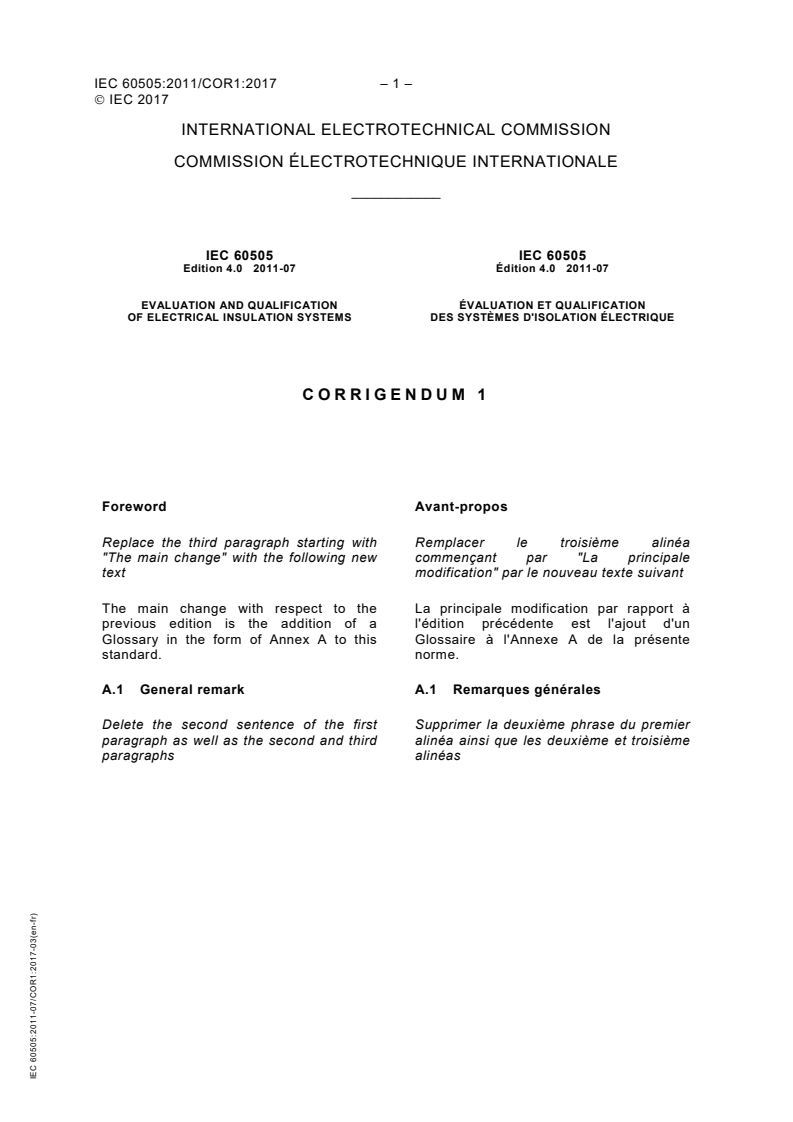
INTERNATIONAL ELECTROTECHNICAL COMMISSION
COMMISSION ÉLECTROTECHNIQUE INTERNATIONALE
____________
IEC 60505 IEC 60505
Edition 4.0 2011-07 Édition 4.0 2011-07
EVALUATION AND QUALIFICATION ÉVALUATION ET QUALIFICATION
OF ELECTRICAL INSULATION SYSTEMS DES SYSTÈMES D'ISOLATION ÉLECTRIQUE
CORRIGENDUM 1
Foreword Avant-propos
Replace the third paragraph starting with Remplacer le troisième alinéa
"The main change" with the following new commençant par "La principale
text modification" par le nouveau texte s
...
This May Also Interest You
IEC TS 61857-42:2025 provides a procedure to evaluate the lifetime of an electrical insulation system (EIS) in a drivetrain unit within road transportation (automotive) applications. Typical applications include motors and generators in hybrid and full electric passenger vehicles, light-duty and heavy-duty commercial vehicles, as well as buses.
In general, the IEC 61857 series is applicable to EIS used in electrotechnical products with an input voltage of up to 1 000 V where the predominant ageing factor is thermal. In the context of this document the limit of 1 000 V is understood to be the application-specific battery DC voltage.
The EIS evaluated by this procedure will operate free from partial discharges over its whole lifetime.
Evaluation of EIS in the following applications is outside the scope:
- motors and generators within the scope of IEC TC 2, Rotating machinery;
- rail traction machines in the scope of IEC TC 9, Electrical equipment and systems for railways;
- motors and generators for road vehicles that are not intended for the traction of them.
- Technical specification51 pagesEnglish languagesale 15% off
IEC TR 61857-2:2025 gives guidelines to identify the appropriate test method for the evaluation of a proposed electrical insulation system (EIS). Some of the standards evaluate the EIS using one stress factor which is thermal. Other standards evaluate the thermal stress factor with adjustments to the conditioning applied prior to the diagnostic testing to simulate applications in air. A third group of these standards when the application is other than in air. This technical report is applicable to existing or proposed EIS used in electrotechnical products across a wide range of operating voltages of IEC Standards. The report takes care to identify the appropriate standard based on construction and intended operating application.
For all performance and safety requirements related to an application, refer to the technical committee requirements for the application.
This edition includes the following significant technical changes with respect to the previous edition.
a) The Introduction is expanded to convey that both TC 112 and TC 2 have established EIS test standards.
b) Clause 4 introduces the fact that there are four stress factors, not only thermal. This essential concept carries over into part of Clause 5.
c) The large number of established standards are organized into common concept groups in Tables 1 to 5:
1) Table 1 covers an overview of EIS evaluations for background and structure.
2) Table 2 covers evaluation of test objects prior to the start of long-term thermal ageing using screening tests.
3) Table 3 covers test standards for the evaluation of thermal stresses in air and has an increased number of standards.
4) Table 4 covers standards for special environmental applications other than in air
5) Table 5 covers standards for the modification of an established EIS.
- Technical report11 pagesEnglish languagesale 15% off
IEC TS 61934:2024 is applicable to the off-line electrical measurement of partial discharges (PDs) that occur in electrical insulation systems (EISs) when stressed by repetitive voltage impulses generated from power electronics devices.
Typical applications are EISs belonging to apparatus driven by power electronics, such as motors, inductive reactors, wind turbine generators and the power electronics modules themselves.
NOTE Use of this document with specific products can require the application of additional procedures.
Excluded from the scope of this document are:
- methods based on optical or ultrasonic PD detection,
- fields of application for PD measurements when stressed by non-repetitive impulse voltages such as lightning impulse or switching impulses from switchgear.
This edition includes the following significant technical changes with respect to the previous edition:
a) background information on the progress being made in the field of power electronics including the introduction of wide band gap semiconductor devices has been added to the Introduction;
b) voltage impulse generators; the parameter values of the voltage impulse waveform have been modified to reflect application of wide band gap semiconductor devices.
c) PD detection methods; charge-based measurements are not described in this third edition nor are source-controlled gating techniques to suppress external noise.
d) Since the previous edition in 2011, there have been significant technical advances in this field as evidenced by several hundreds of publications. Consequently, the Bibliography in the 2011 edition has been deleted in this third edition.
- Technical specification27 pagesEnglish languagesale 15% off
- Technical specification58 pagesEnglish languagesale 15% off
IEC TR 61858-3:2020(E) provides information on the identification of electrical insulating materials and auxiliary components for the assessment of modifications to an established insulation system and gives guidance on the selection of feasible test procedures.
- Technical report9 pagesEnglish languagesale 15% off
IEC 61857-32:2019 series is focused on applications where other possible factors need to be incorporated to evaluate any influence on the performance of the electrical insulation system (EIS). Multi-factor evaluation is the most complex type of project to design and conduct. Clear guidelines are needed to give the user of this document a uniform approach and a method to analyse the test results.
This document is for applications where the stresses are some combination of other factors of influence identified in IEC 60505. The multi-factor stresses are applied during the diagnostic portion of each test cycle.
A few examples of other factors of influence or multi-factor stresses are:
– high vibration;
– submersion in oils, water, or solutions;
– voltage higher than the test voltage of the reference EIS;
– decreased cold shock temperature.
- Standard33 pagesEnglish and French languagesale 15% off
IEC 61857-31:2017 establishes an EIS evaluation for applications with a designed life of 5 000 h or less. This test method follows the procedures of IEC 60505 and is modified based on the range of designed life.
- Standard10 pagesEnglish languagesale 15% off
- Standard21 pagesEnglish and French languagesale 15% off
IEC TS 62332-3:2016 is applicable to EIM and EIS containing solid and liquid components where the refrigerant, oil and thermal stresses are the dominant ageing factor, without restriction to voltage class.
- Technical specification47 pagesEnglish and French languagesale 15% off
IEC TR 61857-2:2015(E) gives guidelines to identify the appropriate test method to be used for the evaluation of a proposed Electrical Insulation System (EIS). Some of the standards are for evaluation and classification of the EIS, while other standards identify the appropriate method to evaluate single or multi-factor stresses of a proposed or of an established EIS. This Technical Report is applicable to existing or proposed EIS used in electrotechnical products across a wide range of operating voltages of IEC Standards. The report takes care to select the appropriate standard based on construction and intended operating conditions.
- Technical report10 pagesEnglish languagesale 15% off
IEC TS 62332-2:2014 is applicable to EIS containing solid and liquid components where the thermal stress is the dominant ageing factor, without restriction to voltage class. This part specifies a sealed tube test procedure for the thermal evaluation and qualification of electrical insulation systems (EIS). One aspect of this procedure is to also provide a method to assign thermal classifications to materials used in EIS where solid and liquid components are both used. This procedure describes a comparative ageing method whereby a reference system composed of kraft paper and mineral oil is compared to a candidate system of any combination of solid and insulating liquid. The test procedures in this part are specifically applicable to liquid immersed transformer insulation systems.
- Technical specification50 pagesEnglish and French languagesale 15% off
IEC 61858-2:2014 lists the required test procedures for qualification of modifications of an established electrical insulation system (EIS) with respect to its thermal classification. This standard is applicable to EIS used in form-wound electrotechnical devices. The test procedures are comparative in that the performance of a candidate EIS is compared to that of a reference EIS, which has proven service experience in accordance with IEC 60505 or has been evaluated by one of the procedures given in IEC 60085 and IEC 60034-18-31.
- Standard46 pagesEnglish and French languagesale 15% off


Questions, Comments and Discussion
Ask us and Technical Secretary will try to provide an answer. You can facilitate discussion about the standard in here.
Loading comments...