

IEC 60153-4:2022
(Main)Hollow metallic waveguides - Part 4: Relevant specifications for circular waveguides
General Information
- Abstract
IEC 60153-4:2022 specifies straight hollow metallic tubing of circular cross section for use as waveguides in electronic equipment. The aim of this document is to specify the hollow metallic waveguides:
a) the details necessary to ensure compatibility and, as far as essential, interchangeability;
b) test methods;
c) uniform requirements for the electrical and mechanical properties
This document is intended to be read in conjunction with IEC 60153-1, which gives general requirements and test methods. This fourth edition cancels and replaces the third edition published in 2017. edition:
a. change of the designation scheme for small circular waveguides (e.g. C 25.5k instead of C 25500);
b. revision of Table 1:
- correction of two waveguide designations (now C 1.2k, C 12k);
- correction of three waveguide diameters (C 140, C 1.4k, C 14k);
- tightening of inner diameter tolerances for waveguides smaller than C 890;
- deletion of waveguide attenuation values for aluminium, gold, and brass;
c. deletion of Table 2 (duplication) and replacement with the table of intermediate waveguide sizes originally envisaged here;
d. addition of an equation for calculating the attenuation of waveguides made of any material.
- Status
- Published
- Publication Date
- 08-Jun-2022
- Technical Committee
- SC 46F - RF and microwave passive components
- Drafting Committee
- WG 2 - TC 46/SC 46F/WG 2
- Current Stage
- PPUB - Publication issued
- Start Date
- 09-Jun-2022
- Completion Date
- 17-Jun-2022
Overview
IEC 60153-4:2022 is an international standard established by the International Electrotechnical Commission (IEC) that specifies the relevant requirements for hollow metallic waveguides with a circular cross-section. This standard applies to straight hollow metallic tubing designed for use as waveguides in electronic and RF/microwave equipment. It ensures uniformity in mechanical and electrical specifications to promote compatibility and interchangeability across manufacturers and applications. IEC 60153-4:2022 is intended to be used alongside IEC 60153-1, which outlines general requirements and testing methods for metallic waveguides.
The fourth edition introduces technical updates including a revised designation scheme for small circular waveguides, corrections to waveguide size tables, tighter inner diameter tolerances for smaller waveguides, removal of attenuation data for certain materials, and new equations for attenuation calculation across different materials.
Key Topics
- Scope and Application
Specifies circular hollow metallic waveguides for electronic equipment, focusing on ensuring physical and electrical compatibility between products. - Type Designation
Waveguides are designated by a code reflecting their size and nominal operating frequency, expressed in multiples of 100 MHz, with kilo suffixes (e.g., “C 25.5k”) for compact notation. - Mechanical Requirements
Detailed specifications on inner/outer diameters, wall thickness, eccentricity, bow, surface roughness, and internal stresses guarantee manufacturing precision and performance consistency. - Electrical Properties and Testing
Emphasis on attenuation coefficients and measurement methods to ensure low-loss signal transmission. The document provides an equation for calculating attenuation customized to the waveguide’s material composition. - Frequency and Mode Considerations
Defines operating frequency ranges based on dominant electromagnetic modes (TE and TM modes), ensuring reliable wave propagation above cut-off frequencies specific to each waveguide size and shape.
Applications
IEC 60153-4:2022 is essential for industries involving radio frequency (RF) and microwave transmission technologies, including:
- Satellite communications systems
- Radar and aerospace electronics
- Telecommunication equipment manufacturing
- Military and defense electronic devices
- Scientific research instrumentation involving waveguide components
The standard's rigorous mechanical and electrical specifications help manufacturers produce waveguides that are compatible across a wide range of systems, facilitating maintenance, repairs, and system upgrades. Additionally, it supports designers in selecting appropriate waveguide sizes for targeted frequency bands and performance criteria.
Related Standards
For comprehensive waveguide specifications and testing, IEC 60153-4:2022 should be used together with:
- IEC 60153-1: General requirements and measuring methods for hollow metallic waveguides. Provides foundational testing protocols and definitions.
- IEC 60153-2: Specifications for rectangular waveguides, complementary where non-circular waveguides are needed.
- IEC 60261: Sealing test methods for pressurized waveguide tubing, relevant for environmental protection of waveguides under operational conditions.
- IEC 60050: International Electrotechnical Vocabulary, for terminology consistency applied throughout IEC standards related to waveguides.
By adhering to IEC 60153-4:2022, stakeholders in electronics and communications can ensure high-quality circular waveguide components that conform to global best practices, enhancing system reliability and interoperability.
Keywords: IEC 60153-4, hollow metallic waveguides, circular waveguides, waveguide specifications, RF components, microwave transmission, waveguide standards, attenuation, mechanical tolerances, electromagnetic modes, frequency range, IEC waveguides.
Relations
- Effective Date
- 05-Sep-2023
Get Certified
Connect with accredited certification bodies for this standard

ANCE
Mexican certification and testing association.

Intertek Slovenia
Intertek testing, inspection, and certification services in Slovenia.

LNE (Laboratoire National de Métrologie et d'Essais)
French national laboratory for metrology and testing.
Sponsored listings
Frequently Asked Questions
IEC 60153-4:2022 is a standard published by the International Electrotechnical Commission (IEC). Its full title is "Hollow metallic waveguides - Part 4: Relevant specifications for circular waveguides". This standard covers: IEC 60153-4:2022 specifies straight hollow metallic tubing of circular cross section for use as waveguides in electronic equipment. The aim of this document is to specify the hollow metallic waveguides: a) the details necessary to ensure compatibility and, as far as essential, interchangeability; b) test methods; c) uniform requirements for the electrical and mechanical properties This document is intended to be read in conjunction with IEC 60153-1, which gives general requirements and test methods. This fourth edition cancels and replaces the third edition published in 2017. edition: a. change of the designation scheme for small circular waveguides (e.g. C 25.5k instead of C 25500); b. revision of Table 1: - correction of two waveguide designations (now C 1.2k, C 12k); - correction of three waveguide diameters (C 140, C 1.4k, C 14k); - tightening of inner diameter tolerances for waveguides smaller than C 890; - deletion of waveguide attenuation values for aluminium, gold, and brass; c. deletion of Table 2 (duplication) and replacement with the table of intermediate waveguide sizes originally envisaged here; d. addition of an equation for calculating the attenuation of waveguides made of any material.
IEC 60153-4:2022 specifies straight hollow metallic tubing of circular cross section for use as waveguides in electronic equipment. The aim of this document is to specify the hollow metallic waveguides: a) the details necessary to ensure compatibility and, as far as essential, interchangeability; b) test methods; c) uniform requirements for the electrical and mechanical properties This document is intended to be read in conjunction with IEC 60153-1, which gives general requirements and test methods. This fourth edition cancels and replaces the third edition published in 2017. edition: a. change of the designation scheme for small circular waveguides (e.g. C 25.5k instead of C 25500); b. revision of Table 1: - correction of two waveguide designations (now C 1.2k, C 12k); - correction of three waveguide diameters (C 140, C 1.4k, C 14k); - tightening of inner diameter tolerances for waveguides smaller than C 890; - deletion of waveguide attenuation values for aluminium, gold, and brass; c. deletion of Table 2 (duplication) and replacement with the table of intermediate waveguide sizes originally envisaged here; d. addition of an equation for calculating the attenuation of waveguides made of any material.
IEC 60153-4:2022 is classified under the following ICS (International Classification for Standards) categories: 33.120.10 - Coaxial cables. Waveguides. The ICS classification helps identify the subject area and facilitates finding related standards.
IEC 60153-4:2022 has the following relationships with other standards: It is inter standard links to IEC 60153-4:2017. Understanding these relationships helps ensure you are using the most current and applicable version of the standard.
IEC 60153-4:2022 is available in PDF format for immediate download after purchase. The document can be added to your cart and obtained through the secure checkout process. Digital delivery ensures instant access to the complete standard document.
Standards Content (Sample)
IEC 60153-4 ®
Edition 4.0 2022-06
INTERNATIONAL
STANDARD
NORME
INTERNATIONALE
Hollow metallic waveguides –
Part 4: Relevant specifications for circular waveguides
Guides d’ondes métalliques creux –
Partie 4: Spécifications applicables aux guides d’ondes circulaires
All rights reserved. Unless otherwise specified, no part of this publication may be reproduced or utilized in any form
or by any means, electronic or mechanical, including photocopying and microfilm, without permission in writing from
either IEC or IEC's member National Committee in the country of the requester. If you have any questions about IEC
copyright or have an enquiry about obtaining additional rights to this publication, please contact the address below or
your local IEC member National Committee for further information.
Droits de reproduction réservés. Sauf indication contraire, aucune partie de cette publication ne peut être reproduite ni
utilisée sous quelque forme que ce soit et par aucun procédé, électronique ou mécanique, y compris la photocopie et
les microfilms, sans l'accord écrit de l'IEC ou du Comité national de l'IEC du pays du demandeur. Si vous avez des
questions sur le copyright de l'IEC ou si vous désirez obtenir des droits supplémentaires sur cette publication, utilisez
les coordonnées ci-après ou contactez le Comité national de l'IEC de votre pays de résidence.
IEC Secretariat Tel.: +41 22 919 02 11
3, rue de Varembé info@iec.ch
CH-1211 Geneva 20 www.iec.ch
Switzerland
About the IEC
The International Electrotechnical Commission (IEC) is the leading global organization that prepares and publishes
International Standards for all electrical, electronic and related technologies.
About IEC publications
The technical content of IEC publications is kept under constant review by the IEC. Please make sure that you have the
latest edition, a corrigendum or an amendment might have been published.
IEC publications search - webstore.iec.ch/advsearchform IEC Products & Services Portal - products.iec.ch
The advanced search enables to find IEC publications by a Discover our powerful search engine and read freely all the
variety of criteria (reference number, text, technical publications previews. With a subscription you will always have
committee, …). It also gives information on projects, replaced access to up to date content tailored to your needs.
and withdrawn publications.
Electropedia - www.electropedia.org
IEC Just Published - webstore.iec.ch/justpublished
The world's leading online dictionary on electrotechnology,
Stay up to date on all new IEC publications. Just Published
containing more than 22 300 terminological entries in English
details all new publications released. Available online and once
and French, with equivalent terms in 19 additional languages.
a month by email.
Also known as the International Electrotechnical Vocabulary
(IEV) online.
IEC Customer Service Centre - webstore.iec.ch/csc
If you wish to give us your feedback on this publication or need
further assistance, please contact the Customer Service
Centre: sales@iec.ch.
A propos de l'IEC
La Commission Electrotechnique Internationale (IEC) est la première organisation mondiale qui élabore et publie des
Normes internationales pour tout ce qui a trait à l'électricité, à l'électronique et aux technologies apparentées.
A propos des publications IEC
Le contenu technique des publications IEC est constamment revu. Veuillez vous assurer que vous possédez l’édition la
plus récente, un corrigendum ou amendement peut avoir été publié.
Recherche de publications IEC - Découvrez notre puissant moteur de recherche et consultez
webstore.iec.ch/advsearchform gratuitement tous les aperçus des publications. Avec un
La recherche avancée permet de trouver des publications IEC abonnement, vous aurez toujours accès à un contenu à jour
en utilisant différents critères (numéro de référence, texte, adapté à vos besoins.
comité d’études, …). Elle donne aussi des informations sur les
projets et les publications remplacées ou retirées. Electropedia - www.electropedia.org
Le premier dictionnaire d'électrotechnologie en ligne au monde,
IEC Just Published - webstore.iec.ch/justpublished
avec plus de 22 300 articles terminologiques en anglais et en
Restez informé sur les nouvelles publications IEC. Just
français, ainsi que les termes équivalents dans 19 langues
Published détaille les nouvelles publications parues.
additionnelles. Egalement appelé Vocabulaire
Disponible en ligne et une fois par mois par email.
Electrotechnique International (IEV) en ligne.
Service Clients - webstore.iec.ch/csc
Si vous désirez nous donner des commentaires sur cette
publication ou si vous avez des questions contactez-nous:
sales@iec.ch.
IEC Products & Services Portal - products.iec.ch
IEC 60153-4 ®
Edition 4.0 2022-06
INTERNATIONAL
STANDARD
NORME
INTERNATIONALE
Hollow metallic waveguides –
Part 4: Relevant specifications for circular waveguides
Guides d’ondes métalliques creux –
Partie 4: Spécifications applicables aux guides d’ondes circulaires
INTERNATIONAL
ELECTROTECHNICAL
COMMISSION
COMMISSION
ELECTROTECHNIQUE
INTERNATIONALE
ICS 33.120.10 ISBN 978-2-8322-0832-8
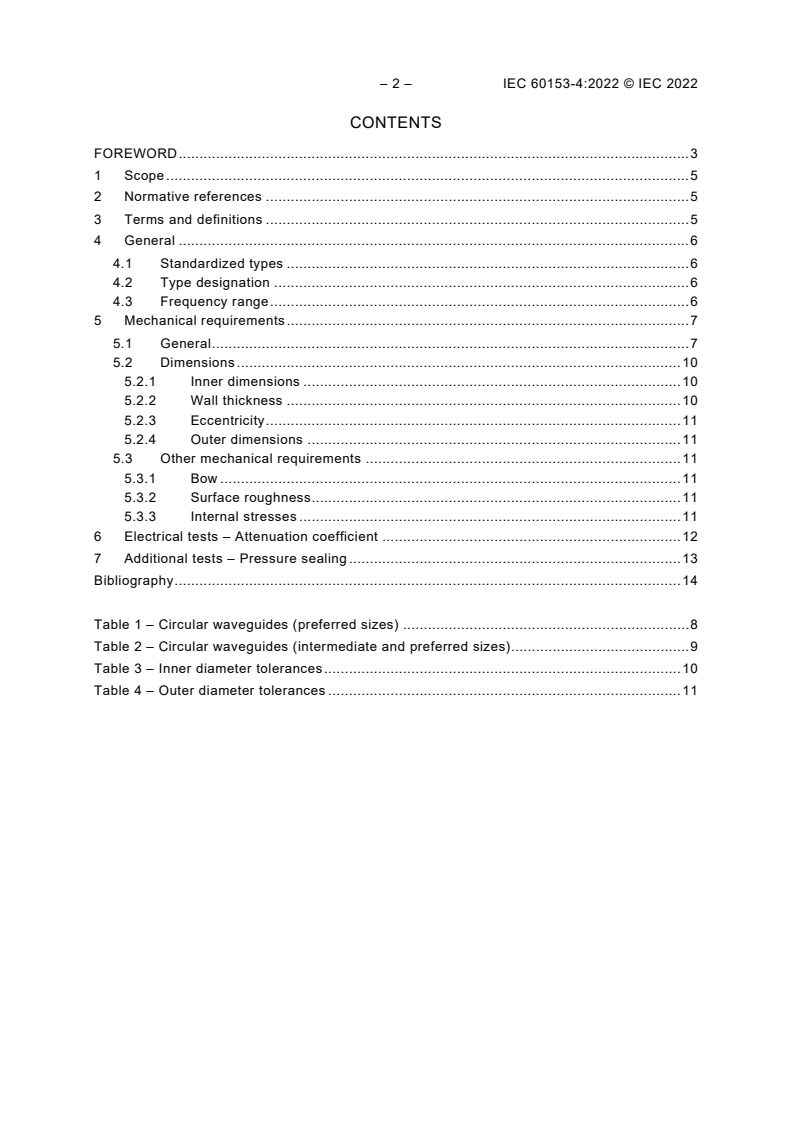
– 2 – IEC 60153-4:2022 © IEC 2022
CONTENTS
FOREWORD . 3
1 Scope . 5
2 Normative references . 5
3 Terms and definitions . 5
4 General . 6
4.1 Standardized types . 6
4.2 Type designation . 6
4.3 Frequency range . 6
5 Mechanical requirements . 7
5.1 General . 7
5.2 Dimensions . 10
5.2.1 Inner dimensions . 10
5.2.2 Wall thickness . 10
5.2.3 Eccentricity . 11
5.2.4 Outer dimensions . 11
5.3 Other mechanical requirements . 11
5.3.1 Bow . 11
5.3.2 Surface roughness . 11
5.3.3 Internal stresses . 11
6 Electrical tests – Attenuation coefficient . 12
7 Additional tests – Pressure sealing . 13
Bibliography . 14
Table 1 – Circular waveguides (preferred sizes) . 8
Table 2 – Circular waveguides (intermediate and preferred sizes). 9
Table 3 – Inner diameter tolerances . 10
Table 4 – Outer diameter tolerances . 11
INTERNATIONAL ELECTROTECHNICAL COMMISSION
____________
HOLLOW METALLIC WAVEGUIDES –
Part 4: Relevant specifications for circular waveguides
FOREWORD
1) The International Electrotechnical Commission (IEC) is a worldwide organization for standardization comprising
all national electrotechnical committees (IEC National Committees). The object of IEC is to promote international
co-operation on all questions concerning standardization in the electrical and electronic fields. To this end and
in addition to other activities, IEC publishes International Standards, Technical Specifications, Technical Reports,
Publicly Available Specifications (PAS) and Guides (hereafter referred to as “IEC Publication(s)”). Their
preparation is entrusted to technical committees; any IEC National Committee interested in the subject dealt with
may participate in this preparatory work. International, governmental and non-governmental organizations liaising
with the IEC also participate in this preparation. IEC collaborates closely with the International Organization for
Standardization (ISO) in accordance with conditions determined by agreement between the two organizations.
2) The formal decisions or agreements of IEC on technical matters express, as nearly as possible, an international
consensus of opinion on the relevant subjects since each technical committee has representation from all
interested IEC National Committees.
3) IEC Publications have the form of recommendations for international use and are accepted by IEC National
Committees in that sense. While all reasonable efforts are made to ensure that the technical content of IEC
Publications is accurate, IEC cannot be held responsible for the way in which they are used or for any
misinterpretation by any end user.
4) In order to promote international uniformity, IEC National Committees undertake to apply IEC Publications
transparently to the maximum extent possible in their national and regional publications. Any divergence between
any IEC Publication and the corresponding national or regional publication shall be clearly indicated in the latter.
5) IEC itself does not provide any attestation of conformity. Independent certification bodies provide conformity
assessment services and, in some areas, access to IEC marks of conformity. IEC is not responsible for any
services carried out by independent certification bodies.
6) All users should ensure that they have the latest edition of this publication.
7) No liability shall attach to IEC or its directors, employees, servants or agents including individual experts and
members of its technical committees and IEC National Committees for any personal injury, property damage or
other damage of any nature whatsoever, whether direct or indirect, or for costs (including legal fees) and
expenses arising out of the publication, use of, or reliance upon, this IEC Publication or any other IEC
Publications.
8) Attention is drawn to the Normative references cited in this publication. Use of the referenced publications is
indispensable for the correct application of this publication.
9) Attention is drawn to the possibility that some of the elements of this IEC Publication may be the subject of patent
rights. IEC shall not be held responsible for identifying any or all such patent rights.
IEC 60153-4 has been prepared by subcommittee 46F: RF and microwave passive components,
of IEC technical committee 46: Cables, wires, waveguides, RF connectors, RF and microwave
passive components and accessories. It is an International Standard.
This fourth edition cancels and replaces the third edition published in 2017. This edition
constitutes a technical revision.
This edition includes the following significant technical changes with respect to the previous
edition:
a) change of the designation scheme for small circular waveguides (e.g. C 25.5k instead of
C 25500);
b) revision of Table 1:
• correction of two waveguide designations (now C 1.2k, C 12k);
• correction of three waveguide diameters (C 140, C 1.4k, C 14k);
• tightening of inner diameter tolerances for waveguides smaller than C 890;
• deletion of waveguide attenuation values for aluminium, gold, and brass;
– 4 – IEC 60153-4:2022 © IEC 2022
c) deletion of Table 2 (duplication) and replacement with the table of intermediate waveguide
sizes originally envisaged here;
d) addition of an equation for calculating the attenuation of waveguides made of any material.
The text of this International Standard is based on the following documents:
Draft Report on voting
46F/616/FDIS 46F/621/RVD
Full information on the voting for its approval can be found in the report on voting indicated in
the above table.
The language used for the development of this International Standard is English.
This document was drafted in accordance with ISO/IEC Directives, Part 2, and developed in
accordance with ISO/IEC Directives, Part 1 and ISO/IEC Directives, IEC Supplement, available
at www.iec.ch/members_experts/refdocs. The main document types developed by IEC are
described in greater detail at www.iec.ch/standardsdev/publications.
A list of all parts in the IEC 60153 series, published under the general title Hollow metallic
waveguides, can be found on the IEC website.
This International Standard is to be read in conjunction with IEC 60153-1.
The committee has decided that the contents of this document will remain unchanged until the
stability date indicated on the IEC website under webstore.iec.ch in the data related to the
specific document. At this date, the document will be
• reconfirmed,
• withdrawn,
• replaced by a revised edition, or
• amended.
HOLLOW METALLIC WAVEGUIDES –
Part 4: Relevant specifications for circular waveguides
1 Scope
This part of IEC 60153 specifies straight hollow metallic tubing of circular cross section for use
as waveguides in electronic equipment.
The aim of this document is to specify the hollow metallic waveguides:
a) the details necessary to ensure compatibility and, as far as essential, interchangeability;
b) test methods;
c) uniform requirements for the electrical and mechanical properties.
No recommendations are made for the materials to be used for waveguides. The choice of
materials is to be agreed on between the customer and the manufacturer.
This document is intended to be read in conjunction with IEC 60153-1, which gives general
requirements and test methods.
2 Normative references
The following documents are referred to in the text in such a way that some or all of their content
constitutes requirements of this document. For dated references, only the edition cited applies.
For undated references, the latest edition of the referenced document (including any
amendments) applies.
IEC 60028:1925, International standard of resistance for copper
IEC 60050 (all parts), International Electrotechnical Vocabulary (available at
http://www.electropedia.org/)
IEC 60153-1, Hollow metallic waveguides – Part 1: General requirements and measuring
methods
IEC 60261, Sealing test for pressurized waveguide tubing and assemblies
3 Terms and definitions
For the purposes of this document, the terms and definitions given in IEC 60050 apply.
ISO and IEC maintain terminological databases for use in standardization at the following
addresses:
• IEC Electropedia: available at http://www.electropedia.org/
• ISO Online browsing platform: available at http://www.iso.org/obp
– 6 – IEC 60153-4:2022 © IEC 2022
4 General
4.1 Standardized types
The series of circular waveguides covered in this document are shown in Table 1 and Table 2.
Table 1 lists the waveguides with preferred sizes. Since the operating frequency ranges of
circular waveguides are very small, it is desirable to have densely spaced waveguide sizes
available. For this reason, intermediate sizes have been defined . In Table 2, these are
compiled together with the preferred sizes.
4.2 Type designation
For circular waveguides the type designation comprises the code
60153˽IEC–C˽size
where
˽ is the space character, and
size is a number characterizing a particular size of waveguide. This number expresses
approximately in multiples of hundred megahertz (100 MHz) the centre frequency of the
recommended operating frequency range. Numbers of one thousand and above are – to
keep the designation short – divided by one thousand and followed by a lower-case "k"
for kilo (e.g. 25.5k for 25 500 and 29k for 29 000) . A possibly necessary decimal sign
is written as a dot.
4.3 Frequency range
Depending on the application of the circular waveguide, a suitable electromagnetic waveguide
mode shall be selected. The propagation of this mode is only possible at frequencies above a
certain cut-off frequency. Table 1 shows the cut-off frequencies for the technically most
important modes : TE (1st and dominant mode), TM (2nd mode), TE (3rd mode), TE
11 01 21 01
(4th mode) and TE (14th mode).
The recommended operating frequency range on which this document is based is defined as a
pure dominant mode range between 1,15 times the TE cut-off frequency and 0,96 times the
TM cut-off frequency . The centre frequency f of the recommended operating frequency
01 centre
range – from which the waveguide type designation is derived – is then calculated as the
geometric mean of this range .
___________
The designations and inner diameters for the intermediate waveguides from C 3.3 to C 890 have been taken
directly from IEC 60153-4:1973. The designations and inner diameters of the smaller intermediate waveguides
have been newly derived from the larger intermediate waveguides by scaling.
This designation scheme is analogous to that specified in IEC 60153-2:2016 for the ordinary rectangular
waveguides.
The cut-off frequency f for a particular mode of a circular waveguide is calculated by f = x · c / (π · D), where
c c 0
x can be approximated by 1,8412; 2,4048; 3,0542; 3,8317; 7,0156 for the mode TE ; TM ; TE ; TE ; TE
11 01 21 01 02,
respectively. Furthermore, c is the velocity of light in free-space (≈ 2,997 925·10 m/s), π is Archimedes' constant
(≈ 3,14159) and D is the inner waveguide diameter expressed in metres (m).
There are other common recommendations for the operating frequency range of a circular waveguide. For
example, the TIA/EIA-200-A standard recommends the range between 1,15 times the TE cut-off frequency and
0,95 times the TE cut-off frequency, which is not a pure dominant mode range.
5 0,5
Due to (1,15 · 0,96 · 2,4048 / 1,8412) ≈ 1,2, the centre frequency f corresponds to 1,2 times the TE
centre 11
cut-off frequency.
5 Mechanical requirements
5.1 General
It should be noted that no recommendations are made for the materials to be used for
waveguides. The choice of materials is to be agreed on between the customer and the
manufacturer.
– 8 – IEC 60153-4:2022 © IEC 2022
Table 1 – Circular waveguides (preferred sizes)
t
D D
Type Cut-off frequency in GHz Inner diameter D Wall thickn. t Outer diameter D attenuation coefficient in dB/m
designation for the mode in mm in mm for TE in an ideal copper waveguide
in mm 11
Nominal Tolerance Nominal Nominal Tolerance Theoretical Maximum
f
centre
60153 IEC– TE TM TE TE TE
11 01 21 01 02
value ± value value ± value value
in GHz
C 3.3 0,271 0,354 0,450 0,564 1,03 647,90 0,65 0,325 0,00067 0,00088
C 4 0,317 0,415 0,527 0,661 1,21 553,49 0,55 0,381 0,00085 0,0011
C 4.5 0,372 0,485 0,616 0,773 1,42 472,85 0,47 0,446 0,0011 0,0014
C 5.3 0,435 0,568 0,722 0,905 1,66 403,94 0,40 0,522 0,0014 0,0018
C 6.2 0,509 0,665 0,845 1,06 1,94 345,06 0,35 0,611 0,0017 0,0023
C 7 0,596 0,778 0,989 1,24 2,27 294,79 0,29 not specified 0,715 0,0022 0,0029
C 8 0,698 0,911 1,16 1,45 2,66 251,84 0,25 0,837 0,0028 0,0036
C 10 0,817 1,07 1,35 1,70 3,11 215,14 0,22 0,980 0,0035 0,0046
C 12 0,956 1,25 1,59 1,99 3,64 183,77 0,18 1,147 0,0045 0,0058
C 14 1,12 1,46 1,86 2,33 4,26 157,00 0,16 1,343 0,0057 0,0073
C 16 1,31 1,71 2,17 2,73 4,99 134,11 0,13 1,572 0,0072 0,0093
C 18 1,53 2,00 2,54 3,19 5,84 114,58 0,11 3,300 121,180 0,130 1,840 0,0091 0,0118
C 22 1,80 2,34 2,98 3,74 6,84 97,866 0,098 3,300 104,466 0,110 2,154 0,0115 0,0149
C 25 2,10 2,74 3,49 4,37 8,01 83,617 0,084 3,300 90,217 0,110 2,521 0,0145 0,0189
C 30 2,46 3,21 4,08 5,12 9,37 71,425 0,071 3,300 78,025 0,095 2,952 0,0184 0,0239
C 35 2,88 3,76 4,78 5,99 11,0 61,036 0,061 3,300 67,636 0,095 3,454 0,0233 0,0303
C 40 3,38 4,41 5,61 7,03 12,9 51,994 0,052 2,540 57,074 0,095 4,055 0,0296 0,0385
C 48 3,95 5,16 6,56 8,23 15,1 44,450 0,044 2,540 49,530 0,080 4,743 0,0375 0,0488
C 56 4,61 6,02 7,65 9,60 17,6 38,100 0,038 2,030 42,160 0,080 5,534 0,0473 0,0614
C 65 5,40 7,05 8,96 11,2 20,6 32,537 0,033 2,030 36,597 0,080 6,480 0,0599 0,0779
C 76 6,32 8,26 10,5 13,2 24,1 27,788 0,028 1,650 31,088 0,080 7,587 0,0759 0,0987
C 89 7,37 9,63 12,2 15,3 28,1 23,825 0,024 1,650 27,125 0,065 8,850 0,0956 0,124
C 104 8,68 11,3 14,4 18,1 33,1 20,244 0,020 1,270 22,784 0,065 10,41 0,122 0,159
C 120 10,1 13,1 16,7 20,9 38,3 17,475 0,017 1,270 20,015 0,065 12,07 0,152
C 140 11,6 15,2 19,3 24,2 44,4 15,088 0,015 1,015 17,118 0,055 13,97 0,190
C 165 13,8 18,1 22,9 28,8 52,7 12,700 0,013 1,015 14,730 0,055 16,60 0,246
C 190 15,8 20,6 26,2 32,9 60,2 11,125 0,010 1,015 13,155 0,050 18,95 0,300
C 220 18,4 24,1 30,6 38,4 70,3 9,5250 0,010 0,760 11,045 0,050 22,14 0,378
C 255 21,1 27,5 35,0 43,9 80,4 8,3312 0,0076 0,760 9,851 0,050 25,31 0,462
C 290 24,6 32,2 40,8 51,2 93,8 7,1374 0,0076 0,760 8,657 0,050 29,54 0,583
C 330 27,7 36,1 45,9 57,6 105 6,3500 0,0076 0,510 7,370 0,050 33,20 0,695
C 380 31,6 41,3 52,4 65,7 120 5,5626 0,0076 0,510 6,583 0,050 37,90 0,847
C 430 36,8 48,1 61,0 76,6 140 4,7752 0,0076 0,510 5,795 0,050 44,15 1,07
C 495 40,2 52,5 66,7 83,7 153 4,3688 0,0076 0,510 5,389 0,050 48,26 1,22
C 580 49,1 64,1 81,4 102 187 3,5814 0,0076 0,510 4,601 0,050 58,87 1,64
C 660 55,3 72,3 91,8 115 211 3,1750 0,0076 0,380 3,935 0,050 66,41 1,96
C 765 63,5 82,9 105 132 242 2,7686 0,0076 0,380 3,529 0,050 76,15 2,41
C 890 73,6 96,1 122 153 280 2,3876 0,0076 0,380 3,148 0,050 88,31 3,01
C 1.04k 86,8 113 144 181 331 2,0244 0,0050 104,1 3,86
C 1.2k 101 131 167 209 383 1,7475 0,0050 120,7 4,81
C 1.4k 116 152 193 242 444 1,5088 0,0050 139,7 6,00
C 1.65k 138 181 229 288 527 1,2700 0,0050 166,0 7,77
C 1.9k 158 206 262 329 602 1,1125 0,0050 189,5 9,47
C 2.2k 184 241 306 384 703 0,9525 0,0050 221,4 12,0
C 2.55k 211 275 350 439 804 0,8331 0,0035 253,1 14,6
C 2.9k 246 322 408 512 938 0,7137 0,0035 295,4 18,4
C 3.3k 277 361 459 576 1050 0,6350 0,0035 332,0 22,0
C 3.8k 316 413 524 657 1200 0,5563 0,0035 379,0 26,8
C 4.3k 368 481 610 766 1400 0,4775 0,0035 441,5 33,7
C 4.95k 402 525 667 837 1530 0,4369 0,0035 482,6 38,5
not specified
C 5.8k 491 641 814 1020 1870 0,3581 0,0025 588,8 51,9
C 6.6k 553 723 918 1150 2110 0,3175 0,0025 664,1 62,1
C 7.65k 635 829 1050 1320 2420 0,2769 0,0025 761,4 76,3
C 8.9k 736 961 1220 1530 2800 0,2388 0,0025 882,9 95,3
C 10.4k 868 1130 1440 1810 3310 0,2024 0,0025 1042 122
C 12k 1010 1310 1670 2090 3830 0,1748 0,0025 1206 152
C 14k 1160 1520 1930 2420 4440 0,1509 0,0015 1397 190
C 16.5k 1380 1810 2290 2880 5270 0,1270 0,0015 1660 246
C 19k 1580 2060 2620 3290 6020 0,1113 0,0015 1894 299
C 22k 1840 2410 3060 3840 7020 0,0953 0,0015 2212 378
C 25.5k 2110 2750 3500 4390 8040 0,0833 0,0015 2531 462
C 29k 2460 3210 4080 5120 9380 0,0714 0,0015 2953 583
for subsequent study
Table 2 – Circular waveguides (intermediate and preferred sizes)
Type Inner diameter D Type Inner diameter D Type Inner diameter D Type Inner diameter D
designation in mm designation in mm designation in mm designation in mm
60153 IEC– Nominal value 60153 IEC– Nominal value 60153 IEC– Nominal value 60153 IEC– Nominal value
C 3.3 647,90 C 40 51,994 C 430 4,7752 C 4.3k 0,4775
C 3.43 623,00 C 42.7 50,000 C 457 4,6700 C 4.57k 0,4670
C 3.56 599,00 C 44.4 48,100 C 467 4,5700 C 4.67k 0,4570
C 3.71 576,00 C 46.2 46,200 C 478 4,4700 C 4.78k 0,4470
C 4 553,49 C 48 44,450 C 495 4,3688 C 4.95k 0,4369
C 4.01 532,00 C 49.9 42,800 C 512 4,1700 C 5.12k 0,4170
C 4.17 512,00 C 51.8 41,200 C 539 3,9600 C 5.39k 0,3960
C 4.34 492,00 C 53.9 39,600 C 568 3,7600 C 5.68k 0,3760
C 4.5 472,85 C 56 38,100 C 580 3,5814 C 5.8k 0,3581
C 4.69 455,00 C 58.3 36,600 C 613 3,4800 C 6.13k 0,3480
C 4.88 437,00 C 60.6 35,200 C 632 3,3800 C 6.32k 0,3380
C 5.08 420,00 C 63.2 33,800 C 651 3,2800 C 6.51k 0,3280
C 5.3 403,94 C 65 32,537 C 660 3,1750 C 6.6k 0,3175
C 5.50 388,00 C 68.2 31,300 C 696 3,0700 C 6.96k 0,3070
C 5.72 373,00 C 70.9 30,100 C 721 2,9600 C 7.21k 0,2960
C 5.95 359,00 C 73.9 28,900 C 746 2,8600 C 7.46k 0,2860
C 6.2 345,06 C 76 27,788 C 765 2,7686 C 7.65k 0,2769
C 6.43 332,00 C 80.0 26,700 C 799 2,6700 C 7.99k 0,2670
C 6.69 319,00 C 83.1 25,700 C 831 2,5700 C 8.31k 0,2570
C 6.95 307,00 C 86.1 24,800 C 876 2,4400 C 8.76k 0,2440
C 7 294,79 C 89 23,825 C 890 2,3876 C 8.9k 0,2388
C 7.54 283,00 C 93.2 22,900 C 932 2,2900 C 9.32k 0,2290
C 7.85 272,00 C 97.0 22,000 C 970 2,2000 C 9.7k 0,2200
C 7.99 262,00 C 101 21,100 C 1.01k 2,1100 C 10.1k 0,2110
C 8 251,84 C 104 20,244 C 1.04k 2,0244 C 10.4k 0,2024
C 8.82 242,00 C 109 19,500 C 1.09k 1,9500 C 10.9k 0,1950
C 9.16 233,00 C 114 18,800 C 1.14k 1,8800 C 11.4k 0,1880
C 9.53 224,00 C 118 18,150 C 1.18k 1,8150 C 11.8k 0,1815
C 10 215,14 C 120 17,475 C 1.2k 1,7475 C 12k 0,1748
C 10.3 207,00 C 127 16,850 C 1.27k 1,6850 C 12.7k 0,1685
C 10.7 199,00 C 129 16,250 C 1.29k 1,6250 C 12.9k 0,1625
C 11.2 191,00 C 136 15,650 C 1.36k 1,5650 C 13.6k 0,1565
C 12 183,77 C 140 15,088 C 1.4k 1,5088 C 14k 0,1509
C 12.1 176,50 C 148 14,450 C 1.48k 1,4450 C 14.8k 0,1445
C 12.6 170,00 C 154 13,850 C 1.54k 1,3850 C 15.4k 0,1385
C 13.1 163,50 C 161 13,250 C 1.61k 1,3250 C 16.1k 0,1325
C 14 157,00 C 165 12,700 C 1.65k 1,2700 C 16.5k 0,1270
C 14.1 151,00 C 174 12,300 C 1.74k 1,2300 C 17.4k 0,1230
C 14.7 145,00 C 179 11,900 C 1.79k 1,1900 C 17.9k 0,1190
C 15.3 139,50 C 186 11,500 C 1.86k 1,1500 C 18.6k 0,1150
C 16 134,11 C 190 11,125 C 1.9k 1,1125 C 19k 0,1113
C 16.5 129,00 C 198 10,760 C 1.98k 1,0760 C 19.8k 0,1076
C 17.2 124,00 C 207 10,300 C 2.07k 1,0300 C 20.7k 0,1030
C 17.9 119,00 C 219 9,7000 C 2.19k 0,9700 C 21.9k 0,0970
C 18 114,58 C 220 9,5250 C 2.2k 0,9525 C 22k 0,0953
C 19.4 110,00 C 232 9,2200 C 2.32k 0,9220 C 23.2k 0,0092
C 20.1 106,00 C 239 8,9200 C 2.39k 0,8920 C 23.9k 0,0892
C 20.9 102,00 C 248 8,6200 C 2.48k 0,8620 C 24.8k 0,0862
C 22 97,866 C 255 8,3312 C 2.55k 0,8331 C 25.5k 0,0833
C 22.7 94,000 C 266 8,0200 C 2.66k 0,8020 C 26.6k 0,0802
C 23.6 90,400 C 277 7,7200 C 2.77k 0,7720 C 27.7k 0,0772
C 24.5 87,000 C 288 7,4200 C 2.88k 0,7420 C 28.8k 0,0742
C 25 83,617 C 290 7,1374 C 2.9k 0,7137 C 29k 0,0714
C 26.6 80,400 C 308 6,9400 C 3.08k 0,6940
C 27.7 77,200 C 317 6,7400 C 3.17k 0,6740
C 28.7 74,400 C 327 6,5200 C 3.27k 0,6520
C 30 71,425 C 330 6,3500 C 3.3k 0,6350
C 31.1 68,600 C 348 6,1400 C 3.48k 0,6140
C 32.3 66,000 C 359 5,9400 C 3.59k 0,5940
C 33.7 63,400 C 372 5,7400 C 3.72k 0,5740
C 35 61,036 C 380 5,5626 C 3.8k 0,5563
C 36.4 58,600 C 398 5,3600 C 3.98k 0,5360
C 37.8 56,400 C 414 5,1600 C 4.14k 0,5160
C 39.4 54,200 C 429 4,9500 C 4.29k 0,4950
– 10 – IEC 60153-4:2022 © IEC 2022
5.2 Dimensions
5.2.1 Inner dimensions
5.2.1.1 Inner diameters and their tolerances
Table 1 specifies the nominal values and the tolerances of the inner diameters for the preferred
sizes of circular waveguides. Table 2 specifies the nominal inner diameters for circular
waveguides of intermediate and preferred sizes.
The inner diameter tolerances specified in Table 1 are based on the general principle given in
Table 3.
Table 3 – Inner diameter tolerances
Range of sizes Tolerance ±
C 3.3 to C 165 0,1 % of the nominal inner diameter
C 190 to C 220 0,010 mm
C 255 to C 890 0,007 6 mm
C 1.04k to C 2.2k 0,005 0 mm
C 2.55k to C 4.95k 0,003 5 mm
C 5.8k to C 12k 0,002 5 mm
C 14k to C 29k 0,001 5 mm
NOTE The smallest circular waveguide (C 29k) has the series’ largest tolerance
relative to its inner diameter (± 2,1 %) .
5.2.1.2 Ellipticity
The ellipticity E is defined as
DD−
max min
E=
D
where
D is the nominal inner diameter;
D is the largest measured inner diameter; and
max
D is the smallest measured inner diameter.
min
For waveguides from C 3.3 to C 165, the ellipticity E shall not exceed 0,1 %. For smaller
waveguides, the requirement for ellipticity is for further study.
5.2.2 Wall thickness
The wall thickness t is defined as half the difference between the outer and the inner diameter.
The nominal values are specified in Table 1.
___________
This relative tolerance agrees well with that of the smallest ordinary rectangular waveguide (60153 IEC-R 26k),
which has approximately the same centre frequency as the 60153 IEC-C 29k. For the R 26k waveguide, the
relative width tolerance is ± 2 %, which is also the largest value in its series.
5.2.3 Eccentricity
The eccentricity is defined as half the difference between the measured thickness of opposite
walls. Unless otherwise specified, the eccentricity shall not exceed 10 % of the nominal wall
thickness. For the determination of the eccentricity, the thicknesses shall be measured where
they give the most unfavourable result.
5.2.4 Outer dimensions
Table 1 specifies the nominal values and the tolerances of the outer diameters for the preferred
sizes of circular waveguides. No outer dimensions are specified for sizes C 16 and larger as
well as for sizes C 1.04k and smaller because a variety of manufacturing techniques are used.
The values of the outer diameter tolerances given in Table 1 are based on Table 4.
Table 4 – Outer diameter tolerances
Range of sizes Tolerance ±
C 3.3 to C 16 Not specified
C 18 0,13 mm
C 22 to C 25 0,11 mm
C 30 to C 40 0,095 mm
C 48 to C 76 0,080 mm
C 89 to C 120 0,065 mm
C 140 to C 165 0,055 mm
C 190 to C 890 0,050 mm
C 1.04k to C 29k Not specified
NOTE Tolerances for the sizes C 18 to C 165 correspond to ISO limit js11.
5.3 Other mechanical requirements
5.3.1 Bow
Bow is defined as the maximum departure of the actual axis of the waveguide from a straight
line of specified length connecting two points on that axis.
The bow is measured on the external surface of the waveguide. For a length of 10 times the
inner diameter, the external bow shall not exceed 10 times the specified inner diameter
tolerance.
For a length of 50 times the inner diameter, the external bow shall not exceed 40 times the
specified inner diameter tolerance.
For the determination of the external bow, the waveguide shall be so positioned that gravity
does not tend to affect the amount of bow.
5.3.2 Surface roughness
Under consideration.
5.3.3 Internal stresses
The waveguide tube shall be cut by means of a saw. The cutting process must be carefully
controlled to avoid distortion arising from the cutting, and the use of a fine high-speed saw is
recommended. After cutting, the cross-section of the waveguide tube shall still be within the
specified tolerance.
– 12 – IEC 60153-4:2022 © IEC 2022
6 Electrical tests – Attenuation coefficient
For test purposes, the insertion loss of a suitable length l of waveguide tube shall be measured
in the dominant TE mode at a frequency of 1,2 times the cut-off frequency (= f ; derivation
11 centre
in 4.3, footnote 5). The accuracy of the measurement shall be ± 10 % of the required value in
decibels. The attenuation coefficient is then calculated by dividing the measured insertion loss
by the length l. This measured attenuation coefficient is then to be compared with a theoretical
value, which results as follows.
The equation below allows the calculation of the theoretical attenuation coefficient for ideally
smooth waveguides made of copper with a conductivity of σ = 5,80 × 10 siemens per metre
(i.e. standard annealed copper according to IEC 60028:1925).
f
1+ 0,4185
f
c
α 5,040×⋅ dB / m
Cu,ideal
D
ff
⋅−1
ff
cc
where
α is the theoretical attenuation coefficient for the ideal copper waveguide, expressed
Cu,ideal
in decibels per metre (dB/m);
D is the nominal inner diameter, expressed in millimetres (mm);
f is the cut-off frequency for the TE mode (equation in 4.3, footnote 3);
c 11
f is the frequency at which the attenuation coefficient is to be calculated.
Table 1 gives the theoretical attenuation coefficients of ideal copper waveguides calculated for
their respective centre frequencies f .
centre
For a practical waveguide, characterized by both a finite surface roughness and a non-magnetic
material other than standard annealed copper, the attenuation coefficient can be calculated with
the following equation.
σ
αα⋅
Cu,ideal
σ
eff
where
α is the theoretical attenuation coefficient of the non-magnetic waveguide under
consideration, expressed in decibels per metre (dB/m);
α is the theoretical attenuation coefficient for the ideal copper waveguide (given in
Cu,ideal
Table 1 for f ), expressed in decibels per metre (dB/m);
centre
σ is the electrical conductivity of standard annealed copper according to IEC 60028:1925
(σ = 5,80 × 10 S/m);
σ is the effective electrical conductivity of the non-magnetic wall material of the
eff
waveguide under consideration considering surface roughness, expressed in siemens
per metre (S/m).
=
=
Testing of waveguide sizes C 104 and larger: Unless otherwise specified, the measured
attenuation coefficient shall not exceed a maximum value of 1,3 times the theoretical
attenuation coefficient. For ideal copper waveguides at their respective centre frequencies, this
maximum attenuation coefficient is given in the last column of Table 1.
Testing of waveguide sizes smaller than C 104: The requirements are for subsequent study.
7 Additional tests – Pressure sealing
The sealing of pressurized waveguide tubing shall conform to the test methods specified in
IEC 60261.
– 14 – IEC 60153-4:2022 © IEC 2022
Bibliography
IEC 60153-2:2016, Hollow metallic waveguides – Part 2: Relevant specifications for ordinary
rectangular waveguides
IEC 60153-4:1973, Hollow metallic waveguides – Part 4: Relevant specifications for circular
waveguides
ISO/IEC 17025:2017, General requirements for the competence of testing and calibration
laboratories
ISO/IEC Guide 98-1, Uncertainty of measurement – Part 1: Introduction to the expression of
uncertainty in measurement
TIA/EIA-200-A, Circular Waveguides, Standard of the Telecommunications Industry Association
of the United States of America, March 1965
___________
– 16 – IEC 60153-4:2022 © IEC 2022
SOMMAIRE
AVANT-PROPOS . 17
1 Domaine d’application . 19
2 Références normatives . 19
3 Termes et définitions . 19
4 Généralités . 20
4.1 Types normalisés . 20
4.2 Désignation de type . 20
4.3 Plage de fréquences . 20
5 Exigences mécaniques . 21
5.1 Généralités . 21
5.2 Dimensions . 25
5.2.1 Dimensions intérieures . 25
5.2.2 Epaisseur des parois . 26
5.2.3 Excentricité . 26
5.2.4 Dimensions extérieures . 26
5.3 Autres exigences mécaniques . 26
5.3.1 Cintrage . 26
5.3.2 Rugosité de la surface . 27
5.3.3 Contraintes internes . 27
6 Essais électriques – Affaiblissement linéique . 27
7 Essais supplémentaires – Etanchéité à la pression . 28
Bibliographie . 29
Tableau 1 – Guides d’ondes circulaires (tailles préférentielles) . 22
Tableau 2 – Guides d’ondes circulaires (tailles intermédiaires et préférentielles) . 24
Tableau 3 – Tolérances sur le diamètre intérieur . 25
Tableau 4 – Tolérances sur le diamètre extérieur. 26
COMMISSION ÉLECTROTECHNIQUE INTERNATIONALE
____________
GUIDES D’ONDES MÉTALLIQUES CREUX –
Partie 4: Spécifications applicables aux guides d’ondes circulaires
AVANT-PROPOS
1) La Commission Electrotechnique Internationale (IEC) est une organisation mondiale de normalisation composée
de l’ensemble des comités électrotechniques nationaux (Comités nationaux de l’IEC). L’IEC a pour objet
de favoriser la coopération internationale pour toutes les questions de normalisation dans les domaines
de l’électricité et de l’électronique. A cet effet, l’IEC – entre autres activités – publie des Normes internationales,
des Spécifications techniques, des Rapports techniques, des Spécifications accessibles au public (PAS) et
des Guides (ci-après dénommés "Publication(s) de l’IEC"). Leur élaboration est confiée à des comités d’études,
aux travaux desquels tout Comité national intéressé par le sujet traité peut participer. Les organisations
internationales, gouvernementales et non gouvernementales, en liaison avec l’IEC, participent également
aux travaux. L’IEC collabore étroitement avec l’Organisation Internationale de Normalisation (ISO), selon
des conditions fixées par accord entre les deux organisations.
2) Les décisions ou accords officiels de l’IEC concernant les questions techniques représentent, dans la mesure
du possible, un accord international sur les sujets étudiés, étant donné que les Comités nationaux de l’IEC
intéressés sont représentés dans chaque comité d’études.
3) Les Publications de l’IEC se présentent sous la forme de recommandations internationales et sont agréées
comme telles par les Comités nationaux de l’IEC. Tous les efforts raisonnables sont entrepris afin que l’IEC
s’assure de l’exactitude du contenu technique de ses publications; l’IEC ne peut pas être tenue responsable
de l’éventuelle mauvaise utilisation ou interprétation qui en est faite par un quelconque utilisateur final.
4) Dans le but d’encourager l’uniformité internationale, les Comités nationaux de l’IEC s’engagent, dans toute
la mesure possible, à appliquer de façon transparente les Publications de l’IEC dans leurs publications nationales
et régionales. Toutes divergences entre toutes Publications de l’IEC et toutes publications nationales ou
régionales correspondantes doivent être indiquées en termes clairs dans ces dernières.
5) L’IEC elle-même ne fournit aucune attestation de conformité. Des organismes de certification indépendants
fournissent des services d’évaluation de conformité et, dans certains secteurs, accèdent aux marques
de conformité de l’IEC. L’IEC n’est responsable d’aucun des services effectués par les organismes de certification
indépendants.
6) Tous les utilisateurs doivent s’assurer qu’ils sont en possession de la dernière édition de cette publication.
7) Aucune responsabilité ne doit être imputée à l’IEC, à ses administrateurs, employés, auxiliaires ou mandataires,
y compris ses experts particuliers et les membres de ses comités d’études et des Comités nationaux de l’IEC,
pour tout préjudice causé en cas de dommages corporels et matériels, ou de tout autre dommage de quelque
nature que ce soit, directe ou indirecte, ou pour supporter les coûts (y compris les frais de justice) et les dépenses
découlant de la publication ou de l’utilisation de cette Publication de l’IEC ou de toute autre Publication de l’IEC,
ou au crédit qui lui est accordé.
8) L’attention est attirée sur les références normatives citées dans cette publication. L’utilisation de publications
référencées est obligatoire pour une application correcte de la présente publication.
9) L’attention est attirée sur le fait que certains des éléments du présent document de l’IEC peuvent faire l’objet
de droits de brevet. L’IEC ne saurait être tenue pour responsable de ne pas avoir identifié de tels droits
de brevets.
L’IEC 60153-4 a été établie par le sous-comité 46F: Composants passifs pour hyperfréquences
et radio fréquences, du comité d’études 46 de l’IEC: Câbles, fils, guides d’ondes, connecteurs,
composants passifs pour micro-onde et accessoires. Il s’agit d’une Norme internationale.
Cette quatrième édition annule et remplace la troisième édition parue en 2017. Cette édition
constitue une révision technique.
Cette édition inclut les modifications techniques majeures suivantes par rapport à l’édition
précédente:
a) modification du système de désignation des petits guides d’ondes circulaires (par exemple
C 25.5k au lieu de C 25500);
– 18 – IEC 60153-4:2022 © IEC 202
...