

IEC TS 62580-2:2016
(Main)Electronic railway equipment - On-board multimedia and telematic subsystems for railways - Part 2: Video surveillance/CCTV services
General Information
- Abstract
IEC TS 62580-2:2016(E) specifies the on-board video surveillance/CCTV system functionality and requirement for the purpose of interoperability between components of on-board video surveillance/CCTV systems in the same vehicle and subsystems in different vehicles of the same train, which means two levels of interoperability are considered, one is interoperability between components and another is between subsystems.
- Status
- Published
- Publication Date
- 06-Jun-2016
- Technical Committee
- TC 9 - Electrical equipment and systems for railways
- Drafting Committee
- WG 46 - TC 9/WG 46
- Current Stage
- PPUB - Publication issued
- Start Date
- 07-Jun-2016
- Completion Date
- 15-Aug-2016

Overview
IEC TS 62580-2:2016 is a technical specification developed by the International Electrotechnical Commission (IEC) that defines the functionality and requirements for on-board video surveillance and CCTV systems on railway vehicles. As part of the IEC 62580 series on on-board multimedia and telematic subsystems for railways, this document aims to ensure interoperability between different components within the same vehicle, as well as across subsystems in different vehicles of the same train. This is critical for efficient, secure, and consistent deployment of video surveillance systems across a diverse and interconnected railway environment.
IEC TS 62580-2:2016 covers a comprehensive set of guidelines for system architecture, functional breakdown, and system requirements, making it indispensable for professionals involved in specifying, designing, integrating, installing, and maintaining video surveillance solutions in the railway industry.
Key Topics
- Interoperability
The standard establishes two levels of interoperability: between components within a vehicle, and between subsystems across vehicles. This enables seamless data sharing and operational consistency throughout the entire train, regardless of equipment manufacturer. - System Structure
The specification identifies four main functional components:- Video capture (e.g., cameras)
- Video storage (e.g., network video recorders)
- Video display (e.g., monitors)
- Video analysis (e.g., analytics devices/software) This modular breakdown allows for scalable and flexible system design.
- Functional Breakdown
Key operational functions include:- Live video capture and monitoring
- Video/audio recording and storage
- Retrieval, display, and replay of recorded footage
- Exporting video data for external analysis or legal compliance
- Analysis of live or recorded data for operational or security purposes
- Security and Data Integrity
The standard emphasizes the importance of protecting the system against unauthorized access, tampering, and data modification to maintain system and data integrity. - Integration with Other Systems
Interfaces for integration with train communication networks (e.g., TCMS), multimedia systems, and external infrastructure support efficient data exchange and system coordination.
Applications
IEC TS 62580-2:2016 is applied throughout the railway sector on various train types, including:
- High-speed trains
- Commuter and metro systems
- Regional and intercity trains
Practical applications include:
- Safety and Operations: Monitoring train front, rear, cab interiors, and passenger areas to assist in incident investigation, operational monitoring, and driver assistance.
- Security: Supporting passenger and staff safety through continuous surveillance, rapid response to alarms, and incident documentation.
- Compliance and Evidence Management: Enabling secure video data export for investigative, legal, or regulatory requirements.
- Integration: Aligning with train-wide communication protocols to support complex, multi-vehicle trainsets with robust data exchange capabilities.
These systems contribute to safer, more secure railway environments by enabling prompt responses to emergencies, supporting operational decisions, and providing reliable investigative material.
Related Standards
IEC TS 62580-2:2016 references and builds upon several international standards to support its goals:
- IEC 62580-1: General requirements for on-board multimedia and telematic subsystems
- IEC 61375 series: Train Communication Network (TCN), including Ethernet Train Backbone and Consist Networks
- IEC 62676 series: Video surveillance systems for security applications, including IP interoperability and system requirements
- ISO 22311: Societal security - Video surveillance - Export interoperability
These related standards ensure that IEC TS 62580-2:2016 is compatible with broader railway and video surveillance protocols, supporting system-wide consistency and long-term sustainability.
For those responsible for railway video surveillance system implementation, IEC TS 62580-2:2016 provides essential guidelines for ensuring reliable, interoperable, and secure on-board CCTV services fully aligned with international best practices.
Get Certified
Connect with accredited certification bodies for this standard

IRIS Certification (UNIFE)
International Railway Industry Standard certification.

TÜV SÜD Rail GmbH
TÜV SÜD railway certification services.

Bureau Veritas Railway Certification
Railway and transportation certification.
Sponsored listings
Frequently Asked Questions
IEC TS 62580-2:2016 is a technical specification published by the International Electrotechnical Commission (IEC). Its full title is "Electronic railway equipment - On-board multimedia and telematic subsystems for railways - Part 2: Video surveillance/CCTV services". This standard covers: IEC TS 62580-2:2016(E) specifies the on-board video surveillance/CCTV system functionality and requirement for the purpose of interoperability between components of on-board video surveillance/CCTV systems in the same vehicle and subsystems in different vehicles of the same train, which means two levels of interoperability are considered, one is interoperability between components and another is between subsystems.
IEC TS 62580-2:2016(E) specifies the on-board video surveillance/CCTV system functionality and requirement for the purpose of interoperability between components of on-board video surveillance/CCTV systems in the same vehicle and subsystems in different vehicles of the same train, which means two levels of interoperability are considered, one is interoperability between components and another is between subsystems.
IEC TS 62580-2:2016 is classified under the following ICS (International Classification for Standards) categories: 45.060.01 - Railway rolling stock in general. The ICS classification helps identify the subject area and facilitates finding related standards.
IEC TS 62580-2:2016 is available in PDF format for immediate download after purchase. The document can be added to your cart and obtained through the secure checkout process. Digital delivery ensures instant access to the complete standard document.
Standards Content (Sample)
IEC TS 62580-2 ®
Edition 1.0 2016-06
TECHNICAL
SPECIFICATION
colour
inside
Electronic railway equipment – On-board multimedia and telematic subsystems
for railways –
Part 2: Video surveillance/CCTV services
All rights reserved. Unless otherwise specified, no part of this publication may be reproduced or utilized in any form
or by any means, electronic or mechanical, including photocopying and microfilm, without permission in writing from
either IEC or IEC's member National Committee in the country of the requester. If you have any questions about IEC
copyright or have an enquiry about obtaining additional rights to this publication, please contact the address below or
your local IEC member National Committee for further information.
IEC Central Office Tel.: +41 22 919 02 11
3, rue de Varembé Fax: +41 22 919 03 00
CH-1211 Geneva 20 info@iec.ch
Switzerland www.iec.ch
About the IEC
The International Electrotechnical Commission (IEC) is the leading global organization that prepares and publishes
International Standards for all electrical, electronic and related technologies.
About IEC publications
The technical content of IEC publications is kept under constant review by the IEC. Please make sure that you have the
latest edition, a corrigenda or an amendment might have been published.
IEC Catalogue - webstore.iec.ch/catalogue Electropedia - www.electropedia.org
The stand-alone application for consulting the entire The world's leading online dictionary of electronic and
bibliographical information on IEC International Standards, electrical terms containing 20 000 terms and definitions in
Technical Specifications, Technical Reports and other English and French, with equivalent terms in 15 additional
documents. Available for PC, Mac OS, Android Tablets and languages. Also known as the International Electrotechnical
iPad. Vocabulary (IEV) online.
IEC publications search - www.iec.ch/searchpub IEC Glossary - std.iec.ch/glossary
The advanced search enables to find IEC publications by a 65 000 electrotechnical terminology entries in English and
variety of criteria (reference number, text, technical French extracted from the Terms and Definitions clause of
committee,…). It also gives information on projects, replaced IEC publications issued since 2002. Some entries have been
and withdrawn publications. collected from earlier publications of IEC TC 37, 77, 86 and
CISPR.
IEC Just Published - webstore.iec.ch/justpublished
Stay up to date on all new IEC publications. Just Published IEC Customer Service Centre - webstore.iec.ch/csc
details all new publications released. Available online and If you wish to give us your feedback on this publication or
also once a month by email. need further assistance, please contact the Customer Service
Centre: csc@iec.ch.
IEC TS 62580-2 ®
Edition 1.0 2016-06
TECHNICAL
SPECIFICATION
colour
inside
Electronic railway equipment – On-board multimedia and telematic subsystems
for railways –
Part 2: Video surveillance/CCTV services
INTERNATIONAL
ELECTROTECHNICAL
COMMISSION
ICS 45.060 ISBN 978-2-8322-3413-6
– 2 – IEC TS 62580-2:2016 © IEC 2016
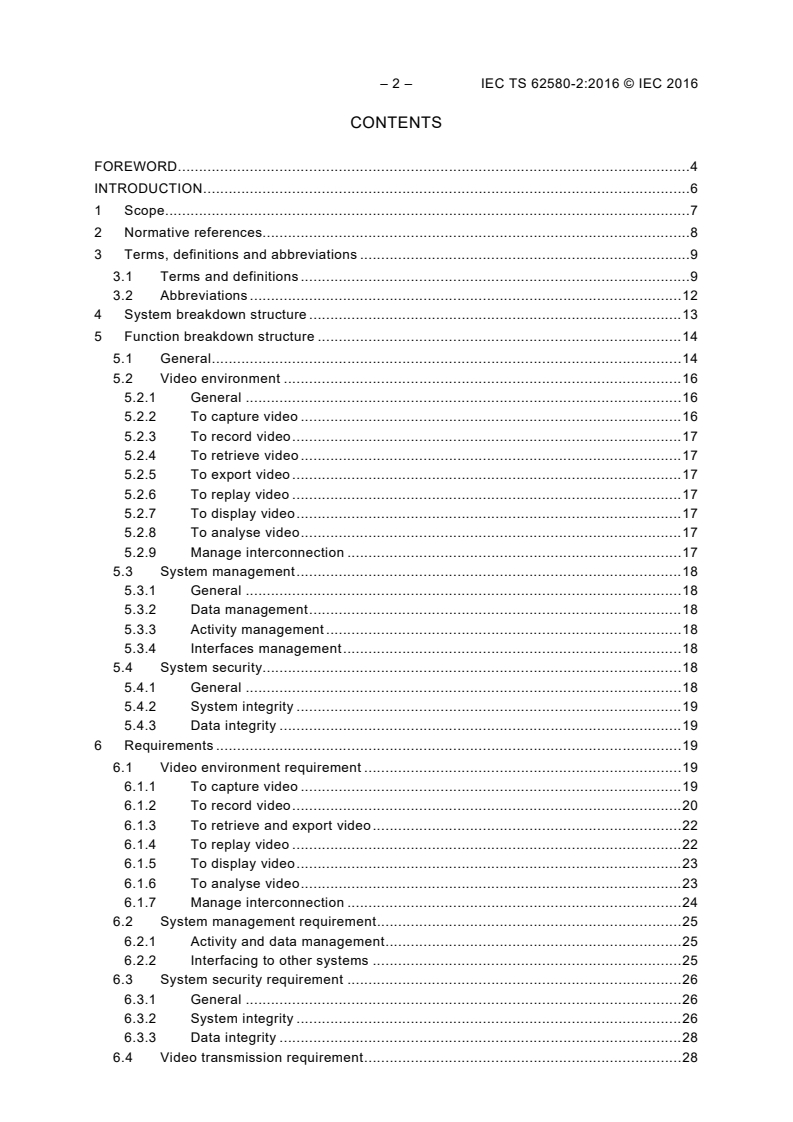
CONTENTS
FOREWORD . 4
INTRODUCTION . 6
1 Scope . 7
2 Normative references. 8
3 Terms, definitions and abbreviations . 9
3.1 Terms and definitions . 9
3.2 Abbreviations . 12
4 System breakdown structure . 13
5 Function breakdown structure . 14
5.1 General . 14
5.2 Video environment . 16
5.2.1 General . 16
5.2.2 To capture video . 16
5.2.3 To record video . 17
5.2.4 To retrieve video . 17
5.2.5 To export video . 17
5.2.6 To replay video . 17
5.2.7 To display video . 17
5.2.8 To analyse video . 17
5.2.9 Manage interconnection . 17
5.3 System management . 18
5.3.1 General . 18
5.3.2 Data management . 18
5.3.3 Activity management . 18
5.3.4 Interfaces management . 18
5.4 System security . 18
5.4.1 General . 18
5.4.2 System integrity . 19
5.4.3 Data integrity . 19
6 Requirements . 19
6.1 Video environment requirement . 19
6.1.1 To capture video . 19
6.1.2 To record video . 20
6.1.3 To retrieve and export video . 22
6.1.4 To replay video . 22
6.1.5 To display video . 23
6.1.6 To analyse video . 23
6.1.7 Manage interconnection . 24
6.2 System management requirement . 25
6.2.1 Activity and data management . 25
6.2.2 Interfacing to other systems . 25
6.3 System security requirement . 26
6.3.1 General . 26
6.3.2 System integrity . 26
6.3.3 Data integrity . 28
6.4 Video transmission requirement . 28
6.4.1 General . 28
6.4.2 Performance requirement . 28
6.4.3 Transmission protocol . 30
6.4.4 IP interoperability implementation based on Web service . 32
Annex A (informative) Use case of on-board video surveillance/CCTV system . 37
Bibliography . 47
Figure 1 – Relation of IEC TS 62580-2 with other standards . 8
Figure 2 – Typical structure of on-board video surveillance/CCTV system and interface
with other systems . 14
Figure 3 – Function blocks of an on-board video surveillance/CCTV system . 16
Figure 4 – On-board video surveillance/CCTV System topology . 24
Figure 5 – Building block of existing standards . 30
Figure 6 – Structure layer . 31
Figure 7 – Device discovery in a multiple consist case . 35
Figure 8 – Message sequence for client and TSP1 within the same consist . 35
Figure 9 – Message sequence for client and TSP2 within two consists . 36
Figure A.1 – Synthesis of use case 1 . 38
Figure A.2 – Synthesis of use case 2 . 40
Figure A.3 – Detailed Scenario 2 with SBS block . 41
Figure A.4 – Synthesis of use case . 42
Figure A.5 – Detailed Scenario 3 with SBS, two consists are displayed . 43
Figure A.6 – Detailed Scenario 4 with SBS . 44
Figure A.7 – Detailed Scenario 5 with SBS . 46
Table 1 – A function breakdown of on-board video surveillance/CCTV system . 15
Table 2 – Access level . 27
Table 3 – Data access . 28
Table 4 – Access to system logs . 28
Table 5 – Mandatory services given in IEC 62676-2-3 required for different functions . 33
– 4 – IEC TS 62580-2:2016 © IEC 2016
INTERNATIONAL ELECTROTECHNICAL COMMISSION
____________
ELECTRONIC RAILWAY EQUIPMENT – ON-BOARD
MULTIMEDIA AND TELEMATIC SUBSYSTEMS FOR RAILWAYS –
Part 2: Video surveillance/CCTV services
FOREWORD
1) The International Electrotechnical Commission (IEC) is a worldwide organization for standardization comprising
all national electrotechnical committees (IEC National Committees). The object of IEC is to promote
international co-operation on all questions concerning standardization in the electrical and electronic fields. To
this end and in addition to other activities, IEC publishes International Standards, Technical Specifications,
Technical Reports, Publicly Available Specifications (PAS) and Guides (hereafter referred to as “IEC
Publication(s)”). Their preparation is entrusted to technical committees; any IEC National Committee interested
in the subject dealt with may participate in this preparatory work. International, governmental and non-
governmental organizations liaising with the IEC also participate in this preparation. IEC collaborates closely
with the International Organization for Standardization (ISO) in accordance with conditions determined by
agreement between the two organizations.
2) The formal decisions or agreements of IEC on technical matters express, as nearly as possible, an international
consensus of opinion on the relevant subjects since each technical committee has representation from all
interested IEC National Committees.
3) IEC Publications have the form of recommendations for international use and are accepted by IEC National
Committees in that sense. While all reasonable efforts are made to ensure that the technical content of IEC
Publications is accurate, IEC cannot be held responsible for the way in which they are used or for any
misinterpretation by any end user.
4) In order to promote international uniformity, IEC National Committees undertake to apply IEC Publications
transparently to the maximum extent possible in their national and regional publications. Any divergence
between any IEC Publication and the corresponding national or regional publication shall be clearly indicated in
the latter.
5) IEC itself does not provide any attestation of conformity. Independent certification bodies provide conformity
assessment services and, in some areas, access to IEC marks of conformity. IEC is not responsible for any
services carried out by independent certification bodies.
6) All users should ensure that they have the latest edition of this publication.
7) No liability shall attach to IEC or its directors, employees, servants or agents including individual experts and
members of its technical committees and IEC National Committees for any personal injury, property damage or
other damage of any nature whatsoever, whether direct or indirect, or for costs (including legal fees) and
expenses arising out of the publication, use of, or reliance upon, this IEC Publication or any other IEC
Publications.
8) Attention is drawn to the Normative references cited in this publication. Use of the referenced publications is
indispensable for the correct application of this publication.
9) Attention is drawn to the possibility that some of the elements of this IEC Publication may be the subject of
patent rights. IEC shall not be held responsible for identifying any or all such patent rights.
The main task of IEC technical committees is to prepare International Standards. In
exceptional circumstances, a technical committee may propose the publication of a Technical
Specification when
• the required support cannot be obtained for the publication of an International Standard,
despite repeated efforts, or
• the subject is still under technical development or where, for any other reason, there is the
future but no immediate possibility of an agreement on an International Standard.
Technical Specifications are subject to review within three years of publication to decide
whether they can be transformed into International Standards.
IEC TS 62580-2, which is a Technical Specification, has been prepared by IEC technical
committee 9: Electrical equipment and systems for railways.
The text of this specification is based on the following documents:
Enquiry draft Report on voting
9/2112/DTS 9/2151A/RVC
Full information on the voting for the approval of this Technical Specification can be found in
the report on voting indicated in the above table.
This publication has been drafted in accordance with the ISO/IEC Directives, Part 2.
A list of all parts in the IEC 62580 series, published under the general title Electronic railway
equipment – On-board multimedia and telematic subsystems for railways, can be found on the
IEC website.
The committee has decided that the contents of this publication will remain unchanged until
the stability date indicated on the IEC website under "http://webstore.iec.ch" in the data
related to the specific publication. At this date, the publication will be
• transformed into an International standard,
• reconfirmed,
• withdrawn,
• replaced by a revised edition, or
• amended.
A bilingual version of this publication may be issued at a later date.
IMPORTANT – The 'colour inside' logo on the cover page of this publication indicates
that it contains colours which are considered to be useful for the correct
understanding of its contents. Users should therefore print this document using a
colour printer.
– 6 – IEC TS 62580-2:2016 © IEC 2016
INTRODUCTION
The IEC 62580 series defines on-board multimedia and telematic sub-systems (OMTS) for
railways, so as to achieve interoperability between subsystems in the same vehicle and
between subsystems in different vehicles of the same train.
The on-board video surveillance/CCTV system is a subsystem of OMTS, providing services
for on-board surveillance and the security issue of the train and passengers. It serves as the
crucial source of information for train operator, security organizations and first responders.
The basic system functionality contains video/audio capture, recording, retrieval, replay,
display, etc.
This Technical Specification will be useful to those responsible for establishing operational
requirements, writing specifications, selecting devices, installing, commissioning, using and
maintaining the on-board video surveillance/CCTV system. This specification is divided into
the following sections:
a) system breakdown: divides the on-board video surveillance/CCTV system into four
components based on their functionality, including video capture component, video
storage component, video display component and video analysis component;
b) function breakdown: gives the function list that system may offer from the user’s point of
view, and presents the function blocks of system according to the functional breakdown,
which includes video environment, system management and system security. Within video
environment, it contains the basic functions that system could provide, such as to capture
video, to record video, to retrieve video, to export video, to replay video, to display video,
to analyse video and manage interconnection;
c) requirements: describes the requirements of video environment, system management and
security as well as video transmission in which transmission performance, protocol and IP
interoperability implementation based on Web service have been introduced;
Some use cases of the on-board video surveillance/CCTV system are given in Annex A.
ELECTRONIC RAILWAY EQUIPMENT – ON-BOARD
MULTIMEDIA AND TELEMATIC SUBSYSTEMS FOR RAILWAYS –
Part 2: Video surveillance/CCTV services
1 Scope
This part of IEC 62580, which is a Technical Specification, specifies the on-board video
surveillance/CCTV system functionality and requirement for the purpose of interoperability
between components of on-board video surveillance/CCTV systems in the same vehicle and
subsystems in different vehicles of the same train, which means two levels of interoperability
are considered, one is interoperability between components and another is between
subsystems.
This specification gives guidelines for:
• system breakdown structure of the on-board video surveillance/CCTV system;
• function breakdown structure of the on-board video surveillance/CCTV system, and
• requirement of the on-board video surveillance/CCTV system.
This specification is applicable to any type of train, for example open trains, multiple unit
trains and closed trains.
As illustrated in Figure 1, this part of IEC 62580 provides video surveillance/CCTV services of
monitoring, recording and retrieval of data, etc. This specification follows the general OMTS
requirement defined in IEC 62580-1. The communication network of on-board video
surveillance/CCTV system is based on the network defined by the IEC 61375 series, in which
IEC 61375-2-5 and IEC 61375-3-4 define communication between and within consists,
respectively, IEC 61375-2-3 lays out the communication profile for the backbone which is
used for the train coupling, and IEC 61375-2-6 provides the support for the communication
between on-board system and ground wayside infrastructures. The general system
requirement of on-board video surveillance/CCTV system is developed based on IEC 62676
series with supplementing the special requirement for railway application. For interoperability
implementation between components of system and subsystems, this specification makes
reference to IEC 62676-2-3, which specifies a compliant IP video protocol and interface based
on Web services. Special requirements for railway, such as device discovery between
consists and within a consist, as well as network compliant to the IEC 61375 series are also
defined here. In addition, IEC 62676-4 gives recommendations and requirements for the
selection, planning, installation, commissioning, maintaining and testing for use in security
applications. Finally, the requirement of exported data of on-board video surveillance/CCTV
system is compliant with ISO 22311 if system is for security purpose.
___________
Under consideration.
– 8 – IEC TS 62580-2:2016 © IEC 2016
IEC
Figure 1 – Relation of IEC TS 62580-2 with other standards
2 Normative references
The following documents, in whole or in part, are normatively referenced in this document and
are indispensable for its application. For dated references, only the edition cited applies. For
undated references, the latest edition of the referenced document (including any
amendments) applies.
IEC 61375 (all parts), Electronic railway equipment – Train communication network (TCN)
IEC 61375-2-3:2015, Electronic railway equipment – Train Communication Network (TCN) –
Part 2-3: TCN communication profile
IEC 61375-2-5, Electronic railway equipment – Train Communication Network (TCN) –
Part 2-5: Ethernet Train Backbone
IEC 61375-2-6 , Electronic railway equipment – Train Communication Network (TCN) –
Part 2-6: On-board to ground communication
IEC 61375-3-4, Electronic railway equipment – Train Communication Network (TCN) –
Part 3-4: Ethernet Consist Network (ECN)
IEC 62580-1:2015, Electronic railway equipment – On-board multimedia and telematic
subsystems for railways – Part 1: General architecture
___________
Under consideration.
IEC 62676-1-1:2013, Video surveillance systems for use in security applications – Part 1-1:
System requirements – General
IEC 62676-1-2:2013, Video surveillance systems for use in security applications – Part 1-2:
System requirements – Performance requirements for video transmission
IEC 62676-2 (all parts), Video surveillance systems for use in security applications – Part 2:
Video transmission protocols
IEC 62676-2-3:2013, Video surveillance systems for use in security applications – Part 2-3:
Video transmission protocols – IP interoperability implementation based on Web services
ISO 22311, Societal security – Video-surveillance – Export interoperability
IEEE 802.1Q, IEEE Standard for Local and metropolitan area networks – Media Access
Control (MAC) Bridges and Virtual Bridged Local Area Networks
RFC 2326, Real Time Streaming Protocol (RTSP)
RFC 3016, RTP Payload Format for MPEG-4 Audio/ Visual Streams
RFC 3550, RTP: A Transport Protocol for Real-Time Applications
RFC 3551, RTP Profile for Audio and Video Conferences with Minimal Control
RFC 3984, RTP Payload Format for H.264 Video
FERRIS, C., KARMARKAR, A, YENDLURI, P., WS-I, Basic Profile Version 2.0 – Working
Group Draft, October 2007 (available at http://www.ws-i.org/Profiles/BasicProfile-
2_0(WGD).html).
3 Terms, definitions and abbreviations
3.1 Terms and definitions
For the purposes of this document, the terms and definitions given in IEC 61375-1,
IEC 62580-1 and IEC 62676-1-1, as well as the following apply.
3.1.1
alarm
warning of the presence of any hazard to life, property or the environment
3.1.2
camera IO
video capturing devices involved in analogue capture devices with Codec and IP capture
devices (digital capture devices)
3.1.3
compression
reduction in the number of bits used to represent an item of data
3.1.4
control plane
media control functions, such as device control, and media configuration commands
– 10 – IEC TS 62580-2:2016 © IEC 2016
3.1.5
consist
single vehicle or group of vehicles which are not separated during normal operation, and
which contains no, one or several consist networks
3.1.6
data identification
capability to find, retrieve or delete specific data without ambiguity
3.1.7
data integrity
condition when data has not been modified or altered from its source either maliciously or by
accident and in which data are maintained during any operation, such as transmission,
storage, and retrieval, in order to preserve data for their intended use
3.1.8
data management
management of user-actions, audio-/video-data and general information that are not part of
the activity management
3.1.9
event
incident in the real world
3.1.10
frame rate
numbers of frames per second
3.1.11
function
application process which exchanges messages with another application process
3.1.12
gateway
connection between different communication technologies
3.1.13
train location
specific location of a train defined by one of several means to represent its latitude, longitude,
altitude as well as relative coordinates in a rail network
3.1.14
image
visible representation of a frame as rectangular grid of pixels
3.1.15
image handling
any activity that transforms an input image into an output image with as little changes as
possible
3.1.16
incident
occurrence or activity of interest that on-board video surveillance/CCTV system is intended to
view or record and which may need a response by an operator
3.1.17
integrity
property of a system to recognize and to reject wrong data in case of malfunction of its parts
3.1.18
JPEG
common standard for image compression
Note 1 to entry: This common standard for image compression was defined by the Joint photographic experts
group.
3.1.19
latency time
time delay between the moment something is initiated, and the moment one of its effects
begins
Note 1 to entry: The time from the source sending a signal to the destination receiving it.
3.1.20
media plane
media stream, such as video, audio and metadata
3.1.21
network
set of possibly different communication systems which interchange information in a commonly
agreed way
3.1.22
open train
train composed of a set of consists, where the configuration may change during operation
Note 1 to entry: International UIC trains are an example of open trains.
3.1.23
operator
authorized user operating on-board video surveillance/CCTV system for intended purpose
3.1.24
receiver
electronic device which may receive signals from the physical medium
3.1.25
resolution
pixels per inch or number of pixels of a video-frame, monitoring device or print out
3.1.26
recording
container for a set of audio, video and metadata tracks
Note 1 to entry: A recording can hold one or more tracks. A track is viewed as an infinite timeline that holds data
at certain times.
3.1.27
service
capabilities and features of a component of subsystem or subsystem provided to a user
3.1.28
streaming
process of sending video over a network to allow instant operation as the video is received,
rather than requiring the entire file to be downloaded prior to operation
3.1.29
system security
protection of the system against failures as tampering, illegal access, vandalism.
– 12 – IEC TS 62580-2:2016 © IEC 2016
Note 1 to entry: The system security controls physical or electronic access to on-board video surveillance/CCTV
system or any component to prevent unauthorised access.
3.1.30
topology
possible cable interconnection and number of devices a given network supports
3.1.31
track
individual data channel consisting of video, audio or metadata
3.1.32
train communication network
TCN
data communication network for connecting programmable electronic devices on on-board rail
vehicles
3.1.33
train backbone
bus connecting the vehicles of a train and which conforms to the TCN protocols
3.2 Abbreviations
CCTV closed circuit television
DHTP dynamic host configuration protocol
CS consist switch
ECN ethernet consist network
ETB ethernet train backbone
ETBN ethernet train backbone node
HTTP hypertext transfer protocol
ICMP Internet control message protocol
IGMP Internet group management protocol
IP Internet protocol
I/O input/output
JPEG Joint photographic experts group
MCG mobile communication gateway
MPEG Moving picture experts group
NAT-ALG network address translation-application layer gateway
NTP network time protocol
OMTS on-board multimedia and telematic sub-systems
RTCP RTP control protocol
RTP real-time transport protocol
RTSP real time streaming protocol
SOAP simple object access protocol
SSL secure sockets layer
TBN train backbone network
TCMS train control and management system
TCN train communication network
TCP transmission control protocol
TLS transport layer security
UDP user datagram protocol
UIC International union of railways (the international railways operators association)
URI uniform resource identifier
URL uniform resource locator
WS Web service
WS-I Web service interoperability
XML extensible markup language
4 System breakdown structure
An on-board video surveillance/CCTV system usually consists of the capturing device,
storage devices, display devices, analysis devices, etc. A single device may perform more
than one functionality. For example, an IP camera can capture the image, handle it, and
transmit it via the network. It may also provide analysis function on the data and store it
temporally. Therefore, it is possible that an on-board video surveillance/CCTV system only
consists of a single camera at a minimum physically. Alternatively, other devices in an on-
board video surveillance/CCTV system can perform several functions. Thus, single physical
device and its requirements are not defined in this specification.
Instead, this specification defines the system components which perform a specific function
and may consist of one or several devices. In addition, the relationship between system
components is described in this specification.
The major components of an on-board video surveillance/CCTV system are classified into
four categories based on their functionality, including video capture component, video storage
component, video display component and video analysis component.
• Video capture component
A component (an IP network camera or analog camera with encoder device, for example)
that captures visual information, encodes it digitally, compresses it and transmits it over
the network to other components.
• Video storage component
A component (a network video recorder, for example) that records media and metadata
received from a video capture component over the network, to a storage medium, and also
enables operator to search and retrieve the stored data.
• Video display component
A component (an IP network video monitor, for example) that receives media data and
metadata from the network, and presents them.
• Video analysis component
A component that performs analysis on live data received from video capture component
or on recorded data from video storage component.
Each component can perform both the service consumer and service provider depending on
its capabilities. The video display and analysis component can be regarded as the service
consumer of video capture and storage component. Besides the service exchanges between
these components within an on-board video surveillance/CCTV system, the system also
provides interfaces for other external system such as TCMS, OMTS and ground CCTV, as
well as user such as train operator or security organization. For instance, it communicates
with TCMS for obtaining time and location, and it enables the driver to visually detect the
passengers and security staff to retrieve the recorded data when necessary. Figure 2 shows
the typical structure of an on-board video surveillance/CCTV System and interface with other
systems.
– 14 – IEC TS 62580-2:2016 © IEC 2016
IEC
Figure 2 – Typical structure of on-board video surveillance/CCTV
system and interface with other systems
5 Function breakdown structure
5.1 General
From the user’s point of view, the function of on-board video surveillance/CCTV system may
mainly include:
• to monitor and investigate the operational issues
The operational issues may include train (or devices on the train) fault, track anomalies,
driver behaviours, pantograph failure, accidents, etc. This function brings out the
significant safety and performance benefits and can be used to assist in determining the
responsibilities, fault prevention, trouble-shooting and analysis.
• to assist the driver during the train dispatch
This function could help the driver to determine if there is a potential risk of accident and
to respond quickly to the potential accident, such as persons running to the train, entering
the space between the train and platform, trapped by the door or holding on the train side.
In addition, this function could be associated with the passenger alarm (if a passenger
alarm related system exists). When passenger alarm is triggered, the on-board video
surveillance/CCTV system could carry out the corresponding functions, such as
automatically displaying and recording accident images.
• to protect the safety of passenger and organization well-being
To monitor the area of passenger compartment such as seating area, walkway, entrances
and exits, this function could protect against the threats to the well-being of passenger
and organization, and be usually associated with the passenger alarm system.
The above mentioned functions are the most common application and are not exhaustive. The
function 3 listed here is more related to the security purpose. Based on the application, a
function breakdown of the on-board video surveillance/CCTV system is given in Table 1.
Table 1 – A function breakdown of on-board video surveillance/CCTV system
st nd rd
1 level function 2 level function 3 level function
1 to monitor and investigate the 1.1 front-view monitoring: live videos 1.1.1 to capture video
operational issues from front-view cameras recording the
1.1.2 to record video
image of forward condition of the train
such as the track, signal, level
1.1.3 to retrieve video
crossing, speed limits, etc.;
1.1.4 to replay video
1.1.5 to export video
1.2 rear-view monitoring: to capture The same as above
and record the live videos from rear
cameras, including platform and other
rail infrastructures;
1.3 cab interior monitoring: to capture The same as above
and record the driver behaviours,
panel, the ambient sound, etc.;
1.4 interior monitoring: to monitor the The same as above
status of train or on-board devices,
for example cameras on the roof of
the vehicle for monitoring the
pantograph, especially the contact
between the pantograph and the
overhead line; or cameras for the
special on-board devices such as the
converter cabinet;
2 to assist the driver for train dispatch 2.1 to enable the driver to visually 2.1.1 to capture video
detect persons or passenger related
2.1.2 to display video
items that are anywhere within the
train dispatch corridor, for example,
2.1.3 to record video
rear-view mirror and side cameras
betting on the door for assisting
driver during the opening and the
closing of the door;
2.2 passenger alarm and accident The same as above
management: when emergency alarm
is triggered, video from the specified
cameras would be recorded for few
seconds/minutes before and after the
alarm for offline analysis by operators
or the police; and displayed to the
drivers to help them in the alarm
management.
3 to protect the safety of passenger 3.1 to have the visual and audio The same as above
and organization well-being evidence into passenger
compartment;
3.2 passenger alarm and accident The same as above
management (see 2.2 above).
NOTE The above mentioned functions of the on-board video surveillance/CCTV system are summarized from the
user’s point of view and some functions may be missing. The user may choose to implement a set of the functions
based on the agreement between operators and providers.
rd
From the function breakdown structure, it can be seen that there are a number of basic functions at 3 level for
rd nd
implementing the higher level functionality. A 3 level function could be used in different 2 level function, for
example, to capture video is used in both front view monitoring and cab monitoring for different purpose, but they
applies the same scheme and interface or service. Meanwhile, for a certain functionality such as to help driver
during train dispatch, besides video capture, record and display, some operators could ask for video analysis from
rd
the device. Therefore, other 3 level function could be used depending on the operator’s functional requirement. In
other word, this function breakdown table only shows the basic functions which are commonly used. Each function
is assigned from the corresponding component, and could be performed by one or several devices which
physically make up the on-board video surveillance/CCTV system.
According to the functional breakdown, an on-board video surveillance/CCTV system can be
presented as functional blocks which portray the various parts and functions of the system for
realizing above-mentioned functions (see Figure 3).
– 16 – IEC TS 62580-2:2016 © IEC 2016
IEC
NOTE The functional block of on-board video surveillance/CCTV system in this specification is basically in
accordance with IEC 62676-1-1:2013. This specification replaces the concept of image handling which is given in
Figure 1 of IEC 62676-1-1:2013 by using more detailed function classification of video environment, including
record, display, analysis, retrieve, export and replay, without being in contradiction with IEC 62676-1-1:2013.
Figure 3 – Function blocks of an on-board video surveillance/CCTV system
5.2 Video environment
5.2.1 General
The entities consisting of the on-board video surveillance/CCTV system devices and
interconnections between these devices can be described as video environment. The video
environment is further divided into eight functions:
• to capture video;
• to record video;
• to retrieve video;
• to export video;
• to replay video;
• to display video;
• to analyse video; and
• to manage interconnection (transmission of media and control signals).
The above-mentioned functions may reside in various hardware or software components of
the system, and only logically match up with the four components defined in Clause 4, rather
than necessarily always mapping to separate devices. This is because several functions can
be performed by a single device.
5.2.2 To capture video
The purpose of video capture is to generate an image and audio of the interior or exterior
scene of the vehicle. The video capture component captures the image of scene, encodes and
compresses it, and delivers it to other components for further handling. The video component
produces the output image data in digital format (such as ITU-T H.264) to facilitate video
display, analysis, record, etc.
5.2.3 To record video
The function stores the video images (as well as audio or metadata) received from video
capture component over a network on a permanent storage medium in a specified format for
later retrieval.
5.2.4 To retrieve video
This function enables the client to search and obtain the video images (as well as audio or
metadata) of interest stored on the storage medium. There are many ways to retrieve the data
such as to replace and convey the storage medium to ground facility, or download the video
sequence through wireless. The method of video retrieve is not discussed in this specification.
5.2.5 To export video
A single image or video sequence could be exported from the storage medium of the system
to a suitable digital storage medium for later replay or analysis.
5.2.6 To replay video
To replay video provides a mechanism for playback of the stored and retrieved video, audio
and metadata, which may also be used to download the data from storage medium for data
export.
5.2.7 To display video
Video information can be viewed in the form of either image or video on monitor screens.
Video display component receives the video information, decodes it and presents it. One or
several video images may be displayed simultaneously. Additionally, video display component
may also enable the audio data and metadata to be presented.
5.2.8 To analyse video
This function enables to extract information from the live or recorded video data for image
analysis. In addition to the video image, the analysis function also uses other data as inputs,
for example audio stream, and metadata.
Analysis could be utilized for several purposes, such as:
• proving the integrity of the system (e.g. camera position);
• interpreting the captured scene (e.g. alarming areas incursion);
• analysing the live video to generate an event or an alarm (e.g. arc discharge of
pantograph or smoke detection);
• providing a decision aid; and
• functional performance evaluation.
5.2.9 Manage interconnection
Interconnection enables all media and control data signals to be exchanged within
components of on-board video surveillance/CCTV system, between subsystems of OMTS as
well as between other systems on the train. The interconnection is not only dedicated to
OMTS, namely, shared with other systems.
– 18 – IEC TS 62580-2:2016 © IEC 2016
5.3 System management
5.3.1 General
The system management of an on-board video surveillance/CCTV system consists of two
...