

IEC 60310:2026
(Main)Railway applications - Transformers and inductors on board rolling stock
General Information
- Abstract
IEC 60310:2026 specifies the terms and definitions, classification, service conditions, characteristics and test methods for transformers and inductors on board rolling stock. This document is applicable to traction and auxiliary power transformers installed on board rolling stock and to the various types of power inductors inserted in the traction and auxiliary circuits of rolling stock, of dry or liquid-immersed design. This document is also applicable to the traction transformers of three-phase AC line-side powered vehicles and to the transformers inserted in the single-phase or polyphase auxiliary circuits of vehicles, after agreement between purchaser and manufacturer. This document does not apply to instrument transformers, transformers of a rated output below 1 kVA single-phase or 5 kVA poly-phase, and inductors of a rated output below 1 kVAR single-phase or 5 kVAR poly-phase on board rolling stock. This document does not cover accessories such as tap changers, resistors, heat exchangers, fans, etc., intended for mounting on transformers or inductors, which are tested separately according to the relevant rules. This fifth edition cancels and replaces the fourth edition published in 2016. This edition constitutes a technical revision.
This edition includes the following significant technical changes with respect to the previous edition:
a) typical circuits for transformer and inductors are added;
b) letter symbols for cooling methods are added;
c) dielectric test table is modified;
d) subclauses for the tests of transformers and inductors are restructured;
e) temperature test for dry type transformer and dry type inductors are separated in different subclauses;
f) requirements for shock and vibration tests are updated according to IEC 61373:20.
- Status
- Published
- Publication Date
- 12-Apr-2026
- Technical Committee
- TC 9 - Electrical equipment and systems for railways
- Drafting Committee
- MT 60310 - TC 9/MT 60310
- Current Stage
- PPUB - Publication issued
- Start Date
- 13-Apr-2026
- Completion Date
- 13-Mar-2026
Buy Documents
IEC 60310:2026 - Railway applications - Transformers and inductors on board rolling stock
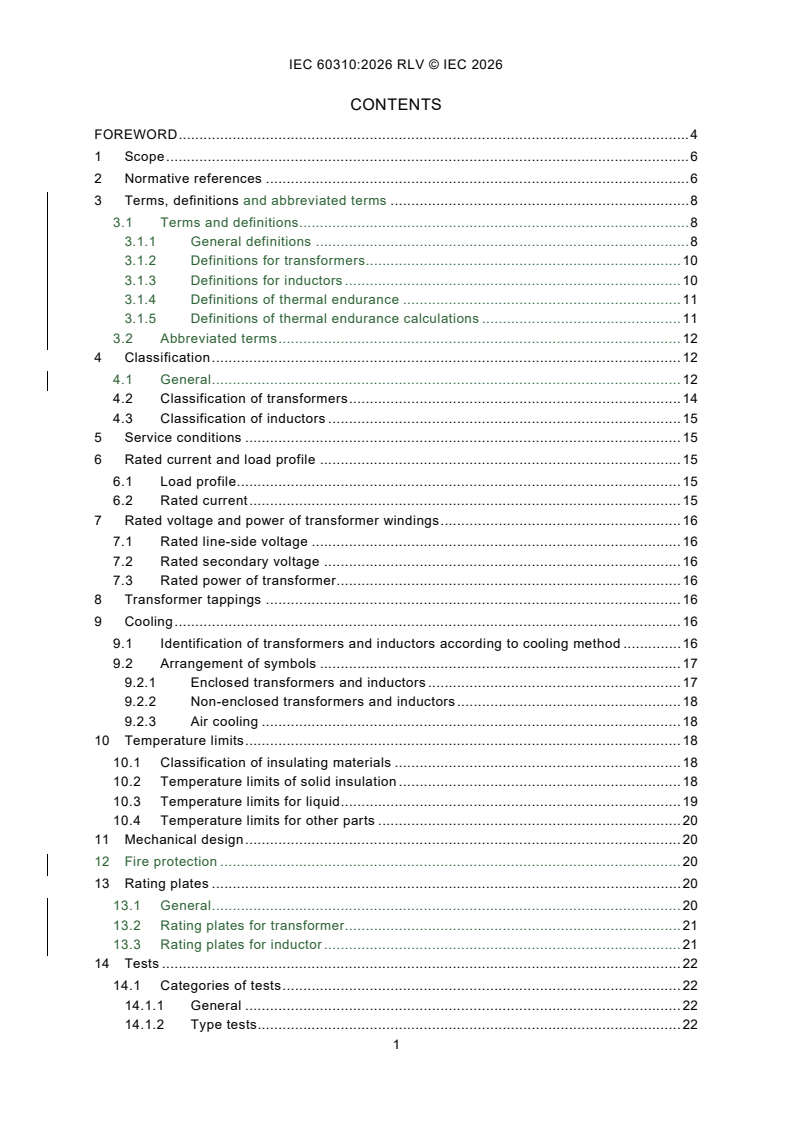
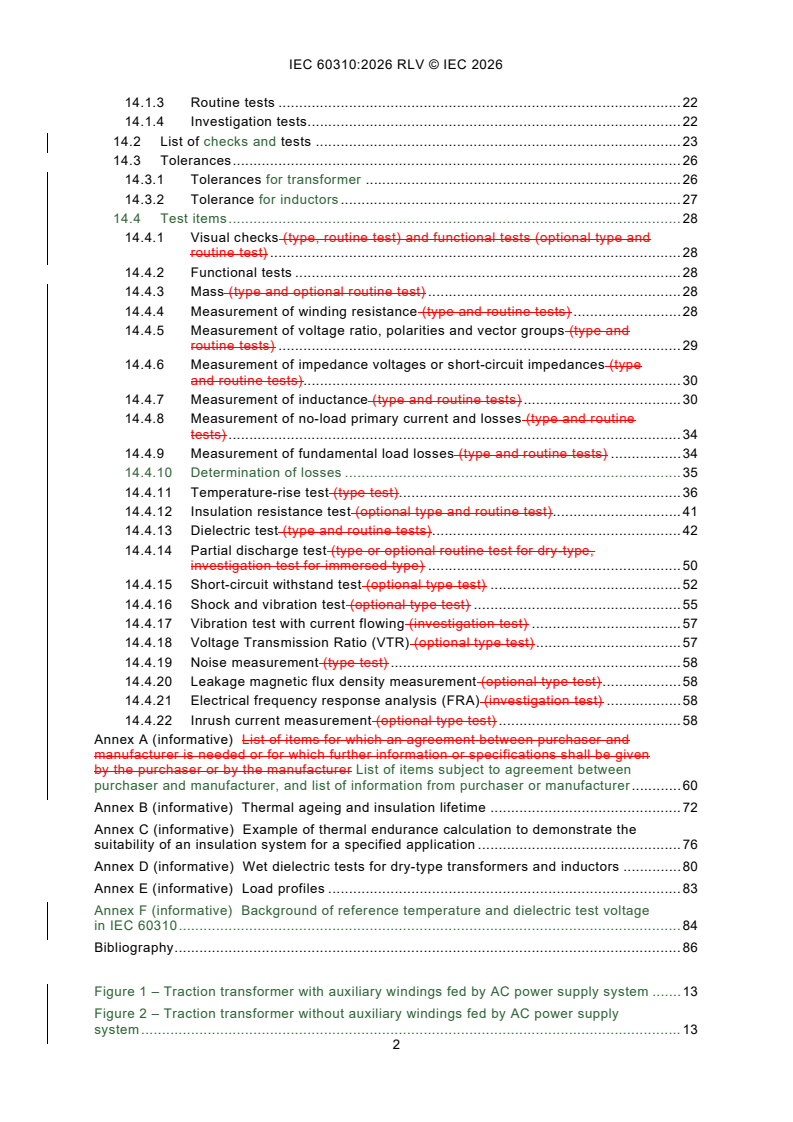
REDLINE IEC 60310:2026 RLV - Railway applications - Transformers and inductors on board rolling stock
Overview
IEC 60310:2026 is the internationally recognized standard developed by the International Electrotechnical Commission (IEC) for railway applications, specifically governing the requirements for transformers and inductors onboard rolling stock. This standard outlines terminology, classification, service conditions, performance characteristics, and test methods for both traction and auxiliary transformers and inductors used within train vehicles. Both dry and liquid-immersed designs are covered, ensuring uniformity and safety across a diverse range of rolling stock electrical equipment.
The fifth edition introduces significant technical updates, including revised test methods and new guidance for both transformers and inductors. By adhering to IEC 60310:2026, railway manufacturers, integrators, and operators promote interoperability, reliability, and safety of electrical systems on board vehicles.
Key Topics
Scope and Definitions: IEC 60310:2026 details vocabulary, classifications, and service conditions for power transformers and inductors installed in rolling stock. It addresses mainline, urban, and regional trains, as well as specialized vehicles with three-phase AC or multi-phase auxiliary circuits.
Exclusions: The standard does not apply to instrument transformers, smaller transformers (below 1 kVA for single-phase or 5 kVA for poly-phase), and inductors below the same capacity. Accessories mounted on transformers/inductors such as tap changers and fans are covered by other standards.
Technical Revisions in 2026 Edition:
- Addition of typical circuit diagrams for transformers and inductors
- Introduction of letter symbols for various cooling methods
- Updated dielectric test tables
- Restructuring of test methodology subclauses
- Separation of temperature test requirements for dry-type transformers and inductors
- Revised shock and vibration test criteria, harmonized with IEC 61373
Service and Performance Requirements:
- Guidelines for rated current, voltage, and load profile specification
- Cooling method identification and associated symbol arrangement
- Temperature limits for components, with separate attention to solid and liquid insulation
- Requirements for mechanical design and fire protection measures
- Rating plate data for clear identification
Test Procedures:
- Type tests, routine tests, and investigative testing procedures
- Detailed tolerances, checklists, and measurement methods (resistance, inductance, loss, insulation, noise, etc.)
- Temperature-rise, dielectric, partial discharge, and withstand tests for validating equipment durability and electrical safety
Applications
Traction Transformers: Essential for supplying power to traction circuits in all types of rail vehicles, including mainline locomotives and EMUs.
Auxiliary Transformers: Used for powering onboard electrical systems separate from traction, such as lighting, HVAC, and passenger amenities.
Power Inductors: Installed in both traction and auxiliary circuits to manage load fluctuations, filter harmonics, and improve power quality.
Three-Phase and Polyphase Systems: The standard is applicable to vehicles powered by three-phase AC as well as those with complex auxiliary circuits, following mutual agreement between supplier and customer.
Safety and Reliability: Ensures that all transformers and inductors onboard comply with rigorous performance, safety, and durability benchmarks, supporting dependable train operation.
Related Standards
For comprehensive railway electrical system compliance, consult the following related IEC and ISO standards:
- IEC 60076 Series – Power Transformers (General, Temperature Rise, Insulation, Reactors)
- IEC 60850 – Railway Applications: Supply Voltages of Traction Systems
- IEC 61373 – Railway Applications: Rolling Stock Equipment - Shock and Vibration Tests
- IEC 62498-1 – Environmental Conditions for Equipment Onboard Rolling Stock
- ISO 3746, ISO 9614 – Acoustics: Sound Power Levels and Sound Intensity Measurements
Ensuring transformers and inductors meet the requirements of IEC 60310:2026 and related standards is key to safe, interoperable, and efficient railway systems in an increasingly interconnected transport sector.
Relations
- Effective Date
- 05-Jul-2024
- Revises
IEC 60310:2016 - Railway applications - Traction transformers and inductors on board rolling stock - Effective Date
- 26-Jan-2024
Buy Documents
IEC 60310:2026 - Railway applications - Transformers and inductors on board rolling stock
REDLINE IEC 60310:2026 RLV - Railway applications - Transformers and inductors on board rolling stock
Get Certified
Connect with accredited certification bodies for this standard

IRIS Certification (UNIFE)
International Railway Industry Standard certification.

TÜV SÜD Rail GmbH
TÜV SÜD railway certification services.

Bureau Veritas Railway Certification
Railway and transportation certification.
Sponsored listings
Frequently Asked Questions
IEC 60310:2026 is a standard published by the International Electrotechnical Commission (IEC). Its full title is "Railway applications - Transformers and inductors on board rolling stock". This standard covers: IEC 60310:2026 specifies the terms and definitions, classification, service conditions, characteristics and test methods for transformers and inductors on board rolling stock. This document is applicable to traction and auxiliary power transformers installed on board rolling stock and to the various types of power inductors inserted in the traction and auxiliary circuits of rolling stock, of dry or liquid-immersed design. This document is also applicable to the traction transformers of three-phase AC line-side powered vehicles and to the transformers inserted in the single-phase or polyphase auxiliary circuits of vehicles, after agreement between purchaser and manufacturer. This document does not apply to instrument transformers, transformers of a rated output below 1 kVA single-phase or 5 kVA poly-phase, and inductors of a rated output below 1 kVAR single-phase or 5 kVAR poly-phase on board rolling stock. This document does not cover accessories such as tap changers, resistors, heat exchangers, fans, etc., intended for mounting on transformers or inductors, which are tested separately according to the relevant rules. This fifth edition cancels and replaces the fourth edition published in 2016. This edition constitutes a technical revision. This edition includes the following significant technical changes with respect to the previous edition: a) typical circuits for transformer and inductors are added; b) letter symbols for cooling methods are added; c) dielectric test table is modified; d) subclauses for the tests of transformers and inductors are restructured; e) temperature test for dry type transformer and dry type inductors are separated in different subclauses; f) requirements for shock and vibration tests are updated according to IEC 61373:20.
IEC 60310:2026 specifies the terms and definitions, classification, service conditions, characteristics and test methods for transformers and inductors on board rolling stock. This document is applicable to traction and auxiliary power transformers installed on board rolling stock and to the various types of power inductors inserted in the traction and auxiliary circuits of rolling stock, of dry or liquid-immersed design. This document is also applicable to the traction transformers of three-phase AC line-side powered vehicles and to the transformers inserted in the single-phase or polyphase auxiliary circuits of vehicles, after agreement between purchaser and manufacturer. This document does not apply to instrument transformers, transformers of a rated output below 1 kVA single-phase or 5 kVA poly-phase, and inductors of a rated output below 1 kVAR single-phase or 5 kVAR poly-phase on board rolling stock. This document does not cover accessories such as tap changers, resistors, heat exchangers, fans, etc., intended for mounting on transformers or inductors, which are tested separately according to the relevant rules. This fifth edition cancels and replaces the fourth edition published in 2016. This edition constitutes a technical revision. This edition includes the following significant technical changes with respect to the previous edition: a) typical circuits for transformer and inductors are added; b) letter symbols for cooling methods are added; c) dielectric test table is modified; d) subclauses for the tests of transformers and inductors are restructured; e) temperature test for dry type transformer and dry type inductors are separated in different subclauses; f) requirements for shock and vibration tests are updated according to IEC 61373:20.
IEC 60310:2026 is classified under the following ICS (International Classification for Standards) categories: 45.060.01 - Railway rolling stock in general. The ICS classification helps identify the subject area and facilitates finding related standards.
IEC 60310:2026 has the following relationships with other standards: It is inter standard links to IEC 60310:2016/COR1:2018, IEC 60310:2016. Understanding these relationships helps ensure you are using the most current and applicable version of the standard.
IEC 60310:2026 is available in PDF format for immediate download after purchase. The document can be added to your cart and obtained through the secure checkout process. Digital delivery ensures instant access to the complete standard document.
Standards Content (Sample)
IEC 60310 ®
Edition 5.0 2026-04
INTERNATIONAL
STANDARD
Railway applications - Transformers and inductors on board rolling stock
ICS 45.060.01 ISBN 978-2-8327-1073-9
All rights reserved. Unless otherwise specified, no part of this publication may be reproduced or utilized in any form or
by any means, electronic or mechanical, including photocopying and microfilm, without permission in writing from either
IEC or IEC's member National Committee in the country of the requester. If you have any questions about IEC copyright
or have an enquiry about obtaining additional rights to this publication, please contact the address below or your local
IEC member National Committee for further information.
IEC Secretariat Tel.: +41 22 919 02 11
3, rue de Varembé info@iec.ch
CH-1211 Geneva 20 www.iec.ch
Switzerland
About the IEC
The International Electrotechnical Commission (IEC) is the leading global organization that prepares and publishes
International Standards for all electrical, electronic and related technologies.
About IEC publications
The technical content of IEC publications is kept under constant review by the IEC. Please make sure that you have the
latest edition, a corrigendum or an amendment might have been published.
IEC publications search - IEC Products & Services Portal - products.iec.ch
webstore.iec.ch/advsearchform Discover our powerful search engine and read freely all the
The advanced search enables to find IEC publications by a publications previews, graphical symbols and the glossary.
variety of criteria (reference number, text, technical With a subscription you will always have access to up to date
committee, …). It also gives information on projects, content tailored to your needs.
replaced and withdrawn publications.
Electropedia - www.electropedia.org
The world's leading online dictionary on electrotechnology,
IEC Just Published - webstore.iec.ch/justpublished
Stay up to date on all new IEC publications. Just Published containing more than 22 500 terminological entries in English
details all new publications released. Available online and and French, with equivalent terms in 25 additional languages.
once a month by email. Also known as the International Electrotechnical Vocabulary
(IEV) online.
IEC Customer Service Centre - webstore.iec.ch/csc
If you wish to give us your feedback on this publication or
need further assistance, please contact the Customer
Service Centre: sales@iec.ch.
CONTENTS
FOREWORD . 5
1 Scope . 7
2 Normative references . 7
3 Terms, definitions and abbreviated terms . 8
3.1 Terms and definitions. 9
3.1.1 General definitions . 9
3.1.2 Definitions for transformers. 11
3.1.3 Definitions for inductors . 11
3.1.4 Definitions of thermal endurance . 12
3.1.5 Definitions of thermal endurance calculations . 12
3.2 Abbreviated terms . 13
4 Classification . 13
4.1 General . 13
4.2 Classification of transformers . 15
4.3 Classification of inductors . 16
5 Service conditions . 16
6 Rated current and load profile . 16
6.1 Load profile . 16
6.2 Rated current . 16
7 Rated voltage and power of transformer windings . 17
7.1 Rated line-side voltage . 17
7.2 Rated secondary voltage . 17
7.3 Rated power of transformer. 17
8 Transformer tappings . 17
9 Cooling . 17
9.1 Identification of transformers and inductors according to cooling method . 17
9.2 Arrangement of symbols . 18
9.2.1 Enclosed transformers and inductors . 18
9.2.2 Non-enclosed transformers and inductors . 19
9.2.3 Air cooling . 19
10 Temperature limits . 19
10.1 Classification of insulating materials . 19
10.2 Temperature limits of solid insulation . 19
10.3 Temperature limits for liquid . 20
10.4 Temperature limits for other parts . 21
11 Mechanical design . 21
12 Fire protection . 21
13 Rating plates . 21
13.1 General . 21
13.2 Rating plates for transformer. 22
13.3 Rating plates for inductor . 22
14 Tests . 22
14.1 Categories of tests . 22
14.1.1 General . 22
14.1.2 Type tests. 23
14.1.3 Routine tests . 23
14.1.4 Investigation tests. 23
14.2 List of checks and tests . 23
14.3 Tolerances . 25
14.3.1 Tolerances for transformer . 25
14.3.2 Tolerance for inductors . 26
14.4 Test items . 26
14.4.1 Visual checks . 26
14.4.2 Functional tests . 26
14.4.3 Mass . 27
14.4.4 Measurement of winding resistance . 27
14.4.5 Measurement of voltage ratio, polarities and vector groups. 28
14.4.6 Measurement of impedance voltages or short-circuit impedances . 28
14.4.7 Measurement of inductance . 29
14.4.8 Measurement of no-load primary current and losses . 32
14.4.9 Measurement of fundamental load losses . 33
14.4.10 Determination of losses . 33
14.4.11 Temperature-rise test . 34
14.4.12 Insulation resistance test . 39
14.4.13 Dielectric test . 40
14.4.14 Partial discharge test . 46
14.4.15 Short-circuit withstand test . 48
14.4.16 Shock and vibration test . 51
14.4.17 Vibration test with current flowing . 52
14.4.18 Voltage Transmission Ratio (VTR) . 53
14.4.19 Noise measurement . 54
14.4.20 Leakage magnetic flux density measurement . 54
14.4.21 Electrical frequency response analysis (FRA) . 54
14.4.22 Inrush current measurement . 54
Annex A (informative) List of items subject to agreement between purchaser and
manufacturer, and list of information from purchaser or manufacturer . 56
A.1 Items subject to agreement between purchaser and manufacturer . 56
A.1.1 Transformers and inductors . 56
A.1.2 Transformers . 57
A.1.3 Inductors . 58
A.2 Information from purchaser to manufacturer . 59
A.2.1 Transformers and inductors . 59
A.2.2 Transformers . 60
A.2.3 Inductors . 60
A.3 Information from manufacturer to purchaser . 60
A.3.1 Transformers and inductors . 60
A.3.2 Transformers . 61
A.3.3 Inductors . 61
Annex B (informative) Thermal ageing and insulation lifetime . 62
B.1 Insulation lifetime and thermal ageing . 62
B.2 Special considerations for thermal design and test. 63
B.2.1 General . 63
B.2.2 Cooling medium temperature at the external interface . 63
B.2.3 Rated current. 63
B.2.4 Temperature rise test of a dry-type transformer or inductor . 64
B.3 Thermal conformity of the insulation system . 64
B.4 End of life criterion . 64
Annex C (informative) Example of thermal endurance calculation to demonstrate the
suitability of an insulation system for a specified application . 65
C.1 Preliminary . 65
C.2 Example 1 – Temperature limits for a dry-type transformer or inductor . 65
C.3 Example 2 – Thermal endurance calculation . 65
C.3.1 General . 65
C.3.2 Operating conditions to be provided by the purchaser . 66
C.3.3 Thermal endurance characteristics to be provided by the manufacturer . 66
C.3.4 Temperature rise test results . 66
C.3.5 Calculations . 67
Annex D (informative) Wet dielectric tests for dry-type transformers and inductors . 69
D.1 General . 69
D.2 Wet test 1 (optional type test or optional routine test): short soaking . 69
D.3 Wet test 2 (investigation test or optional type test): misting . 70
D.4 Wet test 3 (investigation test): thermal shock – long soaking – misting . 70
D.4.1 General . 70
D.4.2 Temperature conditioning . 70
D.4.3 Thermal shock . 70
D.4.4 Dielectric test . 70
D.5 Common test procedure and criteria for wet dielectric tests . 70
Annex E (informative) Load profiles . 72
Annex F (informative) Background of reference temperature and dielectric test voltage
in IEC 60310 . 73
F.1 General . 73
F.2 Reference temperature . 73
F.3 Dielectric test voltage . 73
Bibliography . 75
Figure 1 – Traction transformer with auxiliary windings fed by AC power supply system . 14
Figure 2 – Traction transformer without auxiliary windings fed by AC power supply
system . 14
Figure 3 – DC locomotive typical circuit diagram . 15
Figure 4 – Energy storage system typical circuit diagram . 15
Figure 5 – Examples of set up for induced voltage withstanding tests . 43
Figure 6 – Examples of set up for separate source voltage withstanding tests . 43
Figure 7 – Examples of impulse test connections for traction, inductor and auxiliary
transformers . 44
Figure 8 – Partial discharge test: voltage versus time . 47
Figure 9 – Configurations for VTR test . 53
Figure 10 – Example of test circuit . 55
Table 1 – Letter symbols for cooling method . 18
Table 2 – Order of symbols . 18
Table 3 – Temperature limits of solid insulation . 20
Table 4 – Temperature limits for liquid . 20
Table 5 – List of checks and tests to be made on transformers or inductors . 24
Table 6 – Tolerances for transformer . 25
Table 7 – Tolerances for inductors . 26
Table 8 – Reference temperatures . 27
Table 9 – Dielectric test voltage . 41
Table 10 – Test method of voltage between terminals withstand test . 45
Table 11 – Partial discharge measurements. 47
Table C.1 – Temperature limits and expected lifetime for a dry-type transformer or
inductor (examples) . 65
Table C.2 – Load cycle histogram . 66
Table C.3 – Temperature histogram . 66
Table C.4 – Temperature rise test results . 67
Table C.5 – Thermal endurance calculation . 67
Table C.6 – Equivalent current and temperatures . 68
Table F.1 – Reference temperatures in IEC 60310:2016 . 73
Table F.2 – Dielectric test voltage in IEC 60310:2016 . 74
INTERNATIONAL ELECTROTECHNICAL COMMISSION
____________
Railway applications -
Transformers and inductors on board rolling stock
FOREWORD
1) The International Electrotechnical Commission (IEC) is a worldwide organization for standardization comprising
all national electrotechnical committees (IEC National Committees). The object of IEC is to promote international
co-operation on all questions concerning standardization in the electrical and electronic fields. To this end and
in addition to other activities, IEC publishes International Standards, Technical Specifications, Technical Reports,
Publicly Available Specifications (PAS) and Guides (hereafter referred to as "IEC Publication(s)"). Their
preparation is entrusted to technical committees; any IEC National Committee interested in the subject dealt with
may participate in this preparatory work. International, governmental and non-governmental organizations liaising
with the IEC also participate in this preparation. IEC collaborates closely with the International Organization for
Standardization (ISO) in accordance with conditions determined by agreement between the two organizations.
2) The formal decisions or agreements of IEC on technical matters express, as nearly as possible, an international
consensus of opinion on the relevant subjects since each technical committee has representation from all
interested IEC National Committees.
3) IEC Publications have the form of recommendations for international use and are accepted by IEC National
Committees in that sense. While all reasonable efforts are made to ensure that the technical content of IEC
Publications is accurate, IEC cannot be held responsible for the way in which they are used or for any
misinterpretation by any end user.
4) In order to promote international uniformity, IEC National Committees undertake to apply IEC Publications
transparently to the maximum extent possible in their national and regional publications. Any divergence between
any IEC Publication and the corresponding national or regional publication shall be clearly indicated in the latter.
5) IEC itself does not provide any attestation of conformity. Independent certification bodies provide conformity
assessment services and, in some areas, access to IEC marks of conformity. IEC is not responsible for any
services carried out by independent certification bodies.
6) All users should ensure that they have the latest edition of this publication.
7) No liability shall attach to IEC or its directors, employees, servants or agents including individual experts and
members of its technical committees and IEC National Committees for any personal injury, property damage or
other damage of any nature whatsoever, whether direct or indirect, or for costs (including legal fees) and
expenses arising out of the publication, use of, or reliance upon, this IEC Publication or any other IEC
Publications.
8) Attention is drawn to the Normative references cited in this publication. Use of the referenced publications is
indispensable for the correct application of this publication.
9) IEC draws attention to the possibility that the implementation of this document may involve the use of (a)
patent(s). IEC takes no position concerning the evidence, validity or applicability of any claimed patent rights in
respect thereof. As of the date of publication of this document, IEC had not received notice of (a) patent(s), which
may be required to implement this document. However, implementers are cautioned that this may not represent
the latest information, which may be obtained from the patent database available at https://patents.iec.ch. IEC
shall not be held responsible for identifying any or all such patent rights.
IEC 60310 has been prepared by IEC technical committee 9: Electrical equipment and systems
for railways. It is an International Standard.
This fifth edition cancels and replaces the fourth edition published in 2016. This edition
constitutes a technical revision.
This edition includes the following significant technical changes with respect to the previous
edition:
a) typical circuits for transformer and inductors are added;
b) letter symbols for cooling methods are added;
c) dielectric test table is modified;
d) subclauses for the tests of transformers and inductors are restructured;
e) temperature test for dry type transformer and dry type inductors are separated in different
subclauses;
f) requirements for shock and vibration tests are updated according to IEC 61373:20—.
The text of this International Standard is based on the following documents:
Draft Report on voting
9/3296/FDIS 9/3322/RVD
Full information on the voting for its approval can be found in the report on voting indicated in
the above table.
The language used for the development of this International Standard is English.
This document was drafted in accordance with ISO/IEC Directives, Part 2, and developed in
accordance with ISO/IEC Directives, Part 1 and ISO/IEC Directives, IEC Supplement, available
at www.iec.ch/members_experts/refdocs. The main document types developed by IEC are
described in greater detail at www.iec.ch/publications.
The committee has decided that the contents of this document will remain unchanged until the
stability date indicated on the IEC website under webstore.iec.ch in the data related to the
specific document. At this date, the document will be
– reconfirmed,
– withdrawn, or
– revised.
1 Scope
This document specifies the terms and definitions, classification, service conditions,
characteristics and test methods for transformers and inductors on board rolling stock.
This document is applicable to traction and auxiliary power transformers installed on board
rolling stock and to the various types of power inductors inserted in the traction and auxiliary
circuits of rolling stock, of dry or liquid-immersed design.
This document is also applicable to the traction transformers of three-phase AC line-side
powered vehicles and to the transformers inserted in the single-phase or polyphase auxiliary
circuits of vehicles, after agreement between purchaser and manufacturer.
This document does not apply to instrument transformers, transformers of a rated output below
1 kVA single-phase or 5 kVA poly-phase, and inductors of a rated output below 1 kVAR single-
phase or 5 kVAR poly-phase on board rolling stock.
This document does not cover accessories such as tap changers, resistors, heat exchangers,
fans, etc., intended for mounting on transformers or inductors, which are tested separately
according to the relevant rules.
NOTE Items requiring agreement between the delivery parties and items of supplementary information and
specification particulars to be provided by the ordering party or manufacturer are given in Annex A.
2 Normative references
The following documents are referred to in the text in such a way that some or all of their content
constitutes requirements of this document. For dated references, only the edition cited applies.
For undated references, the latest edition of the referenced document (including any
amendments) applies.
IEC 60076-1:2011, Power transformers - Part 1: General
IEC 60076-2, Power transformers - Part 2: Temperature rise for liquid-immersed transformers
IEC 60076-3, Power transformers - Part 3: Insulation levels, dielectric tests and external
clearances in air
IEC 60076-5, Power transformers - Part 5: Ability to withstand short circuit
IEC 60076-6:2007, Power transformers - Part 6: Reactors
IEC 60076-10, Power transformers - Part 10: Determination of sound levels
IEC 60076-12:2008, Power transformers - Part 12: Loading guide for dry-type transformers
IEC 60076-18, Power transformers - Part 18: Measurement of frequency response
IEC 60296, Fluids for electrotechnical applications - Mineral insulating oils for electrical
equipment
IEC 60836, Specifications for unused silicone insulating liquids for electrotechnical purposes
IEC 60850, Railway applications - Supply voltages of traction systems
IEC 61039, Classification of insulating liquids
IEC 61099, Insulating liquids - Specifications for unused synthetic organic esters for electrical
purposes
IEC 61373:20—, Railway applications - Rolling stock equipment - Shock and vibration tests
IEC 61378-1:2011, Converter transformers - Part 1: Transformers for industrial applications
IEC 62497-1:2010, Railway applications - Insulation coordination - Part 1: Basic requirements -
Clearances and creepage distances for all electrical and electronic equipment
IEC 62497-1:2010/AMD1:2013
IEC 62498-1, Railway applications - Environmental conditions for equipment - Part 1:
Equipment on board rolling stock
ISO 3746, Acoustics - Determination of sound power levels and sound energy levels of noise
sources using sound pressure - Survey method using an enveloping measurement surface over
a reflecting plane
ISO 9614-1, Acoustics - Determination of sound power levels of noise sources using sound
intensity - Part 1: Measurement at discrete points
ISO 9614-2, Acoustics - Determination of sound power levels of noise sources using sound
intensity - Part 2: Measurement by scanning
3 Terms, definitions and abbreviated terms
For the purposes of this document, the terms and definitions given in IEC 60076-1, IEC 62497-1
and the following apply.
ISO and IEC maintain terminology databases for use in standardization at the following
addresses:
– IEC Electropedia: available at https://www.electropedia.org/
– ISO Online browsing platform: available at https://www.iso.org/obp
NOTE 1 When the term "transformer" is used alone, it applies to both traction and auxiliary transformers.
NOTE 2 The term "transformer(s)/inductor(s)" appears in clauses applicable to both transformers and inductors to
avoid duplication of text.
NOTE 3 The term "inductor" is used in this document with the same meaning as the term "reactor" mentioned in
IEC 60050-421, IEC 60050-811 and IEC 60076-6.
___________
Under preparation. Stage at the time of publication: IEC FDIS 61373:2024.
3.1 Terms and definitions
3.1.1 General definitions
3.1.1.1
traction transformer
transformer intended to supply the traction circuits, and optionally other equipment
3.1.1.2
auxiliary transformer
transformer intended to supply electrical equipment except
traction circuits
Note 1 to entry: In the energy storage system, the transformer that supplies power to the traction circuit(s) is called
a traction transformer, and that supplying power to the electrical equipment except traction circuit(s) is called an
auxiliary transformer.
3.1.1.3
inductor
two-terminal device characterized essentially by its inductance
[SOURCE: IEC 60050-151:2001, 151-13-25, modified – The notes to entry have been omitted.]
3.1.1.4
load profile
component output power or current versus time under specified conditions
including voltage, rectifier, configuration, harmonic content, etc.
Note 1 to entry: Efficiency for the transformer is agreed between the manufacturer and purchaser.
3.1.1.5
short time emergency loading
unusually heavy loading of a transient nature (less than one time constant of the transformer)
occurring during degraded mode, such as a loss of one traction converter, etc.
[SOURCE: IEC 60076-12:2008, 3.2, modified – ”(less than one time constant of the coil)”
replaced with “(less than one time constant of the transformer)”, “ the occurrence of one or more
unlikely events which seriously disturb normal system loading” replaced with “occurring during
degraded mode”]
3.1.1.6
cooling medium
medium used to extract the heat out of the transformer or inductor e.g. air, water, oil, heat sink,
etc.
3.1.1.7
rated insulation voltage
U
Nm
RMS withstand voltage value assigned by the manufacturer to the equipment or a part of it,
characterising the specified permanent (over 5 min) withstand capability of its insulation
Note 1 to entry: U is a voltage between a live part of equipment and earth or another live part. For rolling stock,
Nm
earth refers to the car body.
Note 2 to entry: For circuits, systems and sub-systems in railway applications, this definition is preferred to "highest
voltage for equipment" which is widely used in international standards.
Note 3 to entry: U is higher than or equal to the working voltage. As a consequence, for circuits directly connected
Nm
to the contact line, U is equal to or higher than U as specified in IEC 60850. For circuits connected to electronic
Nm max1
converter U is higher than or equal to the DC link voltage.
Nm
Note 4 to entry: U is not necessarily equal to the rated voltage which is primarily related to functional
Nm
performance.
[SOURCE: IEC 62497-1:2010, 3.4.4, modified – Addition of the second sentence in Note 3 to
etnry.]
3.1.1.8
nominal voltage
U
n
suitable approximate voltage used to designate or identify a given supply system
3.1.1.9
rated voltage
U
r
value of voltage assigned for a specific operating condition
3.1.1.10
rated impulse voltage
U
Ni
impulse voltage value, characterizing the specified withstand capability of its insulation against
transient over-voltages
3.1.1.11
test voltage
U
a
RMS value derived from U used for separate source voltage, induced voltage, voltage
Nm
between terminals withstand, depending on test carried out
3.1.1.12
recurring peak voltage
U
mT
U
mG
maximum peak value of periodic excursions of the voltage waveform between terminals (U )
mT
)
or between terminals and ground (U
mG
3.1.2 Definitions for transformers
3.1.2.1
voltage transmission ratio
VTR
ratio between the secondary voltage and the primary voltage when a specified impulse or AC
square voltage is applied on the primary
Note 1 to entry: The VTR is expressed as a percentage of this applied voltage.
3.1.2.2
impedance voltage
voltage applied to reach the rated current in short-circuit
Note 1 to entry: This is expressed as a percentage of this applied voltage to the rated voltage at reference
temperature.
Note 2 to entry: When expressed as a percentage or per unit, this is equal to the short circuit impedance referred
in IEC 60076-1:2011, 3.7.1.
3.1.2.3
tolerance
permitted deviation between the declared value of a quantity and the measured value
[SOURCE: IEC 60050-411:2007, 411-36-19]
3.1.3 Definitions for inductors
NOTE Values of inductance for inductors are related to the different classes of utilization and are defined as follows,
with the understanding that they include an indication of the nature and value of the current used in their
measurement.
3.1.3.1
AC inductance
inductance derived from the measurement of the alternating current carried by the inductor
when it is supplied by a sinusoidal alternating voltage of specified value and frequency
[SOURCE: IEC 60050-811:2017, 811-26-36]
3.1.3.2
differential inductance
inductance defined from the derivative of the linked flux as a function of current (equal to the
slope of the magnetic characteristic)
Note 1 to entry: It is derived from the transient record of instantaneous voltage and current in the inductor or from
the measurement of the variation of magnetic flux.
3.1.3.3
incremental inductance
inductance seen by the AC current of a particular value and frequency superimposed on a DC
current through the inductor
Note 1 to entry: The ripple factor of a pulsating current, expressed as a percentage, is conventionally defined by
the formula:
II−
max min
×100
II+
max min
where I and I respectively represent the maximum and minimum values of the current wave.
max min
Note 2 to entry: It is derived from a record of the terminal voltage.
3.1.4 Definitions of thermal endurance
3.1.4.1
thermal endurance
time taken for the deterioration of a selected property (electrical, mechanical, etc.) to reach a
specified end-point at a given temperature
Note 1 to entry: An insulation material mainly ensures the electric performance (dielectric strength) of the conductor
insulation, while the impregnation, casting, sealing, coating, etc., materials mainly ensure the mechanical
performance of the windings (water tightness, resistance to thermal cycling and shock, resistance to vibration or
shocks, thermal conduction, etc.).
Note 2 to entry: An end-point of 50 % of the initial value of the property is used (unless otherwise specified).
3.1.4.2
temperature index
TI
numerical value of the temperature (in degrees Celsius) derived from the thermal endurance
relationship at a time of 20 000 h (unless otherwise specified)
Note 1 to entry: TI is referring to the RTE (Relative Thermal Endurance) or ATE (Assessed Thermal Endurance)
indexes used in IEC 60216-5.
3.1.4.3
halving interval
HIC
numerical value of the temperature interval (in Kelvins) which expresses the halving of the time
to end-point taken at the temperature equal to TI
[SOURCE: IEC 60050-212:2010, 212-12-13, modified – "corresponding to the temperature
index or the relative temperature index" has been replaced with "equal to TI".]
3.1.5 Definitions of thermal endurance calculations
NOTE As far as thermal endurance calculations are concerned, IEC 60076-12 provides an explanation of ageing
fundamentals and the means to estimate ageing rate and consumption of lifetime of the transformer or inductor
insulation as a function of operating temperature, time and loading. The hot-spot temperature is used to estimate the
number of hours of lifetime consumed during a particular time period of loading.
3.1.5.1
thermal endurance in continuous operation
ECO
value derived from the simplified equation of the Arrhenius plot (based on TI and HIC) for a
given hotspot temperature θ (°C)
HS
TI−θ
HS
HIC
ECO(h) 20 000× 2
Note 1 to entry: This simplified formula is very convenient to understand the concept of TI and HIC. However, this
formula yields slightly pessimistic results compared to the exact formula.
Note 2 to entry: Whenever possible, the exact Arrhenius formula derived from the endurance graph (constants A
and B) is used, where E(h) is the thermal endurance and T (K) = θ (°C) + 273,15 is the thermodynamic (absolute)
HS HS
hot-spot temperature:
B
logEh( ) logA+
TK()
HS
which represents the thermal endurance graph, or
b
Eh( ) a× exp
T
HS
which expresses directly the thermal endurance value.
=
=
=
3.1.5.2
actual operating time
AOT
actual time (in hours) the insulating system will operate at the given hotspot temperature
3.1.5.3
consumed endurance potential
CEP
ratio of actual operating time by consumed endurance potential for a given hotspot temperature
AOT
CEP % × 100
( )
ECO
3.2 Abbreviated terms
For the purposes of this document, the following abbreviations apply:
AC alternating current
AOT actual operating time
ATE assessed thermal endurance
CEP consumed endurance potential
DC direct current
ECO thermal endurance in continuous operation
EIM electrical insulating material
EIS electrical insulating system
FEA finite element analysis
FRA frequency response analysis
HIC halving interval
HV high voltage
RMS root mean square
RTE relative thermal endurance
TI thermal index
VTR voltage transmission ratio
4 Classification
4.1 General
The traction transformer and auxiliary transformer could be integrated, i.e. the traction
transformers could have several secondary windings, such as traction windings, auxiliary
windings. Traction windings supply power to traction circuits. Auxiliary windings supply power
to auxiliary equipment.
NOTE In this document, the load side windings that feed the traction circuit or the auxiliary circuit used for other
purposes or both are collectively called "secondary windings".
The typical circuits are described in this document to show the functions of each component.
Figure 1 shows the typical circuit diagram for traction transformer with auxiliary windings, and
Figure 2 shows that of separated traction and auxiliary transformers, while the traction
transformer is fed by AC power supply system, and the auxiliary transformer is fed by an inverter
connected to DC intermediate link. Figure 3 shows the typical circuit diagram for auxiliary
transformer fed by DC power supply system. Figure 4 shows the typical circuit diagram for
traction transformer (Medium Frequency Transformer) fed by Energy Storage System such as
fuel cell battery system.
=
Figure 1 – Traction transformer with auxiliary windings fed by AC power supply system
Figure 2 – Traction transformer without auxiliary windings fed
by AC power supply system
Figure 3 – DC locomotive typical circuit diagram
Figure 4 – Energy storage system typical circuit diagram
4.2 Classification of transformers
The transformers mentioned above can be:
– traction transformers to supply the traction circuits, and optionally also other equipment;
– auxiliary transformers to supply electrical equipment except traction circuits.
Windings mentioned in this document can be:
– line side windings which are directly connected to the power supply line;
– traction windings which supply the traction circuits;
– auxiliary windings which are used for other purposes.
4.3 Classification of inductors
According to their use, inductors can be classified as follows:
– inductors for AC:
inductors that carry alternating current, such as transition inductors used for transition
between tappings of tap changers, inductors for AC commutator motor braking circuits,
interference suppression inductors, tuned filter inductors, etc.;
– inductors for DC:
inductors that carry DC with small or negligible AC components, such as DC line filter
inductors, inductive shunts for traction motors, inductors for DC motor braking circuits, etc.;
– inductors for pulsating current:
inductors that carry DC or AC current with a significant periodic ripple, such as smoothing
inductors for traction motors, sinusoidal filter inductors in auxiliary converters, etc.
5 Service conditions
The normal service conditions for transformers and inductors shall be in accordance with
IEC 62498-1. The pollution degree shall be specified in accordance with IEC 62497-1. Special
service conditions shall be agreed between the purchaser and manufacturer.
...
IEC 60310 ®
Edition 5.0 2026-04
INTERNATIONAL
STANDARD
REDLINE VERSION
Railway applications - Traction Transformers and inductors on board rolling
stock
ICS 45.060.01 ISBN 978-2-8327-1209-2
All rights reserved. Unless otherwise specified, no part of this publication may be reproduced or utilized in any form or
by any means, electronic or mechanical, including photocopying and microfilm, without permission in writing from either
IEC or IEC's member National Committee in the country of the requester. If you have any questions about IEC copyright
or have an enquiry about obtaining additional rights to this publication, please contact the address below or your local
IEC member National Committee for further information.
IEC Secretariat Tel.: +41 22 919 02 11
3, rue de Varembé info@iec.ch
CH-1211 Geneva 20 www.iec.ch
Switzerland
About the IEC
The International Electrotechnical Commission (IEC) is the leading global organization that prepares and publishes
International Standards for all electrical, electronic and related technologies.
About IEC publications
The technical content of IEC publications is kept under constant review by the IEC. Please make sure that you have the
latest edition, a corrigendum or an amendment might have been published.
IEC publications search - IEC Products & Services Portal - products.iec.ch
webstore.iec.ch/advsearchform Discover our powerful search engine and read freely all the
The advanced search enables to find IEC publications by a publications previews, graphical symbols and the glossary.
variety of criteria (reference number, text, technical With a subscription you will always have access to up to date
committee, …). It also gives information on projects, content tailored to your needs.
replaced and withdrawn publications.
Electropedia - www.electropedia.org
IEC Just Published - webstore.iec.ch/justpublished The world's leading online dictionary on electrotechnology,
Stay up to date on all new IEC publications. Just Published containing more than 22 500 terminological entries in English
details all new publications released. Available online and and French, with equivalent terms in 25 additional languages.
once a month by email. Also known as the International Electrotechnical Vocabulary
(IEV) online.
IEC Customer Service Centre - webstore.iec.ch/csc
If you wish to give us your feedback on this publication or
need further assistance, please contact the Customer
Service Centre: sales@iec.ch.
CONTENTS
FOREWORD . 4
1 Scope . 6
2 Normative references . 6
3 Terms, definitions and abbreviated terms . 8
3.1 Terms and definitions. 8
3.1.1 General definitions . 8
3.1.2 Definitions for transformers. 10
3.1.3 Definitions for inductors . 10
3.1.4 Definitions of thermal endurance . 11
3.1.5 Definitions of thermal endurance calculations . 11
3.2 Abbreviated terms . 12
4 Classification . 12
4.1 General . 12
4.2 Classification of transformers . 14
4.3 Classification of inductors . 15
5 Service conditions . 15
6 Rated current and load profile . 15
6.1 Load profile . 15
6.2 Rated current . 15
7 Rated voltage and power of transformer windings . 16
7.1 Rated line-side voltage . 16
7.2 Rated secondary voltage . 16
7.3 Rated power of transformer. 16
8 Transformer tappings . 16
9 Cooling . 16
9.1 Identification of transformers and inductors according to cooling method . 16
9.2 Arrangement of symbols . 17
9.2.1 Enclosed transformers and inductors . 17
9.2.2 Non-enclosed transformers and inductors . 18
9.2.3 Air cooling . 18
10 Temperature limits . 18
10.1 Classification of insulating materials . 18
10.2 Temperature limits of solid insulation . 18
10.3 Temperature limits for liquid . 19
10.4 Temperature limits for other parts . 20
11 Mechanical design . 20
12 Fire protection . 20
13 Rating plates . 20
13.1 General . 20
13.2 Rating plates for transformer. 21
13.3 Rating plates for inductor . 21
14 Tests . 22
14.1 Categories of tests . 22
14.1.1 General . 22
14.1.2 Type tests. 22
14.1.3 Routine tests . 22
14.1.4 Investigation tests. 22
14.2 List of checks and tests . 23
14.3 Tolerances . 26
14.3.1 Tolerances for transformer . 26
14.3.2 Tolerance for inductors . 27
14.4 Test items . 28
14.4.1 Visual checks (type, routine test) and functional tests (optional type and
routine test) . 28
14.4.2 Functional tests . 28
14.4.3 Mass (type and optional routine test) . 28
14.4.4 Measurement of winding resistance (type and routine tests) . 28
14.4.5 Measurement of voltage ratio, polarities and vector groups (type and
routine tests) . 29
14.4.6 Measurement of impedance voltages or short-circuit impedances (type
and routine tests). 30
14.4.7 Measurement of inductance (type and routine tests) . 30
14.4.8 Measurement of no-load primary current and losses (type and routine
tests) . 34
14.4.9 Measurement of fundamental load losses (type and routine tests) . 34
14.4.10 Determination of losses . 35
14.4.11 Temperature-rise test (type test) . 36
14.4.12 Insulation resistance test (optional type and routine test) . 41
14.4.13 Dielectric test (type and routine tests) . 42
14.4.14 Partial discharge test (type or optional routine test for dry-type,
investigation test for immersed type) . 50
14.4.15 Short-circuit withstand test (optional type test) . 52
14.4.16 Shock and vibration test (optional type test) . 55
14.4.17 Vibration test with current flowing (investigation test) . 57
14.4.18 Voltage Transmission Ratio (VTR) (optional type test) . 57
14.4.19 Noise measurement (type test) . 58
14.4.20 Leakage magnetic flux density measurement (optional type test) . 58
14.4.21 Electrical frequency response analysis (FRA) (investigation test) . 58
14.4.22 Inrush current measurement (optional type test) . 58
Annex A (informative) List of items for which an agreement between purchaser and
manufacturer is needed or for which further information or specifications shall be given
by the purchaser or by the manufacturer List of items subject to agreement between
purchaser and manufacturer, and list of information from purchaser or manufacturer . 60
Annex B (informative) Thermal ageing and insulation lifetime . 72
Annex C (informative) Example of thermal endurance calculation to demonstrate the
suitability of an insulation system for a specified application . 76
Annex D (informative) Wet dielectric tests for dry-type transformers and inductors . 80
Annex E (informative) Load profiles . 83
Annex F (informative) Background of reference temperature and dielectric test voltage
in IEC 60310 . 84
Bibliography . 86
Figure 1 – Traction transformer with auxiliary windings fed by AC power supply system . 13
Figure 2 – Traction transformer without auxiliary windings fed by AC power supply
system . 13
Figure 3 – DC locomotive typical circuit diagram . 14
Figure 4 – Energy storage system typical circuit diagram . 14
Figure 5 – Examples of set up for induced voltage withstanding tests . 46
Figure 6 – Examples of set up for separate source voltage withstanding tests . 46
Figure 7 – Examples of impulse test connections for traction, inductor and auxiliary
transformers . 47
Figure 8 – Partial discharge test: voltage versus time . 51
Figure 9 – Configurations for VTR test . 57
Figure 10 – Example of test circuit . 59
Table 1 – Letter symbols for cooling method . 17
Table 2 – Order of symbols . 17
Table 3 – Temperature limits of solid insulation . 19
Table 4 – Temperature limits for liquid . 19
Table 5 – List of checks and tests to be made on traction transformers .
Table 5 – List of checks and tests to be made on transformers or inductors . 25
Table 6 – Tolerances for transformer . 26
Table 7 – Tolerances for inductors . 27
Table 8 – Reference temperatures . 28
Table 9 – Dielectric test voltage . 43
Table 10 – Test method of voltage between terminals withstand test . 49
Table 10 – List of checks and tests to be made on inductors .
Table 11 – Partial discharge measurements. 51
Table C.1 – Temperature limits and expected lifetime for a dry-type transformer or
inductor (examples) . 76
Table C.2 – Load cycle histogram . 77
Table C.3 – Temperature histogram . 77
Table C.4 – Temperature rise test results . 78
Table C.5 – Thermal endurance calculation . 78
Table C.6 – Equivalent current and temperatures . 79
Table F.1 – Reference temperatures in IEC 60310:2016 . 84
Table F.2 – Dielectric test voltage in IEC 60310:2016 . 85
INTERNATIONAL ELECTROTECHNICAL COMMISSION
____________
Railway applications -
Traction Transformers and inductors on board rolling stock
FOREWORD
1) The International Electrotechnical Commission (IEC) is a worldwide organization for standardization comprising
all national electrotechnical committees (IEC National Committees). The object of IEC is to promote international
co-operation on all questions concerning standardization in the electrical and electronic fields. To this end and
in addition to other activities, IEC publishes International Standards, Technical Specifications, Technical Reports,
Publicly Available Specifications (PAS) and Guides (hereafter referred to as "IEC Publication(s)"). Their
preparation is entrusted to technical committees; any IEC National Committee interested in the subject dealt with
may participate in this preparatory work. International, governmental and non-governmental organizations liaising
with the IEC also participate in this preparation. IEC collaborates closely with the International Organization for
Standardization (ISO) in accordance with conditions determined by agreement between the two organizations.
2) The formal decisions or agreements of IEC on technical matters express, as nearly as possible, an international
consensus of opinion on the relevant subjects since each technical committee has representation from all
interested IEC National Committees.
3) IEC Publications have the form of recommendations for international use and are accepted by IEC National
Committees in that sense. While all reasonable efforts are made to ensure that the technical content of IEC
Publications is accurate, IEC cannot be held responsible for the way in which they are used or for any
misinterpretation by any end user.
4) In order to promote international uniformity, IEC National Committees undertake to apply IEC Publications
transparently to the maximum extent possible in their national and regional publications. Any divergence between
any IEC Publication and the corresponding national or regional publication shall be clearly indicated in the latter.
5) IEC itself does not provide any attestation of conformity. Independent certification bodies provide conformity
assessment services and, in some areas, access to IEC marks of conformity. IEC is not responsible for any
services carried out by independent certification bodies.
6) All users should ensure that they have the latest edition of this publication.
7) No liability shall attach to IEC or its directors, employees, servants or agents including individual experts and
members of its technical committees and IEC National Committees for any personal injury, property damage or
other damage of any nature whatsoever, whether direct or indirect, or for costs (including legal fees) and
expenses arising out of the publication, use of, or reliance upon, this IEC Publication or any other IEC
Publications.
8) Attention is drawn to the Normative references cited in this publication. Use of the referenced publications is
indispensable for the correct application of this publication.
9) IEC draws attention to the possibility that the implementation of this document may involve the use of (a)
patent(s). IEC takes no position concerning the evidence, validity or applicability of any claimed patent rights in
respect thereof. As of the date of publication of this document, IEC had not received notice of (a) patent(s), which
may be required to implement this document. However, implementers are cautioned that this may not represent
the latest information, which may be obtained from the patent database available at https://patents.iec.ch. IEC
shall not be held responsible for identifying any or all such patent rights.
This redline version of the official IEC Standard allows the user to identify the changes made
to the previous edition IEC 60310:2016. A vertical bar appears in the margin wherever a change
has been made. Additions are in green text, deletions are in strikethrough red text.
IEC 60310 has been prepared by IEC technical committee 9: Electrical equipment and systems
for railways. It is an International Standard.
This fifth edition cancels and replaces the fourth edition published in 2016. This edition
constitutes a technical revision.
This edition includes the following significant technical changes with respect to the previous
edition:
a) typical circuits for transformer and inductors are added;
b) letter symbols for cooling methods are added;
c) dielectric test table is modified;
d) subclauses for the tests of transformers and inductors are restructured;
e) temperature test for dry type transformer and dry type inductors are separated in different
subclauses;
f) requirements for shock and vibration tests are updated according to IEC 61373:20—.
The text of this International Standard is based on the following documents:
Draft Report on voting
9/3296/FDIS 9/3322/RVD
Full information on the voting for its approval can be found in the report on voting indicated in
the above table.
The language used for the development of this International Standard is English.
This document was drafted in accordance with ISO/IEC Directives, Part 2, and developed in
accordance with ISO/IEC Directives, Part 1 and ISO/IEC Directives, IEC Supplement, available
at www.iec.ch/members_experts/refdocs. The main document types developed by IEC are
described in greater detail at www.iec.ch/publications.
The committee has decided that the contents of this document will remain unchanged until the
stability date indicated on the IEC website under webstore.iec.ch in the data related to the
specific document. At this date, the document will be
– reconfirmed,
– withdrawn, or
– revised.
1 Scope
This International Standard applies to traction and auxiliary power transformers installed on
board rolling stock and to the various types of power inductors inserted in the traction and
auxiliary circuits of rolling stock, of dry or liquid-immersed design.
NOTE The requirements of IEC 60076 (all parts) are applicable to transformers and inductors where they do not
conflict with this standard, or with the specialized IEC publications dealing with traction applications.
This standard can also be applied, after agreement between purchaser and manufacturer, to
the traction transformers of three-phase a.c. line-side powered vehicles and to the transformers
inserted in the single-phase or poly-phase auxiliary circuits of vehicles, except instrument
transformers and transformers of a rated output below 1 kVA single-phase or 5 kVA poly-phase.
This document specifies the terms and definitions, classification, service conditions,
characteristics and test methods for transformers and inductors on board rolling stock.
This document is applicable to traction and auxiliary power transformers installed on board
rolling stock and to the various types of power inductors inserted in the traction and auxiliary
circuits of rolling stock, of dry or liquid-immersed design.
This document is also applicable to the traction transformers of three-phase AC line-side
powered vehicles and to the transformers inserted in the single-phase or polyphase auxiliary
circuits of vehicles, after agreement between purchaser and manufacturer.
This document does not apply to instrument transformers, transformers of a rated output below
1 kVA single-phase or 5 kVA poly-phase, and inductors of a rated output below 1 kVAR single-
phase or 5 kVAR poly-phase on board rolling stock.
This document does not cover accessories such as tap changers, resistors, heat exchangers,
fans, etc., intended for mounting on transformers or inductors, which are tested separately
according to the relevant rules.
NOTE Items requiring agreement between the delivery parties and items of supplementary information and
specification particulars to be provided by the ordering party or manufacturer are given in Annex A.
2 Normative references
The following documents are referred to in the text in such a way that some or all of their content
constitutes requirements of this document. For dated references, only the edition cited applies.
For undated references, the latest edition of the referenced document (including any
amendments) applies.
IEC 60050-811, International Electrotechnical Vocabulary (IEV) – Chapter 811: Electric traction
IEC 60060-1, High-voltage test techniques – Part 1: General definitions and test requirements
IEC 60060-2, High-voltage test techniques – Part 2: Measuring systems
IEC 60076-1:2011, Power transformers - Part 1: General
IEC 60076-2, Power transformers - Part 2: Temperature rise for liquid-immersed transformers
IEC 60076-3, Power transformers - Part 3: Insulation levels, dielectric tests and external
clearances in air
IEC 60076-4, Power transformers – Part 4: Guide to the lightning impulse and switching impulse
testing – Power transformers and reactors
IEC 60076-5, Power transformers - Part 5: Ability to withstand short circuit
IEC 60076-6:2007, Power transformers - Part 6: Reactors
IEC 60076-7, Power transformers – Part 7: Loading guide for oil-immersed power transformers
IEC 60076-10, Power transformers - Part 10: Determination of sound levels
IEC 60076-11, Power transformers – Part 11: Dry-type transformers
IEC 60076-12:2008, Power transformers - Part 12: Loading guide for dry-type transformers
IEC 60076-14, Power transformers – Part 14: Liquid-immersed power transformers using high-
temperature insulation materials
IEC 60076-18, Power transformers - Part 18: Measurement of frequency response
IEC 60077-1, Railway applications – Electric equipment for rolling stock – Part 1: General
service conditions and general rules
IEC 60085, Electrical insulation – Thermal evaluation and designation
IEC 60270, High-voltage test techniques – Partial discharge measurements
IEC 60296, Fluids for electrotechnical applications - Unused Mineral insulating oils for
transformers and switchgear electrical equipment
IEC 60836, Specifications for unused silicone insulating liquids for electrotechnical purposes
IEC 60850, Railway applications - Supply voltages of traction systems
IEC 61039, Classification of insulating liquids
IEC 61099, Insulating liquids - Specifications for unused synthetic organic esters for electrical
purposes
IEC 61373:201020—, Railway applications - Rolling stock equipment - Shock and vibration
tests
IEC 61378-1:2011, Converter transformers - Part 1: Transformers for industrial applications
IEC 62497-1:2010, Railway applications - Insulation coordination - Part 1: Basic requirements -
Clearances and creepage distances for all electrical and electronic equipment
IEC 62497-1:2010/AMD1:2013
IEC 62498-1, Railway applications - Environmental conditions for equipment - Part 1:
Equipment on board rolling stock
___________
Under preparation. Stage at the time of publication: IEC FDIS 61373:2024.
ISO 3746, Acoustics - Determination of sound power levels and sound energy levels of noise
sources using sound pressure - Survey method using an enveloping measurement surface over
a reflecting plane
ISO 9614-1, Acoustics - Determination of sound power levels of noise sources using sound
intensity - Part 1: Measurement at discrete points
ISO 9614-2, Acoustics - Determination of sound power levels of noise sources using sound
intensity - Part 2: Measurement by scanning
3 Terms, definitions and abbreviated terms
For the purposes of this document, the terms and definitions given in IEC 60076-1, IEC 62497-1
and IEC 60050-811 together with the following apply.
ISO and IEC maintain terminology databases for use in standardization at the following
addresses:
– IEC Electropedia: available at https://www.electropedia.org/
– ISO Online browsing platform: available at https://www.iso.org/obp
NOTE 1 When the term "transformer" is used alone, it applies to both traction and auxiliary transformers.
NOTE 2 The term "transformer(s)/inductor(s)" appears in clauses applicable to both transformers and inductors to
avoid duplication of text.
NOTE 3 The term "inductor" is used in this document with the same meaning as the term "reactor" mentioned in
IEC 60050-421, IEC 60050-811 and IEC 60076-6.
3.1 Terms and definitions
3.1.1 General definitions
3.1.1.1
traction transformer
transformer intended to supply the traction circuits, and optionally other equipment
3.1.1.2
auxiliary transformer
transformer intended to supply electrical equipment except
traction circuits
Note 1 to entry: In the energy storage system, the transformer that supplies power to the traction circuit(s) is called
a traction transformer, and that supplying power to the electrical equipment except traction circuit(s) is called an
auxiliary transformer.
3.1.1.3
inductor
two-terminal device characterized essentially by its inductance
[SOURCE: IEC 60050-151:2001, 151-13-25, modified – The notes to entry have been omitted.]
3.1.1.4
load profile
component output power or current/power versus time under specified conditions
including voltage, rectifier, configuration, harmonic content, etc.
Note 1 to entry: Efficiency for the transformer is agreed between the manufacturer and purchaser.
3.1.1.5
short time emergency loading
unusually heavy loading of a transient nature (less than one time constant of the transformer)
occurring during degraded mode, such as a loss of one traction converter, etc.
[SOURCE: IEC 60076-12:2008, 3.2, modified – ”(less than one time constant of the coil)”
replaced with “(less than one time constant of the transformer)”, “ the occurrence of one or more
unlikely events which seriously disturb normal system loading” replaced with “occurring during
degraded mode”]
3.1.1.6
cooling medium
cooling medium used to extract the heat out of the transformer/ or inductor e.g. air, water, oil,
heat sink, etc.
3.1.1.7
rated insulation voltage
U
Nm
RMS withstand voltage value assigned by the manufacturer to the equipment or a part of it,
characterising the specified permanent (over 5 min) withstand capability of its insulation
Note 1 to entry: U is a voltage between a live part of equipment and earth or another live part. For rolling stock,
Nm
earth refers to the car body.
Note 2 to entry: For circuits, systems and sub-systems in railway applications, this definition is preferred to "highest
voltage for equipment" which is widely used in international standards.
Note 3 to entry: U is higher than or equal to the working voltage. As a consequence, for circuits directly connected
Nm
to the contact line, U is equal to or higher than U as specified in IEC 60850. For circuits connected to electronic
Nm max1
converter U is higher than or equal to the DC link voltage.
Nm
Note 4 to entry: U is not necessarily equal to the rated voltage which is primarily related to functional
Nm
performance.
[SOURCE: IEC 62497-1:2010, 3.4.4, modified – Addition of the second sentence in Note 3 to
etnry.]
3.1.1.8
nominal voltage
U
n
suitable approximate voltage used to designate or identify a given supply system
3.1.1.9
rated voltage
U
r
value of voltage assigned for a specific operating condition
3.1.1.10
rated impulse voltage
U
Ni
impulse voltage value, characterizing the specified withstand capability of its insulation against
transient over-voltages
3.1.1.11
test voltage
U
a
RMS value derived from U used for separate source voltage, induced voltage, voltage
Nm
between terminals withstand, depending on test carried out
3.1.1.12
recurring peak voltage
U
mT
U
mG
maximum peak value of periodic excursions of the voltage waveform between terminals (U )
mT
or between terminals and ground (U )
mG
3.1.2 Definitions for transformers
3.1.2.1
voltage transmission ratio
VTR
ratio between the secondary voltage and the primary voltage when a specified impulse or AC
square voltage is applied on the primary
Note 1 to entry: The VTR is expressed as a percentage of this applied voltage.
3.1.2.2
impedance voltage
voltage applied to reach the rated current in short-circuit
Note 1 to entry: This is expressed as a percentage of this applied voltage to the rated voltage at reference
temperature.
Note 2 to entry: When expressed as a percentage or per unit, this is equal to the short circuit impedance referred
in IEC 60076-1:2011, 3.7.1.
3.1.2.3
tolerance
permitted deviation between the declared value of a quantity and the measured value
[SOURCE: IEC 60050-411:2007, 411-36-19]
3.1.3 Definitions for inductors
NOTE Values of inductance for inductors are related to the different classes of utilization and are defined as follows,
with the understanding that they include an indication of the nature and value of the current used in their
measurement.
3.1.3.1
AC inductance
inductance derived from the measurement of the alternating current carried by the inductor
when it is supplied by a sinusoidal alternating voltage of specified value and frequency
[SOURCE: IEC 60050-811:2017, 811-26-36]
3.1.3.2
differential inductance
inductance defined from the derivative of the linked flux as a function of current (equal to the
slope of the magnetic characteristic)
Note 1 to entry: It is derived from the transient record of instantaneous voltage and current in the inductor or from
the measurement of the variation of magnetic flux.
3.1.3.3
incremental inductance
inductance seen by the AC current of a particular value and frequency superimposed on a DC
current through the inductor
Note 1 to entry: It should be mentioned that The ripple factor of a pulsating current, expressed as a percentage, is
conventionally defined by the formula:
II−
max min
×100
II+
max min
where I and I respectively represent the maximum and minimum values of the current wave.
max min
Note 2 to entry: It is derived from a record of the terminal voltage.
3.1.4 Definitions of thermal endurance
3.1.4.1
thermal endurance
time taken for the deterioration of a selected property (electrical, mechanical, etc.) to reach a
specified end-point at a given temperature
Note 1 to entry: An insulation material mainly ensures the electric performance (dielectric strength) of the conductor
insulation, while the impregnation, casting, sealing, coating, etc., materials mainly ensure the mechanical
performance of the windings (water tightness, resistance to thermal cycling and shock, resistance to vibration or
shocks, thermal conduction, etc.).
Note 2 to entry: An end-point of 50 % of the initial value of the property is used (unless otherwise specified).
3.1.4.2
temperature index
TI
numerical value of the temperature (in degrees Celsius) derived from the thermal endurance
relationship at a time of 20 000 h (unless otherwise specified)
Note 1 to entry: TI is referring to the RTE (Relative Thermal Endurance) or ATE (Assessed Thermal Endurance)
indexes used in IEC 60216-5.
3.1.4.3
halving interval
HIC
numerical value of the temperature interval (in Kelvins) which expresses the halving of the time
to end-point taken at the temperature equal to TI
[SOURCE: IEC 60050-212:2010, 212-12-13, modified – "corresponding to the temperature
index or the relative temperature index" has been replaced with "equal to TI".]
3.1.5 Definitions of thermal endurance calculations
NOTE As far as thermal endurance calculations are concerned, IEC 60076-12 provides an explanation of ageing
fundamentals and the means to estimate ageing rate and consumption of lifetime of the transformer or inductor
insulation as a function of operating temperature, time and loading. The hot-spot temperature is used to estimate the
number of hours of lifetime consumed during a particular time period of loading.
3.1.5.1
thermal endurance in continuous operation
ECO
value derived from the simplified equation of the Arrhenius plot (based on TI and HIC) for a
given hotspot temperature θ (°C)
HS
TI −θ
HS
HIC
ECO(h) 20 000× 2
Note 1 to entry: This simplified formula is very convenient to understand the concept of TI and HIC. However, this
formula yields slightly pessimistic results compared to the exact formula.
Note 2 to entry: Whenever possible, the exact Arrhenius formula derived from the endurance graph (constants A
and B) is used, where E(h) is the thermal endurance and T (K) = θ (°C) + 273,15 is the thermodynamic (absolute)
HS HS
hot-spot temperature:
=
B
logEh( ) logA+
TK()
HS
which represents the thermal endurance graph, or
b
Eh( ) a× exp
T
HS
which expresses directly the thermal endurance value.
3.1.5.2
actual operating time
AOT
actual time (in hours) the insulating system will operate at the given hotspot temperature
3.1.5.3
consumed endurance potential
CEP
ratio of actual operating time by consumed endurance potential for a given hotspot temperature
AOT
CEP(%) × 100
ECO
3.2 Abbreviated terms
For the purposes of this document, the following abbreviations apply:
AC alternating current
AOT actual operating time
ATE assessed thermal endurance
CEP consumed endurance potential
DC direct current
ECO thermal endurance in continuous operation
EIM electrical insulating material
EIS electrical insulating system
FEA finite element analysis
FRA frequency response analysis
HIC halving interval
HV high voltage
RMS root mean square
RTE relative thermal endurance
TI thermal index
VTR voltage transmission ratio
4 Classification
4.1 General
The traction transformer and auxiliary transformer could be integrated, i.e. the traction
transformers could have several secondary windings, such as traction windings, auxiliary
windings. Traction windings supply power to traction circuits. Auxiliary windings supply power
to auxiliary equipment.
=
=
=
NOTE In this document, the load side windings that feed the traction circuit or the auxiliary circuit used for other
purposes or both are collectively called "secondary windings".
The typical circuits are described in this document to show the functions of each component.
Figure 1 shows the typical circuit diagram for traction transformer with auxiliary windings, and
Figure 2 shows that of separated traction and auxiliary transformers, while the traction
transformer is fed by AC power supply system, and the auxiliary transformer is fed by an inverter
connected to DC intermediate link. Figure 3 shows the typical circuit diagram for auxiliary
transformer fed by DC power supply system. Figure 4 shows the typical circuit diagram for
traction transformer (Medium Frequency Transformer) fed by Energy Storage System such as
fuel cell battery system.
Figure 1 – Traction transformer with auxiliary windings fed by AC power supply system
Figure 2 – Traction transformer without auxiliary windings fed
by AC power supply system
Figure 3 – DC locomotive typical circuit diagram
Figure 4 – Energy storage system typical circuit diagram
4.2 Classification of transformers
The transformers mentioned above may can be:
– traction transformers to supply the propulsion traction circuits, and optionally also other
equipment;
– auxiliary transformers to supply electrical equipment except propulsion traction circuits.
Windings mentioned in this document may can be:
– line side windings which are directly connected to the power supply line;
– traction windings which supply the propulsion traction circuits;
– auxiliary windings which are used for other purposes.
4.3 Classification of inductors
According to their use, inductors can be classified as follows:
– inductors for AC:
inductors that carry alternating current, such as transition inductors used for transition
between tappings of tap changers, inductors for AC commutator motor braking circuits,
interference suppression inductors, tuned filter inductors, etc.;
– inductors for DC:
inductors that carry DC with small or negligible AC components, such as DC line filter
inductors, inductive shunts for traction motors, inductors for DC motor braking circuits, etc.;
– inductors for pulsating current:
inductors that carry DC or AC current with a significant periodic ripple, such as smoothing
inductors for traction motors, sinusoidal filter inductors in auxiliary converters, etc.
5 Service conditions
The normal service conditions for transformers and inductors shall be in accordance with
IEC 62498-1. The pollution degree shall be specified in accordance with IEC 62497-1. Special
service conditions shall be agreed between the purchaser and manufacturer.
6 Rated current and load profile
6.1 Load profile
A transformer/or inductor is designed to operate on the train in steady-state and transient (surge)
conditions, both in normal and overload conditions.
The purchaser should specify the load profile according to Annex E (informative). The current
frequency spectrum shall be specified by the responsible party.
6.2 Rated current
The rated current of a winding is the current this winding can sustain permanently at the
reference temperature for continuous load.
The rated current shall be calculated according to either of following methods:
a) RMS current derived from the load profiles;
b) considering thermal ageing of insulating materials according to Annex B (informative)
directly specified by the purchaser.
NOTE 1 For thermal ageing of insulating materials, see Annex B.
Special attention should be paid to varying cooling modes and to the averaging time window.
The reference temperature for continuous load is the cooling medium temperature at the
external interface of the transformer/ or inductor. It shall be:
c) either be directly specified by the purchaser;
Specified values should be based on the air temperature external to vehicle as defined in
IEC 62498-1.
d) or calculated by the manufacturer based on the temperature histogram provided by the
purchaser and the method of Annex B (informative): see cooling medium reference
temperature for lifetime calculation in B.4.2.
NOTE 2 It can also be calculated by the manufacturer based on the temperature histogram provi
...