

IEC 60645-7:2025
(Main)Electroacoustics - Audiometric equipment - Part 7: Instruments for the measurement of auditory evoked potentials
General Information
- Abstract
IEC 60645-7:2025 applies to instruments designed for the measurement of auditory evoked potentials from the inner ear, the auditory nerve, and the brainstem, evoked by either acoustic or vibratory stimuli of short duration. This document defines the characteristics to be specified by the manufacturer, specifies performance requirements for two types of instruments (screening and diagnostic/clinical), and specifies the functions to be provided on these types. It also specifies a means of describing the physical characteristics, in terms of electrical waveforms, of audiometric reference and test signals of short duration used with auditory evoked potential equipment and other equipment (e.g. otoacoustic emission instruments), and methods for their measurement. The purpose of this document is to ensure that measurements made under comparable test conditions with different instruments complying with this document will be consistent. This document is not intended to restrict development or incorporation of new features, nor to discourage innovative approaches. Evoked response measurement using the application of electric stimuli to a subject is beyond the scope of this document.
- Status
- Published
- Publication Date
- 21-Aug-2025
- Technical Committee
- TC 29 - Electroacoustics
- Drafting Committee
- WG 10 - TC 29/WG 10
- Current Stage
- PPUB - Publication issued
- Start Date
- 22-Aug-2025
- Completion Date
- 22-Aug-2025
Buy Documents
IEC 60645-7:2025 - Electroacoustics - Audiometric equipment - Part 7: Instruments for the measurement of auditory evoked potentials Released:8/22/2025
REDLINE IEC 60645-7:2025 RLV - Electroacoustics - Audiometric equipment - Part 7: Instruments for the measurement of auditory evoked potentials/22/2025
IEC 60645-7:2025 - Électroacoustique - Appareils audiométriques - Partie 7: Instruments pour le mesurage des potentiels évoqués auditifs Released:8/22/2025
IEC 60645-7:2025 - Electroacoustics - Audiometric equipment - Part 7: Instruments for the measurement of auditory evoked potentials Released:8/22/2025
Overview
IEC 60645-7:2025 - "Electroacoustics - Audiometric equipment - Part 7: Instruments for the measurement of auditory evoked potentials" specifies requirements for instruments that measure auditory evoked potentials (AEPs) from the inner ear, auditory nerve and brainstem, evoked by short-duration acoustic or vibratory stimuli. The standard defines manufacturer-declared characteristics, performance requirements for two instrument classes (screening and diagnostic/clinical), stimulus and reference-signal descriptions (electrical waveforms), calibration and measurement methods, and verification of measurement uncertainty. The document is designed to ensure consistent, comparable AEP measurements across compliant instruments while allowing innovation. Note: AEPs evoked by applied electrical stimulation are outside the scope.
Key topics and technical requirements
- Instrument classes: performance and functional requirements for screening and diagnostic/clinical AEP instruments.
- Measuring system: units, measurement ranges and time resolution for AEP recordings.
- Stimulus system: general requirements and supported stimulus types (clicks, tone-bursts, broadband and octave‑band chirps, and vibratory stimuli of short duration).
- Reference signals: electrical waveform definitions and measurement methods for reference click, tone-burst, broadband chirp and octave‑band chirps.
- Test quality assurance: recording conditions, automated response detection, and quality estimates to support reliable results.
- Calibration & measurement: procedures for short‑duration signals and periodic calibration requirements, including maximum permitted expanded uncertainty of measurement (Umax).
- Presentation & documentation: required presentation of results and documentation of test conditions, parameters and outcomes.
- General requirements: marking, instruction manuals, safety, immunity to power/RF fields, warm‑up, and environmental/voltage-variation performance.
- Conformity demonstration: methods to show compliance (tolerance vs acceptance limits and uncertainty considerations).
Practical applications and users
IEC 60645-7:2025 is intended for:
- Manufacturers of audiometric and AEP measurement systems (product specification and design verification).
- Clinical engineers and medical device test laboratories performing calibration and conformity testing.
- Audiology clinics and hospitals using screening or diagnostic AEP instruments for objective hearing assessment.
- Regulators and procurement teams defining performance criteria for medical audiometric equipment.
The standard helps ensure reproducible AEP recordings for newborn hearing screening, neuro‑audiological assessment and clinical diagnostic workflows when acoustic or vibratory short‑duration stimuli are used.
Related standards
Key normative references include IEC 60601‑1, IEC 60645‑1, the IEC 60318 series (head/ear simulators and couplers), ISO 389‑6 (reference thresholds for short‑duration test signals) and ISO/IEC Guide 98‑3 (GUM: uncertainty of measurement).
Relations
- Replaces
IEC 60645-3:2020 - Electroacoustics - Audiometric equipment - Part 3: Test signals of short duration - Effective Date
- 26-Oct-2025
- Effective Date
- 05-Sep-2023
Buy Documents
IEC 60645-7:2025 - Electroacoustics - Audiometric equipment - Part 7: Instruments for the measurement of auditory evoked potentials Released:8/22/2025
REDLINE IEC 60645-7:2025 RLV - Electroacoustics - Audiometric equipment - Part 7: Instruments for the measurement of auditory evoked potentials/22/2025
IEC 60645-7:2025 - Électroacoustique - Appareils audiométriques - Partie 7: Instruments pour le mesurage des potentiels évoqués auditifs Released:8/22/2025
IEC 60645-7:2025 - Electroacoustics - Audiometric equipment - Part 7: Instruments for the measurement of auditory evoked potentials Released:8/22/2025
Get Certified
Connect with accredited certification bodies for this standard

BSMI (Bureau of Standards, Metrology and Inspection)
Taiwan's standards and inspection authority.
Sponsored listings
Frequently Asked Questions
IEC 60645-7:2025 is a standard published by the International Electrotechnical Commission (IEC). Its full title is "Electroacoustics - Audiometric equipment - Part 7: Instruments for the measurement of auditory evoked potentials". This standard covers: IEC 60645-7:2025 applies to instruments designed for the measurement of auditory evoked potentials from the inner ear, the auditory nerve, and the brainstem, evoked by either acoustic or vibratory stimuli of short duration. This document defines the characteristics to be specified by the manufacturer, specifies performance requirements for two types of instruments (screening and diagnostic/clinical), and specifies the functions to be provided on these types. It also specifies a means of describing the physical characteristics, in terms of electrical waveforms, of audiometric reference and test signals of short duration used with auditory evoked potential equipment and other equipment (e.g. otoacoustic emission instruments), and methods for their measurement. The purpose of this document is to ensure that measurements made under comparable test conditions with different instruments complying with this document will be consistent. This document is not intended to restrict development or incorporation of new features, nor to discourage innovative approaches. Evoked response measurement using the application of electric stimuli to a subject is beyond the scope of this document.
IEC 60645-7:2025 applies to instruments designed for the measurement of auditory evoked potentials from the inner ear, the auditory nerve, and the brainstem, evoked by either acoustic or vibratory stimuli of short duration. This document defines the characteristics to be specified by the manufacturer, specifies performance requirements for two types of instruments (screening and diagnostic/clinical), and specifies the functions to be provided on these types. It also specifies a means of describing the physical characteristics, in terms of electrical waveforms, of audiometric reference and test signals of short duration used with auditory evoked potential equipment and other equipment (e.g. otoacoustic emission instruments), and methods for their measurement. The purpose of this document is to ensure that measurements made under comparable test conditions with different instruments complying with this document will be consistent. This document is not intended to restrict development or incorporation of new features, nor to discourage innovative approaches. Evoked response measurement using the application of electric stimuli to a subject is beyond the scope of this document.
IEC 60645-7:2025 is classified under the following ICS (International Classification for Standards) categories: 17.140.50 - Electroacoustics. The ICS classification helps identify the subject area and facilitates finding related standards.
IEC 60645-7:2025 has the following relationships with other standards: It is inter standard links to IEC 60645-3:2020, IEC 60645-7:2009. Understanding these relationships helps ensure you are using the most current and applicable version of the standard.
IEC 60645-7:2025 is available in PDF format for immediate download after purchase. The document can be added to your cart and obtained through the secure checkout process. Digital delivery ensures instant access to the complete standard document.
Standards Content (Sample)
IEC 60645-7 ®
Edition 2.0 2025-08
INTERNATIONAL
STANDARD
Electroacoustics - Audiometric equipment -
Part 7: Instruments for the measurement of auditory evoked potentials
ICS 17.140.50 ISBN 978-2-8327-0589-6
All rights reserved. Unless otherwise specified, no part of this publication may be reproduced or utilized in any form or
by any means, electronic or mechanical, including photocopying and microfilm, without permission in writing from either
IEC or IEC's member National Committee in the country of the requester. If you have any questions about IEC copyright
or have an enquiry about obtaining additional rights to this publication, please contact the address below or your local
IEC member National Committee for further information.
IEC Secretariat Tel.: +41 22 919 02 11
3, rue de Varembé info@iec.ch
CH-1211 Geneva 20 www.iec.ch
Switzerland
About the IEC
The International Electrotechnical Commission (IEC) is the leading global organization that prepares and publishes
International Standards for all electrical, electronic and related technologies.
About IEC publications
The technical content of IEC publications is kept under constant review by the IEC. Please make sure that you have the
latest edition, a corrigendum or an amendment might have been published.
IEC publications search - IEC Products & Services Portal - products.iec.ch
webstore.iec.ch/advsearchform Discover our powerful search engine and read freely all the
The advanced search enables to find IEC publications by a publications previews, graphical symbols and the glossary.
variety of criteria (reference number, text, technical With a subscription you will always have access to up to date
committee, …). It also gives information on projects, content tailored to your needs.
replaced and withdrawn publications.
Electropedia - www.electropedia.org
The world's leading online dictionary on electrotechnology,
IEC Just Published - webstore.iec.ch/justpublished
Stay up to date on all new IEC publications. Just Published containing more than 22 500 terminological entries in English
details all new publications released. Available online and and French, with equivalent terms in 25 additional languages.
once a month by email. Also known as the International Electrotechnical Vocabulary
(IEV) online.
IEC Customer Service Centre - webstore.iec.ch/csc
If you wish to give us your feedback on this publication or
need further assistance, please contact the Customer
Service Centre: sales@iec.ch.
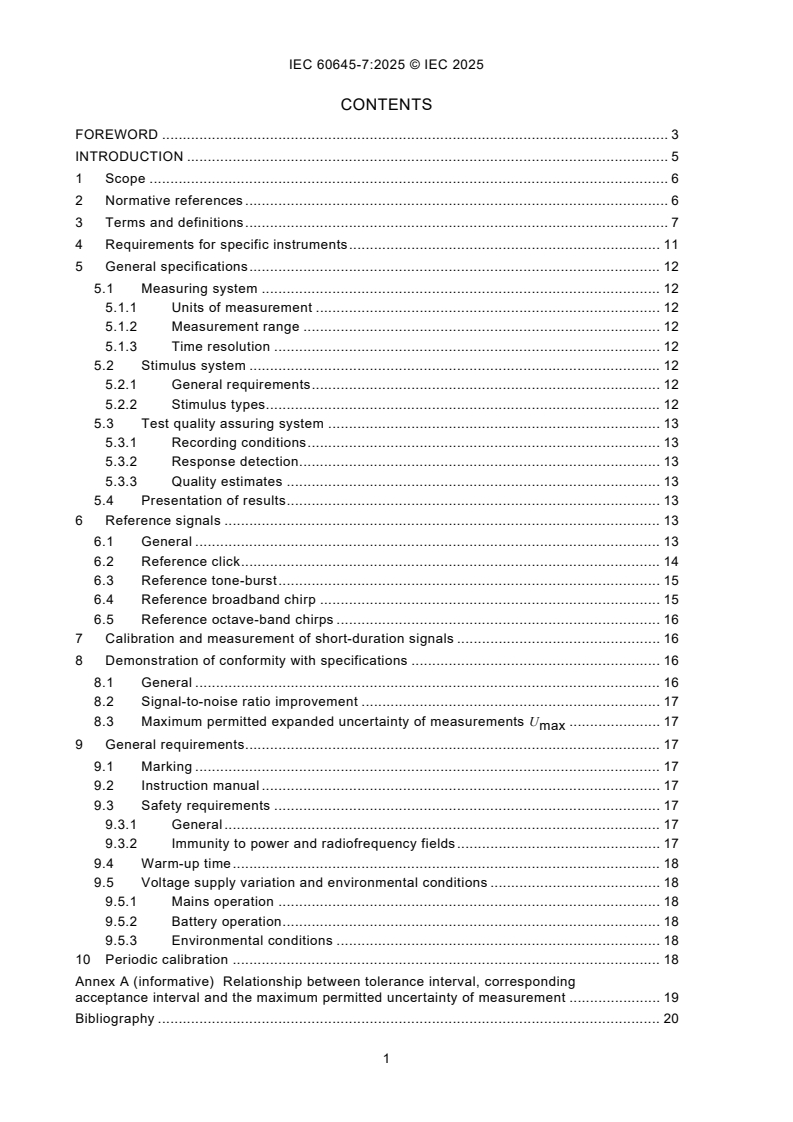
CONTENTS
FOREWORD . 3
INTRODUCTION . 5
1 Scope . 6
2 Normative references . 6
3 Terms and definitions . 7
4 Requirements for specific instruments . 11
5 General specifications . 12
5.1 Measuring system . 12
5.1.1 Units of measurement . 12
5.1.2 Measurement range . 12
5.1.3 Time resolution . 12
5.2 Stimulus system . 12
5.2.1 General requirements . 12
5.2.2 Stimulus types. 12
5.3 Test quality assuring system . 13
5.3.1 Recording conditions . 13
5.3.2 Response detection. 13
5.3.3 Quality estimates . 13
5.4 Presentation of results . 13
6 Reference signals . 13
6.1 General . 13
6.2 Reference click . 14
6.3 Reference tone-burst . 15
6.4 Reference broadband chirp . 15
6.5 Reference octave-band chirps . 16
7 Calibration and measurement of short-duration signals . 16
8 Demonstration of conformity with specifications . 16
8.1 General . 16
8.2 Signal-to-noise ratio improvement . 17
8.3 Maximum permitted expanded uncertainty of measurements U . 17
max
9 General requirements. 17
9.1 Marking . 17
9.2 Instruction manual . 17
9.3 Safety requirements . 17
9.3.1 General . 17
9.3.2 Immunity to power and radiofrequency fields . 17
9.4 Warm-up time . 18
9.5 Voltage supply variation and environmental conditions . 18
9.5.1 Mains operation . 18
9.5.2 Battery operation . 18
9.5.3 Environmental conditions . 18
10 Periodic calibration . 18
Annex A (informative) Relationship between tolerance interval, corresponding
acceptance interval and the maximum permitted uncertainty of measurement . 19
Bibliography . 20
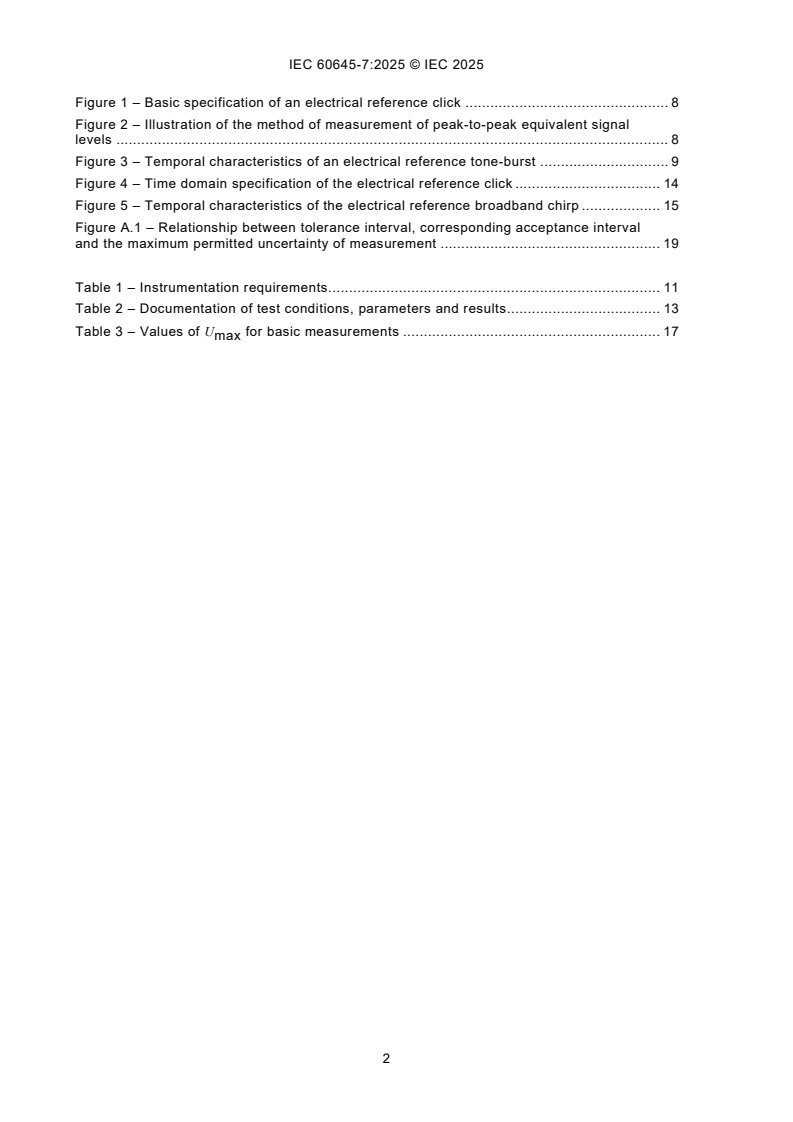
Figure 1 – Basic specification of an electrical reference click . 8
Figure 2 – Illustration of the method of measurement of peak-to-peak equivalent signal
levels . 8
Figure 3 – Temporal characteristics of an electrical reference tone-burst . 9
Figure 4 – Time domain specification of the electrical reference click . 14
Figure 5 – Temporal characteristics of the electrical reference broadband chirp . 15
Figure A.1 – Relationship between tolerance interval, corresponding acceptance interval
and the maximum permitted uncertainty of measurement . 19
Table 1 – Instrumentation requirements. 11
Table 2 – Documentation of test conditions, parameters and results . 13
Table 3 – Values of U for basic measurements . 17
max
INTERNATIONAL ELECTROTECHNICAL COMMISSION
____________
Electroacoustics - Audiometric equipment-
Part 7: Instruments for the measurement of auditory evoked potentials
FOREWORD
1) The International Electrotechnical Commission (IEC) is a worldwide organization for standardization comprising all
national electrotechnical committees (IEC National Committees). The object of IEC is to promote international co-
operation on all questions concerning standardization in the electrical and electronic fields. To this end and in addition
to other activities, IEC publishes International Standards, Technical Specifications, Technical Reports, Publicly
Available Specifications (PAS) and Guides (hereafter referred to as "IEC Publication(s)"). Their preparation is
entrusted to technical committees; any IEC National Committee interested in the subject dealt with may participate
in this preparatory work. International, governmental and non-governmental organizations liaising with the IEC also
participate in this preparation. IEC collaborates closely with the International Organization for Standardization (ISO)
in accordance with conditions determined by agreement between the two organizations.
2) The formal decisions or agreements of IEC on technical matters express, as nearly as possible, an international
consensus of opinion on the relevant subjects since each technical committee has representation from all interested
IEC National Committees.
3) IEC Publications have the form of recommendations for international use and are accepted by IEC National
Committees in that sense. While all reasonable efforts are made to ensure that the technical content of IEC
Publications is accurate, IEC cannot be held responsible for the way in which they are used or for any
misinterpretation by any end user.
4) In order to promote international uniformity, IEC National Committees undertake to apply IEC Publications
transparently to the maximum extent possible in their national and regional publications. Any divergence between
any IEC Publication and the corresponding national or regional publication shall be clearly indicated in the latter.
5) IEC itself does not provide any attestation of conformity. Independent certification bodies provide conformity
assessment services and, in some areas, access to IEC marks of conformity. IEC is not responsible for any services
carried out by independent certification bodies.
6) All users should ensure that they have the latest edition of this publication.
7) No liability shall attach to IEC or its directors, employees, servants or agents including individual experts and
members of its technical committees and IEC National Committees for any personal injury, property damage or other
damage of any nature whatsoever, whether direct or indirect, or for costs (including legal fees) and expenses arising
out of the publication, use of, or reliance upon, this IEC Publication or any other IEC Publications.
8) Attention is drawn to the Normative references cited in this publication. Use of the referenced publications is
indispensable for the correct application of this publication.
9) IEC draws attention to the possibility that the implementation of this document may involve the use of (a) patent(s).
IEC takes no position concerning the evidence, validity or applicability of any claimed patent rights in respect thereof.
As of the date of publication of this document, IEC had not received notice of (a) patent(s), which may be required
to implement this document. However, implementers are cautioned that this may not represent the latest information,
which may be obtained from the patent database available at https://patents.iec.ch. IEC shall not be held responsible
for identifying any or all such patent rights.
IEC 60645-7 has been prepared by IEC technical committee 29: Electroacoustics. It is an
International Standard.
This second edition cancels and replaces the first edition published in 2009 and IEC 60645-3:2020.
This edition constitutes a technical revision.
This edition includes the following significant technical changes with respect to the previous
edition: the contents of IEC 60645-3:2020 have been incorporated into this document to bring it in
line with other parts of the IEC 60645 series, where the specification of the instrument and the
associated test stimuli are included together in the same standard.
The text of this International Standard is based on the following documents:
Draft Report on voting
29/1189/CDV 29/1199/RVC
Full information on the voting for its approval can be found in the report on voting indicated in the
above table.
The language used for the development of this International Standard is English.
This document was drafted in accordance with ISO/IEC Directives, Part 2, and developed in
accordance with ISO/IEC Directives, Part 1 and ISO/IEC Directives, IEC Supplement, available at
www.iec.ch/members_experts/refdocs. The main document types developed by IEC are described
in greater detail at www.iec.ch/publications.
A list of all parts in the IEC 60645 series, published under the general title Electroacoustics –
Audiometric equipment, can be found on the IEC website.
The committee has decided that the contents of this document will remain unchanged until the
stability date indicated on the IEC website under webstore.iec.ch in the data related to the specific
document. At this date, the document will be
– reconfirmed,
– withdrawn, or
– revised.
INTRODUCTION
Developments in the field of diagnostic hearing measurement have resulted in a number of
instruments designed to evaluate the auditory evoked potentials of the human hearing system
which can be evoked by acoustic or vibratory signals having different spectral and temporal
characteristics.
The practical use of such instruments concerns the measurement of these electric potentials and
their separation from electric signals emerging from other physiological or artificial sources.
Conformance to the performance specification in this document is demonstrated when a measured
deviation from a design goal equals or does not exceed the corresponding acceptance limit(s),
and the laboratory has demonstrated that the associated uncertainty of measurement equals or
does not exceed the maximum permitted uncertainty specified in this document.
1 Scope
This part of IEC 60645 applies to instruments designed for the measurement of auditory evoked
potentials from the inner ear, the auditory nerve, and the brainstem, evoked by either acoustic or
vibratory stimuli of short duration. This document defines the characteristics to be specified by the
manufacturer, specifies performance requirements for two types of instruments (screening and
diagnostic/clinical), and specifies the functions to be provided on these types. It also specifies a
means of describing the physical characteristics, in terms of electrical waveforms, of audiometric
reference and test signals of short duration used with auditory evoked potential equipment and
other equipment (e.g. otoacoustic emission instruments), and methods for their measurement.
The purpose of this document is to ensure that measurements made under comparable test
conditions with different instruments complying with this document will be consistent. This
document is not intended to restrict development or incorporation of new features, nor to
discourage innovative approaches.
Evoked response measurement using the application of electric stimuli to a subject is beyond the
scope of this document.
2 Normative references
The following documents are referred to in the text in such a way that some or all of their content
constitutes requirements of this document. For dated references, only the edition cited applies.
For undated references, the latest edition of the referenced document (including any amendments)
applies.
IEC 60601-1, Medical electrical equipment - Part 1: General requirements for basic safety and
essential performance
IEC 60318-1, Electroacoustics - Simulators of human head and ear - Part 1: Ear simulator for the
measurement of supra-aural and circumaural earphones
IEC 60318-3, Electroacoustics - Simulators of human head and ear - Part 3: Acoustic coupler for
the calibration of supra-aural earphones used in audiometry
IEC 60318-4, Electroacoustics - Simulators of human head and ear - Part 4: Occluded-ear
simulator for the measurement of earphones coupled to the ear by means of ear inserts
IEC 60318-5, Electroacoustics - Simulators of human head and ear - Part 5: 2 cm coupler for the
measurement of hearing aids and earphones coupled to the ear by means of ear inserts
IEC 60318-6, Electroacoustics - Simulators of human head and ear - Part 6: Mechanical coupler
for the measurement on bone vibrators
IEC 60645-1:2017, Electroacoustics - Audiometric equipment - Part 1: Equipment for pure-tone
and speech audiometry
IEC 61260-1, Electroacoustics - Octave-band and fractional-octave-band filters - Part 1:
Specifications
ISO/IEC Guide 98-3, Uncertainty of measurement – Part 3: Guide to the expression of uncertainty
in measurement (GUM:1995)
ISO 389-6, Acoustics – Reference zero for the calibration of audiometric equipment – Part 6:
Reference threshold of hearing for test signals of short duration
3 Terms and definitions
For the purposes of this document, the following terms and definitions apply.
ISO and IEC maintain terminology databases for use in standardization at the following addresses:
– IEC Electropedia: available at https://www.electropedia.org/
– ISO Online browsing platform: available at https://www.iso.org/obp
3.1
auditory evoked potentials
AEP
electric potentials which can be evoked by acoustic or vibratory stimulation of the auditory system
and recorded by means of electrodes
3.2
auditory brainstem response
ABR
transient AEPs generated in the inner ear, the auditory nerve, and the brainstem after stimulation
of the ear with an acoustic or vibratory force stimulus of short duration
Note 1 to entry: A method for recording the ABRs is also known as BERA (brainstem electric response audiometry).
3.3
automated auditory brainstem response
AABR
automatic detection of auditory brainstem responses
3.4
nHL
hearing level of otologically normal adults as determined through the use of short-duration signals
calibrated using the peak-to-peak method
Note 1 to entry: nHL can also be termed "normal hearing level" or "normative hearing level".
3.5
short-duration signal
signal having a duration of less than 200 ms
3.6
click
transient acoustic or vibratory signal whose frequency spectrum covers a broad frequency range,
produced by applying a single rectangular electrical pulse to the terminals of the transducer
Note 1 to entry: See Figure 1 and Figure 2.
Figure 1 – Basic specification of an electrical reference click
NOTE 1 The left part of the figure shows an example of the acoustic click signal generated by an electrical rectangular
pulse applied to a transducer (100 µs electrical pulse fed to a TDH-39 earphone with MX-41/AR cushion and measured
on an IEC 60318-1 ear simulator) and the right part presents the long duration sinusoidal signal.
NOTE 2 The first half wave of the left part of the figure comprises the initial wave of the acoustic click signal.
Figure 2 – Illustration of the method of measurement of peak-to-peak equivalent signal
levels
3.7
tone-burst
gated sinusoidal signal having a duration of less than 200 ms
Note 1 to entry: Figure 3 shows a reference tone-burst (see 6.3).
Note 2 to entry: A tone-burst is sometimes called a "brief tone" or a "tone pip".
Key
1 rise time
2 duration
3 fall time
Figure 3 – Temporal characteristics of an electrical reference tone-burst
3.8
instantaneous frequency
frequency f which, for a signal s(t) with a waveform
s t = At sinφ t
() () ( ())
is defined at time t as
dtφ
1 ()
ft =
()
2π dt
with the amplitude modulation A(t) slowly varying compared to the frequency
dA t
()
≪ At f t
() ()
dt
3.9
chirp
short-duration signal in which the instantaneous frequency between two specified values varies
monotonically for the duration of the signal
3.10
upward chirp
chirp which presents the low frequency components in the chirp before the high frequency
components
3.11
broadband chirp
chirp that has a specified electrical amplitude spectrum covering at least 5 octaves of the normal
audible frequency range
Note 1 to entry: See Figure 5.
3.12
octave-band chirp
chirp with an electrical amplitude spectru
...
IEC 60645-7 ®
Edition 2.0 2025-08
INTERNATIONAL
STANDARD
REDLINE VERSION
Electroacoustics - Audiometric equipment -
Part 7: Instruments for the measurement of auditory evoked potentials
ICS 17.140.50 ISBN 978-2-8327-0678-7
All rights reserved. Unless otherwise specified, no part of this publication may be reproduced or utilized in any form or
by any means, electronic or mechanical, including photocopying and microfilm, without permission in writing from either
IEC or IEC's member National Committee in the country of the requester. If you have any questions about IEC copyright
or have an enquiry about obtaining additional rights to this publication, please contact the address below or your local
IEC member National Committee for further information.
IEC Secretariat Tel.: +41 22 919 02 11
3, rue de Varembé info@iec.ch
CH-1211 Geneva 20 www.iec.ch
Switzerland
About the IEC
The International Electrotechnical Commission (IEC) is the leading global organization that prepares and publishes
International Standards for all electrical, electronic and related technologies.
About IEC publications
The technical content of IEC publications is kept under constant review by the IEC. Please make sure that you have the
latest edition, a corrigendum or an amendment might have been published.
IEC publications search - IEC Products & Services Portal - products.iec.ch
webstore.iec.ch/advsearchform Discover our powerful search engine and read freely all the
The advanced search enables to find IEC publications by a publications previews, graphical symbols and the glossary.
variety of criteria (reference number, text, technical With a subscription you will always have access to up to date
committee, …). It also gives information on projects, content tailored to your needs.
replaced and withdrawn publications.
Electropedia - www.electropedia.org
The world's leading online dictionary on electrotechnology,
IEC Just Published - webstore.iec.ch/justpublished
Stay up to date on all new IEC publications. Just Published containing more than 22 500 terminological entries in English
details all new publications released. Available online and and French, with equivalent terms in 25 additional languages.
once a month by email. Also known as the International Electrotechnical Vocabulary
(IEV) online.
IEC Customer Service Centre - webstore.iec.ch/csc
If you wish to give us your feedback on this publication or
need further assistance, please contact the Customer
Service Centre: sales@iec.ch.
CONTENTS
FOREWORD . 3
INTRODUCTION . 1
1 Scope . 6
2 Normative references . 6
3 Terms and definitions . 7
4 Requirements for specific instruments . 11
5 General specifications . 12
5.1 Measuring system . 12
5.1.1 Units of measurement . 12
5.1.2 Measurement range . 12
5.1.3 Time resolution . 12
5.2 Stimulus system . 12
5.2.1 General requirements . 12
5.2.2 Stimulus types. 12
5.3 Test quality assuring system . 13
5.3.1 Recording conditions . 13
5.3.2 Response detection. 13
5.3.3 Quality estimates . 13
5.3.4 Reference values .
5.4 Presentation of results . 13
6 Reference signals . 14
6.1 General . 14
6.2 Reference click . 14
6.3 Reference tone-burst . 15
6.4 Reference broadband chirp . 15
6.5 Reference octave-band chirps . 16
7 Calibration and measurement of short-duration signals . 16
8 Demonstration of conformity with specifications . 14
8.1 General . 17
8.2 Signal-to-noise ratio improvement . 17
8.3 Maximum permitted expanded uncertainty of measurements U . 17
max
9 General requirements. 18
9.1 Marking . 18
9.2 Instruction manual . 18
9.3 Safety requirements . 18
9.3.1 General . 18
9.3.2 Immunity to power and radiofrequency fields . 18
9.4 Warm-up time . 18
9.5 Voltage supply variation and environmental conditions . 18
9.5.1 Mains operation . 18
9.5.2 Battery operation . 19
9.5.3 Environmental conditions . 19
10 Routine Periodic calibration. 19
Annex A (informative) Relationship between tolerance interval, corresponding
acceptance interval and the maximum permitted uncertainty of measurement . 20
Bibliography . 21
Figure 1 – Basic specification of an electrical reference click . 8
Figure 2 – Illustration of the method of measurement of peak-to-peak equivalent signal
levels . 8
Figure 3 – Temporal characteristics of an electrical reference tone-burst . 9
Figure 4 – Time domain specification of the electrical reference click . 15
Figure 5 – Temporal characteristics of the electrical reference broadband chirp . 16
Figure A.1 – Relationship between tolerance interval, corresponding acceptance interval
and the maximum permitted uncertainty of measurement . 20
Table 1 – Instrumentation requirements. 11
Table 2 – Documentation of test conditions, parameters and results . 13
Table 3 – Values of U for basic measurements . 18
max
INTERNATIONAL ELECTROTECHNICAL COMMISSION
____________
Electroacoustics - Audiometric equipment-
Part 7: Instruments for the measurement of auditory evoked potentials
FOREWORD
1) The International Electrotechnical Commission (IEC) is a worldwide organization for standardization comprising all
national electrotechnical committees (IEC National Committees). The object of IEC is to promote international co-
operation on all questions concerning standardization in the electrical and electronic fields. To this end and in addition
to other activities, IEC publishes International Standards, Technical Specifications, Technical Reports, Publicly
Available Specifications (PAS) and Guides (hereafter referred to as "IEC Publication(s)"). Their preparation is
entrusted to technical committees; any IEC National Committee interested in the subject dealt with may participate
in this preparatory work. International, governmental and non-governmental organizations liaising with the IEC also
participate in this preparation. IEC collaborates closely with the International Organization for Standardization (ISO)
in accordance with conditions determined by agreement between the two organizations.
2) The formal decisions or agreements of IEC on technical matters express, as nearly as possible, an international
consensus of opinion on the relevant subjects since each technical committee has representation from all interested
IEC National Committees.
3) IEC Publications have the form of recommendations for international use and are accepted by IEC National
Committees in that sense. While all reasonable efforts are made to ensure that the technical content of IEC
Publications is accurate, IEC cannot be held responsible for the way in which they are used or for any
misinterpretation by any end user.
4) In order to promote international uniformity, IEC National Committees undertake to apply IEC Publications
transparently to the maximum extent possible in their national and regional publications. Any divergence between
any IEC Publication and the corresponding national or regional publication shall be clearly indicated in the latter.
5) IEC itself does not provide any attestation of conformity. Independent certification bodies provide conformity
assessment services and, in some areas, access to IEC marks of conformity. IEC is not responsible for any services
carried out by independent certification bodies.
6) All users should ensure that they have the latest edition of this publication.
7) No liability shall attach to IEC or its directors, employees, servants or agents including individual experts and
members of its technical committees and IEC National Committees for any personal injury, property damage or other
damage of any nature whatsoever, whether direct or indirect, or for costs (including legal fees) and expenses arising
out of the publication, use of, or reliance upon, this IEC Publication or any other IEC Publications.
8) Attention is drawn to the Normative references cited in this publication. Use of the referenced publications is
indispensable for the correct application of this publication.
9) IEC draws attention to the possibility that the implementation of this document may involve the use of (a) patent(s).
IEC takes no position concerning the evidence, validity or applicability of any claimed patent rights in respect thereof.
As of the date of publication of this document, IEC had not received notice of (a) patent(s), which may be required
to implement this document. However, implementers are cautioned that this may not represent the latest information,
which may be obtained from the patent database available at https://patents.iec.ch. IEC shall not be held responsible
for identifying any or all such patent rights.
This redline version of the official IEC Standard allows the user to identify the changes made to
the previous edition IEC 60645-7:2009. A vertical bar appears in the margin wherever a change
has been made. Additions are in green text, deletions are in strikethrough red text.
IEC 60645-7 has been prepared by IEC technical committee 29: Electroacoustics. It is an
International Standard.
This second edition cancels and replaces the first edition published in 2009 and IEC 60645-3:2020.
This edition constitutes a technical revision.
This edition includes the following significant technical changes with respect to the previous
edition: the contents of IEC 60645-3:2020 have been incorporated into this document to bring it in
line with other parts of the IEC 60645 series, where the specification of the instrument and the
associated test stimuli are included together in the same standard.
The text of this International Standard is based on the following documents:
Draft Report on voting
29/1189/CDV 29/1199/RVC
Full information on the voting for its approval can be found in the report on voting indicated in the
above table.
The language used for the development of this International Standard is English.
This document was drafted in accordance with ISO/IEC Directives, Part 2, and developed in
accordance with ISO/IEC Directives, Part 1 and ISO/IEC Directives, IEC Supplement, available at
www.iec.ch/members_experts/refdocs. The main document types developed by IEC are described
in greater detail at www.iec.ch/publications.
A list of all parts in the IEC 60645 series, published under the general title Electroacoustics –
Audiometric equipment, can be found on the IEC website.
The committee has decided that the contents of this document will remain unchanged until the
stability date indicated on the IEC website under webstore.iec.ch in the data related to the specific
document. At this date, the document will be
– reconfirmed,
– withdrawn, or
– revised.
INTRODUCTION
Developments in the field of diagnostic hearing measurement have resulted in a number of
instruments designed to evaluate the auditory evoked potentials of the human hearing system
which can be evoked by acoustic or vibratory signals having different spectral and temporal
characteristics.
The practical use of such instruments concerns the measurement of these electric potentials and
their separation from electric signals emerging from other physiological or artificial sources.
Conformance to the performance specification in this document is demonstrated when a measured
deviation from a design goal equals or does not exceed the corresponding acceptance limit(s),
and the laboratory has demonstrated that the associated uncertainty of measurement equals or
does not exceed the maximum permitted uncertainty specified in this document.
1 Scope
This part of IEC 60645 applies to instruments designed for the measurement of auditory evoked
potentials from the inner ear, the auditory nerve, and the brainstem, evoked by either acoustic or
vibratory stimuli of short duration. This document defines the characteristics to be specified by the
manufacturer, specifies performance requirements for two types of instruments (screening and
diagnostic/clinical), and specifies the functions to be provided on these types. It also specifies a
means of describing the physical characteristics, in terms of electrical waveforms, of audiometric
reference and test signals of short duration used with auditory evoked potential equipment and
other equipment (e.g. otoacoustic emission instruments), and methods for their measurement.
The purpose of this document is to ensure that measurements made under comparable test
conditions with different instruments complying with this document will be consistent. This
document is not intended to restrict development or incorporation of new features, nor to
discourage innovative approaches.
Evoked response measurement using the application of electric stimuli for special purposes to a
subject is beyond the scope of this document.
2 Normative references
The following documents are referred to in the text in such a way that some or all of their content
constitutes requirements of this document. For dated references, only the edition cited applies.
For undated references, the latest edition of the referenced document (including any amendments)
applies.
IEC 60601-1, Medical electrical equipment - Part 1: General requirements for basic safety and
essential performance
IEC 60318-1, Electroacoustics - Simulators of human head and ear - Part 1: Ear simulator for the
measurement of supra-aural and circumaural earphones
IEC 60318-3, Electroacoustics - Simulators of human head and ear - Part 3: Acoustic coupler for
the calibration of supra-aural earphones used in audiometry
IEC 60318-4, Electroacoustics - Simulators of human head and ear - Part 4: Occluded-ear
simulator for the measurement of earphones coupled to the ear by means of ear inserts
IEC 60318-5, Electroacoustics - Simulators of human head and ear - Part 5: 2 cm coupler for the
measurement of hearing aids and earphones coupled to the ear by means of ear inserts
IEC 60318-6, Electroacoustics - Simulators of human head and ear - Part 6: Mechanical coupler
for the measurement on bone vibrators
IEC 60645-1:20012017, Electroacoustics – Audiological equipment – Part 1: Pure-tone
audiometers Electroacoustics - Audiometric equipment - Part 1: Equipment for pure-tone and
speech audiometry
IEC 60645-3:2007, Electroacoustics – Audiometric equipment – Part 3: Test signals of short
duration
IEC 61260-1, Electroacoustics - Octave-band and fractional-octave-band filters - Part 1:
Specifications
ISO/IEC Guide 98-3, Uncertainty of measurement – Part 3: Guide to the expression of uncertainty
in measurement (GUM:1995)
ISO 389 (all parts), Acoustics – Reference zero for the calibration of audiometric equipment
ISO 389-6, Acoustics – Reference zero for the calibration of audiometric equipment – Part 6:
Reference threshold of hearing for test signals of short duration
3 Terms and definitions
For the purposes of this document, the following terms and definitions apply.
ISO and IEC maintain terminology databases for use in standardization at the following addresses:
– IEC Electropedia: available at https://www.electropedia.org/
– ISO Online browsing platform: available at https://www.iso.org/obp
3.1
auditory evoked potentials
AEP
electric potentials which can be evoked by acoustic or vibratory stimulation of the auditory system
and recorded by means of electrodes
3.2
electric response audiometry
ERA
method for recording the AEPs
3.2
auditory brainstem response
ABR
transient AEPs generated in the inner ear, the auditory nerve, and the brainstem after stimulation
of the ear with an acoustic or vibratory force stimulus of short duration
Note 1 to entry: A method for recording the ABRs is also known as BERA (brainstem electric response audiometry).
3.3
automated auditory brainstem response
AABR
automatic detection of auditory brainstem responses
3.4
nHL
hearing level of otologically normal adults as determined through the use of short-duration signals
calibrated using the peak-to-peak method
Note 1 to entry: nHL can also be termed "normal hearing level" or "normative hearing level".
3.5
short-duration signal
signal having a duration of less than 200 ms
3.6
click
transient acoustic or vibratory signal whose frequency spectrum covers a broad frequency range,
produced by applying a single rectangular electrical pulse to the terminals of the transducer
Note 1 to entry: See Figure 1 and Figure 2.
Figure 1 – Basic specification of an electrical reference click
NOTE 1 The left part of the figure shows an example of the acoustic click signal generated by an electrical rectangular
pulse applied to a transducer (100 µs electrical pulse fed to a TDH-39 earphone with MX-41/AR cushion and measured
on an IEC 60318-1 ear simulator) and the right part presents the long duration sinusoidal signal.
NOTE 2 The first half wave of the left part of the figure comprises the initial wave of the acoustic click signal.
Figure 2 – Illustration of the method of measurement of peak-to-peak equivalent signal
levels
3.7
tone-burst
gated sinusoidal signal having a duration of less than 200 ms
Note 1 to entry: Figure 3 shows a reference tone-burst (see 6.3).
Note 2 to entry: A tone-burst is sometimes called a "brief tone" or a "tone pip".
Key
1 rise time
2 duration
3 fall time
Figure 3 – Temporal characteristics of an electrical reference tone-burst
3.8
instantaneous frequency
frequency f which, for a signal s(t) with a waveform
s t = At sin φ t
( ) ( ) ( ( ))
is defined at time t as
dtφ
1 ( )
ft =
( )
2π dt
with the amplitude modulation A(t) slowly varying compared to the frequency
dA t
( )
≪ At f t
( ) ( )
dt
3.9
chirp
short-duration signal in which the instantaneous frequency between two specified values varies
monotonically for the duration of the signal
3.10
upward chirp
chirp which presents the low frequency components in the chirp before the high frequency
components
3.11
broadband chirp
chirp that has a specified electrical amplitude spectrum covering at least 5 octaves of the normal
audible frequency range
Note 1 to entry: See Figure 5.
3.12
octave-band chirp
chirp with an electrical amplitude spectrum corresponding to the amplitude-frequency
characteristic of an IEC 61260-1 octave-band filter with a specified centre frequency
3.13
condensation signal
short-duration signal, the initial wave of which causes an over-pressure relative to ambient
pressure, or an over-force relative to the static force at the plane of the output port of the
transducer
3.14
rarefaction signal
short-duration signal, the initial wave of which causes an under-pressure relative to ambient
pressure, or an under-force relative to the static force at the plane of the output port of the
transducer
3.15
alternating polarity signal
series of short-duration signals, consisting of rarefaction and condensation signals in alternating
order
3.16
initial wave of the acoustic click signal
first half wave of the stimulus signal, the amplitude of which is larger than 0,5 times the amplitude
of the next half wave with opposite polarity
Note 1 to entry: See Figure 2.
Note 2 to entry: The duration of the initial wave of the acoustic click signal is the time interval between the two zero
crossings of the initial stimulus signal wave.
3.17
duration
time interval between the half maximum amplitude points on the rising and falling
portions of the envelope of the electrical tone-burst signal
Note 1 to entry: See Figure 3, key 2.
3.18
rise and fall times
time intervals between the 10 % and 90 % amplitude points of the rising portion and
the 90 % and 10 % amplitude points on the falling portion of the envelope of the electrical tone-
burst signal
Note 1 to entry: See Figure 3, key 1 and key 3.
3.19
peak-to-peak equivalent signal level
peak equivalent signal level
root-mean-square (RMS) value of a long duration sinusoidal signal which, when compared under
the same test conditions with a short-duration output signal from the transducer under test, has
the same peak-to-peak value (i.e. amplitude difference between the maximum and minimum
values) as the short-duration signal
Note 1 to entry: See Figure 2.
Note 2 to entry: For clicks and broadband chirps, the long duration sinusoidal signal should have a frequency
of 1 000 Hz, and for tone-bursts its frequency should equal the fundamental frequency of the tone-burst. For octave-
band chirps, its frequency should equal the centre frequency of the band.
Note 3 to entry: The recommended abbreviations for "peak-to-peak equivalent sound pressure level" and "peak-to-peak
equivalent vibratory force level" are peSPL and peVFL.
3.20
RMS signal level
RMS value of a short-duration signal continuously presented with a given presentation rate,
measured as equivalent continuous sound pressure level or vibratory force level without any
frequency weighting
Note 1 to entry: If short-duration signals are presented with a given transducer, a given ear simulator, and a given
presentation rate, their behaviorial threshold can be described by an RMS signal level which has a fixed ratio to the
peak-to-peak equivalent signal level of the short-duration signal, see [1].
Note 2 to entry: If a sound level meter is to be used to measure the RMS signal level, the IEC 61672-1 Z frequency
weighting should be applied to realize these conditions.
4 Requirements for specific instruments
Two different types of ERA instrument AEP instruments are specified by the requirements for
minimum mandatory functions (see Table 1). Other functions are not precluded. The two types
relate to their presumed primary application (diagnostic/clinical and screening).
Table 1 – Instrumentation requirements
Type
1 2
Feature Diagnostic/clinical Screening
Stimulus
a
Stimulus according to IEC 60645-3 Clause 6 x
x
Adjustable stimulus level, level control x
b
Contra-lateral masking facility
x
Signal processing
Artefact rejection x x
User adjustable averaging x
Automatic response detection (example: automated x
auditory brainstem response, AABR)
Presentation of results
Display of result x
Display of PASS/REFER x
Display of a quality measure x
Type
1 2
Feature Diagnostic/clinical Screening
Documentation
Display, internal/external storage, and export of x
test results/parameters
a
If a different test signal is used, it shall be described by the manufacturer.
b
Usually a white noise signal is used for contra-lateral masking.
5 General specifications
5.1 Measuring system
5.1.1 Units of measurement
SI units or derived SI units shall be used. The units of measurement shall be indicated.
5.1.2 Measurement range
The minimum measurement ranges for AEP shall be from 10 nV to 2 μV for instruments of type 1.
5.1.3 Time resolution
The time resolution shall be 0,1 ms or better for instruments of type 1.
NOTE The minimum time resolution is usually determined by the sampling rate of the device used for testing. The
amplitude accuracy limit is given by the internal noise.
5.2 Stimulus system
5.2.1 General requirements
Specifications for the stimulus system are as given in the relevant parts of Clauses 6, 8 and 10 of
IEC 60645-1:2001, and Clause 5 of IEC 60645-3:2007 with the exceptions specified below
IEC 60645-1:2017, Clauses 6, 8 and 10, and in this document, Clause 6 and Clause 7.
5.2.2 Stimulus types
5.2.2.1 General
The general properties and temporal characteristics of the stimulus signal are specified in
IEC 60645-3 Clause 6. Other stimulus types shall be specified by the manufacturer, if applicable.
5.2.2.2 Masking signal
The manufacturer shall provide the frequency characteristics and levels of the masking signal, if
masking signals are provided.
5.2.2.3 Stimulus levels
For instruments of type 1, using the reference click signal defined in 6.2, stimulus levels shall
cover a hearing level range of at least 30 dB nHL to 80 dB nHL for air conduction and 30 dB nHL
to 60 dB nHL for bone conduction.
For instruments of type 2, the stimulus level range shall be specified by the manufacturer.
5.3 Test quality assuring system
5.3.1 Recording conditions
A facility for checking the test conditions shall be provided, for example, by checking the electrical
impedance between the electrodes.
The system shall be able to improve the initial signal-to-noise ratio of the acquired electrode signal
by at least 30 dB in the relevant frequency range, for example, by an averaging procedure.
An artefact rejection system shall be provided.
5.3.2 Response detection
If an algorithm is used for automatic detection (mandatory for Type 2 instruments), its statistical
significance shall be validated by the manufacturer.
For instruments that provide an automated response detection algorithm and display a
PASS/REFER result, the manufacturer shall provide the statistical sensitivity and specificity of the
algorithm.
During the measurement, a stimulus artefact rejection system shall be used, and its characteristics
shall be specified by the manufacturer.
5.3.3 Quality estimates
The efficiency of the method used for estimation of residual noise shall be documented by the
manufacturer.
5.3.4 Reference values
Reference hearing threshold values are given in the ISO 389 series. If other reference values are
used, these data shall be validated and documented by the manufacturer.
5.4 Presentation of results
All relevant information concerning stimulus, recording conditions and results according to Table 2
shall be stored and be available on demand. The information shall be presented on display of the
instrument display and/or be available as a paper printout if the instrument has a hard copy facility.
Table 2 – Documentation of test conditions, parameters and results
Type
1 2
Diagnostic/clinical Screening
Stimulus level x x
Contra-lateral masking x
a
x
Test conditions
Number of rejected and accepted records x
Artefact rejection limit x
Graphic display of full result x
Display of PASS/REFER x
Test quality x
a
For example, artefacts during test, EEG level, electrode impedance, etc.
6 Reference signals
6.1 General
The reference signals listed in 6.2 to 6.5 are described for the purposes of standardization.
6.2 Reference click
The reference click is based on an electrical rectangular pulse (single monophasic rectangular
wave) of (100 ± 10) µs duration (see Figure 1) with rise and fall times less than or equal to 25 µs
(see Figure 4).
The reference click is specified as an electrical signal meeting the requirements detailed in
Figure 4.
NOTE 1 This specification allows for an acceptable extent of overshoot and transient oscillations, but, at the same
time, sets limits that do not unduly affect reference hearing thresholds and other reference values, determined with
pulses that would follow the strict requirements given by Figure 1, see [2] .
NOTE 2 The same definitions of rise/fall times and duration, as given in Figure 3, apply to the reference click.
NOTE 3 The waveform of the acoustical signal will vary according to the type of transducer and ear simulator used for
measurement.
___________
Numbers in square brackets refer to the Bibliography.
Figure 4 – Time domain specification of the electrical reference click
6.3 Reference tone-burst
The reference tone-burst shall be an electrical signal consisting of five periods of the fundamental
sine wave and having a linear rise and fall. The tone-burst shall have 1,6 periods of rise and fall
time, and a duration of three periods as shown in Figure 3.
NOTE 1,6 periods of linear rise or fall corresponds to two periods from zero to 100 % amplitude. The signal envelope
remains at the 100 % amplitude for one period. The reference tone-burst can also be described according to the "2-1-2"
concept where "2" indicates the number of periods from zero to 100 % amplitude and back to zero and "1" is the 100 %
amplitude period.
6.4 Reference broadband chirp
The reference broadband chirp shall be an electrical signal consisting of a broadband upward chirp
with amplitude and phase spectra specified as follows. The amplitude spectrum shall be designed
to be flat within five octave-bands with a lower and higher amplitude roll-off corresponding to the
lower band edge frequency of a 500 Hz octave-band filter and the upper band edge frequency of
an 8 000 Hz octave-band filter, as specified in IEC 61260-1, respectively.
The reference broadband chirp shall be designed to compensate for the cochlear traveling wave
delay. This is achieved with the following phase spectrum, θ (see [3]):
k
1− d
(rad)
θπ= 2 f
(1− d )
where
f is the frequency, in Hz;
k and d are the two constants k = 0,092 0 and d = 0,435 6.
Any realization of the phase spectrum, which lies within a phase interval of ±2 rad relative to the
stated formula, shall be considered as being in agreement with this document, provided that the
phase spectrum still is a monotonous function of frequency within the specified frequency range
(see Figure 5 and [4]).
NOTE 1 The reference broadband chirp effectively covers the frequency range from 350 Hz to 11 300 Hz.
NOTE 2 The exact temporal location of the 10 000 Hz component is −1,66 ms, and the corresponding locations of the
frequency components at 500 Hz, 1 000 Hz, 2 000 Hz, 4 000 Hz, and 8 000 Hz are as indicated by the vertical lines.
Figure 5 – Temporal characteristics of the electrical reference broadband chirp
6.5 Reference octave-band chirps
The reference octave-band chirps shall be five electrical signals each with a phase spectrum
identical to that of the reference broad-band chirp and with a centre frequency of 500 Hz, 1 000 Hz,
2 000 Hz, 4 000 Hz, and 8 000 Hz, respectively. See [4].
7 Calibration and measurement of short-duration signals
7.1 Reference equivalent threshold sound pressure levels, and reference equivalent threshold
vibratory force levels, are given in ISO 389-6 for some signal/transducer/ear simulator
combinations.
7.2 For each signal type, the following characteristics of an instrument generating signals of
short-duration shall be provided by the manufacturer:
– type of reference signal used; for reference signals that are not defined in Clause 6, the
characteristics of the signals shall be provided;
– type of transducer and associated type of ear simulator/acoustical coupler, mechanical coupler
and sound level meter used and, if applicable, details describing how to couple the transducer
to the measurement system;
– reference levels as given in ISO 389-6; for transducers or reference signals that are not listed
in ISO 389-6, the reference level (including their origin) and measurement method (including
the ear simulator, acoustic coupler or mechanical coupler used) shall be provided;
– polarity of acoustical output signal (i.e. positive (condensation), negative (rarefaction),
alternating or random initial phase);
– shape of the envelope rise and fall (linear, cos , hanning, etc.).
7.3 For air conduction presentation of short-duration signals, the acoustic characteristics of the
short-duration signals shall be measured on an ear simulator (IEC 60318-1) or occluded-ear
simulator (IEC 60318-4). If an acoustic coupler (IEC 60318-5, IEC 60318-3) is used for routine
calibration, the relationship between measurements on the ear simulator (IEC 60318-1) or
occluded-ear simulator (IEC 60318-4) and the acoustic coupler shall be stated by the
manufacturer.
7.4 For bone conduction presentation of short-duration signals, the signals shall be measured
on a mechanical coupler according to IEC 60318-6.
7.5 For sound-field presentation of short-duration signals, the signals should be measured with
a class 1 sound level meter conforming to IEC 61672-1 using the procedures described in
ISO 8253-2. The measuring microphone shall be placed at the reference point in the absence of
the listener. The reference point is the midpoint of a straight line connecting the entrances to the
listener's ear canal openings when positioned in the testing position in the sound field.
7.6 The measurement system shall provide for the measurement of the peak-to-peak equivalent
signal level (see 3.19) or the RMS signal level (see 3.20) of the short-duration signals.
7.7 The amplitude and phase response of the measurement system (including the transducer)
shall be known, in order to determine the polarity of the acoustic or vibratory signal.
8 Demonstration of conformity with specifications
8.1 General
The procedures in 8.2 and 8.3 shall be used for ensuring that an instrument meets the
specifications given in this document.
8.2 Signal-to-noise ratio improvement
The improvement of the signal-to-noise ratio by at least 30 dB in the relevant frequency range
shall be verified by a suitable procedure as specified by the manufacturer.
8.3 Maximum permitted expanded uncertainty of measurements U
max
Table 3 specifies the maximum permitted expanded uncertainty U calculated with for a
max
coverage factor of k = 2 according to ISO/IEC Guide 98-3, to give a level of confidence of
approximately 95 %, associated with the measurements undertaken in this document,. One set of
values for U is given for basic type approval measurements and periodic verification.
max
The expanded uncertainties of measurements given in Table 3 are the maximum permitted for
demonstration of conformance to the requirements of this document. If the actual expanded
uncertainty of a measurement performed by the test laboratory exceeds the maximum permitted
value in Table 3, the measurement shall not be used to demonstrate conformance to the
requirements of this document. Please see Annex A for further guidance in the application of
Table 3.
Table 3 – Values of U for basic measurements
max
Measured quantity Relevant subclause number Basic U (k = 2)
max
Measurement range 5.1.2 3 nV
Time resolution 5.1.3 0,03 ms
Stimulus levels 5.2.2.3 1,0 dB
Signal-to-noise ratio 5.3.1 1,0 dB
Temperature 9.5.3 0,5 °C
Relative humidity 9.5.3 5 %
Ambient pressure 9.5.3 0,1 kPa
9 General requirements
9.1 Marking
The instrument shall be marked according to the requirements of IEC 60645-1:20012017, 15.1.
9.2 Instruction manual
An instruction manual shall be supplied with each instrument. In this manual, the manufacturer
shall specify all characteristics as required by this document and by the relevant statements of
IEC 60645-1:2017, 15.2 of IEC 60645-1:2001, as well as the efficiency and supporting evidence
for the validation of the screening algorithm, if so used, for example the PASS/REFER criteria.
9.3 Safety requirements
9.3.1 General
Instruments shall conform to IEC safety requirements specified in IEC 60601-1.
9.3.2 Immunity to power and radiofrequency fields
During, and as a result of, any EMC immunity testing under the EMC test conditions, the unwanted
sound from any transducer shall not exceed a hearing level of 80 dB. IEC 60645-1 gives methods
for showing conformity.
9.4 Warm-up time
The maximum warm-up time shall be specified by the manufacturer and shall not exceed 10 min
when the unit has been stored at room temperature. The performance requirements of this
document shall be met after the stated warm-up time has elapsed and after any setting-up
adjustments have been carried out in the manner prescribed by the manufacturer.
9.5 Voltage supply variation and environmental conditions
9.5.1 Mains operation
The specifications shall be met when any long-term deviation in any supply voltage or mains
frequency in combination is least favourable within the limits of ±10 % supply voltage or ±5 %
mains frequency. When any short-term line variation has occurred that affects the performance of
the instrument, the instrument shall revert to a mode that will not endanger the subject under test,
nor yield invalid results.
9.5.2 Battery operation
The manufacturer shall state the limits of battery voltages within which the specification shall be
met, and a suitable indicator shall be provided to inform the operator that the battery voltage is
within the limits for correct performance.
9.5.3 Environmental conditions
The specifications shall be met for all combinations of temperature within the range +15 °C to
+35 °C, relative humidity within the range 30 % to 90 % and static ambient pressure within the
range 98 kPa to 104 kPa.
10 Routine Periodic calibration
The following parameters shall be verified at regular intervals:
• stimulus characteristics;
• recording system characteristics.
NOTE A typical regular time interval for routine calibration is 12 months.
For both type 1 and type 2 instruments, the following parameters shall be calibrated regularly:
– measurement system according to manufacturer's guidelines and the requirements of 5.1;
– stimulus system according to manufacturer's guidelines and the requirements of 5.2 and
Clause 7.
NOTE 1 A typical time interval for periodic calibration is 12 months.
A system test shall also be performed to verify the complete system performance.
NOTE 2 The system test is commonly implemented as a loop-back test whereby the electrical stimulus signal is applied
directly to the electrode inputs via a loop-back box or adaptor.
If the system test includes a loop-back test, then the manufacturer shall supply the loop-back
box/adaptor and provide details of its use.
Annex A
(informative)
Relationship between tolerance interval, corresponding acceptance interval
and the maximum permitted uncertainty of measurement
This document, in common with others written by IEC/TC 29, uses adaptations of the guidelines
from ISO/IEC Guide 98-4 (equivalent to guidance document JCGM 106 from the Joint Committee
for Guides in Metrology), as the basis for demonstration of conformance of an instrument to the
specifications given in this document.
ISO/IEC Guide 98-4 describes guarded acceptance in terms of tolerance intervals, acceptance
intervals and uncertainties of measurement.
To promote clarity for users and testing laboratories, IEC/TC 29 has adopted a policy whereby
tolerance limits around design goals are not explicitly stated but can be determined if required
fro
...
IEC 60645-7 ®
Edition 2.0 2025-08
NORME
INTERNATIONALE
Électroacoustique - Appareils audiométriques -
Partie 7: Instruments pour le mesurage des potentiels évoqués auditifs
ICS 17.140.50 ISBN 978-2-8327-0589-6
Droits de reproduction réservés. Sauf indication contraire, aucune partie de cette publication ne peut être reproduite ni
utilisée sous quelque forme que ce soit et par aucun procédé, électronique ou mécanique, y compris la photocopie et
les microfilms, sans l'accord écrit de l'IEC ou du Comité national de l'IEC du pays du demandeur. Si vous avez des
questions sur le copyright de l'IEC ou si vous désirez obtenir des droits supplémentaires sur cette publication, utilisez
les coordonnées ci-après ou contactez le Comité national de l'IEC de votre pays de résidence.
IEC Secretariat Tel.: +41 22 919 02 11
3, rue de Varembé info@iec.ch
CH-1211 Geneva 20 www.iec.ch
Switzerland
A propos de l'IEC
La Commission Electrotechnique Internationale (IEC) est la première organisation mondiale qui élabore et publie des
Normes internationales pour tout ce qui a trait à l'électricité, à l'électronique et aux technologies apparentées.
A propos des publications IEC
Le contenu technique des publications IEC est constamment revu. Veuillez vous assurer que vous possédez l’édition la
plus récente, un corrigendum ou amendement peut avoir été publié.
Recherche de publications IEC - IEC Products & Services Portal - products.iec.ch
webstore.iec.ch/advsearchform Découvrez notre puissant moteur de recherche et consultez
La recherche avancée permet de trouver des publications gratuitement tous les aperçus des publications, symboles
IEC en utilisant différents critères (numéro de référence, graphiques et le glossaire. Avec un abonnement, vous aurez
texte, comité d’études, …). Elle donne aussi des toujours accès à un contenu à jour adapté à vos besoins.
informations sur les projets et les publications remplacées
ou retirées. Electropedia - www.electropedia.org
Le premier dictionnaire d'électrotechnologie en ligne au
IEC Just Published - webstore.iec.ch/justpublished monde, avec plus de 22 500 articles terminologiques en
Restez informé sur les nouvelles publications IEC. Just anglais et en français, ainsi que les termes équivalents
dans 25 langues additionnelles. Egalement appelé
Published détaille les nouvelles publications parues.
Disponible en ligne et une fois par mois par email. Vocabulaire Electrotechnique International (IEV) en ligne.
Service Clients - webstore.iec.ch/csc
Si vous désirez nous donner des commentaires sur cette
publication ou si vous avez des questions contactez-
nous: sales@iec.ch.
SOMMAIRE
AVANT-PROPOS . 3
INTRODUCTION . 5
1 Domaine d'application . 6
2 Références normatives . 6
3 Termes et définitions . 7
4 Exigences relatives aux instruments spécifiques . 11
5 Spécifications générales . 12
5.1 Système de mesure . 12
5.1.1 Unités de mesure . 12
5.1.2 Plage de mesure . 12
5.1.3 Résolution temporelle . 12
5.2 Système de stimulus . 12
5.2.1 Exigences générales . 12
5.2.2 Types de stimuli . 12
5.3 Système pour assurer la qualité d'essai . 13
5.3.1 Conditions d'enregistrement . 13
5.3.2 Détection de la réponse . 13
5.3.3 Estimations de la qualité . 13
5.4 Présentation des résultats . 13
6 Signaux de référence . 14
6.1 Généralités . 14
6.2 Clic de référence . 14
6.3 Impulsion sinusoïdale de référence . 15
6.4 Chirp à large bande de référence . 15
6.5 Chirps de bande d'octave de référence . 16
7 Étalonnage et mesurage des signaux de courte durée . 16
8 Démonstration de conformité aux spécifications . 17
8.1 Généralités . 17
8.2 Amélioration du rapport signal sur bruit . 17
8.3 Incertitude élargie de mesure maximale admise U . 18
max
9 Exigences générales . 18
9.1 Marquage . 18
9.2 Manuel d'instructions . 18
9.3 Exigences de sécurité . 18
9.3.1 Généralités . 18
9.3.2 Immunité aux champs de puissance et aux champs radioélectriques . 18
9.4 Durée de préchauffage . 19
9.5 Variation de la tension d'alimentation et conditions d'environnement . 19
9.5.1 Fonctionnement sur réseau . 19
9.5.2 Fonctionnement sur batterie . 19
9.5.3 Conditions d'environnement . 19
10 Étalonnage périodique . 19
Annexe A (informative) Relation entre l'intervalle de tolérance, l'intervalle d'acceptation
correspondant et l'incertitude de mesure maximale admise . 20
Bibliographie . 21
Figure 1 – Spécification de base d'un clic électrique de référence . 8
Figure 2 – Représentation de la méthode de mesure des niveaux équivalents de signal
crête à crête . 8
Figure 3 – Caractéristiques temporelles d'une impulsion sinusoïdale électrique de
référence . 9
Figure 4 – Spécification du domaine temporel du clic électrique de référence . 15
Figure 5 – Caractéristiques temporelles du chirp électrique à large bande de référence . 16
Figure A.1 – Relation entre l'intervalle de tolérance, l'intervalle d'acceptation
correspondant et l'incertitude de mesure maximale admise . 20
Tableau 1 – Exigences relatives à l'instrumentation . 11
Tableau 2 – Documentation des conditions, paramètres et résultats d'essai . 13
Tableau 3 – Valeurs de U pour les mesurages de base . 18
max
COMMISSION ÉLECTROTECHNIQUE INTERNATIONALE
____________
Électroacoustique - Appareils audiométriques-
Partie 7: Instruments pour le mesurage des potentiels évoqués auditifs
AVANT-PROPOS
1) La Commission Électrotechnique Internationale (IEC) est une organisation mondiale de normalisation composée de
l'ensemble des comités électrotechniques nationaux (Comités nationaux de l'IEC). L'IEC a pour objet de favoriser la
coopération internationale pour toutes les questions de normalisation dans les domaines de l'électricité et de
l'électronique. À cet effet, l'IEC – entre autres activités – publie des Normes internationales, des Spécifications
techniques, des Rapports techniques, des Spécifications accessibles au public (PAS) et des Guides (ci-après
dénommés "Publication(s) de l'IEC"). Leur élaboration est confiée à des comités d'études, aux travaux desquels tout
Comité national intéressé par le sujet traité peut participer. Les organisations internationales, gouvernementales et
non gouvernementales, en liaison avec l'IEC, participent également aux travaux. L'IEC collabore étroitement avec
l'Organisation Internationale de Normalisation (ISO), selon des conditions fixées par accord entre les deux
organisations.
2) Les décisions ou accords officiels de l'IEC concernant les questions techniques représentent, dans la mesure du
possible, un accord international sur les sujets étudiés, étant donné que les Comités nationaux de l'IEC intéressés
sont représentés dans chaque comité d'études.
3) Les Publications de l'IEC se présentent sous la forme de recommandations internationales et sont agréées comme
telles par les Comités nationaux de l'IEC. Tous les efforts raisonnables sont entrepris afin que l'IEC s'assure de
l'exactitude du contenu technique de ses publications; l'IEC ne peut pas être tenue responsable de l'éventuelle
mauvaise utilisation ou interprétation qui en est faite par un quelconque utilisateur final.
4) Dans le but d'encourager l'uniformité internationale, les Comités nationaux de l'IEC s'engagent, dans toute la mesure
possible, à appliquer de façon transparente les Publications de l'IEC dans leurs publications nationales et régionales.
Toutes divergences entre toutes Publications de l'IEC et toutes publications nationales ou régionales
correspondantes doivent être indiquées en termes clairs dans ces dernières.
5) L'IEC elle-même ne fournit aucune attestation de conformité. Des organismes de certification indépendants
fournissent des services d'évaluation de conformité et, dans certains secteurs, accèdent aux marques de conformité
de l'IEC. L'IEC n'est responsable d'aucun des services effectués par les organismes de certification indépendants.
6) Tous les utilisateurs doivent s'assurer qu'ils sont en possession de la dernière édition de cette publication.
7) Aucune responsabilité ne doit être imputée à l'IEC, à ses administrateurs, employés, auxiliaires ou mandataires, y
compris ses experts particuliers et les membres de ses comités d'études et des Comités nationaux de l'IEC, pour
tout préjudice causé en cas de dommages corporels et matériels, ou de tout autre dommage de quelque nature que
ce soit, directe ou indirecte, ou pour supporter les coûts (y compris les frais de justice) et les dépenses découlant
de la publication ou de l'utilisation de cette Publication de l'IEC ou de toute autre Publication de l'IEC, ou au crédit
qui lui est accordé.
8) L'attention est attirée sur les références normatives citées dans cette publication. L'utilisation de publications
référencées est obligatoire pour une application correcte de la présente publication.
9) L'IEC attire l'attention sur le fait que la mise en application du présent document peut entraîner l'utilisation d'un ou
de plusieurs brevets. L'IEC ne prend pas position quant à la preuve, à la validité et à l'applicabilité de tout droit de
brevet revendiqué à cet égard. À la date de publication du présent document, l'IEC n'avait pas reçu notification qu'un
ou plusieurs brevets pouvaient être nécessaires à sa mise en application. Toutefois, il y a lieu d'avertir les
responsables de la mise en application du présent document que des informations plus récentes sont susceptibles
de figurer dans la base de données de brevets, disponible à l'adresse https://patents.iec.ch. L'IEC ne saurait être
tenue pour responsable de ne pas avoir identifié de tels droits de brevets.
L'IEC 60645-7 a été établie par le comité d'études 29 de l'IEC: Électroacoustique. Il s'agit d'une
Norme internationale.
Cette deuxième édition annule et remplace la première édition parue en 2009 et
l'IEC 60645-3 :2020. Cette édition constitue une révision technique.
Cette édition inclut les modifications techniques majeures suivantes par rapport à l'édition
précédente: le contenu de l'IEC 60645-3:2020 a été incorporé au présent document afin d'aligner
le contenu sur les autres parties de la série IEC 60645, où la spécification de l'instrument et les
stimuli d'essai associés sont regroupés dans la même norme.
Le texte de cette Norme internationale est issu des documents suivants:
Projet Rapport de vote
29/1189/CDV 29/1199/RVC
Le rapport de vote indiqué dans le tableau ci-dessus donne toute information sur le vote ayant
abouti à son approbation.
La langue employée pour l'élaboration de cette Norme internationale est l'anglais.
Ce document a été rédigé selon les Directives ISO/IEC, Partie 2, il a été développé selon les
Directives ISO/IEC, Partie 1 et les Directives ISO/IEC, Supplément IEC, disponibles sous
www.iec.ch/members_experts/refdocs. Les principaux types de documents développés par l'IEC
sont décrits plus en détail sous www.iec.ch/publications.
Une liste de toutes les parties de la série IEC 60645, publiées sous le titre général
Électroacoustique – Appareils audiométriques, se trouve sur le site web de l'IEC.
Le comité a décidé que le contenu de ce document ne sera pas modifié avant la date de stabilité
indiquée sur le site web de l'IEC sous webstore.iec.ch dans les données relatives au document
recherché. À cette date, le document sera
– reconduit,
– supprimé, ou
– révisé.
INTRODUCTION
Les développements dans le domaine de la mesure de l'audition à des fins de diagnostic ont
permis la conception de différents instruments pour l'évaluation des potentiels évoqués auditifs du
système d'audition humain qui peuvent être évoqués par des signaux acoustiques ou vibratoires
ayant différentes caractéristiques spectrales et temporelles.
L'utilisation pratique de tels instruments concerne le mesurage de ces potentiels électriques et
leur séparation des signaux électriques provenant d'autres sources physiologiques ou artificielles.
La conformité aux spécifications de performances du présent document est démontrée lorsque
l'écart mesuré par rapport à une valeur nominale est inférieur ou égal à la ou aux limites
d'acceptation correspondantes et que le laboratoire a démontré que l'incertitude de mesure
associée est inférieure ou égale à l'incertitude maximale admise spécifiée dans le présent
document.
1 Domaine d'application
La présente partie de l'IEC 60645 s'applique aux instruments conçus pour le mesurage des
potentiels évoqués auditifs de l'oreille interne, du nerf auditif et du tronc cérébral, évoqués par des
stimuli acoustiques ou vibratoires de courte durée. Le présent document définit les
caractéristiques qui doivent être spécifiées par le fabricant, spécifie les exigences de
performances pour deux types d'instruments (dépistage et diagnostic/utilisation clinique) et
spécifie les fonctions à prévoir sur ces types. Il spécifie également un moyen pour décrire les
caractéristiques physiques, en matière de formes d'onde électriques, des signaux de référence et
d'essai audiométriques de courte durée utilisés avec les équipements de mesure de potentiels
évoqués auditifs et avec d'autres équipements (par exemple, instruments de mesure d'émissions
otoacoustiques), ainsi que les méthodes de mesure associées.
Le présent document a pour objet de s'assurer que les mesurages réalisés dans des conditions
d'essai comparables avec différents instruments conformes au présent document sont cohérents.
Le présent document n'est pas destiné à limiter le développement ou l'ajout de nouvelles
caractéristiques ni à décourager les approches innovantes.
Le mesurage des potentiels évoqués par l'application de stimuli électriques sur un sujet ne relève
pas du domaine d'application du présent document.
2 Références normatives
Les documents suivants sont cités dans le texte de sorte qu'ils constituent, pour tout ou partie de
leur contenu, des exigences du présent document. Pour les références datées, seule l'édition citée
s'applique. Pour les références non datées, la dernière édition du document de référence
s'applique (y compris les éventuels amendements).
IEC 60601-1, Appareils électromédicaux - Partie 1: Exigences générales pour la sécurité de base
et les performances essentielles
IEC 60318-1, Électroacoustique - Simulateurs de tête et d'oreille humaines - Partie 1: Simulateur
d'oreille pour la mesure des écouteurs supra-auraux et circumauraux
IEC 60318-3, Électroacoustique - Simulateurs de tête et d'oreille humaines - Partie 3: Coupleur
acoustique pour l'étalonnage des écouteurs supra-auraux utilisés en audiométrie
IEC 60318-4, Électroacoustique - Simulateurs de tête et d'oreille humaines - Partie 4: Simulateur
d'oreille occluse pour la mesure des écouteurs couplés à l'oreille par des embouts
IEC 60318-5, Électroacoustique - Simulateurs de tête et d'oreille humaines - Partie 5: Coupleur
de 2 cm pour la mesure des appareils de correction auditive et des écouteurs couplés à l'oreille
par des embouts
IEC 60318-6, Électroacoustique - Simulateurs de tête et d'oreille humaines - Partie 6: Coupleur
mécanique destiné aux mesures des ossivibrateurs
IEC 60645-1:2017, Électroacoustique - Appareils audiométriques - Partie 1: Appareils pour
l'audiométrie tonale et vocale
IEC 61260-1, Électroacoustique – Filtres de bande d'octave et de bande d'une fraction d'octave –
Partie 1: Spécifications
ISO/IEC Guide 98-3, Incertitude de mesure – Partie 3: Guide pour l'expression de l'incertitude de
mesure (GUM:1995)
ISO 389-6, Acoustique – Zéro de référence pour l'étalonnage d'équipements audiométriques –
Partie 6: Niveaux liminaires d'audition de référence pour signaux d'essai de courte durée
3 Termes et définitions
Pour les besoins du présent document, les termes et définitions suivants s'appliquent.
L'ISO et l'IEC tiennent à jour des bases de données terminologiques destinées à être utilisées en
normalisation, consultables aux adresses suivantes:
– IEC Electropedia: disponible à l'adresse https://www.electropedia.org/
– ISO Online browsing platform: disponible à l'adresse https://www.iso.org/obp
3.1
potentiels évoqués auditifs
AEP
potentiels électriques qui peuvent être évoqués par une stimulation acoustique ou vibratoire du
système auditif et qui sont enregistrés au moyen d'électrodes
Note 1 à l'article: L'abréviation "AEP" est dérivée du terme anglais développé correspondant "auditory evoked
potentials".
3.2
réponse du tronc cérébral à une stimulation auditive
ABR
AEP transitoires générés dans l'oreille interne, le nerf auditif et le tronc cérébral après une
stimulation de l'oreille par un stimulus acoustique ou une force vibratoire de courte durée
Note 1 à l'article: Une méthode pour l'enregistrement des ABR est également connue sous le nom d'audiométrie des
réponses du tronc cérébral à des stimulations électriques (BERA, Brainstem Electric Response Audiometry).
Note 2 à l'article: L'abréviation "ABR" est dérivée du terme anglais développé correspondant "auditory brainstem
response".
3.3
réponse automatisée du tronc cérébral à une stimulation auditive
AABR
détection automatique des réponses du tronc cérébral à une stimulation auditive
Note 1 à l'article: L'abréviation "AABR" est dérivée du terme anglais développé correspondant "automated auditory
brainstem response".
3.4
nHL
niveau d'audition d'adultes normaux sur le plan otologique, déterminé par l'utilisation de signaux
de courte durée étalonnés selon la méthode crête à crête
Note 1 à l'article: nHL peut également être appelé "niveau d'audition normal" ou "niveau d'audition normalisé".
Note 2 à l'article: L'abréviation "nHL" est dérivée du terme anglais développé correspondant "normal hearing level".
3.5
signal de courte durée
signal d'une durée inférieure à 200 ms
3.6
clic
signal acoustique ou vibratoire transitoire dont le spectre de fréquences couvre une large plage
de fréquences, produit par l'application d'une impulsion électrique rectangulaire unique aux bornes
du transducteur
Note 1 à l'article: Voir Figure 1 et Figure 2.
Anglais Français
Level Niveau
Time Temps
Figure 1 – Spécification de base d'un clic électrique de référence
NOTE 1 La partie gauche de la figure montre un exemple de signal de clic acoustique généré par une impulsion
électrique rectangulaire appliquée à un transducteur (impulsion électrique de 100 µs injectée dans un écouteur TDH-39
avec un coussin MX-41/AR et mesurée par un simulateur d'oreille IEC 60318-1) et la partie droite représente le signal
sinusoïdal de longue durée.
NOTE 2 La première demi-onde dans la partie gauche de la figure comprend l'onde initiale du signal de clic acoustique.
Anglais Français
Level Niveau
Time Temps
Figure 2 – Représentation de la méthode de
mesure des niveaux équivalents de signal crête à crête
3.7
impulsion sinusoïdale
signal sinusoïdal déclenché d'une durée inférieure à 200 ms
Note 1 à l'article: La Figure 3 représente une impulsion sinusoïdale de référence (voir 6.3).
Note 2 à l'article: Une impulsion sinusoïdale est parfois appelée "son bref" ou "bip de tonalité".
Légende
1 temps de montée
2 durée
3 temps de descente
Anglais Français
Level Niveau
Time Temps
Figure 3 – Caractéristiques temporelles
d'une impulsion sinusoïdale électrique de référence
3.8
fréquence instantanée
fréquence f qui, pour un signal s(t) de forme d'onde
s(t)= At()sinφ(t)
( )
est définie à l'instant t comme
dtφ
1 ()
ft =
()
2π dt
où la modulation d'amplitude A(t) varie lentement par rapport à la fréquence
dA(t)
≪ At f t
() ()
dt
3.9
chirp
signal de courte durée dont la fréquence instantanée entre deux valeurs spécifiées varie de façon
monotone pendant la durée du signal
3.10
chirp ascendant
chirp qui présente ses composantes basse fréquence avant ses composantes haute fréquence
3.11
chirp à large bande
chirp de spectre d'amplitude électrique spécifié qui couvre au moins 5 octaves de la plage de
fréquences audible normale
Note 1 à l'article: Voir Figure 5.
3.12
chirp de bande d'octave
chirp dont le spectre d'amplitude électrique correspond à la caractéristique amplitude-fréquence
d'un filtre de bande d'octave IEC 61260-1 de fréquence médiane spécifiée
3.13
signal de condensation
signal de courte durée dont l'onde initiale provoque une surpression par rapport à la pression
ambiante ou une augmentation de la force par rapport à la force statique dans
...
IEC 60645-7 ®
Edition 2.0 2025-08
INTERNATIONAL
STANDARD
NORME
INTERNATIONALE
Electroacoustics - Audiometric equipment -
Part 7: Instruments for the measurement of auditory evoked potentials
Électroacoustique - Appareils audiométriques -
Partie 7: Instruments pour le mesurage des potentiels évoqués auditifs
ICS 17.140.50 ISBN 978-2-8327-0589-6
All rights reserved. Unless otherwise specified, no part of this publication may be reproduced or utilized in any form or
by any means, electronic or mechanical, including photocopying and microfilm, without permission in writing from either
IEC or IEC's member National Committee in the country of the requester. If you have any questions about IEC copyright
or have an enquiry about obtaining additional rights to this publication, please contact the address below or your local
IEC member National Committee for further information.
Droits de reproduction réservés. Sauf indication contraire, aucune partie de cette publication ne peut être reproduite ni
utilisée sous quelque forme que ce soit et par aucun procédé, électronique ou mécanique, y compris la photocopie et
les microfilms, sans l'accord écrit de l'IEC ou du Comité national de l'IEC du pays du demandeur. Si vous avez des
questions sur le copyright de l'IEC ou si vous désirez obtenir des droits supplémentaires sur cette publication, utilisez
les coordonnées ci-après ou contactez le Comité national de l'IEC de votre pays de résidence.
IEC Secretariat Tel.: +41 22 919 02 11
3, rue de Varembé info@iec.ch
CH-1211 Geneva 20 www.iec.ch
Switzerland
About the IEC
The International Electrotechnical Commission (IEC) is the leading global organization that prepares and publishes
International Standards for all electrical, electronic and related technologies.
About IEC publications
The technical content of IEC publications is kept under constant review by the IEC. Please make sure that you have the
latest edition, a corrigendum or an amendment might have been published.
IEC publications search - IEC Products & Services Portal - products.iec.ch
webstore.iec.ch/advsearchform Discover our powerful search engine and read freely all the
The advanced search enables to find IEC publications by a publications previews, graphical symbols and the glossary.
variety of criteria (reference number, text, technical With a subscription you will always have access to up to date
committee, …). It also gives information on projects, content tailored to your needs.
replaced and withdrawn publications.
Electropedia - www.electropedia.org
IEC Just Published - webstore.iec.ch/justpublished The world's leading online dictionary on electrotechnology,
Stay up to date on all new IEC publications. Just Published containing more than 22 500 terminological entries in English
details all new publications released. Available online and and French, with equivalent terms in 25 additional languages.
once a month by email. Also known as the International Electrotechnical Vocabulary
(IEV) online.
IEC Customer Service Centre - webstore.iec.ch/csc
If you wish to give us your feedback on this publication or
need further assistance, please contact the Customer
Service Centre: sales@iec.ch.
A propos de l'IEC
La Commission Electrotechnique Internationale (IEC) est la première organisation mondiale qui élabore et publie des
Normes internationales pour tout ce qui a trait à l'électricité, à l'électronique et aux technologies apparentées.
A propos des publications IEC
Le contenu technique des publications IEC est constamment revu. Veuillez vous assurer que vous possédez l’édition la
plus récente, un corrigendum ou amendement peut avoir été publié.
Recherche de publications IEC - IEC Products & Services Portal - products.iec.ch
webstore.iec.ch/advsearchform Découvrez notre puissant moteur de recherche et consultez
La recherche avancée permet de trouver des publications gratuitement tous les aperçus des publications, symboles
IEC en utilisant différents critères (numéro de référence, graphiques et le glossaire. Avec un abonnement, vous aurez
texte, comité d’études, …). Elle donne aussi des toujours accès à un contenu à jour adapté à vos besoins.
informations sur les projets et les publications remplacées
ou retirées. Electropedia - www.electropedia.org
Le premier dictionnaire d'électrotechnologie en ligne au
IEC Just Published - webstore.iec.ch/justpublished monde, avec plus de 22 500 articles terminologiques en
Restez informé sur les nouvelles publications IEC. Just anglais et en français, ainsi que les termes équivalents
Published détaille les nouvelles publications parues. dans 25 langues additionnelles. Egalement appelé
Disponible en ligne et une fois par mois par email. Vocabulaire Electrotechnique International (IEV) en ligne.
Service Clients - webstore.iec.ch/csc
Si vous désirez nous donner des commentaires sur cette
publication ou si vous avez des questions contactez-
nous: sales@iec.ch.
CONTENTS
FOREWORD . 3
INTRODUCTION . 5
1 Scope . 6
2 Normative references . 6
3 Terms and definitions . 7
4 Requirements for specific instruments . 11
5 General specifications . 12
5.1 Measuring system . 12
5.1.1 Units of measurement . 12
5.1.2 Measurement range . 12
5.1.3 Time resolution . 12
5.2 Stimulus system . 12
5.2.1 General requirements . 12
5.2.2 Stimulus types. 12
5.3 Test quality assuring system . 13
5.3.1 Recording conditions . 13
5.3.2 Response detection. 13
5.3.3 Quality estimates . 13
5.4 Presentation of results . 13
6 Reference signals . 13
6.1 General . 13
6.2 Reference click . 14
6.3 Reference tone-burst . 15
6.4 Reference broadband chirp . 15
6.5 Reference octave-band chirps . 16
7 Calibration and measurement of short-duration signals . 16
8 Demonstration of conformity with specifications . 16
8.1 General . 16
8.2 Signal-to-noise ratio improvement . 17
8.3 Maximum permitted expanded uncertainty of measurements U . 17
max
9 General requirements. 17
9.1 Marking . 17
9.2 Instruction manual . 17
9.3 Safety requirements . 17
9.3.1 General . 17
9.3.2 Immunity to power and radiofrequency fields . 17
9.4 Warm-up time . 18
9.5 Voltage supply variation and environmental conditions . 18
9.5.1 Mains operation . 18
9.5.2 Battery operation . 18
9.5.3 Environmental conditions . 18
10 Periodic calibration . 18
Annex A (informative) Relationship between tolerance interval, corresponding
acceptance interval and the maximum permitted uncertainty of measurement . 19
Bibliography . 20
Figure 1 – Basic specification of an electrical reference click . 8
Figure 2 – Illustration of the method of measurement of peak-to-peak equivalent signal
levels . 8
Figure 3 – Temporal characteristics of an electrical reference tone-burst . 9
Figure 4 – Time domain specification of the electrical reference click . 14
Figure 5 – Temporal characteristics of the electrical reference broadband chirp . 15
Figure A.1 – Relationship between tolerance interval, corresponding acceptance interval
and the maximum permitted uncertainty of measurement . 19
Table 1 – Instrumentation requirements. 11
Table 2 – Documentation of test conditions, parameters and results . 13
Table 3 – Values of U for basic measurements . 17
max
INTERNATIONAL ELECTROTECHNICAL COMMISSION
____________
Electroacoustics - Audiometric equipment-
Part 7: Instruments for the measurement of auditory evoked potentials
FOREWORD
1) The International Electrotechnical Commission (IEC) is a worldwide organization for standardization comprising all
national electrotechnical committees (IEC National Committees). The object of IEC is to promote international co-
operation on all questions concerning standardization in the electrical and electronic fields. To this end and in addition
to other activities, IEC publishes International Standards, Technical Specifications, Technical Reports, Publicly
Available Specifications (PAS) and Guides (hereafter referred to as "IEC Publication(s)"). Their preparation is
entrusted to technical committees; any IEC National Committee interested in the subject dealt with may participate
in this preparatory work. International, governmental and non-governmental organizations liaising with the IEC also
participate in this preparation. IEC collaborates closely with the International Organization for Standardization (ISO)
in accordance with conditions determined by agreement between the two organizations.
2) The formal decisions or agreements of IEC on technical matters express, as nearly as possible, an international
consensus of opinion on the relevant subjects since each technical committee has representation from all interested
IEC National Committees.
3) IEC Publications have the form of recommendations for international use and are accepted by IEC National
Committees in that sense. While all reasonable efforts are made to ensure that the technical content of IEC
Publications is accurate, IEC cannot be held responsible for the way in which they are used or for any
misinterpretation by any end user.
4) In order to promote international uniformity, IEC National Committees undertake to apply IEC Publications
transparently to the maximum extent possible in their national and regional publications. Any divergence between
any IEC Publication and the corresponding national or regional publication shall be clearly indicated in the latter.
5) IEC itself does not provide any attestation of conformity. Independent certification bodies provide conformity
assessment services and, in some areas, access to IEC marks of conformity. IEC is not responsible for any services
carried out by independent certification bodies.
6) All users should ensure that they have the latest edition of this publication.
7) No liability shall attach to IEC or its directors, employees, servants or agents including individual experts and
members of its technical committees and IEC National Committees for any personal injury, property damage or other
damage of any nature whatsoever, whether direct or indirect, or for costs (including legal fees) and expenses arising
out of the publication, use of, or reliance upon, this IEC Publication or any other IEC Publications.
8) Attention is drawn to the Normative references cited in this publication. Use of the referenced publications is
indispensable for the correct application of this publication.
9) IEC draws attention to the possibility that the implementation of this document may involve the use of (a) patent(s).
IEC takes no position concerning the evidence, validity or applicability of any claimed patent rights in respect thereof.
As of the date of publication of this document, IEC had not received notice of (a) patent(s), which may be required
to implement this document. However, implementers are cautioned that this may not represent the latest information,
which may be obtained from the patent database available at https://patents.iec.ch. IEC shall not be held responsible
for identifying any or all such patent rights.
IEC 60645-7 has been prepared by IEC technical committee 29: Electroacoustics. It is an
International Standard.
This second edition cancels and replaces the first edition published in 2009 and IEC 60645-3:2020.
This edition constitutes a technical revision.
This edition includes the following significant technical changes with respect to the previous
edition: the contents of IEC 60645-3:2020 have been incorporated into this document to bring it in
line with other parts of the IEC 60645 series, where the specification of the instrument and the
associated test stimuli are included together in the same standard.
The text of this International Standard is based on the following documents:
Draft Report on voting
29/1189/CDV 29/1199/RVC
Full information on the voting for its approval can be found in the report on voting indicated in the
above table.
The language used for the development of this International Standard is English.
This document was drafted in accordance with ISO/IEC Directives, Part 2, and developed in
accordance with ISO/IEC Directives, Part 1 and ISO/IEC Directives, IEC Supplement, available at
www.iec.ch/members_experts/refdocs. The main document types developed by IEC are described
in greater detail at www.iec.ch/publications.
A list of all parts in the IEC 60645 series, published under the general title Electroacoustics –
Audiometric equipment, can be found on the IEC website.
The committee has decided that the contents of this document will remain unchanged until the
stability date indicated on the IEC website under webstore.iec.ch in the data related to the specific
document. At this date, the document will be
– reconfirmed,
– withdrawn, or
– revised.
INTRODUCTION
Developments in the field of diagnostic hearing measurement have resulted in a number of
instruments designed to evaluate the auditory evoked potentials of the human hearing system
which can be evoked by acoustic or vibratory signals having different spectral and temporal
characteristics.
The practical use of such instruments concerns the measurement of these electric potentials and
their separation from electric signals emerging from other physiological or artificial sources.
Conformance to the performance specification in this document is demonstrated when a measured
deviation from a design goal equals or does not exceed the corresponding acceptance limit(s),
and the laboratory has demonstrated that the associated uncertainty of measurement equals or
does not exceed the maximum permitted uncertainty specified in this document.
1 Scope
This part of IEC 60645 applies to instruments designed for the measurement of auditory evoked
potentials from the inner ear, the auditory nerve, and the brainstem, evoked by either acoustic or
vibratory stimuli of short duration. This document defines the characteristics to be specified by the
manufacturer, specifies performance requirements for two types of instruments (screening and
diagnostic/clinical), and specifies the functions to be provided on these types. It also specifies a
means of describing the physical characteristics, in terms of electrical waveforms, of audiometric
reference and test signals of short duration used with auditory evoked potential equipment and
other equipment (e.g. otoacoustic emission instruments), and methods for their measurement.
The purpose of this document is to ensure that measurements made under comparable test
conditions with different instruments complying with this document will be consistent. This
document is not intended to restrict development or incorporation of new features, nor to
discourage innovative approaches.
Evoked response measurement using the application of electric stimuli to a subject is beyond the
scope of this document.
2 Normative references
The following documents are referred to in the text in such a way that some or all of their content
constitutes requirements of this document. For dated references, only the edition cited applies.
For undated references, the latest edition of the referenced document (including any amendments)
applies.
IEC 60601-1, Medical electrical equipment - Part 1: General requirements for basic safety and
essential performance
IEC 60318-1, Electroacoustics - Simulators of human head and ear - Part 1: Ear simulator for the
measurement of supra-aural and circumaural earphones
IEC 60318-3, Electroacoustics - Simulators of human head and ear - Part 3: Acoustic coupler for
the calibration of supra-aural earphones used in audiometry
IEC 60318-4, Electroacoustics - Simulators of human head and ear - Part 4: Occluded-ear
simulator for the measurement of earphones coupled to the ear by means of ear inserts
IEC 60318-5, Electroacoustics - Simulators of human head and ear - Part 5: 2 cm coupler for the
measurement of hearing aids and earphones coupled to the ear by means of ear inserts
IEC 60318-6, Electroacoustics - Simulators of human head and ear - Part 6: Mechanical coupler
for the measurement on bone vibrators
IEC 60645-1:2017, Electroacoustics - Audiometric equipment - Part 1: Equipment for pure-tone
and speech audiometry
IEC 61260-1, Electroacoustics - Octave-band and fractional-octave-band filters - Part 1:
Specifications
ISO/IEC Guide 98-3, Uncertainty of measurement – Part 3: Guide to the expression of uncertainty
in measurement (GUM:1995)
ISO 389-6, Acoustics – Reference zero for the calibration of audiometric equipment – Part 6:
Reference threshold of hearing for test signals of short duration
3 Terms and definitions
For the purposes of this document, the following terms and definitions apply.
ISO and IEC maintain terminology databases for use in standardization at the following addresses:
– IEC Electropedia: available at https://www.electropedia.org/
– ISO Online browsing platform: available at https://www.iso.org/obp
3.1
auditory evoked potentials
AEP
electric potentials which can be evoked by acoustic or vibratory stimulation of the auditory system
and recorded by means of electrodes
3.2
auditory brainstem response
ABR
transient AEPs generated in the inner ear, the auditory nerve, and the brainstem after stimulation
of the ear with an acoustic or vibratory force stimulus of short duration
Note 1 to entry: A method for recording the ABRs is also known as BERA (brainstem electric response audiometry).
3.3
automated auditory brainstem response
AABR
automatic detection of auditory brainstem responses
3.4
nHL
hearing level of otologically normal adults as determined through the use of short-duration signals
calibrated using the peak-to-peak method
Note 1 to entry: nHL can also be termed "normal hearing level" or "normative hearing level".
3.5
short-duration signal
signal having a duration of less than 200 ms
3.6
click
transient acoustic or vibratory signal whose frequency spectrum covers a broad frequency range,
produced by applying a single rectangular electrical pulse to the terminals of the transducer
Note 1 to entry: See Figure 1 and Figure 2.
Figure 1 – Basic specification of an electrical reference click
NOTE 1 The left part of the figure shows an example of the acoustic click signal generated by an electrical rectangular
pulse applied to a transducer (100 µs electrical pulse fed to a TDH-39 earphone with MX-41/AR cushion and measured
on an IEC 60318-1 ear simulator) and the right part presents the long duration sinusoidal signal.
NOTE 2 The first half wave of the left part of the figure comprises the initial wave of the acoustic click signal.
Figure 2 – Illustration of the method of measurement of peak-to-peak equivalent signal
levels
3.7
tone-burst
gated sinusoidal signal having a duration of less than 200 ms
Note 1 to entry: Figure 3 shows a reference tone-burst (see 6.3).
Note 2 to entry: A tone-burst is sometimes called a "brief tone" or a "tone pip".
Key
1 rise time
2 duration
3 fall time
Figure 3 – Temporal characteristics of an electrical reference tone-burst
3.8
instantaneous frequency
frequency f which, for a signal s(t) with a waveform
s t = At sinφ t
() () ( ())
is defined at time t as
dtφ
1 ()
ft =
()
2π dt
with the amplitude modulation A(t) slowly varying compared to the frequency
dA t
()
≪ At f t
() ()
dt
3.9
chirp
short-duration signal in which the instantaneous frequency between two specified values varies
monotonically for the duration of the signal
3.10
upward chirp
chirp which presents the low frequency components in the chirp before the high frequency
components
3.11
broadband chirp
chirp that has a specified electrical amplitude spectrum covering at least 5 octaves of the normal
audible frequency range
Note 1 to entry: See Figure 5.
3.12
octave-band chirp
chirp with an electrical amplitude spectrum corresponding to the amplitude-frequency
characteristic of an IEC 61260-1 octave-band filter with a specified centre frequency
3.13
condensation signal
short-duration signal, the initial wave of which causes an over-pressure relative to ambient
pressure, or an over-force relative to the static force at the plane of the output port of the
transducer
3.14
rarefaction signal
short-duration signal, the initial wave of which causes an under-pressure relative to ambient
pressure, or an under-force relative to the static force at the plane of the output port of the
transducer
3.15
alternating polarity signal
series of short-duration signals, consisting of rarefaction and condensation signals in alternating
order
3.16
initial wave of the acoustic click signal
first half wave of the stimulus signal, the amplitude of which is larger than 0,5 times the amplitude
of the next half wave with opposite polarity
Note 1 to entry: See Figure 2.
Note 2 to entry: The duration of the initial wave of the acoustic click signal is the time interval between the two zero
crossings of the initial stimulus signal wave.
3.17
duration
time interval between the half maximum amplitude points on the rising and falling
portions of the envelope of the electrical tone-burst signal
Note 1 to entry: See Figure 3, key 2.
3.18
rise and fall times
time intervals between the 10 % and 90 % amplitude points of the rising portion and
the 90 % and 10 % amplitude points on the falling portion of the envelope of the electrical tone-
burst signal
Note 1 to entry: See Figure 3, key 1 and key 3.
3.19
peak-to-peak equivalent signal level
peak equivalent signal level
root-mean-square (RMS) value of a long duration sinusoidal signal which, when compared under
the same test conditions with a short-duration output signal from the transducer under test, has
the same peak-to-peak value (i.e. amplitude difference between the maximum and minimum
values) as the short-duration signal
Note 1 to entry: See Figure 2.
Note 2 to entry: For clicks and broadband chirps, the long duration sinusoidal signal should have a frequency
of 1 000 Hz, and for tone-bursts its frequency should equal the fundamental frequency of the tone-burst. For octave-
band chirps, its frequency should equal the centre frequency of the band.
Note 3 to entry: The recommended abbreviations for "peak-to-peak equivalent sound pressure level" and "peak-to-peak
equivalent vibratory force level" are peSPL and peVFL.
3.20
RMS signal level
RMS value of a short-duration signal continuously presented with a given presentation rate,
measured as equivalent continuous sound pressure level or vibratory force level without any
frequency weighting
Note 1 to entry: If short-duration signals are presented with a given transducer, a given ear simulator, and a given
presentation rate, their behaviorial threshold can be described by an RMS signal level which has a fixed ratio to the
peak-to-peak equivalent signal level of the short-duration signal, see [1].
Note 2 to entry: If a sound level meter is to be used to measure the RMS signal level, the IEC 61672-1 Z frequency
weighting should be applied to realize these conditions.
4 Requirements for specific instruments
Two different types of AEP instruments are specified by the requirements for minimum mandatory
functions (see Table 1). Other functions are not precluded. The two types relate to their presumed
primary application (diagnostic/clinical and screening).
Table 1 – Instrumentation requirements
Type
1 2
Feature Diagnostic/clinical Screening
Stimulus
a
Stimulus according to Clause 6 x
x
Adjustable stimulus level, level control x
b
Contra-lateral masking facility
x
Signal processing
Artefact rejection x x
User adjustable averaging x
Automatic response detection (example: automated x
auditory brainstem response, AABR)
Presentation of results
Display of result x
Display of PASS/REFER x
Display of a quality measure x
Type
1 2
Feature Diagnostic/clinical Screening
Documentation
Display, internal/external storage, and export of x
test results/parameters
a
If a different test signal is used, it shall be described by the manufacturer.
b
Usually a white noise signal is used for contra-lateral masking.
5 General specifications
5.1 Measuring system
5.1.1 Units of measurement
SI units or derived SI units shall be used. The units of measurement shall be indicated.
5.1.2 Measurement range
The minimum measurement ranges for AEP shall be from 10 nV to 2 μV for instruments of type 1.
5.1.3 Time resolution
The time resolution shall be 0,1 ms or better for instruments of type 1.
NOTE The minimum time resolution is usually determined by the sampling rate used for testing.
5.2 Stimulus system
5.2.1 General requirements
Specifications for the stimulus system are as given in IEC 60645-1:2017, Clauses 6, 8 and 10, and
in this document, Clause 6 and Clause 7.
5.2.2 Stimulus types
5.2.2.1 General
The general properties and temporal characteristics of the stimulus signal are specified in Clause
6. Other stimulus types shall be specified by the manufacturer, if applicable.
5.2.2.2 Masking signal
The manufacturer shall provide the frequency characteristics and levels of the masking signal, if
masking signals are provided.
5.2.2.3 Stimulus levels
For instruments of type 1, using the reference click signal defined in 6.2, stimulus levels shall
cover a hearing level range of at least 30 dB nHL to 80 dB nHL for air conduction and 30 dB nHL
to 60 dB nHL for bone conduction.
For instruments of type 2, the stimulus level range shall be specified by the manufacturer.
5.3 Test quality assuring system
5.3.1 Recording conditions
A facility for checking the test conditions shall be provided, for example, by checking the electrical
impedance between the electrodes.
The system shall be able to improve the initial signal-to-noise ratio of the acquired electrode signal
by at least 30 dB in the relevant frequency range, for example, by an averaging procedure.
5.3.2 Response detection
For instruments that provide an automated response detection algorithm and display a
PASS/REFER result, the manufacturer shall provide the statistical sensitivity and specificity of the
algorithm.
During the measurement, a stimulus artefact rejection system shall be used, and its characteristics
shall be specified by the manufacturer.
5.3.3 Quality estimates
The efficiency of the method used for estimation of residual noise shall be documented by the
manufacturer.
5.4 Presentation of results
All relevant information concerning stimulus, recording conditions and results according to Table 2
shall be stored and be available on demand. The information shall be presented on the instrument
display and be available as a paper printout if the instrument has a hard copy facility.
Table 2 – Documentation of test conditions, parameters and results
Type
1 2
Diagnostic/clinical Screening
Stimulus level x x
Contra-lateral masking x
a
x
Test conditions
Number of rejected and accepted records x
Artefact rejection limit x
Graphic display of full result x
Display of PASS/REFER x
Test quality x
a
For example, artefacts during test, EEG level, electrode impedance, etc.
6 Reference signals
6.1 General
The reference signals listed in 6.2 to 6.5 are described for the purposes of standardization.
6.2 Reference click
The reference click is based on an electrical rectangular pulse (single monophasic rectangular
wave) of (100 ± 10) µs duration (see Figure 1) with rise and fall times less than or equal to 25 µs
(see Figure 4).
The reference click is specified as an electrical signal meeting the requirements detailed in
Figure 4.
NOTE 1 This specification allows for an acceptable extent of overshoot and transient oscillations, but, at the same
time, sets limits that do not unduly affect reference hearing thresholds and other reference values, determined with
pulses that would follow the strict requirements given by Figure 1, see [2] .
NOTE 2 The same definitions of rise/fall times and duration, as given in Figure 3, apply to the reference click.
NOTE 3 The waveform of the acoustical signal will vary according to the type of transducer and ear simulator used for
measurement.
Figure 4 – Time domain specification of the electrical reference click
___________
Numbers in square brackets refer to the Bibliography.
6.3 Reference tone-burst
The reference tone-burst shall be an electrical signal consisting of five periods of the fundamental
sine wave and having a linear rise and fall. The tone-burst shall have 1,6 periods of rise and fall
time, and a duration of three periods as shown in Figure 3.
NOTE 1,6 periods of linear rise or fall corresponds to two periods from zero to 100 % amplitude. The signal envelope
remains at the 100 % amplitude for one period. The reference tone-burst can also be described according to the "2-1-2"
concept where "2" indicates the number of periods from zero to 100 % amplitude and back to zero and "1" is the 100 %
amplitude period.
6.4 Reference broadband chirp
The reference broadband chirp shall be an electrical signal consisting of a broadband upward chirp
with amplitude and phase spectra specified as follows. The amplitude spectrum shall be designed
to be flat within five octave-bands with a lower and higher amplitude roll-off corresponding to the
lower band edge frequency of a 500 Hz octave-band filter and the upper band edge frequency of
an 8 000 Hz octave-band filter, as specified in IEC 61260-1, respectively.
The reference broadband chirp shall be designed to compensate for the cochlear traveling wave
delay. This is achieved with the following phase spectrum, θ (see [3]):
k
1− d
(rad)
θπ= 2 f
1− d
( )
where
f is the frequency, in Hz;
k and d are the two constants k = 0,092 0 and d = 0,435 6.
Any realization of the phase spectrum, which lies within a phase interval of ±2 rad relative to the
stated formula, shall be considered as being in agreement with this document, provided that the
phase spectrum still is a monotonous function of frequency within the specified frequency range
(see Figure 5 and [4]).
NOTE 1 The reference broadband chirp effectively covers the frequency range from 350 Hz to 11 300 Hz.
NOTE 2 The exact temporal location of the 10 000 Hz component is −1,66 ms, and the corresponding locations of the
frequency components at 500 Hz, 1 000 Hz, 2 000 Hz, 4 000 Hz, and 8 000 Hz are as indicated by the vertical lines.
Figure 5 – Temporal characteristics of the electrical reference broadband chirp
6.5 Reference octave-band chirps
The reference octave-band chirps shall be five electrical signals each with a phase spectrum
identical to that of the reference broad-band chirp and with a centre frequency of 500 Hz, 1 000 Hz,
2 000 Hz, 4 000 Hz, and 8 000 Hz, respectively. See [4].
7 Calibration and measurement of short-duration signals
7.1 Reference equivalent threshold sound pressure levels, and reference equivalent threshold
vibratory force levels, are given in ISO 389-6 for some signal/transducer/ear simulator
combinations.
7.2 For each signal type, the following characteristics of an instrument generating signals of
short-duration shall be provided by the manufacturer:
– type of reference signal used; for reference signals that are not defined in Clause 6, the
characteristics of the signals shall be provided;
– type of transducer and associated type of ear simulator/acoustical coupler, mechanical coupler
and sound level meter used and, if applicable, details describing how to couple the transducer
to the measurement system;
– reference levels as given in ISO 389-6; for transducers or reference signals that are not listed
in ISO 389-6, the reference level (including their origin) and measurement method (including
the ear simulator, acoustic coupler or mechanical coupler used) shall be provided;
– polarity of acoustical output signal (i.e. positive (condensation), negative (rarefaction),
alternating or random initial phase);
– shape of the envelope rise and fall (linear, cos , hanning, etc.).
7.3 For air conduction presentation of short-duration signals, the acoustic characteristics of the
short-duration signals shall be measured on an ear simulator (IEC 60318-1) or occluded-ear
simulator (IEC 60318-4). If an acoustic coupler (IEC 60318-5, IEC 60318-3) is used for routine
calibration, the relationship between measurements on the ear simulator (IEC 60318-1) or
occluded-ear simulator (IEC 60318-4) and the acoustic coupler shall be stated by the
manufacturer.
7.4 For bone conduction presentation of short-duration signals, the signals shall be measured
on a mechanical coupler according to IEC 60318-6.
7.5 For sound-field presentation of short-duration signals, the signals should be measured with
a class 1 sound level meter conforming to IEC 61672-1 using the procedures described in
ISO 8253-2. The measuring microphone shall be placed at the reference point in the absence of
the listener. The reference point is the midpoint of a straight line connecting the entrances to the
listener's ear canal openings when positioned in the testing position in the sound field.
7.6 The measurement system shall provide for the measurement of the peak-to-peak equivalent
signal level (see 3.19) or the RMS signal level (see 3.20) of the short-duration signals.
7.7 The amplitude and phase response of the measurement system (including the transducer)
shall be known, in order to determine the polarity of the acoustic or vibratory signal.
8 Demonstration of conformity with specifications
8.1 General
The procedures in 8.2 and 8.3 shall be used for ensuring that an instrument meets the
specifications given in this document.
8.2 Signal-to-noise ratio improvement
The improvement of the signal-to-noise ratio by at least 30 dB in the relevant frequency range
shall be verified by a suitable procedure as specified by the manufacturer.
8.3 Maximum permitted expanded uncertainty of measurements U
max
Table 3 specifies the maximum permitted expanded uncertainty for a coverage factor of k = 2
according to ISO/IEC Guide 98-3, associated with the measurements undertaken in this document.
One set of values for U is given for basic type approval measurements and periodic verification.
max
The expanded uncertainties of measurements given in Table 3 are the maximum permitted for
demonstration of conformance to the requirements of this document. If the actual expanded
uncertainty of a measurement performed by the test laboratory exceeds the maximum permitted
value in Table 3, the measurement shall not be used to demonstrate conformance to the
requirements of this document. Please see Annex A for further guidance in the application of
Table 3.
Table 3 – Values of U for basic measurements
max
Measured quantity Relevant subclause number Basic U (k = 2)
max
Measurement range 5.1.2 3 nV
Time resolution 5.1.3 0,03 ms
Stimulus levels 5.2.2.3 1,0 dB
Signal-to-noise ratio 5.3.1 1,0 dB
Temperature 9.5.3
0,5 °C
Relative humidity 9.5.3 5 %
Ambient pressure 9.5.3 0,1 kPa
9 General requirements
9.1 Marking
The instrument shall be marked according to the requirements of IEC 60645-1:2017, 15.1.
9.2 Instruction manual
An instruction manual shall be supplied with each instrument. In this manual, the manufacturer
shall specify all characteristics as required by this document and by the relevant statements of
IEC 60645-1:2017, 15.2, as well as the efficiency and supporting evidence for the validation of the
screening algorithm, if so used, for example the PASS/REFER criteria.
9.3 Safety requirements
9.3.1 General
Instruments shall conform to IEC safety requirements specified in IEC 60601-1.
9.3.2 Immunity to power and radiofrequency fields
During, and as a result of, any EMC immunity testing under the EMC test conditions, the unwanted
sound from any transducer shall not exceed a hearing level of 80 dB. IEC 60645-1 gives methods
for showing conformity.
9.4 Warm-up time
The maximum warm-up time shall be specified by the manufacturer and shall not exceed 10 min
when the unit has been stored at room temperature. The performance requirements of this
document shall be met after the stated warm-up time has elapsed and after any setting-up
adjustments have been carried out in the manner prescribed by the manufacturer.
9.5 Voltage supply variation and environmental conditions
9.5.1 Mains operation
The specifications shall be met when any long-term deviation in any supply voltage or mains
frequency in combination is least favourable within the limits of ±10 % supply voltage or ±5 %
mains frequency. When any short-term line variation has occurred that affects the performance of
the instrument, the instrument shall revert to a mode that will not endanger the subject under test,
nor yield invalid results.
9.5.2 Battery operation
The manufacturer shall state the limits of battery voltages within which the specification shall be
met, and a suitable indicator shall be provided to inform the operator that the battery voltage is
within the limits for correct performance.
9.5.3 Environmental conditions
The specifications shall be met for all combinations of temperature within the range +15 °C to
+35 °C, relative humidity within the range 30 % to 90 % and ambient pressure within the range
98 kPa to 104 kPa.
10 Periodic calibration
For both type 1 and type 2 instruments, the following parameters shall be calibrated regularly:
– measurement system according to manufacturer's guidelines and the requirements of 5.1;
– stimulus system according to manufacturer's guidelines and the requirements of 5.2 and
Clause 7.
NOTE 1 A typical time interval for periodic calibration is 12 months.
A system test shall also be performed to verify the complete system performance.
NOTE 2 The system test is commonly implemented as a loop-back test whereby the electrical stimulus signal is applied
directly to the electrode inputs via a loop-back box or adaptor.
If the system test includes a loop-back test, then the manufacturer shall supply the loop-back
box/adaptor and provide details of its use.
Annex A
(informative)
Relationship between tolerance interval, corresponding acceptance interval
and the maximum permitted uncertainty of measurement
This document, in
...