

IEC 60364-8-82:2022/AMD1:2026
(Amendment)Amendment 1 - Low-voltage electrical installations - Part 8-82: Functional aspects - Prosumer's low-voltage electrical installations
General Information
- Abstract
- Status
- Published
- Publication Date
- 15-Apr-2026
- Technical Committee
- TC 64 - Electrical installations and protection against electric shock
- Drafting Committee
- JWG 44 - TC 64/JWG 44
- Current Stage
- PPUB - Publication issued
- Start Date
- 16-Apr-2026
- Completion Date
- 01-May-2026
Overview
IEC 60364-8-82:2022/AMD1:2026 is the first amendment to the international standard IEC 60364-8-82, which addresses the functional aspects of prosumer's low-voltage electrical installations. This amendment, published by the International Electrotechnical Commission (IEC), enhances the requirements for low-voltage electrical installations involving prosumers, specifically focusing on installations integrating local power sources, energy storage, and direct current (DC) systems with isolated interlink converters.
As the adoption of decentralized energy generation and renewable energy sources increases, prosumers-entities that both produce and consume electricity-require advanced standards for safe, efficient, and reliable operation. This document supports the transition to smart energy systems and the integration of DC systems within residential, commercial, and industrial environments.
Key Topics
- PEIs with DC Systems: Detailed requirements for prosumer’s electrical installations using direct current systems, particularly DC backbones connecting various sources and loads.
- Isolated Interlink Converters (IILC): Specification of converters providing electrical isolation between circuits, crucial for flexible and safe interconnection between AC and DC networks.
- Protection Measures: Safety provisions for electric shock, thermal effects, overcurrent, short-circuit, and transient overvoltages in DC systems.
- Earthing Arrangements: Prescribes appropriate earthing systems to mitigate risks such as corrosion due to stray DC currents, prohibiting TT, TN-C, and TN-C-S systems in the DC backbone.
- Device Selection and Coordination: Selection criteria for interlink converters, semiconductor circuit-breakers, DC residual current devices (DC RCDs), insulation monitoring devices, and conductors based on operational reliability and efficiency.
- Pre-Charging and Start-Up Sequences: Procedures for energizing DC circuits safely to prevent equipment damage and unnecessary tripping of protection devices.
- Maintenance and Shutdown Procedures: Protocols for operational safety during maintenance, start-up, and shutdown, including prevention of unintentional energization.
Applications
The requirements from IEC 60364-8-82:2022/AMD1:2026 are applicable in a range of scenarios, including:
- Smart Homes and Buildings: Integration of photovoltaic (PV) systems, energy storage, and electric vehicle charging into building electrical systems.
- Commercial and Industrial Installations: Decentralized power management with local generation and energy storage for energy efficiency, resilience, and bi-directional energy flows.
- Off-Grid or Stand-Alone Systems: Stand-alone prosumer installations leveraging local renewable energy production, energy storage, and DC distribution for remote or independent applications.
- Electric Vehicle (EV) Infrastructure: Safe and efficient operation of bidirectional EV supply equipment and battery storage systems within prosumer installations.
- Advanced Microgrids: Implementing DC backbones and interlink converters to enable dynamic grid interaction, including grid-connected and island operation modes.
By following this standard, system designers, installers, and inspectors can ensure that prosumer installations comply with the latest global safety, performance, and reliability guidelines for low-voltage electrical installations featuring DC technology and distributed sources.
Related Standards
IEC 60364-8-82:2022/AMD1:2026 makes references to other crucial standards and technical documents, including:
- IEC 60364-4-41 / -4-42 / -4-43: Electrical safety, protection against electric shock, thermal effects, and overcurrent.
- IEC 60947-10: Low-voltage switchgear and semiconductor circuit-breakers.
- IEC 62477-1: Safety requirements for power electronic converter systems.
- IEC TS 63053: General requirements for DC residual current devices.
- IEC TR 63282: Assessment of LVDC system voltages and power quality.
- IEC 60445: Identification of equipment terminals and conductors.
- EN 50162: Protection against DC stray current corrosion.
These standards complement the amendment, helping to build a robust framework for modern prosumer and low-voltage DC electrical installations worldwide.
For the latest updates, always refer to the IEC website and related national documentation.
Relations
- Effective Date
- 08-Jul-2024
Get Certified
Connect with accredited certification bodies for this standard

DIBt (Deutsches Institut für Bautechnik)
German Institute for Building Technology.
DIN CERTCO
DIN Group product certification.

Aboma Certification B.V.
Specialized in construction, metal, and transport sectors.
Sponsored listings
Frequently Asked Questions
IEC 60364-8-82:2022/AMD1:2026 is a standard published by the International Electrotechnical Commission (IEC). Its full title is "Amendment 1 - Low-voltage electrical installations - Part 8-82: Functional aspects - Prosumer's low-voltage electrical installations". This standard covers: Amendment 1 - Low-voltage electrical installations - Part 8-82: Functional aspects - Prosumer's low-voltage electrical installations
Amendment 1 - Low-voltage electrical installations - Part 8-82: Functional aspects - Prosumer's low-voltage electrical installations
IEC 60364-8-82:2022/AMD1:2026 is classified under the following ICS (International Classification for Standards) categories: 91.140.50 - Electricity supply systems. The ICS classification helps identify the subject area and facilitates finding related standards.
IEC 60364-8-82:2022/AMD1:2026 has the following relationships with other standards: It is inter standard links to IEC 60364-8-82:2022. Understanding these relationships helps ensure you are using the most current and applicable version of the standard.
IEC 60364-8-82:2022/AMD1:2026 is available in PDF format for immediate download after purchase. The document can be added to your cart and obtained through the secure checkout process. Digital delivery ensures instant access to the complete standard document.
Standards Content (Sample)
IEC 60364-8-82 ®
Edition 1.0 2026-04
INTERNATIONAL
STANDARD
AMENDMENT 1
Low-voltage electrical installations -
Part 8-82: Functional aspects - Prosumer's low-voltage electrical installations
ICS 91.140.50 ISBN 978-2-8327-1188-0
IEC 60364-8-82:2022-10/AMD1:2026-04(en)
All rights reserved. Unless otherwise specified, no part of this publication may be reproduced or utilized in any form or
by any means, electronic or mechanical, including photocopying and microfilm, without permission in writing from either
IEC or IEC's member National Committee in the country of the requester. If you have any questions about IEC copyright
or have an enquiry about obtaining additional rights to this publication, please contact the address below or your local
IEC member National Committee for further information.
IEC Secretariat Tel.: +41 22 919 02 11
3, rue de Varembé info@iec.ch
CH-1211 Geneva 20 www.iec.ch
Switzerland
About the IEC
The International Electrotechnical Commission (IEC) is the leading global organization that prepares and publishes
International Standards for all electrical, electronic and related technologies.
About IEC publications
The technical content of IEC publications is kept under constant review by the IEC. Please make sure that you have the
latest edition, a corrigendum or an amendment might have been published.
IEC publications search - IEC Products & Services Portal - products.iec.ch
webstore.iec.ch/advsearchform Discover our powerful search engine and read freely all the
The advanced search enables to find IEC publications by a publications previews, graphical symbols and the glossary.
variety of criteria (reference number, text, technical With a subscription you will always have access to up to date
committee, …). It also gives information on projects, content tailored to your needs.
replaced and withdrawn publications.
Electropedia - www.electropedia.org
The world's leading online dictionary on electrotechnology,
IEC Just Published - webstore.iec.ch/justpublished
Stay up to date on all new IEC publications. Just Published containing more than 22 500 terminological entries in English
details all new publications released. Available online and and French, with equivalent terms in 25 additional languages.
once a month by email. Also known as the International Electrotechnical Vocabulary
(IEV) online.
IEC Customer Service Centre - webstore.iec.ch/csc
If you wish to give us your feedback on this publication or
need further assistance, please contact the Customer
Service Centre: sales@iec.ch.
INTERNATIONAL ELECTROTECHNICAL COMMISSION
____________
Low-voltage electrical installations -
Part 8-82: Functional aspects -
Prosumer's low-voltage electrical installations
AMENDMENT 1
FOREWORD
1) The International Electrotechnical Commission (IEC) is a worldwide organization for standardization comprising
all national electrotechnical committees (IEC National Committees). The object of IEC is to promote international
co-operation on all questions concerning standardization in the electrical and electronic fields. To this end and
in addition to other activities, IEC publishes International Standards, Technical Specifications, Technical Reports,
Publicly Available Specifications (PAS) and Guides (hereafter referred to as “IEC Publication(s)”). Their
preparation is entrusted to technical committees; any IEC National Committee interested in the subject dealt with
may participate in this preparatory work. International, governmental and non-governmental organizations liaising
with the IEC also participate in this preparation. IEC collaborates closely with the International Organization for
Standardization (ISO) in accordance with conditions determined by agreement between the two organizations.
2) The formal decisions or agreements of IEC on technical matters express, as nearly as possible, an international
consensus of opinion on the relevant subjects since each technical committee has representation from all
interested IEC National Committees.
3) IEC Publications have the form of recommendations for international use and are accepted by IEC National
Committees in that sense. While all reasonable efforts are made to ensure that the technical content of IEC
Publications is accurate, IEC cannot be held responsible for the way in which they are used or for any
misinterpretation by any end user.
4) In order to promote international uniformity, IEC National Committees undertake to apply IEC Publications
transparently to the maximum extent possible in their national and regional publications. Any divergence between
any IEC Publication and the corresponding national or regional publication shall be clearly indicated in the latter.
5) IEC itself does not provide any attestation of conformity. Independent certification bodies provide conformity
assessment services and, in some areas, access to IEC marks of conformity. IEC is not responsible for any
services carried out by independent certification bodies.
6) All users should ensure that they have the latest edition of this publication.
7) No liability shall attach to IEC or its directors, employees, servants or agents including individual experts and
members of its technical committees and IEC National Committees for any personal injury, property damage or
other damage of any nature whatsoever, whether direct or indirect, or for costs (including legal fees) and
expenses arising out of the publication, use of, or reliance upon, this IEC Publication or any other IEC
Publications.
8) Attention is drawn to the Normative references cited in this publication. Use of the referenced publications is
indispensable for the correct application of this publication.
9) IEC draws attention to the possibility that the implementation of this document may involve the use of (a)
patent(s). IEC takes no position concerning the evidence, validity or applicability of any claimed patent rights in
respect thereof. As of the date of publication of this document, IEC had not received notice of (a) patent(s), which
may be required to implement this document. However, implementers are cautioned that this may not represent
the latest information, which may be obtained from the patent database available at https://patents.iec.ch. IEC
shall not be held responsible for identifying any or all such patent rights.
Amendment 1 to IEC 60364-8-82:2022 has been prepared by IEC technical committee 64:
Electrical installations and protection against electrical shock, IEC technical committee 8:
System aspects of electrical energy supply and its subcommittee 8B: Decentralized electrical
energy systems.
The text of this Amendment is based on the following documents:
Draft Report on voting
64/2815/FDIS 64/2858/RVD
Full information on the voting for its approval can be found in the report on voting indicated in
the above table.
The language used for the development of this Amendment is English.
This document was drafted in accordance with ISO/IEC Directives, Part 2, and developed in
accordance with ISO/IEC Directives, Part 1 and ISO/IEC Directives, IEC Supplement, available
at www.iec.ch/members_experts/refdocs. The main document types developed by IEC are
described in greater detail at www.iec.ch/publications/.
The committee has decided that the contents of this document will remain unchanged until the
stability date indicated on the IEC website under webstore.iec.ch in the data related to the
specific document. At this date, the document will be
– reconfirmed,
– withdrawn, or
– revised.
___________
INTRODUCTION to Amendment 1
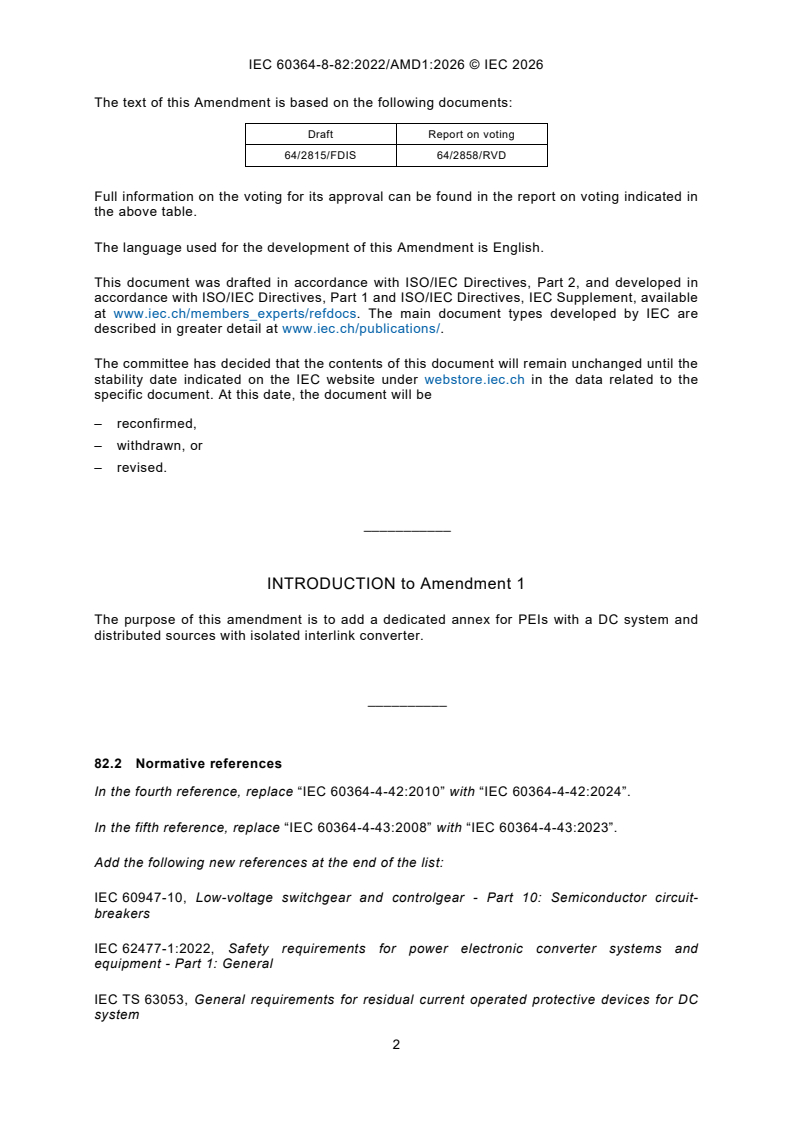
The purpose of this amendment is to add a dedicated annex for PEIs with a DC system and
distributed sources with isolated interlink converter.
__________
82.2 Normative references
In the fourth reference, replace “IEC 60364-4-42:2010” with “IEC 60364-4-42:2024”.
In the fifth reference, replace “IEC 60364-4-43:2008” with “IEC 60364-4-43:2023”.
Add the following new references at the end of the list:
IEC 60947-10, Low-voltage switchgear and controlgear - Part 10: Semiconductor circuit-
breakers
IEC 62477-1:2022, Safety requirements for power electronic converter systems and
equipment - Part 1: General
IEC TS 63053, General requirements for residual current operated protective devices for DC
system
82.3 Terms and definitions
Add the following terms and definitions at the end of the list:
82.3.20
interlink converter
ILC
power electronic converter system (PECS) interconnecting two circuits of an electrical
installation that can have different voltages and frequencies allowing transfer of energy between
these circuits
Note 1 to entry: An International Standard specifying safety and performance requirements for interlink converters
is under development (IEC 63532).
Note 2 to entry: Different types of PECS can be defined depending on the nature of the installation – AC/DC or
DC/DC or AC/AC, unidirectional or bidirectional – but without energy storage capability.
Note 3 to entry: Safety requirements for PECS are defined in the group safety publication IEC 62477-1.
82.3.21
isolated interlink converter
IILC
interlink converter (ILC) that provides at least a basic insulation between the two different
circuits of an electrical installation and allows different types of electric system for these circuits
Note 1 to entry: See item 18 in Figure F.1, Figure F.2 and Figure F.3.
82.3.22
pre-charging
energizing the capacitances of a DC circuit with a limited current
82.3.23
intertripping
tripping of protective devices initiated from tripping of another protective device
82.8.2.2.1 General
Add the following at the end of the third paragraph:
Annex F provides requirements for PEIs with distributed sources in the case of a DC system
with isolated interlink converter.
82.8.2.2.7 Island mode in IT
In Note 1, replace “IEC 60364-4-43:2008” with “IEC 60364-4-43:2023”.
Annex E
(informative)
List of notes concerning certain countries
Add the following country note at the end of the list:
Country Clause N° Text
DE F.5.1.1 In Germany the short time withstand current I does not
cw
apply.
Add the following new annex after Annex E:
Annex F
(normative)
PEIs with a DC system and distributed sources
with isolated interlink converter
F.1 General
Introduction of local power supplies based on renewable energy sources and local electrical
energy storage (EES) system is usually carried out using a DC system and a power electronic
converter. Loads can also be controlled by power electronic converters and operate in DC:
information technology, LED lighting, electric vehicles, etc.
NOTE 1 An electric vehicle can also be a non-permanently connected local storage unit.
An important aspect of prosumer’s electrical installations (PEIs) is that sources can be
decentralized. Clause 82.8 describes PEIs with local supplies connected to the main distribution
board. Alternative architectures, e.g. based on a DC backbone interconnecting sources and
loads, with specific protective measures to comply with 82.8.2.2.1, may be used.
This Annex F applies to PEIs with a DC system connected to the distribution network through
an isolated interlink converter (IILC) with local sources interconnected through converters to a
DC distribution system; see, for example, Figure F.1.
NOTE 2 Annex F can apply also to stand-alone PEIs.
NOTE 3 The isolated interlink converter can be made of several units in parallel.
NOTE 4 PEI with non-isolated interlink converter is under consideration.
Key
1 Distribution network
2 Bidirectional isolated DC/DC electric vehicle supply equipment (EVSE)
8 DC/DC bidirectional non-isolated converter for electrical energy storage (EES) system
9 DC/DC non-isolated PV converter
12 Point of connection (POC)
13 (13a+13b) Prosumer’s electrical installation (PEI)
13a AC side of the PEI (solid line), see an example in Figure 2
13b DC side of the PEI (dotted line in blue)
18 AC/DC isolated interlink converter (unidirectional or bidirectional)
19 DC/DC unidirectional non-isolated converter
20 DC/AC unidirectional non-isolated inverter
21 DC/AC unidirectional isolated inverter
22 DC/DC unidirectional isolated converter
23 DC/AC bidirectional non-isolated converter connected to a regenerative load
NOTE Arrows indicate power flow in normal operation.
Figure F.1 – Example of a PEI with a DC system
F.2 Types of PEI with a DC system
F.2.1 General
A PEI with a DC system connected to the distribution network through an isolated interlink
converter can be grid connected or islandable. See Figure F.2 for islandable PEI.
NOTE When the switching device for islanding (SDFI) is in closed position and the interlink converter is inactive
(not exchanging power with the distribution network), the PEI is still considered as grid connected.
Key
1 Distribution network
2 Point of connection (POC)
3 Main switching device
4 Switching device for islanding (SDFI) (see 82.6.3.4.3)
5 System referencing conductor switching device (see 82.8.2.2.4)
13 (13a+13b) Prosumer’s electrical installation (PEI)
13a AC side of the PEI (solid line), see an example in Figure 2
13b DC side of the PEI (dotted line in blue)
18 AC/DC isolated interlink converter (unidirectional or bidirectional)
Figure F.2 – Example of islandable PEI architecture
F.2.2 Interaction with the distribution network
The AC side of the PEI shall comply with 82.6.3 (see Figure 4). In addition to the requirements
of 82.6.3, a start-up sequence for the DC system shall be defined including pre-charging when
needed to prevent damage to equipment and tripping of protective devices.
The start-up sequence is required when the DC system is put in service or after the system, or
a part of it, has been de-energized. This sequence consists of several steps of pre-charging of
the different circuits to reach the operating voltage of the DC system.
Pre-charging can be provided by the interlink converter, an overcurrent protective device
(OCPD), a dedicated converter supplied from the AC side of the PEI or by a local energy source
on the DC system.
The steps consist in:
– pre-charging all capacitances of the C3 circuit (see F.3.3);
– pre-charging all circuits connected to the C3 circuit.
The start-up sequence is completed when all circuits that are part of the DC system and are
intended to be energized, are pre-charged to a defined voltage within the operating voltage
band B3 (see IEC TR 63282).
Pre-charging shall not impair the isolation provided by isolated converters.
Any other auxiliary circuits (measurement, controller, etc.) connected between the AC side of
the PEI and the DC system shall not impair the isolation provided by the isolated interlink
converter.
Provisions shall be made to prevent inadvertent or unauthorized start-up and pre-charging. This
can be achieved either by means of mechanical or electrical interlocks.
F.3 General characteristics of the DC side of the PEI
F.3.1 DC voltage characteristics
In accordance with IEC TR 63282, the DC voltages are divided into seven different bands for
temporary and continuous operation. Clause 5 of IEC TR 63282:2024 defines for a DC system
– the voltage bands,
– the maximum time of operation within a band, and
– the operating states.
Equipment and devices shall be selected for operation in these bands. The nominal operation
band of the DC system is called B3. Equipment and devices shall be designed for continuous
operation in this voltage band B3.
The operating voltage can be used as a signal to ensure the stability and flexibility of such a
PEI (see IEC TR 63282:2024, 4.3.2).
The DC side of the PEI (13b in Figure F.1) shall be designed in order to maintain
– correct power balancing between sources and loads (e.g. droop control),
– system stability, and
– power quality (e.g. ripple).
F.3.2 Type of electric systems of the DC side of the PEI
The DC side of the PEI shall have one single interconnected earthing arrangement in order to
avoid risk of corrosion in the surroundings of the installation (see F.4.5). Therefore, TT system
is not permitted.
To minimize current in conductive parts not intended to carry current in normal situation, TN-C
and TN-C-S systems are not permitted.
When IT system is selected, exposed-conductive-parts shall be connected to the same earthing
arrangement.
F.3.3 DC circuit classification
The DC circuits of a PEI are classified as follows (see Figure F.3):
– C1 circuit: circuit supplied from only one end;
– C2 circuit: circuit supplied from both ends;
– C3 circuit: circuit connected to more than two sources.
Key
1 Distribution network
2 Bidirectional isolated DC/DC electric vehicle supply equipment (EVSE)
8 DC/DC bidirectional non-isolated converter for electrical energy storage (EES) system
9 DC/DC unidirectional non-isolated PV converter
12 Point of connection (POC)
13 (13a+13b) Prosumer’s electrical installation (PEI)
13a AC side of the PEI (solid line), see an example in Figure 2
13b DC side of the PEI (dotted line in blue)
18 AC/DC isolated interlink converter (unidirectional or bidirectional)
19 DC/DC unidirectional non-isolated converter
20 DC/AC unidirectional non-isolated inverter
21 DC/AC unidirectional isolated inverter
22 DC/DC unidirectional isolated converter
23 DC/AC bidirectional non-isolated converter connected to a regenerative load
24 System referencing conductor (SRC)
Figure F.3 – Example of a PEI with a DC system and illustration
of DC circuit classification
F.4 Protection of PEI with a DC system
F.4.1 Protection against electric shock
F.4.1.1 TN-S system
The system referencing conductor (SRC) shall be connected near the interlink converter.
In case of a fault on a C2 or C3 circuit and where automatic disconnection of supply is used, all
supplies connected to this circuit shall be disconnected in accordance with disconnection times
defined in IEC 60364-4-41. In order to disconnect all supplies, an intertripping function may be
implemented (see F.5.2.3).
Unintended energizing of all sources a
...