


IEC TR 63211-2-12:2020
(Main)Durability test methods for electronic displays - Part 2-12: Environmental tests - Environmental conditions of use, storage and transportation of electronic displays
Durability test methods for electronic displays - Part 2-12: Environmental tests - Environmental conditions of use, storage and transportation of electronic displays
IEC TR 63211-2-12:2020(E) provides data and information on the environmental conditions when electronic displays are used, stored and transported.
This document covers the temperature, relative humidity and light of the environment of electronic displays.
The information provided by this document is related to the following electronic displays:
indoor displays for consumer homes and offices, such as TVs or PC monitors,
indoor displays for commercial applications, such as signage and show cases,
mobile displays, such as smartphones, tablets, e-books and mobile PCs,
wearable displays, such as eyewear displays and smart watches,
in-vehicle displays, and
outdoor displays, such as signage for public information and advertising.
General Information
- Status
- Published
- Publication Date
- 06-Feb-2020
- Technical Committee
- TC 110 - Electronic displays
- Current Stage
- PPUB - Publication issued
- Start Date
- 07-Feb-2020
- Completion Date
- 31-Jan-2020
Overview
IEC TR 63211-2-12:2020 is a Technical Report from the IEC 63211 series that documents environmental conditions of use, storage and transportation for electronic displays. The report provides data and guidance on the three primary environmental stressors that affect display durability: temperature, relative humidity, and light exposure. It covers a broad range of display types including indoor consumer and commercial displays (TVs, monitors, signage), mobile and wearable displays (smartphones, tablets, smart watches, eyewear), in‑vehicle displays, and outdoor signage.
Key topics
- Environmental factors: Detailed treatment of temperature, relative humidity (RH) and light (spectral distribution and illuminance) as the dominant durability stressors.
- Use-case breakdown: Separate condition characterizations for indoor (homes, offices, commercial), outdoor, vehicle cabins, mobile/wearable and transportation/storage scenarios.
- Data-driven guidance: Year‑round temperature/RH datasets, light level histograms and spectral examples for typical environments and geographic/climatic divisions.
- Test conditions mapping: Comparison and alignment with existing environmental testing standards (notably the IEC 60068 series) and a collection of test conditions used in display‑related standards.
- Annex material: Informative annexes summarizing conditions in other IEC display standards, typical high/low temperature and damp‑heat test regimes and transportation temperature/humidity trends.
Practical applications
IEC TR 63211-2-12 is intended to help engineers, test laboratories and product teams translate real‑world environmental exposure into realistic durability test conditions. Typical uses include:
- Defining environmental test profiles for reliability and accelerated aging tests of LCD, OLED and other display technologies.
- Selecting temperature, humidity and light exposure parameters for product qualification, design validation and failure analysis.
- Informing packaging, storage and transportation specifications to avoid environmental damage during logistics.
- Supporting automotive and outdoor display qualification where cabin heating, solar irradiance and wide climatic variation are critical.
- Assisting standards writers, QA managers and procurement teams to ensure displays meet expected field conditions.
Related standards
- IEC TR 63211 series (Durability test methods for electronic displays)
- IEC 60068 series (Environmental testing for electrotechnical products)
- Other IEC display standards referenced in the report (summarized in Annex A)
This Technical Report is a practical reference for anyone involved in environmental testing, durability assessment or lifecycle planning of electronic displays and helps bridge real‑world environmental data with standardized test methods.
Frequently Asked Questions
IEC TR 63211-2-12:2020 is a technical report published by the International Electrotechnical Commission (IEC). Its full title is "Durability test methods for electronic displays - Part 2-12: Environmental tests - Environmental conditions of use, storage and transportation of electronic displays". This standard covers: IEC TR 63211-2-12:2020(E) provides data and information on the environmental conditions when electronic displays are used, stored and transported. This document covers the temperature, relative humidity and light of the environment of electronic displays. The information provided by this document is related to the following electronic displays: indoor displays for consumer homes and offices, such as TVs or PC monitors, indoor displays for commercial applications, such as signage and show cases, mobile displays, such as smartphones, tablets, e-books and mobile PCs, wearable displays, such as eyewear displays and smart watches, in-vehicle displays, and outdoor displays, such as signage for public information and advertising.
IEC TR 63211-2-12:2020(E) provides data and information on the environmental conditions when electronic displays are used, stored and transported. This document covers the temperature, relative humidity and light of the environment of electronic displays. The information provided by this document is related to the following electronic displays: indoor displays for consumer homes and offices, such as TVs or PC monitors, indoor displays for commercial applications, such as signage and show cases, mobile displays, such as smartphones, tablets, e-books and mobile PCs, wearable displays, such as eyewear displays and smart watches, in-vehicle displays, and outdoor displays, such as signage for public information and advertising.
IEC TR 63211-2-12:2020 is classified under the following ICS (International Classification for Standards) categories: 31.120 - Electronic display devices. The ICS classification helps identify the subject area and facilitates finding related standards.
IEC TR 63211-2-12:2020 is available in PDF format for immediate download after purchase. The document can be added to your cart and obtained through the secure checkout process. Digital delivery ensures instant access to the complete standard document.
Standards Content (Sample)
IEC TR 63211-2-12 ®
Edition 1.0 2020-02
TECHNICAL
REPORT
colour
inside
Durability test methods for electronic displays –
Part 2-12: Environmental tests – Environmental conditions of use, storage
and transportation of electronic displays
All rights reserved. Unless otherwise specified, no part of this publication may be reproduced or utilized in any form
or by any means, electronic or mechanical, including photocopying and microfilm, without permission in writing from
either IEC or IEC's member National Committee in the country of the requester. If you have any questions about IEC
copyright or have an enquiry about obtaining additional rights to this publication, please contact the address below or
your local IEC member National Committee for further information.
IEC Central Office Tel.: +41 22 919 02 11
3, rue de Varembé info@iec.ch
CH-1211 Geneva 20 www.iec.ch
Switzerland
About the IEC
The International Electrotechnical Commission (IEC) is the leading global organization that prepares and publishes
International Standards for all electrical, electronic and related technologies.
About IEC publications
The technical content of IEC publications is kept under constant review by the IEC. Please make sure that you have the
latest edition, a corrigendum or an amendment might have been published.
IEC publications search - webstore.iec.ch/advsearchform Electropedia - www.electropedia.org
The advanced search enables to find IEC publications by a The world's leading online dictionary on electrotechnology,
variety of criteria (reference number, text, technical containing more than 22 000 terminological entries in English
committee,…). It also gives information on projects, replaced and French, with equivalent terms in 16 additional languages.
and withdrawn publications. Also known as the International Electrotechnical Vocabulary
(IEV) online.
IEC Just Published - webstore.iec.ch/justpublished
Stay up to date on all new IEC publications. Just Published IEC Glossary - std.iec.ch/glossary
details all new publications released. Available online and 67 000 electrotechnical terminology entries in English and
once a month by email. French extracted from the Terms and Definitions clause of
IEC publications issued since 2002. Some entries have been
IEC Customer Service Centre - webstore.iec.ch/csc collected from earlier publications of IEC TC 37, 77, 86 and
If you wish to give us your feedback on this publication or CISPR.
need further assistance, please contact the Customer Service
Centre: sales@iec.ch.
IEC TR 63211-2-12 ®
Edition 1.0 2020-02
TECHNICAL
REPORT
colour
inside
Durability test methods for electronic displays –
Part 2-12: Environmental tests – Environmental conditions of use, storage
and transportation of electronic displays
INTERNATIONAL
ELECTROTECHNICAL
COMMISSION
ICS 31.120 ISBN 978-2-8322-7802-4
– 2 – IEC TR 63211-2-12:2020 © IEC 2020
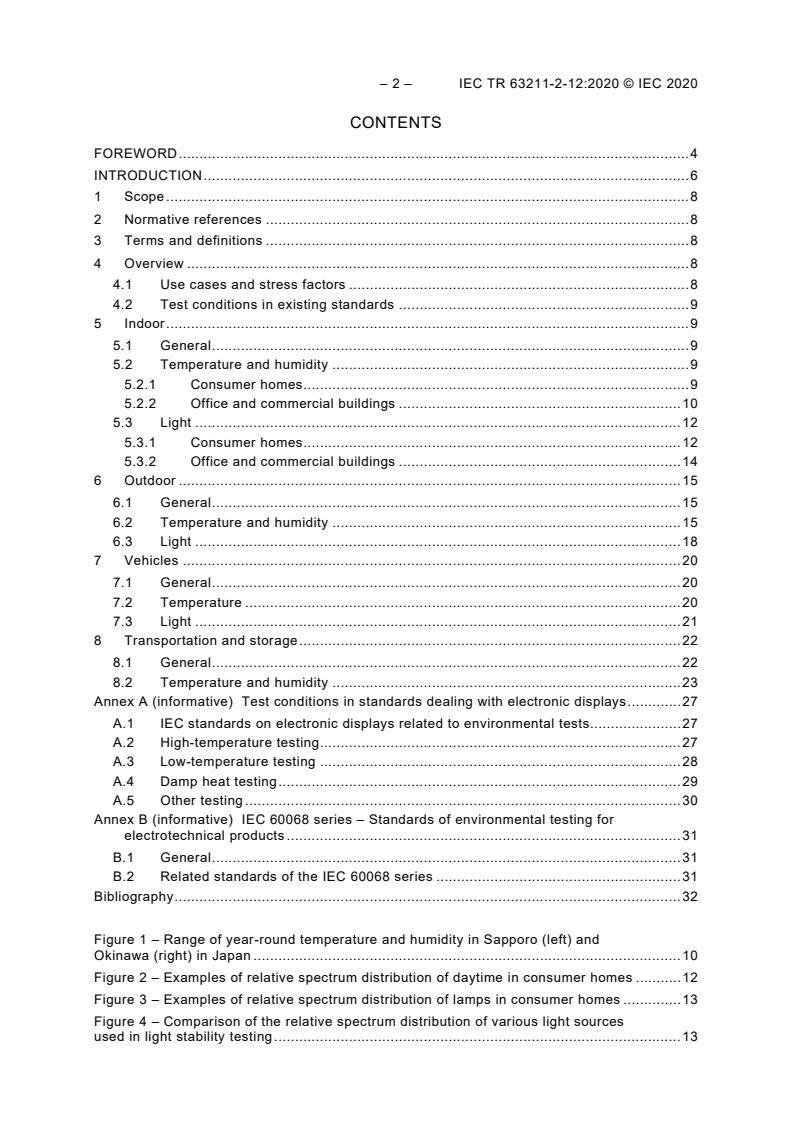
CONTENTS
FOREWORD . 4
INTRODUCTION . 6
1 Scope . 8
2 Normative references . 8
3 Terms and definitions . 8
4 Overview . 8
4.1 Use cases and stress factors . 8
4.2 Test conditions in existing standards . 9
5 Indoor . 9
5.1 General . 9
5.2 Temperature and humidity . 9
5.2.1 Consumer homes . 9
5.2.2 Office and commercial buildings . 10
5.3 Light . 12
5.3.1 Consumer homes . 12
5.3.2 Office and commercial buildings . 14
6 Outdoor . 15
6.1 General . 15
6.2 Temperature and humidity . 15
6.3 Light . 18
7 Vehicles . 20
7.1 General . 20
7.2 Temperature . 20
7.3 Light . 21
8 Transportation and storage . 22
8.1 General . 22
8.2 Temperature and humidity . 23
Annex A (informative) Test conditions in standards dealing with electronic displays . 27
A.1 IEC standards on electronic displays related to environmental tests. 27
A.2 High-temperature testing . 27
A.3 Low-temperature testing . 28
A.4 Damp heat testing . 29
A.5 Other testing . 30
Annex B (informative) IEC 60068 series – Standards of environmental testing for
electrotechnical products . 31
B.1 General . 31
B.2 Related standards of the IEC 60068 series . 31
Bibliography . 32
Figure 1 – Range of year-round temperature and humidity in Sapporo (left) and
Okinawa (right) in Japan . 10
Figure 2 – Examples of relative spectrum distribution of daytime in consumer homes . 12
Figure 3 – Examples of relative spectrum distribution of lamps in consumer homes . 13
Figure 4 – Comparison of the relative spectrum distribution of various light sources
used in light stability testing . 13
Figure 5 – Histogram of average daytime light levels in consumer homes around the
world. 14
Figure 6 – Example of year-round data, New York (United States) . 16
Figure 7 – Temperature versus humidity maps of four climatic divisions . 17
Figure 8 – Worldwide deviation of temperature and relative humidity . 18
Figure 9 – Schematic diagram of solar radiation outdoors . 20
Figure 10 – Temperature trends in a car left in the sun in summer . 21
Figure 11 – Light intensity inside a car cabin as a percentage of the outside light
intensity . 22
Figure 12 – Spectral transmittance examples of automobile windows . 22
Figure 13 – Temperature and humidity trends of marine transportation . 23
Table 1 – Documents related to environmental tests for electronic displays . 7
Table 2 – Overview of the stress factors for each type of use case . 9
Table 3 – Collection of condition data of consumer homes in eight cities . 10
Table 4 – Results of temperature and relative humidity of consumer homes . 10
Table 5 – Examples of guidelines for temperature and humidity . 11
Table 6 – Rate of conformity to the guidelines for temperature and humidity in Japan . 11
Table 7 – Summary of light levels in ISO 8995-1 [15]and JIS Z 9110 [16] . 14
Table 8 – Typical conditions for commercial prints in ISO TS 21139-1 [17] . 14
Table 9 – Forty-eight cities from each climatic division . 16
Table 10 – Boundary data of deviation around the world . 18
Table 11 – Year-round average data of global radiation from 21 countries . 19
Table 12 – Summary of temperature data in cars left in the sun . 21
Table 13 – Survey results of marine transportation . 24
Table 14 – Results of survey of transportation by land . 25
Table 15 – Cargo left in a parked vehicle or stored in a warehouse . 25
Table 16 – Examples of the temperature in air cargo compartments . 26
Table 17 – Temperature, humidity and air pressure during air shipment . 26
Table A.1 – IEC standards for electronic displays related to environmental tests . 27
Table A.2 – Testing conditions for storage at high temperature . 28
Table A.3 – Testing conditions for operation at high temperature . 28
Table A.4 – Testing conditions for storage at low temperature . 28
Table A.5 – Testing conditions for operation at low temperature . 29
Table A.6 – Testing conditions for storage under damp heat . 29
Table A.7 – Testing conditions for operation under damp heat . 30
Table B.1 – Standards of IEC 60068 series . 31
– 4 – IEC TR 63211-2-12:2020 © IEC 2020
INTERNATIONAL ELECTROTECHNICAL COMMISSION
____________
DURABILITY TEST METHODS FOR ELECTRONIC DISPLAYS –
Part 2-12: Environmental tests – Environmental conditions of use,
storage and transportation of electronic displays
FOREWORD
1) The International Electrotechnical Commission (IEC) is a worldwide organization for standardization comprising
all national electrotechnical committees (IEC National Committees). The object of IEC is to promote
international co-operation on all questions concerning standardization in the electrical and electronic fields. To
this end and in addition to other activities, IEC publishes International Standards, Technical Specifications,
Technical Reports, Publicly Available Specifications (PAS) and Guides (hereafter referred to as “IEC
Publication(s)”). Their preparation is entrusted to technical committees; any IEC National Committee interested
in the subject dealt with may participate in this preparatory work. International, governmental and non-
governmental organizations liaising with the IEC also participate in this preparation. IEC collaborates closely
with the International Organization for Standardization (ISO) in accordance with conditions determined by
agreement between the two organizations.
2) The formal decisions or agreements of IEC on technical matters express, as nearly as possible, an international
consensus of opinion on the relevant subjects since each technical committee has representation from all
interested IEC National Committees.
3) IEC Publications have the form of recommendations for international use and are accepted by IEC National
Committees in that sense. While all reasonable efforts are made to ensure that the technical content of IEC
Publications is accurate, IEC cannot be held responsible for the way in which they are used or for any
misinterpretation by any end user.
4) In order to promote international uniformity, IEC National Committees undertake to apply IEC Publications
transparently to the maximum extent possible in their national and regional publications. Any divergence
between any IEC Publication and the corresponding national or regional publication shall be clearly indicated in
the latter.
5) IEC itself does not provide any attestation of conformity. Independent certification bodies provide conformity
assessment services and, in some areas, access to IEC marks of conformity. IEC is not responsible for any
services carried out by independent certification bodies.
6) All users should ensure that they have the latest edition of this publication.
7) No liability shall attach to IEC or its directors, employees, servants or agents including individual experts and
members of its technical committees and IEC National Committees for any personal injury, property damage or
other damage of any nature whatsoever, whether direct or indirect, or for costs (including legal fees) and
expenses arising out of the publication, use of, or reliance upon, this IEC Publication or any other IEC
Publications.
8) Attention is drawn to the Normative references cited in this publication. Use of the referenced publications is
indispensable for the correct application of this publication.
9) Attention is drawn to the possibility that some of the elements of this IEC Publication may be the subject of
patent rights. IEC shall not be held responsible for identifying any or all such patent rights.
The main task of IEC technical committees is to prepare International Standards. However, a
technical committee may propose the publication of a technical report when it has collected
data of a different kind from that which is normally published as an International Standard, for
example "state of the art".
IEC TR 63211-2-12, which is a technical report, has been prepared by IEC technical
committee 110: Electronic displays.
The text of this technical report is based on the following documents:
Enquiry draft Report on voting
110/1102/DTR 110/1122A/RVDTR
Full information on the voting for the approval of this technical report can be found in the
report on voting indicated in the above table.
This document has been drafted in accordance with the ISO/IEC Directives, Part 2.
A list of all parts in the IEC 63211 series, published under the general title Durability test
methods for electronic displays, can be found on the IEC website.
The committee has decided that the contents of this document will remain unchanged until the
stability date indicated on the IEC website under "http://webstore.iec.ch" in the data related to
the specific document. At this date, the document will be
• reconfirmed,
• withdrawn,
• replaced by a revised edition, or
• amended.
IMPORTANT – The 'colour inside' logo on the cover page of this publication indicates
that it contains colours which are considered to be useful for the correct
understanding of its contents. Users should therefore print this document using a
colour printer.
– 6 – IEC TR 63211-2-12:2020 © IEC 2020
INTRODUCTION
The IEC 63211 series covers the durability test methods of electronic displays and related
components. This series describes the evaluation of resistance of two or more electronic
displays and their related components to environmental stress, mechanical stress, a
combination of environmental and mechanical stress, contact with chemicals, and other
stresses.
This part of IEC 63211 focuses on environmental aspects and describes the environmental
conditions of displays, when in use, stored or transported.
The main environmental factors that influence the durability of electronic displays are the
temperature and relative humidity of the air and the level of light exposure. These factors
have been described in the IEC 60068 series as the general conditions of environmental
testing for electrotechnical products. However, in the IEC 60068 series, the conditions are
merely listed and cover an extremely wide range of diverse values. For example, the
conditions of dry heat temperature are stipulated in IEC 60068-2-2 [1] as the range from
30 °C to 1 000 °C. They are merely listed as a series of temperature values such as, (30, 35,
40, 45, 50, 55, 60, 65, 70, 75, 80, 85, 100, 125, 155, 175, 200, 250, 315, 400, 500, 630, 800
and 1 000) °C. Temperatures of several hundreds of degrees are too severe to maintain the
original functions of most electronic displays, and so these elevated temperatures have no
valuable meaning as a test condition.
Therefore, environmental tests for electronic displays have been documented for each type of
technology, such as LCD, PDP and OLED, as shown in Table 1. They were originally created
using the IEC 60068 series documents as a reference, and some modifications were
introduced to be suitable for electronic displays. For example, the conditions of the dry heat
temperature test are limited in IEC 61747-10-2 [2] to the range from 30 °C to 100 °C.
The environmental test documents for electronic displays summarised in Table 1 have two
problems. The first is that each document focuses on a specific display technology. The
second is that the conditions are merely listed so users are required to choose several
conditions that are fit for their intended purpose.
Most environmental stresses are not very different, even if the technologies under test are
different. The test methods and test conditions should be discussed, and the most appropriate
test should be chosen based on the application and the intended usage, rather than the
technology used in the displays.
This document describes the data and information on the environmental conditions relevant to
how electronic displays are actually used, stored or transported in various use profiles. They
are intended to be used as a reference when the test conditions are determined. Even though
the test conditions should be harsher than the actual conditions, in order to accelerate the
tests, it is important to consider the actual conditions when the accelerated test conditions are
discussed.
_____________
Numbers in square brackets refer to the Bibliography.
Table 1 – Documents related to environmental tests for electronic displays
IEC document (scope) Title Status and date
of publication
IEC 61747-10-2 [2] Liquid crystal display devices – Part 10-2: Environmental, Edition 1.0
endurance and mechanical test methods – Environmental and
(LCD) 2014-09-03
endurance
IEC 61988-4-1 [3] Plasma display panels – Part 4-1: Environmental testing methods Edition 1.0
– Climatic and mechanical
(PDP) 2015-03-25
IEC 62341-5 [4] Organic light emitting diode (OLED) displays – Part 5: Edition 1.0
Environmental testing methods
(OLED) 2009-11-20
IEC 62679-4-2 [5] Electronic paper displays – Part 4-2: Environmental test methods Edition 1.0
(EPD) 2016-08-29
IEC 62715-6-2 [6] Flexible display devices – Part 6-2: Environmental testing methods Edition 1.0
(FDD) 2017-05-24
IEC 62908-13-10 [7] Touch and interactive displays – Part 13-10: Reliability test Edition 1.0
methods of touch displays – Environmental durability test methods
(TID) 2016-11-25
– 8 – IEC TR 63211-2-12:2020 © IEC 2020
DURABILITY TEST METHODS FOR ELECTRONIC DISPLAYS –
Part 2-12: Environmental tests – Environmental conditions of use,
storage and transportation of electronic displays
1 Scope
This part of IEC 63211 provides data and information on the environmental conditions when
electronic displays are used, stored and transported.
This document covers the temperature, relative humidity and light of the environment of
electronic displays.
The information provided by this document is related to the following electronic displays:
a) indoor displays for consumer homes and offices, such as TVs or PC monitors,
b) indoor displays for commercial applications, such as signage and show cases,
c) mobile displays, such as smartphones, tablets, e-books and mobile PCs,
d) wearable displays, such as eyewear displays and smart watches,
e) in-vehicle displays, and
f) outdoor displays, such as signage for public information and advertising.
2 Normative references
There are no normative references in this document.
3 Terms and definitions
No terms and definitions are listed in this document.
ISO and IEC maintain terminological databases for use in standardization at the following
addresses:
• IEC Electropedia: available at http://www.electropedia.org/
• ISO Online browsing platform: available at http://www.iso.org/obp
4 Overview
4.1 Use cases and stress factors
Stress factors on electronic displays vary according to the type of use. An overview of the
stress factors in each use case is shown in Table 2. The number of “+” symbols indicates how
serious the stress factor is in each case; “+++++” means seriously affected, “+” means slightly
affected and “-” means not affected. "Duration" indicates the typical length of time of
exposition to the stress factor, “long” means several years to twenty years, “middle” means
several months to a few years and “short” means several days to a few months.
Table 2 – Overview of the stress factors for each type of use case
Use case Environmental stress factors Duration
Heat Humidity Light
Usage Indoor/home and office ++ ++ + long
Indoor/commercial + + ++ middle to long
Mobile +++ ++++ +++ middle
Wearable +++ ++++ +++ middle
In vehicle +++++ +++ ++++ middle
Outdoor/not exposed to rain ++++ +++++ ++++ middle
Outdoor/exposed to rain ++++ +++++ +++++ middle
Storage With air conditioning ++ ++ - middle
Without air conditioning ++++ ++++ - middle
Transportation of products +++ ++ - short
4.2 Test conditions in existing standards
A summary of the test conditions described in the standards for electronic displays issued by
IEC/TC 110 is shown in Annex A. The standards for each type of display technology, such as
LCD, PDP and OLED, have been documented. Originally, the standards were created by
reference to a document of the IEC 60068 series, which describes the environmental testing
of electrotechnical products in general. The related documents of the IEC 60068 series are
shown in Annex B.
The test conditions of the standards for electronic displays are stipulated by IEC/TC 110 with
reference to the IEC 60068 series, with some modification if necessary. They are applicable
to each sort of display in general, but each set of conditions covers too wide a range for any
single specific usage.
The data and information on the environmental conditions when electronic displays are
actually used, stored or transported in various situations are described in Clause 5 to Clause
8 of this document. These clauses provide a reference for when testing conditions need to be
determined. Even though the test conditions should be harsher than the actual conditions, in
order to reduce the time to perform the test, it is indispensable to consider the actual
conditions whenever accelerated test conditions are discussed.
5 Indoor
5.1 General
In the case of indoor use, the structures of houses or buildings divide the atmosphere into
either inside or outside. Inside houses or buildings, the atmosphere is intentionally
conditioned for living, meaning that the indoor temperature, humidity and light conditions are
largely different from the outdoor climatic conditions.
5.2 Temperature and humidity
5.2.1 Consumer homes
Temperature and humidity data in consumer homes over a year was collected in eight cities
around the world [8][9]. The cities where data was collected are shown in Table 3, and the
results are shown in Table 4. Many documents of IEC/TC110 stipulate the measuring
conditions for various types of testing; these are 25 °C ± 3 °C for temperature and from 25 %
to 85 % for relative humidity. It is assumed that these documents cover around four times the
standard deviation in consumer homes in the real world.
– 10 – IEC TR 63211-2-12:2020 © IEC 2020
Table 3 – Collection of condition data of consumer homes in eight cities
No. Region Country City
1 Europe United Kingdom London
2 North America United States Rochester
3 Los Angeles
4 Atlanta
5 South America Brazil Sao Paulo
6 Asia Japan Tokyo
7 China Shanghai
8 Oceania Australia Melbourne
Table 4 – Results of temperature and relative humidity of consumer homes
Temperature (°C) Relative humidity (%RH)
Average 21,1 54
3,9 13
Standard deviation (σ)
The variation inside consumer homes was not large, even in severe climates, because any
direct air flow from outdoors is shut out and air conditioners are used to keep the inhabitants
comfortable. For example, a comparison of the outdoor and indoor conditions is shown
in Figure 1 [10]. Sapporo is a northern Japanese city of subarctic climate, and Okinawa is a
southern Japanese city of temperate but near subtropical climate. In both cities, the range in
the variation in climate was smaller indoors than outdoors.
a) Sapporo b) Okinawa
Figure 1 – Range of year-round temperature and humidity
in Sapporo (left) and Okinawa (right) in Japan
5.2.2 Office and commercial buildings
In many countries, guidelines for temperature and humidity are set by each government to
keep a healthy and comfortable environment for workers and visitors in office spaces and/or
commercial buildings. Table 5 shows some examples of these guidelines [11].
Table 5 – Examples of guidelines for temperature and humidity
Country Title Relative humidity (% RH)
Temperature (°C)
Summer Winter Summer Winter
USA (HHS) PHS Facilities 21,1 to 26,7 18,3 to 20,0 -
Manual
USA (OSHA) Technical Manual 20,0 to 24,4 20 to 60
Canada CSA Z412-00 24,5 to 28,9 20,5 to 25,5 -
(30 % RH) (30 % RH)
23,0 to 25,5 20,0 to 24,0
(60 % RH) (60 % RH)
United Guidance 13,0 to 30,0 -
Kingdom
Finland National Building < 25,0 < 25,0 45 (21 °C)
Code
a a
(< 28,0 ) (< 26,0 )
China GB/T18883-2002 22,0 to 28,0 16,0 to 24,0 40 to 80 30 to 60
Singapore Guidelines 22,5 to 25,5 < 70
Australia Guidelines 23,0 to 26,0 20,0 to 24,0 < 70
b b
New Employment 40 to 70
19,0 to 24,0 18,0 to 22,0
Zealand Regulation
c c
16,0 to 21,0 16,0 to 19,0
Japan Ordinance on Health 17,0 to 28,0 40 to 70
Standards in the
Office
a
When the outside temperature is above 20 °C.
b
Workplace mainly for desk work.
c
Workplace with a lot of activity.
The data in Table 5 can be referred to as typical indoor conditions, but care should be taken
as the actual conditions are not always within the ranges given because they are not strict
regulations; in many cases they are simply guidelines. For example, Azuma et al. surveyed
the rate of conformity to the guidelines in various types of buildings in Japan [12]. The results
of the survey taken in 2008 are shown in Table 6. The conformity rate of temperature is high
for offices and commercial spaces, such as department stores and general shops. However,
conformity to the relative humidity guidelines is lower, and the measured humidity was out of
the range in almost half of the survey sites.
Table 6 – Rate of conformity to the guidelines for temperature and humidity in Japan
Type Rate of conformity to the guidelines in Japan (%)
Guidelines for temperature Guidelines for relative humidity
17,0 °C to 28,0 °C 40 % RH to 70 % RH
Amusement 74 % 58 %
Department store 80 % 53 %
General shops 80 % 53 %
Office 84 % 50 %
School 65 % 50 %
Hotel 86 % 67 %
– 12 – IEC TR 63211-2-12:2020 © IEC 2020
5.3 Light
5.3.1 Consumer homes
In consumer homes, the spectral distribution is very different from that of sunlight because the
structure of the house protects from direct sunlight, and window glass filters out some parts of
the sunlight. This is especially true in the reduction of the UV components of sunlight, which
tend to degrade the materials and components of displays. Figure 2 shows some examples of
the relative spectrum in consumer homes compared to that of direct sunlight. The intensity
data has been normalized at 550 nm.
Figure 2 – Examples of relative spectrum distribution of daytime in consumer homes
In addition to sunlight entering through the window, various lighting is also used indoors. In
the past tungsten lamps and fluorescent lamps were mainly used. In recent years many kinds
of LED lamps have been developed and they are rapidly spreading in the world. Figure 3
shows the spectrum distribution of various lamps. Like the sunlight entering through the
windows, these illumination lights contain few UV components.
NOTE The Illuminating Engineering Society of North America (IESNA) supplies much information about various
types of illumination indoors [13].
a) Tungsten lamp and fluorescent lamp b) LED lamps
Figure 3 – Examples of relative spectrum distribution of lamps in consumer homes
When the stability of a display to light is tested for usage in a consumer home, care should be
taken over the spectral distribution, especially the UV component of the light source, which is
shorter than 380 nm in wavelength. Excess UV components can sometimes cause
degradation, which does not occur during normal usage, and so they are not appropriate even
for accelerated tests. Figure 4 shows the spectral distribution of various light sources used in
light stability testing. A xenon arc lamp with some types of UV filters is known to be
appropriate for simulating indoor lighting conditions.
a) Xenon lamp with filter b) Various lamps
Figure 4 – Comparison of the relative spectrum distribution
of various light sources used in light stability testing
Daytime light levels in seventy houses were measured in the United States, United Kingdom,
Australia, Netherlands and Japan and are shown in the histogram in Figure 5 [14]. The
average light level of the whole data set was around 160 lx, but the values varied widely,
perhaps due to the various structures of houses around the world.
– 14 – IEC TR 63211-2-12:2020 © IEC 2020
Figure 5 – Histogram of average daytime light levels
in consumer homes around the world
5.3.2 Office and commercial buildings
The light level in offices and commercial buildings is higher than in consumer homes because
it is necessary for business or commercial activities. ISO 8995-1 [15] and the related
document, JIS Z 9110 [16], stipulate the appropriate light levels for various types of work,
which can be referred to as typical conditions for considering the light stability of displays in
actual usage. A summary of the conditions is shown in Table 7.
Table 7 – Summary of light levels in ISO 8995-1 [15] and JIS Z 9110 [16]
Type Light level
Office Workplace for reading, writing, typing 500 lx to 750 lx
Common space 100 lx to 750 lx
Commercial building Space for goods displayed 500 lx to 2 000 lx
General space 300 lx to 500 lx
There exists a special case for the use of displays in commercial applications, where the
displays themselves are set inside the building, but they are seen from the outside through a
show window. In this case, the light level is much higher because of sunlight coming directly
through the window. There is a similar situation for commercial prints in a show window.
ISO TS 21139-1 [17] focuses on this kind of typical in-window condition in addition to the
general indoor conditions for considering the light stability of commercial prints and gives
useful reference information for the design of tests for electronic displays. The conditions in
ISO TS 21139-1 [17] are listed in Table 8.
Table 8 – Typical conditions for commercial prints in ISO TS 21139-1 [17]
General indoor display In-window display
Light source Indirect daylight through window glass or Direct daylight through window glass
other general room illumination
Light intensity Duty cycle 12 h/24 h, Duty cycle 12 h/24 h,
500 lx (150 lx to 1 000 lx) 3 000 lx (2 000 lx to 100 000 lx)
Spectral power Indirect daylight, LED, fluorescent, Direct daylight through window glass
distribution tungsten, halogen, metal-halide
6 Outdoor
6.1 General
Outdoor conditions are extremely varied across the world. Latitude, altitude and distance from
the ocean have an effect, and sometimes human activities such as agriculture and
construction can cause a difference in climate. In addition, seasonal deviations are strong in
some regions, so it is important to recognize regional variations in the places where a display
is to be used.
6.2 Temperature and humidity
Temperature and humidity are two parts of climatic conditions and are typically categorized by
the climatic divisions determined by Köppen [18][19]. There are five categories:
1) A: tropical zone;
2) B: arid zone;
3) C: temperate zone;
4) D: subarctic zone; and
5) E: frigid zone
The zones are defined mainly by temperature and the amount of rainfall. Climatic conditions
in most cities in the world are categorised into the four zones from A to D. The climate of the
frigid zone is so severe that there are few cities of high population in this category. The data
of 48 cities from four climatic divisions was surveyed using long-term weather data. Table 9
shows the cities and the climatic divisions surveyed.
NOTE Long-term weather data for each region of the world is featured on the web page of “Weather Forecast &
Reports”: https://wunderground.com/.
– 16 – IEC TR 63211-2-12:2020 © IEC 2020
Table 9 – Forty-eight cities from each climatic division
Climate City Country Climate City Country Climate City Country
A. Tropical (9 cities) C. Temperate (21 cities) D. Subarctic (12 cities)
Af Singapore Singapore Csa Madrid Spain Dwa Beijing China
Af Kuala Malaysia Csa Rome Italy Dwa Harbin China
Lumpur
Cfa Sao Paulo Brazil D Yakutsk Russia
Am Manaus Brazil
Cfa Tokyo Japan Dfa Sapporo Japan
Am Jakarta Indonesia
Cfa New York USA Dfb Moscow Russia
Am Cairns Australia
Cfa Canberra Australia Dfb Ottawa Canada
As Brasilia Brazil
Cfa Buenos Argentina Dfb Oslo Norway
Aw Kolkata India Aires
Dfb Murmansk Russia
Aw Mumbai India Cfb Berlin Germany
Dfb Karaganda Kazakhstan
Aw Bangkok Thailand Cfb London UK
Dfb Helsinki Finland
Cfb Paris Francs
Dfb Asahikawa Japan
Cfb Amsterdam Netherlands
B. Arid (6 cities)
Dfc Anchorage USA
Cfb Bern Switzerland
BW Dubai UAE
Cfb Stockholm Sweden
BW Riyadh Saudi Arabia
Cfb Warsaw Poland
BW Abu Dhabi UAE
Cfb Brussels Belgium
BS Ankara Turkey
Cfb Vienna Austria
BS Ulaanbaatar Mongolia
Cfb Copenhagen Denmark
BSk Tehran Iran
Cfc Reykjavik Iceland
Cwa New Delhi India
Cwa Seoul Korea
Cwb Mexico City Mexico
NOTE Abbreviations such as Af, BW and Csa are Köppen climate symbols. Their description and defining criteria
are stated in the reference documents [18][19].
Daily averaged data over one year was collected in each city. For example, data from New
York in the US is shown in Figure 6.
Figure 6 – Example of year-round data, New York (United States)
Data from the cities was gathered according to each climatic division. Figure 7 shows the
maps of the four climatic divisions.
a) Tropical zone b) Arid zone
c) Temperate zone d) Subarctic zone
Figure 7 – Temperature versus humidity maps of four climatic divisions
The four maps of Figure 7 were combined into one, which is shown in Figure 8. It shows the
worldwide deviation in temperature and relative humidity. In Table 10, the outer boundary of
the worldwide data is listed.
– 18 – IEC TR 63211-2-12:2020 © IEC 2020
Figure 8 – Worldwide deviation of temperature and relative humidity
Table 10 – Boundary data of deviation around the world
Features Examples of places Data
Temperature Relative Climatic City Country Temperature Humidity Month
humidity division
(°C) (%RH)
High High Tropical Singapore Singapore 30 86 May
High Low Arid Dubai UAE 42 24 July
Tehran Iran 37 8 July
Moderate to Low Subarctic Beijing China -2 8 Feb.
low
Low Moderate Subarctic Yakutsk Russia -47 57 Dec.
Low to Extremely Arid Ankara Turkey -3 100 Jan.
moderate high
Subarctic Moscow Russia 1 100 Jan.
Temperate Berlin Germany 2 100 Dec.
Moderate Extremely Temperate New Delhi India 12 100 Jan.
high
6.3 Light
Radiation of sunlight is affected by both the position on the Earth and the climate. Radiation
tends to be high in a low latitude area near the equator, while it tends to be lower in higher
latitude areas. Radiation is also higher in sunny climates, like arid zones, while radiation is
lower in cloudy, rainy or snowy climates, as in the other climatic divisions.
NOTE The World Meteorological Organization (WMO) of the United Nations is surveying the solar radiation data
in many countries and provides the data at the following website of the World Radiation Data Centre (WRDC):
http://wrdc.mgo.rssi.ru/wrdc_en_new.htm.
Table 11 shows the year-round average global radiation data from 21 countries. The most
radiation is observed in Algeria and Chile, which are at lower latitude and have sunny
climates, while the least radiation is observed in Iceland, which is at higher latitude and has a
rainy or snowy climate.
Table 11 – Year-round average data of global radiation from 21 countries
Region Country Year-round Maximum month Minimum month
average
2 2
/day) (J/cm /day)
(J/cm
(J/cm /day)
Africa Algeria 2 310 2 768 1 555
South America Chile 2 317 3 393 1 082
a
1 457 2 446 573
Argentina (3)
Oceania Australia (5) 1 679 2 556 706
North America United States (7) 1 596 2 575 634
Asia Indonesia 1 450 1 613 1 172
Japan (6) 1 442 2 192 743
Philippines 1 432 1 765 1 055
Korea 1 238 1 918 662
Europe Greece 1 612 2 665 700
Switzerland (4) 1 411 2 353 469
Moldova 1 356 2 667 320
Austria (3) 1 251 2 190 401
Slovakia 1 197 2 190 374
Germany 1 180 2 047 397
Netherlands 1 026 1 988 177
Latvia (3) 999 2 145 86
Estonia 966 2 302 67
Ireland 928 1 753 172
UK (2) 919 1 693 140
Iceland 751 1 751 14
Average 1 358
Standard deviation 407
a
The number in parentheses indicates the number of cities compiled and the data is averaged by country.
The sensors of observation devices are set horizontally for the measurement of global
radiation. Measured radiation contains a direct radiation component from the sun and a
diffuse radiation component from the whole unobstructed sky. The level of radiation is
affected by the time of day, the season, latitude on the Earth and clouds in the sky,
represented schematically in Figure 9a).
On the other hand, display devices are not usually set horizontally but can face various
directions. Users usually put their mobile devices face-up on tables but they tend to hold their
devices away from the sun when they watch the displayed contents. Digital signage displays
are standing still but are usually set facing the direction of the target audience. These
inclination (or tilting) and rotation angles of devices strongly affect the radiation amplitude. In
addition, surrounding structures, such as buildings or mountains, also affect the level of
radiation. If they shade the sunlight, radiation levels are decreased. In another case, reflected
light from structures could increase the level of radiation. When assuming the solar radiation
that a display receives, these additional factors need to be considered, as indicated in the
schematic diagram in Figure 9b).
– 20 – IEC TR 63211-2-12:2020 © IEC 2020
a) Measurement of global radiation b) Display under sunlight
Figure 9 – Schematic diagram of solar radiation outdoors
In addition to radiation amplitude, spectrum distribution can vary according to the inclination
(or tilting) and rotation angles of devices because there is a difference between direct
radiation and diffuse radiation. The light of diffuse radiation has low radiation amplitude and
contains a bigger portion of short wavelength and a smaller portion of long wavelength
compared to that of direct radiation. ASTM G197-4 [20] describes the basis for assuming
these spectral irradiance distributions.
7 Vehicles
7.1 General
In vehicles, the body structure divides the atmosphere into an inside and outside, just as in
consumer homes. Cabins are usually kept comfortable by an air conditioner when passengers
are in cars. However, conditions in vehicles tend to be affected by the outdoor conditions
because the portion of windows is large, and the thermal insulation performance of the vehicle
body tends to be poorer than in houses. In summer, especially when cars are parked in direct
sunlight, the cabin becomes like a greenhouse, and the inside ca
...
Questions, Comments and Discussion
Ask us and Technical Secretary will try to provide an answer. You can facilitate discussion about the standard in here.
Loading comments...