

IEC 61131-6:2012
(Main)Programmable controllers - Part 6: Functional safety
General Information
- Abstract
IEC 61131-6:2012 specifies requirements for programmable controllers (PLCs) and their associated peripherals, as defined in Part 1, which are intended to be used as the logic subsystem of an electrical/electronic/programmable electronic (E/E/PE) safety-related system. A programmable controller and its associated peripherals complying with the requirements of this part is considered suitable for use in an E/E/PE safety-related system and is identified as a functional safety programmable logic controller (FS-PLC). An FS-PLC is generally a hardware (HW) / software (SW) subsystem. An FS-PLC may also include software elements, for example predefined function blocks.
- Status
- Published
- Publication Date
- 01-Oct-2012
- Technical Committee
- SC 65B - Measurement and control devices
- Drafting Committee
- WG 7 - TC 65/SC 65B/WG 7
- Current Stage
- PPUB - Publication issued
- Start Date
- 02-Oct-2012
- Completion Date
- 15-Oct-2012
Overview
IEC 61131-6:2012 is an international standard published by the International Electrotechnical Commission (IEC) that defines requirements for programmable logic controllers (PLCs) and associated peripherals used in safety-related electrical/electronic/programmable electronic (E/E/PE) systems. This standard specifies the criteria that these devices must meet to be classified as Functional Safety Programmable Logic Controllers (FS-PLCs). An FS-PLC integrates hardware and software components designed to ensure reliable and safe operation within safety systems.
This standard is essential for engineers, manufacturers, and safety professionals aiming to develop or utilize PLC systems in environments where functional safety is paramount. It supports compliance with safety integrity levels (SIL) and provides guidelines for validation, verification, maintenance, and lifecycle management of FS-PLCs.
Key Topics
Scope and Conformance
IEC 61131-6:2012 outlines the applicability of the standard to PLCs functioning as logic subsystems in E/E/PE safety-related systems. It defines conformance requirements ensuring that PLCs meet safety performance and functional criteria.Safety Lifecycle Management
The standard details the FS-PLC safety lifecycle covering design, development, validation, and operational phases. It emphasizes objectives such as managing safety requirements, data security, and quality management systems throughout the lifecycle.Design and Architecture Requirements
It specifies detailed requirements for hardware (HW) and software (SW) design including failure rates, fault classifications, and architecture of FS-PLCs and their subsystems. The document includes design validation tools and methods such as fault insertion testing and safety validation plans.Hardware and Software Development
The standard mandates rigorous planning, development, and validation processes for both hardware and embedded software components. It addresses systematic and random failures, test procedures for climatic, mechanical, and electromagnetic compatibility (EMC) conditions.Verification and Validation
A comprehensive suite of verification and validation procedures is prescribed, including type testing, fault insertion tests, EMC compliance tests, and assessment of safety integrity performance.Maintenance and Modification Procedures
Guidelines for FS-PLC operation, maintenance, and modification ensure continued compliance to safety requirements during the product lifecycle.Safety Information for Users
Manufacturers must provide detailed documentation such as safety manuals, conformance evidence, and catalogues that guide users in the safe application of the FS-PLC.
Applications
IEC 61131-6:2012 is critically applied in industries where programmable controllers are integral to safety-related control systems. These include:
Industrial Automation
Ensuring FS-PLCs meet safety integrity standards in manufacturing lines, robotic controls, and process automation.Energy and Power Plants
Protecting critical infrastructure with safety-certified PLCs managing emergency shutdowns and control logic.Transportation Systems
Application in signaling and control systems where fault-tolerant controllers are essential for passenger and operational safety.Chemical and Petrochemical Plants
Utilizing FS-PLCs to monitor and control hazardous operations, minimizing risks of system failures leading to loss or injury.Building Automation and Safety Systems
Integration in fire detection, evacuation controls, and access security systems requiring certified functional safety.
Related Standards
IEC 61131-6:2012 is part of the broader IEC 61131 series and integrates with other functional safety standards, including:
IEC 61508 - Functional safety of electrical/electronic/programmable electronic safety-related systems; serves as the fundamental reference for SIL definitions and lifecycle processes.
IEC 61131-3 - Programming languages for PLCs; defining programming models complementary to the hardware and safety requirements of IEC 61131-6.
IEC 61511 - Functional safety for the process industry sector, which often employs FS-PLCs complying with IEC 61131-6.
ISO 13849 and IEC 62061 - Safety of machinery standards that align with FS-PLC functionalities in machine automation contexts.
Integrating IEC 61131-6 with these standards ensures comprehensive safety management, consistent risk reduction, and compliance in control system engineering.
Keywords: IEC 61131-6, functional safety, programmable logic controller, FS-PLC, safety-related systems, hardware design, software validation, SIL, safety lifecycle, verification, validation, safety standards, E/E/PE systems.
Get Certified
Connect with accredited certification bodies for this standard

BSI Group
BSI (British Standards Institution) is the business standards company that helps organizations make excellence a habit.

DVS-ZERT GmbH
German welding certification society.
CARES (UK Certification Authority for Reinforcing Steels)
UK certification for reinforcing steels and construction.
Sponsored listings
Frequently Asked Questions
IEC 61131-6:2012 is a standard published by the International Electrotechnical Commission (IEC). Its full title is "Programmable controllers - Part 6: Functional safety". This standard covers: IEC 61131-6:2012 specifies requirements for programmable controllers (PLCs) and their associated peripherals, as defined in Part 1, which are intended to be used as the logic subsystem of an electrical/electronic/programmable electronic (E/E/PE) safety-related system. A programmable controller and its associated peripherals complying with the requirements of this part is considered suitable for use in an E/E/PE safety-related system and is identified as a functional safety programmable logic controller (FS-PLC). An FS-PLC is generally a hardware (HW) / software (SW) subsystem. An FS-PLC may also include software elements, for example predefined function blocks.
IEC 61131-6:2012 specifies requirements for programmable controllers (PLCs) and their associated peripherals, as defined in Part 1, which are intended to be used as the logic subsystem of an electrical/electronic/programmable electronic (E/E/PE) safety-related system. A programmable controller and its associated peripherals complying with the requirements of this part is considered suitable for use in an E/E/PE safety-related system and is identified as a functional safety programmable logic controller (FS-PLC). An FS-PLC is generally a hardware (HW) / software (SW) subsystem. An FS-PLC may also include software elements, for example predefined function blocks.
IEC 61131-6:2012 is classified under the following ICS (International Classification for Standards) categories: 25.040.40 - Industrial process measurement and control; 35.240.50 - IT applications in industry. The ICS classification helps identify the subject area and facilitates finding related standards.
IEC 61131-6:2012 is available in PDF format for immediate download after purchase. The document can be added to your cart and obtained through the secure checkout process. Digital delivery ensures instant access to the complete standard document.
Standards Content (Sample)
IEC 61131-6 ®
Edition 1.0 2012-10
INTERNATIONAL
STANDARD
NORME
INTERNATIONALE
Programmable controllers –
Part 6: Functional safety
Automates programmables –
Partie 6: Sécurité fonctionnelle
All rights reserved. Unless otherwise specified, no part of this publication may be reproduced or utilized in any form
or by any means, electronic or mechanical, including photocopying and microfilm, without permission in writing from
either IEC or IEC's member National Committee in the country of the requester.
If you have any questions about IEC copyright or have an enquiry about obtaining additional rights to this publication,
please contact the address below or your local IEC member National Committee for further information.
Droits de reproduction réservés. Sauf indication contraire, aucune partie de cette publication ne peut être reproduite ni
utilisée sous quelque forme que ce soit et par aucun procédé, électronique ou mécanique, y compris la photocopie et les
microfilms, sans l'accord écrit de la CEI ou du Comité national de la CEI du pays du demandeur.
Si vous avez des questions sur le copyright de la CEI ou si vous désirez obtenir des droits supplémentaires sur cette
publication, utilisez les coordonnées ci-après ou contactez le Comité national de la CEI de votre pays de résidence.
IEC Central Office Tel.: +41 22 919 02 11
3, rue de Varembé Fax: +41 22 919 03 00
CH-1211 Geneva 20 info@iec.ch
Switzerland www.iec.ch
About the IEC
The International Electrotechnical Commission (IEC) is the leading global organization that prepares and publishes
International Standards for all electrical, electronic and related technologies.
About IEC publications
The technical content of IEC publications is kept under constant review by the IEC. Please make sure that you have the
latest edition, a corrigenda or an amendment might have been published.
Useful links:
IEC publications search - www.iec.ch/searchpub Electropedia - www.electropedia.org
The advanced search enables you to find IEC publications The world's leading online dictionary of electronic and
by a variety of criteria (reference number, text, technical electrical terms containing more than 30 000 terms and
committee,…). definitions in English and French, with equivalent terms in
It also gives information on projects, replaced and additional languages. Also known as the International
withdrawn publications. Electrotechnical Vocabulary (IEV) on-line.
IEC Just Published - webstore.iec.ch/justpublished Customer Service Centre - webstore.iec.ch/csc
Stay up to date on all new IEC publications. Just Published If you wish to give us your feedback on this publication
details all new publications released. Available on-line and or need further assistance, please contact the
also once a month by email. Customer Service Centre: csc@iec.ch.
A propos de la CEI
La Commission Electrotechnique Internationale (CEI) est la première organisation mondiale qui élabore et publie des
Normes internationales pour tout ce qui a trait à l'électricité, à l'électronique et aux technologies apparentées.
A propos des publications CEI
Le contenu technique des publications de la CEI est constamment revu. Veuillez vous assurer que vous possédez
l’édition la plus récente, un corrigendum ou amendement peut avoir été publié.
Liens utiles:
Recherche de publications CEI - www.iec.ch/searchpub Electropedia - www.electropedia.org
La recherche avancée vous permet de trouver des Le premier dictionnaire en ligne au monde de termes
publications CEI en utilisant différents critères (numéro de électroniques et électriques. Il contient plus de 30 000
référence, texte, comité d’études,…). termes et définitions en anglais et en français, ainsi que
Elle donne aussi des informations sur les projets et les les termes équivalents dans les langues additionnelles.
publications remplacées ou retirées. Egalement appelé Vocabulaire Electrotechnique
International (VEI) en ligne.
Just Published CEI - webstore.iec.ch/justpublished
Service Clients - webstore.iec.ch/csc
Restez informé sur les nouvelles publications de la CEI.
Just Published détaille les nouvelles publications parues. Si vous désirez nous donner des commentaires sur
Disponible en ligne et aussi une fois par mois par email. cette publication ou si vous avez des questions
contactez-nous: csc@iec.ch.
IEC 61131-6 ®
Edition 1.0 2012-10
INTERNATIONAL
STANDARD
NORME
INTERNATIONALE
Programmable controllers –
Part 6: Functional safety
Automates programmables –
Partie 6: Sécurité fonctionnelle
INTERNATIONAL
ELECTROTECHNICAL
COMMISSION
COMMISSION
ELECTROTECHNIQUE
PRICE CODE
INTERNATIONALE
CODE PRIX XD
ICS 25.040.40; 35.240.50 ISBN 978-2-83220-402-3
– 2 – 61131-6 © IEC:2012
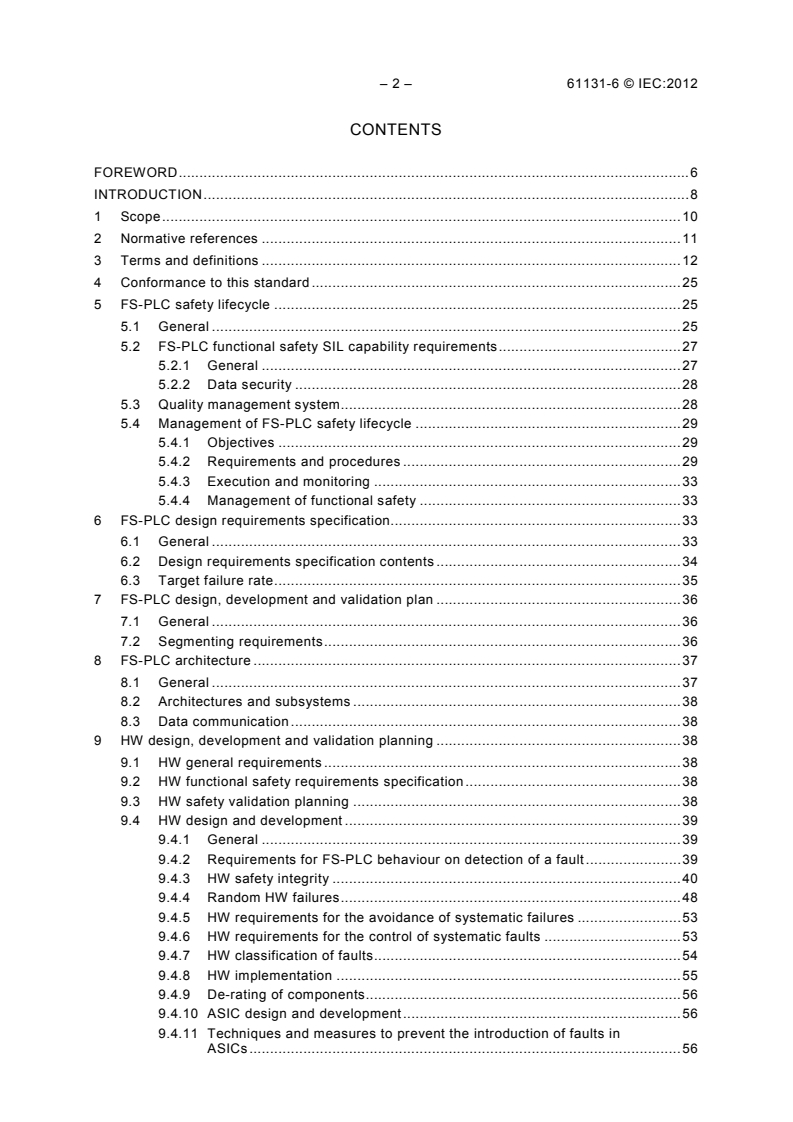
CONTENTS
FOREWORD . 6
INTRODUCTION . 8
1 Scope . 10
2 Normative references . 11
3 Terms and definitions . 12
4 Conformance to this standard . 25
5 FS-PLC safety lifecycle . 25
5.1 General . 25
5.2 FS-PLC functional safety SIL capability requirements . 27
5.2.1 General . 27
5.2.2 Data security . 28
5.3 Quality management system . 28
5.4 Management of FS-PLC safety lifecycle . 29
5.4.1 Objectives . 29
5.4.2 Requirements and procedures . 29
5.4.3 Execution and monitoring . 33
5.4.4 Management of functional safety . 33
6 FS-PLC design requirements specification. 33
6.1 General . 33
6.2 Design requirements specification contents . 34
6.3 Target failure rate . 35
7 FS-PLC design, development and validation plan . 36
7.1 General . 36
7.2 Segmenting requirements . 36
8 FS-PLC architecture . 37
8.1 General . 37
8.2 Architectures and subsystems . 38
8.3 Data communication . 38
9 HW design, development and validation planning . 38
9.1 HW general requirements . 38
9.2 HW functional safety requirements specification . 38
9.3 HW safety validation planning . 38
9.4 HW design and development . 39
9.4.1 General . 39
9.4.2 Requirements for FS-PLC behaviour on detection of a fault . 39
9.4.3 HW safety integrity . 40
9.4.4 Random HW failures . 48
9.4.5 HW requirements for the avoidance of systematic failures . 53
9.4.6 HW requirements for the control of systematic faults . 53
9.4.7 HW classification of faults . 54
9.4.8 HW implementation . 55
9.4.9 De-rating of components. 56
9.4.10 ASIC design and development . 56
9.4.11 Techniques and measures to prevent the introduction of faults in
ASICs . 56
61131-6 © IEC:2012 – 3 –
9.5 HW and embedded SW and FS-PLC integration . 56
9.6 HW operation and maintenance procedures . 57
9.6.1 Objective . 57
9.6.2 Requirements . 57
9.7 HW safety validation . 58
9.7.1 General . 58
9.7.2 Requirements . 58
9.8 HW verification . 59
9.8.1 Objective . 59
9.8.2 Requirements . 59
10 FS-PLC SW design and development . 60
10.1 General . 60
10.2 Requirements . 61
10.3 Classification of engineering tools . 61
10.4 SW safety validation planning . 62
11 FS-PLC safety validation . 62
12 FS-PLC type tests . 62
12.1 General . 62
12.2 Type test requirements . 62
12.3 Climatic test requirements . 65
12.4 Mechanical test requirements . 65
12.5 EMC test requirements . 65
12.5.1 General . 65
12.5.2 General EMC environment . 65
12.5.3 Specified EMC environment . 67
13 FS-PLC verification . 69
13.1 Verification plan . 69
13.2 Fault insertion test requirements . 70
13.3 As qualified versus as shipped . 71
14 Functional safety assessment . 71
14.1 Objective . 71
14.2 Assessment requirements . 72
14.2.1 Assessment evidence and documentation . 72
14.2.2 Assessment method . 72
14.3 FS-PLC assessment information. 74
14.4 Independence. 74
15 FS-PLC operation, maintenance and modification procedures . 75
15.1 Objective . 75
15.2 FS-PLC modification. 75
16 Information to be provided by the FS-PLC manufacturer for the user . 76
16.1 General . 76
16.2 Information on conformance to this standard . 76
16.3 Information on type and content of documentation . 76
16.4 Information on catalogues and/or datasheets . 76
16.5 Safety manual . 76
16.5.1 General . 76
16.5.2 Safety manual contents . 76
Annex A (informative) Reliability calculations . 79
– 4 – 61131-6 © IEC:2012
Annex B (informative) Typical FS-PLC Architectures . 80
Annex C (informative) Energise to trip applications of FS-PLC . 86
Annex D (informative) Available failure rate databases . 88
Annex E (informative) Methodology for the estimation of common cause failure rates
in a multiple channel FS-PLC . 90
Bibliography . 92
Figure 1 – FS-PLC in the overall E/E/PE safety-related system safety lifecycle phases . 9
Figure 2 – Failure model . 16
Figure 3 – FS-PLC safety lifecycle (in realization phase) . 26
Figure 4 – Relevant parts of a safety function . 35
Figure 5 – FS-PLC to engineering tools relationship . 37
Figure 6 – HW subsystem decomposition . 43
Figure 7 – Example: determination of the maximum SIL for specified architecture . 45
Figure 8 – Example of limitation on hardware safety integrity for a multiple-channel
safety function . 47
Figure 9 – Fault classification and FS-PLC behaviour . 54
Figure 10 – ASIC development lifecycle (V-Model) . 56
Figure 11 – Model of FS-PLC and engineering tools layers . 60
Figure B.1 – Single FS-PLC with single I/O and external watchdog (1oo1D) . 81
Figure B.2 – Dual PE with single I/O and external watchdogs (1oo1D) . 81
Figure B.3 – Dual PE with dual I/O, no inter-processor communication, and 1oo2
shutdown logic . 82
Figure B.4 – Dual PE with dual I/O, inter-processor communication, and 1oo2D
shutdown logic . 83
Figure B.5 – Dual PE with dual I/O, no inter-processor communication, external
watchdogs, and 2oo2 shutdown logic . 83
Figure B.6 – Dual PE with dual I/O, inter-processor communication, external
watchdogs, and 2oo2D shutdown logic . 84
Figure B.7 – Triple PE with triple I/O, inter-processor communication, and 2oo3D
shutdown logic . 85
Table 1 – Safety integrity levels for low demand mode of operation . 35
Table 2 – Safety integrity levels for high demand or continuous mode of operation . 36
Table 3 – Faults to be detected and notified (alarmed) to the application program . 40
Table 4 – Hardware safety integrity – low complexity (type A) subsystem . 41
Table 5 – Hardware safety integrity – high complexity (type B) subsystem . 41
Table 6 – Faults or failures to be assumed when quantifying the effect of random
hardware failures or to be taken into account in the derivation of safe failure fraction . 50
Table 7 – Examples of tool classification . 61
Table 8 – Performance criteria . 64
Table 9 – Immunity test levels for enclosure port tests in general EMC environment . 66
Table 10 – Immunity test levels in general EMC environment . 67
Table 11 – Immunity test levels for enclosure port tests in specified EMC environment . 68
Table 12 – Immunity test levels in specified EMC environment . 69
Table 13 – Fault tolerance test, required effectiveness . 71
61131-6 © IEC:2012 – 5 –
Table 14 – Functional safety assessment Information . 74
Table 15 – Minimum levels of independence of those carrying out functional safety
assessment . 75
Table E.1 – Criteria for estimation of common cause failure . 90
Table E.2 – Estimation of common cause failure factor . 91
– 6 – 61131-6 © IEC:2012
INTERNATIONAL ELECTROTECHNICAL COMMISSION
____________
PROGRAMMABLE CONTROLLERS –
Part 6: Functional safety
FOREWORD
1) The International Electrotechnical Commission (IEC) is a worldwide organization for standardization comprising
all national electrotechnical committees (IEC National Committees). The object of IEC is to promote
international co-operation on all questions concerning standardization in the electrical and electronic fields. To
this end and in addition to other activities, IEC publishes International Standards, Technical Specifications,
Technical Reports, Publicly Available Specifications (PAS) and Guides (hereafter referred to as “IEC
Publication(s)”). Their preparation is entrusted to technical committees; any IEC National Committee interested
in the subject dealt with may participate in this preparatory work. International, governmental and non-
governmental organizations liaising with the IEC also participate in this preparation. IEC collaborates closely
with the International Organization for Standardization (ISO) in accordance with conditions determined by
agreement between the two organizations.
2) The formal decisions or agreements of IEC on technical matters express, as nearly as possible, an international
consensus of opinion on the relevant subjects since each technical committee has representation from all
interested IEC National Committees.
3) IEC Publications have the form of recommendations for international use and are accepted by IEC National
Committees in that sense. While all reasonable efforts are made to ensure that the technical content of IEC
Publications is accurate, IEC cannot be held responsible for the way in which they are used or for any
misinterpretation by any end user.
4) In order to promote international uniformity, IEC National Committees undertake to apply IEC Publications
transparently to the maximum extent possible in their national and regional publications. Any divergence
between any IEC Publication and the corresponding national or regional publication shall be clearly indicated in
the latter.
5) IEC itself does not provide any attestation of conformity. Independent certification bodies provide conformity
assessment services and, in some areas, access to IEC marks of conformity. IEC is not responsible for any
services carried out by independent certification bodies.
6) All users should ensure that they have the latest edition of this publication.
7) No liability shall attach to IEC or its directors, employees, servants or agents including individual experts and
members of its technical committees and IEC National Committees for any personal injury, property damage or
other damage of any nature whatsoever, whether direct or indirect, or for costs (including legal fees) and
expenses arising out of the publication, use of, or reliance upon, this IEC Publication or any other IEC
Publications.
8) Attention is drawn to the Normative references cited in this publication. Use of the referenced publications is
indispensable for the correct application of this publication.
9) Attention is drawn to the possibility that some of the elements of this IEC Publication may be the subject of
patent rights. IEC shall not be held responsible for identifying any or all such patent rights.
International Standard IEC 61131-6 has been prepared by subcommittee 65B: Measurement
and control devices, of IEC technical committee 65: Industrial-process measurement, control
and automation.
The text of this standard is based on the following documents:
FDIS Report on voting
65B/831/FDIS 65B/850/RVD
Full information on the voting for the approval of this standard can be found in the report on
voting indicated in the above table.
This publication has been drafted in accordance with the ISO/IEC Directives, Part 2.
61131-6 © IEC:2012 – 7 –
A list of all parts of the IEC 61131 series can be found, under the general title Programmable
controllers, on the IEC website.
The committee has decided that the contents of this publication will remain unchanged until
the stability date indicated on the IEC web site under "http://webstore.iec.ch" in the data
related to the specific publication. At this date, the publication will be
• reconfirmed,
• withdrawn,
• replaced by a revised edition, or
• amended.
– 8 – 61131-6 © IEC:2012
INTRODUCTION
General
IEC 61131 series consists of the following parts under the general title Programmable
controllers:
Part 1: General information
Part 2: Equipment requirements and tests
Part 3: Programming languages
Part 4: User guidelines
Part 5: Communications
Part 6: Functional safety
Part 7: Fuzzy control programming
Part 8: Guidelines for the application and implementation of programming languages
This Part of IEC 61131 series constitutes Part 6 of a series of standards on programmable
controllers and the associated peripherals and should be read in conjunction with the other
parts of the series.
As this document is the FS-PLC product standard, the provisions of this part should be
considered to govern in the area of programmable controllers and their associated
peripherals.
Compliance with Part 6 of IEC 61131 cannot be claimed unless the requirements of Clause 4
of this part are met.
Terms of general use are defined in Part 1 of IEC 61131. More specific terms are defined in
each part.
In keeping with 1.1 of IEC 61508-1:2010, this part encompasses the product specific
requirements of IEC 61508-1, 61508-2 and 61508-3 as pertaining to programmable controllers
and their associated peripherals.
This document’s intent is to follow the IEC 61508 series structure, in principle. But some
aspects do not have a direct correlation and thus need to be addressed somewhat differently.
In part, this is due to addressing hardware, software, firmware, etc. in a single document.
Framework of this part
IEC 61508-1:2010, Figure 2 is included here, and is designated Figure 1. It has been adjusted
to show how an FS-PLC fits into the overall E/E/PE safety-related system safety lifecycle.
Though Figure 1 box 10 includes sensors, logic subsystem and final elements (e.g.
actuators), from the viewpoint of IEC 61508-1, the FS-PLC is given emphasis here by
including a reference to Figure 3.
As such, the Realization Phase, Figure 1, box 10, embodies only the logic subsystem, from
this part’s perspective.
61131-6 © IEC:2012 – 9 –
CConconceeptpt
OOvvereralalll sco scoppee
dedeffiininittiionon
HHazazarardd an andd r riisksk
ananalalyysisiss
OOvvereralalll saf safetetyy
rreqequuiirrememenenttss
OOvvereralalll saf safetetyy
rreqequuiirrememenentts als allloocatcatiioonn
EE//EE//PPEE sy syststeemm saf safeettyy
Other risk
rreqequuiirrememenentts sps speeciciffiicatcatiioonn
reduction measures
Overall planning
OOvveerralalll OOvveerralalll OOvveerralalll E/E/PE Specification and
opeoperraattiion aon andnd safsafetetyy iinsnsttaallllaattiion aon andnd Safety-related systems Realization
66 77 88
mmaiainnttenenanancece vvaalidlidaattioionn ccomommmiissssiionioningng
plplaanninningng plplaanninningng plplaanninningng
Realization
(FS-PLC See Figure 3)
OOvveerraallll in inssttaallallattioionn
aand cnd coommmmiissssiionioningng
Back to appropriate
OOvvereralalll saf safetetyy
overall safety lifecycle
vvaalidlidaattioionn
phase
OOvveerraallll m mooddifificicaattioionn
OOvveerraallll ope operraattiion,on,
1414 1515
mmaiainnttenenanance ance andd r repepaiairr aand rnd reettrrofofiitt
DDecoecommmmiississioonn
IEC 1817/12
oror di dissposposaall
NOTE 1 Activities relating to verification, management of functional safety and functional safety assessment are not shown for
reasons of clarity but are relevant to all overall, E/E/PE system and software safety lifecycle phases.
NOTE 2 The phases represented by box 11 is outside the scope of this standard.
NOTE 3 IEC 61508-2 and IEC 61508-3 deal with box 10 (realization) but they also deal, where relevant, with the programmable
electronic (hardware and software) aspects of boxes 13, 14 and 15.
NOTE 4 See IEC 61508-1, Table 1 for a description of the objectives and scope of the phases represented by each box.
NOTE 5 The technical requirements necessary for the overall operation, maintenance, repair Modification, retrofit and
decommissioning or disposal will be specified as part of the information provided by the supplier of the E/E? PE safety-related
system and its elements and components.
Figure 1 – FS-PLC in the overall E/E/PE safety-related system safety lifecycle phases
The areas included in this part are FS-PLC safety lifecycle management, functional safety
requirements allocation, and development planning; with the major emphasis on the
Realization Phase (Box 10) of the overall safety lifecycle, shown in Figure 1. The assumption
of this part is that the FS-PLC is utilized as a logic subsystem for the overall E/E/PE system.
The Figure 1, Realization (box 10), includes:
• the allocation of the FS-PLC safety aspects to FS-PLC hardware, software or firmware, or
any combination,
• FS-PLC hardware architectures,
• verification and validation activities at the FS-PLC level,
• FS-PLC modification requirements,
• operation and maintenance information for the FS-PLC user,
• information to be provided by the FS-PLC manufacturer for the user.
– 10 – 61131-6 © IEC:2012
PROGRAMMABLE CONTROLLERS –
Part 6: Functional safety
1 Scope
This Part of the IEC 61131 series specifies requirements for programmable controllers (PLCs)
and their associated peripherals, as defined in Part 1, which are intended to be used as the
logic subsystem of an electrical/electronic/programmable electronic (E/E/PE) safety-related
system. A programmable controller and its associated peripherals complying with the
requirements of this part is considered suitable for use in an E/E/PE safety-related system
and is identified as a functional safety programmable logic controller (FS-PLC). An FS-PLC is
generally a hardware (HW) / software (SW) subsystem. An FS-PLC may also include software
elements, for example predefined function blocks.
An E/E/PE safety-related system generally consists of sensors, actuators, software and a
logic subsystem. This part is a product specific implementation of the requirements of the
IEC 61508 series and conformity to this part fulfils all of the applicable requirements of the
IEC 61508 series related to FS-PLCs. While the IEC 61508 series is a system standard, this
part provides product specific requirements for the application of the principles of the
IEC 61508 series to FS-PLC.
This Part of the IEC 61131 series addresses only the functional safety and safety integrity
requirements of an FS-PLC when used as part of an E/E/PE safety-related system. The
definition of the functional safety requirements of the overall E/E/PE safety-related system
and the functional safety requirements of the ultimate application of the E/E/PE safety-related
system are outside the scope of this part, but they are inputs for this part. For application
specific information the reader is referred to standards such as the IEC 61511 series,
IEC 62061, and the ISO 13849 series.
This part does not cover general safety requirements for an FS-PLC such as requirements
related to electric shock and fire hazards specified in IEC 61131-2.
This part applies to an FS-PLC with a Safety Integrity Level (SIL) capability not greater than
SIL 3.
The objective of this part is:
• to establish and describe the safety life-cycle elements of an FS-PLC, in harmony with the
general safety life-cycle identified in IEC 61508-1, -2 and -3;
• to establish and describe the requirements for FS-PLC HW and SW that relate to the
functional safety and safety integrity requirements of a E/E/PE safety-related system;
• to establish evaluation methods for a FS-PLC to this part for the following
parameters/criteria:
– a Safety Integrity Level (SIL) claim for which the FS-PLC is capable,
– a Probability of Failure on Demand (PFD) value,
– an average frequency of dangerous failure per hour value (PFH),
– a value for the safe failure fraction (SFF),
– a value for the hardware fault tolerance (HFT),
– a diagnostic coverage (DC) value,
– a verification that the specified FS-PLC manufacturer’s safety lifecycle processes are
in place,
61131-6 © IEC:2012 – 11 –
– the defined safe state,
– the measures and techniques for the prevention and control of systematic faults, and
– for each failure mode addressed in this part, the functional behaviour in the failed
state;
• to establish the definitions and identify the principal characteristics relevant to the
selection and application of FS-PLCs and their associated peripherals.
This part is primarily intended for FS-PLC manufacturers. It also includes the critical role of
FS-PLC users through the user documentation requirements. Some user guidelines for FS-
PLCs may be found in IEC 61131-4.
The requirements of ISO/IEC Guide 51 and IEC Guide 104, as they relate to this part, are
incorporated herein.
2 Normative references
The following documents, in whole or in part, are normatively referenced in this document and
are indispensable for its application. For dated references, only the edition cited applies. For
undated references, the latest edition of the referenced document (including any
amendments) applies.
IEC 60947-5-1:2003, Low-voltage switchgear and controlgear – Part 5-1: Control circuit
devices and switching elements – Electromechanical control circuit devices
IEC/TS 61000-1-2:2008, Electromagnetic compatibility (EMC) – Part 1-2: General –
Methodology for the achievement of functional safety of electrical and electronic systems
including equipment with regard to electromagnetic phenomena
IEC 61000-4-2:2008, Electromagnetic compatibility (EMC) – Part 4-2: Testing and
measurement techniques – Electrostatic discharge immunity test
IEC 61000-4-3:2006, Electromagnetic compatibility (EMC) – Part 4-3: Testing and
measurement techniques – Radiated, radio-frequency, electromagnetic field immunity test
IEC 61000-4-4:2012, Electromagnetic compatibility (EMC) – Part 4-4: Testing and
measurement techniques – Electrical fast transient/burst immunity test
IEC 61000-4-5:2005, Electromagnetic compatibility (EMC) – Part 4-5: Testing and
measurement techniques – Surge immunity test
IEC 61000-4-6:2008, Electromagnetic compatibility (EMC) – Part 4-6: Testing and
measurement techniques – Immunity to conducted disturbances, induced by radio-frequency
fields
IEC 61000-4-8:2009, Electromagnetic compatibility (EMC) – Part 4-8: Testing and
measurement techniques – Power frequency magnetic field immunity test
IEC 61131-1:2003, Programmable controllers – Part 1: General information
IEC 61131-2:2007, Programmable controllers – Part 2: Equipment requirements and tests
IEC 61131-4:2004, Programmable controllers – Part 4: User guidelines
IEC 61326-3-1:2008, Electrical equipment for measurement, control and laboratory use –
EMC requirements – Part 3-1: Immunity requirements for safety-related systems and for
– 12 – 61131-6 © IEC:2012
equipment intended to perform safety-related functions (functional safety) – General industrial
applications
IEC 61326-3-2:2008, Electrical equipment for measurement, control and laboratory use –
EMC requirements – Part 3-2: Immunity requirements for safety-related systems and for
equipment intended to perform safety-related functions (functional safety) – Industrial
applications with specified electromagnetic environment
IEC 61508-1:2010, Functional safety of electrical/electronic/programmable electronic safety-
related systems – Part 1: General requirements
IEC 61508-2:2010, Functional safety of electrical/electronic/programmable electronic safety-
related systems – Part 2: Requirements for electrical/electronic/programmable electronic
safety-related systems
IEC 61508-3:2010, Functional safety of electrical/electronic/programmable electronic safety-
related systems – Part 3: Software requirements
IEC 61508-6:2010, Functional safety of electrical/electronic/programmable electronic safety-
related systems – Part 6: Guidelines on the application of IEC 61508-2 and IEC 61508-3
IEC 61784-3:2010, Industrial communication networks – Profiles – Part 3: Functional safety
fieldbuses – General rules and profile definitions
IEC 62443 (all parts), Industrial communication networks – Network and system security
IEC Guide 104:2010, The preparation of safety publications and the use of basic safety
publications and group safety publications
ISO/IEC Guide 51:1999, Safety aspects – Guidelines for their inclusion in standards
EN 50205:2002, Relays with forcibly guided (mechanically linked) contacts
3 Terms and definitions
For the purposes of this document, the following terms and definitions apply.
3.1
application program
application software
part of the software of a programmable electronic system that specifies the functions that
perform a task related to the EUC rather than the functioning of, and services provided by the
programmable device itself
[SOURCE: IEC 61508-4:2010, 3.2.7]
3.2
application specific integrated circuit
ASIC
integrated circuit designed and manufactured for specific function, where its functionality is
defined by the product developer
[SOURCE: IEC 61508-4:2010, 3.2.15]
3.3
architecture
specific configuration of hardware and software elements in a system
61131-6 © IEC:2012 – 13 –
[SOURCE: IEC 61508-4:2010, 3.3.4]
3.4
availability
the probability that an item is able to perform its intended function, expressed as a decimal
value between zero and one
EXAMPLE A = 0,9 means that a product is available 90 % of the time.
Note 1 to entry: For λT << 1, A = 1 – λ T, See 3.23.
3.5
average frequency of a dangerous failure per hour
PFH
average frequency of a dangerous failure of an E/E/PE safety-related system to perform the
specified safety function over a given period of time
Note 1 to entry: The term “probability of dangerous failure per hour” is not used in this standard but the acronym
PFH has been retained but when it is used it means “average frequency of dangerous failure [h]”.
Note 2 to entry: From a theoretical point of view, the PFH is the average of the unconditional failure intensity,
also called failure frequency, and which is generally designated w(t). It should not be confused with a failure rate
(see Annex B of IEC 61508-6:2010).
Note 3 to entry: When the E/E/PE safety-related system is the ultimate safety layer, the PFH should be calculated
from its unreliability F(T)=1-R(t) (see failure rate above). When it is not the ultimate safety-related system its PFH
should be calculated from its unavailability U(t) (see PFD, 3.38). PFH approximations are given by F(T)/T and
1/MTTF in the first case and 1/MTBF in the second case.
Note 4 to entry: When the E/E/PE safety-related system implies only quickly repaired revealed failures then an
asymptotic failure rate λ is quickly reached. It provides an estimate of the PFH.
as
[SOURCE: IEC 61508-4:2010, 3.6.19]
3.6
black channel
parts of a communication channel which are not designed or validated according to the
IEC 61508 series
Note 1 to entry: See: 7.4.11.2 of IEC 61508-2:2010.
3.7
channel
element or group of elements that separately implement an element safety function
EXAMPLE A two-channel (or dual-channel) configuration is one with two channels that independently perform the
same function.
Note 1 to entry: The term can be used to describe a complete system, or a portion of a system (for example,
sensors or final elements).
[SOURCE: IEC 61508-4:2010, 3.3.6]
3.8
common cause failure
CCF
failure, that is the result of one or more events, causing concurrent failures of two or more
separate channels in a multiple channel system, leading to system failure
[SOURCE: IEC 61508-4:2010, 3.6.10]
3.9
cyber security
protection of data in computer and information systems from loss or corruption due to
intentional or unintentional activities by unauthorized or malicious individuals
– 14 – 61131-6 © IEC:2012
Note 1 to entry: This term concerns the defence against such activities via network or other communication
interfaces.
3.10
dangerous failure
FS-PLC
failure of an element and/or subsystem and/or system that plays a part in implementing the
safety function that:
a) prevents a safety function from operating when required (demand mode) or causes a
safety function to fail (continuous mode) such that the EUC is put into a hazardous or
potentially hazardous state; or,
b) decreases the probability that the safety function operates correctly when required
[SOURCE: IEC 61508-4:2010, 3.6.7]
3.11
dangerous fault
fault that can lead to dangerous failure
Note 1 to entry: If a dangerous fault is detected, action is taken to avoid a dangerous failure.
3.12
defined safe state
the state of the FS-PLC, as defined by the FS-PLC manufacturer, when a dangerous failure
occurs
Note 1 to entry: Typically, the defined safe state is the default state of each and every FS-PLC output. For digital
outputs, this state is considered de-energized unless specifically defined otherwise. For analogue outputs, this
state is zero volts or zero amps, unless specifically defined otherwise. For communications ports, this state is
defined as no communications, unless specifically defined otherwise.
3.13
detected failure
termination of the ability of a functional unit to perform a required function detected by the
diagnostic tests, proof tests, operator intervention or through normal operation
EXAMPLE Physical inspection and manual tests.
3.14
diagnostic coverage
DC
fraction of dangerous failures, detected by automatic on-line diagnostic tests, computed by
using the dangerous failure rates associated with the detected dangerous failures divided by
the total rate of dangerous failures
Note 1 to entry: The dangerous failure diagnostic coverage is computed us
...