


IEC 61984:2008
(Main)Connectors - Safety requirements and tests
Connectors - Safety requirements and tests
IEC 61984:2008 applies to connectors with rated voltages above 50 V and up to 1000 V a.c. and d.c. and rated currents up to 125 A per contact, for which either no detail specification exists or the detail specification calls up this standard for safety aspects. Changes with respect to the previous edition include: addition of new definitions, of new clauses, tables and annexes for clarification, improvement and better readability. The contents of the corrigendum of October 2011 have been included in this copy.
Connecteurs - Exigences de sécurité et essais
La CEI 61984:2008 s'applique aux connecteurs de tensions assignées comprises entre 50 V et 1 000 V en courant alternatif et en courant continu et de courants assignés jusqu'à 125 A par contact, pour lesquels soit il n'existe pas de spécification particulière, soit la spécification particulière fait appel aux aspects de sécurité. Les modifications par rapport à l'édition précédente incluent: ajout de nouvelles définitions, de nouveaux paragraphes, tableaux et annexes pour clarification, amélioration et une meilleure compréhension. Le contenu du corrigendum d'octobre 2011 a été pris en considération dans cet exemplaire.
General Information
- Status
- Published
- Publication Date
- 07-Oct-2008
- Technical Committee
- SC 48B - Electrical connectors
- Current Stage
- PPUB - Publication issued
- Start Date
- 08-Oct-2008
- Completion Date
- 31-Oct-2008
Relations
- Effective Date
- 05-Sep-2023
- Effective Date
- 05-Sep-2023
Overview
IEC 61984:2008 is an international standard developed by the International Electrotechnical Commission (IEC) that specifies safety requirements and test methods for electrical connectors. This standard applies to connectors with rated voltages above 50 V and up to 1000 V AC and DC, and rated currents up to 125 A per contact. It addresses connectors for which either no detailed specification exists or whose detail specifications call upon IEC 61984 for safety-related aspects. The 2008 edition enhances clarity with additional definitions, clauses, tables, and annexes, including updates from the 2011 corrigendum.
This standard is critical for manufacturers and designers to ensure electrical connectors meet stringent safety and performance criteria, minimizing risks such as electric shock, mechanical failure, and environmental degradation.
Key Topics
Scope and Classification
Defines the voltage and current ratings applicable, and classifies connectors by protection level against electric shock, connector style, and additional characteristics.Construction Requirements
Covers marking/identification, prevention of incorrect mating (non-intermateable connectors), electric shock protection during insertion/withdrawal, earthing provisions (including first make, last break protective earth contacts), and termination methods.Design Considerations
Includes requirements for polarization, fixing of live parts, cable clamps, mechanical robustness, resistance to ageing, clearances and creepage distances, and insulation levels (functional, basic, supplementary, double, reinforced).Testing Procedures
Detailed tests validate safety and performance including mechanical endurance, electrical endurance, temperature rise, dielectric strength, corrosion resistance, and protection against ingress of solid objects and water. Both routine and type tests are specified.Marking and Documentation
Specifies requirements for clear marking of connectors related to electrical ratings, polarity, and contact positions to enhance user safety and component traceability.
Applications
IEC 61984:2008 ensures that connectors used in industrial, commercial, and residential electrical and electronic equipment meet rigorous safety standards. Applications include:
- Power distribution systems requiring safe connection and disconnection of conductors
- Electrical equipment and machinery connectors rated above 50 V
- Industrial automation requiring reliable connector performance under mechanical and environmental stresses
- Consumer electronics and appliances employing connectors within specified voltage and current limits
- Electrical connectors in vehicles and transportation systems, where safety and durability are crucial
Using IEC 61984-compliant connectors helps reduce the risk of electrical shock, fire hazards, and equipment damage, ensuring overall system safety and reliability.
Related Standards
- IEC 60529 – Degrees of protection provided by enclosures (IP Code) relevant for connector ingress protection rating.
- IEC 60204-1 – Safety of machinery - electrical equipment of machines; relates to connectors used in industrial machinery.
- IEC 60320 – Appliance couplers for household and similar equipment; related for specific connector types.
- IEC 60364 – Electrical installations of buildings; complements connector safety in electrical wiring.
- ISO/IEC 11801 – Generic cabling for customer premises; applicable for communication connectors.
- IEC 61076 – Connectors for electronic equipment; includes connector interface standards.
Compliance with IEC 61984:2008 alongside these standards ensures comprehensive safety and interoperability for electrical connectors in varied applications.
This standard is essential for designers, manufacturers, testing laboratories, and safety inspectors working with electrical connectors to guarantee compliance with international safety requirements and robust connector performance. For more information, visit the IEC website at www.iec.ch.
Frequently Asked Questions
IEC 61984:2008 is a standard published by the International Electrotechnical Commission (IEC). Its full title is "Connectors - Safety requirements and tests". This standard covers: IEC 61984:2008 applies to connectors with rated voltages above 50 V and up to 1000 V a.c. and d.c. and rated currents up to 125 A per contact, for which either no detail specification exists or the detail specification calls up this standard for safety aspects. Changes with respect to the previous edition include: addition of new definitions, of new clauses, tables and annexes for clarification, improvement and better readability. The contents of the corrigendum of October 2011 have been included in this copy.
IEC 61984:2008 applies to connectors with rated voltages above 50 V and up to 1000 V a.c. and d.c. and rated currents up to 125 A per contact, for which either no detail specification exists or the detail specification calls up this standard for safety aspects. Changes with respect to the previous edition include: addition of new definitions, of new clauses, tables and annexes for clarification, improvement and better readability. The contents of the corrigendum of October 2011 have been included in this copy.
IEC 61984:2008 is classified under the following ICS (International Classification for Standards) categories: 31.220.10 - Plug-and-socket devices. Connectors. The ICS classification helps identify the subject area and facilitates finding related standards.
IEC 61984:2008 has the following relationships with other standards: It is inter standard links to IEC 61984:2008/COR1:2011, IEC 61984:2001. Understanding these relationships helps ensure you are using the most current and applicable version of the standard.
IEC 61984:2008 is available in PDF format for immediate download after purchase. The document can be added to your cart and obtained through the secure checkout process. Digital delivery ensures instant access to the complete standard document.
Standards Content (Sample)
IEC 61984
Edition 2.0 2008-10
INTERNATIONAL
STANDARD
NORME
INTERNATIONALE
Connectors – Safety requirements and tests
Connecteurs – Exigences de sécurité et essais
All rights reserved. Unless otherwise specified, no part of this publication may be reproduced or utilized in any form or by
any means, electronic or mechanical, including photocopying and microfilm, without permission in writing from either IEC or
IEC's member National Committee in the country of the requester.
If you have any questions about IEC copyright or have an enquiry about obtaining additional rights to this publication,
please contact the address below or your local IEC member National Committee for further information.
Droits de reproduction réservés. Sauf indication contraire, aucune partie de cette publication ne peut être reproduite
ni utilisée sous quelque forme que ce soit et par aucun procédé, électronique ou mécanique, y compris la photocopie
et les microfilms, sans l'accord écrit de la CEI ou du Comité national de la CEI du pays du demandeur.
Si vous avez des questions sur le copyright de la CEI ou si vous désirez obtenir des droits supplémentaires sur cette
publication, utilisez les coordonnées ci-après ou contactez le Comité national de la CEI de votre pays de résidence.
IEC Central Office
3, rue de Varembé
CH-1211 Geneva 20
Switzerland
Email: inmail@iec.ch
Web: www.iec.ch
About the IEC
The International Electrotechnical Commission (IEC) is the leading global organization that prepares and publishes
International Standards for all electrical, electronic and related technologies.
About IEC publications
The technical content of IEC publications is kept under constant review by the IEC. Please make sure that you have the
latest edition, a corrigenda or an amendment might have been published.
ƒ Catalogue of IEC publications: www.iec.ch/searchpub
The IEC on-line Catalogue enables you to search by a variety of criteria (reference number, text, technical committee,…).
It also gives information on projects, withdrawn and replaced publications.
ƒ IEC Just Published: www.iec.ch/online_news/justpub
Stay up to date on all new IEC publications. Just Published details twice a month all new publications released. Available
on-line and also by email.
ƒ Electropedia: www.electropedia.org
The world's leading online dictionary of electronic and electrical terms containing more than 20 000 terms and definitions
in English and French, with equivalent terms in additional languages. Also known as the International Electrotechnical
Vocabulary online.
ƒ Customer Service Centre: www.iec.ch/webstore/custserv
If you wish to give us your feedback on this publication or need further assistance, please visit the Customer Service
Centre FAQ or contact us:
Email: csc@iec.ch
Tel.: +41 22 919 02 11
Fax: +41 22 919 03 00
A propos de la CEI
La Commission Electrotechnique Internationale (CEI) est la première organisation mondiale qui élabore et publie des
normes internationales pour tout ce qui a trait à l'électricité, à l'électronique et aux technologies apparentées.
A propos des publications CEI
Le contenu technique des publications de la CEI est constamment revu. Veuillez vous assurer que vous possédez
l’édition la plus récente, un corrigendum ou amendement peut avoir été publié.
ƒ Catalogue des publications de la CEI: www.iec.ch/searchpub/cur_fut-f.htm
Le Catalogue en-ligne de la CEI vous permet d’effectuer des recherches en utilisant différents critères (numéro de référence,
texte, comité d’études,…). Il donne aussi des informations sur les projets et les publications retirées ou remplacées.
ƒ Just Published CEI: www.iec.ch/online_news/justpub
Restez informé sur les nouvelles publications de la CEI. Just Published détaille deux fois par mois les nouvelles
publications parues. Disponible en-ligne et aussi par email.
ƒ Electropedia: www.electropedia.org
Le premier dictionnaire en ligne au monde de termes électroniques et électriques. Il contient plus de 20 000 termes et
définitions en anglais et en français, ainsi que les termes équivalents dans les langues additionnelles. Egalement appelé
Vocabulaire Electrotechnique International en ligne.
ƒ Service Clients: www.iec.ch/webstore/custserv/custserv_entry-f.htm
Si vous désirez nous donner des commentaires sur cette publication ou si vous avez des questions, visitez le FAQ du
Service clients ou contactez-nous:
Email: csc@iec.ch
Tél.: +41 22 919 02 11
Fax: +41 22 919 03 00
IEC 61984
Edition 2.0 2008-10
INTERNATIONAL
STANDARD
NORME
INTERNATIONALE
Connectors – Safety requirements and tests
Connecteurs – Exigences de sécurité et essais
INTERNATIONAL
ELECTROTECHNICAL
COMMISSION
COMMISSION
ELECTROTECHNIQUE
PRICE CODE
INTERNATIONALE
X
CODE PRIX
ICS 31.220.10 ISBN 978-2-88910-596-0
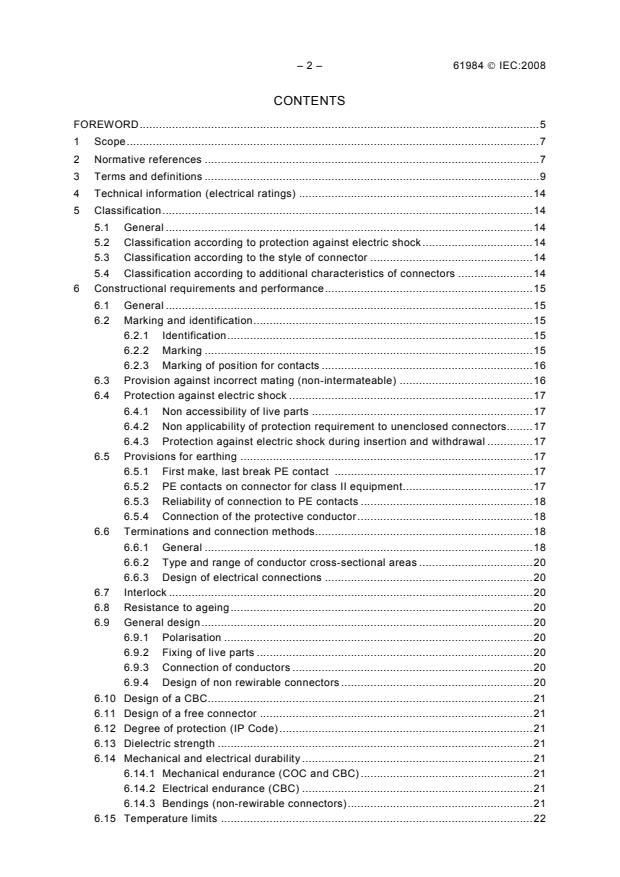
– 2 – 61984 © IEC:2008
CONTENTS
FOREWORD.5
1 Scope.7
2 Normative references .7
3 Terms and definitions .9
4 Technical information (electrical ratings) .14
5 Classification.14
5.1 General .14
5.2 Classification according to protection against electric shock.14
5.3 Classification according to the style of connector .14
5.4 Classification according to additional characteristics of connectors .14
6 Constructional requirements and performance.15
6.1 General .15
6.2 Marking and identification.15
6.2.1 Identification.15
6.2.2 Marking .15
6.2.3 Marking of position for contacts .16
6.3 Provision against incorrect mating (non-intermateable) .16
6.4 Protection against electric shock .17
6.4.1 Non accessibility of live parts .17
6.4.2 Non applicability of protection requirement to unenclosed connectors.17
6.4.3 Protection against electric shock during insertion and withdrawal .17
6.5 Provisions for earthing .17
6.5.1 First make, last break PE contact .17
6.5.2 PE contacts on connector for class II equipment.17
6.5.3 Reliability of connection to PE contacts .18
6.5.4 Connection of the protective conductor.18
6.6 Terminations and connection methods.18
6.6.1 General .18
6.6.2 Type and range of conductor cross-sectional areas .20
6.6.3 Design of electrical connections .20
6.7 Interlock .20
6.8 Resistance to ageing.20
6.9 General design.20
6.9.1 Polarisation .20
6.9.2 Fixing of live parts .20
6.9.3 Connection of conductors .20
6.9.4 Design of non rewirable connectors .20
6.10 Design of a CBC.21
6.11 Design of a free connector .21
6.12 Degree of protection (IP Code).21
6.13 Dielectric strength .21
6.14 Mechanical and electrical durability .21
6.14.1 Mechanical endurance (COC and CBC) .21
6.14.2 Electrical endurance (CBC) .21
6.14.3 Bendings (non-rewirable connectors).21
6.15 Temperature limits .22
61984 © IEC:2008 – 3 –
6.16 Temperature rise.23
6.17 Cable clamp .23
6.18 Mechanical strength .23
6.18.1 Robustness of connectors .23
6.18.2 Retention of contacts.23
6.18.3 Integrity of internal insulation.24
6.19 Clearances and creepage distances .24
6.19.1 Clearances .24
6.19.2 Creepage distances.24
6.20 Insulation .25
6.20.1 Functional and basic insulation.25
6.20.2 Supplementary insulation .25
6.20.3 Double insulation.25
6.20.4 Reinforced insulation .25
6.21 Protection against corrosion .25
7 Tests .26
7.1 General .26
7.1.1 Test sequence and number of specimens .26
7.1.2 Specimens condition.26
7.1.3 Atmospheric conditions.26
7.1.4 Number of specimens for tests on terminations .26
7.1.5 Failure criteria .26
7.1.6 Visual examination tests.26
7.2 Preparation of specimens .26
7.2.1 Pre-conditioning .26
7.2.2 Conductors.26
7.2.3 Torque for screw-type clamping units .27
7.2.4 Assembly conditions .27
7.3 Performance of tests .27
7.3.1 General .27
7.3.2 Durability of marking.27
7.3.3 “First make, last break” protective earthing contact.27
7.3.4 Interlock .27
7.3.5 Breaking capacity of a CBC .27
7.3.6 Protection against electric shock .28
7.3.7 Protection against solid foreign objects and against ingress of water.28
7.3.8 Temperature rise .29
7.3.9 Mechanical operation .31
7.3.10 Bending (flexing) test.31
7.3.11 Measurement of clearances and creepage distances .33
7.3.12 Dielectric strength .33
7.3.13 Resistance between accessible metal parts and the protective
earthing contact.34
7.3.14 Corrosion test.34
7.4 In-process test schedule (routine test) for non-rewirable free connectors .34
7.4.1 General .34
7.4.2 Impulse withstand voltage test.34
7.4.3 Continuity of PE path test .34
7.4.4 AC power-frequency voltage withstand test .34
– 4 – 61984 © IEC:2008
7.5 Test schedule.35
Annex A (informative) Information to be specified in the detail specification, if any, or
manufacturer’s specification .41
Annex B (informative) Additional information on connector classification.43
Bibliography.45
Figure 1a – Test arrangement for temperature rise test of two-part connectors .30
Figure 1b – Test arrangement for temperature rise test of two-part connectors on
printed circuit boards .30
Figure 1c – Test arrangement for temperature rise test of edge-socket connectors.31
Figure 1 – Test arrangements for temperature rise tests .31
Figure 2 – Device for the bending test .32
Table 1 – Minimum cross-sectional area of the protective conductor or the connection
to inactive accessible metal parts .18
Table 2 – Compliant termination and connection methods.19
Table 3 – Tests on connections and terminations.19
Table 4 – Mechanical and electrical durability.22
Table 4a – Operating cycles – Preferred values .22
Table 4b – Bendings –Preferred values .22
Table 5 – Temperature limits .22
Table 5a – Lower limiting temperature (LLT) – Preferred values .22
Table 5b – Upper limiting temperature (ULT) – Preferred values .22
Table 6 – Values for cable clamp testing.23
Table 7 – Length of the connecting cable and conductor loops .29
Table 8 – Test voltages.33
Table 9 – Plan of specimens required for tests.35
Table 10 – Mechanical test group A .35
Table 11 – Service life test group B .37
Table 12 – Thermal test group C.38
Table 13 – Climatic test group D .39
Table 14 – Degree of protection, test group E.40
Table B.1 – Scheme of connectors.43
Table B.2 – Help for the classification of connectors .44
61984 © IEC:2008 – 5 –
INTERNATIONAL ELECTROTECHNICAL COMMISSION
____________
CONNECTORS –
SAFETY REQUIREMENTS AND TESTS
FOREWORD
1) The International Electrotechnical Commission (IEC) is a worldwide organization for standardization comprising
all national electrotechnical committees (IEC National Committees). The object of IEC is to promote
international co-operation on all questions concerning standardization in the electrical and electronic fields. To
this end and in addition to other activities, IEC publishes International Standards, Technical Specifications,
Technical Reports, Publicly Available Specifications (PAS) and Guides (hereafter referred to as “IEC
Publication(s)”). Their preparation is entrusted to technical committees; any IEC National Committee interested
in the subject dealt with may participate in this preparatory work. International, governmental and non-
governmental organizations liaising with the IEC also participate in this preparation. IEC collaborates closely
with the International Organization for Standardization (ISO) in accordance with conditions determined by
agreement between the two organizations.
2) The formal decisions or agreements of IEC on technical matters express, as nearly as possible, an international
consensus of opinion on the relevant subjects since each technical committee has representation from all
interested IEC National Committees.
3) IEC Publications have the form of recommendations for international use and are accepted by IEC National
Committees in that sense. While all reasonable efforts are made to ensure that the technical content of IEC
Publications is accurate, IEC cannot be held responsible for the way in which they are used or for any
misinterpretation by any end user.
4) In order to promote international uniformity, IEC National Committees undertake to apply IEC Publications
transparently to the maximum extent possible in their national and regional publications. Any divergence
between any IEC Publication and the corresponding national or regional publication shall be clearly indicated in
the latter.
5) IEC provides no marking procedure to indicate its approval and cannot be rendered responsible for any
equipment declared to be in conformity with an IEC Publication.
6) All users should ensure that they have the latest edition of this publication.
7) No liability shall attach to IEC or its directors, employees, servants or agents including individual experts and
members of its technical committees and IEC National Committees for any personal injury, property damage or
other damage of any nature whatsoever, whether direct or indirect, or for costs (including legal fees) and
expenses arising out of the publication, use of, or reliance upon, this IEC Publication or any other IEC
Publications.
8) Attention is drawn to the Normative references cited in this publication. Use of the referenced publications is
indispensable for the correct application of this publication.
9) Attention is drawn to the possibility that some of the elements of this IEC Publication may be the subject of
patent rights. IEC shall not be held responsible for identifying any or all such patent rights.
International Standard IEC 61984 has been prepared by subcommittee 48B: Connectors, of
IEC technical committee 48: Electromechanical components and mechanical structures for
electronic equipment.
The text of this standard is based on the following documents:
FDIS Report on voting
48B/1927/FDIS 48B/1947/RVD
Full information on the voting for the approval of this standard can be found in the report on
voting indicated in the above table.
This publication has been drafted in accordance with the ISO/IEC Directives, Part 2.
This second edition cancels and replaces the first edition published in 2001. This edition
constitutes a technical revision.
– 6 – 61984 IEC:2008
This edition included the following significant technical changes with respect to the previous
edition:
1) Addition in the scope of the statement that this standard may be used as a guide for
connectors with rated current higher than 125 A per pole.
2) New definitions added and improvement of existing definitions.
3) In Clause 5, the classification referred to protection against electric shock and that of
connector for class II equipment were added.
4) In 6.4 (Protection against electric shock), it is clarified that all parts which are necessary
to ensure protection against electric shock shall only be removable by the aid of a tool.
5) Table 2 and Table 3 are added for better readability and connecting methods updated to
current status of standardisation.
6) Values for cable clamp testing in Table 6 are adopted according to EN 50262 and no
tests are required if metric cable glands according to this standard are used.
7) Tables in 6.19 are deleted and the text refers to IEC 60664.
8) Table 7 (Values for torque for screw-type clamping units) in 7.1.4 of the 2001 edition is
deleted and the text refers to the relevant standards.
9) Subclause 7.3.7 of the 2001 edition is modified. Length of the connecting cable and
conductor loops are added. Test arrangements for temperature rise test for two-part
printed board connectors are fixed.
10) Figure 2 (Device for bending test) transferred from 7.3.8 (Mechanical operation) of the
2001 edition to Clause 7.3.10 (Bending (flexing) test) of the present edition.
11) In Table 10 (Mechanical test group A) test phase A3, the severity or conditions for
unenclosed and enclosed connectors are specified.
12) The informative Annex B (Additional information on connector classification) with its
Tables B.1 (Scheme of connectors) and B.2 (Help for the classification of connectors)
are added for better readability of the standard.
The committee has decided that the contents of this publication will remain unchanged until
the maintenance result date indicated on the IEC web site under "http://webstore.iec.ch" in
the data related to the specific publication. At this date, the publication will be
• reconfirmed,
• withdrawn,
• replaced by a revised edition, or
• amended.
The contents of the corrigendum of October 2011 have been included in this copy.
61984 © IEC:2008 – 7 –
CONNECTORS –
SAFETY REQUIREMENTS AND TESTS
1 Scope
This International Standard applies to connectors with rated voltages above 50 V and up to
1000 V a.c. and d.c. and rated currents up to 125 A per contact, for which either no detail
specification (DS) exists or the DS calls up this standard for safety aspects.
For connectors with rated voltage up to 50 V, this standard may be used as a guide. In this
case, reference is made to IEC 60664-1 for clearance and creepage distances.
This standard may also be used as a guide for connectors with rated current higher than
125 A per pole.
This standard does not apply to connectors in or on equipment where application specific
safety requirements for connectors exist.
2 Normative references
The following referenced documents are indispensable for the application of this document.
For dated references, only the edition cited applies. For undated references, the latest edition
of the referenced document (including any amendments) applies.
IEC 60050-581, International Electrotechnical Vocabulary (IEV) – Chapter 581:
Electromechanical components for electronic equipment
IEC 60050-826, International Electrotechnical Vocabulary (IEV) – Chapter 826: Electrical
installations
IEC 60060-1, High-voltage test techniques – Part 1: General definitions and test requirements
IEC 60068-1, Environmental testing – Part 1: General and guidance
IEC 60068-2-70, Environmental testing – Part 2: Tests – Test Xb: Abrasion of marking and
letterings caused by rubbing of fingers and hands
IEC 60228: 2004, Conductors of insulated cables
IEC 60309-1:1999, Plugs, socket-outlets and couplers for industrial purposes – Part 1:
General requirements
Amendment 1 (2005)
IEC 60352-1, Solderless connections – Part 1: Wrapped connections – General requirements,
test methods and practical guidance
IEC 60352-2, Solderless connections – Part 2: Crimped connections – General requirements,
test methods and practical guidance
IEC 60352-3:1993, Solderless connections – Part 3: Solderless accessible insulation
displacement connections – General requirements, test methods and practical guidance
– 8 – 61984 © IEC:2008
IEC 60352-4:1994, Solderless connections – Part 4: Solderless non-accessible insulation
displacement connections – General requirements, test methods and practical guidance
IEC 60352-5, Solderless connections – Part 5: Press-in connections – General requirements,
test methods and practical guidance
IEC 60352-6, Solderless connections – Part 6: Insulation piercing connections – General
requirements, test methods and practical guidance
IEC 60352-7, Solderless connections – Part 7: Spring-clamp connections – General
requirements, test methods and practical guidance
IEC 60364-4-41, Low-voltage electrical installations – Part 4-41: Protection for safety –
Protection against electric shock
IEC 60417, Graphical symbols for use on equipment
IEC 60512 (all parts), Connectors for electronic equipment – Tests and measurements
IEC 60512-1-100, Connectors for electronic equipment – Tests and measurements –
Part 1-100: General – Applicable publications
IEC 60529:1989, Degrees of protection provided by enclosures (IP Code)
Amendment 1 (1999)
IEC 60664-1:2007, Insulation coordination for equipment within low voltage systems – Part 1:
Principles, requirements and tests
IEC 60664-5:2007, Insulation coordination for equipment within low-voltage systems – Part 5:
Comprehensive method for determining clearances and creepage distances equal to or less
than 2 mm
IEC 60760, Flat, quick-connect terminations
IEC 60998-2-3:2002, Connecting devices for low-voltage circuits for household and similar
purposes – Part 2-3: Particular requirements for connecting devices as separate entities with
insulation-piercing clamping units
IEC 60999-1:1999, Connecting devices – Electrical copper conductors – Safety requirements
for screw-type and screwless-type clamping units – Part 1: General requirements and
2 2
particular requirements for clamping units for conductors from 0,2 mm up to 35 mm
(included)
IEC 60999-2:2003, Connecting devices – Electrical copper conductors – Safety requirements
for screw-type and screwless-type clamping units – Part 2: Particular requirements for
conductors above 35 up to 300 mm
(included)
IEC 61032, Protection of persons and equipment by enclosures – Probes for verification
IEC 61140, Protection against electric shock – Common aspects for installation and
equipment
—————————
IEC 60512-1-100 gives the list of tests of the IEC 60512 series and the part of IEC 60512 corresponding to
each test.
61984 © IEC:2008 – 9 –
IEC 61210, Connecting devices – Flat quick-connect terminations for electrical copper
conductors – Safety requirements
ISO 6988:1985, Metallic and other non organic coatings – Sulfur dioxide test with general
condensation of moisture
EN 50262:1998, Cable glands for electrical installations
Amendment 1 (2001)
Amendment 2 (2004)
3 Terms and definitions
For the purpose of this International Standard, definitions from IEC 60050-581,
IEC 60050-826, IEC 60309-1, IEC 60664-1, IEC 60999-1 and IEC 61140, as well as the
following, apply.
3.1
connector
component which terminates conductors for the purpose of providing connection to and
disconnection from a suitable mating component
[IEV 581-06-01, modified]
3.2
free connector
connector for attachment to the free end of a wire or cable
[IEV 581-06-12]
3.3
fixed connector
connector for attachment to a rigid surface
[IEV 581-06-10]
3.4
rewirable connector
connector so constructed that the cable or wire can be replaced
3.5
non-rewirable connector
connector so constructed that the cable cannot be separated from the connector without
making it permanently useless
[IEC 60309-1, 2.5, modified]
3.6
enclosed connector
connector for which the protection against electric shock is ensured by the housing of the
connector itself
3.7
unenclosed connector
connector with no protection against electric shock
NOTE The protection against electric shock is provided by e.g. the enclosure of the equipment in which the
unenclosed connector is deemed to be mounted, in accordance with the applicable product safety standard.
– 10 – 61984 © IEC:2008
3.8
connector with breaking capacity
CBC
connector specially designed to be engaged or disengaged in normal use when live or under
load
NOTE 1 In this standard, the term “live” is used if contacts are under an applied voltage, but not necessarily
carrying current. The term “load” is used if a current is flowing through the contacts.
NOTE 2 In this standard, CBC is used only if requirements refer to connectors with a specified breaking capacity.
3.9
connector without breaking capacity
COC
connector which is not deemed to be engaged or disengaged in normal use when live or
under load
3.10
connector for class II equipment
connector in which the protection against indirect contact is realised by double or reinforced
insulation
NOTE Class II according to IEC 61140.
3.11
intended use
application conditions of connectors which are included within the permissible rated values
and environmental conditions and characteristics assigned by the detail specification (DS) or
the manufacturer
3.12
interlock
device, either electrical or mechanical, which prevents the contacts of a connector from
becoming live before it is in proper engagement with its counterpart, and which either
prevents the connector from being withdrawn while its contacts are live or makes the contacts
dead before separation
[IEC 60309-1, 2.9, modified]
3.13
cycle of mechanical operation
one insertion and one withdrawal of the connector with his counterpart
3.14
clamping unit
part(s) of the terminal necessary for the mechanical clamping and the electrical connection of
the conductor(s), including the parts which are necessary to ensure the correct contact
pressure
[IEC 60999-1, 3.1]
3.15
upper limiting temperature
ULT
maximum temperature in the connector as outcome (sum) of the ambient temperature and the
temperature rise due to current flow, at which the connector is intended to be still operable.
NOTE 1 At ambient temperature equal to ULT, the available temperature rise due to current flow is zero, thus the
current carrying capacity of the connector is zero.
NOTE 2 The ULT of a connector is covered by the climatic category as defined in IEC 60068-1, together with the
LLT and the duration of the damp heat test.
61984 © IEC:2008 – 11 –
3.16
lower limiting temperature
LLT
minimum temperature of a connector as defined by the climatic category assigned by the
manufacturer in which a connector is intended to operate
NOTE The LLT of a connector is covered by the climatic category as defined in IEC 60068-1, together with the
ULT and the duration of the damp heat test.
3.17
clearance
shortest distance in air between two conductive parts
[IEC 60664-1:2007, 3.2]
3.18
creepage distance
shortest distance along the surface of the insulating material between two conductive parts
[IEC 60664-1:2007, 3.3]
3.19
overvoltage category
numeral defining a transient overvoltage condition
NOTE Overvoltage categories I, II, III and IV are used.
[IEC 60664-1:2007, 3.10]
3.20
pollution
any addition of foreign matter, solid, liquid, or gaseous that can result in a reduction of
electric strength or surface resistivity of the insulation
[IEC 60664-1:2007, 3.11]
3.21
pollution degree
numeral characterizing the expected pollution of the micro-environment
NOTE Pollution degrees 1, 2, 3 and 4 are used.
[IEC 60664-1:2007, 3.13]
3.22
rated voltage
value of voltage assigned by the manufacturer to the connector and to which operation and
performance characteristics are referred
NOTE A connector may have more than one rated voltage value.
[IEC 60664-1:2007, 3.9, modified]
3.23
rated insulation voltage
r.m.s. withstand voltage value assigned by the manufacturer to the connector, characterising
the specified (long term) withstand capability of its insulation
NOTE The rated insulation voltage is not necessarily equal to the rated voltage, which is primarily related to
functional performance.
[IEC 60664-1:2007, 3.9.1, modified]
– 12 – 61984 © IEC:2008
3.24
rated impulse voltage
impulse withstand voltage value assigned by the manufacturer to the connector,
characterising the specified withstand capability of its insulation against transient
overvoltages
[IEC 60664-1:2007, 3.9.2, modified]
3.25
impulse withstand voltage
highest peak value of impulse voltage of prescribed form and polarity which does not cause
breakdown of insulation under specified conditions
NOTE The impulse withstand voltage is equal to or higher than the rated impulse voltage.
[IEC 60664-1:2007, 3.8.1, modified]
3.26
r.m.s. withstand voltage (power-frequency withstand voltage)
highest r.m.s. value of a voltage which does not cause breakdown of insulation under
specified conditions
[IEC 60664-1:2007, 3.8.2, modified]
3.27
rated current
current value assigned by the manufacturer, which the connector can carry continuously
(without interruption) and simultaneously through all its contacts wired with the largest
specified conductor, preferably at an ambient temperature of 40 °C, without the upper limiting
temperature being exceeded
NOTE If other ambient temperature values are used for the definition of the rated current, the manufacturer
should state, in the technical documentation, the ambient temperature on which the rating is based, with reference,
if appropriate, to the derating curve defined in IEC 60512, test 5b.
3.28
breaking capacity
value of current which the CBC can make and break under specified conditions
3.29
functional insulation
insulation between conductive parts which is necessary only for the proper functioning of the
equipment
[IEC 60664-1:2007, 3.17.1]
3.30
basic insulation
insulation of hazardous-live-parts which provides basic protection
NOTE The concept does not apply to insulation used exclusively for functional purposes.
[IEC 60664-1:2007, 3.17.2]
3.31
internal insulation
part of a basic insulation providing the required clearance and creepage distances inside a
conductive housing or enclosure
61984 © IEC:2008 – 13 –
3.32
supplementary insulation
independent insulation applied in addition to basic insulation for fault protection
[IEC 60664-1:2007, 3.17.3]
3.33
double insulation
insulation comprising both basic insulation and supplementary insulation
[IEC 60664-1:2007, 3.17.4]
3.34
reinforced insulation
insulation of hazardous-live-parts, which provides a degree of protection against electric
shock equivalent to double insulation
NOTE Reinforced insulation may comprise several layers which cannot be tested singly as basic insulation or
supplementary insulation.
[IEC 60664-1:2007, 3.17.5]
3.35
protective conductor (symbol PE)
conductor required by some measures for protection against electric shock for electrically
connecting any of the following parts:
• exposed conductive parts,
• extraneous conductive parts,
• main earthing terminal,
• earth electrode,
• earthed point of the source or artificial neutral
3.36
protective earthing contact
contact for earthing a point or points in a system or in an installation or in equipment for
purposes of electrical safety
[IEV 195-01-11, modified]
3.37
degree of protection
the extent of protection provided by an enclosure against access to hazardous parts, against
ingress of solid foreign objects and/or against ingress of water and verified by standardized
test methods
[IEC 60529:1989, 3.3]
3.38
IP Code
a coding system to indicate the degrees of protection provided by an enclosure against
access to hazardous parts, ingress of solid foreign objects, ingress of water and to give
additional information in connection with such protection
[IEC 60529:1989, 3.4]
– 14 – 61984 © IEC:2008
3.39
cable clamp
accessory or part of a component to grip the cable or wire to provide strain relief and absorb
mechanical stress which would otherwise be transmitted to the termination
[IEV 581-09-03]
3.40
cable gland
device designed to permit the entry of a cable or flexible cable into equipment, and which
provides sealing and retention. It may also provide other functions such as earthing, bonding,
insulation, cable guarding, strain relief or a combination of these.
3.41
specimen
a mating pair of connectors. In the case of contact elements, a mating pair of the intended
coupling elements
3.42
detail specification
part of standard giving requirements and tests relating physical and performance
characteristics of a particular connector or connector range
NOTE See Annex A for guidance.
4 Technical information (electrical ratings)
In this standard, no particular values have been specified for electrical ratings such as
voltage, current and breaking capacity of connectors. Values for these characteristics shall be
specified in conjunction with mechanical and environmental conditions given in the detail
specification or in the manufacturer's specification, where no detail specification exists.
5 Classification
5.1 General
Connectors shall be classified by the manufacturer’s specification or the detail specification
(DS), if any, according to their characteristics and intended use in accordance with 5.2, 5.3
and 5.4 as appropriate.
5.2 Classification according to protection against electric shock
The classification according to protection against electric shock is as follows:
a) unenclosed connector (as per definition in 3.7),
b) enclosed connector (as per definition in 3.6),
c) connector for class II equipment (as per definition in 3.10).
5.3 Classification according to the style of connector
The classification according to the style of connector is a s follows:
a) fixed connector (as per definition in 3.3),
b) free connector (as per definition in 3.2).
5.4 Classification according to additional characteristics of connectors
The classification according to additional characteristics of connectors is as follows:
61984 © IEC:2008 – 15 –
a) connector with protective earthing contact,
b) connector without protective earthing contact,
c) connector without breaking capacity (COC) (as defined in 3.9),
NOTE 1 See also Annex B.
1) unprotected (IP0X),
2) with protection against electric shock by back of hand safety (IP1X or IPXXA), when
mated,
3) with protection against electric shock by finger safety (IP2X or IPXXB), when mated,
d) connector with breaking capacity (CBC) (as defined in 3.8) for protection against electric
shock by finger safety only (IP2X or IPXXB), both in mated and in unmated condition,
NOTE 2 See also Annex B.
e) degree of protection of a connector (IP code),
f) connector with interlock,
g) connector without interlock,
h) non-rewirable connector,
i) rewirable connector,
j) terminations and connection methods.
6 Constructional requirements and performance
6.1 General
Connectors shall be so designed and dimensioned that they can withstand the electrical,
mechanical, thermal and corrosive stresses which occur in their intended use and present no
danger to the user or the environment.
Compliance with this requirement is verified by the specified tests of this standard.
6.2 Marking and identification
6.2.1 Identification
Connectors shall be identified and characterised by the following markings:
a) manufacturer’s name, trademark or mark of origin;
b) type identification;
NOTE The type identification may be a part number, catalogue number or IEC type designation.
c) rated current in ampere (A);
d) rated voltages or rated insulation voltages between line to earth and line to line in volt (V);
e) rated impulse voltage in kilovolt (kV), if specified;
f) pollution degree;
g) degree of protection by en
...
Questions, Comments and Discussion
Ask us and Technical Secretary will try to provide an answer. You can facilitate discussion about the standard in here.
Loading comments...