


IEC 62279:2015
(Main)Railway applications - Communication, signalling and processing systems - Software for railway control and protection systems
Railway applications - Communication, signalling and processing systems - Software for railway control and protection systems
IEC 62279:2015 specifies the process and technical requirements for the development of software for programmable electronic systems for use in railway control and protection applications. It is aimed at use in any area where there are safety implications. These systems can be implemented using dedicated microprocessors, programmable logic controllers, multiprocessor distributed systems, larger scale central processor systems or other architectures. The main technical changes with respect to the previous edition are as follows:
- addition of requirements on software management and organisation, of definition of roles and competencies, deployment and maintenance;
- addition of a new subclause on tools based on IEC 61508-2:2010.
This publication is to be read in conjunction with IEC 62278:2002.
Applications ferroviaires - Systèmes de signalisation, de télécommunication et de traitement - Logiciels pour systèmes de commande et de protection ferroviaire
L'IEC 62279:2015 spécifie les exigences relatives aux processus et aux techniques applicables au développement de logiciel pour des systèmes électroniques programmables utilisés dans les applications ferroviaires de contrôle-commande et de protection. Elle est destinée à être utilisée dans tout domaine comportant des implications de sécurité. Ces systèmes peuvent être mis en oeuvre à l'aide de microprocesseurs dédiés, de contrôleurs à logique programmable (automates programmables), de systèmes multiprocesseurs distribués, de grands systèmes dotés d'un calculateur central ou à l'aide d'autres architectures. Les modifications techniques majeures par rapport à l'édition précédente sont les suivantes:
- ajout des exigences relatives à la gestion et à l'organisation, à la définition des rôles et des compétences, au déploiement et à la maintenance des logiciels;
- ajout d'un nouveau paragraphe concernant les outils, sur la base de l'IEC 61508-2:2010.
Cette publication doit être lue conjointement avec la IEC 62278:2002.
General Information
- Status
- Published
- Publication Date
- 24-Jun-2015
- Technical Committee
- TC 9 - Electrical equipment and systems for railways
- Drafting Committee
- MT 62279 - TC 9/MT 62279
- Current Stage
- PPUB - Publication issued
- Start Date
- 25-Jun-2015
- Completion Date
- 15-Jul-2015
Relations
- Effective Date
- 05-Sep-2023
Overview
IEC 62279:2015 is an international standard developed by the International Electrotechnical Commission (IEC) that specifies the process and technical requirements for the development of software used in railway control and protection systems. Targeted at programmable electronic systems with safety implications, this standard addresses software development for various architectures, including dedicated microprocessors, programmable logic controllers (PLCs), multiprocessor distributed systems, and central processor systems.
The 2015 edition introduces important updates, such as enhanced software management and organizational requirements, the definition of roles and competencies, deployment and maintenance procedures, and the integration of tool requirements based on IEC 61508-2:2010. IEC 62279:2015 must be read in conjunction with IEC 62278:2002, which defines the generic process for railway control and protection system development.
Key Topics
Software Safety Integrity Levels (SILs)
IEC 62279 outlines the assessment and conformance criteria related to software safety integrity levels, emphasizing risk reduction strategies vital in railway environments where safety is paramount.Software Management and Organization
The standard defines clear organizational structures, roles, and responsibilities required for managing software projects effectively. It highlights personnel competence requirements to ensure qualified teams oversee safety-critical software development.Lifecycle and Documentation Requirements
Rigorous documentation mandates cover every phase of the software lifecycle including planning, design, implementation, verification, validation, deployment, and maintenance-ensuring traceability and accountability.Software Assurance and Quality
It provides comprehensive guidance on software testing, verification, validation, assessment, and quality assurance protocols. Change management and configuration control processes are integral to maintaining software integrity over time.Support Tools and Languages
IEC 62279 includes requirements for tools employed during software development to guarantee their suitability and dependability in safety-critical railway applications.Generic Software and Application Data Development
The standard differentiates between generic software components and configurable application data or algorithms, detailing development processes and validation to ensure both meet stringent safety criteria.
Applications
IEC 62279:2015 applies directly to any railway system software that impact control and protection functionalities where safety is critical. The standard is essential for:
Railway Signalling Systems
Ensuring reliable software in systems managing train movements and signaling to prevent accidents and ensure efficient rail traffic.Communication Systems for Railways
Defining safe software protocols and operations in railway communication networks crucial for coordination and control.Train Control Systems
Developing embedded software for programmable electronic systems that control train operations and safety mechanisms.Maintenance and Deployment Processes
Establishing robust procedures for the ongoing maintenance and software updates in railway control infrastructure without compromising safety.
Organizations developing railway control and protection software use IEC 62279:2015 as a benchmark to fulfill safety certification requirements and to align with global best practices in software engineering for railway safety.
Related Standards
IEC 62278:2002
Provides overarching processes for railway control and protection system development, to be used in conjunction with IEC 62279 for software specifics.IEC 61508-2:2010
Focuses on the functional safety of electrical/electronic systems and informs tool requirements for software development under IEC 62279.EN 50128
A European standard closely related to IEC 62279, which also deals with software for railway control and protection systems focusing on software development life cycles and safety.
Practical Value
Adhering to IEC 62279:2015 helps railway organizations:
- Implement consistent and standardized software development processes in safety-critical railway environments.
- Ensure compliance with international safety regulations reducing risks in railway operations.
- Improve software quality and reliability through systematic testing, validation, and verification activities.
- Define clear roles and competencies enhancing organizational efficiency and accountability.
- Manage software deployment and maintenance with established procedures to maintain safety integrity over system life.
This standard is indispensable for railway manufacturers, system integrators, and software developers focused on enhancing the safety, reliability, and interoperability of railway control and protection software systems worldwide.
Get Certified
Connect with accredited certification bodies for this standard

Bureau Veritas Railway Certification
Railway and transportation certification.

Deutsch Quality Systems (India) Pvt. Ltd. (DQS India)
Subsidiary of DQS Holding GmbH, founding member of IQNet. CDSCO Notified Body.

Excellence Ireland Quality Association (EIQA)
Irish quality certification organization.
Sponsored listings
Frequently Asked Questions
IEC 62279:2015 is a standard published by the International Electrotechnical Commission (IEC). Its full title is "Railway applications - Communication, signalling and processing systems - Software for railway control and protection systems". This standard covers: IEC 62279:2015 specifies the process and technical requirements for the development of software for programmable electronic systems for use in railway control and protection applications. It is aimed at use in any area where there are safety implications. These systems can be implemented using dedicated microprocessors, programmable logic controllers, multiprocessor distributed systems, larger scale central processor systems or other architectures. The main technical changes with respect to the previous edition are as follows: - addition of requirements on software management and organisation, of definition of roles and competencies, deployment and maintenance; - addition of a new subclause on tools based on IEC 61508-2:2010. This publication is to be read in conjunction with IEC 62278:2002.
IEC 62279:2015 specifies the process and technical requirements for the development of software for programmable electronic systems for use in railway control and protection applications. It is aimed at use in any area where there are safety implications. These systems can be implemented using dedicated microprocessors, programmable logic controllers, multiprocessor distributed systems, larger scale central processor systems or other architectures. The main technical changes with respect to the previous edition are as follows: - addition of requirements on software management and organisation, of definition of roles and competencies, deployment and maintenance; - addition of a new subclause on tools based on IEC 61508-2:2010. This publication is to be read in conjunction with IEC 62278:2002.
IEC 62279:2015 is classified under the following ICS (International Classification for Standards) categories: 45.060.01 - Railway rolling stock in general. The ICS classification helps identify the subject area and facilitates finding related standards.
IEC 62279:2015 has the following relationships with other standards: It is inter standard links to IEC 62279:2002. Understanding these relationships helps ensure you are using the most current and applicable version of the standard.
IEC 62279:2015 is available in PDF format for immediate download after purchase. The document can be added to your cart and obtained through the secure checkout process. Digital delivery ensures instant access to the complete standard document.
Standards Content (Sample)
IEC 62279 ®
Edition 2.0 2015-06
INTERNATIONAL
STANDARD
NORME
INTERNATIONALE
Railway applications – Communication, signalling and processing systems –
Software for railway control and protection systems
Applications ferroviaires – Systèmes de signalisation, de télécommunication
et de traitement – Logiciels pour systèmes de commande et de protection
ferroviaire
All rights reserved. Unless otherwise specified, no part of this publication may be reproduced or utilized in any form
or by any means, electronic or mechanical, including photocopying and microfilm, without permission in writing from
either IEC or IEC's member National Committee in the country of the requester. If you have any questions about IEC
copyright or have an enquiry about obtaining additional rights to this publication, please contact the address below or
your local IEC member National Committee for further information.
Droits de reproduction réservés. Sauf indication contraire, aucune partie de cette publication ne peut être reproduite
ni utilisée sous quelque forme que ce soit et par aucun procédé, électronique ou mécanique, y compris la photocopie
et les microfilms, sans l'accord écrit de l'IEC ou du Comité national de l'IEC du pays du demandeur. Si vous avez des
questions sur le copyright de l'IEC ou si vous désirez obtenir des droits supplémentaires sur cette publication, utilisez
les coordonnées ci-après ou contactez le Comité national de l'IEC de votre pays de résidence.
IEC Central Office Tel.: +41 22 919 02 11
3, rue de Varembé Fax: +41 22 919 03 00
CH-1211 Geneva 20 info@iec.ch
Switzerland www.iec.ch
About the IEC
The International Electrotechnical Commission (IEC) is the leading global organization that prepares and publishes
International Standards for all electrical, electronic and related technologies.
About IEC publications
The technical content of IEC publications is kept under constant review by the IEC. Please make sure that you have the
latest edition, a corrigenda or an amendment might have been published.
IEC Catalogue - webstore.iec.ch/catalogue Electropedia - www.electropedia.org
The stand-alone application for consulting the entire The world's leading online dictionary of electronic and
bibliographical information on IEC International Standards, electrical terms containing more than 30 000 terms and
Technical Specifications, Technical Reports and other definitions in English and French, with equivalent terms in 15
documents. Available for PC, Mac OS, Android Tablets and additional languages. Also known as the International
iPad. Electrotechnical Vocabulary (IEV) online.
IEC publications search - www.iec.ch/searchpub IEC Glossary - std.iec.ch/glossary
The advanced search enables to find IEC publications by a More than 60 000 electrotechnical terminology entries in
variety of criteria (reference number, text, technical English and French extracted from the Terms and Definitions
committee,…). It also gives information on projects, replaced clause of IEC publications issued since 2002. Some entries
and withdrawn publications. have been collected from earlier publications of IEC TC 37,
77, 86 and CISPR.
IEC Just Published - webstore.iec.ch/justpublished
Stay up to date on all new IEC publications. Just Published IEC Customer Service Centre - webstore.iec.ch/csc
details all new publications released. Available online and If you wish to give us your feedback on this publication or
also once a month by email. need further assistance, please contact the Customer Service
Centre: csc@iec.ch.
A propos de l'IEC
La Commission Electrotechnique Internationale (IEC) est la première organisation mondiale qui élabore et publie des
Normes internationales pour tout ce qui a trait à l'électricité, à l'électronique et aux technologies apparentées.
A propos des publications IEC
Le contenu technique des publications IEC est constamment revu. Veuillez vous assurer que vous possédez l’édition la
plus récente, un corrigendum ou amendement peut avoir été publié.
Catalogue IEC - webstore.iec.ch/catalogue Electropedia - www.electropedia.org
Application autonome pour consulter tous les renseignements
Le premier dictionnaire en ligne de termes électroniques et
bibliographiques sur les Normes internationales,
électriques. Il contient plus de 30 000 termes et définitions en
Spécifications techniques, Rapports techniques et autres
anglais et en français, ainsi que les termes équivalents dans
documents de l'IEC. Disponible pour PC, Mac OS, tablettes
15 langues additionnelles. Egalement appelé Vocabulaire
Android et iPad.
Electrotechnique International (IEV) en ligne.
Recherche de publications IEC - www.iec.ch/searchpub
Glossaire IEC - std.iec.ch/glossary
La recherche avancée permet de trouver des publications IEC Plus de 60 000 entrées terminologiques électrotechniques, en
en utilisant différents critères (numéro de référence, texte, anglais et en français, extraites des articles Termes et
comité d’études,…). Elle donne aussi des informations sur les Définitions des publications IEC parues depuis 2002. Plus
projets et les publications remplacées ou retirées. certaines entrées antérieures extraites des publications des
CE 37, 77, 86 et CISPR de l'IEC.
IEC Just Published - webstore.iec.ch/justpublished
Service Clients - webstore.iec.ch/csc
Restez informé sur les nouvelles publications IEC. Just
Published détaille les nouvelles publications parues. Si vous désirez nous donner des commentaires sur cette
Disponible en ligne et aussi une fois par mois par email. publication ou si vous avez des questions contactez-nous:
csc@iec.ch.
IEC 62279 ®
Edition 2.0 2015-06
INTERNATIONAL
STANDARD
NORME
INTERNATIONALE
Railway applications – Communication, signalling and processing systems –
Software for railway control and protection systems
Applications ferroviaires – Systèmes de signalisation, de télécommunication
et de traitement – Logiciels pour systèmes de commande et de protection
ferroviaire
INTERNATIONAL
ELECTROTECHNICAL
COMMISSION
COMMISSION
ELECTROTECHNIQUE
INTERNATIONALE
ICS 45.060 ISBN 978-2-8322-2741-1
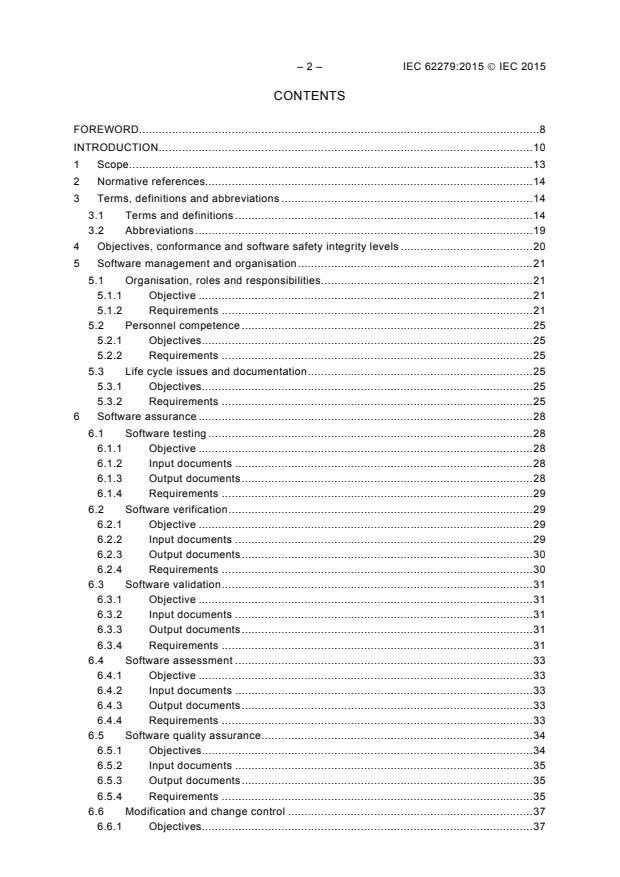
– 2 – IEC 62279:2015 IEC 2015
CONTENTS
FOREWORD . 8
INTRODUCTION . 10
1 Scope . 13
2 Normative references. 14
3 Terms, definitions and abbreviations . 14
3.1 Terms and definitions . 14
3.2 Abbreviations . 19
4 Objectives, conformance and software safety integrity levels . 20
5 Software management and organisation . 21
5.1 Organisation, roles and responsibilities . 21
5.1.1 Objective . 21
5.1.2 Requirements . 21
5.2 Personnel competence . 25
5.2.1 Objectives . 25
5.2.2 Requirements . 25
5.3 Life cycle issues and documentation . 25
5.3.1 Objectives . 25
5.3.2 Requirements . 25
6 Software assurance . 28
6.1 Software testing . 28
6.1.1 Objective . 28
6.1.2 Input documents . 28
6.1.3 Output documents . 28
6.1.4 Requirements . 29
6.2 Software verification . 29
6.2.1 Objective . 29
6.2.2 Input documents . 29
6.2.3 Output documents . 30
6.2.4 Requirements . 30
6.3 Software validation . 31
6.3.1 Objective . 31
6.3.2 Input documents . 31
6.3.3 Output documents . 31
6.3.4 Requirements . 31
6.4 Software assessment . 33
6.4.1 Objective . 33
6.4.2 Input documents . 33
6.4.3 Output documents . 33
6.4.4 Requirements . 33
6.5 Software quality assurance . 34
6.5.1 Objectives . 34
6.5.2 Input documents . 35
6.5.3 Output documents . 35
6.5.4 Requirements . 35
6.6 Modification and change control . 37
6.6.1 Objectives . 37
6.6.2 Input documents . 37
6.6.3 Output documents . 37
6.6.4 Requirements . 37
6.7 Support tools and languages . 38
6.7.1 Objectives . 38
6.7.2 Input documents . 38
6.7.3 Output documents . 38
6.7.4 Requirements . 38
7 Generic software development . 41
7.1 Life cycle and documentation for generic software . 41
7.1.1 Objectives . 41
7.1.2 Requirements . 41
7.2 Software requirements . 42
7.2.1 Objectives . 42
7.2.2 Input documents . 42
7.2.3 Output documents . 42
7.2.4 Requirements . 42
7.3 Architecture and Design . 44
7.3.1 Objectives . 44
7.3.2 Input documents . 44
7.3.3 Output documents . 44
7.3.4 Requirements . 44
7.4 Component design . 50
7.4.1 Objectives . 50
7.4.2 Input documents . 50
7.4.3 Output documents . 50
7.4.4 Requirements . 50
7.5 Component implementation and testing . 52
7.5.1 Objectives . 52
7.5.2 Input documents . 52
7.5.3 Output documents . 52
7.5.4 Requirements . 52
7.6 Integration . 53
7.6.1 Objectives . 53
7.6.2 Input documents . 53
7.6.3 Output documents . 53
7.6.4 Requirements . 53
7.7 Overall Software Testing / Final Validation . 54
7.7.1 Objectives . 54
7.7.2 Input documents . 54
7.7.3 Output documents . 55
7.7.4 Requirements . 55
8 Development of application data or algorithms: systems configured by application
data or algorithms . 56
8.1 Objectives . 56
8.2 Input documents . 57
8.3 Output documents . 57
8.4 Requirements . 57
8.4.1 Application Development Process . 57
– 4 – IEC 62279:2015 IEC 2015
8.4.2 Application Requirements Specification . 59
8.4.3 Architecture and Design . 59
8.4.4 Application Data/Algorithms Production . 59
8.4.5 Application Integration and Testing Acceptance . 60
8.4.6 Application Validation and Assessment . 61
8.4.7 Application preparation procedures and tools . 61
8.4.8 Development of Generic Software . 61
9 Software deployment and maintenance . 62
9.1 Software deployment . 62
9.1.1 Objective . 62
9.1.2 Input documents . 62
9.1.3 Output documents . 62
9.1.4 Requirements . 62
9.2 Software maintenance . 64
9.2.1 Objective . 64
9.2.2 Input documents . 64
9.2.3 Output documents . 64
9.2.4 Requirements . 64
Annex A (normative) Criteria for the selection of techniques and measures . 67
A.1 General . 67
A.2 Clauses tables . 68
A.3 Detailed tables . 74
Annex B (normative) Key software roles and responsibilities . 80
Annex C (informative) Documents Control Summary . 88
Annex D (informative) Aim and description of techniques . 90
D.1 Artificial Intelligence Fault Correction . 90
D.2 Analysable Programs . 90
D.3 Avalanche/Stress Testing . 91
D.4 Boundary Value Analysis . 91
D.5 Backward Recovery . 92
D.6 Cause Consequence Diagrams . 92
D.7 Checklists . 92
D.8 Control Flow Analysis . 93
D.9 Common Cause Failure Analysis . 93
D.10 Data Flow Analysis . 94
D.11 Data Flow Diagrams . 94
D.12 Data Recording and Analysis . 95
D.13 Decision Tables (Truth Tables) . 95
D.14 Defensive Programming . 96
D.15 Coding Standards and Style Guide . 96
D.16 Diverse Programming . 97
D.17 Dynamic Reconfiguration . 98
D.18 Equivalence Classes and Input Partition Testing . 98
D.19 Error Detecting and Correcting Codes . 98
D.20 Error Guessing . 99
D.21 Error Seeding . 99
D.22 Event Tree Analysis . 100
D.23 Fagan Inspections . 100
D.24 Failure Assertion Programming . 100
D.25 SEEA – Software Error Effect Analysis . 101
D.26 Fault Detection and Diagnosis . 101
D.27 Finite State Machines/State Transition Diagrams . 102
D.28 Formal Methods . 102
D.28.1 General . 102
D.28.2 CSP – Communicating Sequential Processes . 103
D.28.3 CCS – Calculus of Communicating Systems . 104
D.28.4 HOL – Higher Order Logic . 104
D.28.5 LOTOS . 104
D.28.6 OBJ . 105
D.28.7 Temporal logic . 105
D.28.8 VDM – Vienna Development Method . 105
D.28.9 Z method . 106
D.28.10 B method . 106
D.28.11 Model Checking . 107
D.29 Formal Proof . 108
D.30 Forward Recovery . 108
D.31 Graceful Degradation . 108
D.32 Impact Analysis . 109
D.33 Information Hiding / Encapsulation . 109
D.34 Interface Testing . 110
D.35 Language Subset . 110
D.36 Memorising Executed Cases . 110
D.37 Metrics . 111
D.38 Modular Approach . 111
D.39 Performance Modelling . 112
D.40 Performance Requirements . 112
D.41 Probabilistic Testing . 113
D.42 Process Simulation . 113
D.43 Prototyping / Animation . 114
D.44 Recovery Block . 114
D.45 Response Timing and Memory Constraints . 114
D.46 Re-Try Fault Recovery Mechanisms . 115
D.47 Safety Bag . 115
D.48 Software Configuration Management . 115
D.49 Strongly Typed Programming Languages . 115
D.50 Structure Based Testing . 116
D.51 Structure Diagrams . 116
D.52 Structured Methodology . 117
D.53 Structured Programming . 118
D.54 Suitable Programming languages . 118
D.55 Time Petri Nets . 119
D.56 Walkthroughs / Design Reviews . 119
D.57 Object Oriented Programming . 120
D.58 Traceability . 120
D.59 Metaprogramming . 121
D.60 Procedural programming . 121
D.61 Sequential Function Charts . 122
– 6 – IEC 62279:2015 IEC 2015
D.62 Ladder Diagram . 122
D.63 Functional Block Diagram . 122
D.64 State Chart or State Diagram . 122
D.65 Data modelling . 123
D.66 Control Flow Diagram/Control Flow Graph . 123
D.67 Sequence diagram . 124
D.68 Tabular Specification Methods . 125
D.69 Application specific language . 125
D.70 UML (Unified Modeling Language) . 125
D.71 Domain specific languages . 126
Bibliography . 127
Figure 1 – Illustrative software route map . 12
Figure 2 – Illustration of the preferred organisational structure . 22
Figure 3 – Illustrative Development Life cycle 1 . 27
Figure 4 – Illustrative Development Life cycle 2 . 28
Table 1 – Relation between tool class and applicable subclauses . 41
Table 2 – Illustrative Relation between tool class and product SIL . 41
Table A.1 – Life cycle Issues and Documentation (5.3) . 68
Table A.2 – Software Requirements Specification (7.2) . 70
Table A.3 – Software Architecture (7.3) . 71
Table A.4 – Software Design and Implementation (7.4) . 72
Table A.5 – Verification and Testing (6.2 and 7.3, 7.5) . 72
Table A.6 – Integration (7.6) . 73
Table A.7 – Overall Software Testing (6.2 and 7.7) . 73
Table A.8 – Software Analysis Techniques (6.3) . 73
Table A.9 – Software Quality Assurance (6.5) . 73
Table A.10 – Software Maintenance (9.2) . 74
Table A.11 – Data Preparation Techniques (8.4) . 74
Table A.12 – Coding Standards . 74
Table A.13 – Dynamic Analysis and Testing . 75
Table A.14 – Functional/Black Box Test . 75
Table A.15 – Textual Programming Languages . 76
Table A 16 – Diagrammatic Languages for Application Algorithms . 76
Table A.17 – Modelling . 77
Table A.18 – Performance Testing . 77
Table A.19 – Static Analysis . 77
Table A.20 – Components . 78
Table A.21 – Test Coverage for Code . 78
Table A.22 – Object Oriented Software Architecture . 79
Table A.23 – Object Oriented Detailed Design . 79
Table B.1 – Requirements Manager Role Specification . 80
Table B.2 – Designer Role Specification . 80
Table B.3 – Implementer Role Specification . 81
Table B.4 – Tester Role Specification . 82
Table B.5 – Verifier Role Specification . 82
Table B.6 – Integrator Role Specification . 83
Table B.7 – Validator Role Specification . 84
Table B.8 – Assessor Role Specification . 85
Table B.9 – Project Manager Role Specification . 86
Table B.10 – Configuration Manager Role Specification . 86
Table B.11 – Quality Assurance Manager Role Specification . 87
Table B.12 – Reviewer Role Specification . 87
Table C.1 – Documents Control Summary . 88
– 8 – IEC 62279:2015 IEC 2015
INTERNATIONAL ELECTROTECHNICAL COMMISSION
____________
RAILWAY APPLICATIONS – COMMUNICATION, SIGNALLING
AND PROCESSING SYSTEMS – SOFTWARE FOR RAILWAY
CONTROL AND PROTECTION SYSTEMS
FOREWORD
1) The International Electrotechnical Commission (IEC) is a worldwide organization for standardization comprising
all national electrotechnical committees (IEC National Committees). The object of IEC is to promote
international co-operation on all questions concerning standardization in the electrical and electronic fields. To
this end and in addition to other activities, IEC publishes International Standards, Technical Specifications,
Technical Reports, Publicly Available Specifications (PAS) and Guides (hereafter referred to as “IEC
Publication(s)”). Their preparation is entrusted to technical committees; any IEC National Committee interested
in the subject dealt with may participate in this preparatory work. International, governmental and non-
governmental organizations liaising with the IEC also participate in this preparation. IEC collaborates closely
with the International Organization for Standardization (ISO) in accordance with conditions determined by
agreement between the two organizations.
2) The formal decisions or agreements of IEC on technical matters express, as nearly as possible, an international
consensus of opinion on the relevant subjects since each technical committee has representation from all
interested IEC National Committees.
3) IEC Publications have the form of recommendations for international use and are accepted by IEC National
Committees in that sense. While all reasonable efforts are made to ensure that the technical content of IEC
Publications is accurate, IEC cannot be held responsible for the way in which they are used or for any
misinterpretation by any end user.
4) In order to promote international uniformity, IEC National Committees undertake to apply IEC Publications
transparently to the maximum extent possible in their national and regional publications. Any divergence
between any IEC Publication and the corresponding national or regional publication shall be clearly indicated in
the latter.
5) IEC itself does not provide any attestation of conformity. Independent certification bodies provide conformity
assessment services and, in some areas, access to IEC marks of conformity. IEC is not responsible for any
services carried out by independent certification bodies.
6) All users should ensure that they have the latest edition of this publication.
7) No liability shall attach to IEC or its directors, employees, servants or agents including individual experts and
members of its technical committees and IEC National Committees for any personal injury, property damage or
other damage of any nature whatsoever, whether direct or indirect, or for costs (including legal fees) and
expenses arising out of the publication, use of, or reliance upon, this IEC Publication or any other IEC
Publications.
8) Attention is drawn to the Normative references cited in this publication. Use of the referenced publications is
indispensable for the correct application of this publication.
9) Attention is drawn to the possibility that some of the elements of this IEC Publication may be the subject of
patent rights. IEC shall not be held responsible for identifying any or all such patent rights.
International Standard IEC 62279 has been prepared by IEC technical committee 9: Electrical
equipment and systems for railways.
This standard is based on EN 50128:2011.
This second edition cancels and replaces the first edition, issued in 2002. It constitutes a
technical revision.
The main technical changes with respect to the previous edition are as follows:
• requirements on software management and organisation, definition of roles and
competencies, deployment and maintenance have been added;
• a new subclause on tools has been inserted in 6.7, based on IEC 61508-2:2010;
• tables in Annex A have been updated;
• a new Annex B on key software roles and responsibilities has been introduced;
• a new Annex C on document control summary has been introduced;
• Annex B on Bibliography of techniques has been revised and updated as new Annex D.
The main changes with respect to EN 50128:2011 are listed below:
• the subclause on tools in 6.7 has been updated;
• Annex B on key software roles and responsibilities has been modified.
The text of this standard is based on the following documents:
FDIS Report on voting
9/2023/FDIS 9/2046/RVD
Full information on the voting for the approval of this standard can be found in the report on
voting indicated in the above table.
This publication has been drafted in accordance with the ISO/IEC Directives, Part 2.
This Standard should be read in conjunction with IEC 62278:2002, Railway applications –
Specification and demonstration of reliability, availability, maintainability and safety (RAMS).
The committee has decided that the contents of this publication will remain unchanged until
the stability date indicated on the IEC website under "http://webstore.iec.ch" in the data
related to the specific publication. At this date, the publication will be
• reconfirmed,
• withdrawn,
• replaced by a revised edition, or
• amended.
– 10 – IEC 62279:2015 IEC 2015
INTRODUCTION
This Standard is part of a group of related standards. The others are IEC 62278:2002,
Railway applications – Specification and demonstration of reliability, availability,
maintainability and safety (RAMS) and IEC 62425:2007, Railway applications –
Communication, signalling and processing systems – Safety related electronic systems for
signalling.
IEC 62278:2002 addresses system issues on the widest scale, while IEC 62425:2007
addresses the approval process for individual systems which can exist within the overall
railway control and protection system. This Standard concentrates on the methods which
need to be used in order to provide software which meets the demands for safety integrity
which are placed upon it by these wider considerations.
This Standard provides a set of requirements with which the development, deployment and
maintenance of any safety-related software intended for railway control and protection
applications should comply. It defines requirements concerning organisational structure, the
relationship between organisations and division of responsibility involved in the development,
deployment and maintenance activities. Criteria for the qualification and expertise of
personnel are also provided in this Standard.
The key concept of this Standard is that of levels of software integrity. This Standard
addresses five software safety integrity levels where SIL 0 is the lowest and SIL 4 the highest
safety related integrity levels. The higher the risk resulting from software failure, the higher
the software safety integrity level will be.
This Standard has identified techniques and measures for the five levels of software integrity.
The required techniques and measures for software Safety Integrity Levels 0 to 4 are shown
in the normative tables of Annex A. In this standard, the required techniques for level 1 are
the same as for level 2, and the required techniques for level 3 are the same as for level 4.
This Standard does not give guidance on which level of software integrity is appropriate for a
given risk. This decision will depend upon many factors including the nature of the
application, the extent to which other systems carry out safety functions and social and
economic factors.
It is within the scope of IEC 62278 and IEC 62425 to define the process of specifying the
safety functions allocated to software.
This Standard specifies those measures necessary to achieve these requirements.
IEC 62278 and IEC 62425 require that a systematic approach be taken to:
a) identify hazards, assessing risks and arriving at decisions based on risk criteria,
b) identify the necessary risk reduction to meet the risk acceptance criteria,
c) define an overall System Safety Requirements Specification for the safeguards necessary
to achieve the required risk reduction,
d) select a suitable system architecture,
e) plan, monitor and control the technical and managerial activities necessary to
...
Questions, Comments and Discussion
Ask us and Technical Secretary will try to provide an answer. You can facilitate discussion about the standard in here.
Loading comments...