

IEC 62341-6-7:2024
(Main)Organic light emitting diode (OLED) displays - Part 6-7: Measuring methods of optical characteristics for display with under-screen feature
General Information
- Abstract
IEC 62341-6-7:2024 specifies the standard measuring conditions and measuring methods for determining the optical characteristics of an OLED display with under-screen camera; other under-screen features, such as under-screen fingerprint or under-screen time of flight (TOF) can also be applied. This document applies to OLED displays such as mobile phone, monitor and TV with under-screen features.
NOTE Under-screen feature will want the display to be partially transparent and partially non-transparent, and this can be achieved only by certain types of display technology, for example OLED. This document mainly focuses on OLED display with under-screen feature.
- Status
- Published
- Publication Date
- 02-Oct-2024
- Technical Committee
- TC 110 - Electronic displays
- Drafting Committee
- WG 18 - TC 110/WG 18
- Current Stage
- PPUB - Publication issued
- Start Date
- 03-Oct-2024
- Completion Date
- 25-Oct-2024
Overview
IEC 62341-6-7:2024 is an international standard developed by the International Electrotechnical Commission (IEC) that specifies standard measuring conditions and methodologies for evaluating the optical characteristics of OLED displays with under-screen features. This document addresses the measurement techniques for determining attributes such as reflectance, uniformity, gamma, angular chromaticity shift, luminance degradation, transmittance, and clarity for displays employing under-screen technology. The standard is particularly relevant for OLED displays in devices such as smartphones, monitors, and TVs that integrate components like under-screen cameras, under-screen fingerprint sensors, or time of flight (TOF) sensors beneath the active display area.
Incorporating under-screen features often requires the display to be partially transparent, a property that OLED technology can achieve through specific pixel structures and circuit designs. This standard provides comprehensive and consistent methods to measure the impact of these features on display performance, enabling reliable comparison and quality assurance in OLED products with under-screen elements.
Key Topics
Measuring Conditions: Guidance on standardized environmental and darkroom conditions for testing, ensuring reproducibility across various laboratories and manufacturers.
- Temperature, humidity, and atmospheric pressure requirements
- Specific darkroom luminance conditions for accurate optical assessments
Measuring Methods for Display Performance:
- Reflectance Difference: Techniques to measure the variation in reflectance between under-screen and standard display areas.
- Luminance and Chromaticity Uniformity: Procedures to assess and quantify uniformity across different display segments.
- Gamma Measurement: Steps to determine the gamma characteristics for consistent image reproduction.
- Angular Chromaticity Shift: Evaluation of color consistency when viewing from various angles.
- Luminance Degradation: Monitoring of brightness reduction over time, important for predicting display lifespan, especially in under-screen regions.
Measuring Methods for Transmittance Performance:
- Transmittance: Assessing how much light passes through the display, critical for under-screen cameras or sensors.
- Clarity: Measurement using Modulation Transfer Function (MTF) and Spatial Frequency Response (SFR) to evaluate image sharpness and the impact of display pixel structures on diffraction effects.
Applications
IEC 62341-6-7:2024 offers significant value for R&D, quality assurance, and manufacturing teams in the consumer electronics, mobile device, and display panel industries. Key applications include:
- Product Development: Assists engineers in designing and optimizing OLED displays to balance transparency for under-screen features with overall display quality.
- Quality Control: Enables consistent evaluation and comparison of optical characteristics to meet performance specifications and maintain brand reputation.
- Certification and Compliance: Provides a recognized framework for demonstrating adherence to international measurement standards, facilitating market acceptance and regulatory approval.
- Performance Benchmarking: Supports benchmarking activities during procurement or supplier audits by offering standardized measurement metrics.
- Research and Innovation: Facilitates development of new under-screen features (e.g., fingerprint sensors, forward-facing cameras) while maintaining display integrity and user experience.
Related Standards
The following related international standards are referenced and complement IEC 62341-6-7:2024 for OLED and electronic display measurement:
- IEC 62341-1-2: OLED displays - Terminology and letter symbols
- IEC 62341-5-3: OLED displays - Measuring methods of image sticking and lifetime
- IEC 62341-6-2: OLED displays - Measuring methods of visual quality and ambient performance
- IEC TR 62977-2-5: Electronic display devices - Transparent displays - Measurements of optical characteristics
- IEC 62977-3-7: Electronic displays - Optical performance - Tone characteristics
- ISO 12233: Photography - Electronic still picture imaging - Resolution and spatial frequency responses
By following the requirements and methodologies detailed in IEC 62341-6-7:2024, organizations can ensure reliable, reproducible, and globally recognized evaluations of OLED displays incorporating under-screen features, thereby supporting advances in display technology and enhancing device functionality for end users.
Frequently Asked Questions
IEC 62341-6-7:2024 is a standard published by the International Electrotechnical Commission (IEC). Its full title is "Organic light emitting diode (OLED) displays - Part 6-7: Measuring methods of optical characteristics for display with under-screen feature". This standard covers: IEC 62341-6-7:2024 specifies the standard measuring conditions and measuring methods for determining the optical characteristics of an OLED display with under-screen camera; other under-screen features, such as under-screen fingerprint or under-screen time of flight (TOF) can also be applied. This document applies to OLED displays such as mobile phone, monitor and TV with under-screen features. NOTE Under-screen feature will want the display to be partially transparent and partially non-transparent, and this can be achieved only by certain types of display technology, for example OLED. This document mainly focuses on OLED display with under-screen feature.
IEC 62341-6-7:2024 specifies the standard measuring conditions and measuring methods for determining the optical characteristics of an OLED display with under-screen camera; other under-screen features, such as under-screen fingerprint or under-screen time of flight (TOF) can also be applied. This document applies to OLED displays such as mobile phone, monitor and TV with under-screen features. NOTE Under-screen feature will want the display to be partially transparent and partially non-transparent, and this can be achieved only by certain types of display technology, for example OLED. This document mainly focuses on OLED display with under-screen feature.
IEC 62341-6-7:2024 is classified under the following ICS (International Classification for Standards) categories: 31.260 - Optoelectronics. Laser equipment. The ICS classification helps identify the subject area and facilitates finding related standards.
IEC 62341-6-7:2024 is available in PDF format for immediate download after purchase. The document can be added to your cart and obtained through the secure checkout process. Digital delivery ensures instant access to the complete standard document.
Standards Content (Sample)
IEC 62341-6-7 ®
Edition 1.0 2024-10
INTERNATIONAL
STANDARD
colour
inside
Organic light emitting diode (OLED) displays –
Part 6-7: Measuring methods of optical characteristics for display with under-
screen feature
All rights reserved. Unless otherwise specified, no part of this publication may be reproduced or utilized in any form
or by any means, electronic or mechanical, including photocopying and microfilm, without permission in writing from
either IEC or IEC's member National Committee in the country of the requester. If you have any questions about IEC
copyright or have an enquiry about obtaining additional rights to this publication, please contact the address below or
your local IEC member National Committee for further information.
IEC Secretariat Tel.: +41 22 919 02 11
3, rue de Varembé info@iec.ch
CH-1211 Geneva 20 www.iec.ch
Switzerland
About the IEC
The International Electrotechnical Commission (IEC) is the leading global organization that prepares and publishes
International Standards for all electrical, electronic and related technologies.
About IEC publications
The technical content of IEC publications is kept under constant review by the IEC. Please make sure that you have the
latest edition, a corrigendum or an amendment might have been published.
IEC publications search - webstore.iec.ch/advsearchform IEC Products & Services Portal - products.iec.ch
The advanced search enables to find IEC publications by a Discover our powerful search engine and read freely all the
variety of criteria (reference number, text, technical publications previews, graphical symbols and the glossary.
committee, …). It also gives information on projects, replaced With a subscription you will always have access to up to date
and withdrawn publications. content tailored to your needs.
IEC Just Published - webstore.iec.ch/justpublished
Electropedia - www.electropedia.org
Stay up to date on all new IEC publications. Just Published
The world's leading online dictionary on electrotechnology,
details all new publications released. Available online and once
containing more than 22 500 terminological entries in English
a month by email.
and French, with equivalent terms in 25 additional languages.
Also known as the International Electrotechnical Vocabulary
IEC Customer Service Centre - webstore.iec.ch/csc
(IEV) online.
If you wish to give us your feedback on this publication or need
further assistance, please contact the Customer Service
Centre: sales@iec.ch.
IEC 62341-6-7 ®
Edition 1.0 2024-10
INTERNATIONAL
STANDARD
colour
inside
Organic light emitting diode (OLED) displays –
Part 6-7: Measuring methods of optical characteristics for display with under-
screen feature
INTERNATIONAL
ELECTROTECHNICAL
COMMISSION
ICS 31.260 ISBN 978-2-8322-9754-4
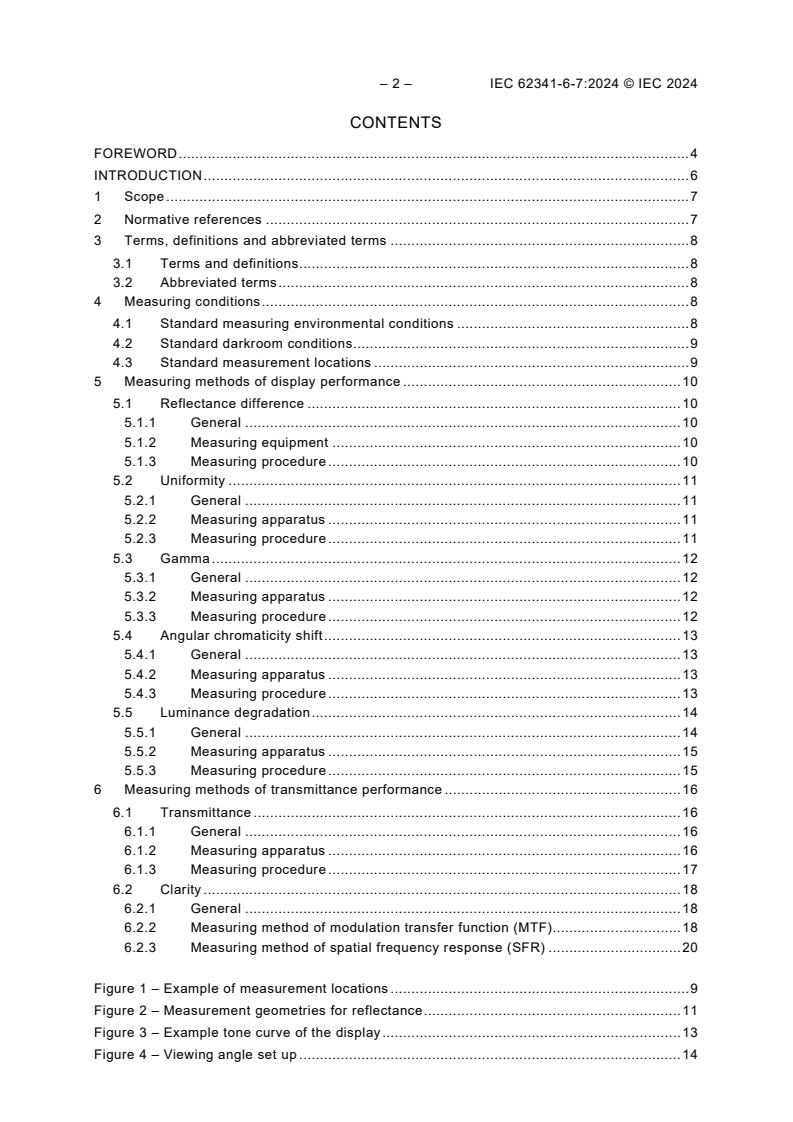
– 2 – IEC 62341-6-7:2024 © IEC 2024
CONTENTS
FOREWORD . 4
INTRODUCTION . 6
1 Scope . 7
2 Normative references . 7
3 Terms, definitions and abbreviated terms . 8
3.1 Terms and definitions . 8
3.2 Abbreviated terms . 8
4 Measuring conditions . 8
4.1 Standard measuring environmental conditions . 8
4.2 Standard darkroom conditions . 9
4.3 Standard measurement locations . 9
5 Measuring methods of display performance . 10
5.1 Reflectance difference . 10
5.1.1 General . 10
5.1.2 Measuring equipment . 10
5.1.3 Measuring procedure . 10
5.2 Uniformity . 11
5.2.1 General . 11
5.2.2 Measuring apparatus . 11
5.2.3 Measuring procedure . 11
5.3 Gamma . 12
5.3.1 General . 12
5.3.2 Measuring apparatus . 12
5.3.3 Measuring procedure . 12
5.4 Angular chromaticity shift . 13
5.4.1 General . 13
5.4.2 Measuring apparatus . 13
5.4.3 Measuring procedure . 13
5.5 Luminance degradation . 14
5.5.1 General . 14
5.5.2 Measuring apparatus . 15
5.5.3 Measuring procedure . 15
6 Measuring methods of transmittance performance . 16
6.1 Transmittance . 16
6.1.1 General . 16
6.1.2 Measuring apparatus . 16
6.1.3 Measuring procedure . 17
6.2 Clarity . 18
6.2.1 General . 18
6.2.2 Measuring method of modulation transfer function (MTF) . 18
6.2.3 Measuring method of spatial frequency response (SFR) . 20
Figure 1 – Example of measurement locations . 9
Figure 2 – Measurement geometries for reflectance . 11
Figure 3 – Example tone curve of the display . 13
Figure 4 – Viewing angle set up . 14
Figure 5 – Example of luminance decreases versus operating time . 15
Figure 6 – Example of the decrease of a luminance difference curve . 16
Figure 7 – Measurement geometry . 17
Figure 8 – Diffraction phenomenon of under-screen camera . 18
Figure 9 – Reference test pattern . 19
Figure 10 – Measurement configuration . 20
Table 1 – Measurement results . 14
Table 2 – Example of measured data . 16
– 4 – IEC 62341-6-7:2024 © IEC 2024
INTERNATIONAL ELECTROTECHNICAL COMMISSION
____________
ORGANIC LIGHT EMITTING DIODE (OLED) DISPLAYS –
Part 6-7: Measuring methods of optical characteristics for
display with under-screen feature
FOREWORD
1) The International Electrotechnical Commission (IEC) is a worldwide organization for standardization comprising
all national electrotechnical committees (IEC National Committees). The object of IEC is to promote international
co-operation on all questions concerning standardization in the electrical and electronic fields. To this end and
in addition to other activities, IEC publishes International Standards, Technical Specifications, Technical Reports,
Publicly Available Specifications (PAS) and Guides (hereafter referred to as “IEC Publication(s)”). Their
preparation is entrusted to technical committees; any IEC National Committee interested in the subject dealt with
may participate in this preparatory work. International, governmental and non-governmental organizations liaising
with the IEC also participate in this preparation. IEC collaborates closely with the International Organization for
Standardization (ISO) in accordance with conditions determined by agreement between the two organizations.
2) The formal decisions or agreements of IEC on technical matters express, as nearly as possible, an international
consensus of opinion on the relevant subjects since each technical committee has representation from all
interested IEC National Committees.
3) IEC Publications have the form of recommendations for international use and are accepted by IEC National
Committees in that sense. While all reasonable efforts are made to ensure that the technical content of IEC
Publications is accurate, IEC cannot be held responsible for the way in which they are used or for any
misinterpretation by any end user.
4) In order to promote international uniformity, IEC National Committees undertake to apply IEC Publications
transparently to the maximum extent possible in their national and regional publications. Any divergence between
any IEC Publication and the corresponding national or regional publication shall be clearly indicated in the latter.
5) IEC itself does not provide any attestation of conformity. Independent certification bodies provide conformity
assessment services and, in some areas, access to IEC marks of conformity. IEC is not responsible for any
services carried out by independent certification bodies.
6) All users should ensure that they have the latest edition of this publication.
7) No liability shall attach to IEC or its directors, employees, servants or agents including individual experts and
members of its technical committees and IEC National Committees for any personal injury, property damage or
other damage of any nature whatsoever, whether direct or indirect, or for costs (including legal fees) and
expenses arising out of the publication, use of, or reliance upon, this IEC Publication or any other IEC
Publications.
8) Attention is drawn to the Normative references cited in this publication. Use of the referenced publications is
indispensable for the correct application of this publication.
9) IEC draws attention to the possibility that the implementation of this document may involve the use of (a)
patent(s). IEC takes no position concerning the evidence, validity or applicability of any claimed patent rights in
respect thereof. As of the date of publication of this document, IEC had not received notice of (a) patent(s), which
may be required to implement this document. However, implementers are cautioned that this may not represent
the latest information, which may be obtained from the patent database available at https://patents.iec.ch. IEC
shall not be held responsible for identifying any or all such patent rights.
IEC 62341-6-7 has been prepared by IEC technical committee 110: Electronic displays. It is an
International Standard.
The text of this International Standard is based on the following documents:
Draft Report on voting
110/1667/FDIS 110/1691/RVD
Full information on the voting for its approval can be found in the report on voting indicated in
the above table.
The language used for the development of this International Standard is English.
This document was drafted in accordance with ISO/IEC Directives, Part 2, and developed in
accordance with ISO/IEC Directives, Part 1 and ISO/IEC Directives, IEC Supplement, available
at www.iec.ch/members_experts/refdocs. The main document types developed by IEC are
described in greater detail at www.iec.ch/publications.
A list of all parts in the IEC 62341 series, published under the general title Organic light emitting
diode (OLED) displays, can be found on the IEC website.
The committee has decided that the contents of this document will remain unchanged until the
stability date indicated on the IEC website under webstore.iec.ch in the data related to the
specific document. At this date, the document will be
• reconfirmed,
• withdrawn, or
• revised.
IMPORTANT – The "colour inside" logo on the cover page of this document indicates
that it contains colours which are considered to be useful for the correct understanding
of its contents. Users should therefore print this document using a colour printer.
– 6 – IEC 62341-6-7:2024 © IEC 2024
INTRODUCTION
A display has originally been conceived to show content or images on the screen and been
designed to be blocked on its back-plate, except for a transparent display. Along with advances
in display technologies, various screen forms with the display are available, such as a notch
type for the camera and sensors area, a pin-hole area, a teardrop shape, and a dual punch-
hole for the front camera.
The display has changed and consistently improved its pixel structures to make it easier for a
user to use multimedia without physical interference, for example, putting cameras and sensors
under the display screen to achieve the functions of finger touch, taking photos, 3D sensing
and so on; these technologies can be called under-screen features.
This document introduces mainly measuring conditions and measuring methods for the impact
of these developing under-screen features.
ORGANIC LIGHT EMITTING DIODE (OLED) DISPLAYS –
Part 6-7: Measuring methods of optical characteristics for
display with under-screen feature
1 Scope
This part of IEC 62341 specifies the standard measuring conditions and measuring methods for
determining the optical characteristics of an OLED display with under-screen camera; other
under-screen features, such as under-screen fingerprint or under-screen time of flight (TOF)
can also be applied. This document applies to OLED displays such as mobile phone, monitor
and TV with under-screen features.
NOTE Under-screen feature will want the display to be partially transparent and partially non-transparent, and this
can be achieved only by certain types of display technology, for example OLED. This document mainly focuses on
OLED display with under-screen feature.
2 Normative references
The following documents are referred to in the text in such a way that some or all of their content
constitutes requirements of this document. For dated references, only the edition cited applies.
For undated references, the latest edition of the referenced document (including any
amendments) applies.
IEC 62341-1-2, Organic light emitting diode (OLED) displays – Part 1-2: Terminology and letter
symbols
IEC 62341-5-3, Organic light emitting diode (OLED) displays – Part 5-3: Measuring methods of
image sticking and lifetime
IEC 62341-6-2, Organic light emitting diode (OLED) displays – Part 6-2: Measuring methods of
visual quality and ambient performance
IEC TR 62977-2-5, Electronic displays devices – Part 2-5: Transparent displays –
Measurements of optical characteristics
IEC 62977-3-7, Electronic displays – Part 3-7: Evaluation of optical performance – Tone
characteristics
ISO 12233, Photography – Electronic still picture imaging – Resolution and spatial frequency
responses
– 8 – IEC 62341-6-7:2024 © IEC 2024
3 Terms, definitions and abbreviated terms
3.1 Terms and definitions
For the purposes of this document, the terms and definitions given in IEC 62341-1-2 and the
following apply.
ISO and IEC maintain terminology databases for use in standardization at the following
addresses:
• IEC Electropedia: available at https://www.electropedia.org/
• ISO Online browsing platform: available at https://www.iso.org/obp
3.1.1
under-screen feature
feature placed under the display screen to achieve the functions of finger touch, taking photos,
3D sensing and so on
3.1.2
under-screen area
display area with special pixel structure and circuit design so that the under-screen feature can
be achieved
3.1.3
normal display area
display area with normal pixel structure and circuit design except for the under-screen area
3.2 Abbreviated terms
CCD charge coupled device
CCT correlated colour temperature
CTF contrast transfer function
DUT device under test
LMD light measuring device
MTF modulation transfer function
SFR spatial frequency response
TOF time of flight
4 Measuring conditions
4.1 Standard measuring environmental conditions
Measurements shall be carried out under the standard environmental conditions as follows:
– temperature: 25 °C ± 3 °C
– relative humidity: 25 % to 85 %
– atmospheric pressure: 86 kPa to 106 kPa
When different environmental conditions are used, they shall be noted in the report.
4.2 Standard darkroom conditions
The luminance contribution from the background illumination reflected off the test display shall
be ≤ 0,01 cd/m or less than 1/20 of the display’s black state luminance, whichever is lower. If
these conditions are not satisfied, then background subtraction is required, and it shall be noted
in the test report. In addition, if the sensitivity of the LMD is inadequate to measure at these low
levels, then the lower limit of the LMD shall be noted in the test report.
4.3 Standard measurement locations
Measurement shall be undertaken at several specified locations on the surface of the DUT. P
is the centre of the whole display area, P is the centre of the under-screen area, P , P , P ,
1 2 3 4
P are the centre of the adjacent display area, and m is the distance between test points which
is determined by the display
...