


IEC 61730-1:2023
(Main)Photovoltaic (PV) module safety qualification - Part 1: Requirements for construction
Photovoltaic (PV) module safety qualification - Part 1: Requirements for construction
IEC 61730-1:2023 specifies and describes the fundamental construction requirements for photovoltaic (PV) modules in order to provide safe electrical and mechanical operation. Specific topics are provided to assess the prevention of electrical shock, fire hazards, and personal injury due to mechanical and environmental stresses. This document pertains to the particular requirements of construction. IEC 61730-2 defines the requirements for testing. Modules with modified construction are qualified as described in IEC TS 62915.
This document lays down requirements for terrestrial PV modules suitable for long-term operation in open-air climates with 98th percentile module operating temperatures of 70 °C or less. Guidelines for modules to be used at higher operating temperatures are described in IEC TS 63126.
This document is intended to apply to all terrestrial flat plate module materials, such as crystalline silicon module types as well as thin-film modules.
This document defines the basic requirements for various applications of PV modules, but it cannot be considered to encompass all national or regional codes.
Qualification pour la sûreté de fonctionnement des modules photovoltaïques (PV) - Partie 1: Exigences pour la construction
IEC 61730-1:2023 spécifie et décrit les exigences fondamentales de construction pour les modules photovoltaïques (PV) afin d'assurer un fonctionnement électrique et mécanique sûr. Des thèmes spécifiques sont fournis pour évaluer la prévention contre les chocs électriques, les risques de feu et les accidents corporels dus à des contraintes mécaniques et environnementales. Le présent document se rapporte aux exigences particulières de construction. L'IEC 61730-2 définit les exigences d'essai. Les modules dont la construction est modifiée sont qualifiés comme cela est décrit dans l’IEC TS 62915.
Le présent document présente les exigences pour les modules PV terrestres adaptés à un fonctionnement à long terme dans des climats à l’air libre à des températures de fonctionnement de 98e centile du module inférieures ou égales à 70 °C. Les lignes directrices concernant les modules à utiliser à des températures de fonctionnement plus élevées sont décrites dans l’IEC TS 63126.
Le présent document est destiné à s'appliquer à tous les matériels à module à plaque plane pour application terrestre (les types de modules au silicium cristallin et les modules en couches minces, par exemple).
General Information
Relations
Overview
IEC 61730-1:2023, titled Photovoltaic (PV) module safety qualification – Part 1: Requirements for construction, is an international standard developed by the International Electrotechnical Commission (IEC). This standard details the fundamental construction requirements essential to ensuring the safe electrical and mechanical operation of terrestrial photovoltaic modules. It focuses on the prevention of risks such as electrical shock, fire hazards, and personal injury caused by mechanical or environmental stresses in PV modules.
The document applies broadly to flat plate terrestrial PV modules, including both crystalline silicon and thin-film types, designed for long-term outdoor use with operating temperatures up to 70 °C. For modules intended for higher operating temperatures, IEC TS 63126 provides the relevant guidance. IEC 61730-1 specifically addresses construction requirements, whereas testing protocols are covered under IEC 61730-2.
Key Topics
- Safety Construction Requirements: Outlines the general design principles and construction features that ensure PV module safety under varied operational conditions.
- Electrical Shock Protection: Defines insulation classes (Class 0, II, III) and sets minimum criteria to prevent accidental contact with live parts.
- Fire Hazard Prevention: Details material choices and construction techniques to minimize fire risks associated with PV modules.
- Mechanical Integrity: Covers mechanical and electromechanical connections including screws, rivets, adhesives, and the use of metallic and polymeric materials for robust module assembly.
- Insulation Coordination: Specifies requirements for creepage distances, clearances, and distances through insulation to maintain electrical safety.
- Marking and Documentation: Emphasizes the need for clear labeling and thorough documentation for user safety and regulatory compliance.
- Component Requirements: Addresses the use of internal and external wiring, connectors, junction boxes, encapsulants, and bypass diodes.
- Environmental Considerations: Designed for modules to withstand outdoor climatic stresses while ensuring long-term durability and safety.
Applications
IEC 61730-1:2023 serves as a foundational standard for manufacturers, designers, and testing laboratories involved in PV module production and certification. Practical applications include:
- PV Module Manufacturers: Ensuring compliance with global safety requirements for the construction of modules to reduce liability and enhance product reliability.
- Certification Bodies: Using the construction requirements as criteria to assess module safety qualifications before market release.
- Installation Professionals: Understanding the construction safety parameters aids in proper handling, mounting, and integration of modules in solar power systems.
- Regulatory Authorities and Policy Makers: Developing national or regional regulations aligned with international safety benchmarks for photovoltaic systems.
- Product Development: Guiding engineers to select appropriate materials and design processes that meet stringent safety and operational standards.
Related Standards
To achieve comprehensive photovoltaic module qualification, IEC 61730-1 works synergistically with several other standards, including:
- IEC 61730-2: Specifies testing methods for PV module safety qualification, complementing the construction criteria set out in Part 1.
- IEC TS 62915: Addresses qualification of PV modules with modified construction features.
- IEC TS 63126: Provides guidelines for PV modules designed to operate at temperatures exceeding 70 °C.
- IEC 61215: Related to PV module performance and durability testing.
- National and Regional Codes: While IEC 61730-1 defines broad international construction requirements, additional localized electrical and fire safety codes may apply.
By adhering to IEC 61730-1:2023, stakeholders in the solar industry can ensure enhanced protection against electrical risks, optimize mechanical durability, and comply with internationally recognized safety standards - making it a critical reference for sustainable and secure photovoltaic energy deployment.
Frequently Asked Questions
IEC 61730-1:2023 is a standard published by the International Electrotechnical Commission (IEC). Its full title is "Photovoltaic (PV) module safety qualification - Part 1: Requirements for construction". This standard covers: IEC 61730-1:2023 specifies and describes the fundamental construction requirements for photovoltaic (PV) modules in order to provide safe electrical and mechanical operation. Specific topics are provided to assess the prevention of electrical shock, fire hazards, and personal injury due to mechanical and environmental stresses. This document pertains to the particular requirements of construction. IEC 61730-2 defines the requirements for testing. Modules with modified construction are qualified as described in IEC TS 62915. This document lays down requirements for terrestrial PV modules suitable for long-term operation in open-air climates with 98th percentile module operating temperatures of 70 °C or less. Guidelines for modules to be used at higher operating temperatures are described in IEC TS 63126. This document is intended to apply to all terrestrial flat plate module materials, such as crystalline silicon module types as well as thin-film modules. This document defines the basic requirements for various applications of PV modules, but it cannot be considered to encompass all national or regional codes.
IEC 61730-1:2023 specifies and describes the fundamental construction requirements for photovoltaic (PV) modules in order to provide safe electrical and mechanical operation. Specific topics are provided to assess the prevention of electrical shock, fire hazards, and personal injury due to mechanical and environmental stresses. This document pertains to the particular requirements of construction. IEC 61730-2 defines the requirements for testing. Modules with modified construction are qualified as described in IEC TS 62915. This document lays down requirements for terrestrial PV modules suitable for long-term operation in open-air climates with 98th percentile module operating temperatures of 70 °C or less. Guidelines for modules to be used at higher operating temperatures are described in IEC TS 63126. This document is intended to apply to all terrestrial flat plate module materials, such as crystalline silicon module types as well as thin-film modules. This document defines the basic requirements for various applications of PV modules, but it cannot be considered to encompass all national or regional codes.
IEC 61730-1:2023 is classified under the following ICS (International Classification for Standards) categories: 27.160 - Solar energy engineering. The ICS classification helps identify the subject area and facilitates finding related standards.
IEC 61730-1:2023 has the following relationships with other standards: It is inter standard links to IEC 61730-1:2016. Understanding these relationships helps ensure you are using the most current and applicable version of the standard.
You can purchase IEC 61730-1:2023 directly from iTeh Standards. The document is available in PDF format and is delivered instantly after payment. Add the standard to your cart and complete the secure checkout process. iTeh Standards is an authorized distributor of IEC standards.
Standards Content (Sample)
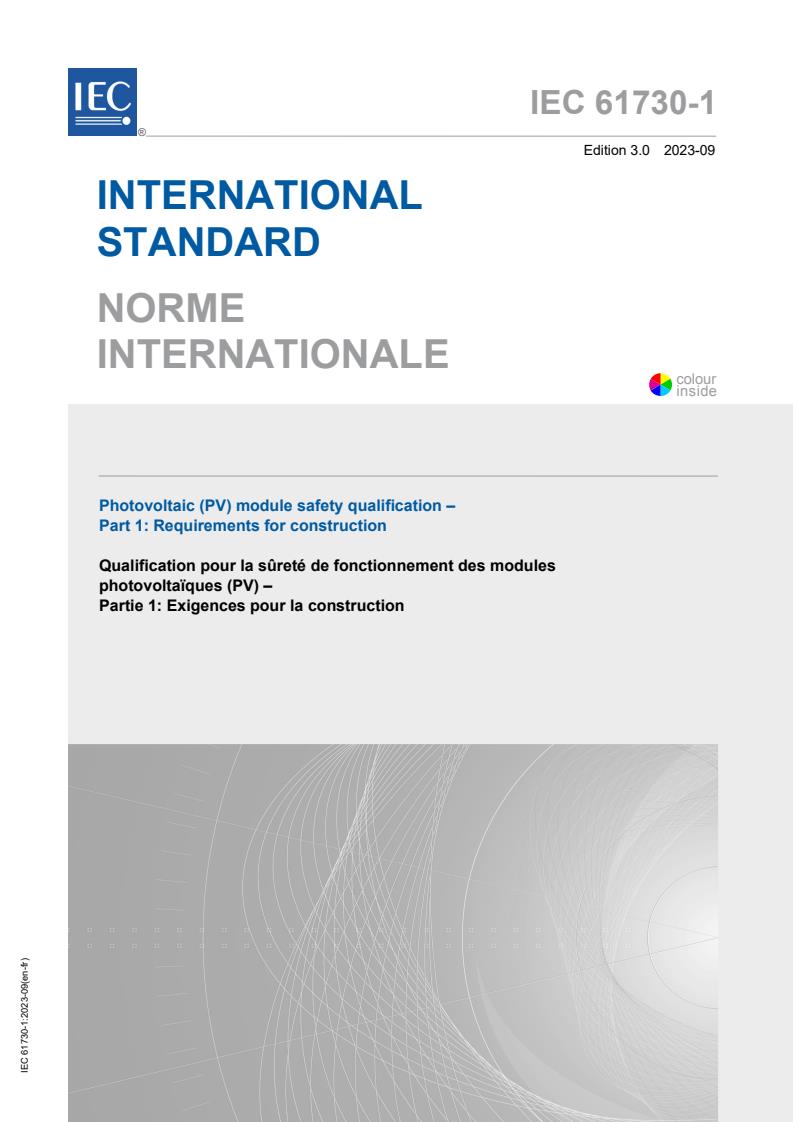
IEC 61730-1 ®
Edition 3.0 2023-09
INTERNATIONAL
STANDARD
NORME
INTERNATIONALE
colour
inside
Photovoltaic (PV) module safety qualification –
Part 1: Requirements for construction
Qualification pour la sûreté de fonctionnement des modules
photovoltaïques (PV) –
Partie 1: Exigences pour la construction
All rights reserved. Unless otherwise specified, no part of this publication may be reproduced or utilized in any form
or by any means, electronic or mechanical, including photocopying and microfilm, without permission in writing from
either IEC or IEC's member National Committee in the country of the requester. If you have any questions about IEC
copyright or have an enquiry about obtaining additional rights to this publication, please contact the address below or
your local IEC member National Committee for further information.
Droits de reproduction réservés. Sauf indication contraire, aucune partie de cette publication ne peut être reproduite ni
utilisée sous quelque forme que ce soit et par aucun procédé, électronique ou mécanique, y compris la photocopie et
les microfilms, sans l'accord écrit de l'IEC ou du Comité national de l'IEC du pays du demandeur. Si vous avez des
questions sur le copyright de l'IEC ou si vous désirez obtenir des droits supplémentaires sur cette publication, utilisez
les coordonnées ci-après ou contactez le Comité national de l'IEC de votre pays de résidence.
IEC Secretariat Tel.: +41 22 919 02 11
3, rue de Varembé info@iec.ch
CH-1211 Geneva 20 www.iec.ch
Switzerland
About the IEC
The International Electrotechnical Commission (IEC) is the leading global organization that prepares and publishes
International Standards for all electrical, electronic and related technologies.
About IEC publications
The technical content of IEC publications is kept under constant review by the IEC. Please make sure that you have the
latest edition, a corrigendum or an amendment might have been published.
IEC publications search - webstore.iec.ch/advsearchform IEC Products & Services Portal - products.iec.ch
The advanced search enables to find IEC publications by a Discover our powerful search engine and read freely all the
variety of criteria (reference number, text, technical publications previews. With a subscription you will always have
committee, …). It also gives information on projects, replaced access to up to date content tailored to your needs.
and withdrawn publications.
Electropedia - www.electropedia.org
IEC Just Published - webstore.iec.ch/justpublished
The world's leading online dictionary on electrotechnology,
Stay up to date on all new IEC publications. Just Published
containing more than 22 300 terminological entries in English
details all new publications released. Available online and once
and French, with equivalent terms in 19 additional languages.
a month by email.
Also known as the International Electrotechnical Vocabulary
(IEV) online.
IEC Customer Service Centre - webstore.iec.ch/csc
If you wish to give us your feedback on this publication or need
further assistance, please contact the Customer Service
Centre: sales@iec.ch.
A propos de l'IEC
La Commission Electrotechnique Internationale (IEC) est la première organisation mondiale qui élabore et publie des
Normes internationales pour tout ce qui a trait à l'électricité, à l'électronique et aux technologies apparentées.
A propos des publications IEC
Le contenu technique des publications IEC est constamment revu. Veuillez vous assurer que vous possédez l’édition la
plus récente, un corrigendum ou amendement peut avoir été publié.
Recherche de publications IEC - IEC Products & Services Portal - products.iec.ch
webstore.iec.ch/advsearchform Découvrez notre puissant moteur de recherche et consultez
La recherche avancée permet de trouver des publications IEC gratuitement tous les aperçus des publications. Avec un
en utilisant différents critères (numéro de référence, texte, abonnement, vous aurez toujours accès à un contenu à jour
comité d’études, …). Elle donne aussi des informations sur les adapté à vos besoins.
projets et les publications remplacées ou retirées.
Electropedia - www.electropedia.org
IEC Just Published - webstore.iec.ch/justpublished
Le premier dictionnaire d'électrotechnologie en ligne au monde,
Restez informé sur les nouvelles publications IEC. Just
avec plus de 22 300 articles terminologiques en anglais et en
Published détaille les nouvelles publications parues.
français, ainsi que les termes équivalents dans 19 langues
Disponible en ligne et une fois par mois par email.
additionnelles. Egalement appelé Vocabulaire
Electrotechnique International (IEV) en ligne.
Service Clients - webstore.iec.ch/csc
Si vous désirez nous donner des commentaires sur cette
publication ou si vous avez des questions contactez-nous:
sales@iec.ch.
IEC 61730-1 ®
Edition 3.0 2023-09
INTERNATIONAL
STANDARD
NORME
INTERNATIONALE
colour
inside
Photovoltaic (PV) module safety qualification –
Part 1: Requirements for construction
Qualification pour la sûreté de fonctionnement des modules
photovoltaïques (PV) –
Partie 1: Exigences pour la construction
INTERNATIONAL
ELECTROTECHNICAL
COMMISSION
COMMISSION
ELECTROTECHNIQUE
INTERNATIONALE
ICS 27.160 ISBN 978-2-8322-7197-1
– 2 – IEC 61730-1:2023 © IEC 2023
CONTENTS
FOREWORD . 5
1 Scope . 8
2 Normative references . 8
3 Terms, definitions, symbols and abbreviated terms . 10
3.1 General terms and definitions . 11
3.2 Components . 11
3.3 Installation and application. 12
3.4 Insulation concepts . 13
3.5 Ratings . 16
3.6 Temperatures . 17
3.7 Voltages . 17
3.8 Bifacial photovoltaics . 18
4 Symbols and abbreviated terms . 19
5 Classification, applications and intended use . 19
5.1 General . 19
5.2 PV modules of Class 0 . 19
5.2.1 General . 19
5.2.2 Insulation . 19
5.2.3 Application. 19
5.3 PV modules of Class II . 20
5.3.1 General . 20
5.3.2 Insulation . 20
5.3.3 Application. 20
5.4 PV modules of Class III . 20
5.4.1 General . 20
5.4.2 Insulation . 20
5.4.3 Application. 20
5.5 Rating categories and special applications . 21
6 Requirements for design and construction . 22
6.1 General . 22
6.2 Marking and documentation . 23
6.2.1 General . 23
6.2.2 Marking . 23
6.2.3 Documentation . 27
6.3 Electrical components and insulation . 30
6.3.1 General . 30
6.3.2 Internal wiring . 30
6.3.3 External wiring and cables . 30
6.3.4 Module overcurrent protection rating . 30
6.3.5 Connectors . 30
6.3.6 Junction boxes . 30
6.3.7 Frontsheets and backsheets . 31
6.3.8 Insulation barriers . 31
6.3.9 Electrical connections . 31
6.3.10 Encapsulants . 32
6.3.11 Bypass diodes . 32
6.4 Mechanical and electromechanical connections . 32
6.4.1 General . 32
6.4.2 Screw connections. 33
6.4.3 Rivets . 34
6.4.4 Thread-cutting screws . 34
6.4.5 Form/press/tight fit . 34
6.4.6 Connections by adhesives . 34
6.4.7 Other connections . 35
6.5 Materials . 35
6.5.1 General . 35
6.5.2 Polymeric materials . 35
6.5.3 Metallic materials. 38
6.5.4 Adhesives . 38
6.6 Protection against electric shock . 38
6.6.1 General . 38
6.6.2 Protection against accessibility to hazardous live parts . 39
6.6.3 Insulation coordination . 40
6.6.4 Distance through functional and relied upon insulation . 47
Annex A (normative) Symbol "Do not disconnect under load" . 50
Annex B (normative) Basis for insulation coordination dimensions . 51
B.1 General . 51
B.2 Influencing factors . 51
B.2.1 General . 51
B.2.2 Overvoltage category and rated impulse voltage . 51
B.2.3 Working voltage . 52
B.2.4 Pollution degree . 52
B.2.5 Insulating material – material groups . 53
B.3 Clearances . 53
B.4 Creepage distances . 54
B.4.1 General . 54
B.4.2 Enclosed parts . 54
B.5 Distance through insulation . 55
B.5.1 Cemented joints. 55
B.5.2 Insulation in thin layers (DTI) . 55
B.5.3 Distance through functional insulation (DTFI) . 56
Annex C (informative) Specific use cases . 57
C.1 Modules . 57
C.1.1 General . 57
C.1.2 Insulation coordination diagrams . 57
C.2 Insulation coordination after mounting of components . 64
C.2.1 General . 64
C.2.2 Backsheets . 65
C.2.3 Junction box . 66
Bibliography . 68
Figure 1 – IEC 60417-5021:2002-10 . 26
Figure 2 – IEC 60417-5017:2006-08 . 26
Figure 3 – IEC 60417-5018:2011-07 . 26
– 4 – IEC 61730-1:2023 © IEC 2023
Figure A.1 – Symbol "DO NOT DISCONNECT UNDER LOAD" . 50
Figure A.2 – Symbol IEC 60417-6070:2011-06: "Do not disconnect under load" . 50
Figure C.1 – General case for clearance, creepage distances and DTI . 58
Figure C.2 – Location of highest potential difference within the module . 59
Figure C.3 – Examples of spacing requirements between live parts of different
potential within a module . 60
Figure C.4 – Clearance and creepage distance between internal live parts and outer
accessible surfaces . 62
Figure C.5 – Effect of frame tape or edge adhesive on clearance and creepage
distance . 62
Figure C.6 – Distance between internal live parts and outer accessible surfaces with a
cemented joint . 63
Figure C.7 – Backsheet with aluminium layer . 64
Figure C.8 – Spacing requirements between the junction box ribbon and aluminium
layer of backsheet . 66
Figure C.9 – Considerations for clearances and creepage distances between live parts
and outer accessible surfaces after installation and termination of junction box (J-box) . 67
Figure C.10 – Possible critical points due to improper installation . 67
Table 1 – Classes for protection against electric shock . 19
Table 2 – Required type of insulation . 40
Table 3 – Minimum clearances (cl), creepage distances (cr) and distances through
solid insulation for Class II PV modules . 41
Table 4 – Minimum clearances (cl), creepage distances (cr) and distances through
solid insulation for Class 0 PV modules . 43
Table 5 – Multiplication factors for clearances of equipment rated for operation at
altitudes greater than 2 000 m above sea level . 47
Table B.1 – Rated impulse voltage . 52
Table B.2 – Minimum clearances for an inhomogeneous field . 54
Table B.3 – Minimum spacings for thin layers . 55
Table C.1 – Distance between parts of different potential within a PV module (values
for Class II modules with working voltage of ≤ 35 V) . 59
Table C.2 – Spacing between live parts and outer accessible surfaces (values for
Class II modules with rated system voltage of 1 500 V) . 61
INTERNATIONAL ELECTROTECHNICAL COMMISSION
____________
PHOTOVOLTAIC (PV) MODULE SAFETY QUALIFICATION –
Part 1: Requirements for construction
FOREWORD
1) The International Electrotechnical Commission (IEC) is a worldwide organization for standardization comprising
all national electrotechnical committees (IEC National Committees). The object of IEC is to promote international
co-operation on all questions concerning standardization in the electrical and electronic fields. To this end and
in addition to other activities, IEC publishes International Standards, Technical Specifications, Technical Reports,
Publicly Available Specifications (PAS) and Guides (hereafter referred to as "IEC Publication(s)"). Their
preparation is entrusted to technical committees; any IEC National Committee interested in the subject dealt with
may participate in this preparatory work. International, governmental and non-governmental organizations liaising
with the IEC also participate in this preparation. IEC collaborates closely with the International Organization for
Standardization (ISO) in accordance with conditions determined by agreement between the two organizations.
2) The formal decisions or agreements of IEC on technical matters express, as nearly as possible, an international
consensus of opinion on the relevant subjects since each technical committee has representation from all
interested IEC National Committees.
3) IEC Publications have the form of recommendations for international use and are accepted by IEC National
Committees in that sense. While all reasonable efforts are made to ensure that the technical content of IEC
Publications is accurate, IEC cannot be held responsible for the way in which they are used or for any
misinterpretation by any end user.
4) In order to promote international uniformity, IEC National Committees undertake to apply IEC Publications
transparently to the maximum extent possible in their national and regional publications. Any divergence between
any IEC Publication and the corresponding national or regional publication shall be clearly indicated in the latter.
5) IEC itself does not provide any attestation of conformity. Independent certification bodies provide conformity
assessment services and, in some areas, access to IEC marks of conformity. IEC is not responsible for any
services carried out by independent certification bodies.
6) All users should ensure that they have the latest edition of this publication.
7) No liability shall attach to IEC or its directors, employees, servants or agents including individual experts and
members of its technical committees and IEC National Committees for any personal injury, property damage or
other damage of any nature whatsoever, whether direct or indirect, or for costs (including legal fees) and
expenses arising out of the publication, use of, or reliance upon, this IEC Publication or any other IEC
Publications.
8) Attention is drawn to the Normative references cited in this publication. Use of the referenced publications is
indispensable for the correct application of this publication.
9) Attention is drawn to the possibility that some of the elements of this IEC Publication may be the subject of patent
rights. IEC shall not be held responsible for identifying any or all such patent rights.
IEC 61730-1 has been prepared by IEC technical committee 82: Solar photovoltaic energy
systems. It is an International Standard.
This third edition cancels and replaces the second edition published in 2016. This edition
constitutes a technical revision.
This edition includes the following significant technical changes with respect to the previous
edition:
a) Revision of Clauses 2 and 3.
b) Addition of requirements for qualification of specific components according to their standard
documents (junction box, connectors, frontsheets/backsheets).
c) Significant changes to the definition and testing of relied upon insulation materials (RUI).
These requirements are described in the pre-qualification document for frontsheets and
backsheets (IEC 62788-2-1). This includes:
1) clarifications on the concept and measurement of DTI, and related materials test
requirements;
– 6 – IEC 61730-1:2023 © IEC 2023
2) frontsheet/backsheet weathering requirements.
d) Removal of all reference to "open rack", with updates according to an intended use for
th
applications according to the application's 98 percentile module operating temperature.
e) Modules meeting Class 0 for use in restricted access areas are not required to pass the
breakage test, (MST 32).
f) Marking and documentation subclauses have been revised and aligned with the IEC 61215
series.
g) Electronic copies are now allowed instead of paper copies of required safety documentation.
h) Requirements for bifacial modules:
1) addition of new term, aBSI;
2) relevant tests have been changed to account for higher current of bifacial modules;
3) for bifacial modules, marking that indicates which side is designed as the front side, or
if both are designed for prolonged exposure to direct sunlight (> 300 W/m );
4) relevant parameters for installing bifacial modules clarified;
5) overprotection rating;
6) documentation has been modified.
i) In 6.2, marking requirements for connectors have been added.
j) Related to the intended use temperature range:
th
1) Clause 5 and 6.2 have been modified to include temperature ratings, with > 70 °C 98
percentile module operating temperature as the default maximum. Guidance for factors
which could impact the module operating temperature for a system design/location are
provided, and responsibility for proper installation is placed upon the installer.
2) Changes to insulation coordination sections (6.6, Annex B and Annex C).
3) Subclauses on insulation coordination (6.6.3) and distance through solid insulation
(6.6.4) have been updated to clearly state the insulation coordination requirements, and
are aligned with Annex B.
4) Annex B has been revised to show the basis for the dimensioning related to insulation
coordination and is aligned with 6.6.3 and 6.6.4.
5) Annex C has been created to show specific use cases and describe how changes to
materials or use of additional testing can modify the required dimensioning. Diagrams
have been updated.
6) A new term, distance through functional insulation (DTFI), has been defined to describe
the spacing between fully encapsulated live parts of different potential (the larger of
creepage and clearance for the relevant voltage).
7) Testing requirements to verify a clearance value less than the listed value (but not below
the creepage distance) are defined.
8) Requirements for junction boxes, cables and connectors, and polymeric
frontsheets/backsheets have been removed (these are now covered in their respective
standards).
9) In Table 2, functional insulation is required for insulation between live parts of different
potential inside a PV module for all module types.
10) In Table 3 and Table 4:
i) lines related to pollution degree 3 have been removed, since this is not applicable to
module laminates passing the requirements of IEC 61730-2;
ii) the minimum values for DTI have been increased to include the minimum 0,030 mm
thickness (pinhole considerations);
iii) lines related to reinforced insulation have been combined;
iv) lines related to basic insulation have been combined, and functional insulation
included on those lines;
v) lines for DTFI have been added.
11) Insulation coordination requirements for Class III modules have been removed from
Table 4, and functional insulation requirements are included in text (no DTI thickness
requirement).
The text of this International Standard is based on the following documents:
Draft Report on voting
82/2140/FDIS 82/2165/RVD
Full information on the voting for its approval can be found in the report on voting indicated in
the above table.
The language used for the development of this International Standard is English.
A list of all parts in the IEC 61730 series, under the general title Photovoltaic (PV) module safety
qualification, can be found on the IEC website.
This document was drafted in accordance with ISO/IEC Directives, Part 2, and developed in
accordance with ISO/IEC Directives, Part 1 and ISO/IEC Directives, IEC Supplement, available
at www.iec.ch/members_experts/refdocs. The main document types developed by IEC are
described in greater detail at www.iec.ch/standardsdev/publications.
The committee has decided that the contents of this document will remain unchanged until the
stability date indicated on the IEC website under webstore.iec.ch in the data related to the
specific document. At this date, the document will be
• reconfirmed,
• withdrawn,
• replaced by a revised edition, or
• amended.
IMPORTANT – The "colour inside" logo on the cover page of this document indicates
that it contains colours which are considered to be useful for the correct understanding
of its contents. Users should therefore print this document using a colour printer.
– 8 – IEC 61730-1:2023 © IEC 2023
PHOTOVOLTAIC (PV) MODULE SAFETY QUALIFICATION –
Part 1: Requirements for construction
1 Scope
This part of IEC 61730 specifies and describes the fundamental construction requirements for
photovoltaic (PV) modules in order to provide safe electrical and mechanical operation. Specific
topics are provided to assess the prevention of electrical shock, fire hazards, and personal
injury due to mechanical and environmental stresses. This document pertains to the particular
requirements of construction. IEC 61730-2 defines the requirements for testing. Modules with
modified construction are qualified as described in IEC TS 62915.
This document lays down requirements for terrestrial PV modules suitable for long-term
th
operation in open-air climates with 98 percentile module operating temperatures of 70 °C or
less. Guidelines for modules to be used at higher operating temperatures are described in
IEC TS 63126. The useful service life of modules so qualified will depend on their design, their
environment, and the conditions under which they are operated. Therefore, test results are not
construed as a quantitative prediction of module lifetime.
This document is intended to apply to all terrestrial flat plate module materials, such as
crystalline silicon module types as well as thin-film modules.
PV modules covered by this document are limited to a maximum DC system voltage of 1 500 V.
This document defines the basic requirements for various applications of PV modules, but it
cannot be considered to encompass all national or regional codes. Specific requirements, e.g.
for building, floating, marine and vehicle applications, are not covered.
This document does not address specific requirements for products that combine a PV module
with power conversion equipment, monitoring or control electronics, such as integrated
inverters, converters or output disabling functions, which are addressed in IEC 62109-3.
While it is possible that parts of this document are applicable to flat plate PV modules with
internally generated low-level concentration below three times, it was not written specifically to
address these concerns.
This document is designed to coordinate with the test sequences in the IEC 61215 series, so
that a single set of samples can be used to perform both the safety and design qualification of
a PV module.
Additional construction requirements outlined in relevant ISO standards, or the national or local
codes which govern the installation and use of these PV modules in their intended locations,
can apply in addition to the requirements contained within this document.
Any change to materials, design, or internal spacing are subject to a re-evaluation of the PV
module or its component(s), as applicable, according to the IEC 61730 series and
IEC TS 62915.
2 Normative references
The following documents are referred to in the text in such a way that some or all of their content
constitutes requirements of this document. For dated references, only the edition cited applies.
For undated references, the latest edition of the referenced document (including any
amendments) applies.
IEC 60216-1, Electrical insulating materials – Thermal endurance properties – Part 1: Ageing
procedures and evaluation of test results
IEC 60216-2, Electrical insulating materials – Thermal endurance properties – Part 2:
Determination of thermal endurance properties of electrical insulating materials – Choice of test
criteria
IEC 60216-5, Electrical insulating materials – Thermal endurance properties – Part 5:
Determination of relative temperature index (RTE) of an insulating material
IEC 60243-1:2013, Electric strength of insulating materials – Test methods – Part 1: Tests at
power frequencies
IEC 60243-2:2013, Electric strength of insulating materials – Test methods – Part 2: Additional
requirements for tests using direct voltage
IEC 60269-6, Low-voltage fuses – Part 6: Supplementary requirements for fuse-links for the
protection of solar photovoltaic energy systems
IEC 60364-7-712, Low voltage electrical installations – Part 7-712: Requirements for special
installations or locations – Solar photovoltaic (PV) power supply systems
IEC 60417, Graphical symbols for use on equipment, available at https://www.graphical-
symbols.info/equipment
IEC 60529, Degrees of protection provided by enclosures (IP code)
IEC 60664-1:2020, Insulation coordination for equipment within low-voltage systems – Part 1:
Principles, requirements and tests
IEC 60695-11-10, Fire hazard testing – Part 11-10: Test flames – 50 W horizontal and vertical
flame test methods
IEC TS 60904-1-2, Photovoltaic devices – Part 1-2: Measurement of current-voltage
characteristics of bifacial photovoltaic (PV) devices
IEC 60950-1:2005, Information technology equipment – Safety – Part 1: General requirements
IEC 61032:1997, Protection of persons and equipment by enclosures – Probes for verification
IEC 61140, Protection against electric shock – Common aspects for installation and equipment
IEC 61215 (all parts), Terrestrial photovoltaic (PV) modules – Design qualification and type
approval
IEC 61730-2, Photovoltaic (PV) module safety qualification – Part 2: Requirements for testing
IEC TS 61836, Solar photovoltaic energy systems – Terms, definitions and symbols
IEC 62548, Photovoltaic (PV) arrays – Design requirements
IEC 62788-1 (all parts), Measurement procedures for materials used in photovoltaic modules –
Part 1: Encapsulants
– 10 – IEC 61730-1:2023 © IEC 2023
IEC 62788-1-2, Measurement procedures for materials used in photovoltaic modules – Part 1-2:
Encapsulants – Measurement of volume resistivity of photovoltaic encapsulants and other
polymeric materials
IEC TS 62788-2, Measurement procedures for materials used in photovoltaic modules – Part 2:
Polymeric materials – Frontsheets and backsheets
IEC 62788-2-1, Measurement procedures for materials used in photovoltaic modules – Part 2-1:
Polymeric materials – Frontsheets and backsheets – Safety requirements
IEC 62790:2020, Junction boxes for photovoltaic modules – Safety requirements and tests
IEC 62852, Connectors for DC-application in photovoltaic systems – Safety requirements and
tests
IEC 62930, Electric cables for photovoltaic systems with a voltage rating of 1,5 kV DC
IEC TS 63126, Guidelines for qualifying PV modules, components and materials for operation
at high temperatures
IEC TR 63225, Incompatibility of connectors for DC-application in photovoltaic systems
ISO 1456, Metallic and other inorganic coatings – Electrodeposited coatings of nickel, nickel
plus chromium, copper plus nickel and of copper plus nickel plus chromium
ISO 1461, Hot dip galvanized coatings on fabricated iron and steel articles – Specifications and
test methods
ISO 2081, Metallic and other inorganic coatings – Electroplated coatings of zinc with
supplementary treatments on iron or steel
ISO 2093, Electroplated coatings of tin – Specification and test methods
ISO 7010, Graphical symbols – Safety colours and safety signs – Registered safety signs,
available at https://www.iso.org/obp
ISO 9224:2012, Corrosion of metals and alloys – Corrosivity of atmospheres – Guiding values
for the corrosivity categories
EN 50618, Electric cables for photovoltaic systems
UL 746B, Standard for Polymeric Materials – Long Term Property Evaluations
IEC/IEEE 82079-1, Preparation of information for use (instructions for use) of products – Part 1:
Principles and general requirements
3 Terms, definitions, symbols and abbreviated terms
For the purposes of this document, the terms and definitions given in IEC 60664-1,
IEC TS 60904-1-2, IEC 61140, IEC TS 61836, IEC 61215-1and the following apply.
ISO and IEC maintain terminological databases for use in standardization at the following
addresses:
• IEC Electropedia: available at http://www.electropedia.org/
• ISO Online browsing platform: available at http://www.iso.org/obp
3.1 General terms and definitions
3.1.1
functional earthing
earthing for purposes other than electrical safety
[SOURCE: IEC 60050-195:2021, 195-01-13]
3.1.2
internal wiring
wiring and electrical connections that are made within the apparatus by its manufacturer
[SOURCE: IEC 60050-426:2020, 426-11-32]
3.1.3
external wiring
wiring that is not internal wiring (3.1.2), including, but not limited to, output cables
3.1.4
laminate
product made by bonding together two or more layers of the same or different materials
Note 1 to entry: It includes all components prior to attaching the junction box, frame or rail, and nameplate.
[SOURCE: IEC 60050-212:2010, 212-15-52, modified – Note 1 to entry has been added]
3.1.5
manufacturer
legal entity that manufactures a product, or that has a product designed or manufactured, and
that markets the product under its name or trademark
3.1.6
module quality test
MQT
PV module quality test in accordance with IEC 61215-2
3.1.7
module safety test
MST
PV module safety test in accordance with IEC 61730-2
3.2 Components
3.2.1
backsheet
outer layer or combination of outer layers of the PV module, located as substrate on the back
of the PV module and providing protection of the inner components of the PV module from
external stresses and weather elements, as well as providing electrical insulation
3.2.2
connector
component which terminates conductors for the purpose of providing connection to and
disconnection from a suitable mating component
[SOURCE: IEC 60050-581:2008, 581-06-01]
– 12 – IEC 61730-1:2023 © IEC 2023
3.2.3
encapsulant
material used between the substrate and superstrate to provide environmental
protection for photovoltaic cells in a photovoltaic module
[SOURCE: IEC TS 61836:2016, 3.1.30, modified – Domain has been added.]
3.2.4
enclosure
part of an assembly providing a specified degree of protection of equipment against external
influences and a specified degree of protection against approach to or contact with live parts
[SOURCE: IEC 60050-441:1984, 441-13-01, modified – In the definition, the words "and against
contact with moving parts" have been deleted.]
3.2.5
frontsheet
outer layer or combination of outer layers of the PV module, located as superstrate on the front
of the PV module and providing protection of the inner components of the PV module from
external stresses and weather elements, as well as providing electrical insulation
3.2.6
insulation barrier
raised or recessed configuration of an insulator to increase creepage distance between
conducting surfaces
[SOURCE: IEC 60050-581:2008, 581-22-15]
3.2.7
junction box
closed or protected enclosure in which circuits are electrically connected
[SOURCE: IEC TS 61836:2016, 3.2.16]
3.2.8
potting
sealing of components and associated conductors with a compound to exclude contaminants
[SOURCE: IEC 60050-581:2008, 581-24-20]
3.2.9
terminal
conductive part of a device, electric circuit or electric network, provided for connecting that
device, electric circuit or electric network to one or more external conductors
Note 1 to entry: Can contain one or several contacts and the term therefore includes sockets, connectors, etc.
[SOURCE: IEC 60050-151:2001, 151-12-12, modified – The original Note 1 to entry has been
replaced.]
3.3 Installation and application
3.3.1
building attached PV
BAPV
system in which the PV modules are mounted on a building envelope and do not fulfil the criteria
for building integrated PV (3.3.2)
3.3.2
building integrated PV
BIPV
system in which the PV modules form a building component providing additional functions as
defined in 5.5 b)
3.3.3
installation
permanent wiring system such as a raceway or conduit that prevents or reduces
wire and cable movement
3.3.4
installation
unconstrained wiring system that consists of cables or wires able to move
freely
3.3.5
non-restricted access area
area to which all persons including those who are not skilled, trained or instructed in electrical
safety have general access
EXAMPLE Any PV installations which are not protected against public access by any means.
Note 1 to entry: A building's roof is considered non-restricted access area, unless explicitly marked as restricted
area.
3.3.6
restricted access area
area accessible only to electrically skilled persons and electrically instructed persons with the
proper authorization
EXAMPLE Utility-scale PV installations which are protected against public access by fences, location, etc., and
where only persons skilled, trained or instructed in electrical safety have access.
[SOURCE: IEC 60050-195:2021, 195-04-04, modified – The example has been added.]
3.4 Insulation concepts
3.4.1
accessible part
part which can be touched by means of the standard test finger
Note 1 to entry: The standard test finger is as in Figure 2, test probe B of IEC 61032:1997.
[SOURCE: IEC 60050-442:1998, 442-01-15, modified – Note 1 to entry has been added.]
3.4.2
live part
conductive part intended to be energized under normal operating conditions
[SOURCE: IEC 60050-195:2021, 195-02-19, modified – The second part of the definition has
been deleted because not applicable to DC.]
3.4.3
insulation system
insulating material, or an assembly of insulation materials, to be considered in relation with
associated conducting parts, as applied to a particular type or size or part of electrical
equipment
[SOURCE: IEC 60050-411:2007, 411-39-25]
– 14 – IEC 61730-1:2023 © IEC 2023
3.4.4
electric insulation
insulation
part of an electrotechnical product which separates conducting parts at different
electric potentials during operation or insulates such parts from the sur
...
IEC 61730-1:2023 offers a comprehensive framework focused on the safety qualification of photovoltaic (PV) modules, specifically addressing the construction requirements crucial for ensuring safe electrical and mechanical operation. This standard is pivotal in guiding manufacturers and engineers involved in the production and assembly of PV modules, as it delineates essential safety aspects that mitigate risks associated with electrical shock, fire hazards, and mechanical or environmental stresses. One of the key strengths of IEC 61730-1:2023 is its emphasis on providing clear construction requirements tailored for long-term, reliable operation of terrestrial PV modules in open-air climates. By specifying operational parameters, including the 98th percentile module operating temperatures not exceeding 70 °C, the standard addresses a critical factor in ensuring the longevity and durability of PV installations. Furthermore, additional guidance for modules designed for higher operating temperatures is available in the complementary document IEC TS 63126, reinforcing the standard’s adaptability to a range of environmental conditions. The scope of IEC 61730-1:2023 extends to various materials used in terrestrial flat plate module construction, including both crystalline silicon and thin-film technologies. By encompassing multiple types of PV modules, the standard facilitates a unified approach to safety that can be broadly applied across the solar energy sector. This inclusivity enhances its relevance in an evolving market that sees diverse materials and technologies being utilized. While IEC 61730-1:2023 cannot claim to cover all national or regional codes, its comprehensive guidelines provide a robust baseline that can be harmonized with local regulations. This flexibility is essential for manufacturers aiming to align their products with international safety standards while accommodating regional variations in code requirements. In summary, IEC 61730-1:2023 represents a vital resource for the photovoltaic industry, focusing on the critical construction requirements necessary for the safe operation of PV modules. Its strengths lie in its thorough approach to safety, material inclusivity, and relevance to global markets, making it an indispensable guideline for manufacturers, engineers, and stakeholders in the solar energy sector.
IEC 61730-1:2023は、太陽光発電(PV)モジュールの安全性の資格に関する標準であり、その主要な構築要件を明確に定義しています。この標準は、電気的および機械的な運用において安全を提供するために必要な基本的な構造要件を詳細に説明しています。特に、電気ショックの防止、火災の危険、機械的および環境的ストレスによる人身傷害の予防に関して、具体的なトピックが取り上げられています。 IEC 61730-1:2023の強みは、オープンエアの気候条件で長期間の運用に適した地上PVモジュールに対する要件を明確に定めている点にあります。98パーセンタイルのモジュール運用温度が70 °C以下であることを前提としており、高温での使用に関するガイドラインをIEC TS 63126で提供しています。このことから、様々な用途に応じたPVモジュールの設計と仕様が可能になります。 さらに、この文書は結晶シリコンモジュールや薄膜モジュールを含む、すべての地上フラットプレートモジュール材料に対して適用されることが明記されています。これにより、技術的な多様性が確保され、さまざまな市場ニーズに応えるための基盤が強化されています。したがって、IEC 61730-1:2023はPVモジュールの設計者や製造業者にとって、重要な指針となる特徴を兼ね備えています。 ただし、この文書がすべての国や地域のコードを網羅しているわけではない点も留意すべきです。このことは、地域特有の規制や基準に対応する上で追加の考慮が必要であることを示唆しています。 総じて、IEC 61730-1:2023はPVモジュールの安全性を確保するための強力な基準を提供しており、技術的に先進的な環境での利用において重要な役割を果たすとともに、その適用範囲の広さも際立っています。
Die Norm IEC 61730-1:2023 stellt eine entscheidende Grundlage für die Sicherheitsqualifikation von Photovoltaik(PV)-Modulen dar. Sie definiert spezifische Anforderungen an die Konstruktion, die für eine sichere elektrische und mechanische Betriebssicherheit unerlässlich sind. Der spezifische Fokus auf den Schutz vor elektrischen Schlägen, Brandgefahren und Verletzungen durch mechanische sowie umweltbedingte Beanspruchungen verdeutlicht die Relevanz dieser Norm für die gesamte Branche. Ein herausragendes Merkmal der IEC 61730-1:2023 ist, dass sie Anforderungen für terrestrische PV-Module festlegt, die für den langfristigen Betrieb unter Freiluftbedingungen ausgelegt sind. Insbesondere werden die Module für Betriebstemperaturen von 70 °C oder weniger spezifiziert, was einen wichtigen Aspekt für die Planung und den Einsatz in verschiedenen Klimazonen darstellt. Diese Betrachtung der langfristigen Betriebsbedingungen ist besonders relevant, da sie die Zuverlässigkeit und Sicherheit der Module unter extremen Umständen gewährleistet. Darüber hinaus berücksichtigt die Norm eine Vielzahl von Modultypen, einschließlich kristalliner Siliziummodule und Dünnschichtmodule. Diese Breite an Anwendungen zeigt ihre umfassende Anwendbarkeit und den Ansatz, die unterschiedlichen Technologien innerhalb der Photovoltaik zu integrieren. Es ist auch wichtig zu beachten, dass, obwohl diese Norm grundlegende Anforderungen definiert, sie nicht als vollständig erschöpfend für alle nationalen oder regionalen Vorschriften betrachtet werden kann. Die IEC 61730-1:2023 arbeitet in einem komplementären Rahmen mit IEC 61730-2, das die Testanforderungen festlegt, und IEC TS 62915, das Verfahren für Module mit modifizierter Konstruktion beschreibt. Dadurch wird ein kohärentes System geschaffen, das die Sicherheitsstandards der PV-Technologie umfassend adressiert. Insgesamt bietet die Norm IEC 61730-1:2023 eine solide Grundlage zur Gewährleistung von Sicherheit und Zuverlässigkeit für Photovoltaikmodule und ist somit für Hersteller, Installateure sowie Regulierungsbehörden von großer Bedeutung, um die Qualität der PV-Systeme sicherzustellen.
La norme IEC 61730-1:2023 établit des exigences fondamentales de construction pour les modules photovoltaïques (PV) afin d'assurer un fonctionnement électrique et mécanique sûr. Ce document joue un rôle essentiel dans la qualification de sécurité des modules PV en précisant les normes nécessaires pour prévenir les risques de choc électrique, les incendies et les blessures personnelles dues aux stress mécaniques et environnementaux. L'un des atouts majeurs de la norme IEC 61730-1:2023 réside dans son approche exhaustive couvrant les exigences de construction spécifiques qui visent à garantir la fiabilité et la durabilité des modules PV dans des conditions extérieures, même dans des climats difficiles. Cela inclut une attention particulière aux modules conçus pour fonctionner à des températures d'exploitation allant jusqu'à 70 °C, ce qui est essentiel pour leur longévité et leur performance en plein air. De plus, cette norme est pertinente non seulement pour les types de modules en silicium cristallin, mais également pour les modules à couche mince, ce qui élargit sa portée sur le marché. En intégrant des lignes directrices pour des modules destinés à des températures de fonctionnement plus élevées, comme indiqué dans la norme IEC TS 63126, elle permet de répondre aux défis posés par des conditions climatiques extrêmes. Il est important de noter que, bien que IEC 61730-1:2023 établisse des exigences de base pour diverses applications des modules photovoltaïques, elle ne peut pas être considérée comme une couverture exhaustive de tous les codes nationaux ou régionaux. Cela souligne la nécessité d'une prise en compte des réglementations locales en matière de sécurité et de construction. En somme, la norme IEC 61730-1:2023 représente un pilier fondamental pour assurer la sécurité et la performance des modules photovoltaïques dans diverses conditions environnementales, tout en favorisant l'innovation et la confiance sur le marché des énergies renouvelables.
IEC 61730-1:2023 표준은 태양광(PV) 모듈의 안전 자격을 위한 핵심 문서로, 특히 구조에 대한 요구사항을 명확하게 정의하고 있습니다. 이 표준은 태양광 모듈이 안전하게 전기 및 기계적으로 작동할 수 있도록 기본적인 구조 요구사항을 설명하고 있으며, 이는 전기 충격 예방, 화재 위험, 기계적 및 환경적 스트레스로 인한 개인 상해를 방지하기 위한 중요한 토픽을 포함합니다. 이 문서의 강점은 다양한 태양광 모듈의 응용을 위한 기본 요구사항을 제시함으로써 사용자와 제조업체 간의 공통된 이해를 도모하고 있다는 점입니다. 특히, 98번째 백분위수 모듈 작동 온도가 70°C 이하인 외부 기후에서의 장기적인 운영에 적합한 육상 태양광 모듈에 대한 지침을 포함하고 있어, 실용적인 안전 기준을 설정하고 있습니다. 또한, IEC TS 63126에서의 고온 작동 온도를 위한 모듈에 대한 가이드라인도 언급되어 있어, 더욱 다양한 환경에서의 안전성을 보장합니다. 이 표준은 크리스탈 실리콘 모듈 및 박막 모듈 등 모든 육상 평면판 모듈 재료에 적용 가능하다는 점에서, 태양광 산업의 폭넓은 요구 사항을 만족시킬 수 있는 중요한 문서입니다. 그러나 모든 국가 또는 지역 코드에 포괄적으로 적용될 수 없다는 점은 사용자가 고려해야 할 사항입니다. IEC 61730-1:2023 표준은 태양광 모듈의 안전성과 성능을 보장하는 데 필수적인 가이드라인을 제공하며, 지속 가능하고 안전한 재생 에너지 솔루션을 도입하는 데 큰 기여를 하고 있습니다.
Questions, Comments and Discussion
Ask us and Technical Secretary will try to provide an answer. You can facilitate discussion about the standard in here.
Loading comments...