IEC 60270:2000/COR1:2001
(Corrigendum)Corrigendum 1 - High-voltage test techniques - Partial discharge measurements
Corrigendum 1 - High-voltage test techniques - Partial discharge measurements
Corrigendum 1 - Techniques des essais à haute tension - Mesures des décharges partielles
General Information
Relations
Standards Content (Sample)
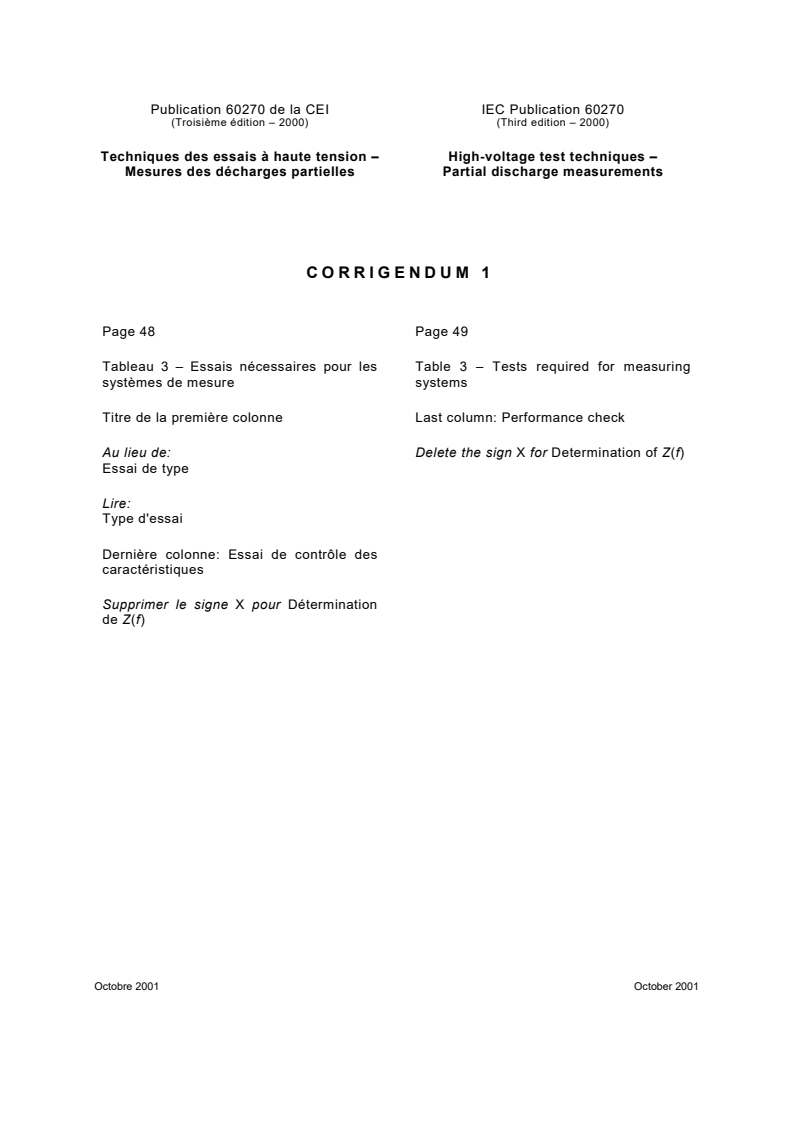
Publication 60270 de la CEI IEC Publication 60270
(Troisième édition – 2000) (Third edition – 2000)
Techniques des essais à haute tension – High-voltage test techniques –
Mesures des décharges partielles Partial discharge measurements
CORRIGENDUM 1
Page 48 Page 49
Tableau 3 – Essais nécessaires pour les Table 3 – Tests required for measuring
systèmes
...
This May Also Interest You
IEC 60270:2025 is applicable to the charge-based measurement of partial discharges which occur in electrical apparatus, components or systems when tested with alternating voltages (AC) up to 500 Hz or with direct voltage (DC).
This document:
– defines the terms used;
– defines the quantities to be measured;
– describes the measurement frequencies as well as the test and measuring circuits which may be used;
– defines analogue and digital measuring methods required for common applications;
– specifies methods for calibration and requirements of instruments used for calibration;
– gives guidance on test procedures;
– gives some assistance concerning the discrimination of partial discharges from external interference.
The provisions of this document are used in the drafting of specifications relating to partial discharge measurements for specific power apparatus. It deals with electrical measurements of impulsive (short-duration) partial discharges, but reference is also made to non-electrical methods primarily used for partial discharge location (see Annex F). Diagnosis of the behaviour of specific power apparatus can be aided by digital processing of partial discharge data (see Annex E) and also by non-electrical methods that are primarily used for partial discharge location (see Annex F).
This document is primarily concerned with electrical measurement of partial discharge in terms of apparent charge for specific power apparatus made during tests with alternating voltage, but specific problems which arise when tests are made with direct voltage are considered in Clause 11.
The terminology, definitions, basic test circuits and procedures often also apply to tests at other frequencies, but special test procedures and measuring system characteristics which are not considered in this document may be required. For measurements at higher frequency ranges, see IEC TS 62478.
Annex A provides normative requirements for performance tests on calibrators.
This fourth edition cancels and replaces the third edition published in 2000, and Amendment 1:2015. This edition constitutes a technical revision.
This edition includes the following significant technical changes with respect to the previous edition:
a) Title modified.
b) Use with alternating voltages up to 500 Hz or with direct voltage.
c) Clear focus on charge-based partial discharge measurements.
d) Streamlined performance checks for partial discharge measurement system components.
e) Improved normative Annex A for performance tests on calibrators.
f) Revised and new informative Annexes.
In a future revision, this document will seek horizontal publication status in accordance with IEC Guide 108.
- Standard145 pagesEnglish and French languagesale 15% off
IEC 60060-2:2025 is applicable to complete measuring systems and to their components, used for the measurement of high voltages during laboratory and factory tests with direct voltage, alternating voltage and lightning and switching impulse voltages and combined and composite voltages as specified in IEC 60060-1. For measurements during on-site tests, see IEC 60060-3. The limits on uncertainties of measurements stated in this document apply to test levels stated in IEC 60071-1. The principles of this document apply also to higher levels but the uncertainty can be greater.
This document:
• defines the terms used;
• describes methods to estimate the uncertainties of high-voltage measurements;
• states the requirements that apply to measuring systems;
• describes the methods for approving a measuring system and checking its components;
• describes the procedures by which the user demonstrates that a measuring system meets the requirements of this document, including the limits set for the uncertainty of measurement.
This fourth edition cancels and replaces the third edition published in 2010. This edition constitutes a technical revision.
This edition includes the following significant technical changes with respect to the previous edition:
a) The general layout and text has been updated and improved to make the standard easier to use.
b) This document has been revised to align it with the fourth edition of IEC 60060-1.
c) The treatment of measurement uncertainty estimation has been expanded.
d) This document is now applicable to measuring systems used in testing at all standard insulation levels specified in IEC 60071-1.
e) The measurement uncertainty requirement for the front time of the standard lighting impulse voltage has been changed from 10 % to 15 %, for testing at all standard insulation levels specified in IEC 60071-1.
f) The parameter "time-to-peak" of the switching impulse defined in the third edition of IEC 60060-1:2010 has been replaced by "front time" in the fourth edition of IEC 60060-1. Necessary changes have been made in this document to accommodate this change in IEC 60060-1.
g) Clause 10, Measurement of combined voltages and Clause 11, Measurement of composite voltages have been added.
h) Clause B.1 has been significantly revised to align more closely with the provisions of Clause 5, including using the same nomenclature.
- Standard174 pagesEnglish and French languagesale 15% off
IEC 61083-1:2021 is applicable to digital recorders, including digital oscilloscopes, used for measurements during tests with high impulse voltages and high impulse currents. It specifies the measuring characteristics and calibrations required to meet the measuring uncertainties and procedures specified in IEC 60060-2 and IEC 62475.
This document
• defines the terms specifically related to digital recorders;
• specifies the necessary requirements for such instruments to ensure their compliance with the requirements for high-voltage and high-current impulse tests;
• establishes the tests and procedures necessary to demonstrate their compliance;
• covers digital recorders that permit access to raw data from permanent or temporary storage;
• covers peak meters used for measuring the extreme value of lightning impulses, the peak value of switching or current impulses.
It has the status of a horizontal standard in accordance with IEC Guide 108.
This horizontal standard is primarily intended for use by technical committees in the preparation of standards in accordance with the principles laid down in IEC Guide 108. One of the responsibilities of a technical committee is, wherever applicable, to make use of horizontal standards in the preparation of its publications. The contents of this horizontal standard will not apply unless specifically referred to or included in the relevant publications.
This third edition cancels and replaces the second edition published in 2001. This edition constitutes a technical revision.
This edition includes the following significant technical changes with respect to the previous edition:
a) Requirements for static integral non-linearity and static differential non-linearity have been removed.
b) Requirement for impulse scale factor non-linearity has been added.
c) Uncertainty requirements for impulse calibrators have been revised.
d) Requirements for peak voltmeter have been revised.
- Standard50 pagesEnglish and French languagesale 15% off
IEC 61083-3:2020 is applicable to digital recording instruments used for measurements during tests with high alternating and direct voltages and currents. It specifies the measuring characteristics and calibrations required to meet the measuring uncertainties and procedures specified in the relevant IEC standards (e.g. IEC 60060-1, IEC 60060-2, IEC 60060-3, IEC 62475, IEC 61180).
This document is applicable to those digital recording instruments that will be designed and type tested according to this document.
This document
• defines performance requirements for digital recording instruments used during tests with alternating voltages and currents (AC) or direct voltages and currents (DC);
• specifies the necessary requirements for such instruments to ensure their suitability for use under the relevant standards;
• establishes the tests and procedures necessary to demonstrate their compliance;
• defines the terms related to digital recording instruments with recording function and access to raw data.
Examples of relevant alternating and direct voltages and currents to be measured are listed in Annex D.
This International Standard has the status of a horizontal standard in accordance with IEC Guide 108.
- Standard66 pagesEnglish and French languagesale 15% off
- Standard25 pagesEnglish and French languagesale 15% off
IEC 60060-2:2010 is applicable to complete measuring systems, and to their components, used for the measurement of high voltages during laboratory and factory tests with direct voltage, alternating voltage and lightning and switching impulse voltages as specified in IEC 60060-1. For measurements during on-site tests see IEC 60060-3. The limits on uncertainties of measurements stated in this standard apply to test levels stated in IEC 60071-1:2006. The principles of this standard apply also to higher levels but the uncertainty may be greater. This standard also defines the terms used, methods to estimate the uncertainties of high-voltage measurements, states the requirements which the measuring systems shall meet, describes the methods for approving a measuring system and checking its components and describes the procedures by which the user shall show that a measuring system meets the requirements of this standard, including the limits set for the uncertainty of measurement. This third edition cancels and replaces the second edition, published in 1994, and constitutes a technical revision. The significant technical changes with respect to the previous edition are as follows:
- The general layout and text was updated and improved to make the standard easier to use.
- The standard was revised to align it with IEC 60060-1.
- The treatment of measurement uncertainty estimation has been expanded.
- Standard149 pagesEnglish and French languagesale 15% off
Applicable to the following on-site test voltages and in service stresses, which are in relation to IEC 60060-1: direct voltage;alternating voltage; lightning impulse voltage of aperiodic or oscillating shape: switching impulse voltage of aperiodic or oscillating shape.
- Standard33 pagesEnglish languagesale 15% off
Applicable to the following on-site test voltages and in service stresses, which are in relation to IEC 60060-1: direct voltage;alternating voltage; lightning impulse voltage of aperiodic or oscillating shape: switching impulse voltage of aperiodic or oscillating shape.
- Standard33 pagesEnglish languagesale 15% off
Applies to digital recorders and digital oscilloscopes used for measurements during tests with high impulse voltages and high impulse currents. Specifies the measuring characteristics and calibrations required to meet the measuring accuracies and procedures given in IEC 60-1.
- Standard69 pagesEnglish and French languagesale 15% off
Applies to the measurement of localized electrical discharges in insulating media, restricted to only a part of the dielectric under test and only partially bridging the insulation between conductors. The contents of the corrigendum of October 2001 have been included in this copy.
- Standard50 pagesEnglish languagesale 15% off
- Standard50 pagesFrench languagesale 15% off
- Standard99 pagesEnglish and French languagesale 15% off
- Standard226 pagesEnglish and French languagesale 15% off


Questions, Comments and Discussion
Ask us and Technical Secretary will try to provide an answer. You can facilitate discussion about the standard in here.
Loading comments...