

IEC 61083-3:2020
(Main)Instruments and software used for measurement in high-voltage and high-current tests - Part 3: Requirements for hardware for tests with alternating and direct voltages and currents
General Information
- Abstract
IEC 61083-3:2020 is applicable to digital recording instruments used for measurements during tests with high alternating and direct voltages and currents. It specifies the measuring characteristics and calibrations required to meet the measuring uncertainties and procedures specified in the relevant IEC standards (e.g. IEC 60060-1, IEC 60060-2, IEC 60060-3, IEC 62475, IEC 61180).
This document is applicable to those digital recording instruments that will be designed and type tested according to this document.
This document
• defines performance requirements for digital recording instruments used during tests with alternating voltages and currents (AC) or direct voltages and currents (DC);
• specifies the necessary requirements for such instruments to ensure their suitability for use under the relevant standards;
• establishes the tests and procedures necessary to demonstrate their compliance;
• defines the terms related to digital recording instruments with recording function and access to raw data.
Examples of relevant alternating and direct voltages and currents to be measured are listed in Annex D.
This International Standard has the status of a horizontal standard in accordance with IEC Guide 108.
- Status
- Published
- Publication Date
- 24-Nov-2020
- Technical Committee
- TC 42 - High-voltage and high-current test techniques
- Drafting Committee
- MT 21 - TC 42/MT 21
- Current Stage
- PPUB - Publication issued
- Start Date
- 25-Nov-2020
- Completion Date
- 11-Dec-2020
Buy Documents
IEC 61083-3:2020 - Instruments and software used for measurement in high-voltage and high-current tests - Part 3: Requirements for hardware for tests with alternating and direct voltages and currents Released:11/25/2020
Overview
IEC 61083-3:2020 is an internationally recognized standard issued by the International Electrotechnical Commission (IEC) that sets forth requirements for hardware used in measurement instruments during high-voltage and high-current tests. Specifically, it applies to digital recording instruments designed for measuring alternating (AC) and direct currents (DC) and voltages in electrical testing environments. This standard is essential for ensuring accurate, reliable, and consistent measurements during electrical tests involving high voltages and currents, which are critical for electrical equipment safety, performance validation, and compliance.
The standard establishes performance criteria, calibration methods, testing procedures, and uncertainty evaluations for digital instruments used in these challenging test conditions. By following IEC 61083-3, manufacturers and testing laboratories can ensure that their measurement instruments meet stringent quality and accuracy levels compatible with other related IEC standards such as IEC 60060 series and IEC 62475.
Key Topics
Scope and Applicability: Focuses on digital recording instruments used during tests with high AC and DC voltages and currents. Covers design, type testing, and performance verification of hardware suited for these tests.
Performance Requirements: Defines precise specifications including scale factor accuracy, sampling rate, resolution, rise time (bandwidth), amplitude linearity, noise levels, and interference immunity crucial for reliable measurements.
Calibration and Test Methods:
- Qualification of instruments using approved reference generators.
- Comprehensive type, performance, and routine tests to confirm conformance.
- Alternative and special test methods such as rise time and internal noise measurement.
Dynamic Performance and Uncertainty: Addresses key parameters affecting measurement precision and outlines methods to evaluate and minimize uncertainty contributions in complete measuring systems.
Electromagnetic Interference (EMI) Considerations: Provides guidance and recommendations to protect instruments in high-voltage/high-current lab environments from EMI, including shielding, noise reduction, and optical transmission techniques.
Terminology and Definitions: Clarifies terms related to digital recording instruments, rated values, dynamic response, and calibration procedures to provide a common understanding essential for standard compliance.
Annexes: Include examples of relevant voltage/current waveforms, recommended instrument specifications for AC/DC tests, and practical considerations for harmonics, rise times, and combined voltages.
Applications
IEC 61083-3:2020 is vital in multiple sectors and use cases such as:
High-Voltage Testing Laboratories: Ensures measurement instruments used to test transformers, circuit breakers, insulators, and cables meet international quality standards.
Electrical Utilities and Power Generation: Supports reliable testing in power plants and substations by standardizing measurement hardware requirements for system equipment validation.
Manufacturing and Quality Control: Assists manufacturers of high-voltage equipment in designing and qualifying their test instruments for accurate product performance verification.
Research and Development: Facilitates development of advanced digital instrumentation suited for rigorous high-voltage and high-current test environments with stringent measurement demands.
Compliance and Certification Bodies: Acts as a benchmark standard to assess and certify compliance of digital recording instruments used in electrical testing according to international norms.
By adhering to IEC 61083-3, users ensure measurement data integrity, improve safety margins, and align testing procedures with global best practices.
Related Standards
IEC 61083-3 is part of a wider family of standards related to electrical testing instrumentation and measurement technology. Key related standards include:
IEC 60060 Series (High-voltage test techniques):
- IEC 60060-1: General definitions and test requirements.
- IEC 60060-2: Measuring systems for high-voltage tests.
- IEC 60060-3: Instructions for measuring systems.
IEC 62475: Measuring equipment for partial discharge measurements.
IEC 61180: Test procedures for measuring DC resistance and other parameters of electrical apparatuses.
These complementary standards ensure harmonized methodologies for electrical testing equipment and measurement accuracy across various testing scenarios. Together, they provide comprehensive guidance for instrumentation design, verification, and application in high-voltage and high-current test fields.
Keywords: IEC 61083-3:2020, high-voltage test instruments, digital recording instruments, alternating current measurement, direct current measurement, high-current tests, electrical test standards, instrument calibration, measurement uncertainty, electromagnetic interference, electrical testing compliance, IEC standards for measurement.
Buy Documents
IEC 61083-3:2020 - Instruments and software used for measurement in high-voltage and high-current tests - Part 3: Requirements for hardware for tests with alternating and direct voltages and currents Released:11/25/2020
Get Certified
Connect with accredited certification bodies for this standard

BSMI (Bureau of Standards, Metrology and Inspection)
Taiwan's standards and inspection authority.
IMP NDT d.o.o.
Non-destructive testing services. Radiography, ultrasonic, magnetic particle, penetrant, visual inspection.
Inštitut za kovinske materiale in tehnologije
Institute of Metals and Technology. Materials testing, metallurgical analysis, NDT.
Sponsored listings
Frequently Asked Questions
IEC 61083-3:2020 is a standard published by the International Electrotechnical Commission (IEC). Its full title is "Instruments and software used for measurement in high-voltage and high-current tests - Part 3: Requirements for hardware for tests with alternating and direct voltages and currents". This standard covers: IEC 61083-3:2020 is applicable to digital recording instruments used for measurements during tests with high alternating and direct voltages and currents. It specifies the measuring characteristics and calibrations required to meet the measuring uncertainties and procedures specified in the relevant IEC standards (e.g. IEC 60060-1, IEC 60060-2, IEC 60060-3, IEC 62475, IEC 61180). This document is applicable to those digital recording instruments that will be designed and type tested according to this document. This document • defines performance requirements for digital recording instruments used during tests with alternating voltages and currents (AC) or direct voltages and currents (DC); • specifies the necessary requirements for such instruments to ensure their suitability for use under the relevant standards; • establishes the tests and procedures necessary to demonstrate their compliance; • defines the terms related to digital recording instruments with recording function and access to raw data. Examples of relevant alternating and direct voltages and currents to be measured are listed in Annex D. This International Standard has the status of a horizontal standard in accordance with IEC Guide 108.
IEC 61083-3:2020 is applicable to digital recording instruments used for measurements during tests with high alternating and direct voltages and currents. It specifies the measuring characteristics and calibrations required to meet the measuring uncertainties and procedures specified in the relevant IEC standards (e.g. IEC 60060-1, IEC 60060-2, IEC 60060-3, IEC 62475, IEC 61180). This document is applicable to those digital recording instruments that will be designed and type tested according to this document. This document • defines performance requirements for digital recording instruments used during tests with alternating voltages and currents (AC) or direct voltages and currents (DC); • specifies the necessary requirements for such instruments to ensure their suitability for use under the relevant standards; • establishes the tests and procedures necessary to demonstrate their compliance; • defines the terms related to digital recording instruments with recording function and access to raw data. Examples of relevant alternating and direct voltages and currents to be measured are listed in Annex D. This International Standard has the status of a horizontal standard in accordance with IEC Guide 108.
IEC 61083-3:2020 is classified under the following ICS (International Classification for Standards) categories: 17.220.20 - Measurement of electrical and magnetic quantities; 19.080 - Electrical and electronic testing. The ICS classification helps identify the subject area and facilitates finding related standards.
IEC 61083-3:2020 is available in PDF format for immediate download after purchase. The document can be added to your cart and obtained through the secure checkout process. Digital delivery ensures instant access to the complete standard document.
Standards Content (Sample)
IEC 61083-3 ®
Edition 1.0 2020-11
INTERNATIONAL
STANDARD
NORME
INTERNATIONALE
colour
inside
Instruments and software used for measurement in high-voltage and
high‑current tests –
Part 3: Requirements for hardware for tests with alternating and direct voltages
and currents
Appareils et logiciels utilisés pour les mesurages pendant les essais à haute
tension et à courant élevé –
Partie 3: Exigences relatives au matériel pendant les essais avec des tensions et
des courants alternatifs et continus
All rights reserved. Unless otherwise specified, no part of this publication may be reproduced or utilized in any form
or by any means, electronic or mechanical, including photocopying and microfilm, without permission in writing from
either IEC or IEC's member National Committee in the country of the requester. If you have any questions about IEC
copyright or have an enquiry about obtaining additional rights to this publication, please contact the address below or
your local IEC member National Committee for further information.
Droits de reproduction réservés. Sauf indication contraire, aucune partie de cette publication ne peut être reproduite
ni utilisée sous quelque forme que ce soit et par aucun procédé, électronique ou mécanique, y compris la photocopie
et les microfilms, sans l'accord écrit de l'IEC ou du Comité national de l'IEC du pays du demandeur. Si vous avez des
questions sur le copyright de l'IEC ou si vous désirez obtenir des droits supplémentaires sur cette publication, utilisez
les coordonnées ci-après ou contactez le Comité national de l'IEC de votre pays de résidence.
IEC Central Office Tel.: +41 22 919 02 11
3, rue de Varembé info@iec.ch
CH-1211 Geneva 20 www.iec.ch
Switzerland
About the IEC
The International Electrotechnical Commission (IEC) is the leading global organization that prepares and publishes
International Standards for all electrical, electronic and related technologies.
About IEC publications
The technical content of IEC publications is kept under constant review by the IEC. Please make sure that you have the
latest edition, a corrigendum or an amendment might have been published.
IEC publications search - webstore.iec.ch/advsearchform Electropedia - www.electropedia.org
The advanced search enables to find IEC publications by a The world's leading online dictionary on electrotechnology,
variety of criteria (reference number, text, technical containing more than 22 000 terminological entries in English
committee,…). It also gives information on projects, replaced and French, with equivalent terms in 16 additional languages.
and withdrawn publications. Also known as the International Electrotechnical Vocabulary
(IEV) online.
IEC Just Published - webstore.iec.ch/justpublished
Stay up to date on all new IEC publications. Just Published IEC Glossary - std.iec.ch/glossary
details all new publications released. Available online and 67 000 electrotechnical terminology entries in English and
once a month by email. French extracted from the Terms and Definitions clause of
IEC publications issued since 2002. Some entries have been
IEC Customer Service Centre - webstore.iec.ch/csc collected from earlier publications of IEC TC 37, 77, 86 and
If you wish to give us your feedback on this publication or CISPR.
need further assistance, please contact the Customer Service
Centre: sales@iec.ch.
A propos de l'IEC
La Commission Electrotechnique Internationale (IEC) est la première organisation mondiale qui élabore et publie des
Normes internationales pour tout ce qui a trait à l'électricité, à l'électronique et aux technologies apparentées.
A propos des publications IEC
Le contenu technique des publications IEC est constamment revu. Veuillez vous assurer que vous possédez l’édition la
plus récente, un corrigendum ou amendement peut avoir été publié.
Recherche de publications IEC - Electropedia - www.electropedia.org
webstore.iec.ch/advsearchform Le premier dictionnaire d'électrotechnologie en ligne au
La recherche avancée permet de trouver des publications IEC monde, avec plus de 22 000 articles terminologiques en
en utilisant différents critères (numéro de référence, texte, anglais et en français, ainsi que les termes équivalents dans
comité d’études,…). Elle donne aussi des informations sur les 16 langues additionnelles. Egalement appelé Vocabulaire
projets et les publications remplacées ou retirées. Electrotechnique International (IEV) en ligne.
IEC Just Published - webstore.iec.ch/justpublished Glossaire IEC - std.iec.ch/glossary
Restez informé sur les nouvelles publications IEC. Just 67 000 entrées terminologiques électrotechniques, en anglais
Published détaille les nouvelles publications parues. et en français, extraites des articles Termes et Définitions des
Disponible en ligne et une fois par mois par email. publications IEC parues depuis 2002. Plus certaines entrées
antérieures extraites des publications des CE 37, 77, 86 et
Service Clients - webstore.iec.ch/csc CISPR de l'IEC.
Si vous désirez nous donner des commentaires sur cette
publication ou si vous avez des questions contactez-nous:
sales@iec.ch.
IEC 61083-3 ®
Edition 1.0 2020-11
INTERNATIONAL
STANDARD
NORME
INTERNATIONALE
colour
inside
Instruments and software used for measurement in high-voltage and
high‑current tests –
Part 3: Requirements for hardware for tests with alternating and direct voltages
and currents
Appareils et logiciels utilisés pour les mesurages pendant les essais à haute
tension et à courant élevé –
Partie 3: Exigences relatives au matériel pendant les essais avec des tensions
et des courants alternatifs et continus
INTERNATIONAL
ELECTROTECHNICAL
COMMISSION
COMMISSION
ELECTROTECHNIQUE
INTERNATIONALE
ICS 17.220.20; 19.080 ISBN 978-2-8322-9037-8
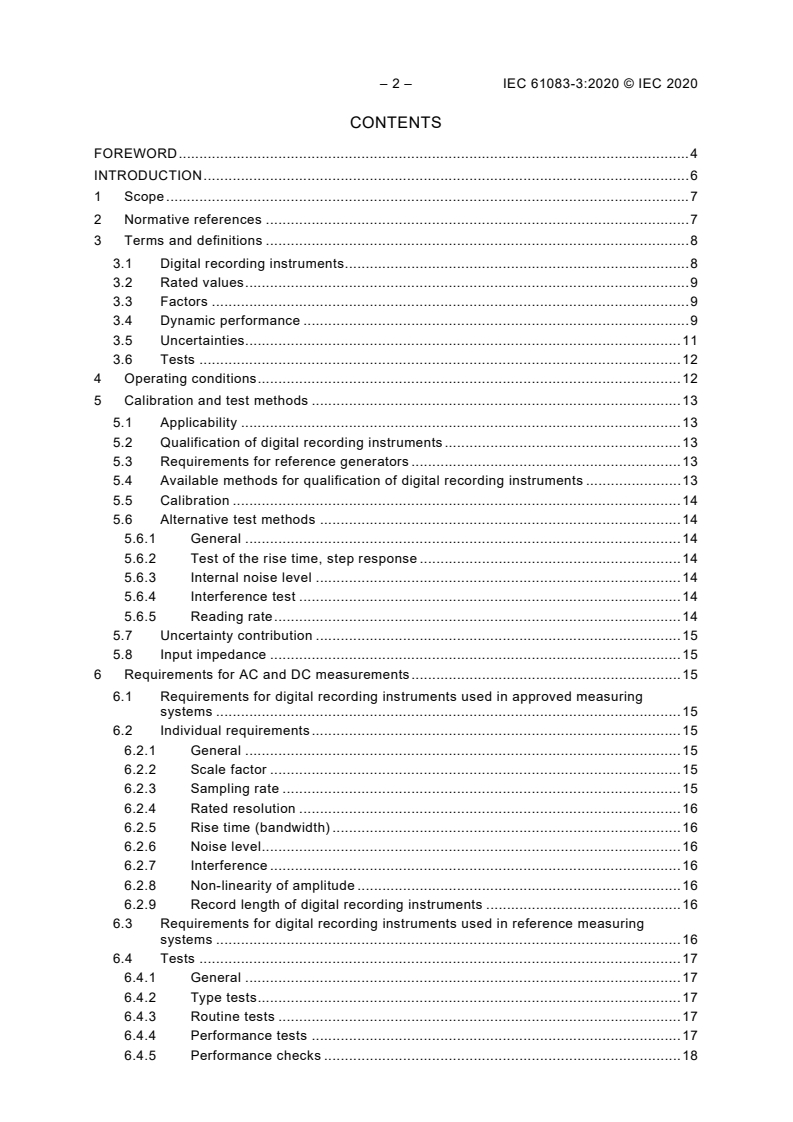
– 2 – IEC 61083-3:2020 © IEC 2020
CONTENTS
FOREWORD . 4
INTRODUCTION . 6
1 Scope . 7
2 Normative references . 7
3 Terms and definitions . 8
3.1 Digital recording instruments . 8
3.2 Rated values . 9
3.3 Factors . 9
3.4 Dynamic performance . 9
3.5 Uncertainties. 11
3.6 Tests . 12
4 Operating conditions . 12
5 Calibration and test methods . 13
5.1 Applicability . 13
5.2 Qualification of digital recording instruments . 13
5.3 Requirements for reference generators . 13
5.4 Available methods for qualification of digital recording instruments . 13
5.5 Calibration . 14
5.6 Alternative test methods . 14
5.6.1 General . 14
5.6.2 Test of the rise time, step response . 14
5.6.3 Internal noise level . 14
5.6.4 Interference test . 14
5.6.5 Reading rate . 14
5.7 Uncertainty contribution . 15
5.8 Input impedance . 15
6 Requirements for AC and DC measurements . 15
6.1 Requirements for digital recording instruments used in approved measuring
systems . 15
6.2 Individual requirements . 15
6.2.1 General . 15
6.2.2 Scale factor . 15
6.2.3 Sampling rate . 15
6.2.4 Rated resolution . 16
6.2.5 Rise time (bandwidth) . 16
6.2.6 Noise level . 16
6.2.7 Interference . 16
6.2.8 Non-linearity of amplitude . 16
6.2.9 Record length of digital recording instruments . 16
6.3 Requirements for digital recording instruments used in reference measuring
systems . 16
6.4 Tests . 17
6.4.1 General . 17
6.4.2 Type tests . 17
6.4.3 Routine tests . 17
6.4.4 Performance tests . 17
6.4.5 Performance checks . 18
7 Uncertainty contributions for complete measuring systems . 18
8 Record of performance . 18
(normative) Electromagnetic interference in high-voltage and high-current
laboratories and test fields . 19
A.1 General . 19
A.2 Precautions . 19
A.2.1 Electromagnetic shielding . 19
A.2.2 Reduction of conducted interference from the supply line . 19
A.2.3 Reduction of interference on the signal line . 19
A.2.4 Signal transmission by optical means . 20
A.3 Tests with transient induced electromagnetic fields . 20
A.4 Tests with current injection . 20
(informative) Electromagnetic interference in high-voltage and high-current
laboratories and test fields – Recommendations for digital recording instruments . 22
(informative) Procedure to determine the non-linearity of amplitude of
sampling instruments . 24
(informative) Examples and considerations . 26
D.1 Suggested requirements for digital recording instruments for AC and DC
voltage measurements . 26
D.1.1 Test cases . 26
D.1.2 Background . 27
D.1.3 Recommendations for digital recording instruments for AC testing (up to
60 Hz without consideration of harmonics) . 27
D.1.4 Recommendations for digital recording instruments for DC testing
(without consideration of ripple) . 27
D.1.5 Recommendations for digital recording instruments for AC and DC
testing under consideration of harmonics or superimposed or combined
voltages . 27
D.2 Examples of relevant voltage and current characteristics to be measured . 27
D.3 Determination of the necessary rise time of instruments . 29
D.4 Considerations regarding the large variety of AC and DC measurements . 30
Bibliography . 31
Figure 1 – Integral non-linearity s(k) at code k . 10
Figure 2 – Non-linearity d(k) and code bin width w(k) under DC conditions . 11
Figure A.1 – Application of electric and magnetic fields. 20
Figure A.2 – Current injection into the shield of the cable . 21
Figure C.1 – Digitalization of a sinusoidal waveform with a 4 bit A/D converter . 24
Figure C.2 – Ideal code distribution of a sinusoidal waveform digitized by a 4 bit A/D
converter . 24
Figure C.3 – Example of a non-ideal measurement of ideal sinusoidal waveform . 25
Figure C.4 – Example of the determination of the differential non-linearity . 25
Table 1 – Operating conditions . 13
Table 2 – Tests required for digital recording instruments . 17
Table B.1 – Increased immunity levels suggested for digital recording instruments
used in high-voltage environments . 23
Table D.1 – Relevant voltages and currents . 28
– 4 – IEC 61083-3:2020 © IEC 2020
INTERNATIONAL ELECTROTECHNICAL COMMISSION
____________
INSTRUMENTS AND SOFTWARE USED FOR MEASUREMENT
IN HIGH-VOLTAGE AND HIGH-CURRENT TESTS –
Part 3: Requirements for hardware for tests with alternating
and direct voltages and currents
FOREWORD
1) The International Electrotechnical Commission (IEC) is a worldwide organization for standardization comprising
all national electrotechnical committees (IEC National Committees). The object of IEC is to promote international
co-operation on all questions concerning standardization in the electrical and electronic fields. To this end and
in addition to other activities, IEC publishes International Standards, Technical Specifications, Technical Reports,
Publicly Available Specifications (PAS) and Guides (hereafter referred to as “IEC Publication(s)”). Their
preparation is entrusted to technical committees; any IEC National Committee interested in the subject dealt with
may participate in this preparatory work. International, governmental and non-governmental organizations liaising
with the IEC also participate in this preparation. IEC collaborates closely with the International Organization for
Standardization (ISO) in accordance with conditions determined by agreement between the two organizations.
2) The formal decisions or agreements of IEC on technical matters express, as nearly as possible, an international
consensus of opinion on the relevant subjects since each technical committee has representation from all
interested IEC National Committees.
3) IEC Publications have the form of recommendations for international use and are accepted by IEC National
Committees in that sense. While all reasonable efforts are made to ensure that the technical content of IEC
Publications is accurate, IEC cannot be held responsible for the way in which they are used or for any
misinterpretation by any end user.
4) In order to promote international uniformity, IEC National Committees undertake to apply IEC Publications
transparently to the maximum extent possible in their national and regional publications. Any divergence between
any IEC Publication and the corresponding national or regional publication shall be clearly indicated in the latter.
5) IEC itself does not provide any attestation of conformity. Independent certification bodies provide conformity
assessment services and, in some areas, access to IEC marks of conformity. IEC is not responsible for any
services carried out by independent certification bodies.
6) All users should ensure that they have the latest edition of this publication.
7) No liability shall attach to IEC or its directors, employees, servants or agents including individual experts and
members of its technical committees and IEC National Committees for any personal injury, property damage or
other damage of any nature whatsoever, whether direct or indirect, or for costs (including legal fees) and
expenses arising out of the publication, use of, or reliance upon, this IEC Publication or any other IEC
Publications.
8) Attention is drawn to the Normative references cited in this publication. Use of the referenced publications is
indispensable for the correct application of this publication.
9) Attention is drawn to the possibility that some of the elements of this IEC Publication may be the subject of patent
rights. IEC shall not be held responsible for identifying any or all such patent rights.
International Standard IEC 61083-3 has been prepared by IEC technical committee 42: High-
voltage and high-current test techniques.
The text of this International Standard is based on the following documents:
FDIS Report on voting
42/380/FDIS 42/387/RVD
Full information on the voting for the approval of this International Standard can be found in the
report on voting indicated in the above table.
This document has been drafted in accordance with the ISO/IEC Directives, Part 2.
A list of all parts in the IEC 61083 series, published under the general title Instruments and
software used for measurement in high-voltage and high-current tests, can be found on the IEC
website.
Future standards in this series will carry the new general title as cited above. Titles of existing
standards in this series will be updated at the time of the next edition.
The committee has decided that the contents of this document will remain unchanged until the
stability date indicated on the IEC website under "http://webstore.iec.ch" in the data related to
the specific document. At this date, the document will be
• reconfirmed,
• withdrawn,
• replaced by a revised edition, or
• amended.
IMPORTANT – The 'colour inside' logo on the cover page of this publication indicates
that it contains colours which are considered to be useful for the correct understanding
of its contents. Users should therefore print this document using a colour printer.
– 6 – IEC 61083-3:2020 © IEC 2020
INTRODUCTION
The electric power industry requires standardized tools to provide confidence in testing results,
and to prove equivalence between tests performed in different laboratories and test fields.
This part of IEC 61083 specifies requirements for the performance of digital recording
instruments used for tests with alternating and direct voltages and currents.
The intention of this document is to provide recommendations on the digital recording
instruments to be used in tests with alternating and direct voltages and currents.
Digital recording instruments are considered as black boxes (including hardware, firmware, and
software). They are characterized for their intended application by physical calibration with the
waveforms needed for that application.
This document does not apply to simple analogue or digital meters that do not have recording
capability.
INSTRUMENTS AND SOFTWARE USED FOR MEASUREMENT
IN HIGH-VOLTAGE AND HIGH-CURRENT TESTS –
Part 3: Requirements for hardware for tests with alternating
and direct voltages and currents
1 Scope
This part of IEC 61083 is applicable to digital recording instruments used for measurements
during tests with high alternating and direct voltages and currents. It specifies the measuring
characteristics and calibrations required to meet the measuring uncertainties and procedures
specified in the relevant IEC standards (e.g. IEC 60060-1, IEC 60060-2, IEC 60060-3,
IEC 62475, IEC 61180).
This document is applicable to those digital recording instruments that will be designed and
type tested according to this document.
This document
• defines performance requirements for digital recording instruments used during tests with
alternating voltages and currents (AC) or direct voltages and currents (DC);
• specifies the necessary requirements for such instruments to ensure their suitability for use
under the relevant standards;
• establishes the tests and procedures necessary to demonstrate their compliance;
• defines the terms related to digital recording instruments with recording function and access
to raw data.
NOTE Examples of relevant alternating and direct voltages and currents to be measured are listed in Annex D.
This International Standard has the status of a horizontal standard in accordance with
IEC Guide 108.
2 Normative references
The following documents are referred to in the text in such a way that some or all of their content
constitutes requirements of this document. For dated references, only the edition cited applies.
For undated references, the latest edition of the referenced document (including any
amendments) applies.
IEC 60060-2, High-voltage test techniques – Part 2: Measuring systems
IEC 61180, High-voltage test techniques for low-voltage equipment – Definitions, test and
procedure requirements, test equipment
IEC 62475, High-current test techniques – Definitions and requirements for test currents and
measuring systems
ISO/IEC Guide 98-3:2008, Uncertainty of measurement – Part 3: Guide to the expression of
uncertainty in measurement (GUM:1995)
– 8 – IEC 61083-3:2020 © IEC 2020
3 Terms and definitions
For the purposes of this document, the following terms and definitions apply.
ISO and IEC maintain terminological databases for use in standardization at the following
addresses:
• IEC Electropedia: available at http://www.electropedia.org/
• ISO Online browsing platform: available at http://www.iso.org/obp
3.1 Digital recording instruments
3.1.1
approved instrument
measuring device that is shown to comply with the requirements set out in IEC 61083-3
3.1.2
digital recording instrument
device with digital output capability of the recorded input
Note 1 to entry: This definition includes digital recorders, digital oscilloscopes, digital peak voltmeters and other
digital recording instruments if applicable.
Note 2 to entry: The waveform of the digital record is usually displayed on a screen, plotted or printed. This process
may change the appearance of the waveform due to the processing involved.
3.1.3
assigned measurement range
range of input voltage for which the digital recording instrument can be used within the
uncertainty limits given in IEC 61083-3
3.1.4
output
displayed (in any way) value of a digital recording instrument at a specific instant or the
numerical value of a digital recording instrument recorded at a specific instant
3.1.5
full-scale deflection
minimum input value, which produces the nominal maximum output of the digital recording
instrument in the specified range
3.1.6
offset
output of a digital recording instrument for zero input
3.1.7
raw data
original record of sampled and quantized information obtained when a digital recording
instrument converts an analogue signal into a digital form, with the correction of the output for
offset and multiplying the record by a constant factor being permitted
3.1.8
test duration
range of a time interval in which the measurement is done
3.1.9
reading rate
rate with which the instrument displays or stores the readings of the measured AC or DC voltage
or current
Note 1 to entry: In sampling instruments, readings are calculated e.g. by averaging (DC) or by calculating the RMS
value (AC) of several samples.
3.2 Rated values
3.2.1
rated resolution
r
reciprocal of two to the power of the rated number of bits N of the A/D converter, defined as
–N
r = 2
3.2.2
sampling rate
number of samples taken per unit of time
3.2.3
record length
duration of the record expressed either in a time unit or as the total number of samples
3.2.4
warm-up time
time interval from when an instrument is first switched on to when an instrument meets
operational requirements
3.3 Factors
3.3.1
scale factor
factor by which the output corrected for offset is multiplied in order to determine the measured
value of the input quantity
Note 1 to entry: Scale factor includes the ratio of any built-in or external attenuator and is determined by calibration.
3.3.2
static scale factor
scale factor for a direct voltage or a direct current input
3.3.3
non-linearity of amplitude
deviation of the actual output of a digital recording instrument from the nominal value, which is
determined by dividing the input voltage or input current by the scale factor
Note 1 to entry: The static non-linearity for a DC input voltage or current is different from the non-linearity under
dynamic conditions.
3.3.4
peak factor
numerical value calculated from the peak value divided by the RMS value of a measurement
3.4 Dynamic performance
3.4.1
integral non-linearity
s(k)
difference between corresponding points on the measured quantization characteristic and on
the ideal quantization characteristic that is based on the static scale factor
SEE: Figure 1.
– 10 – IEC 61083-3:2020 © IEC 2020
3.4.2
quantization characteristic
characteristic showing the relationship between the output of the digital recording instrument
and the direct voltage on the input which produces this output
SEE: Figure 1.
Note 1 to entry: The average slope of the quantization characteristic is equal to the reciprocal of the static scale
factor of the A/D converter.
Curve 1: Quantization characteristic of an ideal 5-bit digital recording instrument.
Curve 2: Quantization characteristic of a non-linear 5-bit digital recording instrument (the low resolution of 5 bits
has been chosen to clarify the illustration).
Figure 1 – Integral non-linearity s(k) at code k
3.4.3
code k
integer used to identify a digital level
3.4.4
code bin width
w(k)
range of input voltage or input current allocated to code k
SEE: Figure 2.
3.4.5
average code bin width
w
product of the full-scale deflection and the rated resolution
SEE: Figure 2.
Note 1 to entry: The average code bin width is approximately equal to the static scale factor.
3.4.6
differential non-linearity
d(k)
difference between a measured code bin width w(k) for code k and the average code bin width
w divided by the average code bin width w
0 0
w k − w
( )
d k=
( )
w
Curve 1: Quantization characteristic of an ideal 3-bit digital recording instrument.
Curve 2: Quantization characteristic of a 3 bit digital recording instrument showing large d(k) at codes k = 2, 3 and
4.
Line AB: A straight line joining the midpoints of the code bins of an ideal instrument (the low resolution of 3 bits has
been chosen to clarify the illustration).
Figure 2 – Non-linearity d(k) and code bin width w(k) under DC conditions
3.4.7
rise time
t
R
time interval within which the response to an applied step passes from 10 % to 90 % of its
steady-state amplitude
3.4.8
time base
unit of the digital recording instrument horizontal scale against which a time interval is measured
3.5 Uncertainties
3.5.1
uncertainty
parameter, associated with the result of a measurement, that characterizes the dispersion of
the values that could reasonably be attributed to the measurand
Note 1 to entry: Uncertainty is positive and given without sign.
Note 2 to entry: Uncertainty of measurement should not be confused with the tolerance of the test value.
3.5.2
standard uncertainty
uncertainty of the result of a measurement expressed as a standard deviation
[SOURCE: ISO/IEC Guide 98-3:2008, 2.3.1]
– 12 – IEC 61083-3:2020 © IEC 2020
3.6 Tests
3.6.1
calibration
set of operations that establishes, by reference to standards, the relationship which exists,
under specified conditions, between an indication and a result of a measurement
[SOURCE: IEC 60050-311:2001, 311-01-09, modified – The notes have been deleted.]
3.6.2
type test
conformity test made on one or more items representative of the production
Note 1 to entry: For a measuring system, this is understood as a test performed on a component or on a complete
measuring system of the same design to characterize it under operating conditions.
[Source: IEC 60050-151:2001, 151-16-16, modified – The note has been added.]
3.6.3
routine test
conformity test made on each individual item during or after manufacture
Note 1 to entry: This is understood as a test performed on each component or on each complete measuring system
to characterize it under operating conditions.
[Source: IEC 60050-151:2001, 151-16-17, modified – The note has been added.]
3.6.4
performance test
test performed on a complete measuring system to characterize it under operating conditions
3.6.5
performance check
simple procedure to ensure that the most recent performance test is still valid
3.6.6
record of performance
detailed record, established and maintained by the user, describing the measuring system and
containing evidence that the requirements given in IEC 61083-3 have been met, which includes
the results of the initial performance test and the schedule and results of each subsequent
performance test and performance check
4 Operating conditions
The limits of operating conditions given in Table 1 are those under which the digital recording
instrument shall operate and meet the uncertainty requirements specified for this instrument.
Table 1 – Operating conditions
Condition Range
Environment
Ambient temperature 5 °C to 40 °C
Ambient relative humidity (non-condensing) 10 % to 90 %
Mains power supply
Supply voltage Rated voltage ±10 % (RMS)
Rated voltage ±12 % (AC peak)
Supply frequency Rated frequency ±5 %
Any exceptions to the values given in Table 1 shall be explicitly and clearly stated in the record
of performance.
NOTE The general requirements for testing electromagnetic compatibility of electrical equipment for measurement,
control and laboratory use are described in IEC 61326-1.
5 Calibration and test methods
5.1 Applicability
A digital recording instrument may be qualified for all requirements in this document, or for a
suitable subset.
5.2 Qualification of digital recording instruments
Digital recording instruments for measurement of high voltage and/or high current are qualified
by comparative measurements against known reference systems traceable to national
standards, proving both requirements on accuracy and dynamic performance.
Qualifications are performed both as type tests performed once for each type of instrument and
routine tests performed once for each instrument, and calibrations are performed regularly on
each instrument.
For electromagnetic interference tests in high-voltage and high-current laboratories and test
fields, see recommendations in Annex B.
5.3 Requirements for reference generators
A reference waveform generator is only necessary for calibration when the digital recording
instrument contains a measurement device which is to be used as a reference instrument
(see 6.3). Otherwise any waveform generator can be used if it fulfils general requirements for
amplitude and frequency stability and noise.
NOTE An approved waveform generator can be considered qualified if the amplitude and the frequency are stable
within 0,1 % of output and the noise is < 1 % of output.
5.4 Available methods for qualification of digital recording instruments
Calibration (scale factor determination) (5.5),
Dynamic performance tests (5.6.2),
Internal noise (5.6.3),
Interference tests (5.6.4),
Displaying performance (5.6.5).
– 14 – IEC 61083-3:2020 © IEC 2020
5.5 Calibration
Calibration is the preferred method to establish the scale factor of approved digital recording
instruments. It is also the preferred method to check the time parameter determination from the
records of digital recording instruments. The actual values shall be entered in the record of
performance.
In the case of direct voltages and currents (DC) the polarity of the calibration signal shall be
that of the signal to be measured.
The output of a digital recording instrument corresponding to the applied calibration signal shall
be evaluated for a sufficient number of values in each measurement range. The scale factor is
the average of the values of the quotient of the input value and the output value. Different scale
factors may be determined for different voltage and current parameters or for different waveform
frequencies (e.g. peak values and derivations, RMS values).
The relevant frequency and time parameters of records shall be evaluated and compared with
traceable reference values.
The calibration shall be performed on each range of use for tests. A calibration curve or table
of scale factors may be developed to reduce the effects of non-linear converter characteristics.
5.6 Alternative test methods
5.6.1 General
Alternative test methods shall be applied if a calibration according to 5.5 is not possible. While
the calibration is the recommended method, such test methods may be used if the type of
instrument does not allow a calibration or they may be used in addition to the calibration.
5.6.2 Test of the rise time, step response
Apply a step with a rise time, which is less than 20 % of the specified rise time limit (see 6.2.5)
required for the application. Measure the rise time of the output as the time from 10 % to 90 %
of the settling level. The amplitude of the applied step shall be (95 ± 5) % of the full-scale
deflection.
This rise time shall be determined at least at 5 levels (preferably with a constant quotient
between levels, e.g. 1, 2, 5, 10 sequence), over the operating range.
NOTE A standard waveform generator up to a few kHz can be used for this task since usually the test frequencies
are below 400 Hz (see Clause D.1).
5.6.3 Internal noise level
A direct voltage within the range of the digital recording instrument shall be applied.
Enough records shall be taken at a specified sampling rate to acquire at least 10 samples. The
standard deviation of these samples is taken as the internal noise level.
5.6.4 Interference test
Annex A gives the requirements for interference tests.
5.6.5 Reading rate
The reading rate shall be sufficient to catch the voltage preceding the breakdown with required
accuracy during tests.
NOTE The reading rate is not the sampling rate.
5.7 Uncertainty contribution
The manufacturer shall provide uncertainty estimates for quantities relevant to the intended
application. The uncertainty contributions can then be used to evaluate the uncertainty
according to IEC 60060-2, IEC 62475, IEC 61180 and IEC 61083-4 .
5.8 Input impedance
Depending on the type of measuring system used, the input impedance of the instrument may
influence the scale factor and response of a measuring system. For this reason, the input
impedance of the digital recording instrument (resistance and capacitance) shall be stated.
6 Requirements for AC and DC measurements
6.1 Requirements for digital recording instruments used in approved measuring
systems
The expanded uncertainty contribution for a measurement by digital recording instruments
according to this document and used in an approved measuring system according to
IEC 60060-2, IEC 61180 and IEC 62475, shall not be more than (at a confidence level of not
less than 95 %)
• 1 % in the voltage (current) measurement,
• 1 % in the measurement of the time and frequency parameters.
These uncertainties shall be estimated according to ISO/IEC Guide 98-3:2008.
NOTE The estimated uncertainty of the digitizer is used as a component of uncertainty of the complete
measurement system according to IEC 60060-2, IEC 61180 or IEC 62475.
6.2 Individual requirements
6.2.1 General
In order to stay within the limits given in 6.1, the limits for individual contributions given in 6.2
should usually be met. In some cases, one or more of these limits may be exceeded provided
the permitted overall uncertainty specified in 6.1 is not exceeded.
6.2.2 Scale factor
The scale factor shall be constant within ±1 % over the time intervals or frequency range and
shall be determined with an uncertainty of not more than 1 %.
6.2.3 Sampling rate
The sampling rate after signal processing shall be high enough for capturing the peak value
with the required uncertainty (see Clause D.1).
The above requirement is met usually when the sampling rate is not less than N/T where N is
the number of samples per period of the highest harmonic and T is the cycle duration of the
highest harmonic to be measured with the specified uncertainty U . N is given by
SR
π/arcos(1-U ).
SR
NOTE For a measurement with an uncertainty U of 1 %, N will be 23 samples per period. This leads for AC
SR
(f = 50 Hz, without harmonics) to a minimal sampling rate = 1,2 kS/s and for AC (f = 60 Hz, without harmonics) to a
minimal sampling rate = 1,4 kS/s.
_____________
Under preparation. Stage at the time of publication IEC ACD 61083-4:2020.
– 16 – IEC 61083-3:2020 © IEC 2020
For a measurement of an AC signal with up to 7th harmonics and with an uncertainty U of 0,3 %, N will be 284
SR
samples per period. This leads for AC (f = 50 Hz) to a minimal sampling rate = 14,2 kS/s and for AC (f = 60 Hz) to a
minimal sampling rate = 17,0 kS/s.
6.2.4 Rated resolution
The rated resolution required depends on the parameters to be measured and the required
uncertainty (see Clause D.1).
6.2.5 Rise time (bandwidth)
The necessary rise time of a digital recording instrument depends on the uncertainty
requirements (6.1) and this relates directly to the analogue bandwidth of the digital recording
instrument. The rise time t shall not be more than 1/(18 · f ) where f is the highest
R MAX MAX
frequency contained in the signal to be measured with an uncertainty of not more than 1 %. For
more information refer to Clause D.3.
6.2.6 Noise level
The internal noise level shall be < 0,1 % of the low end of the specified measurement range for
normal use.
6.2.7 Interference
The digital recording instrument (or the digital recording instrument and a suitable screening
arrangement) is considered to be suitable for the electromagnetic environment if it fulfils the
following requirements for electromagnetic compatibility.
The maximum amplitude of any deflection from the base magnitude in the interference test
specified in Annex A shall be less than 1 % of the full-scale deflection in the ranges used for
tests.
NOTE An interference performance test is required by IEC 60060-2 for the complete impulse measuring system.
6.2.8 Non-linearity of amplitude
The dynamic integral non-linearity and the differential non-linearity, for both static and dynamic
tests, shall be so that the requirements of 6.1 are achieved. A procedure to determine the non-
linearity of amplitude is shown in Annex C.
NOTE The requirements of 6.1 might be achieved when the dynamic integral non-linearity is within ±0,5 % of full-
scale deflection and the differential non-linearity is within ±0,8 w .
6.2.9 Record length of digital recording instruments
The record length shall be sufficiently long to allow the required parameter to be evaluated or
a specific phenomenon to be observed (see Clause D.1).
6.3 Requirements for digital recording instruments used in reference measuring
systems
Reference digital recording instruments are used in reference measuring systems specified in
IEC 60060-2 for the calibration of approved measuring systems by comparison measurements.
The overall uncertainty of digital recording instruments used in a reference measuring system
according to IEC 60060-2 shall not be more than (at a confidence level of not less than 95 %):
• 0,3 % in the voltage (current
...