

IEC 61131-1:2003
(Main)Programmable controllers - Part 1: General information
General Information
- Abstract
IEC 61131-1:2003 applies to programmable controllers (PLC) and their associated peri-pherals such as programming and debugging tools (PADTs), human-machine interfaces (HMIs), etc., which have as their intended use the control and command of machines and industrial processes. It gives the definitions of terms used in this standard. It identifies the principal functional characteristics of programmable controller systems. This second edition cancels and replaces the first edition published in 1992 and constitutes a technical revision. This bilingual version (2012-05) corresponds to the monolingual English version, published in 2003-05.
- Status
- Published
- Publication Date
- 21-May-2003
- Technical Committee
- SC 65B - Measurement and control devices
- Drafting Committee
- WG 7 - TC 65/SC 65B/WG 7
- Current Stage
- PPUB - Publication issued
- Start Date
- 22-May-2003
- Completion Date
- 31-Jul-2003
Buy Documents
IEC 61131-1:2003 - Programmable controllers - Part 1: General information Released:5/22/2003
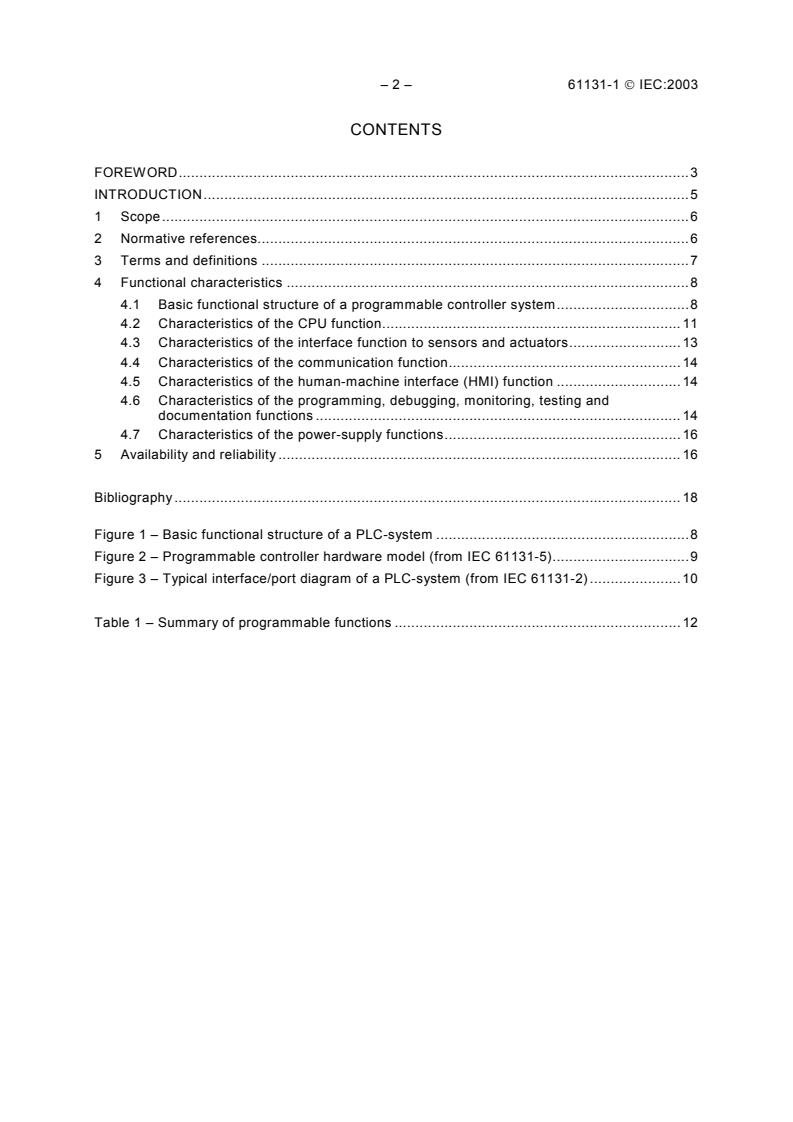
IEC 61131-1:2003 - Programmable controllers - Part 1: General information Released:5/22/2003
Overview
IEC 61131-1:2003 - Programmable controllers: Part 1, General information - is the International Electrotechnical Commission (IEC) standard that establishes the vocabulary, scope and principal functional characteristics of programmable logic controllers (PLCs) and their associated peripherals (for example, programming and debugging tools (PADTs), human‑machine interfaces (HMIs), remote I/O stations, field devices). This second edition (2003) supersedes the 1992 edition and provides the foundational definitions and architectural descriptions used across the IEC 61131 series.
Key topics and technical requirements
- Definitions and terminology: standardized terms for PLC components and concepts (e.g., application programme, PADT, remote I/O station (RIOS), ladder diagram).
- Functional architecture: basic functional structure of a PLC system, including CPU functions, memory/storage, I/O interfaces, communication modules and power supply units.
- Interface/port models: typical interface diagrams and port descriptions for digital/analog inputs and outputs, communication ports, power and earthing connections.
- Module characteristics: principal characteristics of CPU, sensor/actuator interfaces, communication functions, HMI functions, programming/debugging/testing and documentation capabilities, and power‑supply behavior.
- Reliability and availability: high‑level guidance on availability, reliability and diagnostic features (self‑test, parity checking), while noting that system‑level functional safety is outside Part 1’s scope.
- Applicability: covers products that implement PLC functionality on dedicated hardware or on general‑purpose computers configured for industrial use.
- Normative links: references to other parts of the series - notably IEC 61131‑2 (equipment requirements and tests) and IEC 61131‑3 (programming languages).
Applications and users
IEC 61131‑1 is intended for professionals involved in industrial automation and control system design:
- Control engineers and system integrators selecting or specifying PLC systems
- PLC and peripheral manufacturers defining functional characteristics and marketing documentation
- HMI, PADT and field‑device designers ensuring interoperability with PLC architectures
- Test laboratories and procurement teams assessing compliance and compatibility
- Automation project managers and maintenance teams seeking consistent terminology and system models
By standardizing definitions and functional models, IEC 61131‑1 helps improve interoperability, procurement clarity and system documentation across manufacturing, process control and industrial automation projects.
Related standards
- IEC 61131‑2: Equipment requirements and tests (hardware tests, environmental and safety requirements)
- IEC 61131‑3: Programming languages (syntax, semantics, language mappings)
- Other IEC and national standards for electrical installation and safety (e.g., IEC 60364) for installation and safety practices
Keywords: IEC 61131‑1, PLC standard, programmable controllers, industrial automation, HMI, PADT, remote I/O, PLC architecture, programming languages.
Relations
- Effective Date
- 25-Aug-2026
Buy Documents
IEC 61131-1:2003 - Programmable controllers - Part 1: General information Released:5/22/2003
IEC 61131-1:2003 - Programmable controllers - Part 1: General information Released:5/22/2003
Get Certified
Connect with accredited certification bodies for this standard

BSI Group
BSI (British Standards Institution) is the business standards company that helps organizations make excellence a habit.

DVS-ZERT GmbH
German welding certification society.
CARES (UK Certification Authority for Reinforcing Steels)
UK certification for reinforcing steels and construction.
Sponsored listings
Frequently Asked Questions
IEC 61131-1:2003 is a standard published by the International Electrotechnical Commission (IEC). Its full title is "Programmable controllers - Part 1: General information". This standard covers: IEC 61131-1:2003 applies to programmable controllers (PLC) and their associated peri-pherals such as programming and debugging tools (PADTs), human-machine interfaces (HMIs), etc., which have as their intended use the control and command of machines and industrial processes. It gives the definitions of terms used in this standard. It identifies the principal functional characteristics of programmable controller systems. This second edition cancels and replaces the first edition published in 1992 and constitutes a technical revision. This bilingual version (2012-05) corresponds to the monolingual English version, published in 2003-05.
IEC 61131-1:2003 applies to programmable controllers (PLC) and their associated peri-pherals such as programming and debugging tools (PADTs), human-machine interfaces (HMIs), etc., which have as their intended use the control and command of machines and industrial processes. It gives the definitions of terms used in this standard. It identifies the principal functional characteristics of programmable controller systems. This second edition cancels and replaces the first edition published in 1992 and constitutes a technical revision. This bilingual version (2012-05) corresponds to the monolingual English version, published in 2003-05.
IEC 61131-1:2003 is classified under the following ICS (International Classification for Standards) categories: 25.040.40 - Industrial process measurement and control; 35.240.50 - IT applications in industry. The ICS classification helps identify the subject area and facilitates finding related standards.
IEC 61131-1:2003 has the following relationships with other standards: It is inter standard links to EN ISO 22734-1:2025. Understanding these relationships helps ensure you are using the most current and applicable version of the standard.
IEC 61131-1:2003 is available in PDF format for immediate download after purchase. The document can be added to your cart and obtained through the secure checkout process. Digital delivery ensures instant access to the complete standard document.
Standards Content (Sample)
INTERNATIONAL IEC
STANDARD
61131-1
Second edition
2003-05
Programmable controllers –
Part 1:
General information
Automates programmables –
Partie 1:
Informations générales
Reference number
Publication numbering
As from 1 January 1997 all IEC publications are issued with a designation in the
60000 series. For example, IEC 34-1 is now referred to as IEC 60034-1.
Consolidated editions
The IEC is now publishing consolidated versions of its publications. For example,
edition numbers 1.0, 1.1 and 1.2 refer, respectively, to the base publication, the
base publication incorporating amendment 1 and the base publication incorporating
amendments 1 and 2.
Further information on IEC publications
The technical content of IEC publications is kept under constant review by the IEC,
thus ensuring that the content reflects current technology. Information relating to
this publication, including its validity, is available in the IEC Catalogue of
publications (see below) in addition to new editions, amendments and corrigenda.
Information on the subjects under consideration and work in progress undertaken
by the technical committee which has prepared this publication, as well as the list
of publications issued, is also available from the following:
• IEC Web Site (www.iec.ch)
• Catalogue of IEC publications
The on-line catalogue on the IEC web site (http://www.iec.ch/searchpub/cur_fut.htm)
enables you to search by a variety of criteria including text searches, technical
committees and date of publication. On-line information is also available on
recently issued publications, withdrawn and replaced publications, as well as
corrigenda.
• IEC Just Published
This summary of recently issued publications (http://www.iec.ch/online_news/
justpub/jp_entry.htm) is also available by email. Please contact the Customer
Service Centre (see below) for further information.
• Customer Service Centre
If you have any questions regarding this publication or need further assistance,
please contact the Customer Service Centre:
Email: custserv@iec.ch
Tel: +41 22 919 02 11
Fax: +41 22 919 03 00
INTERNATIONAL IEC
STANDARD
61131-1
Second edition
2003-05
Programmable controllers –
Part 1:
General information
Automates programmables –
Partie 1:
Informations générales
IEC 2003 Copyright - all rights reserved
No part of this publication may be reproduced or utilized in any form or by any means, electronic or
mechanical, including photocopying and microfilm, without permission in writing from the publisher.
International Electrotechnical Commission, 3, rue de Varembé, PO Box 131, CH-1211 Geneva 20, Switzerland
Telephone: +41 22 919 02 11 Telefax: +41 22 919 03 00 E-mail: inmail@iec.ch Web: www.iec.ch
PRICE CODE
Commission Electrotechnique Internationale
R
International Electrotechnical Commission
Международная Электротехническая Комиссия
For price, see current catalogue
– 2 – 61131-1 IEC:2003(E)
CONTENTS
FOREWORD . 3
INTRODUCTION .5
1 Scope . 6
2 Normative references . 6
3 Terms and definitions. 7
4 Functional characteristics. 8
4.1 Basic functional structure of a programmable controller system . 8
4.2 Characteristics of the CPU function . 11
4.3 Characteristics of the interface function to sensors and actuators . 13
4.4 Characteristics of the communication function . 14
4.5 Characteristics of the human-machine interface (HMI) function. 14
4.6 Characteristics of the programming, debugging, monitoring, testing and
documentation functions . 14
4.7 Characteristics of the power-supply functions . 16
5 Availability and reliability . 16
Bibliography . 18
Figure 1 – Basic functional structure of a PLC-system. 8
Figure 2 – Programmable controller hardware model (from IEC 61131-5) . 9
Figure 3 – Typical interface/port diagram of a PLC-system (from IEC 61131-2) . 10
Table 1 – Summary of programmable functions. 12
61131-1 IEC:2003(E) – 3 –
INTERNATIONAL ELECTROTECHNICAL COMMISSION
____________
PROGRAMMABLE CONTROLLERS –
Part 1: General information
FOREWORD
1) The IEC (International Electrotechnical Commission) is a worldwide organization for standardization comprising
all national electrotechnical committees (IEC National Committees). The object of the IEC is to promote
international co-operation on all questions concerning standardization in the electrical and electronic fields. To
this end and in addition to other activities, the IEC publishes International Standards. Their preparation is
entrusted to technical committees; any IEC National Committee interested in the subject dealt with may
participate in this preparatory work. International, governmental and non-governmental organizations liaising
with the IEC also participate in this preparation. The IEC collaborates closely with the International Organization
for Standardization (ISO) in accordance with conditions determined by agreement between the two
organizations.
2) The formal decisions or agreements of the IEC on technical matters express, as nearly as possible, an
international consensus of opinion on the relevant subjects since each technical committee has representation
from all interested National Committees.
3) The documents produced have the form of recommendations for international use and are published in the form
of standards, technical specifications, technical reports or guides and they are accepted by the National
Committees in that sense.
4) In order to promote international unification, IEC National Committees undertake to apply IEC International
Standards transparently to the maximum extent possible in their national and regional standards. Any
divergence between the IEC Standard and the corresponding national or regional standard shall be clearly
indicated in the latter.
5) The IEC provides no marking procedure to indicate its approval and cannot be rendered responsible for any
equipment declared to be in conformity with one of its standards.
6) Attention is drawn to the possibility that some of the elements of this International Standard may be the subject
of patent rights. The IEC shall not be held responsible for identifying any or all such patent rights.
International Standard IEC 61131-1 has been prepared by subcommittee 65B: Devices, of
IEC technical committee 65: Industrial-process measurement and control.
This second edition of IEC 61131-1 cancels and replaces the first edition published in 1992 and
constitutes a technical revision.
The text of this standard is based on the following documents:
FDIS Report on voting
65B/484/FDIS 65B/487/RVD
Full information on the voting for the approval of this standard can be found in the report on
voting indicated in the above table.
This publication has been drafted in accordance with the ISO/IEC Directives, Part 2.
IEC 61131 consists of the following parts under the general title: Programmable controllers.
Part 1: General information
Part 2: Equipment requirements and tests
Part 3: Programming languages
Part 4: User guidelines
Part 5: Communications
Part 6: Reserved
– 4 – 61131-1 IEC:2003(E)
Part 7: Fuzzy-control programming
Part 8: Guidelines for the application and implementation of programming languages for
programmable controllers
The committee has decided that the contents of this publication will remain unchanged until 2007.
At this date, the publication will be
• reconfirmed;
• withdrawn;
• replaced by a revised edition, or
• amended.
A bilingual version of this standard may be issued at a later date.
61131-1 IEC:2003(E) – 5 –
INTRODUCTION
This Part of IEC 61131 constitutes Part 1 of a series of standards on programmable controllers
and their associated peripherals and should be read in conjunction with the other parts of the
series.
Where a conflict exists between this and other IEC standards (except basic safety standards),
the provisions of this standard should be considered to govern in the area of programmable
controllers and their associated peripherals.
The purposes of this standard are:
Part 1 establishes the definitions and identifies the principal characteristics relevant to the
selection and application of programmable controllers and their associated peripherals;
Part 2 specifies equipment requirements and related tests for programmable controllers (PLC)
and their associated peripherals;
Part 3 defines, for each of the most commonly used programming languages, major fields of
application, syntactic and semantic rules, simple but complete basic sets of programming
elements, applicable tests and means by which manufacturers may expand or adapt those
basic sets to their own programmable controller implementations;
Part 4 gives general overview information and application guidelines of the standard for the
PLC end-user;
Part 5 defines the communication between programmable controllers and other electronic
systems;
Part 6 is reserved;
Part 7 defines the programming language for fuzzy control;
Part 8 gives guidelines for the application and implementation of the programming languages
defined in Part 3.
– 6 – 61131-1 IEC:2003(E)
PROGRAMMABLE CONTROLLERS –
Part 1: General information
1 Scope
This Part of IEC 61131 applies to programmable controllers (PLC) and their associated peri-
pherals such as programming and debugging tools (PADTs), human-machine interfaces
(HMIs), etc., which have as their intended use the control and command of machines and
industrial processes.
PLCs and their associated peripherals are intended to be used in an industrial environment
and may be provided as open or enclosed equipment. If a PLC or its associated peripherals are
intended for use in other environments, then the specific requirements, standards and
installation practices for those other environments must be additionally applied to the PLC
and its associated peripherals.
The functionality of a programmable controller can be performed as well on a specific hardware
and software platform as on a general-purpose computer or a personal computer with industrial
environment features. This standard applies to any products performing the function of PLCs
and/or their associated peripherals. This standard does not deal with the functional safety or
other aspects of the overall automated system. PLCs, their application programme and their
associated peripherals are considered as components of a control system.
Since PLCs are component devices, safety considerations for the overall automated system
including installation and application are beyond the scope of this Part. However, PLC safety as
related to electric shock and fire hazards, electrical interference immunity and error detecting
of the PLC-system operation (such as the use of parity checking, self-testing diagnostics, etc.),
are addressed. Refer to IEC 60364 or applicable national/local regulations for electrical instal-
lation and guidelines.
This Part of IEC 61131 gives the definitions of terms used in this standard. It identifies the
principal functional characteristics of programmable controller systems.
2 Normative references
The following referenced documents are indispensable for the application of this document. For
dated references, only the edition cited applies. For undated references, the latest edition of
the referenced document (including any amendments) applies.
IEC 61131-2, Programmable controllers – Part 2: Equipment requirements and tests
IEC 61131-3:2003, Programmable controllers – Part 3: Programming languages
___________
To be published.
61131-1 IEC:2003(E) – 7 –
3 Terms and definitions
For the purposes of this document, the following terms and definitions apply.
3.1
application programme or user programme
logical assembly of all the programming language elements and constructs necessary for the
intended signal processing required for the control of a machine or process by a PLC-system
3.2
automated system
control system beyond the scope of IEC 61131, in which PLC-systems are incorporated by or
for the user, but which also contains other components including their application programmes
3.3
field device
catalogued part to provide input and/or output interfaces or to provide data pre-
processing/post-processing to the programmable controller system. A remote field device may
operate autonomously from the programmable controller system. It can be connected to the
programmable controller using a field bus
3.4
ladder diagram or relay ladder diagram
one or more networks of contacts, coils, graphically represented functions, function blocks,
data elements, labels, and connective elements, delimited on the left and (optionally) on the
right by power rails
3.5
programmable (logic) controller (PLC)
digitally operating electronic system, designed for use in an industrial environment, which uses
a programmable memory for the internal storage of user-oriented instructions for implementing
specific functions such as logic, sequencing, timing, counting and arithmetic, to control,
through digital or analogue inputs and outputs, various types of machines or processes. Both
the PLC and its associated peripherals are designed so that they can be easily integrated into
an industrial control system and easily used in all their intended functions
NOTE The abbreviation PLC is used in this standard to stand for programmable controllers, as is the common
practice in the automation industry. The use of PC as an abbreviation for programmable controllers leads to
confusion with personal computers.
3.6
programmable controller system or PLC-system
user-built configuration, consisting of a programmable controller and associated peripherals,
that is necessary for the intended automated system. It consists of units interconnected by
cables or plug-in connections for permanent installation and by cables or other means for
portable and transportable peripherals
3.7
programming and debugging tool (PADT)
catalogued peripheral to assist in programming, testing, commissioning and troubleshooting the
PLC-system application, programme documentation and storage and possibly to be used as
HMIs. PADTs are said to be pluggable when they may be plugged or unplugged at any time into
their associated interface, without any risk to the operators and the application. In all other
cases, PADTs are said to be fixed
– 8 – 61131-1 IEC:2003(E)
3.8
remote input/output station (RIOS)
manufacturer's catalogued part of a PLC-system including input and/or output interfaces
allowed to operate only under the hierarchy of the main processing unit (CPU) for I/O
multiplexing/demultiplexing and data pre-processing/post-processing. The RIOS is the only
permitted limited autonomous operation, for example, under emergency conditions such as
breakdown of the communication link to the CPU or of the CPU itself, or when maintenance
and troubleshooting operations are to be performed
4 Functional characteristics
4.1 Basic functional structure of a programmable controller system
The general structure with main functional components in a programmable controller system is
illustrated in Figures 1, 2 and 3. These functions communicate with each other and with the
signals of the machine/process to be controlled.
Other systems
HUMAN--MACHINE
INTERFACE OPERATOR
functions
COMMUNICATION
functions
PROGRAMMING,
DEBUGGING, APPLICATION
programmer
TESTING
functions
SIGNAL PROCESSING
functions OPERATING
SYSTEM
functions
POWER
APPLICATION
APPLICATION
SUPPLY
Mains
PROGRAMME
function PROGRAMME
supply
STORAGE
functions
functions
DATA
STORAGE
INTERFACE functions to
sensors and actuators
Machine/Process
IEC 1621/03
Figure 1 – Basic functional structure of a PLC-system
61131-1 IEC:2003(E) – 9 –
Peripherals
Remote I/O station(s)
Main processing unit
Input module(s)
Memory (ies)
and Output module(s)
processing unit(s)
Communication module(s)
Power supply unit(s)
Implementer-specific subsystem(s)
IEC 1622/03
Figure 2 – Programmable controller hardware model
(from IEC 61131-5)
– 10 – 61131-1 IEC:2003(E)
Peripherals
(permanently /non-permanently installed)
Ar
Digital and analogue
C
input signal interface/port
J
I/O power interface/port
Remote IOs
Digital and analogue
C
D output signal interface/port
J
Local extension rack
J I/O power interface/port
Al
C
Basic PLC J D
J
C
E Communication signals interface/port
Input
with third-party devices
module(s)
J
(computers, printers, fieldbus, etc.)
D
J
E
Memory F
Mains power input interface/port
(ies)
Output D
module(s)
and
J E
F
Auxiliary power output interface/port
K
processing
(to provide energy for sensors
unit(s)
Commu-
and actuators)
E
nication
F
G
modules
K
Protective earthing port
(optional)
F
K
H
Power supply G
Functional earthing port
Be Open communication signals
K H
G
interface/port
Auxiliary power
(internal communications also open
Bi
to third-party devices
supply (optional)
Be
G H
Bi
H Be
Bi
Be
Bi
Limit of the scope of this standard Interfaced devices and signals
IEC 461/03
Key
Al Communication interface/port for local I/O
Ar Communication interface/port for remote I/O station
Be Open-communication interface/port also open to third-party devices (for example, personal computer used
for programming instead of a PADT)
Bi Internal communication interfac
...
IEC 61131-1 ®
Edition 2.0 2003-05
INTERNATIONAL
STANDARD
NORME
INTERNATIONALE
Programmable controllers –
Part 1: General information
Automates programmables –
Partie 1: Informations générales
All rights reserved. Unless otherwise specified, no part of this publication may be reproduced or utilized in any form
or by any means, electronic or mechanical, including photocopying and microfilm, without permission in writing from
either IEC or IEC's member National Committee in the country of the requester.
If you have any questions about IEC copyright or have an enquiry about obtaining additional rights to this publication,
please contact the address below or your local IEC member National Committee for further information.
Droits de reproduction réservés. Sauf indication contraire, aucune partie de cette publication ne peut être reproduite ni
utilisée sous quelque forme que ce soit et par aucun procédé, électronique ou mécanique, y compris la photocopie et les
microfilms, sans l'accord écrit de la CEI ou du Comité national de la CEI du pays du demandeur.
Si vous avez des questions sur le copyright de la CEI ou si vous désirez obtenir des droits supplémentaires sur cette
publication, utilisez les coordonnées ci-après ou contactez le Comité national de la CEI de votre pays de résidence.
IEC Central Office Tel.: +41 22 919 02 11
3, rue de Varembé Fax: +41 22 919 03 00
CH-1211 Geneva 20 info@iec.ch
Switzerland www.iec.ch
About the IEC
The International Electrotechnical Commission (IEC) is the leading global organization that prepares and publishes
International Standards for all electrical, electronic and related technologies.
About IEC publications
The technical content of IEC publications is kept under constant review by the IEC. Please make sure that you have the
latest edition, a corrigenda or an amendment might have been published.
Useful links:
IEC publications search - www.iec.ch/searchpub Electropedia - www.electropedia.org
The advanced search enables you to find IEC publications The world's leading online dictionary of electronic and
by a variety of criteria (reference number, text, technical electrical terms containing more than 30 000 terms and
committee,…). definitions in English and French, with equivalent terms in
It also gives information on projects, replaced and additional languages. Also known as the International
withdrawn publications. Electrotechnical Vocabulary (IEV) on-line.
IEC Just Published - webstore.iec.ch/justpublished Customer Service Centre - webstore.iec.ch/csc
Stay up to date on all new IEC publications. Just Published If you wish to give us your feedback on this publication
details all new publications released. Available on-line and or need further assistance, please contact the
also once a month by email. Customer Service Centre: csc@iec.ch.
A propos de la CEI
La Commission Electrotechnique Internationale (CEI) est la première organisation mondiale qui élabore et publie des
Normes internationales pour tout ce qui a trait à l'électricité, à l'électronique et aux technologies apparentées.
A propos des publications CEI
Le contenu technique des publications de la CEI est constamment revu. Veuillez vous assurer que vous possédez
l’édition la plus récente, un corrigendum ou amendement peut avoir été publié.
Liens utiles:
Recherche de publications CEI - www.iec.ch/searchpub Electropedia - www.electropedia.org
La recherche avancée vous permet de trouver des Le premier dictionnaire en ligne au monde de termes
publications CEI en utilisant différents critères (numéro de électroniques et électriques. Il contient plus de 30 000
référence, texte, comité d’études,…). termes et définitions en anglais et en français, ainsi que
Elle donne aussi des informations sur les projets et les les termes équivalents dans les langues additionnelles.
publications remplacées ou retirées. Egalement appelé Vocabulaire Electrotechnique
International (VEI) en ligne.
Just Published CEI - webstore.iec.ch/justpublished
Service Clients - webstore.iec.ch/csc
Restez informé sur les nouvelles publications de la CEI.
Just Published détaille les nouvelles publications parues. Si vous désirez nous donner des commentaires sur
Disponible en ligne et aussi une fois par mois par email. cette publication ou si vous avez des questions
contactez-nous: csc@iec.ch.
IEC 61131-1 ®
Edition 2.0 2003-05
INTERNATIONAL
STANDARD
NORME
INTERNATIONALE
Programmable controllers –
Part 1: General information
Automates programmables –
Partie 1: Informations générales
INTERNATIONAL
ELECTROTECHNICAL
COMMISSION
COMMISSION
ELECTROTECHNIQUE
PRICE CODE
INTERNATIONALE
CODE PRIX R
ICS 25.040.40; 35.240.50 ISBN 978-2-88912-887-7
– 2 – 61131-1 IEC:2003
CONTENTS
FOREWORD . 3
INTRODUCTION . 5
1 Scope . 6
2 Normative references. 6
3 Terms and definitions . 7
4 Functional characteristics . 8
4.1 Basic functional structure of a programmable controller system . 8
4.2 Characteristics of the CPU function . 11
4.3 Characteristics of the interface function to sensors and actuators . 13
4.4 Characteristics of the communication function . 14
4.5 Characteristics of the human-machine interface (HMI) function . 14
4.6 Characteristics of the programming, debugging, monitoring, testing and
documentation functions . 14
4.7 Characteristics of the power-supply functions . 16
5 Availability and reliability . 16
Bibliography . 18
Figure 1 – Basic functional structure of a PLC-system . 8
Figure 2 – Programmable controller hardware model (from IEC 61131-5) . 9
Figure 3 – Typical interface/port diagram of a PLC-system (from IEC 61131-2) . 10
Table 1 – Summary of programmable functions . 12
61131-1 IEC:2003 – 3 –
INTERNATIONAL ELECTROTECHNICAL COMMISSION
____________
PROGRAMMABLE CONTROLLERS –
Part 1: General information
FOREWORD
1) The IEC (International Electrotechnical Commission) is a worldwide organization for standardization comprising
all national electrotechnical committees (IEC National Committees). The object of the IEC is to promote
international co-operation on all questions concerning standardization in the electrical and electronic fields. To
this end and in addition to other activities, the IEC publishes International Standards. Their preparation is
entrusted to technical committees; any IEC National Committee interested in the subject dealt with may
participate in this preparatory work. International, governmental and non-governmental organizations liaising
with the IEC also participate in this preparation. The IEC collaborates closely with the International Organization
for Standardization (ISO) in accordance with conditions determined by agreement between the two
organizations.
2) The formal decisions or agreements of the IEC on technical matters express, as nearly as possible, an
international consensus of opinion on the relevant subjects since each technical committee has representation
from all interested National Committees.
3) The documents produced have the form of recommendations for international use and are published in the form
of standards, technical specifications, technical reports or guides and they are accepted by the National
Committees in that sense.
4) In order to promote international unification, IEC National Committees undertake to apply IEC International
Standards transparently to the maximum extent possible in their national and regional standards. Any
divergence between the IEC Standard and the corresponding national or regional standard shall be clearly
indicated in the latter.
5) The IEC provides no marking procedure to indicate its approval and cannot be rendered responsible for any
equipment declared to be in conformity with one of its standards.
6) Attention is drawn to the possibility that some of the elements of this International Standard may be the subject
of patent rights. The IEC shall not be held responsible for identifying any or all such patent rights.
International Standard IEC 61131-1 has been prepared by subcommittee 65B: Devices, of
IEC technical committee 65: Industrial-process measurement and control.
This second edition of IEC 61131-1 cancels and replaces the first edition published in 1992 and
constitutes a technical revision.
This bilingual version (2012-05) corresponds to the monolingual English version, published in
2003-05.
The text of this standard is based on the following documents:
FDIS Report on voting
65B/484/FDIS 65B/487/RVD
Full information on the voting for the approval of this standard can be found in the report on
voting indicated in the above table.
The French version of this standard has not been voted upon.
This publication has been drafted in accordance with the ISO/IEC Directives, Part 2.
IEC 61131 consists of the following parts under the general title: Programmable controllers.
Part 1: General information
Part 2: Equipment requirements and tests
Part 3: Programming languages
– 4 – 61131-1 IEC:2003
Part 4: User guidelines
Part 5: Communications
Part 6: Reserved
Part 7: Fuzzy-control programming
Part 8: Guidelines for the application and implementation of programming languages for
programmable controllers
The committee has decided that the contents of this publication will remain unchanged until
2007. At this date, the publication will be
• reconfirmed;
• withdrawn;
• replaced by a revised edition, or
• amended.
61131-1 IEC:2003 – 5 –
INTRODUCTION
This Part of IEC 61131 constitutes Part 1 of a series of standards on programmable controllers
and their associated peripherals and should be read in conjunction with the other parts of the
series.
Where a conflict exists between this and other IEC standards (except basic safety standards),
the provisions of this standard should be considered to govern in the area of programmable
controllers and their associated peripherals.
The purposes of this standard are:
Part 1 establishes the definitions and identifies the principal characteristics relevant to the
selection and application of programmable controllers and their associated peripherals;
Part 2 specifies equipment requirements and related tests for programmable controllers (PLC)
and their associated peripherals;
Part 3 defines, for each of the most commonly used programming languages, major fields of
application, syntactic and semantic rules, simple but complete basic sets of programming
elements, applicable tests and means by which manufacturers may expand or adapt those
basic sets to their own programmable controller implementations;
Part 4 gives general overview information and application guidelines of the standard for the
PLC end-user;
Part 5 defines the communication between programmable controllers and other electronic
systems;
Part 6 is reserved;
Part 7 defines the programming language for fuzzy control;
Part 8 gives guidelines for the application and implementation of the programming languages
defined in Part 3.
– 6 – 61131-1 IEC:2003
PROGRAMMABLE CONTROLLERS –
Part 1: General information
1 Scope
This Part of IEC 61131 applies to programmable controllers (PLC) and their associated peri-
pherals such as programming and debugging tools (PADTs), human-machine interfaces
(HMIs), etc., which have as their intended use the control and command of machines and
industrial processes.
PLCs and their associated peripherals are intended to be used in an industrial environment
and may be provided as open or enclosed equipment. If a PLC or its associated peripherals are
intended for use in other environments, then the specific requirements, standards and
installation practices for those other environments must be additionally applied to the PLC
and its associated peripherals.
The functionality of a programmable controller can be performed as well on a specific hardware
and software platform as on a general-purpose computer or a personal computer with industrial
environment features. This standard applies to any products performing the function of PLCs
and/or their associated peripherals. This standard does not deal with the functional safety or
other aspects of the overall automated system. PLCs, their application programme and their
associated peripherals are considered as components of a control system.
Since PLCs are component devices, safety considerations for the overall automated system
including installation and application are beyond the scope of this Part. However, PLC safety as
related to electric shock and fire hazards, electrical interference immunity and error detecting
of the PLC-system operation (such as the use of parity checking, self-testing diagnostics, etc.),
are addressed. Refer to IEC 60364 or applicable national/local regulations for electrical instal-
lation and guidelines.
This Part of IEC 61131 gives the definitions of terms used in this standard. It identifies the
principal functional characteristics of programmable controller systems.
2 Normative references
The following referenced documents are indispensable for the application of this document. For
dated references, only the edition cited applies. For undated references, the latest edition of
the referenced document (including any amendments) applies.
IEC 61131-2, Programmable controllers – Part 2: Equipment requirements and tests
IEC 61131-3:2003, Programmable controllers – Part 3: Programming languages
61131-1 IEC:2003 – 7 –
3 Terms and definitions
For the purposes of this document, the following terms and definitions apply.
3.1
application programme or user programme
logical assembly of all the programming language elements and constructs necessary for the
intended signal processing required for the control of a machine or process by a PLC-system
3.2
automated system
control system beyond the scope of IEC 61131, in which PLC-systems are incorporated by or
for the user, but which also contains other components including their application programmes
3.3
field device
catalogued part to provide input and/or output interfaces or to provide data pre-
processing/post-processing to the programmable controller system. A remote field device may
operate autonomously from the programmable controller system. It can be connected to the
programmable controller using a field bus
3.4
ladder diagram or relay ladder diagram
one or more networks of contacts, coils, graphically represented functions, function blocks,
data elements, labels, and connective elements, delimited on the left and (optionally) on the
right by power rails
3.5
programmable (logic) controller (PLC)
digitally operating electronic system, designed for use in an industrial environment, which uses
a programmable memory for the internal storage of user-oriented instructions for implementing
specific functions such as logic, sequencing, timing, counting and arithmetic, to control,
through digital or analogue inputs and outputs, various types of machines or processes. Both
the PLC and its associated peripherals are designed so that they can be easily integrated into
an industrial control system and easily used in all their intended functions
NOTE The abbreviation PLC is used in this standard to stand for programmable controllers, as is the common
practice in the automation industry. The use of PC as an abbreviation for programmable controllers leads to
confusion with personal computers.
3.6
programmable controller system or PLC-system
user-built configuration, consisting of a programmable controller and associated peripherals,
that is necessary for the intended automated system. It consists of units interconnected by
cables or plug-in connections for permanent installation and by cables or other means for
portable and transportable peripherals
3.7
programming and debugging tool (PADT)
catalogued peripheral to assist in programming, testing, commissioning and troubleshooting
the PLC-system application, programme documentation and storage and possibly to be used
as HMIs. PADTs are said to be pluggable when they may be plugged or unplugged at any time
into their associated interface, without any risk to the operators and the application. In all other
cases, PADTs are said to be fixed
– 8 – 61131-1 IEC:2003
3.8
remote input/output station (RIOS)
manufacturer's catalogued part of a PLC-system including input and/or output interfaces
allowed to operate only under the hierarchy of the main processing unit (CPU) for I/O
multiplexing/demultiplexing and data pre-processing/post-processing. The RIOS is the only
permitted limited autonomous operation, for example, under emergency conditions such as
breakdown of the communication link to the CPU or of the CPU itself, or when maintenance
and troubleshooting operations are to be performed
4 Functional characteristics
4.1 Basic functional structure of a programmable controller system
The general structure with main functional components in a programmable controller system is
illustrated in Figures 1, 2 and 3. These functions communicate with each other and with the
signals of the machine/process to be controlled.
Other systems
HUMAN-- MACHINE
INTERFACE OPERATOR
functions
COMMUNICATION
functions
PROGRAMMING,
APPLICATION
DEBUGGING,
programme
TESTING
functions
SIGNAL PROCESSING
OPERATING
functions
SYSTEM
functions
POWER
APPLICATION
SUPPLY APPLICATION
Mains
PROGRAMME
PROGRAMME
function
supply
STORAGE
functions
functions
DATA
STORAGE
INTERFACE functions to
sensors and actuators
Machine/Process
IEC 1621/03
Figure 1 – Basic functional structure of a PLC-system
61131-1 IEC:2003 – 9 –
Peripherals
Remote I/O station(s)
Main processing unit
Input module(s)
Memory (ies)
and Output module(s)
processing unit(s)
Communication module(s)
Power supply unit(s)
Implementer-specific subsystem(s)
IEC 1622/03
Figure 2 – Programmable controller hardware model
(from IEC 61131-5)
– 10 – 61131-1 IEC:2003
Peripherals
(permanently /non-permanently installed)
Ar
Digital and analogue
C input signal interface/port
J I/O power interface/port
Remote IOs
Digital and analogue
C
D output signal interface/port
J
Local extension rack
I/O power interface/port
Al J
C
Basic PLC J D
J
C E
Input Communication signals interface/port
with third-party devices
module(s)
J
(computers, printers, fieldbus, etc.)
D
J
E
Memory
F
Mains power input interface/port
(ies)
D
Output
module(s)
and
J E
F
Auxiliary power output interface/port
K
processing
(to provide energy for sensors
unit(s)
Commu-
and actuators)
nication E
F
G
modules
K
Protective earthing port
(optional)
F
K
H
G
Power supply
Functional earthing port
Open communication signals
Be
H
K
G
interface/port
Auxiliary power
(internal communications also open
Bi
supply (optional) to third-party devices
Be
H
G
Bi
Be
H
Bi
Be
Bi
Limit of the scope of this standard Interfaced devices and signals
IEC 461/03
Key
Al Communication interface/port for local I/O
Ar Communication interface/port for remote I/O station
Be Open-communication interface/port also open to third-party devices (for example, personal computer used
for programming instead of a PADT)
Bi Internal communication interface/port for peripherals
C Interface/port for digital and analogue input signals
D Interface/port for digital and analogue output signals
E Serial or parallel communication interfaces/ports for data communication with third-party devices
F Mains power interface/port. Devices with F ports have requirements on keeping downstream devices intel-
ligent during power-up, power-down and power interruptions.
G Port for protective earthing
H Port for functional earthing
J I/O power interface/port used to power sensors and actuators
K Auxiliary power output interface/port
Figure 3 – Typical interface/port diagram of a PLC-system
(from IEC 61131-2)
61131-1 IEC:2003 – 11 –
The CPU function consists of the application programme storage, the data storage, the
operating system, and the execution of the application programme functions.
The CPU processes signals obtained from sensors as well as internal data storage and
generates signals to actuators as well as internal data storage in accordance with the
application programme.
• Interface function to sensors and actuators
The interface function to sensors and actuators converts
– the input signals and/or data obtained from the machine/process to appropriate signal
levels for processing;
– the output signals and/or data from the signal processing function to appropriate signal
levels to drive actuators and/or displays.
The input/output signals to the interface functions may be coming from special modules
which pre-process external sensor signals according to the defined functions contained in
the special modules themselves. Examples of such special modules include PID module,
fuzzy-control module, high-speed counter module, motion modules and others.
• Communication function
The communication function provides data exchange with other systems (third-party
devices) such as other PLC-systems, robot controllers, computers, etc.
• Human-machine interface (HMI) function
The HMI function provides for interaction between the operator, the signal processing
function and the machine/process.
• Programming, debugging, testing and documentation functions
These functions provide for application programme generation and loading, monitoring,
testing and debugging as well as for application programme documentation and archiving.
• Power-supply functions
The power-supply functions provide for the conversion and isolation of the PLC-system
power from the mains supply.
4.2 Characteristics of the CPU function
4.2.1 Summary
The capabilities of the programmable controllers are determined by programmable functions
which are summarized in Table 1. They are subdivided for ease of use into application-oriented
groups.
– 12 – 61131-1 IEC:2003
Table 1 – Summary of programmable functions
Function group Examples
Logic control Programming language elements
– Logic AND, OR, NOT, XOR, bi-stable elements
– Timers On-delay, off-delay
– Counters Up- and/or down-counting (of pulses)
Signal/data processing
– Mathematical functions Basic arithmetic: ADD, SUB, MUL, DIV
Extended arithmetic: SQRT, trigonometric functions
Comparisons: greater, smaller, equal
– Data handling Selecting, formatting, moving
– Analogue data processing PID, integration, filtering (not as standard elements)
Fuzzy control
Interfacing functions Analogue, digital I/O modules
– Input/output BCD conversion
– Other systems Communication protocols
– HMI Display, commands
– Printers Messages, reports
– Mass memory Logging
Execution control Periodic, event-driven execution
System configuration Status checking (not as standard elements)
4.2.2 Operating system
The operating system function is responsible for the management of internal PLC-system
interdependent functions (configuration control, diagnostics, memory management, application
programme execution management, communication with peripherals and with the interface
functions to sensors and actuators, etc.).
After a power-down or a distortion, the PLC system can restart in three different ways.
a) Cold restart
Restart of the PLC-system and its application programme after all dynamic data (variables
such as I/O image, internal registers, timers, counters, etc., and programme contexts) are
reset to a predetermined state. A cold restart may be automatic (for example, after a power
failure, a loss of information in the dynamic portion(s) of the memory(ies), etc.) or manual
(for example, push-button reset, etc.).
b) Warm restart
Restart after a power failure with a user-programmed predetermined set of remnant data
and a system predetermined application programme context. A warm restart is identified by
a status flag or equivalent means made available to the application programme indicating
that the power failure shut-down of the PLC-system was detected in the run mode.
c) Hot restart
Restart after power failure that occurs within the process-dependent maximum time allowed
for the PLC-system to recover as if there had been no power failure.
All I/O information and other dynamic data as well as the application programme context
are restored or unchanged.
Hot-restart capability requires a separately powered real-time clock or timer to determine
elapsed time since the power failure was detected and a user-accessible means to
programme the process-dependent maximum time allowed.
61131-1 IEC:2003 – 13 –
4.2.3 Memory for application data storage
• Application programme storage
The application programme storage provides for memory locations to store a series of in-
structions whose periodic or event-driven execution determines the progression of the
machine or the process. The application programme storage may also provide for memory
locations to store initial values for application programme data.
• Application data storage
The application data storage provides for memory locations to store I/O image table
and data (for example, set values for timers, counters, alarm conditions, parameters and
recipes for the machine or the process) required during the execution of the application
programme.
• Memory type, memory capacity, memory utilization
Various types of memory are in use: read/write (RAM), read-only (ROM), programmable
read-only (PROM), reprogrammable read-only (EPROM/UV-PROM, EEPROM). Memory
retention at power failure is achieved by a proper selection of the memory type where
applicable (for example, EPROM, EEPROM) or the use of memory back-up for volatile
memories (for example, a battery).
Memory capacity relates to the number of memory locations in Kbytes, which are reserved
to store both the application programme and the application data. Memory capacity
measurements are:
– capacity in the minimum useful configuration;
– size(s) for expansion increments;
– capacity(ies) at maximal configuration(s).
Each programmable function used by the application programme occupies memory
locations. The number of locations required generally depends on the programmable
functions and the type of programmable controller.
Application data storage requires memory capacity depending on the amount and format of
data stored.
4.2.4 Execution of the application programme
An application programme may consist of a number of tasks. The execution of each task is
accomplished sequentially, one programmable function at a time until the end of the task. The
initiation of a task, periodically or upon the detection of an event (interrupt condition), is under
the control of the operating system.
4.3 Characteristics of the interface function to sensors and actuators
a) Types of input/output signals
Status information and data from the machine/process are conveyed to the I/O system of
the programmable controller by binary, digital, incremental or analogue signals. Conversely,
decisions and results determined by the processing function are conveyed to the
machine/process by use of appropriate binary, digital, incremental or analogue signals.
The large variety of sensors and actuators used requires accommodating a wide range of
input and output signals.
b) Characteristics of the input/output system
Various methods of signal processing, conversion and isolation are used in input/output
systems. The behaviour and performance of the PLC-system depend on the static/dynamic
evaluation of the signal (detection of events), storing/non-storing procedures, opto-
isolation, etc.
Input/output systems in general display a modular functionality which allows for con-
figuration of the PLC-system according to the needs of the machine/process and also for
later expansion (up to the maximum configuration).
– 14 – 61131-1 IEC:2003
The input/output system may be located in close proximity to the signal processing function
or may be mounted close to the sensors or actuators of the machine/process, remotely
from the signal-processing function.
4.4 Characteristics of the communication function
The communication function represents the communication aspects of a programmable
controller. It serves the programme and data exchange between the programmable controller
and external devices or other programmable controllers or any devices in an automated
system.
It provides functions such as device verification, data acquisition, alarm reporting, programme
execution, and I/O control, application programme transfer, and connection management to the
signal-processing unit of the PLC from or to an external device.
The communication function is generally accomplished by serial data transmission over local
area networks or point-to-point links.
4.5 Characteristics of the human-machine interface (HMI) function
The HMI function has two purposes.
• To provide the operator with the information necessary for monitoring the operation of the
machine/process.
• To allow the operator to interact with the PLC-system and its application programme in
order to make decisions and adjustments beyond their individual user scope.
4.6 Characteristics of the programming, debugging, monitoring, testing and
documentation functions
4.6.1 Summary
These functions are implemented as either an integral or an independent part of
a programmable controller and provide for code generation and storage of the application
programme and application data in the programmable controller memory(ies) as well as
retrieving such programmes and data from memory(ies).
4.6.2 Language
For the programming of the application, there is a set of languages defined in IEC 61131-3.
a) Textual languages
1) Instruction list (IL) language
A textual programming language using instructions for representing the application
programme for a PLC-system.
2) Structured text (ST) language
A textual programming language using assignment, sub-programme control, selection
and iteration statements to represent the application programme for a PLC-system.
b) Graphical languages
1) Function block diagram (FBD) language
A graphical programming language using function block diagrams for representing the
application programme for a PLC-system.
2) Ladder diagram (LD) language
A graphical programming language using ladder diagrams for representing the
application programme for a PLC-system
3) Sequential function chart (SFC)
A graphical and textual notation for the use of steps and transitions to represent the
61131-1 IEC:2003 – 15 –
structure of a program organization unit (program or function block) for a PLC-System.
The transition conditions and the step action can be represented in a subset of the
above-listed languages.
4.6.3 Writing the application programme
• Generating the application programme
The application programme may be entered via alphanumeric or symbolic keyboards and,
when menu-driven displays are, or a graphical programme entry is, used via cursor keys,
joystick, mouse, etc. All programme and data entries are generally checked for validity and
internal consistency in such a way that the entry of incorrect programmes and data is
minimized.
• Displaying the application programme
During application programme generation, all instructions are displayed immediately, state-
ment by statement or segment by segment (in the case of a monitor or other large display).
In addition, the complete programme can generally be printed. If alternative representation
of programming language elements is available, then the display representation is generally
user-selectable.
4.6.4 Automated system start-up
a) Loading the application programme
The generated programme resides either in the memory of the programmable controller or
in the memory of the PADT. The latter requires a programme transfer via down-load or
memory cartridge insertion into the programmable controller before start-up.
c) Accessing the memory
During start-up or trouble-shooting operations, the application programme and application
data storage are accessed by the PADT as well as by the processing unit to allow
programme monitoring, modification and correction. This may be done on line (i.e. while the
PLC-system is controlling the machine/process).
d) Adapting the programmable controller system
Typical functions for adapting the PLC-system to the machine/process to be controlled are:
1) test functions which check the sensors and actuators connected to the PLC-systems
(for example, forcing the outputs of the PLC-system);
1) test functions which check the operation of the programme sequence (for example,
setting of flags and forcing the inputs);
2) setting or resetting of variables (for example, timers, counters, etc.).
e) Indicating the automated system status
The ability to provide information about the machine/process and the internal status of
the PLC-system and of its application programme facilitates the start-up and debugging
of a PLC application. Typical means are:
1) status indication for inputs/outputs;
3) indication/recording of status changes of external signals and internal data;
4) scan time/execution times monitoring;
5) real-time visualization of programme execution and data processing;
6) fuse/short-circuit protection status indicators.
– 16 – 61131-1 IEC:2003
f) Testing the application programme
Test functions support the user during writing, debugging and checking the application
programme. Typical test functions are:
1) checking the status of inputs/outputs, internal functions (timers, counters);
2) checking programme sequences, for example, step-by-step operations, variations of
programme cycle time, halt commands;
3) simulation of interface functions, for example, forcing of I/Os, of information exchanged
between tasks or modules internal to the PLC-system.
g) Modifying the application programme
Functions for modification provide for changing, adjusting and correcting application
programmes. Typical functions are search, replace, insert, delete, and add; they apply to
characters, instructions, programme modules, etc.
4.6.5 Documentation
A documentation package should be provided to fully describe the PLC-system and the
application. The documentation package may consist of
a) description of the hardware configuration with project-dependent notations;
b) application programme documentation consisting of
1) programme listing, with possibly mnemonics for signals and data processed;
2) cross-reference tables for all data processed (I/Os, internal functions such as internal
stored data, timers, counters, etc.);
3) comments;
4) description of modifications;
5) maintenance manual.
4.6.6 Application programme archiving
For rapid repair and to minimize down-time, the user may want to store the application
programme in non-volatile media such as flash, PC-cards, EEPROM, EPROM, disks, etc. Such
a record needs to be updated after every programme modification so that the programme
executing in the PLC-system and the archived programme remain the same.
4.7 Characteristics of the power-supply functions
The power-supply functions generate voltages necessary to operate the PLC-system and
generally also provide control signals for proper ON/OFF synchronization of the equipment.
Various power supplies may be available depending on supply voltages, power consumption,
parallel connection, requirements for uninterruptible operation, etc.
5 Availability and reliability
Every automated system requires a certain level of availability and reliability of its control
system. It is the user's responsibility to ensure that the architecture of the overall automated
system, the characteristics of the PLC-system and its application programme will jointly satisfy
the intended application requirements.
a) Architecture of the automated system
Techniques such as redundancy, fault tolerance and automatic error checking, as well as
machine/process diagnostic functions can provide enhancements in the area of availability
of the automated system.
61131-1 IEC:2003 – 17 –
b) Architecture of the programmable controller system
A modular construction in conjunction with suitable internal self-tests allowing rapid fault
identification may provide enhancements in the area of maintainability of the PLC-system
and therefore of the availability of the automated system. Techniques such as redundancy
and fault tolerance may also be considered for special applications.
c) Design, testing and maintenance of the application programme
The application programme is a key component of the overall automated system. Most
programmable controllers provide enough computing power to permit implementation
of diagnostic functions in addition to the minimum control function. Machine/process
behaviour modelling and subsequent identification of faulty conditions should be
considered.
Adequate testing of the application programme is mandatory. Every modification implies
proper design and testing so that the overall availability and reliability are not impaired. The
programme documentation shall be maintained and annotated accordingly.
d) Installation and service conditions
PLC-systems are typically of rugged design and intended for general-purpose service.
However, as for any equipment, the more stressing the service conditions, the worse is the
reliability, and benefit in this area may be expected when permitted service conditions are
better than the normal service conditions specified in IEC 61131-2. Some applications
may require consideration of special packaging, cooling, electrical noise protection, etc., for
reliable operation.
– 18 – 61131-1 IEC:2003
Bibliography
IEC 60050-351:1998, International Electrotechnical Vocabulary (IEV) – Part 351: Automatic
control
______________
– 20 – 61131-1 IEC:2003
SOMMAIRE
AVANT-PROPOS . 21
INTRODUCTION . 23
1 Domaine d’application . 24
2 Références normatives . 24
3 Termes et définitions . 25
4 Caractéristiques fonctionnelles . 26
4.1 Système fonctionnel de base d'un système d'automate programmable . 26
4.2 Caractéristiques de la fonction CPU . 29
4.3 Caractéristiques de la fonction d’interface avec les capteurs et les
actionneurs . 31
4.4 Caractéristiques de la fonction de communication . 32
4.5 Caractéristiques de la fonction Interface homme/machine (IHM) . 32
4.6 Caractéristiques des fonctions de programmation, mise au point,
surveillance, essais et documentation . 32
4.7 Caractéristiques des fonctions alimentation . 34
5 Disponibilité et fiabilité . 35
Bibliographie . 36
Figure 1 – Structure fonctionnelle de base d'une configuration d'AP . 27
Figure 2 – Modèle matériel d'un automate programmable (provenant de la CEI 61131-5) . 27
Figure 3 – Schéma type de l'interface/port d'une configuration d'AP (provenant de la
CEI 61131-2) . 28
Tableau 1 – Résumé des fonctions programmables . 30
61131-1 IEC:2003 – 21 –
COMMISSION ÉLECTROTECHNIQUE INTERNATIONALE
____________
AUTOMATES PROGRAMMABLES –
Partie 1: Informations générales
AVANT-PROPOS
1) La CEI (Commission Électrotechnique Internationale) est une organisation mondiale de normalisation composée
de l'ensemble des comités électrotechniques nationaux (Comités nationaux de la CEI). La CEI a pour objet de
favoriser la coopération internationale pour toutes les questions de normalisation dans les domaines de
l'électricité et de l'électronique. À cet effet, la CEI, entre autres activités, publie des Normes internationales.
Leur élaboration est confiée à des comités d'études, aux travaux desquels tout Comité national intéressé par le
sujet traité peut participer. Les organisations internationales, gouvernementales et non gouvernementales, en
liaison avec la CEI, participent également aux travaux. La CEI collabore étroitement avec l'Organisation
Internationale de Normalisation (ISO), selon des conditions fixées par accord entre les deux organisations.
2) Les décisio
...