

IEC 60947-5-3:2026
(Main)Low-voltage switchgear and controlgear - Part 5-3: Control circuit devices and switching elements - Requirements for proximity devices with defined behaviour under fault conditions (PDDB)
- Abstract
IEC 60947-5-3:2026 provides additional requirements to those given in IEC 60947-5-2 and IEC 60947-5-1:2024, Annex D (reed contact magnetic switches). It addresses the fault performance aspects of proximity devices with a defined behaviour under fault conditions (PDDB). It does not address any other characteristics that can be required for specific applications.
This document does not apply to protective equipment to directly detect the presence of persons, that are covered by the IEC 61496 series or IEC TS 62998 series.
NOTE 1 A PDDB device can be used to detect indirectly the presence of a person, for example by detecting the position of a platform on which the operator stands (example, garbage trucks).
This document does not specify requirements for the analogue output of PDDB, if any.
This document does not deal with any specific requirements on acoustic noise as the noise emission of proximity devices is not considered to be a relevant hazard.
A PDDB product is intended to be used as sensing subsystem of a safety related control system according to IEC 62061 or ISO 13849-1. Depending on construction principles and complexity, this document is based on product development of the IEC 61508 series to meet the product specific requirements of one or more of the following:
– IEC 61508 series;
– IEC 62061;
– ISO 13849 series.
NOTE 2 The Functional safety device type classification regarding functional safety correlates with IEC 62683-2-3.
This document includes requirements for PDDB when designed for use as part of an interlocking device according to ISO 14119.
This document does not consider aspects of:
– software updates and self-evolving behaviour;
– explosive atmospheres.
This third edition cancels and replaces the second edition published in 2013. This edition constitutes a technical revision.
This third edition includes the following significant technical changes with respect to the previous edition:
a) Update of the scope, refined fault performance aspects and relation to standards of functional safety.
b) The ‘safe state’ is generally determined as ‘OFF-state’ (see 3.1.8).
c) Update of EMC requirements in 8.2.6 with references to IEC 60947-5-2:2019 for acceptance criteria A, B and C and requirements of Table 17 for acceptance criterion DS.
d) Interface types for binary interfaces are introduced (see 4.6.2 and Annex B).
e) Functional safety device types according to ISO 13849-1:2023 Annex O (see 4.9).
f) Interlocking device type and coding level according to ISO 14119 are adapted (see 4.10 and 4.11).
g) The operating modes target present (4.12.2) and target absent (4.12.3) are introduced.
h) The ‘switching distance’ replaces the terms ‘release’ and ‘operating’. The behaviour of the PDDB is described according to the operating mode (4.12).
i) The context and verification of the switching distances are considered according to ISO/IEC Guide 98-3:2008 (GUM) and IEC TR 63649 (see 8.2.1.3 and 9.4.2).
j) Requirements for electrical equipment class III are refined.
k) The risk time is replaced with the safety response time (3.1.11).
l) Annex A gives a new example of safety related control system.
m) The test sequences (see 9.3.1) are updated for the specific behaviour of a PDDB.
- Status
- Published
- Publication Date
- 18-Aug-2026
- Technical Committee
- SC 121A - Low-voltage switchgear and controlgear
- Drafting Committee
- WG 3 - TC 121/SC 121A/WG 3
- Current Stage
- PPUB - Publication issued
- Start Date
- 19-Aug-2026
- Completion Date
- 26-Jun-2026
Buy Documents
iec60947-5-3{ed3.0}en - Low-voltage switchgear and controlgear - Part 5-3: Control circuit devices and switching elements - Requirements for proximity devices with defined behaviour under fault conditions (PDDB)
iec60947-5-3{ed3.0}fr - Appareillage a basse tension - Partie 5-3: Appareils et éléments de commutation pour circuits de commande - Exigences pour dispositifs de détection de proximité a comportement défini dans des conditions de défaut (PDDB)
IEC 60947-5-3:2026 is an International Electrotechnical Commission (IEC) standard for low-voltage switchgear and controlgear. It gives additional requirements for proximity devices with defined behaviour under fault conditions (PDDB) when they are used as sensing subsystems in safety-related control systems or as part of an interlocking device. For engineers, buyers and assessors, it sets out the PDDB fault behaviour, classification, product information and verification tests that matter in practice.
What does IEC 60947-5-3:2026 specify?
IEC 60947-5-3:2026 specifies additional requirements to IEC 60947-5-2 and IEC 60947-5-1:2024, Annex D, for the fault-performance aspects of PDDB. It applies to PDDB used for safety-related sensing, but not to direct person-detection protective equipment.
The document is organized into:
- scope and normative references
- terms, definitions, symbols and abbreviations
- classification
- characteristics
- product information
- normal service, mounting and transport conditions
- construction and performance requirements
- tests
- informative annexes
| Annex | What it covers |
|---|---|
| Annex A | An informative example of a safety-related control system |
| Annex B | Classification of binary interfaces and the safety-functional aspects covered by dynamic tests |
| Annex C | Vacant |
| Annex D | Vacant, informative |
| Annex E | Product information |
What are the key requirements of IEC 60947-5-3:2026?
IEC 60947-5-3:2026 focuses on how a PDDB must behave in fault conditions, how it is classified, and how that behaviour is verified. The most important points are the operating modes, the safety-related switching distances, the electrical interface limits, the product information that must be supplied, and the tests used to prove the declared behaviour.
Classification and operating modes
- Clause 4 classifies PDDB by detection mode, mechanical installation, enclosure form and size, output type, connection method, electrical equipment class, functional safety device type, interlocking device type, target coding level and operating mode. This matters because the classification tells the user how the device can be connected, mounted and used in a safety function.
- The operating modes are TP (Target Present), TA (Target Absent) and TP&TA. In practice, the user needs to match the mode to the intended machine state, because the output behaviour depends on whether the target is present, absent, or either.
Safety-related behaviour and electrical limits
- Clause 5.2 defines the safety-related switching distances for the target-present and target-absent conditions, and it uses acceptance criteria with margins for measurement uncertainty, component variation and influence quantities. This is the part to check when the sensing distance must stay reliable enough for the machine and the installation tolerances.
- Clause 5.3 gives rated and limiting values for voltages, currents, short-circuit behaviour, the inactive state of the OSSD and the static and dynamic characteristics of interface types A0, B0, C0, C1, C2 and C3. For a buyer or integrator, this is the electrical compatibility check between the PDDB and the control system.
- Clause 5.5 links the device to safety use as a sensing subsystem, and Clause 5.6 addresses class III equipment. The PDDB is designed to maintain safe output conditions at up to 30 V AC or 60 V DC, and the product documentation must state the maximum terminal voltage when lower limits apply.
Documentation, installation and testing
- Clauses 6 and 7 require product identification, marking, installation, operation and maintenance instructions, diagnostic-test information, environmental information, the declared temperature range and the mounting conditions. If the PDDB is used as an interlocking device under ISO 14119, the relevant mounting measures must also be documented.
- Clause 8 covers construction, performance, fault detection and diagnostics, EMC, shock and vibration, blocking-at-stop conditions and the effect of influence quantities. The analysis of foreseeable effects that can shift switching distance or safety response time has to be recorded in the technical documentation.
- Clause 9 defines type tests, series tests and sample tests, including switching-distance tests, time verification, fault-generation tests, EMC verification and temperature and humidity tests. In practice, this is the evidence used for design validation, quality control and conformity assessment.
What terms does IEC 60947-5-3:2026 define?
IEC 60947-5-3:2026 uses a small set of core terms that are central to the whole document.
- PDDB - A proximity device with a defined behaviour under fault conditions, used as a safety-related sensing subsystem to detect the presence or absence of an object or the position of a part.
- OSSD - Output Signal Switching Device, the output that changes state for the safety function.
- Switching distance - The distance at which the PDDB changes output state relative to the target position, and a key parameter for safe sensing.
- TP - Target Present operating mode, where the device is defined around the presence of the target.
- TA - Target Absent operating mode, where the device is defined around the absence of the target.
- TG - Test pulse Generator, the part of the system that generates diagnostic pulses.
- TE - Test pulse Evaluator, the part of the system that evaluates diagnostic pulses.
Who uses IEC 60947-5-3:2026?
IEC 60947-5-3:2026 is used by machine builders, safety-control designers, proximity-device manufacturers, and system integrators who need a PDDB as part of a safety function. It is also relevant to quality managers, test laboratories and certification bodies that verify fault behaviour, EMC performance, switching distances and product documentation.
In practice, users rely on it when they design or assess safety-related control systems under IEC 62061 or ISO 13849-1, or when they use a PDDB as part of an interlocking device under ISO 14119. The standard is also useful for buyers who need to compare output interfaces, mounting conditions and declared ratings before specifying a device.
What changed in IEC 60947-5-3:2026 from the previous edition?
IEC 60947-5-3:2026 is the third edition and it replaces the second edition published in 2013. The document states these significant technical changes:
- the scope was updated and the fault-performance focus was refined
- the safe state is generally treated as the OFF-state
- EMC requirements were updated, including references for acceptance criteria A, B and C and revised requirements for criterion DS
- binary output interface types were introduced
- functional safety device types were aligned with ISO 13849-1:2023, Annex O
- interlocking device type and coding level were adapted to ISO 14119
- TP and TA operating modes were introduced
- the terms release and operating were replaced by switching distance
- switching-distance verification was aligned with the context of ISO/IEC Guide 98-3:2008 and IEC TR 63649
- requirements for class III electrical equipment were refined
- risk time was replaced by safety response time
- Annex A now gives a new example of a safety-related control system
- the test sequences were updated for PDDB behaviour
Which standards are used with IEC 60947-5-3:2026?
IEC 60947-5-3:2026 is written to be read with IEC 60947-1:2020 and IEC 60947-5-2:2019. It also uses other standards for safety, EMC, machine control and enclosure rules.
| Standard | What it contributes |
|---|---|
| IEC 60947-1 | General rules for low-voltage switchgear and controlgear |
| IEC 60947-5-1:2024, Annex D | Reed contact magnetic switches |
| IEC 60947-5-2:2019 | Core proximity-device requirements and shared terminology |
| IEC 60068-2-1 | Cold environmental test |
| IEC 60068-2-30:2005 | Cyclic damp heat test |
| IEC 60204-1:2016 and AMD1:2021 | Electrical equipment of machines |
| IEC 60812 | Failure mode and effects analysis |
| IEC 61000-4-2, -4-3, -4-4, -4-5, -4-6, -4-8, -4-11, -4-29 | EMC immunity test methods used by the standard |
| IEC 61131-2:2017 | Digital input interface context for 24 V DC output levels |
| IEC 61140:2016 | Protection against electric shock and electrical equipment classes |
| IEC 61508-2 and IEC 61508-3 | Functional safety system and software requirements |
| IEC 62061:2021 and AMD1:2024 | Machinery functional safety |
| ISO 13849-1:2023 | Safety-related parts of control systems |
| ISO 14119:2024 | Interlocking devices associated with guards |
What does the IEC 60947-5-3:2026 document contain?
IEC 60947-5-3:2026 contains tables for classification, electrical ratings, interface characteristics, safety values, switching-distance criteria and product-information content. It also contains figures for switching-distance behaviour, EMC and test circuits, including a circuit for stuck-at-high fault detection.
The test clause gives the structure of type, series and sample testing, then covers construction checks, performance tests, EMC verification, timing verification and environmental conditioning. Annex A provides a worked safety-related control-system example, including data collection and a quantitative calculation, while Annex B defines binary-interface classes A0, B0 and C with their static and dynamic characteristics and the product data to provide.
Relations
- Effective Date
- 05-Sep-2023
Buy Documents
iec60947-5-3{ed3.0}en - Low-voltage switchgear and controlgear - Part 5-3: Control circuit devices and switching elements - Requirements for proximity devices with defined behaviour under fault conditions (PDDB)
iec60947-5-3{ed3.0}fr - Appareillage a basse tension - Partie 5-3: Appareils et éléments de commutation pour circuits de commande - Exigences pour dispositifs de détection de proximité a comportement défini dans des conditions de défaut (PDDB)
Get Certified
Connect with accredited certification bodies for this standard

IMQ S.p.A. (Certification)
Italian electrical product certification.

SLG Prüf- und Zertifizierungs GmbH
German testing and certification body.

UL Solutions
Global safety science company with testing, inspection and certification.
Sponsored listings
Frequently Asked Questions
IEC 60947-5-3:2026 is a standard published by the International Electrotechnical Commission (IEC). Its full title is "Low-voltage switchgear and controlgear - Part 5-3: Control circuit devices and switching elements - Requirements for proximity devices with defined behaviour under fault conditions (PDDB)". This standard covers: IEC 60947-5-3:2026 provides additional requirements to those given in IEC 60947-5-2 and IEC 60947-5-1:2024, Annex D (reed contact magnetic switches). It addresses the fault performance aspects of proximity devices with a defined behaviour under fault conditions (PDDB). It does not address any other characteristics that can be required for specific applications. This document does not apply to protective equipment to directly detect the presence of persons, that are covered by the IEC 61496 series or IEC TS 62998 series. NOTE 1 A PDDB device can be used to detect indirectly the presence of a person, for example by detecting the position of a platform on which the operator stands (example, garbage trucks). This document does not specify requirements for the analogue output of PDDB, if any. This document does not deal with any specific requirements on acoustic noise as the noise emission of proximity devices is not considered to be a relevant hazard. A PDDB product is intended to be used as sensing subsystem of a safety related control system according to IEC 62061 or ISO 13849-1. Depending on construction principles and complexity, this document is based on product development of the IEC 61508 series to meet the product specific requirements of one or more of the following: – IEC 61508 series; – IEC 62061; – ISO 13849 series. NOTE 2 The Functional safety device type classification regarding functional safety correlates with IEC 62683-2-3. This document includes requirements for PDDB when designed for use as part of an interlocking device according to ISO 14119. This document does not consider aspects of: – software updates and self-evolving behaviour; – explosive atmospheres. This third edition cancels and replaces the second edition published in 2013. This edition constitutes a technical revision. This third edition includes the following significant technical changes with respect to the previous edition: a) Update of the scope, refined fault performance aspects and relation to standards of functional safety. b) The ‘safe state’ is generally determined as ‘OFF-state’ (see 3.1.8). c) Update of EMC requirements in 8.2.6 with references to IEC 60947-5-2:2019 for acceptance criteria A, B and C and requirements of Table 17 for acceptance criterion DS. d) Interface types for binary interfaces are introduced (see 4.6.2 and Annex B). e) Functional safety device types according to ISO 13849-1:2023 Annex O (see 4.9). f) Interlocking device type and coding level according to ISO 14119 are adapted (see 4.10 and 4.11). g) The operating modes target present (4.12.2) and target absent (4.12.3) are introduced. h) The ‘switching distance’ replaces the terms ‘release’ and ‘operating’. The behaviour of the PDDB is described according to the operating mode (4.12). i) The context and verification of the switching distances are considered according to ISO/IEC Guide 98-3:2008 (GUM) and IEC TR 63649 (see 8.2.1.3 and 9.4.2). j) Requirements for electrical equipment class III are refined. k) The risk time is replaced with the safety response time (3.1.11). l) Annex A gives a new example of safety related control system. m) The test sequences (see 9.3.1) are updated for the specific behaviour of a PDDB.
IEC 60947-5-3:2026 provides additional requirements to those given in IEC 60947-5-2 and IEC 60947-5-1:2024, Annex D (reed contact magnetic switches). It addresses the fault performance aspects of proximity devices with a defined behaviour under fault conditions (PDDB). It does not address any other characteristics that can be required for specific applications. This document does not apply to protective equipment to directly detect the presence of persons, that are covered by the IEC 61496 series or IEC TS 62998 series. NOTE 1 A PDDB device can be used to detect indirectly the presence of a person, for example by detecting the position of a platform on which the operator stands (example, garbage trucks). This document does not specify requirements for the analogue output of PDDB, if any. This document does not deal with any specific requirements on acoustic noise as the noise emission of proximity devices is not considered to be a relevant hazard. A PDDB product is intended to be used as sensing subsystem of a safety related control system according to IEC 62061 or ISO 13849-1. Depending on construction principles and complexity, this document is based on product development of the IEC 61508 series to meet the product specific requirements of one or more of the following: – IEC 61508 series; – IEC 62061; – ISO 13849 series. NOTE 2 The Functional safety device type classification regarding functional safety correlates with IEC 62683-2-3. This document includes requirements for PDDB when designed for use as part of an interlocking device according to ISO 14119. This document does not consider aspects of: – software updates and self-evolving behaviour; – explosive atmospheres. This third edition cancels and replaces the second edition published in 2013. This edition constitutes a technical revision. This third edition includes the following significant technical changes with respect to the previous edition: a) Update of the scope, refined fault performance aspects and relation to standards of functional safety. b) The ‘safe state’ is generally determined as ‘OFF-state’ (see 3.1.8). c) Update of EMC requirements in 8.2.6 with references to IEC 60947-5-2:2019 for acceptance criteria A, B and C and requirements of Table 17 for acceptance criterion DS. d) Interface types for binary interfaces are introduced (see 4.6.2 and Annex B). e) Functional safety device types according to ISO 13849-1:2023 Annex O (see 4.9). f) Interlocking device type and coding level according to ISO 14119 are adapted (see 4.10 and 4.11). g) The operating modes target present (4.12.2) and target absent (4.12.3) are introduced. h) The ‘switching distance’ replaces the terms ‘release’ and ‘operating’. The behaviour of the PDDB is described according to the operating mode (4.12). i) The context and verification of the switching distances are considered according to ISO/IEC Guide 98-3:2008 (GUM) and IEC TR 63649 (see 8.2.1.3 and 9.4.2). j) Requirements for electrical equipment class III are refined. k) The risk time is replaced with the safety response time (3.1.11). l) Annex A gives a new example of safety related control system. m) The test sequences (see 9.3.1) are updated for the specific behaviour of a PDDB.
IEC 60947-5-3:2026 is classified under the following ICS (International Classification for Standards) categories: 29.130.20 - Low voltage switchgear and controlgear. The ICS classification helps identify the subject area and facilitates finding related standards.
IEC 60947-5-3:2026 has the following relationships with other standards: It is inter standard links to IEC 60947-5-3:2013. Understanding these relationships helps ensure you are using the most current and applicable version of the standard.
IEC 60947-5-3:2026 is available in PDF format for immediate download after purchase. The document can be added to your cart and obtained through the secure checkout process. Digital delivery ensures instant access to the complete standard document.
Standards Content (Sample)
IEC 60947-5-3 ®
Edition 3.0 2026-08
INTERNATIONAL
STANDARD
Low-voltage switchgear and controlgear -
Part 5-3: Control circuit devices and switching elements - Requirements for
proximity devices with defined behaviour under fault conditions (PDDB)
ICS 29.130.20 ISBN 978-2-8327-1385-3
All rights reserved. Unless otherwise specified, no part of this publication may be reproduced or utilized in any form or
by any means, electronic or mechanical, including photocopying and microfilm, without permission in writing from either
IEC or IEC's member National Committee in the country of the requester. If you have any questions about IEC copyright
or have an enquiry about obtaining additional rights to this publication, please contact the address below or your local
IEC member National Committee for further information.
IEC Secretariat Tel.: +41 22 919 02 11
3, rue de Varembé info@iec.ch
CH-1211 Geneva 20 www.iec.ch
Switzerland
About the IEC
The International Electrotechnical Commission (IEC) is the leading global organization that prepares and publishes
International Standards for all electrical, electronic and related technologies.
About IEC publications
The technical content of IEC publications is kept under constant review by the IEC. Please make sure that you have the
latest edition, a corrigendum or an amendment might have been published.
IEC publications search - IEC Products & Services Portal - products.iec.ch
webstore.iec.ch/advsearchform Discover our powerful search engine and read freely all the
The advanced search enables to find IEC publications by a publications previews, graphical symbols and the glossary.
variety of criteria (reference number, text, technical With a subscription you will always have access to up to date
committee, …). It also gives information on projects, content tailored to your needs.
replaced and withdrawn publications.
Electropedia - www.electropedia.org
The world's leading online dictionary on electrotechnology,
IEC Just Published - webstore.iec.ch/justpublished
Stay up to date on all new IEC publications. Just Published containing more than 22 500 terminological entries in English
details all new publications released. Available online and and French, with equivalent terms in 25 additional languages.
once a month by email. Also known as the International Electrotechnical Vocabulary
(IEV) online.
IEC Customer Service Centre - webstore.iec.ch/csc
If you wish to give us your feedback on this publication or
need further assistance, please contact the Customer
Service Centre: sales@iec.ch.
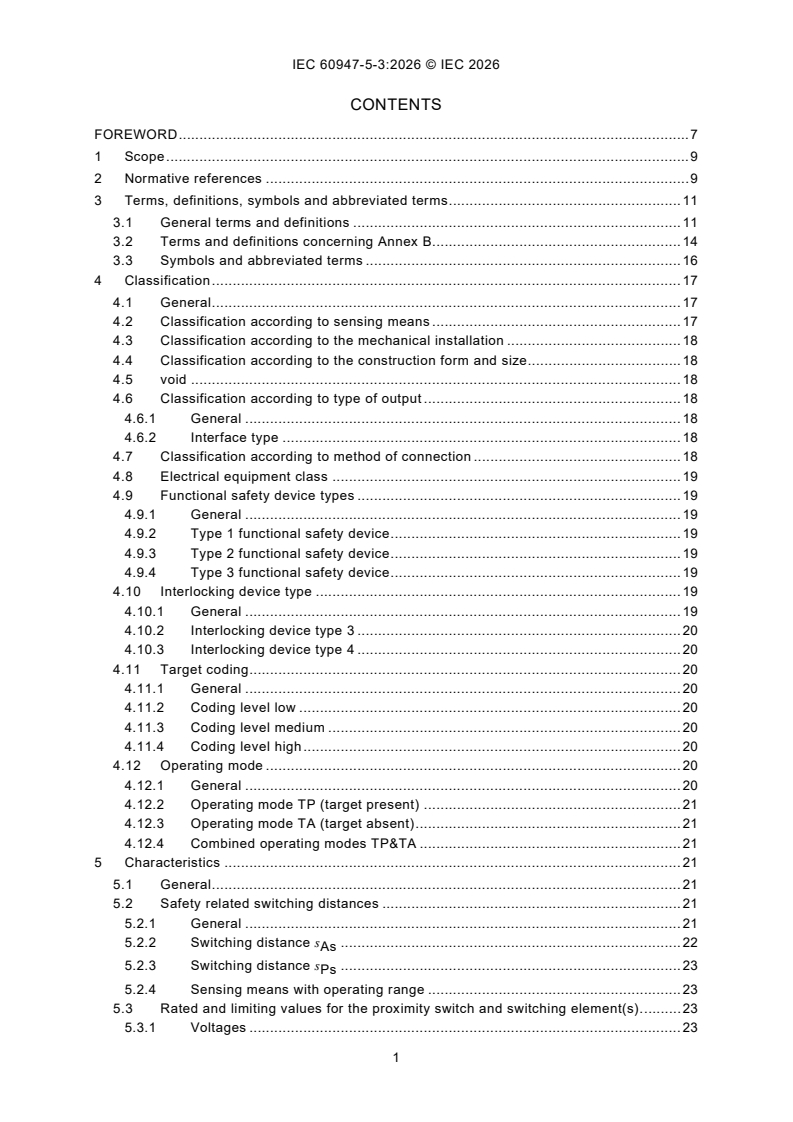
CONTENTS
FOREWORD . 7
1 Scope . 9
2 Normative references . 9
3 Terms, definitions, symbols and abbreviated terms . 11
3.1 General terms and definitions . 11
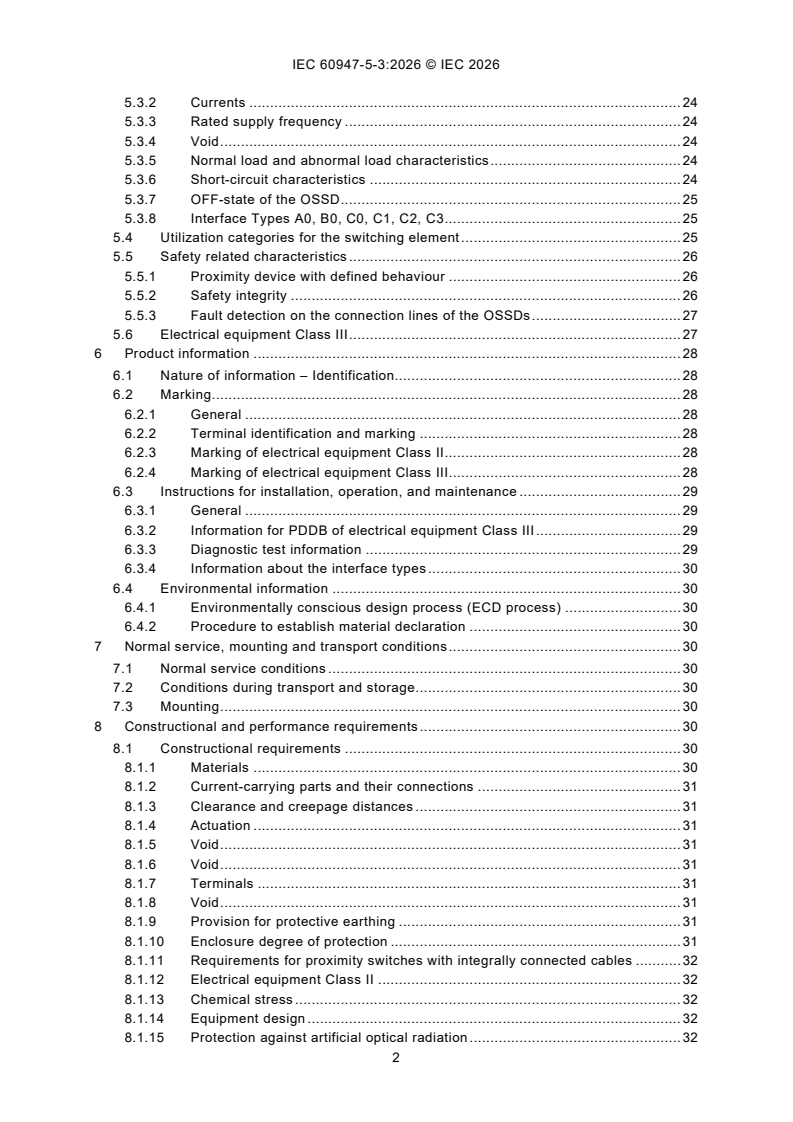
3.2 Terms and definitions concerning Annex B. 14
3.3 Symbols and abbreviated terms . 16
4 Classification . 17
4.1 General . 17
4.2 Classification according to sensing means . 17
4.3 Classification according to the mechanical installation . 18
4.4 Classification according to the construction form and size . 18
4.5 void . 18
4.6 Classification according to type of output . 18
4.6.1 General . 18
4.6.2 Interface type . 18
4.7 Classification according to method of connection . 18
4.8 Electrical equipment class . 19
4.9 Functional safety device types . 19
4.9.1 General . 19
4.9.2 Type 1 functional safety device . 19
4.9.3 Type 2 functional safety device . 19
4.9.4 Type 3 functional safety device . 19
4.10 Interlocking device type . 19
4.10.1 General . 19
4.10.2 Interlocking device type 3 . 20
4.10.3 Interlocking device type 4 . 20
4.11 Target coding . 20
4.11.1 General . 20
4.11.2 Coding level low . 20
4.11.3 Coding level medium . 20
4.11.4 Coding level high . 20
4.12 Operating mode . 20
4.12.1 General . 20
4.12.2 Operating mode TP (target present) . 21
4.12.3 Operating mode TA (target absent) . 21
4.12.4 Combined operating modes TP&TA . 21
5 Characteristics . 21
5.1 General . 21
5.2 Safety related switching distances . 21
5.2.1 General . 21
5.2.2 Switching distance s . 22
As
5.2.3 Switching distance s . 23
Ps
5.2.4 Sensing means with operating range . 23
5.3 Rated and limiting values for the proximity switch and switching element(s). . 23
5.3.1 Voltages . 23
5.3.2 Currents . 24
5.3.3 Rated supply frequency . 24
5.3.4 Void . 24
5.3.5 Normal load and abnormal load characteristics . 24
5.3.6 Short-circuit characteristics . 24
5.3.7 OFF-state of the OSSD . 25
5.3.8 Interface Types A0, B0, C0, C1, C2, C3 . 25
5.4 Utilization categories for the switching element . 25
5.5 Safety related characteristics . 26
5.5.1 Proximity device with defined behaviour . 26
5.5.2 Safety integrity . 26
5.5.3 Fault detection on the connection lines of the OSSDs . 27
5.6 Electrical equipment Class III . 27
6 Product information . 28
6.1 Nature of information – Identification. 28
6.2 Marking . 28
6.2.1 General . 28
6.2.2 Terminal identification and marking . 28
6.2.3 Marking of electrical equipment Class II . 28
6.2.4 Marking of electrical equipment Class III. 28
6.3 Instructions for installation, operation, and maintenance . 29
6.3.1 General . 29
6.3.2 Information for PDDB of electrical equipment Class III . 29
6.3.3 Diagnostic test information . 29
6.3.4 Information about the interface types . 30
6.4 Environmental information . 30
6.4.1 Environmentally conscious design process (ECD process) . 30
6.4.2 Procedure to establish material declaration . 30
7 Normal service, mounting and transport conditions . 30
7.1 Normal service conditions . 30
7.2 Conditions during transport and storage . 30
7.3 Mounting . 30
8 Constructional and performance requirements . 30
8.1 Constructional requirements . 30
8.1.1 Materials . 30
8.1.2 Current-carrying parts and their connections . 31
8.1.3 Clearance and creepage distances . 31
8.1.4 Actuation . 31
8.1.5 Void . 31
8.1.6 Void . 31
8.1.7 Terminals . 31
8.1.8 Void . 31
8.1.9 Provision for protective earthing . 31
8.1.10 Enclosure degree of protection . 31
8.1.11 Requirements for proximity switches with integrally connected cables . 32
8.1.12 Electrical equipment Class II . 32
8.1.13 Chemical stress . 32
8.1.14 Equipment design . 32
8.1.15 Protection against artificial optical radiation . 32
8.1.16 Biological and chemical effects . 32
8.1.17 Unattended operation . 32
8.1.18 Software related security . 32
8.1.19 Requirements for embedded software . 32
8.1.20 Requirements for safety related hardware . 33
8.1.21 Limited energy source . 33
8.2 Performance requirements . 35
8.2.1 Operating conditions . 35
8.2.2 Temperature rise . 42
8.2.3 Dielectric properties . 42
8.2.4 Ability to make and break under normal load and abnormal load
conditions . 42
8.2.5 Conditional short-circuit current . 42
8.2.6 Electromagnetic compatibility (EMC) . 43
8.3 Physical dimensions . 46
8.4 Shock and vibration . 46
8.4.1 General . 46
8.4.2 Shock . 46
8.4.3 Vibration . 47
8.4.4 Results to be obtained . 47
8.4.5 Special environmental condition – damp heat, salt mist, shock and
vibration . 47
8.5 Fault detection requirements . 47
8.5.1 Faults . 47
8.5.2 Diagnostic . 48
8.5.3 Lock-out condition . 48
8.6 Measures to influence quantities . 48
9 Tests . 49
9.1 Kind of tests . 49
9.1.1 General . 49
9.1.2 Type tests. 49
9.1.3 Routine tests . 49
9.1.4 Sampling tests . 49
9.2 Compliance with constructional requirements . 49
9.2.1 General . 49
9.2.2 Test of materials to abnormal heat and fire . 50
9.2.3 void . 50
9.2.4 Enclosures for equipment . 50
9.2.5 Mechanical and electrical properties of terminals . 50
9.2.6 void . 50
9.2.7 Limited energy source test . 50
9.2.8 Stored charge energy test. 50
9.2.9 Conduit pull-out test, torque test and bending test with metallic conduits . 50
9.2.10 Test of earth continuity for protective earth . 50
9.2.11 Breakdown of components . 50
9.2.12 Short-circuit and overload protection of ports . 50
9.2.13 void . 50
9.2.14 Wire flexing test . 50
9.2.15 Artificial optical radiation test . 50
9.3 Performances . 51
9.3.1 Test sequences . 51
9.3.2 General test conditions . 52
9.3.3 Performance under no load, normal load and abnormal load conditions . 53
9.3.4 Performances under short-circuit current conditions . 58
9.3.5 Fault insertion tests . 58
9.4 Verification of the safety related switching distances. 59
9.4.1 General . 59
9.4.2 Switching distance test . 59
9.5 Verification of timing . 60
9.5.1 General . 60
9.5.2 Verification of turn-on time (t ) . 60
on
9.5.3 Verification of turn-off time (t ) . 60
off
9.6 Verification of electromagnetic compatibility . 61
9.6.1 General . 61
9.6.2 Immunity . 61
9.6.3 Emission . 61
9.7 Test results and test report . 61
9.8 Ambient temperature variation and humidity . 62
9.8.1 General . 62
9.8.2 Temperature variation . 62
9.8.3 Temperature variation and humidity test . 62
9.8.4 Condensing test. 63
Annex A (informative) Example of a safety related control system . 64
A.1 Description . 64
A.1.1 General . 64
A.1.2 Safety integrity level requirements, performance level requirements . 64
A.1.3 Conditions of use . 64
A.2 Realization . 65
A.3 Collection of data . 65
A.4 Quantitative calculation . 66
A.5 Results . 68
Annex B (informative) Classification of binary interfaces – Functional safety aspects
covered by dynamic testing . 69
B.1 General . 69
B.2 Minimum information on compatibility to be provided in the product
documentation . 69
B.2.1 General . 69
B.2.2 Basic electrical parameters . 69
B.2.3 Structure of the identifying key for a PDDB . 69
B.3 Characteristics of Interface Type A0 . 70
B.3.1 General . 70
B.3.2 Static characteristics of Interface Type A0 . 71
B.3.3 Dynamic characteristics of Interface Type A0 . 71
B.3.4 Product information to be supplied in the product documentation . 71
B.4 Characteristics of Interface Type B0 . 72
B.4.1 General . 72
B.4.2 Static characteristics of Interface Type B0 . 72
B.4.3 Dynamic characteristics of Interface Type B0 . 72
B.4.4 Product information to be supplied in the product documentation . 74
B.5 Characteristics of Interface Type C . 74
B.5.1 General . 74
B.5.2 Static characteristics of Interface Type C . 75
B.5.3 Dynamic characteristics of Interface Type C . 75
B.5.4 Classification of Interface Type C . 76
B.5.5 Product information to be supplied in the product documentation . 77
Annex C Void . 79
Annex D (informative) Void . 80
Annex E (informative) Product information . 81
Bibliography . 84
Figure 1 – Absent and present switching distance s and s for a PDDB with
As P
operating mode TP (target present) . 22
Figure 2 – Absent and present switching distance s and s for a PDDB with
A Ps
operating mode TA (target absent) . 23
Figure 3 – Characteristics of the absent switching distance . 36
Figure 4 – Characteristics of the present switching distance . 37
Figure 5 – Voltages and current characteristics . 54
Figure 6 – Test circuit diagram for the detection of stuck-at-high faults . 56
Figure A.1 – Position monitoring of movable guards for the prevention of hazardous
movements . 65
Figure A.2 – Safety-related block diagram of the safety-related function . 66
Figure B.1 – Interface Type A0 . 70
Figure B.2 – Interface Type B0 . 72
Figure B.3 – Test pulse delay ∆t much smaller than test pulse duration t . 73
i i
Figure B.4 – Test pulse delay ∆t greater than test pulse duration t . 73
i i
Figure B.5 – Interface Type C . 74
Figure B.6 – Dynamic behaviour Interface Type C . 75
Table 1 – Symbols and abbreviated terms . 16
Table 2 – Interface types of PDDBs . 18
Table 3 – Operating modes of PDDBs . 20
Table 4 – Static characteristics of Interface Types A0, B0, C0, C1, C2 and C3 . 25
Table 5 – Dynamic characteristics of Interface Types A0, B0, C0, C1, C2 and C3 . 25
Table 6 – Characteristic safety values of functional safety device types . 27
Table 7 – Product information on Interface Types A0, B0, C0, C1, C2 and C3 . 30
Table 8 – Limits for limited energy sources without an overcurrent protective device . 34
Table 9 – Limits for limited energy sources with an overcurrent protective device . 34
Table 10 – Limits for limited energy source with limited current impedance . 35
Table 11 – Characteristics of the absent switching distance . 36
Table 12 – Characteristics of the present switching distance . 37
Table 13 – Acceptance criteria for s . 39
Ai
Table 14 – Acceptance criteria for s . 39
Pi
Table 15 – Operating voltages of 24 V solid state OSSD . 42
Table 16 – Reaction of PDDB during test . 44
Table 17 – Immunity test requirements for PDDBs . 45
Table A.1 – Collection of safety related reliability data . 65
Table B.1 – Basic electrical parameters . 69
Table B.2 – Product information Interface Type A0 – Source . 71
Table B.3 – Product information Interface Type A0 – Sink . 71
Table B.4 – Product information Interface Type B0 – source . 74
Table B.5 – Product information Interface Type B0 – sink . 74
Table B.6 – Classification for Interface Type C . 76
Table B.7 – Product information Interface Type C – Source . 77
Table B.8 – Product information Interface Type C – Sink . 78
Table E.1 – Product information . 81
INTERNATIONAL ELECTROTECHNICAL COMMISSION
____________
Low-voltage switchgear and controlgear -
Part 5-3: Control circuit devices and switching elements -
Requirements for proximity devices with defined
behaviour under fault conditions (PDDB)
FOREWORD
1) The International Electrotechnical Commission (IEC) is a worldwide organization for standardization comprising
all national electrotechnical committees (IEC National Committees). The object of IEC is to promote international
co-operation on all questions concerning standardization in the electrical and electronic fields. To this end and
in addition to other activities, IEC publishes International Standards, Technical Specifications, Technical Reports,
Publicly Available Specifications (PAS) and Guides (hereafter referred to as “IEC Publication(s)”). Their
preparation is entrusted to technical committees; any IEC National Committee interested in the subject dealt with
may participate in this preparatory work. International, governmental and non-governmental organizations liaising
with the IEC also participate in this preparation. IEC collaborates closely with the International Organization for
Standardization (ISO) in accordance with conditions determined by agreement between the two organizations.
2) The formal decisions or agreements of IEC on technical matters express, as nearly as possible, an international
consensus of opinion on the relevant subjects since each technical committee has representation from all
interested IEC National Committees.
3) IEC Publications have the form of recommendations for international use and are accepted by IEC National
Committees in that sense. While all reasonable efforts are made to ensure that the technical content of IEC
Publications is accurate, IEC cannot be held responsible for the way in which they are used or for any
misinterpretation by any end user.
4) In order to promote international uniformity, IEC National Committees undertake to apply IEC Publications
transparently to the maximum extent possible in their national and regional publications. Any divergence between
any IEC Publication and the corresponding national or regional publication shall be clearly indicated in the latter.
5) IEC itself does not provide any attestation of conformity. Independent certification bodies provide conformity
assessment services and, in some areas, access to IEC marks of conformity. IEC is not responsible for any
services carried out by independent certification bodies.
6) All users should ensure that they have the latest edition of this publication.
7) No liability shall attach to IEC or its directors, employees, servants or agents including individual experts and
members of its technical committees and IEC National Committees for any personal injury, property damage or
other damage of any nature whatsoever, whether direct or indirect, or for costs (including legal fees) and
expenses arising out of the publication, use of, or reliance upon, this IEC Publication or any other IEC
Publications.
8) Attention is drawn to the Normative references cited in this publication. Use of the referenced publications is
indispensable for the correct application of this publication.
9) IEC draws attention to the possibility that the implementation of this document may involve the use of (a)
patent(s). IEC takes no position concerning the evidence, validity or applicability of any claimed patent rights in
respect thereof. As of the date of publication of this document, IEC had not received notice of (a) patent(s), which
may be required to implement this document. However, implementers are cautioned that this may not represent
the latest information, which may be obtained from the patent database available at https://patents.iec.ch. IEC
shall not be held responsible for identifying any or all such patent rights.
IEC 60947-5-3 has been prepared by subcommittee SC121A: Low-voltage switchgear and
controlgear, of IEC technical committee 121: Switchgear and controlgear and their assemblies
for low voltage. It is an International Standard.
This third edition cancels and replaces the second edition published in 2013. This edition
constitutes a technical revision.
This third edition includes the following significant technical changes with respect to the
previous edition:
a) Update of the scope, refined fault performance aspects and relation to standards of
functional safety.
b) The ‘safe state’ is generally determined as ‘OFF-state’ (see 3.1.8).
c) Update of EMC requirements in 8.2.6 with references to IEC 60947-5-2:2019 for acceptance
criteria A, B and C and requirements of Table 17 for acceptance criterion DS.
d) Interface types for binary interfaces are introduced (see 4.6.2 and Annex B).
e) Functional safety device types according to ISO 13849-1:2023 Annex O (see 4.9).
f) Interlocking device type and coding level according to ISO 14119 are adapted (see 4.10 and
4.11).
g) The operating modes target present (4.12.2) and target absent (4.12.3) are introduced.
h) The ‘switching distance’ replaces the terms ‘release’ and ‘operating’. The behaviour of the
PDDB is described according to the operating mode (4.12).
i) The context and verification of the switching distances are considered according to
ISO/IEC Guide 98-3:2008 (GUM) and IEC TR 63649 (see 8.2.1.3 and 9.4.2).
j) Requirements for electrical equipment class III are refined.
k) The risk time is replaced with the safety response time (3.1.11).
l) Annex A gives a new example of safety related control system.
m) The test sequences (see 9.3.1) are updated for the specific behaviour of a PDDB.
This document is to be read in conjunction with IEC 60947-1:2020 and IEC 60947-5-2:2019.
The provisions of Part 1 and Part 5-2 are only applicable to this document where specifically
called for. The numbering of the subclauses of this document is sometimes not continuous
because it is based on the numbering of the subclauses of IEC 60947-1:2020 or
IEC 60947-5-2:2019.
The text of this International Standard is based on the following documents:
Draft Report on voting
121A/716/FDIS 121A/728/RVD
Full information on the voting for its approval can be found in the report on voting indicated in
the above table.
The language used for the development of this International Standard is English.
This document was drafted in accordance with ISO/IEC Directives, Part 2, and developed in
accordance with ISO/IEC Directives, Part 1 and ISO/IEC Directives, IEC Supplement, available
at www.iec.ch/members_experts/refdocs. The main document types developed by IEC are
described in greater detail at www.iec.ch/publications.
A list of all parts in the IEC 60947 series, published under the general title Low-voltage
switchgear and controlgear, can be found on the IEC website.
The committee has decided that the contents of this document will remain unchanged until the
stability date indicated on the IEC website under webstore.iec.ch in the data related to the
specific document. At this date, the document will be
– reconfirmed,
– withdrawn, or
– revised.
___________
Under preparation. Stage at the time of publication: IEC DTR 63649:2025.
1 Scope
This part of IEC 60947 provides additional requirements to those given in
IEC 60947-5-2 and IEC 60947-5-1:2024, Annex D (reed contact magnetic switches). It
addresses the fault performance aspects of proximity devices with a defined behaviour under
fault conditions (PDDB). It does not address any other characteristics that can be required for
specific applications.
This document does not apply to protective equipment to directly detect the presence of
persons, that are covered by the IEC 61496 series or IEC TS 62998 series.
NOTE 1 A PDDB device can be used to detect indirectly the presence of a person, for example by detecting the
position of a platform on which the operator stands (example, garbage trucks).
This document does not specify requirements for the analogue output of PDDB, if any.
This document does not deal with any specific requirements on acoustic noise as the noise
emission of proximity devices is not considered to be a relevant hazard.
A PDDB product is intended to be used as sensing subsystem of a safety related control system
according to IEC 62061 or ISO 13849-1. Depending on construction principles and complexity,
this document is based on product development of the IEC 61508 series to meet the product
specific requirements of one or more of the following:
– IEC 61508 series;
– IEC 62061;
– ISO 13849 series.
NOTE 2 The Functional safety device type classification regarding functional safety correlates with IEC 62683-2-3.
This document includes requirements for PDDB when designed for use as part of an interlocking
device according to ISO 14119.
This document does not consider aspects of:
– software updates and self-evolving behaviour;
– explosive atmospheres.
2 Normative references
The following documents are referred to in the text in such a way that some or all of their content
constitutes requirements of this document. For dated references, only the edition cited applies.
For undated references, the latest edition of the referenced document (including any
amendments) applies.
IEC 60068-2-1, Environmental testing - Part 2-1: Tests - Test A: Cold
IEC 60068-2-30:2005, Environmental testing - Part 2-30: Tests - Test Db: Damp heat, cyclic
(12 + 12 h cycle)
IEC 60204-1:2016, Safety of machinery - Electrical equipment of machines - Part 1: General
requirements
IEC 60204-1:2016/AMD1:2021
IEC 60730-1, Automatic electrical controls - Part 1: General requirements
IEC 60812, Failure modes and effects analysis (FMEA and FMECA)
IEC 60947-1:- , Low-voltage switchgear and controlgear - Part 1: General rules
IEC 60947-5-1:2024, Low-voltage switchgear and controlgear - Part 5-1: Control circuit devices
and switching elements - Electromechanical control circuit devices
IEC 60947-5-2:2019, Low-voltage switchgear and controlgear - Part 5-2: Control circuit devices
and switching elements - Proximity switches
IEC 61000-4-2, Electromagnetic compatibility (EMC) - Part 4-2: Testing and measurement
techniques - Electrostatic discharge immunity test
IEC 61000-4-3, Electromagnetic compatibility (EMC) - Part 4-3: Testing and measurement
techniques - Radiated, radio-frequency, electromagnetic field immunity test
IEC 61000-4-4, Electromagnetic compatibility (EMC) - Part 4-4: Testing and measurement
techniques - Electrical fast transient/burst immunity test
IEC 61000-4-5, Electromagnetic compatibility (EMC) - Part 4-5: Testing and measurement
techniques - Surge immunity test
IEC 61000-4-6, Electromagnetic compatibility (EMC) - Part 4-6: Testing and measurement
techniques - Immunity to conducted disturbances, induced by radio-frequency fields
IEC 61000-4-8, Electromagnetic compatibility (EMC) - Part 4-8: Testing and measurement
techniques - Power frequency magnetic field immunity test
IEC 61000-4-11, Electromagnetic compatibility (EMC) - Part 4-11: Testing and measurement
techniques - Voltage dips, short interruptions and voltage variations immunity tests
IEC 61000-4-29, Electromagnetic compatibility (EMC) - Part 4-29: Testing and measurement
techniques - Voltage dips, short interruptions and voltage variations on d.c. input power port -
immunity tests
IEC 61131-2:2017, Programmable controllers - Part 2: Equipment requirements and tests
IEC 61140:2016, Protection against electric shock - Common aspects for installation and
equipment
IEC 61508-2:2010, Functional safety of electrical/electronic/programmable electronic
safety-related systems - Part 2: Requirements for electrical/electronic/programmable electronic
safety-related systems
IEC 61508-3, Functional safety of electrical/electronic/programmable electronic safety-related
systems - Part 3: Software requirements (see Functional Safety and IEC 61508)
IEC 62061:2021, Safety of machinery - Functional safety of safety-related control systems
IEC 62061:2021/AMD1:2024
ISO 13849-1:2023, Safety of machinery - Safety-related parts of control systems - Part 1:
General principles for design
ISO 14119:2024, Safety of machinery - Interlocking devices associated with guards - Principles
for design and selection
...
IEC 60947-5-3 ®
Edition 3.0 2026-08
NORME
INTERNATIONALE
Appareillage à basse tension -
Partie 5-3: Appareils et éléments de commutation pour circuits de commande -
Exigences pour dispositifs de détection de proximité à comportement défini
dans des conditions de défaut (PDDB)
ICS 29.130.20 ISBN 978-2-8327-1385-3
Droits de reproduction réservés. Sauf indication contraire, aucune partie de cette publication ne peut être reproduite ni
utilisée sous quelque forme que ce soit et par aucun procédé, électronique ou mécanique, y compris la photocopie et
les microfilms, sans l'accord écrit de l'IEC ou du Comité national de l'IEC du pays du demandeur. Si vous avez des
questions sur le copyright de l'IEC ou si vous désirez obtenir des droits supplémentaires sur cette publication, utilisez
les coordonnées ci-après ou contactez le Comité national de l'IEC de votre pays de résidence.
IEC Secretariat Tel.: +41 22 919 02 11
3, rue de Varembé info@iec.ch
CH-1211 Geneva 20 www.iec.ch
Switzerland
A propos de l'IEC
La Commission Electrotechnique Internationale (IEC) est la première organisation mondiale qui élabore et publie des
Normes internationales pour tout ce qui a trait à l'électricité, à l'électronique et aux technologies apparentées.
A propos des publications IEC
Le contenu technique des publications IEC est constamment revu. Veuillez vous assurer que vous possédez l’édition la
plus récente, un corrigendum ou amendement peut avoir été publié.
Recherche de publications IEC - IEC Products & Services Portal - products.iec.ch
webstore.iec.ch/advsearchform Découvrez notre puissant moteur de recherche et consultez
La recherche avancée permet de trouver des publications gratuitement tous les aperçus des publications, symboles
IEC en utilisant différents critères (numéro de référence, graphiques et le glossaire. Avec un abonnement, vous aurez
texte, comité d’études, …). Elle donne aussi des toujours accès à un contenu à jour adapté à vos besoins.
informations sur les projets et les publications remplacées
ou retirées. Electropedia - www.electropedia.org
Le premier dictionnaire d'électrotechnologie en ligne au
IEC Just Published - webstore.iec.ch/justpublished monde, avec plus de 22 500 articles terminologiques en
Restez informé sur les nouvelles publications IEC. Just anglais et en français, ainsi que les termes équivalents
dans 25 langues additionnelles. Egalement appelé
Published détaille les nouvelles publications parues.
Disponible en ligne et une fois par mois par email. Vocabulaire Electrotechnique International (IEV) en ligne.
Service Clients - webstore.iec.ch/csc
Si vous désirez nous donner des commentaires sur cette
publication ou si vous avez des questions contactez-
nous: sales@iec.ch.
SOMMAIRE
AVANT-PROPOS . 7
1 Domaine d'application . 10
2 Références normatives . 10
3 Termes, définitions, symboles et abréviations . 12
3.1 Termes et définitions généraux . 12
3.2 Termes et définitions relatifs à l'Annexe B . 16
3.3 Symboles et abréviations . 18
4 Classification . 20
4.1 Généralités . 20
4.2 Classification selon le mode de détection. 20
4.3 Classification selon l'installation mécanique . 20
4.4 Classification selon la forme et la taille du boîtier . 20
4.5 Vacant . 20
4.6 Classification selon le type de sortie . 20
4.6.1 Généralités . 20
4.6.2 Type d'interface . 20
4.7 Classification selon la méthode de connexion . 21
4.8 Classe d'équipement électrique . 21
4.9 Types de dispositifs de sécurité fonctionnelle . 21
4.9.1 Généralités . 21
4.9.2 Dispositif de sécurité fonctionnelle de type 1 . 22
4.9.3 Dispositif de sécurité fonctionnelle de type 2 . 22
4.9.4 Dispositif de sécurité fonctionnelle de type 3 . 22
4.10 Type de dispositif de verrouillage . 22
4.10.1 Généralités . 22
4.10.2 Type de dispositif de verrouillage 3 . 22
4.10.3 Type de dispositif de verrouillage 4 . 22
4.11 Codage de la cible . 22
4.11.1 Généralités . 22
4.11.2 Niveau de codage faible . 23
4.11.3 Niveau de codage moyen . 23
4.11.4 Niveau de codage élevé . 23
4.12 Mode de fonctionnement . 23
4.12.1 Généralités . 23
4.12.2 Mode de fonctionnement TP (cible présente) . 23
4.12.3 Mode de fonctionnement TA (cible absente) . 23
4.12.4 Modes de fonctionnement combinés TP&TA . 23
5 Caractéristiques . 24
5.1 Généralités . 24
5.2 Distances de commutation relatives à la sécurité . 24
5.2.1 Généralités . 24
5.2.2 Distance de commutation s . 24
As
5.2.3 Distance de commutation s . 25
Ps
5.2.4 Modes de détection avec plage de fonctionnement . 26
5.3 Valeurs assignées et valeurs limites pour les détecteurs de proximité et pour
leur(s) élément(s) de commutation. . 26
5.3.1 Tensions . 26
5.3.2 Courants . 27
5.3.3 Fréquence d'alimentation assignée . 27
5.3.4 Vacant . 27
5.3.5 Caractéristiques en charges normale et anormale . 27
5.3.6 Caractéristiques de court-circuit . 27
5.3.7 État INACTIF de l'OSSD . 28
5.3.8 Types d'interfaces A0, B0, C0, C1, C2, C3 . 28
5.4 Catégories d'emploi de l'élément de commutation . 28
5.5 Caractéristiques relatives à la sécurité . 29
5.5.1 Dispositif de détection de proximité à comportement défini . 29
5.5.2 Intégrité de sécurité . 29
5.5.3 Détection des défauts sur les lignes de connexion des OSSD . 30
5.6 Classes d'équipement électrique III . 31
6 Informations sur le produit . 31
6.1 Nature des informations – Identification . 31
6.2 Marquage . 31
6.2.1 Généralités . 31
6.2.2 Identification et marquage des bornes . 31
6.2.3 Marquage de la classe d'équipement électrique II . 31
6.2.4 Marquage de la classe d'équipement électrique III . 31
6.3 Instructions d'installation, de fonctionnement et de maintenance . 32
6.3.1 Généralités . 32
6.3.2 Informations pour les PDDB de la classe d'équipement électrique III . 32
6.3.3 Informations relatives aux essais de diagnostic . 32
6.3.4 Informations relatives aux types d'interfaces . 33
6.4 Informations relatives à l'environnement . 33
6.4.1 Processus d'écoconception (processus ECD) . 33
6.4.2 Procédure pour établir la déclaration des matériaux . 33
7 Conditions normales de service, de montage et de transport . 33
7.1 Conditions normales de service . 33
7.2 Conditions pendant le transport et le stockage . 33
7.3 Montage . 33
8 Exigences relatives à la construction et au fonctionnement . 34
8.1 Exigences relatives à la construction . 34
8.1.1 Matériaux . 34
8.1.2 Parties transportant le courant et leurs connexions . 34
8.1.3 Distances d'isolement et lignes de fuite . 34
8.1.4 Actionnement . 34
8.1.5 Vacant . 34
8.1.6 Vacant . 34
8.1.7 Bornes . 34
8.1.8 Vacant . 34
8.1.9 Dispositions pour la mise à la terre . 34
8.1.10 Degré de protection procuré par les enveloppes . 35
8.1.11 Exigences relatives aux détecteurs de proximité avec câble solidaire de
l'appareil . 35
8.1.12 Classe d'équipement électrique II . 35
8.1.13 Contraintes chimiques . 35
8.1.14 Conception du matériel . 35
8.1.15 Protection contre le rayonnement optique artificiel . 35
8.1.16 Effets biologiques et chimiques . 35
8.1.17 Fonctionnement sans surveillance . 35
8.1.18 Considérations de sûreté relatives aux logiciels . 35
8.1.19 Exigences relatives aux logiciels intégrés . 36
8.1.20 Exigences pour le matériel relatif à la sécurité . 36
8.1.21 Source d'énergie limitée . 36
8.2 Exigences relatives aux performances . 38
8.2.1 Conditions de fonctionnement . 38
8.2.2 Échauffement . 45
8.2.3 Propriétés diélectriques . 45
8.2.4 Aptitude à l'établissement et à la coupure dans les conditions de charge
normales et anormales . 45
8.2.5 Courant de court-circuit conditionnel. 45
8.2.6 Compatibilité électromagnétique (CEM) . 46
8.3 Dimensions . 49
8.4 Chocs et vibrations . 49
8.4.1 Généralités . 49
8.4.2 Chocs . 49
8.4.3 Vibrations . 50
8.4.4 Résultats à obtenir . 50
8.4.5 Conditions d'environnement particulières – chaleur humide, brouillard
salin, chocs et vibrations . 50
8.5 Exigences de détection des défauts . 50
8.5.1 Défauts . 50
8.5.2 Diagnostic . 51
8.5.3 Condition de blocage à l'arrêt . 51
8.6 Mesurages des grandeurs d'influence . 51
9 Essais . 52
9.1 Nature des essais . 52
9.1.1 Généralités . 52
9.1.2 Essais de type . 52
9.1.3 Essais individuels de série. 52
9.1.4 Essais sur prélèvement . 53
9.2 Conformité aux exigences relatives à la construction . 53
9.2.1 Généralités . 53
9.2.2 Essai d'exposition de matériaux à la chaleur anormale et au feu . 53
9.2.3 Vacant . 53
9.2.4 Enveloppes pour le matériel . 53
9.2.5 Propriétés mécaniques et électriques des bornes . 53
9.2.6 Vacant . 53
9.2.7 Essai de la source d'énergie limitée . 53
9.2.8 Essai d'énergie de charge emmagasinée . 53
9.2.9 Essais de traction, torsion et flexion avec des conduits métalliques . 53
9.2.10 Essai de continuité à la terre de la terre de protection . 53
9.2.11 Panne des composants. 53
9.2.12 Protection des accès contre les courts-circuits et les surcharges . 54
9.2.13 Vacant . 54
9.2.14 Essai de flexion de câble . 54
9.2.15 Essai de rayonnement optique artificiel. 54
9.3 Performances . 54
9.3.1 Séquences d'essais . 54
9.3.2 Conditions générales pour les essais . 55
9.3.3 Fonctionnement à vide et dans les conditions de charge normales et
anormales . 57
9.3.4 Fonctionnement en conditions de court-circuit . 61
9.3.5 Essais de génération de panne . 62
9.4 Vérification des distances de commutation relatives à la sécurité . 63
9.4.1 Généralités . 63
9.4.2 Essai de distance de commutation . 63
9.5 Vérification des temps. 64
9.5.1 Généralités . 64
9.5.2 Vérification du temps d'action (t ) . 64
on
9.5.3 Vérification du temps de relâchement (t ) . 64
off
9.6 Vérification de la compatibilité électromagnétique . 65
9.6.1 Généralités . 65
9.6.2 Immunité . 65
9.6.3 Émissions . 65
9.7 Résultats d'essai et rapport d'essai . 65
9.8 Variation de température ambiante et humidité . 66
9.8.1 Généralités . 66
9.8.2 Variation de température . 66
9.8.3 Essai de variation de température et d'humidité . 66
9.8.4 Essai de condensation . 67
Annexe A (informative) Exemple de système de commande relatif à la sécurité . 68
A.1 Description . 68
A.1.1 Généralités . 68
A.1.2 Exigences relatives au niveau d'intégrité de sécurité, exigences
relatives au niveau de performance . 68
A.1.3 Conditions d'utilisation . 68
A.2 Réalisation . 69
A.3 Collecte des données . 69
A.4 Calcul quantitatif . 70
A.5 Résultats . 72
Annexe B (informative) Classification des interfaces binaires – Aspects de sécurité
fonctionnelle couverts par les essais dynamiques . 73
B.1 Généralités . 73
B.2 Informations minimales sur la compatibilité à fournir dans la documentation
du produit . 73
B.2.1 Généralités . 73
B.2.2 Paramètres électriques de base. 73
B.2.3 Structure de la clé d'identification d'un PDDB . 73
B.3 Caractéristiques du type d'interface A0 . 74
B.3.1 Généralités . 74
B.3.2 Caractéristiques statiques du type d'interface A0 . 75
B.3.3 Caractéristiques dynamiques du type d'interface A0 . 75
B.3.4 Informations sur le produit à fournir dans la documentation du produit . 75
B.4 Caractéristiques du type d'interface B0 . 76
B.4.1 Généralités . 76
B.4.2 Caractéristiques statiques du type d'interface B0 . 76
B.4.3 Caractéristiques dynamiques du type d'interface B0 . 76
B.4.4 Informations sur le produit à fournir dans la documentation du produit . 78
B.5 Caractéristiques du type d'interface C . 78
B.5.1 Généralités . 78
B.5.2 Caractéristiques statiques du type d'interface C . 79
B.5.3 Caractéristiques dynamiques du type d'interface C . 79
B.5.4 Classification du type d'interface C . 80
B.5.5 Informations sur le produit à fournir dans la documentation du produit . 82
Annexe C Vacant . 84
Annexe D (informative) Vacant . 85
Annexe E (informative) Informations sur le produit . 86
Bibliographie . 89
Figure 1 – Distances de commutation absente et présente s et s pour un PDDB
As P
avec le mode de fonctionnement TP (cible présente) . 25
Figure 2 – Distances de commutation absente et présente s et s pour un PDDB
A Ps
avec le mode de fonctionnement TA (cible absente) . 26
Figure 3 – Caractéristiques de la distance de commutation absente . 39
Figure 4 – Caractéristiques de la distance de commutation présente . 40
Figure 5 – Tensions et caractéristiques de courant . 58
Figure 6 – Schéma du circuit d'essai pour la détection des défauts stuck-at-high . 60
Figure A.1 – Contrôle de position des protecteurs mobiles pour la prévention des
mouvements dangereux . 69
Figure A.2 – Schéma fonctionnel de sécurité de la fonction de sécurité . 70
Figure B.1 – Type d'interface A0 . 74
Figure B.2 – Type d'interface B0 . 76
Figure B.3 – Retard d'une impulsion d'essai ∆t nettement inférieur à la durée d'une
i
impulsion d'essai t . 77
i
Figure B.4 – Retard d'une impulsion d'essai ∆t supérieur à la durée d'une impulsion
i
d'essai t . 77
i
Figure B.5 – Type d'interface C . 78
Figure B.6 – Comportement dynamique du type d'interface C . 80
Tableau 1 – Symboles et abréviations. 18
Tableau 2 – Types d'interfaces des PDDB . 21
Tableau 3 – Modes de fonctionnement des PDDB . 23
Tableau 4 – Caractéristiques statiques des types d'interfaces A0, B0, C0, C1, C2 et C3 . 28
Tableau 5 – Caractéristiques dynamiques des types d'interfaces A0, B0, C0, C1, C2
et C3 . 28
Tableau 6 – Valeurs de sécurité caractéristiques des types de dispositifs de sécurité
fonctionnelle . 30
Tableau 7 – Informations sur le produit relatives aux types d'interfaces A0, B0, C0,
C1, C2 et C3 . 33
Tableau 8 – Limites pour les sources d'énergie limitée sans dispositif de protection
contre les surintensités . 37
Tableau 9 – Limites pour les sources d'énergie limitée avec dispositif de protection
contre les surintensités . 37
Tableau 10 – Limites pour la source d'énergie limitée avec impédance de limitation de
courant . 38
Tableau 11 – Caractéristiques de la distance de commutation absente . 39
Tableau 12 – Caractéristiques de la distance de commutation présente . 40
Tableau 13 – Critères d'acceptation pour s . 42
Ai
Tableau 14 – Critères d'acceptation pour s . 42
Pi
Tableau 15 – Tensions d'emploi des OSSD statiques de 24 V . 45
Tableau 16 – Réaction du PDDB pendant l'essai . 47
Tableau 17 – Exigences d'essai d'immunité pour les PDDB . 48
Tableau A.1 – Collecte des données de fiabilité relative à la sécurité . 69
Tableau B.1 – Paramètres électriques de base . 73
Tableau B.2 – Informations sur le produit, type d'interface A0 – Source . 75
Tableau B.3 – Informations sur le produit, type d'interface A0 – Collecteur . 75
Tableau B.4 – Informations sur le produit, type d'interface B0 – Source . 78
Tableau B.5 – Informations sur le produit, type d'interface B0 – Collecteur . 78
Tableau B.6 – Classification du type d'interface C . 81
Tableau B.7 – Informations sur le produit, type d'interface C – Source. 82
Tableau B.8 – Informations sur le produit, type d'interface C – Collecteur . 83
Tableau E.1 – Informations sur le produit . 86
COMMISSION ÉLECTROTECHNIQUE INTERNATIONALE
____________
Appareillage à basse tension -
Partie 5-3: Appareils et éléments
de commutation pour circuits de commande -
Exigences pour dispositifs de détection de proximité
à comportement défini dans des conditions de défaut (PDDB)
AVANT-PROPOS
1) La Commission Électrotechnique Internationale (IEC) est une organisation mondiale de normalisation composée
de l'ensemble des comités électrotechniques nationaux (Comités nationaux de l'IEC). L'IEC a pour objet de
favoriser la coopération internationale pour toutes les questions de normalisation dans les domaines de
l'électricité et de l'électronique. À cet effet, l'IEC – entre autres activités – publie des Normes internationales,
des Spécifications techniques, des Rapports techniques, des Spécifications accessibles au public (PAS) et des
Guides (ci-après dénommés "Publication(s) de l'IEC"). Leur élaboration est confiée à des comités d'études, aux
travaux desquels tout Comité national intéressé par le sujet traité peut participer. Les organisations
internationales, gouvernementales et non gouvernementales, en liaison avec l'IEC, participent également aux
travaux. L'IEC collabore étroitement avec l'Organisation Internationale de Normalisation (ISO), selon des
conditions fixées par accord entre les deux organisations.
2) Les décisions ou accords officiels de l'IEC concernant les questions techniques représentent, dans la mesure du
possible, un accord international sur les sujets étudiés, étant donné que les Comités nationaux de l'IEC intéressés
sont représentés dans chaque comité d'études.
3) Les Publications de l'IEC se présentent sous la forme de recommandations internationales et sont agréées
comme telles par les Comités nationaux de l'IEC. Tous les efforts raisonnables sont entrepris afin que l'IEC
s'assure de l'exactitude du contenu technique de ses publications; l'IEC ne peut pas être tenue responsable de
l'éventuelle mauvaise utilisation ou interprétation qui en est faite par un quelconque utilisateur final.
4) Dans le but d'encourager l'uniformité internationale, les Comités nationaux de l'IEC s'engagent, dans toute la
mesure possible, à appliquer de façon transparente les Publications de l'IEC dans leurs publications nationales
et régionales. Toutes divergences entre toutes Publications de l'IEC et toutes publications nationales ou
régionales correspondantes doivent être indiquées en termes clairs dans ces dernières.
5) L'IEC elle-même ne fournit aucune attestation de conformité. Des organismes de certification indépendants
fournissent des services d'évaluation de conformité et, dans certains secteurs, accèdent aux marques de
conformité de l'IEC. L'IEC n'est responsable d'aucun des services effectués par les organismes de certification
indépendants.
6) Tous les utilisateurs doivent s'assurer qu'ils sont en possession de la dernière édition de cette publication.
7) Aucune responsabilité ne doit être imputée à l'IEC, à ses administrateurs, employés, auxiliaires ou mandataires,
y compris ses experts particuliers et les membres de ses comités d'études et des Comités nationaux de l'IEC,
pour tout préjudice causé en cas de dommages corporels et matériels, ou de tout autre dommage de quelque
nature que ce soit, directe ou indirecte, ou pour supporter les coûts (y compris les frais de justice) et les dépenses
découlant de la publication ou de l'utilisation de cette Publication de l'IEC ou de toute autre Publication de l'IEC,
ou au crédit qui lui est accordé.
8) L'attention est attirée sur les références normatives citées dans cette publication. L'utilisation de publications
référencées est obligatoire pour une application correcte de la présente publication.
9) L'IEC attire l'attention sur le fait que la mise en application du présent document peut entraîner l'utilisation d'un
ou de plusieurs brevets. L'IEC ne prend pas position quant à la preuve, à la validité et à l'applicabilité de tout
droit de brevet revendiqué à cet égard. À la date de publication du présent document, l'IEC n'avait pas reçu
notification qu'un ou plusieurs brevets pouvaient être nécessaires à sa mise en application. Toutefois, il y a lieu
d'avertir les responsables de la mise en application du présent document que des informations plus récentes
sont susceptibles de figurer dans la base de données de brevets, disponible à l'adresse https://patents.iec.ch.
L'IEC ne saurait être tenue pour responsable de ne pas avoir identifié de tels droits de brevets.
L'IEC 60947-5-3 a été établie par le sous-comité 121A: Appareillages à basse tension, du
comité d'études 121 de l'IEC: Appareillages et ensembles d'appareillages basse tension. Il
s'agit d'une Norme internationale.
Cette troisième édition annule et remplace la deuxième édition parue en 2013. Cette édition
constitue une révision technique.
Cette troisième édition inclut les modifications techniques majeures suivantes par rapport à
l'édition précédente:
a) mise à jour du domaine d'application, précision des aspects de défaut et de la relation avec
les normes de sécurité fonctionnelle;
b) l'"état de sécurité" est généralement déterminé comme étant l'"état INACTIF" (voir le 3.1.8);
c) mise à jour des exigences de CEM au 8.2.6 avec référence à l'IEC 60947-5-2:2019 pour les
critères d'acceptation A, B et C et aux exigences du Tableau 17 pour le critère d'acceptation
DS;
d) introduction des types d'interfaces pour les interfaces binaires (voir le 4.6.2 et l'Annexe B);
e) types de dispositifs de sécurité fonctionnelle selon l'ISO 13849-1:2023, Annexe O (voir le
4.9);
f) adaptation du type et du niveau de codage des dispositifs de verrouillage selon l'ISO 14119
(voir le 4.10 et le 4.11);
g) introduction des modes de fonctionnement Cible présente (4.12.2) et Cible absente (4.12.3);
h) remplacement des termes "portée de déclenchement" et "distance de fonctionnement" par
la "distance de commutation". Le comportement du PDDB est décrit en fonction du mode
de fonctionnement (4.12);
i) prise en compte du contexte et de la vérification des distances de commutation
conformément au Guide 98-3:2008 de l'ISO/IEC (GUM) et à l'IEC TR 63649 (voir le 8.2.1.3
et le 9.4.2);
j) précision des exigences pour la classe d'équipement électrique III;
k) remplacement du temps de risque par le temps de réponse de sécurité (3.1.11);
l) l'Annexe A donne un nouvel exemple de système de commande relatif à la sécurité;
m) mise à jour des séquences d'essais (voir le 9.3.1) pour le comportement spécifique d'un
PDDB.
Le présent document doit être lu conjointement avec l'IEC 60947-1:2020 et
l'IEC 60947-5-2:2019. Les dispositions de la Partie 1 et de la Partie 5-2 ne s'appliquent au
présent document que lorsque celui-ci le précise. La numérotation des paragraphes du présent
document n'est parfois pas continue, car elle est fondée sur la numérotation des paragraphes
de l'IEC 60947-1:2020 ou de l'IEC 60947-5-2:2019.
Le texte de cette Norme internationale est issu des documents suivants:
Projet Rapport de vote
121A/716/FDIS 121A/728/RVD
Le rapport de vote indiqué dans le tableau ci-dessus donne toute information sur le vote ayant
abouti à son approbation.
La langue employée pour l'élaboration de cette Norme internationale est l'anglais.
Ce document a été rédigé selon les Directives ISO/IEC, Partie 2, il a été développé selon les
Directives ISO/IEC, Partie 1 et les Directives ISO/IEC, Supplément IEC, disponibles sous
www.iec.ch/members_experts/refdocs. Les principaux types de documents développés par
l'IEC sont décrits plus en détail sous www.iec.ch/publications.
Une liste de toutes les parties de la série IEC 60947, publiées sous le titre général Appareillage
à basse tension, se trouve sur le site web de l'IEC.
___________
En cours d'élaboration. Stade au moment de la publication: IEC DTR 63649:2025.
Le comité a décidé que le contenu de ce document ne sera pas modifié avant la date de stabilité
indiquée sur le site web de l'IEC sous webstore.iec.ch dans les données relatives au document
recherché. À cette date, le document sera
– reconduit,
– supprimé, ou
– révisé.
1 Domaine d'application
La présente partie de l'IEC 60947 fournit des exigences supplémentaires à celles énoncées
dans l'IEC 60947-5-2 et l'IEC 60947-5-1:2024, Annexe D (interrupteurs magnétiques à lames
souples). Elle couvre les aspects de défaut des dispositifs de détection de proximité à
comportement défini (PDDB, Proximity Devices with a Defined Behaviour) dans les conditions
de défaut. Elle ne couvre aucune autre fonctionnalité qui peut être exigée pour des applications
spécifiques.
Le présent document ne s'applique pas aux équipements de protection destinés à détecter
directement la présence de personnes, qui sont couverts par la série IEC 61496 ou la série
IEC TS 62998.
NOTE 1 Un dispositif PDDB peut être utilisé pour détecter indirectement la présence d'une personne, par exemple
en détectant la position d'une plateforme sur laquelle se situe l'opérateur (camions poubelles, par exemple).
Le présent document ne spécifie pas d'exigences relatives à la sortie analogique du PDDB, le
cas échéant.
Le présent document ne traite pas des exigences spécifiques concernant le bruit acoustique
dans la mesure où l'émission de bruit par les dispositifs de détection de proximité n'est pas
considérée comme un phénomène dangereux.
Un produit PDDB est destiné à être utilisé comme sous-système de détection d'un système de
commande relatif à la sécurité selon l'IEC 62061 ou l'ISO 13849-1. En fonction des principes
de construction et de la complexité, le présent document repose sur le développement de
produits de la série IEC 61508 afin de satisfaire aux exigences spécifiques aux produits d'une
ou de plusieurs des normes suivantes:
– série IEC 61508;
– IEC 62061;
– série ISO 13849.
NOTE 2 La classification des types de dispositifs de sécurité fonctionnelle par rapport à la sécurité fonctionnelle est
corrélée avec l'IEC 62683-2-3.
Le présent document comporte des exigences relatives aux PDDB lorsqu'ils sont conçus pour
être utilisés en tant que partie d'un dispositif de verrouillage selon l'ISO 14119.
Le présent document ne tient pas compte des aspects relatifs:
– aux mises à jour logicielles et au comportement autoévolutif;
– aux atmosphères explosives.
2 Références normatives
Les documents suivants sont cités dans le texte de sorte qu'ils constituent, pour tout ou partie
de leur contenu, des exigences du présent document. Pour les références datées, seule
l'édition citée s'applique. Pour les références non datées, la dernière édition du document de
référence s'applique (y compris les éventuels amendements).
IEC 60068-2-1, Essais d'environnement - Partie 2-1: Essais - Essai A: Froid
IEC 60068-2-30:2005, Essais d'environnement - Partie 2-30: Essais - Essai Db: Essai cyclique
de chaleur humide (cycle de 12 h + 12 h)
IEC 60204-1:2016, Sécurité des machines - Équipement électrique des machines -
Partie 1: Exigences générales
IEC 60204-1:2016/AMD1:2021
IEC 60730-1, Dispositifs de commande électrique automatiques - Partie 1: Exigences
générales
IEC 60812, Analyse des modes de défaillance et de leurs effets (AMDE et AMDEC)
IEC 60947-1:- , Appareillage à basse tension - Partie 1: Règles générales
IEC 60947-5-1:2024, Appareillage à basse tension - Partie 5-1: Appareils et é
...