


IEC TS 62915:2023
(Main)Photovoltaic (PV) modules - Type approval, design and safety qualification - Retesting
General Information
- Abstract
IEC TS 62915:2023 sets forth a uniform approach to maintain type approval, design and safety qualification of terrestrial PV modules that have undergone or will undergo modification from their originally assessed design. This document addresses two types of PV module technologies, wafer-based technologies (WBT) and monolithically-integrated (MLI) thin-film based technologies.
This document lists typical modifications and the resulting requirements for retesting based on the different test standards. It provides assistance; at some level, engineering judgement may be needed.
This publication contains attached files in the form of xls document. These files are intended to be used as a complement and do not form an integral part of the publication.
This second edition cancels and replaces the first edition published in 2018. This edition includes the following significant technical changes with respect to the previous edition:
- Prior references to specific process-related changes to PV modules have been removed in this edition and replaced with a general requirement to ensure that a consistent quality management system is in place per IEC 62941
- References to IEC 61215 and IEC 61730 have been updated to the latest editions (2021 and 2023 respectively)
- Retest requirements with respect to new added tests such as cyclic (dynamic) mechanical load (MQT 20) and potential-induced degradation (MQT 21) are addressed in this edition
- Retest requirements for IEC 61215 and IEC 61730 have been separated for the sake of clarity
- A comprehensive matrix table summarizing all the retest requirements for each possible change in material(s) or design modification is provided in this edition
- References to component level standards, namely IEC 62788-1 series and IEC 62788-2 series, are included in this edition to address changes that could be made to the critical sub-components going into new PV module constructions
- Crystalline silicon and thin film references have been updated to be consistent with nomenclature in the updated IEC 61215 and IEC 61730 standards; namely, wafer-based technology (WBT) and monolithically integrated (MLI) thin film PV modules
- In this edition, 4.3 which addresses retest requirements for MLI thin film PV modules has been truncated and simplified by removing redundant sections that are identical with the subclauses in 4.2
Guidance for retesting modules according to IEC TS 63126, “Guidelines for qualifying PV modules, components and materials for operation at high temperatures” has been added to this edition.
- In this edition, requirements have been added for changes affecting system compatibility with variants of the same model
The contents of the corrigendum 1 of July 2024 have been included in this copy.
- Status
- Published
- Publication Date
- 14-Sep-2023
- Technical Committee
- TC 82 - Solar photovoltaic energy systems
- Drafting Committee
- WG 2 - TC 82/WG 2
- Current Stage
- PPUB - Publication issued
- Start Date
- 15-Sep-2023
- Completion Date
- 20-Jul-2023
Buy Documents
iects62915{ed2.0}en - IEC TS 62915:2023 - Photovoltaic (PV) modules - Type approval, design and safety qualification - Retesting Released:9/15/2023 Isbn: 9782832274446
iects62915{ed2.0}en - IEC TS 62915:2023 - Photovoltaic (PV) modules - Type approval, design and safety qualification - Retesting/15/2023
Overview
IEC TS 62915:2023 provides a uniform, practical approach for retesting terrestrial PV modules when a module’s design, materials or components are modified after initial type approval. It covers both wafer-based technologies (WBT) (formerly crystalline silicon) and monolithically‑integrated (MLI) thin‑film PV modules. The Technical Specification maps typical design or material changes to required retest programs so manufacturers, test labs and certification bodies can maintain type approval, design qualification and safety qualification.
Note: this edition (2.0, 2023) includes corrigendum 1 (July 2024) and attached Excel files as complementary tools.
Key topics and requirements
- Scope and intent: Retest sequences are selected to identify adverse effects from modifications and to confirm continued compliance with the originally assessed standard.
- Technology separation: Retest programs are specified separately for WBT and MLI modules for clarity.
- Comprehensive retest matrix: A consolidated table summarizes retest requirements for common changes (e.g., frontsheet, encapsulant, cell technology, interconnects, backsheet, electrical terminations, frames, module size, bifacial conversion, operating temperature and system-compatibility variants).
- Updated normative references: Retest requirements aligned with the latest editions of IEC 61215 (2021) and IEC 61730 (2023).
- New test coverage: Retesting now addresses added tests such as cyclic (dynamic) mechanical load (MQT 20) and potential-induced degradation (MQT 21).
- Quality management linkage: Process‑specific change references were replaced by a general requirement to maintain a consistent quality management system per IEC 62941.
- Component-level guidance: References to IEC 62788-1 and IEC 62788-2 series address critical sub-component changes.
- Guidance for high-temperature operation: Added guidance referencing IEC TS 63126 for qualification under high-temperature conditions.
- Practical allowances: Where applicable, representative sample approaches and sample counts / pass–fail criteria follow IEC 61215 / IEC 61730.
Applications and users
Who uses IEC TS 62915:2023:
- PV module manufacturers implementing design or material changes
- Test laboratories and certification bodies defining retest scopes
- Quality and compliance engineers maintaining type approval and safety qualification
- System integrators and procurement teams assessing variant compatibility
Practical uses:
- Determining which laboratory tests are required after a component or process change
- Preparing documentation and samples for retest campaigns
- Maintaining product certification during iterative product development or supplier substitutions
Related standards
- IEC 61215-1 /-2 (2021) - Design qualification and type approval (WBT)
- IEC 61730-1 /-2 (2023) - PV module safety qualification
- IEC 62941 - Quality management requirements referenced
- IEC 62788 series - Component measurement methods
- IEC TS 63126 - Qualification for high-temperature operation
Keywords: IEC TS 62915:2023, PV modules retesting, type approval, design qualification, safety qualification, WBT, MLI, IEC 61215, IEC 61730, PV module retest matrix.
Relations
- Effective Date
- 21-Jun-2024
- Effective Date
- 05-Sep-2023
Buy Documents
iects62915{ed2.0}en - IEC TS 62915:2023 - Photovoltaic (PV) modules - Type approval, design and safety qualification - Retesting Released:9/15/2023 Isbn: 9782832274446
iects62915{ed2.0}en - IEC TS 62915:2023 - Photovoltaic (PV) modules - Type approval, design and safety qualification - Retesting/15/2023
Get Certified
Connect with accredited certification bodies for this standard

DNV
DNV is an independent assurance and risk management provider.

Lloyd's Register
Lloyd's Register is a global professional services organisation specialising in engineering and technology.
DNV Energy Systems
Energy and renewable energy certification.
Sponsored listings
Frequently Asked Questions
IEC TS 62915:2023 is a technical specification published by the International Electrotechnical Commission (IEC). Its full title is "Photovoltaic (PV) modules - Type approval, design and safety qualification - Retesting". This standard covers: IEC TS 62915:2023 sets forth a uniform approach to maintain type approval, design and safety qualification of terrestrial PV modules that have undergone or will undergo modification from their originally assessed design. This document addresses two types of PV module technologies, wafer-based technologies (WBT) and monolithically-integrated (MLI) thin-film based technologies. This document lists typical modifications and the resulting requirements for retesting based on the different test standards. It provides assistance; at some level, engineering judgement may be needed. This publication contains attached files in the form of xls document. These files are intended to be used as a complement and do not form an integral part of the publication. This second edition cancels and replaces the first edition published in 2018. This edition includes the following significant technical changes with respect to the previous edition: - Prior references to specific process-related changes to PV modules have been removed in this edition and replaced with a general requirement to ensure that a consistent quality management system is in place per IEC 62941 - References to IEC 61215 and IEC 61730 have been updated to the latest editions (2021 and 2023 respectively) - Retest requirements with respect to new added tests such as cyclic (dynamic) mechanical load (MQT 20) and potential-induced degradation (MQT 21) are addressed in this edition - Retest requirements for IEC 61215 and IEC 61730 have been separated for the sake of clarity - A comprehensive matrix table summarizing all the retest requirements for each possible change in material(s) or design modification is provided in this edition - References to component level standards, namely IEC 62788-1 series and IEC 62788-2 series, are included in this edition to address changes that could be made to the critical sub-components going into new PV module constructions - Crystalline silicon and thin film references have been updated to be consistent with nomenclature in the updated IEC 61215 and IEC 61730 standards; namely, wafer-based technology (WBT) and monolithically integrated (MLI) thin film PV modules - In this edition, 4.3 which addresses retest requirements for MLI thin film PV modules has been truncated and simplified by removing redundant sections that are identical with the subclauses in 4.2 Guidance for retesting modules according to IEC TS 63126, “Guidelines for qualifying PV modules, components and materials for operation at high temperatures” has been added to this edition. - In this edition, requirements have been added for changes affecting system compatibility with variants of the same model The contents of the corrigendum 1 of July 2024 have been included in this copy.
IEC TS 62915:2023 sets forth a uniform approach to maintain type approval, design and safety qualification of terrestrial PV modules that have undergone or will undergo modification from their originally assessed design. This document addresses two types of PV module technologies, wafer-based technologies (WBT) and monolithically-integrated (MLI) thin-film based technologies. This document lists typical modifications and the resulting requirements for retesting based on the different test standards. It provides assistance; at some level, engineering judgement may be needed. This publication contains attached files in the form of xls document. These files are intended to be used as a complement and do not form an integral part of the publication. This second edition cancels and replaces the first edition published in 2018. This edition includes the following significant technical changes with respect to the previous edition: - Prior references to specific process-related changes to PV modules have been removed in this edition and replaced with a general requirement to ensure that a consistent quality management system is in place per IEC 62941 - References to IEC 61215 and IEC 61730 have been updated to the latest editions (2021 and 2023 respectively) - Retest requirements with respect to new added tests such as cyclic (dynamic) mechanical load (MQT 20) and potential-induced degradation (MQT 21) are addressed in this edition - Retest requirements for IEC 61215 and IEC 61730 have been separated for the sake of clarity - A comprehensive matrix table summarizing all the retest requirements for each possible change in material(s) or design modification is provided in this edition - References to component level standards, namely IEC 62788-1 series and IEC 62788-2 series, are included in this edition to address changes that could be made to the critical sub-components going into new PV module constructions - Crystalline silicon and thin film references have been updated to be consistent with nomenclature in the updated IEC 61215 and IEC 61730 standards; namely, wafer-based technology (WBT) and monolithically integrated (MLI) thin film PV modules - In this edition, 4.3 which addresses retest requirements for MLI thin film PV modules has been truncated and simplified by removing redundant sections that are identical with the subclauses in 4.2 Guidance for retesting modules according to IEC TS 63126, “Guidelines for qualifying PV modules, components and materials for operation at high temperatures” has been added to this edition. - In this edition, requirements have been added for changes affecting system compatibility with variants of the same model The contents of the corrigendum 1 of July 2024 have been included in this copy.
IEC TS 62915:2023 is classified under the following ICS (International Classification for Standards) categories: 27.160 - Solar energy engineering. The ICS classification helps identify the subject area and facilitates finding related standards.
IEC TS 62915:2023 has the following relationships with other standards: It is inter standard links to IEC TS 62915:2023/COR1:2024, IEC TS 62915:2018. Understanding these relationships helps ensure you are using the most current and applicable version of the standard.
IEC TS 62915:2023 is available in PDF format for immediate download after purchase. The document can be added to your cart and obtained through the secure checkout process. Digital delivery ensures instant access to the complete standard document.
Standards Content (Sample)
IEC TS 62915 ®
Edition 2.0 2023-09
TECHNICAL
SPECIFICATION
colour
inside
Photovoltaic (PV) modules – Type approval, design and safety qualification –
Retesting
All rights reserved. Unless otherwise specified, no part of this publication may be reproduced or utilized in any form
or by any means, electronic or mechanical, including photocopying and microfilm, without permission in writing from
either IEC or IEC's member National Committee in the country of the requester. If you have any questions about IEC
copyright or have an enquiry about obtaining additional rights to this publication, please contact the address below or
your local IEC member National Committee for further information.
IEC Secretariat Tel.: +41 22 919 02 11
3, rue de Varembé info@iec.ch
CH-1211 Geneva 20 www.iec.ch
Switzerland
About the IEC
The International Electrotechnical Commission (IEC) is the leading global organization that prepares and publishes
International Standards for all electrical, electronic and related technologies.
About IEC publications
The technical content of IEC publications is kept under constant review by the IEC. Please make sure that you have the
latest edition, a corrigendum or an amendment might have been published.
IEC publications search - webstore.iec.ch/advsearchform IEC Products & Services Portal - products.iec.ch
The advanced search enables to find IEC publications by a Discover our powerful search engine and read freely all the
variety of criteria (reference number, text, technical publications previews. With a subscription you will always have
committee, …). It also gives information on projects, replaced access to up to date content tailored to your needs.
and withdrawn publications.
Electropedia - www.electropedia.org
IEC Just Published - webstore.iec.ch/justpublished
The world's leading online dictionary on electrotechnology,
Stay up to date on all new IEC publications. Just Published
containing more than 22 300 terminological entries in English
details all new publications released. Available online and once
and French, with equivalent terms in 19 additional languages.
a month by email.
Also known as the International Electrotechnical Vocabulary
(IEV) online.
IEC Customer Service Centre - webstore.iec.ch/csc
If you wish to give us your feedback on this publication or need
further assistance, please contact the Customer Service
Centre: sales@iec.ch.
IEC TS 62915 ®
Edition 2.0 2023-09
TECHNICAL
SPECIFICATION
colour
inside
Photovoltaic (PV) modules – Type approval, design and safety qualification –
Retesting
INTERNATIONAL
ELECTROTECHNICAL
COMMISSION
ICS 27.160 ISBN 978-2-8322-7444-6
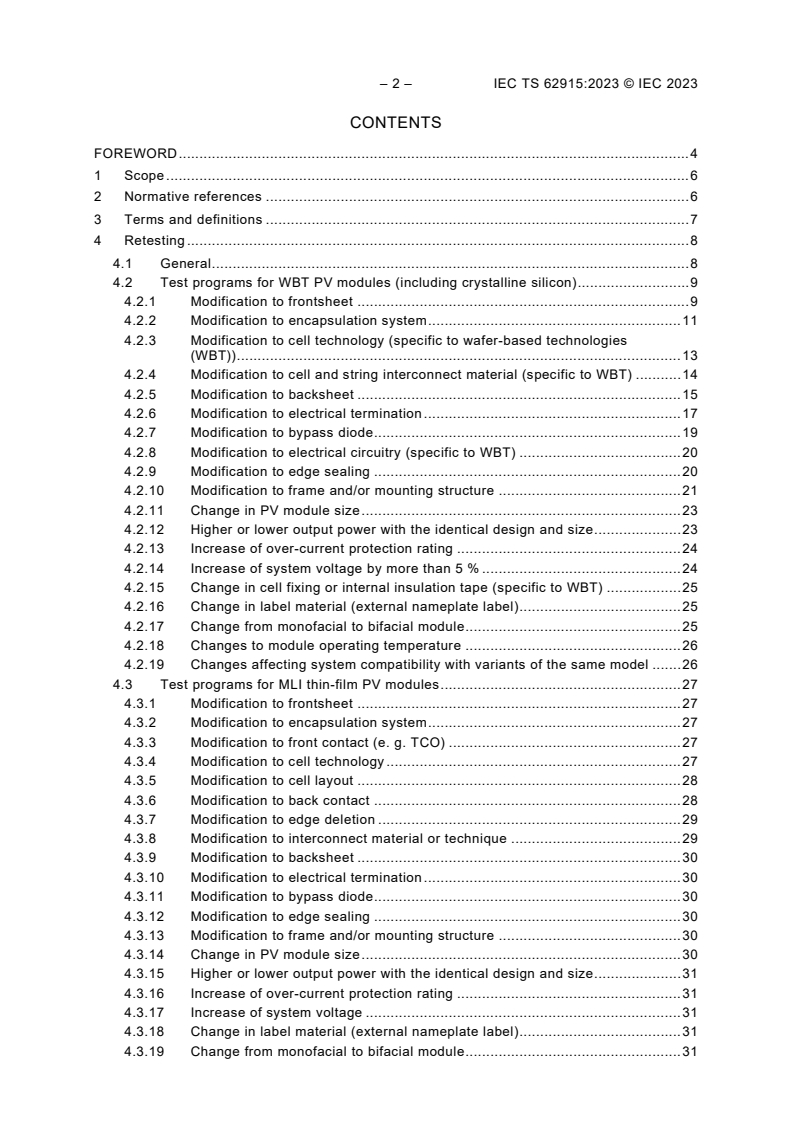
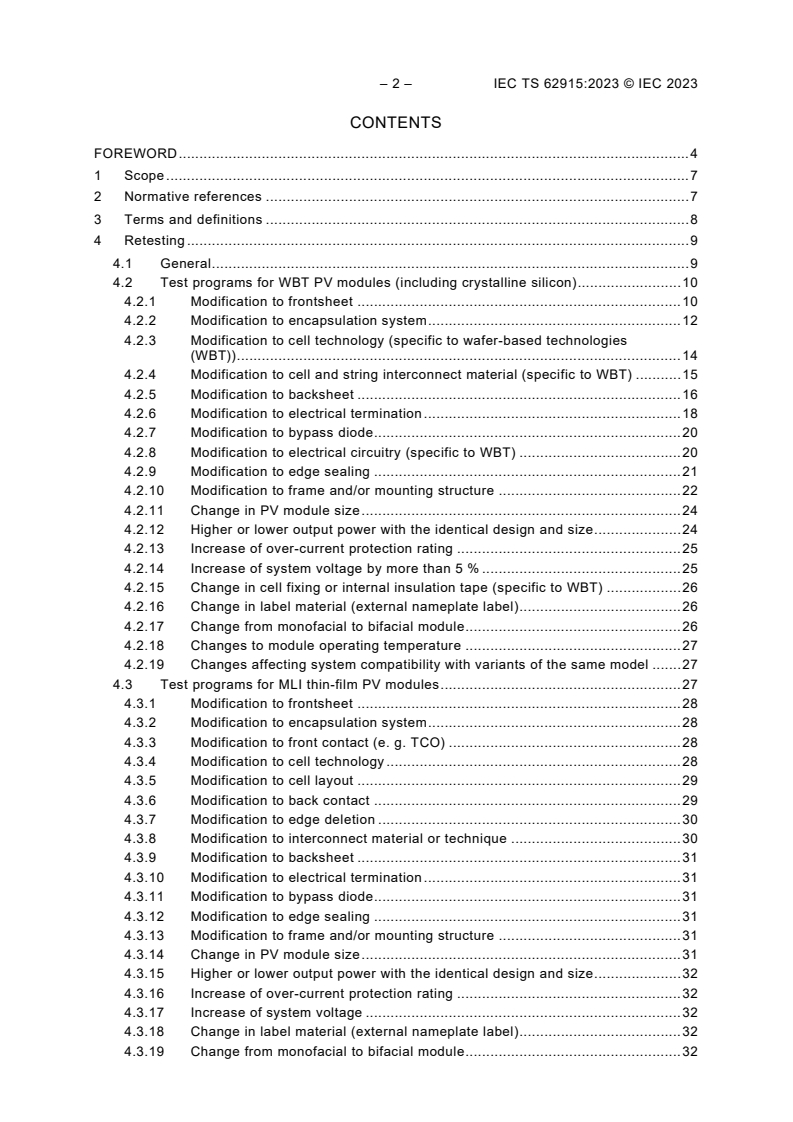
– 2 – IEC TS 62915:2023 © IEC 2023
CONTENTS
FOREWORD . 4
1 Scope . 6
2 Normative references . 6
3 Terms and definitions . 7
4 Retesting . 8
4.1 General . 8
4.2 Test programs for WBT PV modules (including crystalline silicon) . 9
4.2.1 Modification to frontsheet . 9
4.2.2 Modification to encapsulation system . 11
4.2.3 Modification to cell technology (specific to wafer-based technologies
(WBT)) . 13
4.2.4 Modification to cell and string interconnect material (specific to WBT) . 14
4.2.5 Modification to backsheet . 15
4.2.6 Modification to electrical termination . 17
4.2.7 Modification to bypass diode . 19
4.2.8 Modification to electrical circuitry (specific to WBT) . 20
4.2.9 Modification to edge sealing . 20
4.2.10 Modification to frame and/or mounting structure . 21
4.2.11 Change in PV module size . 23
4.2.12 Higher or lower output power with the identical design and size . 23
4.2.13 Increase of over-current protection rating . 24
4.2.14 Increase of system voltage by more than 5 % . 24
4.2.15 Change in cell fixing or internal insulation tape (specific to WBT) . 25
4.2.16 Change in label material (external nameplate label) . 25
4.2.17 Change from monofacial to bifacial module . 25
4.2.18 Changes to module operating temperature . 26
4.2.19 Changes affecting system compatibility with variants of the same model . 26
4.3 Test programs for MLI thin-film PV modules . 27
4.3.1 Modification to frontsheet . 27
4.3.2 Modification to encapsulation system . 27
4.3.3 Modification to front contact (e. g. TCO) . 27
4.3.4 Modification to cell technology . 27
4.3.5 Modification to cell layout . 28
4.3.6 Modification to back contact . 28
4.3.7 Modification to edge deletion . 29
4.3.8 Modification to interconnect material or technique . 29
4.3.9 Modification to backsheet . 30
4.3.10 Modification to electrical termination . 30
4.3.11 Modification to bypass diode . 30
4.3.12 Modification to edge sealing . 30
4.3.13 Modification to frame and/or mounting structure . 30
4.3.14 Change in PV module size . 30
4.3.15 Higher or lower output power with the identical design and size . 31
4.3.16 Increase of over-current protection rating . 31
4.3.17 Increase of system voltage . 31
4.3.18 Change in label material (external nameplate label) . 31
4.3.19 Change from monofacial to bifacial module . 31
4.3.20 Changes to module operating temperature . 31
4.3.21 Changes affecting compatibility with variants of the same model . 31
4.3.22 Changes to documentation . 31
Annex A (normative) Retests and test flow . 32
A.1 Required retests for PV modules, tabular overview . 32
A.2 Combined test flow IEC 61215 and IEC 61730 (see Figure A.1 and
Table A.2) . 39
A.3 Tests for new combinations of materials and/or components . 41
Bibliography . 43
Figure 1 – X-X and Y-Y axes relevant for the elastic section modulus of a typical PV
frame . 21
Figure A.1 – Combined test flow IEC 61215 and IEC 61730 . 39
Figure A.2 – Illustration of example for required tests for new material combinations . 42
Table A.1 – Required retests for PV modules . 32
Table A.2 – IEC identifiers for test sequences . 40
– 4 – IEC TS 62915:2023 © IEC 2023
INTERNATIONAL ELECTROTECHNICAL COMMISSION
____________
PHOTOVOLTAIC (PV) MODULES – TYPE APPROVAL,
DESIGN AND SAFETY QUALIFICATION – RETESTING
FOREWORD
1) The International Electrotechnical Commission (IEC) is a worldwide organization for standardization comprising
all national electrotechnical committees (IEC National Committees). The object of IEC is to promote international
co-operation on all questions concerning standardization in the electrical and electronic fields. To this end and
in addition to other activities, IEC publishes International Standards, Technical Specifications, Technical Reports,
Publicly Available Specifications (PAS) and Guides (hereafter referred to as “IEC Publication(s)”). Their
preparation is entrusted to technical committees; any IEC National Committee interested in the subject dealt with
may participate in this preparatory work. International, governmental and non-governmental organizations liaising
with the IEC also participate in this preparation. IEC collaborates closely with the International Organization for
Standardization (ISO) in accordance with conditions determined by agreement between the two organizations.
2) The formal decisions or agreements of IEC on technical matters express, as nearly as possible, an international
consensus of opinion on the relevant subjects since each technical committee has representation from all
interested IEC National Committees.
3) IEC Publications have the form of recommendations for international use and are accepted by IEC National
Committees in that sense. While all reasonable efforts are made to ensure that the technical content of IEC
Publications is accurate, IEC cannot be held responsible for the way in which they are used or for any
misinterpretation by any end user.
4) In order to promote international uniformity, IEC National Committees undertake to apply IEC Publications
transparently to the maximum extent possible in their national and regional publications. Any divergence between
any IEC Publication and the corresponding national or regional publication shall be clearly indicated in the latter.
5) IEC itself does not provide any attestation of conformity. Independent certification bodies provide conformity
assessment services and, in some areas, access to IEC marks of conformity. IEC is not responsible for any
services carried out by independent certification bodies.
6) All users should ensure that they have the latest edition of this publication.
7) No liability shall attach to IEC or its directors, employees, servants or agents including individual experts and
members of its technical committees and IEC National Committees for any personal injury, property damage or
other damage of any nature whatsoever, whether direct or indirect, or for costs (including legal fees) and
expenses arising out of the publication, use of, or reliance upon, this IEC Publication or any other IEC
Publications.
8) Attention is drawn to the Normative references cited in this publication. Use of the referenced publications is
indispensable for the correct application of this publication.
9) IEC draws attention to the possibility that the implementation of this document may involve the use of (a)
patent(s). IEC takes no position concerning the evidence, validity or applicability of any claimed patent rights in
respect thereof. As of the date of publication of this document, IEC had not received notice of (a) patent(s), which
may be required to implement this document. However, implementers are cautioned that this may not represent
the latest information, which may be obtained from the patent database available at https://patents.iec.ch. IEC
shall not be held responsible for identifying any or all such patent rights.
IEC TS 62915 has been prepared by IEC technical committee 82: Solar photovoltaic energy
systems. It is a Technical Specification.
This publication contains attached files in the form of xls document. These files are intended to
be used as a complement and do not form an integral part of the publication.
This second edition cancels and replaces the first edition published in 2018. This edition
constitutes a technical revision.
This edition includes the following significant technical changes with respect to the previous
edition:
• Prior references to specific process-related changes to PV modules have been removed in
this edition and replaced with a general requirement to ensure that a consistent quality
management system is in place per IEC 62941
• References to IEC 61215 and IEC 61730 have been updated to the latest editions (2021
and 2023 respectively)
o Retest requirements with respect to new added tests such as cyclic (dynamic)
mechanical load (MQT 20) and potential-induced degradation (MQT 21) are addressed
in this edition
• Retest requirements for IEC 61215 and IEC 61730 have been separated for the sake of
clarity
• A comprehensive matrix table summarizing all the retest requirements for each possible
change in material(s) or design modification is provided in this edition
• References to component level standards, namely IEC 62788-1 series and IEC 62788-2
series, are included in this edition to address changes that could be made to the critical sub-
components going into new PV module constructions
• Crystalline silicon and thin film references have been updated to be consistent with
nomenclature in the updated IEC 61215 and IEC 61730 standards; namely, wafer-based
technology (WBT) and monolithically integrated (MLI) thin film PV modules
• In this edition, 4.3 which addresses retest requirements for MLI thin film PV modules has
been truncated and simplified by removing redundant sections that are identical with the
subclauses in 4.2
• Guidance for retesting modules according to IEC TS 63126, “Guidelines for qualifying PV
modules, components and materials for operation at high temperatures” has been added
to this edition
• In this edition, requirements have been added for changes affecting system compatibility
with variants of the same model
The text of this technical specification is based on the following documents:
Enquiry draft Reports on voting
82/2121/DTS 82/2157A/RVDTS
Full information on the voting for the approval of this technical specification can be found in the
report on voting indicated in the above table.
The language used for the development of this Technical Specification is English.
This document was drafted in accordance with ISO/IEC Directives, Part 2, and developed in
accordance with ISO/IEC Directives, Part 1 and ISO/IEC Directives, IEC Supplement, available
at www.iec.ch/members_experts/refdocs. The main document types developed by IEC are
described in greater detail at www.iec.ch/publications.
The committee has decided that the contents of this document will remain unchanged until the
stability date indicated on the IEC website under webstore.iec.ch in the data related to the
specific document. At this date, the document will be
• reconfirmed,
• withdrawn, or
• revised.
IMPORTANT – The 'colour inside' logo on the cover page of this publication indicates that it
contains colours which are considered to be useful for the correct understanding of its
contents. Users should therefore print this document using a colour printer.
– 6 – IEC TS 62915:2023 © IEC 2023
PHOTOVOLTAIC (PV) MODULES – TYPE APPROVAL,
DESIGN AND SAFETY QUALIFICATION – RETESTING
1 Scope
This document sets forth a uniform approach to maintain type approval, design and safety
qualification of terrestrial PV modules that have undergone or will undergo modification from
their originally assessed design. This document addresses two types of PV module
technologies, wafer-based technologies (WBT) and monolithically-integrated (MLI) thin-film
based technologies.
Changes in material selection, components and manufacturing process can impact electrical
performance, reliability and safety of the modified product. This document lists typical
modifications and the resulting requirements for retesting based on the different test standards.
It provides assistance; at some level, engineering judgement may be needed.
The test sequences are selected to identify adverse changes to the modified product.
Those products successfully following the herein defined test sequences are considered to be
compliant with the standard against which they have originally been assessed in a full
qualification.
The number of samples to be included in the retesting program and the pass/fail criteria are
listed in the referenced standards IEC 61215 and IEC 61730. In addition, a representative
sample may be used as described in IEC 61215 and IEC 61730 as applicable.
2 Normative references
The following documents are referred to in the text in such a way that some or all of their content
constitutes requirements of this document. For dated references, only the edition cited applies.
For undated references, the latest edition of the referenced document (including any
amendments) applies.
IEC 61215-1:2021, Terrestrial photovoltaic (PV) modules – Design qualification and type
approval – Part 1: Test requirements
IEC 61215-2:2021, Terrestrial photovoltaic (PV) modules – Design qualification and type
approval – Part 2: Test procedures
IEC 61730-1:2023, Photovoltaic (PV) module safety qualification – Part 1: Requirements for
construction
IEC 61730-2:2023, Photovoltaic (PV) module safety qualification – Part 2: Requirements for
testing
IEC TS 61836, Solar photovoltaic energy systems – Terms, definitions and symbolsIEC 62788-
2-1, Measurement procedures for materials used in photovoltaic modules – Part 2-1: Polymeric
materials – Frontsheet and backsheet – Safety requirements
IEC 62790, Junction boxes for photovoltaic modules – Safety requirements and tests
IEC 62852, Connectors for DC-application in photovoltaic systems – Safety requirements and
tests
IEC 62930, Electric cables for photovoltaic systems with a voltage rating of 1,5 kV DC
IEC 62941:2019, Terrestrial photovoltaic (PV) modules - Quality system for PV module
manufacturing
IEC TS 63126 2020, Guidelines for qualifying PV modules, components, and materials for
operation at high temperatures
ISO 9001, Quality management systems – Requirements
3 Terms and definitions
For the purposes of this document, the terms and definitions given in IEC 61215-1,
IEC 61215-2, IEC 61730-1 and IEC TS 61836, as well as the following apply.
ISO and IEC maintain terminological databases for use in standardization at the following
addresses:
• IEC Electropedia: available at http://www.electropedia.org/
• ISO Online browsing platform: available at http://www.iso.org/obp
3.1
different material
material that differs in its chemical composition, type designation, or specification from the
material it replaces (including, e.g., electrical, optical, mechanical properties; the nominal
values including tolerances shall be considered)
Note 1 to entry: However the same material provided by a different supplier or manufacturing location is not
necessarily a different material as long as it can be clearly demonstrated.
Note 2 to entry: See relevant component clauses for further definition and clarification. For polymeric components,
refer to the relevant standards, IEC 62788-1 and, IEC 62788-2 series, for more specific definition of materials with
alternate constructions that could qualify as the same model designation.
3.2
control plan
documented description of the systems and processes required for controlling the product and
process quality by addressing the key characteristics and engineering requirements
[SOURCE IEC 62941:2019, 3.2]
3.3
nominal value
value of a quantity used to designate and identify a component, device, equipment, or system
[SOURCE IEC 60050-151:2001, 151-16-09]
3.4
UV cut-off wavelength
λ
cUV
wavelength of light below which the material is considered optically absorbing and above which
the material is considered transmitting
Note 1 to entry: In this procedure, the absolute transmittance of 10 % (corresponding to the optical absorbance of
1) is considered as the threshold of the UV cut-off wavelength.
[SOURCE IEC 62788-1-4:2016, 3.3]
– 8 – IEC TS 62915:2023 © IEC 2023
3.5
tolerance
manufacturing deviation of declared nominal value
3.6
th
98 -percentile temperature
th
-
when temperature data from a varying temperature process are placed into rank order, the 98
percentile temperature represents a temperature that is larger than 98 percent of remaining
temperatures and is exactly met or exceeded only 2 % of the time
th
Note 1 to entry: The 98 -percentile temperature is to be determined from data taken at hourly, or more frequent,
th
measurements. For a standard year, the 98 -percentile temperature would be met or exceeded for 175,2 h.
[SOURCE IEC TS 63126:2020, 3.4]
3.7
temperature level 1
th
is used to categorize test modifications and applies for PV modules whose 98 -percentile
temperature falls into the range greater than 70 °C but less than or equal to 80 °C
[SOURCE IEC TS 63126:2020, 3.5]
3.8
temperature level 2
th
is used to categorize test modifications and applies for PV modules whose 98 -percentile
temperature falls into the range greater than 80 °C but less than or equal to 90 °C
[SOURCE IEC TS 63126:2020, 3.6]
4 Retesting
4.1 General
This clause is separated into one subclause each for WBT and for MLI technologies. Within
those subclauses, retest requirements are defined for both IEC 61215 and IEC 61730 whether
standalone or combined. The document is organized by major modification headings with
specific supporting examples and parenthetical reference to the specific clauses of the relevant
IEC standards.
The manufacturer shall have the responsibility of disclosing changes in the design, materials,
components, material combinations, manufacturers or processing of the PV module type family
from the last tested version. Such changes may require a repetition of some or all of the
qualification tests according to the clauses that follow in order to maintain type and safety
approval. The manufacturer is also responsible for providing any necessary data to support
component level changes which may reduce re-test requirements. For any assessment of a new
thickness or dimension of a material or component, the initially tested thickness or dimension
shall be used as reference. Any variation of a parameter may be assessed as a change if the
new value is out of the tolerance from the nominal value of this parameter. If the declared
tolerance of the manufacturer exceeds the relative percentage change that would trigger a
required re-test (e.g. 10 % reduction in thickness of glass frontsheet), then the component under
question shall be submitted for testing with the extreme worst-case value.
Annex A provides a comprehensive summary table of all the test requirements as well as a new
version of the detailed combined test flow of IEC 61730:2023 and IEC 61215:2021.
All combinations of materials and components shall be evaluated based on the provided
detailed matrix tables in Clause A.3. The test sequences required for single-component
modifications can be identified from the look-up table in Clause A.3 and comparing against the
requirements of a second material alteration. If the combination is not shared between the
combination being evaluated or is not available, then that particular combination testing is not
required. A specific example is provided in Figure A.2 for clarification.
Each PV module delivered for retesting shall be subjected to electrical stabilisation (MQT 19),
as applicable by the relevant type approval standard.
Initial and final measurements as listed in the referenced standards shall be performed before
and after the specific tests, for example:
a) Tests MQT 01 / 03 / 06.1 / 15 / 19 for an IEC 61215 retest program.
b) Tests MST 01 / 03 / 16 / 17 for an IEC 61730 retest program.
Refer to the testing tree in unclear cases. For example, the module breakage test (MST 32)
does not require MST 03 / 16 / 17 for an IEC 61730 retest program but does however require
MST 01.
Any scenario including a change in the optical path or electric circuitry that may or may not
require retesting detailed in Clause A.3 as defined hereinafter shall include an STC output
power measurement (MQT 06.1). For IEC 61215 related re-test programs (standalone or
combined with IEC 61730), the measured stabilized power, open-circuit voltage and short-
circuit current shall be assessed against the rating (Gate No. 1), and the relative change in
output power (in the event of a retest) shall be assessed (Gate No. 2) according to the pass
criteria defined in IEC 61215-1.
The Durability of markings (MST 05) and the Sharp edge test (MST 06) need to be considered
in general for all design changes which may impact the results of these tests. Unless otherwise
noted, reference to Damp Heat testing (MST 53) per IEC 61730 shall mean the full duration of
1000 h.
The Bypass diode functionality test (MST 07), Accessibility test (MST 11), and Continuity test
of equipotential bonding (MST 13) shall also be considered for all design changes which may
impact the results of these tests.
If multiple tests from a test sequence are required, they shall be done in the sequence
prescribed by the referenced standard even if only a portion of the tests from a given sequence
are required for re-testing (e.g. in Sequence B of IEC 61730, if the frontside UV exposure is
omitted, the rest of the sequence shall be done sequentially as in the original standard).
Any changes in the design of the PV module shall comply with IEC 61730-1 and/or IEC 61215-1
(requirements for construction) depending on the scope of the retest project, whether
standalone or combined. Furthermore, any changes in the design of the PV module requiring a
modification in the installation method which would not qualify as a compatible alternative
requires the designation of a new model number in accordance with 4.2.19 or 4.3.20, as
applicable.
4.2 Test programs for WBT PV modules (including crystalline silicon)
NOTE See Table A.1 for a summary of the retest requirements for WBT PV modules.
4.2.1 Modification to frontsheet
A change from glass to non-glass or vice-versa requires a full qualification. Modifications to
polymeric frontsheets shall be confirmed to comply with the requirements of IEC 62788-2-1.
For the following modifications:
– 10 – IEC TS 62915:2023 © IEC 2023
• Any of the following changes resulting in a different polymeric frontsheet model designation
according to the requirements of IEC 62788-2-1:
– Reduction of thickness by more than the larger of 10 % or ± 5 µm of any one of the
individual relied upon insulation (RUI) layers (while maintaining the required minimum
distance through insulation)
– If the reduction in thickness is less than 10 % in any one of the individual RUI layers,
the minimum distance through insulation should be rechecked (MST 04). MST 04 can
be done on a fresh laminate in this case
– For non-RUI layers, a reduction in thickness by more than 20 %
– Different surface treatment, e.g. any coating on frontsheet (inside or outside)
– A different material, i.e. any change other than those listed above that results in a model
designation change per IEC 62788-2-1
NOTE For polymeric frontsheets refer to IEC 62788-2-1 for guidance on frontsheet model designation and testing
requirements for a series of frontsheets of similar construction.
• Different material (for glass)
– It could be considered the same material from a different supplier or manufacturing
location as long as the following properties are the same: thickness, anti-reflective
coating employing identical chemistry and process, patterned or float solar glass,
maximum bow allowed (e.g. 3 mm to 4 mm across entire glass surface), and thermal or
chemical strengthening process (e.g. full-tempered or thermally/chemically toughened
glass). Nominal values and tolerances shall be considered when determining similarity.
• Glass: reduction of thickness by more than 10 %
• For glass, if there is a reduction in the strengthening process (for example retest if change
is from tempered glass to heat strengthened or annealed)
• For glass, different surface treatment, e.g. any coating on frontsheet (inside or outside)
Repeat for IEC 61215 (w/o IEC 61730; standalone):
• Hot-spot endurance test (MQT 09) if change in material, strengthening process or if
thickness is reduced.
• UV preconditioning test (MQT 10) / Cyclic (dynamic) mechanical load test (MQT 20) /
Thermal cycling test, 50 cycles (MQT 11) / Humidity freeze test (MQT 12) / Retention of
junction box on mounting surface (MQT 14.1)
– Entire sequence can be omitted for glass with λcUV at or above the glass which was
previously tested.
– MQT 14.1 can be omitted if junction box is not mounted on the frontsheet or for change
in glass thickness
• Damp heat test (MQT 13) if non-glass or if surface treatment is added/changed (inside or
outside)
• Bending Test (MQT 22) if non-glass and if module is considered to be “flexible” per the
definition specified in IEC 61215
– Can be omitted for changes related only to outside surface treatment
• Static mechanical load test (MQT 16) (can be omitted for different outside surface
treatments)
• Hail test (MQT 17) (can be omitted for different surface treatment)
Repeat for IEC 61730 (w/o IEC 61215; standalone):
• Hot-spot endurance test (MST 22) if change in material, strengthening process or if
thickness is reduced for non-glass frontsheet
• UV test (MST 54) / Thermal cycling test, 50 cycles (MST 51) / Humidity freeze test (MST
52) / Robustness of terminations test (MST 42).
– Entire sequence can be omitted for glass with λcUV at or above the glass which was
previously tested
– MST 42 can be omitted if junction box is not mounted on the frontsheet or for change in
glass thickness
• Damp heat test (MST 53) if non-glass or if surface treatment is added/changed (inside or
outside)
• Static mechanical load test (MST 34) (can be omitted for different outside surface
treatments)
• Insulation thickness test (MST 04) if non-glass
• Cut susceptibility test (MST 12) if non-glass
• Impulse voltage test (MST 14) if non-glass and reduced thickness or if change in material
• Ignitability test (MST 24) if non-glass
• Module breakage test (MST 32) (can be omitted for different surface treatments)
• Peel test (MST 35) or Lap shear strength test (MST 36) if design includes cemented joint
(not for reduction of thickness, not for different outer surface treatment and not for change
in glass strengthening process)
• Materials creep test (MST 37)
– For more than 10 % increase in glass thickness and 20 % for non-glass thickness,
frameless modules only (not required for framed modules).
• Sequence B if non-glass
• Sequence B1 if design qualified for pollution degree 1 (not for reduction of thickness, not
for different outside surface treatment and not for change in glass strengthening process)
Repeat for IEC 61730 (if IEC 61215 already included):
• Insulation thickness test (MST 04) if non-glass
• Cut susceptibility test (MST 12) if non-glass
• Impulse voltage test (MST 14) if non-glass and reduced thickness or if change in material
• Ignitability test (MST 24) if non-glass
• Module breakage test (MST 32) (can be omitted for different surface treatments that do not
impair mechanical strength)
• Peel test (MST 35) or Lap shear strength test (MST 36) if design includes cemented joint
(not for change of thickness, not for different outer surface treatment and not for change in
glass strengthening process)
• Materials creep test (MST 37)
– For more than 10 % increase in glass thickness and 20 % for non-glass thickness,
frameless modules only (not required for framed modules).
• Sequence B if non-glass
• Sequence B1 if design qualified for pollution degree 1 (not for reduction of thickness, not
for different outside surface treatment and not for change in glass strengthening process)
4.2.2 Modification to encapsulation system
For the following modifications:
• Different material
• Change in amount or type of additives but same material (e.g. EVA) from the same
manufacturer
– 12 – IEC TS 62915:2023 © IEC 2023
• Different lamination process or equipment that is not under the same quality management
system as defined in the manufacturer’s control plan (such as IEC 62941 or ISO 9001, see
defined terms above); in this scenario the quality control plan describing appropriate
lamination process controls shall be provided for review
• Reduction in thickness of a single encapsulation film (sunny-side or rearside) by more than
20 % prior to processing (thickness shall also be expressed in aerial density, e.g. in g/cm
to ensure that the amount of material is properly specified)
Repeat for IEC 61215 (w/o IEC 61730; standalone):
• Hot-spot endurance test (MQT 09)
• UV preconditioning test (MQT 10) / Cyclic (dynamic) mechanical load test (MQT 20) /
Thermal cycling test, 50 cycles (MQT 11) / Humidity freeze test (MQT 12)
– Can omit cyclic (dynamic) mechanical load test (MQT 20) for change in amount or type
of additives but same material
• Thermal cycling test, 200 cycles (MQT 11)
– Only required if reduction in thickness or g/m by more than 20 %
• Damp heat test (MQT 13)
• Hail test (MQT 17) if frontsheet is polymeric
– Can omit hail test (MQT 17) for change in amount or type of additives but same material
• Potential induced degradation test (MQT 21)
– If volume resistivity (according to IEC 62788-1-2) specified for the sunny-side or rear-
side stack decreases by more than 1 order of magnitude (e.g. 1017 Ω-m vs. 1018 Ω-m)
• Bending Test (MQT 22) if module is considered to be “flexible” per the definition specified
in IEC 61215
Repeat for IEC 61730 (w/o IEC 61215; standalone):
• Hot-spot endurance test (MST 22)
• UV test (MST 54) / Thermal cycling test, 50 cycles (MST 51) / Humidity freeze test (MST
52)
• Thermal cycling test, 200 cycles (MST 51)
– Only required if reduction in thickness or g/m by more than 20 %
• Damp heat test (MST 53)
• Cut susceptibility test (MST 12) if frontsheet or backsheet is polymeric
• Impulse voltage test (MST 14) if reduced thickness or if different material
• Module breakage test (MST 32) if material composition changes
• Peel test (MST 35) or Lap shear strength test (MST 36) if design includes encapsulant as a
part of a qualified cemented joint
• Materials creep test (MST 37)
• Sequence B (only for different material or reduction in thickness)
• Sequence B1 if design qualified for pollution degree 1
Repeat for IEC 61730 (if IEC 61215 already included):
• Cut susceptibility test (MST 12) if frontsheet or backsheet is polymeric
• Impulse voltage test (MST 14) if reduced thickness or if different material
• Module breakage test (MST 32) if material composition changes
• Peel test (MST 35) or Lap shear strength test (MST 36) if design includes encapsulant as a
part of a qualified cemented joint
• Materials creep test (MST 37)
• Sequence B (only for different material or reduction in thickness)
• Sequence B1 if design qualified for pollution degree 1
4.2.3 Modification to cell technology (specific to wafer-based technologies (WBT))
For the following modifications:
• Metallization material composition (e.g. paste, only inorganic components)
• Decrease in total bonded area (between solder pad on cell and interconnecting ribbon/wire)
by more than 15 %
• Increase in number of busbars
• Change in anti-reflective coating
• Change in cell technology. For example changes between any of the following:
– p-type, n-type, Aluminum Back-Surface Field (Al BSF), Passivated Emitter/Rear Contact
(PERC), Passivated Emitter/Rear Totally diffused (PERT), Heterojunction Technology or
Heterojunction Intrinsic Thin film (HJT/HIT), front/rear contact, back-contact Metal Wrap-
Through or Interdigitated Back-Contact (MWT/IBC), Tunneling Oxide Passivated
Contact (TOPCon), addition of selective emitter, monofacial PERC to bifacial PERC.
• Change in wafer crystallization (i.e. mono- versus poly-crystalline versus cast-mono)
• Change of manufacturing site of the solar cells not under the same quality management
system as defined in the manufacturer’s control plan (such as IEC 62941 or ISO 9001, see
defined terms above); in this scenario the quality control plan describing critical solar cell
manufacturing processes shall be provided
• Reduction in nominal cell thickness greater than 10 %
• Different size of cell (e.g. M3/G1, 158,75 mm vs. M6, 166 mm) if more than 10 % in length,
width, or area as long as cell to cell, or cell to bussing ribbon spacing is the same or larger.
• Change from full-sized cells to cut cells (e.g. halved)
– Re-test should not be required:
If a cell supplier and part number for an un-cut cell have already been tested and
qualified by module manufacturer AND if module manufacturer has already qualified
a half-cell of same technology from another cell supplier (given that module
manufacturer is the one cutting cells).
Repeat for IEC 61215 (w/o IEC 61730; standalone):
• Cyclic (dynamic) mechanical load test (MQT 20) / Thermal cycling test, 50 cycles (MQT 11)
/ Humidity freeze test (MQT 12)
• Potential-Induced Degradation (MQT 21) only for change in technology, i.e. semiconductor
layer material, anti-reflective (AR) coating, crystallization, or different manufacturer
• Hot-spot endurance test (MQT 09)
• Thermal cycling test, 200 cycles (MQT 11)
• Damp heat test (MQT 13) (may be omitted for change in crystallization or if outer surface of
cell is chemically identical (metallization and AR coating))
• Static mechanical load test (MQT 16) for reduction of cell thickness or change in
crystallization only
• Hail test (MQT 17) for reduction of cell thickness only
• Bending Test (MQT 22) if module is considered to be “flexible” per the definition specified
in IEC 61215
– 14 – IEC TS 62915:2023 © IEC 2023
– Can be omitted for change in anti-reflective coating, change in semiconductor layer
material, change in crystallization or change in manufacturing site / different
manufacturer
Repeat for IEC 61730 (w/o IEC 61215; standalone):
• Hot-spot endurance test (MST 22)
• Thermal cycling test, 200 cycles (MST 51)
• Damp heat test (MST 53) (may be omitted for change in crystallization or if outer surface of
cell is chemically identical (metallization and AR coating))
• Static mechanical load test (MST 34) for reduction of cell thickness or change in
crystallization only
• Reverse current overload test (MST 26)
– Can be omitted for crystallization
Repeat for IEC 61730 (if IEC 61215 already included):
• Reverse current overload test (MST 26)
– Can be omitted for crystallization
4.2.4 Modification to cell and string interconnect material (specific to WBT)
For the following modifications:
• Different material (e.g. alloy, coating, chemistry, and core)
– It could be considered the same material from a different supplier or manufacturing
location as long as the following properties are specified: thickness/diameter, width,
alloy, chemistry, core thickness/diameter (within the ranges allowable in the change in
thickness definition below), coating chemistry, and coating thickness (within the ranges
allowable in the change in thickness definition below).
• Reduction in minimum tensile strength by more than 20 %, or an increase in maximum yield
strength by more than 20 %, or a reduction in minimum elongation to break by more than
20 %
• Change in core thickness/diameter by more than 10 %, change in coating thickness by more
than 30 %, or the change in the area of cross section (including ribbon core and coating) by
more than 10 %
• Change in (total) cross-section of interconnect material (e.g., more busbars / more busbars
with less width) or different bonding technique (e.g. an IR lamp process vs. induction
soldering process) that is not under the same quality management system as defined in a
manufacturer’s control plan (such as IEC 62941 or ISO 9001, see defined terms above); in
this scenario the quality control plan describing critical interconnection bonding
manufacturing processes shall be provided
• Change in the number of interconnect or bonding points or decrease in bonding area per
contact point
• Decrease in length of interconnect material by more than 10 % between last bond on one
cell and first bond on the adjacent cell
• Different solder paste/wire, flux, or conductive adhesive
• Change in insulation tape/film (change in area > 30 %, change in thickness > 25 %, material,
manufacturer)
• Change or addition of engineered tapes on or around interconnect ribbon (such as Light
Reflecting Film)
NOTE It is possible that different stringing/soldering equipment can affect performance of cell and string
interconnect bonds during environmental chamber stress. Therefore, it is prudent to check that the quality
management system in place during the original certification testing verifies that new or different stringing/soldering
equipment is routinely checked for key process control parameters such as peel strength and re-crystallization depth.
Repeat for IEC 61215 (w/o IEC 61730; standalone):
• Hot-spot endurance test (MQT 09) for c
...
IEC TS 62915 ®
Edition 2.0 2023-09
TECHNICAL
SPECIFICATION
colour
inside
Photovoltaic (PV) modules – Type approval, design and safety qualification –
Retesting
All rights reserved. Unless otherwise specified, no part of this publication may be reproduced or utilized in any form
or by any means, electronic or mechanical, including photocopying and microfilm, without permission in writing from
either IEC or IEC's member National Committee in the country of the requester. If you have any questions about IEC
copyright or have an enquiry about obtaining additional rights to this publication, please contact the address below or
your local IEC member National Committee for further information.
IEC Secretariat Tel.: +41 22 919 02 11
3, rue de Varembé info@iec.ch
CH-1211 Geneva 20 www.iec.ch
Switzerland
About the IEC
The International Electrotechnical Commission (IEC) is the leading global organization that prepares and publishes
International Standards for all electrical, electronic and related technologies.
About IEC publications
The technical content of IEC publications is kept under constant review by the IEC. Please make sure that you have the
latest edition, a corrigendum or an amendment might have been published.
IEC publications search - webstore.iec.ch/advsearchform IEC Products & Services Portal - products.iec.ch
The advanced search enables to find IEC publications by a Discover our powerful search engine and read freely all the
variety of criteria (reference number, text, technical publications previews. With a subscription you will always have
committee, …). It also gives information on projects, replaced access to up to date content tailored to your needs.
and withdrawn publications.
Electropedia - www.electropedia.org
IEC Just Published - webstore.iec.ch/justpublished
The world's leading online dictionary on electrotechnology,
Stay up to date on all new IEC publications. Just Published
containing more than 22 300 terminological entries in English
details all new publications released. Available online and once
and French, with equivalent terms in 19 additional languages.
a month by email.
Also known as the International Electrotechnical Vocabulary
(IEV) online.
IEC Customer Service Centre - webstore.iec.ch/csc
If you wish to give us your feedback on this publication or need
further assistance, please contact the Customer Service
Centre: sales@iec.ch.
IEC TS 62915 ®
Edition 2.0 2023-09
TECHNICAL
SPECIFICATION
colour
inside
Photovoltaic (PV) modules – Type approval, design and safety qualification –
Retesting
INTERNATIONAL
ELECTROTECHNICAL
COMMISSION
ICS 27.160 ISBN 978-2-8322-7444-6
– 2 – IEC TS 62915:2023 © IEC 2023
CONTENTS
FOREWORD . 4
1 Scope . 7
2 Normative references . 7
3 Terms and definitions . 8
4 Retesting . 9
4.1 General . 9
4.2 Test programs for WBT PV modules (including crystalline silicon) . 10
4.2.1 Modification to frontsheet . 10
4.2.2 Modification to encapsulation system . 12
4.2.3 Modification to cell technology (specific to wafer-based technologies
(WBT)) . 14
4.2.4 Modification to cell and string interconnect material (specific to WBT) . 15
4.2.5 Modification to backsheet . 16
4.2.6 Modification to electrical termination . 18
4.2.7 Modification to bypass diode . 20
4.2.8 Modification to electrical circuitry (specific to WBT) . 20
4.2.9 Modification to edge sealing . 21
4.2.10 Modification to frame and/or mounting structure . 22
4.2.11 Change in PV module size . 24
4.2.12 Higher or lower output power with the identical design and size . 24
4.2.13 Increase of over-current protection rating . 25
4.2.14 Increase of system voltage by more than 5 % . 25
4.2.15 Change in cell fixing or internal insulation tape (specific to WBT) . 26
4.2.16 Change in label material (external nameplate label) . 26
4.2.17 Change from monofacial to bifacial module . 26
4.2.18 Changes to module operating temperature . 27
4.2.19 Changes affecting system compatibility with variants of the same model . 27
4.3 Test programs for MLI thin-film PV modules . 27
4.3.1 Modification to frontsheet . 28
4.3.2 Modification to encapsulation system . 28
4.3.3 Modification to front contact (e. g. TCO) . 28
4.3.4 Modification to cell technology . 28
4.3.5 Modification to cell layout . 29
4.3.6 Modification to back contact . 29
4.3.7 Modification to edge deletion . 30
4.3.8 Modification to interconnect material or technique . 30
4.3.9 Modification to backsheet . 31
4.3.10 Modification to electrical termination . 31
4.3.11 Modification to bypass diode . 31
4.3.12 Modification to edge sealing . 31
4.3.13 Modification to frame and/or mounting structure . 31
4.3.14 Change in PV module size . 31
4.3.15 Higher or lower output power with the identical design and size . 32
4.3.16 Increase of over-current protection rating . 32
4.3.17 Increase of system voltage . 32
4.3.18 Change in label material (external nameplate label) . 32
4.3.19 Change from monofacial to bifacial module . 32
4.3.20 Changes to module operating temperature . 32
4.3.21 Changes affecting compatibility with variants of the same model . 32
4.3.22 Changes to documentation . 32
Annex A (normative) Retests and test flow . 33
A.1 Required retests for PV modules, tabular overview . 33
A.2 Combined test flow IEC 61215 and IEC 61730 (see Figure A.1 and
Table A.2) . 40
A.3 Tests for new combinations of materials and/or components . 42
Bibliography . 44
Figure 1 – X-X and Y-Y axes relevant for the elastic section modulus of a typical PV
frame . 22
Figure A.1 – Combined test flow IEC 61215 and IEC 61730 . 40
Figure A.2 – Illustration of example for required tests for new material combinations . 43
Table A.1 – Required retests for PV modules . 33
Table A.2 – IEC identifiers for test sequences . 41
– 4 – IEC TS 62915:2023 © IEC 2023
INTERNATIONAL ELECTROTECHNICAL COMMISSION
____________
PHOTOVOLTAIC (PV) MODULES – TYPE APPROVAL,
DESIGN AND SAFETY QUALIFICATION – RETESTING
FOREWORD
1) The International Electrotechnical Commission (IEC) is a worldwide organization for standardization comprising
all national electrotechnical committees (IEC National Committees). The object of IEC is to promote international
co-operation on all questions concerning standardization in the electrical and electronic fields. To this end and
in addition to other activities, IEC publishes International Standards, Technical Specifications, Technical Reports,
Publicly Available Specifications (PAS) and Guides (hereafter referred to as “IEC Publication(s)”). Their
preparation is entrusted to technical committees; any IEC National Committee interested in the subject dealt with
may participate in this preparatory work. International, governmental and non-governmental organizations liaising
with the IEC also participate in this preparation. IEC collaborates closely with the International Organization for
Standardization (ISO) in accordance with conditions determined by agreement between the two organizations.
2) The formal decisions or agreements of IEC on technical matters express, as nearly as possible, an international
consensus of opinion on the relevant subjects since each technical committee has representation from all
interested IEC National Committees.
3) IEC Publications have the form of recommendations for international use and are accepted by IEC National
Committees in that sense. While all reasonable efforts are made to ensure that the technical content of IEC
Publications is accurate, IEC cannot be held responsible for the way in which they are used or for any
misinterpretation by any end user.
4) In order to promote international uniformity, IEC National Committees undertake to apply IEC Publications
transparently to the maximum extent possible in their national and regional publications. Any divergence between
any IEC Publication and the corresponding national or regional publication shall be clearly indicated in the latter.
5) IEC itself does not provide any attestation of conformity. Independent certification bodies provide conformity
assessment services and, in some areas, access to IEC marks of conformity. IEC is not responsible for any
services carried out by independent certification bodies.
6) All users should ensure that they have the latest edition of this publication.
7) No liability shall attach to IEC or its directors, employees, servants or agents including individual experts and
members of its technical committees and IEC National Committees for any personal injury, property damage or
other damage of any nature whatsoever, whether direct or indirect, or for costs (including legal fees) and
expenses arising out of the publication, use of, or reliance upon, this IEC Publication or any other IEC
Publications.
8) Attention is drawn to the Normative references cited in this publication. Use of the referenced publications is
indispensable for the correct application of this publication.
9) IEC draws attention to the possibility that the implementation of this document may involve the use of (a)
patent(s). IEC takes no position concerning the evidence, validity or applicability of any claimed patent rights in
respect thereof. As of the date of publication of this document, IEC had not received notice of (a) patent(s), which
may be required to implement this document. However, implementers are cautioned that this may not represent
the latest information, which may be obtained from the patent database available at https://patents.iec.ch. IEC
shall not be held responsible for identifying any or all such patent rights.
IEC TS 62915 has been prepared by IEC technical committee 82: Solar photovoltaic energy
systems. It is a Technical Specification.
This publication contains attached files in the form of xls document. These files are intended to
be used as a complement and do not form an integral part of the publication.
This second edition cancels and replaces the first edition published in 2018. This edition
constitutes a technical revision.
This edition includes the following significant technical changes with respect to the previous
edition:
• Prior references to specific process-related changes to PV modules have been removed in
this edition and replaced with a general requirement to ensure that a consistent quality
management system is in place per IEC 62941
• References to IEC 61215 and IEC 61730 have been updated to the latest editions (2021
and 2023 respectively)
o Retest requirements with respect to new added tests such as cyclic (dynamic)
mechanical load (MQT 20) and potential-induced degradation (MQT 21) are addressed
in this edition
• Retest requirements for IEC 61215 and IEC 61730 have been separated for the sake of
clarity
• A comprehensive matrix table summarizing all the retest requirements for each possible
change in material(s) or design modification is provided in this edition
• References to component level standards, namely IEC 62788-1 series and IEC 62788-2
series, are included in this edition to address changes that could be made to the critical sub-
components going into new PV module constructions
• Crystalline silicon and thin film references have been updated to be consistent with
nomenclature in the updated IEC 61215 and IEC 61730 standards; namely, wafer-based
technology (WBT) and monolithically integrated (MLI) thin film PV modules
• In this edition, 4.3 which addresses retest requirements for MLI thin film PV modules has
been truncated and simplified by removing redundant sections that are identical with the
subclauses in 4.2
• Guidance for retesting modules according to IEC TS 63126, “Guidelines for qualifying PV
modules, components and materials for operation at high temperatures” has been added
to this edition
• In this edition, requirements have been added for changes affecting system compatibility
with variants of the same model
The text of this technical specification is based on the following documents:
Enquiry draft Reports on voting
82/2121/DTS 82/2157A/RVDTS
Full information on the voting for the approval of this technical specification can be found in the
report on voting indicated in the above table.
The language used for the development of this Technical Specification is English.
This document was drafted in accordance with ISO/IEC Directives, Part 2, and developed in
accordance with ISO/IEC Directives, Part 1 and ISO/IEC Directives, IEC Supplement, available
at www.iec.ch/members_experts/refdocs. The main document types developed by IEC are
described in greater detail at www.iec.ch/publications.
– 6 – IEC TS 62915:2023 © IEC 2023
The committee has decided that the contents of this document will remain unchanged until the
stability date indicated on the IEC website under webstore.iec.ch in the data related to the
specific document. At this date, the document will be
• reconfirmed,
• withdrawn, or
• revised.
IMPORTANT – The 'colour inside' logo on the cover page of this publication indicates that it
contains colours which are considered to be useful for the correct understanding of its
contents. Users should therefore print this document using a colour printer.
The contents of the corrigendum 1 (2024-08) have been included in this copy.
PHOTOVOLTAIC (PV) MODULES – TYPE APPROVAL,
DESIGN AND SAFETY QUALIFICATION – RETESTING
1 Scope
This document sets forth a uniform approach to maintain type approval, design and safety
qualification of terrestrial PV modules that have undergone or will undergo modification from
their originally assessed design. This document addresses two types of PV module
technologies, wafer-based technologies (WBT) and monolithically-integrated (MLI) thin-film
based technologies.
Changes in material selection, components and manufacturing process can impact electrical
performance, reliability and safety of the modified product. This document lists typical
modifications and the resulting requirements for retesting based on the different test standards.
It provides assistance; at some level, engineering judgement may be needed.
The test sequences are selected to identify adverse changes to the modified product.
Those products successfully following the herein defined test sequences are considered to be
compliant with the standard against which they have originally been assessed in a full
qualification.
The number of samples to be included in the retesting program and the pass/fail criteria are
listed in the referenced standards IEC 61215 and IEC 61730. In addition, a representative
sample may be used as described in IEC 61215 and IEC 61730 as applicable.
2 Normative references
The following documents are referred to in the text in such a way that some or all of their content
constitutes requirements of this document. For dated references, only the edition cited applies.
For undated references, the latest edition of the referenced document (including any
amendments) applies.
IEC 61215-1:2021, Terrestrial photovoltaic (PV) modules – Design qualification and type
approval – Part 1: Test requirements
IEC 61215-2:2021, Terrestrial photovoltaic (PV) modules – Design qualification and type
approval – Part 2: Test procedures
IEC 61730-1:2023, Photovoltaic (PV) module safety qualification – Part 1: Requirements for
construction
IEC 61730-2:2023, Photovoltaic (PV) module safety qualification – Part 2: Requirements for
testing
IEC TS 61836, Solar photovoltaic energy systems – Terms, definitions and symbolsIEC 62788-
2-1, Measurement procedures for materials used in photovoltaic modules – Part 2-1: Polymeric
materials – Frontsheet and backsheet – Safety requirements
IEC 62790, Junction boxes for photovoltaic modules – Safety requirements and tests
IEC 62852, Connectors for DC-application in photovoltaic systems – Safety requirements and
tests
– 8 – IEC TS 62915:2023 © IEC 2023
IEC 62930, Electric cables for photovoltaic systems with a voltage rating of 1,5 kV DC
IEC 62941:2019, Terrestrial photovoltaic (PV) modules - Quality system for PV module
manufacturing
IEC TS 63126 2020, Guidelines for qualifying PV modules, components, and materials for
operation at high temperatures
ISO 9001, Quality management systems – Requirements
3 Terms and definitions
For the purposes of this document, the terms and definitions given in IEC 61215-1,
IEC 61215-2, IEC 61730-1 and IEC TS 61836, as well as the following apply.
ISO and IEC maintain terminological databases for use in standardization at the following
addresses:
• IEC Electropedia: available at http://www.electropedia.org/
• ISO Online browsing platform: available at http://www.iso.org/obp
3.1
different material
material that differs in its chemical composition, type designation, or specification from the
material it replaces (including, e.g., electrical, optical, mechanical properties; the nominal
values including tolerances shall be considered)
Note 1 to entry: However the same material provided by a different supplier or manufacturing location is not
necessarily a different material as long as it can be clearly demonstrated.
Note 2 to entry: See relevant component clauses for further definition and clarification. For polymeric components,
refer to the relevant standards, IEC 62788-1 and, IEC 62788-2 series, for more specific definition of materials with
alternate constructions that could qualify as the same model designation.
3.2
control plan
documented description of the systems and processes required for controlling the product and
process quality by addressing the key characteristics and engineering requirements
[SOURCE IEC 62941:2019, 3.2]
3.3
nominal value
value of a quantity used to designate and identify a component, device, equipment, or system
[SOURCE IEC 60050-151:2001, 151-16-09]
3.4
UV cut-off wavelength
λ
cUV
wavelength of light below which the material is considered optically absorbing and above which
the material is considered transmitting
Note 1 to entry: In this procedure, the absolute transmittance of 10 % (corresponding to the optical absorbance of
1) is considered as the threshold of the UV cut-off wavelength.
[SOURCE IEC 62788-1-4:2016, 3.3]
3.5
tolerance
manufacturing deviation of declared nominal value
3.6
th
98 -percentile temperature
th
-
when temperature data from a varying temperature process are placed into rank order, the 98
percentile temperature represents a temperature that is larger than 98 percent of remaining
temperatures and is exactly met or exceeded only 2 % of the time
th
Note 1 to entry: The 98 -percentile temperature is to be determined from data taken at hourly, or more frequent,
th
measurements. For a standard year, the 98 -percentile temperature would be met or exceeded for 175,2 h.
[SOURCE IEC TS 63126:2020, 3.4]
3.7
temperature level 1
th
is used to categorize test modifications and applies for PV modules whose 98 -percentile
temperature falls into the range greater than 70 °C but less than or equal to 80 °C
[SOURCE IEC TS 63126:2020, 3.5]
3.8
temperature level 2
th
is used to categorize test modifications and applies for PV modules whose 98 -percentile
temperature falls into the range greater than 80 °C but less than or equal to 90 °C
[SOURCE IEC TS 63126:2020, 3.6]
4 Retesting
4.1 General
This clause is separated into one subclause each for WBT and for MLI technologies. Within
those subclauses, retest requirements are defined for both IEC 61215 and IEC 61730 whether
standalone or combined. The document is organized by major modification headings with
specific supporting examples and parenthetical reference to the specific clauses of the relevant
IEC standards.
The manufacturer shall have the responsibility of disclosing changes in the design, materials,
components, material combinations, manufacturers or processing of the PV module type family
from the last tested version. Such changes may require a repetition of some or all of the
qualification tests according to the clauses that follow in order to maintain type and safety
approval. The manufacturer is also responsible for providing any necessary data to support
component level changes which may reduce re-test requirements. For any assessment of a new
thickness or dimension of a material or component, the initially tested thickness or dimension
shall be used as reference. Any variation of a parameter may be assessed as a change if the
new value is out of the tolerance from the nominal value of this parameter. If the declared
tolerance of the manufacturer exceeds the relative percentage change that would trigger a
required re-test (e.g. 10 % reduction in thickness of glass frontsheet), then the component under
question shall be submitted for testing with the extreme worst-case value.
Annex A provides a comprehensive summary table of all the test requirements as well as a new
version of the detailed combined test flow of IEC 61730:2023 and IEC 61215:2021.
– 10 – IEC TS 62915:2023 © IEC 2023
All combinations of materials and components shall be evaluated based on the provided
detailed matrix tables in Clause A.3. The test sequences required for single-component
modifications can be identified from the look-up table in Clause A.3 and comparing against the
requirements of a second material alteration. If the combination is not shared between the
combination being evaluated or is not available, then that particular combination testing is not
required. A specific example is provided in Figure A.2 for clarification.
Each PV module delivered for retesting shall be subjected to electrical stabilisation (MQT 19),
as applicable by the relevant type approval standard.
Initial and final measurements as listed in the referenced standards shall be performed before
and after the specific tests, for example:
a) Tests MQT 01 / 03 / 06.1 / 15 / 19 for an IEC 61215 retest program.
b) Tests MST 01 / 03 / 16 / 17 for an IEC 61730 retest program.
Refer to the testing tree in unclear cases. For example, the module breakage test (MST 32)
does not require MST 03 / 16 / 17 for an IEC 61730 retest program but does however require
MST 01.
Any scenario including a change in the optical path or electric circuitry that may or may not
require retesting detailed in Clause A.3 as defined hereinafter shall include an STC output
power measurement (MQT 06.1). For IEC 61215 related re-test programs (standalone or
combined with IEC 61730), the measured stabilized power, open-circuit voltage and short-
circuit current shall be assessed against the rating (Gate No. 1), and the relative change in
output power (in the event of a retest) shall be assessed (Gate No. 2) according to the pass
criteria defined in IEC 61215-1.
The Durability of markings (MST 05) and the Sharp edge test (MST 06) need to be considered
in general for all design changes which may impact the results of these tests. Unless otherwise
noted, reference to Damp Heat testing (MST 53) per IEC 61730 shall mean the full duration of
1000 h.
The Bypass diode functionality test (MST 07), Accessibility test (MST 11), and Continuity test
of equipotential bonding (MST 13) shall also be considered for all design changes which may
impact the results of these tests.
If multiple tests from a test sequence are required, they shall be done in the sequence
prescribed by the referenced standard even if only a portion of the tests from a given sequence
are required for re-testing (e.g. in Sequence B of IEC 61730, if the frontside UV exposure is
omitted, the rest of the sequence shall be done sequentially as in the original standard).
Any changes in the design of the PV module shall comply with IEC 61730-1 and/or IEC 61215-1
(requirements for construction) depending on the scope of the retest project, whether
standalone or combined. Furthermore, any changes in the design of the PV module requiring a
modification in the installation method which would not qualify as a compatible alternative
requires the designation of a new model number in accordance with 4.2.19 or 4.3.20, as
applicable.
4.2 Test programs for WBT PV modules (including crystalline silicon)
NOTE See Table A.1 for a summary of the retest requirements for WBT PV modules.
4.2.1 Modification to frontsheet
A change from glass to non-glass or vice-versa requires a full qualification. Modifications to
polymeric frontsheets shall be confirmed to comply with the requirements of IEC 62788-2-1.
For the following modifications:
• Any of the following changes resulting in a different polymeric frontsheet model designation
according to the requirements of IEC 62788-2-1:
– Reduction of thickness by more than the larger of 10 % or ± 5 µm of any one of the
individual relied upon insulation (RUI) layers (while maintaining the required minimum
distance through insulation)
– If the reduction in thickness is less than 10 % in any one of the individual RUI layers,
the minimum distance through insulation should be rechecked (MST 04). MST 04 can
be done on a fresh laminate in this case
– For non-RUI layers, a reduction in thickness by more than 20 %
– Different surface treatment, e.g. any coating on frontsheet (inside or outside)
– A different material, i.e. any change other than those listed above that results in a model
designation change per IEC 62788-2-1
NOTE For polymeric frontsheets refer to IEC 62788-2-1 for guidance on frontsheet model designation and testing
requirements for a series of frontsheets of similar construction.
• Different material (for glass)
– It could be considered the same material from a different supplier or manufacturing
location as long as the following properties are the same: thickness, anti-reflective
coating employing identical chemistry and process, patterned or float solar glass,
maximum bow allowed (e.g. 3 mm to 4 mm across entire glass surface), and thermal or
chemical strengthening process (e.g. full-tempered or thermally/chemically toughened
glass). Nominal values and tolerances shall be considered when determining similarity.
• Glass: reduction of thickness by more than 10 %
• For glass, if there is a reduction in the strengthening process (for example retest if change
is from tempered glass to heat strengthened or annealed)
• For glass, different surface treatment, e.g. any coating on frontsheet (inside or outside)
Repeat for IEC 61215 (w/o IEC 61730; standalone):
• Hot-spot endurance test (MQT 09) if change in material, strengthening process or if
thickness is reduced.
• UV preconditioning test (MQT 10) / Cyclic (dynamic) mechanical load test (MQT 20) /
Thermal cycling test, 50 cycles (MQT 11) / Humidity freeze test (MQT 12) / Retention of
junction box on mounting surface (MQT 14.1)
– Entire sequence can be omitted for glass with λcUV at or above the glass which was
previously tested.
– MQT 14.1 can be omitted if junction box is not mounted on the frontsheet or for change
in glass thickness
• Damp heat test (MQT 13) if non-glass or if surface treatment is added/changed (inside or
outside)
• Bending Test (MQT 22) if non-glass and if module is considered to be “flexible” per the
definition specified in IEC 61215
– Can be omitted for changes related only to outside surface treatment
• Static mechanical load test (MQT 16) (can be omitted for different outside surface
treatments)
• Hail test (MQT 17) (can be omitted for different surface treatment)
Repeat for IEC 61730 (w/o IEC 61215; standalone):
• Hot-spot endurance test (MST 22) if change in material, strengthening process or if
thickness is reduced for non-glass frontsheet
• UV test (MST 54) / Thermal cycling test, 50 cycles (MST 51) / Humidity freeze test (MST
52) / Robustness of terminations test (MST 42).
– 12 – IEC TS 62915:2023 © IEC 2023
– Entire sequence can be omitted for glass with λcUV at or above the glass which was
previously tested
– MST 42 can be omitted if junction box is not mounted on the frontsheet or for change in
glass thickness
• Damp heat test (MST 53) if non-glass or if surface treatment is added/changed (inside or
outside)
• Static mechanical load test (MST 34) (can be omitted for different outside surface
treatments)
• Insulation thickness test (MST 04) if non-glass
• Cut susceptibility test (MST 12) if non-glass
• Impulse voltage test (MST 14) if non-glass and reduced thickness or if change in material
• Ignitability test (MST 24) if non-glass
• Module breakage test (MST 32) (can be omitted for different surface treatments)
• Peel test (MST 35) or Lap shear strength test (MST 36) if design includes cemented joint
(not for reduction of thickness, not for different outer surface treatment and not for change
in glass strengthening process)
• Materials creep test (MST 37)
– For more than 10 % increase in glass thickness and 20 % for non-glass thickness,
frameless modules only (not required for framed modules).
• Sequence B if non-glass
• Sequence B1 if design qualified for pollution degree 1 (not for reduction of thickness, not
for different outside surface treatment and not for change in glass strengthening process)
Repeat for IEC 61730 (if IEC 61215 already included):
• Insulation thickness test (MST 04) if non-glass
• Cut susceptibility test (MST 12) if non-glass
• Impulse voltage test (MST 14) if non-glass and reduced thickness or if change in material
• Ignitability test (MST 24) if non-glass
• Module breakage test (MST 32) (can be omitted for different surface treatments that do not
impair mechanical strength)
• Peel test (MST 35) or Lap shear strength test (MST 36) if design includes cemented joint
(not for change of thickness, not for different outer surface treatment and not for change in
glass strengthening process)
• Materials creep test (MST 37)
– For more than 10 % increase in glass thickness and 20 % for non-glass thickness,
frameless modules only (not required for framed modules).
• Sequence B if non-glass
• Sequence B1 if design qualified for pollution degree 1 (not for reduction of thickness, not
for different outside surface treatment and not for change in glass strengthening process)
4.2.2 Modification to encapsulation system
For the following modifications:
• Different material
• Change in amount or type of additives but same material (e.g. EVA) from the same
manufacturer
• Different lamination process or equipment that is not under the same quality management
system as defined in the manufacturer’s control plan (such as IEC 62941 or ISO 9001, see
defined terms above); in this scenario the quality control plan describing appropriate
lamination process controls shall be provided for review
• Reduction in thickness of a single encapsulation film (sunny-side or rearside) by more than
20 % prior to processing (thickness shall also be expressed in aerial density, e.g. in g/cm
to ensure that the amount of material is properly specified)
Repeat for IEC 61215 (w/o IEC 61730; standalone):
• Hot-spot endurance test (MQT 09)
• UV preconditioning test (MQT 10) / Cyclic (dynamic) mechanical load test (MQT 20) /
Thermal cycling test, 50 cycles (MQT 11) / Humidity freeze test (MQT 12)
– Can omit cyclic (dynamic) mechanical load test (MQT 20) for change in amount or type
of additives but same material
• Thermal cycling test, 200 cycles (MQT 11)
– Only required if reduction in thickness or g/m by more than 20 %
• Damp heat test (MQT 13)
• Hail test (MQT 17) if frontsheet is polymeric
– Can omit hail test (MQT 17) for change in amount or type of additives but same material
• Potential induced degradation test (MQT 21)
– If volume resistivity (according to IEC 62788-1-2) specified for the sunny-side or rear-
side stack decreases by more than 1 order of magnitude (e.g. 1017 Ω-m vs. 1018 Ω-m)
• Bending Test (MQT 22) if module is considered to be “flexible” per the definition specified
in IEC 61215
Repeat for IEC 61730 (w/o IEC 61215; standalone):
• Hot-spot endurance test (MST 22)
• UV test (MST 54) / Thermal cycling test, 50 cycles (MST 51) / Humidity freeze test (MST
52)
• Thermal cycling test, 200 cycles (MST 51)
– Only required if reduction in thickness or g/m by more than 20 %
• Damp heat test (MST 53)
• Cut susceptibility test (MST 12) if frontsheet or backsheet is polymeric
• Impulse voltage test (MST 14) if reduced thickness or if different material
• Module breakage test (MST 32) if material composition changes
• Peel test (MST 35) or Lap shear strength test (MST 36) if design includes encapsulant as a
part of a qualified cemented joint
• Materials creep test (MST 37)
• Sequence B (only for different material or reduction in thickness)
• Sequence B1 if design qualified for pollution degree 1
Repeat for IEC 61730 (if IEC 61215 already included):
• Cut susceptibility test (MST 12) if frontsheet or backsheet is polymeric
• Impulse voltage test (MST 14) if reduced thickness or if different material
• Module breakage test (MST 32) if material composition changes
• Peel test (MST 35) or Lap shear strength test (MST 36) if design includes encapsulant as a
part of a qualified cemented joint
– 14 – IEC TS 62915:2023 © IEC 2023
• Materials creep test (MST 37)
• Sequence B (only for different material or reduction in thickness)
• Sequence B1 if design qualified for pollution degree 1
4.2.3 Modification to cell technology (specific to wafer-based technologies (WBT))
For the following modifications:
• Metallization material composition (e.g. paste, only inorganic components)
• Decrease in total bonded area (between solder pad on cell and interconnecting ribbon/wire)
by more than 15 %
• Increase in number of busbars
• Change in anti-reflective coating
• Change in cell technology. For example changes between any of the following:
– p-type, n-type, Aluminum Back-Surface Field (Al BSF), Passivated Emitter/Rear Contact
(PERC), Passivated Emitter/Rear Totally diffused (PERT), Heterojunction Technology or
Heterojunction Intrinsic Thin film (HJT/HIT), front/rear contact, back-contact Metal Wrap-
Through or Interdigitated Back-Contact (MWT/IBC), Tunneling Oxide Passivated
Contact (TOPCon), addition of selective emitter, monofacial PERC to bifacial PERC.
• Change in wafer crystallization (i.e. mono- versus poly-crystalline versus cast-mono)
• Change of manufacturing site of the solar cells not under the same quality management
system as defined in the manufacturer’s control plan (such as IEC 62941 or ISO 9001, see
defined terms above); in this scenario the quality control plan describing critical solar cell
manufacturing processes shall be provided
• Reduction in nominal cell thickness greater than 10 %
• Different size of cell (e.g. M3/G1, 158,75 mm vs. M6, 166 mm) if more than 10 % in length,
width, or area as long as cell to cell, or cell to bussing ribbon spacing is the same or larger.
• Change from full-sized cells to cut cells (e.g. halved)
– Re-test should not be required:
If a cell supplier and part number for an un-cut cell have already been tested and
qualified by module manufacturer AND if module manufacturer has already qualified
a half-cell of same technology from another cell supplier (given that module
manufacturer is the one cutting cells).
Repeat for IEC 61215 (w/o IEC 61730; standalone):
• Cyclic (dynamic) mechanical load test (MQT 20) / Thermal cycling test, 50 cycles (MQT 11)
/ Humidity freeze test (MQT 12)
• Potential-Induced Degradation (MQT 21) only for change in technology, i.e. semiconductor
layer material, anti-reflective (AR) coating, crystallization, or different manufacturer
• Hot-spot endurance test (MQT 09)
• Thermal cycling test, 200 cycles (MQT 11)
• Damp heat test (MQT 13) (may be omitted for change in crystallization or if outer surface of
cell is chemically identical (metallization and AR coating))
• Static mechanical load test (MQT 16) for reduction of cell thickness or change in
crystallization only
• Hail test (MQT 17) for reduction of cell thickness only
• Bending Test (MQT 22) if module is considered to be “flexible” per the definition specified
in IEC 61215
– Can be omitted for change in anti-reflective coating, change in semiconductor layer
material, change in crystallization or change in manufacturing site / different
manufacturer
Repeat for IEC 61730 (w/o IEC 61215; standalone):
• Hot-spot endurance test (MST 22)
• Thermal cycling test, 200 cycles (MST 51)
• Damp heat test (MST 53) (may be omitted for change in crystallization or if outer surface of
cell is chemically identical (metallization and AR coating))
• Static mechanical load test (MST 34) for reduction of cell thickness or change in
crystallization only
• Reverse current overload test (MST 26)
– Can be omitted for crystallization
Repeat for IEC 61730 (if IEC 61215 already included):
• Reverse current overload test (MST 26)
– Can be omitted for crystallization
4.2.4 Modification to cell and string interconnect material (specific to WBT)
For the following modifications:
• Different material (e.g. alloy, coating, chemistry, and core)
– It could be considered the same material from a different supplier or manufacturing
location as long as the following properties are specified: thickness/diameter, width,
alloy, chemistry, core thickness/diameter (within the ranges allowable in the change in
thickness definition below), coating chemistry, and coating thickness (within the ranges
allowable in the change in thickness definition below).
• Reduction in minimum tensile strength by more than 20 %, or an increase in maximum yield
strength by more than 20 %, or a reduction in minimum elongation to break by more than
20 %
• Change in core thickness/diameter by more than 10 %, change in coating thickness by more
than 30 %, or the change in the area of cross section (including ribbon core and coating) by
more than 10 %
• Change in (total) cross-section of interconnect material (e.g., more busbars / more busbars
with less width) or different bonding technique (e.g. an IR lamp process vs. induction
soldering process) that is not under the same quality management system as defined in a
manufacturer’s control plan (such as IEC 62941 or ISO 9001, see defined terms above); in
this scenario the quality control plan describing critical interconnection bonding
manufacturing processes shall be provided
• Change in the number of interconnect or bonding points or decrease in bonding area per
contact point
• Decrease in length of interconnect material by more than 10 % between last bond on one
cell and first bond on the adjacent cell
• Different solder paste/wire, flux, or conductive adhesive
• Change in insulation tape/film (change in area > 30 %, change in thickness > 25 %, material,
manufacturer)
• Change or addition of engineered tapes on or around interconnect ribbon (such as Light
Reflecting Film)
NOTE It is possible that different stringing/soldering equipment can affect performance of cell and string
interconnect bonds during environmental chamber stress. Therefore, it is prudent to check that the quality
management system in place during the original certification testing verifies that new or different stringing/soldering
equipment is routinely checked for key process control parameters such as peel strength and re-crystallization depth.
---------
...