

IEC TR 61916:2014
(Main)Electrical accessories - Harmonization of general rules
General Information
- Abstract
IEC TR 61916:2014 provides guidance on requirements and tests for subjects common to TC 23 and its subcommittees by providing recommendations applicable to electrical accessories that are within the scope of TC 23 and its subcommittees. This third edition cancels and replaces the second edition published in 2009 and constitutes a technical revision. This edition includes the following significant technical changes with respect to the previous edition:
a) Modification of "General requirements" to include standard conditions for operation in service and information on ambient temperature range for testing;
b) Replacement of Clause 14;
c) Addition of a Clause 15 in UV resistance;
d) Addition of Annex A on Material selection process.
- Status
- Published
- Publication Date
- 19-Nov-2014
- Technical Committee
- TC 23 - Electrical accessories
- Drafting Committee
- MT 11 - TC 23/MT 11
- Current Stage
- DELPUB - Deleted Publication
- Start Date
- 28-Mar-2017
- Completion Date
- 28-Aug-2026
IEC TR 61916:2014 Overview
IEC TR 61916:2014 is a technical report published by the International Electrotechnical Commission (IEC) focused on the harmonization of general rules for electrical accessories. This third edition updates and replaces the 2009 edition and introduces significant technical revisions aimed at providing unified guidance on requirements and tests for electrical accessories covered by IEC Technical Committee 23 (TC 23) and its subcommittees.
The report sets out standardized conditions for operation in service, ambient testing parameters, and material selection processes, which are essential for manufacturers, testing laboratories, and regulatory bodies involved in the development and certification of electrical accessories. By harmonizing general rules, IEC TR 61916:2014 supports enhanced product safety, interoperability, and compliance across international markets.
Key Topics Covered
IEC TR 61916:2014 addresses a broad spectrum of general requirements and testing protocols, including:
General requirements and standard conditions for operation in service
- Ambient temperature ranges for testing and operating conditions
- Effects of altitude, relative humidity, external magnetic fields, and accessory orientation
Thermal and mechanical performance
- Resistance to heat, abnormal heat, and fire, including glow-wire flammability tests
- Mechanical strength tests such as impact and free-fall resistance
Electrical and mechanical connections
- Specifications and tests for screws, threaded connections, and current-carrying parts
Insulating materials properties
- Resistance to tracking and rusting to ensure durability and safety
- UV resistance testing for accessories exposed to sunlight or outdoor conditions
Marking and labeling
- Durability, legibility, and indelibility requirements for product markings
Insulation dimensioning
- Appropriate clearances, creepage distances, and insulation thickness according to the IEC 60664 series
Material selection process
- Recommendations for choosing materials based on flammability, arc ignition properties, and mechanical resistance (Annex A)
Practical Applications
IEC TR 61916:2014 serves as a comprehensive guide for multiple stakeholders involved in the electrical accessory industry:
- Manufacturers use these harmonized rules to design and produce electrical accessories that meet international safety standards, ensuring improved product reliability and market acceptance.
- Testing laboratories apply the standardized conditions and test methods to verify product compliance with required safety and performance criteria.
- Regulatory agencies adopt these general rules as a basis for certifying electrical accessories, facilitating alignment between regional and global standards.
- Quality assurance teams implement material selection criteria and testing guidelines to reduce failure risks due to heat, fire, environmental exposure, and mechanical stress.
- Research and development units leverage updated technical revisions to innovate product features while preserving compliance and enhancing user safety.
By following the harmonized general rules in IEC TR 61916:2014, stakeholders benefit from consistent testing methodologies and evaluation criteria, which help reduce trade barriers and foster safer electrical systems worldwide.
Related Standards
IEC TR 61916:2014 complements several IEC publications and international standards related to electrical accessories and safety:
- IEC 60695-2-11 – Glow-wire flammability test methods for electrical devices
- IEC 60112 – Test methods for resistance to tracking of insulating materials
- IEC 60664 Series – Insulation coordination for electrical equipment
- IEC 60947 Series – Low-voltage switchgear and controlgear standards
- ISO/IEC 17025 – General requirements for the competence of testing and calibration laboratories, relevant for conformity assessment
Understanding and integrating IEC TR 61916:2014 alongside these standards ensures a robust and holistic approach to electrical accessory safety, performance, and international compliance.
Keywords: IEC TR 61916:2014, electrical accessories, harmonization, general rules, electrical safety standards, testing requirements, material selection, insulation coordination, glow-wire test, UV resistance, IEC standards, international certification
Relations
- Effective Date
- 05-Sep-2023
- Effective Date
- 05-Sep-2023
Get Certified
Connect with accredited certification bodies for this standard

IMQ S.p.A. (Certification)
Italian electrical product certification.

SLG Prüf- und Zertifizierungs GmbH
German testing and certification body.

UL Solutions
Global safety science company with testing, inspection and certification.
Sponsored listings
Frequently Asked Questions
IEC TR 61916:2014 is a technical report published by the International Electrotechnical Commission (IEC). Its full title is "Electrical accessories - Harmonization of general rules". This standard covers: IEC TR 61916:2014 provides guidance on requirements and tests for subjects common to TC 23 and its subcommittees by providing recommendations applicable to electrical accessories that are within the scope of TC 23 and its subcommittees. This third edition cancels and replaces the second edition published in 2009 and constitutes a technical revision. This edition includes the following significant technical changes with respect to the previous edition: a) Modification of "General requirements" to include standard conditions for operation in service and information on ambient temperature range for testing; b) Replacement of Clause 14; c) Addition of a Clause 15 in UV resistance; d) Addition of Annex A on Material selection process.
IEC TR 61916:2014 provides guidance on requirements and tests for subjects common to TC 23 and its subcommittees by providing recommendations applicable to electrical accessories that are within the scope of TC 23 and its subcommittees. This third edition cancels and replaces the second edition published in 2009 and constitutes a technical revision. This edition includes the following significant technical changes with respect to the previous edition: a) Modification of "General requirements" to include standard conditions for operation in service and information on ambient temperature range for testing; b) Replacement of Clause 14; c) Addition of a Clause 15 in UV resistance; d) Addition of Annex A on Material selection process.
IEC TR 61916:2014 is classified under the following ICS (International Classification for Standards) categories: 29.120.01 - Electrical accessories in general. The ICS classification helps identify the subject area and facilitates finding related standards.
IEC TR 61916:2014 has the following relationships with other standards: It is inter standard links to IEC TR 61916:2017, IEC TR 61916:2009. Understanding these relationships helps ensure you are using the most current and applicable version of the standard.
IEC TR 61916:2014 is available in PDF format for immediate download after purchase. The document can be added to your cart and obtained through the secure checkout process. Digital delivery ensures instant access to the complete standard document.
Standards Content (Sample)
IEC TR 61916 ®
Edition 3.0 2014-11
TECHNICAL
REPORT
RAPPORT
TECHNIQUE
Electrical accessories – Harmonization of general rules
Petit appareillage – Harmonisation des règles générales
All rights reserved. Unless otherwise specified, no part of this publication may be reproduced or utilized in any form
or by any means, electronic or mechanical, including photocopying and microfilm, without permission in writing from
either IEC or IEC's member National Committee in the country of the requester. If you have any questions about IEC
copyright or have an enquiry about obtaining additional rights to this publication, please contact the address below or
your local IEC member National Committee for further information.
Droits de reproduction réservés. Sauf indication contraire, aucune partie de cette publication ne peut être reproduite
ni utilisée sous quelque forme que ce soit et par aucun procédé, électronique ou mécanique, y compris la photocopie
et les microfilms, sans l'accord écrit de l'IEC ou du Comité national de l'IEC du pays du demandeur. Si vous avez des
questions sur le copyright de l'IEC ou si vous désirez obtenir des droits supplémentaires sur cette publication, utilisez
les coordonnées ci-après ou contactez le Comité national de l'IEC de votre pays de résidence.
IEC Central Office Tel.: +41 22 919 02 11
3, rue de Varembé Fax: +41 22 919 03 00
CH-1211 Geneva 20 info@iec.ch
Switzerland www.iec.ch
About the IEC
The International Electrotechnical Commission (IEC) is the leading global organization that prepares and publishes
International Standards for all electrical, electronic and related technologies.
About IEC publications
The technical content of IEC publications is kept under constant review by the IEC. Please make sure that you have the
latest edition, a corrigenda or an amendment might have been published.
IEC Catalogue - webstore.iec.ch/catalogue Electropedia - www.electropedia.org
The stand-alone application for consulting the entire The world's leading online dictionary of electronic and
bibliographical information on IEC International Standards, electrical terms containing more than 30 000 terms and
Technical Specifications, Technical Reports and other definitions in English and French, with equivalent terms in 14
documents. Available for PC, Mac OS, Android Tablets and additional languages. Also known as the International
iPad. Electrotechnical Vocabulary (IEV) online.
IEC publications search - www.iec.ch/searchpub IEC Glossary - std.iec.ch/glossary
The advanced search enables to find IEC publications by a More than 55 000 electrotechnical terminology entries in
variety of criteria (reference number, text, technical English and French extracted from the Terms and Definitions
committee,…). It also gives information on projects, replaced clause of IEC publications issued since 2002. Some entries
and withdrawn publications. have been collected from earlier publications of IEC TC 37,
77, 86 and CISPR.
IEC Just Published - webstore.iec.ch/justpublished
Stay up to date on all new IEC publications. Just Published IEC Customer Service Centre - webstore.iec.ch/csc
details all new publications released. Available online and If you wish to give us your feedback on this publication or
also once a month by email. need further assistance, please contact the Customer Service
Centre: csc@iec.ch.
A propos de l'IEC
La Commission Electrotechnique Internationale (IEC) est la première organisation mondiale qui élabore et publie des
Normes internationales pour tout ce qui a trait à l'électricité, à l'électronique et aux technologies apparentées.
A propos des publications IEC
Le contenu technique des publications IEC est constamment revu. Veuillez vous assurer que vous possédez l’édition la
plus récente, un corrigendum ou amendement peut avoir été publié.
Catalogue IEC - webstore.iec.ch/catalogue Electropedia - www.electropedia.org
Application autonome pour consulter tous les renseignements
Le premier dictionnaire en ligne de termes électroniques et
bibliographiques sur les Normes internationales,
électriques. Il contient plus de 30 000 termes et définitions en
Spécifications techniques, Rapports techniques et autres
anglais et en français, ainsi que les termes équivalents dans
documents de l'IEC. Disponible pour PC, Mac OS, tablettes
14 langues additionnelles. Egalement appelé Vocabulaire
Android et iPad.
Electrotechnique International (IEV) en ligne.
Recherche de publications IEC - www.iec.ch/searchpub
Glossaire IEC - std.iec.ch/glossary
Plus de 55 000 entrées terminologiques électrotechniques, en
La recherche avancée permet de trouver des publications IEC
en utilisant différents critères (numéro de référence, texte, anglais et en français, extraites des articles Termes et
comité d’études,…). Elle donne aussi des informations sur les Définitions des publications IEC parues depuis 2002. Plus
projets et les publications remplacées ou retirées. certaines entrées antérieures extraites des publications des
CE 37, 77, 86 et CISPR de l'IEC.
IEC Just Published - webstore.iec.ch/justpublished
Service Clients - webstore.iec.ch/csc
Restez informé sur les nouvelles publications IEC. Just
Published détaille les nouvelles publications parues. Si vous désirez nous donner des commentaires sur cette
Disponible en ligne et aussi une fois par mois par email. publication ou si vous avez des questions contactez-nous:
csc@iec.ch.
IEC TR 61916 ®
Edition 3.0 2014-11
TECHNICAL
REPORT
RAPPORT
TECHNIQUE
Electrical accessories – Harmonization of general rules
Petit appareillage – Harmonisation des règles générales
INTERNATIONAL
ELECTROTECHNICAL
COMMISSION
COMMISSION
ELECTROTECHNIQUE
PRICE CODE
INTERNATIONALE
CODE PRIX V
ICS 29.120 ISBN 978-2-8322-1938-6
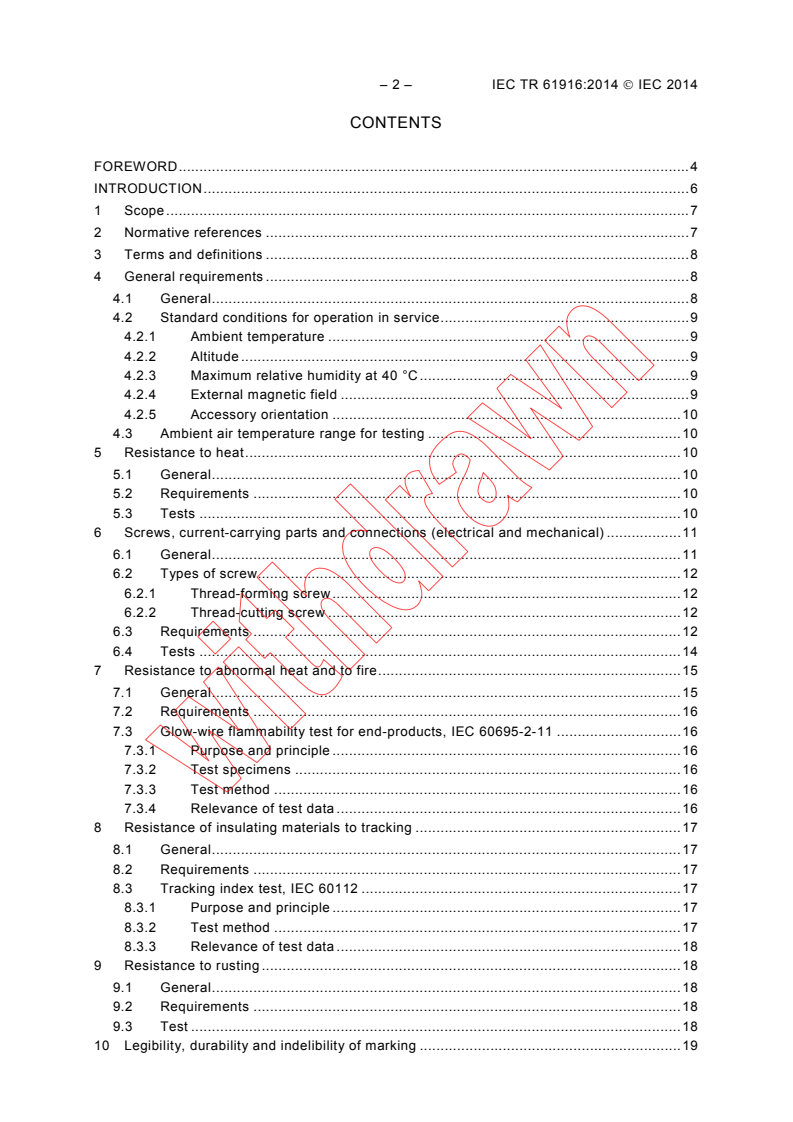
– 2 – IEC TR 61916:2014 IEC 2014
CONTENTS
FOREWORD . 4
INTRODUCTION . 6
1 Scope . 7
2 Normative references . 7
3 Terms and definitions . 8
4 General requirements . 8
4.1 General . 8
4.2 Standard conditions for operation in service . 9
4.2.1 Ambient temperature . 9
4.2.2 Altitude . 9
4.2.3 Maximum relative humidity at 40 °C . 9
4.2.4 External magnetic field . 9
4.2.5 Accessory orientation . 10
4.3 Ambient air temperature range for testing . 10
5 Resistance to heat . 10
5.1 General . 10
5.2 Requirements . 10
5.3 Tests . 10
6 Screws, current-carrying parts and connections (electrical and mechanical) . 11
6.1 General . 11
6.2 Types of screw . 12
6.2.1 Thread-forming screw . 12
6.2.2 Thread-cutting screw . 12
6.3 Requirements . 12
6.4 Tests . 14
7 Resistance to abnormal heat and to fire . 15
7.1 General . 15
7.2 Requirements . 16
7.3 Glow-wire flammability test for end-products, IEC 60695-2-11 . 16
7.3.1 Purpose and principle . 16
7.3.2 Test specimens . 16
7.3.3 Test method . 16
7.3.4 Relevance of test data . 16
8 Resistance of insulating materials to tracking . 17
8.1 General . 17
8.2 Requirements . 17
8.3 Tracking index test, IEC 60112 . 17
8.3.1 Purpose and principle . 17
8.3.2 Test method . 17
8.3.3 Relevance of test data . 18
9 Resistance to rusting . 18
9.1 General . 18
9.2 Requirements . 18
9.3 Test . 18
10 Legibility, durability and indelibility of marking . 19
10.1 General . 19
10.2 Requirements . 19
10.3 Test . 19
11 Screw-type terminals for connecting conductors . 19
12 Criteria for tests in accessory standards . 19
13 Tolerances . 20
14 Mechanical strength . 20
14.1 Impact. 20
14.2 Free fall . 20
15 Appropriate dimensioning of insulation distances . 20
15.1 General . 20
15.2 General information . 21
15.3 Dimensioning of clearances . 21
15.4 Dimensioning of creepage distances . 22
15.5 Dimensioning of solid insulation . 23
15.6 Dimensioning of functional insulation . 23
15.7 Practical application of IEC 60664 series with regards to particular questions . 23
15.8 Other information useful for TC 23 . 24
16 Resistance to UV . 25
16.1 General . 25
16.2 Basic principles . 25
16.3 Tests . 26
16.3.1 General . 26
16.3.2 UV Test . 26
16.3.3 Mechanical test . 26
Annex A (informative) Material selection process . 27
A.1 General . 27
A.2 Terms and definitions . 27
A.3 Requirements for material selection process . 27
A.4 Material selection process. 28
A.4.1 Material selection based on flammability classifications . 28
A.4.2 Arc ignition test . 28
Bibliography . 30
Figure 1 – Thread-forming screw . 12
Figure 2 – Thread-cutting screw . 12
Table 1 – Torque per thread diameter . 15
Table A.1 – Minimum glow wire ignition temperature (GWIT) of insulating materials
required for the flammability classification of the selected material . 28
Table A.2 – Minimum glow wire ignition temperature (GWIT) of insulating materials
required for the GWFI classification of the selected material . 28
Table A.3 – Minimum number of arcs required for the flammability classification of the
selected material . 28
Table A.4 – Minimum number of arcs required for the GWFI classification of the
selected material . 29
– 4 – IEC TR 61916:2014 IEC 2014
INTERNATIONAL ELECTROTECHNICAL COMMISSION
____________
ELECTRICAL ACCESSORIES –
HARMONIZATION OF GENERAL RULES
FOREWORD
1) The International Electrotechnical Commission (IEC) is a worldwide organization for standardization comprising
all national electrotechnical committees (IEC National Committees). The object of IEC is to promote
international co-operation on all questions concerning standardization in the electrical and electronic fields. To
this end and in addition to other activities, IEC publishes International Standards, Technical Specifications,
Technical Reports, Publicly Available Specifications (PAS) and Guides (hereafter referred to as “IEC
Publication(s)”). Their preparation is entrusted to technical committees; any IEC National Committee interested
in the subject dealt with may participate in this preparatory work. International, governmental and non-
governmental organizations liaising with the IEC also participate in this preparation. IEC collaborates closely
with the International Organization for Standardization (ISO) in accordance with conditions determined by
agreement between the two organizations.
2) The formal decisions or agreements of IEC on technical matters express, as nearly as possible, an international
consensus of opinion on the relevant subjects since each technical committee has representation from all
interested IEC National Committees.
3) IEC Publications have the form of recommendations for international use and are accepted by IEC National
Committees in that sense. While all reasonable efforts are made to ensure that the technical content of IEC
Publications is accurate, IEC cannot be held responsible for the way in which they are used or for any
misinterpretation by any end user.
4) In order to promote international uniformity, IEC National Committees undertake to apply IEC Publications
transparently to the maximum extent possible in their national and regional publications. Any divergence
between any IEC Publication and the corresponding national or regional publication shall be clearly indicated in
the latter.
5) IEC itself does not provide any attestation of conformity. Independent certification bodies provide conformity
assessment services and, in some areas, access to IEC marks of conformity. IEC is not responsible for any
services carried out by independent certification bodies.
6) All users should ensure that they have the latest edition of this publication.
7) No liability shall attach to IEC or its directors, employees, servants or agents including individual experts and
members of its technical committees and IEC National Committees for any personal injury, property damage or
other damage of any nature whatsoever, whether direct or indirect, or for costs (including legal fees) and
expenses arising out of the publication, use of, or reliance upon, this IEC Publication or any other IEC
Publications.
8) Attention is drawn to the Normative references cited in this publication. Use of the referenced publications is
indispensable for the correct application of this publication.
9) Attention is drawn to the possibility that some of the elements of this IEC Publication may be the subject of
patent rights. IEC shall not be held responsible for identifying any or all such patent rights.
The main task of IEC technical committees is to prepare International Standards. However, a
technical committee may propose the publication of a technical report when it has collected
data of a different kind from that which is normally published as an International Standard, for
example "state of the art".
IEC TR 61916, which is a technical report, has been prepared by IEC technical committee 23:
Electrical accessories.
This third edition cancels and replaces the second edition published in 2009 and constitutes a
technical revision. This edition includes the following significant technical changes with
respect to the previous edition:
a) Modification of “General requirements” to include standard conditions for operation in
service and information on ambient temperature range for testing;
b) Replacement of Clause 14;
c) Addition of a Clause 15 in UV resistance;
d) Addition of Annex A on Material selection process.
The text of this technical report is based on the following documents:
Enquiry draft Report on voting
23/639/DTR 23/667A/RVC
Full information on the voting for the approval of this technical report can be found in the
report on voting indicated in the above table.
This publication has been drafted in accordance with the ISO/IEC Directives, Part 2.
In this technical report, the following print types are used:
– requirements proper: in roman type;
– test specifications: in italic type;
– Explanatory matter: in smaller roman type.
The committee has decided that the contents of this publication will remain unchanged until
the stability date indicated on the IEC website under "http://webstore.iec.ch" in the data
related to the specific publication. At this date, the publication will be
• reconfirmed,
• withdrawn,
• replaced by a revised edition, or
• amended.
– 6 – IEC TR 61916:2014 IEC 2014
INTRODUCTION
The purpose of this Technical Report is to have harmonized rules on the same subjects in all
the Standards published by TC 23 and its subcommittees, in order to give coordinated
indications to subcommittees when making their standards.
These recommendations are meant as a guide. Consequently, subcommittees, according to
their own particularities, may use whole or part of the document which is not meant to be
compulsory.
In publishing these recommendations, TC 23 wishes to spread the information so that other
committees of the IEC may use these recommendations, if necessary.
ELECTRICAL ACCESSORIES –
HARMONIZATION OF GENERAL RULES
1 Scope
This Technical Report provides guidance on requirements and tests for subjects common to
TC 23 and its subcommittees by providing recommendations applicable to electrical
accessories that are within the scope of TC 23 and its subcommittees.
2 Normative references
The following documents, in whole or in part, are normatively referenced in this document and
are indispensable for its application. For dated references, only the edition cited applies. For
undated references, the latest edition of the referenced document (including any
amendments) applies.
IEC 60112, Method for the determination of the proof and the comparative tracking indices of
solid insulating materials
IEC 60228, Conductors of insulated cables
IEC 60664-1:2007, Insulation coordination for equipment within low-voltage systems – Part 1:
Principles, requirements and tests
IEC TR 60664-2-1:2011, Insulation coordination for equipment within low-voltage systems –
Part 2-1: Application guide – Explanation of the application of the IEC 60664 series,
dimensioning examples and dielectric testing
IEC 60664-3, Insulation coordination for equipment within low-voltage systems – Part 3: Use
of coating, potting or moulding for protection against pollution
IEC 60664-4, Insulation coordination for equipment within low-voltage systems – Part 4:
Consideration of high-frequency voltage stress
IEC 60664-5:2007, Insulation coordination for equipment within low-voltage systems – Part 5:
Comprehensive method for determining clearances and creepage distances equal to or less
than 2 mm
IEC 60695-2-10, Fire hazard testing – Part 2-10: Glowing/hot-wire based test methods –
Glow-wire apparatus and common test procedure
IEC 60695-2-11:2014, Fire hazard testing – Part 2-11: Glowing/hot-wire based test methods –
Glow-wire flammability test method for end-products (GWEPT)
IEC 60695-10-2:2014, Fire hazard testing – Part 10-2: Abnormal heat – Ball pressure test
method
IEC 60998-1:2002, Connecting devices for low-voltage circuits for household and similar
purposes – Part 1: General requirements
IEC 60998-2-1:2002, Connecting devices for low-voltage circuits for household and similar
purposes – Part 2-1: Particular requirements for connecting devices as separate entities with
screw-type clamping units
– 8 – IEC TR 61916:2014 IEC 2014
IEC 60999 (all parts), Connecting devices – Electrical copper conductors – Safety
requirements for screw-type and screwless-type clamping units
ISO 4892-2: 2013, Plastics – Methods of exposure to laboratory light sources – Part 2: Xenon-
arc lamps
3 Terms and definitions
For the purposes of this document, the following terms and definitions apply.
NOTE The terms defined hereafter concern Clause 8 Resistance of insulation materials to tracking.
3.1
tracking
progressive formation of conducting paths, which are produced on the surface of a solid
insulating material, due to the combined effects of electric stress and electrolytic
contamination on this surface
[SOURCE: IEC 60050-212:2010, 212-11-56, modified – The note has been deleted.]
3.2
electrical erosion
wearing away of insulating material by action of electrical discharges
[SOURCE: IEC 60050-212:2010, 212-11-55]
3.3
comparative tracking index
CTI
numerical value of the maximum voltage in volts at which a material withstands 50 drops
without tracking
Note 1 to entry: The value of each test voltage and the CTI should be divisible by 25.
[SOURCE: IEC 60050-212:2010, 212-11-59, modified – The text "and without a persistent flame
occurring under specified test conditions" has been removed at the end of the definition and Note 1
to entry has been added.]
3.4
proof tracking index
PTI
numerical value of the proof voltage in volts at which a material withstands 50 drops without
tracking
[SOURCE: IEC 60050-212:2010, 212-11-60, modified – Number of drops specified.]
4 General requirements
4.1 General
This guidance is applicable to the relevant clause(s) of TC 23 standards and of its
subcommittees covering general requirements and/or scope.
Before tests, the specimen is stored for at least 24 h in an atmosphere having a temperature
between 15 °C and 35 °C and relative humidity between 45 % and 75 %, except for the test of
Clause 7 where IEC 60112 applies.
Accessories within the scope of TC 23 standards, and those of its subcommittees, shall be
designed and constructed so that, in normal use, their performance is reliable and safe for the
user and the surroundings.
Standard conditions for operation in service for electrical accessories complying with the
existing standards should be suitable for use at ambient temperatures not normally exceeding
40 °C, but their average over a period of 24 h does not exceed 35 °C, with a lower limit of the
ambient air temperature of –5 °C.
4.2 Standard conditions for operation in service
4.2.1 Ambient temperature
4.2.1.1 General
Unless covered by a temperature classification, accessories within the scope of TC 23
standards should be at least capable of operating under the following standard conditions.
4.2.1.2 Ambient air temperature range in normal use
Electrical accessories complying with the existing standards are suitable for normal use at
ambient temperatures not normally exceeding 40 °C, but their average over a period of 24 h
does not exceed 35 °C, with a lower limit of the ambient air temperature of –5 °C.
NOTE This temperature range corresponds to AA4 of IEC 60364-5-51:2005, Table 51A. Part of the temperature
range of IEC 60721-3-3, class 3K5, with the high air temperature restricted to 40 °C.
Accessories intended to be used in ambient air temperatures outside the above mentioned
conditions permanently or during a long period shall be covered by special requirements or
tests, if necessary, to be decided by each product committee.
4.2.1.3 Ambient air temperature range in cold climate
In areas where electrical accessories are to be used in cold or arctic climate, any tests may
need to be performed in a suitable cold ambient temperature.
Product committees have the responsibility to evaluate if the accessories intended to be used
in ambient air temperatures in cold climate permanently or during a long period shall be
tested in a temperature corresponding to the climate area, for example AA3 or AA2 of
IEC 60364-5-51:2005, Table 51A.
4.2.2 Altitude
Unless otherwise specified, the accessories are intended to be installed at an altitude not
higher than 2 000 m.
4.2.3 Maximum relative humidity at 40 °C
Unless otherwise specified, the maximum relative humidity at the temperature of 40 °C is
50 %.
Higher relative humidity values are admitted at lower temperature (for example 90 % at
20 °C).
4.2.4 External magnetic field
Unless otherwise specified, the external magnetic field is considered not exceeding 5 times
the earth’s magnetic field in any direction.
– 10 – IEC TR 61916:2014 IEC 2014
NOTE When an equipment is installed in proximity of a strong magnetic field, supplementary requirements may be
necessary.
4.2.5 Accessory orientation
Unless otherwise specified, the mounting coordinates of the accessories with respect to the
horizontal or vertical is as stated by the manufacturer, with a tolerance of 2° in any direction.
4.3 Ambient air temperature range for testing
Unless otherwise specified, the tests are carried out at an ambient temperature of (20 ± 5) °C.
5 Resistance to heat
5.1 General
This guidance is applicable to the relevant clause(s) of a TC 23 standard covering
requirements and tests to determine the resistance to heat of accessories.
These recommendations are in accordance with IEC 60669-1.
The text includes two subclauses:
– Requirements (5.2)
– Tests (5.3)
For editing purposes the order and the numbers may be altered if necessary.
5.2 Requirements
Accessories including enclosures, if any, shall be sufficiently resistant to heat.
Compliance is checked by the tests of 5.3.
5.3 Tests
5.3.1 Verification of resistance to heat:
a) for surface mounting boxes, separable covers, separable cover plates and separable
frames by the test of 5.3.4;
b) for accessories, with the exception of the parts, if any, covered by a), by the tests of 5.3.2,
5.3.3 and, with the exception for the accessories made from natural or synthetic rubber or
a mixture of both, by the test of 5.3.4.
5.3.2 The specimens are kept for 1 h in a heating cabinet at a temperature of
100 °C ± 2 °C.
During the test, they shall not undergo any change impairing their further use, and sealing
compound, if any, shall not flow to such an extent that live parts are exposed.
After the test and after the specimens have been allowed to cool down to approximately room
temperature, there shall be no access to live parts which are normally not accessible when
the specimens are mounted as in normal use, even if probe B of IEC 61032 is applied with a
force not exceeding 5 N.
After the test, markings shall still be legible.
Discoloration, blisters or slight displacement of the sealing compound is disregarded provided
that safety is not impaired within the meaning of the relevant standard.
5.3.3 Parts of insulating material necessary to retain current-carrying parts and parts of the
earthing circuit in position are subjected to a ball-pressure test according to IEC 60695-10-2,
except that the insulating parts necessary to retain the earthing terminals in a box shall be
tested instead to the test as specified in 5.3.4.
A current carrying part or a part of the earthing circuit retained by a mechanical means is
considered to be retained in position. The use of grease or the like is not considered to be
mechanical means.
In case of doubt, to determine whether an insulating material is necessary to retain current
carrying parts and parts of the earthing circuit in position, the specimen is examined without
conductors while held in all positions with the insulating material in question removed.
Before the test is started, the ball and the support on which the specimen shall be placed, are
brought to the temperature specified. The part under test shall be placed on a 3 mm thick
steel plate in direct contact with it, so as to be supported to withstand the test force.
When it is not possible to carry out the test on the specimens, the test should be carried out
on a piece at least 2 mm thick which is cut out of the specimen. If this is not possible, up to
and including four layers, each cut out of the same specimen, may be used, in which case the
total thickness of the layers should be not less than 2,5 mm.
The test load and the supporting means shall be placed within the heating cabinet for a
sufficient time to ensure that they have attained the stabilized testing temperature before the
test commences.
The test is made in a heating cabinet at a temperature of 125 °C ± 2 °C.
+2
After 60 min, the ball is removed from the specimen which is then cooled and treated
−0
according to Clause 7 of IEC 60695-10-2:2014.
The diameter of the impression caused by the ball is measured in accordance with
IEC 60695-10-2:2014 and shall not exceed 2 mm.
5.3.4 Parts of insulating material not necessary to retain current-carrying parts and parts of
the earthing circuit in position, even though they are in contact with them, are subjected to a
ball pressure test in accordance with 5.3.3, but the test is made at a temperature of 70 °C ± 2 °C or
40 °C ± 2 °C plus the highest temperature rise determined for the relevant part during the test
of clause “Temperature rise test”, whichever is the higher.
6 Screws, current-carrying parts and connections (electrical and mechanical)
6.1 General
This guidance is applicable to the relevant clause(s) of a TC 23 standard covering the
requirements and tests of screws, current-carrying parts and connections (electrical and
mechanical) of accessories.
These recommendations are in accordance with IEC 60669-1.
The text includes three subclauses as follows:
– Definitions (6.2)
– 12 – IEC TR 61916:2014 IEC 2014
– Requirements (6.3)
– Tests (6.4)
For editing purposes, the order and numbers may be altered, if necessary.
6.2 Types of screw
6.2.1 Thread-forming screw
A tapping screw having an uninterrupted thread which by screwing-in forms a thread by
displacing material in the cavity.
An example of a thread-forming screw is shown in Figure 1.
IEC
Figure 1 – Thread-forming screw
6.2.2 Thread-cutting screw
A screw having an interrupted thread which, by screwing-in, makes a thread by removing
material from the cavity.
An example of thread-cutting screw is shown in Figure 2.
IEC
Figure 2 – Thread-cutting screw
6.3 Requirements
6.3.1 Connections, electrical or mechanical, using screws and nuts, shall withstand the
mechanical stresses occurring in normal use.
Screws and nuts which transmit contact pressure shall be of metal and shall be in
engagement with a metal thread. Screws and nuts which are operated when mounting an
accessory during installation, and/or which are likely to be operated during the life of the
accessory, shall be in engagement with a metal thread.
Screws for connecting external conductors shall not be tapping screws.
Screws and nuts operated when mounting the accessory during installation, and/or which are
likely to be operated during the life of the accessory, shall not be of the thread cutting type.
NOTE Screws and nuts which are operated when mounting the accessory include screws for fixing cover of cover
plates, etc., but not connecting means for screwed conduits and screws for fixing the base of the accessory.
Compliance is checked by inspection and by the test of 6.4.
6.3.2 For screws in engagement with a thread of insulating material and screws of
insulating material, which are used for the installation of the accessory and/or which are likely
to be operated during the life of the accessory, correct introduction of the screw into the screw
hole or nut shall be ensured.
Screws of insulating materials shall not be used in cases when the replacement with metal
screws could impair the insulation of the accessory.
Compliance is checked by inspection and by manual test.
The requirements with regard to correct introduction are met if introduction of the screw in a
slanting manner is prevented, for example by guiding the screw by the part to be fixed, by a
recess in the female thread or by the use of a screw with the leading thread removed.
6.3.3 Screws and rivets, intended to be used for electrical connections and screws and
rivets intended to be used for mechanical connection, shall be locked against loosening or
turning.
NOTE Spring washers can provide satisfactory locking. For rivets, a non-circular shank or an appropriate notch
can be sufficient. Sealing compound which softens on heating provides satisfactory locking only for screw
connections not subjected to torsion in normal use.
Compliance is checked by inspection and manual test.
6.3.4 Electrical connections shall be so designed that contact pressure is not transmitted
through insulating material other than ceramic, pure mica or other material with characteristics
no less suitable, unless there is sufficient resiliency in the metallic parts to compensate for
any possible shrinkage or yielding of the insulating material.
Compliance is checked by inspection.
NOTE The suitability of the material is considered with regard to the stability of the dimensions.
6.3.5 Current-carrying parts, including those of terminals (also earthing terminals), shall be
of a metal having, under the conditions occurring in the equipment, mechanical strength,
electrical conductivity and resistance to corrosion adequate for their intended use.
Compliance is checked by inspection and, if necessary, by chemical analysis.
Examples of suitable metals, when used within a permissible temperature range and under
normal conditions of chemical pollution are:
– copper;
– an alloy containing at least 58 % copper for parts that are worked cold or at-least 50 %
copper for other parts;
– stainless steel containing at least 13 % chromium and not more than 0,09 % carbon;
– steel provided with an electroplated coating of zinc according to ISO 2081, the coating
having a thickness of at least:
• 5 µm (ISO service condition 1) for ordinary equipment
• 8 µm (ISO service condition 2) for drip-proof and splash-proof equipment
• 12 µm (ISO service condition 3) for jet-proof and watertight equipment
– steel provided with an electroplated coating of nickel and chromium according to
ISO 1456, the coating having a thickness of at least:
• 10 µm (ISO service condition 1) for ordinary equipment
• 20 µm (ISO service condition 2) for drip-proof and splash-proof equipment
– 14 – IEC TR 61916:2014 IEC 2014
• 30 µm (ISO service condition 3) for jet-proof and watertight equipment;
– steel provided with an electroplated coating of tin, according to ISO 2093, the coating
having a thickness equal to at least that specified for:
• 12 µm (ISO service condition 1) for ordinary equipment
• 20 µm (ISO service condition 2) for drip-proof and splash-proof equipment
• 30 µm(ISO service condition 3) for jet-proof and watertight equipment
Parts which may be subjected to mechanical wear, shall not be made of steel provided
with an electroplated coating;
– steel provided with an electroplated coating of zinc is only permitted for prime current-
carrying parts if no fixed connection is intended to be made. For connection, an
electroplated coating of zinc is permissible only on parts which do not participate directly
in current transmission, such as screws or washers used for certain types of terminals in
which they transmit only the contact pressure.
This requirement is not intended to apply to contacts, magnetic circuits, heating elements,
bimetallic components, shunts, parts of electronic devices, etc.
NOTE Screws, nuts, washers, clamping plates and similar parts of terminals are not regarded as current-carrying
parts.
Under moist conditions, metals having a great difference of electrochemical potential with
respect to each other, shall not be used in contact with each other.
Compliance is checked by inspection.
6.3.6 Thread-forming screws and thread-cutting screws shall not be used for the
connection of current-carrying parts. Thread-forming screws and thread cutting screws may
be used to provide earthing continuity, provided that it is not necessary to disturb the
connection in normal use and at least two screws are used for each connection.
Compliance is checked by inspection.
NOTE The use of thread-forming screws without displacing of material which are operated when mounting the
accessory is under consideration.
6.4 Tests
Compliance with the requirements of 6.3.1 is checked by inspection and by the following test.
The screws and nuts are tightened and loosened:
– 10 times for metal screws in engagement with a thread of insulating material and for
screws of insulating material;
– 5 times in all other cases.
Screws or nuts in engagement with a thread of insulating material and screw of insulating
material are completely removed and re-inserted each time.
The test is made by means of a suitable test screwdriver or spanner applying a torque as
shown in Table 1.
The shape of the blade of the test screwdriver shall suit the head of the screw for screws and
nuts which are operated when mounting and connecting up the device by the following test.
The screws and nuts shall be tightened smoothly. In the case of a test on terminals, the
conductor is moved each time the screw or nut is loosened.
Table 1 – Torque per thread diameter
Torque
Nominal diameter of thread
Nm
mm
I II III IV V
Up to and including 2,8 0,2 – 0,4 0,4 –
over 2,8 up to and including 3,0 0,25 – 0,5 0,5 –
over 3,0 up to and including 3,2 0,3 – 0,6 0,6 –
over 3,2 up to and including 3,6 0,4 – 0,8 0,8 –
over 3,6 up to and including 4,1 0,7 1,2 1,2 1,2 1,2
over 4,1 up to and including 4,7 0,8 1,2 1,8 1,8 1,8
over 4,7 up to and including 5,3 0,8 1,4 2,0 2,0 2,0
over 5,3 up to and including 6,0 1,2 1,8 2,5 3,0 3,0
over 6,0 up to and including 8,0 2,5 2,5 3,5 6,0 4,0
over 8,0 up to and including 10,0 – 3,5 4,0 10,0 6,0
over 10,0 up to and including 12,0 – 4,0 – – 8,0
over 12,0 up to and including 15,0 – 5,0 – – 10,0
Column I applies to screws without head if the screw when tightened does not protrude from
t
...