

IEC 62149-2:2014
(Main)Fibre optic active components and devices - Performance standards - Part 2: 850 nm discrete vertical cavity surface emitting laser devices
- Abstract
IEC 62149-2:2014 covers the performance specification for 850-nm discrete vertical cavity surface emitting laser (VCSEL) devices of transverse multimode types used for fibre optic telecommunication and optical data transmission applications. The performance standard contains a definition of the product performance requirements together with a series of sets of tests and measurements with clearly defined conditions, severities, and pass/fail criteria. The tests are intended to be run on a "once-off" basis to prove any product's ability to satisfy the performance standard's requirements. This second edition cancels and replaces the first edition published in 2009 and constitutes a technical revision. The significant technical changes with respect to the previous edition include the introduction of the performance standards for 10 Gbit/s 850-nm wavelength, vertical cavity surface emitting laser (VCSEL) devices and the deletion of the package diagrams and pin configurations in Clause A.4 and Clause B.4 by citing the VCSEL package standard IEC 62148-15 instead. Keywords: 850-nm discrete vertical cavity surface emitting laser (VCSEL) devices, transverse multimode types
- Status
- Published
- Publication Date
- 25-May-2014
- Technical Committee
- SC 86C - Fibre optic systems, sensing and active devices
- Drafting Committee
- WG 4 - Fibre optic active devices including optoelectronic devices
- Current Stage
- PPUB - Publication issued - 60 Publication
- Start Date
- 26-May-2014
- Due Date
- 15-Aug-2014
- Completion Date
- 15-Aug-2014
Overview
IEC 62149-2:2014 is an international standard published by the International Electrotechnical Commission (IEC) that establishes performance specifications for 850 nm discrete vertical cavity surface emitting laser (VCSEL) devices. This standard specifically addresses transverse multimode VCSELs used in fibre optic telecommunication and optical data transmission systems. It defines a comprehensive set of product performance requirements, along with rigorous testing procedures and pass/fail criteria to ensure device reliability and functionality.
This second edition, published in 2014, updates the original 2009 version by enhancing performance standards to cover 10 Gbit/s data rates for 850-nm VCSELs and streamlining package specifications through reference to IEC 62148-15. The standard serves as a crucial benchmark for manufacturers and users of fibre optic active components, ensuring consistent quality and enabling interoperability in high-speed optical communication networks.
Key Topics
- 850 nm Discrete VCSEL Devices: Specifies device parameters for vertical cavity surface emitting lasers operating at 850 nanometers, a common wavelength for short-reach multimode fibre optic communications.
- Transverse Multimode Types: Focuses on multimode laser devices suitable for transmitting signals over multimode optical fibres used in data center and telecommunications infrastructure.
- Performance Requirements: Includes detailed criteria for absolute limiting ratings, operating environments, functional specifications, and diagrams that define device operation parameters.
- Testing Protocols: Describes characterization testing and performance testing conducted under controlled conditions to verify compliance with the standard. Tests are designed as “once-off” validations of device capability.
- Environmental and Safety Specifications: Covers operational environment constraints, laser safety guidelines, electromagnetic compatibility (EMC), and general safety provisions ensuring robust device deployment.
- Packaging Standards Integration: References IEC 62148-15 for VCSEL packaging, instead of including package diagrams and pin configurations within its own clauses.
- Data Transmission Speeds: Incorporates sub-categorized performance specifications to address different modulation speeds, including a focus on 10 Gbit/s transmission capabilities.
Applications
IEC 62149-2:2014 is essential for stakeholders in the fibre optics and telecommunications industries who manufacture, test, or deploy multimode VCSEL devices. The standard’s guidance is especially relevant for:
- Telecommunication Networks: Ensures reliability and performance of optical transmitters operating over multimode fibre for local area networks (LANs) and data centers.
- Data Transmission Systems: Supports development of high-speed optical interconnects operating at 850 nm wavelength, critical for short-range communications.
- Component Manufacturers: Provides a framework to design and validate VCSEL devices that meet international performance benchmarks, facilitating global market access.
- Quality Assurance: Offers clear pass/fail criteria aiding in quality control processes and conformance verification across production batches.
- Safety Compliance: Helps maintain laser safety standards to protect users and equipment during the operation of fibre optic active components.
Related Standards
- IEC 62148-15: Defines packaging requirements for VCSEL devices, referenced by IEC 62149-2 for detailed package diagrams and pin configurations.
- IEC 62149 Series: Covers performance standards for fibre optic active components and devices, including other wavelength devices and types.
- ISO/IEC Directives, Part 2: Provides guidance on the drafting and structure of international standards such as IEC 62149-2.
- EMC Standards: Relevant electromagnetic compatibility standards guide the compliance aspects related to laser and optical device emissions.
By adhering to IEC 62149-2:2014, manufacturers and users can ensure VCSEL devices operating at 850 nm meet the high-performance and safety standards essential for secure, scalable, and efficient fibre optic communication systems worldwide. This standard plays a fundamental role in advancing fibre optic technology for multimode applications, enabling seamless integration and interoperability across global networks.
Relations
- Effective Date
- 05-Sep-2023
Get Certified
Connect with accredited certification bodies for this standard

ANCE
Mexican certification and testing association.

Intertek Slovenia
Intertek testing, inspection, and certification services in Slovenia.

LNE (Laboratoire National de Métrologie et d'Essais)
French national laboratory for metrology and testing.
Sponsored listings
Frequently Asked Questions
IEC 62149-2:2014 is a standard published by the International Electrotechnical Commission (IEC). Its full title is "Fibre optic active components and devices - Performance standards - Part 2: 850 nm discrete vertical cavity surface emitting laser devices". This standard covers: IEC 62149-2:2014 covers the performance specification for 850-nm discrete vertical cavity surface emitting laser (VCSEL) devices of transverse multimode types used for fibre optic telecommunication and optical data transmission applications. The performance standard contains a definition of the product performance requirements together with a series of sets of tests and measurements with clearly defined conditions, severities, and pass/fail criteria. The tests are intended to be run on a "once-off" basis to prove any product's ability to satisfy the performance standard's requirements. This second edition cancels and replaces the first edition published in 2009 and constitutes a technical revision. The significant technical changes with respect to the previous edition include the introduction of the performance standards for 10 Gbit/s 850-nm wavelength, vertical cavity surface emitting laser (VCSEL) devices and the deletion of the package diagrams and pin configurations in Clause A.4 and Clause B.4 by citing the VCSEL package standard IEC 62148-15 instead. Keywords: 850-nm discrete vertical cavity surface emitting laser (VCSEL) devices, transverse multimode types
IEC 62149-2:2014 covers the performance specification for 850-nm discrete vertical cavity surface emitting laser (VCSEL) devices of transverse multimode types used for fibre optic telecommunication and optical data transmission applications. The performance standard contains a definition of the product performance requirements together with a series of sets of tests and measurements with clearly defined conditions, severities, and pass/fail criteria. The tests are intended to be run on a "once-off" basis to prove any product's ability to satisfy the performance standard's requirements. This second edition cancels and replaces the first edition published in 2009 and constitutes a technical revision. The significant technical changes with respect to the previous edition include the introduction of the performance standards for 10 Gbit/s 850-nm wavelength, vertical cavity surface emitting laser (VCSEL) devices and the deletion of the package diagrams and pin configurations in Clause A.4 and Clause B.4 by citing the VCSEL package standard IEC 62148-15 instead. Keywords: 850-nm discrete vertical cavity surface emitting laser (VCSEL) devices, transverse multimode types
IEC 62149-2:2014 is classified under the following ICS (International Classification for Standards) categories: 33.180.20 - Fibre optic interconnecting devices. The ICS classification helps identify the subject area and facilitates finding related standards.
IEC 62149-2:2014 has the following relationships with other standards: It is inter standard links to IEC 62149-2:2009. Understanding these relationships helps ensure you are using the most current and applicable version of the standard.
IEC 62149-2:2014 is available in PDF format for immediate download after purchase. The document can be added to your cart and obtained through the secure checkout process. Digital delivery ensures instant access to the complete standard document.
Standards Content (Sample)
IEC 62149-2 ®
Edition 2.0 2014-05
INTERNATIONAL
STANDARD
NORME
INTERNATIONALE
Fibre optic active components and devices – Performance standards –
Part 2: 850 nm discrete vertical cavity surface emitting laser devices
Composants et dispositifs actifs à fibres optiques – Normes de performances –
Partie 2: Dispositifs discrets à laser 850 nm à cavité verticale émettant
en surface
All rights reserved. Unless otherwise specified, no part of this publication may be reproduced or utilized in any form
or by any means, electronic or mechanical, including photocopying and microfilm, without permission in writing from
either IEC or IEC's member National Committee in the country of the requester. If you have any questions about IEC
copyright or have an enquiry about obtaining additional rights to this publication, please contact the address below or
your local IEC member National Committee for further information.
Droits de reproduction réservés. Sauf indication contraire, aucune partie de cette publication ne peut être reproduite
ni utilisée sous quelque forme que ce soit et par aucun procédé, électronique ou mécanique, y compris la photocopie
et les microfilms, sans l'accord écrit de l'IEC ou du Comité national de l'IEC du pays du demandeur. Si vous avez des
questions sur le copyright de l'IEC ou si vous désirez obtenir des droits supplémentaires sur cette publication, utilisez
les coordonnées ci-après ou contactez le Comité national de l'IEC de votre pays de résidence.
IEC Central Office Tel.: +41 22 919 02 11
3, rue de Varembé Fax: +41 22 919 03 00
CH-1211 Geneva 20 info@iec.ch
Switzerland www.iec.ch
About the IEC
The International Electrotechnical Commission (IEC) is the leading global organization that prepares and publishes
International Standards for all electrical, electronic and related technologies.
About IEC publications
The technical content of IEC publications is kept under constant review by the IEC. Please make sure that you have the
latest edition, a corrigenda or an amendment might have been published.
IEC Catalogue - webstore.iec.ch/catalogue Electropedia - www.electropedia.org
The stand-alone application for consulting the entire The world's leading online dictionary of electronic and
bibliographical information on IEC International Standards, electrical terms containing more than 30 000 terms and
Technical Specifications, Technical Reports and other definitions in English and French, with equivalent terms in 14
documents. Available for PC, Mac OS, Android Tablets and additional languages. Also known as the International
iPad. Electrotechnical Vocabulary (IEV) online.
IEC publications search - www.iec.ch/searchpub IEC Glossary - std.iec.ch/glossary
The advanced search enables to find IEC publications by a More than 55 000 electrotechnical terminology entries in
variety of criteria (reference number, text, technical English and French extracted from the Terms and Definitions
committee,…). It also gives information on projects, replaced clause of IEC publications issued since 2002. Some entries
and withdrawn publications. have been collected from earlier publications of IEC TC 37,
77, 86 and CISPR.
IEC Just Published - webstore.iec.ch/justpublished
Stay up to date on all new IEC publications. Just Published IEC Customer Service Centre - webstore.iec.ch/csc
details all new publications released. Available online and If you wish to give us your feedback on this publication or
also once a month by email. need further assistance, please contact the Customer Service
Centre: csc@iec.ch.
A propos de l'IEC
La Commission Electrotechnique Internationale (IEC) est la première organisation mondiale qui élabore et publie des
Normes internationales pour tout ce qui a trait à l'électricité, à l'électronique et aux technologies apparentées.
A propos des publications IEC
Le contenu technique des publications IEC est constamment revu. Veuillez vous assurer que vous possédez l’édition la
plus récente, un corrigendum ou amendement peut avoir été publié.
Catalogue IEC - webstore.iec.ch/catalogue Electropedia - www.electropedia.org
Application autonome pour consulter tous les renseignements
Le premier dictionnaire en ligne de termes électroniques et
bibliographiques sur les Normes internationales,
électriques. Il contient plus de 30 000 termes et définitions en
Spécifications techniques, Rapports techniques et autres
anglais et en français, ainsi que les termes équivalents dans
documents de l'IEC. Disponible pour PC, Mac OS, tablettes
14 langues additionnelles. Egalement appelé Vocabulaire
Android et iPad.
Electrotechnique International (IEV) en ligne.
Recherche de publications IEC - www.iec.ch/searchpub
Glossaire IEC - std.iec.ch/glossary
Plus de 55 000 entrées terminologiques électrotechniques, en
La recherche avancée permet de trouver des publications IEC
en utilisant différents critères (numéro de référence, texte, anglais et en français, extraites des articles Termes et
comité d’études,…). Elle donne aussi des informations sur les Définitions des publications IEC parues depuis 2002. Plus
projets et les publications remplacées ou retirées. certaines entrées antérieures extraites des publications des
CE 37, 77, 86 et CISPR de l'IEC.
IEC Just Published - webstore.iec.ch/justpublished
Service Clients - webstore.iec.ch/csc
Restez informé sur les nouvelles publications IEC. Just
Published détaille les nouvelles publications parues. Si vous désirez nous donner des commentaires sur cette
Disponible en ligne et aussi une fois par mois par email. publication ou si vous avez des questions contactez-nous:
csc@iec.ch.
IEC 62149-2 ®
Edition 2.0 2014-05
INTERNATIONAL
STANDARD
NORME
INTERNATIONALE
Fibre optic active components and devices – Performance standards –
Part 2: 850 nm discrete vertical cavity surface emitting laser devices
Composants et dispositifs actifs à fibres optiques – Normes de performances –
Partie 2: Dispositifs discrets à laser 850 nm à cavité verticale émettant
en surface
INTERNATIONAL
ELECTROTECHNICAL
COMMISSION
COMMISSION
ELECTROTECHNIQUE
PRICE CODE
INTERNATIONALE
CODE PRIX R
ICS 33.180.20 ISBN 978-2-8322-1603-3
– 2 – IEC 62149-2:2014 © IEC 2014
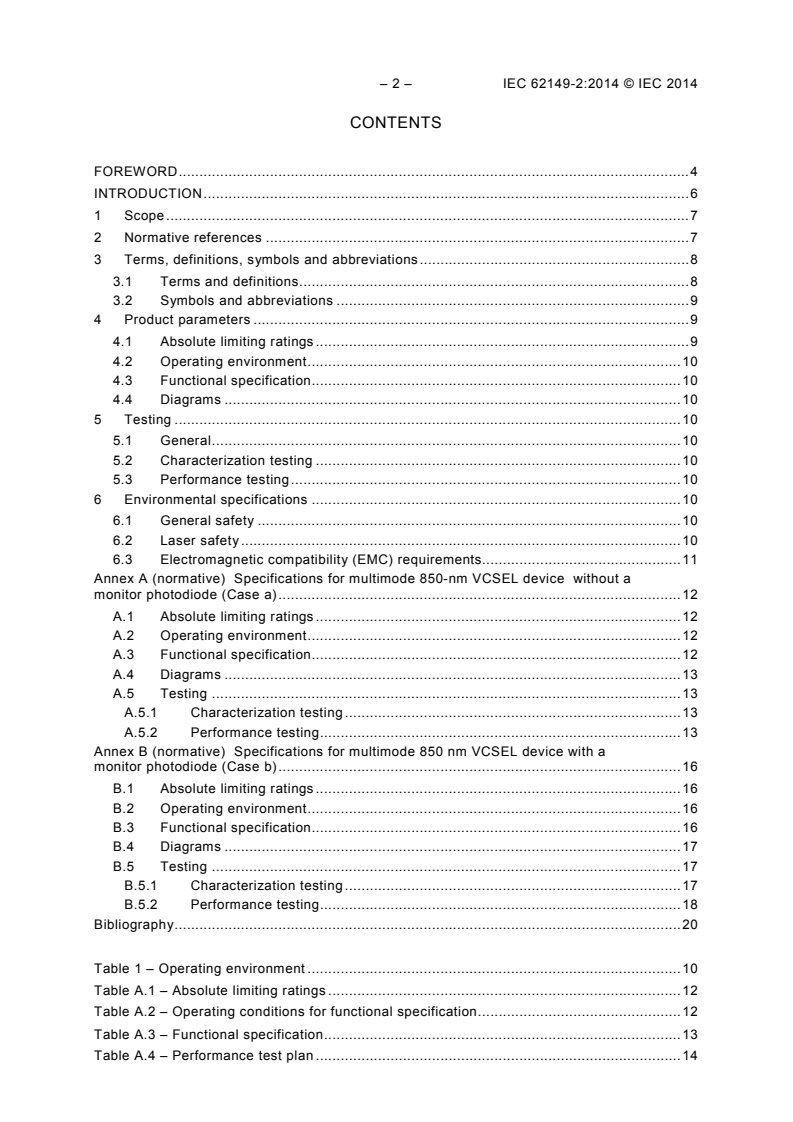
CONTENTS
FOREWORD . 4
INTRODUCTION . 6
1 Scope . 7
2 Normative references . 7
3 Terms, definitions, symbols and abbreviations . 8
3.1 Terms and definitions . 8
3.2 Symbols and abbreviations . 9
4 Product parameters . 9
4.1 Absolute limiting ratings . 9
4.2 Operating environment . 10
4.3 Functional specification. 10
4.4 Diagrams . 10
5 Testing . 10
5.1 General . 10
5.2 Characterization testing . 10
5.3 Performance testing . 10
6 Environmental specifications . 10
6.1 General safety . 10
6.2 Laser safety . 10
6.3 Electromagnetic compatibility (EMC) requirements. 11
Annex A (normative) Specifications for multimode 850-nm VCSEL device without a
monitor photodiode (Case a) . 12
A.1 Absolute limiting ratings . 12
A.2 Operating environment . 12
A.3 Functional specification. 12
A.4 Diagrams . 13
A.5 Testing . 13
A.5.1 Characterization testing . 13
A.5.2 Performance testing. 13
Annex B (normative) Specifications for multimode 850 nm VCSEL device with a
monitor photodiode (Case b) . 16
B.1 Absolute limiting ratings . 16
B.2 Operating environment . 16
B.3 Functional specification. 16
B.4 Diagrams . 17
B.5 Testing . 17
B.5.1 Characterization testing . 17
B.5.2 Performance testing. 18
Bibliography . 20
Table 1 – Operating environment . 10
Table A.1 – Absolute limiting ratings . 12
Table A.2 – Operating conditions for functional specification . 12
Table A.3 – Functional specification . 13
Table A.4 – Performance test plan . 14
Table A.5 – Recommended performance test failure criteria . 15
Table B.1 – Absolute limiting ratings . 16
Table B.2 – Operating conditions for functional specification . 16
Table B.3 – Functional specification . 17
Table B.4 – Performance test plan . 18
Table B.5 – Recommended performance test failure criteria . 19
– 4 – IEC 62149-2:2014 © IEC 2014
INTERNATIONAL ELECTROTECHNICAL COMMISSION
____________
FIBRE OPTIC ACTIVE COMPONENTS AND DEVICES –
PERFORMANCE STANDARDS –
Part 2: 850 nm discrete vertical cavity surface emitting laser devices
FOREWORD
1) The International Electrotechnical Commission (IEC) is a worldwide organization for standardization comprising
all national electrotechnical committees (IEC National Committees). The object of IEC is to promote
international co-operation on all questions concerning standardization in the electrical and electronic fields. To
this end and in addition to other activities, IEC publishes International Standards, Technical Specifications,
Technical Reports, Publicly Available Specifications (PAS) and Guides (hereafter referred to as “IEC
Publication(s)”). Their preparation is entrusted to technical committees; any IEC National Committee interested
in the subject dealt with may participate in this preparatory work. International, governmental and non-
governmental organizations liaising with the IEC also participate in this preparation. IEC collaborates closely
with the International Organization for Standardization (ISO) in accordance with conditions determined by
agreement between the two organizations.
2) The formal decisions or agreements of IEC on technical matters express, as nearly as possible, an international
consensus of opinion on the relevant subjects since each technical committee has representation from all
interested IEC National Committees.
3) IEC Publications have the form of recommendations for international use and are accepted by IEC National
Committees in that sense. While all reasonable efforts are made to ensure that the technical content of IEC
Publications is accurate, IEC cannot be held responsible for the way in which they are used or for any
misinterpretation by any end user.
4) In order to promote international uniformity, IEC National Committees undertake to apply IEC Publications
transparently to the maximum extent possible in their national and regional publications. Any divergence
between any IEC Publication and the corresponding national or regional publication shall be clearly indicated in
the latter.
5) IEC itself does not provide any attestation of conformity. Independent certification bodies provide conformity
assessment services and, in some areas, access to IEC marks of conformity. IEC is not responsible for any
services carried out by independent certification bodies.
6) All users should ensure that they have the latest edition of this publication.
7) No liability shall attach to IEC or its directors, employees, servants or agents including individual experts and
members of its technical committees and IEC National Committees for any personal injury, property damage or
other damage of any nature whatsoever, whether direct or indirect, or for costs (including legal fees) and
expenses arising out of the publication, use of, or reliance upon, this IEC Publication or any other IEC
Publications.
8) Attention is drawn to the Normative references cited in this publication. Use of the referenced publications is
indispensable for the correct application of this publication.
9) Attention is drawn to the possibility that some of the elements of this IEC Publication may be the subject of
patent rights. IEC shall not be held responsible for identifying any or all such patent rights.
International Standard IEC 62149-2 has been prepared by subcommittee 86C: Fibre optic
systems and active devices, of IEC technical committee 86: Fibre optics.
This second edition cancels and replaces the first edition published in 2009 and constitutes a
technical revision.
The significant technical changes with respect to the previous edition include the introduction
of the performance standards for 10 Gbit/s 850-nm wavelength, vertical cavity surface
emitting laser (VCSEL) devices and the deletion of the package diagrams and pin
configurations in Clause A.4 and Clause B.4 by citing the VCSEL package standard
IEC 62148-15 instead.
The text of this standard is based on the following documents:
CDV Report on voting
86C/1146/CDV 86C/1229/RVC
Full information on the voting for the approval of this standard can be found in the report on
voting indicated in the above table.
This publication has been drafted in accordance with the ISO/IEC Directives, Part 2.
A list of all parts of the IEC 62149 series, published under the general title Fibre optic active
components and devices – Performance standards, can be found on the IEC website.
The committee has decided that the contents of this publication will remain unchanged until
the stability date indicated on the IEC web site under "http://webstore.iec.ch" in the data
related to the specific publication. At this date, the publication will be
• reconfirmed,
• withdrawn,
• replaced by a revised edition, or
• amended.
– 6 – IEC 62149-2:2014 © IEC 2014
INTRODUCTION
Fibre optic laser devices are used to convert electrical signals into optical signals. This part of
IEC 62149 covers the performance specification for 850 nm discrete vertical cavity surface
emitting laser devices in fibre optic telecommunication and optical data transmission
applications.
FIBRE OPTIC ACTIVE COMPONENTS AND DEVICES –
PERFORMANCE STANDARDS –
Part 2: 850 nm discrete vertical cavity surface emitting laser devices
1 Scope
This part of IEC 62149 covers the performance specification for 850-nm discrete vertical
cavity surface emitting laser (VCSEL) devices of transverse multimode types used for fibre
optic telecommunication and optical data transmission applications. The performance
standard contains a definition of the product performance requirements together with a series
of sets of tests and measurements with clearly defined conditions, severities, and pass/fail
criteria. The tests are intended to be run on a “once-off” basis to prove any product’s ability to
satisfy the performance standard’s requirements.
A product that has been shown to meet all the requirements of a performance standard can
be declared as complying with the performance standard, but should then be controlled by a
quality assurance/quality conformance program.
Depending on the modulation speeds, sub-categorized specifications are defined. Types A1,
A2, A3 and A4 correspond to 1,25 Gbit/s, 2,5 Gbit/s, 4,25 Gbit/s and 10 Gbit/s VCSELs,
respectively.
Each sub-categorized specification is also defined by separate details depending on the
device types, such as specifications for a VCSEL device without a monitor photodiode (case
a) and for a VCSEL device with a monitor photodiode (case b).
2 Normative references
The following documents, in whole or in part, are normatively referenced in this document and
are indispensable for its application. For dated references, only the edition cited applies. For
undated references, the latest edition of the referenced document (including any
amendments) applies.
IEC 60749-6, Semiconductor devices – Mechanical and climatic test methods – Part 6:
Storage at high temperature
IEC 60749-7, Semiconductor devices – Mechanical and climatic test methods – Part 7:
Internal moisture content measurement and the analysis of other residual gases
IEC 60749-10, Semiconductor devices – Mechanical and climatic test methods – Part 10:
Mechanical shock
IEC 60749-11, Semiconductor devices – Mechanical and climatic test methods – Part 11:
Rapid change of temperature – Two-fluid-bath method
IEC 60749-12, Semiconductor devices – Mechanical and climatic test methods – Part 12:
Vibration, variable frequency
IEC 60749-25, Semiconductor devices – Mechanical and climatic test methods – Part 25:
Temperature cycling
– 8 – IEC 62149-2:2014 © IEC 2014
IEC 60749-26, Semiconductor devices – Mechanical and climatic test methods – Part 26:
Electrostatic discharge (ESD) sensitivity testing – Human body model (HBM)
IEC 60825-1, Safety of laser products – Part 1: Equipment classification and requirements
IEC 60950-1, Information technology equipment – Safety – Part 1: General requirements
IEC 61300-2-4, Fibre optic interconnecting devices and passive components – Basic test and
measurement procedures – Part 2-4: Tests – Fibre/cable retention
IEC 61300-2-19, Fibre optic interconnecting devices and passive components – Basic test
and measurement procedures – Part 2-19: Tests – Damp heat (steady state)
IEC 61300-2-48, Fibre optic interconnecting devices and passive components – Basic test
and measurement procedures – Part 2-48: Tests – Temperature-humidity cycling
IEC 62148-15, Fibre optic active components and devices – Package and interface standards
– Part 15: Discrete vertical cavity surface emitting laser packages
IEC Guide 107, Electromagnetic compatibility – Guide to the drafting of electromagnetic
compatibility publications
3 Terms, definitions, symbols and abbreviations
For the purposes of this document, the following terms, definitions, symbols and abbreviations
apply.
NOTE Terminology concerning physical concepts, types of devices, general terms, and that related to ratings and
characteristics of semiconductor devices can be found in IEC 60747-5-1. In addition, definitions for essential
ratings and characteristics of semiconductor optoelectronic devices for fibre optic system applications can be found
in IEC 62007-1. Terminology and test methods for laser wavelength and spectral width of VCSEL devices are also
found in IEC 61280-1-3.
3.1 Terms and definitions
The following terms are defined for the specific characteristics of VCSEL devices.
3.1.1
operating wavelength
peak centre laser wavelength of the vertical cavity surface emitting laser device when it is
operated at the normal operating conditions specified in the sectional specification of the
VCSEL
3.1.2
transverse mode
electromagnetic mode of a laser diode characterized by its power or field distribution in a
section perpendicular to the direction of propagation, and in the direction perpendicular to the
junction
Note 1 to entry: Depending on the mode behaviour (multi-mode or single-mode), the package type of the VCSEL
device is also defined.
3.1.3
multi-mode
cross-section transverse mode of the laser beam profile with mode number greater than one,
which means that the intensity profile has more than one spot, compared to the single-mode
which corresponds to the cross-section transverse mode of the laser beam profile with mode
number of one having the intensity profile of one circular spot
3.1.4
modulation speed
digital modulation speed with optimum modulation amplitude between the operating current
and threshold current level
3.1.5
submount
substrate upon which a laser is mounted for assembly into the further packaging
3.1.6
VCSEL device without a monitor photodiode
VCSEL packaged device without a monitor photodiode
3.1.7
VCSEL device with a monitor photodiode
VCSEL packaged device with a monitor photodiode
3.2 Symbols and abbreviations
λ peak laser wavelength
p
I threshold current
th
V threshold voltage
th
I operating current
op
V forward voltage at operating current
f
R series resistance
s
η slope efficiency
P continuous laser output power (at connector output or pigtailed fibre output for
o
packaged types)
∆λT/∆T wavelength change over temperature
θ beam divergence at 1/e intensity
t /t rise and fall time from 20 % to 80 % of the peak intensity
r f
∆λ spectral width, RMS (at static condition)
rms
RIN relative intensity noise
∆R /∆T series resistance temperature coefficient
S
Abbreviation Term
VCSEL Vertical cavity surface emitting laser
4 Product parameters
4.1 Absolute limiting ratings
Absolute limiting (maximum and/or minimum) ratings imply that no catastrophic damage will
occur if the product is subject to these ratings for short periods, provided each limiting
parameter is in isolation and all other parameters have values within the normal performance
parameters. It should not be assumed that limiting value of more than one parameter can be
applied at any one time. The absolute maximum ratings of the subcategorized types A1, A2,
A3 and A4 for modulation speeds are listed in Annex A and Annex B, depending on the device
types.
– 10 – IEC 62149-2:2014 © IEC 2014
4.2 Operating environment
The operating environment of all the sub-categorized types, A1, A2, A3 and A4, is specified in
Table 1.
Table 1 – Operating environment
Value
Parameter Symbol Unit
Minimum Maximum
Operating temperature T 0 70 °C
op
4.3 Functional specification
Functional specifications of all the sub-categorized types, A1, A2, A3 and A4, for modulation
speeds are listed in Annex A and Annex B, depending on the device types.
4.4 Diagrams
Diagrams of all the VCSEL device types are included in Annex A and Annex B.
5 Testing
5.1 General
Initial characterization and qualification shall be undertaken when a build standard has been
completed and frozen. Qualification maintenance is carried out using periodic testing
programs. Test conditions for all tests, unless otherwise stated, are 25 °C ± 2 °C.
5.2 Characterization testing
Characterization shall be carried out on at least 20 products taken from at least three different
manufacturing lots. The characteristics and conditions of laser diode are tested at the
operating temperature and the operating current to satisfy the functional specifications
defined in 4.3.
5.3 Performance testing
Performance testing is undertaken when characterization testing is complete. The
performance test plan and recommended performance test failure criteria are specified in
Annex A and Annex B, depending on the device types.
6 Environmental specifications
6.1 General safety
All products meeting this standard shall conform to IEC 60950-1.
6.2 Laser safety
Fibre optic transmitters and transceivers using the laser diode specified in this standard shall
be class 3R laser or lower class (class 1 or 1M) laser certified under any condition of
operation. This includes single fault conditions, whether coupled into a fibre or out of an open
bore. Fibre optic transmitters and transceivers using the laser diode specified in this standard
shall be certified to be in conformance with IEC 60825-1.
Laser safety standards and regulations require that the manufacturer of a laser product
provide information about the product’s laser, safety features, labelling, use, maintenance and
service. This documentation shall explicitly define requirements and usage restrictions on the
host system necessary to meet these safety certifications.
6.3 Electromagnetic compatibility (EMC) requirements
Products defined in this standard shall comply with suitable requirements for electromagnetic
compatibility (in terms of both emission and immunity), depending on particular
usage/environment in which they are intended to be installed or integrated. Guidance to the
drafting of such EMC requirements is provided in IEC Guide 107. Guidance for electrostatic
discharge (ESD) is still under study.
– 12 – IEC 62149-2:2014 © IEC 2014
Annex A
(normative)
Specifications for multimode 850-nm VCSEL device
without a monitor photodiode (Case a)
A.1 Absolute limiting ratings
Absolute limiting (maximum and/or minimum) ratings (Table A.1) imply that no catastrophic
damage will occur if the product is subject to these ratings for short periods, provided each
limiting parameter is in isolation and all other parameters have values within the normal
performance parameters. It should not be assumed that a limiting value of more than one
parameter can be applied at any one time.
Table A.1 – Absolute limiting ratings
Value
Parameter Symbol Unit
Minimum Maximum
T
Storage temperature –40 100 °C
stg
260 °C,
Soldering condition T
sol
10 s
Laser diode
Reverse bias voltage V 5 V
RB
Continuous forward current I 12 mA
FLD
A.2 Operating environment
The requirements of 4.2 shall be met.
A.3 Functional specification
Tables A.2 and A.3 contain the operating conditions for functional specifications and the
functional specifications of 1,25/ 2,5/ 4,25/ 10 Gbit/s 850 nm VCSEL devices without a
monitor photodiode at the operating conditions.
Table A.2 – Operating conditions for functional specification
Value
Parameter Symbol Unit
Minimum Maximum
Operating forward current I 7 mA
op
Operating forward bias voltage V 1,6 2,5 V
f
Table A.3 – Functional specification
Value
Parameter Symbol Unit Note
Minimum Maximum
Laser diode
Laser wavelength λ 840 860 nm CW
p
Spectral bandwidth, RMS ∆λ 0,85 nm CW
rms
I
Threshold current 3,0 mA
th
Threshold voltage V 2,0 V
th
Series resistance R 20 65 Ω I
s op
I ,TO
0,2 0,7 mW/mA
op
I , TOSA
Slope efficiency η
op
0,03 0,2 mW/mA
and pigtail
20,0 mW I , TO
op
I , TOSA
Continuous laser output power P
op
O
3,0 mW
and pigtail
Wavelength change over temperature ∆λ/∆T 0,07 nm/°C
1,25 Gbit/s,
300/300 ps
type A1a
2,5 Gbit/s,
150/150 ps
type A2a
Rise and fall time t /t
r f
4,25 Gbit/s,
90/90 ps
type A3a
10 Gbit/s,
50/50 ps
type A4a
a
Relative intensity noise RIN –130 dB/Hz
a
At 1 GHz bandwidth for below 5 Gbit/s (at 5 GHz bandwidth for 10 Gbit/s) and optical power specified
(typically a negative value).
A.4 Diagrams
Refer to IEC 62148-15.
A.5 Testing
A.5.1 Characterization testing
The requirements of 5.1 shall be met.
A.5.2 Performance testing
Performance testing is undertaken when characterization testing is complete.
– 14 – IEC 62149-2:2014 © IEC 2014
Table A.4 – Performance test plan
Sample
No. Test Reference Conditions
size
1 Endurance test of:
1.1 Package
1.1.1 High temperature storage IEC 60749-6 Temperature: T =T 11
stg max
Duration: 1 000 h
Temperature: T =T
1.1.2 Low temperature storage 11
stg min
Duration: >2 000 h
Temperature: T =T
1.1.3 Temperature cycling IEC 60749-25 11
A stg min
T =T
s
B tg max
Number of cycles = 100
1.1.4 Damp heat IEC 61300-2-19 11
T = +40 °C ± 2 °C
RH: 93 % ± 2 %
96 h duration
1.1.5 Temperature-humidity IEC 61300-2-48, 11
–40 °C ± 2 °C to +85 °C ± 2 °C
cycling method A
85 ± 5 % RH at the maximum
temperature
1 h minimum duration at extremes
≥1 °C/min rate of change
42 cycles
a
1.1.6 Fibre pull IEC 61300-2-4 11
5 N ± 0,5 N at 0,5 N/s
60 s duration for buffered fibres
b
1.2 Laser diode (submount) Temperature: at least two test
temperatures:
b
φ specified, constant power
e
1.2.1 T = T
s1 s max
1.2.2 T = <(T –20 °C)
s2 s1
Duration: >5 000 h
2 Mechanical shock IEC 60749-10 1 500 G, 0,5 ms 11
5 times/axis
3 Vibration IEC 60749-12 20 g, 20 Hz – 2 000 Hz, 11
4 min/cycle, 4 cycles/axis
4 Rapid change of IEC 60749-11 ∆T = 100 °C, temperature change 11
temperature
time <10 s, dwell time >2 min
temperature reach time <5 min
15 cycles
5 ESD IEC 60749-26 Human body model, positive and 3
negative voltage pulses with a
pulse interval of 300 ms
–6
6 Internal moisture IEC 60749-7 11
≤5 000 × 10 water vapour
a
Applied to fibre pigtailed packages.
b
These parameters can be determined from negotiation between manufacturer and user.
Table A.5 – Recommended performance test failure criteria
Devices Parameter Failure criterion Measurement condition
a
Laser diode Operating current 50 % increase 25 °C or life test temperature
a
Slope efficiency 10 % change 25 °C or life test temperature
a
Forward voltage 10 % change 25 °C or life test temperature
T , 25 °C, T
Kinks in L/I curve Kink-free within 1,2 × P
op min op max
nom
a
(linearity change ≤10 %)
a
Laser package Operating current 50 % increase 25 °C or life test temperature
Fibre or connector 10 % change Life test temperature
I set to initial value
output power
mon
Kinks in L/I curve T , 25 °C, T
Kink-free within 1,2 × P
nom
op min op max
a
(linearity change ≤10 %)
Tracking ratio T ~ T
< LSL ≥ USL
op min op max
(I / P )
mon fibre
At rated power level
a
Change of pre- and post-test values in the detail specification.
– 16 – IEC 62149-2:2014 © IEC 2014
Annex B
(normative)
Specifications for multimode 850 nm VCSEL device
with a monitor photodiode (Case b)
B.1 Absolute limiting ratings
Absolute limiting (maximum and/or minimum) ratings (Table B.1) imply that no catastrophic
damage will occur if the product is subject to these ratings for short periods, provided each
limiting parameter is in isolation and all other parameters have values within the normal
performance parameters. It should not be assumed that limiting value of more than one
parameter can be applied at any one time.
Table B.1 – Absolute limiting ratings
Value
Parameter Symbol Unit
Minimum Maximum
Storage temperature T −40 100
°C
stg
260 °C,
Soldering condition T
sol
10 s
Laser diode
Reverse bias voltage V 5 V
RB
Continuous forward current I 12 mA
FLD
Monitor photodiode
Maximum reverse voltage V 5,0 V
mR
Maximum forward current I mA
mF
B.2 Operating environment
The requirements of 4.2 shall be met.
B.3 Functional specification
Tables B.2 and B.3 contain the operating conditions for functional specifications and the
functional specifications of 1,25/ 2,5/ 4,25/ 10 Gbit/s 850-nm VCSEL devices with a monitor
photodiode at the operating conditions.
Table B.2 – Operating conditions for functional specification
Value
Parameter Symbol Unit
Minimum Maximum
Operating forward current I 7 mA
op
Operating forward bias voltage V 1,6 2,5 V
f
Table B.3 – Functional specification
Value
Parameter Symbol Unit Note
Minimum Maximum
Laser diode
Laser wavelength λ 840 860 nm CW
p
Spectral bandwidth, RMS ∆λ 0,85 nm CW
rms
I
Threshold current 3,0 mA
th
Threshold voltage V 2,0 V
th
Series resistance R 20 65 Ω I
s op
I , CAN
0,2 0,7 mW/mA
op
I , TOSA
Slope efficiency η
op
0,03 0,2 mW/mA
and pigtail
20,0 mW I , CAN
op
I , TOSA
Continuous laser output power P
op
O
3,0 mW
and pigtail
Wavelength change over temperature ∆λ/∆T 0,07 nm/°C
1,25 Gbit/s,
300/300 ps
type A1b
2,5 Gbit/s,
150/150 ps
type A2b
Rise and fall time t /t
r f
4,25 Gbit/s,
90/90 ps
type A3b
10 Gbit/s,
50/50 ps
type A4b
a
Relative intensity noise RIN -130 dB/Hz
b
Monitor photodiode
Monitor current I 0,1 1,0 mA
m
P = 0 mW,
op
Dark current I 30 nA
mR0
V = 3 V
rev
Linearity of monitor diode current L %
m
V = 0 V,
rev
Capacitance C 100 pF
tot
1 MHz
a
At 1 GHz bandwidth for below 5 Gbit/s (at 5 GHz bandwidth for 10 Gbit/s) and optical power specified
(typically a negative value).
b
This part applies only to the VCSELs with monitor photodiode at a room temperature condition of 25 °C.
B.4 Diagrams
Refer to IEC 62148-15.
B.5 Testing
B.5.1 Characterization testing
The requirements of 5.1 shall be met.
– 18 – IEC 62149-2:2014 © IEC 2014
B.5.2 Performance testing
Performance testing is undertaken when characterization testing is complete.
Table B.4 – Performance test plan
Sample
No. Test Reference Conditions
size
1 Endurance test of:
1.1 Package
1.1.1 High temperature IEC 60749-6 Temperature: T =T 11
stg max
storage Duration: 1 000 h
1.1.2 Low temperature Temperature: T =T 11
stg min
storage Duration: > 2 000 h
Temperature: T = T
1.1.3 Temperature IEC 60749-25 11
A stg min
cycling T = T
B stg max
Number of cycles = 100
1.1.4 Damp heat IEC 61300-2-19 11
T= +40 °C + 2 °C
RH: 93 % + 2 %
96 h duration
1.1.5 Temperature- IEC 61300-2-48, method A 11
–40 °C ± 2 °C to +85 °C ± 2 °C
humidity cycling
85 % ± 5 % RH at the maximum
temperature
1 h minimum duration at extremes
≥1 °C/min rate of change
42 cycles
a
1.1.6 Fibre pull IEC 61300-2-4 11
5 N ± 0,5 N at 0,5 N/s
60 s duration for buffered fibres
b
1.2 Laser diode Temperature: at least two test
(submount) temperatures:
φ specified, constant power
e
b
12.1 T = T
s1 s max
1.2.2
T = < (T 20 °C)
–
s2 s1
Duration: >5 000 h
b
1.3 Photodiode (in Temperature: at least two test
representative temperatures:
package)
b
V or I specified
r r
T = 125 °C min
1.3.1
s1
1.3.2 T = < (T –30 °C) 11
s2 s1
Duration: >1 000 h
2 Mechanical shock IEC 60749-10 1 500 g, 0,5 ms 11
5 times/axis
3 Vibration IEC 60749-12 20 g, 20 Hz – 2 000 Hz, 11
4 min/cycle, 4 cycle/axis
4 Rapid change of IEC 60749-11 ∆T =100 °C, temperature change 11
temperature
time <10 s, dwell time >2 min
temperature reach time <5 min
15 cycles
5 ESD IEC 60749-26 Human body model, positive and 3
negative voltage pulses with a
pulse interval of 300 ms
–6
6 Internal moisture IEC 60749-7 11
≤ 5 000 ×10 water vapour
a
Applied to fibre pigtailed packages.
b
These parameters can be determined from negotiation between manufacturer and user.
Table B.5 – Recommended performance test failure criteria
Devices Parameter Failure criterion Measurement condition
a
Laser diode Operating current 50 % increase 25 °C or life test temperature
a
Slope efficiency 10 % change 25 °C or life test temperature
a
Forward voltage 10 % change 25 °C or life test temperature
T , 25 °C, T
Kinks in L/I curve Kink-free within 1,2 × P
op min op max
nom
a
(linearity change ≤10 %)
Photodiode Dark current USL or 10 nA increase 25 °C
a
Laser package Operating current 50 % increase 25 °C or life test temperature
Fibre or connector 10 % change Life test temperature
output power I set to initial value
mon
Kinks in L/I curve T , 25 °C, T
Kink-free within 1,2 × P
nom op min op max
a
(linearity change ≤10 %)
Tracking ratio T ~ T
p min op max
(I /P ) At rated power level
mon fibre
a
Photodiode dark current USL or 10 nA increase 25 °C
a
Change of pre- and post-test values in the detail specification.
– 20 – IEC 62149-2:2014 © IEC 2014
Bibliography
IEC 60191 (all parts), Mechanical standardization of semiconductor devices
IEC 60747-5-1, Discrete semiconductor devices and integrated circuits – Part 5-1:
Optoelectronic devices – General
IEC 60749 (all parts), Semiconductor devices – Mechanical and climate test methods
IEC 60825 (all parts), Safety of laser products
IEC 60874 (all parts), Fibre optic interconnecting devices and passive components –
Connectors for optical fibres and cables
IEC 61280-1-3, Fibre optic communication subsystem test procedures – Part 1-3: General
communication subsystems – Central wavelength and spectral width measurement
IEC 62007-1, Semiconductor optoelectronic devices for fibre optic system applications –
Part 1: Specification template for essential ratings and characteristics
IEC 62007-2, Semiconductor optoelectronic devices for fibre optic system applications –
Part 2: Measuring methods
IEC 62148-1, Fibre optic active components and devices – Package and interface standards –
Part 1: General and guidance
IEC 62149-1, Fibre optic active components and devices – Performance standards – Part 1:
General and guidance
_____________
– 22 – IEC 62149-2:2014 © IEC 2014
SOMMAIRE
AVANT-PROPOS . 24
INTRODUCTION . 26
1 Domaine d’application . 27
2 Références normatives . 27
3 Termes, définitions, symboles et abréviations . 28
3.1 Termes et définitions . 28
3.2 Symboles et abréviations . 29
4 Paramètres du produit . 30
4.1 Valeurs limites absolues . 30
4.2 Environnement de fonctionnement . 30
4.3 Spécifications fonctionnelles . 30
4.4 Schémas . 30
5 Essais . 30
5.1 Généralités . 30
5.2 Essais de caractérisation . 30
5.3 Essais de performance . 30
6 Spécifications d’environnement . 31
6.1 Sécurité générale . 31
6.2 Sécurité liée à l'utilisation de lasers . 31
6.3 Exigences relatives à la compatibilité électromagnétique (CEM) . 31
Annexe A (normative) Spécifications relatives aux dispositifs VCSEL 850 nm
multimodaux sans photodiode de contrôle (Cas a) . 32
A.1 Valeurs limites absolues . 32
A.2 Environnement de fonctionnement . 32
A.3 Spécifications fonctionnelles . 32
A.4 Schémas . 33
A.5 Essais .
...