

IEC 62281:2019
(Main)Safety of primary and secondary lithium cells and batteries during transport
General Information
- Abstract
IEC 62281:2019 specifies test methods and requirements for primary and secondary (rechargeable) lithium cells and batteries to ensure their safety during transport other than for recycling or disposal. Requirements specified in this document do not apply in those cases where special provisions given in the relevant regulations, listed in 7.3, provide exemptions. NOTE Different standards may apply for lithium-ion traction battery systems used for electrically propelled road vehicles. This fourth edition cancels and replaces the third edition published in 2016. This edition constitutes a technical revision.This edition includes the following significant technical changes with respect to the previous edition:
a) button cell definition revised, moved to coin (cell or battery);
b) addition of provisions for batteries forming an integral part of equipment (5.4);
c) all tests for secondary cells and batteries now also contain a requirement for 25 charge and recharge cycles prior to the test;
d) addition of alternative tables for Table 1 and Table 2 in Annex B;
e) addition of "forcible" to the rupture criteria;
f) test report 6.8 merged with test certificate 6.9 and replaced with the items listed in [13];
g) addition of an informative Annex B with important deviations from the UN Manual of Tests and Criteria, Chapter 38.3.
Keywords: transport of primary lithium cells and batteries
- Status
- Published
- Publication Date
- 23-Feb-2023
- Technical Committee
- TC 35 - Primary cells and batteries
- Drafting Committee
- JMT 18 - TC 35/JMT 18
- Current Stage
- PPUB - Publication issued
- Start Date
- 10-Apr-2019
- Completion Date
- 12-Apr-2019
Buy Documents
IEC 62281:2019 RLV - Safety of primary and secondary lithium cells and batteries during transport Released:4/10/2019
IEC 62281:2019 - Safety of primary and secondary lithium cells and batteries during transport Released:4/10/2019

IEC 62281:2019+AMD1:2021 CSV - Safety of primary and secondary lithium cells and batteries during transport Released:2/8/2021

IEC 62281:2019+AMD1:2021+AMD2:2023 CSV - Safety of primary and secondary lithium cells and batteries during transport Released:2/24/2023
Overview
IEC 62281:2019 - "Safety of primary and secondary lithium cells and batteries during transport" - specifies test methods, requirements, marking and information to ensure the safe transport of primary (non-rechargeable) and secondary (rechargeable) lithium cells and batteries (except when transported for recycling or disposal). This fourth edition (2019) is a technical revision that updates definitions, adds provisions for batteries integral to equipment, aligns secondary-cell tests with pre‑conditioning requirements, and clarifies test/reporting criteria. Note: different standards may apply to lithium‑ion traction battery systems for electrically propelled road vehicles.
Key Topics
- Scope & exclusions: Applies to transport safety (not recycling/disposal). Special provisions in transport regulations (see Clause 7.3) may provide exemptions.
- Type testing and sampling: Defines requirements for type testing of cells and batteries, sampling plans and re‑testing criteria.
- Transport and misuse tests: Standard includes an array of tests to evaluate transport safety:
- Altitude (T-1)
- Thermal cycling (T-2)
- Vibration (T-3)
- Shock (T-4)
- External short-circuit (T-5)
- Impact / crush (T-6)
- Overcharge (T-7)
- Forced discharge (T-8)
- Packaging drop test (P-1)
- Preconditioning: All tests for secondary cells and batteries include a requirement for 25 charge/discharge cycles prior to testing.
- Requirements & evaluation: Criteria for shifting, distortion, short-circuit, excessive temperature rise, leakage, venting, fire, forcible rupture, and explosion are specified; mass loss limits and pass/fail evaluation methods are included.
- Information & marking: Specifies packaging, handling, transport documentation, quarantine instructions and marking required for safe shipment.
- Annex B: Informative annex summarizing important deviations from the UN Manual of Tests and Criteria, Chapter 38.3, and alternative tables for test quantities.
Applications
- Manufacturers of primary and secondary lithium cells/batteries: use IEC 62281 for design validation and type approval to demonstrate transport safety.
- Testing laboratories and certification bodies: implement the specified test methods and reporting format for transport certificates.
- Packaging designers and logistics providers: apply packaging, handling and marking requirements to reduce transport risk.
- Shippers, freight forwarders and regulatory compliance teams: ensure shipments meet international transport safety rules and documentation standards.
- OEMs with batteries forming an integral part of equipment: follow Clause 5.4 provisions when shipping equipment with embedded batteries.
Related Standards
- UN Manual of Tests and Criteria, Chapter 38.3 - referenced throughout; Annex B highlights deviations.
- Other IEC publications on battery safety and transport (refer to the IEC webstore for the latest related documents).
Keywords: IEC 62281:2019, transport of primary lithium cells and batteries, safety during transport, lithium battery transport tests, UN 38.3 deviations, battery packaging and marking.
Relations
- Effective Date
- 09-Feb-2026
- Effective Date
- 05-Sep-2023
- Effective Date
- 05-Sep-2023
- Revises
IEC 62281:2016 - Safety of primary and secondary lithium cells and batteries during transport - Effective Date
- 05-Sep-2023
Buy Documents
IEC 62281:2019 RLV - Safety of primary and secondary lithium cells and batteries during transport Released:4/10/2019
IEC 62281:2019 - Safety of primary and secondary lithium cells and batteries during transport Released:4/10/2019
IEC 62281:2019+AMD1:2021 CSV - Safety of primary and secondary lithium cells and batteries during transport Released:2/8/2021
IEC 62281:2019+AMD1:2021+AMD2:2023 CSV - Safety of primary and secondary lithium cells and batteries during transport Released:2/24/2023
Get Certified
Connect with accredited certification bodies for this standard

IMQ S.p.A. (Certification)
Italian electrical product certification.

SLG Prüf- und Zertifizierungs GmbH
German testing and certification body.

UL Solutions
Global safety science company with testing, inspection and certification.
Sponsored listings
Frequently Asked Questions
IEC 62281:2019 is a standard published by the International Electrotechnical Commission (IEC). Its full title is "Safety of primary and secondary lithium cells and batteries during transport". This standard covers: IEC 62281:2019 specifies test methods and requirements for primary and secondary (rechargeable) lithium cells and batteries to ensure their safety during transport other than for recycling or disposal. Requirements specified in this document do not apply in those cases where special provisions given in the relevant regulations, listed in 7.3, provide exemptions. NOTE Different standards may apply for lithium-ion traction battery systems used for electrically propelled road vehicles. This fourth edition cancels and replaces the third edition published in 2016. This edition constitutes a technical revision.This edition includes the following significant technical changes with respect to the previous edition: a) button cell definition revised, moved to coin (cell or battery); b) addition of provisions for batteries forming an integral part of equipment (5.4); c) all tests for secondary cells and batteries now also contain a requirement for 25 charge and recharge cycles prior to the test; d) addition of alternative tables for Table 1 and Table 2 in Annex B; e) addition of "forcible" to the rupture criteria; f) test report 6.8 merged with test certificate 6.9 and replaced with the items listed in [13]; g) addition of an informative Annex B with important deviations from the UN Manual of Tests and Criteria, Chapter 38.3. Keywords: transport of primary lithium cells and batteries
IEC 62281:2019 specifies test methods and requirements for primary and secondary (rechargeable) lithium cells and batteries to ensure their safety during transport other than for recycling or disposal. Requirements specified in this document do not apply in those cases where special provisions given in the relevant regulations, listed in 7.3, provide exemptions. NOTE Different standards may apply for lithium-ion traction battery systems used for electrically propelled road vehicles. This fourth edition cancels and replaces the third edition published in 2016. This edition constitutes a technical revision.This edition includes the following significant technical changes with respect to the previous edition: a) button cell definition revised, moved to coin (cell or battery); b) addition of provisions for batteries forming an integral part of equipment (5.4); c) all tests for secondary cells and batteries now also contain a requirement for 25 charge and recharge cycles prior to the test; d) addition of alternative tables for Table 1 and Table 2 in Annex B; e) addition of "forcible" to the rupture criteria; f) test report 6.8 merged with test certificate 6.9 and replaced with the items listed in [13]; g) addition of an informative Annex B with important deviations from the UN Manual of Tests and Criteria, Chapter 38.3. Keywords: transport of primary lithium cells and batteries
IEC 62281:2019 is classified under the following ICS (International Classification for Standards) categories: 29.220.10 - Primary cells and batteries. The ICS classification helps identify the subject area and facilitates finding related standards.
IEC 62281:2019 has the following relationships with other standards: It is inter standard links to CEN/CLC/TR 17603-20-02:2021, IEC 62281:2019/AMD1:2021, IEC 62281:2019/AMD2:2023, IEC 62281:2016. Understanding these relationships helps ensure you are using the most current and applicable version of the standard.
IEC 62281:2019 is available in PDF format for immediate download after purchase. The document can be added to your cart and obtained through the secure checkout process. Digital delivery ensures instant access to the complete standard document.
Standards Content (Sample)
IEC 62281 ®
Edition 4.0 2019-04
REDLINE VERSION
INTERNATIONAL
STANDARD
colour
inside
Safety of primary and secondary lithium cells and batteries during transport
All rights reserved. Unless otherwise specified, no part of this publication may be reproduced or utilized in any form
or by any means, electronic or mechanical, including photocopying and microfilm, without permission in writing from
either IEC or IEC's member National Committee in the country of the requester. If you have any questions about IEC
copyright or have an enquiry about obtaining additional rights to this publication, please contact the address below or
your local IEC member National Committee for further information.
IEC Central Office Tel.: +41 22 919 02 11
3, rue de Varembé info@iec.ch
CH-1211 Geneva 20 www.iec.ch
Switzerland
About the IEC
The International Electrotechnical Commission (IEC) is the leading global organization that prepares and publishes
International Standards for all electrical, electronic and related technologies.
About IEC publications
The technical content of IEC publications is kept under constant review by the IEC. Please make sure that you have the
latest edition, a corrigendum or an amendment might have been published.
IEC publications search - webstore.iec.ch/advsearchform Electropedia - www.electropedia.org
The advanced search enables to find IEC publications by a The world's leading online dictionary on electrotechnology,
variety of criteria (reference number, text, technical containing more than 22 000 terminological entries in English
committee,…). It also gives information on projects, replaced and French, with equivalent terms in 16 additional languages.
and withdrawn publications. Also known as the International Electrotechnical Vocabulary
(IEV) online.
IEC Just Published - webstore.iec.ch/justpublished
Stay up to date on all new IEC publications. Just Published IEC Glossary - std.iec.ch/glossary
details all new publications released. Available online and 67 000 electrotechnical terminology entries in English and
once a month by email. French extracted from the Terms and Definitions clause of
IEC publications issued since 2002. Some entries have been
IEC Customer Service Centre - webstore.iec.ch/csc collected from earlier publications of IEC TC 37, 77, 86 and
If you wish to give us your feedback on this publication or CISPR.
need further assistance, please contact the Customer Service
Centre: sales@iec.ch.
IEC 62281 ®
Edition 4.0 2019-04
REDLINE VERSION
INTERNATIONAL
STANDARD
colour
inside
Safety of primary and secondary lithium cells and batteries during transport
INTERNATIONAL
ELECTROTECHNICAL
COMMISSION
ICS 29.220.10 ISBN 978-2-8322-6833-9
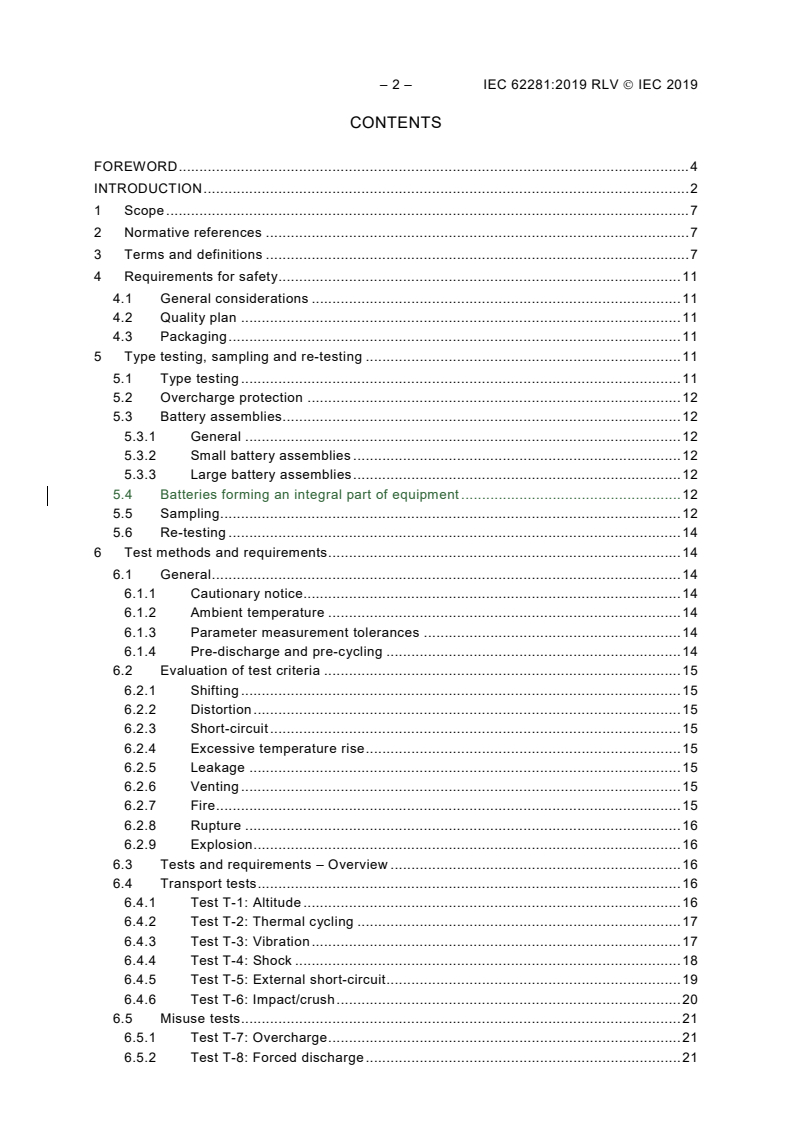
– 2 – IEC 62281:2019 RLV IEC 2019
CONTENTS
FOREWORD . 4
INTRODUCTION . 2
1 Scope . 7
2 Normative references . 7
3 Terms and definitions . 7
4 Requirements for safety . 11
4.1 General considerations . 11
4.2 Quality plan . 11
4.3 Packaging . 11
5 Type testing, sampling and re-testing . 11
5.1 Type testing . 11
5.2 Overcharge protection . 12
5.3 Battery assemblies. 12
5.3.1 General . 12
5.3.2 Small battery assemblies . 12
5.3.3 Large battery assemblies . 12
5.4 Batteries forming an integral part of equipment . 12
5.5 Sampling. 12
5.6 Re-testing . 14
6 Test methods and requirements . 14
6.1 General . 14
6.1.1 Cautionary notice. 14
6.1.2 Ambient temperature . 14
6.1.3 Parameter measurement tolerances . 14
6.1.4 Pre-discharge and pre-cycling . 14
6.2 Evaluation of test criteria . 15
6.2.1 Shifting . 15
6.2.2 Distortion . 15
6.2.3 Short-circuit . 15
6.2.4 Excessive temperature rise . 15
6.2.5 Leakage . 15
6.2.6 Venting . 15
6.2.7 Fire . 15
6.2.8 Rupture . 16
6.2.9 Explosion . 16
6.3 Tests and requirements – Overview . 16
6.4 Transport tests . 16
6.4.1 Test T-1: Altitude . 16
6.4.2 Test T-2: Thermal cycling . 17
6.4.3 Test T-3: Vibration . 17
6.4.4 Test T-4: Shock . 18
6.4.5 Test T-5: External short-circuit . 19
6.4.6 Test T-6: Impact/crush . 20
6.5 Misuse tests . 21
6.5.1 Test T-7: Overcharge . 21
6.5.2 Test T-8: Forced discharge . 21
6.6 Packaging test – Test P-1: Drop test . 22
6.7 Information to be given in the relevant specification . 22
6.8 Test report summary . 23
Transport certificate .
7 Information for safety . 23
7.1 Packaging . 24
7.2 Handling of battery cartons . 24
7.3 Transport . 24
7.3.1 General . 24
7.3.2 Air transport. 24
7.3.3 Sea transport . 24
7.3.4 Land transport . 24
7.3.5 Classification . 24
7.4 Display and Storage . 25
8 Instructions for packaging and handling during transport – Quarantine . 25
9 Marking . 25
9.1 Marking of primary and secondary (rechargeable) cells and batteries . 25
9.2 Marking of the packaging and shipping documents . 25
Annex A (informative) Shock test – adjustment of acceleration for large batteries . 26
A.1 General . 26
A.2 Shock energy depends on mass, acceleration, and pulse duration . 26
A.3 The constant acceleration approach . 27
A.4 The constant energy approach . 28
Annex B (informative) Deviations from Chapter 38.3 of the UN Manual . 29
B.1 General . 29
B.2 Summary table of required tests for primary cells and batteries . 29
B.3 Summary table of required tests for rechargeable cells and batteries . 30
B.4 Evaluation of a rupture . 32
B.5 Evaluation of an explosion . 32
Bibliography . 33
Figure 1 – Example of a test set-up for the impact test. 20
Figure A.1 – Half sine shock for batteries (constant peak acceleration) . 27
Figure A.2 – Half sine shock for batteries (constant energy) . 28
Table 1 – Number of primary test cells and batteries for type testing . 13
Table 2 – Number of secondary test cells and batteries for type testing . 13
Table 3 – Number of packages with primary or secondary test cells and batteries. 14
Table 4 – Mass loss limits . 15
Table 5 – Transport and packaging tests and requirements . 16
Table 6 – Vibration profile (sinusoidal) . 18
Table 7 – Shock parameters . 19
Table B.1 – Summary table of required tests for primary cells and batteries . 30
Table B.2 – Summary table of required tests for rechargeable cells and batteries . 31
– 4 – IEC 62281:2019 RLV IEC 2019
INTERNATIONAL ELECTROTECHNICAL COMMISSION
____________
SAFETY OF PRIMARY AND SECONDARY LITHIUM CELLS
AND BATTERIES DURING TRANSPORT
FOREWORD
1) The International Electrotechnical Commission (IEC) is a worldwide organization for standardization comprising
all national electrotechnical committees (IEC National Committees). The object of IEC is to promote
international co-operation on all questions concerning standardization in the electrical and electronic fields. To
this end and in addition to other activities, IEC publishes International Standards, Technical Specifications,
Technical Reports, Publicly Available Specifications (PAS) and Guides (hereafter referred to as "IEC
Publication(s)"). Their preparation is entrusted to technical committees; any IEC National Committee interested
in the subject dealt with may participate in this preparatory work. International, governmental and non-
governmental organizations liaising with the IEC also participate in this preparation. IEC collaborates closely
with the International Organization for Standardization (ISO) in accordance with conditions determined by
agreement between the two organizations.
2) The formal decisions or agreements of IEC on technical matters express, as nearly as possible, an international
consensus of opinion on the relevant subjects since each technical committee has representation from all
interested IEC National Committees.
3) IEC Publications have the form of recommendations for international use and are accepted by IEC National
Committees in that sense. While all reasonable efforts are made to ensure that the technical content of IEC
Publications is accurate, IEC cannot be held responsible for the way in which they are used or for any
misinterpretation by any end user.
4) In order to promote international uniformity, IEC National Committees undertake to apply IEC Publications
transparently to the maximum extent possible in their national and regional publications. Any divergence
between any IEC Publication and the corresponding national or regional publication shall be clearly indicated in
the latter.
5) IEC itself does not provide any attestation of conformity. Independent certification bodies provide conformity
assessment services and, in some areas, access to IEC marks of conformity. IEC is not responsible for any
services carried out by independent certification bodies.
6) All users should ensure that they have the latest edition of this publication.
7) No liability shall attach to IEC or its directors, employees, servants or agents including individual experts and
members of its technical committees and IEC National Committees for any personal injury, property damage or
other damage of any nature whatsoever, whether direct or indirect, or for costs (including legal fees) and
expenses arising out of the publication, use of, or reliance upon, this IEC Publication or any other IEC
Publications.
8) Attention is drawn to the Normative references cited in this publication. Use of the referenced publications is
indispensable for the correct application of this publication.
9) Attention is drawn to the possibility that some of the elements of this IEC Publication may be the subject of
patent rights. IEC shall not be held responsible for identifying any or all such patent rights.
This redline version of the official IEC Standard allows the user to identify the changes
made to the previous edition. A vertical bar appears in the margin wherever a change
has been made. Additions are in green text, deletions are in strikethrough red text.
International Standard IEC 62281 has been prepared jointly by IEC technical committee 35:
Primary cells and batteries and subcommittee 21A: Secondary cells and batteries containing
alkaline or other non-acid electrolytes, of IEC technical committee 21: Secondary cells and
batteries.
This fourth edition cancels and replaces the third edition published in 2016. This edition
constitutes a technical revision.
This edition includes the following significant technical changes with respect to the previous
edition:
a) button cell definition revised, moved to coin (cell or battery);
b) addition of provisions for batteries forming an integral part of equipment (5.4);
c) all tests for secondary cells and batteries now also contain a requirement for 25 charge
and recharge cycles prior to the test;
d) addition of alternative tables for Table 1 and Table 2 in Annex B;
e) addition of "forcible" to the rupture criteria;
f) test report 6.8 merged with test certificate 6.9 and replaced with the items listed in [12];
g) addition of an informative Annex B with important deviations from the UN Manual of Tests
and Criteria, Chapter 38.3.
The text of this standard is based on the following documents:
FDIS Report on voting
35/1416/FDIS 35/1422/RVD
Full information on the voting for the approval of this International Standard can be found in
the report on voting indicated in the above table.
This document has been drafted in accordance with the ISO/IEC Directives, Part 2.
The committee has decided that the contents of this document will remain unchanged until the
stability date indicated on the IEC website under "http://webstore.iec.ch" in the data related to
the specific document. At this date, the document will be
• reconfirmed,
• withdrawn,
• replaced by a revised edition, or
• amended.
IMPORTANT – The “colour inside” logo on the cover page of this publication indicates
that it contains colours which are considered to be useful for the correct understanding
of its contents. Users should therefore print this publication using a colour printer.
– 6 – IEC 62281:2019 RLV IEC 2019
INTRODUCTION
Primary lithium cells and batteries were first introduced in military applications in the 1970s.
At that time, little commercial interest and no industrial standards existed. Consequently, the
United Nations (UN) Committee of Experts on the Transport of Dangerous Goods, although
usually referring to industrial standards for testing and criteria, introduced a sub-section in the
Manual of tests and criteria concerning safety tests relevant to transport of primary lithium
cells and batteries. Meanwhile, commercial interest in primary and secondary (rechargeable)
lithium cells and batteries has grown and several industrial standards exist. However, the
existing IEC standards are manifold, not completely harmonized, and not necessarily relevant
to transport. They are not suitable to be used as a source of reference in the UN Model
Regulations. Therefore this group safety standard has been prepared to harmonize the tests
and requirements relevant to transport.
This document applies to primary and secondary (rechargeable) lithium cells and batteries
containing lithium in any chemical form: lithium metal, lithium alloy or lithium-ion. Lithium-
metal and lithium alloy primary electrochemical systems use metallic lithium and lithium alloy,
respectively, as the negative electrode. Lithium-ion secondary electrochemical systems use
intercalation compounds (intercalated lithium exists in an ionic or quasi-atomic form within the
lattice of the electrode material) in the positive and in the negative electrodes.
This document also applies to lithium polymer cells and batteries, which are considered either
as primary lithium-metal cells and batteries or as secondary lithium-ion cells and batteries,
depending on the nature of the material used in the negative electrode.
The history of transporting primary and secondary lithium cells and batteries is worth noting.
Since the 1970s, over ten billion primary lithium cells and batteries have been transported,
and since the early 1990s, over one billion secondary (rechargeable) lithium cells and
batteries utilizing a lithium-ion system have been transported. As the number of primary and
secondary lithium cells and batteries to be transported is increasing, it is appropriate to also
include in this document the safety testing of packaging used for the transportation of these
products.
This document specifically addresses the safety of primary and secondary lithium cells and
batteries during transport and also the safety of the packaging used.
The UN Manual of Tests and Criteria [12] distinguishes between lithium metal and lithium
alloy cells and batteries on the one hand, and lithium ion and lithium polymer cells and
batteries on the other hand. While it defines that lithium metal and lithium alloy cells and
batteries can be either primary (non-rechargeable) or rechargeable, it always considers
lithium ion cells and batteries as rechargeable. However, test methods in the UN Manual of
Tests and Criteria are the same for both secondary lithium metal and lithium alloy cells and
batteries and lithium ion and lithium polymer cells and batteries. The concept is only needed
to distinguish between small and large battery assemblies. Battery assemblies assembled
from (primary or secondary) lithium metal and lithium alloy batteries are distinguished by the
aggregate lithium content of all anodes (measured in grams), while battery assemblies
assembled from lithium ion or lithium polymer batteries are distinguished by their "nominal"
energy (measured in Watt-hours).
___________
Numbers in square brackets refer to the Bibliography.
SAFETY OF PRIMARY AND SECONDARY LITHIUM CELLS
AND BATTERIES DURING TRANSPORT
1 Scope
This International Standard specifies test methods and requirements for primary and
secondary (rechargeable) lithium cells and batteries to ensure their safety during transport
other than for recycling or disposal. Requirements specified in this document do not apply in
those cases where special provisions given in the relevant regulations, listed in 7.3, provide
exemptions.
NOTE Different standards may apply for lithium-ion traction battery systems used for electrically propelled road
vehicles.
2 Normative references
There are no normative references in this document.
3 Terms and definitions
For the purposes of this document, the following terms and definitions apply.
ISO and IEC maintain terminological databases for use in standardization at the following
addresses:
• IEC Electropedia: available at http://www.electropedia.org/
• ISO Online browsing platform: available at http://www.iso.org/obp
3.1
aggregate lithium content
total lithium content of the cells comprising a battery
3.2
battery
one or more cells electrically connected and fitted in a case, with terminals, markings and
protective devices etc., as necessary for use
Note 1 to entry: This definition is different from the definition used in the UN Manual of Tests and Criteria [12].
This document was, however, carefully prepared so that the test set-up for each test is harmonized with the UN
Manual.
Note 2 to entry: A cell used in equipment where the equipment is providing the functions of a case, terminals,
markings and protective devices etc., as necessary for use in the equipment, is, for the purposes of this document,
considered to be a battery.
[SOURCE: IEC 60050-482:2004 [1], 482-01-04, modified – Reference to "electrically
connected" has been added.]
3.3
battery assembly
battery comprising two or more batteries
– 8 – IEC 62281:2019 RLV IEC 2019
3.4
coin (cell or battery)
lithium button (cell or battery)
small round cell or battery where the overall height is less than the diameter, e.g. in the shape
of a button or a coin containing non-aqueous electrolyte
Note 1 to entry: The nominal voltage of lithium batteries is typically greater than 2 V.
[SOURCE: IEC 60050-482:2004, 482-02-40, modified – The definition "small round cell or
battery" replaces the original "cell with a cylindrical shape", "containing non-aqueous
electrolyte" was added, the term "lithium button" was added]
3.5
cell
basic functional unit, consisting of an assembly of electrodes, electrolyte, container, terminals
and, usually, separators that is a source of electric energy obtained by direct conversion of
chemical energy
[SOURCE: IEC 60050-482:2004, 482-01-01]
3.6
component cell
cell contained in a battery
3.7
cycle
set of operations that is carried out on a
secondary (rechargeable) cell or battery and is repeated regularly in the same sequence
Note 1 to entry: These operations may consist of a sequence of a discharge followed by a charge or a charge
followed by a discharge under specified conditions. This sequence may include rest periods.
[SOURCE: IEC 60050-482:2004, 482-05-28, modified – The words "secondary
(rechargeable)" have been added.]
3.8
cylindrical cell or battery
round cell or battery in which the overall height is equal to or greater than the diameter
[SOURCE: IEC 60050-482:2004, 482-02-39, modified – The words "round cell or battery"
replace the original "cell with a cylindrical shape", the term "cylindrical battery" has been
added.]
3.9
depth of discharge
DOD
percentage of rated capacity discharged from a battery
Note 1 to entry: This note applies to the French language only.
3.10
first cycle
initial cycle of a secondary (rechargeable) cell or battery following completion of all
manufacturing, formation and quality control processes
3.11
fully charged, adj
state of charge of a secondary (rechargeable) cell or battery corresponding to 0 % depth of
discharge
3.12
fully discharged, adj
state of charge of a cell or battery corresponding to 100 % depth of discharge
3.13
large battery
battery with a gross mass of more than 12 kg
3.14
large cell
cell with a gross mass of more than 500 g
3.15
lithium cell
cell containing a non-aqueous electrolyte and a
negative electrode of lithium or containing lithium
Note 1 to entry: Depending on the design features chosen, a lithium cell may be primary or secondary
(rechargeable).
[SOURCE: IEC 60050-482:2004, 482-01-06, modified – The notion of domain "primary or
secondary (rechargeable)" has been added.]
3.16
lithium content
mass of lithium in the negative electrode of a lithium metal or lithium alloy cell or battery in the
undischarged or fully charged state
3.17
lithium ion cell or battery
rechargeable non-aqueous cell or battery in which the positive and negative electrodes are
both intercalation compounds constructed with no metallic lithium in either electrode
Note 1 to entry: Intercalated lithium exists in an ionic or quasi-atomic form with the lattice of the electrode
material.
Note 2 to entry: A lithium polymer cell or battery that uses lithium ion chemistries, as described herein, is
considered as a lithium ion cell or battery.
3.18
nominal energy
energy value of a cell or battery determined under specified conditions and declared by the
manufacturer
Note 1 to entry: The nominal energy is calculated by multiplying the nominal voltage by rated capacity.
Note 2 to entry: The term "rated energy" could be more appropriate.
3.19
nominal voltage
suitable approximate value of the voltage used to designate or identify a cell, a battery or an
electrochemical system
[SOURCE: IEC 60050-482:2004, 482-03-31]
3.20
open-circuit voltage
voltage across the terminals of a cell or battery when no external current is flowing
[SOURCE: IEC 60050-482:2004, 482-03-32, modified – "when no external current is flowing"
replaces "when the discharge current is zero".]
– 10 – IEC 62281:2019 RLV IEC 2019
3.21
primary cell or battery
cell or battery that is not designed to be electrically recharged
[SOURCE: IEC 60050-482:2004, 482-01-02, modified – Addition of "or battery".]
3.22
prismatic cell or battery
cell or battery having rectangular sides and bases
[SOURCE: IEC 60050-482:2004, 482-02-38, modified – Omission of "having the shape of a
parallelepiped".]
3.23
protective devices
devices such as fuses, diodes or other electric or electronic current limiters designed to
interrupt the current flow, block the current flow in one direction or limit the current flow in an
electrical circuit
3.24
rated capacity
capacity value of a cell or battery determined under specified conditions and declared by the
manufacturer
Note 1 to entry: The following IEC standards provide guidance and methodology for determining the rated
capacity: IEC 61960-3 [5], IEC 62133-2 [6], IEC 62660-1 [7].
[SOURCE: IEC 60050-482:2004, 482-03-15, modified – Inclusion of "a cell or battery",
addition of Note 1 to entry.]
3.25
secondary (rechargeable) cell or battery
cell or battery which is designed to be electrically recharged
[SOURCE: IEC 60050-482:2004, 482-01-03, modified – Addition of "rechargeable" and "or
battery".]
3.26
small battery
battery with a gross mass of not more than 12 kg
3.27
small cell
cell with a gross mass of not more than 500 g
3.28
type
particular electrochemical system and physical design of cells or
batteries
3.29
undischarged, adj
state of charge of a primary cell or battery corresponding to 0 % depth of discharge
4 Requirements for safety
4.1 General considerations
Lithium cells and batteries are categorized by their chemical composition (electrodes,
electrolyte) and internal construction (bobbin, spiral, stacked). They are available in various
shapes. It is necessary to consider all relevant safety aspects at the battery design stage,
recognizing the fact that they may differ considerably, depending on the specific lithium
system, power output and battery configuration.
The following design concepts for safety are common to all lithium cells and batteries:
a) To prevent by design an abnormal temperature rise above the critical value defined by the
manufacturer.
b) To control by design temperature increases in the cell or battery e.g. by limiting the
current flow or by adequate thermal management.
c) To design lithium cells and batteries so as to relieve excessive internal pressure or to
preclude a violent rupture under conditions of transport.
d) To design lithium cells and batteries so as to prevent a short-circuit under normal
conditions of transport and intended use.
e) To equip primary lithium batteries containing cells or strings of cells connected in parallel
with effective means, as may be necessary, to prevent dangerous reverse current flow
(e.g. diodes, fuses, etc.).
4.2 Quality plan
The manufacturer shall implement a documented quality plan (i.e. quality reports, inspection
records, management structure) defining the procedures for the inspection of materials,
components, cells and batteries during the course of manufacture, to be applied to the total
process of producing a specific type of battery. Manufacturers should understand their
process capabilities and should institute the necessary process controls as they relate to
product safety and reliability.
4.3 Packaging
Lithium cells and batteries shall be packaged so as to prevent an external short-circuit under
normal transport conditions.
NOTE Additional requirements for packaging of dangerous goods are given in UN Model Regulations:2015 [12]
2017 [13], section 6.1. See also regulations mentioned in 7.3.
5 Type testing, sampling and re-testing
5.1 Type testing
Lithium metal and lithium ion cells or batteries which differ from a tested type by
a) for primary cells and batteries, a change of more than 0,1 g or 20 % by mass, whichever
is greater, to the electrodes or to the electrolyte, or
b) for rechargeable cells and batteries, a change in nominal energy (in Wh) of more than
20 % or an increase in nominal voltage of more than 20 %, or
c) a change that would lead to failure of any of the tests,
shall be considered a different type and shall be subject to the required tests.
NOTE The type of change that might be considered to differ from a tested type, such that it might lead to failure
of any of the test results, may include, but is not limited to
1) a change in the material of the anode, the cathode, the separator or the electrolyte,
– 12 – IEC 62281:2019 RLV IEC 2019
2) a change of protective devices, including hardware and software,
3) a change of safety design in cells or batteries, such as a venting valve,
4) a change in the number of component cells, and
5) a change in connecting mode of component cells, and,
6) for batteries which are to be tested according to test T-4 with a peak acceleration less than 150 g , a
n
change in the mass which could adversely impact the result of the T-4 test and lead to a failure.
5.2 Overcharge protection
Secondary batteries not equipped with battery overcharge protection that are designed for use
only in a battery assembly or in equipment, which affords such protection, are not subject to
the requirements of test T-7.
5.3 Battery assemblies
5.3.1 General
Generally, battery assemblies, including battery packs, battery modules, and other units that
may be assembled from batteries, are tested like batteries.
5.3.2 Small battery assemblies
When testing a battery assembly in which the aggregate lithium content of all anodes, when
fully charged, is not more than 500 g, or in the case of a lithium ion battery, with a nominal
energy of not more than 6 200 Wh, assembled from batteries that have passed all applicable
tests, one battery assembly in a fully charged state shall be tested under tests T-3, T-4
and T-5, and, in addition, test T-7 in the case of a secondary battery assembly.
NOTE The term "fully charged" is used in [12] although it applies only to secondary battery assemblies. For
primary battery assemblies, the term "undischarged" would be more appropriate.
5.3.3 Large battery assemblies
A battery assembly with an aggregate lithium content of more than 500 g, or in the case of a
lithium ion battery, with a nominal energy of more than 6 200 Wh, does not need to be tested
if it is of a type that has been verified as preventing:
• overcharge, and
• short circuits; and
• over discharge between the batteries.
5.4 Batteries forming an integral part of equipment
Cells or batteries that are an integral part of the equipment they are intended to power, and
which are transported only when installed in the equipment, may be tested in accordance with
the applicable tests when installed in the equipment.
5.5 Sampling
Each different type shall be tested by taking random samples. The number of samples for
testing primary cells and batteries is given in Table 1. The number of samples for testing
secondary cells and batteries is given in Table 2. The number of samples for testing packages
of primary and secondary cells and batteries is given in Table 3.
Table 1 – Number of primary test cells and batteries for type testing
a
Tests Discharge state Cells or single-cell batteries Multi-cell batteries
Undischarged 10 4
Tests
T-1 to T-5
Fully discharged 10 4
Undischarged 5 5 component cells
Test T-6
Fully discharged 5 5 component cells
Test T-8 Fully discharged 10 10 component cells
Total for 8 batteries and
all tests 20 component cells
a
Single-cell batteries containing one tested component cell do not require re-testing unless the change could
result in a failure of any of the tests.
See also Clause B.2 in Annex B.
Table 2 – Number of secondary test cells and batteries for type testing
a
Tests Cycles and Cells Single-cell batteries Multi-cell batteries
discharge
Small Large Small Large
state
At first cycle,
10 5 10 5 10 5 4 2
fully charged
b
Tests After 25 cycles, N/A
b b b
N/A 5 N/A 5 N/A 4 2
T-1 to T-5 fully charged 5
After 50 cycles,
b b b b
N/A N/A N/A 4 N/A
fully charged
At first cycle,
Test T-6 5 5 5 5 component cells 5 component cells
at 50 % DOD
After 25 cycles,
5 5 5 5 component cells 5 component cells
at 50 % DOD
At first cycle,
b c c c c
N/A 4 2 4 2
fully charged
After 25 cycles,
b b c c b c c
Test T-7 N/A N/A 4 2 N/A 4 2
fully charged
After 50 cycles,
b c b c b
N/A 4 N/A 4 N/A
fully charged
At first cycle,
d d
10 10 10 10 component cells 10 component cells
fully discharged
Test T-8
After 50 25
d d
cycles, 10 10 10 10 component cells 10 component cells
fully discharged
16 batteries and 8 batteries and
Total for
35 40 43 48 39 44 25 30 component 25 30 component
all tests
cells cells
a
Single-cell batteries containing one tested component cell do not require re-testing unless the change could
result in a failure of any of the tests, except for test T-7 where only batteries are tested.
b
N/A = not applicable.
c
See 5.2.
d
Multi-cell batteries are considered to be protected against overdischarge of their component cells. Otherwise
they would have to be tested as well.
See also Clause B.3 in Annex B.
– 14 – IEC 62281:2019 RLV IEC 2019
Table 3 – Number of packages with primary or secondary test cells and batteries
Number of samples for test P-1 1 package as supplied for transport
5.6 Re-testing
In the event that a primary or secondary lithium cell or battery type does not meet the test
requirements, steps shall be taken to correct the deficiency or deficiencies that caused the
failure before such a cell or battery type is re-tested.
6 Test methods and requirements
6.1 General
6.1.1 Cautionary notice
WARNING – These tests call for the use of procedures which may result in injury if
adequate precautions are not taken.
The execution of these tests shall only be conducted by appropriately qualified and
experienced technicians using adequate protection.
6.1.2 Ambient temperature
Unless otherwise specified, the tests shall be carried out in an ambient temperature
of 20 °C ± 5 °C.
6.1.3 Parameter measurement tolerances
The overall accuracy of controlled or measured values, relative to the specified or actual
parameters, shall be within the following tolerances:
a) ± 1 % for voltage;
b) ± 1 % for current;
c) ± 2 °C for temperature;
d) ± 0,1 % for time;
e) ± 1 % for dimension;
f) ± 1 % for capacity.
These tolerances comprise the combined accuracy of the measuring instruments, the
measurement techniques used, and all other sources of error in the test procedure.
6.1.4 Pre-discharge and pre-cycling
Where, prior to testing, it is required to discharge primary test cells or test batteries, they shall
be discharged to their respective depth of discharge on a resistive load with which the rated
capacity is obtained, or at a constant current specified by the manufacturer.
Where, prior to testing, it is required to cycle secondary (rechargeable) test cells or test
batteries, they shall be cycled using the charge and discharge conditions specified by the
manufacturer for optimum performance and safety.
6.2 Evaluation of test criteria
6.2.1 Shifting
Shifting is considered to have occurred during a test if one or more test cells or batteries are
released from the packaging, do not retain their original orientation, or are affected in such a
way that the occurrence of an external short-circuit or crushing cannot be excluded.
6.2.2 Distortion
Distortion is considered to have occurred if a physical dimension changes by more than 10 %.
6.2.3 Short-circuit
A short-circuit is considered to have occurred during a test if the open circuit voltage of the
cell or battery directly after the test is less than 90 % of its voltage immediately prior to the
test. This requirement is not applicable to test cells and batteries at fully discharged states.
6.2.4 Excessive temperature rise
An excessive temperature rise is considered to have occurred during a test if the external
case temperature of the test cell or battery rises above 170 °C.
6.2.5 Leakage
Leakage is considered to have occurred during a test if there is visible escape of electrolyte
or other material from the test cell or battery or the loss of material (except battery casing,
handling devices or labels) from the test cell or battery such that the mass loss exceeds the
limits in Table 4.
In order to quantify mass loss ∆m / m, the following equation is provided:
mm−
Δm/ m × 100 %
m
where
m is the mass before a test;
m is the mass after that test.
Table 4 – Mass loss limits
Mass of cell or battery Mass loss limit
m ∆m / m
m < 1 g 0,5 %
0,2 %
1 g ≤ m ≤ 75 g
0,1 %
m > 75 g
6.2.6 Venting
Venting is considered to have occurred during a test if gas has escaped from a cell or battery
through a feature designed for this purpose, in order to relieve excessive internal pressure.
This gas may include entrapped materials.
6.2.7 Fire
A fire is considered to have occurred if, during a test, flames are emitted from the test cell or
battery.
=
– 16 – IEC 62281:2019 RLV IEC 2019
6.2.8 Rupture
A rupture is considered to have occurred if a cell container or battery case has mechanically
failed, resulting in expulsion of gas or spillage of liquids but not forcible ejection of solid
materials.
6.2.9 Explosion
An explosion is considered to have occurred if a cell container or battery case opens violently
and solid components are forcibly expelled.
6.3 Tests and requirements – Overview
Table 5 contains an overview of the tests and requirements for transport, misuse and
packaging tests.
Table 5 – Transport and packaging tests and requirements
Test number Designation Requirements
Transport tests T-1 Altitude NL, NV, NC, NR, NE, NF
T-2 Thermal cycling NL, NV, NC, NR, NE, NF
T-3 Vibration NL, NV, NC, NR, NE, NF
T-4 Shock NL, NV, NC, NR, NE, NF
T-5 External short-circuit NT, NR, NE, NF
T-6 Impact/crush NT, NE, NF
Misuse tests T-7 Overcharge NE, NF
T-8 Forced discharge NE, NF
Packaging tests P-1 Drop NS, ND, NL, NV, NC, NT, NR, NE, NF
Tests T-1 to T-5 shall be conducte
...
IEC 62281 ®
Edition 4.0 2019-04
INTERNATIONAL
STANDARD
NORME
INTERNATIONALE
Safety of primary and secondary lithium cells and batteries during transport
Sécurité des piles et des accumulateurs au lithium pendant le transport
All rights reserved. Unless otherwise specified, no part of this publication may be reproduced or utilized in any form
or by any means, electronic or mechanical, including photocopying and microfilm, without permission in writing from
either IEC or IEC's member National Committee in the country of the requester. If you have any questions about IEC
copyright or have an enquiry about obtaining additional rights to this publication, please contact the address below or
your local IEC member National Committee for further information.
Droits de reproduction réservés. Sauf indication contraire, aucune partie de cette publication ne peut être reproduite ni
utilisée sous quelque forme que ce soit et par aucun procédé, électronique ou mécanique, y compris la photocopie et
les microfilms, sans l'accord écrit de l'IEC ou du Comité national de l'IEC du pays du demandeur. Si vous avez des
questions sur le copyright de l'IEC ou si vous désirez obtenir des droits supplémentaires sur cette publication, utilisez
les coordonnées ci-après ou contactez le Comité national de l'IEC de votre pays de résidence.
IEC Central Office Tel.: +41 22 919 02 11
3, rue de Varembé info@iec.ch
CH-1211 Geneva 20 www.iec.ch
Switzerland
About the IEC
The International Electrotechnical Commission (IEC) is the leading global organization that prepares and publishes
International Standards for all electrical, electronic and related technologies.
About IEC publications
The technical content of IEC publications is kept under constant review by the IEC. Please make sure that you have the
latest edition, a corrigendum or an amendment might have been published.
IEC publications search - webstore.iec.ch/advsearchform Electropedia - www.electropedia.org
The advanced search enables to find IEC publications by a The world's leading online dictionary on electrotechnology,
variety of criteria (reference number, text, technical containing more than 22 000 terminological entries in English
committee,…). It also gives information on projects, replaced and French, with equivalent terms in 16 additional languages.
and withdrawn publications. Also known as the International Electrotechnical Vocabulary
(IEV) online.
IEC Just Published - webstore.iec.ch/justpublished
Stay up to date on all new IEC publications. Just Published IEC Glossary - std.iec.ch/glossary
details all new publications released. Available online and once 67 000 electrotechnical terminology entries in English and
a month by email. French extracted from the Terms and Definitions clause of IEC
publications issued since 2002. Some entries have been
IEC Customer Service Centre - webstore.iec.ch/csc collected from earlier publications of IEC TC 37, 77, 86 and
If you wish to give us your feedback on this publication or need CISPR.
further assistance, please contact the Customer Service
Centre: sales@iec.ch.
A propos de l'IEC
La Commission Electrotechnique Internationale (IEC) est la première organisation mondiale qui élabore et publie des
Normes internationales pour tout ce qui a trait à l'électricité, à l'électronique et aux technologies apparentées.
A propos des publications IEC
Le contenu technique des publications IEC est constamment revu. Veuillez vous assurer que vous possédez l’édition la
plus récente, un corrigendum ou amendement peut avoir été publié.
Recherche de publications IEC - Le premier dictionnaire d'électrotechnologie en ligne au monde,
webstore.iec.ch/advsearchform avec plus de 22 000 articles terminologiques en anglais et en
La recherche avancée permet de trouver des publications IEC français, ainsi que les termes équivalents dans 16 langues
en utilisant différents critères (numéro de référence, texte, additionnelles. Egalement appelé Vocabulaire
comité d’études,…). Elle donne aussi des informations sur les Electrotechnique International (IEV) en ligne.
projets et les publications remplacées ou retirées.
Glossaire IEC - std.iec.ch/glossary
IEC Just Published - webstore.iec.ch/justpublished 67 000 entrées terminologiques électrotechniques, en anglais
Restez informé sur les nouvelles publications IEC. Just et en français, extraites des articles Termes et Définitions des
Published détaille les nouvelles publications parues. publications IEC parues depuis 2002. Plus certaines entrées
Disponible en ligne et une fois par mois par email. antérieures extraites des publications des CE 37, 77, 86 et
CISPR de l'IEC.
Service Clients - webstore.iec.ch/csc
Si vous désirez nous donner des commentaires sur cette
publication ou si vous avez des questions contactez-nous:
sales@iec.ch.
Electropedia - www.electropedia.org
IEC 62281 ®
Edition 4.0 2019-04
INTERNATIONAL
STANDARD
NORME
INTERNATIONALE
Safety of primary and secondary lithium cells and batteries during transport
Sécurité des piles et des accumulateurs au lithium pendant le transport
INTERNATIONAL
ELECTROTECHNICAL
COMMISSION
COMMISSION
ELECTROTECHNIQUE
INTERNATIONALE
ICS 29.220.10 ISBN 978-2-8322-6661-8
– 2 – IEC 62281:2019 IEC 2019
CONTENTS
FOREWORD . 4
INTRODUCTION . 6
1 Scope . 7
2 Normative references . 7
3 Terms and definitions . 7
4 Requirements for safety . 11
4.1 General considerations . 11
4.2 Quality plan . 11
4.3 Packaging . 11
5 Type testing, sampling and re-testing . 11
5.1 Type testing . 11
5.2 Overcharge protection . 12
5.3 Battery assemblies. 12
5.3.1 General . 12
5.3.2 Small battery assemblies . 12
5.3.3 Large battery assemblies . 12
5.4 Batteries forming an integral part of equipment . 12
5.5 Sampling. 12
5.6 Re-testing . 13
6 Test methods and requirements . 14
6.1 General . 14
6.1.1 Cautionary notice. 14
6.1.2 Ambient temperature . 14
6.1.3 Parameter measurement tolerances . 14
6.1.4 Pre-discharge and pre-cycling . 14
6.2 Evaluation of test criteria . 14
6.2.1 Shifting . 14
6.2.2 Distortion . 14
6.2.3 Short-circuit . 15
6.2.4 Excessive temperature rise . 15
6.2.5 Leakage . 15
6.2.6 Venting . 15
6.2.7 Fire . 15
6.2.8 Rupture . 15
6.2.9 Explosion . 15
6.3 Tests and requirements – Overview . 16
6.4 Transport tests . 16
6.4.1 Test T-1: Altitude . 16
6.4.2 Test T-2: Thermal cycling . 16
6.4.3 Test T-3: Vibration . 17
6.4.4 Test T-4: Shock . 18
6.4.5 Test T-5: External short-circuit . 18
6.4.6 Test T-6: Impact/crush . 19
6.5 Misuse tests . 21
6.5.1 Test T-7: Overcharge . 21
6.5.2 Test T-8: Forced discharge . 21
6.6 Packaging test – Test P-1: Drop test . 21
6.7 Information to be given in the relevant specification . 22
6.8 Test report summary . 22
7 Information for safety . 23
7.1 Packaging . 23
7.2 Handling of battery cartons . 23
7.3 Transport . 23
7.3.1 General . 23
7.3.2 Air transport. 23
7.3.3 Sea transport . 23
7.3.4 Land transport . 23
7.3.5 Classification . 23
7.4 Storage . 24
8 Instructions for packaging and handling during transport – Quarantine . 24
9 Marking . 24
9.1 Marking of primary and secondary (rechargeable) cells and batteries . 24
9.2 Marking of the packaging and shipping documents . 24
Annex A (informative) Shock test – adjustment of acceleration for large batteries . 25
A.1 General . 25
A.2 Shock energy depends on mass, acceleration, and pulse duration . 25
A.3 The constant acceleration approach . 26
A.4 The constant energy approach . 27
Annex B (informative) Deviations from Chapter 38.3 of the UN Manual . 28
B.1 General . 28
B.2 Summary table of required tests for primary cells and batteries . 28
B.3 Summary table of required tests for rechargeable cells and batteries . 29
B.4 Evaluation of a rupture . 31
B.5 Evaluation of an explosion . 31
Bibliography . 32
Figure 1 – Example of a test set-up for the impact test. 20
Figure A.1 – Half sine shock for batteries (constant peak acceleration) . 26
Figure A.2 – Half sine shock for batteries (constant energy) . 27
Table 1 – Number of primary test cells and batteries for type testing . 13
Table 2 – Number of secondary test cells and batteries for type testing . 13
Table 3 – Number of packages with primary or secondary test cells and batteries. 13
Table 4 – Mass loss limits . 15
Table 5 – Transport and packaging tests and requirements . 16
Table 6 – Vibration profile (sinusoidal) . 17
Table 7 – Shock parameters . 18
Table B.1 – Summary table of required tests for primary cells and batteries . 29
Table B.2 – Summary table of required tests for rechargeable cells and batteries . 30
– 4 – IEC 62281:2019 IEC 2019
INTERNATIONAL ELECTROTECHNICAL COMMISSION
____________
SAFETY OF PRIMARY AND SECONDARY LITHIUM CELLS
AND BATTERIES DURING TRANSPORT
FOREWORD
1) The International Electrotechnical Commission (IEC) is a worldwide organization for standardization comprising
all national electrotechnical committees (IEC National Committees). The object of IEC is to promote
international co-operation on all questions concerning standardization in the electrical and electronic fields. To
this end and in addition to other activities, IEC publishes International Standards, Technical Specifications,
Technical Reports, Publicly Available Specifications (PAS) and Guides (hereafter referred to as "IEC
Publication(s)"). Their preparation is entrusted to technical committees; any IEC National Committee interested
in the subject dealt with may participate in this preparatory work. International, governmental and non-
governmental organizations liaising with the IEC also participate in this preparation. IEC collaborates closely
with the International Organization for Standardization (ISO) in accordance with conditions determined by
agreement between the two organizations.
2) The formal decisions or agreements of IEC on technical matters express, as nearly as possible, an international
consensus of opinion on the relevant subjects since each technical committee has representation from all
interested IEC National Committees.
3) IEC Publications have the form of recommendations for international use and are accepted by IEC National
Committees in that sense. While all reasonable efforts are made to ensure that the technical content of IEC
Publications is accurate, IEC cannot be held responsible for the way in which they are used or for any
misinterpretation by any end user.
4) In order to promote international uniformity, IEC National Committees undertake to apply IEC Publications
transparently to the maximum extent possible in their national and regional publications. Any divergence
between any IEC Publication and the corresponding national or regional publication shall be clearly indicated in
the latter.
5) IEC itself does not provide any attestation of conformity. Independent certification bodies provide conformity
assessment services and, in some areas, access to IEC marks of conformity. IEC is not responsible for any
services carried out by independent certification bodies.
6) All users should ensure that they have the latest edition of this publication.
7) No liability shall attach to IEC or its directors, employees, servants or agents including individual experts and
members of its technical committees and IEC National Committees for any personal injury, property damage or
other damage of any nature whatsoever, whether direct or indirect, or for costs (including legal fees) and
expenses arising out of the publication, use of, or reliance upon, this IEC Publication or any other IEC
Publications.
8) Attention is drawn to the Normative references cited in this publication. Use of the referenced publications is
indispensable for the correct application of this publication.
9) Attention is drawn to the possibility that some of the elements of this IEC Publication may be the subject of
patent rights. IEC shall not be held responsible for identifying any or all such patent rights.
International Standard IEC 62281 has been prepared jointly by IEC technical committee 35:
Primary cells and batteries and subcommittee 21A: Secondary cells and batteries containing
alkaline or other non-acid electrolytes, of IEC technical committee 21: Secondary cells and
batteries.
This fourth edition cancels and replaces the third edition published in 2016. This edition
constitutes a technical revision.
This edition includes the following significant technical changes with respect to the previous
edition:
a) button cell definition revised, moved to coin (cell or battery);
b) addition of provisions for batteries forming an integral part of equipment (5.4);
c) all tests for secondary cells and batteries now also contain a requirement for 25 charge
and recharge cycles prior to the test;
d) addition of alternative tables for Table 1 and Table 2 in Annex B;
e) addition of "forcible" to the rupture criteria;
f) test report 6.8 merged with test certificate 6.9 and replaced with the items listed in [12];
g) addition of an informative Annex B with important deviations from the UN Manual of Tests
and Criteria, Chapter 38.3.
The text of this standard is based on the following documents:
FDIS Report on voting
35/1416/FDIS 35/1422/RVD
Full information on the voting for the approval of this International Standard can be found in
the report on voting indicated in the above table.
This document has been drafted in accordance with the ISO/IEC Directives, Part 2.
The committee has decided that the contents of this document will remain unchanged until the
stability date indicated on the IEC website under "http://webstore.iec.ch" in the data related to
the specific document. At this date, the document will be
• reconfirmed,
• withdrawn,
• replaced by a revised edition, or
• amended.
– 6 – IEC 62281:2019 IEC 2019
INTRODUCTION
Primary lithium cells and batteries were first introduced in military applications in the 1970s.
At that time, little commercial interest and no industrial standards existed. Consequently, the
United Nations (UN) Committee of Experts on the Transport of Dangerous Goods, although
usually referring to industrial standards for testing and criteria, introduced a sub-section in the
Manual of tests and criteria concerning safety tests relevant to transport of primary lithium
cells and batteries. Meanwhile, commercial interest in primary and secondary (rechargeable)
lithium cells and batteries has grown and several industrial standards exist. However, the
existing IEC standards are manifold, not completely harmonized, and not necessarily relevant
to transport. They are not suitable to be used as a source of reference in the UN Model
Regulations. Therefore this group safety standard has been prepared to harmonize the tests
and requirements relevant to transport.
This document applies to primary and secondary (rechargeable) lithium cells and batteries
containing lithium in any chemical form: lithium metal, lithium alloy or lithium-ion. Lithium-
metal and lithium alloy primary electrochemical systems use metallic lithium and lithium alloy,
respectively, as the negative electrode. Lithium-ion secondary electrochemical systems use
intercalation compounds (intercalated lithium exists in an ionic or quasi-atomic form within the
lattice of the electrode material) in the positive and in the negative electrodes.
This document also applies to lithium polymer cells and batteries, which are considered either
as primary lithium-metal cells and batteries or as secondary lithium-ion cells and batteries,
depending on the nature of the material used in the negative electrode.
The history of transporting primary and secondary lithium cells and batteries is worth noting.
Since the 1970s, over ten billion primary lithium cells and batteries have been transported,
and since the early 1990s, over one billion secondary (rechargeable) lithium cells and
batteries utilizing a lithium-ion system have been transported. As the number of primary and
secondary lithium cells and batteries to be transported is increasing, it is appropriate to also
include in this document the safety testing of packaging used for the transportation of these
products.
This document specifically addresses the safety of primary and secondary lithium cells and
batteries during transport and also the safety of the packaging used.
The UN Manual of Tests and Criteria [12] distinguishes between lithium metal and lithium
alloy cells and batteries on the one hand, and lithium ion and lithium polymer cells and
batteries on the other hand. While it defines that lithium metal and lithium alloy cells and
batteries can be either primary (non-rechargeable) or rechargeable, it always considers
lithium ion cells and batteries as rechargeable. However, test methods in the UN Manual of
Tests and Criteria are the same for both secondary lithium metal and lithium alloy cells and
batteries and lithium ion and lithium polymer cells and batteries. The concept is only needed
to distinguish between small and large battery assemblies. Battery assemblies assembled
from (primary or secondary) lithium metal and lithium alloy batteries are distinguished by the
aggregate lithium content of all anodes (measured in grams), while battery assemblies
assembled from lithium ion or lithium polymer batteries are distinguished by their "nominal"
energy (measured in Watt-hours).
___________
Numbers in square brackets refer to the Bibliography.
SAFETY OF PRIMARY AND SECONDARY LITHIUM CELLS
AND BATTERIES DURING TRANSPORT
1 Scope
This International Standard specifies test methods and requirements for primary and
secondary (rechargeable) lithium cells and batteries to ensure their safety during transport
other than for recycling or disposal. Requirements specified in this document do not apply in
those cases where special provisions given in the relevant regulations, listed in 7.3, provide
exemptions.
NOTE Different standards may apply for lithium-ion traction battery systems used for electrically propelled road
vehicles.
2 Normative references
There are no normative references in this document.
3 Terms and definitions
For the purposes of this document, the following terms and definitions apply.
ISO and IEC maintain terminological databases for use in standardization at the following
addresses:
• IEC Electropedia: available at http://www.electropedia.org/
• ISO Online browsing platform: available at http://www.iso.org/obp
3.1
aggregate lithium content
total lithium content of the cells comprising a battery
3.2
battery
one or more cells electrically connected and fitted in a case, with terminals, markings and
protective devices etc., as necessary for use
Note 1 to entry: This definition is different from the definition used in the UN Manual of Tests and Criteria [12].
This document was, however, carefully prepared so that the test set-up for each test is harmonized with the UN
Manual.
Note 2 to entry: A cell used in equipment where the equipment is providing the functions of a case, terminals,
markings and protective devices etc., as necessary for use in the equipment, is, for the purposes of this document,
considered to be a battery.
[SOURCE: IEC 60050-482:2004 [1], 482-01-04, modified – Reference to "electrically
connected" has been added.]
3.3
battery assembly
battery comprising two or more batteries
– 8 – IEC 62281:2019 IEC 2019
3.4
coin cell or battery
lithium button cell or battery
small round cell or battery where the overall height is less than the diameter, containing non-
aqueous electrolyte
Note 1 to entry: The nominal voltage of lithium batteries is typically greater than 2 V.
[SOURCE: IEC 60050-482:2004, 482-02-40, modified – The definition "small round cell or
battery" replaces the original "cell with a cylindrical shape", "containing non-aqueous
electrolyte" was added, the term "lithium button" was added]
3.5
cell
basic functional unit, consisting of an assembly of electrodes, electrolyte, container, terminals
and, usually, separators that is a source of electric energy obtained by direct conversion of
chemical energy
[SOURCE: IEC 60050-482:2004, 482-01-01]
3.6
component cell
cell contained in a battery
3.7
cycle
set of operations that is carried out on a
secondary (rechargeable) cell or battery and is repeated regularly in the same sequence
Note 1 to entry: These operations may consist of a sequence of a discharge followed by a charge or a charge
followed by a discharge under specified conditions. This sequence may include rest periods.
[SOURCE: IEC 60050-482:2004, 482-05-28, modified – The words "secondary
(rechargeable)" have been added.]
3.8
cylindrical cell or battery
round cell or battery in which the overall height is equal to or greater than the diameter
[SOURCE: IEC 60050-482:2004, 482-02-39, modified – The words "round cell or battery"
replace the original "cell with a cylindrical shape", the term "cylindrical battery" has been
added.]
3.9
depth of discharge
DOD
percentage of rated capacity discharged from a battery
Note 1 to entry: This note applies to the French language only.
3.10
first cycle
initial cycle of a secondary (rechargeable) cell or battery following completion of all
manufacturing, formation and quality control processes
3.11
fully charged, adj
state of charge of a secondary (rechargeable) cell or battery corresponding to 0 % depth of
discharge
3.12
fully discharged, adj
state of charge of a cell or battery corresponding to 100 % depth of discharge
3.13
large battery
battery with a gross mass of more than 12 kg
3.14
large cell
cell with a gross mass of more than 500 g
3.15
lithium cell
cell containing a non-aqueous electrolyte and a
negative electrode of lithium or containing lithium
Note 1 to entry: Depending on the design features chosen, a lithium cell may be primary or secondary
(rechargeable).
[SOURCE: IEC 60050-482:2004, 482-01-06, modified – The domain "primary or secondary
(rechargeable)" has been added.]
3.16
lithium content
mass of lithium in the negative electrode of a lithium metal or lithium alloy cell or battery in the
undischarged or fully charged state
3.17
lithium ion cell or battery
rechargeable non-aqueous cell or battery in which the positive and negative electrodes are
both intercalation compounds constructed with no metallic lithium in either electrode
Note 1 to entry: Intercalated lithium exists in an ionic or quasi-atomic form with the lattice of the electrode
material.
Note 2 to entry: A lithium polymer cell or battery that uses lithium ion chemistries, as described herein, is
considered as a lithium ion cell or battery.
3.18
nominal energy
energy value of a cell or battery determined under specified conditions and declared by the
manufacturer
Note 1 to entry: The nominal energy is calculated by multiplying the nominal voltage by rated capacity.
Note 2 to entry: The term "rated energy" could be more appropriate.
3.19
nominal voltage
suitable approximate value of the voltage used to designate or identify a cell, a battery or an
electrochemical system
[SOURCE: IEC 60050-482:2004, 482-03-31]
3.20
open-circuit voltage
voltage across the terminals of a cell or battery when no external current is flowing
[SOURCE: IEC 60050-482:2004, 482-03-32, modified – "when no external current is flowing"
replaces "when the discharge current is zero".]
– 10 – IEC 62281:2019 IEC 2019
3.21
primary cell or battery
cell or battery that is not designed to be electrically recharged
[SOURCE: IEC 60050-482:2004, 482-01-02, modified – Addition of "or battery".]
3.22
prismatic cell or battery
cell or battery having rectangular sides and bases
[SOURCE: IEC 60050-482:2004, 482-02-38, modified – Omission of "having the shape of a
parallelepiped".]
3.23
protective devices
devices such as fuses, diodes or other electric or electronic current limiters designed to
interrupt the current flow, block the current flow in one direction or limit the current flow in an
electrical circuit
3.24
rated capacity
capacity value of a cell or battery determined under specified conditions and declared by the
manufacturer
Note 1 to entry: The following IEC standards provide guidance and methodology for determining the rated
capacity: IEC 61960-3 [5], IEC 62133-2 [6], IEC 62660-1 [7].
[SOURCE: IEC 60050-482:2004, 482-03-15, modified – Inclusion of "a cell or battery",
addition of Note 1 to entry.]
3.25
secondary (rechargeable) cell or battery
cell or battery which is designed to be electrically recharged
[SOURCE: IEC 60050-482:2004, 482-01-03, modified – Addition of "rechargeable" and "or
battery".]
3.26
small battery
battery with a gross mass of not more than 12 kg
3.27
small cell
cell with a gross mass of not more than 500 g
3.28
type
particular electrochemical system and physical design of cells or
batteries
3.29
undischarged, adj
state of charge of a primary cell or battery corresponding to 0 % depth of discharge
4 Requirements for safety
4.1 General considerations
Lithium cells and batteries are categorized by their chemical composition (electrodes,
electrolyte) and internal construction (bobbin, spiral, stacked). They are available in various
shapes. It is necessary to consider all relevant safety aspects at the battery design stage,
recognizing the fact that they may differ considerably, depending on the specific lithium
system, power output and battery configuration.
The following design concepts for safety are common to all lithium cells and batteries:
a) To prevent by design an abnormal temperature rise above the critical value defined by the
manufacturer.
b) To control by design temperature increases in the cell or battery e.g. by limiting the
current flow or by adequate thermal management.
c) To design lithium cells and batteries so as to relieve excessive internal pressure or to
preclude a violent rupture under conditions of transport.
d) To design lithium cells and batteries so as to prevent a short-circuit under normal
conditions of transport and intended use.
e) To equip primary lithium batteries containing cells or strings of cells connected in parallel
with effective means, as may be necessary, to prevent dangerous reverse current flow
(e.g. diodes, fuses, etc.).
4.2 Quality plan
The manufacturer shall implement a documented quality plan (i.e. quality reports, inspection
records, management structure) defining the procedures for the inspection of materials,
components, cells and batteries during the course of manufacture, to be applied to the total
process of producing a specific type of battery. Manufacturers should understand their
process capabilities and should institute the necessary process controls as they relate to
product safety and reliability.
4.3 Packaging
Lithium cells and batteries shall be packaged so as to prevent an external short-circuit under
normal transport conditions.
NOTE Additional requirements for packaging of dangerous goods are given in UN Model Regulations:2017 [13],
section 6.1. See also regulations mentioned in 7.3.
5 Type testing, sampling and re-testing
5.1 Type testing
Lithium metal and lithium ion cells or batteries which differ from a tested type by
a) for primary cells and batteries, a change of more than 0,1 g or 20 % by mass, whichever
is greater, to the electrodes or to the electrolyte, or
b) for rechargeable cells and batteries, a change in nominal energy (in Wh) of more than
20 % or an increase in nominal voltage of more than 20 %, or
c) a change that would lead to failure of any of the tests,
shall be considered a different type and shall be subject to the required tests.
NOTE The type of change that might be considered to differ from a tested type, such that it might lead to failure
of any of the test results, may include, but is not limited to
1) a change in the material of the anode, the cathode, the separator or the electrolyte,
– 12 – IEC 62281:2019 IEC 2019
2) a change of protective devices, including hardware and software,
3) a change of safety design in cells or batteries, such as a venting valve,
4) a change in the number of component cells, and
5) a change in connecting mode of component cells, and,
6) for batteries which are to be tested according to test T-4 with a peak acceleration less than 150 g , a
n
change in the mass which could adversely impact the result of the T-4 test and lead to a failure.
5.2 Overcharge protection
Secondary batteries not equipped with battery overcharge protection that are designed for use
only in a battery assembly or in equipment, which affords such protection, are not subject to
the requirements of test T-7.
5.3 Battery assemblies
5.3.1 General
Generally, battery assemblies, including battery packs, battery modules, and other units that
may be assembled from batteries, are tested like batteries.
5.3.2 Small battery assemblies
When testing a battery assembly in which the aggregate lithium content of all anodes, when
fully charged, is not more than 500 g, or in the case of a lithium ion battery, with a nominal
energy of not more than 6 200 Wh, assembled from batteries that have passed all applicable
tests, one battery assembly in a fully charged state shall be tested under tests T-3, T-4
and T-5, and, in addition, test T-7 in the case of a secondary battery assembly.
NOTE The term "fully charged" is used in [12] although it applies only to secondary battery assemblies. For
primary battery assemblies, the term "undischarged" would be more appropriate.
5.3.3 Large battery assemblies
A battery assembly with an aggregate lithium content of more than 500 g, or in the case of a
lithium ion battery, with a nominal energy of more than 6 200 Wh, does not need to be tested
if it is of a type that has been verified as preventing:
• overcharge, and
• short circuits; and
• over discharge between the batteries.
5.4 Batteries forming an integral part of equipment
Cells or batteries that are an integral part of the equipment they are intended to power, and
which are transported only when installed in the equipment, may be tested in accordance with
the applicable tests when installed in the equipment.
5.5 Sampling
Each different type shall be tested by taking random samples. The number of samples for
testing primary cells and batteries is given in Table 1. The number of samples for testing
secondary cells and batteries is given in Table 2. The number of samples for testing packages
of primary and secondary cells and batteries is given in Table 3.
Table 1 – Number of primary test cells and batteries for type testing
a
Tests Discharge state Cells or single-cell batteries Multi-cell batteries
Undischarged 10 4
Tests
T-1 to T-5
Fully discharged 10 4
Undischarged 5 5 component cells
Test T-6
Fully discharged 5 5 component cells
Test T-8 Fully discharged 10 10 component cells
Total for 8 batteries and
all tests 20 component cells
a
Single-cell batteries containing one tested component cell do not require re-testing unless the change could
result in a failure of any of the tests.
See also Clause B.2 in Annex B.
Table 2 – Number of secondary test cells and batteries for type testing
a
Tests Cycles and Cells Single-cell batteries Multi-cell batteries
discharge
Small Large Small Large
state
At first cycle,
5 5 5 4 2
fully charged
Tests
T-1 to T-5
After 25 cycles,
5 5 5 4 2
fully charged
At first cycle,
5 5 5 5 component cells 5 component cells
at 50 % DOD
Test T-6
After 25 cycles,
5 5 5 5 component cells 5 component cells
at 50 % DOD
At first cycle,
b c c c c
N/A 4 2 4 2
fully charged
Test T-7
After 25 cycles,
b c c c c
N/A 4 2 4 2
fully charged
At first cycle,
d d
10 10 10 10 component cells 10 component cells
fully discharged
Test T-8
After 25 cycles,
d d
10 10 10 10 component cells 10 component cells
fully discharged
Total for 16 batteries and 8 batteries and
40 48 44
all tests 30 component cells 30 component cells
a
Single-cell batteries containing one tested component cell do not require re-testing unless the change could
result in a failure of any of the tests, except for test T-7 where only batteries are tested.
b
N/A = not applicable.
c
See 5.2.
d
Multi-cell batteries are considered to be protected against overdischarge of their component cells. Otherwise
they would have to be tested as well.
See also Clause B.3 in Annex B.
Table 3 – Number of packages with primary or secondary test cells and batteries
Number of samples for test P-1 1 package as supplied for transport
5.6 Re-testing
In the event that a primary or secondary lithium cell or battery type does not meet the test
requirements, steps shall be taken to correct the deficiency or deficiencies that caused the
failure before such a cell or battery type is re-tested.
– 14 – IEC 62281:2019 IEC 2019
6 Test methods and requirements
6.1 General
6.1.1 Cautionary notice
WARNING – These tests call for the use of procedures which may result in injury if
adequate precautions are not taken.
The execution of these tests shall only be conducted by appropriately qualified and
experienced technicians using adequate protection.
6.1.2 Ambient temperature
Unless otherwise specified, the tests shall be carried out in an ambient temperature
of 20 °C ± 5 °C.
6.1.3 Parameter measurement tolerances
The overall accuracy of controlled or measured values, relative to the specified or actual
parameters, shall be within the following tolerances:
a) ± 1 % for voltage;
b) ± 1 % for current;
c) ± 2 °C for temperature;
d) ± 0,1 % for time;
e) ± 1 % for dimension;
f) ± 1 % for capacity.
These tolerances comprise the combined accuracy of the measuring instruments, the
measurement techniques used, and all other sources of error in the test procedure.
6.1.4 Pre-discharge and pre-cycling
Where, prior to testing, it is required to discharge primary test cells or test batteries, they shall
be discharged to their respective depth of discharge on a resistive load with which the rated
capacity is obtained, or at a constant current specified by the manufacturer.
Where, prior to testing, it is required to cycle secondary (rechargeable) test cells or test
batteries, they shall be cycled using the charge and discharge conditions specified by the
manufacturer for optimum performance and safety.
6.2 Evaluation of test criteria
6.2.1 Shifting
Shifting is considered to have occurred during a test if one or more test cells or batteries are
released from the packaging, do not retain their original orientation, or are affected in such a
way that the occurrence of an external short-circuit or crushing cannot be excluded.
6.2.2 Distortion
Distortion is considered to have occurred if a physical dimension changes by more than 10 %.
6.2.3 Short-circuit
A short-circuit is considered to have occurred during a test if the open circuit voltage of the
cell or battery directly after the test is less than 90 % of its voltage immediately prior to the
test. This requirement is not applicable to test cells and batteries at fully discharged states.
6.2.4 Excessive temperature rise
An excessive temperature rise is considered to have occurred during a test if the external
case temperature of the test cell or battery rises above 170 °C.
6.2.5 Leakage
Leakage is considered to have occurred during a test if there is visible escape of electrolyte
or other material from the test cell or battery or the loss of material (except battery casing,
handling devices or labels) from the test cell or battery such that the mass loss exceeds the
limits in Table 4.
In order to quantify mass loss ∆m / m, the following equation is provided:
mm−
...
IEC 62281 ®
Edition 4.1 2021-02
CONSOLIDATED VERSION
INTERNATIONAL
STANDARD
NORME
INTERNATIONALE
colour
inside
Safety of primary and secondary lithium cells and batteries during transport
Sécurité des piles et des accumulateurs au lithium pendant le transport
All rights reserved. Unless otherwise specified, no part of this publication may be reproduced or utilized in any form
or by any means, electronic or mechanical, including photocopying and microfilm, without permission in writing from
either IEC or IEC's member National Committee in the country of the requester. If you have any questions about IEC
copyright or have an enquiry about obtaining additional rights to this publication, please contact the address below or
your local IEC member National Committee for further information.
Droits de reproduction réservés. Sauf indication contraire, aucune partie de cette publication ne peut être reproduite
ni utilisée sous quelque forme que ce soit et par aucun procédé, électronique ou mécanique, y compris la photocopie
et les microfilms, sans l'accord écrit de l'IEC ou du Comité national de l'IEC du pays du demandeur. Si vous avez des
questions sur le copyright de l'IEC ou si vous désirez obtenir des droits supplémentaires sur cette publication, utilisez
les coordonnées ci-après ou contactez le Comité national de l'IEC de votre pays de résidence.
IEC Central Office Tel.: +41 22 919 02 11
3, rue de Varembé info@iec.ch
CH-1211 Geneva 20 www.iec.ch
Switzerland
About the IEC
The International Electrotechnical Commission (IEC) is the leading global organization that prepares and publishes
International Standards for all electrical, electronic and related technologies.
About IEC publications
The technical content of IEC publications is kept under constant review by the IEC. Please make sure that you have the
latest edition, a corrigendum or an amendment might have been published.
IEC publications search - webstore.iec.ch/advsearchform IEC online collection - oc.iec.ch
The advanced search enables to find IEC publications by a Discover our powerful search engine and read freely all the
variety of criteria (reference number, text, technical publications previews. With a subscription you will always
committee, …). It also gives information on projects, replaced have access to up to date content tailored to your needs.
and withdrawn publications.
Electropedia - www.electropedia.org
IEC Just Published - webstore.iec.ch/justpublished
The world's leading online dictionary on electrotechnology,
Stay up to date on all new IEC publications. Just Published
containing more than 22 000 terminological entries in English
details all new publications released. Available online and
and French, with equivalent terms in 18 additional languages.
once a month by email.
Also known as the International Electrotechnical Vocabulary
(IEV) online.
IEC Customer Service Centre - webstore.iec.ch/csc
If you wish to give us your feedback on this publication or
need further assistance, please contact the Customer Service
Centre: sales@iec.ch.
A propos de l'IEC
La Commission Electrotechnique Internationale (IEC) est la première organisation mondiale qui élabore et publie des
Normes internationales pour tout ce qui a trait à l'électricité, à l'électronique et aux technologies apparentées.
A propos des publications IEC
Le contenu technique des publications IEC est constamment revu. Veuillez vous assurer que vous possédez l’édition la
plus récente, un corrigendum ou amendement peut avoir été publié.
Recherche de publications IEC - IEC online collection - oc.iec.ch
webstore.iec.ch/advsearchform Découvrez notre puissant moteur de recherche et consultez
La recherche avancée permet de trouver des publications IEC gratuitement tous les aperçus des publications. Avec un
en utilisant différents critères (numéro de référence, texte, abonnement, vous aurez toujours accès à un contenu à jour
comité d’études, …). Elle donne aussi des informations sur adapté à vos besoins.
les projets et les publications remplacées ou retirées.
Electropedia - www.electropedia.org
IEC Just Published - webstore.iec.ch/justpublished
Le premier dictionnaire d'électrotechnologie en ligne au
Restez informé sur les nouvelles publications IEC. Just
monde, avec plus de 22 000 articles terminologiques en
Published détaille les nouvelles publications parues.
anglais et en français, ainsi que les termes équivalents dans
Disponible en ligne et une fois par mois par email.
16 langues additionnelles. Egalement appelé Vocabulaire
Electrotechnique International (IEV) en ligne.
Service Clients - webstore.iec.ch/csc
Si vous désirez nous donner des commentaires sur cette
publication ou si vous avez des questions contactez-nous:
sales@iec.ch.
IEC 62281 ®
Edition 4.1 2021-02
CONSOLIDATED VERSION
INTERNATIONAL
STANDARD
NORME
INTERNATIONALE
colour
inside
Safety of primary and secondary lithium cells and batteries during transport
Sécurité des piles et des accumulateurs au lithium pendant le transport
INTERNATIONAL
ELECTROTECHNICAL
COMMISSION
COMMISSION
ELECTROTECHNIQUE
INTERNATIONALE
ICS 29.220.10 ISBN 978-2-8322-9419-2
IEC 62281 ®
Edition 4.1 2021-02
CONSOLIDATED VERSION
REDLINE VERSION
VERSION REDLINE
colour
inside
Safety of primary and secondary lithium cells and batteries during transport
Sécurité des piles et des accumulateurs au lithium pendant le transport
– 2 – IEC 62281:2019+AMD1:2021 CSV
IEC 2021
CONTENTS
FOREWORD . 4
INTRODUCTION . 6
1 Scope . 7
2 Normative references . 7
3 Terms and definitions . 7
4 Requirements for safety . 11
4.1 General considerations . 11
4.2 Quality plan . 11
4.3 Packaging . 11
5 Type testing, sampling and re-testing . 11
5.1 Type testing . 11
5.2 Overcharge protection . 12
5.3 Battery assemblies. 12
5.3.1 General . 12
5.3.2 Small battery assemblies . 12
5.3.3 Large battery assemblies . 12
5.4 Batteries forming an integral part of equipment . 12
5.5 Sampling. 12
5.6 Re-testing . 13
6 Test methods and requirements . 14
6.1 General . 14
6.1.1 Cautionary notice. 14
6.1.2 Ambient temperature . 14
6.1.3 Parameter measurement tolerances . 14
6.1.4 Pre-discharge and pre-cycling . 14
6.2 Evaluation of test criteria . 14
6.2.1 Shifting . 14
6.2.2 Distortion . 14
6.2.3 Short-circuit . 15
6.2.4 Excessive temperature rise . 15
6.2.5 Leakage . 15
6.2.6 Venting . 15
6.2.7 Fire . 15
6.2.8 Rupture . 15
6.2.9 Explosion . 15
6.3 Tests and requirements – Overview . 16
6.4 Transport tests . 16
6.4.1 Test T-1: Altitude . 16
6.4.2 Test T-2: Thermal cycling . 16
6.4.3 Test T-3: Vibration . 17
6.4.4 Test T-4: Shock . 18
6.4.5 Test T-5: External short-circuit . 18
6.4.6 Test T-6: Impact/crush . 19
6.5 Misuse tests . 21
6.5.1 Test T-7: Overcharge . 21
6.5.2 Test T-8: Forced discharge . 21
IEC 2021
6.6 Packaging test – Test P-1: Drop test . 21
6.7 Information to be given in the relevant specification . 22
6.8 Test report summary . 22
7 Information for safety . 23
7.1 Packaging . 23
7.2 Handling of battery cartons . 23
7.3 Transport . 23
7.3.1 General . 23
7.3.2 Air transport. 23
7.3.3 Sea transport . 23
7.3.4 Land transport . 23
7.3.5 Classification . 24
7.4 Storage . 24
8 Instructions for packaging and handling during transport – Quarantine . 24
9 Marking . 24
9.1 Marking of primary and secondary (rechargeable) cells and batteries . 24
9.2 Marking of the packaging and shipping documents . 24
Annex A (informative) Shock test – adjustment of acceleration for large batteries . 25
A.1 General . 25
A.2 Shock energy depends on mass, acceleration, and pulse duration . 25
A.3 The constant acceleration approach . 26
A.4 The constant energy approach . 27
Annex B (informative) Deviations from Chapter 38.3 of the UN Manual . 28
B.1 General . 28
B.2 Summary table of required tests for primary cells and batteries . 28
B.3 Summary table of required tests for rechargeable cells and batteries . 29
B.4 Evaluation of a rupture . 31
B.5 Evaluation of an explosion . 31
Bibliography . 32
Figure 1 – Example of a test set-up for the impact test. 20
Figure A.1 – Half sine shock for batteries (constant peak acceleration) . 26
Figure A.2 – Half sine shock for batteries (constant energy) . 27
Table 1 – Number of primary test cells and batteries for type testing . 13
Table 2 – Number of secondary test cells and batteries for type testing . 13
Table 3 – Number of packages with primary or secondary test cells and batteries. 13
Table 4 – Mass loss limits . 15
Table 5 – Transport and packaging tests and requirements . 16
Table 6 – Vibration profile (sinusoidal) . 17
Table 7 – Shock parameters . 18
Table B.1 – Summary table of required tests for primary cells and batteries . 29
Table B.2 – Summary table of required tests for rechargeable cells and batteries . 30
– 4 – IEC 62281:2019+AMD1:2021 CSV
IEC 2021
INTERNATIONAL ELECTROTECHNICAL COMMISSION
____________
SAFETY OF PRIMARY AND SECONDARY LITHIUM CELLS
AND BATTERIES DURING TRANSPORT
FOREWORD
1) The International Electrotechnical Commission (IEC) is a worldwide organization for standardization comprising
all national electrotechnical committees (IEC National Committees). The object of IEC is to promote
international co-operation on all questions concerning standardization in the electrical and electronic fields. To
this end and in addition to other activities, IEC publishes International Standards, Technical Specifications,
Technical Reports, Publicly Available Specifications (PAS) and Guides (hereafter referred to as "IEC
Publication(s)"). Their preparation is entrusted to technical committees; any IEC National Committee interested
in the subject dealt with may participate in this preparatory work. International, governmental and non-
governmental organizations liaising with the IEC also participate in this preparation. IEC collaborates closely
with the International Organization for Standardization (ISO) in accordance with conditions determined by
agreement between the two organizations.
2) The formal decisions or agreements of IEC on technical matters express, as nearly as possible, an international
consensus of opinion on the relevant subjects since each technical committee has representation from all
interested IEC National Committees.
3) IEC Publications have the form of recommendations for international use and are accepted by IEC National
Committees in that sense. While all reasonable efforts are made to ensure that the technical content of IEC
Publications is accurate, IEC cannot be held responsible for the way in which they are used or for any
misinterpretation by any end user.
4) In order to promote international uniformity, IEC National Committees undertake to apply IEC Publications
transparently to the maximum extent possible in their national and regional publications. Any divergence
between any IEC Publication and the corresponding national or regional publication shall be clearly indicated in
the latter.
5) IEC itself does not provide any attestation of conformity. Independent certification bodies provide conformity
assessment services and, in some areas, access to IEC marks of conformity. IEC is not responsible for any
services carried out by independent certification bodies.
6) All users should ensure that they have the latest edition of this publication.
7) No liability shall attach to IEC or its directors, employees, servants or agents including individual experts and
members of its technical committees and IEC National Committees for any personal injury, property damage or
other damage of any nature whatsoever, whether direct or indirect, or for costs (including legal fees) and
expenses arising out of the publication, use of, or reliance upon, this IEC Publication or any other IEC
Publications.
8) Attention is drawn to the Normative references cited in this publication. Use of the referenced publications is
indispensable for the correct application of this publication.
9) Attention is drawn to the possibility that some of the elements of this IEC Publication may be the subject of
patent rights. IEC shall not be held responsible for identifying any or all such patent rights.
This consolidated version of the official IEC Standard and its amendment has been
prepared for user convenience.
IEC 62281 edition 4.1 contains the fourth edition (2019-04) [documents 35/1416/FDIS
and 35/1422/RVD] and its amendment 1 (2021-02) [documents 35/1459/FDIS and
35/1463/RVD].
In this Redline version, a vertical line in the margin shows where the technical content
is modified by amendment 1. Additions are in green text, deletions are in strikethrough
red text. A separate Final version with all changes accepted is available in this
publication.
IEC 2021
International Standard IEC 62281 has been prepared jointly by IEC technical committee 35:
Primary cells and batteries and subcommittee 21A: Secondary cells and batteries containing
alkaline or other non-acid electrolytes, of IEC technical committee 21: Secondary cells and
batteries.
This fourth edition constitutes a technical revision.
This edition includes the following significant technical changes with respect to the previous
edition:
a) button cell definition revised, moved to coin (cell or battery);
b) addition of provisions for batteries forming an integral part of equipment (5.4);
c) all tests for secondary cells and batteries now also contain a requirement for 25 charge
and recharge cycles prior to the test;
d) addition of alternative tables for Table 1 and Table 2 in Annex B;
e) addition of "forcible" to the rupture criteria;
f) test report 6.8 merged with test certificate 6.9 and replaced with the items listed in [12];
g) addition of an informative Annex B with important deviations from the UN Manual of Tests
and Criteria, Chapter 38.3.
This document has been drafted in accordance with the ISO/IEC Directives, Part 2.
The committee has decided that the contents of the base publication and its amendment will
remain unchanged until the stability date indicated on the IEC web site under
"http://webstore.iec.ch" in the data related to the specific publication. At this date, the
publication will be
• reconfirmed,
• withdrawn,
• replaced by a revised edition, or
• amended.
IMPORTANT – The 'colour inside' logo on the cover page of this publication indicates
that it contains colours which are considered to be useful for the correct
understanding of its contents. Users should therefore print this document using a
colour printer.
– 6 – IEC 62281:2019+AMD1:2021 CSV
IEC 2021
INTRODUCTION
Primary lithium cells and batteries were first introduced in military applications in the 1970s.
At that time, little commercial interest and no industrial standards existed. Consequently, the
United Nations (UN) Committee of Experts on the Transport of Dangerous Goods, although
usually referring to industrial standards for testing and criteria, introduced a sub-section in the
Manual of tests and criteria concerning safety tests relevant to transport of primary lithium
cells and batteries. Meanwhile, commercial interest in primary and secondary (rechargeable)
lithium cells and batteries has grown and several industrial standards exist. However, the
existing IEC standards are manifold, not completely harmonized, and not necessarily relevant
to transport. They are not suitable to be used as a source of reference in the UN Model
Regulations. Therefore this group safety standard has been prepared to harmonize the tests
and requirements relevant to transport.
This document applies to primary and secondary (rechargeable) lithium cells and batteries
containing lithium in any chemical form: lithium metal, lithium alloy or lithium-ion. Lithium-
metal and lithium alloy primary electrochemical systems use metallic lithium and lithium alloy,
respectively, as the negative electrode. Lithium-ion secondary electrochemical systems use
intercalation compounds (intercalated lithium exists in an ionic or quasi-atomic form within the
lattice of the electrode material) in the positive and in the negative electrodes.
This document also applies to lithium polymer cells and batteries, which are considered either
as primary lithium-metal cells and batteries or as secondary lithium-ion cells and batteries,
depending on the nature of the material used in the negative electrode.
The history of transporting primary and secondary lithium cells and batteries is worth noting.
Since the 1970s, over ten billion primary lithium cells and batteries have been transported,
and since the early 1990s, over one billion secondary (rechargeable) lithium cells and
batteries utilizing a lithium-ion system have been transported. As the number of primary and
secondary lithium cells and batteries to be transported is increasing, it is appropriate to also
include in this document the safety testing of packaging used for the transportation of these
products.
This document specifically addresses the safety of primary and secondary lithium cells and
batteries during transport and also the safety of the packaging used.
The UN Manual of Tests and Criteria [12] distinguishes between lithium metal and lithium
alloy cells and batteries on the one hand, and lithium ion and lithium polymer cells and
batteries on the other hand. While it defines that lithium metal and lithium alloy cells and
batteries can be either primary (non-rechargeable) or rechargeable, it always considers
lithium ion cells and batteries as rechargeable. However, test methods in the UN Manual of
Tests and Criteria are the same for both secondary lithium metal and lithium alloy cells and
batteries and lithium ion and lithium polymer cells and batteries. The concept is only needed
to distinguish between small and large battery assemblies. Battery assemblies assembled
from (primary or secondary) lithium metal and lithium alloy batteries are distinguished by the
aggregate lithium content of all anodes (measured in grams), while battery assemblies
assembled from lithium ion or lithium polymer batteries are distinguished by their "nominal"
energy (measured in Watt-hours).
___________
Numbers in square brackets refer to the Bibliography.
IEC 2021
SAFETY OF PRIMARY AND SECONDARY LITHIUM CELLS
AND BATTERIES DURING TRANSPORT
1 Scope
This International Standard specifies test methods and requirements for primary and
secondary (rechargeable) lithium cells and batteries to ensure their safety during transport
other than for recycling or disposal. Requirements specified in this document do not apply in
those cases where special provisions given in the relevant regulations, listed in 7.3, provide
exemptions.
NOTE Different standards may apply for lithium-ion traction battery systems used for electrically propelled road
vehicles.
2 Normative references
There are no normative references in this document.
3 Terms and definitions
For the purposes of this document, the following terms and definitions apply.
ISO and IEC maintain terminological databases for use in standardization at the following
addresses:
• IEC Electropedia: available at http://www.electropedia.org/
• ISO Online browsing platform: available at http://www.iso.org/obp
3.1
aggregate lithium content
total lithium content of the cells comprising a battery
3.2
battery
one or more cells electrically connected and fitted in a case, with terminals, markings and
protective devices etc., as necessary for use
Note 1 to entry: This definition is different from the definition used in the UN Manual of Tests and Criteria [12].
This document was, however, carefully prepared so that the test set-up for each test is harmonized with the UN
Manual.
Note 2 to entry: A cell used in equipment where the equipment is providing the functions of a case, terminals,
markings and protective devices etc., as necessary for use in the equipment, is, for the purposes of this document,
considered to be a battery.
[SOURCE: IEC 60050-482:2004 [1], 482-01-04, modified – Reference to "electrically
connected" has been added.]
3.3
battery assembly
battery comprising two or more batteries
– 8 – IEC 62281:2019+AMD1:2021 CSV
IEC 2021
3.4
coin cell or battery
lithium button cell or battery
small round cell or battery where the overall height is less than the diameter, containing non-
aqueous electrolyte
Note 1 to entry: The nominal voltage of lithium batteries is typically greater than 2 V.
[SOURCE: IEC 60050-482:2004, 482-02-40, modified – The definition "small round cell or
battery" replaces the original "cell with a cylindrical shape", "containing non-aqueous
electrolyte" was added, the term "lithium button" was added]
3.5
cell
basic functional unit, consisting of an assembly of electrodes, electrolyte, container, terminals
and, usually, separators that is a source of electric energy obtained by direct conversion of
chemical energy
[SOURCE: IEC 60050-482:2004, 482-01-01]
3.6
component cell
cell contained in a battery
3.7
cycle
set of operations that is carried out on a
secondary (rechargeable) cell or battery and is repeated regularly in the same sequence
Note 1 to entry: These operations may consist of a sequence of a discharge followed by a charge or a charge
followed by a discharge under specified conditions. This sequence may include rest periods.
[SOURCE: IEC 60050-482:2004, 482-05-28, modified – The words "secondary
(rechargeable)" have been added.]
3.8
cylindrical cell or battery
round cell or battery in which the overall height is equal to or greater than the diameter
[SOURCE: IEC 60050-482:2004, 482-02-39, modified – The words "round cell or battery"
replace the original "cell with a cylindrical shape", the term "cylindrical battery" has been
added.]
3.9
depth of discharge
DOD
percentage of rated capacity discharged from a battery
Note 1 to entry: This note applies to the French language only.
3.10
first cycle
initial cycle of a secondary (rechargeable) cell or battery following completion of all
manufacturing, formation and quality control processes
3.11
fully charged, adj
state of charge of a secondary (rechargeable) cell or battery corresponding to 0 % depth of
discharge
IEC 2021
3.12
fully discharged, adj
state of charge of a cell or battery corresponding to 100 % depth of discharge
3.13
large battery
battery with a gross mass of more than 12 kg
3.14
large cell
cell with a gross mass of more than 500 g
3.15
lithium cell
cell containing a non-aqueous electrolyte and a
negative electrode of lithium or containing lithium
Note 1 to entry: Depending on the design features chosen, a lithium cell may be primary or secondary
(rechargeable).
[SOURCE: IEC 60050-482:2004, 482-01-06, modified – The domain "primary or secondary
(rechargeable)" has been added.]
3.16
lithium content
mass of lithium in the negative electrode of a lithium metal or lithium alloy cell or battery in the
undischarged or fully charged state
3.17
lithium ion cell or battery
rechargeable non-aqueous cell or battery in which the positive and negative electrodes are
both intercalation compounds constructed with no metallic lithium in either electrode
Note 1 to entry: Intercalated lithium exists in an ionic or quasi-atomic form with the lattice of the electrode
material.
Note 2 to entry: A lithium polymer cell or battery that uses lithium ion chemistries, as described herein, is
considered as a lithium ion cell or battery.
3.18
nominal energy
energy value of a cell or battery determined under specified conditions and declared by the
manufacturer
Note 1 to entry: The nominal energy is calculated by multiplying the nominal voltage by rated capacity.
Note 2 to entry: The term "rated energy" could be more appropriate.
3.19
nominal voltage
suitable approximate value of the voltage used to designate or identify a cell, a battery or an
electrochemical system
[SOURCE: IEC 60050-482:2004, 482-03-31]
3.20
open-circuit voltage
voltage across the terminals of a cell or battery when no external current is flowing
[SOURCE: IEC 60050-482:2004, 482-03-32, modified – "when no external current is flowing"
replaces "when the discharge current is zero".]
– 10 – IEC 62281:2019+AMD1:2021 CSV
IEC 2021
3.21
primary cell or battery
cell or battery that is not designed to be electrically recharged
[SOURCE: IEC 60050-482:2004, 482-01-02, modified – Addition of "or battery".]
3.22
prismatic cell or battery
cell or battery having rectangular sides and bases
[SOURCE: IEC 60050-482:2004, 482-02-38, modified – Omission of "having the shape of a
parallelepiped".]
3.23
protective devices
devices such as fuses, diodes or other electric or electronic current limiters designed to
interrupt the current flow, block the current flow in one direction or limit the current flow in an
electrical circuit
3.24
rated capacity
capacity value of a cell or battery determined under specified conditions and declared by the
manufacturer
Note 1 to entry: The following IEC standards provide guidance and methodology for determining the rated
capacity: IEC 61960-3 [5], IEC 62133-2 [6], IEC 62660-1 [7].
[SOURCE: IEC 60050-482:2004, 482-03-15, modified – Inclusion of "a cell or battery",
addition of Note 1 to entry.]
3.25
secondary (rechargeable) cell or battery
cell or battery which is designed to be electrically recharged
[SOURCE: IEC 60050-482:2004, 482-01-03, modified – Addition of "rechargeable" and "or
battery".]
3.26
small battery
battery with a gross mass of not more than 12 kg
3.27
small cell
cell with a gross mass of not more than 500 g
3.28
type
particular electrochemical system and physical design of cells or
batteries
3.29
undischarged, adj
state of charge of a primary cell or battery corresponding to 0 % depth of discharge
IEC 2021
4 Requirements for safety
4.1 General considerations
Lithium cells and batteries are categorized by their chemical composition (electrodes,
electrolyte) and internal construction (bobbin, spiral, stacked). They are available in various
shapes. It is necessary to consider all relevant safety aspects at the battery design stage,
recognizing the fact that they may differ considerably, depending on the specific lithium
system, power output and battery configuration.
The following design concepts for safety are common to all lithium cells and batteries:
a) To prevent by design an abnormal temperature rise above the critical value defined by the
manufacturer.
b) To control by design temperature increases in the cell or battery e.g. by limiting the
current flow or by adequate thermal management.
c) To design lithium cells and batteries so as to relieve excessive internal pressure or to
preclude a violent rupture under conditions of transport.
d) To design lithium cells and batteries so as to prevent a short-circuit under normal
conditions of transport and intended use.
e) To equip primary lithium batteries containing cells or strings of cells connected in parallel
with effective means, as may be necessary, to prevent dangerous reverse current flow
(e.g. diodes, fuses, etc.).
4.2 Quality plan
The manufacturer shall implement a documented quality plan (i.e. quality reports, inspection
records, management structure) defining the procedures for the inspection of materials,
components, cells and batteries during the course of manufacture, to be applied to the total
process of producing a specific type of battery. Manufacturers should understand their
process capabilities and should institute the necessary process controls as they relate to
product safety and reliability.
4.3 Packaging
Lithium cells and batteries shall be packaged so as to prevent an external short-circuit under
normal transport conditions.
NOTE Additional requirements for packaging of dangerous goods are given in UN Model Regulations:2017 [13],
section 6.1. See also regulations mentioned in 7.3.
5 Type testing, sampling and re-testing
5.1 Type testing
Lithium metal and lithium ion cells or batteries which differ from a tested type by
a) for primary cells and batteries, a change of more than 0,1 g or 20 % by mass, whichever
is greater, to the electrodes or to the electrolyte, or
b) for rechargeable cells and batteries, a change in nominal energy (in Wh) of more than
20 % or an increase in nominal voltage of more than 20 %, or
c) a change that would lead to failure of any of the tests,
shall be considered a different type and shall be subject to the required tests.
NOTE The type of change that might be considered to differ from a tested type, such that it might lead to failure
of any of the test results, may include, but is not limited to
1) a change in the material of the anode, the cathode, the separator or the electrolyte,
– 12 – IEC 62281:2019+AMD1:2021 CSV
IEC 2021
2) a change of protective devices, including hardware and software,
3) a change of safety design in cells or batteries, such as a venting valve,
4) a change in the number of component cells, and
5) a change in connecting mode of component cells, and,
6) for batteries which are to be tested according to test T-4 with a peak acceleration less than 150 g , a
n
change in the mass which could adversely impact the result of the T-4 test and lead to a failure.
5.2 Overcharge protection
Secondary batteries not equipped with battery overcharge protection that are designed for use
only in a battery assembly or in equipment, which affords such protection, are not subject to
the requirements of test T-7.
5.3 Battery assemblies
5.3.1 General
Generally, battery assemblies, including battery packs, battery modules, and other units that
may be assembled from batteries, are tested like batteries.
5.3.2 Small battery assemblies
When testing a battery assembly in which the aggregate lithium content of all anodes, when
fully charged, is not more than 500 g, or in the case of a lithium ion battery, with a nominal
energy of not more than 6 200 Wh, assembled from batteries that have passed all applicable
tests, one battery assembly in a fully charged state shall be tested under tests T-3, T-4
and T-5, and, in addition, test T-7 in the case of a secondary battery assembly.
NOTE The term "fully charged" is used in [12] although it applies only to secondary battery assemblies. For
primary battery assemblies, the term "undischarged" would be more appropriate.
5.3.3 Large battery assemblies
A battery assembly with an aggregate lithium content of more than 500 g, or in the case of a
lithium ion battery, with a nominal energy of more than 6 200 Wh, does not need to be tested
if it is of a type that has been verified as preventing:
• overcharge, and
• short circuits; and
• over discharge between the batteries.
5.4 Batteries forming an integral part of equipment
Cells or batteries that are an integral part of the equipment they are intended to power, and
which are transported only when installed in the equipment, may be tested in accordance with
the applicable tests when installed in the equipment.
5.5 Sampling
Each different type shall be tested by taking random samples. The number of samples for
testing primary cells and batteries is given in Table 1. The number of samples for testing
secondary cells and batteries is given in Table 2. The number of samples for testing packages
of primary and secondary cells and batteries is given in Table 3.
IEC 2021
Table 1 – Number of primary test cells and batteries for type testing
a
Tests Discharge state Cells or single-cell batteries Multi-cell batteries
Undischarged 10 4
Tests
T-1 to T-5
Fully discharged 10 4
Undischarged 5 5 component cells
Test T-6
Fully discharged 5 5 component cells
Test T-8 Fully discharged 10 10 component cells
Total for 8 batteries and
all tests 20 component cells
a
Single-cell batteries containing one tested component cell do not require re-testing unless the change could
result in a failure of any of the tests.
See also Clause B.2 in Annex B.
Table 2 – Number of secondary test cells and batteries for type testing
a
Tests Cycles and Cells Single-cell batteries Multi-cell batteries
discharge
Small Large Small Large
state
At first cycle,
5 5 5 4 2
fully charged
Tests
T-1 to T-5
After 25 cycles,
5 5 5 4 2
fully charged
At first cycle,
5 5 5 5 component cells 5 component cells
at 50 % DOD
Test T-6
After 25 cycles,
5 5 5 5 component cells 5 component cells
at 50 % DOD
At first cycle,
b c c c c
N/A 4 2 4 2
fully charged
Test T-7
After 25 cycles,
b c c c c
N/A 4 2 4 2
fully charged
At first cycle,
d d
10 10 10 10 component cells 10 component cells
fully discharged
Test T-8
After 25 cycles,
d d
10 10 10 10 component cells 10 component cells
fully discharged
Total for 16 batteries and 8 batteries and
40 48 44
all tests 30 component cells 30 component cells
a
Single-cell batteries containing one tested component cell do not require re-testing unless the change could
result in a failure of any of the tests, except for test T-7 where only batteries are tested.
b
N/A = not applicable.
c
See 5.2.
d
Multi-cell batteries are considered to be protected against overdischarge of their component cells. Otherwise
they would have to be tested as well.
See also Clause B.3 in Annex B.
Table 3 – Number of packages with primary or secondary test cells and batteries
Number of samples for test P-1 1 package as supplied for transport
5.6 Re-testing
In the event that a primary or secondary lithium cell or battery type does not meet the test
requirements, steps shall be taken to correct the deficiency or deficiencies that caused the
failure before such a cell or battery type is re-tested.
– 14 – IEC 62281:2019+AMD1:2021 CSV
IEC 2021
6 Test methods and requirements
6.1 General
6.1.1 Cautionary notice
WARNING – These tests call for the use of procedures which may result in injury if
adequate precautions are not taken.
The execution of these tests shall only be conducted by appropriately qualified and
experienced technicians using adequate protection.
6.1.2 Ambient temperature
Unless otherwise specified, the tests shall be carried out in an ambient temperature
of 20 °C ± 5 °C.
6.1.3 Parameter measurement tolerances
The overall accuracy of controlled or measured values, relative to the specified or actual
parameters, shall be within the following tolerances:
a) ± 1 % for voltage;
b) ± 1 % for current;
c) ± 2 °C for temperature;
d) ± 0,1 % for time;
e) ± 1 % for dimension;
f) ± 1 % for capacity.
These tolerances comprise the combined accuracy of the measuring instruments, the
measurement techniques used, and all other sources of error in the test procedure.
6.1.4 Pre-discharge and pre-cycling
Where, prior to testing, it is required to discharge primary test cells or test batteries, they shall
be discharged to their respective depth of discharge on a resistive load with which the rated
capacity is obtained, or at a constant current specified by the manufacturer.
Where, prior to testing, it is required to cycle secondary (rechargeable) test cells or test
batteries, they shall be cycled using the charge and discharge conditions specified by the
manufacturer for optimum performance and safety.
6.2 Evaluation of test criteria
6.2.1 Shifting
Shifting is considered to have occurred during a test if one or more test cells or batteries are
released from the packaging, do not retain their original orientation, or are affected in such a
way that the occurrence of an external short-circuit or crushing cannot be excluded.
6.2.2 Distortion
Distortion is considered to have o
...
IEC 62281 ®
Edition 4.2 2023-02
CONSOLIDATED VERSION
INTERNATIONAL
STANDARD
NORME
INTERNATIONALE
colour
inside
Safety of primary and secondary lithium cells and batteries during transport
Sécurité des piles et des accumulateurs au lithium pendant le transport
All rights reserved. Unless otherwise specified, no part of this publication may be reproduced or utilized in any form
or by any means, electronic or mechanical, including photocopying and microfilm, without permission in writing from
either IEC or IEC's member National Committee in the country of the requester. If you have any questions about IEC
copyright or have an enquiry about obtaining additional rights to this publication, please contact the address below or
your local IEC member National Committee for further information.
Droits de reproduction réservés. Sauf indication contraire, aucune partie de cette publication ne peut être reproduite ni
utilisée sous quelque forme que ce soit et par aucun procédé, électronique ou mécanique, y compris la photocopie et
les microfilms, sans l'accord écrit de l'IEC ou du Comité national de l'IEC du pays du demandeur. Si vous avez des
questions sur le copyright de l'IEC ou si vous désirez obtenir des droits supplémentaires sur cette publication, utilisez
les coordonnées ci-après ou contactez le Comité national de l'IEC de votre pays de résidence.
IEC Secretariat Tel.: +41 22 919 02 11
3, rue de Varembé info@iec.ch
CH-1211 Geneva 20 www.iec.ch
Switzerland
About the IEC
The International Electrotechnical Commission (IEC) is the leading global organization that prepares and publishes
International Standards for all electrical, electronic and related technologies.
About IEC publications
The technical content of IEC publications is kept under constant review by the IEC. Please make sure that you have the
latest edition, a corrigendum or an amendment might have been published.
IEC publications search - webstore.iec.ch/advsearchform IEC Products & Services Portal - products.iec.ch
The advanced search enables to find IEC publications by a Discover our powerful search engine and read freely all the
variety of criteria (reference number, text, technical publications previews. With a subscription you will always have
committee, …). It also gives information on projects, replaced access to up to date content tailored to your needs.
and withdrawn publications.
Electropedia - www.electropedia.org
IEC Just Published - webstore.iec.ch/justpublished
The world's leading online dictionary on electrotechnology,
Stay up to date on all new IEC publications. Just Published
containing more than 22 300 terminological entries in English
details all new publications released. Available online and once
and French, with equivalent terms in 19 additional languages.
a month by email.
Also known as the International Electrotechnical Vocabulary
(IEV) online.
IEC Customer Service Centre - webstore.iec.ch/csc
If you wish to give us your feedback on this publication or need
further assistance, please contact the Customer Service
Centre: sales@iec.ch.
A propos de l'IEC
La Commission Electrotechnique Internationale (IEC) est la première organisation mondiale qui élabore et publie des
Normes internationales pour tout ce qui a trait à l'électricité, à l'électronique et aux technologies apparentées.
A propos des publications IEC
Le contenu technique des publications IEC est constamment revu. Veuillez vous assurer que vous possédez l’édition la
plus récente, un corrigendum ou amendement peut avoir été publié.
Recherche de publications IEC - Découvrez notre puissant moteur de recherche et consultez
webstore.iec.ch/advsearchform gratuitement tous les aperçus des publications. Avec un
La recherche avancée permet de trouver des publications IEC abonnement, vous aurez toujours accès à un contenu à jour
en utilisant différents critères (numéro de référence, texte, adapté à vos besoins.
comité d’études, …). Elle donne aussi des informations sur les
projets et les publications remplacées ou retirées. Electropedia - www.electropedia.org
Le premier dictionnaire d'électrotechnologie en ligne au monde,
IEC Just Published - webstore.iec.ch/justpublished
avec plus de 22 300 articles terminologiques en anglais et en
Restez informé sur les nouvelles publications IEC. Just
français, ainsi que les termes équivalents dans 19 langues
Published détaille les nouvelles publications parues.
additionnelles. Egalement appelé Vocabulaire
Disponible en ligne et une fois par mois par email.
Electrotechnique International (IEV) en ligne.
Service Clients - webstore.iec.ch/csc
Si vous désirez nous donner des commentaires sur cette
publication ou si vous avez des questions contactez-nous:
sales@iec.ch.
IEC Products & Services Portal - products.iec.ch
IEC 62281 ®
Edition 4.2 2023-02
CONSOLIDATED VERSION
INTERNATIONAL
STANDARD
NORME
INTERNATIONALE
colour
inside
Safety of primary and secondary lithium cells and batteries during transport
Sécurité des piles et des accumulateurs au lithium pendant le transport
INTERNATIONAL
ELECTROTECHNICAL
COMMISSION
COMMISSION
ELECTROTECHNIQUE
INTERNATIONALE
ICS 29.220.10 ISBN 978-2-8322-6553-6
IEC 62281 ®
Edition 4.2 2023-02
CONSOLIDATED VERSION
REDLINE VERSION
VERSION REDLINE
colour
inside
Safety of primary and secondary lithium cells and batteries during transport
Sécurité des piles et des accumulateurs au lithium pendant le transport
– 2 – IEC 62281:2019+AMD1:2021
+AMD2:2023 CSV IEC 2023
CONTENTS
FOREWORD . 4
INTRODUCTION . 6
INTRODUCTION to Amendment 2 . 7
1 Scope . 8
2 Normative references . 8
3 Terms and definitions . 8
4 Requirements for safety . 12
4.1 General considerations . 12
4.2 Quality plan . 12
4.3 Packaging . 12
5 Type testing, sampling and re-testing . 12
5.1 Type testing . 12
5.2 Overcharge protection . 13
5.3 Battery assemblies. 13
5.3.1 General . 13
5.3.2 Small battery assemblies . 13
5.3.3 Large battery assemblies . 13
5.4 Batteries forming an integral part of equipment . 13
5.5 Sampling. 14
5.6 Re-testing . 15
6 Test methods and requirements . 15
6.1 General . 15
6.1.1 Cautionary notice. 15
6.1.2 Ambient temperature . 15
6.1.3 Parameter measurement tolerances . 15
6.1.4 Pre-discharge and pre-cycling . 15
6.2 Evaluation of test criteria . 15
6.2.1 Shifting . 15
6.2.2 Distortion . 16
6.2.3 Short-circuit . 16
6.2.4 Excessive temperature rise . 16
6.2.5 Leakage . 16
6.2.6 Venting . 16
6.2.7 Fire . 16
6.2.8 Rupture . 16
6.2.9 Explosion . 17
6.3 Tests and requirements – Overview . 17
6.4 Transport tests . 17
6.4.1 Test T-1: Altitude . 17
6.4.2 Test T-2: Thermal cycling . 18
6.4.3 Test T-3: Vibration . 18
6.4.4 Test T-4: Shock . 19
6.4.5 Test T-5: External short-circuit . 20
6.4.6 Test T-6: Impact/crush . 21
6.5 Misuse tests . 22
6.5.1 Test T-7: Overcharge . 22
+AMD2:2023 CSV IEC 2023
6.5.2 Test T-8: Forced discharge . 22
6.6 Packaging test – Test P-1: Drop test . 23
6.7 Information to be given in the relevant specification . 23
6.8 Test report summary . 24
7 Information for safety . 24
7.1 Packaging . 24
7.2 Handling of battery cartons . 24
7.3 Transport . 24
7.3.1 General . 24
7.3.2 Air transport. 25
7.3.3 Sea transport . 25
7.3.4 Land transport . 25
7.3.5 Classification . 25
7.4 Storage . 25
8 Instructions for packaging and handling during transport – Quarantine . 25
9 Marking . 26
9.1 Marking of primary and secondary (rechargeable) cells and batteries . 26
9.2 Marking of the packaging and shipping documents . 26
Annex A (informative) Shock test – adjustment of acceleration for large batteries . 27
A.1 General . 27
A.2 Shock energy depends on mass, acceleration, and pulse duration . 27
A.3 The constant acceleration approach . 28
A.4 The constant energy approach . 29
Annex B (informative) Deviations from Chapter 38.3 of the UN Manual . 30
B.1 General . 30
B.2 Summary table of required tests for primary cells and batteries . 30
B.3 Summary table of required tests for rechargeable cells and batteries . 31
B.4 Evaluation of a rupture . 33
B.5 Evaluation of an explosion . 33
Bibliography . 34
Figure 1 – Example of a test set-up for the impact test. 21
Figure A.1 – Half sine shock for batteries (constant peak acceleration) . 28
Figure A.2 – Half sine shock for batteries (constant energy) . 29
Table 1 – Number of primary test cells and batteries for type testing . 14
Table 2 – Number of secondary test cells and batteries for type testing . 14
Table 3 – Number of packages with primary or secondary test cells and batteries. 14
Table 4 – Mass loss limits . 16
Table 5 – Transport and packaging tests and requirements . 17
Table 6 – Vibration profile (sinusoidal) . 19
Table 7 – Shock parameters . 20
Table B.1 – Summary table of required tests for primary cells and batteries . 31
Table B.2 – Summary table of required tests for rechargeable cells and batteries . 32
– 4 – IEC 62281:2019+AMD1:2021
+AMD2:2023 CSV IEC 2023
INTERNATIONAL ELECTROTECHNICAL COMMISSION
____________
SAFETY OF PRIMARY AND SECONDARY LITHIUM CELLS
AND BATTERIES DURING TRANSPORT
FOREWORD
1) The International Electrotechnical Commission (IEC) is a worldwide organization for standardization comprising
all national electrotechnical committees (IEC National Committees). The object of IEC is to promote
international co-operation on all questions concerning standardization in the electrical and electronic fields. To
this end and in addition to other activities, IEC publishes International Standards, Technical Specifications,
Technical Reports, Publicly Available Specifications (PAS) and Guides (hereafter referred to as "IEC
Publication(s)"). Their preparation is entrusted to technical committees; any IEC National Committee interested
in the subject dealt with may participate in this preparatory work. International, governmental and non-
governmental organizations liaising with the IEC also participate in this preparation. IEC collaborates closely
with the International Organization for Standardization (ISO) in accordance with conditions determined by
agreement between the two organizations.
2) The formal decisions or agreements of IEC on technical matters express, as nearly as possible, an international
consensus of opinion on the relevant subjects since each technical committee has representation from all
interested IEC National Committees.
3) IEC Publications have the form of recommendations for international use and are accepted by IEC National
Committees in that sense. While all reasonable efforts are made to ensure that the technical content of IEC
Publications is accurate, IEC cannot be held responsible for the way in which they are used or for any
misinterpretation by any end user.
4) In order to promote international uniformity, IEC National Committees undertake to apply IEC Publications
transparently to the maximum extent possible in their national and regional publications. Any divergence
between any IEC Publication and the corresponding national or regional publication shall be clearly indicated in
the latter.
5) IEC itself does not provide any attestation of conformity. Independent certification bodies provide conformity
assessment services and, in some areas, access to IEC marks of conformity. IEC is not responsible for any
services carried out by independent certification bodies.
6) All users should ensure that they have the latest edition of this publication.
7) No liability shall attach to IEC or its directors, employees, servants or agents including individual experts and
members of its technical committees and IEC National Committees for any personal injury, property damage or
other damage of any nature whatsoever, whether direct or indirect, or for costs (including legal fees) and
expenses arising out of the publication, use of, or reliance upon, this IEC Publication or any other IEC
Publications.
8) Attention is drawn to the Normative references cited in this publication. Use of the referenced publications is
indispensable for the correct application of this publication.
9) Attention is drawn to the possibility that some of the elements of this IEC Publication may be the subject of
patent rights. IEC shall not be held responsible for identifying any or all such patent rights.
This consolidated version of the official IEC Standard and its amendments has been
prepared for user convenience.
IEC 62281 edition 4.2 contains the fourth edition (2019-04) [documents 35/1416/FDIS
and 35/1422/RVD], its amendment 1 (2021-02) [documents 35/1459/FDIS and
35/1463/RVD] and its amendment 2 (2023-02) [documents 35/1511/FDIS and
35/1513/RVD].
In this Redline version, a vertical line in the margin shows where the technical content
is modified by amendments 1 and 2. Additions are in green text, deletions are in
strikethrough red text. A separate Final version with all changes accepted is available
in this publication.
+AMD2:2023 CSV IEC 2023
International Standard IEC 62281 has been prepared jointly by IEC technical committee 35:
Primary cells and batteries and subcommittee 21A: Secondary cells and batteries containing
alkaline or other non-acid electrolytes, of IEC technical committee 21: Secondary cells and
batteries.
This fourth edition constitutes a technical revision.
This edition includes the following significant technical changes with respect to the previous
edition:
a) button cell definition revised, moved to coin (cell or battery);
b) addition of provisions for batteries forming an integral part of equipment (5.4);
c) all tests for secondary cells and batteries now also contain a requirement for 25 charge
and recharge cycles prior to the test;
d) addition of alternative tables for Table 1 and Table 2 in Annex B;
e) addition of "forcible" to the rupture criteria;
f) test report 6.8 merged with test certificate 6.9 and replaced with the items listed in [12];
g) addition of an informative Annex B with important deviations from the UN Manual of Tests
and Criteria, Chapter 38.3.
This document has been drafted in accordance with the ISO/IEC Directives, Part 2.
The committee has decided that the contents of the base publication and its amendments will
remain unchanged until the stability date indicated on the IEC web site under
"http://webstore.iec.ch" in the data related to the specific publication. At this date, the
publication will be
• reconfirmed,
• withdrawn,
• replaced by a revised edition, or
• amended.
IMPORTANT – The 'colour inside' logo on the cover page of this publication indicates
that it contains colours which are considered to be useful for the correct
understanding of its contents. Users should therefore print this document using a
colour printer.
– 6 – IEC 62281:2019+AMD1:2021
+AMD2:2023 CSV IEC 2023
INTRODUCTION
Primary lithium cells and batteries were first introduced in military applications in the 1970s.
At that time, little commercial interest and no industrial standards existed. Consequently, the
United Nations (UN) Committee of Experts on the Transport of Dangerous Goods, although
usually referring to industrial standards for testing and criteria, introduced a sub-section in the
Manual of tests and criteria concerning safety tests relevant to transport of primary lithium
cells and batteries. Meanwhile, commercial interest in primary and secondary (rechargeable)
lithium cells and batteries has grown and several industrial standards exist. However, the
existing IEC standards are manifold, not completely harmonized, and not necessarily relevant
to transport. They are not suitable to be used as a source of reference in the UN Model
Regulations. Therefore this group safety standard has been prepared to harmonize the tests
and requirements relevant to transport.
This document applies to primary and secondary (rechargeable) lithium cells and batteries
containing lithium in any chemical form: lithium metal, lithium alloy or lithium-ion. Lithium-
metal and lithium alloy primary electrochemical systems use metallic lithium and lithium alloy,
respectively, as the negative electrode. Lithium-ion secondary electrochemical systems use
intercalation compounds (intercalated lithium exists in an ionic or quasi-atomic form within the
lattice of the electrode material) in the positive and in the negative electrodes.
This document also applies to lithium polymer cells and batteries, which are considered either
as primary lithium-metal cells and batteries or as secondary lithium-ion cells and batteries,
depending on the nature of the material used in the negative electrode.
The history of transporting primary and secondary lithium cells and batteries is worth noting.
Since the 1970s, over ten billion primary lithium cells and batteries have been transported,
and since the early 1990s, over one billion secondary (rechargeable) lithium cells and
batteries utilizing a lithium-ion system have been transported. As the number of primary and
secondary lithium cells and batteries to be transported is increasing, it is appropriate to also
include in this document the safety testing of packaging used for the transportation of these
products.
This document specifically addresses the safety of primary and secondary lithium cells and
batteries during transport and also the safety of the packaging used.
The UN Manual of Tests and Criteria [12] distinguishes between lithium metal and lithium
alloy cells and batteries on the one hand, and lithium ion and lithium polymer cells and
batteries on the other hand. While it defines that lithium metal and lithium alloy cells and
batteries can be either primary (non-rechargeable) or rechargeable, it always considers
lithium ion cells and batteries as rechargeable. However, test methods in the UN Manual of
Tests and Criteria are the same for both secondary lithium metal and lithium alloy cells and
batteries and lithium ion and lithium polymer cells and batteries. The concept is only needed
to distinguish between small and large battery assemblies. Battery assemblies assembled
from (primary or secondary) lithium metal and lithium alloy batteries are distinguished by the
aggregate lithium content of all anodes (measured in grams), while battery assemblies
assembled from lithium ion or lithium polymer batteries are distinguished by their "nominal"
energy (measured in Watt-hours).
___________
Numbers in square brackets refer to the Bibliography.
+AMD2:2023 CSV IEC 2023
INTRODUCTION to Amendment 2
This amendment includes the following significant technical changes with respect to the
previous edition:
a) Changes based on amendments to chapter 38.3 of the UN Manual of Tests and Criteria as
published in UN document ST/SG/AC.10/11/Rev.7/Amend.1;
b) Addition of "assembled from batteries that have passed all applicable tests" to 5.3.3,
based on chapter 38.3.3 g) of the UN Manual of tests and criteria as published in UN
document ST/SG/AC.10/11/Rev.7.
– 8 – IEC 62281:2019+AMD1:2021
+AMD2:2023 CSV IEC 2023
SAFETY OF PRIMARY AND SECONDARY LITHIUM CELLS
AND BATTERIES DURING TRANSPORT
1 Scope
This International Standard specifies test methods and requirements for primary and
secondary (rechargeable) lithium cells and batteries to ensure their safety during transport
other than for recycling or disposal. Requirements specified in this document do not apply in
those cases where special provisions given in the relevant regulations, listed in 7.3, provide
exemptions.
NOTE Different standards may apply for lithium-ion traction battery systems used for electrically propelled road
vehicles.
2 Normative references
There are no normative references in this document.
3 Terms and definitions
For the purposes of this document, the following terms and definitions apply.
ISO and IEC maintain terminological databases for use in standardization at the following
addresses:
• IEC Electropedia: available at http://www.electropedia.org/
• ISO Online browsing platform: available at http://www.iso.org/obp
3.1
aggregate lithium content
total lithium content of the cells comprising a battery
3.2
battery
one or more cells electrically connected and fitted in a case, with terminals, markings and
protective devices etc., as necessary for use
Note 1 to entry: This definition is different from the definition used in the UN Manual of Tests and Criteria [12].
This document was, however, carefully prepared so that the test set-up for each test is harmonized with the UN
Manual.
Note 2 to entry: A cell used in equipment where the equipment is providing the functions of a case, terminals,
markings and protective devices etc., as necessary for use in the equipment, is, for the purposes of this document,
considered to be a battery.
[SOURCE: IEC 60050-482:2004 [1], 482-01-04, modified – Reference to "electrically
connected" has been added.]
3.3
battery assembly
battery comprising two or more batteries
+AMD2:2023 CSV IEC 2023
3.4
coin cell or battery
lithium button cell or battery
small round cell or battery where the overall height is less than the diameter, containing non-
aqueous electrolyte
Note 1 to entry: The nominal voltage of lithium batteries is typically greater than 2 V.
[SOURCE: IEC 60050-482:2004, 482-02-40, modified – The definition "small round cell or
battery" replaces the original "cell with a cylindrical shape", "containing non-aqueous
electrolyte" was added, the term "lithium button" was added]
3.5
cell
basic functional unit, consisting of an assembly of electrodes, electrolyte, container, terminals
and, usually, separators that is a source of electric energy obtained by direct conversion of
chemical energy
[SOURCE: IEC 60050-482:2004, 482-01-01]
3.6
component cell
cell contained in a battery
3.7
cycle
set of operations that is carried out on a
secondary (rechargeable) cell or battery and is repeated regularly in the same sequence
Note 1 to entry: These operations may consist of a sequence of a discharge followed by a charge or a charge
followed by a discharge under specified conditions. This sequence may include rest periods.
[SOURCE: IEC 60050-482:2004, 482-05-28, modified – The words "secondary
(rechargeable)" have been added.]
3.8
cylindrical cell or battery
round cell or battery in which the overall height is equal to or greater than the diameter
[SOURCE: IEC 60050-482:2004, 482-02-39, modified – The words "round cell or battery"
replace the original "cell with a cylindrical shape", the term "cylindrical battery" has been
added.]
3.9
depth of discharge
DOD
percentage of rated capacity discharged from a battery
Note 1 to entry: This note applies to the French language only.
3.10
first cycle
initial cycle of a secondary (rechargeable) cell or battery following completion of all
manufacturing, formation and quality control processes
3.11
fully charged, adj
state of charge of a secondary (rechargeable) cell or battery corresponding to 0 % depth of
discharge
– 10 – IEC 62281:2019+AMD1:2021
+AMD2:2023 CSV IEC 2023
3.12
fully discharged, adj
state of charge of a cell or battery corresponding to 100 % depth of discharge
3.13
large battery
battery with a gross mass of more than 12 kg
3.14
large cell
cell with a gross mass of more than 500 g
3.15
lithium cell
cell containing a non-aqueous electrolyte and a
negative electrode of lithium or containing lithium
Note 1 to entry: Depending on the design features chosen, a lithium cell may be primary or secondary
(rechargeable).
[SOURCE: IEC 60050-482:2004, 482-01-06, modified – The domain "primary or secondary
(rechargeable)" has been added.]
3.16
lithium content
mass of lithium in the negative electrode of a lithium metal or lithium alloy cell or battery in the
undischarged or fully charged state
3.17
lithium ion cell or battery
rechargeable non-aqueous cell or battery in which the positive and negative electrodes are
both intercalation compounds constructed with no metallic lithium in either electrode
Note 1 to entry: Intercalated lithium exists in an ionic or quasi-atomic form with the lattice of the electrode
material.
Note 2 to entry: A lithium polymer cell or battery that uses lithium ion chemistries, as described herein, is
considered as a lithium ion cell or battery.
3.18
nominal energy
energy value of a cell or battery determined under specified conditions and declared by the
manufacturer
Note 1 to entry: The nominal energy is calculated by multiplying the nominal voltage by rated capacity.
Note 2 to entry: The term "rated energy" could be more appropriate.
3.19
nominal voltage
suitable approximate value of the voltage used to designate or identify a cell, a battery or an
electrochemical system
[SOURCE: IEC 60050-482:2004, 482-03-31]
3.20
open-circuit voltage
voltage across the terminals of a cell or battery when no external current is flowing
[SOURCE: IEC 60050-482:2004, 482-03-32, modified – "when no external current is flowing"
replaces "when the discharge current is zero".]
+AMD2:2023 CSV IEC 2023
3.21
primary cell or battery
cell or battery that is not designed to be electrically recharged
[SOURCE: IEC 60050-482:2004, 482-01-02, modified – Addition of "or battery".]
3.22
prismatic cell or battery
cell or battery having rectangular sides and bases
[SOURCE: IEC 60050-482:2004, 482-02-38, modified – Omission of "having the shape of a
parallelepiped".]
3.23
protective devices
devices such as fuses, diodes or other electric or electronic current limiters designed to
interrupt the current flow, block the current flow in one direction or limit the current flow in an
electrical circuit
3.24
rated capacity
capacity value of a cell or battery determined under specified conditions and declared by the
manufacturer
Note 1 to entry: The following IEC standards provide guidance and methodology for determining the rated
capacity: IEC 61960-3 [5], IEC 62133-2 [6], IEC 62660-1 [7].
[SOURCE: IEC 60050-482:2004, 482-03-15, modified – Inclusion of "a cell or battery",
addition of Note 1 to entry.]
3.25
secondary (rechargeable) cell or battery
cell or battery which is designed to be electrically recharged
[SOURCE: IEC 60050-482:2004, 482-01-03, modified – Addition of "rechargeable" and "or
battery".]
3.26
small battery
battery with a gross mass of not more than 12 kg
3.27
small cell
cell with a gross mass of not more than 500 g
3.28
type
particular electrochemical system and physical design of cells or
batteries
3.29
undischarged, adj
state of charge of a primary cell or battery corresponding to 0 % depth of discharge
– 12 – IEC 62281:2019+AMD1:2021
+AMD2:2023 CSV IEC 2023
4 Requirements for safety
4.1 General considerations
Lithium cells and batteries are categorized by their chemical composition (electrodes,
electrolyte) and internal construction (bobbin, spiral, stacked). They are available in various
shapes. It is necessary to consider all relevant safety aspects at the battery design stage,
recognizing the fact that they may differ considerably, depending on the specific lithium
system, power output and battery configuration.
The following design concepts for safety are common to all lithium cells and batteries:
a) To prevent by design an abnormal temperature rise above the critical value defined by the
manufacturer.
b) To control by design temperature increases in the cell or battery e.g. by limiting the
current flow or by adequate thermal management.
c) To design lithium cells and batteries so as to relieve excessive internal pressure or to
preclude a violent rupture under conditions of transport.
d) To design lithium cells and batteries so as to prevent a short-circuit under normal
conditions of transport and intended use.
e) To equip primary lithium batteries containing cells or strings of cells connected in parallel
with effective means, as may be necessary, to prevent dangerous reverse current flow
(e.g. diodes, fuses, etc.).
4.2 Quality plan
The manufacturer shall implement a documented quality plan (i.e. quality reports, inspection
records, management structure) defining the procedures for the inspection of materials,
components, cells and batteries during the course of manufacture, to be applied to the total
process of producing a specific type of battery. Manufacturers should understand their
process capabilities and should institute the necessary process controls as they relate to
product safety and reliability.
4.3 Packaging
Lithium cells and batteries shall be packaged so as to prevent an external short-circuit under
normal transport conditions.
NOTE Additional requirements for packaging of dangerous goods are given in UN Model Regulations:2017 [13],
section 6.1. See also regulations mentioned in 7.3.
5 Type testing, sampling and re-testing
5.1 Type testing
Lithium metal and lithium ion cells or batteries which differ from a tested type by
a) for primary cells and batteries, a change of more than 0,1 g or 20 % by mass, whichever
is greater, to the electrodes or to the electrolyte, or
b) for rechargeable cells and batteries, a change in nominal energy (in Wh) of more than
20 % or an increase in nominal voltage of more than 20 %, or
c) a change that would lead to failure of any of the tests,
shall be considered a different type and shall be subject to the required tests.
NOTE The type of change that might be considered to differ from a tested type, such that it might lead to failure
of any of the test results, may include, but is not limited to
1) a change in the material of the anode, the cathode, the separator or the electrolyte,
+AMD2:2023 CSV IEC 2023
2) a change of protective devices, including hardware and software,
3) a change of safety design in cells or batteries, such as a venting valve,
4) a change in the number of component cells, and
5) a change in connecting mode of component cells, and,
6) for batteries which are to be tested according to test T-4 with a peak acceleration less than 150 g , a
n
change in the mass which could adversely impact the result of the T-4 test and lead to a failure.
5.2 Overcharge protection
Secondary batteries not equipped with battery overcharge protection that are designed for use
only in a battery assembly, vehicle, or in equipment, which affords such protection, are not
subject to the requirements of test T-7.
5.3 Battery assemblies
5.3.1 General
Generally, battery assemblies, including battery packs, battery modules, and other units that
may be assembled from batteries, are tested like batteries.
5.3.2 Small battery assemblies
When testing a battery assembly in which the aggregate lithium content of all anodes, when
fully charged, is not more than 500 g, or in the case of a lithium ion battery, with a nominal
energy of not more than 6 200 Wh, assembled from batteries that have passed all applicable
tests, one battery assembly in a fully charged state shall be tested under tests T-3, T-4
and T-5, and, in addition, test T-7 in the case of a secondary battery assembly.
NOTE The term "fully charged" is used in [12] although it applies only to secondary battery assemblies. For
primary battery assemblies, the term "undischarged" would be more appropriate.
5.3.3 Large battery assemblies
A battery assembly with an aggregate lithium content of more than 500 g, or in the case of a
lithium ion battery, with a nominal energy of more than 6 200 Wh, assembled from batteries
that have passed all applicable tests, does not need to be tested if it is of a type that has
been verified as preventing:
• overcharge, and
• short circuits; and
• over discharge between the batteries.
For an assembled battery not equipped with overcharge protection that is designed for use
only as a component in another battery assembly, in equipment, or in a vehicle, which affords
such protection:
– the overcharge protection shall be verified at the battery assembly, equipment or vehicle
level, as appropriate, and
– the use of charging systems without overcharge protection shall be prevented through a
physical system or process controls.
5.4 Batteries forming an integral part of equipment
Cells or batteries that are an integral part of the equipment they are intended to power, and
which are transported only when installed in the equipment, may be tested in accordance with
the applicable tests when installed in the equipment.
– 14 – IEC 62281:2019+AMD1:2021
+AMD2:2023 CSV IEC 2023
5.5 Sampling
Each different type shall be tested by taking random samples. The number of samples for
testing primary cells and batteries is given in Table 1. The number of samples for testing
secondary cells and batteries is given in Table 2. The number of samples for testing packages
of primary and secondary cells and batteries is given in Table 3.
Table 1 – Number of primary test cells and batteries for type testing
a
Tests Discharge state Cells or single-cell batteries Multi-cell batteries
Undischarged 10 4
Tests
T-1 to T-5
Fully discharged 10 4
Undischarged 5 5 component cells
Test T-6
Fully discharged 5 5 component cells
Test T-8 Fully discharged 10 10 component cells
Total for 8 batteries and
all tests 20 component cells
a
Single-cell batteries containing one tested component cell do not require re-testing unless the change could
result in a failure of any of the tests.
See also Clause B.2 in Annex B.
Table 2 – Number of secondary test cells and batteries for type testing
a
Tests Cycles and Cells Single-cell batteries Multi-cell batteries
discharge
Small Large Small Large
state
At first cycle,
5 5 5 4 2
fully charged
Tests
T-1 to T-5
After 25 cycles,
5 5 5 4 2
fully charged
At first cycle,
5 5 5 5 component cells 5 component cells
at 50 % DOD
Test T-6
After 25 cycles,
5 5 5 5 component cells 5 component cells
at 50 % DOD
At first cycle,
b c c c c
N/A 4 2 4 2
fully charged
Test T-7
After 25 cycles,
b c c c c
N/A 4 2 4 2
fully charged
At first cycle,
d d
10 10 10 10 component cells 10 component cells
fully discharged
Test T-8
After 25 cycles,
d d
10 10 10 10 component cells 10 component cells
fully discharged
Total for 16 batteries and 8 batteries and
40 48 44
all tests 30 component cells 30 component cells
a
Single-cell batteries containing one tested component cell do not require re-testing unless the change could
result in a failure of any of the tests, except for test T-7 where only batteries are tested.
b
N/A = not applicable.
c
See 5.2.
d
Multi-cell batteries are considered to be protected against overdischarge of their component cells. Otherwise
they would have to be tested as well.
See also Clause B.3 in Annex B.
Table 3 – Number of packages with primary or secondary test cells and batteries
Number of samples for test P-1 1 package as supplied for transport
+AMD2:2023 CSV IEC 2023
5.6 Re-testing
In the event that a primary or secondary lithium cell or battery type does not meet the test
requirements, steps shall be taken to correct the deficiency or deficiencies that caused the
failure before such a cell or battery type is re-tested.
6 Test methods and requirements
6.1 General
6.1.1 Cautionary notice
WARNING – These tests call for the use of procedures which may result in injury if
adequate precautions are not taken.
The execution of these tests shall only be conducted by appropriately qualified and
experienced technicians using adequate protection.
6.1.2 Ambient temperature
Unless otherwise specified, the tests shall be carried out in an ambient temperature
of 20 °C ± 5 °C.
6.1.3 Parameter measur
...