


IEC 60839-7-1:2001
(Main)Alarm systems - Part 7-1: Message formats and protocols for serial data interfaces in alarm transmission systems - General
General Information
- Abstract
Describes the requirements for standard serial data interfaces in alarm transmission systems. Gives an outline of how alarm transmission systems are connected and the various types of serial data interfaces that might be employed.
- Status
- Withdrawn
- Publication Date
- 08-Mar-2001
- Withdrawal Date
- 13-Oct-2022
- Technical Committee
- TC 79 - Alarm and electronic security systems
- Drafting Committee
- WG 5 - TC 79/WG 5
- Current Stage
- WPUB - Publication withdrawn
- Start Date
- 14-Oct-2022
- Completion Date
- 14-Oct-2022
Buy Documents
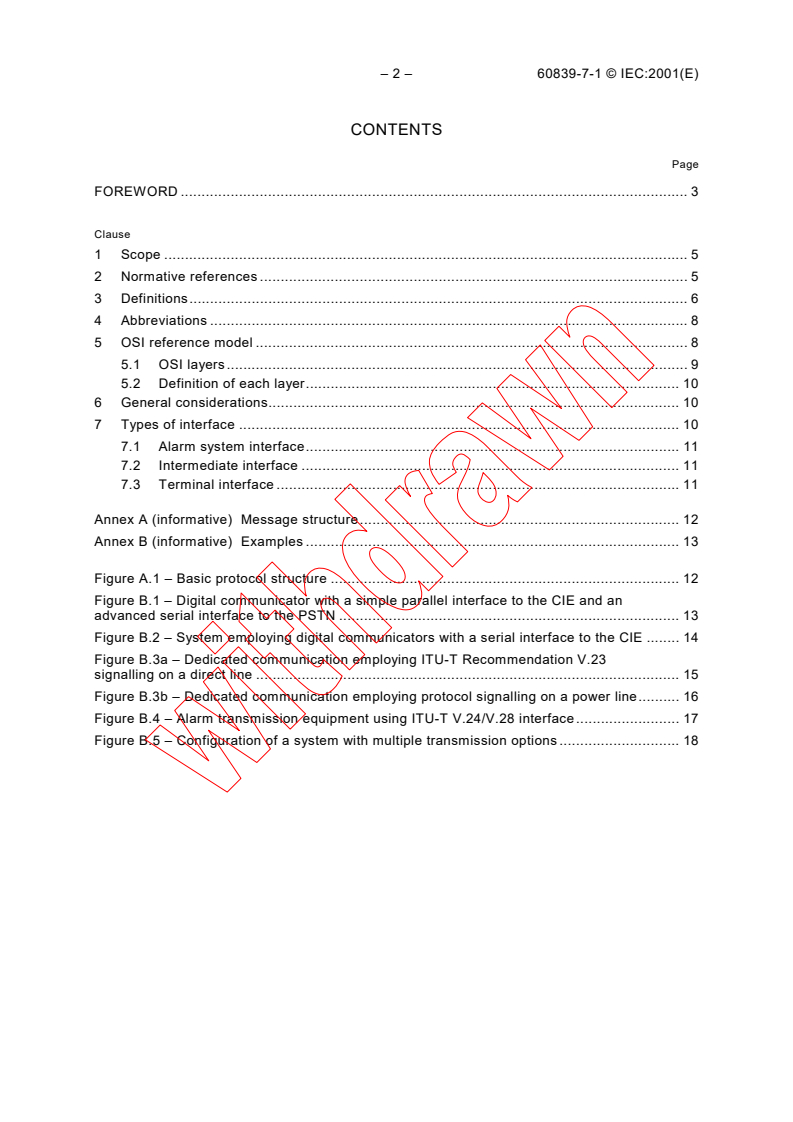
IEC 60839-7-1:2001 - Alarm systems - Part 7-1: Message formats and protocols for serial data interfaces in alarm transmission systems - General Released:3/9/2001


IEC 60839-7-1:2001 - Alarm systems - Part 7-1: Message formats and protocols for serial data interfaces in alarm transmission systems - General Released:3/9/2001
Buy Documents
IEC 60839-7-1:2001 - Alarm systems - Part 7-1: Message formats and protocols for serial data interfaces in alarm transmission systems - General Released:3/9/2001
IEC 60839-7-1:2001 - Alarm systems - Part 7-1: Message formats and protocols for serial data interfaces in alarm transmission systems - General Released:3/9/2001
Get Certified
Connect with accredited certification bodies for this standard

CIS Institut d.o.o.
Personal Protective Equipment (PPE) certification body. Notified Body NB-2890 for EU Regulation 2016/425 PPE.

Kiwa BDA Testing
Building and construction product certification.
Kmetijski inštitut Slovenije
Agricultural Institute of Slovenia. Soil testing, plant health, agricultural product analysis.
Sponsored listings
Frequently Asked Questions
IEC 60839-7-1:2001 is a standard published by the International Electrotechnical Commission (IEC). Its full title is "Alarm systems - Part 7-1: Message formats and protocols for serial data interfaces in alarm transmission systems - General". This standard covers: Describes the requirements for standard serial data interfaces in alarm transmission systems. Gives an outline of how alarm transmission systems are connected and the various types of serial data interfaces that might be employed.
Describes the requirements for standard serial data interfaces in alarm transmission systems. Gives an outline of how alarm transmission systems are connected and the various types of serial data interfaces that might be employed.
IEC 60839-7-1:2001 is classified under the following ICS (International Classification for Standards) categories: 13.320 - Alarm and warning systems. The ICS classification helps identify the subject area and facilitates finding related standards.
IEC 60839-7-1:2001 is available in PDF format for immediate download after purchase. The document can be added to your cart and obtained through the secure checkout process. Digital delivery ensures instant access to the complete standard document.
Standards Content (Sample)
INTERNATIONAL IEC
STANDARD
60839-7-1
First edition
2001-03
Alarm systems –
Part 7-1:
Message formats and protocols for serial data
interfaces in alarm transmission systems –
General
Systèmes d'alarme –
Partie 7-1:
Formats de message et protocoles pour les interfaces de
données série dans les systèmes de transmission d'alarme –
Généralités
Reference number
Publication numbering
As from 1 January 1997 all IEC publications are issued with a designation in the
60000 series. For example, IEC 34-1 is now referred to as IEC 60034-1.
Consolidated editions
The IEC is now publishing consolidated versions of its publications. For example,
edition numbers 1.0, 1.1 and 1.2 refer, respectively, to the base publication, the
base publication incorporating amendment 1 and the base publication incorporating
amendments 1 and 2.
Further information on IEC publications
The technical content of IEC publications is kept under constant review by the IEC,
thus ensuring that the content reflects current technology. Information relating to
this publication, including its validity, is available in the IEC Catalogue of
publications (see below) in addition to new editions, amendments and corrigenda.
Information on the subjects under consideration and work in progress undertaken
by the technical committee which has prepared this publication, as well as the list
of publications issued, is also available from the following:
• IEC Web Site (www.iec.ch)
• Catalogue of IEC publications
The on-line catalogue on the IEC web site (www.iec.ch/catlg-e.htm) enables
you to search by a variety of criteria including text searches, technical
committees and date of publication. On-line information is also available on
recently issued publications, withdrawn and replaced publications, as well as
corrigenda.
• IEC Just Published
This summary of recently issued publications (www.iec.ch/JP.htm) is also
available by email. Please contact the Customer Service Centre (see below) for
further information.
• Customer Service Centre
If you have any questions regarding this publication or need further assistance,
please contact the Customer Service Centre:
Email: custserv@iec.ch
Tel: +41 22 919 02 11
Fax: +41 22 919 03 00
INTERNATIONAL IEC
STANDARD
60839-7-1
First edition
2001-03
Alarm systems –
Part 7-1:
Message formats and protocols for serial data
interfaces in alarm transmission systems –
General
Systèmes d'alarme –
Partie 7-1:
Formats de message et protocoles pour les interfaces de
données série dans les systèmes de transmission d'alarme –
Généralités
IEC 2001 Copyright - all rights reserved
No part of this publication may be reproduced or utilized in any form or by any means, electronic or
mechanical, including photocopying and microfilm, without permission in writing from the publisher.
International Electrotechnical Commission 3, rue de Varembé Geneva, Switzerland
Telefax: +41 22 919 0300 e-mail: inmail@iec.ch IEC web site http://www.iec.ch
Commission Electrotechnique Internationale
PRICE CODE
R
International Electrotechnical Commission
For price, see current catalogue
– 2 – 60839-7-1 © IEC:2001(E)
CONTENTS
Page
FOREWORD . 3
Clause
1 Scope . 5
2 Normative references . 5
3 Definitions. 6
4 Abbreviations . 8
5 OSI reference model . 8
5.1 OSI layers. 9
5.2 Definition of each layer. 10
6 General considerations. 10
7 Types of interface . 10
7.1 Alarm system interface. 11
7.2 Intermediate interface . 11
7.3 Terminal interface . 11
Annex A (informative) Message structure. 12
Annex B (informative) Examples . 13
Figure A.1 – Basic protocol structure . 12
Figure B.1 – Digital communicator with a simple parallel interface to the CIE and an
advanced serial interface to the PSTN . 13
Figure B.2 – System employing digital communicators with a serial interface to the CIE . 14
Figure B.3a – Dedicated communication employing ITU-T Recommendation V.23
signalling on a direct line . 15
Figure B.3b – Dedicated communication employing protocol signalling on a power line. 16
Figure B.4 – Alarm transmission equipment using ITU-T V.24/V.28 interface. 17
Figure B.5 – Configuration of a system with multiple transmission options . 18
60839-7-1 © IEC:2001(E) – 3 –
INTERNATIONAL ELECTROTECHNICAL COMMISSION
––––––––
ALARM SYSTEMS –
Part 7-1: Message formats and protocols for serial data interfaces
in alarm transmission systems – General
FOREWORD
1) The IEC (International Electrotechnical Commission) is a worldwide organization for standardization comprising
all national electrotechnical committees (IEC National Committees). The object of the IEC is to promote
international co-operation on all questions concerning standardization in the electrical and electronic fields. To
this end and in addition to other activities, the IEC publishes International Standards. Their preparation is
entrusted to technical committees; any IEC National Committee interested in the subject dealt with may
participate in this preparatory work. International, governmental and non-governmental organizations liaising
with the IEC also participate in this preparation. The IEC collaborates closely with the International Organization
for Standardization (ISO) in accordance with conditions determined by agreement between the two
organizations.
2) The formal decisions or agreements of the IEC on technical matters express, as nearly as possible, an
international consensus of opinion on the relevant subjects since each technical committee has representation
from all interested National Committees.
3) The documents produced have the form of recommendations for international use and are published in the form
of standards, technical specifications, technical reports or guides and they are accepted by the National
Committees in that sense.
4) In order to promote international unification, IEC National Committees undertake to apply IEC International
Standards transparently to the maximum extent possible in their national and regional standards. Any
divergence between the IEC Standard and the corresponding national or regional standard shall be clearly
indicated in the latter.
5) The IEC provides no marking procedure to indicate its approval and cannot be rendered responsible for any
equipment declared to be in conformity with one of its standards.
6) Attention is drawn to the possibility that some of the elements of this International Standard may be the subject
of patent rights. The IEC shall not be held responsible for identifying any or all such patent rights.
International Standard IEC 60839-7-1 has been prepared by IEC technical committee 79: Alarm
systems.
The text of this standard is based on the following documents:
FDIS Report on voting
79/198/FDIS 79/208/RVD
Full information on the voting for the approval of this standard can be found in the report on
voting indicated in the above table.
This publication has been drafted in accordance with the ISO/IEC Directives, Part 3.
Annexes A and B are for information only.
The committee has decided that the contents of this publication will remain unchanged until
2004. At this date, the publication will be
reconfirmed;
withdrawn;
replaced by a revised edition, or
amended.
– 4 – 60839-7-1 © IEC:2001(E)
A bilingual version of this standard may be issued at a later date.
IEC 60839-7-1 forms one of a number of related parts presented under the general title: Alarm
systems – Part 7: Message formats and protocols for serial data interfaces in alarm
transmission systems:
IEC 60839-7-1: General
IEC 60839-7-2: Common application layer protocol
IEC 60839-7-3: Common data link layer protocol
IEC 60839-7-4: Common transport layer protocol
IEC 60839-7-5: Alarm system interfaces employing a two-wire configuration in accordance
with ISO/IEC 8482
IEC 60839-7-6: Alarm system interfaces employing ITU-T Recommendation V.24/V.28
signalling
IEC 60839-7-7: Alarm system interfaces for plug-in alarm system transceivers
IEC 60839-7-11: Serial protocol for use by digital communicator systems using ITU-T
Recommendation V.23 signalling at interfaces with the PSTN
IEC 60839-7-12: PTT interfaces for dedicated communications channels using ITU-T
Recommendation V.23 signalling
IEC 60839-7-20: Terminal interfaces employing ITU-T Recommendation V.24/V.28
signalling
60839-7-1 © IEC:2001(E) – 5 –
ALARM SYSTEMS –
Part 7-1: Message formats and protocols for serial data interfaces
in alarm transmission systems – General
1 Scope
This part of IEC 60839 describes the requirements for standard serial data interfaces in alarm
transmission systems. It gives an outline of how alarm transmission systems are connected
and the various types of serial data interfaces that might be employed. This part includes a
range of examples.
2 Normative references
The following normative documents contain provisions which, through reference in this text,
constitute provisions of this part of IEC 60839. For dated references, subsequent amendments
to, or revisions of, any of these publications do not apply. However, parties to agreements
based on this part of IEC 60839 are encouraged to investigate the possibility of applying the
most recent editions of the normative documents indicated below. For undated references, the
latest edition of the normative document referred to applies. Members of IEC and ISO maintain
registers of currently valid International Standards.
IEC 60839-7-2, Alarm systems – Part 7-2: Message formats and protocols for serial data
interfaces in alarm transmission systems – Common application layer protocol
IEC 60839-7-5, Alarm systems – Part 7-5: Message formats and protocols for serial data
interfaces in alarm transmission systems – Alarm system interface employing a two-wire
configuration in accordance with ISO/IEC 8482
IEC 60839-7-7, Alarm systems – Part 7-7: Message formats and protocols for serial data
interfaces in alarm transmission systems – Alarm system interface for plug-in alarm system
transceivers
IEC 60839-7-11, Alarm systems – Part 7-11: Message formats and protocols for serial data
interfaces in alarm transmission systems – Serial protocol for use by digital communicator
systems using ITU-T Recommendation V.23 signalling at interfaces with the PSTN
IEC 60839-7-12, Alarm systems – Part 7-12: Message formats and protocols for serial data
interfaces in alarm transmission systems – PTT Interfaces for dedicated communications using
ITU-T Recommendation V.23 signalling
IEC 60839-7-20, Alarm systems – Part 7-20: Message formats and protocols for serial data
interfaces in alarm transmission systems – Terminal interfaces employing ITU-T
Recommendation V.24/V.28 signalling
ISO/IEC 8482, Information technology – Telecommunications and information exchange
between systems – Twisted pair multipoint interconnections
ITU-T Recommendation V.23, 600/1200-baud modem standardized for use in the general
switched telephone network
– 6 – 60839-7-1 © IEC:2001(E)
ITU-T Recommendation V.24, List of definitions for interchange circuits between data terminal
1)
equipment (DTE) and data circuit-terminating equipment (DCE)
ITU-T Recommendation V.28, Electrical characteristics for unbalanced double-current inter-
change circuits
3 Definitions
For the purpose of this part of IEC 60839, the following definitions apply.
3.1
alarm system messages
messages that convey information about the status of an alarm system
These may comprise:
3.1.1
alarm messages
messages that convey the presence of a hazard or a potential hazard to life or property, or the
removal of such a hazard, including messages that convey the status of an alarm since the
alarm transmission system is only responsible for decoding the type of the transmitted
message
3.1.2
commands
messages that give instructions to an alarm system or to part of the alarm transmission system
3.1.3
informative messages
messages that give information about the status of functions of an alarm system
3.1.4
transmission system messages
messages that convey the status of parts of the alarm transmission system, including
messages which report the status of the alarm system transceiver
NOTE The format and treatment of such messages may be the same as for alarm system messages.
3.2
alarm channel
part of the logical alarm transmission path across which information about the status of
separately identifiable logical functional parts of the connected alarm system are passed
3.3
functional part
logical function which may include individual detectors, groups of detectors and sections of the
common parts of the system (e.g. power supply unit (PSU), warning device, etc.)
NOTE Such a functional part may be in one or more of the following states as shown below.
3.3.1
normal condition
status of a functional part when it is fully operational and not in any other condition
___________
1)
To be published.
60839-7-1 © IEC:2001(E) – 7 –
3.3.2
alarm condition
status of a functional part which results from the response of that functional part to the
presence of an abnormal condition indicating the presence of a hazard (or a potential hazard)
which has not been acknowledged by either its successful transmission or by a local manual
action
3.3.3
outstanding alarm
status of a functional part which results from the response of that functional part to the
presence of an abnormal condition indicating the presence of a hazard (or a potential hazard)
which has been acknowledged by either its successful transmission or by a local manual action
3.3.4
tamper
status of a functional part which results from the operation of a tamper device within that
functional part
3.3.5
test condition
status of the functional part which results from changing the status out of normal condition for
test purposes
3.3.6
disabled
status of the functional part in which the normal functions have been taken out of service
3.4
alarm system transceiver
alarm transmission equipment, which is located at the supervised premises or at a satellite
station
3.5
master
item of equipment which controls the messages on the link and to which messages are either
sent or received
3.6
slave
item of equipment on the link which is not in control and which can only transmit a message in
response to the master, in response to a request from it
3.7
data link data
information element, a data link message or a message originating from LAYER 4 -
TRANSPORT
3.8
originator
item of equipment which initiates the data communications on a link
NOTE This need not be the item which initiates the physical/logical connection.
3.9
receiver
item of equipment on a link which accepts data communication initiated on a link by another
item of equipment (an ORIGINATOR)
– 8 – 60839-7-1 © IEC:2001(E)
3.10
message authentication code (MAC)
code ensuring that the message arrives from the correct source
3.11
window size
maximum number of messages which may be transmitted without receiving ACK.
4 Abbreviations
ACK acknowledgement
CCTV closed circuit television
ITU-T International Telecommunication Union – Telecommunications
CIE control and indicating equipment
CR carriage return
CRC cyclic redundancy check
DLLA data link layer authentication
HEX hexadecimal
ID identity
INIT initiated
ISO International Standards Organization
ISDN Integrated System Digital Network
Ki secondary key
MAC message authentication code
Mk master key
LSB least significant (byte) octet
OSI open interconnection
PSTN Public Switched Telephone Network
PTT Post, Telegraph and Telephone
R1 random number
Rs random seed
STX start of text
TTL transistor transistor logic
5 OSI reference model
The open system interconnection (OSI) reference model was developed by the International
Standards Organization (ISO) both to provide a commonly agreed way of describing,
understanding and analyzing the various functions of complex communications systems. It also
provides a framework for drafting international standards.
The reference model views the functions of a system as being divided into a number of layers.
There are formally 7 LAYERS (1-7), though layers 0 and 8 are now commonly added as
described below.
The layered structure enables changes to be made to the different functions without affecting
the other layers. In actual systems, some layers may be omitted. Designers are free to
implement the layers individually or to combine them.
60839-7-1 © IEC:2001(E) – 9 –
It was also developed to enable a variety of applications to be operated over any combination
of current or future network technologies without the need for changes in the applications
themselves. Thus, there is a fundamental division in the model so as to provide a stable
boundary between applications and the real networks being used. This occurs at LAYER 3 -
NETWORK layer of the reference model.layers in the OSI reference model are shown below.
5.1 OSI layers
LAYER 0 MECHANICAL is only required in cases where there is a need to specify the physical
shape of connectors and modules that connect directly to each other. An example would be
defining the maximum size and connector arrangements of plug-in digital communicators, so
that manufacturers of control and indicating equipment could have a standard space and
connector layout into which communicators from a number of other manufacturers could fit.
LAYERS 1 to 3 reflect the logical division of the functions in any network. LAYER 1 -
PHYSICAL defines the physical and electrical interface characteristics of the interface to the
actual transmission medium. It provides a totally transparent transmission path. LAYER 2 -
DATA LINK is responsible for any low level formatting of the data into blocks and for the
provision of error detection and/or correction. LAYER 3 - NETWORK provides addressing and
routing in networks with multiple terminals, as well as basic call set-up and clear down
procedures.
LAYER 4 - TRANSPORT - In some applications, these lower levels do not provide all the
transmission features required by the application. Within the context of alarm transmission, this
might apply to the provision of higher levels of error detection and correction, scrambling and
encryption and linking short blocks together to form longer messages. These additional
features are provided in this layer.
The layers above LAYER 4 are concerned with the management and synchronization of the
data, and should be independent of the data transmission systems used. LAYER 5 - SESSION
is used to manage systems where different applications share the same transmission system.
LAYER 6 - PRESENTATION is responsible for changing the format of the data, where the two
end applications have different ways of presenting the data. These two layers are unlikely to
feature in an alarm transmission system.
LAYER 7 - APPLICATION is the top level that provides the actual transmission service to the
application, it is the window through which the application sees the alarm transmission service.
LAYER 8 - NETWORK MANAGEMENT is a common format for the control and management of
transmission equipment, particularly more complex switching and multiplexing equipment. It
can be considered as a specialized, alternative presentation/application layer for use by the
network managers to monitor the transmission system.
LAYER 8 - NETWORK MANAGEMENT
LAYER 7 - APPLICATION
USERS OF TRANSPORT SERVICE
LAYER 6 - PRESENTATION
LAYER 5 - SESSION
LAYER 4 - TRANSPORT TRANSPORTS
SERVICE
LAYER 3 - NETWORK
NETWORK
LAYER 2 - DATA LINK
SERVICE
LAYER 1 - PHYSICAL
LAYER 0 - MECHANICAL
– 10 – 60839-7-1 © IEC:2001(E)
5.2 Definition of each layer
Each layer in the reference model is defined by three sets of requirements:
a) the services it provides to, and the interface with the layer above. This includes the way in
which it accepts messages from, and passes messages to the layer above it (or in the case
of the application layer from/to the application itself);
b) the processing functions of the layer;
c) the services required from, and the interface with the layer below. This includes the way in
which it accepts messages from, and passes messages to the layer below it.
Within a single network, the technology employed may vary for different links. Thus, although a
single set of higher level protocols can be applied across the whole of the transmission system,
the lower level layers may be different for each link.
NOTE The OSI specification is contained in ISO 7498-1, Information technology – Open Systems Interconnection
– Basic Reference Model – The Basic Model.
6 General considerations
The intent of standards IEC 60839-7-1 to 7, IEC 60839-7-11, IEC 60839-7-12 and IEC 60839-7-20 is
to define the requirements for the transmission of alarms, alarm system status and control data
between an alarm system and an alarm receiving centre or monitoring centre using serial data
transmission. It includes details of recommended protocols, message struct
...
IEC 60839-7-1
Edition 1.0 2001-03
INTERNATIONAL
STANDARD
NORME
INTERNATIONALE
Alarm systems –
Part 7-1: Message formats and protocols for serial data interfaces in alarm
transmission systems – General
Systèmes d’alarme –
Partie 7-1: Formats de message et protocoles pour les interfaces de données
série dans les systèmes de transmission d’alarme – Généralités
All rights reserved. Unless otherwise specified, no part of this publication may be reproduced or utilized in any form or by
any means, electronic or mechanical, including photocopying and microfilm, without permission in writing from either IEC or
IEC's member National Committee in the country of the requester.
If you have any questions about IEC copyright or have an enquiry about obtaining additional rights to this publication,
please contact the address below or your local IEC member National Committee for further information.
Droits de reproduction réservés. Sauf indication contraire, aucune partie de cette publication ne peut être reproduite
ni utilisée sous quelque forme que ce soit et par aucun procédé, électronique ou mécanique, y compris la photocopie
et les microfilms, sans l'accord écrit de la CEI ou du Comité national de la CEI du pays du demandeur.
Si vous avez des questions sur le copyright de la CEI ou si vous désirez obtenir des droits supplémentaires sur cette
publication, utilisez les coordonnées ci-après ou contactez le Comité national de la CEI de votre pays de résidence.
IEC Central Office
3, rue de Varembé
CH-1211 Geneva 20
Switzerland
Email: inmail@iec.ch
Web: www.iec.ch
About the IEC
The International Electrotechnical Commission (IEC) is the leading global organization that prepares and publishes
International Standards for all electrical, electronic and related technologies.
About IEC publications
The technical content of IEC publications is kept under constant review by the IEC. Please make sure that you have the
latest edition, a corrigenda or an amendment might have been published.
ƒ Catalogue of IEC publications: www.iec.ch/searchpub
The IEC on-line Catalogue enables you to search by a variety of criteria (reference number, text, technical committee,…).
It also gives information on projects, withdrawn and replaced publications.
ƒ IEC Just Published: www.iec.ch/online_news/justpub
Stay up to date on all new IEC publications. Just Published details twice a month all new publications released. Available
on-line and also by email.
ƒ Electropedia: www.electropedia.org
The world's leading online dictionary of electronic and electrical terms containing more than 20 000 terms and definitions
in English and French, with equivalent terms in additional languages. Also known as the International Electrotechnical
Vocabulary online.
ƒ Customer Service Centre: www.iec.ch/webstore/custserv
If you wish to give us your feedback on this publication or need further assistance, please visit the Customer Service
Centre FAQ or contact us:
Email: csc@iec.ch
Tel.: +41 22 919 02 11
Fax: +41 22 919 03 00
A propos de la CEI
La Commission Electrotechnique Internationale (CEI) est la première organisation mondiale qui élabore et publie des
normes internationales pour tout ce qui a trait à l'électricité, à l'électronique et aux technologies apparentées.
A propos des publications CEI
Le contenu technique des publications de la CEI est constamment revu. Veuillez vous assurer que vous possédez
l’édition la plus récente, un corrigendum ou amendement peut avoir été publié.
ƒ Catalogue des publications de la CEI: www.iec.ch/searchpub/cur_fut-f.htm
Le Catalogue en-ligne de la CEI vous permet d’effectuer des recherches en utilisant différents critères (numéro de référence,
texte, comité d’études,…). Il donne aussi des informations sur les projets et les publications retirées ou remplacées.
ƒ Just Published CEI: www.iec.ch/online_news/justpub
Restez informé sur les nouvelles publications de la CEI. Just Published détaille deux fois par mois les nouvelles
publications parues. Disponible en-ligne et aussi par email.
ƒ Electropedia: www.electropedia.org
Le premier dictionnaire en ligne au monde de termes électroniques et électriques. Il contient plus de 20 000 termes et
définitions en anglais et en français, ainsi que les termes équivalents dans les langues additionnelles. Egalement appelé
Vocabulaire Electrotechnique International en ligne.
ƒ Service Clients: www.iec.ch/webstore/custserv/custserv_entry-f.htm
Si vous désirez nous donner des commentaires sur cette publication ou si vous avez des questions, visitez le FAQ du
Service clients ou contactez-nous:
Email: csc@iec.ch
Tél.: +41 22 919 02 11
Fax: +41 22 919 03 00
IEC 60839-7-1
Edition 1.0 2001-03
INTERNATIONAL
STANDARD
NORME
INTERNATIONALE
Alarm systems –
Part 7-1: Message formats and protocols for serial data interfaces in alarm
transmission systems – General
Systèmes d’alarme –
Partie 7-1: Formats de message et protocoles pour les interfaces de données
série dans les systèmes de transmission d’alarme – Généralités
INTERNATIONAL
ELECTROTECHNICAL
COMMISSION
COMMISSION
ELECTROTECHNIQUE
PRICE CODE
INTERNATIONALE
R
CODE PRIX
ICS 13.320 ISBN 2-8318-6014-8
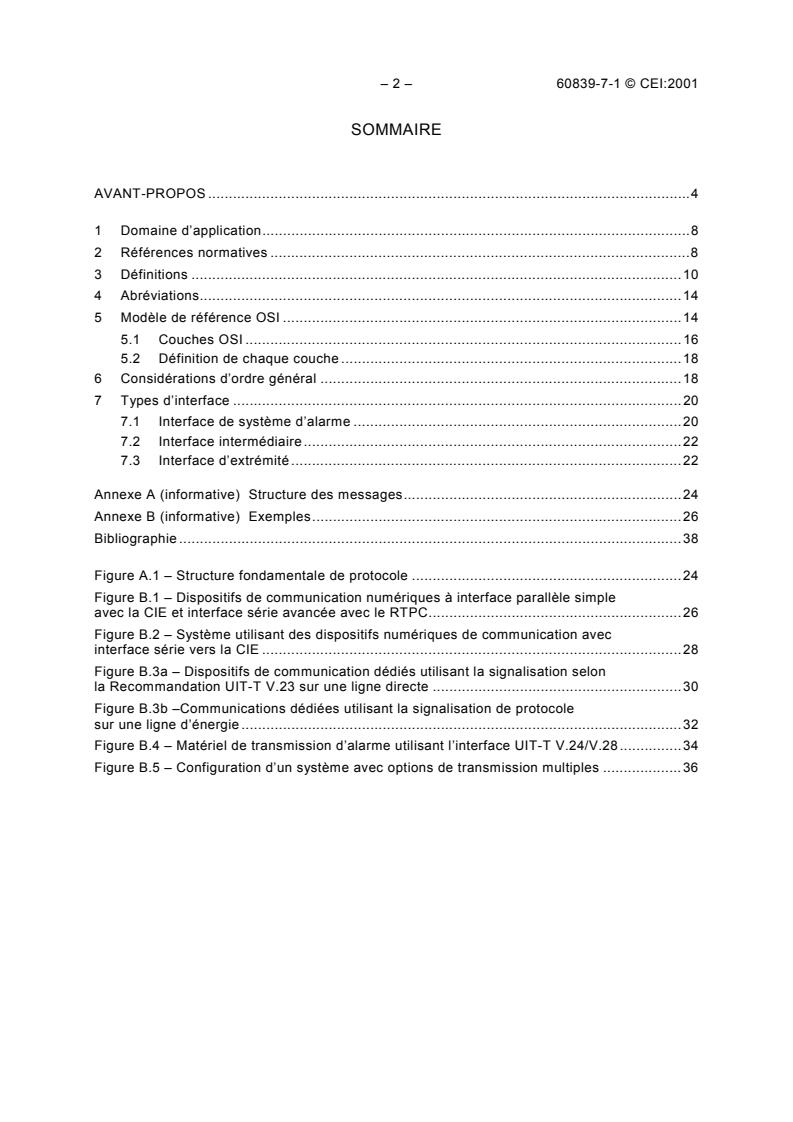
– 2 – 60839-7-1 © CEI:2001
SOMMAIRE
AVANT-PROPOS .4
1 Domaine d’application.8
2 Références normatives .8
3 Définitions .10
4 Abréviations.14
5 Modèle de référence OSI .14
5.1 Couches OSI .16
5.2 Définition de chaque couche .18
6 Considérations d’ordre général .18
7 Types d’interface .20
7.1 Interface de système d’alarme .20
7.2 Interface intermédiaire.22
7.3 Interface d’extrémité.22
Annexe A (informative) Structure des messages.24
Annexe B (informative) Exemples.26
Bibliographie .38
Figure A.1 – Structure fondamentale de protocole .24
Figure B.1 – Dispositifs de communication numériques à interface parallèle simple
avec la CIE et interface série avancée avec le RTPC.26
Figure B.2 – Système utilisant des dispositifs numériques de communication avec
interface série vers la CIE .28
Figure B.3a – Dispositifs de communication dédiés utilisant la signalisation selon
la Recommandation UIT-T V.23 sur une ligne directe .30
Figure B.3b –Communications dédiées utilisant la signalisation de protocole
sur une ligne d’énergie .32
Figure B.4 – Matériel de transmission d’alarme utilisant l’interface UIT-T V.24/V.28.34
Figure B.5 – Configuration d’un système avec options de transmission multiples .36
60839-7-1 © IEC:2001 – 3 –
CONTENTS
FOREWORD.5
1 Scope.9
2 Normative references.9
3 Definitions .11
4 Abbreviations.15
5 OSI reference model.15
5.1 OSI layers .17
5.2 Definition of each layer .19
6 General considerations .19
7 Types of interface .21
7.1 Alarm system interface .21
7.2 Intermediate interface.23
7.3 Terminal interface.23
Annex A (informative) Message structure .25
Annex B (informative) Examples.27
Bibliography .39
Figure A.1 – Basic protocol structure.25
Figure B.1 – Digital communicator with a simple parallel interface to the CIE and an
advanced serial interface to the PSTN.27
Figure B.2 – System employing digital communicators with a serial interface to the CIE .29
Figure B.3a – Dedicated communication employing ITU-T Recommendation V.23
signalling on a direct line.31
Figure B.3b – Dedicated communication employing protocol signalling on a power line .33
Figure B.4 – Alarm transmission equipment using ITU-T V.24/V.28 interface .35
Figure B.5 – Configuration of a system with multiple transmission options.37
– 4 – 60839-7-1 © CEI:2001
COMMISSION ÉLECTROTECHNIQUE INTERNATIONALE
__________
SYSTÈMES D'ALARME –
Partie 7-1: Formats de message et protocoles pour les interfaces de
données série dans les systèmes de transmission d'alarme – Généralités
AVANT-PROPOS
1) La CEI (Commission Electrotechnique Internationale) est une organisation mondiale de normalisation composée
de l'ensemble des comités électrotechniques nationaux (Comités nationaux de la CEI). La CEI a pour objet de
favoriser la coopération internationale pour toutes les questions de normalisation dans les domaines de
l'électricité et de l'électronique. A cet effet, la CEI, entre autres activités, publie des Normes internationales.
Leur élaboration est confiée à des comités d'études, aux travaux desquels tout Comité national intéressé par le
sujet traité peut participer. Les organisations internationales, gouvernementales et non gouvernementales, en
liaison avec la CEI, participent également aux travaux. La CEI collabore étroitement avec l'Organisation
Internationale de Normalisation (ISO), selon des conditions fixées par accord entre les deux organisations.
2) Les décisions ou accords officiels de la CEI concernant les questions techniques représentent, dans la mesure
du possible un accord international sur les sujets étudiés, étant donné que les Comités nationaux intéressés
sont représentés dans chaque comité d’études.
3) Les documents produits se présentent sous la forme de recommandations internationales. Ils sont publiés
comme normes, rapports techniques ou guides et agréés comme tels par les Comités nationaux.
4) Dans le but d'encourager l'unification internationale, les Comités nationaux de la CEI s'engagent à appliquer de
façon transparente, dans toute la mesure possible, les Normes internationales de la CEI dans leurs normes
nationales et régionales. Toute divergence entre la norme de la CEI et la norme nationale ou régionale
correspondante doit être indiquée en termes clairs dans cette dernière.
5) La CEI n’a fixé aucune procédure concernant le marquage comme indication d’approbation et sa responsabilité
n’est pas engagée quand un matériel est déclaré conforme à l’une de ses normes.
6) L’attention est attirée sur le fait que certains des éléments de la présente Norme internationale peuvent faire
l’objet de droits de propriété intellectuelle ou de droits analogues. La CEI ne saurait être tenue pour
responsable de ne pas avoir identifié de tels droits de propriété et de ne pas avoir signalé leur existence.
La Norme internationale CEI 60839-7-1 a été établie par le comité d'études 79 de la CEI:
Systèmes d’alarme.
La présente version bilingue, publiée en 2001-11, correspond à la version anglaise.
Le texte anglais de cette norme est basé sur les documents 79/198/FDIS et 79/208/RVD.
Le rapport de vote 79/208/RVD donne toute information sur le vote ayant abouti à l'approbation
de cette norme.
La version française de cette norme n'a pas été soumise au vote.
Cette publication a été rédigée selon les Directives ISO/CEI, Partie 3.
Les annexes A et B sont données uniquement à titre d'information.
Le comité a décidé que le contenu de cette publication ne sera pas modifié avant 2004. A cette
date, la publication sera
• reconduite;
• supprimée;
• remplacée par une édition révisée, ou
• amendée.
60839-7-1 © IEC:2001 – 5 –
INTERNATIONAL ELECTROTECHNICAL COMMISSION
__________
ALARM SYSTEMS –
Part 7-1: Message formats and protocols for serial data interfaces
in alarm transmission systems – General
FOREWORD
1) The IEC (International Electrotechnical Commission) is a worldwide organization for standardization comprising
all national electrotechnical committees (IEC National Committees). The object of the IEC is to promote
international co-operation on all questions concerning standardization in the electrical and electronic fields. To
this end and in addition to other activities, the IEC publishes International Standards. Their preparation is
entrusted to technical committees; any IEC National Committee interested in the subject dealt with may
participate in this preparatory work. International, governmental and non-governmental organizations liaising
with the IEC also participate in this preparation. The IEC collaborates closely with the International Organization
for Standardization (ISO) in accordance with conditions determined by agreement between the two
organizations.
2) The formal decisions or agreements of the IEC on technical matters express, as nearly as possible, an
international consensus of opinion on the relevant subjects since each technical committee has representation
from all interested National Committees.
3) The documents produced have the form of recommendations for international use and are published in the form
of standards, technical specifications, technical reports or guides and they are accepted by the National
Committees in that sense.
4) In order to promote international unification, IEC National Committees undertake to apply IEC International
Standards transparently to the maximum extent possible in their national and regional standards. Any
divergence between the IEC Standard and the corresponding national or regional standard shall be clearly
indicated in the latter.
5) The IEC provides no marking procedure to indicate its approval and cannot be rendered responsible for any
equipment declared to be in conformity with one of its standards.
6) Attention is drawn to the possibility that some of the elements of this International Standard may be the subject
of patent rights. The IEC shall not be held responsible for identifying any or all such patent rights.
International Standard IEC 60839-7-1 has been prepared by IEC technical committee 79: Alarm
systems.
This bilingual version, published in 2001-11, corresponds to the English version.
The text of this standard is based on the following documents:
FDIS Report on voting
79/198/FDIS 79/208/RVD
Full information on the voting for the approval of this standard can be found in the report on
voting indicated in the above table.
This publication has been drafted in accordance with the ISO/IEC Directives, Part 3.
Annexes A and B are for information only.
The committee has decided that the contents of this publication will remain unchanged
until 2004. At this date, the publication will be
• reconfirmed;
• withdrawn;
• replaced by a revised edition, or
• amended.
– 6 – 60839-7-1 © CEI:2001
La CEI 60839-7-1 constitue une partie d'une série de publications présentées sous le titre
général: Systèmes d'alarme – Partie 7: Formats de message et protocoles pour les interfaces
de données série dans les systèmes de transmission d'alarme.
CEI 60839-7-1: Généralités
CEI 60839-7-2: Protocole de la couche commune d'application
CEI 60839-7-3: Protocole de la couche commune de liaison de données
CEI 60839-7-4: Protocole de la couche commune de transport
CEI 60839-7-5: Interfaces des systèmes d'alarme utilisant une configuration bifilaire
conforme à l'ISO/CEI 8482
CEI 60839-7-6: Interfaces des systèmes d'alarme utilisant la recommandation UIT-T
V.24/V.28 pour la signalisation
CEI 60839-7-7: Interfaces des systèmes d'alarme pour les transmetteurs de systèmes
d'alarme enfichables
CEI 60839-7-11: Protocole série à utiliser par les systèmes numériques de communication
utilisant la recommandation UIT-T V.23 pour la signalisation au niveau des
interfaces avec le RTPC
CEI 60839-7-12: Interfaces PTT pour les voies de communication dédiées utilisant la
recommandation UIT-T V.23 pour la signalisation
CEI 60839-7-20: Interfaces d'extrémité utilisant la recommandation UIT-T V.24/V.28 pour la
signalisation
60839-7-1 © IEC:2001 – 7 –
IEC 60839-7-1 forms one of a series of publications presented under the general title: Alarm
systems – Part 7: Message formats and protocols for serial data interfaces in alarm
transmission systems.
IEC 60839-7-1: General
IEC 60839-7-2: Common application layer protocol
IEC 60839-7-3: Common data link layer protocol
IEC 60839-7-4: Common transport layer protocol
IEC 60839-7-5: Alarm system interfaces employing a two-wire configuration in accordance
with ISO/IEC 8482
IEC 60839-7-6: Alarm system interfaces employing ITU-T Recommendation V.24/V.28
signalling
IEC 60839-7-7: Alarm system interfaces for plug-in alarm system transceivers
IEC 60839-7-11: Serial protocol for use by digital communicator systems using ITU-T
Recommendation V.23 signalling at interfaces with the PSTN
IEC 60839-7-12: PTT interfaces for dedicated communications channels using ITU-T
Recommendation V.23 signalling
IEC 60839-7-20: Terminal interfaces employing ITU-T Recommendation V.24/V.28 signalling
– 8 – 60839-7-1 © CEI:2001
SYSTÈMES D'ALARME –
Partie 7-1: Formats de message et protocoles pour les interfaces de
données série dans les systèmes de transmission d'alarme – Généralités
1 Domaine d’application
La présente partie de la CEI 60839 spécifie les exigences pour les interfaces de données série
normalisées des systèmes de transmission d’alarme. Elle indique la manière dont les systèmes
de transmission d’alarme sont connectés et les différents types d’interfaces de données série
qui peuvent être utilisés. Cette partie contient une série d’exemples.
2 Références normatives
Les documents de référence suivants sont indispensables pour l'application du présent
document. Pour les références datées, seule l'édition citée s'applique. Pour les références non
datées, la dernière édition du document de référence s'applique (y compris les éventuels
amendements).
CEI 60839-7-2: Systèmes d'alarme – Partie 7-2: Formats de message et protocoles pour les
interfaces de données série dans les systèmes de transmission d'alarme – Protocole de la
couche commune d'application
CEI 60839-7-5: Systèmes d'alarme – Partie 7-5: Formats de message et protocoles pour les
interfaces de données série dans les systèmes de transmission d'alarme – Interfaces des
systèmes d'alarme utilisant une configuration bifilaire conforme à l'ISO/CEI 8482
CEI 60839-7-7: Systèmes d'alarme – Partie 7-7: Formats de message et protocoles pour les
interfaces de données série dans les systèmes de transmission d'alarme – Interfaces des
systèmes d'alarme pour les transmetteurs de systèmes d'alarme enfichables
CEI 60839-7-11: Systèmes d'alarme – Partie 7-11: Formats de message et protocoles pour les
interfaces de données série dans les systèmes de transmission d'alarme – Protocole série à
utiliser par les systèmes numériques de communication utilisant la recommandation UIT-T V.23
pour la signalisation au niveau des interfaces avec le RTPC
CEI 60839-7-12: Systèmes d'alarme – Partie 7-12: Formats de message et protocoles pour les
interfaces de données série dans les systèmes de transmission d'alarme – Interfaces PTT pour les
voies de communication dédiées utilisant la recommandation UIT-T V.23 pour la signalisation
CEI 60839-7-20: Systèmes d'alarme – Partie 7-20: Formats de message et protocoles pour les
interfaces de données série dans les systèmes de transmission d'alarme – Interfaces
d'extrémité utilisant la recommandation UIT-T V.24/V.28 pour la signalisation
ISO/CEI 8482: Technologies de l’information – Télécommunications et échange d’informations
entre systèmes – Interconnexions multipoints par paire torsadée
Recommandation UIT-T V.23: Modem à 600/1200-bauds normalisé pour usage sur le réseau
téléphonique général avec commutation
Recommandation UIT-T V.24: Liste des définitions des circuits de jonction entre l’équipement
terminal de traitement de données (DTE) et l’équipement de terminaison du circuit de données
1)
(DCE)
Recommandation UIT-T V.28: Caractéristiques électroniques des circuits de jonction dissymé-
triques pour transmission à double courant
___________
1)
A publier.
60839-7-1 © IEC:2001 – 9 –
ALARM SYSTEMS –
Part 7-1: Message formats and protocols for serial data interfaces
in alarm transmission systems – General
1 Scope
This part of IEC 60839 describes the requirements for standard serial data interfaces in alarm
transmission systems. It gives an outline of how alarm transmission systems are connected
and the various types of serial data interfaces that might be employed. This part includes a
range of examples.
2 Normative references
The following referenced documents are indispensable for the application of this document. For
dated references, only the edition cited applies. For undated references, the latest edition of
the referenced document (including any amendments) applies.
IEC 60839-7-2, Alarm systems – Part 7-2: Message formats and protocols for serial data
interfaces in alarm transmission systems – Common application layer protocol
IEC 60839-7-5, Alarm systems – Part 7-5: Message formats and protocols for serial data
interfaces in alarm transmission systems – Alarm system interface employing a two-wire
configuration in accordance with ISO/IEC 8482
IEC 60839-7-7, Alarm systems – Part 7-7: Message formats and protocols for serial data
interfaces in alarm transmission systems – Alarm system interface for plug-in alarm system
transceivers
IEC 60839-7-11, Alarm systems – Part 7-11: Message formats and protocols for serial data
interfaces in alarm transmission systems – Serial protocol for use by digital communicator
systems using ITU-T Recommendation V.23 signalling at interfaces with the PSTN
IEC 60839-7-12, Alarm systems – Part 7-12: Message formats and protocols for serial data
interfaces in alarm transmission systems – PTT Interfaces for dedicated communications using
ITU-T Recommendation V.23 signalling
IEC 60839-7-20, Alarm systems – Part 7-20: Message formats and protocols for serial data
interfaces in alarm transmission systems – Terminal interfaces employing ITU-T
Recommendation V.24/V.28 signalling
ISO/IEC 8482, Information technology – Telecommunications and information exchange
between systems – Twisted pair multipoint interconnections
ITU-T Recommendation V.23, 600/1 200-baud modem standardized for use in the general
switched telephone network
ITU-T Recommendation V.24, List of definitions for interchange circuits between data terminal
1)
equipment (DTE) and data circuit-terminating equipment (DCE)
ITU-T Recommendation V.28, Electrical characteristics for unbalanced double-current inter-
change circuits
___________
1)
To be published.
– 10 – 60839-7-1 © CEI:2001
3 Définitions
Pour les besoins de cette partie de la CEI 60839, les définitions suivantes s’appliquent.
3.1
messages de système d’alarme
messages qui transmettent des informations concernant le statut d’un système d’alarme
Ces messages peuvent comprendre:
3.1.1
messages d’alarme
messages qui indiquent la présence d’un risque ou d’un risque potentiel pour la vie ou pour les
biens, ou la suppression d’un tel risque, y compris les messages qui transmettent le statut
d’une alarme puisque le système de transmission d’alarme est seulement responsable du
décodage du type du message transmis
3.1.2
commandes
messages qui donnent des instructions à un système d’alarme ou à une partie du système de
transmission d’alarme
3.1.3
messages informatifs
messages qui donnent des informations concernant le statut des fonctions d’un système
d’alarme
3.1.4
messages de système de transmission
messages qui transmettent le statut des parties du système de transmission d’alarme, y
compris les messages qui indiquent le statut du transmetteur du système d’alarme
NOTE Le formatage et le traitement de ces messages peuvent être les mêmes que pour les messages de
système d’alarme.
3.2
voie d’alarme
partie du chemin logique de transmission d’alarme par laquelle passent les informations
concernant le statut de parties fonctionnelles logiques identifiables séparément du système
d’alarme connecté
3.3
partie fonctionnelle
fonction logique qui peut inclure des détecteurs individuels, des groupes de détecteurs et des
sections des parties communes du système (par exemple un dispositif d’alimentation (PSU),
un dispositif d’avertissement, etc.)
NOTE Une telle partie fonctionnelle peut se trouver dans un ou plusieurs des états présentés ci-dessous.
3.3.1
condition normale
statut d’une partie fonctionnelle qui est complètement opérationnelle et qui se trouve dans
aucune autre condition
3.3.2
condition d’alarme
statut d’une partie fonctionnelle qui résulte de la réponse de cette partie à une condition
anormale indiquant la présence d'un risque (ou d'un risque potentiel) qui n’a pas été reconnue
acquittée soit par sa transmission réussie soit par une action manuelle en local
60839-7-1 © IEC:2001 – 11 –
3 Definitions
For the purpose of this part of IEC 60839, the following definitions apply.
3.1
alarm system messages
messages that convey information about the status of an alarm system
These may comprise:
3.1.1
alarm messages
messages that convey the presence of a hazard or a potential hazard to life or property, or the
removal of such a hazard, including messages that convey the status of an alarm since the
alarm transmission system is only responsible for decoding the type of the transmitted
message
3.1.2
commands
messages that give instructions to an alarm system or to part of the alarm transmission system
3.1.3
informative messages
messages that give information about the status of functions of an alarm system
3.1.4
transmission system messages
messages that convey the status of parts of the alarm transmission system, including
messages which report the status of the alarm system transceiver
NOTE The format and treatment of such messages may be the same as for alarm system messages.
3.2
alarm channel
part of the logical alarm transmission path across which information about the status of
separately identifiable logical functional parts of the connected alarm system are passed
3.3
functional part
logical function which may include individual detectors, groups of detectors and sections of the
common parts of the system (for example power supply unit (PSU), warning device, etc.)
NOTE Such a functional part may be in one or more of the following states as shown below.
3.3.1
normal condition
status of a functional part when it is fully operational and not in any other condition
3.3.2
alarm condition
status of a functional part which results from the response of that functional part to the
presence of an abnormal condition indicating the presence of a hazard (or a potential hazard)
which has not been acknowledged by either its successful transmission or by a local manual
action
– 12 – 60839-7-1 © CEI:2001
3.3.3
alarme en cours
statut d’une partie fonctionnelle qui résulte de la réponse de cette partie à une condition
anormale indiquant la présence d'un risque (ou d'un risque potentiel) qui a été acquittée soit
par sa transmission réussie soit par une action manuelle en local
3.3.4
autosurveillance
statut d’une partie fonctionnelle qui résulte du fonctionnement d’un dispositif d’autosurveillance
existant à l’intérieur de cette partie
3.3.5
condition d’essai
statut de la partie fonctionnelle qui résulte du changement de statut correspondant à la sortie
de la condition normale pour des besoins d'essai
3.3.6
désactivé
statut de la partie fonctionnelle dans lequel les fonctions normales ont été mises hors service
3.4
transmetteur de système d’alarme
matériel de transmission d’alarme qui est situé dans les locaux surveillés ou dans une station
satellite
3.5
maître
élément du matériel qui contrôle les messages sur la liaison et auquel on envoie les messages
3.6
esclave
élément du matériel sur la liaison qui n’assure pas de fonction de contrôle et qui peut
uniquement transmettre un message en réponse au maître, à la suite d’une requête émanant
de celui-ci
3.7
données de liaison de données
élément d’information, message de liaison de données ou message provenant de la COUCHE 4 –
TRANSPORT (LAYER 4 – TRANSPORT)
3.8
origine
élément de matériel qui lance les communications de données sur une liaison
NOTE Il n’est pas nécessaire que ce soit cet élément qui lance la connexion physique/logique.
3.9
récepteur
élément du matériel sur une liaison qui accepte la communication de données lancée sur une
liaison par un autre élément de matériel (une ORIGINE – ORIGINATOR)
3.10
code d’authentification de message (MAC)
code assurant que le message provient de la bonne source
3.11
taille de fenêtre
nombre maximal de messages qui peuvent être transmis sans recevoir d'acquittement (de ACK)
60839-7-1 © IEC:2001 – 13 –
3.3.3
outstanding alarm
status of a functional part which results from the response of that functional part to the
presence of an abnormal condition indicating the presence of a hazard (or a potential hazard)
which has been acknowledged by either its successful transmission or by a local manual action
3.3.4
tamper
status of a functional part which results from the operation of a tamper device within that
functional part
3.3.5
test condition
status of the functional part which results from changing the status out of normal condition for
test purposes
3.3.6
disabled
status of the functional part in which the normal functions have been taken out of service
3.4
alarm system transceiver
alarm transmission equipment, which is located at the supervised premises or at a satellite
station
3.5
master
item of equipment which controls the messages on the link and to which messages are either
sent or received
3.6
slave
item of equipment on the link which is not in control and which can only transmit a message in
response to the master, in response to a request from it
3.7
data link data
information element, a data link message or a message originating from LAYER 4 –
TRANSPORT
3.8
originator
item of equipment which initiates the data communications on a link
NOTE This need not be the item which initiates the physical/logical connection.
3.9
receiver
item of equipment on a link which accepts data communication initiated on a link by another
item of equipment (an ORIGINATOR)
3.10
message authentication code (MAC)
code ensuring that the message arrives from the correct source
3.11
window size
maximum number of messages which may be transmitted without receiving ACK.
– 14 – 60839-7-1 © CEI:2001
4 Abréviations
ACK acknowledgement (acquittement)
CCTV closed circuit television (télévision en circuit fermé)
UIT-T International Telecommunication Union – Telecommunication (Union internationale
des télécommunications – télécommunications)
CIE control and indicating equipment (centrale)
CR carriage return (retour chariot)
CRC cyclic redundancy check (code cyclique de redondance)
DLLA data link layer authentication (authentification de la couche de liaison de données)
HEX hexadécimal
ID identité
INIT initié
ISO International Standards Organization (Organisation internationale de normalisation)
ISDN Integrated System Digital Network (Réseau numérique à intégration de services)
(RNIS)
Ki secondary key (clé secondaire)
MAC message authentication code (code d’authentification de message)
Mk master key (clé maître)
LSB least significant (byte) octet (octet le moins significatif)
OSI open system interconnection (interconnexion de systèmes ouverts)
PSTN Public Switched Telephone Network (Réseau téléphonique public commuté)
(RTPC)
PTT Poste, Télégraphe et Téléphone
R1 random number (nombre aléatoire)
Rs random seed (tirage aléatoire)
STX start of text (début de texte)
TTL transistor transistor logic (logique à transistor et transistors)
5 Modèle de référence OSI
Le modèle de référence pour l’interconnexion des systèmes ouverts (OSI) a été développé par
l’Organisation Internationale de Normalisation (ISO) pour offrir un moyen communément
accepté à la fois pour la description, la compréhension et l’analyse des différentes fonctions
des systèmes de communications complexes. Il fournit également un cadre pour la préparation
de normes internationales.
Le modèle de référence considère les fonctions d’un système comme étant divisées en un
certain nombre de couches. Il y a normalement 7 COUCHES (LAYERS) (1 à 7), bien que les
couches 0 et 8 soient désormais communément ajoutées comme cela est décrit ci-dessous.
La structure en couches permet de procéder à des modifications dans les différentes fonctions
sans affecter les autres couches. Dans les systèmes existants, il est admis d’omettre certaines
couches. Les concepteurs sont libres de mettre en œuvre ces couches séparément ou de les
combiner.
60839-7-1 © IEC:2001 – 15 –
4 Abbreviations
ACK acknowledgement
CCTV closed circuit television
ITU-T International Telecommunication Union – Telecommunications
CIE control and indicating equipment
CR carriage return
CRC cyclic redundancy check
DLLA data link layer authentication
HEX hexadecimal
ID identity
INIT initiated
ISO International Standards Organization
ISDN Integrated System Digital Network
Ki secondary key
MAC message authentication code
Mk master key
LSB least significant (byte) octet
OSI open system interconnection
PSTN Public Switched Telephone Network
PTT Post, Telegraph and Telephone
R1 random number
Rs random seed
STX start of text
TTL transistor transistor logic
5 OSI reference model
The open system interconnection (OSI) reference model was developed by the International
Standards Organization (ISO) both to provide a commonly agreed way of describing,
understanding and analyzing the various functions of complex communications systems. It also
provides a framework for drafting international standards.
The reference model views the functions of a system as being divided into a number of layers.
There are formally 7 LAYERS (1-7), though layers 0 and 8 are now commonly added as
described below.
The layered structure enables changes to be made to the different functions without affecting
the other layers. In actual systems, some layers may be omitted. Designers are free to
implement the layers individually or to combine them.
– 16 – 60839-7-1 © CEI:2001
Ce modèle avait aussi été développé pour permettre de faire fonctionner différentes
applications avec n'importe quelle autres combinaisons de technologies réseau existantes et à
venir sans avoir besoin de modifier les applications elles-mêmes. Ainsi, il existe une division
fondamentale dans le modèle de manière à fournir une limite stable entre les applications et
les réels réseaux utilisés. Ceci intervient au niveau de la COUCHE 3 – RÉSEAU (LAYER 3 –
NETWORK) du modèle de référence. Les couches du modèle de référence OSI sont
représentées ci-dessous.
5.1 Couches OSI
La COUCHE 0 – MÉCANIQUE (LAYER 0-MECHANICAL) est seulement requise dans les cas
où il est nécessaire de spécifier la forme physique des connecteurs et des modules qui
s’accouplent directement entre eux. On peut donner comme exemple la définition de la taille
maximale et de la disposition des connecteurs des dispositifs de communication numériques
enfichables, pour que les fabricants de centrales puissent avoir un espace et une conception
de connecteur normalisés dans lesquels les dispositifs de communication des autres fabricants
pourraient s’adapter.
Les COUCHES 1 à 3 (LAYERS 1 to 3) donnent la division logique des fonctions dans tout
réseau. La COUCHE 1 – PHYSIQUE (LAYER 1 – PHYSICAL) définit les caractéristiques
d’interface électriques et physiques de l’interface avec le moyen de transmission réel. Elle
donne un chemin de transmission totalement transparent. La COUCHE 2 – LIAISON DE
DONNÉES (LAYER 2 – DATA LINK) assume tous les formatages de bas niveau des données
en blocs et la détection et/ou la correction des erreurs. La COUCHE 3 – RÉSEAU (LAYER 3 –
NETWORK) assume l’adressage et le routage dans les réseaux à terminaux multiples, ainsi
que les configurations fondamentales d’appel et les procédures de remise à zéro.
COUCHE 4 – TRANSPORT (LAYER 4 – TRANSPORT) – Dans certaines applications, ces
niveaux inférieurs ne fournissent pas toutes les caractéristiques de transmission requises par
l’application. Dans le contexte de la transmission d’alarme, ceci devrait s’appliquer à la
fourniture de niveaux supérieurs de détection et de correction d’erreurs, de brassage et de
codage et de blocs de liaison de faible longueur pour former des messages plus longs. Ces
caractéristiques complémentaires sont données dans cette couche.
Les couches au-delà de la COUCHE 4 (LAYER 4) concernent la gestion et la synchronisation
des données et il convient qu’elles soient indépendantes des systèmes de transmission de
données utilisés. La COUCHE 5 – SESSION (LAYER 5 – SESSION) est utilisée pour gérer les
systèmes dans lesquels différentes applications partagent le même système de transmission.
La COUCHE 6 – PRÉSENTATION (LAYER 6 – PRESÉNTATION) assume la modification du
format des données, lorsque les deux applications finales présentent les données de manière
différente. Ces deux couches ne sont pas susceptibles d’intervenir dans un système de
transmission d’alarme.
La COUCHE 7 – APPLICATION (LAYER 7 – APPLICATION) correspond au niveau supérieur
qui fournit le service de transmission réel vers l’application. Elle constitue la fenêtre à travers
laquelle l’application voit le service de transmission d’alarme.
La COUCHE 8 – GESTION RÉSEAU (LAYER 8 – NETWORK MANAGEMENT) constitue un
format commun pour la commande et la gestion du matériel de transmission, en particulier du
matériel plus complexe de commutation et de multiplexage. Elle peut être considérée comme
une autre couche de présentation/application spécialisée destinée à être utilisée par les
gestionnaires de réseau pour surveiller le système de transmission.
60839-7-1 © IEC:2001 – 17 –
It was also developed to enable a variety of applications to be operated over any combination
of current or future network technologies without the need for changes in the applications
themselves. Thus, there is a fundamental division in the model so as to provide a stable
boundary between applications and the real networks being used. This occurs at LAYER 3 –
NETWORK layer of the reference model.layers in the OSI reference model are shown below.
5.1 OSI layers
LAYER 0 – MECHANICAL is only required in cases where there is a need to specify the
physical shape of connectors and modules that connect directly to each other. An example
would be defining the maximum size and connector arrangements of plug-in digital
communicators, so that manufacturers of control and indicating equipment could have a
standard space and connector layout into which communicators from a number of other
manufacturers could fit.
LAYERS 1 to 3 reflect the logical division of the functions in any network. LAYER 1 –
PHYSICAL defines the physical and electrical interface characteristics of the interface to the
actual transmission medium. It provides a totally transparent transmission path. LAYER 2 –
DATA LINK is responsible for any low level formatting of the data into blocks and for the
provision of error detection and/or correction. LAYER 3 – NETWORK provides addressing and
routing in networks with multiple terminals, as well as basic call set-up and clear down
procedures.
LAYER 4 – TRANSPORT – In some applications, these lower levels do not provide all the
transmission features required by the application. Within the context of alarm transmission, this
might apply to the provision of higher levels of error detection and correction, scrambling and
encryption and linking short blocks together to form longer messages. These additional
features are provided in this layer.
The layers above LAYER 4 are concerned with the management and synchronization of the
data, and should be independent of the data transmission systems used. LAYER 5 – SESSION
is used to manage systems where different applications share the same transmission system.
LAYER 6 – PRESENTATION is responsible for changing the format of the data, where the two
end applications have different ways of presenting the data. These two layers are unlikely to
feature in an alarm transmission system.
LAYER 7 – APPLICATION is the top level that provides the actual transmission service to the
application, it is the window through which the application sees the alarm transmission service.
LAYER 8 – NETWORK MANAGEMENT is a common format for the control and management of
transmission equipment, particularly more complex switch
...