

IEC 62676-5:2018
(Main)Video surveillance systems for use in security applications - Part 5: Data specifications and image quality performance for camera devices
General Information
- Abstract
IEC 62676-5:2018 defines recommendations and requirements for representation and measuring methods of performance values to be described in materials such as instruction manuals, brochures and specifications of video surveillance camera equipment. The first part of this document defines requirements for description of video surveillance camera specification items. The second part defines requirements for measurement methods of video surveillance camera specification items.
- Status
- Published
- Publication Date
- 04-Jun-2018
- Technical Committee
- TC 79 - Alarm and electronic security systems
- Drafting Committee
- WG 12 - TC 79/WG 12
- Current Stage
- PPUB - Publication issued
- Start Date
- 05-Jun-2018
- Completion Date
- 22-Jun-2018

Overview
IEC 62676-5:2018 is an international standard developed by the International Electrotechnical Commission (IEC) focusing on video surveillance systems used in security applications. This part 5 document specifically addresses data specifications and image quality performance for video surveillance camera devices. It provides a comprehensive framework for describing camera specifications and sets out standardized methods for measuring key performance values. These guidelines are intended to ensure consistency, transparency, and reliability in the technical documentation of surveillance cameras, benefiting manufacturers, integrators, and end-users by establishing clear, objective parameters.
Key Topics
The standard is divided into two main sections:
Specification Items for Video Surveillance Cameras
This section defines how performance aspects of camera devices should be described in manuals, brochures, and technical specifications. Key specification items include:- Image sensor characteristics and maximum resolution
- Minimum illumination and signal-to-noise ratio (SNR)
- White balance, electronic shutter, and slow shutter sensitivity
- Dynamic range (DR) and visible dynamic range (VDR)
- Infrared illumination and day/night mode functionality
- Lens parameters such as focal length, aperture, field of view, and image distortion
- Video output formats and specifications
- Pan and tilt mechanics including rotation angles, speed, and preset accuracy
- Network features encompassing interface types, compression standards, bit rate, frame rate, encoding streams, latency, and security protocols
- Additional features like local camera storage, audio capabilities, and time synchronization
Measurement Methods for Performance Evaluation
This section provides standardized methodologies for assessing camera specifications under controlled conditions, ensuring objective comparisons. Measurement topics include:- Setting up standard shooting conditions for testing
- Video signal quantization levels and environment setup
- Resolution measurement techniques
- Minimum illumination tests and dynamic range assessment
- Visible dynamic range and infrared illumination operating distance tests
- Evaluation of image distortion and flare
- Capture frame rate measurement procedures
The standard also includes normative test charts and informative annexes detailing specialized testing methods, such as low-light performance evaluation, and safety requirements for infrared illuminators.
Applications
IEC 62676-5:2018 is essential for a variety of stakeholders involved with video surveillance technology:
Manufacturers and Developers
Use this standard to accurately define and communicate the technical performance of surveillance cameras, ensuring product datasheets and user manuals cover critical aspects like image quality, sensor specs, and network capabilities consistently.Security System Integrators
Leverage the standardized specifications and measurement metrics to compare camera products objectively and select the optimal devices for specific security projects, such as public safety, industrial monitoring, or critical infrastructure protection.Regulatory Bodies and Test Laboratories
Employ prescribed test methods to certify and validate camera performance, ensuring compliance with industry norms and maintaining high-quality video surveillance standards worldwide.End-Users and Facility Managers
Benefit from clear, reliable specification data that inform purchasing decisions and optimize surveillance system setups, improving the overall effectiveness of security surveillance deployments.
Related Standards
IEC 62676-5:2018 is part of the IEC 62676 series on video surveillance systems and interfaces with multiple associated standards, including:
- IEC 62676-1: General requirements for video surveillance systems used in security applications
- IEC 62676-2: Video transmission protocols and interfaces
- IEC 62676-3: Video analytics and functional specifications
- IEC 62471: Photobiological safety of lamps and lamp systems, applicable for infrared illuminator safety requirements referenced in Annex B of IEC 62676-5
These interconnected standards provide a holistic approach covering everything from system architecture to device interoperability and safety, supporting the development and deployment of high-performance, secure video surveillance solutions.
By adhering to IEC 62676-5:2018, stakeholders gain access to a trusted international framework that enhances transparency, performance consistency, and interoperability in video surveillance camera technologies-key qualities for robust and effective security applications worldwide.
Get Certified
Connect with accredited certification bodies for this standard

ECOCERT
Organic and sustainability certification.

CIS Institut d.o.o.
Personal Protective Equipment (PPE) certification body. Notified Body NB-2890 for EU Regulation 2016/425 PPE.

Eurofins Food Testing Global
Global leader in food, environment, and pharmaceutical product testing.
Sponsored listings
Frequently Asked Questions
IEC 62676-5:2018 is a standard published by the International Electrotechnical Commission (IEC). Its full title is "Video surveillance systems for use in security applications - Part 5: Data specifications and image quality performance for camera devices". This standard covers: IEC 62676-5:2018 defines recommendations and requirements for representation and measuring methods of performance values to be described in materials such as instruction manuals, brochures and specifications of video surveillance camera equipment. The first part of this document defines requirements for description of video surveillance camera specification items. The second part defines requirements for measurement methods of video surveillance camera specification items.
IEC 62676-5:2018 defines recommendations and requirements for representation and measuring methods of performance values to be described in materials such as instruction manuals, brochures and specifications of video surveillance camera equipment. The first part of this document defines requirements for description of video surveillance camera specification items. The second part defines requirements for measurement methods of video surveillance camera specification items.
IEC 62676-5:2018 is classified under the following ICS (International Classification for Standards) categories: 13.220.40 - Ignitability and burning behaviour of materials and products; 13.320 - Alarm and warning systems; 71.040.40 - Chemical analysis. The ICS classification helps identify the subject area and facilitates finding related standards.
IEC 62676-5:2018 is available in PDF format for immediate download after purchase. The document can be added to your cart and obtained through the secure checkout process. Digital delivery ensures instant access to the complete standard document.
Standards Content (Sample)
IEC 62676-5 ®
Edition 1.0 2018-06
INTERNATIONAL
STANDARD
NORME
INTERNATIONALE
colour
inside
Video surveillance systems for use in security applications –
Part 5: Data specifications and image quality performance for camera devices
Systèmes de vidéosurveillance destinés à être utilisés dans les applications de
sécurité –
Partie 5: Spécifications des données et performances de la qualité d'image pour
les dispositifs de caméra
All rights reserved. Unless otherwise specified, no part of this publication may be reproduced or utilized in any form
or by any means, electronic or mechanical, including photocopying and microfilm, without permission in writing from
either IEC or IEC's member National Committee in the country of the requester. If you have any questions about IEC
copyright or have an enquiry about obtaining additional rights to this publication, please contact the address below or
your local IEC member National Committee for further information.
Droits de reproduction réservés. Sauf indication contraire, aucune partie de cette publication ne peut être reproduite
ni utilisée sous quelque forme que ce soit et par aucun procédé, électronique ou mécanique, y compris la photocopie
et les microfilms, sans l'accord écrit de l'IEC ou du Comité national de l'IEC du pays du demandeur. Si vous avez des
questions sur le copyright de l'IEC ou si vous désirez obtenir des droits supplémentaires sur cette publication, utilisez
les coordonnées ci-après ou contactez le Comité national de l'IEC de votre pays de résidence.
IEC Central Office Tel.: +41 22 919 02 11
3, rue de Varembé info@iec.ch
CH-1211 Geneva 20 www.iec.ch
Switzerland
About the IEC
The International Electrotechnical Commission (IEC) is the leading global organization that prepares and publishes
International Standards for all electrical, electronic and related technologies.
About IEC publications
The technical content of IEC publications is kept under constant review by the IEC. Please make sure that you have the
latest edition, a corrigenda or an amendment might have been published.
IEC Catalogue - webstore.iec.ch/catalogue Electropedia - www.electropedia.org
The stand-alone application for consulting the entire The world's leading online dictionary of electronic and
bibliographical information on IEC International Standards, electrical terms containing 21 000 terms and definitions in
Technical Specifications, Technical Reports and other English and French, with equivalent terms in 16 additional
documents. Available for PC, Mac OS, Android Tablets and languages. Also known as the International Electrotechnical
iPad. Vocabulary (IEV) online.
IEC publications search - webstore.iec.ch/advsearchform IEC Glossary - std.iec.ch/glossary
The advanced search enables to find IEC publications by a 67 000 electrotechnical terminology entries in English and
variety of criteria (reference number, text, technical French extracted from the Terms and Definitions clause of
committee,…). It also gives information on projects, replaced IEC publications issued since 2002. Some entries have been
and withdrawn publications. collected from earlier publications of IEC TC 37, 77, 86 and
CISPR.
IEC Just Published - webstore.iec.ch/justpublished
Stay up to date on all new IEC publications. Just Published IEC Customer Service Centre - webstore.iec.ch/csc
details all new publications released. Available online and If you wish to give us your feedback on this publication or
also once a month by email. need further assistance, please contact the Customer Service
Centre: sales@iec.ch.
A propos de l'IEC
La Commission Electrotechnique Internationale (IEC) est la première organisation mondiale qui élabore et publie des
Normes internationales pour tout ce qui a trait à l'électricité, à l'électronique et aux technologies apparentées.
A propos des publications IEC
Le contenu technique des publications IEC est constamment revu. Veuillez vous assurer que vous possédez l’édition la
plus récente, un corrigendum ou amendement peut avoir été publié.
Catalogue IEC - webstore.iec.ch/catalogue Electropedia - www.electropedia.org
Application autonome pour consulter tous les renseignements
Le premier dictionnaire en ligne de termes électroniques et
bibliographiques sur les Normes internationales,
électriques. Il contient 21 000 termes et définitions en anglais
Spécifications techniques, Rapports techniques et autres
et en français, ainsi que les termes équivalents dans 16
documents de l'IEC. Disponible pour PC, Mac OS, tablettes
langues additionnelles. Egalement appelé Vocabulaire
Android et iPad.
Electrotechnique International (IEV) en ligne.
Recherche de publications IEC -
Glossaire IEC - std.iec.ch/glossary
webstore.iec.ch/advsearchform
67 000 entrées terminologiques électrotechniques, en anglais
La recherche avancée permet de trouver des publications IEC et en français, extraites des articles Termes et Définitions des
en utilisant différents critères (numéro de référence, texte, publications IEC parues depuis 2002. Plus certaines entrées
comité d’études,…). Elle donne aussi des informations sur les antérieures extraites des publications des CE 37, 77, 86 et
projets et les publications remplacées ou retirées. CISPR de l'IEC.
IEC Just Published - webstore.iec.ch/justpublished Service Clients - webstore.iec.ch/csc
Restez informé sur les nouvelles publications IEC. Just Si vous désirez nous donner des commentaires sur cette
Published détaille les nouvelles publications parues. publication ou si vous avez des questions contactez-nous:
Disponible en ligne et aussi une fois par mois par email. sales@iec.ch.
IEC 62676-5 ®
Edition 1.0 2018-06
INTERNATIONAL
STANDARD
NORME
INTERNATIONALE
colour
inside
Video surveillance systems for use in security applications –
Part 5: Data specifications and image quality performance for camera devices
Systèmes de vidéosurveillance destinés à être utilisés dans les applications de
sécurité –
Partie 5: Spécifications des données et performances de la qualité d'image pour
les dispositifs de caméra
INTERNATIONAL
ELECTROTECHNICAL
COMMISSION
COMMISSION
ELECTROTECHNIQUE
INTERNATIONALE
ICS 13.320 ISBN 978-2-8322-5763-0
– 2 – IEC 62676-5:2018 IEC 2018
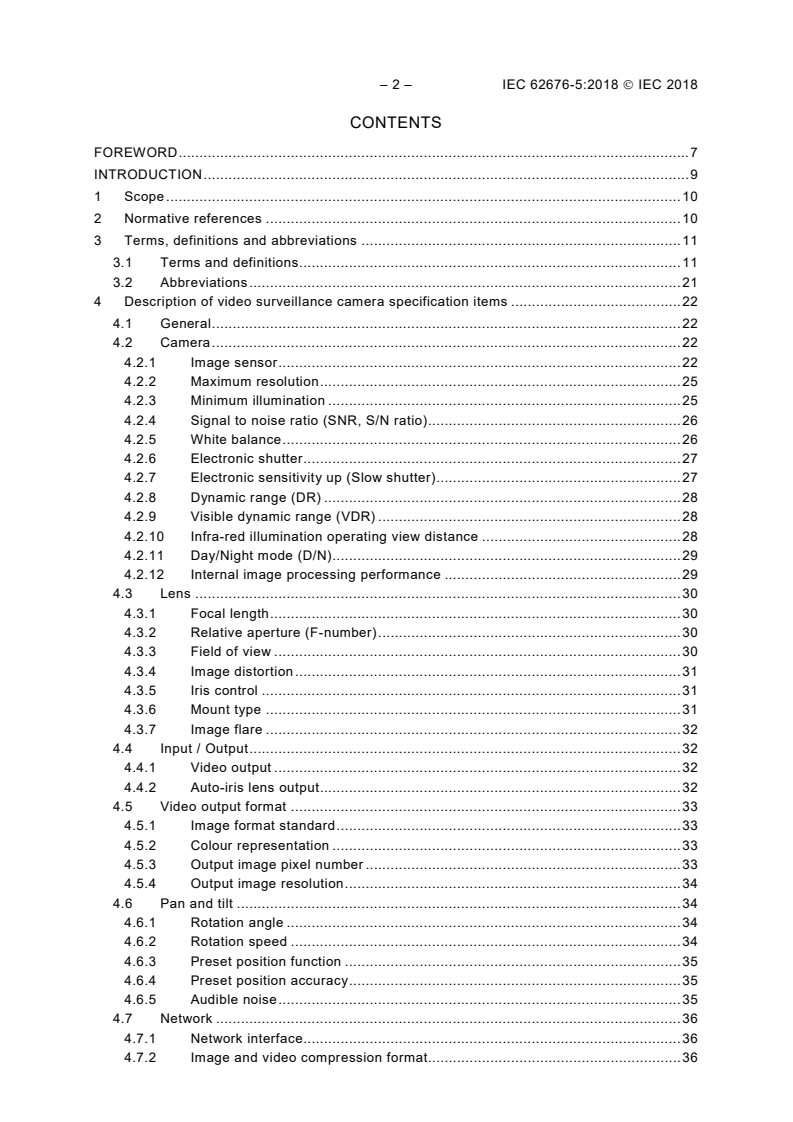
CONTENTS
FOREWORD . 7
INTRODUCTION . 9
1 Scope . 10
2 Normative references . 10
3 Terms, definitions and abbreviations . 11
3.1 Terms and definitions . 11
3.2 Abbreviations . 21
4 Description of video surveillance camera specification items . 22
4.1 General . 22
4.2 Camera . 22
4.2.1 Image sensor . 22
4.2.2 Maximum resolution . 25
4.2.3 Minimum illumination . 25
4.2.4 Signal to noise ratio (SNR, S/N ratio) . 26
4.2.5 White balance . 26
4.2.6 Electronic shutter . 27
4.2.7 Electronic sensitivity up (Slow shutter). 27
4.2.8 Dynamic range (DR) . 28
4.2.9 Visible dynamic range (VDR) . 28
4.2.10 Infra-red illumination operating view distance . 28
4.2.11 Day/Night mode (D/N) . 29
4.2.12 Internal image processing performance . 29
4.3 Lens . 30
4.3.1 Focal length . 30
4.3.2 Relative aperture (F-number) . 30
4.3.3 Field of view . 30
4.3.4 Image distortion . 31
4.3.5 Iris control . 31
4.3.6 Mount type . 31
4.3.7 Image flare . 32
4.4 Input / Output . 32
4.4.1 Video output . 32
4.4.2 Auto-iris lens output . 32
4.5 Video output format . 33
4.5.1 Image format standard . 33
4.5.2 Colour representation . 33
4.5.3 Output image pixel number . 33
4.5.4 Output image resolution . 34
4.6 Pan and tilt . 34
4.6.1 Rotation angle . 34
4.6.2 Rotation speed . 34
4.6.3 Preset position function . 35
4.6.4 Preset position accuracy . 35
4.6.5 Audible noise . 35
4.7 Network . 36
4.7.1 Network interface. 36
4.7.2 Image and video compression format. 36
4.7.3 Bit rate control . 36
4.7.4 Maximum frame rate . 37
4.7.5 Maximum number of encoding streams . 37
4.7.6 Multicast streaming . 38
4.7.7 Maximum number of connections . 38
4.7.8 Total encoding performance . 38
4.7.9 Image stream delay (Latency) . 38
4.7.10 Camera storage (Local storage). 39
4.7.11 Audio function. 39
4.7.12 Network protocol. 39
4.7.13 Camera time synchronization and localization . 40
4.8 Network security . 40
4.8.1 General description . 40
4.8.2 Network authentication . 40
4.8.3 Video authentication and watermarking . 41
4.9 Other specifications . 41
5 Measurement methods of video surveillance camera specification items . 41
5.1 Setting of standard shooting condition . 41
5.1.1 General . 41
5.1.2 Common standard shooting condition . 42
5.2 Video signal quantization level . 44
5.2.1 General . 44
5.2.2 Digital video signal quantization level . 44
5.2.3 Other quantization levels . 44
5.3 Measurement environment . 44
5.3.1 General . 44
5.3.2 Test chart . 45
5.3.3 Software for measurement . 48
5.4 Measuring methods . 48
5.4.1 General . 48
5.4.2 Resolution . 48
5.4.3 Minimum illumination . 56
5.4.4 Dynamic range . 59
5.4.5 Visible dynamic range (VDR) . 67
5.4.6 Infra-red illumination operating view distance . 70
5.4.7 Image distortion . 73
5.4.8 Image flare . 77
5.4.9 Capture frame rate . 84
Annex A (normative) Sine wave star test chart . 88
Annex B (informative) Infra-red illuminator safety requirements according to
IEC 62471. 91
B.1 General . 91
B.2 Declaration of the hazard distance . 91
B.3 Other information to be declared . 92
B.4 Item indication . 92
B.5 Content indication . 92
Annex C (informative) Low light performance method . 93
C.1 General . 93
C.1.1 General . 93
– 4 – IEC 62676-5:2018 IEC 2018
C.1.2 Test chart . 93
C.1.3 Creation of the coloured dead leaves structure . 94
C.1.4 Capturing a reference image . 94
C.1.5 Capture of the test images . 94
C.1.6 Image quality aspects affected by low light . 94
C.1.7 Presentation of the results . 96
C.2 Example for generating a single performance value from measured results. 96
C.3 Description of test chart example . 97
C.3.1 General . 97
C.3.2 Chart sizes and background . 98
C.3.3 Sine wave modulated starburst patterns . 98
C.3.4 OECF patches . 98
C.3.5 Colour patches . 98
C.3.6 Dead leaves . 100
C.3.7 Slanted edges and visual structures . 101
C.3.8 Small sine wave modulated starburst patterns . 101
C.3.9 Centre marks . 101
Annex D (informative) Streaming bit rate (bit-stream) . 102
D.1 General . 102
D.2 Description . 102
D.3 Uncompressed and compressed video streams . 102
D.4 Content indication . 103
D.4.1 General . 103
D.4.2 Video streaming in a system . 103
D.4.3 Network traffic analysis (NTA) . 103
D.5 Measuring the video streaming . 104
D.5.1 General . 104
D.5.2 The procedure of measuring streaming bit rate in a system . 104
Annex E (informative) IP video latency measurement . 107
E.1 General . 107
E.2 Description . 107
E.3 Visual perception of the latency . 109
E.4 Measurement procedure for IP video latency . 109
E.5 Content indication . 110
Annex F (informative) Motion blur measurement . 111
F.1 General . 111
F.2 Description . 111
F.3 Projected pixel shift (PPS) due to moving objects . 111
F.4 Content indication . 111
F.5 Calculating the projected pixel shift of moving objects . 112
F.6 Calculating the projected pixel shift of moving objects at various angles . 113
F.7 Acceptable PPS . 113
F.8 Test chart measuring of moving objects . 114
Annex G (informative) SD/HD test target example . 118
Annex H (informative) UL test chart implementations . 119
Annex I (informative) Explanation of image flare from light source within and outside
of camera field of view . 120
I.1 Image flare of light source within the field of view . 120
I.2 Image flare of light source outside of the field of view . 120
Bibliography . 122
Figure 1 – Test set-up for reflective test chart . 45
Figure 2 – Test set-up for transparent test chart . 46
Figure 3 – Test set-up for fixture with lamps . 47
Figure 4 – Alignment of the camera with the target plane using a mirror . 48
Figure 5 – IEC 61146-1 No. 4 and No. 5 (Resolution chart) . 49
Figure 6 – ISO 12233:2000 Resolution test chart . 50
Figure 7 – Sine wave modulated starburst pattern test chart . 51
Figure 8 – The star is divided into eight segments for the analysis . 53
Figure 9 – The star is analysed radius by radius, equivalent to frequency by frequency . 53
Figure 10 – The pixels along a specific radius are located . 54
Figure 11 – Digital code values as a function of the angle . 54
Figure 12 – Calculation of the contrast of the sine curve . 55
Figure 13 – Example of grey scale test chart . 57
Figure 14 – Example of OECF transparent test chart . 57
Figure 15 – Signal difference between white area and black surrounding . 58
Figure 16 – Example of lamp fixture . 60
Figure 17 – Possible arrangements of luminance levels . 61
Figure 18 – Graphical presentation of results . 67
Figure 19 – Example of signal level . 69
Figure 20 – Graphical presentation of results . 70
Figure 21 – White chart . 71
Figure 22 – Camera positioning . 71
Figure 23 – Video level . 72
Figure 24 – Conversion measurement using electronic shutter . 73
Figure 25 – Regular grid (solid lines) in the scene is distorted and the red diamonds
mark the position of the intersections in the image produced by the camera . 74
Figure 26 – Line grid pattern chart . 75
Figure 27 – Schematic drawings for measuring the horizontal line distortion . 77
Figure 28 – Schematic drawings for measuring the vertical line distortion . 77
Figure 29 – Example test chart with multiple black areas (“Dot pattern chart”) . 79
Figure 30 – Set-up of image flare device . 80
Figure 31 – Image flare lamp for cameras with small field of view (large focal length) . 81
Figure 32 – Image flare lamp for cameras with large field of view (short focal length) . 81
Figure 33 – Evaluation area . 83
Figure 34 – Frame rate test target. 85
Figure A.1 – Sine wave test chart (multiple target version) . 88
Figure C.1 – An example for a multipurpose test chart with frame rate tester . 93
Figure C.2 – An example for a multipurpose test chart . 98
Figure D.1 – Network connection for video streaming measurement . 105
Figure D.2 – An example graph of network traffic . 106
Figure E.1 – Comparison of image compression and video compression . 107
– 6 – IEC 62676-5:2018 IEC 2018
Figure E.2 – Example of GOP . 108
Figure E.3 – Video latency . 110
Figure F.1 – Motion blur due to moving objects . 111
Figure F.2 – Calculation of projected pixel shift . 112
Figure F.3 – Movement in various angles . 113
Figure F.4 – Measuring of moving objects . 115
Figure F.5 – Example of moving test chart . 117
Figure G.1 – SD/HD test target example . 118
Figure I.1 – Image flare from a light source within the camera field of view . 120
Figure I.2 – Image flare from a light source outside of the camera field of view . 121
Table 1 – Lighting condition . 42
Table 2 – Relation of illuminance and luminance . 43
Table 3 – Standard camera settings . 43
Table 4 – Digital video signal quantization level . 44
Table 5 – Camera settings for resolution . 49
Table 6 – Camera settings for minimum illumination . 56
Table 7 – Camera settings for dynamic range . 59
Table 8 – Example results of dynamic range measurement . 65
Table 9 – Camera settings for visible dynamic range . 68
Table 10 – Camera settings for IR illumination operating view distance . 70
Table 11 – Camera settings for image flare . 78
Table 12 – Camera settings for capture frame rate . 85
Table A.1 – Features of sine wave test chart . 89
Table A.2 – Design of sine wave star test chart . 90
Table C.1 – Results table of an example camera . 96
Table C.2 – Results table of an example camera . 97
INTERNATIONAL ELECTROTECHNICAL COMMISSION
____________
VIDEO SURVEILLANCE SYSTEMS FOR USE
IN SECURITY APPLICATIONS –
Part 5: Data specifications and image
quality performance for camera devices
FOREWORD
1) The International Electrotechnical Commission (IEC) is a worldwide organization for standardization comprising
all national electrotechnical committees (IEC National Committees). The object of IEC is to promote
international co-operation on all questions concerning standardization in the electrical and electronic fields. To
this end and in addition to other activities, IEC publishes International Standards, Technical Specifications,
Technical Reports, Publicly Available Specifications (PAS) and Guides (hereafter referred to as “IEC
Publication(s)”). Their preparation is entrusted to technical committees; any IEC National Committee interested
in the subject dealt with may participate in this preparatory work. International, governmental and non-
governmental organizations liaising with the IEC also participate in this preparation. IEC collaborates closely
with the International Organization for Standardization (ISO) in accordance with conditions determined by
agreement between the two organizations.
2) The formal decisions or agreements of IEC on technical matters express, as nearly as possible, an international
consensus of opinion on the relevant subjects since each technical committee has representation from all
interested IEC National Committees.
3) IEC Publications have the form of recommendations for international use and are accepted by IEC National
Committees in that sense. While all reasonable efforts are made to ensure that the technical content of IEC
Publications is accurate, IEC cannot be held responsible for the way in which they are used or for any
misinterpretation by any end user.
4) In order to promote international uniformity, IEC National Committees undertake to apply IEC Publications
transparently to the maximum extent possible in their national and regional publications. Any divergence
between any IEC Publication and the corresponding national or regional publication shall be clearly indicated in
the latter.
5) IEC itself does not provide any attestation of conformity. Independent certification bodies provide conformity
assessment services and, in some areas, access to IEC marks of conformity. IEC is not responsible for any
services carried out by independent certification bodies.
6) All users should ensure that they have the latest edition of this publication.
7) No liability shall attach to IEC or its directors, employees, servants or agents including individual experts and
members of its technical committees and IEC National Committees for any personal injury, property damage or
other damage of any nature whatsoever, whether direct or indirect, or for costs (including legal fees) and
expenses arising out of the publication, use of, or reliance upon, this IEC Publication or any other IEC
Publications.
8) Attention is drawn to the Normative references cited in this publication. Use of the referenced publications is
indispensable for the correct application of this publication.
9) Attention is drawn to the possibility that some of the elements of this IEC Publication may be the subject of
patent rights. IEC shall not be held responsible for identifying any or all such patent rights.
International Standard IEC 62676-5 has been prepared by IEC technical committee 79: Alarm
and electronic security systems.
The text of this International Standard is based on the following documents:
FDIS Report on voting
79/607/FDIS 79/609/RVD
Full information on the voting for the approval of this International Standard can be found in
the report on voting indicated in the above table.
This document has been drafted in accordance with the ISO/IEC Directives, Part 2.
– 8 – IEC 62676-5:2018 IEC 2018
A list of all parts in the IEC 62676 series, published under the general title Video surveillance
systems for use in security applications, can be found on the IEC website.
The committee has decided that the contents of this document will remain unchanged until the
stability date indicated on the IEC website under "http://webstore.iec.ch" in the data related to
the specific document. At this date, the document will be
• reconfirmed,
• withdrawn,
• replaced by a revised edition, or
• amended.
IMPORTANT – The 'colour inside' logo on the cover page of this publication indicates
that it contains colours which are considered to be useful for the correct
understanding of its contents. Users should therefore print this document using a
colour printer.
INTRODUCTION
IEC Technical Committee 79 in charge of alarm and electronic security systems together with
many governmental organizations, test houses and equipment manufacturers has defined a
common framework for video surveillance transmission in order to achieve interoperability
between products.
The IEC 62676 series of standards on video surveillance systems is divided into five
independent parts:
Part 1: System requirements
Part 2: Video transmission protocols
Part 3: Analog and digital video interfaces
Part 4: Application guidelines
Part 5: Data specifications and image quality performance for camera devices
Each part offers its own clauses for the scope, normative references, definitions and
requirements.
The purpose of this part of IEC 62676 is to specify representation and measuring methods of
performance values to be described in materials such as instruction manuals, brochures and
specifications of video surveillance camera equipment, and provide convenience for users,
installers, integrators and maintenance companies, etc.
– 10 – IEC 62676-5:2018 IEC 2018
VIDEO SURVEILLANCE SYSTEMS FOR USE
IN SECURITY APPLICATIONS –
Part 5: Data specifications and image
quality performance for camera devices
1 Scope
This part of IEC 62676 defines recommendations and requirements for representation and
measuring methods of performance values to be described in materials such as instruction
manuals, brochures and specifications of video surveillance camera equipment.
This document consists of two parts. The first part is requirements for description of video
surveillance camera specification items. The second part is requirements for measurement
methods of video surveillance camera specification items.
A video surveillance camera's output can be analogue (e.g. composite video such as NTSC or
PAL) or digital (e.g. compressed network output, uncompressed SDI (serial digital output),
etc.).
2 Normative references
The following documents are referred to in the text in such a way that some or all of their
content constitutes requirements of this document. For dated references, only the edition
cited applies. For undated references, the latest edition of the referenced document (including
any amendments) applies.
IEC 60825-1, Safety of laser products – Part 1: Equipment classification and requirements
IEC 61146-1, Video cameras (PAL/SECAM/NTSC) – Methods of measurement – Part 1: Non-
broadcast single-sensor cameras
IEC 62471, Photobiological safety of lamps and lamp systems
IEC 62676-1-2:2013, Video surveillance systems for use in security applications – Part 1-2:
System requirements – Performance requirements for video transmission
IEC 62676-3, Video surveillance systems for use in security applications – Part 3: Analog and
digital video interfaces
ISO 14524, Photography – Electronic still picture cameras – Methods for measuring opto-
electronic conversion functions (OECFs)
ITU-R Recommendation BT.601, Studio encoding parameters of digital television for standard
4:3 and wide-screen 16:9 aspect ratios
ITU-R Recommendation BT.709, Parameter values for the HDTV standards for production and
international programme exchange
3 Terms, definitions and abbreviations
3.1 Terms and definitions
3.1.1
4k
image size format with approximately 4 000 horizontal pixels defined as SMPTE 2036
(3 840 × 2 160 UHDTV)
3.1.2
aperture
opening of lens diaphragm through which light passes
3.1.3
bit rate
amount of digital signal in a second
3.1.4
C/CS mount
lens physical mounting standards (C mount and CS mount) typically used for video
surveillance cameras
Note 1 to entry: C mount is an older standard defined as one inch (25,4 mm) in diameter with 32 threads per inch
and the flange back distance where an image is projected on a sensor is 17,526 mm.
Note 2 to entry: CS mount is a newer standard which uses the same diameter and thread of C mount, but the
flange back distance is 12,5 mm.
3.1.5
colour temperature
measure of temperature of a heated surface which generates a radiant energy having the
same spectral distribution generated from a blackbody of the same temperature
Note 1 to entry: Colour temperature is expressed in kelvins (K).
[SOURCE: IEC 60194:2015, 24.1355]
3.1.6
compression
process of reducing the size of data (image or video)
[SOURCE: IEC 62676-1-1:2013, 3.1.27, modified – In the definition, "data (image or video)"
has replaced "a data (image) file".]
3.1.7
compression ratio
ratio of the uncompressed size of files, images or videos to the compressed size
Note 1 to entry: A high compression ratio means smaller image files and lower image quality and vice versa.
[SOURCE: IEC 62676-1-1:2013, 3.1.28, modified – In the definition, "files, images or videos"
has replaced "files or images".]
3.1.8
contrast
difference in visual luminance properties that makes an object (or its
representation in an image) distinguishable from other objects and the background
Note 1 to entry: In visual perception of the real world, contrast is determined by the difference in the colour and
brightness of the object and other objects within the same field of view.
– 12 – IEC 62676-5:2018 IEC 2018
[SOURCE: IEC 62676-1-1:2013, 3.1.33]
3.1.9
dome camera
camera mounted inside a dome, usually protecting it from outside influences
3.1.10
dynamic range
quotient of the signal from the maximum measurable indication of a quantity by the signal
from the minimum measurable value of that quantity
[SOURCE: IEC 62232:2011, 3.15]
3.1.11
electronic shutter
arrangement in the camera changing its sensitivity by electronically controlling the exposure
time of the image sensor
[SOURCE: IEC 62676-4:2014, 3.1.14]
3.1.12
encoding streams
series of consecutive encoded images or video from the same image source which are
transmitted from one system component to another
[SOURCE: IEC 62676-1-1:2013, 3.1.77, modified – In the definition, "encoding streams" has
replaced "image streams", "encoded images or video" has replaced "images".]
3.1.13
exposure control
electronic control of the time needed to expose image sensor pixels to light
Note 1 to entry: For "live" video stream the default exposure is typically 1/25 s or 1/30 s.
3.1.14
exposure time
length of time for which image sensor pixels are exposed to light
3.1.15
flare
light falling on an image, in an imaging system, which does not emanate from the subject
point
Note 1 to entry: Flare is also sometimes referred to as veiling glare.
Note 2 to entry: See also image flare (3.1.30).
3.1.16
frame
full frame of video as acquired in progressive mode or as
combination of two interlaced fields together
[SOURCE: IEC 62676-2-1:2013, 3.1.20, modified – The specific context "
format>" is added.]
3.1.17
frame rate
number of frames per second
3.1.18
F-number
iris opening of a lens defined as a ratio between the focal length of the lens and its iris
opening
Note 1 to entry: It is typically a number larger then 1 (e.g. F1.4, F2, F2.8) and indicates the amount of light
coming th
...