

IEC 60755:2017
(Main)General safety requirements for residual current operated protective devices
General Information
- Abstract
IEC 60775:2017(E) provides general minimum requirements, recommendations and information for the drafting of standards on residual current operated protective devices (hereinafter referred to as residual current devices, "RCDs"). It applies to any device providing residual current protection intended primarily for protection against electric shock hazard.
This first edition cancels and replaces IEC TR 60755 published in 2008 and constitutes a technical revision.
This edition includes the following significant technical changes with respect to IEC TR 60755:
a. restructuration of the document, as a Group Safety Publication, in compliance with Guide 104;
b. introduction of classification for type F RCDs;
c. introduction of Clause 9 for tests of RCDs (operating characteristics, electrical endurance, behaviour in short-circuit conditions, trip-free mechanism, test device, surges, reliability, EMC).
It has the status of a group safety publication in accordance with IEC Guide 104.
- Status
- Published
- Publication Date
- 25-Oct-2017
- Technical Committee
- SC 23E - Circuit-breakers and similar equipment for household use
- Drafting Committee
- WG 2 - TC 23/SC 23E/WG 2
- Current Stage
- PPUB - Publication issued
- Start Date
- 26-Oct-2017
- Completion Date
- 17-Nov-2017
Overview
IEC 60755:2017 - General safety requirements for residual current operated protective devices (RCDs) - is an IEC Group Safety Publication that provides general minimum requirements, recommendations and guidance for drafting product standards for residual current devices. It replaces IEC TR 60755 (2008) and aligns the document with IEC Guide 104. The standard applies to any device providing residual current protection intended primarily for protection against electric shock.
Key updates in IEC 60755:2017 include restructuring as a group safety publication, the introduction of classification for Type F RCDs, and a dedicated Clause 9 covering test requirements (operating characteristics, electrical endurance, short‑circuit behaviour, trip‑free mechanisms, surge testing, reliability and EMC).
Key technical topics and requirements
- Scope and classification: Comprehensive classification of RCDs by method of operation, installation type, adjustable operating current, immunity to DC components, time-delay, mounting and connection method, number of poles/current paths, and intended use.
- Rated quantities and characteristics: Definitions and preferred values for rated voltages, rated current, rated residual operating and non‑operating currents, making/breaking capacities and conditional short‑circuit currents.
- Construction and safety requirements: Mechanical design, clearance and creepage, terminals and connections, protection against electric shock, dielectric properties, temperature rise and fire resistance.
- Operating behaviour: Requirements for response to different residual current waveforms (AC, A, F, B types), behaviour at and above rated residual operating current, and performance under DC components.
- Performance and reliability testing (Clause 9):
- Operating characteristics tests for AC/A/F/B types
- Electrical endurance and mechanical endurance tests
- Short‑circuit behaviour and conditional short‑circuit testing
- Verification of trip‑free mechanisms and test devices
- Surge immunity (ring wave and 8/20 µs surge tests)
- Climatic, ageing and EMC testing
- Marking and information: Required labeling and documentation for product standards and embedded RCDs.
- Coordination: Guidance for coordination with short‑circuit protective devices (SCPDs) and application notes in Annex D.
Practical applications and who uses this standard
IEC 60755:2017 is used to:
- Guide national and international RCD product standards and test clauses
- Inform manufacturers designing RCDs or integrating RCDs into equipment
- Support test laboratories and certification bodies in developing test programs for safety, EMC and surge performance
- Help standards committees and technical writers apply uniform classification and test requirements
- Assist electrical safety engineers, specifiers and regulators in selecting compliant RCDs for residential, commercial and industrial installations
Keywords: IEC 60755:2017, residual current operated protective devices, RCDs, residual current devices, safety requirements, Type F RCD, testing, electrical endurance, EMC, trip‑free mechanism.
Related standards and guidance
- IEC Guide 104 (Group Safety Publication guidance)
- Product‑specific RCD standards and national equivalents (see Annex D of IEC 60755:2017 for relationships and application guidance)
Relations
- Effective Date
- 05-Sep-2023
- Effective Date
- 10-Feb-2026
Get Certified
Connect with accredited certification bodies for this standard

IMQ S.p.A. (Certification)
Italian electrical product certification.

SLG Prüf- und Zertifizierungs GmbH
German testing and certification body.

UL Solutions
Global safety science company with testing, inspection and certification.
Sponsored listings
Frequently Asked Questions
IEC 60755:2017 is a standard published by the International Electrotechnical Commission (IEC). Its full title is "General safety requirements for residual current operated protective devices". This standard covers: IEC 60775:2017(E) provides general minimum requirements, recommendations and information for the drafting of standards on residual current operated protective devices (hereinafter referred to as residual current devices, "RCDs"). It applies to any device providing residual current protection intended primarily for protection against electric shock hazard. This first edition cancels and replaces IEC TR 60755 published in 2008 and constitutes a technical revision. This edition includes the following significant technical changes with respect to IEC TR 60755: a. restructuration of the document, as a Group Safety Publication, in compliance with Guide 104; b. introduction of classification for type F RCDs; c. introduction of Clause 9 for tests of RCDs (operating characteristics, electrical endurance, behaviour in short-circuit conditions, trip-free mechanism, test device, surges, reliability, EMC). It has the status of a group safety publication in accordance with IEC Guide 104.
IEC 60775:2017(E) provides general minimum requirements, recommendations and information for the drafting of standards on residual current operated protective devices (hereinafter referred to as residual current devices, "RCDs"). It applies to any device providing residual current protection intended primarily for protection against electric shock hazard. This first edition cancels and replaces IEC TR 60755 published in 2008 and constitutes a technical revision. This edition includes the following significant technical changes with respect to IEC TR 60755: a. restructuration of the document, as a Group Safety Publication, in compliance with Guide 104; b. introduction of classification for type F RCDs; c. introduction of Clause 9 for tests of RCDs (operating characteristics, electrical endurance, behaviour in short-circuit conditions, trip-free mechanism, test device, surges, reliability, EMC). It has the status of a group safety publication in accordance with IEC Guide 104.
IEC 60755:2017 is classified under the following ICS (International Classification for Standards) categories: 29.120.50 - Fuses and other overcurrent protection devices. The ICS classification helps identify the subject area and facilitates finding related standards.
IEC 60755:2017 has the following relationships with other standards: It is inter standard links to IEC TR 60755:2008, EN 50122-1:2022. Understanding these relationships helps ensure you are using the most current and applicable version of the standard.
IEC 60755:2017 is available in PDF format for immediate download after purchase. The document can be added to your cart and obtained through the secure checkout process. Digital delivery ensures instant access to the complete standard document.
Standards Content (Sample)
IEC 60755 ®
Edition 1.0 2017-10
INTERNATIONAL
STANDARD
GROUP SAFETY PUBLICATION
General safety requirements for residual current operated protective devices
All rights reserved. Unless otherwise specified, no part of this publication may be reproduced or utilized in any form
or by any means, electronic or mechanical, including photocopying and microfilm, without permission in writing from
either IEC or IEC's member National Committee in the country of the requester. If you have any questions about IEC
copyright or have an enquiry about obtaining additional rights to this publication, please contact the address below or
your local IEC member National Committee for further information.
IEC Central Office Tel.: +41 22 919 02 11
3, rue de Varembé Fax: +41 22 919 03 00
CH-1211 Geneva 20 info@iec.ch
Switzerland www.iec.ch
About the IEC
The International Electrotechnical Commission (IEC) is the leading global organization that prepares and publishes
International Standards for all electrical, electronic and related technologies.
About IEC publications
The technical content of IEC publications is kept under constant review by the IEC. Please make sure that you have the
latest edition, a corrigenda or an amendment might have been published.
IEC Catalogue - webstore.iec.ch/catalogue Electropedia - www.electropedia.org
The stand-alone application for consulting the entire The world's leading online dictionary of electronic and
bibliographical information on IEC International Standards, electrical terms containing 20 000 terms and definitions in
Technical Specifications, Technical Reports and other English and French, with equivalent terms in 16 additional
documents. Available for PC, Mac OS, Android Tablets and languages. Also known as the International Electrotechnical
iPad. Vocabulary (IEV) online.
IEC publications search - www.iec.ch/searchpub IEC Glossary - std.iec.ch/glossary
The advanced search enables to find IEC publications by a 65 000 electrotechnical terminology entries in English and
variety of criteria (reference number, text, technical French extracted from the Terms and Definitions clause of
committee,…). It also gives information on projects, replaced IEC publications issued since 2002. Some entries have been
and withdrawn publications. collected from earlier publications of IEC TC 37, 77, 86 and
CISPR.
IEC Just Published - webstore.iec.ch/justpublished
Stay up to date on all new IEC publications. Just Published IEC Customer Service Centre - webstore.iec.ch/csc
details all new publications released. Available online and If you wish to give us your feedback on this publication or
also once a month by email. need further assistance, please contact the Customer Service
Centre: csc@iec.ch.
IEC 60755 ®
Edition 1.0 2017-10
INTERNATIONAL
STANDARD
GROUP SAFETY PUBLICATION
General safety requirements for residual current operated protective devices
INTERNATIONAL
ELECTROTECHNICAL
COMMISSION
ICS 29.120.50 ISBN 978-2-8322-4935-2
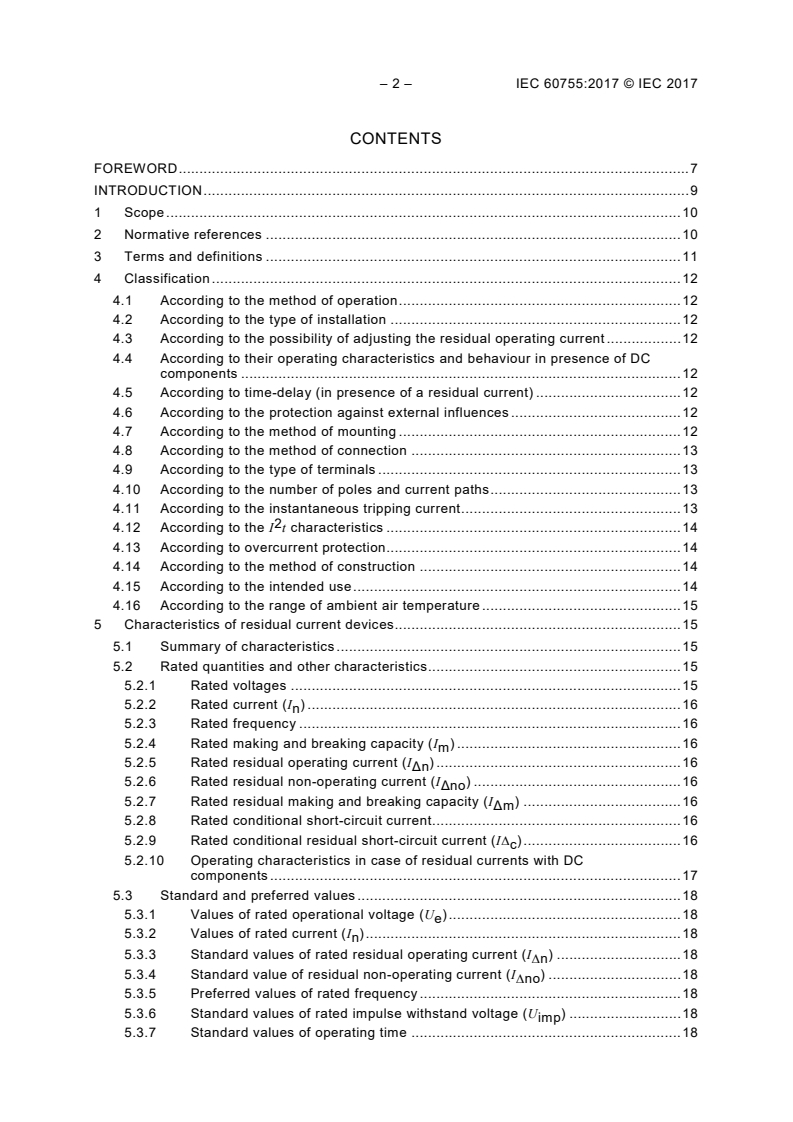
– 2 – IEC 60755:2017 © IEC 2017
CONTENTS
FOREWORD . 7
INTRODUCTION . 9
1 Scope . 10
2 Normative references . 10
3 Terms and definitions . 11
4 Classification . 12
4.1 According to the method of operation . 12
4.2 According to the type of installation . 12
4.3 According to the possibility of adjusting the residual operating current . 12
4.4 According to their operating characteristics and behaviour in presence of DC
components . 12
4.5 According to time-delay (in presence of a residual current) . 12
4.6 According to the protection against external influences . 12
4.7 According to the method of mounting . 12
4.8 According to the method of connection . 13
4.9 According to the type of terminals . 13
4.10 According to the number of poles and current paths . 13
4.11 According to the instantaneous tripping current . 13
4.12 According to the I t characteristics . 14
4.13 According to overcurrent protection . 14
4.14 According to the method of construction . 14
4.15 According to the intended use . 14
4.16 According to the range of ambient air temperature . 15
5 Characteristics of residual current devices . 15
5.1 Summary of characteristics . 15
5.2 Rated quantities and other characteristics . 15
5.2.1 Rated voltages . 15
5.2.2 Rated current (I ) . 16
n
5.2.3 Rated frequency . 16
5.2.4 Rated making and breaking capacity (I ) . 16
m
5.2.5 Rated residual operating current (I ) . 16
Δn
5.2.6 Rated residual non-operating current (I ) . 16
Δno
5.2.7 Rated residual making and breaking capacity (I ) . 16
Δm
5.2.8 Rated conditional short-circuit current . 16
5.2.9 Rated conditional residual short-circuit current (I∆ ) . 16
c
5.2.10 Operating characteristics in case of residual currents with DC
components . 17
5.3 Standard and preferred values . 18
5.3.1 Values of rated operational voltage (U ) . 18
e
5.3.2 Values of rated current (I ) . 18
n
5.3.3 Standard values of rated residual operating current (I ) . 18
∆n
5.3.4 Standard value of residual non-operating current (I ) . 18
∆no
5.3.5 Preferred values of rated frequency . 18
5.3.6 Standard values of rated impulse withstand voltage (U ) . 18
imp
5.3.7 Standard values of operating time . 18
5.3.8 Standard minimum value of non-operating overcurrent in case of a load
through an RCD with two current paths . 19
5.3.9 Standard minimum value of non-operating overcurrent in case of a
single-phase load through a three- or four-pole or four-current-paths
RCD . 19
5.3.10 Minimum value of the rated making and breaking capacity (I ) . 19
m
5.3.11 Minimum value of the rated residual making and breaking capacity
(I∆ ) . 19
m
5.3.12 Preferred values of the rated conditional short-circuit current . 19
5.3.13 Preferred values of the rated conditional residual short-circuit current
(I∆ ) . 19
c
5.4 Coordination with short-circuit protective devices (SCPDs) . 19
6 Marking and other product information . 20
6.1 Information and marking for RCDs according to 4.15.1 . 20
6.2 Information and marking for RCDs according to 4.15.2 and 4.15.3 . 21
7 Conditions for operation in service and for installation . 22
7.1 Preferred ranges of application, reference values of influencing
quantities/factors and the associated test tolerances . 22
7.2 Conditions of installation . 22
7.3 Pollution degree . 22
7.4 Additional standard conditions for operation in service and for installation
when an RCD is incorporated or embedded in an equipment. 22
8 Requirements for construction and operation . 22
8.1 Mechanical design . 22
8.1.1 General . 22
8.1.2 Mechanism . 24
8.1.3 Clearance and creepage distances . 25
8.1.4 Screws, current-carrying parts and connections . 25
8.1.5 Terminals for external conductors . 26
8.2 Protection against electric shock . 26
8.3 Dielectric properties and isolating capability . 26
8.4 Temperature rise . 27
8.5 Operating characteristics . 27
8.5.1 General . 27
8.5.2 Operation in response to the type of residual current . 27
8.5.3 Operation in presence of a residual current equal to and greater than
I∆ . 28
n
8.5.4 Additional requirements for RCDs according to 4.15.2 and 4.15.3 . 29
8.6 Mechanical and electrical endurance . 29
8.7 Performance at short-circuit currents . 29
8.8 Resistance to mechanical shock and impact . 29
8.9 Resistance to heat . 29
8.10 Resistance to abnormal heat and to fire . 29
8.11 Test device . 30
8.12 Requirements for RCDs in case of loss of supply . 30
8.13 Behaviour of RCDs in case of overcurrent in the main circuit . 30
8.14 Behaviour of RCDs in case of current surges caused by impulse voltages . 30
8.15 Void . 30
8.16 Reliability . 30
8.17 Electromagnetic compatibility (EMC) . 31
– 4 – IEC 60755:2017 © IEC 2017
8.18 Resistance to temporary overvoltages (TOV) . 31
9 Preparation of test clauses for RCD product standards and of test clauses for
RCD incorporated or embedded in an equipment . 31
9.1 General . 31
9.1.1 General test conditions . 31
9.1.2 Additional test conditions for preparation of standards for RCDs
according to 4.15.2 . 32
9.1.3 Additional test conditions for preparation of standards for RCDs
according to 4.15.3 . 32
9.1.4 Tests not specified in this document . 32
9.2 Operating characteristics . 32
9.2.1 General requirements for operating characteristics tests . 32
9.2.2 Tests of RCDs of type AC . 33
9.2.3 Tests of RCDs of type A . 33
9.2.4 Tests of RCD of type F . 34
9.2.5 Tests of RCDs of type B . 35
9.3 Tests of electrical endurance . 37
9.4 Tests of behaviour of the RCD under short-circuit conditions . 37
9.4.1 General . 37
9.4.2 Short-circuit tests . 38
9.4.3 Behaviour of the RCD during and after the tests . 39
9.5 Test of the trip-free mechanism . 39
9.6 Verification of the operation of the test device . 40
9.7 Tests of behaviour of RCDs in case of current surges caused by impulse
voltages . 40
9.7.1 Current surge test for all RCDs (0,5 µs/100 kHz ring wave test) . 40
9.7.2 Verification of behaviour at surge currents (8/20 µs surge current test) . 40
9.8 Tests of reliability . 41
9.8.1 Climatic test. 41
9.8.2 Test with temperature of 40 °C . 41
9.8.3 Verification of the resistance to ageing . 42
9.9 Tests of electromagnetic compatibility (EMC) . 42
9.9.1 General . 42
9.9.2 Specific requirements for RCDs for household and similar uses . 43
Annex A (informative) Recommended diagram for short-circuit tests . 54
Annex B (informative) Possible load and fault currents . 57
Annex C (informative) Correspondence between clauses and modules . 60
Annex D (informative) Relationship with product standards . 62
D.1 General . 62
D.2 RCD product standards . 62
D.3 Application of RCDs . 62
Bibliography . 64
Figure 1 – Void . 52
Figure 2 – Void . 52
Figure 3 – Void . 52
Figure 4 – Void . 52
Figure 5 – Void . 52
Figure 6 – Void . 52
Figure 7 – Void . 52
Figure 8 – Void . 52
Figure 9 – Void . 52
Figure 10 – Void . 52
Figure 11 – Void . 52
Figure 12 – Void . 52
Figure 13 – Void . 52
Figure 14 – Void . 52
Figure 15 – Void . 53
Figure 16 – Current ring wave 0,5 µs/100 kHz . 53
Figure A.1 – Diagram for all the short-circuit tests. 55
Figure A.2 – Detail of impedance Z or Z . 56
Figure B.1 – Possible fault currents in systems with semiconductors . 59
Table 1 – Values of influencing quantities . 43
Table 2 – Marking for RCDs according to 4.15.1 . 44
Table 3 – Marking for RCDs according to 4.15.2 and 4.15.3 . 46
Table 4 – Standard values of maximum break time of non time-delay type RCDs for
AC residual current . 46
Table 5 – Standard values of maximum break time of non time-delay type RCDs for
half-wave pulsating DC residual current . 47
Table 6 – Standard values of maximum break time of non time-delay type RCDs for
residual direct currents which result from rectifying circuits and/or smooth DC residual
current . 47
Table 7 – Acceptable alternative standard values of maximum break times for RCDs
with a rated residual current of 6 mA and non time-delay type intended to be used in
bi-phase system 120 V with middle point . 47
Table 8 – Standard values of break time for AC residual current for time-delay type
residual current devices . 47
Table 9 – Standard values of break time for pulsating DC residual current for time-
delay type residual current devices . 48
Table 10 – Standard values of break time for rectifying circuits and smooth DC
residual current for time-delay type residual current devices . 48
Table 11 – Void . 48
Table 12 – Void . 48
Table 13 – Tripping current limits . 48
Table 14 – Tripping current limits . 49
Table 15 – Different frequency component values of test currents and starting current
values (I ) for verifying the operating in case of steady increased residual current . 49
Δ
Table 16 – Operating current ranges for composite residual current . 49
Table 17 – Tripping current ranges for type B RCDs at frequencies which differ from
the rated frequency 50/60 Hz . 49
Table 18 – Tripping current limits . 50
Table 19 – Void . 50
Table 20 – Void . 50
– 6 – IEC 60755:2017 © IEC 2017
Table 21 – Void . 50
Table 22 – Void . 50
Table 23 – Void . 50
Table 24 – Void . 50
Table 25 – Void . 50
Table 26 – Void . 50
Table 27 – Void . 50
Table 28 – Void . 50
Table 29 – Void . 50
Table 30 – Withstand values and duration of temporary overvoltages . 50
Table 31 – Void . 50
Table 32 – Void . 50
Table 33 – Void . 50
Table 34 – Void . 51
Table 35 – Void . 51
Table 36 – Minimum values of I t and I . 51
p
Table 37 – Void . 51
Table 38 – Void . 51
Table 39 – Void . 51
Table 40 – Void . 51
Table 41 – Void . 51
Table 42 – Void . 51
Table 43 – Void . 51
Table 44 – Void . 51
Table 45 – List of electromagnetic phenomena covered by IEC 61543 . 52
Table C.1 – Correspondence between clauses and modules used in this standard . 60
INTERNATIONAL ELECTROTECHNICAL COMMISSION
____________
GENERAL SAFETY REQUIREMENTS FOR RESIDUAL CURRENT
OPERATED PROTECTIVE DEVICES
FOREWORD
1) The International Electrotechnical Commission (IEC) is a worldwide organization for standardization comprising
all national electrotechnical committees (IEC National Committees). The object of IEC is to promote
international co-operation on all questions concerning standardization in the electrical and electronic fields. To
this end and in addition to other activities, IEC publishes International Standards, Technical Specifications,
Technical Reports, Publicly Available Specifications (PAS) and Guides (hereafter referred to as “IEC
Publication(s)”). Their preparation is entrusted to technical committees; any IEC National Committee interested
in the subject dealt with may participate in this preparatory work. International, governmental and non-
governmental organizations liaising with the IEC also participate in this preparation. IEC collaborates closely
with the International Organization for Standardization (ISO) in accordance with conditions determined by
agreement between the two organizations.
2) The formal decisions or agreements of IEC on technical matters express, as nearly as possible, an international
consensus of opinion on the relevant subjects since each technical committee has representation from all
interested IEC National Committees.
3) IEC Publications have the form of recommendations for international use and are accepted by IEC National
Committees in that sense. While all reasonable efforts are made to ensure that the technical content of IEC
Publications is accurate, IEC cannot be held responsible for the way in which they are used or for any
misinterpretation by any end user.
4) In order to promote international uniformity, IEC National Committees undertake to apply IEC Publications
transparently to the maximum extent possible in their national and regional publications. Any divergence
between any IEC Publication and the corresponding national or regional publication shall be clearly indicated in
the latter.
5) IEC itself does not provide any attestation of conformity. Independent certification bodies provide conformity
assessment services and, in some areas, access to IEC marks of conformity. IEC is not responsible for any
services carried out by independent certification bodies.
6) All users should ensure that they have the latest edition of this publication.
7) No liability shall attach to IEC or its directors, employees, servants or agents including individual experts and
members of its technical committees and IEC National Committees for any personal injury, property damage or
other damage of any nature whatsoever, whether direct or indirect, or for costs (including legal fees) and
expenses arising out of the publication, use of, or reliance upon, this IEC Publication or any other IEC
Publications.
8) Attention is drawn to the Normative references cited in this publication. Use of the referenced publications is
indispensable for the correct application of this publication.
9) Attention is drawn to the possibility that some of the elements of this IEC Publication may be the subject of
patent rights. IEC shall not be held responsible for identifying any or all such patent rights.
International Standard IEC 60755 has been prepared by subcommittee 23E: Circuit breakers
and similar equipment for household use, of IEC technical committee 23: Electrical
accessories.
This first edition cancels and replaces IEC TR 60755 published in 2008 and constitutes a
technical revision.
This edition includes the following significant technical changes with respect to IEC TR 60755:
a) restructuration of the document, as a Group Safety Publication, in compliance with Guide
104;
b) introduction of classification for type F RCDs;
c) introduction of Clause 9 for tests of RCDs (operating characteristics, electrical endurance,
behaviour in short-circuit conditions, trip-free mechanism, test device, surges, reliability,
EMC).
– 8 – IEC 60755:2017 © IEC 2017
The text of this International Standard is based on the following documents:
FDIS Report on voting
23E/1035/FDIS 23E/1036/RVD
Full information on the voting for the approval of this International Standard can be found in
the report on voting indicated in the above table.
This document has been drafted in accordance with the ISO/IEC Directives, Part 2.
It has the status of a group safety publication in accordance with IEC Guide 104.
The following differing practices of a less permanent nature exist in the countries indicated
below:
– 5.3.3: 0,015 A, 0,05 A and 0,2 A are also considered standard values (Korea and Japan);
– 5.3.12: 1 000 A, 2 000 A, 2 500 A, 7 500 A and 9 000 A are also considered preferred
values (Korea and Japan);
– 8.1.1.1: multiple settings are not allowed (Australia, Germany, Denmark, the UK and
Switzerland);
– 8.1.2: the colours red and green are not used for contact position indication (US).
The committee has decided that the contents of this document will remain unchanged until the
stability date indicated on the IEC website under "http://webstore.iec.ch" in the data related to
the specific document. At this date, the document will be
• reconfirmed,
• withdrawn,
• replaced by a revised edition, or
• amended.
A bilingual version of this publication may be issued at a later date.
INTRODUCTION
IEC 60755 has been prepared as a Group Safety Publication by subcommittee 23E in
accordance with its Group Safety Function for residual current devices. It is intended for use
by technical committees in the preparation of standards for residual current unit, function or
devices when it is intended to provide protective measures according to IEC 60364 (all parts).
There are two basic conditions of protection against the risk of electric shock: fault protection
(indirect contact) and basic protection (direct contact).
Fault protection implies that the device is used to prevent dangerous voltages persisting on
accessible installation metalworks, which are earthed but become live under earth fault
conditions.
Under such conditions, the risk arises not from the user making direct contact with a live
conductive part, but making contact with earthed metalwork, which itself is in contact with a
live conductive part.
The primary or basic function of residual current devices is to provide fault protection.
However, where devices have an adequate sensitivity (i.e. units having operating residual
currents not exceeding 30 mA), they provide the additional benefit of people (and livestock)
protection to a user making direct contact with a live conductive part where other methods of
protection failed.
The operating characteristics given in this document are therefore based on requirements,
which themselves are based on the information contained in IEC 60479-1 and IEC 60479-2.
Residual current devices having rated residual operating currents not exceeding 300 mA also
provide protection against the risk of fire resulting from earth fault currents which can exist for
lengthy periods without operating the overcurrent protective device.
– 10 – IEC 60755:2017 © IEC 2017
GENERAL SAFETY REQUIREMENTS FOR RESIDUAL CURRENT
OPERATED PROTECTIVE DEVICES
1 Scope
This document provides general minimum requirements, recommendations and information for
the drafting of standards on residual current operated protective devices (hereinafter referred
to as residual current devices, "RCDs"). It applies to any device providing residual current
protection intended primarily for protection against electric shock hazard.
NOTE 1 Residual current monitors (RCMs) according to IEC 62020, whose purpose is to monitor an electrical
installation and not to provide protection, are not covered by this document and cannot be considered similar or
equivalent to RCDs.
NOTE 2 RCDs for DC supply system are under consideration.
NOTE 3 For the relationship between this document and the RCD product standards, see Annex D.
This document is primarily intended to be used as a reference for drafting product safety
standard for devices identified as "RCD" or "residual current device" either for general use or
incorporated or embedded in equipment.
This document is also intended to be used as a reference for defining the design requirements
and the applicable testing procedure for an RCD incorporated or embedded in an equipment.
This group safety publication is primarily intended for use by technical Committees in the
preparation of standards in accordance with the principles laid down in IEC Guide 104 and
lSO/lEC Guide 51. It is not intended for use by manufacturers or certification bodies.
One of the responsibilities of a technical committee is, wherever applicable, to make use of
group safety publications in the preparation of its publications. The requirements, test
methods or test conditions of this group safety publication will not apply unless specifically
referred to or included in the relevant publications.
2 Normative references
The following documents are referred to in the text in such a way that some or all of their
content constitutes requirements of this document. For dated references, only the edition
cited applies. For undated references, the latest edition of the referenced document (including
any amendments) applies.
IEC 60060-1, High-voltage test techniques – Part 1: General definitions and test requirements
IEC 60060-2, High-voltage test techniques – Part 2: Measuring systems
IEC 60068-2-30:2005, Environmental testing – Part 2-30: Tests – Test Db: Damp heat, cyclic
(12 h + 12 h cycle)
IEC 60068-3-4, Environmental testing – Part 3-4: Supporting documentation and guidance –
Damp heat tests
IEC 60364 (all parts), Low-voltage electrical installations
IEC 60364-4-41, Low-voltage electrical installations – Part 4-41: Protection for safety –
Protection against electric shock
IEC 60417, Graphical symbols for use on equipment (available at http://www.graphical-
symbols.info/equipment)
IEC 60479 (all parts), Effects of current on human beings and livestock
IEC 60529, Degrees of protection provided by enclosures (IP Code)
IEC 60664-1, Insulation coordination for equipment within low-voltage systems – Part 1:
Principles, requirements and tests
IEC 61000-6-1, Electromagnetic compatibility (EMC) – Part 6-1: Generic standards –
Immunity standard for residential, commercial and light-industrial environments
IEC 61000-6-2, Electromagnetic compatibility (EMC) – Part 6-2: Generic standards –
Immunity standard for industrial environments
IEC 61000-6-3, Electromagnetic compatibility (EMC) – Part 6-3: Generic standards –
Emission standard for residential, commercial and light-industrial environments
IEC 61000-6-4, Electromagnetic compatibility (EMC) – Part 6-4: Generic standards –
Emission standard for industrial environments
IEC 61140, Protection against electric shock – Common aspects for installation and
equipment
IEC 61543:1995, Residual current-operated protective devices (RCDs) for household and
similar use – Electromagnetic compatibility
IEC 61543:1995/AMD1:2004
IEC 61543:1995/AMD2:2005
IEC 62873-2, Residual current operated circuit-breakers for household and similar use –
Part 2: Residual current devices (RCDs) – Vocabulary
IEC GUIDE 104, The preparation of safety publications and the use of basic safety
publications and group safety publications
ISO/IEC Guide 51, Safety aspects – Guidelines for their inclusion in standards
CISPR 14-1, Electromagnetic compatibility – Requirements for household appliances, electric
tools and similar apparatus – Part 1: Emission
3 Terms and definitions
For the purposes of this document, the terms and definitions given in IEC 62873-2 and the
following apply.
ISO and IEC maintain terminological databases for use in standardization at the following
addresses:
• IEC Electropedia: available at http://www.electropedia.org/
• ISO Online browsing platform: available at http://www.iso.org/obp
3.1
supplementary protection
measure to further reduce the risk of electric shock without replacing fault and/or additional
protection according to IEC 60364-4-41
– 12 – IEC 60755:2017 © IEC 2017
4 Classification
4.1 According to the method of operation
Classification is given in the relevant product standard.
4.2 According to the type of installation
4.2.1 RCD for fixed installation and fixed wiring
NOTE RCDs according to this classification are designed to be used to provide protection against electric shock
according to IEC 60364-4-41.
4.2.2 Portable RCDs with corded connection
NOTE RCDs according to this classification are designed to be used to provide supplementary protection only.
4.3 According to the possibility of adjusting the residual operating current
4.3.1 RCD with a single value of rated residual operating current
4.3.2 RCD with multiple settings of residual operating current by fixed steps
4.3.3 RCD whose rated residual operating current is continuously adjustable
4.4 According to their operating characteristics and behaviour in presence of DC
components
4.4.1 RCD of type AC
4.4.2 RCD of type A
4.4.3 RCD of Type F
4.4.4 RCD of Type B
4.5 According to time-delay (in presence of a residual current)
4.5.1 RCD without time-delay
4.5.2 RCD with time-delay
4.5.2.1 RCD of type S with time-delay of 0,06 s;
4.5.2.2 RCD with other time-delay.
4.6 According to the protection against external influences
4.6.1 Enclosed-type RCD (not requiring an appropriate enclosure)
4.6.2 Unenclosed-type RCD (for use with an appropriate enclosure)
4.7 According to the method of mounting
4.7.1 Surface-type RCD
4.7.2 Flush-type RCD
4.7.3 Panel board type RCD, also referred to as distribution board type
NOTE These types can be intended to be mounted on rails.
4.8 According to the method of connection
4.8.1 RCD, the electrical connections of which are not associated with the mechanical
mounting
4.8.2 RCD, the electrical connections of which are associated with the mechanical
mounting
NOTE Examples of this type are:
– plug-in type;
– bolt-on type;
– screw-in type.
Some RCDs can be of the plug-in type or bolt-on type on the line side only, the load terminals being usually
suitable for wiring connection.
4.9 According to the type of terminals
4.9.1 RCD with screw-type terminals for external copper conductors
4.9.2 RCD with screwless type terminals for external copper conductors
NOTE The requirements for RCDs equipped with these types of terminals are given in IEC 62873-3-1.
4.9.3 RCD with flat quick-connect terminals for external copper conductors
NOTE The requirements for RCDs equipped with these types of terminals are given in IEC 62873-3-2.
4.9.4 RCD with screw-type terminals for external aluminium conductors
NOTE The requirements for RCDs equipped with this type of terminal are given in IEC 62873-3-3.
4.10 According to the number of poles and current paths
4.10.1 Single-pole RCD with two current paths
NOTE In this case, the neutral path does not contain any switching contact.
4.10.2 Two-pole RCD
4.10.3 Two-pole RCD with three current paths
NOTE In this case, the neutral path does not contain any switching contact.
4.10.4 Three-pole RCD
4.10.5 Three-pole RCD with four current paths
NOTE In this case, the neutral path does not contain any switching contact.
4.10.6 Four-pole RCD
4.11 According to the instantaneous tripping current
This classification applies to RCD with integral overcurrent protection and shall be defined in
the relevant product standard.
– 14 – IEC 60755:2017 © IEC 2017
...