


IEC 60079-10-1:2020
(Main)Explosive atmospheres - Part 10-1: Classification of areas - Explosive gas atmospheres
Explosive atmospheres - Part 10-1: Classification of areas - Explosive gas atmospheres
IEC 60079-10-1:2020 is concerned with the classification of areas where flammable gas or vapour hazards may arise and may then be used as a basis to support the proper design, construction, operation and maintenance of equipment for use in hazardous areas.
It is intended to be applied where there may be an ignition hazard due to the presence of flammable gas or vapour, mixed with air, but it does not apply to:
a) mines susceptible to firedamp;
b) the processing and manufacture of explosives;
c) catastrophic failures or rare malfunctions which are beyond the concept of normality dealt with in this standard;
d) rooms used for medical purposes;
e) domestic premises;
f) where a hazard may arise due to the presence of combustible dusts or combustible flyings but the principles may be used in assessment of a hybrid mixture.
Flammable mists may form or be present at the same time as flammable vapour. In such case the strict application of the details in this document may not be appropriate. Flammable mists may also form when liquids not considered to be a hazard due to the high flash point are released under pressure. In these cases the classifications and details given in this document do not apply.
For the purpose of this document, an area is a three-dimensional region or space.
Atmospheric conditions include variations above and below reference levels of 101,3 kPa (1 013 mbar) and 20 °C (293 K), provided that the variations have a negligible effect on the explosion properties of the flammable substances.
In any site, irrespective of size, there may be numerous sources of ignition apart from those associated with equipment. Appropriate precautions will be necessary to ensure safety in this context. This standard is applicable with judgement for other ignition sources but in some applications other safeguards may also need to be considered. E.g. larger distances may apply for naked flames when considering hot work permits.
This document does not take into account the consequences of ignition of an explosive atmosphere except where a zone is so small that if ignition did occur it would have negligible consequences.
This third edition of IEC 60079-10-1 cancels and replaces the second edition, published in 2015, and constitutes a technical revision, see foreword for further details.
Atmosphères explosives - Partie 10-1: Classification des emplacements - Atmosphères explosives gazeuses
l'IEC 60079-10-1:2020 concerne la classification des emplacements dans lesquels des phénomènes dangereux dus à des gaz ou vapeurs inflammables peuvent apparaître, et peut ainsi constituer une base pour la conception, l'exploitation et la maintenance correctes du matériel utilisé dans de tels emplacements.
Elle est destinée à être appliquée là où il peut exister un danger d'inflammation du fait de la présence de gaz ou vapeurs inflammables, en mélange avec l'air, mais elle ne s'applique pas:
a) aux mines grisouteuses;
b) au traitement et à la fabrication des explosifs;
c) aux défaillances catastrophiques ou rares dysfonctionnements, qui dépassent le concept de normalité traité dans la présente norme;
d) aux locaux utilisés à des fins médicales;
e) aux locaux à usage domestique;
f) lorsqu’un danger peut apparaître compte tenu de la présence de poussières combustibles ou de particules combustibles en suspension dans l'air, mais les principes définis peuvent toutefois être appliqués dans l’évaluation d’un mélange hybride.
Des brouillards inflammables peuvent se former ou être présents en même temps que les vapeurs inflammables. Dans ce type de cas, l’application stricte des détails du présent document peut ne pas être appropriée. Les brouillards inflammables peuvent également se former lorsque les liquides qui ne sont pas considérés comme dangereux en raison du point d’éclair élevé sortent sous pression. Dans ces cas, les classifications et détails donnés dans le présent document ne s’appliquent pas. Des informations relatives aux brouillards inflammables sont données à l’Annexe G.
Pour les besoins du présent document, un emplacement est une région ou un espace tridimensionnel.
Les conditions atmosphériques englobent les écarts au-dessus et au-dessous des niveaux de référence de 101,3 kPa (1 013 mbar) et 20 °C (293 K) à condition que cela ait un effet négligeable sur les propriétés explosives des substances inflammables.
Dans tout site quelle que soit son importance, il peut y avoir de nombreuses sources d'inflammation en dehors de celles qui sont associées au matériel. Il est nécessaire dès lors de prendre les précautions appropriées pour garantir la sécurité. La présente norme est applicable avec prudence pour ces autres sources d'inflammation mais d'autres applications peuvent nécessiter de prendre en considération d’autres mesures de protection. Par exemple, de plus grandes distances peuvent s'appliquer aux flammes nues lorsqu’il s’agit de permis de travaux à chaud.
Le présent document ne tient pas compte des conséquences de l'inflammation d'une atmosphère explosive, sauf dans une zone si petite que si une inflammation se produit, ses conséquences sont négligeables.
Cette troisième édition de l'IEC 60079-10-1 annule et remplace la deuxième édition parue en 2015. Cette édition constitue une révision technique.
General Information
- Status
- Published
- Publication Date
- 28-Mar-2021
- Technical Committee
- SC 31J - Classification of hazardous areas and installation requirements
- Drafting Committee
- MT 60079-10-1 - TC 31/SC 31J/MT 60079-10-1
- Current Stage
- PPUB - Publication issued
- Start Date
- 18-Dec-2020
- Completion Date
- 23-Oct-2020
Relations
- Effective Date
- 09-Feb-2026
- Effective Date
- 09-Feb-2026
- Effective Date
- 09-Feb-2026
- Effective Date
- 09-Feb-2026
- Effective Date
- 09-Feb-2026
- Effective Date
- 09-Feb-2026
- Effective Date
- 09-Feb-2026
- Effective Date
- 05-Sep-2023
- Effective Date
- 05-Sep-2023
Overview
IEC 60079-10-1:2020 - Explosive atmospheres - Part 10-1: Classification of areas - Explosive gas atmospheres - defines the methodology for classifying three‑dimensional areas where flammable gas or vapour mixed with air may create ignition hazards. Edition 3.0 (2020) provides guidance to support the safe design, construction, operation and maintenance of equipment for use in hazardous areas. The standard clarifies scope and exclusions (for example, mines susceptible to firedamp, manufacture of explosives, domestic premises, medical rooms and certain flammable mists or dusty atmospheres) and introduces the concept of a zone of negligible extent.
Key topics and technical requirements
- Hazardous area classification methodology: structured approaches including classification by sources of release, simplified methods and combinations of methods.
- Sources and forms of release: identification and assessment of continuous, primary and secondary releases; gaseous releases; liquefied releases (by pressure or refrigeration); vapours and liquid pools.
- Ventilation and dilution: evaluation of natural and artificial ventilation, degree of dilution, ventilation effectiveness and criteria for availability of ventilation.
- Type and extent of zones: determination of Zone 0/1/2 (gas) areas based on release grade, dilution and ventilation; guidance on estimating spatial extent of hazardous zones.
- Risk and explosion assessment principles: explosion risk assessment, exclusion of catastrophic failures beyond normality, and consideration of other ignition sources (e.g., hot work, naked flames).
- Documentation and drawings: recommended presentation of hazardous areas, data sheets, and required records to support design, inspection and maintenance.
- Informative annexes: worked examples, equations for dilution/time estimates, guidance for flammable mists, hydrogen and hybrid mixtures, and references to industry codes.
Applications and who uses it
IEC 60079-10-1 is used by:
- Process, chemical and petroleum engineers for plant layout and piping design
- Electrical and instrumentation engineers for specifying explosion-protected equipment
- Safety, EHS and risk assessors conducting hazardous area classification and permit-to-work programs
- Maintenance planners and inspection bodies for safe operation and zoning documentation
- Certification and compliance teams demonstrating conformity with the IEC 60079 series
Practical uses include selecting appropriate explosion-protection techniques, defining safe distances, designing ventilation systems, preparing hot work permits and producing hazardous area drawings for procurement and inspection.
Related standards
- Other parts of the IEC 60079 series (equipment protection, selection and installation) are complementary for full explosive atmosphere management and compliance.
- Users should also consult relevant national regulations and industry codes referenced in IEC 60079-10-1 for site‑specific requirements.
Keywords: IEC 60079-10-1:2020, hazardous area classification, explosive gas atmospheres, flammable gas, vapour, ventilation, zone extent, hazardous zones, explosion protection.
Buy Documents
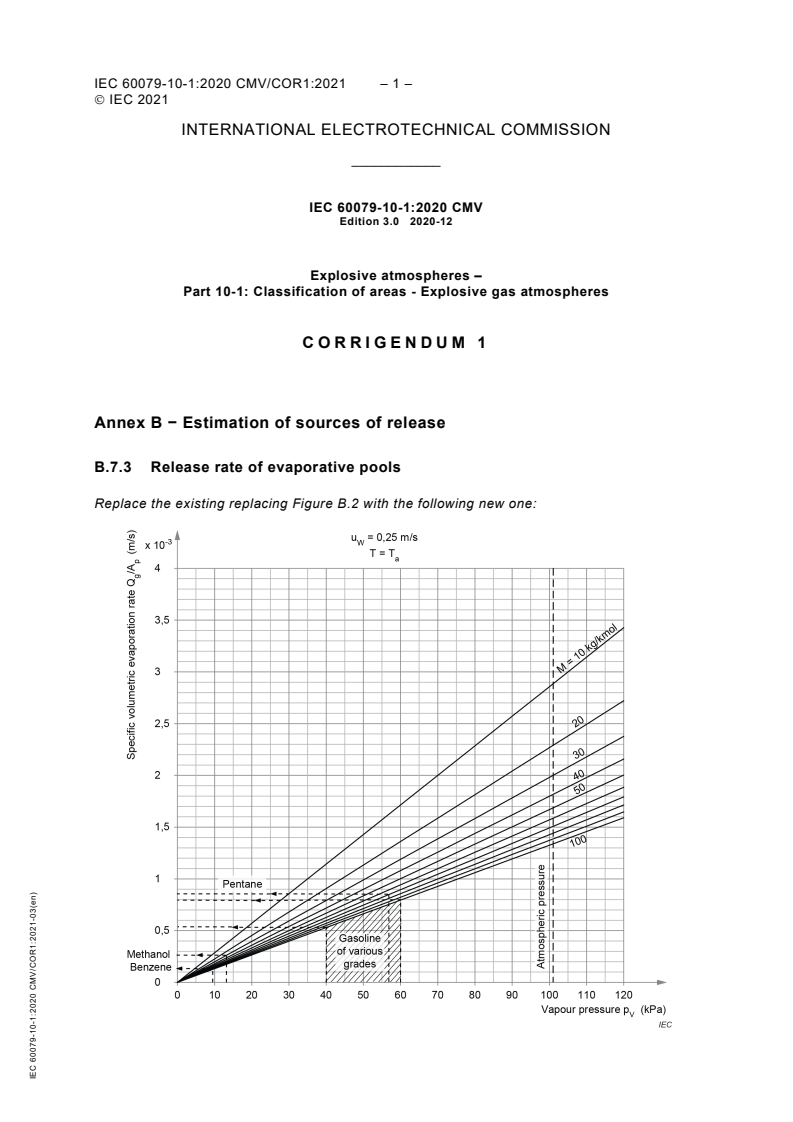


REDLINE IEC 60079-10-1:2020 CMV/COR1:2021 - Corrigendum 1 - Explosive atmospheres - Part 10-1: Classification of areas - Explosive gas atmospheres Released:3/29/2021
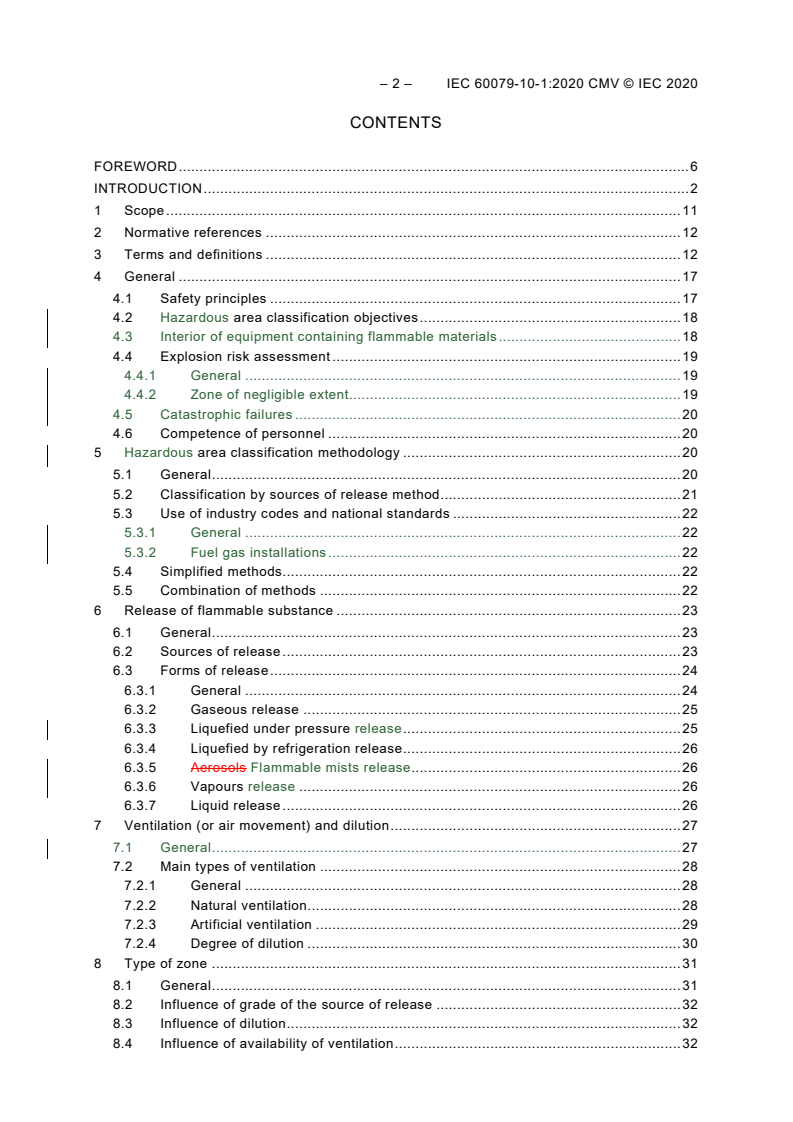
REDLINE IEC 60079-10-1:2020 CMV - Explosive atmospheres - Part 10-1: Classification of areas - Explosive gas atmospheres Released:12/18/2020 Isbn:9782832292136


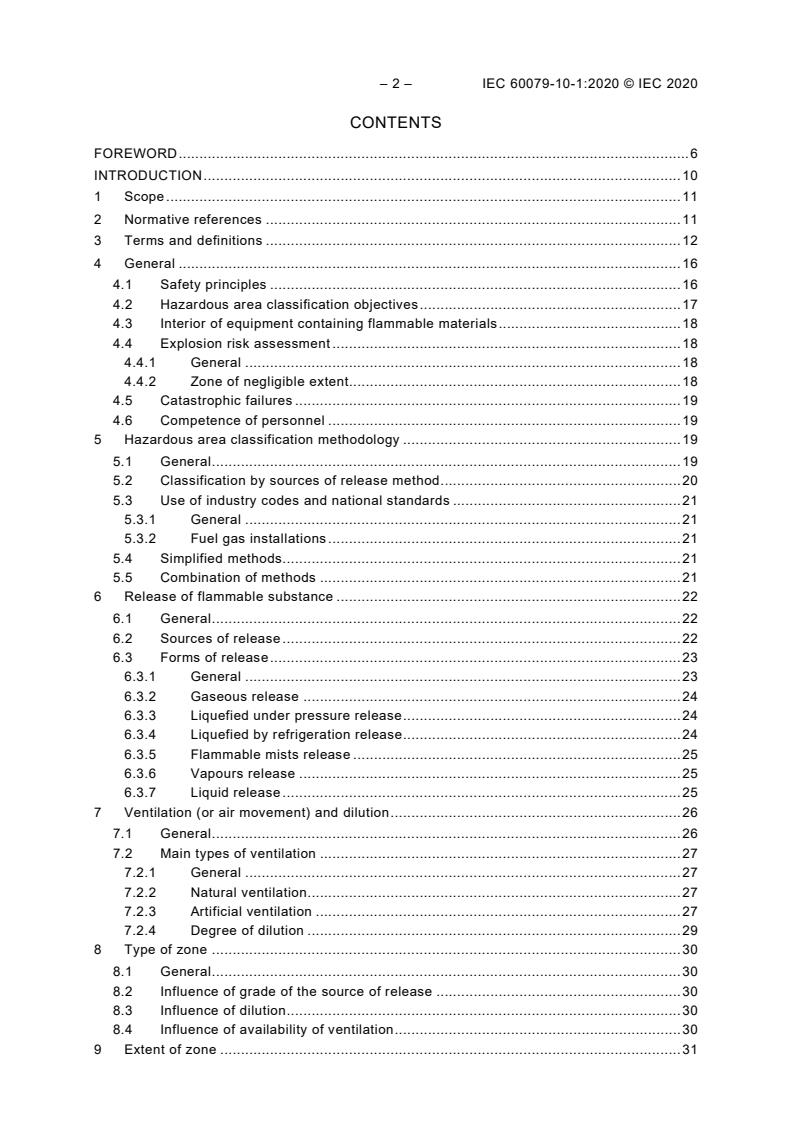
IEC 60079-10-1:2020 - Explosive atmospheres - Part 10-1: Classification of areas - Explosive gas atmospheres Released:12/18/2020 Isbn:9782832288900
Get Certified
Connect with accredited certification bodies for this standard

Intertek Testing Services NA Inc.
Intertek certification services in North America.

UL Solutions
Global safety science company with testing, inspection and certification.

ANCE
Mexican certification and testing association.
Sponsored listings
Frequently Asked Questions
IEC 60079-10-1:2020 is a standard published by the International Electrotechnical Commission (IEC). Its full title is "Explosive atmospheres - Part 10-1: Classification of areas - Explosive gas atmospheres". This standard covers: IEC 60079-10-1:2020 is concerned with the classification of areas where flammable gas or vapour hazards may arise and may then be used as a basis to support the proper design, construction, operation and maintenance of equipment for use in hazardous areas. It is intended to be applied where there may be an ignition hazard due to the presence of flammable gas or vapour, mixed with air, but it does not apply to: a) mines susceptible to firedamp; b) the processing and manufacture of explosives; c) catastrophic failures or rare malfunctions which are beyond the concept of normality dealt with in this standard; d) rooms used for medical purposes; e) domestic premises; f) where a hazard may arise due to the presence of combustible dusts or combustible flyings but the principles may be used in assessment of a hybrid mixture. Flammable mists may form or be present at the same time as flammable vapour. In such case the strict application of the details in this document may not be appropriate. Flammable mists may also form when liquids not considered to be a hazard due to the high flash point are released under pressure. In these cases the classifications and details given in this document do not apply. For the purpose of this document, an area is a three-dimensional region or space. Atmospheric conditions include variations above and below reference levels of 101,3 kPa (1 013 mbar) and 20 °C (293 K), provided that the variations have a negligible effect on the explosion properties of the flammable substances. In any site, irrespective of size, there may be numerous sources of ignition apart from those associated with equipment. Appropriate precautions will be necessary to ensure safety in this context. This standard is applicable with judgement for other ignition sources but in some applications other safeguards may also need to be considered. E.g. larger distances may apply for naked flames when considering hot work permits. This document does not take into account the consequences of ignition of an explosive atmosphere except where a zone is so small that if ignition did occur it would have negligible consequences. This third edition of IEC 60079-10-1 cancels and replaces the second edition, published in 2015, and constitutes a technical revision, see foreword for further details.
IEC 60079-10-1:2020 is concerned with the classification of areas where flammable gas or vapour hazards may arise and may then be used as a basis to support the proper design, construction, operation and maintenance of equipment for use in hazardous areas. It is intended to be applied where there may be an ignition hazard due to the presence of flammable gas or vapour, mixed with air, but it does not apply to: a) mines susceptible to firedamp; b) the processing and manufacture of explosives; c) catastrophic failures or rare malfunctions which are beyond the concept of normality dealt with in this standard; d) rooms used for medical purposes; e) domestic premises; f) where a hazard may arise due to the presence of combustible dusts or combustible flyings but the principles may be used in assessment of a hybrid mixture. Flammable mists may form or be present at the same time as flammable vapour. In such case the strict application of the details in this document may not be appropriate. Flammable mists may also form when liquids not considered to be a hazard due to the high flash point are released under pressure. In these cases the classifications and details given in this document do not apply. For the purpose of this document, an area is a three-dimensional region or space. Atmospheric conditions include variations above and below reference levels of 101,3 kPa (1 013 mbar) and 20 °C (293 K), provided that the variations have a negligible effect on the explosion properties of the flammable substances. In any site, irrespective of size, there may be numerous sources of ignition apart from those associated with equipment. Appropriate precautions will be necessary to ensure safety in this context. This standard is applicable with judgement for other ignition sources but in some applications other safeguards may also need to be considered. E.g. larger distances may apply for naked flames when considering hot work permits. This document does not take into account the consequences of ignition of an explosive atmosphere except where a zone is so small that if ignition did occur it would have negligible consequences. This third edition of IEC 60079-10-1 cancels and replaces the second edition, published in 2015, and constitutes a technical revision, see foreword for further details.
IEC 60079-10-1:2020 is classified under the following ICS (International Classification for Standards) categories: 29.260.20 - Electrical apparatus for explosive atmospheres. The ICS classification helps identify the subject area and facilitates finding related standards.
IEC 60079-10-1:2020 has the following relationships with other standards: It is inter standard links to EN ISO 24252:2022, EN ISO/ASTM 52931:2023, EN ISO 22734-1:2025, EN 17893:2024, EN ISO 20519:2022, EN ISO 12643-2:2023, EN ISO 12643-1:2023, IEC 60079-10-1:2015/COR1:2015, IEC 60079-10-1:2015. Understanding these relationships helps ensure you are using the most current and applicable version of the standard.
IEC 60079-10-1:2020 is available in PDF format for immediate download after purchase. The document can be added to your cart and obtained through the secure checkout process. Digital delivery ensures instant access to the complete standard document.
Standards Content (Sample)
IEC 2021
INTERNATIONAL ELECTROTECHNICAL COMMISSION
____________
Edition 3.0 2020-12
Explosive atmospheres –
Part 10-1: Classification of areas - Explosive gas atmospheres
CO RRI G E N
...
IEC 60079-10-1 ®
Edition 3.0 2020-12
COMMENTED VERSION
INTERNATIONAL
STANDARD
colour
inside
Explosive atmospheres –
Part 10-1: Classification of areas – Explosive gas atmospheres
All rights reserved. Unless otherwise specified, no part of this publication may be reproduced or utilized in any form
or by any means, electronic or mechanical, including photocopying and microfilm, without permission in writing from
either IEC or IEC's member National Committee in the country of the requester. If you have any questions about IEC
copyright or have an enquiry about obtaining additional rights to this publication, please contact the address below or
your local IEC member National Committee for further information.
IEC Central Office Tel.: +41 22 919 02 11
3, rue de Varembé info@iec.ch
CH-1211 Geneva 20 www.iec.ch
Switzerland
About the IEC
The International Electrotechnical Commission (IEC) is the leading global organization that prepares and publishes
International Standards for all electrical, electronic and related technologies.
About IEC publications
The technical content of IEC publications is kept under constant review by the IEC. Please make sure that you have the
latest edition, a corrigendum or an amendment might have been published.
IEC publications search - webstore.iec.ch/advsearchform Electropedia - www.electropedia.org
The advanced search enables to find IEC publications by a The world's leading online dictionary on electrotechnology,
variety of criteria (reference number, text, technical containing more than 22 000 terminological entries in English
committee,…). It also gives information on projects, replaced and French, with equivalent terms in 16 additional languages.
and withdrawn publications. Also known as the International Electrotechnical Vocabulary
(IEV) online.
IEC Just Published - webstore.iec.ch/justpublished
Stay up to date on all new IEC publications. Just Published IEC Glossary - std.iec.ch/glossary
details all new publications released. Available online and 67 000 electrotechnical terminology entries in English and
once a month by email. French extracted from the Terms and Definitions clause of
IEC publications issued since 2002. Some entries have been
IEC Customer Service Centre - webstore.iec.ch/csc collected from earlier publications of IEC TC 37, 77, 86 and
If you wish to give us your feedback on this publication or CISPR.
need further assistance, please contact the Customer Service
Centre: sales@iec.ch.
IEC 60079-10-1 ®
Edition 3.0 2020-12
COMMENTED VERSION
INTERNATIONAL
STANDARD
colour
inside
Explosive atmospheres –
Part 10-1: Classification of areas – Explosive gas atmospheres
INTERNATIONAL
ELECTROTECHNICAL
COMMISSION
ICS 29.260.20 ISBN 978-2-8322-9213-6
– 2 – IEC 60079-10-1:2020 CMV © IEC 2020
CONTENTS
FOREWORD . 6
INTRODUCTION . 2
1 Scope . 11
2 Normative references . 12
3 Terms and definitions . 12
4 General . 17
4.1 Safety principles . 17
4.2 Hazardous area classification objectives . 18
4.3 Interior of equipment containing flammable materials . 18
4.4 Explosion risk assessment . 19
4.4.1 General . 19
4.4.2 Zone of negligible extent. 19
4.5 Catastrophic failures . 20
4.6 Competence of personnel . 20
5 Hazardous area classification methodology . 20
5.1 General . 20
5.2 Classification by sources of release method . 21
5.3 Use of industry codes and national standards . 22
5.3.1 General . 22
5.3.2 Fuel gas installations . 22
5.4 Simplified methods. 22
5.5 Combination of methods . 22
6 Release of flammable substance . 23
6.1 General . 23
6.2 Sources of release . 23
6.3 Forms of release . 24
6.3.1 General . 24
6.3.2 Gaseous release . 25
6.3.3 Liquefied under pressure release . 25
6.3.4 Liquefied by refrigeration release . 26
6.3.5 Aerosols Flammable mists release . 26
6.3.6 Vapours release . 26
6.3.7 Liquid release . 26
7 Ventilation (or air movement) and dilution . 27
7.1 General . 27
7.2 Main types of ventilation . 28
7.2.1 General . 28
7.2.2 Natural ventilation . 28
7.2.3 Artificial ventilation . 29
7.2.4 Degree of dilution . 30
8 Type of zone . 31
8.1 General . 31
8.2 Influence of grade of the source of release . 32
8.3 Influence of dilution . 32
8.4 Influence of availability of ventilation . 32
9 Extent of zone . 32
10 Documentation . 33
10.1 General . 33
10.2 Drawings, data sheets and tables . 34
Annex A (informative) Suggested presentation of hazardous areas . 35
A.1 Hazardous area zones – Preferred symbols for zones . 35
A.2 Hazardous area suggested shapes . 38
Annex B (informative) Estimation of sources of release . 40
B.1 Symbols . 40
B.2 Examples of grade of release . 40
B.2.1 General . 40
B.2.2 Sources giving a continuous grade of release . 41
B.2.3 Sources giving a primary grade of release . 41
B.2.4 Sources giving a secondary grade of release . 41
B.3 Assessment of grades of release . 41
B.4 Summation of releases . 42
B.5 Hole size and source radius . 43
B.6 Forms of release . 45
B.7 Release rate . 46
B.7.1 General . 46
B.7.2 Estimation of release rate . 47
B.7.3 Release rate of evaporative pools . 49
B.8 Release from openings in buildings . 52
B.8.1 General . 52
B.8.2 Openings as possible sources of release . 53
B.8.3 Openings classification . 53
Annex C (informative) Ventilation guidance . 55
C.1 Symbols . 55
C.2 General . 56
C.3 Assessment of ventilation and dilution and its influence on hazardous area . 57
C.3.1 General . 57
C.3.2 Effectiveness of ventilation . 57
C.3.3 Criteria for dilution . 58
C.3.4 Assessment of ventilation velocity . 58
C.3.5 Assessment of the degree of dilution . 59
C.3.6 Dilution in a room . 59
C.3.7 Criteria for availability of ventilation . 63
C.4 Examples of ventilation arrangements and assessments . 65
C.4.1 Introduction . 65
C.4.2 Jet release in a large building . 65
C.4.3 Jet release in a small naturally ventilated building . 66
C.4.4 Jet release in a small artificially ventilated building . 67
C.4.5 Release with low velocity . 68
C.4.6 Fugitive emissions . 68
C.4.7 Local ventilation-extraction . 69
C.5 Natural Ventilation in buildings . 69
C.5.1 General . 69
C.5.2 Wind induced ventilation . 70
– 4 – IEC 60079-10-1:2020 CMV © IEC 2020
C.5.3 Buoyancy induced ventilation . 71
C.5.4 Combination of the natural ventilation induced by wind and buoyancy . 73
Annex D (informative) Estimation of hazardous zones areas . 75
D.1 General . 75
D.2 Estimating types of the zones . 75
D.3 Estimating the extent of the hazardous zones area . 76
Annex E (informative) Examples of hazardous area classification . 80
E.1 General . 80
E.2 Examples . 80
E.3 Example case study for hazardous area classification . 105
Annex F (informative) Schematic approach to classification of hazardous areas . 115
F.1 Schematic approach to classification of hazardous areas . 115
F.2 Schematic approach to classification of hazardous areas . 116
F.3 Schematic approach to classification of hazardous areas . 117
F.4 Schematic approach to classification of hazardous areas . 118
Annex G (informative) Flammable mists . 119
Annex H (informative) Hydrogen . 122
Annex I (informative) Hybrid mixtures . 124
I.1 General . 124
I.2 Use of ventilation . 124
I.3 Concentration limits . 124
I.4 Chemical reactions . 124
I.5 Energy/temperature limits . 124
I.6 Zoning requirements . 124
Annex J (informative) Useful equations in support to hazardous area classification . 125
J.1 General . 125
J.2 Dilution with air of a flammable substance release . 125
J.3 Estimate of the time required to dilute a flammable substance release . 125
Annex K (informative) Industry codes and national standards . 128
K.1 General . 128
Bibliography . 132
Figure 1 – Dilution Volume . 31
Figure A.1 – Preferred symbols for hazardous area zones . 35
Figure A.2 – Gas/ or vapour at low pressure (or at high pressure in case of
unpredictable release direction) . 38
Figure A.3 – Gas/ or vapour at high pressure . 38
Figure A.4 – Liquefied gas . 39
Figure A.5 – Flammable liquid (non boiling evaporative pool) . 39
Figure B.1 – Forms of release . 45
Figure B.2 – Specific volumetric evaporation rate of liquids . 51
Figure C.1 – Chart for assessing the degree of dilution . 60
Figure C.2 – Self diffusion of an unimpeded high velocity jet release . 66
Figure C.3 – Supply only ventilation . 67
Figure C.4 – Supply and extraction ventilation . 68
Figure C.5 – Local extraction ventilation . 69
Figure C.6 – Specific volumetric flow rate of fresh air per m of equivalent effective
opening area . 73
Figure C.7 – Example of opposing ventilation driving forces. 74
Figure D.1 – Chart for estimating hazardous area distances . 78
Figure E.1 – Degree of dilution (Example No. 1) . 81
Figure E.2 – Hazardous distance (Example No. 1) . 83
Figure E.3 – Zone classification (Example No. 1) . 84
Figure E.4 – Degree of dilution (Example No. 2) . 87
Figure E.5 – Hazardous distance (Example No. 2) .
Figure E.5 – Degree of dilution (Example No. 3) . 90
Figure E.6 – Hazardous distance (Example No. 3) . 92
Figure E.7 – Zones classification (Example No. 3) . 94
Figure E.8 – Degree of dilution (Example No. 4) . 95
Figure E.9 – Hazardous distance (Example No. 4) . 97
Figure E.10 – Zones classification (Example No. 4) . 99
Figure E.11 – Degree of dilution (Example No. 5) . 102
Figure E.12 – Hazardous distance (Example No. 5) . 104
Figure E.13 – Enclosed compressor handling natural gas . 107
Figure E.14 – Example of hazardous area classification for a compressor facility
handling natural gas (elevation) . 113
Figure E.15 – Example of hazardous area classification for a compressor facility
handling natural gas (plan) . 114
Figure F.1 – Schematic approach to classification. 115
Figure F.2 – Schematic approach to classification for continuous grade releases . 116
Figure F.3 – Schematic approach to classification for primary grade releases . 117
Figure F.4 – Schematic approach to classification for secondary grade releases . 118
Table A.1 – Hazardous area classification data sheet – Part I: Flammable substance
list and characteristics . 36
Table A.2 – Hazardous area classification data sheet – Part II: List of sources of
release . 37
Table B.1 – Suggested hole cross sections for secondary grade of releases . 44
Table B.2 – Effect of hazardous zones on openings as possible sources of release . 54
Table C.1 – Indicative outdoor ventilation velocities (u ) . 59
w
Table D.1 – Zones for grade of release and effectiveness of ventilation . 75
Table E.1 – Compressor facility handling natural gas . 107
Table E.2 – Hazardous area classification data sheet – Part I: Flammable substance
list and characteristics . 110
Table E.3 – Hazardous area classification data sheet – Part II: List of sources of
release . 111
Table K.1 – Examples of codes and standards . 129
– 6 – IEC 60079-10-1:2020 CMV © IEC 2020
INTERNATIONAL ELECTROTECHNICAL COMMISSION
____________
EXPLOSIVE ATMOSPHERES –
Part 10-1: Classification of areas –
Explosive gas atmospheres
FOREWORD
1) The International Electrotechnical Commission (IEC) is a worldwide organization for standardization comprising
all national electrotechnical committees (IEC National Committees). The object of IEC is to promote
international co-operation on all questions concerning standardization in the electrical and electronic fields. To
this end and in addition to other activities, IEC publishes International Standards, Technical Specifications,
Technical Reports, Publicly Available Specifications (PAS) and Guides (hereafter referred to as “IEC
Publication(s)”). Their preparation is entrusted to technical committees; any IEC National Committee interested
in the subject dealt with may participate in this preparatory work. International, governmental and non-
governmental organizations liaising with the IEC also participate in this preparation. IEC collaborates closely
with the International Organization for Standardization (ISO) in accordance with conditions determined by
agreement between the two organizations.
2) The formal decisions or agreements of IEC on technical matters express, as nearly as possible, an international
consensus of opinion on the relevant subjects since each technical committee has representation from all
interested IEC National Committees.
3) IEC Publications have the form of recommendations for international use and are accepted by IEC National
Committees in that sense. While all reasonable efforts are made to ensure that the technical content of IEC
Publications is accurate, IEC cannot be held responsible for the way in which they are used or for any
misinterpretation by any end user.
4) In order to promote international uniformity, IEC National Committees undertake to apply IEC Publications
transparently to the maximum extent possible in their national and regional publications. Any divergence
between any IEC Publication and the corresponding national or regional publication shall be clearly indicated in
the latter.
5) IEC itself does not provide any attestation of conformity. Independent certification bodies provide conformity
assessment services and, in some areas, access to IEC marks of conformity. IEC is not responsible for any
services carried out by independent certification bodies.
6) All users should ensure that they have the latest edition of this publication.
7) No liability shall attach to IEC or its directors, employees, servants or agents including individual experts and
members of its technical committees and IEC National Committees for any personal injury, property damage or
other damage of any nature whatsoever, whether direct or indirect, or for costs (including legal fees) and
expenses arising out of the publication, use of, or reliance upon, this IEC Publication or any other IEC
Publications.
8) Attention is drawn to the Normative references cited in this publication. Use of the referenced publications is
indispensable for the correct application of this publication.
9) Attention is drawn to the possibility that some of the elements of this IEC Publication may be the subject of
patent rights. IEC shall not be held responsible for identifying any or all such patent rights.
This commented version (CMV) of the official standard IEC 60079-10-1:2020 edition 3.0
allows the user to identify the changes made to the previous IEC 60079-10-1:2015
edition 2.0. Futhermore, comments from IEC SC 31J experts are provided to explain the
reasons of the most relevant changes.
A vertical bar appears in the margin wherever a change has been made. Additions are in
green text, deletions are in strikethrough red text. Experts' comments are identified by
a blue-background number. Mouse over a number to display a pop-up note with the
comment.
This publication contains the CMV and the official standard. The full list of comments is
available at the end of the CMV.
International Standard IEC 60079-10-1 has been prepared by subcommittee 31J:
Classification of hazardous areas and installation requirements, of IEC technical
committee 31: Equipment for explosive atmospheres.
This third edition of IEC 60079-10-1 cancels and replaces the second edition, published in
2015, and constitutes a technical revision. The significant technical changes with respect to
the previous edition are as follows:
Type
Minor and Major
Changes Clause editorial Extension technical
changes changes
Deleting commercial and industrial applications for
1 C1
fuel gas from the Scope exemptions
Updating editorial details and notes to the definitions 3 X
Deletion of the previous edition clause 3.7.3
definition for catastrophic failure (dealt with in clause X
4.5)
Introduction of new Subclause 4.4.2 Zone of
4.4.2 X
negligible extent
Introduction of new clause 5.3.2 Fuel gas
5.3.2 X
installations
Renumbering of headings 7 X
Introduction of Figure 1 – Dilution volume 7 X
Upgrading Table A.1 with UFL and its column 15
A.1 X
heading with the ‘source of data’
Updating the flow-chart in Figure B.1 B.6 X
Updating equations for evaporation rate to align with
B.7.3 X
the recent source modifications
Updating the chart in Figure B.2 according to the
updated equations for evaporation rate and the B.7.3 X
ventilation velocity of 0,25 m/s
Restructuring Table C.1 C.3.4 X
Removal of safety factor k and deleting it from the
C.3.5 C2
horizontal axis of the chart in Figure C.1
Revising equations (C.2) and (C.3) C.5.2 C3
Revising equations (C.4) and (C.5) C.5.3 C4
Revising the chart in Figure C.6 by changing the
C.5.3 C5
label on the horizontal axis
Revising equation (C.6) and deleting equation (C.7) C.5.4 C6
Removal of safety factor k and deleting it from the
D.3 C7
horizontal axis of the charts in Figure D.1
Imposing limitations to the use of the chart in Figure
D.3 X
D.1
Updating and corrections in Annex E Annex E X
Upgrading Annex G on Flammable mists Annex G X
Introducing new items in Table K.1 Annex K X
Introducing new items in the Bibliography Bibliography X
NOTE The technical changes referred to include the significance of technical changes in the revised IEC
Standard, but they do not form an exhaustive list of all modifications from the previous version.
– 8 – IEC 60079-10-1:2020 CMV © IEC 2020
Explanations:
A) Definitions
Minor and editorial changes clarification
decrease of technical requirements
minor technical change
editorial corrections
These are changes which modify requirements in an editorial or a minor technical way. They
include changes of the wording to clarify technical requirements without any technical change.
Extension addition of technical options
These are changes which add new or modify existing technical requirements, in a way that
new options are given, but without increasing requirements.
Major technical changes addition of technical requirements
increase of technical requirements
B) Information about the background of changes
C1 The previous edition item e) was: “commercial and industrial applications where only
low pressure fuel gas is used for appliances e.g. for cooking, water heating and similar
uses, where the installation is compliant with relevant gas codes”. Industrial applications
of any kind should not be exempted from the scope of this standard. See also new
clause 5.3.2.
C2 The factor k was initially intended to provide for additional safety for uncertainties in
determining LFL for flammable substances, particularly gas mixtures. However, this was
considered as unnecessary and confusing considering the derivation of the chart.
C3 The equations are updated to align with BS 5925
C4 The equations are updated to align with BS 5925
C5 The chart is revised to match the new equation (C.4)
C6 The equation is updated to align with BS 5925
C7 See the explanation under C2
These are changes to technical requirements (addition, increase of the level or removal).
NOTE These changes represent current technological knowledge. However, these changes should not normally
have an influence on equipment already placed on the market.
The text of this standard is based on the following documents:
FDIS Report on voting
31J/307/FDIS 31J/310/RVD
Full information on the voting for the approval of this International Standard can be found in
the report on voting indicated in the above table.
This document has been drafted in accordance with the ISO/IEC Directives, Part 2.
A list of all parts of the IEC 60079 series, under the general title Explosive atmospheres, can
be found on the IEC website.
The committee has decided that the contents of this document will remain unchanged until the
stability date indicated on the IEC website under "http://webstore.iec.ch" in the data related to
the specific document. At this date, the document will be
• reconfirmed,
• withdrawn,
• replaced by a revised edition, or
• amended.
IMPORTANT – The 'colour inside' logo on the cover page of this publication indicates
that it contains colours which are considered to be useful for the correct
understanding of its contents. Users should therefore print this document using a
colour printer.
The contents of the corrigendum of March 2021 have been included in this copy.
– 10 – IEC 60079-10-1:2020 CMV © IEC 2020
INTRODUCTION
In areas where dangerous quantities and concentrations of flammable gas or vapour may
arise, protective measures need to be applied in order to reduce the risk of explosions. This
part of IEC 60079 sets out the essential criteria against which the ignition hazards can be
assessed and gives guidance on the design and control parameters which can be used in
order to reduce such hazards.
EXPLOSIVE ATMOSPHERES –
Part 10-1: Classification of areas –
Explosive gas atmospheres
1 Scope
This part of IEC 60079 is concerned with the classification of areas where flammable gas or
vapour hazards may arise and may then be used as a basis to support the proper selection
and installation design, construction, operation and maintenance 1 of equipment for use in
hazardous areas.
It is intended to be applied where there may be an ignition hazard due to the presence of
flammable gas or vapour, mixed with air, but it does not apply to:
a) mines susceptible to firedamp;
b) the processing and manufacture of explosives;
c) catastrophic failures or rare malfunctions which are beyond the concept of abnormality
normality dealt with in this standard (see 3.7.3 and 3.7.4 4.5);
d) rooms used for medical purposes;
e) commercial and industrial applications where only low pressure fuel gas is used for
appliances e.g. for cooking, water heating and similar uses, where the installation is
compliant with relevant gas codes; 2
e) domestic premises;
f) where a hazard may arise due to the presence of combustible dusts or combustible flyings
but the principles may be used in assessment of a hybrid mixture (refer also to
IEC 60079-10-2).
NOTE Additional guidance on hybrid mixtures is provided in Annex I.
Flammable mists may form or be present at the same time as flammable vapour. In such case
the strict application of the details in this document may not be appropriate. Flammable mists
may also form when liquids not considered to be a hazard due to the high flash point are
released under pressure. In these cases the classifications and details given in this document
do not apply. Information on flammable mists is provided in Annex G.
For the purpose of this document, an area is a three-dimensional region or space.
Atmospheric conditions include variations above and below reference levels of 101,3 kPa
(1 013 mbar) and 20 °C (293 K), provided that the variations have a negligible effect on the
explosion properties of the flammable substances.
In any process plant site 3, irrespective of size, there may be numerous sources of ignition
apart from those associated with equipment. Appropriate precautions will be necessary to
ensure safety in this context. This standard is applicable with judgement for other ignition
sources but in some applications other safeguards may also need to be considered. E.g.
larger distances may apply for naked flames when considering hot work permits. 4
This document does not take into account the consequences of ignition of an explosive
atmosphere except where a zone is so small that if ignition did occur it would have negligible
consequences (see 3.3.8 and 4.4.2). 5
– 12 – IEC 60079-10-1:2020 CMV © IEC 2020
2 Normative references
The following documents, in whole or in part, are normatively referenced in this document and
are indispensable for its application. For dated references, only the edition cited applies. For
undated references, the latest edition of the referenced document (including any
amendments) applies.
IEC 60079-0, Explosive atmospheres – Part 0: Equipment – General requirements
IEC 60079-14, Explosive atmospheres – Part 14: Electrical installations design, selection and
erection
This document contains no normative references.
3 Terms and definitions
For the purposes of this document, the terms and definitions given in IEC 60079-0 and the
following apply.
ISO and IEC maintain terminological databases for use in standardization at the following
addresses:
• IEC Electropedia: available at http://www.electropedia.org/
• ISO Online browsing platform: available at http://www.iso.org/obp
NOTE Additional definitions applicable to explosive atmospheres can be found in IEC 60050-426.
3.1
explosive atmosphere
mixture with air, under atmospheric conditions, of flammable substances in the form of gas,
vapour, or dust, fibres, or flyings, which, after ignition, permits self-sustaining flame
propagation
[SOURCE: IEC 60079-0:20132017, 3.30 3.38]
3.2
explosive gas atmosphere
mixture with air, under atmospheric conditions, of flammable substances in the form of gas or
vapour, which, after ignition, permits self-sustaining flame propagation
Note 1 to entry: Although a mixture which has a concentration above the upper flammable limit (UFL) is not an
explosive gas atmosphere, it can readily become so and, generally for hazardous area classification purposes, it is
advisable to consider it as an explosive gas atmosphere.
Note 2 to entry: There are some gases and vapours which are explosive with the concentration of 100 % (e.g.
acetylene, CAS no. 74-86-2, C H ; monovinyl acetylene, CAS no. 689-97-4, C H ; 1-propyl nitrate (vapour), CAS
2 2 4 4
no. 627-13-4, CH (CH ) NO ; isopropyl nitrate (vapour), CAS no. 1712-64-7, (CH ) CH ONO ; ethylene oxide
3 2 2 3 3 2 2
(vapour), CAS no. 75-21-8, (CH ) O; hydrazine (vapour), CAS no. 302-01-2, H N .
2 2 4 2
[SOURCE: IEC 60079-0:20132017, 3.32 3.40, modified (addition of Notes to entry)]
3.3
hazardous areas and zones
3.3.1
hazardous area
area in which an explosive gas atmosphere is present or may can be expected to be present,
in quantities such as to require that special precautions for the construction, installation and
use of equipment are required
Note 1 to entry: The interior of many items of process equipment are commonly considered as a hazardous area
even though a flammable atmosphere may not normally be present to account for the possibility of air entering the
equipment. Where specific controls such as inerting are used the interior of process equipment may not need to be
classified as a hazardous area.
3.3.2
non-hazardous area
area in which an explosive gas atmosphere is not expected to be present in quantities such as
to require that special precautions for the construction, installation and use of equipment are
required
3.3.3
zone
hazardous area classification based on the frequency of the occurrence and duration of the
explosive atmosphere
3.3.4
Zone 0
area in which an explosive gas atmosphere is present continuously, or for long periods, or
frequently
Note 1 to entry: Both “long” and “frequently” are the terms which are intended to describe a very high likelihood of
a potentially explosive atmosphere in the area. In that respect, those terms do not necessarily need to be
quantified.
3.3.5
Zone 1
area in which an explosive gas atmosphere is likely to occur periodically or occasionally in
normal operation
3.3.6
Zone 2
area in which an explosive gas atmosphere is not likely to occur in normal operation, but, if it
does occur, will exist for a short period only
Note 1 to entry: Indications of the frequency of the occurrence and duration of the explosive atmosphere may can
be taken from codes or standards relating to specific industries or applications.
[SOURCE: IEC 60050-426:20092020, 426-03-05]
3.3.7
extent of zone
distance in any direction from the source of release to where a gas/air mixture will be diluted
by air to a concentration below the lower flammable limit
3.3.8
Zone NE
zone of negligible extent such that if ignition did occur it would have negligible consequences 6
Note 1 to entry: Zones of negligible extent could be Zone 0 NE, Zone 1 NE or Zone 2 NE.
3.4
releases
3.4.1
source of release
point or location from which a flammable gas, vapour, mist or liquid may be released into the
atmosphere so that an explosive gas atmosphere could be formed
[SOURCE: IEC 60050-426:20092020, 426-03-06, modified (addition of "mist")]
– 14 – IEC 60079-10-1:2020 CMV © IEC 2020
3.4.2
continuous grade of release
release which is continuous or is expected to occur frequently or for long periods
Note 1 to entry: Both “frequently” and “long” are the terms which are intended to describe a very high likelihood of
a potential release. In that respect, those terms do not necessarily need to be quantified.
3.4.3
primary grade of release
release which can be expected to occur periodically or occasionally during normal operation
3.4.4
secondary grade of release
release which is not expected to occur in normal operation and, if it does occur, is likely to do
so only infrequently and for short periods
3.4.5
release rate
quantity of flammable gas, liquid, vapour or mist emitted per unit time from the source of
release
3.5
ventilation and dilution
3.5.1
ventilation
movement of air and its replacement with fresh air due to the effects of wind, temperature
gradients, or artificial means (for example, fans or extractors)
Note 1 to entry: Fresh air is intended to be synomonous with the term ‘clean air’ used in IEC 60079-13. Both terms
mean air that is essentially free of flammable gas or vapour.
3.5.2
dilution
mixing of flammable vapour or gas with air which, over time, will reduce the flammable
concentration
3.5.3
dilution volume
volume in the vicinity of a source of release where the concentration of flammable gas or
vapour is not diluted to a safe level
Note 1 to entry: In certain instances, the volumes under 3.5.3 and 3.5.5 could be the same.
3.5.4
background concentration
mean concentration of flammable substance within the volume under consideration outside of
the release plume or jet
3.5.5
volume under consideration
volume served by the ventilation in the vicinity of the release being considered
Note 1 to entry: For an enclosed space this could be an entire room or part of a larger space where the
considered ventilati
...
IEC 60079-10-1 ®
Edition 3.0 2020-12
INTERNATIONAL
STANDARD
NORME
INTERNATIONALE
colour
inside
Explosive atmospheres –
Part 10-1: Classification of areas – Explosive gas atmospheres
Atmosphères explosives –
Partie 10-1: Classification des emplacements – Atmosphères explosives
gazeuses
All rights reserved. Unless otherwise specified, no part of this publication may be reproduced or utilized in any form
or by any means, electronic or mechanical, including photocopying and microfilm, without permission in writing from
either IEC or IEC's member National Committee in the country of the requester. If you have any questions about IEC
copyright or have an enquiry about obtaining additional rights to this publication, please contact the address below or
your local IEC member National Committee for further information.
Droits de reproduction réservés. Sauf indication contraire, aucune partie de cette publication ne peut être reproduite ni
utilisée sous quelque forme que ce soit et par aucun procédé, électronique ou mécanique, y compris la photocopie et
les microfilms, sans l'accord écrit de l'IEC ou du Comité national de l'IEC du pays du demandeur. Si vous avez des
questions sur le copyright de l'IEC ou si vous désirez obtenir des droits supplémentaires sur cette publication, utilisez
les coordonnées ci-après ou contactez le Comité national de l'IEC de votre pays de résidence.
IEC Central Office Tel.: +41 22 919 02 11
3, rue de Varembé info@iec.ch
CH-1211 Geneva 20 www.iec.ch
Switzerland
About the IEC
The International Electrotechnical Commission (IEC) is the leading global organization that prepares and publishes
International Standards for all electrical, electronic and related technologies.
About IEC publications
The technical content of IEC publications is kept under constant review by the IEC. Please make sure that you have the
latest edition, a corrigendum or an amendment might have been published.
IEC publications search - webstore.iec.ch/advsearchform Electropedia - www.electropedia.org
The advanced search enables to find IEC publications by a The world's leading online dictionary on electrotechnology,
variety of criteria (reference number, text, technical containing more than 22 000 terminological entries in English
committee,…). It also gives information on projects, replaced and French, with equivalent terms in 16 additional languages.
and withdrawn publications. Also known as the International Electrotechnical Vocabulary
(IEV) online.
IEC Just Published - webstore.iec.ch/justpublished
Stay up to date on all new IEC publications. Just Published IEC Glossary - std.iec.ch/glossary
details all new publications released. Available online and once 67 000 electrotechnical terminology entries in English and
a month by email. French extracted from the Terms and Definitions clause of IEC
publications issued since 2002. Some entries have been
IEC Customer Service Centre - webstore.iec.ch/csc collected from earlier publications of IEC TC 37, 77, 86 and
If you wish to give us your feedback on this publication or need CISPR.
further assistance, please contact the Customer Service
Centre: sales@iec.ch.
A propos de l'IEC
La Commission Electrotechnique Internationale (IEC) est la première organisation mondiale qui élabore et publie des
Normes internationales pour tout ce qui a trait à l'électricité, à l'électronique et aux technologies apparentées.
A propos des publications IEC
Le contenu technique des publications IEC est constamment revu. Veuillez vous assurer que vous possédez l’édition la
plus récente, un corrigendum ou amendement peut avoir été publié.
Recherche de publications IEC - Le premier dictionnaire d'électrotechnologie en ligne au monde,
webstore.iec.ch/advsearchform avec plus de 22 000 articles terminologiques en anglais et en
La recherche avancée permet de trouver des publications IEC français, ainsi que les termes équivalents dans 16 langues
en utilisant différents critères (numéro de référence, texte, additionnelles. Egalement appelé Vocabulaire
comité d’études,…). Elle donne aussi des informations sur les Electrotechnique International (IEV) en ligne.
projets et les publications remplacées ou retirées.
Glossaire IEC - std.iec.ch/glossary
IEC Just Published - webstore.iec.ch/justpublished 67 000 entrées terminologiques électrotechniques, en anglais
Restez informé sur les nouvelles publications IEC. Just et en français, extraites des articles Termes et Définitions des
Published détaille les nouvelles publications parues. publications IEC parues depuis 2002. Plus certaines entrées
Disponible en ligne et une fois par mois par email. antérieures extraites des publications des CE 37, 77, 86 et
CISPR de l'IEC.
Service Clients - webstore.iec.ch/csc
Si vous désirez nous donner des commentaires sur cette
publication ou si vous avez des questions contactez-nous:
sales@iec.ch.
Electropedia - www.electropedia.org
IEC 60079-10-1 ®
Edition 3.0 2020-12
INTERNATIONAL
STANDARD
NORME
INTERNATIONALE
colour
inside
Explosive atmospheres –
Part 10-1: Classification of areas – Explosive gas atmospheres
Atmosphères explosives –
Partie 10-1: Classification des emplacements – Atmosphères explosives
gazeuses
INTERNATIONAL
ELECTROTECHNICAL
COMMISSION
COMMISSION
ELECTROTECHNIQUE
INTERNATIONALE
ICS 29.260.20 ISBN 978-2-8322-8890-0
– 2 – IEC 60079-10-1:2020 © IEC 2020
CONTENTS
FOREWORD . 6
INTRODUCTION . 10
1 Scope . 11
2 Normative references . 11
3 Terms and definitions . 12
4 General . 16
4.1 Safety principles . 16
4.2 Hazardous area classification objectives . 17
4.3 Interior of equipment containing flammable materials . 18
4.4 Explosion risk assessment . 18
4.4.1 General . 18
4.4.2 Zone of negligible extent. 18
4.5 Catastrophic failures . 19
4.6 Competence of personnel . 19
5 Hazardous area classification methodology . 19
5.1 General . 19
5.2 Classification by sources of release method . 20
5.3 Use of industry codes and national standards . 21
5.3.1 General . 21
5.3.2 Fuel gas installations . 21
5.4 Simplified methods. 21
5.5 Combination of methods . 21
6 Release of flammable substance . 22
6.1 General . 22
6.2 Sources of release . 22
6.3 Forms of release . 23
6.3.1 General . 23
6.3.2 Gaseous release . 24
6.3.3 Liquefied under pressure release . 24
6.3.4 Liquefied by refrigeration release . 24
6.3.5 Flammable mists release . 25
6.3.6 Vapours release . 25
6.3.7 Liquid release . 25
7 Ventilation (or air movement) and dilution . 26
7.1 General . 26
7.2 Main types of ventilation . 27
7.2.1 General . 27
7.2.2 Natural ventilation . 27
7.2.3 Artificial ventilation . 27
7.2.4 Degree of dilution . 29
8 Type of zone . 30
8.1 General . 30
8.2 Influence of grade of the source of release . 30
8.3 Influence of dilution . 30
8.4 Influence of availability of ventilation . 30
9 Extent of zone . 31
10 Documentation . 31
10.1 General . 31
10.2 Drawings, data sheets and tables . 32
Annex A (informative) Suggested presentation of hazardous areas . 33
A.1 Hazardous area – Preferred symbols for zones . 33
A.2 Hazardous area suggested shapes . 36
Annex B (informative) Estimation of sources of release . 38
B.1 Symbols . 38
B.2 Examples of grade of release . 38
B.2.1 General . 38
B.2.2 Sources giving a continuous grade of release . 39
B.2.3 Sources giving a primary grade of release . 39
B.2.4 Sources giving a secondary grade of release . 39
B.3 Assessment of grades of release . 39
B.4 Summation of releases . 40
B.5 Hole size and source radius . 41
B.6 Forms of release . 43
B.7 Release rate . 44
B.7.1 General . 44
B.7.2 Estimation of release rate . 45
B.7.3 Release rate of evaporative pools . 47
B.8 Release from openings in buildings . 49
B.8.1 General . 49
B.8.2 Openings as possible sources of release . 50
B.8.3 Openings classification . 50
Annex C (informative) Ventilation guidance . 52
C.1 Symbols . 52
C.2 General . 53
C.3 Assessment of ventilation and dilution and its influence on hazardous area . 53
C.3.1 General . 53
C.3.2 Effectiveness of ventilation . 54
C.3.3 Criteria for dilution . 54
C.3.4 Assessment of ventilation velocity . 55
C.3.5 Assessment of the degree of dilution . 56
C.3.6 Dilution in a room . 58
C.3.7 Criteria for availability of ventilation . 59
C.4 Examples of ventilation arrangements and assessments . 60
C.4.1 Introduction . 60
C.4.2 Jet release in a large building . 61
C.4.3 Jet release in a small naturally ventilated building . 62
C.4.4 Jet release in a small artificially ventilated building . 62
C.4.5 Release with low velocity . 63
C.4.6 Fugitive emissions . 63
C.4.7 Local ventilation-extraction . 64
C.5 Natural Ventilation in buildings . 64
C.5.1 General . 64
C.5.2 Wind induced ventilation . 64
C.5.3 Buoyancy induced ventilation . 65
– 4 – IEC 60079-10-1:2020 © IEC 2020
C.5.4 Combination of the natural ventilation induced by wind and buoyancy . 67
Annex D (informative) Estimation of hazardous areas . 69
D.1 General . 69
D.2 Estimating types of the zones . 69
D.3 Estimating the extent of the hazardous area . 70
Annex E (informative) Examples of hazardous area classification . 72
E.1 General . 72
E.2 Examples . 72
E.3 Example case study for hazardous area classification . 86
Annex F (informative) Schematic approach to classification of hazardous areas . 96
F.1 Schematic approach to classification of hazardous areas . 96
F.2 Schematic approach to classification of hazardous areas . 97
F.3 Schematic approach to classification of hazardous areas . 98
F.4 Schematic approach to classification of hazardous areas . 99
Annex G (informative) Flammable mists . 100
Annex H (informative) Hydrogen . 103
Annex I (informative) Hybrid mixtures . 105
I.1 General . 105
I.2 Use of ventilation . 105
I.3 Concentration limits . 105
I.4 Chemical reactions . 105
I.5 Energy/temperature limits . 105
I.6 Zoning requirements . 105
Annex J (informative) Useful equations in support to hazardous area classification . 106
J.1 General . 106
J.2 Dilution with air of a flammable substance release . 106
J.3 Estimate of the time required to dilute a flammable substance release . 106
Annex K (informative) Industry codes and national standards . 108
K.1 General . 108
Bibliography . 112
Figure 1 – Dilution Volume . 29
Figure A.1 – Preferred symbols for zones . 33
Figure A.2 – Gas or vapour at low pressure (or at high pressure in case of
unpredictable release direction) . 36
Figure A.3 – Gas or vapour at high pressure . 36
Figure A.4 – Liquefied gas . 37
Figure A.5 – Flammable liquid (non boiling evaporative pool) . 37
Figure B.1 – Forms of release . 43
Figure B.2 – Specific volumetric evaporation rate of liquids . 49
Figure C.1 – Chart for assessing the degree of dilution . 57
Figure C.2 – Self diffusion of an unimpeded high velocity jet release . 61
Figure C.3 – Supply only ventilation . 62
Figure C.4 – Supply and extraction ventilation . 63
Figure C.5 – Local extraction ventilation . 64
Figure C.6 – Specific volumetric flow rate of fresh air of equivalent effective opening area . 67
Figure C.7 – Example of opposing ventilation driving forces. 68
Figure D.1 – Chart for estimating hazardous area distances . 71
Figure E.1 – Degree of dilution (Example No. 1) . 73
Figure E.2 – Hazardous distance (Example No. 1) . 74
Figure E.3 – Zone classification (Example No. 1) . 74
Figure E.4 – Degree of dilution (Example No. 2) . 76
Figure E.5 – Degree of dilution (Example No. 3) . 78
Figure E.6 – Hazardous distance (Example No. 3) . 79
Figure E.7 – Zones classification (Example No. 3) . 79
Figure E.8 – Degree of dilution (Example No. 4) . 81
Figure E.9 – Hazardous distance (Example No. 4) . 82
Figure E.10 – Zones classification (Example No. 4) . 83
Figure E.11 – Degree of dilution (Example No. 5) . 85
Figure E.12 – Hazardous distance (Example No. 5) . 86
Figure E.13 – Enclosed compressor handling natural gas . 88
Figure E.14 – Example of hazardous area classification for a compressor facility
handling natural gas (elevation) . 94
Figure E.15 – Example of hazardous area classification for a compressor facility
handling natural gas (plan) . 95
Figure F.1 – Schematic approach to classification. 96
Figure F.2 – Schematic approach to classification for continuous grade releases . 97
Figure F.3 – Schematic approach to classification for primary grade releases . 98
Figure F.4 – Schematic approach to classification for secondary grade releases . 99
Table A.1 – Hazardous area classification data sheet – Part I: Flammable substance
list and characteristics . 34
Table A.2 – Hazardous area classification data sheet – Part II: List of sources of
release . 35
Table B.1 – Suggested hole cross sections for secondary grade of releases . 42
Table B.2 – Effect of zones on openings as possible sources of release . 51
Table C.1 – Indicative outdoor ventilation velocities (u ) . 56
w
Table D.1 – Zones for grade of release and effectiveness of ventilation . 69
Table E.1 – Compressor facility handling natural gas . 88
Table E.2 – Hazardous area classification data sheet – Part I: Flammable substance
list and characteristics . 91
Table E.3 – Hazardous area classification data sheet – Part II: List of sources of
release . 92
Table K.1 – Examples of codes and standards . 109
– 6 – IEC 60079-10-1:2020 © IEC 2020
INTERNATIONAL ELECTROTECHNICAL COMMISSION
____________
EXPLOSIVE ATMOSPHERES –
Part 10-1: Classification of areas –
Explosive gas atmospheres
FOREWORD
1) The International Electrotechnical Commission (IEC) is a worldwide organization for standardization comprising
all national electrotechnical committees (IEC National Committees). The object of IEC is to promote
international co-operation on all questions concerning standardization in the electrical and electronic fields. To
this end and in addition to other activities, IEC publishes International Standards, Technical Specifications,
Technical Reports, Publicly Available Specifications (PAS) and Guides (hereafter referred to as “IEC
Publication(s)”). Their preparation is entrusted to technical committees; any IEC National Committee interested
in the subject dealt with may participate in this preparatory work. International, governmental and non-
governmental organizations liaising with the IEC also participate in this preparation. IEC collaborates closely
with the International Organization for Standardization (ISO) in accordance with conditions determined by
agreement between the two organizations.
2) The formal decisions or agreements of IEC on technical matters express, as nearly as possible, an international
consensus of opinion on the relevant subjects since each technical committee has representation from all
interested IEC National Committees.
3) IEC Publications have the form of recommendations for international use and are accepted by IEC National
Committees in that sense. While all reasonable efforts are made to ensure that the technical content of IEC
Publications is accurate, IEC cannot be held responsible for the way in which they are used or for any
misinterpretation by any end user.
4) In order to promote international uniformity, IEC National Committees undertake to apply IEC Publications
transparently to the maximum extent possible in their national and regional publications. Any divergence
between any IEC Publication and the corresponding national or regional publication shall be clearly indicated in
the latter.
5) IEC itself does not provide any attestation of conformity. Independent certification bodies provide conformity
assessment services and, in some areas, access to IEC marks of conformity. IEC is not responsible for any
services carried out by independent certification bodies.
6) All users should ensure that they have the latest edition of this publication.
7) No liability shall attach to IEC or its directors, employees, servants or agents including individual experts and
members of its technical committees and IEC National Committees for any personal injury, property damage or
other damage of any nature whatsoever, whether direct or indirect, or for costs (including legal fees) and
expenses arising out of the publication, use of, or reliance upon, this IEC Publication or any other IEC
Publications.
8) Attention is drawn to the Normative references cited in this publication. Use of the referenced publications is
indispensable for the correct application of this publication.
9) Attention is drawn to the possibility that some of the elements of this IEC Publication may be the subject of
patent rights. IEC shall not be held responsible for identifying any or all such patent rights.
International Standard IEC 60079-10-1 has been prepared by subcommittee 31J:
Classification of hazardous areas and installation requirements, of IEC technical
committee 31: Equipment for explosive atmospheres.
This third edition of IEC 60079-10-1 cancels and replaces the second edition, published in
2015, and constitutes a technical revision. The significant technical changes with respect to
the previous edition are as follows:
Type
Minor and Major
Changes Clause editorial Extension technical
changes changes
Deleting commercial and industrial applications for
1 C1
fuel gas from the Scope exemptions
Updating editorial details and notes to the definitions 3 X
Deletion of the previous edition clause 3.7.3
definition for catastrophic failure (dealt with in clause X
4.5)
Introduction of new Subclause 4.4.2 Zone of
4.4.2 X
negligible extent
Introduction of new clause 5.3.2 Fuel gas
5.3.2 X
installations
Renumbering of headings 7 X
Introduction of Figure 1 – Dilution volume 7 X
Upgrading Table A.1 with UFL and its column 15
A.1 X
heading with the ‘source of data’
Updating the flow-chart in Figure B.1 B.6 X
Updating equations for evaporation rate to align with
B.7.3 X
the recent source modifications
Updating the chart in Figure B.2 according to the
updated equations for evaporation rate and the B.7.3 X
ventilation velocity of 0,25 m/s
Restructuring Table C.1 C.3.4 X
Removal of safety factor k and deleting it from the
C.3.5 C2
horizontal axis of the chart in Figure C.1
Revising equations (C.2) and (C.3) C.5.2 C3
Revising equations (C.4) and (C.5) C.5.3 C4
Revising the chart in Figure C.6 by changing the
C.5.3 C5
label on the horizontal axis
Revising equation (C.6) and deleting equation (C.7) C.5.4 C6
Removal of safety factor k and deleting it from the
D.3 C7
horizontal axis of the charts in Figure D.1
Imposing limitations to the use of the chart in Figure
D.3 X
D.1
Updating and corrections in Annex E Annex E X
Upgrading Annex G on Flammable mists Annex G X
Introducing new items in Table K.1 Annex K X
Introducing new items in the Bibliography Bibliography X
NOTE The technical changes referred to include the significance of technical changes in the revised IEC
Standard, but they do not form an exhaustive list of all modifications from the previous version.
– 8 – IEC 60079-10-1:2020 © IEC 2020
Explanations:
A) Definitions
Minor and editorial changes clarification
decrease of technical requirements
minor technical change
editorial corrections
These are changes which modify requirements in an editorial or a minor technical way. They
include changes of the wording to clarify technical requirements without any technical change.
Extension addition of technical options
These are changes which add new or modify existing technical requirements, in a way that
new options are given, but without increasing requirements.
Major technical changes addition of technical requirements
increase of technical requirements
B) Information about the background of changes
C1 The previous edition item e) was: “commercial and industrial applications where only low
pressure fuel gas is used for appliances e.g. for cooking, water heating and similar
uses, where the installation is compliant with relevant gas codes”. Industrial
applications of any kind should not be exempted from the scope of this standard. See
also new clause 5.3.2.
C2 The factor k was initially intended to provide for additional safety for uncertainties in
determining LFL for flammable substances, particularly gas mixtures. However, this
was considered as unnecessary and confusing considering the derivation of the chart.
C3 The equations are updated to align with BS 5925
C4 The equations are updated to align with BS 5925
C5 The chart is revised to match the new equation (C.4)
C6 The equation is updated to align with BS 5925
C7 See the explanation under C2
These are changes to technical requirements (addition, increase of the level or removal).
NOTE These changes represent current technological knowledge. However, these changes should not normally
have an influence on equipment already placed on the market.
The text of this standard is based on the following documents:
FDIS Report on voting
31J/307/FDIS 31J/310/RVD
Full information on the voting for the approval of this International Standard can be found in
the report on voting indicated in the above table.
This document has been drafted in accordance with the ISO/IEC Directives, Part 2.
A list of all parts of the IEC 60079 series, under the general title Explosive atmospheres, can
be found on the IEC website.
The committee has decided that the contents of this document will remain unchanged until the
stability date indicated on the IEC website under "http://webstore.iec.ch" in the data related to
the specific document. At this date, the document will be
• reconfirmed,
• withdrawn,
• replaced by a revised edition, or
• amended.
IMPORTANT – The 'colour inside' logo on the cover page of this publication indicates
that it contains colours which are considered to be useful for the correct
understanding of its contents. Users should therefore print this document using a
colour printer.
– 10 – IEC 60079-10-1:2020 © IEC 2020
INTRODUCTION
In areas where dangerous quantities and concentrations of flammable gas or vapour may
arise, measures need to be applied in order to reduce the risk of explosions. This part of
IEC 60079 sets out the essential criteria against which the ignition hazards can be assessed
and gives guidance on the design and control parameters which can be used in order to
reduce such hazards.
EXPLOSIVE ATMOSPHERES –
Part 10-1: Classification of areas –
Explosive gas atmospheres
1 Scope
This part of IEC 60079 is concerned with the classification of areas where flammable gas or
vapour hazards may arise and may then be used as a basis to support the proper design,
construction, operation and maintenance of equipment for use in hazardous areas.
It is intended to be applied where there may be an ignition hazard due to the presence of
flammable gas or vapour, mixed with air, but it does not apply to:
a) mines susceptible to firedamp;
b) the processing and manufacture of explosives;
c) catastrophic failures or rare malfunctions which are beyond the concept of normality dealt
with in this standard (see 3.7.3 and 4.5);
d) rooms used for medical purposes;
e) domestic premises;
f) where a hazard may arise due to the presence of combustible dusts or combustible flyings
but the principles may be used in assessment of a hybrid mixture (refer also to
IEC 60079-10-2).
NOTE Additional guidance on hybrid mixtures is provided in Annex I.
Flammable mists may form or be present at the same time as flammable vapour. In such case
the strict application of the details in this document may not be appropriate. Flammable mists
may also form when liquids not considered to be a hazard due to the high flash point are
released under pressure. In these cases the classifications and details given in this document
do not apply. Information on flammable mists is provided in Annex G.
For the purpose of this document, an area is a three-dimensional region or space.
Atmospheric conditions include variations above and below reference levels of 101,3 kPa
(1 013 mbar) and 20 °C (293 K), provided that the variations have a negligible effect on the
explosion properties of the flammable substances.
In any site, irrespective of size, there may be numerous sources of ignition apart from those
associated with equipment. Appropriate precautions will be necessary to ensure safety in this
context. This standard is applicable with judgement for other ignition sources but in some
applications other safeguards may also need to be considered. E.g. larger distances may
apply for naked flames when considering hot work permits.
This document does not take into account the consequences of ignition of an explosive
atmosphere except where a zone is so small that if ignition did occur it would have negligible
consequences (see 3.3.8 and 4.4.2).
2 Normative references
This document contains no normative references.
– 12 – IEC 60079-10-1:2020 © IEC 2020
3 Terms and definitions
For the purposes of this document, the terms and definitions given in IEC 60079-0 and the
following apply.
ISO and IEC maintain terminological databases for use in standardization at the following
addresses:
• IEC Electropedia: available at http://www.electropedia.org/
• ISO Online browsing platform: available at http://www.iso.org/obp
NOTE Additional definitions applicable to explosive atmospheres can be found in IEC 60050-426.
3.1
explosive atmosphere
mixture with air, under atmospheric conditions, of flammable substances in the form of gas,
vapour, or dust which, after ignition, permits self-sustaining propagation
[SOURCE: IEC 60079-0:2017, 3.38]
3.2
explosive gas atmosphere
mixture with air, under atmospheric conditions, of flammable substances in the form of gas or
vapour, which, after ignition, permits self-sustaining flame propagation
Note 1 to entry: Although a mixture which has a concentration above the upper flammable limit (UFL) is not an
explosive gas atmosphere, it can readily become so and, generally for hazardous area classification purposes, it is
advisable to consider it as an explosive gas atmosphere.
Note 2 to entry: There are some gases and vapours which are explosive with the concentration of 100 % (e.g.
acetylene, CAS no. 74-86-2, C H ; monovinyl acetylene, CAS no. 689-97-4, C H ; 1-propyl nitrate (vapour), CAS
2 2 4 4
no. 627-13-4, CH (CH ) NO ; isopropyl nitrate (vapour), CAS no. 1712-64-7, (CH ) CH ONO ; ethylene oxide
3 2 2 3 3 2 2
(vapour), CAS no. 75-21-8, (CH ) O; hydrazine (vapour), CAS no. 302-01-2, H N .
2 2 4 2
[SOURCE: IEC 60079-0:2017, 3.40, modified (addition of Notes to entry)]
3.3
hazardous areas and zones
3.3.1
hazardous area
area in which an explosive gas atmosphere is present or can be expected to be present, in
quantities such that special precautions for the construction, installation and use of equipment
are required
3.3.2
non-hazardous area
area in which an explosive gas atmosphere is not expected to be present in quantities such
that special precautions for the construction, installation and use of equipment are required
3.3.3
zone
hazardous area classification based on the frequency of the occurrence and duration of the
explosive atmosphere
3.3.4
Zone 0
area in which an explosive gas atmosphere is present continuously, or for long periods, or
frequently
Note 1 to entry: Both “long” and “frequently” are the terms which are intended to describe a very high likelihood of
a potentially explosive atmosphere in the area. In that respect, those terms do not necessarily need to be
quantified.
3.3.5
Zone 1
area in which an explosive gas atmosphere is likely to occur occasionally in normal operation
3.3.6
Zone 2
area in which an explosive gas atmosphere is not likely to occur in normal operation, but, if it
does occur, will exist for a short period only
Note 1 to entry: Indications of the frequency of the occurrence and duration of the explosive atmosphere can be
taken from codes or standards relating to specific industries or applications.
[SOURCE: IEC 60050-426:2020, 426-03-05]
3.3.7
extent of zone
distance in any direction from the source of release to where a gas/air mixture will be diluted
by air to a concentration below the lower flammable limit
3.3.8
Zone NE
zone of negligible extent such that if ignition did occur it would have negligible consequences
Note 1 to entry: Zones of negligible extent could be Zone 0 NE, Zone 1 NE or Zone 2 NE.
3.4
releases
3.4.1
source of release
point or location from which a flammable gas, vapour, mist or liquid may be released into the
atmosphere so that an explosive gas atmosphere could be formed
[SOURCE: IEC 60050-426:2020, 426-03-06]
3.4.2
continuous grade of release
release which is continuous or is expected to occur frequently or for long periods
Note 1 to entry: Both “frequently” and “long” are the terms which are intended to describe a very high likelihood of
a potential release. In that respect, those terms do not necessarily need to be quantified.
3.4.3
primary grade of release
release which can be expected to occur periodically or occasionally during normal operation
3.4.4
secondary grade of release
release which is not expected to occur in normal operation and, if it does occur, is likely to do
so only infrequently and for short periods
3.4.5
release rate
quantity of flammable gas, liquid, vapour or mist emitted per unit time from the source of
release
– 14 – IEC 60079-10-1:2020 © IEC 2020
3.5
ventilation and dilution
3.5.1
ventilation
movement of air and its replacement with fresh air due to the effects of wind, temperature
gradients, or artificial means (for example, fans or extractors)
Note 1 to entry: Fresh air is intended to be synomonous with the term ‘clean air’ used in IEC 60079-13. Both terms
mean air that is essentially free of flammable gas or vapour.
3.5.2
dilution
mixing of flammable vapour or gas with air which, over time, will reduce the flammable
concentration
3.5.3
dilution volume
volume in the vicinity of a source of release where the concentration of flammable gas or
vapour is not di
...
Questions, Comments and Discussion
Ask us and Technical Secretary will try to provide an answer. You can facilitate discussion about the standard in here.
Loading comments...