

IEC 60079-19:2025
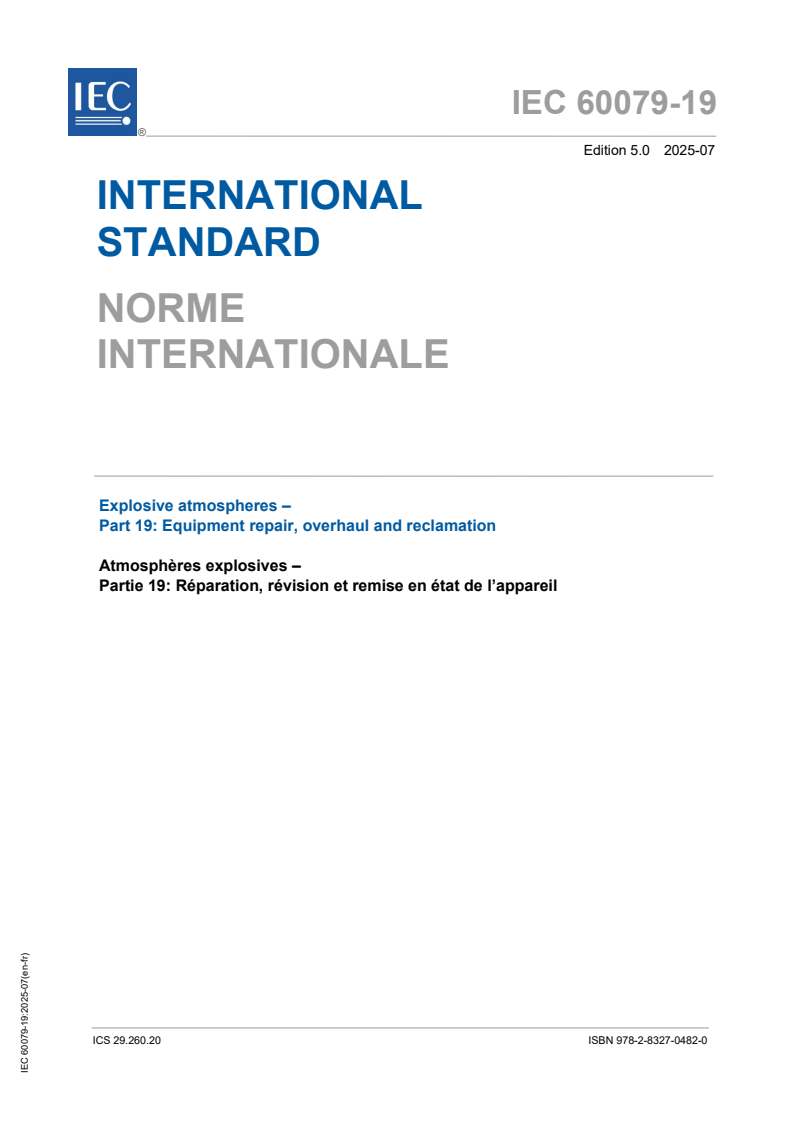
(Main)Explosive atmospheres - Part 19: Equipment repair, overhaul and reclamation
General Information
- Abstract
IEC 60079-19:2025 applies to service facilities and covers only those factors related to overhaul, repair or reclamation of Ex Equipment specifically designed for hazardous areas, where the hazard is caused by explosive atmospheres. Ex Equipment can be overhauled, repaired or reclaimed to mitigate deficiencies identified during operation, inspection and maintenance.
It does not include:
• advice on cable and wiring systems which can require a renewal when the equipment is re-installed;
• Repair or overhaul of Type of Protection “m”;
• Repair or overhaul of Ex Components;
• Requirements for manufacturers who overhaul and repair equipment which they have manufactured
This fifth edition cancels and replaces the fourth edition published in 2019. This edition constitutes a technical revision.
Users of this document are advised that interpretation sheets clarifying the interpretation of this document can be published. Interpretation sheets are available from the IEC webstore and can be found in the “history” tab of the page for each document.
The significance of changes between IEC 60079-19, Edition 5 (2025) and IEC 60079-19, Edition 4 (2019) are as listed in the foreword of this standard.
- Status
- Published
- Publication Date
- 15-Jul-2025
- Technical Committee
- SC 31J - Classification of hazardous areas and installation requirements
- Drafting Committee
- MT 60079-19 - TC 31/SC 31J/MT 60079-19
- Current Stage
- PPUB - Publication issued
- Start Date
- 16-Jul-2025
- Completion Date
- 04-Jul-2025
Buy Documents
IEC 60079-19:2025 - Explosive atmospheres - Part 19: Equipment repair, overhaul and reclamation Released:7/16/2025
IEC 60079-19:2025 - Atmospheres explosives - Partie 19: Réparation, révision et remise en état de l’appareil Released:7/16/2025
IEC 60079-19:2025 - Explosive atmospheres - Part 19: Equipment repair, overhaul and reclamation Released:7/16/2025
Overview
IEC 60079-19:2025 - Explosive atmospheres - Part 19: Equipment repair, overhaul and reclamation - is the fifth edition (2025) of the international guidance for service facilities that overhaul, repair or reclaim Ex Equipment used in hazardous areas where the risk is explosive atmospheres. This edition replaces IEC 60079-19:2019 and constitutes a technical revision. It focuses on service-related factors for mitigating deficiencies found during operation, inspection and maintenance of Ex Equipment and clarifies interpretation through IEC interpretation sheets (available from the IEC webstore).
Key topics and requirements
The standard addresses practical, service-level aspects rather than original design certification. Major topics include:
- General principles and status after repair - guidance on documentation, schedule/related drawings, and evaluation when equipment is repaired to standards or via expert/user evaluation.
- Service facility controls - statutory considerations, quality control of overhaul/repair/reclamation, records, work instructions, markings and documentation.
- Spare parts, temporary repairs and reclamation - procedures for mechanical, electrical winding and electrical machine reclamations, including converter-fed machines and variable speed drives.
- Component- and protection-specific requirements - additional requirements and repair guidance for Types of Protection such as **"d" (flameproof), "i" (intrinsic safety), "p" (pressurized), "e"/"eb" (increased safety), "nA"/"ec", and "t" (protection by enclosures/solid insulation). Topics include enclosures, cable glands, terminations, internal wiring, transformers, printed circuit boards, encapsulated components and breathing/pressurization systems.
- Alterations and modifications - criteria for acceptable alterations, marking of overhauled equipment and instructions for re‑installation.
- Special equipment - auxiliary devices, control equipment, ballasts and enclosed break devices.
Note: IEC 60079-19:2025 does not cover cable/wiring renewal advice on re‑installation, repair/overhaul of Type "m", Ex Components, nor requirements for manufacturers overhauling their own products.
Applications and users
IEC 60079-19:2025 is intended for:
- Service facilities and repair shops working on Ex Equipment from oil & gas, chemical, pharmaceutical, mining and other hazardous industries.
- Maintenance engineers and technicians executing overhauls, reclamations and repairs to maintain safe operation in explosive atmospheres.
- Inspection bodies and plant safety managers who assess post-repair status, documentation and conformity for re‑installation.
- Third‑party assessors and certification bodies referencing service-level controls and records.
Practical benefits include safer re‑installation, preserved explosion protection after repair, consistent documentation and clearer decisions on reclaim versus replace.
Related standards
- IEC 60079 series (explosive atmospheres) - consult other Parts for design, testing and protection types.
- IEC 60079-26 - referenced for equipment covered by that part (see specific clause in this standard).
Keywords: IEC 60079-19:2025, explosive atmospheres, Ex Equipment repair, overhaul, reclamation, hazardous areas, Type of Protection, service facility requirements.
Relations
- Revises
IEC 60079-19:2019 - Explosive atmospheres - Part 19: Equipment repair, overhaul and reclamation - Effective Date
- 05-Sep-2023
Buy Documents
IEC 60079-19:2025 - Explosive atmospheres - Part 19: Equipment repair, overhaul and reclamation Released:7/16/2025
IEC 60079-19:2025 - Atmospheres explosives - Partie 19: Réparation, révision et remise en état de l’appareil Released:7/16/2025
IEC 60079-19:2025 - Explosive atmospheres - Part 19: Equipment repair, overhaul and reclamation Released:7/16/2025
Get Certified
Connect with accredited certification bodies for this standard

IMQ S.p.A. (Certification)
Italian electrical product certification.

SLG Prüf- und Zertifizierungs GmbH
German testing and certification body.

UL Solutions
Global safety science company with testing, inspection and certification.
Sponsored listings
Frequently Asked Questions
IEC 60079-19:2025 is a standard published by the International Electrotechnical Commission (IEC). Its full title is "Explosive atmospheres - Part 19: Equipment repair, overhaul and reclamation". This standard covers: IEC 60079-19:2025 applies to service facilities and covers only those factors related to overhaul, repair or reclamation of Ex Equipment specifically designed for hazardous areas, where the hazard is caused by explosive atmospheres. Ex Equipment can be overhauled, repaired or reclaimed to mitigate deficiencies identified during operation, inspection and maintenance. It does not include: • advice on cable and wiring systems which can require a renewal when the equipment is re-installed; • Repair or overhaul of Type of Protection “m”; • Repair or overhaul of Ex Components; • Requirements for manufacturers who overhaul and repair equipment which they have manufactured This fifth edition cancels and replaces the fourth edition published in 2019. This edition constitutes a technical revision. Users of this document are advised that interpretation sheets clarifying the interpretation of this document can be published. Interpretation sheets are available from the IEC webstore and can be found in the “history” tab of the page for each document. The significance of changes between IEC 60079-19, Edition 5 (2025) and IEC 60079-19, Edition 4 (2019) are as listed in the foreword of this standard.
IEC 60079-19:2025 applies to service facilities and covers only those factors related to overhaul, repair or reclamation of Ex Equipment specifically designed for hazardous areas, where the hazard is caused by explosive atmospheres. Ex Equipment can be overhauled, repaired or reclaimed to mitigate deficiencies identified during operation, inspection and maintenance. It does not include: • advice on cable and wiring systems which can require a renewal when the equipment is re-installed; • Repair or overhaul of Type of Protection “m”; • Repair or overhaul of Ex Components; • Requirements for manufacturers who overhaul and repair equipment which they have manufactured This fifth edition cancels and replaces the fourth edition published in 2019. This edition constitutes a technical revision. Users of this document are advised that interpretation sheets clarifying the interpretation of this document can be published. Interpretation sheets are available from the IEC webstore and can be found in the “history” tab of the page for each document. The significance of changes between IEC 60079-19, Edition 5 (2025) and IEC 60079-19, Edition 4 (2019) are as listed in the foreword of this standard.
IEC 60079-19:2025 is classified under the following ICS (International Classification for Standards) categories: 29.260.20 - Electrical apparatus for explosive atmospheres. The ICS classification helps identify the subject area and facilitates finding related standards.
IEC 60079-19:2025 has the following relationships with other standards: It is inter standard links to IEC 60079-19:2019. Understanding these relationships helps ensure you are using the most current and applicable version of the standard.
IEC 60079-19:2025 is available in PDF format for immediate download after purchase. The document can be added to your cart and obtained through the secure checkout process. Digital delivery ensures instant access to the complete standard document.
Standards Content (Sample)
IEC 60079-19 ®
Edition 5.0 2025-07
INTERNATIONAL
STANDARD
Explosive atmospheres –
Part 19: Equipment repair, overhaul and reclamation
ICS 29.260.20 ISBN 978-2-8327-0482-0
All rights reserved. Unless otherwise specified, no part of this publication may be reproduced or utilized in any form or
by any means, electronic or mechanical, including photocopying and microfilm, without permission in writing from either
IEC or IEC's member National Committee in the country of the requester. If you have any questions about IEC copyright
or have an enquiry about obtaining additional rights to this publication, please contact the address below or your local
IEC member National Committee for further information.
IEC Secretariat Tel.: +41 22 919 02 11
3, rue de Varembé info@iec.ch
CH-1211 Geneva 20 www.iec.ch
Switzerland
About the IEC
The International Electrotechnical Commission (IEC) is the leading global organization that prepares and publishes
International Standards for all electrical, electronic and related technologies.
About IEC publications
The technical content of IEC publications is kept under constant review by the IEC. Please make sure that you have the
latest edition, a corrigendum or an amendment might have been published.
IEC publications search - IEC Products & Services Portal - products.iec.ch
webstore.iec.ch/advsearchform Discover our powerful search engine and read freely all the
The advanced search enables to find IEC publications by a publications previews, graphical symbols and the glossary.
variety of criteria (reference number, text, technical With a subscription you will always have access to up to date
committee, …). It also gives information on projects, content tailored to your needs.
replaced and withdrawn publications.
Electropedia - www.electropedia.org
The world's leading online dictionary on electrotechnology,
IEC Just Published - webstore.iec.ch/justpublished
Stay up to date on all new IEC publications. Just Published containing more than 22 500 terminological entries in English
details all new publications released. Available online and and French, with equivalent terms in 25 additional languages.
once a month by email. Also known as the International Electrotechnical Vocabulary
(IEV) online.
IEC Customer Service Centre - webstore.iec.ch/csc
If you wish to give us your feedback on this publication or
need further assistance, please contact the Customer
Service Centre: sales@iec.ch.
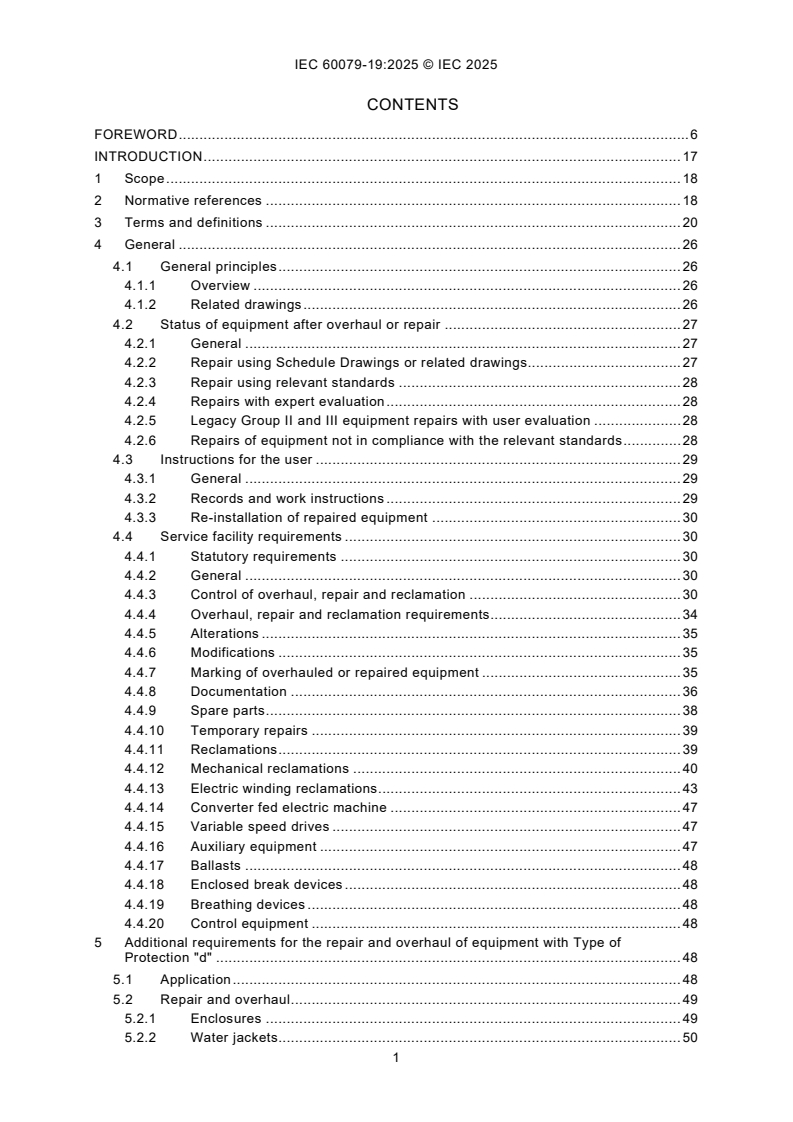
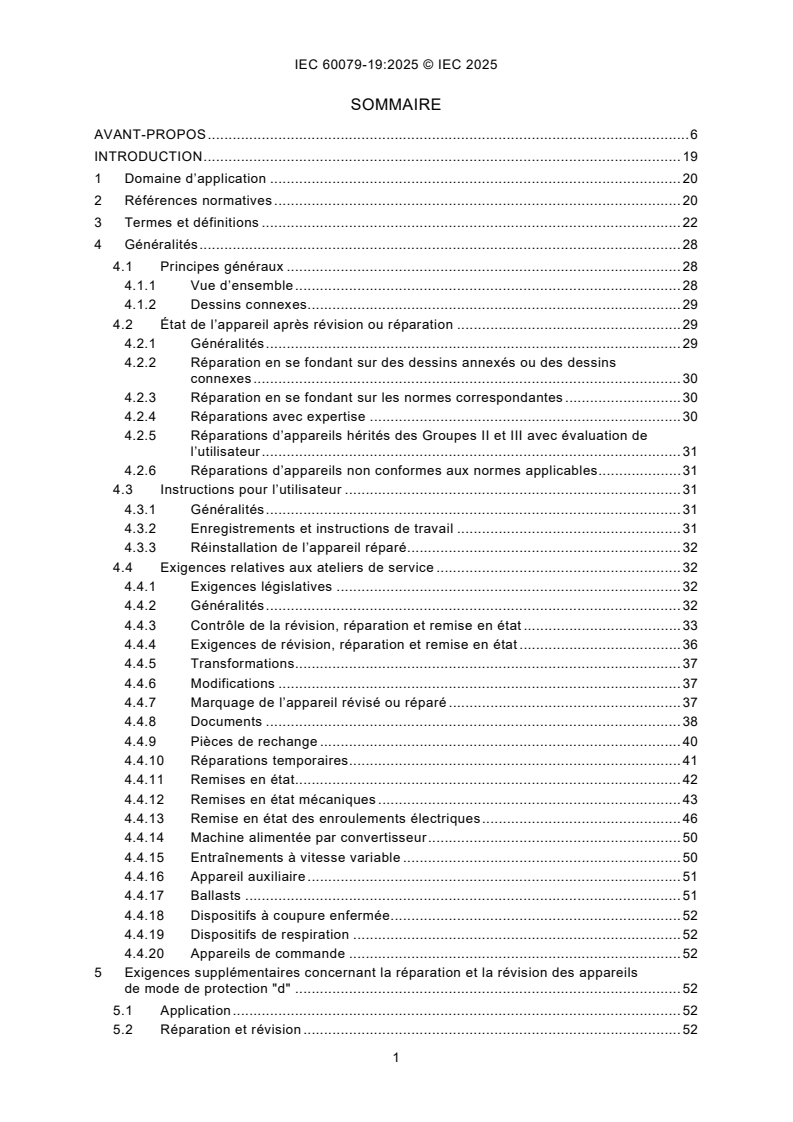
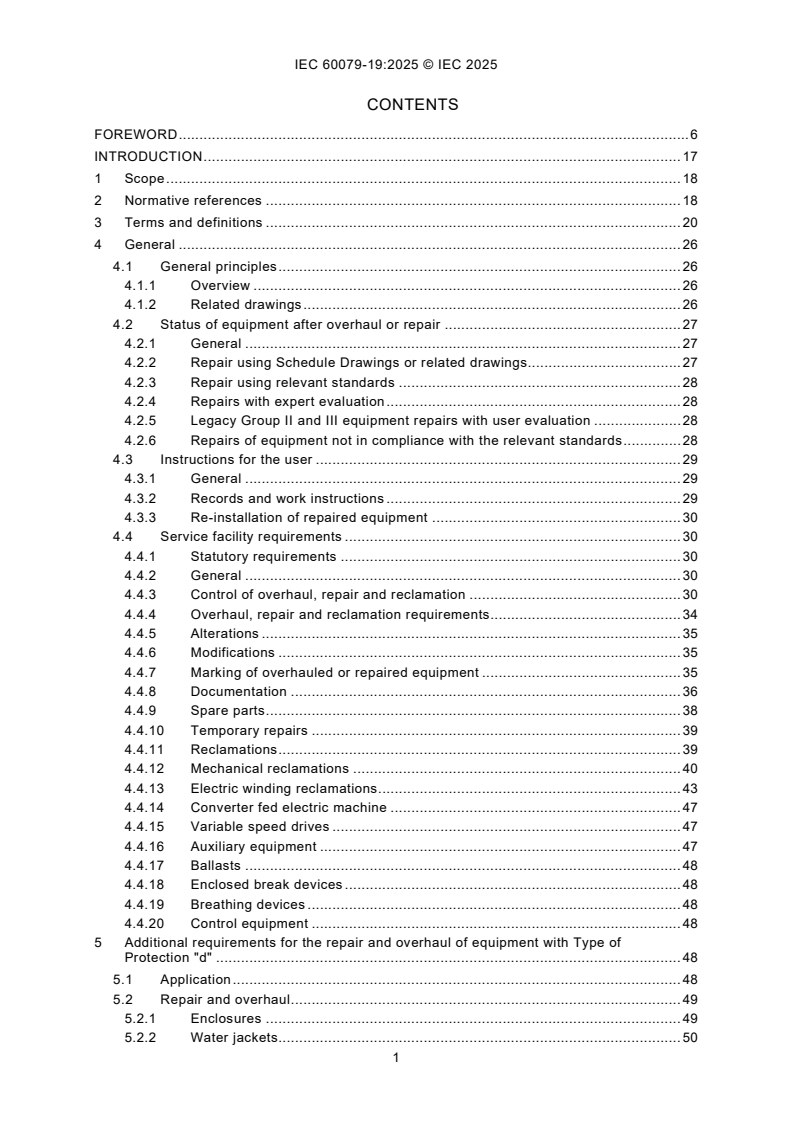
CONTENTS
FOREWORD . 6
INTRODUCTION . 17
1 Scope . 18
2 Normative references . 18
3 Terms and definitions . 20
4 General . 26
4.1 General principles . 26
4.1.1 Overview . 26
4.1.2 Related drawings . 26
4.2 Status of equipment after overhaul or repair . 27
4.2.1 General . 27
4.2.2 Repair using Schedule Drawings or related drawings. 27
4.2.3 Repair using relevant standards . 28
4.2.4 Repairs with expert evaluation . 28
4.2.5 Legacy Group II and III equipment repairs with user evaluation . 28
4.2.6 Repairs of equipment not in compliance with the relevant standards . 28
4.3 Instructions for the user . 29
4.3.1 General . 29
4.3.2 Records and work instructions . 29
4.3.3 Re-installation of repaired equipment . 30
4.4 Service facility requirements . 30
4.4.1 Statutory requirements . 30
4.4.2 General . 30
4.4.3 Control of overhaul, repair and reclamation . 30
4.4.4 Overhaul, repair and reclamation requirements. 34
4.4.5 Alterations . 35
4.4.6 Modifications . 35
4.4.7 Marking of overhauled or repaired equipment . 35
4.4.8 Documentation . 36
4.4.9 Spare parts . 38
4.4.10 Temporary repairs . 39
4.4.11 Reclamations . 39
4.4.12 Mechanical reclamations . 40
4.4.13 Electric winding reclamations . 43
4.4.14 Converter fed electric machine . 47
4.4.15 Variable speed drives . 47
4.4.16 Auxiliary equipment . 47
4.4.17 Ballasts . 48
4.4.18 Enclosed break devices . 48
4.4.19 Breathing devices . 48
4.4.20 Control equipment . 48
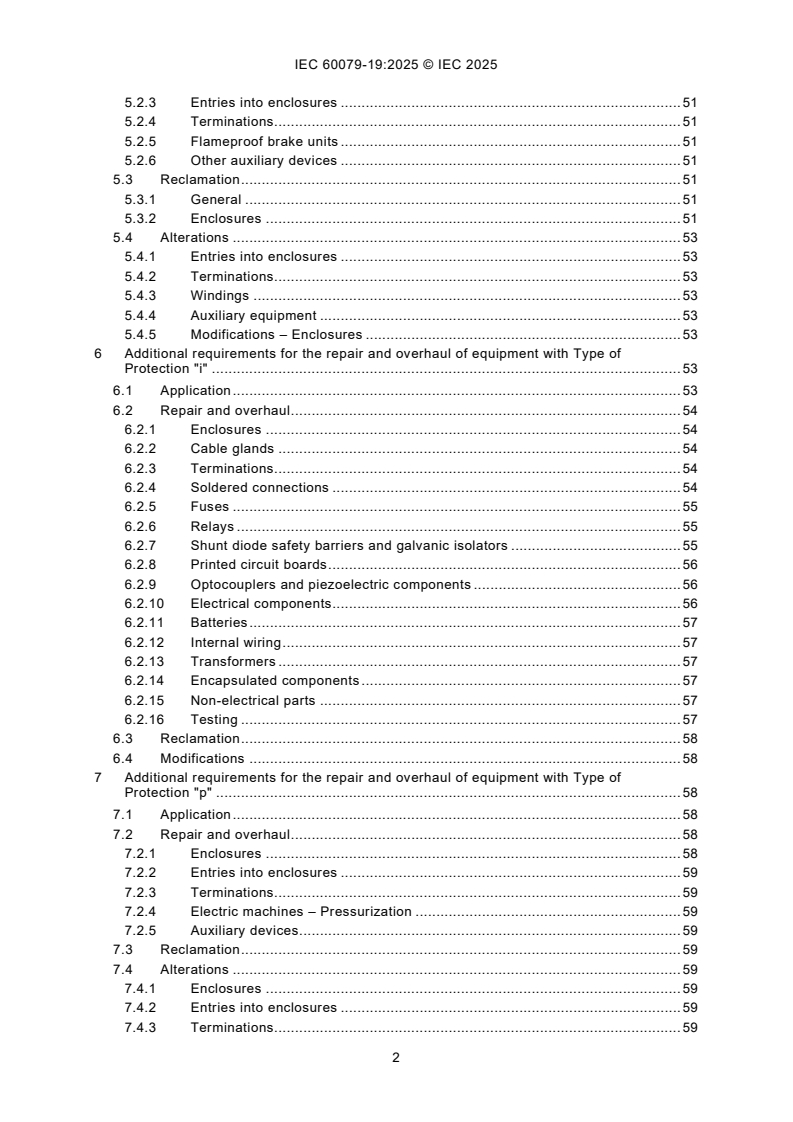
5 Additional requirements for the repair and overhaul of equipment with Type of
Protection "d" . 48
5.1 Application . 48
5.2 Repair and overhaul . 49
5.2.1 Enclosures . 49
5.2.2 Water jackets. 50
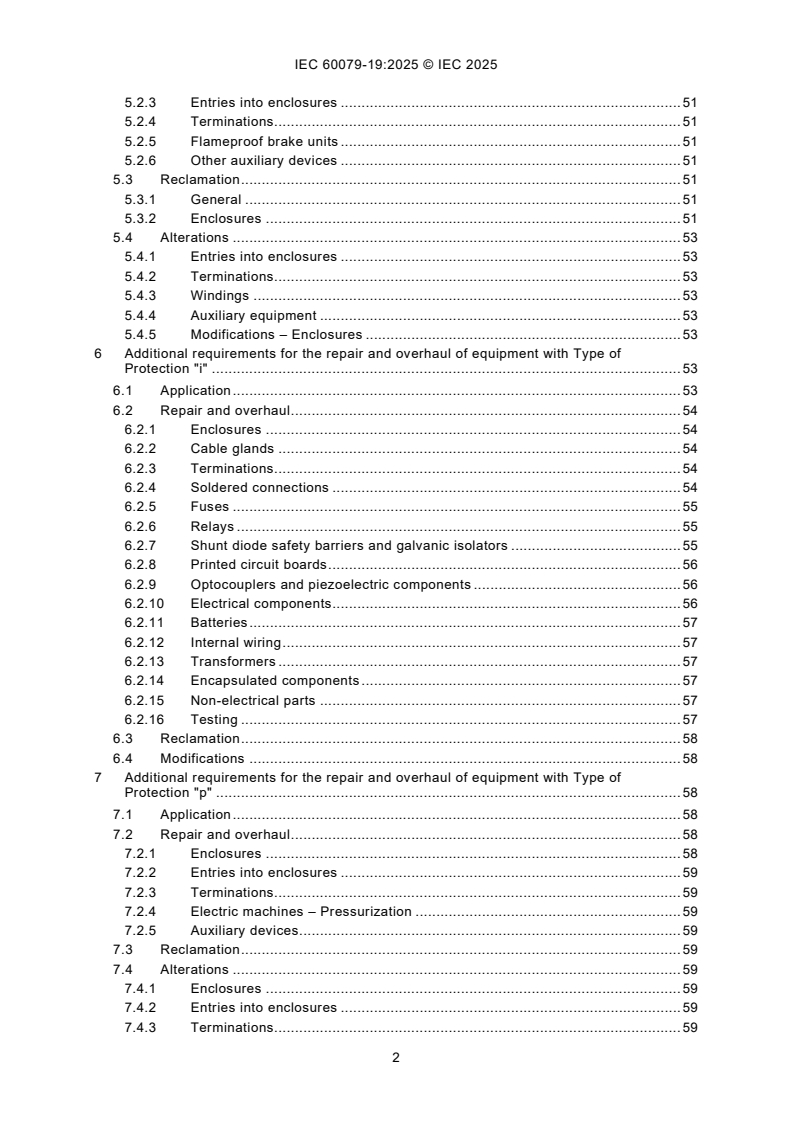
5.2.3 Entries into enclosures . 51
5.2.4 Terminations. 51
5.2.5 Flameproof brake units . 51
5.2.6 Other auxiliary devices . 51
5.3 Reclamation . 51
5.3.1 General . 51
5.3.2 Enclosures . 51
5.4 Alterations . 53
5.4.1 Entries into enclosures . 53
5.4.2 Terminations. 53
5.4.3 Windings . 53
5.4.4 Auxiliary equipment . 53
5.4.5 Modifications – Enclosures . 53
6 Additional requirements for the repair and overhaul of equipment with Type of
Protection "i" . 53
6.1 Application . 53
6.2 Repair and overhaul . 54
6.2.1 Enclosures . 54
6.2.2 Cable glands . 54
6.2.3 Terminations. 54
6.2.4 Soldered connections . 54
6.2.5 Fuses . 55
6.2.6 Relays . 55
6.2.7 Shunt diode safety barriers and galvanic isolators . 55
6.2.8 Printed circuit boards . 56
6.2.9 Optocouplers and piezoelectric components . 56
6.2.10 Electrical components . 56
6.2.11 Batteries . 57
6.2.12 Internal wiring . 57
6.2.13 Transformers . 57
6.2.14 Encapsulated components . 57
6.2.15 Non-electrical parts . 57
6.2.16 Testing . 57
6.3 Reclamation . 58
6.4 Modifications . 58
7 Additional requirements for the repair and overhaul of equipment with Type of
Protection "p" . 58
7.1 Application . 58
7.2 Repair and overhaul . 58
7.2.1 Enclosures . 58
7.2.2 Entries into enclosures . 59
7.2.3 Terminations. 59
7.2.4 Electric machines – Pressurization . 59
7.2.5 Auxiliary devices . 59
7.3 Reclamation . 59
7.4 Alterations . 59
7.4.1 Enclosures . 59
7.4.2 Entries into enclosures . 59
7.4.3 Terminations. 59
7.4.4 Auxiliary equipment . 60
7.5 Modifications . 60
7.6 Pressurization system . 60
8 Additional requirements for the repair and overhaul of equipment with Type of
Protection "e" or Level of Protection "eb" . 60
8.1 Application . 60
8.2 Repair and overhaul . 61
8.2.1 Enclosures . 61
8.2.2 Entries into enclosures . 61
8.2.3 Electric machines . 61
8.2.4 Temperature detectors . 62
8.2.5 Lamps . 62
8.2.6 Lampholders . 62
8.3 Reclamation . 62
8.4 Alterations . 62
8.4.1 Enclosures . 62
8.4.2 Entries into enclosures . 63
8.4.3 Auxiliary equipment . 63
8.5 Modifications . 63
8.5.1 Windings . 63
8.5.2 Terminations. 63
9 Additional requirements for the repair and overhaul of equipment with Type of
Protection "nA" or Level of Protection "ec" . 63
9.1 Application . 63
9.2 Repair and overhaul . 63
9.2.1 Enclosures . 63
9.2.2 Entries into enclosures . 64
9.2.3 Terminations. 64
9.2.4 Electric machines – Repair of windings . 64
9.3 Reclamation . 65
9.4 Alterations and modifications . 65
9.4.1 Enclosures . 65
9.4.2 Entries into enclosures . 65
9.4.3 Terminations. 65
9.4.4 Windings . 65
9.4.5 Auxiliary equipment . 65
10 Additional requirements for the repair and overhaul of equipment covered by
IEC 60079-26 . 66
11 Additional requirements for the repair and overhaul of equipment with Type of
Protection "t" (formerly "tD" or DIP) . 66
11.1 Application . 66
11.2 Repair and overhaul . 66
11.2.1 Enclosures . 66
11.2.2 Entries into enclosures . 67
11.2.3 Terminations. 67
11.2.4 Internal connections . 67
11.2.5 Electric machines . 67
11.3 Reclamation . 67
11.3.1 General . 67
11.3.2 Enclosures . 67
11.3.3 Joints . 67
11.3.4 Shafts and housings . 68
11.4 Alterations and modifications . 68
11.4.1 Enclosures . 68
11.4.2 Entries into enclosures . 68
11.4.3 Windings . 68
11.4.4 Auxiliary equipment . 68
12 Requirements for the repair and overhaul of equipment with Type of Protection "o" . 68
12.1 Application . 68
12.2 Repair and overhaul . 69
12.2.1 Associated Types of Protection . 69
12.2.2 Protective liquid . 69
12.2.3 Replacement of components . 69
12.2.4 Closure of container . 69
12.3 Reclamation . 69
12.4 Modifications . 69
13 Requirements for the repair and overhaul of equipment with Type of Protection "q" . 70
13.1 Application . 70
13.2 Repair and overhaul . 70
13.2.1 Associated Types of Protection . 70
13.2.2 Removal of protective materials . 70
13.2.3 Replacement of components . 70
13.2.4 Preparation for replacing filling material . 70
13.2.5 Filling material . 70
13.2.6 Closure of container . 70
13.3 Reclamation . 70
13.4 Modifications . 71
14 Requirements for the repair and overhaul of equipment with Type of Protection "s" . 71
15 Electrical resistance trace heating . 71
16 Requirements for the overhaul and repair of non-equipment with Type of
Protection "h" . 71
16.1 Application . 71
16.2 Repair and overhaul – Complementary method of ignition protection "c", "b"
and "k" . 71
16.3 Associated protection techniques . 72
16.4 Protective liquid . 72
16.4.1 Removal of protective liquid . 72
16.4.2 Preparation for replacing protective liquid . 72
16.4.3 Replacement protective liquid . 72
16.5 Replacement of components . 72
16.6 Closure of enclosure . 72
16.7 Reclamation . 72
16.8 Alterations . 72
Annex A (normative) Identification of repaired Ex Equipment by marking . 73
A.1 Marking information . 73
A.2 Symbols . 73
A.2.1 Repair Symbols . 73
A.2.2 Repair in accordance with Schedule Drawings or manufacturer's
specification . 73
A.2.3 Type of Protection standards . 74
A.2.4 Repair in accordance with expert evaluation . 74
A.2.5 Legacy Group II and III equipment repairs with user evaluation . 74
A.2.6 Repairs of equipment not in compliance with the relevant standards . 75
Annex B (normative) Knowledge, skills and competence of responsible persons and
operatives . 76
B.1 General . 76
B.2 Knowledge and skills . 76
B.2.1 Responsible persons . 76
B.2.2 Operatives . 76
B.3 Competence . 76
B.3.1 General . 76
B.3.2 Responsible persons . 77
B.3.3 Operatives . 77
B.4 Assessment . 77
B.5 Qualification of reclamation operatives. 77
Annex C (normative) Requirements for measurements in flameproof equipment during
overhaul, repair and reclamation (including guidance on tolerances). 78
Annex D (normative) Quality management system requirements . 81
Annex E (normative) Electric machine copy rewind requirements . 82
Annex F (informative) Additional requirements relating to Ex control equipment . 84
F.1 General . 84
F.2 Common items . 84
F.3 Isolators and circuit interrupters . 84
F.4 Interlocks and mechanical linkages . 85
F.5 Earth fault devices . 85
F.6 Other devices . 85
F.7 Transformers . 85
F.8 Change assessed by a responsible person . 86
Bibliography . 87
Figure 1 – Overhaul, repair and reclamation flow chart . 33
Figure A.1 – Repair marking . 73
Figure C.1 – Determination of maximum gap of reclaimed parts . 80
Table 1 – Pressure Test Requirements . 50
Table C.1 – Determination of maximum gap of reclaimed parts . 79
INTERNATIONAL ELECTROTECHNICAL COMMISSION
____________
Explosive atmospheres -
Part 19: Equipment repair, overhaul and reclamation
FOREWORD
1) The International Electrotechnical Commission (IEC) is a worldwide organization for standardization comprising
all national electrotechnical committees (IEC National Committees). The object of IEC is to promote international
co-operation on all questions concerning standardization in the electrical and electronic fields. To this end and
in addition to other activities, IEC publishes International Standards, Technical Specifications, Technical Reports,
Publicly Available Specifications (PAS) and Guides (hereafter referred to as "IEC Publication(s)"). Their
preparation is entrusted to technical committees; any IEC National Committee interested in the subject dealt with
may participate in this preparatory work. International, governmental and non-governmental organizations liaising
with the IEC also participate in this preparation. IEC collaborates closely with the International Organization for
Standardization (ISO) in accordance with conditions determined by agreement between the two organizations.
2) The formal decisions or agreements of IEC on technical matters express, as nearly as possible, an international
consensus of opinion on the relevant subjects since each technical committee has representation from all
interested IEC National Committees.
3) IEC Publications have the form of recommendations for international use and are accepted by IEC National
Committees in that sense. While all reasonable efforts are made to ensure that the technical content of IEC
Publications is accurate, IEC cannot be held responsible for the way in which they are used or for any
misinterpretation by any end user.
4) In order to promote international uniformity, IEC National Committees undertake to apply IEC Publications
transparently to the maximum extent possible in their national and regional publications. Any divergence between
any IEC Publication and the corresponding national or regional publication shall be clearly indicated in the latter.
5) IEC itself does not provide any attestation of conformity. Independent certification bodies provide conformity
assessment services and, in some areas, access to IEC marks of conformity. IEC is not responsible for any
services carried out by independent certification bodies.
6) All users should ensure that they have the latest edition of this publication.
7) No liability shall attach to IEC or its directors, employees, servants or agents including individual experts and
members of its technical committees and IEC National Committees for any personal injury, property damage or
other damage of any nature whatsoever, whether direct or indirect, or for costs (including legal fees) and
expenses arising out of the publication, use of, or reliance upon, this IEC Publication or any other IEC
Publications.
8) Attention is drawn to the Normative references cited in this publication. Use of the referenced publications is
indispensable for the correct application of this publication.
9) IEC draws attention to the possibility that the implementation of this document may involve the use of (a)
patent(s). IEC takes no position concerning the evidence, validity or applicability of any claimed patent rights in
respect thereof. As of the date of publication of this document, IEC had not received notice of patent(s), which
may be required to implement this document. However, implementers are cautioned that this may not represent
the latest information, which may be obtained from the patent database available at https://patents.iec.ch. IEC
shall not be held responsible for identifying any or all such patent rights.
IEC 60079-19 has been prepared by Subcommittee 31J: Classification of hazardous areas and
installation requirements of IEC Technical Committee 31: Equipment for explosive
atmospheres. It is an International Standard.
This fifth edition cancels and replaces the fourth edition published in 2019. This edition
constitutes a technical revision.
Users of this document are advised that interpretation sheets clarifying the interpretation of this
document can be published. Interpretation sheets are available from the IEC webstore and can
be found in the "history" tab of the page for each document.
The significance of changes between IEC 60079-19, Edition 5 (2025) and IEC 60079-19,
Edition 4 (2019) are as listed below:
Type
Explanation of the significance of changes Clause Minor and Extension Major
editorial technical
changes changes
Reference to IEC 60079 series moved before Introduction X
IEC 60034 series
Scope restructured and reworded to clarify Scope 1 X
of this document and align with other TC31
standards
New bullet point clarifying that Ex Components are 1 X
not repaired
Normative references updated to include all 2 X
standards referenced in the text
For Terms, with this document as the source 3 X
document, as identified in IEC 60050-426:2020 as
426-15-xx the source reference has been omitted
from this document since this document is the
source
New Terms related to certificates, to group related 3.2 X
terms
Term certificate, amended to align with new 3.2.1 X
IEC 60079-0. Former definitions 3.2.1 and 3.2.2
deleted, these are defined in IEC 60079-0, in this
document remaining definitions become 3.2.1 and
3.2.2
Term Schedule Drawing, kept even though it is in 3.2.2 X
IEC 60079-0 to maintain connection with related
drawings
Note 1 added to term related drawings, to assist 3.2.3 X
manufacturers who consider Schedule Drawings
intellectual property not accessible by others
Previous Term 3.27 renumbered and Deprecated 3.6 X
Term dust ignition protection "tD" added with
amended Note 1
Previous 3.7 Term flameproof enclosure "d" 3.8 X
definition updated to current IEV definition
Previous 3.8 Term increased safety "e" definition 3.9 X
updated to forthcoming IEC 60079-7 Ed 6.0
Previous 3.9 renumbered and Source updated 3.10 X
Previous 3.11 with 3.11 X
added
Term non-electrical equipment added 3.14 X
Previous 3.10 renumbered and Term corrected 3.15 X
Previous 3.17 deleted Depreciated Term "pD" 3.19 X
added to 3.19 "p"
New Term 3.21 qualification added 3.20 X
Previous 3.18 renumbered Note deleted now a 3.21 X
Term 3.22
New Term relevant standard added, previously a 3.22 X
Note in 3.18 and 3.19
Previous 3.19 renumbered Note deleted now a 3.23 X
Term 3.22
New Term added Type of Protection "h" 3.27 A1
New Term added for non-electrical Equipment with 3.27.1 A1
method of ignition protection -control of ignition
sources "b"
Type
Explanation of the significance of changes Clause Minor and Extension Major
editorial technical
changes changes
New Term added for non-electrical Equipment with 3.27.2 A1
method of ignition protection -constructional safety
"c"
New Term added for non-electrical Equipment with 3.27.3 A1
method of ignition protection -liquid immersion "k"
Previous Term 3.23 amended to align with 3.32 X
IEC 60079-0 a new Note was added to change
definition when used in IEC 60079-19
Clauses increased from 15 to 16 for new Type of 4.1.1 X
Protection "h" with method of ignition protection
Para. 1
"b", "c" and "k"
Include functional and visual inspection of Ex "m" 4.1.1 X
is the only option to validate the ongoing use of Ex
Para 2
"m"
New paragraph to clarify IEC 60079-19 is used in 4.1.1 X
conjunction with IEC 60079 series and other
Para. 4
relevant standards such as IEC 60034 series.
Clarification of scope requirement
New paragraph related to Ex Components 4.1.1 X
Para. 3
New paragraph clarifying what are the relevant 4.1.1 X
standards
Para. 4
New paragraph clarifying the requirements for use 4.1.1 A2
of related drawings in relation to overhaul and
Para. 5
repair
Clarification of requirement to agree status with 4.1.1 X
user previously in Ed 4, 4.3.2.1 m)
Para. 6
New paragraph clarifying service facility limitations 4.1.1 A3
particularly in relation to control systems and
Para. 7
packages
New subclause clarifying related drawings in 4.1.2 X
relation to overhaul and repair formally Clause
4.3.2.4.1
rd
Previous 4.3.2.4.1 3 paragraph amended now 4.1.2 X
Para. 1
Previous 4.3.2.4.1 list a) – J) clarified and 4.1.2 X
renumbered
a)
New EXAMPLES of relevant information for repair 4.1.2 X
added to previous 4.3.2.4.1 b)
e)
New sub-clause Status of equipment after 4.2 A4
overhaul and repair
New paragraph clarifying status of electrical
4.2.1 A4
equipment after overhaul and repair
Para. 1
New paragraph clarifying status of non-electrical 4.2.1 A4
equipment after overhaul and repair
Para. 2
New paragraph clarifying repair to Schedule 4.2.1 X
Drawings should be first option, repair to
Para. 1
standards is not permitted when Schedule
Drawings are available
New paragraph providing similar guidance for 4.2.1 X
repair of non-electrical equipment
Para. 2
Type
Explanation of the significance of changes Clause Minor and Extension Major
editorial technical
changes changes
NOTE 2 in former Ed 4, Clause 4.1 moved to 4.2.1 4.2.1 X
NOTE
New subclause clarifying status of repair to 4.2.2 X
Schedule Drawings or related drawings, previously
4.1, 4.3.2.6 a) and A 2.1
New subclause clarifying status of repair to 4.2.3 X
relevant standards, previously 4.1, 4.3.2.4 2 g),
4.3.2.6 b), A2.2 a)
New subclause clarifying status repair to repairs X
with expert evaluation previously 4.1, 4.3.2.6 d), 4.2.4
A.2.2 b)
New subclause clarifying service facility 4.2.5 A5
involvement in fitness for purpose evaluations for
legacy equipment by the used under IEC 60079-17
New subclause clarifying status of equipment not 4.2.6 X
in compliance with the relevant standards,
previously 4.1, 4.3.2.6 c), A2.3
The equipment user, changed to, the user of Ex 4.3.1 X
Equipment
Para. 1
Note from previous 4.2.4 moved to 4.3.1 X
Note 2
Minor editorial changes to content moving 4.3.2 X
requirements from previous 4.3.2.4.1 into new
4.3.2
Previous 4.2.3 reference standard IEC 60079-14 4.3.3 X
corrected to IEC 60079-17
Previous 4.3.2 title changed to "Service facility
4.4 X
requirements" to clarify purpose
Previous 4.3.1 Statutory requirements clause 4.4.1 X
renumbered
Restructure clause. Edition 4 C, 4.3.2 Repair and 4.4.2 X
st
overhaul, renamed, 4.4.2 General adding 1
paragraph from Edition 4, 4.3.2.4.1
Schedule of QMS requirements in previous 4.3.2.1 4.4.2 X
b)-f), h)-k), p) moved to new Annex D
Para. 2
st
Previous 4.3.2.1 l) 1 part – facilities and 4.4.2 X
equipment now new paragraph
Para 3
Re-introduce "-and follows good engineering 4.4.2 X
practices" this was removed in Ed 4 but required
Para. 3
in this edition for non-electrical equipment
reclamations
nd
Previous 4.3.2.1 l) 2 part – trained personnel 4.4.3.1 X
now new subclause
st
Previous 4.3.2.1 1 para edited is now 4.4.2 X
Paras. 1 and 2
Previous 4.3.2.4.1 first 2 paragraphs moved into 4.4.2 X
new clause General
Paras. 4 and 6
Previous 4.3.2 now new subclause Control of 4.4.3 X
overhaul, repair and reclamation
Previous 4.3.2.2 now new subclause and clarified 4.4.3.1 X
Para. 1
Type
Explanation of the significance of changes Clause Minor and Extension Major
editorial technical
changes changes
Last paragraph from B.4 moved to Competence 4.4.3.1 X
clause
Paras. 2 and 3
New sub-clause Responsible person, to clarify 4.4.3.2 X
requirements previously in 4.3.2.1 a) and
elsewhere
Clarification of need for responsible person at 4.4.3.2 X
each service facility site
Two new paragraphs clarifying delegation to other 4.4.3.2 X
responsible persons and holiday and sickness
coverage
Clear statement clarifying situation where there is 4.4.3.2 X
no responsible person at a service facility site
New subclause Duties and responsibilities of the 4.4.3.3 X
Responsible Person, in previous editions these
were implied but now clarified
rd
4.4.3.3 X
Previous 4.3.2.1 o) 3 sentence now
Para. 2
Previous 4.3.2.1 General, now new subclause, 4.4.4 X
Overhaul, repair and reclamation requirements
New paragraph introducing the Overhaul & Repair 4.4.4 X
flow chart which also identifies where the
Para. 1
responsible persons participation is required
New flow chart to clarify overhaul, repair and Figure 1 A6
reclamation process which also identifies when the
responsible person has to be involved in reviews
or decisions
Previous 4.3.2.1.n) reworded and new reference to
4.4.4 X
manufacturer's instructions for non-electrical
Para. 2
equipment
Previous 4.3.2.1.m) with clarification of 4.4.4 X
requirement
Para. 3
st rd
4.4.4 X
Previous 4.3.2.1.o) 1 sentence now 3 para. of
4.4.4
Para. 4
nd
4.4.4 X
Previous 4.3.2.1.n) 2 sentence amened to clarify
only electrical tests can be omitted
Para. 5
New paragraph clarifying requirements for Ingress 4.4.4 X
Protection gaskets
Para. 6
Previous 4.3.2.3 Repair of components, moved 4.4.4 X
into new subclause Overhaul, repair and
Para. 7
reclamation, with clarification of requirements
st
4.4.4 X
Previous 4.3.2.6 1 paragraph now
Para. 8
New paragraph clarifying OEM label 4.4.4 X
Para. 9
New paragraph to raise awareness of paint finish 4.4.4 X
change possible static charge effects
Para. 10
Previous Clause 4.3.4 Alteration and modification 4.4.5 X
separated into 2 subclauses
4.4.6
Previous clause 4.3.2.6 renumbered and text 4.4.7 X
references amended
Type
Explanation of the significance of changes Clause Minor and Extension Major
editorial technical
changes changes
New paragraphs added to clarify requirements for 4.4.7 X
replacement of manufacturers nameplates
Paras. 1 and 2
Previous 4.3.2.6 numbered list clarified to align 4.4.7 X
with new subclause 4.2 Status of equipment after
a)
overhau
...
IEC 60079-19 ®
Edition 5.0 2025-07
NORME
INTERNATIONALE
Atmosphères explosives –
Partie 19: Réparation, révision et remise en état de l’appareil
ICS 29.260.20 ISBN 978-2-8327-0482-0
Droits de reproduction réservés. Sauf indication contraire, aucune partie de cette publication ne peut être reproduite ni
utilisée sous quelque forme que ce soit et par aucun procédé, électronique ou mécanique, y compris la photocopie et
les microfilms, sans l'accord écrit de l'IEC ou du Comité national de l'IEC du pays du demandeur. Si vous avez des
questions sur le copyright de l'IEC ou si vous désirez obtenir des droits supplémentaires sur cette publication, utilisez
les coordonnées ci-après ou contactez le Comité national de l'IEC de votre pays de résidence.
IEC Secretariat Tel.: +41 22 919 02 11
3, rue de Varembé info@iec.ch
CH-1211 Geneva 20 www.iec.ch
Switzerland
A propos de l'IEC
La Commission Electrotechnique Internationale (IEC) est la première organisation mondiale qui élabore et publie des
Normes internationales pour tout ce qui a trait à l'électricité, à l'électronique et aux technologies apparentées.
A propos des publications IEC
Le contenu technique des publications IEC est constamment revu. Veuillez vous assurer que vous possédez l’édition la
plus récente, un corrigendum ou amendement peut avoir été publié.
Recherche de publications IEC - IEC Products & Services Portal - products.iec.ch
webstore.iec.ch/advsearchform Découvrez notre puissant moteur de recherche et consultez
La recherche avancée permet de trouver des publications gratuitement tous les aperçus des publications, symboles
IEC en utilisant différents critères (numéro de référence, graphiques et le glossaire. Avec un abonnement, vous aurez
texte, comité d’études, …). Elle donne aussi des toujours accès à un contenu à jour adapté à vos besoins.
informations sur les projets et les publications remplacées
ou retirées. Electropedia - www.electropedia.org
Le premier dictionnaire d'électrotechnologie en ligne au
IEC Just Published - webstore.iec.ch/justpublished monde, avec plus de 22 500 articles terminologiques en
Restez informé sur les nouvelles publications IEC. Just anglais et en français, ainsi que les termes équivalents
dans 25 langues additionnelles. Egalement appelé
Published détaille les nouvelles publications parues.
Disponible en ligne et une fois par mois par email. Vocabulaire Electrotechnique International (IEV) en ligne.
Service Clients - webstore.iec.ch/csc
Si vous désirez nous donner des commentaires sur cette
publication ou si vous avez des questions contactez-
nous: sales@iec.ch.
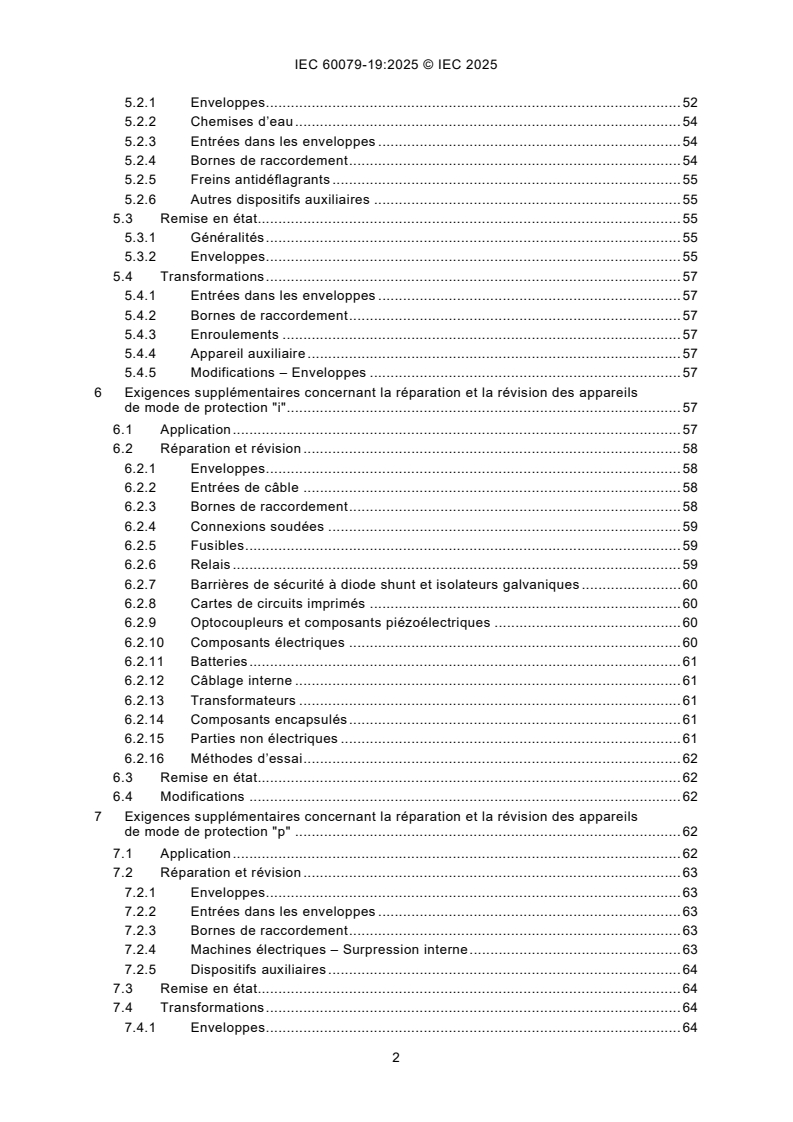
SOMMAIRE
AVANT-PROPOS . 6
INTRODUCTION . 19
1 Domaine d’application . 20
2 Références normatives . 20
3 Termes et définitions . 22
4 Généralités . 28
4.1 Principes généraux . 28
4.1.1 Vue d’ensemble . 28
4.1.2 Dessins connexes. 29
4.2 État de l’appareil après révision ou réparation . 29
4.2.1 Généralités . 29
4.2.2 Réparation en se fondant sur des dessins annexés ou des dessins
connexes . 30
4.2.3 Réparation en se fondant sur les normes correspondantes . 30
4.2.4 Réparations avec expertise . 30
4.2.5 Réparations d’appareils hérités des Groupes II et III avec évaluation de
l’utilisateur . 31
4.2.6 Réparations d’appareils non conformes aux normes applicables . 31
4.3 Instructions pour l’utilisateur . 31
4.3.1 Généralités . 31
4.3.2 Enregistrements et instructions de travail . 31
4.3.3 Réinstallation de l’appareil réparé. 32
4.4 Exigences relatives aux ateliers de service . 32
4.4.1 Exigences législatives . 32
4.4.2 Généralités . 32
4.4.3 Contrôle de la révision, réparation et remise en état . 33
4.4.4 Exigences de révision, réparation et remise en état . 36
4.4.5 Transformations. 37
4.4.6 Modifications . 37
4.4.7 Marquage de l’appareil révisé ou réparé . 37
4.4.8 Documents . 38
4.4.9 Pièces de rechange . 40
4.4.10 Réparations temporaires . 41
4.4.11 Remises en état. 42
4.4.12 Remises en état mécaniques . 43
4.4.13 Remise en état des enroulements électriques . 46
4.4.14 Machine alimentée par convertisseur . 50
4.4.15 Entraînements à vitesse variable . 50
4.4.16 Appareil auxiliaire . 51
4.4.17 Ballasts . 51
4.4.18 Dispositifs à coupure enfermée . 52
4.4.19 Dispositifs de respiration . 52
4.4.20 Appareils de commande . 52
5 Exigences supplémentaires concernant la réparation et la révision des appareils
de mode de protection "d" . 52
5.1 Application . 52
5.2 Réparation et révision . 52
5.2.1 Enveloppes . 52
5.2.2 Chemises d’eau . 54
5.2.3 Entrées dans les enveloppes . 54
5.2.4 Bornes de raccordement . 54
5.2.5 Freins antidéflagrants . 55
5.2.6 Autres dispositifs auxiliaires . 55
5.3 Remise en état. 55
5.3.1 Généralités . 55
5.3.2 Enveloppes . 55
5.4 Transformations . 57
5.4.1 Entrées dans les enveloppes . 57
5.4.2 Bornes de raccordement . 57
5.4.3 Enroulements . 57
5.4.4 Appareil auxiliaire . 57
5.4.5 Modifications – Enveloppes . 57
6 Exigences supplémentaires concernant la réparation et la révision des appareils
de mode de protection "i" . 57
6.1 Application . 57
6.2 Réparation et révision . 58
6.2.1 Enveloppes . 58
6.2.2 Entrées de câble . 58
6.2.3 Bornes de raccordement . 58
6.2.4 Connexions soudées . 59
6.2.5 Fusibles . 59
6.2.6 Relais . 59
6.2.7 Barrières de sécurité à diode shunt et isolateurs galvaniques . 60
6.2.8 Cartes de circuits imprimés . 60
6.2.9 Optocoupleurs et composants piézoélectriques . 60
6.2.10 Composants électriques . 60
6.2.11 Batteries . 61
6.2.12 Câblage interne . 61
6.2.13 Transformateurs . 61
6.2.14 Composants encapsulés . 61
6.2.15 Parties non électriques . 61
6.2.16 Méthodes d’essai . 62
6.3 Remise en état. 62
6.4 Modifications . 62
7 Exigences supplémentaires concernant la réparation et la révision des appareils
de mode de protection "p" . 62
7.1 Application . 62
7.2 Réparation et révision . 63
7.2.1 Enveloppes . 63
7.2.2 Entrées dans les enveloppes . 63
7.2.3 Bornes de raccordement . 63
7.2.4 Machines électriques – Surpression interne . 63
7.2.5 Dispositifs auxiliaires . 64
7.3 Remise en état. 64
7.4 Transformations . 64
7.4.1 Enveloppes . 64
7.4.2 Entrées dans les enveloppes . 64
7.4.3 Bornes de raccordement . 64
7.4.4 Appareil auxiliaire . 64
7.5 Modifications . 64
7.6 Système de surpression interne . 64
8 Exigences supplémentaires concernant la réparation et la révision des appareils
de mode de protection "e" ou de niveau de protection "eb" . 65
8.1 Application . 65
8.2 Réparation et révision . 65
8.2.1 Enveloppes . 65
8.2.2 Entrées dans les enveloppes . 66
8.2.3 Machines électriques . 66
8.2.4 Détecteurs de température . 67
8.2.5 Lampes . 67
8.2.6 Douilles . 67
8.3 Remise en état. 67
8.4 Transformations . 67
8.4.1 Enveloppes . 67
8.4.2 Entrées dans les enveloppes . 67
8.4.3 Appareil auxiliaire . 67
8.5 Modifications . 67
8.5.1 Enroulements . 67
8.5.2 Bornes de raccordement . 68
9 Exigences supplémentaires concernant la réparation et la révision des appareils
de mode de protection "nA" ou de niveau de protection "ec" . 68
9.1 Application . 68
9.2 Réparation et révision . 68
9.2.1 Enveloppes . 68
9.2.2 Entrées dans les enveloppes . 69
9.2.3 Bornes de raccordement . 69
9.2.4 Machines électriques – Réparation des enroulements . 69
9.3 Remise en état. 70
9.4 Transformations et modifications . 70
9.4.1 Enveloppes . 70
9.4.2 Entrées dans les enveloppes . 70
9.4.3 Bornes de raccordement . 70
9.4.4 Enroulements . 70
9.4.5 Appareil auxiliaire . 70
10 Exigences supplémentaires concernant la réparation et la révision des appareils
conformément à l’IEC 60079-26 . 71
11 Exigences supplémentaires concernant la réparation et la révision des appareils
de mode de protection "t" (précédemment "tD" ou DIP) . 71
11.1 Application . 71
11.2 Réparation et révision . 71
11.2.1 Enveloppes . 71
11.2.2 Entrées dans les enveloppes . 72
11.2.3 Bornes de raccordement . 72
11.2.4 Connexions internes . 72
11.2.5 Machines électriques . 72
11.3 Remise en état. 72
11.3.1 Généralités . 72
11.3.2 Enveloppes . 72
11.3.3 Joints . 73
11.3.4 Arbres et logements . 73
11.4 Transformations et modifications . 73
11.4.1 Enveloppes . 73
11.4.2 Entrées dans les enveloppes . 73
11.4.3 Enroulements . 73
11.4.4 Appareil auxiliaire . 73
12 Exigences concernant la réparation et la révision des appareils de mode de
protection "o" . 74
12.1 Application . 74
12.2 Réparation et révision . 74
12.2.1 Modes de protection associés . 74
12.2.2 Liquide de protection . 74
12.2.3 Remplacement des composants . 74
12.2.4 Fermeture du conteneur . 75
12.3 Remise en état. 75
12.4 Modifications . 75
13 Exigences concernant la réparation et la révision des appareils de mode de
protection "q" . 75
13.1 Application . 75
13.2 Réparation et révision . 75
13.2.1 Modes de Protection associés . 75
13.2.2 Retrait des matériaux de protection . 75
13.2.3 Remplacement des composants . 76
13.2.4 Préparation au remplacement des matériaux de remplissage . 76
13.2.5 Matériau de remplissage . 76
13.2.6 Fermeture du conteneur . 76
13.3 Remise en état. 76
13.4 Modifications . 76
14 Exigences concernant la réparation et la révision des appareils de mode de
protection "s" . 76
15 Traçage par résistance électrique . 76
16 Exigences concernant la réparation et la révision des appareils de mode de
protection "h" . 77
16.1 Application . 77
16.2 Réparation et révision – Méthode complémentaire de protection contre
l’inflammation "c", "b" et "k" . 77
16.3 Techniques de protection associées . 77
16.4 Liquide de protection . 77
16.4.1 Retrait du liquide de protection . 77
16.4.2 Préparation au remplacement du liquide de protection . 77
16.4.3 Liquide de protection de remplacement . 78
16.5 Remplacement des composants . 78
16.6 Fermeture de l’enveloppe . 78
16.7 Remise en état. 78
16.8 Transformations . 78
Annexe A (normative) Identification d’un appareil Ex réparé par un marquage . 79
A.1 Informations relatives au marquage . 79
A.2 Symboles . 79
A.2.1 Symboles de réparation . 79
A.2.2 Réparation conforme aux dessins annexés ou aux spécifications du
fabricant . 80
A.2.3 Normes de mode de protection . 80
A.2.4 Réparation selon expertise . 80
A.2.5 Réparations d’appareils hérités des Groupes II et III avec évaluation de
l’utilisateur . 80
A.2.6 Réparations d’appareils non conformes aux normes applicables . 81
Annexe B (normative) Connaissances, savoir-faire et compétence des personnes
responsables et des opérateurs . 82
B.1 Généralités . 82
B.2 Connaissances et savoir-faire . 82
B.2.1 Personnes responsables . 82
B.2.2 Opérateurs . 82
B.3 Compétence . 83
B.3.1 Généralités . 83
B.3.2 Personnes responsables . 83
B.3.3 Opérateurs . 83
B.4 Évaluation . 83
B.5 Qualification des opérateurs de remise en état . 83
Annexe C (normative) Exigences relatives aux mesurages des appareils
antidéflagrants pendant la révision, la réparation et la remise en état (y compris des
recommandations concernant les tolérances) . 84
Annexe D (normative) Exigences relatives au système de management de la qualité . 87
Annexe E (normative) Exigences concernant le rebobinage conforme des machines
électriques . 89
Annexe F (informative) Exigences supplémentaires relatives aux appareils de
commande Ex . 91
F.1 Généralités . 91
F.2 Éléments communs . 91
F.3 Isolateurs et interrupteurs de circuits . 91
F.4 Verrouillage et liaisons mécaniques . 92
F.5 Dispositifs de détection de défauts à la terre . 92
F.6 Autres dispositifs . 92
F.7 Transformateurs . 93
F.8 Modification évaluée par une personne responsable . 93
Bibliographie . 94
Figure 1 – Organigramme de révision, réparation et remise en état . 35
Figure A.1 – Marquage de réparation . 79
Figure C.1 – Détermination de l’interstice maximal des parties remises en état. 86
Tableau 1 – Exigences des essais de pression . 53
Tableau C.1 – Détermination de l’interstice maximal des parties remises en état . 85
COMMISSION ÉLECTROTECHNIQUE INTERNATIONALE
____________
Atmosphères explosives -
Partie 19: Réparation, révision et remise en état de l’appareil
AVANT-PROPOS
1) La Commission Électrotechnique Internationale (IEC) est une organisation mondiale de normalisation composée
de l’ensemble des comités électrotechniques nationaux (Comités nationaux de l’IEC). L’IEC a pour objet de
favoriser la coopération internationale pour toutes les questions de normalisation dans les domaines de
l’électricité et de l’électronique. À cet effet, l’IEC – entre autres activités – publie des Normes internationales,
des Spécifications techniques, des Rapports techniques, des Spécifications accessibles au public (PAS) et des
Guides (ci-après dénommés "Publication(s) de l’IEC"). Leur élaboration est confiée à des comités d’études,
aux travaux desquels tout Comité national intéressé par le sujet traité peut participer. Les organisations
internationales, gouvernementales et non gouvernementales, en liaison avec l’IEC, participent également aux
travaux. L’IEC collabore étroitement avec l’Organisation Internationale de Normalisation (ISO), selon des
conditions fixées par accord entre les deux organisations.
2) Les décisions ou accords officiels de l’IEC concernant les questions techniques représentent, dans la mesure du
possible, un accord international sur les sujets étudiés, étant donné que les Comités nationaux de l’IEC intéressés
sont représentés dans chaque comité d’études.
3) Les Publications de l’IEC se présentent sous la forme de recommandations internationales et sont agréées
comme telles par les Comités nationaux de l’IEC. Tous les efforts raisonnables sont entrepris afin que l’IEC
s’assure de l’exactitude du contenu technique de ses publications; l’IEC ne peut pas être tenue responsable de
l’éventuelle mauvaise utilisation ou interprétation qui en est faite par un quelconque utilisateur final.
4) Dans le but d’encourager l’uniformité internationale, les Comités nationaux de l’IEC s’engagent, dans toute la
mesure possible, à appliquer de façon transparente les Publications de l’IEC dans leurs publications nationales
et régionales. Toutes divergences entre toutes Publications de l’IEC et toutes publications nationales ou
régionales correspondantes doivent être indiquées en termes clairs dans ces dernières.
5) L’IEC elle-même ne fournit aucune attestation de conformité. Des organismes de certification indépendants
fournissent des services d’évaluation de conformité et, dans certains secteurs, accèdent aux marques de
conformité de l’IEC. L’IEC n’est responsable d’aucun des services effectués par les organismes de certification
indépendants.
6) Tous les utilisateurs doivent s’assurer qu’ils sont en possession de la dernière édition de cette publication.
7) Aucune responsabilité ne doit être imputée à l’IEC, à ses administrateurs, employés, auxiliaires ou mandataires,
y compris ses experts particuliers et les membres de ses comités d’études et des Comités nationaux de l’IEC,
pour tout préjudice causé en cas de dommages corporels et matériels, ou de tout autre dommage de quelque
nature que ce soit, directe ou indirecte, ou pour supporter les coûts (y compris les frais de justice) et les dépenses
découlant de la publication ou de l’utilisation de cette Publication de l’IEC ou de toute autre Publication de l’IEC,
ou au crédit qui lui est accordé.
8) L’attention est attirée sur les références normatives citées dans cette publication. L’utilisation de publications
référencées est obligatoire pour une application correcte de la présente publication.
9) L’IEC attire l’attention sur le fait que la mise en application du présent document peut entraîner l’utilisation d’un
ou de plusieurs brevets. L’IEC ne prend pas position quant à la preuve, à la validité et à l’applicabilité de tout
droit de brevet revendiqué à cet égard. À la date de publication du présent document, l’IEC n’avait pas reçu
notification qu’un ou plusieurs brevets pouvaient être nécessaires à sa mise en application. Toutefois, il y a lieu
d’avertir les responsables de la mise en application du présent document que des informations plus récentes
sont susceptibles de figurer dans la base de données de brevets, disponible à l’adresse https://patents.iec.ch.
L’IEC ne saurait être tenue pour responsable de ne pas avoir identifié de tels droits de brevet.
L’IEC 60079-19 a été établie par le sous-comité 31J: Classification des emplacements
dangereux et règles d’installation du comité d’études 31 de l’IEC: Équipements pour
atmosphères explosives. Il s’agit d’une Norme internationale.
Cette cinquième édition annule et remplace la quatrième édition parue en 2019. Cette édition
constitue une révision technique.
Les utilisateurs du présent document sont informés que des feuilles d’interprétation clarifiant
l’interprétation de ce dernier peuvent être publiées. Ces feuilles d’interprétation sont
disponibles sur le webstore de l’IEC, dans l’onglet "History" de la page de chaque document.
L’importance des modifications entre l’IEC 60079-19, Édition 5 (2025), et l’IEC 60079-19,
Édition 4 (2019), est indiquée ci-dessous:
Type
Explication de l’importance des Paragraphe Modifications Extension Modifications
modifications mineures et techniques
rédactionnelles majeures
Référence à la série IEC 60079 déplacée Introduction X
avant la série IEC 60034
Le domaine d’application a été restructuré et 1 X
reformulé afin de clarifier le domaine
d’application du présent document et de
l’aligner sur les autres normes du TC31.
Nouvelle puce précisant que les composants 1 X
Ex ne sont pas réparés.
Actualisation des références normatives, afin 2 X
d’y inclure toutes les normes citées en
référence dans le texte.
Pour les termes, lorsque le présent document 3 X
constitue le document source, tel qu’identifié
dans l’IEC 60050-426:2020 sous la référence
426-15-xx, la référence à la source a été
omise dans le présent document, puisqu’il en
est lui-même la source.
Ajout d’un nouveau groupe de termes relatifs 3.2 X
aux certificats.
Modification du terme "certificat" pour 3.2.1 X
s’aligner sur la nouvelle IEC 60079-0. Les
anciennes définitions 3.2.1 et 3.2.2 sont
supprimées, car elles sont définies dans
l’IEC 60079-0. Dans le présent document, les
définitions restantes deviennent 3.2.1 et
3.2.2.
Conservation du terme "dessin annexé", 3.2.2 X
même s’il figure dans l’IEC 60079-0, afin de
maintenir le lien avec le terme "dessin
connexe".
Note 1 ajoutée au terme dessin connexe pour 3.2.3 X
aider les fabricants qui considèrent que les
dessins annexés sont une propriété
intellectuelle non accessible à d’autres
personnes.
L’ancien terme 3.27 a été renuméroté et le
3.6 X
terme déconseillé "protection contre
l’inflammation de poussières "tD"" a été
ajouté, avec modification de la Note 1.
La définition de l’ancien terme 3.7 "enveloppe 3.8 X
antidéflagrante "d"" a été mise à jour par
rapport à la définition IEV.
La définition de l’ancien terme 3.8 "sécurité 3.9 X
augmentée "e"" a été mise à jour en fonction
de l’Édition 6.0 à paraître de l’IEC 60079-7.
L’ancien 3.9 a été renuméroté et la source a 3.10 X
été mise à jour.
La mention a 3.11 X
été ajoutée à l’ancien 3.11
Le terme "appareil non électrique" a été 3.14 X
ajouté.
L’ancien 3.10 a été renuméroté et le terme a 3.15 X
été corrigé.
L’ancien 3.17 a été supprimé, le terme 3.19 X
déconseillé "pD" a été ajouté au terme "p"
dans le paragraphe 3.19
Type
Explication de l’importance des Paragraphe Modifications Extension Modifications
modifications mineures et techniques
rédactionnelles majeures
Le nouveau terme 3.21 "qualification 3.20 X
" a été ajouté.
L’ancien 3.18 a été renuméroté. La note a été 3.21 X
supprimée et constitue désormais le
terme 3.22.
Le nouveau terme "norme correspondante" a 3.22 X
été ajouté, qui constituait précédemment une
note dans les paragraphes 3.18 et 3.19.
L’ancien 3.19 a été renuméroté. La note a été 3.23 X
supprimée et constitue désormais le
terme 3.22.
Le nouveau terme "mode de protection "h"" a 3.27 A1
été ajouté.
Un nouveau terme a été ajouté pour les 3.27.1 A1
appareils non électriques, avec la méthode de
protection contre l’inflammation dite de
commande de la source d’inflammation "b".
Un nouveau terme a été ajouté pour les 3.27.2 A1
appareils non électriques, avec la méthode de
protection contre l’inflammation dite de
sécurité de construction "c".
Un nouveau terme a été ajouté pour les 3.27.3 A1
appareils non électriques, avec la méthode de
protection contre l’inflammation dite
d’immersion dans le liquide "k".
L’ancien terme 3.23 a été modifié pour 3.32 X
s’aligner sur l’IEC 60079-0. Une nouvelle note
a été ajoutée pour modifier la définition
lorsqu’elle est utilisée dans l’IEC 60079-19.
L’article correspondant au mode de protection 4.1.1 X
"h" est passé du numéro 15 au 16, avec les
Para 1
méthodes de protection contre l’inflammation
"b", "c" et "k".
Le passage "l’inspection fonctionnelle et 4.1.1 X
visuelle de l’appareil Ex "m" est la seule
Para. 2
option pour valider l’utilisation continue de
l’appareil Ex "m"" a été ajouté.
Nouvel alinéa clarifiant que l’IEC 60079-19 4.1.1 X
est utilisée en conjonction avec la série
Para. 4
IEC 60079 et d’autres normes pertinentes
telles que la série IEC 60034. Clarification
des exigences du domaine d’application.
Nouvel alinéa relatif aux composants Ex. 4.1.1 X
Para. 3
Nouvel alinéa clarifiant ce en quoi consistent 4.1.1 X
les normes correspondantes.
Para. 4
Nouvel alinéa clarifiant les exigences
4.1.1 A2
relatives à l’utilisation de dessins connexes
Para. 5
dans le cadre de la révision et de la
réparation.
Clarification de l’exigence de convenir de 4.1.1 X
l’état avec l’utilisateur, figurant
Para. 6
précédemment en 4.3.2.1 m) dans l’Édition 4.
Nouvel alinéa clarifiant les limitations des 4.1.1 A3
ateliers de service, notamment en ce qui
Para. 7
concerne les systèmes de contrôle et les
emballages.
Type
Explication de l’importance des Paragraphe Modifications Extension Modifications
modifications mineures et techniques
rédactionnelles majeures
Nouveau paragraphe clarifiant les dessins 4.1.2 X
connexes dans le cadre de la révision et de la
réparation (ancien paragraphe 4.3.2.4.1).
e
Modification du 3 alinéa de 4.1.2 X
l’ancien 4.3.2.4.1. Désormais en:
Para. 1
Clarification et renumérotation de la liste a) – 4.1.2 X
j) de l’ancien 4.3.2.4.1.
a)
Nouveaux exemples d’informations 4.1.2 X
pertinentes pour la réparation ajoutés à
e)
l’ancien alinéa b) du paragraphe 4.3.2.4.1.
Nouveau paragraphe "État de l’appareil après 4.2 A4
la révision et la réparation".
Nouveau paragraphe clarifiant l’état des 4.2.1 A4
appareils électriques après la révision et la
Para. 1
réparation.
Nouveau paragraphe clarifiant l’état des 4.2.1 A4
appareils non électriques après la révision et
Para. 2
la réparation.
Nouvel alinéa clarifiant qu’il convient que la 4.2.1 X
réparation selon les dessins annexés soit la
Para. 1
première option, la réparation selon les
normes n’étant pas autorisée lorsque les
dessins annexés sont disponibles.
Nouvel alinéa fournissant des 4.2.1 X
recommandations similaires pour la
Para. 2
réparation des appareils non électriques.
La Note 2 qui, dans l’Édition 4, se trouvait au 4.2.1 X
paragraphe 4.1 a été déplacée en 4.2.1.
NOTE
Nouveau paragraphe clarifiant l’état de 4.2.2 X
réparation selon les dessins annexés ou les
dessins connexes (anciennement en 4.1,
4.3.2.6 a) et A 2.1).
Nouveau paragraphe clarifiant l’état de 4.2.3 X
réparation selon les normes correspondantes
(anciennement en 4.1, 4.3.2.4 2 g), 4.3.2.6 b),
A2.2 a)).
Nouveau paragraphe clarifiant l’état de
X
réparation dans le cadre de réparations avec
4.2.4
expertise (précédemment en 4.1, 4.3.2.6 d),
A.2.2 b)).
Nouveau paragraphe clarifiant l’implication de 4.2.5 A5
l’atelier de service dans les évaluations de
l’aptitude à l’usage de l’appareil existant par
l’utilisateur au titre de l’IEC 60079-17.
Nouveau paragraphe clarifiant l’état d’un 4.2.6 X
appareil non conforme aux normes
correspondantes (anciennement en 4.1,
4.3.2.6 c), A2.3).
"L’utilisateur de l’appareil" a été modifié en 4.3.1 X
"l’utilisateur de l’appareil Ex".
Para. 1
Déplacement de la note de l’ancien 4.2.4. 4.3.1 X
Désormais en:
Note 2
Modifications rédactionnelles mineures du 4.3.2 X
contenu, déplaçant les exigences de
l’ancien 4.3.2.4.1 vers le nouveau 4.3.2.
Type
Explication de l’importance des Paragraphe Modifications Extension Modifications
modifications mineures et techniques
rédactionnelles majeures
La norme de référence IEC 60079-14 4.3.3 X
mentionnée dans l’ancien 4.2.3 a été corrigée
en IEC 60079-17.
Le titre de l’ancien 4.3.2 a été modifié en 4.4 X
"Exigences relatives aux ateliers de service"
pour en clarifier l’objectif.
L’ancien 4.3.1 "Exigences législatives" a été 4.4.1 X
renuméroté.
Le paragraphe a été restructuré. Le 4.4.2 X
paragraphe 4.3.2 "Réparation et révision" de
l’Édition 4 C a été renommé paragraphe 4.4.2
er
"Généralités" et le 1 alinéa du
paragraphe 4.3.2.4.1 de l’Édition 4 y a été
ajouté.
Les exigences relatives au SMQ, énoncées 4.4.2 X
en 4.3.2.1 b)-f), h)-k), p) dans l’édition
Para. 2
précédente, ont été déplacées à l’Annexe D.
re
La 1 partie de l’alinéa l) de l’ancien
...
IEC 60079-19 ®
Edition 5.0 2025-07
INTERNATIONAL
STANDARD
NORME
INTERNATIONALE
Explosive atmospheres –
Part 19: Equipment repair, overhaul and reclamation
Atmosphères explosives –
Partie 19: Réparation, révision et remise en état de l’appareil
ICS 29.260.20 ISBN 978-2-8327-0482-0
All rights reserved. Unless otherwise specified, no part of this publication may be reproduced or utilized in any form or
by any means, electronic or mechanical, including photocopying and microfilm, without permission in writing from either
IEC or IEC's member National Committee in the country of the requester. If you have any questions about IEC copyright
or have an enquiry about obtaining additional rights to this publication, please contact the address below or your local
IEC member National Committee for further information.
Droits de reproduction réservés. Sauf indication contraire, aucune partie de cette publication ne peut être reproduite ni
utilisée sous quelque forme que ce soit et par aucun procédé, électronique ou mécanique, y compris la photocopie et
les microfilms, sans l'accord écrit de l'IEC ou du Comité national de l'IEC du pays du demandeur. Si vous avez des
questions sur le copyright de l'IEC ou si vous désirez obtenir des droits supplémentaires sur cette publication, utilisez
les coordonnées ci-après ou contactez le Comité national de l'IEC de votre pays de résidence.
IEC Secretariat Tel.: +41 22 919 02 11
3, rue de Varembé info@iec.ch
CH-1211 Geneva 20 www.iec.ch
Switzerland
About the IEC
The International Electrotechnical Commission (IEC) is the leading global organization that prepares and publishes
International Standards for all electrical, electronic and related technologies.
About IEC publications
The technical content of IEC publications is kept under constant review by the IEC. Please make sure that you have the
latest edition, a corrigendum or an amendment might have been published.
IEC publications search - IEC Products & Services Portal - products.iec.ch
webstore.iec.ch/advsearchform Discover our powerful search engine and read freely all the
The advanced search enables to find IEC publications by a publications previews, graphical symbols and the glossary.
variety of criteria (reference number, text, technical With a subscription you will always have access to up to date
committee, …). It also gives information on projects, content tailored to your needs.
replaced and withdrawn publications.
Electropedia - www.electropedia.org
IEC Just Published - webstore.iec.ch/justpublished The world's leading online dictionary on electrotechnology,
Stay up to date on all new IEC publications. Just Published containing more than 22 500 terminological entries in English
details all new publications released. Available online and and French, with equivalent terms in 25 additional languages.
once a month by email. Also known as the International Electrotechnical Vocabulary
(IEV) online.
IEC Customer Service Centre - webstore.iec.ch/csc
If you wish to give us your feedback on this publication or
need further assistance, please contact the Customer
Service Centre: sales@iec.ch.
A propos de l'IEC
La Commission Electrotechnique Internationale (IEC) est la première organisation mondiale qui élabore et publie des
Normes internationales pour tout ce qui a trait à l'électricité, à l'électronique et aux technologies apparentées.
A propos des publications IEC
Le contenu technique des publications IEC est constamment revu. Veuillez vous assurer que vous possédez l’édition la
plus récente, un corrigendum ou amendement peut avoir été publié.
Recherche de publications IEC - IEC Products & Services Portal - products.iec.ch
webstore.iec.ch/advsearchform Découvrez notre puissant moteur de recherche et consultez
La recherche avancée permet de trouver des publications gratuitement tous les aperçus des publications, symboles
IEC en utilisant différents critères (numéro de référence, graphiques et le glossaire. Avec un abonnement, vous aurez
texte, comité d’études, …). Elle donne aussi des toujours accès à un contenu à jour adapté à vos besoins.
informations sur les projets et les publications remplacées
ou retirées. Electropedia - www.electropedia.org
Le premier dictionnaire d'électrotechnologie en ligne au
IEC Just Published - webstore.iec.ch/justpublished monde, avec plus de 22 500 articles terminologiques en
Restez informé sur les nouvelles publications IEC. Just anglais et en français, ainsi que les termes équivalents
Published détaille les nouvelles publications parues. dans 25 langues additionnelles. Egalement appelé
Disponible en ligne et une fois par mois par email. Vocabulaire Electrotechnique International (IEV) en ligne.
Service Clients - webstore.iec.ch/csc
Si vous désirez nous donner des commentaires sur cette
publication ou si vous avez des questions contactez-
nous: sales@iec.ch.
CONTENTS
FOREWORD . 6
INTRODUCTION . 17
1 Scope . 18
2 Normative references . 18
3 Terms and definitions . 20
4 General . 26
4.1 General principles . 26
4.1.1 Overview . 26
4.1.2 Related drawings . 26
4.2 Status of equipment after overhaul or repair . 27
4.2.1 General . 27
4.2.2 Repair using Schedule Drawings or related drawings. 27
4.2.3 Repair using relevant standards . 28
4.2.4 Repairs with expert evaluation . 28
4.2.5 Legacy Group II and III equipment repairs with user evaluation . 28
4.2.6 Repairs of equipment not in compliance with the relevant standards . 28
4.3 Instructions for the user . 29
4.3.1 General . 29
4.3.2 Records and work instructions . 29
4.3.3 Re-installation of repaired equipment . 30
4.4 Service facility requirements . 30
4.4.1 Statutory requirements . 30
4.4.2 General . 30
4.4.3 Control of overhaul, repair and reclamation . 30
4.4.4 Overhaul, repair and reclamation requirements. 34
4.4.5 Alterations . 35
4.4.6 Modifications . 35
4.4.7 Marking of overhauled or repaired equipment . 35
4.4.8 Documentation . 36
4.4.9 Spare parts . 38
4.4.10 Temporary repairs . 39
4.4.11 Reclamations . 39
4.4.12 Mechanical reclamations . 40
4.4.13 Electric winding reclamations . 43
4.4.14 Converter fed electric machine . 47
4.4.15 Variable speed drives . 47
4.4.16 Auxiliary equipment . 47
4.4.17 Ballasts . 48
4.4.18 Enclosed break devices . 48
4.4.19 Breathing devices . 48
4.4.20 Control equipment . 48
5 Additional requirements for the repair and overhaul of equipment with Type of
Protection "d" . 48
5.1 Application . 48
5.2 Repair and overhaul . 49
5.2.1 Enclosures . 49
5.2.2 Water jackets. 50
5.2.3 Entries into enclosures . 51
5.2.4 Terminations. 51
5.2.5 Flameproof brake units . 51
5.2.6 Other auxiliary devices . 51
5.3 Reclamation . 51
5.3.1 General . 51
5.3.2 Enclosures . 51
5.4 Alterations . 53
5.4.1 Entries into enclosures . 53
5.4.2 Terminations. 53
5.4.3 Windings . 53
5.4.4 Auxiliary equipment . 53
5.4.5 Modifications – Enclosures . 53
6 Additional requirements for the repair and overhaul of equipment with Type of
Protection "i" . 53
6.1 Application . 53
6.2 Repair and overhaul . 54
6.2.1 Enclosures . 54
6.2.2 Cable glands . 54
6.2.3 Terminations. 54
6.2.4 Soldered connections . 54
6.2.5 Fuses . 55
6.2.6 Relays . 55
6.2.7 Shunt diode safety barriers and galvanic isolators . 55
6.2.8 Printed circuit boards . 56
6.2.9 Optocouplers and piezoelectric components . 56
6.2.10 Electrical components . 56
6.2.11 Batteries . 57
6.2.12 Internal wiring . 57
6.2.13 Transformers . 57
6.2.14 Encapsulated components . 57
6.2.15 Non-electrical parts . 57
6.2.16 Testing . 57
6.3 Reclamation . 58
6.4 Modifications . 58
7 Additional requirements for the repair and overhaul of equipment with Type of
Protection "p" . 58
7.1 Application . 58
7.2 Repair and overhaul . 58
7.2.1 Enclosures . 58
7.2.2 Entries into enclosures . 59
7.2.3 Terminations. 59
7.2.4 Electric machines – Pressurization . 59
7.2.5 Auxiliary devices . 59
7.3 Reclamation . 59
7.4 Alterations . 59
7.4.1 Enclosures . 59
7.4.2 Entries into enclosures . 59
7.4.3 Terminations. 59
7.4.4 Auxiliary equipment . 60
7.5 Modifications . 60
7.6 Pressurization system . 60
8 Additional requirements for the repair and overhaul of equipment with Type of
Protection "e" or Level of Protection "eb" . 60
8.1 Application . 60
8.2 Repair and overhaul . 61
8.2.1 Enclosures . 61
8.2.2 Entries into enclosures . 61
8.2.3 Electric machines . 61
8.2.4 Temperature detectors . 62
8.2.5 Lamps . 62
8.2.6 Lampholders . 62
8.3 Reclamation . 62
8.4 Alterations . 62
8.4.1 Enclosures . 62
8.4.2 Entries into enclosures . 63
8.4.3 Auxiliary equipment . 63
8.5 Modifications . 63
8.5.1 Windings . 63
8.5.2 Terminations. 63
9 Additional requirements for the repair and overhaul of equipment with Type of
Protection "nA" or Level of Protection "ec" . 63
9.1 Application . 63
9.2 Repair and overhaul . 63
9.2.1 Enclosures . 63
9.2.2 Entries into enclosures . 64
9.2.3 Terminations. 64
9.2.4 Electric machines – Repair of windings . 64
9.3 Reclamation . 65
9.4 Alterations and modifications . 65
9.4.1 Enclosures . 65
9.4.2 Entries into enclosures . 65
9.4.3 Terminations. 65
9.4.4 Windings . 65
9.4.5 Auxiliary equipment . 65
10 Additional requirements for the repair and overhaul of equipment covered by
IEC 60079-26 . 66
11 Additional requirements for the repair and overhaul of equipment with Type of
Protection "t" (formerly "tD" or DIP) . 66
11.1 Application . 66
11.2 Repair and overhaul . 66
11.2.1 Enclosures . 66
11.2.2 Entries into enclosures . 67
11.2.3 Terminations. 67
11.2.4 Internal connections . 67
11.2.5 Electric machines . 67
11.3 Reclamation . 67
11.3.1 General . 67
11.3.2 Enclosures . 67
11.3.3 Joints . 67
11.3.4 Shafts and housings . 68
11.4 Alterations and modifications . 68
11.4.1 Enclosures . 68
11.4.2 Entries into enclosures . 68
11.4.3 Windings . 68
11.4.4 Auxiliary equipment . 68
12 Requirements for the repair and overhaul of equipment with Type of Protection "o" . 68
12.1 Application . 68
12.2 Repair and overhaul . 69
12.2.1 Associated Types of Protection . 69
12.2.2 Protective liquid . 69
12.2.3 Replacement of components . 69
12.2.4 Closure of container . 69
12.3 Reclamation . 69
12.4 Modifications . 69
13 Requirements for the repair and overhaul of equipment with Type of Protection "q" . 70
13.1 Application . 70
13.2 Repair and overhaul . 70
13.2.1 Associated Types of Protection . 70
13.2.2 Removal of protective materials . 70
13.2.3 Replacement of components . 70
13.2.4 Preparation for replacing filling material . 70
13.2.5 Filling material . 70
13.2.6 Closure of container . 70
13.3 Reclamation . 70
13.4 Modifications . 71
14 Requirements for the repair and overhaul of equipment with Type of Protection "s" . 71
15 Electrical resistance trace heating . 71
16 Requirements for the overhaul and repair of non-equipment with Type of
Protection "h" . 71
16.1 Application . 71
16.2 Repair and overhaul – Complementary method of ignition protection "c", "b"
and "k" . 71
16.3 Associated protection techniques . 72
16.4 Protective liquid . 72
16.4.1 Removal of protective liquid . 72
16.4.2 Preparation for replacing protective liquid . 72
16.4.3 Replacement protective liquid . 72
16.5 Replacement of components . 72
16.6 Closure of enclosure . 72
16.7 Reclamation . 72
16.8 Alterations . 72
Annex A (normative) Identification of repaired Ex Equipment by marking . 73
A.1 Marking information . 73
A.2 Symbols . 73
A.2.1 Repair Symbols . 73
A.2.2 Repair in accordance with Schedule Drawings or manufacturer's
specification . 73
A.2.3 Type of Protection standards . 74
A.2.4 Repair in accordance with expert evaluation . 74
A.2.5 Legacy Group II and III equipment repairs with user evaluation . 74
A.2.6 Repairs of equipment not in compliance with the relevant standards . 75
Annex B (normative) Knowledge, skills and competence of responsible persons and
operatives . 76
B.1 General . 76
B.2 Knowledge and skills . 76
B.2.1 Responsible persons . 76
B.2.2 Operatives . 76
B.3 Competence . 76
B.3.1 General . 76
B.3.2 Responsible persons . 77
B.3.3 Operatives . 77
B.4 Assessment . 77
B.5 Qualification of reclamation operatives. 77
Annex C (normative) Requirements for measurements in flameproof equipment during
overhaul, repair and reclamation (including guidance on tolerances). 78
Annex D (normative) Quality management system requirements . 81
Annex E (normative) Electric machine copy rewind requirements . 82
Annex F (informative) Additional requirements relating to Ex control equipment . 84
F.1 General . 84
F.2 Common items . 84
F.3 Isolators and circuit interrupters . 84
F.4 Interlocks and mechanical linkages . 85
F.5 Earth fault devices . 85
F.6 Other devices . 85
F.7 Transformers . 85
F.8 Change assessed by a responsible person . 86
Bibliography . 87
Figure 1 – Overhaul, repair and reclamation flow chart . 33
Figure A.1 – Repair marking . 73
Figure C.1 – Determination of maximum gap of reclaimed parts . 80
Table 1 – Pressure Test Requirements . 50
Table C.1 – Determination of maximum gap of reclaimed parts . 79
INTERNATIONAL ELECTROTECHNICAL COMMISSION
____________
Explosive atmospheres -
Part 19: Equipment repair, overhaul and reclamation
FOREWORD
1) The International Electrotechnical Commission (IEC) is a worldwide organization for standardization comprising
all national electrotechnical committees (IEC National Committees). The object of IEC is to promote international
co-operation on all questions concerning standardization in the electrical and electronic fields. To this end and
in addition to other activities, IEC publishes International Standards, Technical Specifications, Technical Reports,
Publicly Available Specifications (PAS) and Guides (hereafter referred to as "IEC Publication(s)"). Their
preparation is entrusted to technical committees; any IEC National Committee interested in the subject dealt with
may participate in this preparatory work. International, governmental and non-governmental organizations liaising
with the IEC also participate in this preparation. IEC collaborates closely with the International Organization for
Standardization (ISO) in accordance with conditions determined by agreement between the two organizations.
2) The formal decisions or agreements of IEC on technical matters express, as nearly as possible, an international
consensus of opinion on the relevant subjects since each technical committee has representation from all
interested IEC National Committees.
3) IEC Publications have the form of recommendations for international use and are accepted by IEC National
Committees in that sense. While all reasonable efforts are made to ensure that the technical content of IEC
Publications is accurate, IEC cannot be held responsible for the way in which they are used or for any
misinterpretation by any end user.
4) In order to promote international uniformity, IEC National Committees undertake to apply IEC Publications
transparently to the maximum extent possible in their national and regional publications. Any divergence between
any IEC Publication and the corresponding national or regional publication shall be clearly indicated in the latter.
5) IEC itself does not provide any attestation of conformity. Independent certification bodies provide conformity
assessment services and, in some areas, access to IEC marks of conformity. IEC is not responsible for any
services carried out by independent certification bodies.
6) All users should ensure that they have the latest edition of this publication.
7) No liability shall attach to IEC or its directors, employees, servants or agents including individual experts and
members of its technical committees and IEC National Committees for any personal injury, property damage or
other damage of any nature whatsoever, whether direct or indirect, or for costs (including legal fees) and
expenses arising out of the publication, use of, or reliance upon, this IEC Publication or any other IEC
Publications.
8) Attention is drawn to the Normative references cited in this publication. Use of the referenced publications is
indispensable for the correct application of this publication.
9) IEC draws attention to the possibility that the implementation of this document may involve the use of (a)
patent(s). IEC takes no position concerning the evidence, validity or applicability of any claimed patent rights in
respect thereof. As of the date of publication of this document, IEC had not received notice of patent(s), which
may be required to implement this document. However, implementers are cautioned that this may not represent
the latest information, which may be obtained from the patent database available at https://patents.iec.ch. IEC
shall not be held responsible for identifying any or all such patent rights.
IEC 60079-19 has been prepared by Subcommittee 31J: Classification of hazardous areas and
installation requirements of IEC Technical Committee 31: Equipment for explosive
atmospheres. It is an International Standard.
This fifth edition cancels and replaces the fourth edition published in 2019. This edition
constitutes a technical revision.
Users of this document are advised that interpretation sheets clarifying the interpretation of this
document can be published. Interpretation sheets are available from the IEC webstore and can
be found in the "history" tab of the page for each document.
The significance of changes between IEC 60079-19, Edition 5 (2025) and IEC 60079-19,
Edition 4 (2019) are as listed below:
Type
Explanation of the significance of changes Clause Minor and Extension Major
editorial technical
changes changes
Reference to IEC 60079 series moved before Introduction X
IEC 60034 series
Scope restructured and reworded to clarify Scope 1 X
of this document and align with other TC31
standards
New bullet point clarifying that Ex Components are 1 X
not repaired
Normative references updated to include all 2 X
standards referenced in the text
For Terms, with this document as the source 3 X
document, as identified in IEC 60050-426:2020 as
426-15-xx the source reference has been omitted
from this document since this document is the
source
New Terms related to certificates, to group related 3.2 X
terms
Term certificate, amended to align with new 3.2.1 X
IEC 60079-0. Former definitions 3.2.1 and 3.2.2
deleted, these are defined in IEC 60079-0, in this
document remaining definitions become 3.2.1 and
3.2.2
Term Schedule Drawing, kept even though it is in 3.2.2 X
IEC 60079-0 to maintain connection with related
drawings
Note 1 added to term related drawings, to assist 3.2.3 X
manufacturers who consider Schedule Drawings
intellectual property not accessible by others
Previous Term 3.27 renumbered and Deprecated 3.6 X
Term dust ignition protection "tD" added with
amended Note 1
Previous 3.7 Term flameproof enclosure "d" 3.8 X
definition updated to current IEV definition
Previous 3.8 Term increased safety "e" definition 3.9 X
updated to forthcoming IEC 60079-7 Ed 6.0
Previous 3.9 renumbered and Source updated 3.10 X
Previous 3.11 with 3.11 X
added
Term non-electrical equipment added 3.14 X
Previous 3.10 renumbered and Term corrected 3.15 X
Previous 3.17 deleted Depreciated Term "pD" 3.19 X
added to 3.19 "p"
New Term 3.21 qualification added 3.20 X
Previous 3.18 renumbered Note deleted now a 3.21 X
Term 3.22
New Term relevant standard added, previously a 3.22 X
Note in 3.18 and 3.19
Previous 3.19 renumbered Note deleted now a 3.23 X
Term 3.22
New Term added Type of Protection "h" 3.27 A1
New Term added for non-electrical Equipment with 3.27.1 A1
method of ignition protection -control of ignition
sources "b"
Type
Explanation of the significance of changes Clause Minor and Extension Major
editorial technical
changes changes
New Term added for non-electrical Equipment with 3.27.2 A1
method of ignition protection -constructional safety
"c"
New Term added for non-electrical Equipment with 3.27.3 A1
method of ignition protection -liquid immersion "k"
Previous Term 3.23 amended to align with 3.32 X
IEC 60079-0 a new Note was added to change
definition when used in IEC 60079-19
Clauses increased from 15 to 16 for new Type of 4.1.1 X
Protection "h" with method of ignition protection
Para. 1
"b", "c" and "k"
Include functional and visual inspection of Ex "m" 4.1.1 X
is the only option to validate the ongoing use of Ex
Para 2
"m"
New paragraph to clarify IEC 60079-19 is used in 4.1.1 X
conjunction with IEC 60079 series and other
Para. 4
relevant standards such as IEC 60034 series.
Clarification of scope requirement
New paragraph related to Ex Components 4.1.1 X
Para. 3
New paragraph clarifying what are the relevant 4.1.1 X
standards
Para. 4
New paragraph clarifying the requirements for use 4.1.1 A2
of related drawings in relation to overhaul and
Para. 5
repair
Clarification of requirement to agree status with 4.1.1 X
user previously in Ed 4, 4.3.2.1 m)
Para. 6
New paragraph clarifying service facility limitations 4.1.1 A3
particularly in relation to control systems and
Para. 7
packages
New subclause clarifying related drawings in 4.1.2 X
relation to overhaul and repair formally Clause
4.3.2.4.1
rd
Previous 4.3.2.4.1 3 paragraph amended now 4.1.2 X
Para. 1
Previous 4.3.2.4.1 list a) – J) clarified and 4.1.2 X
renumbered
a)
New EXAMPLES of relevant information for repair 4.1.2 X
added to previous 4.3.2.4.1 b)
e)
New sub-clause Status of equipment after 4.2 A4
overhaul and repair
New paragraph clarifying status of electrical
4.2.1 A4
equipment after overhaul and repair
Para. 1
New paragraph clarifying status of non-electrical 4.2.1 A4
equipment after overhaul and repair
Para. 2
New paragraph clarifying repair to Schedule 4.2.1 X
Drawings should be first option, repair to
Para. 1
standards is not permitted when Schedule
Drawings are available
New paragraph providing similar guidance for 4.2.1 X
repair of non-electrical equipment
Para. 2
Type
Explanation of the significance of changes Clause Minor and Extension Major
editorial technical
changes changes
NOTE 2 in former Ed 4, Clause 4.1 moved to 4.2.1 4.2.1 X
NOTE
New subclause clarifying status of repair to 4.2.2 X
Schedule Drawings or related drawings, previously
4.1, 4.3.2.6 a) and A 2.1
New subclause clarifying status of repair to 4.2.3 X
relevant standards, previously 4.1, 4.3.2.4 2 g),
4.3.2.6 b), A2.2 a)
New subclause clarifying status repair to repairs X
with expert evaluation previously 4.1, 4.3.2.6 d), 4.2.4
A.2.2 b)
New subclause clarifying service facility 4.2.5 A5
involvement in fitness for purpose evaluations for
legacy equipment by the used under IEC 60079-17
New subclause clarifying status of equipment not 4.2.6 X
in compliance with the relevant standards,
previously 4.1, 4.3.2.6 c), A2.3
The equipment user, changed to, the user of Ex 4.3.1 X
Equipment
Para. 1
Note from previous 4.2.4 moved to 4.3.1 X
Note 2
Minor editorial changes to content moving 4.3.2 X
requirements from previous 4.3.2.4.1 into new
4.3.2
Previous 4.2.3 reference standard IEC 60079-14 4.3.3 X
corrected to IEC 60079-17
Previous 4.3.2 title changed to "Service facility
4.4 X
requirements" to clarify purpose
Previous 4.3.1 Statutory requirements clause 4.4.1 X
renumbered
Restructure clause. Edition 4 C, 4.3.2 Repair and 4.4.2 X
st
overhaul, renamed, 4.4.2 General adding 1
paragraph from Edition 4, 4.3.2.4.1
Schedule of QMS requirements in previous 4.3.2.1 4.4.2 X
b)-f), h)-k), p) moved to new Annex D
Para. 2
st
Previous 4.3.2.1 l) 1 part – facilities and 4.4.2 X
equipment now new paragraph
Para 3
Re-introduce "-and follows good engineering 4.4.2 X
practices" this was removed in Ed 4 but required
Para. 3
in this edition for non-electrical equipment
reclamations
nd
Previous 4.3.2.1 l) 2 part – trained personnel 4.4.3.1 X
now new subclause
st
Previous 4.3.2.1 1 para edited is now 4.4.2 X
Paras. 1 and 2
Previous 4.3.2.4.1 first 2 paragraphs moved into 4.4.2 X
new clause General
Paras. 4 and 6
Previous 4.3.2 now new subclause Control of 4.4.3 X
overhaul, repair and reclamation
Previous 4.3.2.2 now new subclause and clarified 4.4.3.1 X
Para. 1
Type
Explanation of the significance of changes Clause Minor and Extension Major
editorial technical
changes changes
Last paragraph from B.4 moved to Competence 4.4.3.1 X
clause
Paras. 2 and 3
New sub-c
...