

IEC 62288:2008
(Main)Maritime navigation and radiocommunication equipment and systems - Presentation of navigation-related information on shipborne navigational displays - General requirements, methods of testing and required test results
General Information
- Abstract
IEC 62288:2008(E) specifies the general requirements, methods of testing, and required test results, for the presentation of navigation-related information on shipborne navigational displays in support of IMO resolution MSC.191(79). Also addresses the guidelines for the presentation of navigation-related symbols, terms and abbreviations in Safety of Navigation circular SN/Circ.243 together with some requirements published in resolution MSC.192(79) on radar; resolution MSC.232(82) on ECDIS; and ergonomic criteria published in circular MSC/Circ.982.
- Status
- Published
- Publication Date
- 24-Jul-2008
- Technical Committee
- TC 80 - Maritime navigation and radiocommunication equipment and systems
- Drafting Committee
- WG 13 - TC 80/WG 13
- Current Stage
- DELPUB - Deleted Publication
- Start Date
- 10-Jul-2014
- Completion Date
- 28-Aug-2026
Buy Documents

IEC 62288:2008 - Maritime navigation and radiocommunication equipment and systems - Presentation of navigation-related information on shipborne navigational displays - General requirements, methods of testing and required test results Released:7/25/2008
Overview
IEC 62288:2008 defines the general requirements, methods of testing, and required test results for the presentation of navigation‑related information on shipborne navigational displays. It supports IMO resolution MSC.191(79) and incorporates guidance from IMO circulars and resolutions (for example SN/Circ.243, MSC.192(79) on radar, MSC.232(82) on ECDIS and MSC/Circ.982 on ergonomics). The standard covers display content, colours and symbols, alarms, target presentation (radar/AIS), chart and radar integration, and physical display requirements.
Key Topics and Technical Requirements
- Display readability and legibility: Requirements for alphanumeric text, icons, and readability under varying ambient light conditions, with test methods to verify contrast and visibility.
- Colours, intensity and symbol sets: Standardized presentation colours and navigation symbols (see normative annex on presentation colours and symbols) to ensure consistent interpretation across equipment.
- Operational information presentation: Rules for own‑ship depiction, target graphics, AIS and radar target association, target trails and tracking, plus CPA/TCPA alarm behavior.
- Chart and radar integration: Guidance on simultaneous display, priority handling of radar vs. chart data, chart categories, safety contours/depths, and composite task‑oriented presentations (multifunction displays, ECDIS & radar overlays).
- Alarms and integrity marking: Indication of source, validity and integrity status; alarm lists; and presentation of multi‑source alarm information.
- Physical and ergonomic requirements: Screen size, resolution, viewing angle, contrast/brightness adjustment, magnetic interference, temporal stability, and physical controls - with specific test methods and required results.
- Test methods and results: Defined methods of testing display behaviour, performance and compliance; informative annex provides guidance on testing and design.
Applications and Who Uses It
IEC 62288 is essential for:
- Maritime electronics manufacturers producing ECDIS, radar displays, multifunction displays and integrated bridge systems.
- Shipbuilders and shipowners specifying compliant navigational equipment for newbuilds and retrofits.
- System integrators and software developers ensuring consistent presentation of navigation information (radar overlays, AIS integration).
- Classification societies, flag administrations and testing laboratories performing compliance verification and certification.
- Bridge ergonomics specialists and maritime training organizations developing human‑centered interfaces and procedures.
Related Standards and Guidance
- IEC 60945 (general requirements for maritime navigation equipment)
- IMO resolutions and circulars: MSC.191(79), MSC.192(79), MSC.232(82), MSC/Circ.982, SN/Circ.243
- IEC 62288 annexes (colours & symbols, terminology, display/dialogue guidance, testing guidance, operational controls)
IEC 62288 helps ensure consistent, safe and ergonomically sound presentation of navigation data-critical for situational awareness, collision avoidance (radar/AIS) and safe navigation.
Relations
- Effective Date
- 05-Sep-2023
Buy Documents
IEC 62288:2008 - Maritime navigation and radiocommunication equipment and systems - Presentation of navigation-related information on shipborne navigational displays - General requirements, methods of testing and required test results Released:7/25/2008
Get Certified
Connect with accredited certification bodies for this standard

DNV
DNV is an independent assurance and risk management provider.

Lloyd's Register
Lloyd's Register is a global professional services organisation specialising in engineering and technology.

FSC International
Forest Stewardship Council certification.
Sponsored listings
Frequently Asked Questions
IEC 62288:2008 is a standard published by the International Electrotechnical Commission (IEC). Its full title is "Maritime navigation and radiocommunication equipment and systems - Presentation of navigation-related information on shipborne navigational displays - General requirements, methods of testing and required test results". This standard covers: IEC 62288:2008(E) specifies the general requirements, methods of testing, and required test results, for the presentation of navigation-related information on shipborne navigational displays in support of IMO resolution MSC.191(79). Also addresses the guidelines for the presentation of navigation-related symbols, terms and abbreviations in Safety of Navigation circular SN/Circ.243 together with some requirements published in resolution MSC.192(79) on radar; resolution MSC.232(82) on ECDIS; and ergonomic criteria published in circular MSC/Circ.982.
IEC 62288:2008(E) specifies the general requirements, methods of testing, and required test results, for the presentation of navigation-related information on shipborne navigational displays in support of IMO resolution MSC.191(79). Also addresses the guidelines for the presentation of navigation-related symbols, terms and abbreviations in Safety of Navigation circular SN/Circ.243 together with some requirements published in resolution MSC.192(79) on radar; resolution MSC.232(82) on ECDIS; and ergonomic criteria published in circular MSC/Circ.982.
IEC 62288:2008 is classified under the following ICS (International Classification for Standards) categories: 47.020.70 - Navigation and control equipment. The ICS classification helps identify the subject area and facilitates finding related standards.
IEC 62288:2008 has the following relationships with other standards: It is inter standard links to IEC 62288:2014. Understanding these relationships helps ensure you are using the most current and applicable version of the standard.
IEC 62288:2008 is available in PDF format for immediate download after purchase. The document can be added to your cart and obtained through the secure checkout process. Digital delivery ensures instant access to the complete standard document.
Standards Content (Sample)
IEC 62288
Edition 1.0 2008-07
INTERNATIONAL
STANDARD
Maritime navigation and radiocommunication equipment and systems –
Presentation of navigation-related information on shipborne navigational
displays – General requirements, methods of testing and required test results
All rights reserved. Unless otherwise specified, no part of this publication may be reproduced or utilized in any form
or by any means, electronic or mechanical, including photocopying and microfilm, without permission in writing from
either IEC or IEC's member National Committee in the country of the requester.
If you have any questions about IEC copyright or have an enquiry about obtaining additional rights to this publication,
please contact the address below or your local IEC member National Committee for further information.
IEC Central Office
3, rue de Varembé
CH-1211 Geneva 20
Switzerland
Email: inmail@iec.ch
Web: www.iec.ch
About the IEC
The International Electrotechnical Commission (IEC) is the leading global organization that prepares and publishes
International Standards for all electrical, electronic and related technologies.
About IEC publications
The technical content of IEC publications is kept under constant review by the IEC. Please make sure that you have the
latest edition, a corrigenda or an amendment might have been published.
ƒ Catalogue of IEC publications: www.iec.ch/searchpub
The IEC on-line Catalogue enables you to search by a variety of criteria (reference number, text, technical committee,…).
It also gives information on projects, withdrawn and replaced publications.
ƒ IEC Just Published: www.iec.ch/online_news/justpub
Stay up to date on all new IEC publications. Just Published details twice a month all new publications released. Available
on-line and also by email.
ƒ Electropedia: www.electropedia.org
The world's leading online dictionary of electronic and electrical terms containing more than 20 000 terms and definitions
in English and French, with equivalent terms in additional languages. Also known as the International Electrotechnical
Vocabulary online.
ƒ Customer Service Centre: www.iec.ch/webstore/custserv
If you wish to give us your feedback on this publication or need further assistance, please visit the Customer Service
Centre FAQ or contact us:
Email: csc@iec.ch
Tel.: +41 22 919 02 11
Fax: +41 22 919 03 00
IEC 62288
Edition 1.0 2008-07
INTERNATIONAL
STANDARD
Maritime navigation and radiocommunication equipment and systems –
Presentation of navigation-related information on shipborne navigational
displays – General requirements, methods of testing and required test results
INTERNATIONAL
ELECTROTECHNICAL
COMMISSION
PRICE CODE
XD
ICS 47.020.70 ISBN 2-8318-9935-4
– 2 – 62288 © IEC:2008(E)
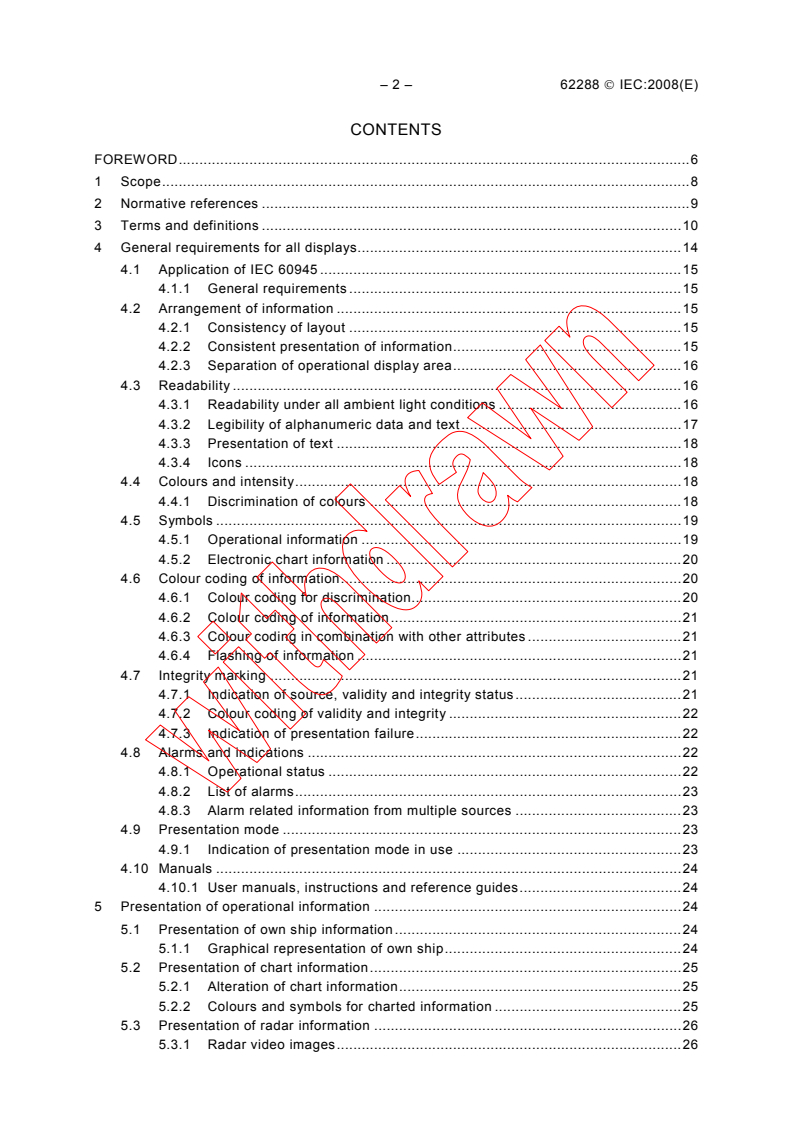
CONTENTS
FOREWORD.6
1 Scope.8
2 Normative references .9
3 Terms and definitions .10
4 General requirements for all displays.14
4.1 Application of IEC 60945 .15
4.1.1 General requirements .15
4.2 Arrangement of information .15
4.2.1 Consistency of layout .15
4.2.2 Consistent presentation of information.15
4.2.3 Separation of operational display area.16
4.3 Readability .16
4.3.1 Readability under all ambient light conditions .16
4.3.2 Legibility of alphanumeric data and text.17
4.3.3 Presentation of text .18
4.3.4 Icons .18
4.4 Colours and intensity.18
4.4.1 Discrimination of colours .18
4.5 Symbols .19
4.5.1 Operational information .19
4.5.2 Electronic chart information .20
4.6 Colour coding of information.20
4.6.1 Colour coding for discrimination.20
4.6.2 Colour coding of information.21
4.6.3 Colour coding in combination with other attributes .21
4.6.4 Flashing of information .21
4.7 Integrity marking .21
4.7.1 Indication of source, validity and integrity status.21
4.7.2 Colour coding of validity and integrity .22
4.7.3 Indication of presentation failure.22
4.8 Alarms and indications .22
4.8.1 Operational status .22
4.8.2 List of alarms.23
4.8.3 Alarm related information from multiple sources .23
4.9 Presentation mode .23
4.9.1 Indication of presentation mode in use .23
4.10 Manuals .24
4.10.1 User manuals, instructions and reference guides.24
5 Presentation of operational information .24
5.1 Presentation of own ship information.24
5.1.1 Graphical representation of own ship.24
5.2 Presentation of chart information.25
5.2.1 Alteration of chart information.25
5.2.2 Colours and symbols for charted information .25
5.3 Presentation of radar information .26
5.3.1 Radar video images.26
62288 © IEC:2008(E) – 3 –
5.3.2 Target trails .27
5.4 Presentation of target information.27
5.4.1 Providing target information.27
5.4.2 Consistent user interface for target information .28
5.4.3 Indication of exceeding target capacity .29
5.4.4 Filtering sleeping AIS targets.29
5.4.5 Activation of AIS targets .30
5.4.6 Graphical presentation of targets.30
5.4.7 Target selection.31
5.4.8 Indication of target derivation .32
5.4.9 Presentation of tracked radar target information .32
5.4.10 Presentation of reported AIS target information .32
5.4.11 Continual update of target information .33
5.4.12 Own ship’s AIS information.34
5.4.13 Obscuring the operational display area.34
5.5 Operational alarms .34
5.5.1 Alarm status .34
5.5.2 CPA/TCPA alarms .34
5.5.3 Acquisition/activation zones.34
5.5.4 Lost target alarms.35
5.6 AIS and radar target association .36
5.6.1 Target association .36
5.6.2 AIS presentation status .36
5.6.3 Trial manoeuvre .37
5.7 Measurement .38
5.7.1 Measurement from own ship.38
5.7.2 Bearing and range measurements .38
5.8 Navigation Tools .38
5.8.1 Range rings.39
5.8.2 Variable range marker (VRM) .39
5.8.3 Bearing scale .40
5.8.4 Electronic bearing line (EBL) .41
5.8.5 Parallel index lines (PI).42
5.8.6 Offset measurement of range and bearing .42
5.8.7 User cursor.43
6 Radar and chart displays .44
6.1 General .44
6.1.1 Multifunction displays .44
6.1.2 Simultaneous display of radar and chart data .45
6.1.3 Range scales.45
6.1.4 Range ring scale .45
6.1.5 Operational display area.46
6.1.6 Motion display modes .46
6.1.7 Orientation modes .47
6.1.8 Off-centring .47
6.1.9 Stabilisation modes .48
6.2 Radar displays .48
6.2.1 Radar video image .48
6.2.2 Brightness of radar information.49
– 4 – 62288 © IEC:2008(E)
6.2.3 Display of chart information on radar .49
6.2.4 Priority of radar information .50
6.2.5 Display of map graphics .50
6.3 Chart displays .51
6.3.1 Display of chart information .51
6.3.2 IMO display categories .52
6.3.3 Adding or removing information from the display .52
6.3.4 Safety contour .53
6.3.5 Safety depth .53
6.3.6 Chart scale .53
6.3.7 Display of radar and target information .53
6.3.8 Display of additional navigation-related information .54
6.4 Composite task-oriented presentations.54
6.4.1 User-configured presentations.54
6.4.2 Information associated with the task-at-hand .54
7 Physical requirements .55
7.1 General .55
7.2 Display adjustment .55
7.2.1 Contrast and brightness.55
7.2.2 Magnetic interference .56
7.2.3 Temporal stability .56
7.2.4 Physical controls and status indicators .56
7.3 Screen size .57
7.3.1 Requirement.57
7.3.2 Method of test and required results .57
7.4 Multicoloured display equipment.57
7.4.1 Requirement.57
7.4.2 Method of test and required results .58
7.5 Screen resolution .58
7.5.1 Requirement.58
7.5.2 Method of test and required results .58
7.6 Screen viewing angle .58
7.6.1 Requirement.58
7.6.2 Methods of test and required results.58
Annex A (normative) Presentation colours and symbols .59
Annex B (normative) Guidelines for the presentation of navigation-related terminology
and abbreviations .82
Annex C (informative) Guidance on display and dialogue design in MSC/Circ.982 .89
Annex D (informative) Guidance on testing .91
Annex E (normative) Operational controls.96
Bibliography.100
Table 1 – Ambient light conditions .16
Table 2 – Operational status .22
Table 3 – Minimum number of tracked radar targets to be displayed .28
Table 4 – Minimum number of AIS targets to be displayed .28
Table 5 – AIS status .36
62288 © IEC:2008(E) – 5 –
Table A.1 – Own ship symbols .60
Table A.2 – Radar and AIS symbols.64
Table A.3 – Navigation symbols.74
Table A.4 – Navigation tools .80
Table A.5 – Other symbols.81
Table B.1 – List of standard terms and abbreviations.84
Table B.2 – List of standard units of measurement and abbreviations .88
Table C.1 – Paragraphs in MSC/Circ.982 associated with IEC 60945 requirements .89
Table C.2 – Other paragraphs in MSC/Circ.982 related to display design.90
Table C.3 – Other paragraphs in MSC/Circ.982 partially related to display design .90
Table E.1 – Top-level grouping of data and control functions for radar applications .96
Table E.2 – Top-level grouping of data and control functions for charting.97
Table E.3 – General control icons .98
Table E.4 – Task-oriented measurement control icons .98
Table E.5 – Radar specific control icons .99
– 6 – 62288 © IEC:2008(E)
INTERNATIONAL ELECTROTECHNICAL COMMISSION
____________
MARITIME NAVIGATION AND RADIOCOMMUNICATION
EQUIPMENT AND SYSTEMS –
Presentation of navigation-related information
on shipborne navigational displays –
General requirements, methods of testing and required test results
FOREWORD
1) The International Electrotechnical Commission (IEC) is a worldwide organization for standardization comprising
all national electrotechnical committees (IEC National Committees). The object of IEC is to promote
international co-operation on all questions concerning standardization in the electrical and electronic fields. To
this end and in addition to other activities, IEC publishes International Standards, Technical Specifications,
Technical Reports, Publicly Available Specifications (PAS) and Guides (hereafter referred to as “IEC
Publication(s)”). Their preparation is entrusted to technical committees; any IEC National Committee interested
in the subject dealt with may participate in this preparatory work. International, governmental and non-
governmental organizations liaising with the IEC also participate in this preparation. IEC collaborates closely
with the International Organization for Standardization (ISO) in accordance with conditions determined by
agreement between the two organizations.
2) The formal decisions or agreements of IEC on technical matters express, as nearly as possible, an international
consensus of opinion on the relevant subjects since each technical committee has representation from all
interested IEC National Committees.
3) IEC Publications have the form of recommendations for international use and are accepted by IEC National
Committees in that sense. While all reasonable efforts are made to ensure that the technical content of IEC
Publications is accurate, IEC cannot be held responsible for the way in which they are used or for any
misinterpretation by any end user.
4) In order to promote international uniformity, IEC National Committees undertake to apply IEC Publications
transparently to the maximum extent possible in their national and regional publications. Any divergence
between any IEC Publication and the corresponding national or regional publication shall be clearly indicated in
the latter.
5) IEC provides no marking procedure to indicate its approval and cannot be rendered responsible for any
equipment declared to be in conformity with an IEC Publication.
6) All users should ensure that they have the latest edition of this publication.
7) No liability shall attach to IEC or its directors, employees, servants or agents including individual experts and
members of its technical committees and IEC National Committees for any personal injury, property damage or
other damage of any nature whatsoever, whether direct or indirect, or for costs (including legal fees) and
expenses arising out of the publication, use of, or reliance upon, this IEC Publication or any other IEC
Publications.
8) Attention is drawn to the Normative references cited in this publication. Use of the referenced publications is
indispensable for the correct application of this publication.
9) Attention is drawn to the possibility that some of the elements of this IEC Publication may be the subject of
patent rights. IEC shall not be held responsible for identifying any or all such patent rights.
International Standard IEC 62288 has been prepared by IEC technical committee 80: Maritime
navigation and radiocommunication equipment and systems.
This standard supports the performance standards for the presentation of navigation-related
information on shipborne navigational displays, adopted by the IMO in resolution
MSC.191(79) in December 2004.
62288 © IEC:2008(E) – 7 –
The text of this standard is based on the following documents:
FDIS Report on voting
80/527/FDIS 80/540/RVD
Full information on the voting for the approval of this standard can be found in the report on
voting indicated in the above table.
This publication has been drafted in accordance with the ISO/IEC Directives, Part 2.
The committee has decided that the contents of this publication will remain unchanged until
the maintenance result date indicated on the IEC web site under "http://webstore.iec.ch" in
the data related to the specific publication. At this date, the publication will be
• reconfirmed,
• withdrawn,
• replaced by a revised edition, or
• amended.
A bilingual version of this publication may be issued at a later date.
– 8 – 62288 © IEC:2008(E)
MARITIME NAVIGATION AND RADIOCOMMUNICATION
EQUIPMENT AND SYSTEMS –
Presentation of navigation-related information
on shipborne navigational displays –
General requirements, methods of testing and required test results
1 Scope
This International Standard specifies the general requirements, methods of testing, and
required test results, for the presentation of navigation-related information on shipborne
navigational displays in support of IMO resolution MSC.191(79).
(MSC191/1) IMO resolution MSC.191(79) harmonizes the requirements for the presentation of
navigation-related information on the bridge of a ship to ensure that all navigational displays
adopt a consistent human machine interface philosophy and implementation.
(MSC191/1) IMO resolution MSC.191(79) supplements and, in the case of a conflict, takes
priority over, the presentation requirements of the individual performance standards adopted
by the IMO for relevant navigational systems and equipment and covers the presentation of
navigation-related information by equipment for which Performance Standards have not been
adopted by the IMO.
This standard also addresses the guidelines for the presentation of navigation-related
symbols, terms and abbreviations in Safety of Navigation circular SN/Circ.243 together with
some requirements published in resolution MSC.192(79) on radar; resolution MSC.232(82) on
ECDIS; and ergonomic criteria published in circular MSC/Circ.982.
The symbols from SN/Circ.243 are reproduced and expanded upon in Annex A. The terms
and abbreviations from SN/Circ.243 are reproduced and expanded upon in Annex B.
Additional guidance on display and dialogue design from MSC/Circ.982 is listed by reference
in Annex C.
Some requirements set forth in MSC.191(79) duplicate requirements set forth in other IMO
documents (for example, Resolutions A.694(17), MSC.192(79), MSC.232(82), etc.) or in the
IEC standards further specifying the methods of test and required test results for those
requirements (for example, IEC 60945, IEC 61174, IEC 62388, etc.). Where a requirement in
this standard duplicates a requirement in another standard, the method(s) of test for that
requirement may refer to the other standard.
NOTE Manufactures may offer relevant test data from compliance tests to other standards such as IEC 60945,
IEC 61174, IEC 62388, etc. as evidence of compliance with appropriate tests of this standard.
This standard is organized so that each group of requirements is immediately followed by a
clause identifying the method(s) of test. The methods of test are derived from ISO 9241-12 on
the presentation of information on visual displays. Guidance on testing is provided in
Annex D.
NOTE All text in this standard whose wording is identical to text contained in an IMO document is printed in
italics. Reference to the document is noted at the beginning of the paragraph. The notation contains a prefix
referring to the document and a suffix with the paragraph number from the document (for example, (MSC191/1);
(SN243/1), etc.).
62288 © IEC:2008(E) – 9 –
1.1 Purpose
(MSC191/2) This standard specifies the presentation of navigational information on the bridge
of a ship, including the consistent use of navigational terms, abbreviations, colours and
symbols, as well as other presentation characteristics.
(MSC191/2) This standard also addresses the presentation of information related to specific
navigational tasks by recognising user selected presentations in addition to presentations
required by the relevant individual performance standards adopted by the IMO.
1.2 Application
(MSC191/3) This standard is applicable to any display equipment associated with the
navigational systems and equipment for which individual performance standards have been
adopted by the IMO. It addresses the stand-alone displays for radar and ECDIS, the
multifunction displays used in IBS and INS and composite presentations that integrate
information derived from two or more systems. This standard also addresses display
equipment associated with navigational systems and equipment for which individual
performance standards have not been adopted by the IMO.
NOTE Some IEC standards may individually include display requirements in conformity with IMO resolution
MSC.191(79).
(MSC191/3) The general principles and the physical characteristics specified in Clauses 4
and 7, respectively, of this standard are applicable to all displays on the bridge of a ship.
2 Normative references
The following referenced documents are indispensable for the application of this document.
For dated references, only the edition cited applies. For undated references, the latest edition
of the referenced document (including any amendments) applies.
IEC 60945:2002, Maritime navigation and radiocommunication equipment and systems –
General requirements – Methods of tests of testing and required test results
IEC 61162, (all parts) Maritime navigation and radiocommunication equipment and systems -
Digital interfaces
IEC 61174, Maritime navigation and radiocommunication equipment and systems – Electronic
chart display and information system (ECDIS) – Operational and performance requirements,
methods of testing and required test results
IEC 61966-4:2000, Multimedia systems and equipment – Colour measurement and
management – Part 4: Equipment using liquid crystal display panels
IEC 62065:2002, Maritime navigation and radiocommunication equipment and systems –
Track control systems – Operational and performance requirements, methods of testing and
required test results
IEC 62388:2007, Maritime navigation and radiocommunication equipment and systems –
Shipborne radar – Performance requirements, methods of testing and required test results
IHO S-52:1996, Specifications for chart content and display aspects of ECDIS
IHO S-52 Appendix 1:1996, Guidance on updating the electronic navigational chart
IHO S-52 Appendix 2:2004, Colour and symbol specifications for ECDIS
– 10 – 62288 © IEC:2008(E)
IMO A.694(17):1991, General requirements for shipborne radio equipment forming part of the
global maritime distress and safety system (GMDSS) and for electronic navigational aids
IMO MSC.191(79):2004, Performance standards for the presentation of navigation related
information on shipborne navigational displays
IMO MSC.192(79):2004, Performance standards for radar equipment
IMO MSC.232(82):2006, Revised performance standards for electronic chart display and
information systems (ECDIS)
IMO SN/Circ.243:2004, Guidelines for the presentation of navigation related symbols, terms
and abbreviations
ISO 13406-2: 2001, Ergonomic requirements for work with visual displays based on flat
panels – Part 2: Ergonomic requirements for flat panel displays
ISO 80416-4:2005, Basic principles for graphical symbols for use on equipment – Part 4:
Guidelines for the adaptation of graphical symbols for use on screens and displays (icons)
VESA-2001-6:2001, Flat Panel Display Measurements (FPDM)
3 Terms and definitions
For the purposes of this document, the following terms and definitions apply.
3.1
activated AIS target
(MSC191/A) target activated for the display of additional graphically presented information
(for example, heading line, velocity vector, etc.)
3.2
automatic identification system
AIS
system which complies with the requirements set forth in Annex 3 to IMO Resolution
MSC.74(69)
3.3
AIS target (or reported AIS target)
(MSC191/A) target generated from an AIS message
3.4
associated target
(MSC191/A) target simultaneously representing a tracked radar target and a reported AIS
target having similar parameters (for example, position, course, speed, etc.) and which
comply with an association algorithm
3.5
consistent common reference point
CCRP
(MSC191/A) location on own ship, to which all horizontal measurements such as own ship
position, heading, attitude, and target range, bearing, relative course, relative speed, closest
point of approach (CPA) or time to closest point of approach (TCPA) are referenced, typically
the conning position of the ship. An alternative location (or multiple locations) may be used as
necessary where clearly indicated or distinctively obvious, for example, the origin of the
reference axis of the ship
62288 © IEC:2008(E) – 11 –
3.6
composite presentation
integrated presentation that is derived from the simultaneous display of information from two
or more navigational systems or equipment
3.7
dangerous target
(MSC191/A) tracked radar or reported AIS target with a predicted CPA and TCPA that violates
values preset by the user. The respective target is marked by a “dangerous target” symbol
3.8
dead-reckoned position
DR
position extrapolated from the last accepted position update, based on present course and
speed, and updated on a time interval selected by the operator
3.9
display base
(MSC191/A) level of information which cannot be removed from the ECDIS display, consisting
of information which is required at all times in all geographic areas and all circumstances. It is
not intended to be sufficient for safe navigation
3.10
display equipment
device capable of representing information visually
3.11
doubtful integrity
property of information where its accuracy, timeliness or completeness cannot be measured
or determined
3.12
electronic chart display and information system
ECDIS
system which complies with the requirements set forth in IMO Resolution MSC.232(82)
3.13
electronic chart information
one or more electronic chart databases (for example, ENC)
3.14
electronic navigational chart
ENC
(MSC191/A) database standardised as to content, structure and format according to IHO S-57
and its Appendix B.1 and issued by, or on the authority of, a Government
3.15
estimated position
EP
position of own ship determined by the common intersection of two LOPs
3.16
fix
position of own ship determined, without reference to any former position, by the common
intersection of three or more LOPs
– 12 – 62288 © IEC:2008(E)
3.17
heading
(MSC191/A) horizontal direction in which the bow of a ship is actually pointing at any instant,
expressed as an angular displacement from north
3.18
human machine interface
interaction interface between humans and machines consisting of all elements used to
achieve a particular goal, or the task interface between humans and machines resulting from
the allocation of functions to humans and/or machines
3.19
integrated bridge system
IBS
system which complies with the requirements set forth in Annex 1 to IMO Resolution
MSC.64(67)
3.20
icon
graphical symbol with a particular meaning used to convey information independent of
language. Icons may be used for visual identification or reinforcement of a textual description,
to invoke a function, or to open an object when selected with the cursor
3.21
important indication
(MSC191/A) marking of an operational status of displayed information which needs special
attention, for example, information with low integrity or invalid information
3.22
integrated navigation system
INS
system which complies with the requirements set forth in IMO Resolution MSC.252(83)
3.23
integrity
property of information as being accurate, timely, complete and uncorrupted
3.24
line of position
LOP
plotted line on which own ship is located determined by observation or measurement of the
range or bearing to an aid to navigation or other charted element
3.25
lost target
(MSC191/A) tracked radar or reported AIS target for which the system is no longer receiving
valid position data. The target is represented by a “lost target” symbol
3.26
menu
area of the display that is allocated to a structured list of options for the selection and entry of
operational parameters, data and commands
3.27
multifunction display
single visual display unit that can present, either simultaneously or through a series of
selectable pages, information from multiple systems or equipment. A multifunction display
62288 © IEC:2008(E) – 13 –
may typically be part of an INS or IBS (for example, providing dedicated presentation modes
conforming to both radar and ECDIS presentation requirements), and may replace their
individual display units
3.28
operational display area
(MSC191/A) area of the display used to graphically present electronic chart and/or radar
information, excluding the user dialogue area. On the chart display this is the area of the chart
presentation. On the radar display this is the area encompassing the radar video image
3.29
past positions
(MSC191/A) time-spaced marks on the past track of own ship, or a tracked radar or reported
AIS target
3.30
permanent
property of information as existing for a long time (or forever) without change
3.31
persistent
property of information as existing continuously
3.32
radar
system which complies with the requirements set forth in IMO Resolution MSC.192(79)
3.33
radar echo
returned radar signal (i.e. "paint") appearing in the radar video image
3.34
radar video image
set of displayed information constructed from radar echoes processed by anti-clutter means
and other tools (for example, scan-to-scan correlation)
3.35
readily available
property of information as being directly accessible (for example, in a top-level menu, from a
screen function, or an icon, etc.)
3.36
selected target
(MSC191/A) target selected manually or automatically for the display of detailed alphanumeric
data, information and text in a separate user dialogue area. The target is represented by a
“selected target” symbol
3.37
single user/operator action
use of a single hardware key, or the use of a cursor, to select a single display icon or window
followed by the operation of a key
– 14 – 62288 © IEC:2008(E)
3.38
sleeping AIS target
(MSC191/A) AIS target indicating the presence of a vessel equipped with AIS in a certain
location. The target is represented by a “sleeping target” symbol indicating the vessel’s
orientation. No additional information is presented until the AIS target is activated
3.39
standard display
(MSC191/A) level of information that should be shown when a chart is first displayed on
ECDIS. The level of the information it provides for route planning or route monitoring may be
modified by the user according to the user's needs
3.40
target tracking system
system which complies with the requirements set forth in IMO Resolution MSC.192(79)
3.41
task-at-hand
specific navigation-related activity performed by a user (for example, route planning, route
monitoring, target tracking, collision avoidance, etc.)
3.42
tracked radar target
object, fixed or moving, which is tracked by a radar or target tracking system
3.43
trial manoeuvre
(MSC191/A) facility used to assist the user to perform a simulated manoeuvre for navigation
and collision avoidance purposes, by displaying the predicted future status of all tracked radar
and reported AIS targets as a result of the simulated manoeuvres
3.44
user-added electronic chart information
electronic chart information manually entered by the user for presentation (for example,
navigational notes, safety zones of interest, local notices to mariners, etc.)
3.45
user-configured presentation
(MSC191/A) auxiliary presentation configured by the user for a specific task-at-hand. The
presentation may include radar and/or electronic chart information, in combination with other
navigational or ship related data
3.46
user dialogue area
(MSC191/A) area of the display consisting of data fields and/or menus that is allocated to the
interactive presentation and entry or selection of operational parameters, data, information,
text and commands mainly in alphanumeric form
3.47
validity
property of information as conforming to specified criteria, and the marking of such
information as being “valid” or “invalid” (i.e. “good” or “no good”) for its intended use
4 General requirements for all displays
The provisions of this clause are applicable to all displays on the bridge of a ship.
62288 © IEC:2008(E) – 15 –
NOTE If display equipment is permitted to be monochrome by the applicable IMO performance standards, then
the colour-related requirements specified in 4.2.1, 4.4.1, 4.6.1, 4.6.2, 4.6.3, 4.7.2 and 4.8.1 will not apply.
4.1 Application of IEC 60945
4.1.1 General requirements
4.1.1.1 Requirement
(MSC191/3) In addition to the general requirements set forth in IMO Resolution A.694(17) and
further specified in IEC 60945, display equipment shall meet the requirements set forth in IMO
Resolution MSC.191(79) and further specified in this standard, as applicable.
4.1.1.2 Methods of test and required results
See Annex D for guidance in the application of IEC 60945 for testing.
4.2 Arrangement of information
4.2.1 Consistency of layout
4.2.1.1 Requirement
(MSC191/5.1.1) The presentation of information shall be consistent within the user interface
with respect to screen layout and arrangement of information, for example, from screen to
screen and/or from page to page, as appropriate, and as far as practical. Data and control
functions shall be logically grouped according to their function or the task-at-hand. Priority
information essential to the task-at-hand shall be identified for each application (for example,
radar, ECDIS, etc.), permanently or persistently displayed, as appropriate for the application,
and presented to the user in a prominent manner by, for example, use of position (for
example, screen location), size and colour.
4.2.1.2 Methods of test and required results
The methods of test and the required results are as follows:
a) verify that the arrangement, operation and identification of controls, screen displays and
indications are in accordance with Annex E and IEC 60945, 4.2.1.2 through 4.2.1.5;
b) confirm by observation that the screen layout and arrangement of information is consistent
fr
...