


IEC 60086-1:2015
(Main)Primary batteries - Part 1: General
General Information
- Abstract
IEC 60086-1:2015 is intended to standardize primary batteries with respect to dimensions, nomenclature, terminal configurations, markings, test methods, typical performance, safety and environmental aspects. As a primary battery classification tool, electrochemical systems are also standardized with respect to system letter, electrodes, electrolyte, nominal and maximum open circuit voltage. The object of this part of IEC 60086 is to benefit primary battery users, device designers and battery manufacturers by ensuring that batteries from different manufacturers are interchangeable according to standard form, fit and function. Furthermore, to ensure compliance with the above, this part specifies standard test methods for testing primary cells and batteries. This twelfth edition cancels and replaces the eleventh edition (2011) and constitutes a technical revision. The major technical changes with respect to the previous edition are:
- the order of the Annexes was changed to the order in which they appearin the document and a caption was added to indicate where the Annex information first appears in the document;
- the humidity conditions for non P-system batteries in Table 3 was modified;
- the standard discharge voltage for the Y and W chemistries was determined to be at 3,5 V and 2,8 V respectively;
- details on capacity measurement were moved from Annex E to Subclause 5.1.
- the coin/button cell and battery definition was clarified in order to better address issues with the swallowing of coin cells. Keywords: fundamental requirements and information on primary cells and batteries
- Status
- Published
- Publication Date
- 27-Jul-2015
- Technical Committee
- TC 35 - Primary cells and batteries
- Drafting Committee
- MT 14 - TC 35/MT 14
- Current Stage
- DELPUB - Deleted Publication
- Start Date
- 27-Apr-2021
- Completion Date
- 30-Jun-2017
Buy Documents
IEC 60086-1:2015 - Primary batteries - Part 1: General Released:7/28/2015
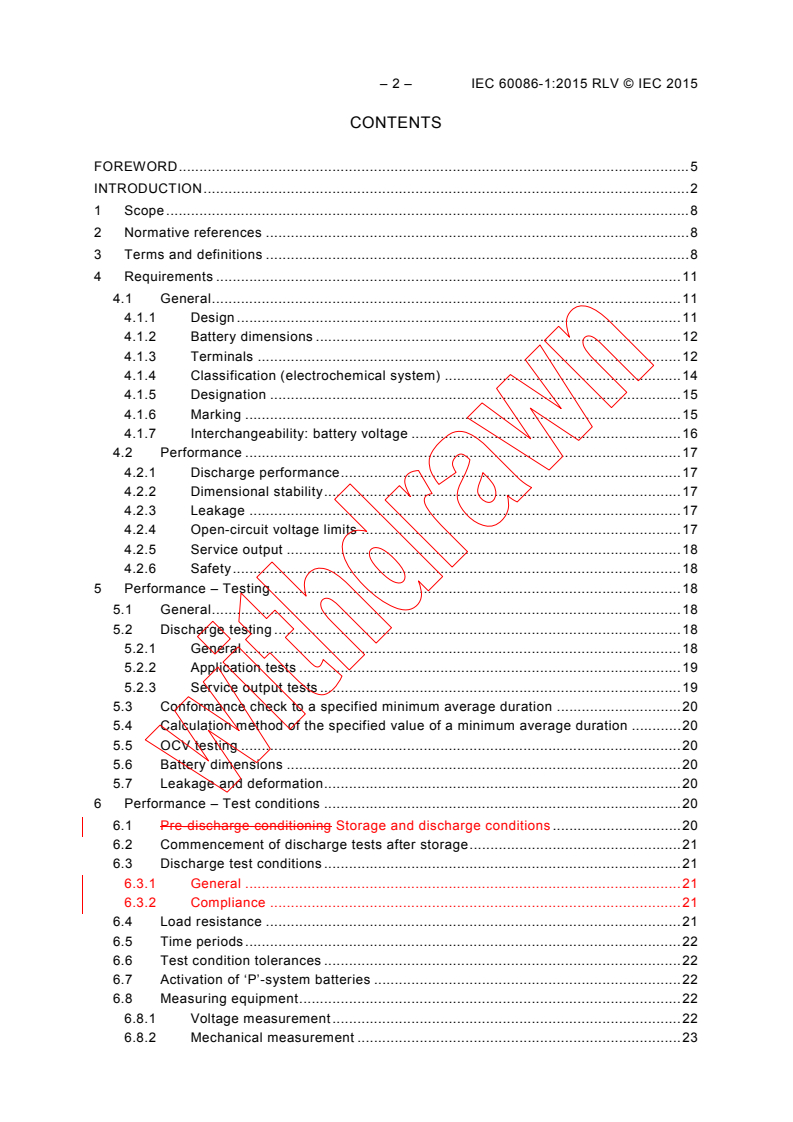
IEC 60086-1:2015 RLV - Primary batteries - Part 1: General Released:7/28/2015
IEC 60086-1:2015 - Primary batteries - Part 1: General Released:7/28/2015
Overview
IEC 60086-1:2015 - "Primary batteries – Part 1: General" is the 12th edition of the International Electrotechnical Commission’s core standard for primary (non-rechargeable) batteries. The standard standardizes primary batteries with respect to dimensions, nomenclature, terminal configurations, markings, test methods, typical performance, safety and environmental aspects. It establishes classification rules for electrochemical systems (system letter, electrodes, electrolyte, nominal and maximum open-circuit voltage) and defines standard test methods so batteries from different manufacturers are interchangeable by form, fit and function.
Key topics and technical requirements
- Dimensions and mechanical design: standardized physical sizes and terminal layouts to ensure interchangeability.
- Nomenclature and designation: classification scheme for cells and batteries including electrochemical system identification.
- Terminal configurations and markings: required marks and designation to aid correct use and identification.
- Performance and testing: standardized discharge tests, open-circuit voltage (OCV) limits, service output tests, and conditions for measuring capacity and discharge behaviour.
- Safety and environmental aspects: guidance on design, leak prevention, and information to reduce safety risks (including coin/button-cell ingestion concerns).
- Sampling and quality assurance: procedures for sampling, attribute/variable testing and performance indices used in production control.
- Packaging and handling: code of practice for packaging, shipment, storage, use and disposal (Annex G).
- Notable technical revisions in the 2015 edition include updated Annex ordering and captions, modified humidity test conditions for non P-system batteries (Table 3), defined standard discharge voltages (Y = 3.5 V; W = 2.8 V), relocation of capacity measurement details into Clause 5.1, and clarified coin/button-cell definitions to address ingestion risks.
Practical applications and who uses this standard
IEC 60086-1 is used by:
- Battery manufacturers for product design, testing, marking and quality control.
- Device designers and OEMs to select compatible primary batteries and design battery compartments and voltage cut-offs.
- Test laboratories and certification bodies for conformity testing and performance verification.
- Regulatory and safety professionals for assessing packaging, labelling and end-of-life guidance.
- Procurement and quality teams to ensure interchangeability and compliance across suppliers.
Practical benefits include improved product interoperability, clearer safety labelling, harmonized testing protocols and predictable performance data for consumer and industrial applications.
Related standards and resources
For complementary guidance consult other IEC publications in the battery and electrical-testing portfolio and the IEC webstore for the latest editions and corrigenda. IEC 60086-1:2015 is available from the IEC catalogue (webstore.iec.ch).
Relations
- Effective Date
- 05-Sep-2023
- Effective Date
- 05-Sep-2023
Buy Documents
IEC 60086-1:2015 - Primary batteries - Part 1: General Released:7/28/2015
IEC 60086-1:2015 RLV - Primary batteries - Part 1: General Released:7/28/2015
IEC 60086-1:2015 - Primary batteries - Part 1: General Released:7/28/2015
Get Certified
Connect with accredited certification bodies for this standard

IMQ S.p.A. (Certification)
Italian electrical product certification.

SLG Prüf- und Zertifizierungs GmbH
German testing and certification body.

UL Solutions
Global safety science company with testing, inspection and certification.
Sponsored listings
Frequently Asked Questions
IEC 60086-1:2015 is a standard published by the International Electrotechnical Commission (IEC). Its full title is "Primary batteries - Part 1: General". This standard covers: IEC 60086-1:2015 is intended to standardize primary batteries with respect to dimensions, nomenclature, terminal configurations, markings, test methods, typical performance, safety and environmental aspects. As a primary battery classification tool, electrochemical systems are also standardized with respect to system letter, electrodes, electrolyte, nominal and maximum open circuit voltage. The object of this part of IEC 60086 is to benefit primary battery users, device designers and battery manufacturers by ensuring that batteries from different manufacturers are interchangeable according to standard form, fit and function. Furthermore, to ensure compliance with the above, this part specifies standard test methods for testing primary cells and batteries. This twelfth edition cancels and replaces the eleventh edition (2011) and constitutes a technical revision. The major technical changes with respect to the previous edition are: - the order of the Annexes was changed to the order in which they appearin the document and a caption was added to indicate where the Annex information first appears in the document; - the humidity conditions for non P-system batteries in Table 3 was modified; - the standard discharge voltage for the Y and W chemistries was determined to be at 3,5 V and 2,8 V respectively; - details on capacity measurement were moved from Annex E to Subclause 5.1. - the coin/button cell and battery definition was clarified in order to better address issues with the swallowing of coin cells. Keywords: fundamental requirements and information on primary cells and batteries
IEC 60086-1:2015 is intended to standardize primary batteries with respect to dimensions, nomenclature, terminal configurations, markings, test methods, typical performance, safety and environmental aspects. As a primary battery classification tool, electrochemical systems are also standardized with respect to system letter, electrodes, electrolyte, nominal and maximum open circuit voltage. The object of this part of IEC 60086 is to benefit primary battery users, device designers and battery manufacturers by ensuring that batteries from different manufacturers are interchangeable according to standard form, fit and function. Furthermore, to ensure compliance with the above, this part specifies standard test methods for testing primary cells and batteries. This twelfth edition cancels and replaces the eleventh edition (2011) and constitutes a technical revision. The major technical changes with respect to the previous edition are: - the order of the Annexes was changed to the order in which they appearin the document and a caption was added to indicate where the Annex information first appears in the document; - the humidity conditions for non P-system batteries in Table 3 was modified; - the standard discharge voltage for the Y and W chemistries was determined to be at 3,5 V and 2,8 V respectively; - details on capacity measurement were moved from Annex E to Subclause 5.1. - the coin/button cell and battery definition was clarified in order to better address issues with the swallowing of coin cells. Keywords: fundamental requirements and information on primary cells and batteries
IEC 60086-1:2015 is classified under the following ICS (International Classification for Standards) categories: 29.220.10 - Primary cells and batteries. The ICS classification helps identify the subject area and facilitates finding related standards.
IEC 60086-1:2015 has the following relationships with other standards: It is inter standard links to IEC 60086-1:2021, IEC 60086-1:2011. Understanding these relationships helps ensure you are using the most current and applicable version of the standard.
IEC 60086-1:2015 is available in PDF format for immediate download after purchase. The document can be added to your cart and obtained through the secure checkout process. Digital delivery ensures instant access to the complete standard document.
Standards Content (Sample)
IEC 60086-1 ®
Edition 12.0 2015-07
INTERNATIONAL
STANDARD
Primary batteries –
Part 1: General
All rights reserved. Unless otherwise specified, no part of this publication may be reproduced or utilized in any form
or by any means, electronic or mechanical, including photocopying and microfilm, without permission in writing from
either IEC or IEC's member National Committee in the country of the requester. If you have any questions about IEC
copyright or have an enquiry about obtaining additional rights to this publication, please contact the address below or
your local IEC member National Committee for further information.
IEC Central Office Tel.: +41 22 919 02 11
3, rue de Varembé Fax: +41 22 919 03 00
CH-1211 Geneva 20 info@iec.ch
Switzerland www.iec.ch
About the IEC
The International Electrotechnical Commission (IEC) is the leading global organization that prepares and publishes
International Standards for all electrical, electronic and related technologies.
About IEC publications
The technical content of IEC publications is kept under constant review by the IEC. Please make sure that you have the
latest edition, a corrigenda or an amendment might have been published.
IEC Catalogue - webstore.iec.ch/catalogue Electropedia - www.electropedia.org
The stand-alone application for consulting the entire The world's leading online dictionary of electronic and
bibliographical information on IEC International Standards, electrical terms containing more than 30 000 terms and
Technical Specifications, Technical Reports and other definitions in English and French, with equivalent terms in 15
documents. Available for PC, Mac OS, Android Tablets and additional languages. Also known as the International
iPad. Electrotechnical Vocabulary (IEV) online.
IEC publications search - www.iec.ch/searchpub IEC Glossary - std.iec.ch/glossary
The advanced search enables to find IEC publications by a More than 60 000 electrotechnical terminology entries in
variety of criteria (reference number, text, technical English and French extracted from the Terms and Definitions
committee,…). It also gives information on projects, replaced clause of IEC publications issued since 2002. Some entries
and withdrawn publications. have been collected from earlier publications of IEC TC 37,
77, 86 and CISPR.
IEC Just Published - webstore.iec.ch/justpublished
Stay up to date on all new IEC publications. Just Published IEC Customer Service Centre - webstore.iec.ch/csc
details all new publications released. Available online and If you wish to give us your feedback on this publication or
also once a month by email. need further assistance, please contact the Customer Service
Centre: csc@iec.ch.
IEC 60086-1 ®
Edition 12.0 2015-07
INTERNATIONAL
STANDARD
Primary batteries –
Part 1: General
INTERNATIONAL
ELECTROTECHNICAL
COMMISSION
ICS 29.220.10 ISBN 978-2-8322-2813-5
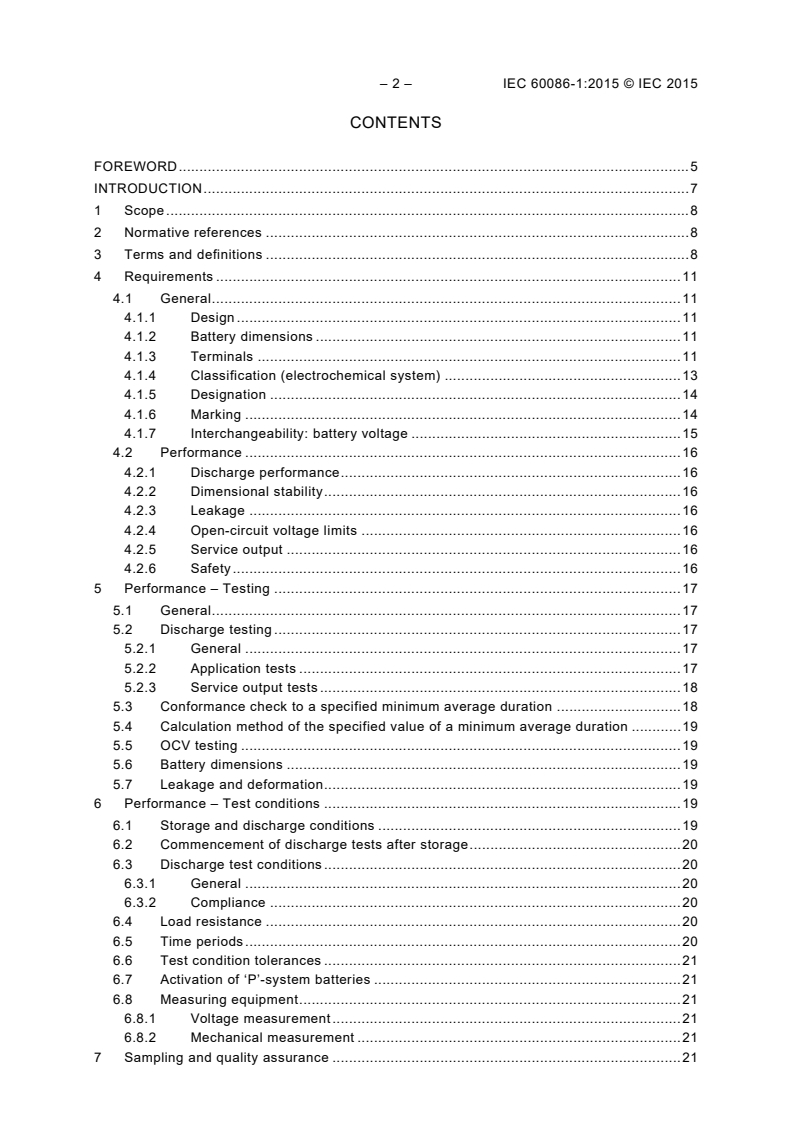
– 2 – IEC 60086-1:2015 © IEC 2015
CONTENTS
FOREWORD . 5
INTRODUCTION . 7
1 Scope . 8
2 Normative references . 8
3 Terms and definitions . 8
4 Requirements . 11
4.1 General . 11
4.1.1 Design . 11
4.1.2 Battery dimensions . 11
4.1.3 Terminals . 11
4.1.4 Classification (electrochemical system) . 13
4.1.5 Designation . 14
4.1.6 Marking . 14
4.1.7 Interchangeability: battery voltage . 15
4.2 Performance . 16
4.2.1 Discharge performance . 16
4.2.2 Dimensional stability . 16
4.2.3 Leakage . 16
4.2.4 Open-circuit voltage limits . 16
4.2.5 Service output . 16
4.2.6 Safety . 16
5 Performance – Testing . 17
5.1 General . 17
5.2 Discharge testing . 17
5.2.1 General . 17
5.2.2 Application tests . 17
5.2.3 Service output tests . 18
5.3 Conformance check to a specified minimum average duration . 18
5.4 Calculation method of the specified value of a minimum average duration . 19
5.5 OCV testing . 19
5.6 Battery dimensions . 19
5.7 Leakage and deformation . 19
6 Performance – Test conditions . 19
6.1 Storage and discharge conditions . 19
6.2 Commencement of discharge tests after storage . 20
6.3 Discharge test conditions . 20
6.3.1 General . 20
6.3.2 Compliance . 20
6.4 Load resistance . 20
6.5 Time periods . 20
6.6 Test condition tolerances . 21
6.7 Activation of ‘P’-system batteries . 21
6.8 Measuring equipment . 21
6.8.1 Voltage measurement . 21
6.8.2 Mechanical measurement . 21
7 Sampling and quality assurance . 21
8 Battery packaging . 21
Annex A (normative) Criteria for the standardization of batteries . 22
Annex B (informative) Recommendations for equipment design . 23
B.1 Technical liaison . 23
B.2 Battery compartment . 23
B.2.1 General . 23
B.2.2 Limiting access by children . 24
B.3 Voltage cut-off . 24
Annex C (normative) Designation system (nomenclature) . 25
C.1 General . 25
C.2 Designation system in use up to October 1990. 25
C.2.1 General . 25
C.2.2 Cells . 25
C.2.3 Electrochemical system . 27
C.2.4 Batteries . 28
C.2.5 Modifiers . 28
C.2.6 Examples. 28
C.3 Designation system in use since October 1990 . 28
C.3.1 General . 28
C.3.2 Round batteries . 28
C.3.3 Non-round batteries . 32
C.3.4 Ambiguity . 35
Annex D (informative) Standard discharge voltage U – Definition and method of
s
determination . 37
D.1 Definition . 37
D.2 Determination . 37
D.2.1 General considerations: the C/R-plot . 37
D.2.2 Determination of the standard discharge resistor R . 38
s
D.2.3 Determination of the standard discharge capacity C and standard
s
discharge time t . 39
s
D.3 Experimental conditions to be observed and test results . 39
Annex E (informative) Preparation of standard methods of measuring performance
(SMMP) of consumer goods . 41
E.1 General . 41
E.2 Performance characteristics . 41
E.3 Criteria for the development of test methods . 41
Annex F (informative) Calculation method for the specified value of minimum average
duration . 42
Annex G (normative) Code of practice for packaging, shipment, storage, use and
disposal of primary batteries . 43
G.1 General . 43
G.2 Packaging . 43
G.3 Transport and handling . 43
G.4 Storage and stock rotation . 43
G.5 Displays at sales points . 44
G.6 Selection, use and disposal . 44
G.6.1 Purchase . 44
G.6.2 Installation . 44
G.6.3 Use . 44
– 4 – IEC 60086-1:2015 © IEC 2015
G.6.4 Replacement . 45
G.6.5 Disposal . 45
Bibliography . 46
Figure 1 – Ingestion gauge . 11
Figure C.1 – Designation system for round batteries: d < 100 mm; height h < 100 mm . 29
1 1
Figure C.2 – Diameter code for non-recommended diameters . 30
Figure C.3 – Height code for denoting the hundredths of a millimetre of height . 31
Figure C.4 – Designation system for round batteries: d ≥ 100 mm; height h ≥ 100 mm . 32
1 1
Figure C.5 – Designation system for non-round batteries, dimensions < 100 mm . 33
Figure C.6 – Designation system for non-round batteries, dimensions ≥ 100 mm . 34
Figure C.7 – Height code for discrimination per tenth of a millimetre . 35
Figure D.1 – Normalized C/R-plot (schematic) . 38
Figure D.2 – Standard discharge voltage (schematic) . 39
Table 1 – Standardized electrochemical systems . 13
Table 2 – Marking requirements . 15
Table 3 – Conditions for storage before and during discharge testing . 19
Table 4 – Resistive loads for new tests . 20
Table 5 – Time periods for new tests . 20
Table 6 – Test condition tolerances . 21
Table A.1 – Items necessary to standardize . 22
Table C.1 – Physical designation and dimensions of round cells and batteries . 26
Table C.2 – Physical designation and nominal overall dimensions of flat cells . 27
Table C.3 – Physical designation and dimensions of square cells and batteries . 27
Table C.4 – Diameter code for recommended diameter . 30
Table C.5 – Physical designation and dimensions of round cells and batteries based on
Clause C.2 . 36
Table C.6 – Physical designation and dimensions of non-round batteries based on
Clause C.2 . 36
Table D.1 – Standard discharge voltage by system . 40
INTERNATIONAL ELECTROTECHNICAL COMMISSION
____________
PRIMARY BATTERIES –
Part 1: General
FOREWORD
1) The International Electrotechnical Commission (IEC) is a worldwide organization for standardization comprising
all national electrotechnical committees (IEC National Committees). The object of IEC is to promote
international co-operation on all questions concerning standardization in the electrical and electronic fields. To
this end and in addition to other activities, IEC publishes International Standards, Technical Specifications,
Technical Reports, Publicly Available Specifications (PAS) and Guides (hereafter referred to as “IEC
Publication(s)”). Their preparation is entrusted to technical committees; any IEC National Committee interested
in the subject dealt with may participate in this preparatory work. International, governmental and non-
governmental organizations liaising with the IEC also participate in this preparation. IEC collaborates closely
with the International Organization for Standardization (ISO) in accordance with conditions determined by
agreement between the two organizations.
2) The formal decisions or agreements of IEC on technical matters express, as nearly as possible, an international
consensus of opinion on the relevant subjects since each technical committee has representation from all
interested IEC National Committees.
3) IEC Publications have the form of recommendations for international use and are accepted by IEC National
Committees in that sense. While all reasonable efforts are made to ensure that the technical content of IEC
Publications is accurate, IEC cannot be held responsible for the way in which they are used or for any
misinterpretation by any end user.
4) In order to promote international uniformity, IEC National Committees undertake to apply IEC Publications
transparently to the maximum extent possible in their national and regional publications. Any divergence
between any IEC Publication and the corresponding national or regional publication shall be clearly indicated in
the latter.
5) IEC itself does not provide any attestation of conformity. Independent certification bodies provide conformity
assessment services and, in some areas, access to IEC marks of conformity. IEC is not responsible for any
services carried out by independent certification bodies.
6) All users should ensure that they have the latest edition of this publication.
7) No liability shall attach to IEC or its directors, employees, servants or agents including individual experts and
members of its technical committees and IEC National Committees for any personal injury, property damage or
other damage of any nature whatsoever, whether direct or indirect, or for costs (including legal fees) and
expenses arising out of the publication, use of, or reliance upon, this IEC Publication or any other IEC
Publications.
8) Attention is drawn to the Normative references cited in this publication. Use of the referenced publications is
indispensable for the correct application of this publication.
9) Attention is drawn to the possibility that some of the elements of this IEC Publication may be the subject of
patent rights. IEC shall not be held responsible for identifying any or all such patent rights.
International Standard IEC 60086-1 has been prepared by IEC technical committee 35:
Primary cells and batteries.
This twelfth edition cancels and replaces the eleventh edition (2011) and constitutes a
technical revision.
The major technical changes with respect to the previous edition are:
– the order of the Annexes was changed to the order in which they appear in the document
and a caption was added to indicate where the Annex information first appears in the
document;
– the humidity conditions for non P-system batteries in Table 3 was modified;
– the standard discharge voltage for the Y and W chemistries was determined to be at 3,5 V
and 2,8 V respectively;
– details on capacity measurement were moved from Annex E to Subclause 5.1.
– 6 – IEC 60086-1:2015 © IEC 2015
– the coin/button cell and battery definition was clarified in order to better address issues
with the swallowing of coin cells.
The text of this standard is based on the following documents:
FDIS Report on voting
35/1346/FDIS 35/1349/RVD
Full information on the voting for the approval of this standard can be found in the report on
voting indicated in the above table.
This publication has been drafted in accordance with the ISO/IEC Directives, Part 2.
A list of all parts in the IEC 60086 series, under the general title Primary batteries, can be
found on the IEC website.
The committee has decided that the contents of this publication will remain unchanged until
the stability date indicated on the IEC website under "http://webstore.iec.ch" in the data
related to the specific publication. At this date, the publication will be
• reconfirmed,
• withdrawn,
• replaced by a revised edition, or
• amended.
A bilingual version of this publication may be issued at a later date.
INTRODUCTION
The technical content of this part of IEC 60086 provides fundamental requirements and
information on primary cells and batteries. All batteries within the IEC 60086 series are
considered dry cell batteries. In this sense, IEC 60086-1 is the main component of the
IEC 60086 series and forms the basis for the subsequent parts. For example, this part
includes elementary information on definitions, nomenclature, dimensions and marking. While
specific requirements are included, the content of this part tends to explain methodology (how)
and justification (why).
Over the years, this part has been changed to improve its content and remains under
continual scrutiny to ensure that the publication is kept up to date with the advances in both
battery and battery-powered device technologies.
NOTE Safety information is available in IEC 60086-4, IEC 60086-5 and IEC 62281.
– 8 – IEC 60086-1:2015 © IEC 2015
PRIMARY BATTERIES –
Part 1: General
1 Scope
This part of IEC 60086 is intended to standardize primary batteries with respect to dimensions,
nomenclature, terminal configurations, markings, test methods, typical performance, safety
and environmental aspects.
As a primary battery classification tool, electrochemical systems are also standardized with
respect to system letter, electrodes, electrolyte, nominal and maximum open circuit voltage.
NOTE The requirements justifying the inclusion or the ongoing retention of batteries in the IEC 60086 series are
given in Annex A.
The object of this part of IEC 60086 is to benefit primary battery users, device designers and
battery manufacturers by ensuring that batteries from different manufacturers are
interchangeable according to standard form, fit and function. Furthermore, to ensure
compliance with the above, this part specifies standard test methods for testing primary cells
and batteries.
2 Normative references
The following documents, in whole or in part, are normatively referenced in this document and
are indispensable for its application. For dated references, only the edition cited applies. For
undated references, the latest edition of the referenced document (including any
amendments) applies.
IEC 60086-2:− , Primary batteries – Part 2: Physical and electrical specifications
IEC 60086-3:2011, Primary batteries – Part 3: Watch batteries
IEC 60086-4:2014, Primary batteries – Part 4: Safety of lithium batteries
IEC 60086-5:2011, Primary batteries – Part 5: Safety of batteries with aqueous electrolyte
3 Terms and definitions
For the purposes of this document, the following terms and definitions apply.
3.1
application test
simulation of the actual use of a battery in a specific application
3.2
battery
one or more cells electrically connected and fitted in a case, with terminals, markings and
protective devices etc., as necessary for use
_____________
To be published.
[SOURCE:IEC 60050-482:2004, 482-01-04, modified definition]
3.3
button (cell or battery)
small round cell or battery where the overall height is less than the diameter
Note 1 to entry: In English, the term “button (cell or battery)” is only used for non-lithium batteries while the term
“coin (cell or battery)” is used for lithium batteries only. In languages other than English, the terms “coin” and
“button” are often used interchangeably, regardless of the electrochemical system.
3.4
cell
basic functional unit, consisting of an assembly of electrodes, electrolyte, container, terminals
and usually separators, that is a source of electric energy obtained by direct conversion of
chemical energy
[SOURCE:IEC 60050-482:2004, 482-01-01]
3.5
closed-circuit voltage
CCV (abbreviation)
voltage across the terminals of a battery when it is on discharge
[SOURCE:IEC 60050-482:2004, 482-03-28, modified ("voltage between the terminals of a cell
or battery" replaced by "voltage across the terminals of a battery")]
3.6
coin (cell or battery)
see button (cell or battery)
3.7
cylindrical (cell or battery)
round cell or battery in which the overall height is equal to or greater than the diameter
[SOURCE:IEC 60050-482: 2004, 482-02-39, modified ("cell with a cylindrical shape" replaced
by "round cell or battery")]
3.8
discharge (of a primary battery)
operation during which a battery delivers current to an external circuit
3.9
dry (primary) battery
primary battery in which the liquid electrolyte is essentially immobilized
[SOURCE:IEC 60050-482:2004, 482-04-14, modified]
3.10
effective internal resistance – DC method
the internal d.c. resistance of any electrochemical cell is defined by the following relation:
∆U (V)
R (Ω) =
i
∆i (A)
– 10 – IEC 60086-1:2015 © IEC 2015
3.11
end-point voltage
EV (abbreviation)
specified voltage of a battery at which the battery discharge is terminated
[SOURCE:IEC 60050-482:2004, 482-03-30]
3.12
leakage
unplanned escape of electrolyte, gas or other material from a cell or battery
[SOURCE:IEC 60050-482:2004, 482-02-32]
3.13
minimum average duration
MAD (abbreviation)
minimum average time on discharge which is met by a sample of batteries
Note 1 to entry: The discharge test is carried out according to the specified methods or standards and designed
to show conformity with the standard applicable to the battery types.
3.14
nominal voltage (of a primary battery)
V (symbol)
n
suitable approximate value of the voltage used to designate or identify a cell, a battery or an
electrochemical system
[SOURCE:IEC 60050-482:2004, 482-03-31, modified (addition of "(of a primary battery)" and
symbol V )]
n
3.15
open-circuit voltage
OCV (abbreviation)
voltage across the terminals of a cell or battery when it is off discharge
3.16
primary (cell or battery)
cell or battery that is not designed to be electrically recharged
3.17
round (cell or battery)
cell or battery with circular cross section
3.18
service output (of a primary battery)
service life, or capacity, or energy output of a battery under specified conditions of discharge
3.19
service output test
test designed to measure the service output of a battery
Note 1 to entry: A service output test may be prescribed, for example, when
a) an application test is too complex to replicate;
b) the duration of an application test would make it impractical for routine testing purposes.
3.20
small battery
cell or battery fitting entirely within the limits of the truncated cylinder as defined in Figure 1
Inner dimensions in millimetres (mm)
+0,1
∅ 31,7 0
IEC
Figure 1 – Ingestion gauge
3.21
storage life
duration under specified conditions at the end of which a battery retains its ability to perform a
specified service output
[SOURCE:IEC 60050-482:2004, 482-03-47, modified ("function" replaced by "service output")]
3.22
terminals (of a primary battery)
conductive parts of a battery that provide connection to an external circuit
4 Requirements
4.1 General
4.1.1 Design
Primary batteries are sold mainly in consumer markets. In recent years, they have become
more sophisticated in both chemistry and construction, for example both capacity and rate
capability have increased to meet the growing demands from new, battery-powered equipment
technology.
When designing primary batteries, the aforementioned considerations shall be taken into
account. Specifically, their dimensional conformity and stability, their physical and electrical
performance and their safe operation under normal use and foreseeable mis-use conditions
shall be assured.
Additional information on equipment design can be found in Annex B.
4.1.2 Battery dimensions
The dimensions for individual types of batteries are given in IEC 60086-2 and IEC 60086-3.
4.1.3 Terminals
4.1.3.1 General
Terminals shall be in accordance with Clause 6 of IEC 60086-2:−.
+0,1
25,4 0
+0,1
57,1 0
– 12 – IEC 60086-1:2015 © IEC 2015
Their physical shape shall be designed in such a way that they ensure that the batteries make
and maintain good electrical contact at all times.
They shall be made of materials that provide good electrical conductivity and resistance to
corrosion.
4.1.3.2 Contact pressure resistance
Where stated in the battery specification tables or the individual specification sheets in
IEC 60086-2, the following applies:
– a force of 10 N applied through a steel ball of 1 mm diameter at the centre of each contact
area for a period of 10 s shall not cause any apparent deformation which might prevent
satisfactory operation of the battery.
NOTE See also IEC 60086-3 for exceptions.
4.1.3.3 Cap and base
This type of terminal is used for batteries which have their dimensions specified according to
Figures 1 to 7 of IEC 60086-2:− and which have the cylindrical side of the battery insulated
from the terminals.
4.1.3.4 Cap and case
This type of terminal is used for batteries which have their dimensions specified according to
Figures 8, 9, 10, 14, 15 and 16 of IEC 60086-2:−, but in which the cylindrical side of the
battery forms part of the positive terminal.
4.1.3.5 Screw terminals
This contact consists of a threaded rod in combination with either a metal or insulated metal
nut.
4.1.3.6 Flat contacts
These are essentially flat metal surfaces adapted to make electrical contact by suitable
contact mechanisms bearing against them.
4.1.3.7 Flat or spiral springs
These contacts comprise flat metal strips or spirally wound wires which are in a form that
provides pressure contact.
4.1.3.8 Plug-in-sockets
These are made up of a suitable assembly of metal contacts, mounted in an insulated housing
or holding device and adapted to receive corresponding pins of a mating plug.
4.1.3.9 Snap fasteners
4.1.3.9.1 General
These contacts are composed of a combination comprising a stud (non-resilient) for the
positive terminal and a socket (resilient) for the negative terminal.
They shall be of suitable metal so as to provide efficient electrical connection when joined to
the corresponding parts of an external circuit.
4.1.3.9.2 Snap fastener
This type of terminal consists of a stud for the positive terminal and a socket for the negative
terminal. These shall be made from nickel plated steel or other suitable material. They shall
be designed to provide a secure physical and electrical connection, when fitted with similar
corresponding parts for connection to an electrical circuit.
4.1.3.10 Wire
Wire leads may be single or multi-strand flexible insulated tinned copper. The positive
terminal wire covering shall be red and the negative black.
4.1.3.11 Other spring contacts or clips
These contacts are generally used on batteries when the corresponding parts of the external
circuit are not precisely known. They shall be of spring brass or of other material having
similar properties.
4.1.4 Classification (electrochemical system)
Primary batteries are classified according to their electrochemical system.
Each system, with the exception of the zinc-ammonium chloride, zinc chloride-manganese
dioxide system, has been allocated a letter denoting the particular system.
The electrochemical systems that have been standardized up to now are given in Table 1.
Table 1 – Standardized electrochemical systems
Nominal Maximum
Negative voltage open circuit
Letter Electrolyte Positive electrode
electrode voltage
V V
No letter Zinc (Zn) Ammonium chloride, Manganese dioxide (MnO ) 1,5 1,73
Zinc chloride
A Zinc (Zn) Ammonium chloride, Oxygen (O ) 1,4 1,55
Zinc chloride
B Lithium (Li) Organic electrolyte Carbon monofluoride (CF) 3,0 3,7
x
C Lithium (Li) Organic electrolyte Manganese dioxide (MnO ) 3,0 3,7
E Lithium (Li) Non-aqueous Thionyl chloride (SOCl ) 3,6 3,9
inorganic
F Lithium (Li) Organic electrolyte Iron disulfide (FeS ) 1,5 1,83
G Lithium (Li) Organic electrolyte Copper (II) oxide (CuO) 1,5 2,3
L Zinc (Zn) Alkali metal hydroxide Manganese dioxide (MnO ) 1,5 1,68
P Zinc (Zn) Alkali metal hydroxide Oxygen (O ) 1,4 1,59
S Zinc (Zn) Alkali metal hydroxide Silver oxide (Ag O) 1,55 1,63
W Lithium (Li) Organic electrolyte Sulphur dioxide (SO ) 3,0 3,05
Y Lithium (Li) Non-aqueous Sulfuryl chloride (SO Cl ) 3,9 4,1
2 2
inorganic
Z Zinc (Zn) Alkali metal hydroxide Nickel oxyhydroxide (NiOOH) 1,5 1,78
NOTE 1 The value of the nominal voltage is not verifiable; therefore it is only given as a reference.
NOTE 2 The maximum open-circuit voltage (3.15) is measured as defined in 5.5 and 6.8.1.
NOTE 3 When referring to an electrochemical system, common protocol is to list negative electrode first,
followed by positive electrode, i.e. lithium-iron disulfide.
– 14 – IEC 60086-1:2015 © IEC 2015
4.1.5 Designation
The designation of primary batteries is based on their physical parameters, their
electrochemical system as well as modifiers, if needed.
A comprehensive explanation of the designation system (nomenclature) can be found in
Annex C.
4.1.6 Marking
4.1.6.1 General (see Table 2)
With the exception of small batteries (see 4.1.6.2), each battery shall be marked with the
following information:
a) designation, IEC or common;
b) expiration of a recommended usage period or year and month or week of manufacture.
The year and month or week of manufacture may be in code;
c) polarity of the positive (+) terminal;
d) nominal voltage;
e) name or trade mark of the manufacturer or supplier;
f) cautionary advice.
NOTE Examples of the common designations can be found in Annex D of IEC 60086-2:−.
4.1.6.2 Marking of small batteries (see Table 2)
a) Batteries designated in the IEC as small, mainly category 3 and category 4 batteries have
a surface too small to accommodate all markings shown in 4.1.6.1. For these batteries the
designation 4.1.6.1a) and the polarity 4.1.6.1c) shall be marked on the battery. All other
markings shown in 4.1.6.1 may be given on the immediate packing instead of on the
battery.
b) For P-system batteries, 4.1.6.1a) may be on the battery, the sealing tab or the
package.4.1.6.1c) may be marked on the sealing tab and/or on the battery. 4.1.6.1b),
4.1.6.1d) and 4.1.6.1e) may be given on the immediate packing instead of on the battery.
c) Caution for ingestion of swallowable batteries shall be given. Refer to IEC 60086-4:2014
(7.2 a) and 9.2) and IEC 60086-5:2011 (7.1 l) and 9.2) for details.
Table 2 – Marking requirements
Small batteries
Batteries with
Marking the exception of
P-system
small batteries
batteries
a) Designation, IEC or common A A C
b) Expiration of a recommended usage period or
year and month or week of manufacture. The
A B B
year and month or week of manufacture may
be in code
c) Polarity of the positive (+) terminal A A D
d) Nominal voltage A B B
e) Name or trade mark of the manufacturer or
A B B
supplier
a a
f) Cautionary advice A B B
A: shall be marked on the battery
B: may be marked on the immediate packing instead on the battery
C: may be marked on the battery, the sealing tab or the immediate packing
D: may be marked on the sealing tab and/or on the battery
a
Caution for ingestion of swallowable batteries shall be given. Refer to IEC 60086-4:2014 (7.2a) and 9.2) and
IEC 60086-5:2011 (7.1l) and 9.2) for details.
4.1.6.3 Marking of batteries regarding method of disposal
Marking of batteries with respect to the method of disposal shall be in accordance with local
legal requirements.
4.1.7 Interchangeability: battery voltage
Primary batteries as presently standardized in the IEC 60086 series can be categorized by
their standard discharge voltage U . For a new battery system, its interchangeability by
s
voltage is assessed for compliance with the following formula:
n × 0,85 U ≤ m × U ≤ n × 1,15 U
r s r
where
n is the number of cells connected in series, based on reference voltage U ;
r
m is the number of cells connected in series, based on standard discharge voltage U .
s
Currently, two voltage ranges that conform to the above formula have been identified. They
are identified by reference voltage U , which is the midpoint of the relevant voltage range.
r
Voltage range 1, U = 1,4 V: Batteries having a standard discharge voltage m × U equal to or
s
r
within the range of n × 1,19 V to n × 1,61 V.
Voltage range 2, U = 3,2 V: Batteries having a standard discharge voltage m × U equal to or
s
r
within the range of n × 2,72 V to n × 3,68 V.
The term standard discharge voltage and related quantities, as well as the methods of their
determination, are given in Annex D.
_____________
The standard discharge voltage U was introduced to comply with the principle of experimental verifiability.
s
Neither the nominal voltage nor the maximum off-load voltage complies with this requirement.
– 16 – IEC 60086-1:2015 © IEC 2015
NOTE For single-cell batteries and for multi-cell batteries assembled with cells of the same voltage range, m and
n will be identical; m and n will be different for multi-cell batteries if assembled with cells from a different voltage
range than those of an already standardized battery.
Voltage range 1 encompasses all presently standardized batteries with a nominal voltage of
1,5 V, i.e. "no-letter" system, systems A, F, G, L, P, S and Z.
Voltage range 2 encompasses all presently standardized batteries with a nominal voltage of 3
V, i.e. systems B, C, E, W and Y.
Because batteries from voltage range 1 and voltage range 2 show significantly different
discharge voltages, they shall be designed to be physically non-interchangeable. Before
standardizing a new electrochemical system, its standard discharge voltage shall be
determined in accordance with the procedure given in Annex D to resolve its
interchangeability by voltage.
WARNING Failure to comply with this requirement can present safety hazards to the user, such as fire, explosion,
leakage and/or device damage. This requirement is necessary for safety and operational reasons.
4.2 Performance
4.2.1 Discharge performance
Discharge performance of primary batteries is specified in IEC 60086-2.
4.2.2 Dimensional stability
The dimensions of batteries shall conform with the relevant specified dimensions as given in
IEC 60086-2 and IEC 60086-3 at all times during discharge testing under the standard
conditions given in this specification.
NOTE 1 An increase in battery height of 0,25 mm can occur with button cells of the B, C, G, L, P and S systems,
if discharged below end-point voltage.
NOTE 2 For certain button cells (coin cells) of the C and B systems, a decrease in battery height may occur as
discharge continues.
4.2.3 Leakage
When batteries are stored and discharged under the standard conditions given in this
specification, no leakage shall occur.
4.2.4 Open-circuit voltage limits
The maximum open-circuit voltage of batteries shall not exceed the values given in Table 1.
4.2.5 Service output
Discharge durations, initial and delayed, of batteries shall meet the requirements given in
IEC 60086-2.
4.2.6 Safety
When designing primary batteries, safety under conditions of intended use and foreseeable
mis-use as prescribed in IEC 60086-4 and IEC 60086-5 shall be considered.
5 Performance – Testing
5.1 General
For the preparation of standard methods of measuring performance (SMMP) of consumer
goods, refer to Annex E.
A capacity of a primary battery may be established by electrical discharge tests as detailed in
D.2.3. However, under consumer usage conditions, the capacities realised from electrical
discharge test methods can vary.
The following factors/variables dramatically impact on optimum capacity realisation.
a) The current demand from the external electrical circuit/device.
b) The frequency of current demand. (Continuous or intermittent usage).
c) The minimum voltage at which the device will satisfactorily operate. (Cut off voltage).
d) The temperature of operation.
From the variables listed in a) to d), high current demand for prolonged periods coupled with a
high cut off voltage and low temperature represent the worst case conditions resulting in
significant capacity loss.
Because the electrically or chemically derived capacity of a primary battery cannot be reliably
used in any calculation of ultimate battery performance it is nevertheless essential to convey
to
...
IEC 60086-1 ®
Edition 12.0 2015-07
REDLINE VERSION
INTERNATIONAL
STANDARD
colour
inside
Primary batteries –
Part 1: General
All rights reserved. Unless otherwise specified, no part of this publication may be reproduced or utilized in any form
or by any means, electronic or mechanical, including photocopying and microfilm, without permission in writing from
either IEC or IEC's member National Committee in the country of the requester. If you have any questions about IEC
copyright or have an enquiry about obtaining additional rights to this publication, please contact the address below or
your local IEC member National Committee for further information.
IEC Central Office Tel.: +41 22 919 02 11
3, rue de Varembé Fax: +41 22 919 03 00
CH-1211 Geneva 20 info@iec.ch
Switzerland www.iec.ch
About the IEC
The International Electrotechnical Commission (IEC) is the leading global organization that prepares and publishes
International Standards for all electrical, electronic and related technologies.
About IEC publications
The technical content of IEC publications is kept under constant review by the IEC. Please make sure that you have the
latest edition, a corrigenda or an amendment might have been published.
IEC Catalogue - webstore.iec.ch/catalogue Electropedia - www.electropedia.org
The stand-alone application for consulting the entire The world's leading online dictionary of electronic and
bibliographical information on IEC International Standards, electrical terms containing more than 30 000 terms and
Technical Specifications, Technical Reports and other definitions in English and French, with equivalent terms in 15
documents. Available for PC, Mac OS, Android Tablets and additional languages. Also known as the International
iPad. Electrotechnical Vocabulary (IEV) online.
IEC publications search - www.iec.ch/searchpub IEC Glossary - std.iec.ch/glossary
The advanced search enables to find IEC publications by a More than 60 000 electrotechnical terminology entries in
variety of criteria (reference number, text, technical English and French extracted from the Terms and Definitions
committee,…). It also gives information on projects, replaced clause of IEC publications issued since 2002. Some entries
and withdrawn publications. have been collected from earlier publications of IEC TC 37,
77, 86 and CISPR.
IEC Just Published - webstore.iec.ch/justpublished
Stay up to date on all new IEC publications. Just Published IEC Customer Service Centre - webstore.iec.ch/csc
details all new publications released. Available online and If you wish to give us your feedback on this publication or
also once a month by email. need further assistance, please contact the Customer Service
Centre: csc@iec.ch.
IEC 60086-1 ®
Edition 12.0 2015-07
REDLINE VERSION
INTERNATIONAL
STANDARD
colour
inside
Primary batteries –
Part 1: General
INTERNATIONAL
ELECTROTECHNICAL
COMMISSION
ICS 29.220.10 ISBN 978-2-8322-2825-8
– 2 – IEC 60086-1:2015 RLV © IEC 2015
CONTENTS
FOREWORD . 5
INTRODUCTION . 2
1 Scope . 8
2 Normative references . 8
3 Terms and definitions . 8
4 Requirements . 11
4.1 General . 11
4.1.1 Design . 11
4.1.2 Battery dimensions . 12
4.1.3 Terminals . 12
4.1.4 Classification (electrochemical system) . 14
4.1.5 Designation . 15
4.1.6 Marking . 15
4.1.7 Interchangeability: battery voltage . 16
4.2 Performance . 17
4.2.1 Discharge performance . 17
4.2.2 Dimensional stability . 17
4.2.3 Leakage . 17
4.2.4 Open-circuit voltage limits . 17
4.2.5 Service output . 18
4.2.6 Safety . 18
5 Performance – Testing . 18
5.1 General . 18
5.2 Discharge testing . 18
5.2.1 General . 18
5.2.2 Application tests . 19
5.2.3 Service output tests . 19
5.3 Conformance check to a specified minimum average duration . 20
5.4 Calculation method of the specified value of a minimum average duration . 20
5.5 OCV testing . 20
5.6 Battery dimensions . 20
5.7 Leakage and deformation . 20
6 Performance – Test conditions . 20
6.1 Pre-discharge conditioning Storage and discharge conditions . 20
6.2 Commencement of discharge tests after storage . 21
6.3 Discharge test conditions . 21
6.3.1 General . 21
6.3.2 Compliance . 21
6.4 Load resistance . 21
6.5 Time periods . 22
6.6 Test condition tolerances . 22
6.7 Activation of ‘P’-system batteries . 22
6.8 Measuring equipment . 22
6.8.1 Voltage measurement . 22
6.8.2 Mechanical measurement . 23
7 Sampling and quality assurance . 23
7.1 General .
7.2 Sampling.
7.2.1 Testing by attributes .
7.2.2 Testing by variables .
7.3 Product quality indices .
7.3.1 General .
7.3.2 Capability index (c ) .
p
7.3.3 Capability index (c ) .
pk
7.3.4 Performance index (p ) .
p
7.3.5 Performance index (p ) .
pk
8 Battery packaging . 24
Annex A (normative) Guidelines Criteria for the standardization of batteries . 25
Annex B (normative informative) Recommendations for equipment design . 26
B.1 Technical liaison . 26
B.2 Battery compartment . 26
B.2.1 General . 26
B.2.2 Limiting access by children . 27
B.3 Voltage cut-off . 27
Annex C (normative) Designation system (nomenclature) . 28
C.1 General . 28
C.2 Designation system in use up to October 1990. 28
C.2.1 General . 28
C.2.2 Cells . 28
C.2.3 Electrochemical system . 30
C.2.4 Batter ies . 31
C.2.5 Modifiers . 31
C.2.6 Ex am pl es . 31
C.3 Designation system in use since October 1990 . 31
C.3.1 General . 31
C.3.2 Round batteries . 31
C.3.3 Non-round batteries . 35
C.3.4 Ambiguity . 38
Annex D (informative) Standard discharge voltage U – Definition and method of
s
de t er m in at i on . 40
D.1 Definition . 40
D.2 Determination . 40
D.2.1 General considerations: the C/R - p l o t . 40
D.2.2 Determination of the standard discharge resistor R . 41
s
D.2.3 Determination of the standard discharge capacity C and standard
s
discharge time t . 42
s
D.3 Experimental conditions to be observed and test results . 42
Annex E (informative) Preparation of standard methods of measuring performance
(SMMP) of consumer goods . 44
E.1 Overview General . 44
E.2 Performance char ac t e r i s t ic s . 44
E.3 Criteria for the development of test methods . 44
Annex F (informative) Calculation method for the specified value of minimum average
duration . 45
– 4 – IEC 60086-1:2015 RLV © IEC 2015
Annex G (normative) Code of practice for packaging, shipment, storage, use and
disposal of primary batteries . 46
G.1 General . 46
G.2 Packaging . 46
G.3 Transport and handling . 46
G.4 Storage and stock rotation . 46
G.5 Displays at sales points . 47
G.6 Selection, use and disposal . 47
G.6.1 Purchase . 47
G.6.2 Installation . 47
G.6.3 Use . 47
G.6.4 Replacement . 48
G.6.5 Disposal . 48
Bibliography . 49
Figure 1 – Small cell or battery gauge (inner dimensions) Ingestion gauge . 11
Figure 2 – Stud .
Figure C.1 – Designation system for round batteries: d < 100 mm; height h < 100 mm . 32
1 1
Figure C.2 – Diameter code for non-recommended diameters . 33
Figure C.3 – Height code for denoting the hundredths of a millimetre of height . 34
Figure C.4 – Designation system for round batteries: d ≥ 100 mm; height h ≥ 100 mm . 35
1 1
Figure C.5 – Designation system for non-round batteries, dimensions < 100 mm . 36
Figure C.6 – Designation system for non-round batteries, dimensions ≥ 100 mm . 37
Figure C.7 – Height code for discrimination per tenth of a millimetre . 38
Figure D.1 – Normalized C/R-plot (schematic) . 41
Figure D.2 – Standard discharge voltage (schematic) . 42
Table 1 – Spacing of contacts .
Table 2 – Snap fastener connectors .
Table 1 – Standardized electrochemical systems . 15
Table 2 – Marking requirements . 16
Table 3 – Conditions for storage before and during discharge testing . 21
Table 4 – Resistive loads for new tests . 22
Table 5 – Time periods for new tests . 22
Table 6 – Test condition tolerances . 22
Table A.1 – Items necessary to standardize . 25
Table C.1 – Physical designation and dimensions of round cells and batteries . 29
Table C.2 – Physical designation and nominal overall dimensions of flat cells . 30
Table C.3 – Physical designation and dimensions of square cells and batteries . 30
Table C.4 – Diameter code for recommended diameter . 33
Table C.5 – Physical designation and dimensions of round cells and batteries based on
Clause C.2 . 39
Table C.6 – Physical designation and dimensions of non-round batteries based on
Clause C.2 . 39
Table D.1 – Standard discharge voltage by system . 43
INTERNATIONAL ELECTROTECHNICAL COMMISSION
____________
PRIMARY BATTERIES –
Part 1: General
FOREWORD
1) The International Electrotechnical Commission (IEC) is a worldwide organization for standardization comprising
all national electrotechnical committees (IEC National Committees). The object of IEC is to promote
international co-operation on all questions concerning standardization in the electrical and electronic fields. To
this end and in addition to other activities, IEC publishes International Standards, Technical Specifications,
Technical Reports, Publicly Available Specifications (PAS) and Guides (hereafter referred to as “IEC
Publication(s)”). Their preparation is entrusted to technical committees; any IEC National Committee interested
in the subject dealt with may participate in this preparatory work. International, governmental and non-
governmental organizations liaising with the IEC also participate in this preparation. IEC collaborates closely
with the International Organization for Standardization (ISO) in accordance with conditions determined by
agreement between the two organizations.
2) The formal decisions or agreements of IEC on technical matters express, as nearly as possible, an international
consensus of opinion on the relevant subjects since each technical committee has representation from all
interested IEC National Committees.
3) IEC Publications have the form of recommendations for international use and are accepted by IEC National
Committees in that sense. While all reasonable efforts are made to ensure that the technical content of IEC
Publications is accurate, IEC cannot be held responsible for the way in which they are used or for any
misinterpretation by any end user.
4) In order to promote international uniformity, IEC National Committees undertake to apply IEC Publications
transparently to the maximum extent possible in their national and regional publications. Any divergence
between any IEC Publication and the corresponding national or regional publication shall be clearly indicated in
the latter.
5) IEC itself does not provide any attestation of conformity. Independent certification bodies provide conformity
assessment services and, in some areas, access to IEC marks of conformity. IEC is not responsible for any
services carried out by independent certification bodies.
6) All users should ensure that they have the latest edition of this publication.
7) No liability shall attach to IEC or its directors, employees, servants or agents including individual experts and
members of its technical committees and IEC National Committees for any personal injury, property damage or
other damage of any nature whatsoever, whether direct or indirect, or for costs (including legal fees) and
expenses arising out of the publication, use of, or reliance upon, this IEC Publication or any other IEC
Publications.
8) Attention is drawn to the Normative references cited in this publication. Use of the referenced publications is
indispensable for the correct application of this publication.
9) Attention is drawn to the possibility that some of the elements of this IEC Publication may be the subject of
patent rights. IEC shall not be held responsible for identifying any or all such patent rights.
This redline version of the official IEC Standard allows the user to identify the changes
made to the previous edition. A vertical bar appears in the margin wherever a change
has been made. Additions are in green text, deletions are in strikethrough red text.
– 6 – IEC 60086-1:2015 RLV © IEC 2015
International Standard IEC 60086-1 has been prepared by IEC technical committee 35:
Primary cells and batteries.
This twelfth edition cancels and replaces the eleventh edition (2011) and constitutes a
technical revision.
The major technical changes with respect to the previous edition are:
– the order of the Annexes was changed to the order in which they appear in the document
and a caption was added to indicate where the Annex information first appears in the
document;
– the humidity conditions for non P-system batteries in Table 3 was modified;
– the standard discharge voltage for the Y and W chemistries was determined to be at 3,5 V
and 2,8 V respectively;
– details on capacity measurement were moved from Annex E to Subclause 5.1.
– the coin/button cell and battery definition was clarified in order to better address issues
with the swallowing of coin cells.
The text of this standard is based on the following documents:
FDIS Report on voting
35/1346/FDIS 35/1349/RVD
Full information on the voting for the approval of this standard can be found in the report on
voting indicated in the above table.
This publication has been drafted in accordance with the ISO/IEC Directives, Part 2.
A list of all parts in the IEC 60086 series, under the general title Primary batteries, can be
found on the IEC website.
The committee has decided that the contents of this publication will remain unchanged until
the stability date indicated on the IEC website under "http://webstore.iec.ch" in the data
related to the specific publication. At this date, the publication will be
• reconfirmed,
• withdrawn,
• replaced by a revised edition, or
• amended.
A bilingual version of this publication may be issued at a later date.
IMPORTANT – The “colour inside” logo on the cover page of this publication indicates
that it contains colours which are considered to be useful for the correct understanding
of its contents. Users should therefore print this publication using a colour printer.
INTRODUCTION
The technical content of this part of IEC 60086 provides fundamental requirements and
information on primary cells and batteries. All batteries within the IEC 60086 series are
considered dry cell batteries. In this sense, IEC 60086-1 is the main component of the
IEC 60086 series and forms the basis for the subsequent parts. For example, this part
includes elementary information on definitions, nomenclature, dimensions and marking. While
specific requirements are included, the content of this part tends to explain methodology (how)
and justification (why).
Over the years, this part has been changed to improve its content and remains under
continual scrutiny to ensure that the publication is kept up to date with the advances in both
battery and battery-powered device technologies.
NOTE Safety information is available in IEC 60086-4, IEC 60086-5 and IEC 62281.
– 8 – IEC 60086-1:2015 RLV © IEC 2015
PRIMARY BATTERIES –
Part 1: General
1 Scope
This part of IEC 60086 is intended to standardize primary batteries with respect to dimensions,
nomenclature, terminal configurations, markings, test methods, typical performance, safety
and environmental aspects.
As a primary battery classification tool, electrochemical systems are also standardized with
respect to system letter, electrodes, electrolyte, nominal and maximum open circuit voltage.
NOTE The requirements justifying the inclusion or the ongoing retention of batteries in the IEC 60086 series are
given in Annex A.
The object of this part of IEC 60086 is to benefit primary battery users, device designers and
battery manufacturers by ensuring that batteries from different manufacturers are
interchangeable according to standard form, fit and function. Furthermore, to ensure
compliance with the above, this part specifies standard test methods for testing primary cells
and batteries.
2 Normative references
The following documents, in whole or in part, are normatively referenced in this document and
are indispensable for its application. For dated references, only the edition cited applies. For
undated references, the latest edition of the referenced document (including any
amendments) applies.
IEC 60086-2:2011− , Primary batteries – Part 2: Physical and electrical specifications
IEC 60086-3:2011, Primary batteries – Part 3: Watch batteries
IEC 60086-4:2007 2014, Primary batteries – Part 4: Safety of lithium batteries
IEC 60086-5:2011, Primary batteries – Part 5: Safety of batteries with aqueous electrolyte
IEC 60410, Sampling plans and procedures for inspection by attributes
ISO/IEC Directives, Part 1: Procedures for the technical work
ISO 3951(all parts, as applicable), Sampling procedures
3 Terms and definitions
For the purposes of this document, the following terms and definitions apply.
_____________
To be published.
3.1
application test
simulation of the actual use of a battery in a specific application
3.2
battery
one or more cells electrically connected by permanent means, and fitted in a case, with
terminals, markings and protective devices etc., as necessary for use
[SOURCE:IEC 60050-482:2004, 482-01-04, modified definition]
3.3
button (cell or battery)
small round cell or battery where the overall height is less than the diameter; batteries
complying with Figures 3 and 4 of IEC 60086-2
Note 1 to entry: In English, the term “button (cell or battery)” is only used for non-lithium batteries while the term
“coin (cell or battery)” is used for lithium batteries only. In languages other than English, the terms “coin” and
“button” are often used interchangeably, regardless of the electrochemical system.
3.4
cell
basic functional unit, consisting of an assembly of electrodes, electrolyte, container, terminals
and usually separators, that is a source of electric energy obtained by direct conversion of
chemical energy
[SOURCE:IEC 60050-482:2004, 482-01-01]
3.5
closed-circuit voltage
CCV (abbreviation)
voltage across the terminals of a battery when it is on discharge
[SOURCE:IEC 60050-482:2004, 482-03-28, modified ("voltage between the terminals of a cell
or battery" replaced by "voltage across the terminals of a battery")]
3.6
coin (cell or battery)
see button (cell or battery)
3.7
cylindrical (cell or battery)
round cell or battery with a cylindrical shape in which the overall height is equal to or greater
than the diameter
[SOURCE:IEC 60050-482: 2004, 482-02-39, modified ("cell with a cylindrical shape" replaced
by "round cell or battery")]
3.8
discharge (of a primary battery)
operation during which a battery delivers current to an external circuit
[IEC 60050-482:2004, 482-03-23, modified]
3.9
dry (primary) battery
primary battery in which the liquid electrolyte is essentially immobilized
– 10 – IEC 60086-1:2015 RLV © IEC 2015
[SOURCE:IEC 60050-482:2004, 482-04-14, modified]
3.10
effective internal resistance – DC method
the internal d.c. resistance of any electrochemical cell is defined by the following relation:
∆U (V)
R (Ω) =
i
∆i (A)
3.11
end-point voltage
EV (abbreviation)
specified voltage of a battery at which the battery discharge is terminated
[SOURCE:IEC 60050-482:2004, 482-03-30, modified]
3.12
leakage
unplanned escape of electrolyte, gas or other material from a cell or battery
[SOURCE:IEC 60050-482:2004, 482-02-32]
3.13
minimum average duration
MAD (abbreviation)
minimum average time on discharge which is met by a sample of batteries
Note 1 to entry: The discharge test is carried out according to the specified methods or standards and designed
to show conformity with the standard applicable to the battery types.
3.14
nominal voltage (of a primary battery)
V (symbol)
n
suitable approximate value of the voltage used to designate or identify a cell, a battery or an
electrochemical system
[SOURCE:IEC 60050-482:2004, 482-03-31, modified (addition of "(of a primary battery)" and
symbol V )]
n
3.15
open-circuit voltage
OCV (abbreviation)
voltage across the terminals of a cell or battery when it is off discharge
[IEC 60050-482:2004, 482-03-32, modified]
3.16
primary (cell or battery)
cell or battery that is not designed to be electrically recharged
3.17
round (cell or battery)
cell or battery with circular cross section
3.18
service output (of a primary battery)
service life, or capacity, or energy output of a battery under specified conditions of discharge
3.19
service output test
test designed to measure the service output of a battery
Note 1 to entry: A service output test may be prescribed, for example, when
a) an application test is too complex to replicate;
b) the duration of an application test would make it impractical for routine testing purposes.
3.20
small battery
cell or battery fitting entirely within the limits of the truncated cylinder as defined in Figure 1
Inner dimensions in millimetres (mm)
+0,1
∅ 31,7 0
Figure 1 – Small cell or battery gauge (inner dimensions) Ingestion gauge
3.21
storage life
duration under specified conditions at the end of which a battery retains its ability to perform a
specified service output
[SOURCE:IEC 60050-482:2004, 482-03-47, modified ("function" replaced by "service output")]
3.22
terminals (of a primary battery)
conductive parts provided for the connection of a battery that provide connection to an
external conductors circuit
4 Requirements
4.1 General
4.1.1 Design
Primary batteries are sold mainly in consumer markets. In recent years, they have become
more sophisticated in both chemistry and construction, for example both capacity and rate
capability have increased to meet the growing demands from new, battery-powered equipment
technology.
When designing primary batteries, the aforementioned considerations shall be taken into
account. Specifically, their dimensional conformity and stability, their physical and electrical
performance and their safe operation under normal use and foreseeable mis-use conditions
shall be assured.
+0,1
25,4 0
+0,1
57,1 0
– 12 – IEC 60086-1:2015 RLV © IEC 2015
Additional information on equipment design can be found in Annex B.
4.1.2 Battery dimensions
The dimensions for individual types of batteries are given in IEC 60086-2 and IEC 60086-3.
4.1.3 Terminals
4.1.3.1 General
Terminals shall be in accordance with Clause 6 of IEC 60086-2:−.
Their physical shape shall be designed in such a way that they ensure that the batteries make
and maintain good electrical contact at all times.
They shall be made of materials that provide adequate good electrical conductivity and
resistance to corrosion protection.
4.1.3.2 Contact pressure resistance
Where stated in the battery specification tables or the individual specification sheets in
IEC 60086-2, the following applies:
– a force of 10 N applied through a steel ball of 1 mm diameter at the centre of each contact
area for a period of 10 s shall not cause any apparent deformation which might prevent
satisfactory operation of the battery.
NOTE See also IEC 60086-3 for exceptions.
4.1.3.3 Cap and base
This type of terminal is used for batteries which have their dimensions specified according to
Figures 1 and 2 to 7 of IEC 60086-2:− and which have the cylindrical side of the battery
insulated from the terminals.
4.1.3.4 Cap and case
This type of terminal is used for batteries which have their dimensions specified according to
Figures 3 and 4 8, 9, 10, 14, 15 and 16 of IEC 60086-2:−, but in which the cylindrical side of
the battery forms part of the positive terminal.
4.1.3.5 Screw terminals
This contact consists of a threaded rod in combination with either a metal or insulated metal
nut.
4.1.3.6 Flat contacts
These are essentially flat metal surfaces adapted to make electrical contact by suitable
contact mechanisms bearing against them.
4.1.3.7 Flat or spiral springs
These contacts comprise flat metal strips or spirally wound wires which are in a form that
provides pressure contact.
4.1.3.8 Plug-in-sockets
These are made up of a suitable assembly of metal contacts, mounted in an insulated housing
or holding device and adapted to receive corresponding pins of a mating plug.
4.1.3.9 Snap fasteners
4.1.3.9.1 General
These contacts are composed of a combination comprising a stud (non-resilient) for the
positive terminal and a socket (resilient) for the negative terminal.
They shall be of suitable metal so as to provide efficient electrical connection when joined to
the corresponding parts of an external circuit.
4.1.3.9.2 Spacing of contacts
The spacing between the stud and socket is given in the following table, and applies from
centre to centre. The stud always forms the positive connection and the socket the negative
connection on the battery (see Table 1).
Table 1 – Spacing of contacts
Nominal voltage Standard Miniature
V mm mm
35 ± 0,4 12,7 ± 0,25
4.1.3.9.3 Non-resilient snap fastener connectors (studs)
All dimensions not specified are free. The shape of the studs shall be chosen so that they
conform to the dimensions specified (see Figure 2 and Table 2).
a
r
r
b
IEC 2218/06
Figure 2 – Stud
Table 2 – Snap fastener connectors
Standard Miniature
mm mm
a
7,16 ± 0,05 5,72 ± 0,05
b
+0,07
6,65 5,38 ± 0,05
−0,05
c
3,20 ± 0,1 3,00 ± 0,1
d
2,67 ± 0,05 2,54 ± 0,05
r
+0,05 +0,1
0,61 0,9
−0,08 −0,3
r
+0,3 +0,2
0,4 0,3
0 0
c
d
– 14 – IEC 60086-1:2015 RLV © IEC 2015
4.1.3.9.4 Resilient snap fastener connectors (sockets)
Dimensions and requirements:
The dimensions of the resilient (socket) parts of snap fastener connectors are not specified as
such. The properties shall be such that
a) the resiliency ensures that the standardized studs can be properly mated,
b) good electrical contact is maintained.
4.1.3.9.2 Snap fastener
This type of terminal consists of a stud for the positive terminal and a socket for the negative
terminal. These shall be made from nickel plated steel or other suitable material. They shall
be designed to provide a secure physical and electrical connection, when fitted with similar
corresponding parts for connection to an electrical circuit.
4.1.3.10 Wire
Wire leads shall may be single or multi-strand flexible insulated tinned copper. The insulation
may be cotton braid or suitable plastic. The positive terminal wire covering shall be red and
the negative black.
4.1.3.11 Other spring contacts or clips
These contacts are generally used on batteries when the corresponding parts of the external
circuit are not precisely known. They shall be of spring brass or of other material having
similar properties.
4.1.4 Classification (electrochemical system)
Primary batteries are classified according to their electrochemical system.
Each system, with the exception of the zinc-ammonium chloride, zinc chloride-manganese
dioxide system, has been allocated a letter denoting the particular system.
The electrochemical systems that have been standardized up to now are given in Table 1.
Table 1 – Standardized electrochemical systems
Nominal Maximum
Negative voltage open circuit
Letter Electrolyte Positive electrode
electrode voltage
V V
No letter Zinc (Zn) Ammonium chloride, Manganese dioxide (MnO ) 1,5 1,73
Zinc chloride
A Zinc (Zn) Ammonium chloride, Oxygen (O ) 1,4 1,55
Zinc chloride
B Lithium (Li) Organic electrolyte Carbon monofluoride (CF) 3,0 3,7
x
C Lithium (Li) Organic electrolyte Manganese dioxide (MnO ) 3,0 3,7
E Lithium (Li) Non-aqueous Thionyl chloride (SOCl ) 3,6 3,9
inorganic
F Lithium (Li) Organic electrolyte Iron disulfide (FeS ) 1,5 1,83
G Lithium (Li) Organic electrolyte Copper (II) oxide (CuO) 1,5 2,3
L Zinc (Zn) Alkali metal hydroxide Manganese dioxide (MnO ) 1,5 1,68
P Zinc (Zn) Alkali metal hydroxide Oxygen (O ) 1,4 1,59
S Zinc (Zn) Alkali metal hydroxide Silver oxide (Ag O) 1,55 1,63
W Lithium (Li) Organic electrolyte Sulphur dioxide (SO ) 3,0 3,05
Y Lithium (Li) Non-aqueous Sulfuryl chloride (SO Cl ) 3,9 4,1
2 2
inorganic
Z Zinc (Zn) Alkali metal hydroxide Nickel oxyhydroxide (NiOOH) 1,5 1,78
NOTE 1 The value of the nominal voltage is not verifiable; therefore it is only given as a reference.
NOTE 2 The maximum open-circuit voltage (3.15) is measured as defined in 5.5 and 6.8.1.
NOTE 3 When referring to an electrochemical system, common protocol is to list negative electrode first,
followed by positive electrode, i.e. lithium-iron disulfide.
4.1.5 Designation
The designation of primary batteries is based on their physical parameters, their
electrochemical system as well as modifiers, if needed.
A comprehensive explanation of the designation system (nomenclature) can be found in
Annex C.
4.1.6 Marking
4.1.6.1 General (see Table 2)
With the exception of small batteries (see 4.1.6.2), each battery shall be marked with the
following information:
a) designation, IEC or common;
b) expiration of a recommended usage period or year and month or week of manufacture.
The year and month or week of manufacture may be in code;
c) polarity of the positive (+) terminal;
d) nominal voltage;
e) name or trade mark of the manufacturer or supplier;
f) cautionary advice.
NOTE Examples of the common designations can be found in Annex D of IEC 60086-2:−.
– 16 – IEC 60086-1:2015 RLV © IEC 2015
4.1.6.2 Marking of small batteries (see Table 2)
a) Batteries designated in the IEC as small, mainly category 3 and category 4 batteries have
a surface too small to accommodate all markings shown in 4.1.6.1. For these batteries the
designation 4.1.6.1a) and the polarity 4.1.6.1c) shall be marked on the battery. All other
markings shown in 4.1.6.1 may be given on the immediate packing instead of on the
battery.
b) For P-system batteries, 4.1.6.1a) may be on the battery, the sealing tab or the
package.4.1.6.1c) may be marked on the sealing tab and/or on the battery. 4.1.6.1b),
4.1.6.1d) and 4.1.6.1e) may be given on the immediate packing instead of on the battery.
c) Caution for ingestion of swallowable batteries shall be given. Refer to IEC 60086-4:2014
(7.2 a) and 9.2) and IEC 60086-5:2011 (7.1 l) and 9.2) for details.
Table 2 – Marking requirements
Small batteries
Batteries with
Marking the exception of
P-system
small batteries
batteries
a) Designation, IEC or common A A C
b) Expiration of a recommended usage period or
year and month or week of manufacture. The
A B B
year and month or week of manufacture may
be in code
A A D
c) Polarity of the positive (+) terminal
d) Nominal voltage A B B
e) Name or trade mark of the manufacturer or
A B B
supplier
a a
f) Cautionary advice A B B
A: shall be marked on the battery
B: may be marked on the immediate packing instead on the battery
C: may be marked on the battery, the sealing tab or the immediate packing
D: may be marked on the sealing tab and/or on the battery
a
Caution for ingestion of swallowable batteries shall be given. Refer to IEC 60086-4:2014 (7.2a) and 9.2) and
IEC 60086-5:2011 (7.1l) and 9.2) for details.
4.1.6.3 Marking of batteries regarding method of disposal
Marking of batteries with respect to the method of disposal shall be in accordance with local
legal requirements.
4.1.7 Interchangeability: battery voltage
Primary batteries as presently standardized in the IEC 60086 series can be categorized by
their standard discharge voltage U . For a new battery system, its interchangeability by
s
voltage is assessed for compliance with the following formula:
n × 0,85 U ≤ m × U ≤ n × 1,15 U
r s r
where
n is the number of cells connected in series, bas
...
IEC 60086-1 ®
Edition 12.0 2015-07
INTERNATIONAL
STANDARD
NORME
INTERNATIONALE
Primary batteries –
Part 1: General
Piles électriques –
Partie 1: Généralités
All rights reserved. Unless otherwise specified, no part of this publication may be reproduced or utilized in any form
or by any means, electronic or mechanical, including photocopying and microfilm, without permission in writing from
either IEC or IEC's member National Committee in the country of the requester. If you have any questions about IEC
copyright or have an enquiry about obtaining additional rights to this publication, please contact the address below or
your local IEC member National Committee for further information.
Droits de reproduction réservés. Sauf indication contraire, aucune partie de cette publication ne peut être reproduite
ni utilisée sous quelque forme que ce soit et par aucun procédé, électronique ou mécanique, y compris la photocopie
et les microfilms, sans l'accord écrit de l'IEC ou du Comité national de l'IEC du pays du demandeur. Si vous avez des
questions sur le copyright de l'IEC ou si vous désirez obtenir des droits supplémentaires sur cette publication, utilisez
les coordonnées ci-après ou contactez le Comité national de l'IEC de votre pays de résidence.
IEC Central Office Tel.: +41 22 919 02 11
3, rue de Varembé info@iec.ch
CH-1211 Geneva 20 www.iec.ch
Switzerland
About the IEC
The International Electrotechnical Commission (IEC) is the leading global organization that prepares and publishes
International Standards for all electrical, electronic and related technologies.
About IEC publications
The technical content of IEC publications is kept under constant review by the IEC. Please make sure that you have the
latest edition, a corrigendum or an amendment might have been published.
IEC publications search - webstore.iec.ch/advsearchform Electropedia - www.electropedia.org
The advanced search enables to find IEC publications by a The world's leading online dictionary on electrotechnology,
variety of criteria (reference number, text, technical containing more than 22 000 terminological entries in English
committee,…). It also gives information on projects, replaced and French, with equivalent terms in 16 additional languages.
and withdrawn publications. Also known as the International Electrotechnical Vocabulary
(IEV) online.
IEC Just Published - webstore.iec.ch/justpublished
Stay up to date on all new IEC publications. Just Published IEC Glossary - std.iec.ch/glossary
details all new publications released. Available online and 67 000 electrotechnical terminology entries in English and
once a month by email. French extracted from the Terms and Definitions clause of
IEC publications issued since 2002. Some entries have been
IEC Customer Service Centre - webstore.iec.ch/csc collected from earlier publications of IEC TC 37, 77, 86 and
If you wish to give us your feedback on this publication or CISPR.
need further assistance, please contact the Customer Service
Centre: sales@iec.ch.
A propos de l'IEC
La Commission Electrotechnique Internationale (IEC) est la première organisation mondiale qui élabore et publie des
Normes internationales pour tout ce qui a trait à l'électricité, à l'électronique et aux technologies apparentées.
A propos des publications IEC
Le contenu technique des publications IEC est constamment revu. Veuillez vous assurer que vous possédez l’édition la
plus récente, un corrigendum ou amendement peut avoir été publié.
Recherche de publications IEC - Electropedia - www.electropedia.org
webstore.iec.ch/advsearchform Le premier dictionnaire d'électrotechnologie en ligne au
La recherche avancée permet de trouver des publications IEC monde, avec plus de 22 000 articles terminologiques en
en utilisant différents critères (numéro de référence, texte, anglais et en français, ainsi que les termes équivalents dans
comité d’études,…). Elle donne aussi des informations sur les 16 langues additionnelles. Egalement appelé Vocabulaire
projets et les publications remplacées ou retirées. Electrotechnique International (IEV) en ligne.
IEC Just Published - webstore.iec.ch/justpublished Glossaire IEC - std.iec.ch/glossary
Restez informé sur les nouvelles publications IEC. Just 67 000 entrées terminologiques électrotechniques, en anglais
Published détaille les nouvelles publications parues. et en français, extraites des articles Termes et Définitions des
Disponible en ligne et une fois par mois par email. publications IEC parues depuis 2002. Plus certaines entrées
antérieures extraites des publications des CE 37, 77, 86 et
Service Clients - webstore.iec.ch/csc CISPR de l'IEC.
Si vous désirez nous donner des commentaires sur cette
publication ou si vous avez des questions contactez-nous:
sales@iec.ch.
IEC 60086-1 ®
Edition 12.0 2015-07
INTERNATIONAL
STANDARD
NORME
INTERNATIONALE
Primary batteries –
Part 1: General
Piles électriques –
Partie 1: Généralités
INTERNATIONAL
ELECTROTECHNICAL
COMMISSION
COMMISSION
ELECTROTECHNIQUE
INTERNATIONALE
ICS 29.220.10 ISBN 978-2-8322-8893-1
– 2 – IEC 60086-1:2015 © IEC 2015
CONTENTS
FOREWORD . 5
INTRODUCTION . 7
1 Scope . 8
2 Normative references . 8
3 Terms and definitions . 8
4 Requirements . 11
4.1 General . 11
4.1.1 Design . 11
4.1.2 Battery dimensions . 11
4.1.3 Terminals . 11
4.1.4 Classification (electrochemical system) . 13
4.1.5 Designation . 14
4.1.6 Marking . 14
4.1.7 Interchangeability: battery voltage . 15
4.2 Performance . 16
4.2.1 Discharge performance . 16
4.2.2 Dimensional stability . 16
4.2.3 Leakage . 16
4.2.4 Open-circuit voltage limits . 16
4.2.5 Service output . 16
4.2.6 Safety . 16
5 Performance – Testing . 17
5.1 General . 17
5.2 Discharge testing . 17
5.2.1 General . 17
5.2.2 Application tests . 17
5.2.3 Service output tests . 18
5.3 Conformance check to a specified minimum average duration . 18
5.4 Calculation method of the specified value of a minimum average duration . 19
5.5 OCV testing . 19
5.6 Battery dimensions . 19
5.7 Leakage and deformation . 19
6 Performance – Test conditions . 19
6.1 Storage and discharge conditions . 19
6.2 Commencement of discharge tests after storage . 20
6.3 Discharge test conditions . 20
6.3.1 General . 20
6.3.2 Compliance . 20
6.4 Load resistance . 20
6.5 Time periods . 20
6.6 Test condition tolerances . 21
6.7 Activation of ‘P’-system batteries . 21
6.8 Measuring equipment . 21
6.8.1 Voltage measurement . 21
6.8.2 Mechanical measurement . 21
7 Sampling and quality assurance . 21
8 Battery packaging . 21
Annex A (normative) Criteria for the standardization of batteries . 22
Annex B (informative) Recommendations for equipment design . 23
B.1 Technical liaison . 23
B.2 Battery compartment . 23
B.2.1 General . 23
B.2.2 Limiting access by children . 24
B.3 Voltage cut-off . 24
Annex C (normative) Designation system (nomenclature) . 25
C.1 General . 25
C.2 Designation system in use up to October 1990. 25
C.2.1 General . 25
C.2.2 Cells . 25
C.2.3 Electrochemical system . 28
C.2.4 Batteries . 28
C.2.5 Modifiers . 28
C.2.6 Examples. 28
C.3 Designation system in use since October 1990 . 28
C.3.1 General . 28
C.3.2 Round batteries . 29
C.3.3 Non-round batteries . 32
C.3.4 Ambiguity . 35
Annex D (informative) Standard discharge voltage U – Definition and method of
s
determination . 37
D.1 Definition . 37
D.2 Determination . 37
D.2.1 General considerations: the C/R-plot . 37
D.2.2 Determination of the standard discharge resistor R . 38
s
D.2.3 Determination of the standard discharge capacity C and standard
s
discharge time t . 39
s
D.3 Experimental conditions to be observed and test results . 39
Annex E (informative) Preparation of standard methods of measuring performance
(SMMP) of consumer goods . 41
E.1 General . 41
E.2 Performance characteristics . 41
E.3 Criteria for the development of test methods . 41
Annex F (informative) Calculation method for the specified value of minimum average
duration . 42
Annex G (normative) Code of practice for packaging, shipment, storage, use and
disposal of primary batteries . 43
G.1 General . 43
G.2 Packaging . 43
G.3 Transport and handling . 43
G.4 Storage and stock rotation . 43
G.5 Displays at sales points . 44
G.6 Selection, use and disposal . 44
G.6.1 Purchase . 44
G.6.2 Installation . 44
G.6.3 Use . 44
– 4 – IEC 60086-1:2015 © IEC 2015
G.6.4 Replacement . 45
G.6.5 Disposal . 45
Bibliography . 46
Figure 1 – Ingestion gauge . 11
Figure C.1 – Designation system for round batteries: d < 100 mm; height h < 100 mm . 29
1 1
Figure C.2 – Diameter code for non-recommended diameters . 30
Figure C.3 – Height code for denoting the hundredths of a millimetre of height . 31
Figure C.4 – Designation system for round batteries: d ≥ 100 mm; height h ≥ 100 mm . 32
1 1
Figure C.5 – Designation system for non-round batteries, dimensions < 100 mm . 33
Figure C.6 – Designation system for non-round batteries, dimensions ≥ 100 mm . 34
Figure C.7 – Height code for discrimination per tenth of a millimetre . 35
Figure D.1 – Normalized C/R-plot (schematic) . 38
Figure D.2 – Standard discharge voltage (schematic) . 39
Table 1 – Standardized electrochemical systems . 13
Table 2 – Marking requirements . 15
Table 3 – Conditions for storage before and during discharge testing . 19
Table 4 – Resistive loads for new tests . 20
Table 5 – Time periods for new tests . 20
Table 6 – Test condition tolerances . 21
Table A.1 – Items necessary to standardize . 22
Table C.1 – Physical designation and dimensions of round cells and batteries . 26
Table C.2 – Physical designation and nominal overall dimensions of flat cells . 27
Table C.3 – Physical designation and dimensions of square cells and batteries . 27
Table C.4 – Diameter code for recommended diameter . 30
Table C.5 – Physical designation and dimensions of round cells and batteries based on
Clause C.2 . 36
Table C.6 – Physical designation and dimensions of non-round batteries based on
Clause C.2 . 36
Table D.1 – Standard discharge voltage by system . 40
INTERNATIONAL ELECTROTECHNICAL COMMISSION
____________
PRIMARY BATTERIES –
Part 1: General
FOREWORD
1) The International Electrotechnical Commission (IEC) is a worldwide organization for standardization comprising
all national electrotechnical committees (IEC National Committees). The object of IEC is to promote
international co-operation on all questions concerning standardization in the electrical and electronic fields. To
this end and in addition to other activities, IEC publishes International Standards, Technical Specifications,
Technical Reports, Publicly Available Specifications (PAS) and Guides (hereafter referred to as “IEC
Publication(s)”). Their preparation is entrusted to technical committees; any IEC National Committee interested
in the subject dealt with may participate in this preparatory work. International, governmental and non-
governmental organizations liaising with the IEC also participate in this preparation. IEC collaborates closely
with the International Organization for Standardization (ISO) in accordance with conditions determined by
agreement between the two organizations.
2) The formal decisions or agreements of IEC on technical matters express, as nearly as possible, an international
consensus of opinion on the relevant subjects since each technical committee has representation from all
interested IEC National Committees.
3) IEC Publications have the form of recommendations for international use and are accepted by IEC National
Committees in that sense. While all reasonable efforts are made to ensure that the technical content of IEC
Publications is accurate, IEC cannot be held responsible for the way in which they are used or for any
misinterpretation by any end user.
4) In order to promote international uniformity, IEC National Committees undertake to apply IEC Publications
transparently to the maximum extent possible in their national and regional publications. Any divergence
between any IEC Publication and the corresponding national or regional publication shall be clearly indicated in
the latter.
5) IEC itself does not provide any attestation of conformity. Independent certification bodies provide conformity
assessment services and, in some areas, access to IEC marks of conformity. IEC is not responsible for any
services carried out by independent certification bodies.
6) All users should ensure that they have the latest edition of this publication.
7) No liability shall attach to IEC or its directors, employees, servants or agents including individual experts and
members of its technical committees and IEC National Committees for any personal injury, property damage or
other damage of any nature whatsoever, whether direct or indirect, or for costs (including legal fees) and
expenses arising out of the publication, use of, or reliance upon, this IEC Publication or any other IEC
Publications.
8) Attention is drawn to the Normative references cited in this publication. Use of the referenced publications is
indispensable for the correct application of this publication.
9) Attention is drawn to the possibility that some of the elements of this IEC Publication may be the subject of
patent rights. IEC shall not be held responsible for identifying any or all such patent rights.
International Standard IEC 60086-1 has been prepared by IEC technical committee 35:
Primary cells and batteries.
This bilingual version (2020-10) corresponds to the monolingual English version, published in
2015-07.
This twelfth edition cancels and replaces the eleventh edition (2011) and constitutes a
technical revision.
The major technical changes with respect to the previous edition are:
– the order of the Annexes was changed to the order in which they appear in the document
and a caption was added to indicate where the Annex information first appears in the
document;
– the humidity conditions for non P-system batteries in Table 3 was modified;
– 6 – IEC 60086-1:2015 © IEC 2015
– the standard discharge voltage for the Y and W chemistries was determined to be at 3,5 V
and 2,8 V respectively;
– details on capacity measurement were moved from Annex E to Subclause 5.1.
– the coin/button cell and battery definition was clarified in order to better address issues
with the swallowing of coin cells.
The text of this standard is based on the following documents:
FDIS Report on voting
35/1346/FDIS 35/1349/RVD
Full information on the voting for the approval of this standard can be found in the report on
voting indicated in the above table.
The French version of this standard has not been voted upon.
This publication has been drafted in accordance with the ISO/IEC Directives, Part 2.
A list of all parts in the IEC 60086 series, under the general title Primary batteries, can be
found on the IEC website.
The committee has decided that the contents of this publication will remain unchanged until
the stability date indicated on the IEC website under "http://webstore.iec.ch" in the data
related to the specific publication. At this date, the publication will be
• reconfirmed,
• withdrawn,
• replaced by a revised edition, or
• amended.
INTRODUCTION
The technical content of this part of IEC 60086 provides fundamental requirements and
information on primary cells and batteries. All batteries within the IEC 60086 series are
considered dry cell batteries. In this sense, IEC 60086-1 is the main component of the
IEC 60086 series and forms the basis for the subsequent parts. For example, this part
includes elementary information on definitions, nomenclature, dimensions and marking. While
specific requirements are included, the content of this part tends to explain methodology (how)
and justification (why).
Over the years, this part has been changed to improve its content and remains under
continual scrutiny to ensure that the publication is kept up to date with the advances in both
battery and battery-powered device technologies.
NOTE Safety information is available in IEC 60086-4, IEC 60086-5 and IEC 62281.
– 8 – IEC 60086-1:2015 © IEC 2015
PRIMARY BATTERIES –
Part 1: General
1 Scope
This part of IEC 60086 is intended to standardize primary batteries with respect to dimensions,
nomenclature, terminal configurations, markings, test methods, typical performance, safety
and environmental aspects.
As a primary battery classification tool, electrochemical systems are also standardized with
respect to system letter, electrodes, electrolyte, nominal and maximum open circuit voltage.
NOTE The requirements justifying the inclusion or the ongoing retention of batteries in the IEC 60086 series are
given in Annex A.
The object of this part of IEC 60086 is to benefit primary battery users, device designers and
battery manufacturers by ensuring that batteries from different manufacturers are
interchangeable according to standard form, fit and function. Furthermore, to ensure
compliance with the above, this part specifies standard test methods for testing primary cells
and batteries.
2 Normative references
The following documents, in whole or in part, are normatively referenced in this document and
are indispensable for its application. For dated references, only the edition cited applies. For
undated references, the latest edition of the referenced document (including any
amendments) applies.
IEC 60086-2:− , Primary batteries – Part 2: Physical and electrical specifications
IEC 60086-3:2011, Primary batteries – Part 3: Watch batteries
IEC 60086-4:2014, Primary batteries – Part 4: Safety of lithium batteries
IEC 60086-5:2011, Primary batteries – Part 5: Safety of batteries with aqueous electrolyte
3 Terms and definitions
For the purposes of this document, the following terms and definitions apply.
3.1
application test
simulation of the actual use of a battery in a specific application
3.2
battery
one or more cells electrically connected and fitted in a case, with terminals, markings and
protective devices etc., as necessary for use
_____________
To be published.
[SOURCE:IEC 60050-482:2004, 482-01-04, modified definition]
3.3
button (cell or battery)
small round cell or battery where the overall height is less than the diameter
Note 1 to entry: In English, the term “button (cell or battery)” is only used for non-lithium batteries while the term
“coin (cell or battery)” is used for lithium batteries only. In languages other than English, the terms “coin” and
“button” are often used interchangeably, regardless of the electrochemical system.
3.4
cell
basic functional unit, consisting of an assembly of electrodes, electrolyte, container, terminals
and usually separators, that is a source of electric energy obtained by direct conversion of
chemical energy
[SOURCE:IEC 60050-482:2004, 482-01-01]
3.5
closed-circuit voltage
CCV (abbreviation)
voltage across the terminals of a battery when it is on discharge
[SOURCE:IEC 60050-482:2004, 482-03-28, modified ("voltage between the terminals of a cell
or battery" replaced by "voltage across the terminals of a battery")]
3.6
coin (cell or battery)
see button (cell or battery)
3.7
cylindrical (cell or battery)
round cell or battery in which the overall height is equal to or greater than the diameter
[SOURCE:IEC 60050-482: 2004, 482-02-39, modified ("cell with a cylindrical shape" replaced
by "round cell or battery")]
3.8
discharge (of a primary battery)
operation during which a battery delivers current to an external circuit
3.9
dry (primary) battery
primary battery in which the liquid electrolyte is essentially immobilized
[SOURCE:IEC 60050-482:2004, 482-04-14, modified]
3.10
effective internal resistance – DC method
the internal d.c. resistance of any electrochemical cell is defined by the following relation:
∆U (V)
R (Ω) =
i
∆i (A)
– 10 – IEC 60086-1:2015 © IEC 2015
3.11
end-point voltage
EV (abbreviation)
specified voltage of a battery at which the battery discharge is terminated
[SOURCE:IEC 60050-482:2004, 482-03-30]
3.12
leakage
unplanned escape of electrolyte, gas or other material from a cell or battery
[SOURCE:IEC 60050-482:2004, 482-02-32]
3.13
minimum average duration
MAD (abbreviation)
minimum average time on discharge which is met by a sample of batteries
Note 1 to entry: The discharge test is carried out according to the specified methods or standards and designed
to show conformity with the standard applicable to the battery types.
3.14
nominal voltage (of a primary battery)
V (symbol)
n
suitable approximate value of the voltage used to designate or identify a cell, a battery or an
electrochemical system
[SOURCE:IEC 60050-482:2004, 482-03-31, modified (addition of "(of a primary battery)" and
symbol V )]
n
3.15
open-circuit voltage
OCV (abbreviation)
voltage across the terminals of a cell or battery when it is off discharge
3.16
primary (cell or battery)
cell or battery that is not designed to be electrically recharged
3.17
round (cell or battery)
cell or battery with circular cross section
3.18
service output (of a primary battery)
service life, or capacity, or energy output of a battery under specified conditions of discharge
3.19
service output test
test designed to measure the service output of a battery
Note 1 to entry: A service output test may be prescribed, for example, when
a) an application test is too complex to replicate;
b) the duration of an application test would make it impractical for routine testing purposes.
3.20
small battery
cell or battery fitting entirely within the limits of the truncated cylinder as defined in Figure 1
Inner dimensions in millimetres (mm)
+0,1
∅ 31,7 0
IEC
Figure 1 – Ingestion gauge
3.21
storage life
duration under specified conditions at the end of which a battery retains its ability to perform a
specified service output
[SOURCE:IEC 60050-482:2004, 482-03-47, modified ("function" replaced by "service output")]
3.22
terminals (of a primary battery)
conductive parts of a battery that provide connection to an external circuit
4 Requirements
4.1 General
4.1.1 Design
Primary batteries are sold mainly in consumer markets. In recent years, they have become
more sophisticated in both chemistry and construction, for example both capacity and rate
capability have increased to meet the growing demands from new, battery-powered equipment
technology.
When designing primary batteries, the aforementioned considerations shall be taken into
account. Specifically, their dimensional conformity and stability, their physical and electrical
performance and their safe operation under normal use and foreseeable mis-use conditions
shall be assured.
Additional information on equipment design can be found in Annex B.
4.1.2 Battery dimensions
The dimensions for individual types of batteries are given in IEC 60086-2 and IEC 60086-3.
4.1.3 Terminals
4.1.3.1 General
Terminals shall be in accordance with Clause 6 of IEC 60086-2:−.
+0,1
25,4 0
+0,1
57,1 0
– 12 – IEC 60086-1:2015 © IEC 2015
Their physical shape shall be designed in such a way that they ensure that the batteries make
and maintain good electrical contact at all times.
They shall be made of materials that provide good electrical conductivity and resistance to
corrosion.
4.1.3.2 Contact pressure resistance
Where stated in the battery specification tables or the individual specification sheets in
IEC 60086-2, the following applies:
– a force of 10 N applied through a steel ball of 1 mm diameter at the centre of each contact
area for a period of 10 s shall not cause any apparent deformation which might prevent
satisfactory operation of the battery.
NOTE See also IEC 60086-3 for exceptions.
4.1.3.3 Cap and base
This type of terminal is used for batteries which have their dimensions specified according to
Figures 1 to 7 of IEC 60086-2:− and which have the cylindrical side of the battery insulated
from the terminals.
4.1.3.4 Cap and case
This type of terminal is used for batteries which have their dimensions specified according to
Figures 8, 9, 10, 14, 15 and 16 of IEC 60086-2:−, but in which the cylindrical side of the
battery forms part of the positive terminal.
4.1.3.5 Screw terminals
This contact consists of a threaded rod in combination with either a metal or insulated metal
nut.
4.1.3.6 Flat contacts
These are essentially flat metal surfaces adapted to make electrical contact by suitable
contact mechanisms bearing against them.
4.1.3.7 Flat or spiral springs
These contacts comprise flat metal strips or spirally wound wires which are in a form that
provides pressure contact.
4.1.3.8 Plug-in-sockets
These are made up of a suitable assembly of metal contacts, mounted in an insulated housing
or holding device and adapted to receive corresponding pins of a mating plug.
4.1.3.9 Snap fasteners
4.1.3.9.1 General
These contacts are composed of a combination comprising a stud (non-resilient) for the
positive terminal and a socket (resilient) for the negative terminal.
They shall be of suitable metal so as to provide efficient electrical connection when joined to
the corresponding parts of an external circuit.
4.1.3.9.2 Snap fastener
This type of terminal consists of a stud for the positive terminal and a socket for the negative
terminal. These shall be made from nickel plated steel or other suitable material. They shall
be designed to provide a secure physical and electrical connection, when fitted with similar
corresponding parts for connection to an electrical circuit.
4.1.3.10 Wire
Wire leads may be single or multi-strand flexible insulated tinned copper. The positive
terminal wire covering shall be red and the negative black.
4.1.3.11 Other spring contacts or clips
These contacts are generally used on batteries when the corresponding parts of the external
circuit are not precisely known. They shall be of spring brass or of other material having
similar properties.
4.1.4 Classification (electrochemical system)
Primary batteries are classified according to their electrochemical system.
Each system, with the exception of the zinc-ammonium chloride, zinc chloride-manganese
dioxide system, has been allocated a letter denoting the particular system.
The electrochemical systems that have been standardized up to now are given in Table 1.
Table 1 – Standardized electrochemical systems
Nominal Maximum
Negative voltage open circuit
Letter Electrolyte Positive electrode
electrode voltage
V V
No letter Zinc (Zn) Ammonium chloride, Manganese dioxide (MnO ) 1,5 1,73
Zinc chloride
A Zinc (Zn) Ammonium chloride, Oxygen (O ) 1,4 1,55
Zinc chloride
B Lithium (Li) Organic electrolyte Carbon monofluoride (CF) 3,0 3,7
x
C Lithium (Li) Organic electrolyte Manganese dioxide (MnO ) 3,0 3,7
E Lithium (Li) Non-aqueous Thionyl chloride (SOCl ) 3,6 3,9
inorganic
F Lithium (Li) Organic electrolyte Iron disulfide (FeS ) 1,5 1,83
G Lithium (Li) Organic electrolyte Copper (II) oxide (CuO) 1,5 2,3
L Zinc (Zn) Alkali metal hydroxide Manganese dioxide (MnO ) 1,5 1,68
P Zinc (Zn) Alkali metal hydroxide Oxygen (O ) 1,4 1,59
S Zinc (Zn) Alkali metal hydroxide Silver oxide (Ag O) 1,55 1,63
W Lithium (Li) Organic electrolyte Sulphur dioxide (SO ) 3,0 3,05
Y Lithium (Li) Non-aqueous Sulfuryl chloride (SO Cl ) 3,9 4,1
2 2
inorganic
Z Zinc (Zn) Alkali metal hydroxide Nickel oxyhydroxide (NiOOH) 1,5 1,78
NOTE 1 The value of the nominal voltage is not verifiable; therefore it is only given as a reference.
NOTE 2 The maximum open-circuit voltage (3.15) is measured as defined in 5.5 and 6.8.1.
NOTE 3 When referring to an electrochemical system, common protocol is to list negative electrode first,
followed by positive electrode, i.e. lithium-iron disulfide.
– 14 – IEC 60086-1:2015 © IEC 2015
4.1.5 Designation
The designation of primary batteries is based on their physical parameters, their
electrochemical system as well as modifiers, if needed.
A comprehensive explanation of the designation system (nomenclature) can be found in
Annex C.
4.1.6 Marking
4.1.6.1 General (see Table 2)
With the exception of small batteries (see 4.1.6.2), each battery shall be marked with the
following information:
a) designation, IEC or common;
b) expiration of a recommended usage period or year and month or week of manufacture.
The year and month or week of manufacture may be in code;
c) polarity of the positive (+) terminal;
d) nominal voltage;
e) name or trade mark of the manufacturer or supplier;
f) cautionary advice.
NOTE Examples of the common designations can be found in Annex D of IEC 60086-2:−.
4.1.6.2 Marking of small batteries (see Table 2)
a) Batteries designated in the IEC as small, mainly category 3 and category 4 batteries have
a surface too small to accommodate all markings shown in 4.1.6.1. For these batteries the
designation 4.1.6.1a) and the polarity 4.1.6.1c) shall be marked on the battery. All other
markings shown in 4.1.6.1 may be given on the immediate packing instead of on the
battery.
b) For P-system batteries, 4.1.6.1a) may be on the battery, the sealing tab or the
package.4.1.6.1c) may be marked on the sealing tab and/or on the battery. 4.1.6.1b),
4.1.6.1d) and 4.1.6.1e) may be given on the immediate packing instead of on the battery.
c) Caution for ingestion of swallowable batteries shall be given. Refer to IEC 60086-4:2014
(7.2 a) and 9.2) and IEC 60086-5:2011 (7.1 l) and 9.2) for details.
Table 2 – Marking requirements
Small batteries
Batteries with
Marking the exception of
P-system
small batteries
batteries
a) Designation, IEC or common A A C
b) Expiration of a recommended usage period or
year and month or week of manufacture. The
A B B
year and month or week of manufacture may
be in code
c) Polarity of the positive (+) terminal A A D
d) Nominal voltage A B B
e) Name or trade mark of the manufacturer or
A B B
supplier
a a
f) Cautionary advice A B B
A: shall be marked on the battery
B: may be marked on the immediate packing instead on the battery
C: may be marked on the battery, the sealing tab or the immediate packing
D: may be marked on the sealing tab and/or on the battery
a
Caution for ingestion of swallowable batteries shall be given. Refer to IEC 60086-4:2014 (7.2a) and 9.2) and
IEC 60086-5:2011 (7.1l) and 9.2) for details.
4.1.6.3 Marking of batteries regarding method of disposal
Marking of batteries with respect to the method of disposal shall be in accordance with local
legal requirements.
4.1.7 Interchangeability: battery voltage
Primary batteries as presently standardized in the IEC 60086 series can be categorized by
their standard discharge voltage U . For a new battery system, its interchangeability by
s
voltage is assessed for compliance with the following formula:
≤ m × U ≤ n × 1,15 U
n × 0,85 U
r s r
where
n is the number of cells connected in series, based on reference voltage U ;
r
m is the number of cells connected in series, based on standard discharge voltage U .
s
Currently, two voltage ranges that conform to the above formula have been identified. They
are identified by reference voltage U , which is the midpoint of the relevant voltage range.
r
Voltage range 1, U = 1,4 V: Batteries having a standard discharge voltage m × U equal to or
s
r
within the range of n × 1,19 V to n × 1,61 V.
Voltage range 2, U = 3,2 V: Batteries having a standard discharge voltage m × U equal to or
s
r
within the range of n × 2,72 V to n × 3,68 V.
The term standard discharge voltage and related quantities, as well as the methods of their
determination, are given in Annex D.
_____________
The standard discharge voltage U was introduced to comply with the principle of experimental verifiability.
s
Neither the nominal voltage nor the maximum off-load voltage complies with this requirement.
– 16 – IEC 60086-1:2015 © IEC 2015
NOTE For single-cell batteries and for multi-cell batteries assembled with cells of the same voltage range, m and
n will be identical; m and n will be different for multi-cell batteries if assembled with cells from a different voltage
range than those of an already standardized battery.
Voltage range 1 encompasses all presently standardized batteries with a nominal voltage of
1,5 V, i.e. "no-letter" system, systems A, F, G, L, P, S and Z.
Voltage range 2 encompasses all presently standardized batteries with a nominal voltage of 3
V, i.e. systems B, C, E, W and Y.
Because batteries from voltage range 1 and voltage range 2 show significantly different
discharge voltages, they shall be designed to be physically non-interchangeable. Before
standardizing a new electrochemical system, its standard discharge voltage shall be
determined in accordance with the procedure given in Annex D to resolve its
interchangeability by voltage.
WARNING Failure to comply with this requirement can present safety hazards to the user, such as fire, explosion,
leakage and/or device damage. This requirement is necessary for
...