


IEC 60092-502:1999
(Main)Electrical installations in ships - Part 502: Tankers - Special features
Electrical installations in ships - Part 502: Tankers - Special features
General Information
- Status
- Published
- Publication Date
- 09-Feb-1999
- Current Stage
- PPUB - Publication issued
- Start Date
- 10-Feb-1999
- Completion Date
- 28-Feb-1999
Overview
IEC 60092-502:1999 - "Electrical installations in ships - Part 502: Tankers - Special features" is an IEC international standard addressing electrical installations specifically for tankers carrying flammable liquids, flammable liquefied gases, or cargoes that may react to evolve flammable gases. This fifth edition (1999) supplements other parts of IEC 60092 and introduces tanker‑specific guidance such as the zonal concept for hazardous area classification and provisions that permit the use of earthed distribution systems under the standard’s scope.
Key topics and requirements
The standard organizes technical requirements into clear subject areas. Major topics covered include:
- Area classification (Clause 4) - zonal classification for different cargo types, including:
- tankers carrying flammable liquids (flashpoint ≤ 60 °C)
- tankers carrying flammable liquids (flashpoint > 60 °C)
- tankers carrying flammable liquefied gases
- cargoes that react to evolve flammable gases
- Electrical systems (Clause 5) - power sources, distribution arrangements, protection, equipotential bonding, static electricity, lightning protection, cathodic protection interaction, and electromagnetic radiation considerations.
- Electrical equipment (Clause 6) - equipment selection, certified safe‑type devices, protection types (e.g., encapsulation “m”, increased safety “e”, intrinsic safety “i”, powder filling “q”, oil immersion “o”, type “n”), and movable equipment in hazardous areas.
- Installation practices (Clause 7) - wiring systems, cable selection and joints, apparatus selection and installation techniques appropriate for tanker hazardous zones.
- Ventilation and pressurisation (Clause 8) - design principles for ventilation and protection by over‑pressure relative to area classification.
- Inspection, maintenance and documentation (Clauses 9–10) - testing, isolation, personnel qualifications, record keeping and documentation requirements for area classification, equipment and maintenance.
- Informative annexes - worked examples for hazardous area classification for the various tanker cargo types (Annexes A–E).
Practical applications and users
IEC 60092-502 is used by professionals involved in the design, construction, certification and operation of tanker electrical systems:
- Ship designers and naval architects
- Marine electrical and systems engineers
- Shipyards and electrical installers
- Manufacturers of marine electrical equipment and certified explosion‑protected devices
- Classification societies, flag state authorities and surveyors
- Ship owners, operators and offshore tanker safety officers
- Maintenance teams responsible for inspection and safe operation in hazardous areas
Practical uses include defining hazardous zones, selecting and installing explosion‑protected equipment, specifying ventilation and bonding measures, and preparing documentation to support inspections and regulatory equivalence.
Related standards and references
IEC 60092-502 references other parts of IEC 60092 (e.g., Parts 101, 201, 202, 350, 401) and the IEC 60079 series (equipment and installation requirements for explosive atmospheres). Note: the introduction advises verifying equivalence with IMO Codes (IBC, IGC) and SOLAS where applicable.
Get Certified
Connect with accredited certification bodies for this standard

DNV
DNV is an independent assurance and risk management provider.

Lloyd's Register
Lloyd's Register is a global professional services organisation specialising in engineering and technology.

ABS Quality Evaluations Inc.
American Bureau of Shipping quality certification.
Sponsored listings
Frequently Asked Questions
IEC 60092-502:1999 is a standard published by the International Electrotechnical Commission (IEC). Its full title is "Electrical installations in ships - Part 502: Tankers - Special features". This standard covers: Electrical installations in ships - Part 502: Tankers - Special features
Electrical installations in ships - Part 502: Tankers - Special features
IEC 60092-502:1999 is classified under the following ICS (International Classification for Standards) categories: 47.020.60 - Electrical equipment of ships and of marine structures. The ICS classification helps identify the subject area and facilitates finding related standards.
IEC 60092-502:1999 is available in PDF format for immediate download after purchase. The document can be added to your cart and obtained through the secure checkout process. Digital delivery ensures instant access to the complete standard document.
Standards Content (Sample)
INTERNATIONAL
IEC
STANDARD
60092-502
Fifth edition
1999-02
Electrical installations in ships –
Part 502:
Tankers –
Special features
Installations électriques à bord des navires –
Partie 502:
Navires-citernes –
Caractéristiques spéciales
Reference number
Numbering
As from 1 January 1997 all IEC publications are issued with a designation in the
60000 series.
Consolidated publications
Consolidated versions of some IEC publications including amendments are
available. For example, edition numbers 1.0, 1.1 and 1.2 refer, respectively, to the
base publication, the base publication incorporating amendment 1 and the base
publication incorporating amendments 1 and 2.
Validity of this publication
The technical content of IEC publications is kept under constant review by the IEC,
thus ensuring that the content reflects current technology.
Information relating to the date of the reconfirmation of the publication is available
in the IEC catalogue.
Information on the subjects under consideration and work in progress undertaken by
the technical committee which has prepared this publication, as well as the list of
publications issued, is to be found at the following IEC sources:
• IEC web site*
• Catalogue of IEC publications
Published yearly with regular updates
(On-line catalogue)*
• IEC Bulletin
Available both at the IEC web site* and as a printed periodical
Terminology, graphical and letter symbols
For general terminology, readers are referred to IEC 60050: International Electro-
technical Vocabulary (IEV).
For graphical symbols, and letter symbols and signs approved by the IEC for
general use, readers are referred to publications IEC 60027: Letter symbols to be
used in electrical technology, IEC 60417: Graphical symbols for use on equipment.
Index, survey and compilation of the single sheets and IEC 60617: Graphical symbols
for diagrams.
* See web site address on title page.
INTERNATIONAL
IEC
STANDARD
60092-502
Fifth edition
1999-02
Electrical installations in ships –
Part 502:
Tankers –
Special features
Installations électriques à bord des navires –
Partie 502:
Navires-citernes –
Caractéristiques spéciales
IEC 1999 Copyright - all rights reserved
No part of this publication may be reproduced or utilized in any form or by any means, electronic or
mechanical, including photocopying and microfilm, without permission in writing from the publisher.
International Electrotechnical Commission 3, rue de Varembé Geneva, Switzerland
Telefax: +41 22 919 0300 e-mail: inmail@iec.ch IEC web site http://www.iec.ch
Commission Electrotechnique Internationale
PRICE CODE
X
International Electrotechnical Commission
For price, see current catalogue
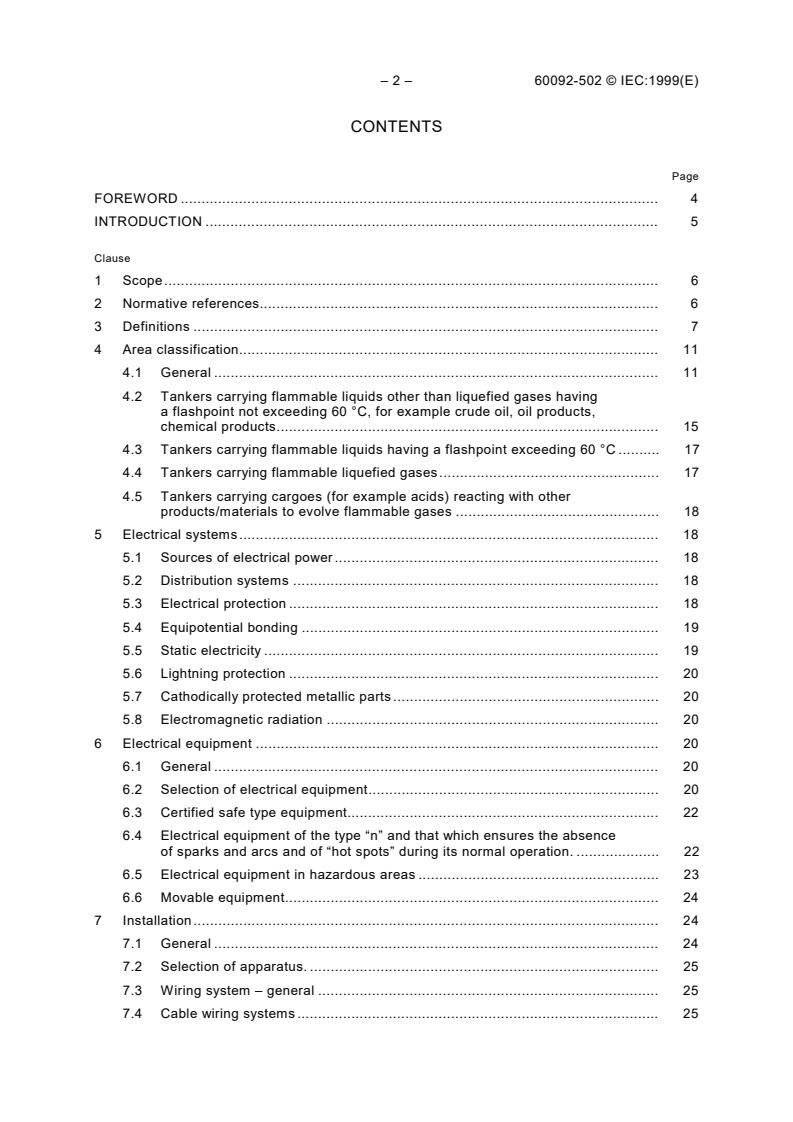
– 2 – 60092-502 © IEC:1999(E)
CONTENTS
Page
FOREWORD . 4
INTRODUCTION . 5
Clause
1 Scope. 6
2 Normative references. 6
3 Definitions. 7
4 Area classification. 11
4.1 General. 11
4.2 Tankers carrying flammable liquids other than liquefied gases having
a flashpoint not exceeding 60 °C, for example crude oil, oil products,
chemical products. 15
4.3 Tankers carrying flammable liquids having a flashpoint exceeding 60 °C . 17
4.4 Tankers carrying flammable liquefied gases. 17
4.5 Tankers carrying cargoes (for example acids) reacting with other
products/materials to evolve flammable gases . 18
5 Electrical systems. 18
5.1 Sources of electrical power . 18
5.2 Distribution systems. 18
5.3 Electrical protection. 18
5.4 Equipotential bonding. 19
5.5 Static electricity. 19
5.6 Lightning protection. 20
5.7 Cathodically protected metallic parts . 20
5.8 Electromagnetic radiation. 20
6 Electrical equipment. 20
6.1 General. 20
6.2 Selection of electrical equipment. 20
6.3 Certified safe type equipment. 22
6.4 Electrical equipment of the type “n” and that which ensures the absence
of sparks and arcs and of “hot spots” during its normal operation. . 22
6.5 Electrical equipment in hazardous areas . 23
6.6 Movable equipment. 24
7 Installation. 24
7.1 General. 24
7.2 Selection of apparatus. . 25
7.3 Wiring system – general . 25
7.4 Cable wiring systems . 25
60092-502 © IEC:1999(E) – 3 –
7.5 Connection of cables . 25
7.6 Cable joints. 25
8 Ventilation and pressurisation . 26
8.1 General. 26
8.2 Design principles. 27
8.3 Ventilation related to area classification . 27
8.4 Protection by over-pressure . 27
9 Inspection and maintenance. 29
9.1 General. 29
9.2 Inspection and testing. 29
9.3 Isolation of apparatus . 29
9.4 Maintenance. 29
9.5 Qualifications of personnel. 29
10 Documentation. 29
10.1 Area classification. 29
10.2 Equipment. 30
10.3 Installation. 31
10.4 Maintenance. 32
10.5 Administration of the documentation . 32
Annexes
A (informative) Examples of hazardous area classification – Basic principles . 33
B (informative) Examples of hazardous area classification – Tankers carrying flammable
liquids other than liquefied gases having a flashpoint not exceeding 60 °C,
for example, crude oil, oil products, chemical products. 37
C (informative) Examples of hazardous area classification – Tankers carrying flammable
liquids having a flashpoint exceeding 60 °C – Unheated cargoes
and cargoes heated to temperature (TH) below, and not within 15 °C of,
their flashpoint (FP). . 40
D (informative) Examples of hazardous area classification – Tankers carrying flammable
liquefied gases . 41
E (informative) Examples of hazardous area classification – Tanker carrying cargoes
(for example acids) reacting with other products/materials to evolve
flammable gases . 43
– 4 – 60092-502 © IEC:1999(E)
INTERNATIONAL ELECTROTECHNICAL COMMISSION
____________
ELECTRICAL INSTALLATIONS IN SHIPS –
Part 502: Tankers – Special features
FOREWORD
1) The IEC (International Electrotechnical Commission) is a worldwide organization for standardization comprising
all national electrotechnical committees (IEC National Committees). The object of the IEC is to promote
international co-operation on all questions concerning standardization in the electrical and electronic fields. To
this end and in addition to other activities, the IEC publishes International Standards. Their preparation is
entrusted to technical committees; any IEC National Committee interested in the subject dealt with may
participate in this preparatory work. International, governmental and non-governmental organizations liaising
with the IEC also participate in this preparation. The IEC collaborates closely with the International Organization
for Standardization (ISO) in accordance with conditions determined by agreement between the two
organizations.
2) The formal decisions or agreements of the IEC on technical matters express, as nearly as possible, an
international consensus of opinion on the relevant subjects since each technical committee has representation
from all interested National Committees.
3) The documents produced have the form of recommendations for international use and are published in the form
of standards, technical reports or guides and they are accepted by the National Committees in that sense.
4) In order to promote international unification, IEC National Committees undertake to apply IEC International
Standards transparently to the maximum extent possible in their national and regional standards. Any
divergence between the IEC Standard and the corresponding national or regional standard shall be clearly
indicated in the latter.
5) The IEC provides no marking procedure to indicate its approval and cannot be rendered responsible for any
equipment declared to be in conformity with one of its standards.
6) Attention is drawn to the possibility that some of the elements of this International Standard may be the subject
of patent rights. The IEC shall not be held responsible for identifying any or all such patent rights.
International Standard IEC 60092-502 has been prepared by IEC technical committee 18:
Electrical installations of ships and of mobile and fixed offshore units.
This fifth edition cancels and replaces the fourth edition published in 1994.
The text of this standard is based on the following documents:
FDIS Report on voting
18/853/FDIS 18/862/RVD
Full information on the voting for the approval of this standard can be found in the report on
voting indicated in the above table.
Annexes A, B, C, D and E are for information only.
A bilingual version of this standard may be issued at a later date.
60092-502 © IEC:1999(E) – 5 –
INTRODUCTION
This standard introduces the zonal concept for hazardous area classification and permits the
use of earthed distribution systems.
It should be noted, however, that it is not in full concurrence with the requirements for electrical
)
installations in hazardous areas given in Clause 10.2 of the IBC Code and Clause 10.2 of the
)
IGC Code and the system earthing requirements of Regulations II-1/45.4.1 and 45.4.3 of
)
SOLAS .
Until the International Maritime Organization has decided upon corresponding amendments to
the Codes and to SOLAS, users of this standard are advised to ask the appropriate authority to
consider equivalence in accordance with the “Equivalents” provisions of Clause 1.4 of the IBC
Code and Clause 1.4 of the IGC Code and Regulation I/5 of SOLAS.
__________
)
International Code for the Construction and Equipment of Ships Carrying Dangerous Chemicals in Bulk (1994
edition).
)
International Code for the Construction and Equipment of Ships Carrying Liquefied Gases in Bulk (1993 edition).
)
SOLAS – the International Convention for the Safety of Life at Sea, 1974, and its Protocol of 1978
(Consolidated edition, 1997).
– 6 – 60092-502 © IEC:1999(E)
ELECTRICAL INSTALLATIONS IN SHIPS –
Part 502: Tankers – Special features
1 Scope
This part of IEC 60092 deals with the electrical installations in tankers carrying liquids which
are flammable, either inherently, or due to their reaction with other substances, or flammable
liquefied gases.
The requirements in other parts of IEC 60092 also apply to tankers, unless otherwise
mentioned in this standard.
2 Normative references
The following normative documents contain provisions which, through reference in this text,
constitute provisions of this part of IEC 60092. At the time of publication, the editions indicated
were valid. All normative documents are subject to revision, and parties to agreements based
on this part of IEC 60092 are encouraged to investigate the possibility of applying the most
recent editions of the normative documents indicated below. Members of IEC and ISO maintain
registers of currently valid International Standards.
IEC 60050(426):1990, International Electrotechnical Vocabulary (IEV) – Chapter 426: Electrical
apparatus for explosive atmospheres
IEC 60079-0:1983, Electrical apparatus for explosive gas atmospheres – Part 0: General
requirements
IEC 60079-1:1990, Electrical apparatus for explosive gas atmospheres – Part 1: Construction
and verification test of flameproof enclosures of electrical apparatus
IEC 60079-2:1983, Electrical apparatus for explosive gas atmospheres – Part 2: Electrical
apparatus, type of protection ‘p’
IEC 60079-4:1975, Electrical apparatus for explosive gas atmospheres – Part 4: Method of test
for ignition temperature
IEC 60079-5:1997, Electrical apparatus for explosive gas atmospheres – Part 5: Powder filling ‘q’
IEC 60079-6:1995, Electrical apparatus for explosive gas atmospheres – Part 6: Oil-immersion ‘o’
IEC 60079-7:1990, Electrical apparatus for explosive gas atmospheres – Part 7: Increased
safety ‘e’
IEC 60079-10:1968, Electrical apparatus for explosive gas atmospheres – Part 10:
Classification of hazardous areas
IEC 60079-11:1991, Electrical apparatus for explosive gas atmospheres – Part 11: Intrinsic
safety ‘i’
60092-502 © IEC:1999(E) – 7 –
IEC 60079-12:1978, Electrical apparatus for explosive gas atmospheres – Part 12:
Classification of mixtures of gases or vapours with air according to their maximum experimental
safe gaps and minimum igniting currents
IEC 60079-14:1996, Electrical apparatus for explosive gas atmospheres – Part 14: Electrical
installation in hazardous areas (other than mines)
IEC 60079-15:1987, Electrical apparatus for explosive gas atmospheres – Part 15: Electrical
apparatus with type of protection ‘n’
IEC 60079-17:1990, Electrical apparatus for explosive gas atmospheres – Part 17: Inspection
and maintenance of electrical installations in hazardous areas (other than mines)
IEC 60079-18:1992, Electrical apparatus for explosive gas atmospheres – Part 18:
Encapsulation ‘m’
IEC 60079-19:1993, Electrical apparatus for explosive gas atmospheres – Part 19: Repair and
overhaul for apparatus used in explosive atmospheres (other than mines or explosives)
IEC 60092-101:1994, Electrical installations in ships – Part 101: Definitions and general
requirements
IEC 60092-201:1994, Electrical installations in ships – Part 201: System design – General
IEC 60092-202:1994, Electrical installations in ships – Part 202: System design – Protection
IEC 60092-350:1988, Electrical installations in ships – Part 350: Low-voltage shipboard power
cables – General construction and test requirements
IEC 60092-401:1980, Electrical installations in ships – Part 401: Installation and test of
completed installation
3 Definitions
For the purpose of this part of IEC 60092, the following definitions apply.
3.1
certified safe-type equipment
electrical equipment of a type for which a national or other appropriate authority has carried out
the type verifications and tests necessary to certify the safety of the equipment with regard to
explosion hazard when used in an explosive gas atmosphere
3.2
encapsulation “m”
a type of protection in which the parts which could ignite an explosive atmosphere by either
sparking or heating are enclosed in a compound in such a way that this explosive atmosphere
cannot be ignited [IEC 60078-18, 3.1]
3.3
enclosed space
any space within which, in the absence of artificial ventilation, the ventilation will be limited and
any explosive atmosphere will not be dispersed naturally
– 8 – 60092-502 © IEC:1999(E)
3.4
enclosure
all the walls which surround the live parts of electrical apparatus including doors, covers,
cable entries, rods, spindles and shafts, ensuring the protection of the electrical apparatus
[IEV 426-04-01, modified]
3.5
explosion protected enclosure
enclosure, the mechanical integrity of which is considered essential for, and is examined in
detail for, its certification or acceptance for use in a hazardous area
3.6
explosive limits
3.6.1
lower explosive limit (LEL)
concentration of flammable gas, vapour or mist in air, below which an explosive gas
atmosphere will not be formed [IEV 426-02-09]
3.6.2
upper explosive limit (UEL)
concentration of flammable gas, vapour or mist in air, above which an explosive gas
atmosphere will not be formed [IEV 426-02-10]
3.7
explosive gas atmosphere
mixture with air, under atmospheric conditions, of flammable substances in the form of gas,
vapour or mist, in which, after ignition, combustion spreads throughout the unconsumed
mixture [IEV 426-02-03]
3.8
flameproof enclosure “d”
type of protection of electrical apparatus in which the enclosure will withstand an internal
explosion of a flammable mixture which has penetrated into the interior, without suffering
damage and without causing ignition, through any joints or structural openings in the enclosure,
of an external explosive atmosphere consisting of one or more of the gases or vapours for
which it is designed [IEV 426-06-01]
NOTE – IEC 60079-1 specifies the constructional features and test requirements for apparatus using this method of
protection.
3.9
flammable gas or vapour
gas or vapour which, when mixed with air in certain proportions, will form an explosive gas
atmosphere [IEC 60079-10, 2.14]
3.10
flammable liquid
liquid capable of producing a flammable vapour or mist under any foreseeable operating
conditions [IEC 60079-10. 2.13 modified]
3.11
flammable material
material consisting of flammable gas, vapour, liquid and/or mist [IEC 60079-10, 2.12 modified]
3.12
flammable mist
droplets of flammable liquid, dispersed in air, so as to form an explosive atmosphere
[IEC 60079-10, 2.15]
60092-502 © IEC:1999(E) – 9 –
3.13
flashpoint
lowest liquid temperature at which, under certain standardised conditions, a liquid gives off
vapours in quantity such as to be capable of forming an ignitable vapour/air mixture
[IEV 426-02-14]
NOTE – Differing values of flashpoint may be obtained under open-cup or closed-cup test conditions; for the
purposes of this standard, only the flashpoint obtained under closed-cup conditions is considered.
3.14
gas-tight
attribute of a physical barrier which prevents any significant quantity of flammable gas or
vapour from entering into an adjoining area
3.15
hazardous area
area in which an explosive gas atmosphere is or may be expected to be present, in quantities
such as to require special precautions for the construction, installation and use of electrical
apparatus [IEV 426-03-01]
3.15.1
zone 0
area in which an explosive gas atmosphere is present continuously or is present for long
periods [IEV 426-03-03]
3.15.2
zone 1
area in which an explosive gas atmosphere is likely to occur in normal operation
[IEV 426-03-04]
3.15.3
zone 2
area in which an explosive gas atmosphere is not likely to occur in normal operation and, if it
does occur, is likely to do so only infrequently and will exist for a short period only
[IEV 426-03-05 modified]
3.16
ignition temperature (of an explosive gas atmosphere)
lowest temperature of a heated surface at which, under specific conditions according to
IEC 60079-4, the ignition of a flammable material in the form of a gas or vapour in mixture with
air will occur [IEV 426-03-01 modified]
3.17
increased safety “e”
type of protection applied to electrical apparatus that does not produce arcs or sparks in
normal service, in which additional measures are applied so as to give increased security
against the possibility of excessive temperatures and the occurrence of arcs and sparks
[IEC 60078-7, 3.1]
NOTE – IEC 60079-7 specifies the constructional features and test requirements for apparatus using this method of
protection.
3.18
intrinsically-safe circuit “i”
circuit in which no spark or any thermal effect produced in the test conditions prescribed (which
include normal operation and specified fault conditions) is capable of causing ignition of a
given explosive gas atmosphere [IEV 426-11-01 modified]
NOTE – IEC 60079-11 specifies the constructional features and test requirements for apparatus using this method
of protection.
– 10 – 60092-502 © IEC:1999(E)
3.19
liquefied gas
A liquid formed by pressurisation and/or cooling of a gas having a vapour pressure exceeding
2,8 bar absolute at a temperature of 37,8 °C
3.20
non-hazardous area
area in which an explosive gas atmosphere is not expected to be present in quantities such as
to require special precautions for the construction, installation and use of electrical apparatus
[IEV 426-03-02]
3.21
oil immersion “o”
type of protection in which the electrical apparatus or parts of the electrical apparatus are
immersed in a protective liquid in such a way that an explosive atmosphere which may be
above the liquid or outside the enclosure cannot be ignited
3.22
open space
space in an open air situation without stagnant areas where vapours are rapidly dispersed by
wind and natural convection. Typical air velocities should rarely be less than 0,5 m/s and
should frequently be above 2 m/s
3.23
opening
any aperture, or door, window or panel not designed to prevent the passage of gas or vapour
3.24
pressurisation “p”
technique of guarding against the ingress of the external atmosphere, which may be explosive,
into an enclosure by maintaining a protective gas therein at a pressure above that of the
external atmosphere [IEC 60079-2, 2.2]
NOTE – IEC 60079-2 gives guidance on the design, construction and use of electrical apparatus protected by this
technique.
3.25
protection “n”
type of protection applied to electrical apparatus such that, in normal operation, it is not
capable of igniting a surrounding explosive gas atmosphere and a fault capable of causing
ignition is not likely to occur [IEC 60079-15, 3.1]
NOTE – IEC 60079-15 specifies the constructional features and test requirements for apparatus using this method
of protection.
3.26
purging
passing of sufficient volume of protective gas through a pressurized enclosure and its ducts
before the application of voltage to the apparatus to reduce any explosive gas atmosphere to a
concentration well below the lower explosive limit [IEV 426-09-03]
3.27
sand-filled apparatus “q”
an apparatus is considered "sand-filled" when all its live parts are entirely embedded in a mass
of powdery material [IEV 426-07-01 modified]
NOTE – IEC 60079-5 specifies the constructional features and test requirements for apparatus using this method of
protection.
60092-502 © IEC:1999(E) – 11 –
3.28
semi-enclosed space
space limited by decks and/or bulkheads in such a manner that the natural conditions of
ventilation in the spaces are notably different from those obtained on open deck
3.29
source of release
point or location from which a gas, vapour, mist or liquid may be released into the atmosphere
so that an explosive atmosphere may be formed under normal operating conditions, for
example valves and flanges in cargo piping systems [IEV 426-03-06 modified]
3.30
tanker
sea-going cargo ship constructed or adapted for the carriage of liquid cargoes in bulk
3.31
ventilation
3.31.1
natural ventilation
movement of air and its replacement with fresh air due to the effects of wind and/or
temperature gradients [IEV 426-03-07]
3.31.2
artificial ventilation
movement of air and its replacement with fresh air by artificial means (for example fans) and
applied to a general area [IEV 426-03-08 modified]
4 Area classification
4.1 General
4.1.1 Basic principles
4.1.1.1 Area classification is a method of analyzing and classifying the areas where explosive
gas atmospheres may occur. The object of the classification is to allow the selection of
electrical apparatus able to be operated safely in these areas. Where it is necessary to use
electrical apparatus in an area in which there may be an explosive gas atmosphere and it is not
possible to eliminate:
a) any possibility of an explosive gas atmosphere occurring around any source of ignition, or,
b) any source of ignition,
then measures shall aim at reducing the likelihood of the occurrence of either or both of the
above factors so that the likelihood of coincidence is so small as to be acceptable.
4.1.1.2 In order to facilitate the selection of appropriate electrical apparatus and the design of
suitable electrical installations, hazardous areas are divided into zones 0, 1 and 2 according to
IEC 60079-10 and the guidance given in this standard.
4.1.1.3 The likelihood of the presence of an explosive gas atmosphere and hence the type of
zone depends mainly on the source of release and rate at which the released substance is
dispersed by natural or artificial ventilation. Pressurisation and other factors such as the
provision of an inert atmosphere may also affect the type of zone.
– 12 – 60092-502 © IEC:1999(E)
4.1.1.4 Area classification shall be carried out at an early stage of planning, before any
construction work starts and the results documented in drawings showing the different zones.
NOTE 1 – Small pockets of non-hazardous areas within a general hazardous area or between hazardous areas
should not be defined, unless such a pocket is a special feature of the design, for example an enclosure protected
by pressurisation. Likewise small pockets of zone 2 should not be defined in or between zone 1 hazardous areas.
NOTE 2 – It is not necessary to determine the hazardous area that would arise from each individual source of
release when this would not influence the overall zone boundary.
NOTE 3 – At completion of design and again at completion of construction, the area classification shown on the
drawings should be reviewed against the actual sources of possible release and any structural changes. If
necessary, modification to drawings and installation should be made.
NOTE 4 – Where any alteration is proposed to cargo containment system, cargo pumping or piping arrangements or
ventilation arrangements, the impact on area classification should be reviewed. If necessary, modifications to
drawings and installation should be made, and a further review, together with any necessary modification, carried
out upon completion of the alteration.
4.1.1.5 Spaces and areas not mentioned in this standard, but considered by the appropriate
authority, as a result of the application of the principles of IEC 60079-10, to present an
equivalent risk of the presence of an explosive gas atmosphere as defined for zones 0, 1
and 2, shall be considered as these zones.
4.1.1.6 Examples of hazardous area classification are given in annexes A to E.
4.1.2 Substances capable of creating an explosive gas atmosphere
A hazardous area may arise from the presence of any of the following:
a) flammable liquid having a flashpoint (closed-cup test) not exceeding 60 °C;
b) flammable liquid having a flashpoint exceeding 60 °C, heated or raised by ambient
conditions to a temperature within 15 °C of its flashpoint;
c) flammable gas, in gaseous or liquid state.
d) substances (for example acids) reacting with other products/materials to evolve flammable
gases.
4.1.3 Sources of release
The following are examples of some sources of release:
a) venting and other openings to cargo tanks, slop tanks and cargo piping;
b) piping systems and equipment, containing liquid or gas, having flanged joints or glands or
other openings through which leakage may occur under normal operating conditions.
4.1.4 Separation by gastight boundaries
4.1.4.1 A space separated by gastight boundaries from a hazardous area may be classified
as zones 0, 1, 2, or considered as non-hazardous, taking into account the sources of release
inside that space and its conditions of ventilation as indicated in 8.3, in accordance with
table 1.
A bulkhead or other such boundary having penetrations, for example a bolted, gasketted plate
or cargo pump drive shaft seal, may be considered to remain gastight, provided that the sealing
and securing arrangements and provisions to prevent opening other than under gas-free
conditions, are acceptable to the appropriate authority.
4.1.4.2 Tanks, continuous fully welded pipes without flanges, joints, glands, etc., containing
liquid or gas are not considered as sources of release, although account may need to be taken
of the possibility of an escape of gas, vapour, mist or liquid under abnormal conditions, for
example seepage through a cargo tank bulkhead.
60092-502 © IEC:1999(E) – 13 –
Table 1 – Spaces separated by one gastight boundary
from the zones mentioned in the column
1)
Without source of release
With source of release
2) 2)
Without ventilation Without ventilation
With ventilation With ventilation
Zone 0 Zone 1 Zone 0 Zone 2 Zone 1
for example cargo for example cofferdams for example ballast for example cofferdam,
pump room with cargo pipe flanges pump rooms adjacent void space
to cargo tanks
(see annex A, (see annex A, (see annex A, (see annex A,
clause A.1) clause A.4) clause A.7) clause A.10)
Zone 1 zone 2 zone 1
for example rooms with for example rooms with Non-hazardous areas Non-hazardous areas
cargo pipe flanges, cargo pipe flanges
(see annex A, (see annex A, (see annex A (see annex A,
clause A.2) clause A.5) clause A.8) clause A.11)
Zone 2 Zone 2 Zone 1
for example rooms with for example rooms with Non-hazardous areas Non-hazardous areas
cargo pipe flanges cargo pipe flanges
(see annex A, (see annex A, (see annex A, (see annex A,
clause A.3) clause A.6) clause A.9) clause A.12)
1)
The following are examples of some sources of release:
– venting and other openings to cargo tanks, slop tanks and cargo piping;
– seals of cargo pumps, cargo compressors and process equipment;
– seals of valves and flanges and other connections and pipe fittings.
2)
Where the area classification of a space is dependent upon its ventilation, the arrangements shall be such that
discontinuities in ventilation are not expected to occur for long periods and there is no accumulation of gas or
vapour in the vicinity of any source of release, or where electrical equipment is installed.
4.1.5 Openings, access and ventilation conditions affecting the extent of hazardous
area
See table 2 and clause 8.
4.1.5.1 Access doors or other openings shall not be provided between an area intended to be
considered as non-hazardous and a hazardous area, or between a space intended to be
considered as zone 2 and a zone 1 space except where required for operational reasons.
Where access doors or other openings are provided for operational reasons, 4.1.5.2, 4.1.5.3,
4.1.5.4 or 4.1.5.5 apply.
4.1.5.2 For spaces where the access doors or similar means of access are closable and
capable of maintaining an over-pressure, the following provisions apply:
a) An enclosed space with access to any zone 1 location may be considered as zone 2 if:
– the space is ventilated by over-pressure in accordance with 8.4, and
– the access is fitted with a self-closing door without holding back arrangements, capable
of maintaining the over-pressure, opening into the zone 2 space (if the door is hinged).
b) An enclosed space with access to any zone 2 location may be considered non-hazardous if:
– the space is ventilated by over-pressure in accordance with 8.4, and
– the access is fitted with a self-closing door without holding back arrangements, capable
of maintaining the over-pressure, opening into the non-hazardous space (if the door is
hinged).
– 14 – 60092-502 © IEC:1999(E)
c) An enclosed space with access to any zone 1 location may be considered non-hazardous if:
– the access is fitted with two doors forming an air-lock, both self-closing and without
holding back arrangements, capable of maintaining the over-pressure in each of the
spaces, and
– the space and the air-lock are ventilated by over-pressure in accordance with 8.4.
d) Notices, warning that the doors are to be kept closed, are to be fitted whenever any of the
above arrangements are adopted.
4.1.5.3 For spaces where the access doors or similar means of access are closable and gas-
tight, the following provisions apply:
a) an enclosed space with access to any zone 1 location may be considered as zone 2 if:
– the access is fitted with two doors forming an air-lock, both gas-tight, self-closing and
without holding back arrangements;
– the space and the air-lock have artificial ventilation in accordance with 8.3, and
b) an enclosed space with access to any zone 2 location may be considered non-hazardous if:
– the access is fitted with two doors forming an air-lock, both gas-tight, self-closing and
without holding back arrangements;
– the space and the air-lock have artificial ventilation in accordance with 8.3, and
c) notices, warning that the doors are to be kept closed, are to be fitted whenever any of the
above arrangements is adopted.
4.1.5.4 Enclosed spaces with ventilation or semi-enclosed spaces with openings or doors not
forming an air-lock to a hazardous area shall be designated as the same hazardous zone as
the area in which the openings or doors are located.
4.1.5.5 Enclosed spaces without ventilation with openings or doors to a hazardous area shall
be designated as the same hazardous zone as the area in which the openings or doors are
located, or as a more hazardous zone.
4.1.5.6 Certain areas and rooms may, if so indicated by the circumstances, be classified as a
more hazardous zone than set out in these examples.
4.1.5.7 In the event of loss of the protection by over-pressure or loss of ventilation the
requirements of 8.4 or 8.3, respectively, shall be complied with.
60092-502 © IEC:1999(E) – 15 –
Table 2 – Spaces without source of release and separated by door(s)
from the zones mentioned in the column
Protected by over-pressure Not protected by over-pressure Not protected by over-
relative to the surrounding relative to the surrounding pressure relative to the
hazardous area hazardous area but artificially surrounding hazardous area
ventilated and not artificially ventilated
Separated by Separated by Separated by Separated by Separated by Separated by
1) 2) 5) 5)
one gastight two gastight
one door two doors one door two doors
3) 4)
door doors
Zone 2 Non-hazardous Zone 1 Zone 2 Zone 1 Zone 1
Zone 1
area
(see annex A, (see annex A, (see annex A, (see annex A, (see annex A, (see annex A,
clause A.13) clause A.15) clause A.16) clause A.18) clause A.20) clause A.20)
Zone 2 Non-hazardous Non-hazardous Zone 2 Non-hazardous Zone 2 Zone 2
area area area
(see annex A, (one door is (see annex A, (see annex A, (see annex A, (see annex A,
clause A.15) sufficient) clause A.17) clause A.19) clause A.21) clause A.21)
1)
Door capable of maintaining the over-pressure.
2)
Two doors forming an air-lock capable of maintaining the over-pressure.
3)
Watertight doors or fire doors class A are considered as gastight.
4)
Two gastight doors forming a ventilated air-lock.
5)
Any type of doors; see 4.1.5.5.
4.2 Tankers carrying flammable liquids other than liquefied gases having a flashpoint
not exceeding 60 °C, for example crude oil, oil products, chemical products
Hazardous areas which normally apply on these types of tankers include the following, for
which informative examples are given in annex B.
4.2.1 Hazardous areas zone 0
The interiors of cargo tanks, slop tanks, any pipework of pressure-relief or other venting
systems for cargo and slop tanks, pipes and equipment containing the cargo or developing
flammable gases or vapours.
4.2.2 Hazardous areas zone 1
4.2.2.1 Void spaces adjacent to, above or below integral cargo tanks
4.2.2.2 Hold spaces containing independent cargo tanks
4.2.2.3 Cofferdams and permanent (for example, segregated) ballast tanks adjacent to cargo
tanks
4.2.2.4 Cargo pump rooms
4.2.2.5 Enclosed or semi-enclosed spaces, immediately above cargo tanks (for example,
between decks) or having bulkheads above and in line with cargo tank bulkheads, unless
protected by a diagonal plate acceptable to the appropriate authority.
4.2.2.6 Spaces, other than cofferdam, adjacent to and below the top of a cargo tank (for
example, trunks, passageways and hold)
– 16 – 60092-502 © IEC:1999(E)
4.2.2.7 Areas on open deck, or semi-enclosed spaces on open deck, within 3 m of any cargo
tank outlet, gas or vapour outlet (see note), cargo manifold valve, cargo valve, cargo pipe
flange, cargo pump-room ventilation outlets and cargo tank openings for pressure release
provided to permit the flow of small volumes of gas or vapour mixtures caused by thermal
variation.
NOTE – Such areas are, for example, all areas within 3 m of cargo tank hatches, sight ports, tank cleaning
openings, ullage openings, sounding pipes, cargo vapour outlets.
4.2.2.8 Areas on open deck, or semi-enclosed spaces on open deck above and in the vicinity
of any cargo gas outlet intended for the passage of large volumes of gas or vapour mixture
during cargo loading and ballasting or during discharging, within a vertical cylinder of unlimited
height and 6 m radius centred upon the centre of the outlet, and within a hemisphere of 6 m
radius below the outlet.
4.2.2.9 Areas on open deck, or semi-enclosed spaces on open deck, within 1,5 m of cargo
pump room entrances, cargo pump room ventilation inlet, openings into cofferdams or other
zone 1 spaces.
4.2.2.10 Areas on open deck within spillage coamings surrounding cargo manifold valves and
3 m beyond these, up to a height of 2,4 m above the deck.
4.2.2.11 Areas on open deck over all cargo tanks (including all ballast tanks within the cargo
tank area) where structures are restricting the natural ventilation and to the full breadth of the
ship plus 3 m fore and aft of the forward-most and aft-most cargo tank bulkhead, up to a height
of 2,4 m above the deck.
4.2.2.12 Compartments for cargo hoses.
4.2.2.13 Enclosed or semi-enclosed spaces in which pipes containing cargoes are located.
4.2.3 Hazardous areas zone 2
4.2.3.1 Areas of 1,5 m surrounding open or semi-enclosed spaces of zone 1 as specified
in 4.2.2, if not otherwise specified in this standard .
4.2.3.2 Spaces 4 m beyond the cylinder and 4 m beyond the sphere defined in 4.2.2.8.
4.2.3.3 The spaces forming an air-lock as defined in 4.1.5.2.c).
4.2.3.4 Areas on open deck extending to the coamings fitted to keep any spills on deck and
away from the accommodation and service areas and 3 m beyond these up to a height of 2,4 m
above the deck.
4.2.3.5 Areas on open deck over all cargo tanks (including all ballast tanks within the cargo
tank area) where unrestricted natural ventilation is guaranteed and to the full breadth of the
ship plus 3 m fore and aft of the forward-most and aft-most cargo tank bulkhead, up to a height
of 2,4 m above the deck surrounding open or semi-enclosed spaces of zone 1
4.2.3.6 Spaces forward of the open deck areas to which reference is made in 4.2.2.11
and 4.2.3.5, below the level of the main deck, and having an opening on to the main deck or at
a level less than 0,5 m above the main deck, unless:
a) the entrances to such spaces do not face the cargo tank area and, together with all other
openings to the spaces, including ventilating system inlets and exhausts, are situated at
least 5 m from the foremost cargo tank and at least 10 m measured horizontally from any
cargo tank outlet or gas or vapour outlet; and
b) the spaces are mechanically ventilated.
60092-502 © IEC:1999(E) – 17 –
4.3 Tankers carrying flammable liquids having a flashpoint exceeding 60 °C
4.3.1 Unheated cargoes and cargoes heated to temperature (T ) below, and not within
H
15 °C, of their flashpoint (FP)
Hazardous areas which normally apply on these types of tankers include the following, for
which informative examples are given in annex C.
4.3.1.1 Hazardous areas zone 2
The interiors of cargo tanks, slop tanks, any pipework of pressure-relief or other venting
systems for cargo and slop tanks, pipes and equipment containing the cargo.
4.3.2 Cargoes heated to temperature (T ) above their flashpoint (FP) and cargoes
H
heated to temperature within 15 °C of their flashpoint: T ≥ FP –15 °C
H
4.3.2.1 The requirements of 4.2 are applicable.
4.4 Tankers carrying flammable liquefied gases
Hazardous areas which normally apply on these types of tankers include the following, for
which informative examples are given in annex D.
4.4.1 Hazardous areas zone 0
Areas as specified in 4.2.1, interbarrier spaces and, only where the cargo tank requires a
secondary barrier, in 4.2.2.2.
4.4.2 Hazardous areas zone 1
4.4.2.1 Areas as specified in 4.2.2.1, 4.2.2.2, 4.2.2.3, 4.2.2.4 and cargo compressor rooms,
4.2.2.5, 4.2.2.6, 4.2.2.7 and cargo compressor room ventilation outlets, 4.2.2.8, 4.2.2.9 and
cargo compressor room entrances or cargo compressor room ventilation inlets, 4.2.2.10,
4.2.2.11, 4.2.2.12 and 4.2.2.13.
4.4.2.2 A space separated from a hold space, where cargo is carried in a cargo tank requiring
a secondary ba
...
Questions, Comments and Discussion
Ask us and Technical Secretary will try to provide an answer. You can facilitate discussion about the standard in here.
Loading comments...