

IEC 60331-11:1999
(Main)Tests for electric cables under fire conditions - Circuit integrity - Part 11: Apparatus - Fire alone at a flame temperature of at least 750 °C
General Information
- Abstract
- Status
- Withdrawn
- Publication Date
- 07-Jul-2009
- Withdrawal Date
- 30-Dec-2024
- Technical Committee
- TC 20 - Electric cables
- Drafting Committee
- WG 18 - TC 20/WG 18
- Current Stage
- WPUB - Publication withdrawn
- Start Date
- 31-Dec-2024
- Completion Date
- 31-Dec-2024
Buy Documents
IEC 60331-11:1999 - Tests for electric cables under fire conditions - Circuit integrity - Part 11: Apparatus - Fire alone at a flame temperature of at least 750 °C
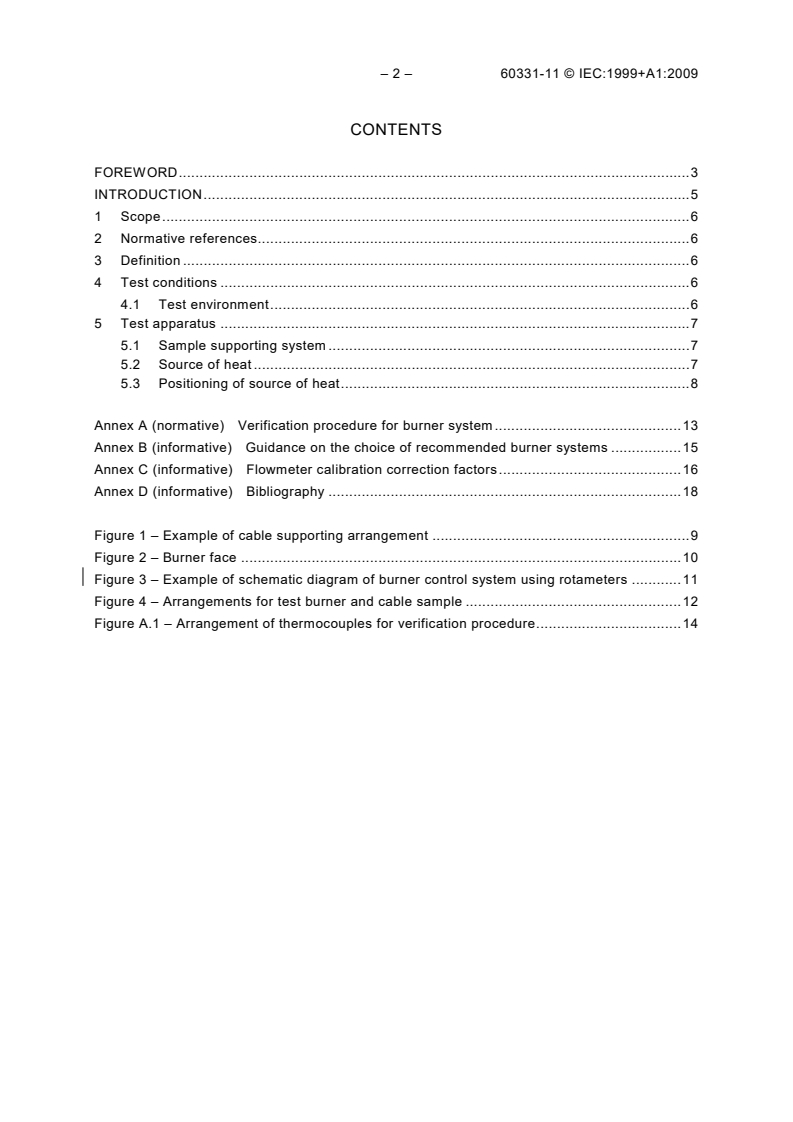
IEC 60331-11:1999+AMD1:2009 CSV - Tests for electric cables under fire conditions - Circuit integrity - Part 11: Apparatus - Fire alone at a flame temperature of at least 750 °C Released:7/8/2009
Overview
IEC 60331-11:1999 is an internationally recognized standard published by the International Electrotechnical Commission (IEC) that specifies the test apparatus for evaluating electric cables under fire conditions. The focus of this part, titled "Tests for electric cables under fire conditions - Circuit integrity - Part 11: Apparatus - Fire alone at a flame temperature of at least 750 °C," is to define the equipment and method for testing the circuit integrity of cables exposed to a controlled flame at a minimum temperature of 750 °C. This standard ensures cables maintain functionality during fire exposure, crucial for safety-critical installations.
Key Topics
Circuit Integrity Testing
The standard defines circuit integrity as the ability of an electrical cable to continue operating as intended while exposed to a specified flame source for a designated period. This ensures the cable remains functional during fire events.Test Apparatus Specification
IEC 60331-11 specifies the design and setup for the test apparatus, including:- A propane gas burner with a nominal face length of 500 mm and a flame temperature of at least 750 °C.
- A ribbon-type burner featuring a Venturi mixer to ensure stable flame characteristics.
- Positioning and support mechanisms for the cable sample to prevent interference and allow thermal expansion.
Sample Support System
- The cable is held horizontally on metal supporting rings, spaced 300 mm apart with additional supports for smaller cables.
- Supports must be earthed to ensure electrical safety and accurate test results.
Test Environment Controls
The tests are conducted within a ventilated chamber maintaining an ambient temperature between 5°C and 40°C. Proper exhaust and ventilation systems are required to safely clear noxious gases produced during testing.Burner Verification
Annex A of the standard details the verification procedure for the burner system and control to ensure consistent flame temperature and output throughout testing.
Applications
Fire Safety Engineering
IEC 60331-11 is essential for engineers and safety professionals tasked with selecting and certifying electric cables for installation in fire-prone environments such as tunnels, high-rise buildings, industrial plants, and transport infrastructure.Cable Manufacturers
Producers of power, control, data, and optical fiber cables use this standard to verify product compliance with fire performance requirements, thereby demonstrating reliability and safety under fire exposure conditions.Compliance and Certification Bodies
Regulatory and certifying organizations utilize this standard to assess and approve cables for use in critical applications where circuit integrity during fire conditions is mandated.Research and Development
R&D teams leverage the guidelines to innovate and improve flame-resistant cable designs, focusing on enhancing performance under extreme conditions.
Related Standards
IEC 60331 Series
Part 21, 23, and 25 complement Part 11 by providing procedural requirements for testing cables of different types and voltage ratings under fire-alone conditions.IEC 61034-1
Provides guidance on suitable testing chambers and ventilation requirements for fire testing of cables, ensuring standardized environmental conditions.IEC 60584-1
Covers thermocouple reference tables used for accurate temperature measurement in fire testing setups.IEC Guide 104
Offers principles for preparing safety publications, underpinning the classification of this document as a group safety publication.
Practical Value
Implementing IEC 60331-11 ensures that electrical installations maintain circuit integrity in the event of a fire, reducing risk of failure and enhancing life safety. The standard provides a consistent test methodology, facilitating product evaluation, regulatory compliance, and international acceptance. By adhering to IEC 60331-11, stakeholders benefit from:
- Reliable assessment of cable fire resistance at a critical temperature threshold (750 °C).
- Standardized burner apparatus design for reproducibility of tests across laboratories.
- Clear guidance on test environment and safety precautions, minimizing hazards during testing.
- Framework to support improvements in cable design and fire safety performance.
This standard is pivotal in safeguarding electrical systems in fire emergencies by assuring that cables can maintain operational integrity, thereby protecting infrastructure, property, and lives.
Relations
- Effective Date
- 25-Aug-2026
- Effective Date
- 25-Aug-2026
- Effective Date
- 25-Aug-2026
- Effective Date
- 10-Feb-2026
- Effective Date
- 10-Feb-2026
- Effective Date
- 05-Sep-2023
Buy Documents
IEC 60331-11:1999 - Tests for electric cables under fire conditions - Circuit integrity - Part 11: Apparatus - Fire alone at a flame temperature of at least 750 °C
IEC 60331-11:1999+AMD1:2009 CSV - Tests for electric cables under fire conditions - Circuit integrity - Part 11: Apparatus - Fire alone at a flame temperature of at least 750 °C Released:7/8/2009
Get Certified
Connect with accredited certification bodies for this standard

IMQ S.p.A. (Certification)
Italian electrical product certification.

SLG Prüf- und Zertifizierungs GmbH
German testing and certification body.

UL Solutions
Global safety science company with testing, inspection and certification.
Sponsored listings
Frequently Asked Questions
IEC 60331-11:1999 is a standard published by the International Electrotechnical Commission (IEC). Its full title is "Tests for electric cables under fire conditions - Circuit integrity - Part 11: Apparatus - Fire alone at a flame temperature of at least 750 °C". This standard covers: Tests for electric cables under fire conditions - Circuit integrity - Part 11: Apparatus - Fire alone at a flame temperature of at least 750 °C
Tests for electric cables under fire conditions - Circuit integrity - Part 11: Apparatus - Fire alone at a flame temperature of at least 750 °C
IEC 60331-11:1999 is classified under the following ICS (International Classification for Standards) categories: 13.220.40 - Ignitability and burning behaviour of materials and products; 29.020 - Electrical engineering in general; 29.060.20 - Cables. The ICS classification helps identify the subject area and facilitates finding related standards.
IEC 60331-11:1999 has the following relationships with other standards: It is inter standard links to CEN/TR 14819-2:2005, CEN/TR 14819-1:2004, EN ISO 20257-1:2020, EN 60794-1-1:2002, HD 60364-5-559:2012, IEC 60331-11:1999/AMD1:2009. Understanding these relationships helps ensure you are using the most current and applicable version of the standard.
IEC 60331-11:1999 is available in PDF format for immediate download after purchase. The document can be added to your cart and obtained through the secure checkout process. Digital delivery ensures instant access to the complete standard document.
Standards Content (Sample)
NORME
CEI
INTERNATIONALE
IEC
60331-11
INTERNATIONAL
Première édition
STANDARD
First edition
1999-04
PUBLICATION GROUPÉE DE SÉCURITÉ
GROUP SAFETY PUBLICATION
Essais de câbles électriques soumis au feu –
Intégrité des circuits –
Partie 11:
Appareillage – Incendie seul avec flamme
à une température d’au moins 750 °C
Tests for electric cables under fire conditions –
Circuit integrity –
Part 11:
Apparatus – Fire alone at a flame temperature
of at least 750 °C
Numéro de référence
Reference number
CEI/IEC 60331-11:1999
Numéros des publications Numbering
Depuis le 1er janvier 1997, les publications de la CEI As from 1 January 1997 all IEC publications are
sont numérotées à partir de 60000. issued with a designation in the 60000 series.
Publications consolidées Consolidated publications
Les versions consolidées de certaines publications de Consolidated versions of some IEC publications
la CEI incorporant les amendements sont disponibles. including amendments are available. For example,
Par exemple, les numéros d’édition 1.0, 1.1 et 1.2 edition numbers 1.0, 1.1 and 1.2 refer, respectively, to
indiquent respectivement la publication de base, la the base publication, the base publication
publication de base incorporant l’amendement 1, et la incorporating amendment 1 and the base publication
publication de base incorporant les amendements 1 incorporating amendments 1 and 2.
et 2.
Validité de la présente publication Validity of this publication
Le contenu technique des publications de la CEI est The technical content of IEC publications is kept under
constamment revu par la CEI afin qu'il reflète l'état constant review by the IEC, thus ensuring that the
actuel de la technique. content reflects current technology.
Des renseignements relatifs à la date de Information relating to the date of the reconfirmation of
reconfirmation de la publication sont disponibles dans the publication is available in the IEC catalogue.
le Catalogue de la CEI.
Les renseignements relatifs à des questions à l’étude et Information on the subjects under consideration and
des travaux en cours entrepris par le comité technique work in progress undertaken by the technical
qui a établi cette publication, ainsi que la liste des committee which has prepared this publication, as well
publications établies, se trouvent dans les documents ci- as the list of publications issued, is to be found at the
dessous: following IEC sources:
• «Site web» de la CEI* • IEC web site*
• Catalogue des publications de la CEI • Catalogue of IEC publications
Publié annuellement et mis à jour régulièrement Published yearly with regular updates
(Catalogue en ligne)* (On-line catalogue)*
• Bulletin de la CEI • IEC Bulletin
Disponible à la fois au «site web» de la CEI* et Available both at the IEC web site* and as a
comme périodique imprimé printed periodical
Terminologie, symboles graphiques Terminology, graphical and letter
et littéraux symbols
En ce qui concerne la terminologie générale, le lecteur For general terminology, readers are referred to
se reportera à la CEI 60050: Vocabulaire Electro- IEC 60050: International Electrotechnical Vocabulary
technique International (VEI). (IEV).
Pour les symboles graphiques, les symboles littéraux For graphical symbols, and letter symbols and signs
et les signes d'usage général approuvés par la CEI, le approved by the IEC for general use, readers are
lecteur consultera la CEI 60027: Symboles littéraux à referred to publications IEC 60027: Letter symbols to
utiliser en électrotechnique, la CEI 60417: Symboles be used in electrical technology, IEC 60417: Graphical
graphiques utilisables sur le matériel. Index, relevé et symbols for use on equipment. Index, survey and
compilation des feuilles individuelles, et la CEI 60617: compilation of the single sheets and IEC 60617:
Symboles graphiques pour schémas. Graphical symbols for diagrams.
* Voir adresse «site web» sur la page de titre. * See web site address on title page.
NORME
CEI
INTERNATIONALE
IEC
60331-11
INTERNATIONAL
Première édition
STANDARD
First edition
1999-04
PUBLICATION GROUPÉE DE SÉCURITÉ
GROUP SAFETY PUBLICATION
Essais de câbles électriques soumis au feu –
Intégrité des circuits –
Partie 11:
Appareillage – Incendie seul avec flamme
à une température d’au moins 750 °C
Tests for electric cables under fire conditions –
Circuit integrity –
Part 11:
Apparatus – Fire alone at a flame temperature
of at least 750 °C
IEC 1999 Droits de reproduction réservés Copyright - all rights reserved
Aucune partie de cette publication ne peut être reproduite ni No part of this publication may be reproduced or utilized in
utilisée sous quelque forme que ce soit et par aucun any form or by any means, electronic or mechanical,
procédé, électronique ou mécanique, y compris la photo- including photocopying and microfilm, without permission in
copie et les microfilms, sans l'accord écrit de l'éditeur. writing from the publisher.
International Electrotechnical Commission 3, rue de Varembé Geneva, Switzerland
Telefax: +41 22 919 0300 e-mail: inmail@iec.ch IEC web site http: //www.iec.ch
CODE PRIX
Commission Electrotechnique Internationale
PRICE CODE Q
International Electrotechnical Commission
Pour prix, voir catalogue en vigueur
For price, see current catalogue
– 2 – 60331-11 © CEI:1999
SOMMAIRE
Pages
AVANT-PROPOS . 4
INTRODUCTION .6
Articles
1 Domaine d'application . 8
2 Références normatives. 8
3 Définition . 8
4 Conditions d'essai . 8
4.1 Environnement de l’essai . 8
5 Dispositif d'essai . 10
5.1 Système de support de l'échantillon. 10
5.2 Source de chaleur . 10
5.3 Positionnement de la source de chaleur . 12
Annexe A (normative) Procédure de vérification du système de brûleur . 22
Annexe B (informative) Guide relatif au choix des systèmes de brûleur recommandés. 26
Annexe C (informative) Facteurs de correction de l'étalonnage du débitmètre . 28
Annexe D (informative) Bibliographie . 32
Figure 1 – Exemple de système de support du câble. 14
Figure 2 – Face avant du brûleur . 16
Figure 3 – Exemple de schéma de montage des systèmes de contrôle du brûleur . 18
Figure 4 – Disposition du brûleur d'essai et de l'échantillon du câble à l'essai. 20
Figure A.1 – Disposition des thermocouples pour la procédure de vérification . 24
60331-11 © IEC:1999 – 3 –
CONTENTS
Page
FOREWORD . 5
INTRODUCTION .7
Clause
1 Scope . 9
2 Normative references . 9
3 Definition . 9
4 Test conditions. 9
4.1 Test environment . 9
5 Test apparatus . 11
5.1 Sample supporting system . 11
5.2 Source of heat . 11
5.3 Positioning of source of heat . 13
Annex A (normative) Verification procedure for burner system. 23
Annex B (informative) Guidance on the choice of recommended burner systems. 27
Annex C (informative) Flowmeter calibration correction factors. 29
Annex D (informative) Bibliography . 33
Figure 1 – Example of cable supporting arrangement . 15
Figure 2 – Burner face .17
Figure 3 – Example of schematic diagram of burner control systems . 19
Figure 4 – Arrangements for test burner and cable sample. 21
Figure A.1 – Arrangement of thermocouples for verification procedure . 25
– 4 – 60331-11 © CEI:1999
COMMISSION ÉLECTROTECHNIQUE INTERNATIONALE
–––––––––––
ESSAIS DE CÂBLES ÉLECTRIQUES SOUMIS AU FEU –
INTÉGRITÉ DES CIRCUITS –
Partie 11: Appareillage – Incendie seul avec flamme
à une température d'au moins 750 °C
AVANT-PROPOS
1) La CEI (Commission Electrotechnique Internationale) est une organisation mondiale de normalisation composée
de l'ensemble des comités électrotechniques nationaux (Comités nationaux de la CEI). La CEI a pour objet de
favoriser la coopération internationale pour toutes les questions de normalisation dans les domaines de
l'électricité et de l'électronique. A cet effet, la CEI, entre autres activités, publie des Normes internationales.
Leur élaboration est confiée à des comités d'études, aux travaux desquels tout Comité national intéressé par le
sujet traité peut participer. Les organisations internationales, gouvernementales et non gouvernementales, en
liaison avec la CEI, participent également aux travaux. La CEI collabore étroitement avec l'Organisation
Internationale de Normalisation (ISO), selon des conditions fixées par accord entre les deux organisations.
2) Les décisions ou accords officiels de la CEI concernant les questions techniques représentent, dans la mesure
du possible un accord international sur les sujets étudiés, étant donné que les Comités nationaux intéressés
sont représentés dans chaque comité d’études.
3) Les documents produits se présentent sous la forme de recommandations internationales. Ils sont publiés
comme normes, rapports techniques ou guides et agréés comme tels par les Comités nationaux.
4) Dans le but d'encourager l'unification internationale, les Comités nationaux de la CEI s'engagent à appliquer de
façon transparente, dans toute la mesure possible, les Normes internationales de la CEI dans leurs normes
nationales et régionales. Toute divergence entre la norme de la CEI et la norme nationale ou régionale
correspondante doit être indiquée en termes clairs dans cette dernière.
5) La CEI n’a fixé aucune procédure concernant le marquage comme indication d’approbation et sa responsabilité
n’est pas engagée quand un matériel est déclaré conforme à l’une de ses normes.
6) L’attention est attirée sur le fait que certains des éléments de la présente Norme internationale peuvent faire
l’objet de droits de propriété intellectuelle ou de droits analogues. La CEI ne saurait être tenue pour
responsable de ne pas avoir identifié de tels droits de propriété et de ne pas avoir signalé leur existence.
La Norme internationale CEI 60331-11 a été établie par le sous-comité 20C: Caractéristiques
de combustion des câbles électriques, du comité d'études 20 de la CEI: Câbles électriques.
Cette première édition de la CEI 60331-11, ainsi que celle de la CEI 60331-21, annulent et
remplacent la première édition de la CEI 60331 publiée en 1970. Cette édition constitue une
révision technique.
Elle a le statut d'une publication groupée de sécurité conformément au Guide CEI 104.
Le texte de cette norme est issu des documents suivants:
FDIS Rapport de vote
20C/81/FDIS 20C/86/RVD
Le rapport de vote indiqué dans le tableau ci-dessus donne toute information sur le vote ayant
abouti à l'approbation de cette norme.
L'annexe A fait partie intégrante de cette norme.
Les annexes B, C et D sont données uniquement à titre d’information.
60331-11 © IEC:1999 – 5 –
INTERNATIONAL ELECTROTECHNICAL COMMISSION
–––––––––––––
TESTS FOR ELECTRIC CABLES UNDER FIRE CONDITIONS –
CIRCUIT INTEGRITY –
Part 11: Apparatus – Fire alone at a flame temperature
of at least 750 °C
FOREWORD
1) The IEC (International Electrotechnical Commission) is a worldwide organization for standardization comprising
all national electrotechnical committees (IEC National Committees). The object of the IEC is to promote
international co-operation on all questions concerning standardization in the electrical and electronic fields. To
this end and in addition to other activities, the IEC publishes International Standards. Their preparation is
entrusted to technical committees; any IEC National Committee interested in the subject dealt with may
participate in this preparatory work. International, governmental and non-governmental organizations liaising
with the IEC also participate in this preparation. The IEC collaborates closely with the International Organization
for Standardization (ISO) in accordance with conditions determined by agreement between the two
organizations.
2) The formal decisions or agreements of the IEC on technical matters express, as nearly as possible, an
international consensus of opinion on the relevant subjects since each technical committee has representation
from all interested National Committees.
3) The documents produced have the form of recommendations for international use and are published in the form
of standards, technical reports or guides and they are accepted by the National Committees in that sense.
4) In order to promote international unification, IEC National Committees undertake to apply IEC International
Standards transparently to the maximum extent possible in their national and regional standards. Any
divergence between the IEC Standard and the corresponding national or regional standard shall be clearly
indicated in the latter.
5) The IEC provides no marking procedure to indicate its approval and cannot be rendered responsible for any
equipment declared to be in conformity with one of its standards.
6) Attention is drawn to the possibility that some of the elements of this International Standard may be the subject
of patent rights. The IEC shall not be held responsible for identifying any or all such patent rights.
International Standard IEC 60331-11 has been prepared by subcommittee 20C: Burning
characteristics of electric cables, of IEC technical committee 20: Electric cables.
This first edition of IEC 60331-11, combined with IEC 60331-21, cancels and replaces the first
edition of IEC 60331 published in 1970 and constitutes a technical revision.
It has the status of a group safety publication in accordance with IEC Guide 104.
The text of this standard is based on the following documents:
FDIS Report on voting
20C/81/FDIS 20C/86/RVD
Full information on the voting for the approval of this standard can be found in the report on
voting indicated in the above table.
Annex A forms an integral part of this standard.
Annexes B, C and D are for information only.
– 6 – 60331-11 © CEI:1999
INTRODUCTION
La CEI 60331 comprend les parties suivantes présentées sous le titre général: Essais de
câbles électriques soumis au feu – Intégrité des circuits:
Partie 11: Appareillage – Incendie seul avec flamme à une température d'au moins 750 °C.
NOTE – Des parties supplémentaires sont à l'étude (par exemple pour l'exposition au feu à des températures de
flamme plus élevées, exposition au feu avec choc mécanique, exposition au feu sous pulvérisation d'eau).
Partie 21: Procédures et prescriptions – Câbles de tension assignée jusque et y compris
0,6/1,0 kV
Partie 22: Procédures et prescriptions – Câbles de tension assignée supérieure à 1 kV (à
l'étude)
Partie 23: Procédures et prescriptions – Câbles électriques de données
Partie 25: Procédures et prescriptions – Câbles à fibres optiques
Depuis sa première édition (1970), la CEI 60331 a été élargie afin que l'appareillage d'essai
puisse être utilisé pour les essais des câbles d'énergie, de contrôle, de données et les câbles à
fibres optiques.
La CEI 60331-11 introduit une série d'améliorations fondées sur l'expérience pratique acquise
avec la CEI 60331 (1970). Ces améliorations concernent les points suivants:
– la définition du brûleur et son positionnement durant l'essai, surtout pour s'assurer que les
débris tombant de l'échantillon à l'essai n'interfèrent pas sur la flamme d'essai;
– la définition du combustible, ainsi que du débit et du contrôle de son alimentation;
– le contrôle, la mesure et la vérification de la température.
La CEI 60331-11 peut être utilisée conjointement avec l'une quelconque des parties 21 et
suivantes.
60331-11 © IEC:1999 – 7 –
INTRODUCTION
IEC 60331 consists of the following parts under the general title: Tests for electric cables under
fire conditions – Circuit integrity:
Part 11: Apparatus – Fire alone at a flame temperature of at least 750 °C
NOTE – Further parts are under consideration (e.g. for fire at higher temperatures, fire with mechanical shock, fire
with water spray).
Part 21: Procedures and requirements – Cables of rated voltage up to and including 0,6/1,0 kV
Part 22: Procedures and requirements – Cables of rated voltage greater than 1 kV (under
consideration)
Part 23: Procedures and requirements – Electric data cables
Part 25: Procedures and requirements – Optical fibre cables
Since its first edition (1970), IEC 60331 has been extended in order that the test apparatus
may be used to test power, control, data and optical fibre cables.
IEC 60331-11 introduces a range of improvements based upon practical experience gained
with IEC 60331 (1970). These improvements cover the following:
– the definition of the burner and its positioning in the test, especially to ensure that no
interference with the test flame will arise from debris falling from the test sample;
– the definition of the fuel, the flow rate and control of its supply;
– the control, measurement and verification of the temperature.
IEC 60331-11 may be used in conjunction with any part from 21 onwards.
– 8 – 60331-11 © CEI:1999
ESSAIS DE CÂBLES ÉLECTRIQUES SOUMIS AU FEU –
INTÉGRITÉ DES CIRCUITS –
Partie 11: Appareillage – Incendie seul avec flamme
à une température d'au moins 750 °C
1 Domaine d'application
La présente partie de la CEI 60331 donne des précisions sur l'appareillage d'essai à utiliser
pour l'essai des câbles devant conserver l'intégrité de leurs circuits lorsqu'ils sont soumis à un
incendie seul en condition d'essai basé sur une flamme avec un dégagement de chaleur
contrôlé correspondant à une température d'au moins 750 °C.
La CEI 60311-11 indique aussi dans l'annexe A la procédure de vérification du brûleur et du
système de contrôle utilisés pour l'essai.
2 Références normatives
Les documents normatifs suivants contiennent des dispositions qui, par suite de la référence
qui y est faite, constituent des dispositions valables pour la présente Norme internationale.
Pour les références datées, les amendements ultérieurs ou les révisions de ces publications ne
s’appliquent pas. Toutefois, les parties prenantes aux accords fondés sur la présente Norme
internationale sont invitées à rechercher la possibilité d'appliquer les éditions les plus récentes
des documents normatifs indiqués ci-après. Pour les références non datées, la dernière édition
du document normatif en référence s’applique. Les membres de la CEI et de l'ISO possèdent
le registre des Normes internationales en vigueur.
CEI 60584-1:1995, Couples thermoélectriques – Partie 1: Tables de référence
Guide CEI 104:1997, Elaboration des publications de sécurité et utilisation des publications
fondamentales de sécurité et publications groupées de sécurité
3 Définition
Pour les besoins de la présente partie de la CEI 60331, la définition suivante s'applique.
3.1
intégrité du circuit
aptitude du câble à continuer de fonctionner de la façon prévue lorsqu'il est soumis à une
source de flamme spécifiée pendant une durée spécifiée
4 Conditions d'essai
4.1 Environnement de l’essai
L'essai doit être effectué dans un local approprié pourvu de moyens d'évacuation des gaz
nocifs résultant de la combustion. Une ventilation suffisante doit être disposée afin d’entretenir
la flamme pendant la durée de l'essai.
NOTE 1 – Un exemple de local approprié est indiqué dans la CEI 61034-1.
La température ambiante à l'extérieur du local doit être comprise entre 5 °C et 40 °C.
60331-11 © IEC:1999 – 9 –
TESTS FOR ELECTRIC CABLES UNDER FIRE CONDITIONS –
CIRCUIT INTEGRITY –
Part 11: Apparatus – Fire alone at a flame temperature
of at least 750 °C
1 Scope
This part of IEC 60331 specifies the test apparatus to be used for testing cables required to
maintain circuit integrity when subject to fire alone where the test condition is based upon a
flame with a controlled heat output corresponding to a temperature of at least 750 °C.
It also provides in annex A the method of verification of the burner and control system used for
the test.
2 Normative references
The following normative documents contain provisions which, through reference in this text,
constitute provisions of this International Standard. For dated references, subsequent
amendments to, or revisions of, any of these publications do not apply. However, parties to
agreements based on this International Standard are encouraged to investigate the possibility
of applying the most recent editions of the normative documents indicated below. For undated
references, the latest edition of the normative document referred to applies. Members of IEC
and ISO maintain registers of currently valid International Standards.
IEC 60584-1:1995, Thermocouples – Part 1: Reference tables
IEC Guide 104:1997, The preparation of safety publications and the use of basic safety
publications and group safety publications
3 Definition
For the purpose of this part of IEC 60331, the following definition applies.
3.1
circuit integrity
ability to continue to operate in the designated manner whilst subjected to a specified flame
source for a specified period
4 Test conditions
4.1 Test environment
The test shall be carried out in a suitable chamber with facilities for disposing of any noxious
gases resulting from burning. Sufficient ventilation shall be available to sustain the flame for
the duration of the test.
NOTE 1 – An example of a suitable chamber is given in IEC 61034-1.
The chamber shall be maintained in an external environment where the temperature is between
5 °C and 40 °C.
– 10 – 60331-11 © CEI:1999
Dans le local, les conditions de ventilation et de disposition des écrans utilisées durant les
opérations de vérification doivent être maintenues identiques pendant la réalisation de l’essai.
NOTE 2 – Il peut être nécessaire de placer des écrans tels que ceux décrits dans la CEI 61034-1 par exemple dans
une position appropriée pour protéger le brûleur des courants d'air qui pourraient influencer la géométrie de la
flamme.
NOTE 3 – L'essai indiqué dans la présente norme peut impliquer l'emploi de tensions et de températures
dangereuses. Il convient de prendre des précautions appropriées contre les risques de choc, de brûlure, de feu et
d'explosion qui pourraient en résulter, et contre les fumées nocives qui pourraient être générées.
5 Dispositif d'essai
5.1 Système de support de l'échantillon
L'échantillon de câble, tel qu'il est décrit dans la procédure concernée dans les parties 21 et
suivantes de la CEI 60331, doit être tenu horizontalement à l'aide de supports convenables à
chaque extrémité de la portion sous gaine ou protégée. L'échantillon doit être solidement
attaché à une extrémité pour éviter tout mouvement et supporté à l'autre extrémité pour
permettre la dilatation thermique dans le sens longitudinal. La portion centrale du câble doit
être soutenue par deux anneaux métalliques placés approximativement à 300 mm l'un de
l'autre; ceux-ci ainsi que toute autre partie métallique de l'appareil de support doivent être mis
à la terre. Les anneaux doivent avoir un diamètre intérieur d'approximativement 150 mm et être
constitués d'une tige d'acier circulaire de (10 ± 2) mm de diamètre. Le dispositif de support du
câble est présenté à la figure 1.
Pour les câbles non armés
...
IEC 60331-11 ®
Edition 1.1 2009-07
CONSOLIDATED VERSION
INTERNATIONAL
STANDARD
NORME
INTERNATIONALE
GROUP SAFETY PUBLICATION
PUBLICATION GROUPÉE DE SÉCURITÉ
Tests for electric cables under fire conditions – Circuit integrity –
Part 11: Apparatus – Fire alone at a flame temperature of at least 750 °C
Essais pour câbles électriques soumis au feu – Intégrité des circuits –
Partie 11: Appareillage – Incendie seul avec flamme à une température d’au
moins 750 °C
All rights reserved. Unless otherwise specified, no part of this publication may be reproduced or utilized in any form
or by any means, electronic or mechanical, including photocopying and microfilm, without permission in writing from
either IEC or IEC's member National Committee in the country of the requester. If you have any questions about IEC
copyright or have an enquiry about obtaining additional rights to this publication, please contact the address below or
your local IEC member National Committee for further information.
Droits de reproduction réservés. Sauf indication contraire, aucune partie de cette publication ne peut être reproduite
ni utilisée sous quelque forme que ce soit et par aucun procédé, électronique ou mécanique, y compris la photocopie
et les microfilms, sans l'accord écrit de l'IEC ou du Comité national de l'IEC du pays du demandeur. Si vous avez des
questions sur le copyright de l'IEC ou si vous désirez obtenir des droits supplémentaires sur cette publication, utilisez
les coordonnées ci-après ou contactez le Comité national de l'IEC de votre pays de résidence.
IEC Central Office Tel.: +41 22 919 02 11
3, rue de Varembé Fax: +41 22 919 03 00
CH-1211 Geneva 20 info@iec.ch
Switzerland www.iec.ch
About the IEC
The International Electrotechnical Commission (IEC) is the leading global organization that prepares and publishes
International Standards for all electrical, electronic and related technologies.
About IEC publications
The technical content of IEC publications is kept under constant review by the IEC. Please make sure that you have the
latest edition, a corrigenda or an amendment might have been published.
IEC Catalogue - webstore.iec.ch/catalogue Electropedia - www.electropedia.org
The stand-alone application for consulting the entire The world's leading online dictionary of electronic and
bibliographical information on IEC International Standards, electrical terms containing 20 000 terms and definitions in
Technical Specifications, Technical Reports and other English and French, with equivalent terms in 15 additional
documents. Available for PC, Mac OS, Android Tablets and languages. Also known as the International Electrotechnical
iPad. Vocabulary (IEV) online.
IEC publications search - www.iec.ch/searchpub IEC Glossary - std.iec.ch/glossary
The advanced search enables to find IEC publications by a 65 000 electrotechnical terminology entries in English and
variety of criteria (reference number, text, technical French extracted from the Terms and Definitions clause of
committee,…). It also gives information on projects, replaced IEC publications issued since 2002. Some entries have been
and withdrawn publications. collected from earlier publications of IEC TC 37, 77, 86 and
CISPR.
IEC Just Published - webstore.iec.ch/justpublished
Stay up to date on all new IEC publications. Just Published IEC Customer Service Centre - webstore.iec.ch/csc
details all new publications released. Available online and If you wish to give us your feedback on this publication or
also once a month by email. need further assistance, please contact the Customer Service
Centre: csc@iec.ch.
A propos de l'IEC
La Commission Electrotechnique Internationale (IEC) est la première organisation mondiale qui élabore et publie des
Normes internationales pour tout ce qui a trait à l'électricité, à l'électronique et aux technologies apparentées.
A propos des publications IEC
Le contenu technique des publications IEC est constamment revu. Veuillez vous assurer que vous possédez l’édition la
plus récente, un corrigendum ou amendement peut avoir été publié.
Catalogue IEC - webstore.iec.ch/catalogue Electropedia - www.electropedia.org
Application autonome pour consulter tous les renseignements
Le premier dictionnaire en ligne de termes électroniques et
bibliographiques sur les Normes internationales,
électriques. Il contient 20 000 termes et définitions en anglais
Spécifications techniques, Rapports techniques et autres
et en français, ainsi que les termes équivalents dans 15
documents de l'IEC. Disponible pour PC, Mac OS, tablettes
langues additionnelles. Egalement appelé Vocabulaire
Android et iPad.
Electrotechnique International (IEV) en ligne.
Recherche de publications IEC - www.iec.ch/searchpub
Glossaire IEC - std.iec.ch/glossary
La recherche avancée permet de trouver des publications IEC
65 000 entrées terminologiques électrotechniques, en anglais
en utilisant différents critères (numéro de référence, texte,
et en français, extraites des articles Termes et Définitions des
comité d’études,…). Elle donne aussi des informations sur les
publications IEC parues depuis 2002. Plus certaines entrées
projets et les publications remplacées ou retirées.
antérieures extraites des publications des CE 37, 77, 86 et
CISPR de l'IEC.
IEC Just Published - webstore.iec.ch/justpublished
Restez informé sur les nouvelles publications IEC. Just Service Clients - webstore.iec.ch/csc
Published détaille les nouvelles publications parues. Si vous désirez nous donner des commentaires sur cette
Disponible en ligne et aussi une fois par mois par email. publication ou si vous avez des questions contactez-nous:
csc@iec.ch.
IEC 60331-11 ®
Edition 1.1 2009-07
CONSOLIDATED VERSION
INTERNATIONAL
STANDARD
NORME
INTERNATIONALE
GROUP SAFETY PUBLICATION
PUBLICATION GROUPÉE DE SÉCURITÉ
Tests for electric cables under fire conditions – Circuit integrity –
Part 11: Apparatus – Fire alone at a flame temperature of at least 750 °C
Essais pour câbles électriques soumis au feu – Intégrité des circuits –
Partie 11: Appareillage – Incendie seul avec flamme à une température d’au
moins 750 °C
INTERNATIONAL
ELECTROTECHNICAL
COMMISSION
COMMISSION
ELECTROTECHNIQUE
INTERNATIONALE
ICS 29.060.20; 29.020; 13.220.40 ISBN 978-2-8891-0128-3
– 2 – 60331-11 © IEC:1999+A1:2009
CONTENTS
FOREWORD.3
INTRODUCTION.5
1 Scope.6
2 Normative references.6
3 Definition .6
4 Test conditions .6
4.1 Test environment.6
5 Test apparatus .7
5.1 Sample supporting system .7
5.2 Source of heat .7
5.3 Positioning of source of heat.8
Annex A (normative) Verification procedure for burner system.13
Annex B (informative) Guidance on the choice of recommended burner systems .15
Annex C (informative) Flowmeter calibration correction factors.16
Annex D (informative) Bibliography .18
Figure 1 – Example of cable supporting arrangement .9
Figure 2 – Burner face .10
Figure 3 – Example of schematic diagram of burner control system using rotameters .11
Figure 4 – Arrangements for test burner and cable sample .12
Figure A.1 – Arrangement of thermocouples for verification procedure.14
60331-11 © IEC:1999+A1:2009 – 3 –
INTERNATIONAL ELECTROTECHNICAL COMMISSION
–––––––––––––
TESTS FOR ELECTRIC CABLES UNDER FIRE CONDITIONS –
CIRCUIT INTEGRITY –
Part 11: Apparatus – Fire alone at a flame temperature
of at least 750 °C
FOREWORD
1) The International Electrotechnical Commission (IEC) is a worldwide organization for standardization comprising
all national electrotechnical committees (IEC National Committees). The object of IEC is to promote
international co-operation on all questions concerning standardization in the electrical and electronic fields. To
this end and in addition to other activities, IEC publishes International Standards, Technical Specifications,
Technical Reports, Publicly Available Specifications (PAS) and Guides (hereafter referred to as “IEC
Publication(s)”). Their preparation is entrusted to technical committees; any IEC National Committee interested
in the subject dealt with may participate in this preparatory work. International, governmental and non-
governmental organizations liaising with the IEC also participate in this preparation. IEC collaborates closely
with the International Organization for Standardization (ISO) in accordance with conditions determined by
agreement between the two organizations.
2) The formal decisions or agreements of IEC on technical matters express, as nearly as possible, an international
consensus of opinion on the relevant subjects since each technical committee has representation from all
interested IEC National Committees.
3) IEC Publications have the form of recommendations for international use and are accepted by IEC National
Committees in that sense. While all reasonable efforts are made to ensure that the technical content of IEC
Publications is accurate, IEC cannot be held responsible for the way in which they are used or for any
misinterpretation by any end user.
4) In order to promote international uniformity, IEC National Committees undertake to apply IEC Publications
transparently to the maximum extent possible in their national and regional publications. Any divergence
between any IEC Publication and the corresponding national or regional publication shall be clearly indicated in
the latter.
5) IEC provides no marking procedure to indicate its approval and cannot be rendered responsible for any
equipment declared to be in conformity with an IEC Publication.
6) All users should ensure that they have the latest edition of this publication.
7) No liability shall attach to IEC or its directors, employees, servants or agents including individual experts and
members of its technical committees and IEC National Committees for any personal injury, property damage or
other damage of any nature whatsoever, whether direct or indirect, or for costs (including legal fees) and
expenses arising out of the publication, use of, or reliance upon, this IEC Publication or any other IEC
Publications.
8) Attention is drawn to the Normative references cited in this publication. Use of the referenced publications is
indispensable for the correct application of this publication.
9) Attention is drawn to the possibility that some of the elements of this IEC Publication may be the subject of
patent rights. IEC shall not be held responsible for identifying any or all such patent rights.
This consolidated version of the official IEC Standard and its amendment has been
prepared for user convenience.
IEC 60331-11 edition 1.1 contains the first edition (1999) [documents 20C/81/FDIS and
20C/86/RVD] and its amendment 1 (2009) [documents 20/1052/FDIS and 20/1056/RVD].
A vertical line in the margin shows where the base publication has been modified by
amendment 1.
International Standard IEC 60331-11 has been prepared by subcommittee 20C: Burning
characteristics of electric cables, of IEC technical committee 20: Electric cables.
– 4 – 60331-11 © IEC:1999+A1:2009
IEC 60331-11 is to be used in conjunction with Parts 21, 23 or 25.
It has the status of a group safety publication in accordance with IEC Guide 104.
Annex A forms an integral part of this standard.
Annexes B, C and D are for information only.
The committee has decided that the contents of the base publication and its amendments will
remain unchanged until the maintenance result date indicated on the IEC web site under
"http://webstore.iec.ch" in the data related to the specific publication. At this date,
the publication will be
• reconfirmed,
• withdrawn,
• replaced by a revised edition, or
• amended.
60331-11 © IEC:1999+A1:2009 – 5 –
INTRODUCTION
IEC 60331 consists of the following parts under the general title: Tests for electric cables under
fire conditions – Circuit integrity:
Part 1, Test method for fire with shock at a temperature of at least 830 °C for cables of rated
voltage up to and including 0,6/1,0 kV and with an overall diameter exceeding 20 mm
Part 2, Test method for fire with shock at a temperature of at least 830 °C for cables of rated
voltage up to and including 0,6/1,0 kV and with an overall diameter not exceeding 20 mm
Part 3, Test method for fire with shock at a temperature of at least 830 °C for cables of rated
voltage up to and including 0,6/1,0 kV tested in a metal enclosure
Part 11, Apparatus – Fire alone at a flame temperature of at least 750 °C
Part 21, Procedures and requirements – Cables of rated voltage up to and including 0,6/1,0 kV
Part 23, Procedures and requirements – Electric data cables
Part 25, Procedures and requirements – Optical fibre cables
NOTE Parts 21, 23 and 25 relate to fire-only conditions at a flame temperature of at least 750 °C.
Since its first edition (1970), IEC 60331 has been extended and has introduced a range of test
apparatus in order that a test may be carried out on large and small power, control, data and
optical fibre cables.
When first published in 1999, IEC 60331-11 introduced a range of improvements, based upon
practical experience gained with IEC 60331(1970), which have been retained. These
improvements cover the following:
– the definition of the burner and its positioning in the test, especially to ensure that no
interference with the test flame will arise from debris falling from the test sample;
– the definition of the fuel, the flow rate and control of its supply;
– the control, measurement and verification of the temperature.
– 6 – 60331-11 © IEC:1999+A1:2009
TESTS FOR ELECTRIC CABLES UNDER FIRE CONDITIONS –
CIRCUIT INTEGRITY –
Part 11: Apparatus – Fire alone at a flame temperature
of at least 750 °C
1 Scope
This part of IEC 60331 specifies the test apparatus to be used for testing cables required to
maintain circuit integrity when subject to fire alone where the test condition is based upon a
flame with a controlled heat output corresponding to a temperature of at least 750 °C.
It also provides in annex A the method of verification of the burner and control system used for
the test.
2 Normative references
The following referenced documents are indispensable for the application of this document. For
dated references, only the edition cited applies. For undated references, the latest edition of
the referenced document (including any amendments) applies.
IEC 60584-1:1995, Thermocouples – Part 1: Reference tables
IEC Guide 104:1997, The preparation of safety publications and the use of basic safety
publications and group safety publications
3 Definition
For the purpose of this part of IEC 60331, the following definition applies.
3.1
circuit integrity
ability to continue to operate in the designated manner whilst subjected to a specified flame
source for a specified period
4 Test conditions
4.1 Test environment
The test shall be carried out in a suitable chamber with facilities for disposing of any noxious
gases resulting from burning. Sufficient ventilation shall be available to sustain the flame for
the duration of the test.
NOTE 1 An example of a suitable chamber is given in IEC 61034-1.
The chamber shall be maintained in an external environment where the temperature is between
5 °C and 40 °C.
60331-11 © IEC:1999+A1:2009 – 7 –
The same ventilation and shielding conditions shall be used in the chamber during both the
verification and cable test procedures.
NOTE 2 Shields, such as those described in IEC 61034-1, may need to be placed in an appropriate position to
protect the burner from draughts that may influence the flame geometry.
NOTE 3 The test given in this standard may involve the use of dangerous voltages and temperatures. Suitable
precautions should be taken against the risk of shock, burning, fire and explosion that may be involved, and against
any noxious fumes that may be produced.
5 Test apparatus
5.1 Sample supporting system
The cable sample, as described in the relevant procedure in Parts 21, 23 or 25 of IEC 60331,
shall be held horizontally by means of suitable supports at each end of the sheathed or
protected portion. The sample shall be securely clamped at one end to prevent movement and
supported at the other end to allow for thermal expansion in the longitudinal direction. The
middle portion of the cable shall be supported by two metal rings placed approximately 300 mm
apart; these, as well as any other metal parts of the supporting apparatus, shall be earthed.
The rings shall have an inside diameter of approximately 150 mm and shall be made from a
circular steel rod of (10 ± 2) mm in diameter. The cable supporting arrangement is shown in
figure 1.
For unarmoured cables of less than 10 mm in diameter, three additional metal supporting rings,
each placed approximately 150 mm from the two previously specified rings, shall be used to
support the cable.
5.2 Source of heat
5.2.1 The source of heat shall be a ribbon type propane gas burner with a nominal burner
face length of 500 mm with Venturi mixer. A centre-feed burner is recommended. The nominal
burner face width shall be 10 mm. The face of the burner shall have three staggered rows of
drilled holes, nominally 1,32 mm in diameter and drilled on 3,2 mm centres, as shown in figure 2.
Additionally, a row of small holes milled on each side of the burner plate, to serve as pilot holes
for keeping the flame burning, is permitted.
Guidance on the choice of recommended burner system is given in annex B.
5.2.2 Mass flow meters/controllers should be used as the means of controlling accurately the
input flow rates of fuel and air to the burner.
NOTE 1 Rotameter type flow meters may be used as an alternative, but are not recommended. Guidance on their
use, and the application of appropriate correction factors is given in Annex C. Figure 3 shows an example of a
rotameter type system.
For the purpose of this test, the air shall have a dew point not higher than 0 °C.
The flow rates used for the test at reference conditions (1 bar and 20 °C) shall be as follows:
– air: (80 ± 5) l/min per 500 mm burner face length;
– propane: (5 ± 0,25) l/min per 500 mm burner face length.
NOTE 2 The purity of the propane is not defined. Industrial grades that contain impurities are allowed, provided
that the verification requirements are achieved.
5.2.3 The burner and control system shall be subject to verification following the procedure
given in annex A.
– 8 – 60331-11 © IEC:1999+A1:2009
5.3 Positioning of source of heat
The burner face shall be positioned in the test chamber so that it is at least 200 mm above the
floor of the chamber and at least 300 mm from any chamber wall.
The burner shall be aligned with the test sample, as shown in figure 4, so that:
– its horizontal central plane is at a distance of (70 ± 10) mm below the lowest point of the
test sample;
– its vertical front face is approximately 45 mm from the central vertical plane of the test
sample.
The exact burner location to be used during cable testing shall be determined using the
verification procedure given in annex A.
60331-11 © IEC:1999+A1:2009 – 9 –
70 ± 10
IEC 561/99
Dimensions in millimetres
(Untoleranced dimension is approximate)
Key
1 Clamp
2 Support
Figure 1 – Example of cable supporting arrangement
– 10 – 60331-11 © IEC:1999+A1:2009
3,2
IEC 562/99
Dimensions in millimetres
Tolerance on all dimensions ± 5 %
Round holes, 1,32 mm diameter, on 3,2 mm centres staggered in three rows and centred on face of burner
Figure 2 – Burner face
3,2
4,5
60331-11 © IEC:1999+A1:2009 – 11 –
FFD
6A
1 11
IEC 563/99
Key
1 Regulator 8 Gas flow
2 Piezoelectric igniter 9 Rotameter-type flowmeters
3 Flame failure device 10 Venturi mixer
4 Control thermocouples 11 Burner
5 Propane cylinder 12 Ball valve
6 Screw valve (6A = alternative position) 13 Air flow
7 Pilot feed 14 Compressed air cylinder
Figure 3 – Example of schematic diagram of burner control system using rotameters
– 12 – 60331-11 © IEC:1999+A1:2009
IEC 564/99
Dimensions in millimetres
(Untoleranced dimensions are approximate)
Key
1 Burner 5 Entry propane gas
2 Cable sample 6 Support rings
3 Venturi mixer 7 Burner face
4 Entry for air
Figure 4 – Arrangements for test burner and cable sample
70 ± 10
60331-11 © IEC:1999+A1:2009 – 13 –
Annex A
(normative)
Verification procedure for burner system
A.1 Temperature measuring arrangement
The flame temperature shall be measured using two 1,5 mm mineral-insulated stainless steel
sheathed thermocouples type K, as specified in IEC 60584-1, positioned as shown in figure A.1.
A.2 Verification procedure
A.2.1 Position the burner approximately 45 mm horizontally (x mm) from the thermocouple
and 70 mm vertically (y mm) below the centre line of the thermocouples, as shown in figure A.1.
A.2.2 Ignite the burner and adjust the gas and air supplies to the values given in 5.2.2.
A.2.3 Adjust the burner position horizontally until the thermocouples are near the vertical
centre line of the flame.
A.2.4 Monitor the temperature as recorded by the thermocouples over a period of 10 min to
ensure conditions are stable.
A.2.5 The verification procedure shall be considered satisfied if the average of the two
+50
thermocouple readings over the 10 min, falls within the requirement of (750 ) °C and the
maximum difference of the average individual thermocouple readings does not exceed 40 °C.
At least one measurement shall be made every 30 s in order to obtain the average.
NOTE The actual method of obtaining the average thermocouple reading over the period is not specified but it is
recommended that a recorder with averaging facilities is used in order to damp the variability caused by point
measurement.
A.2.6 If the verification is not successful, the flow rates shall be altered within the tolerance
limits given in 5.2.2 and a further verification carried out.
A.2.7 If the verification of A.2.6 is not successful, the vertical distance (y) shall be altered
within the tolerance given in 5.3, with appropriate adjustment of the horizontal distance (x) to
comply with A.2.3 and a further verification carried out.
A.2.8 The positions established for successful verification shall be recorded.
A.2.9 If no successful verification can be achieved within the tolerances given in 5.2.2 and
5.3, then the burner system shall be considered as not capable of meeting the requirements of
this standard.
– 14 – 60331-11 © IEC:1999+A1:2009
x
x
IEC 565/99
Dimensions in millimetres
Key
1 Burner 5 Entry for air
2 Thermocouple A 6 Entry propane gas
3 Thermocouple tip 7 Thermocouple B
4 Venturi mixer 8 Burner face
Figure A.1 – Arrangement of thermocouples for verification procedure
125 ± 25 125 ± 25
y
60331-11 © IEC:1999+A1:2009 – 15 –
Annex B
(informative)
Guidance on the choice of recommended burner systems
B.1 Burner and Venturi
A commercially available burner face meeting the recommendations of this standard is the AGF
burner insert 11-55, and a suitable 500 mm burner, including the specified burner face, is
1)
available from AGF, reference 1857B .
A recommended Venturi mixer is the AGF 14-18.
AGF
American Gas Furnace Company
PO Box 496
Elizabeth
New Jersey 07207
USA
B.2 Mass flow meters
Commercially available mass flow meters suitable for use in carrying out tests according to this
standard are supplied by, amongst others
– Brooks Instrument Rosemount
– Kobold Instruments MAS Flow Monitor
B.3 Influence of test chamber volume
Experience has shown variance between results from test chambers with different volumes. It
is thus recommended that a standard test chamber, i.e. the design of 27 m volume in
accordance with IEC 61034-1, be used.
B.4 Influence of draughts in the test chamber
Experience has shown that the flame geometry is influenced by any draughts in the test
chamber and it is recommended that the burner be shielded from direct forced ventilation by
using appropriate draught shields.
–––––––––––
1)
This information is given for the convenience of users of this International Standard and does not constitute an
endorsement by IEC of the product named. Equivalent products may be used if they can be shown to lead to the
same results.
– 16 – 60331-11 © IEC:1999+A1:2009
Annex C
(informative)
Flowmeter calibration correction factors
C.1 General
When using the rotameter type flowmeters to monitor the supply rate of the gases, two factors
need to be considered in order to use them correctly. It is important
a) to know what the flowmeter is indicating when used under the actual operating conditions;
b) to know under what conditions of temperature and gas pressure the flowmeter was
calibrated, and at what conditions it was designed to operate.
Considering point a), most flowmeters are designed to indicate the volumetric flow rate at
atmospheric temperature and pressure, i.e. 20 °C and 1 bar. However, considering point b), not
all flowmeters are calibrated and designed to work at the same temperature and pressure, and
care should be taken to ensure that the temperature and pressure of the gas flowing through a
flowmeter are correct for that particular meter. Working the flowmeter at temperatures and
pressures different from these conditions requires application of a correction factor such as
provided hereafter.
C.2 Example
C.2.1 General
Assume that an air flow rate of 80 l/min at 1 bar and 20 °C is required at the burner.
Flowmeter 1 Calibrated to operate at 2,4 bar absolute and 15 °C, but to indicate l/min at 1 bar
and 15 °C
Flowmeter 2 Calibrated to operate at 1 bar absolute and 20 °C, but to indicate l/min at 1 bar
and 20 °C
Assume that the air supply pressure up to and including the flowmeters is alternatively at 1 bar
(see C.2.2) or at 2,4 bar (see C.2.3) and 20 °C.
The calibration correction factor is given as follows:
P1 T 2
C = ×
P2 T1
where
T is the absolute temperature, in kelvins (K);
P is the absolute pressure, in bars (bar);
P1, T1 are the calibration conditions;
P2, T2 are t
...