

IEC 60627:2001
(Main)Diagnostic X-ray imaging equipment - Characteristics of general purpose and mammographic anti-scatter grids
General Information
- Abstract
Deals with the definitions, determination and indication of characteristics of anti-scatter grids used in diagnostic X-ray imaging equipment, in order to reduce the incidence of scattered radiation, produced particularly in the body of the patient, upon the image reception area and thus to improve the contrast of the X-ray pattern. Only linear grids are considered in this standard. This standard is intended to be applied for the demonstration of the characteristics of anti-scatter grids under test conditions.
- Status
- Published
- Publication Date
- 27-Aug-2001
- Technical Committee
- SC 62B - Medical imaging equipment, software, and systems
- Drafting Committee
- WG 19 - TC 62/SC 62B/WG 19
- Current Stage
- DELPUB - Deleted Publication
- Start Date
- 09-Jul-2013
- Completion Date
- 28-Aug-2026
Overview
IEC 60627:2001 is an international standard developed by the International Electrotechnical Commission (IEC) that defines and specifies the characteristics of general purpose and mammographic anti-scatter grids used in diagnostic X-ray imaging equipment. The purpose of these anti-scatter grids is to reduce the impact of scattered radiation-primarily produced within the patient's body-on the image reception area, thereby improving the contrast quality of X-ray images. This standard offers a harmonized approach to the assessment and indication of anti-scatter grid characteristics, addressing both general radiology and mammography applications, but focusing solely on linear grids.
Key Topics
- Definitions and Terminology: Clear definitions for various types of anti-scatter grids (such as linear, parallel, and focused grids) as well as associated geometric properties including grid ratio and focusing distance.
- Measurement Methods: Standardized methods and conditions for measuring the physical characteristics of anti-scatter grids, such as transmission of primary and scattered radiation.
- Prescribed Characteristics: Guidelines for the declaration and marking of grid features, including tolerances, application limits, and compliance documentation.
- Test Conditions: Emphasis on conducting evaluations under controlled laboratory conditions, which are more precise than typical user environments.
- Distinct Considerations for Mammography: Alignment with current mammographic practices, as the standard covers only focused grids for mammographic anti-scatter grid applications.
Applications
IEC 60627:2001 is essential for:
- Medical Imaging Equipment Manufacturers: Ensuring the anti-scatter grids integrated into X-ray systems meet harmonized international requirements for image clarity and diagnostic accuracy.
- Testing and Calibration Laboratories: Conducting standardized evaluations of anti-scatter grids to verify compliance with defined performance characteristics under controlled settings.
- Regulatory Authorities: Providing a reference framework for the approval and quality assessment of diagnostic X-ray imaging equipment, thereby enhancing patient safety and diagnostic effectiveness.
- Healthcare Providers and Medical Physicists: Understanding the technical capabilities and limitations of anti-scatter grids used in radiological procedures, leading to informed procurement and optimal clinical use.
By guiding how anti-scatter grids are specified, measured, and labeled, IEC 60627:2001 supports improved image contrast in both general radiology and mammography, leading to higher quality diagnostic information and reduced radiation exposure resulting from repeat imaging.
Related Standards
Several key IEC standards are referenced in IEC 60627:2001, highlighting its place within a broader context of X-ray imaging and equipment safety:
- IEC 60601-1: Medical electrical equipment - General requirements for safety
- IEC 60788: Medical radiology - Terminology
- IEC 61223-1: Evaluation and routine testing in medical imaging departments - General aspects
- IEC 61267: Medical diagnostic X-ray equipment - Radiation conditions for determination of characteristics
- IEC 60417: Graphical symbols for use on equipment
These related standards ensure consistency in terminology, safety, and assessment methods across diagnostic imaging technologies and devices.
By adhering to IEC 60627:2001, stakeholders in the medical imaging field achieve reliable, high-contrast X-ray images, ensure regulatory compliance, and support global harmonization in the evaluation and labeling of anti-scatter grids used in diagnostic radiology and mammography.
Relations
- Effective Date
- 05-Sep-2023
- Effective Date
- 05-Sep-2023
Get Certified
Connect with accredited certification bodies for this standard

BSI Group
BSI (British Standards Institution) is the business standards company that helps organizations make excellence a habit.

TÜV Rheinland
TÜV Rheinland is a leading international provider of technical services.

TÜV SÜD
TÜV SÜD is a trusted partner of choice for safety, security and sustainability solutions.
Sponsored listings
Frequently Asked Questions
IEC 60627:2001 is a standard published by the International Electrotechnical Commission (IEC). Its full title is "Diagnostic X-ray imaging equipment - Characteristics of general purpose and mammographic anti-scatter grids". This standard covers: Deals with the definitions, determination and indication of characteristics of anti-scatter grids used in diagnostic X-ray imaging equipment, in order to reduce the incidence of scattered radiation, produced particularly in the body of the patient, upon the image reception area and thus to improve the contrast of the X-ray pattern. Only linear grids are considered in this standard. This standard is intended to be applied for the demonstration of the characteristics of anti-scatter grids under test conditions.
Deals with the definitions, determination and indication of characteristics of anti-scatter grids used in diagnostic X-ray imaging equipment, in order to reduce the incidence of scattered radiation, produced particularly in the body of the patient, upon the image reception area and thus to improve the contrast of the X-ray pattern. Only linear grids are considered in this standard. This standard is intended to be applied for the demonstration of the characteristics of anti-scatter grids under test conditions.
IEC 60627:2001 is classified under the following ICS (International Classification for Standards) categories: 11.040.50 - Radiographic equipment. The ICS classification helps identify the subject area and facilitates finding related standards.
IEC 60627:2001 has the following relationships with other standards: It is inter standard links to IEC 61953:1997, IEC 60627:2013. Understanding these relationships helps ensure you are using the most current and applicable version of the standard.
IEC 60627:2001 is available in PDF format for immediate download after purchase. The document can be added to your cart and obtained through the secure checkout process. Digital delivery ensures instant access to the complete standard document.
Standards Content (Sample)
NORME CEI
INTERNATIONALE IEC
INTERNATIONAL
Deuxième édition
STANDARD
Second edition
2001-08
Equipements de diagnostic par imagerie
à rayonnement X –
Caractéristiques des grilles antidiffusantes
d'usage général et de mammographie
Diagnostic X-ray imaging equipment –
Characteristics of general purpose and
mammographic anti-scatter grids
Numéro de référence
Reference number
CEI/IEC 60627:2001
Numérotation des publications Publication numbering
Depuis le 1er janvier 1997, les publications de la CEI As from 1 January 1997 all IEC publications are
sont numérotées à partir de 60000. Ainsi, la CEI 34-1 issued with a designation in the 60000 series. For
devient la CEI 60034-1. example, IEC 34-1 is now referred to as IEC 60034-1.
Editions consolidées Consolidated editions
Les versions consolidées de certaines publications de la The IEC is now publishing consolidated versions of its
CEI incorporant les amendements sont disponibles. Par publications. For example, edition numbers 1.0, 1.1
exemple, les numéros d’édition 1.0, 1.1 et 1.2 indiquent and 1.2 refer, respectively, to the base publication,
respectivement la publication de base, la publication de the base publication incorporating amendment 1 and
base incorporant l’amendement 1, et la publication de the base publication incorporating amendments 1
base incorporant les amendements 1 et 2. and 2.
Informations supplémentaires Further information on IEC publications
sur les publications de la CEI
Le contenu technique des publications de la CEI est The technical content of IEC publications is kept
constamment revu par la CEI afin qu'il reflète l'état under constant review by the IEC, thus ensuring that
actuel de la technique. Des renseignements relatifs à the content reflects current technology. Information
cette publication, y compris sa validité, sont dispo- relating to this publication, including its validity, is
nibles dans le Catalogue des publications de la CEI available in the IEC Catalogue of publications
(voir ci-dessous) en plus des nouvelles éditions, (see below) in addition to new editions, amendments
amendements et corrigenda. Des informations sur les and corrigenda. Information on the subjects under
sujets à l’étude et l’avancement des travaux entrepris consideration and work in progress undertaken by the
par le comité d’études qui a élaboré cette publication, technical committee which has prepared this
ainsi que la liste des publications parues, sont publication, as well as the list of publications issued,
également disponibles par l’intermédiaire de: is also available from the following:
• Site web de la CEI (www.iec.ch) • IEC Web Site (www.iec.ch)
• Catalogue des publications de la CEI • Catalogue of IEC publications
Le catalogue en ligne sur le site web de la CEI The on-line catalogue on the IEC web site
(www.iec.ch/catlg-f.htm) vous permet de faire des (www.iec.ch/catlg-e.htm) enables you to search
recherches en utilisant de nombreux critères, by a variety of criteria including text searches,
comprenant des recherches textuelles, par comité technical committees and date of publication. On-
d’études ou date de publication. Des informations line information is also available on recently
en ligne sont également disponibles sur les issued publications, withdrawn and replaced
nouvelles publications, les publications rempla- publications, as well as corrigenda.
cées ou retirées, ainsi que sur les corrigenda.
• IEC Just Published
• IEC Just Published
Ce résumé des dernières publications parues
This summary of recently issued publications
(www.iec.ch/JP.htm) est aussi disponible par
(www.iec.ch/JP.htm) is also available by email.
courrier électronique. Veuillez prendre contact
Please contact the Customer Service Centre (see
avec le Service client (voir ci-dessous) pour plus
below) for further information.
d’informations.
• Service clients
• Customer Service Centre
Si vous avez des questions au sujet de cette
If you have any questions regarding this
publication ou avez besoin de renseignements
publication or need further assistance, please
supplémentaires, prenez contact avec le Service
contact the Customer Service Centre:
clients:
Email: custserv@iec.ch
Email: custserv@iec.ch
Tél: +41 22 919 02 11
Tel: +41 22 919 02 11
Fax: +41 22 919 03 00
Fax: +41 22 919 03 00
.
NORME CEI
INTERNATIONALE IEC
INTERNATIONAL
Deuxième édition
STANDARD
Second edition
2001-08
Equipements de diagnostic par imagerie
à rayonnement X –
Caractéristiques des grilles antidiffusantes
d'usage général et de mammographie
Diagnostic X-ray imaging equipment –
Characteristics of general purpose and
mammographic anti-scatter grids
IEC 2001 Droits de reproduction réservés Copyright - all rights reserved
Aucune partie de cette publication ne peut être reproduite ni No part of this publication may be reproduced or utilized in
utilisée sous quelque forme que ce soit et par aucun procédé, any form or by any means, electronic or mechanical,
électronique ou mécanique, y compris la photocopie et les including photocopying and microfilm, without permission in
microfilms, sans l'accord écrit de l'éditeur. writing from the publisher.
International Electrotechnical Commission 3, rue de Varembé Geneva, Switzerland
Telefax: +41 22 919 0300 e-mail: inmail@iec.ch IEC web site http://www.iec.ch
CODE PRIX
Commission Electrotechnique Internationale
U
PRICE CODE
International Electrotechnical Commission
Pour prix, voir catalogue en vigueur
For price, see current catalogue
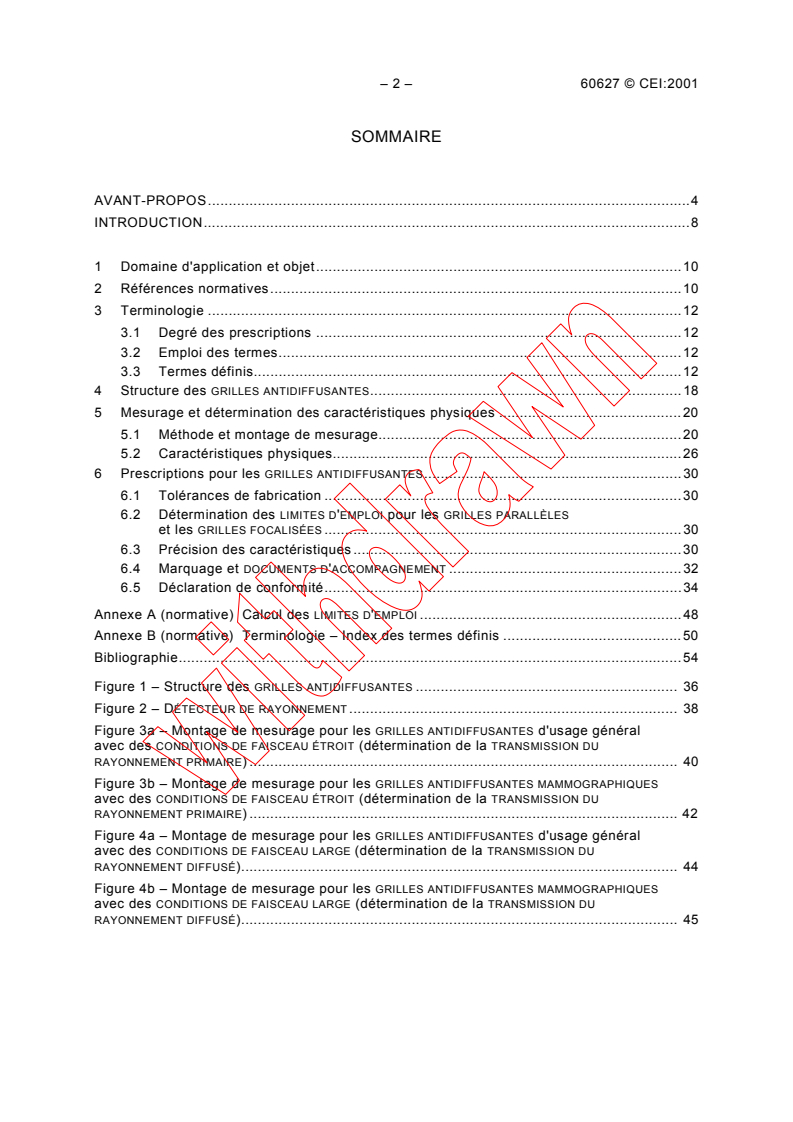
– 2 – 60627 © CEI:2001
SOMMAIRE
AVANT-PROPOS.4
INTRODUCTION.8
1 Domaine d'application et objet.10
2 Références normatives.10
3 Terminologie .12
3.1 Degré des prescriptions .12
3.2 Emploi des termes.12
3.3 Termes définis.12
4 Structure des GRILLES ANTIDIFFUSANTES.18
5 Mesurage et détermination des caractéristiques physiques .20
5.1 Méthode et montage de mesurage.20
5.2 Caractéristiques physiques.26
6 Prescriptions pour les GRILLES ANTIDIFFUSANTES.30
6.1 Tolérances de fabrication .30
6.2 Détermination des LIMITES D'EMPLOI pour les GRILLES PARALLÈLES
et les GRILLES FOCALISÉES .30
6.3 Précision des caractéristiques .30
6.4 Marquage et DOCUMENTS D'ACCOMPAGNEMENT .32
6.5 Déclaration de conformité.34
Annexe A (normative) Calcul des LIMITES D'EMPLOI .48
Annexe B (normative) Terminologie – Index des termes définis .50
Bibliographie.54
Figure 1 – Structure des GRILLES ANTIDIFFUSANTES . 36
Figure 2 – DÉTECTEUR DE RAYONNEMENT . 38
Figure 3a – Montage de mesurage pour les GRILLES ANTIDIFFUSANTES d'usage général
avec des CONDITIONS DE FAISCEAU ÉTROIT (détermination de la TRANSMISSION DU
RAYONNEMENT PRIMAIRE) . 40
Figure 3b – Montage de mesurage pour les GRILLES ANTIDIFFUSANTES MAMMOGRAPHIQUES
avec des CONDITIONS DE FAISCEAU ÉTROIT (détermination de la TRANSMISSION DU
RAYONNEMENT PRIMAIRE) . 42
Figure 4a – Montage de mesurage pour les GRILLES ANTIDIFFUSANTES d'usage général
avec des CONDITIONS DE FAISCEAU LARGE (détermination de la TRANSMISSION DU
RAYONNEMENT DIFFUSÉ). 44
Figure 4b – Montage de mesurage pour les GRILLES ANTIDIFFUSANTES MAMMOGRAPHIQUES
avec des CONDITIONS DE FAISCEAU LARGE (détermination de la TRANSMISSION DU
RAYONNEMENT DIFFUSÉ). 45
60627 © IEC:2001 – 3 –
CONTENTS
FOREWORD.5
INTRODUCTION.9
1 Scope and object.11
2 Normative references .11
3 Terminology .13
3.1 Degree of requirements .13
3.2 Use of terms.13
3.3 Defined terms.13
4 Structure of ANTI-SCATTER GRIDS .19
5 Measurement and determination of physical characteristics.21
5.1 Method and arrangement for measurement .21
5.2 Physical characteristics .27
6 Requirements for ANTI-SCATTER GRIDS.31
6.1 Manufacturing tolerances .31
6.2 Determination of the APPLICATION LIMITS for PARALLEL GRIDS and FOCUSED GRIDS .31
6.3 Accuracy of characteristics.31
6.4 Marking and ACCOMPANYING DOCUMENTS .33
6.5 Statement of compliance .35
Annex A (normative) Calculation of the APPLICATION LIMITS.49
Annex B (normative) Terminology – Index of defined terms.51
Bibliography.55
Figure 1 – Structure of ANTI-SCATTER GRIDS .37
Figure 2 – RADIATION DETECTOR.39
Figure 3a – Measurement arrangement for general purpose ANTI-SCATTER GRIDS
with NARROW-BEAM CONDITION (determination of the TRANSMISSION OF PRIMARY RADIATION).41
Figure 3b – Measurement arrangement for MAMMOGRAPHIC ANTI-SCATTER GRIDS with
NARROW-BEAM CONDITION (determination of the TRANSMISSION OF PRIMARY RADIATION).43
Figure 4a – Measurement arrangement for general purpose ANTI-SCATTER GRIDS
with BROAD-BEAM CONDITION (determination of the TRANSMISSION OF SCATTERED RADIATION) .45
Figure 4b – Measurement arrangement for MAMMOGRAPHIC ANTI-SCATTER GRIDS
with BROAD-BEAM CONDITION (determination of the TRANSMISSION OF SCATTERED RADIATION) .47
– 4 – 60627 © CEI:2001
COMMISSION ÉLECTROTECHNIQUE INTERNATIONALE
____________
ÉQUIPEMENTS DE DIAGNOSTIC PAR IMAGERIE À RAYONNEMENT X –
Caractéristiques des grilles antidiffusantes d'usage général
et de mammographie
AVANT-PROPOS
1) La CEI (Commission Électrotechnique Internationale) est une organisation mondiale de normalisation
composée de l'ensemble des comités électrotechniques nationaux (Comités nationaux de la CEI). La CEI a
pour objet de favoriser la coopération internationale pour toutes les questions de normalisation dans les
domaines de l'électricité et de l'électronique. A cet effet, la CEI, entre autres activités, publie des Normes
internationales. Leur élaboration est confiée à des comités d'études, aux travaux desquels tout Comité national
intéressé par le sujet traité peut participer. Les organisations internationales, gouvernementales et non
gouvernementales, en liaison avec la CEI, participent également aux travaux. La CEI collabore étroitement
avec l'Organisation Internationale de Normalisation (ISO), selon des conditions fixées par accord entre les
deux organisations.
2) Les décisions ou accords officiels de la CEI concernant les questions techniques représentent, dans la mesure
du possible, un accord international sur les sujets étudiés, étant donné que les Comités nationaux intéressés
sont représentés dans chaque comité d’études.
3) Les documents produits se présentent sous la forme de recommandations internationales. Ils sont publiés
comme normes, spécifications techniques, rapports techniques ou guides et agréés comme tels par les
Comités nationaux.
4) Dans le but d'encourager l'unification internationale, les Comités nationaux de la CEI s'engagent à appliquer de
façon transparente, dans toute la mesure possible, les Normes internationales de la CEI dans leurs normes
nationales et régionales. Toute divergence entre la norme de la CEI et la norme nationale ou régionale
correspondante doit être indiquée en termes clairs dans cette dernière.
5) La CEI n’a fixé aucune procédure concernant le marquage comme indication d’approbation et sa responsabilité
n’est pas engagée quand un matériel est déclaré conforme à l’une de ses normes.
6) L’attention est attirée sur le fait que certains des éléments de la présente Norme internationale peuvent faire
l’objet de droits de propriété intellectuelle ou de droits analogues. La CEI ne saurait être tenue pour
responsable de ne pas avoir identifié de tels droits de propriété et de ne pas avoir signalé leur existence.
La Norme internationale CEI 60627 a été établie par le sous-comité 62B: Équipements de
diagnostic par imagerie, du comité d'études 62 de la CEI: Appareillage électrique dans la
pratique médicale.
Cette deuxième édition annule et remplace la première édition parue en 1978 et en constitue
une révision technique. Elle annule et remplace également la CEI 61953 parue en 1997 qui y
est intégrée sans modification technique.
Le texte de cette norme est issu des documents suivants:
FDIS Rapport de vote
62B/436A/FDIS 62B/441/RVD
Le rapport de vote indiqué dans le tableau ci-dessus donne toute information sur le vote ayant
abouti à l’approbation de cette norme.
Cette publication a été rédigée selon les Directives ISO/CEI, Partie 2.
Les annexes A et B font partie intégrante de cette norme.
60627 © IEC:2001 – 5 –
INTERNATIONAL ELECTROTECHNICAL COMMISSION
____________
DIAGNOSTIC X-RAY IMAGING EQUIPMENT –
Characteristics of general purpose and mammographic
anti-scatter grids
FOREWORD
1) The IEC (International Electrotechnical Commission) is a worldwide organization for standardization comprising
all national electrotechnical committees (IEC National Committees). The object of the IEC is to promote
international co-operation on all questions concerning standardization in the electrical and electronic fields. To
this end and in addition to other activities, the IEC publishes International Standards. Their preparation is
entrusted to technical committees; any IEC National Committee interested in the subject dealt with may
participate in this preparatory work. International, governmental and non-governmental organizations liaising
with the IEC also participate in this preparation. The IEC collaborates closely with the International
Organization for Standardization (ISO) in accordance with conditions determined by agreement between the
two organizations.
2) The formal decisions or agreements of the IEC on technical matters express, as nearly as possible, an
international consensus of opinion on the relevant subjects since each technical committee has representation
from all interested National Committees.
3) The documents produced have the form of recommendations for international use and are published in the form
of standards, technical specifications, technical reports or guides and they are accepted by the National
Committees in that sense.
4) In order to promote international unification, IEC National Committees undertake to apply IEC International
Standards transparently to the maximum extent possible in their national and regional standards. Any
divergence between the IEC Standard and the corresponding national or regional standard shall be clearly
indicated in the latter.
5) The IEC provides no marking procedure to indicate its approval and cannot be rendered responsible for any
equipment declared to be in conformity with one of its standards.
6) Attention is drawn to the possibility that some of the elements of this International Standard may be the subject
of patent rights. The IEC shall not be held responsible for identifying any or all such patent rights.
International Standard IEC 60627 has been prepared by subcommittee 62B: Diagnostic
imaging equipment, of IEC technical committee 62: Electrical equipment in medical practice.
This second edition cancels and replaces the first edition published in 1978, and constitutes a
technical revision. It also cancels and replaces IEC 61953 published in 1997 which is
incorporated in this standard technically unchanged.
The text of this standard is based on the following documents:
FDIS Report on voting
62B/436A/FDIS 62B/441/RVD
Full information on the voting for the approval of this standard can be found in the report on
voting indicated in the above table.
This publication has been drafted in accordance with the ISO/IEC Directives, Part 2.
Annexes A and B form an integral part of this standard.
– 6 – 60627 © CEI:2001
Dans la présente norme, les caractères d’imprimerie suivants sont employés:
– prescriptions dont la conformité peut être vérifiée par un essai et définitions: caractères
romains;
– explications, conseils, notes, énoncés de portée générale, exceptions et références: petits caractères romains;
– modalités d’essais: caractères italiques;
– TERMES DÉFINIS DANS LES NORMES CEI 60601-1, CEI 60788, À L'ARTICLE 3 DE CETTE NORME OU
DANS D'AUTRES PUBLICATIONS CEI RÉFÉRENCÉES À L'ANNEXE B: PETITES CAPITALES.
Le comité a décidé que le contenu de cette publication ne sera pas modifié avant 2007.
A cette date, la publication sera
• reconduite;
• supprimée;
• remplacée par une édition révisée, ou
• amendée.
60627 © IEC:2001 – 7 –
In this standard, the following print types are used:
– requirements, compliances with which can be tested, and definitions: in roman type;
– explanations, advice, notes, general statements, exceptions and references: in smaller roman type;
– test specifications: in italic type;
– TERMS DEFINED IN IEC 60601-1, IN IEC 60788, IN CLAUSE 3 OF THIS STANDARD OR IN OTHER IEC
PUBLICATIONS REFERENCED IN ANNEX B: IN SMALL CAPITALS.
The committee has decided that the contents of this publication will remain unchanged
until 2007. At this date, the publication will be
• reconfirmed;
• withdrawn;
• replaced by a revised edition, or
• amended.
– 8 – 60627 © CEI:2001
INTRODUCTION
La première édition de la CEI 60627 a été établie pour les GRILLES ANTIDIFFUSANTES utilisées
en radiographie générale et n'est pas applicable aux GRILLES ANTIDIFFUSANTES utilisées en
mammographie. Par conséquent, une norme complémentaire, la CEI 61953 a été publiée.
Lors de l'élaboration de cette dernière norme, il est apparu qu'une révision de la CEI 60627
s'imposait et il a été décidé d'amalgamer les deux normes couvrant les GRILLES
ANTIDIFFUSANTES. Dans la mesure du possible, elles ont été harmonisées. Lorsque cette
norme, comporte des différences entre les GRILLES ANTIDIFFUSANTES d'usage général et les
GRILLES ANTIDIFFUSANTES MAMMOGRAPHIQUES, celles-ci sont respectivement citées aux alinéas
a) et b).
Certaines différences concernant les GRILLES ANTIDIFFUSANTES d'usage général, entre cette
deuxième édition et la première de la CEI 60627, sont indiquées ci-dessous:
– des définitions ont été modifiées et d'autres ajoutées pour améliorer la clarté, l'harmo-
nisation ou la notion de généralité;
– le concept de GRILLE ANTIDIFFUSANTE de référence est maintenant inexistant. On a
constaté que de telles GRILLES ANTIDIFFUSANTES étaient peu employées. Il suffit de définir
sans ambiguïté le DÉTECTEUR DE RAYONNEMENT et le procédé de mesurage;
– le même FANTÔME est utilisé pour des mesurages de TRANSMISSION DU RAYONNEMENT
PRIMAIRE et de TRANSMISSION DU RAYONNEMENT DIFFUSÉ;
–les QUALITÉS DE RAYONNEMENT utilisées pour le mesurage ont été modifiées et sont
maintenant les qualités indiquées dans la CEI 61267;
–un SPECTRE DE RAYONNEMENT X à plus faible énergie que précédemment est utilisé pour
mesurer les performances des GRILLES ANTIDIFFUSANTES d'usage général. Celui-ci a été
considéré comme plus approprié que le spectre utilisé auparavant;
– là où une GRILLE ANTIDIFFUSANTE d'usage général est spécifiée pour une utilisation en
faible énergie, des mesurages additionnels sont dorénavant faits avec des QUALITÉS DE
RAYONNEMENT appropriées et spécifiées;
– le diamètre du champ de mesurage est réduit;
–la TRANSMISSION DU RAYONNEMENT PRIMAIRE est maintenant donnée sur la GRILLE
ANTIDIFFUSANTE ou dans les DOCUMENTS D'ACCOMPAGNEMENT;
– les informations sur la nature du matériau employé pour l'espace entre les lames de la
grille et sur la nature du matériau de couverture de la grille sont désormais données dans
les DOCUMENTS D'ACCOMPAGNEMENT;
– les limites d'emploi sont maintenant données pour des GRILLES PARALLÈLES;
– la position du centre de la grille est maintenant indiquée.
Des dispositions particulières de laboratoire et des conditions d'essai soigneusement
contrôlées sont nécessaires pour les mesurages décrits ici.
60627 © IEC:2001 – 9 –
INTRODUCTION
The first edition of IEC 60627 was intended for ANTI-SCATTER GRIDS used in general radio-
graphy and is not appropriate for ANTI-SCATTER GRIDS used in mammography. As a
consequence, a complementary standard IEC 61953 was published. During the preparation of
this latter standard, it became clear that a revision of IEC 60627 itself was necessary, and it
was decided to merge together the two standards covering ANTI-SCATTER GRIDS. Wherever
possible, a harmonized approach has been used. Where there are differences in this standard
between general purpose ANTI-SCATTER GRIDS and MAMMOGRAPHIC ANTI-SCATTER GRIDS, these
are listed as items a) and b) respectively.
Some of the differences for general purpose ANTI-SCATTER GRIDS between this second edition
and the first edition of IEC 60627 are outlined below:
– some definitions have been modified and others added to improve clarity, harmonization
or generality;
– the concept of a reference ANTI-SCATTER GRID is now omitted. It was found that such ANTI-
SCATTER GRIDS were little used. It should be sufficient to define unambiguously the
RADIATION DETECTOR and the measuring procedure;
–the same PHANTOM is used for measurements of TRANSMISSION OF PRIMARY RADIATION and
TRANSMISSION OF SCATTERED RADIATION;
–the RADIATION QUALITIES used for the measurement have been changed and are now
qualities specified in IEC 61267;
– a lower energy X-RAY SPECTRUM than before is used to measure the performance of
general purpose ANTI-SCATTER GRIDS. This was considered to be more appropriate than the
spectrum previously used;
– where a general purpose ANTI-SCATTER GRID is specified for low-energy use, additional
measurements have now to be made with appropriate, specified RADIATION QUALITIES;
– the diameter of the measuring field is reduced;
–the TRANSMISSION OF PRIMARY RADIATION is now given on the ANTI-SCATTER GRID or in the
ACCOMPANYING DOCUMENTS;
– information on the nature of the material used for the grid interspace and on the nature of
the grid covers is now given in the ACCOMPANYING DOCUMENTS;
– application limits are now given for PARALLEL GRIDS;
– the position of the grid centre is now indicated.
Special laboratory provisions and carefully controlled test conditions are needed for the
measurements described here.
– 10 – 60627 © CEI:2001
EQUIPEMENTS DE DIAGNOSTIC PAR IMAGERIE À RAYONNEMENT X –
Caractéristiques des grilles antidiffusantes d'usage général
et de mammographie
1 Domaine d'application et objet
La présente Norme internationale traite des définitions, de la détermination et de l'indication
des caractéristiques des GRILLES ANTIDIFFUSANTES utilisées dans les équipements de
diagnostic par imagerie à rayonnement X, afin de réduire l'influence du RAYONNEMENT DIFFUSÉ
produit en particulier dans le corps du PATIENT, sur la SURFACE RÉCEPTRICE DE L'IMAGE et
d'améliorer ainsi le contraste de l'IMAGE RADIOLOGIQUE POTENTIELLE.
Cette norme ne traite que des GRILLES LINÉAIRES.
Puisque à présent seules les GRILLES FOCALISÉES sont utilisées en mammographie, cette norme
se limite aux GRILLES FOCALISÉES pour des GRILLES ANTIDIFFUSANTES MAMMOGRAPHIQUES.
Cette norme n'est pas destinée à être appliquée aux ESSAIS D'ACCEPTATION.
Cette norme ne couvre pas l'homogénéité des performances sur la surface d'une grille.
Il est prévu que cette norme soit appliquée à la démonstration des caractéristiques des
GRILLES ANTIDIFFUSANTES dans des conditions d'essai. Ces conditions ne sont habituellement
pas rencontrées sur le site de l'utilisateur.
2 Références normatives
Les documents de référence suivants sont indispensables pour l'application du présent
document. Pour les références datées, seule l'édition citée s'applique. Pour les références
non datées, la dernière édition du document de référence s'applique (y compris les éventuels
amendements).
CEI 60417 (toutes les parties), Symboles graphiques utilisables sur le matériel
CEI 60601-1, Appareils électromédicaux – Partie 1: Règles générales de sécurité
CEI 60788, Radiologie médicale – Terminologie
CEI 61223-1, Essais d’évaluation et de routine dans les services d’imagerie médicale –
Partie 1: Aspects généraux
CEI 61267, Equipement de diagnostic médical à rayonnement X – Conditions de rayonnement
pour utilisation dans la détermination des caractéristiques
60627 © IEC:2001 – 11 –
DIAGNOSTIC X-RAY IMAGING EQUIPMENT –
Characteristics of general purpose and mammographic
anti-scatter grids
1 Scope and object
This International Standard deals with the definitions, determination and indication of
characteristics of ANTI-SCATTER GRIDS used in diagnostic X-ray imaging equipment, in order to
reduce the incidence of SCATTERED RADIATION, produced particularly in the body of the
PATIENT, upon the IMAGE RECEPTION AREA and thus to improve the contrast of the X-RAY
PATTERN.
In this standard only LINEAR GRIDS are considered.
Since at present only FOCUSED GRIDS are used in mammography, this standard is restricted to
FOCUSED GRIDS for MAMMOGRAPHIC ANTI-SCATTER GRIDS.
This standard is not intended to be applied for ACCEPTANCE TESTS.
This standard does not cover the homogeneity of performance over the area of a grid.
This standard is intended to be applied for the demonstration of the characteristics of ANTI-
SCATTER GRIDS under test conditions. These conditions are not usually available at the USER's
site.
2 Normative references
The following referenced documents are indispensable for the application of this document.
For dated references, only the edition cited applies. For undated references, the latest edition
of the referenced document (including any amendments) applies.
IEC 60417 (all parts), Graphical symbols for use on equipment
IEC 60601-1, Medical electrical equipment – Part 1: General requirements for safety
IEC 60788, Medical radiology – Terminology
IEC 61223-1, Evaluation and routine testing in medical imaging departments – Part 1: General
aspects
IEC 61267, Medical diagnostic X-ray equipment – Radiation conditions for use in the
determination of characteristics
– 12 – 60627 © CEI:2001
3 Terminologie
3.1 Degré des prescriptions
Dans cette norme, certains termes qui ne sont pas imprimés en PETITES CAPITALES ont des
significations particulières:
– «doit» indique une prescription qui est obligatoire pour la conformité;
– «il convient de» indique une forte recommandation qui n'est pas obligatoire pour la conformité;
– «peut» indique une façon autorisée de satisfaire à une prescription ou d'éviter la
nécessité d'y satisfaire;
– «spécifique» est employé pour indiquer des informations certaines, données dans la
présente norme ou référencées dans d'autres normes, concernant
habituellement des conditions de fonctionnement, des montages d'essai
ou des valeurs particulières liées à la conformité;
– «spécifié» est employé pour indiquer des informations certaines, données par le
CONSTRUCTEUR dans des DOCUMENTS D'ACCOMPAGNEMENT ou dans
d'autres documentations concernant l'APPAREIL en question; elles concernent
habituellement l'usage auquel il est destiné ou les paramètres ou les
conditions liées à son utilisation ou aux essais pour en déterminer la
conformité.
3.2 Emploi des termes
Dans cette norme, les termes imprimés en PETITES CAPITALES sont employés suivant leurs
définitions dans la CEI 60601-1, la CEI 60788, le paragraphe 3.3 de cette norme ou dans les
autres publications CEI référencées à l'annexe B.
NOTE L'attention est attirée sur le fait que dans les cas où le concept concerné n'est pas fortement impliqué par
la définition donnée dans une des publications énumérées ci-dessus, un terme correspondant est imprimé en
lettres minuscules.
Un index des termes définis utilisés dans cette norme est donné à l'annexe B.
3.3 Termes définis
Pour les besoins de la présente Norme internationale, les définitions suivantes s'appliquent.
NOTE Certains termes définis donnés dans cette norme diffèrent de ceux donnés dans l'édition courante de la
CEI 60788.
3.3.1
GRILLE ANTIDIFFUSANTE
dispositif comportant un arrangement périodique et fixe de matériaux avec différentes
propriétés d'ATTÉNUATION DU RAYONNEMENT X, à placer devant la SURFACE RÉCEPTRICE DE
L'IMAGE, afin de réduire l'incidence du RAYONNEMENT DIFFUSÉ sur cette surface et d'augmenter
ainsi le contraste de l'IMAGE RADIOLOGIQUE POTENTIELLE
3.3.2
GRILLE LINÉAIRE
GRILLE ANTIDIFFUSANTE composée de lames fortement absorbantes et d'espaces inter-lames à
haut pouvoir de transmission qui sont parallèles dans leur direction longitudinale
3.3.3
GRILLE PARALLÈLE
GRILLE LINÉAIRE dans laquelle les plans des lames absorbantes sont parallèles entre eux et
perpendiculaires à la face incidente
60627 © IEC:2001 – 13 –
3 Terminology
3.1 Degree of requirements
In this standard, certain terms which are not printed in SMALL CAPITALS have particular
meanings:
– "shall" indicates a requirement that is mandatory for compliance;
– "should" indicates a strong recommendation that is not mandatory for compliance;
– "may" indicates a permitted manner of complying with a requirement or of avoiding
the need to comply;
– "specific" is used to indicate definitive information stated in this standard or
referenced in other standards, usually concerning particular operating
conditions, test arrangements or values connected with compliance;
– "specified" is used to indicate definitive information stated by the MANUFACTURER in
ACCOMPANYING DOCUMENTS or in other documentation relating to the
EQUIPMENT under consideration, usually concerning its intended purpose, or
the parameters or conditions associated with its use or with testing to
determine compliance.
3.2 Use of terms
In this standard, terms printed in SMALL CAPITALS are used as defined in IEC 60601-1, in
IEC 60788, in 3.3 of this standard or in other IEC publications referenced in annex B.
NOTE Attention is drawn to the fact, that in cases where the concept addressed is not strongly confined to the
definition given in one of the publications listed above a corresponding term is printed in lower-case letters.
An index of defined terms used in this standard is given in annex B.
3.3 Defined terms
For the purpose of this International Standard, the following definitions apply.
NOTE Some of the defined terms given in this standard deviate from those given in the current edition of
IEC 60788.
3.3.1
ANTI-SCATTER GRID
device with a fixed periodic arrangement of materials with different X-ray ATTENUATION
properties to be placed in front of the IMAGE RECEPTION AREA in order to reduce the incidence
of SCATTERED RADIATION upon that area and thus increase the contrast in the X-RAY PATTERN
3.3.2
LINEAR GRID
ANTI-SCATTER GRID composed of highly absorbing strips and highly transmitting interspaces
which are parallel in their longitudinal direction
3.3.3
PARALLEL GRID
LINEAR GRID in which the planes of the absorbing strips are parallel to each other and
perpendicular to the incident face
– 14 – 60627 © CEI:2001
3.3.4
GRILLE FOCALISÉE
GRILLE LINÉAIRE dans laquelle les plans des lames absorbantes convergent vers une ligne
droite à la DISTANCE DE FOCALISATION
3.3.5
GRILLE EN TOIT
GRILLE LINÉAIRE dans laquelle la hauteur des lames absorbantes décroît à mesure que la
distance entre les lames absorbantes et la LIGNE MÉDIANE VRAIE augmente. Cette
décroissance est symétrique par rapport à la LIGNE MÉDIANE VRAIE
3.3.6
GRILLE CROISÉE
GRILLE ANTIDIFFUSANTE constituée de deux GRILLES LINÉAIRES assemblées de telle façon que
les directions de leurs lames absorbantes forment un certain angle
3.3.6.1
GRILLE CROISÉE ORTHOGONALE
GRILLE CROISÉE dans laquelle les directions des lames absorbantes forment un angle de 90°
3.3.6.2
GRILLE CROISÉE OBLIQUE
GRILLE CROISÉE dans laquelle les directions des lames absorbantes forment un angle différent
de 90°
3.3.7
GRILLE FIXE
GRILLE ANTIDIFFUSANTE utilisée de telle façon qu'elle ne se déplace pas par rapport au
FAISCEAU DE RAYONNEMENT qui la traverse
3.3.8
GRILLE MOBILE
GRILLE ANTIDIFFUSANTE utilisée dans un ACCESSOIRE qui permet de déplacer la GRILLE
ANTIDIFFUSANTE pendant l'irradiation par un FAISCEAU DE RAYONNEMENT, afin d'éviter la
formation de l'image des lames absorbantes et la perte d'informations qui en résulte
3.3.9
GRILLE ANTIDIFFUSANTE MAMMOGRAPHIQUE
GRILLE FOCALISÉE spécialement conçue pour la mammographie
NOTE Dans cette norme le terme «GRILLE ANTIDIFFUSANTE d'usage général» est employé pour décrire toute GRILLE
ANTIDIFFUSANTE non spécialement conçue pour la mammographie.
3.3.10
Caractéristiques géométriques
3.3.10.1
RAPPORT DE GRILLE, r
rapport entre la hauteur des lames absorbantes et la distance qui les sépare au centre d'une
GRILLE LINÉAIRE
3.3.10.2
DISTANCE DE FOCALISATION, f
distance entre la face incidente d'une GRILLE FOCALISÉE et la ligne de convergence des plans
des lames absorbantes de cette grille (unité: cm)
NOTE L'attention est attirée sur les différences entre la «DISTANCE DE FOCALISATION», la «distance FOYER – grille»
et la «distance FOYER – film».
60627 © IEC:2001 – 15 –
3.3.4
FOCUSED GRID
LINEAR GRID in which the planes of the absorbing strips converge to a straight line at the
FOCUSING DISTANCE
3.3.5
TAPERED GRID
LINEAR GRID in which the height of the absorbing strips decreases as the distance between the
absorbing strips and the TRUE CENTRAL LINE increases. This decrease is symmetrical about
the TRUE CENTRAL LINE
3.3.6
CROSS-GRID
ANTI-SCATTER GRID composed of two LINEAR GRIDS built together in such a way that the
directions of their absorbing strips form an angle
3.3.6.1
ORTHOGONAL CROSS-GRID
CROSS-GRID in which the directions of the absorbing strips form an angle of 90°
3.3.6.2
OBLIQUE CROSS-GRID
CROSS-GRID in which the directions of the absorbing strips form an angle other than 90°
3.3.7
STATIONARY GRID
ANTI-SCATTER GRID used in such a way that it does not move in relation to the RADIATION BEAM
3.3.8
MOVING GRID
ANTI-SCATTER GRID used in an ACCESSORY that enables the ANTI-SCATTER GRID to be moved,
when irradiated by a RADIATION BEAM, in order to avoid the imaging of the absorbing strips and
the consequent loss of information
3.3.9
MAMMOGRAPHIC ANTI-SCATTER GRID
FOCUSED GRID specially designed for mammography
NOTE In this standard the term "general purpose ANTI-SCATTER GRID" is used to describe any ANTI-SCATTER GRID
not specially designed for mammography.
3.3.10
Geometric characteristics
3.3.10.1
GRID RATIO, r
ratio between the height of the absorbing strips and the distance between the absorbing strips
in the centre of a LINEAR GRID
3.3.10.2
FOCUSING DISTANCE, f
distance between the incident face of a FOCUSED GRID and the line into which the planes of the
absorbing strips of the grid converge (unit: cm)
NOTE Attention is drawn to the differences between "FOCUSING DISTANCE", "FOCAL SPOT to grid distance" and
"FOCAL SPOT to film distance".
– 16 – 60627 © CEI:2001
3.3.10.3
LIMITES D'EMPLOI, f , f
1 2
limite inférieure, f , et limite supérieure, f , de la distance du foyer à la face incidente d'une
1 2
GRILLE FOCALISÉE ou d'une GRILLE PARALLÈLE entre lesquelles les informations radiologiques
obtenues peuvent être considérées comme acceptables dans la plupart des cas (unité: cm)
NOTE Voir annexe A pour des détails sur le calcul des LIMITES D'EMPLOI.
3.3.10.4
LIGNE MÉDIANE VRAIE
– pour une GRILLE PARALLÈLE: la ligne sur la face incidente dans la direction des lames
absorbantes et passant par le centre de la surface de la grille
– pour une GRILLE FOCALISÉE: la projection perpendiculaire sur la face incidente de la grille,
de la ligne vers laquelle les plans des lames absorbantes
convergent
– pour une GRILLE EN TOIT: la ligne sur la face incidente dans la direction des lames
absorbantes et se trouvant dans un plan de symétrie de la
structure de la grille
NOTE Une GRILLE CROISÉE a deux LIGNES MÉDIANES VRAIES.
3.3.10.5
INDICATION DE LIGNE MÉDIANE
marquage sur la face incidente d'une GRILLE LINÉAIRE qui est prévue pour indiquer la position
et la direction de la LIGNE MÉDIANE VRAIE
NOTE Dans la plupart des cas, ce marquage coïncide avec la ligne médiane géométrique de la face incidente de
la grille.
3.3.10.6
FRÉQUENCE DE LAMES, N
–1
nombre de lames absorbantes par unité de longueur d'une GRILLE LINÉAIRE (unité: cm )
NOMBRE DE LAMES PAR CENTIMÈTRE
NOTE Ce terme remplace le terme précédent « ».
3.3.11
Caractéristiques physiques
3.3.11.1
TRANSMISSION DU RAYONNEMENT PRIMAIRE, T
p
caractéristique d'un objet, évaluée comme le rapport de la VALEUR MESURÉE de la quantité ou
du taux du RAYONNEMENT PRIMAIRE avec l'objet placé dans un FAISCEAU DE RAYONNEMENT à
celle de l'objet retiré du faisceau, dans des conditions de mesurage spécifiques
3.3.11.2
TRANSMISSION DU RAYONNEMENT DIFFUSÉ, T
s
caractéristique d'un objet, évaluée comme le rapport de la VALEUR MESURÉE de la quantité ou
du taux du RAYONNEMENT DIFFUSÉ avec l'objet placé dans un FAISCEAU DE RAYONNEMENT à
celle de l'objet retiré du faisceau, dans des conditions de mesurage spécifiques
3.3.11.3
TRANSMISSION DU RAYONNEMENT TOTAL, T
t
caractéristique d'un objet, évaluée comme le rapport de la VALEUR MESURÉE de la quantité ou
du taux total du RAYONNEMENT avec l'objet placé dans un FAISCEAU DE RAYONNEMENT à celle de
l'objet retiré du faisceau, dans des conditions de mesurage spécifiques
60627 © IEC:2001 – 17 –
3.3.10.3
APPLICATION LIMITS, f , f
1 2
lower, f , and upper, f , limits of the distance from the FOCAL SPOT to the incident face of a
1 2
FOCUSED GRID or a PARALLEL GRID between which the obtained radiological information can be
considered acceptable for many purposes (unit: cm)
NOTE See annex A for details on the calculation of the APPLICATION LIMITS.
3.3.10.4
TRUE CENTRAL LINE
–for a PARALLEL GRID: line on the incident face in the direction of the absorbing strips
and passing through the centre of the grid area
–for a FOCUSED GRID: perpendicular projection onto the incident face of the grid, of the
line into which the planes of the absorbing strips converge
–for a TAPERED GRID: line on the incident face in the direction of the absorbing strips
and lying within a symmetry plane of the grid structure
NOTE A CROSS-GRID has two TRUE CENTRAL LINES.
3.3.10.5
CENTRAL LINE INDICATION
marking on the incident face of a LINEAR GRID, which is intended to indicate the position and
direction of the TRUE CENTRAL LINE
NOTE In most cases, this marking coincides with the geometric centre line of the grid's incident face.
3.3.10.6
STRIP FREQUENCY, N
–1
number of absorbing strips per unit length of a LINEAR GRID (unit: cm )
NOTE This term replaces the previous term "STRIPS PER CENTIMETRE".
3.3.11
Physical characteristics
3.3.11.1
TRANSMISSION OF PRIMARY RADIATION, T
p
characteristic of an object, evaluated as the ratio of the MEASURED VALUE of the quantity or
rate of PRIMARY RADIATION with the object placed in a RADIATION BEAM to that with the object
removed from the beam, under specific measuring conditions
3.3.11.2
TRANSMISSION OF SCATTERED RADIATION, T
s
characteristic of an object, evaluated as the ratio of the MEASURED VALUE of the quantity or
rate of SCATTERED RADIATION with the object placed in a RADIATION BEAM to that with the object
removed from the beam, under specific measuring conditions
3.3.11.3
TRANSMISSION OF TOTAL RADIATION, T
t
characteristic of an object, evaluated as the ratio of the MEASURED VALUE of the quantity or
rate of total RADIATION with the object placed in a RADIATION BEAM to that with the object
removed from the beam, under specific measuring conditions
– 18 – 60627 © CEI:2001
3.3.11.4
SÉLECTIVITÉ DE GRILLE, ΣΣΣΣ
caractéristique d'une GRILLE ANTIDIFFUSANTE évaluée comme le rapport de la TRANSMISSION DU
RAYONNEMENT PRIMAIRE à la TRANSMISSION DU RAYONNEMENT DIFFUSÉ, dans des conditions de
mesurage spécifiques
3.3.11.5
FACTEUR D'AMÉLIORATION DE CONTRASTE, K
caractéristique d'une GRILLE ANTIDIFFUSANTE évaluée comme le rapport de la TRANSMISSION DU
RAYONNEMENT PRIMAIRE à la TRANSMISSION DU RAYONNEMENT TOTAL, dans des conditions de
mesurage spécifiques
3.3.11.6
facteur d'exposition de grille, B
caractéristique d'une GRILLE ANTIDIFFUSANTE, évaluée comme le rapport de la VALEUR MESURÉE
de la quantité ou du taux total du RAYONNEMENT en l'absence de GRILLE ANTIDIFFUSANTE dans
un FAISCEAU DE RAYONNEMENT à la valeur correspondante lorsque la GRILLE ANTIDIFFUSANTE est
placée dans le faisceau, dans des conditions de mesurage spécifiques
3.3.12
Autres termes
3.3.12.1
DÉCENTRAGE D'UNE GRILLE FOCALISÉE
distance du FOYER d'un TUBE RADIOGÈNE au plan passant par la LIGNE MÉDIANE VRAIE d'une
...