


IEC 62128-1:2013
(Main)Railway applications - Fixed installations - Electrical safety, earthing and the return circuit - Part 1: Protective provisions against electric shock
Railway applications - Fixed installations - Electrical safety, earthing and the return circuit - Part 1: Protective provisions against electric shock
IEC 62128-1:2013 specifies requirements for the protective provisions relating to electrical safety in fixed installations associated with a.c. and/or d.c. traction systems and to any installations that can be endangered by the traction power supply system. It also applies to all aspects of fixed installations that are necessary to ensure electrical safety during maintenance work within electric traction systems. This standard applies to all new lines and to all major revisions to existing lines. The main technical changes with regard to the previous edition are the restructuring of all clauses and changes in the touch voltages limits.
Applications ferroviaires - Installations fixes - Sécurité électrique, mise à la terre et circuit de retour - Partie 1: Mesures de protection contre les chocs électriques
La CEI 62128-1:2013 spécifie les exigences relatives aux mesures de protection concernant la sécurité électrique dans les installations fixes associées à des systèmes de traction en courant alternatif et/ou continu et dans toutes les installations susceptibles d'être affectées par le système d'alimentation de traction. Elle s'applique également à toutes les installations fixes qui sont nécessaires pour garantir la sécurité électrique lors des travaux de maintenance réalisés sur des systèmes de traction électrique. La présente norme s'applique aux systèmes de traction électriques pour toutes les lignes nouvelles et pour toutes les lignes existantes. Les modifications majeures consistent en la restructuration de tous les articles et les modifications de limites de tensions de contact.
General Information
- Status
- Published
- Publication Date
- 15-Sep-2013
- Technical Committee
- TC 9 - Electrical equipment and systems for railways
- Drafting Committee
- WG 49 - TC 9/WG 49
- Current Stage
- PPUB - Publication issued
- Start Date
- 16-Sep-2013
- Completion Date
- 15-Sep-2013
Relations
- Effective Date
- 05-Sep-2023
Overview
IEC 62128-1:2013 is an international standard published by the International Electrotechnical Commission (IEC) that addresses electrical safety, earthing, and the return circuit in fixed installations for railway applications. Specifically, Part 1 focuses on protective provisions against electric shock in installations related to both alternating current (a.c.) and direct current (d.c.) traction systems. This standard is essential for designing, maintaining, and upgrading fixed railway infrastructure to ensure the safety of personnel and equipment in contact line zones and current collector areas.
The standard applies to all new railway lines and major revisions to existing lines, making it a crucial reference for engineers, safety managers, and maintenance personnel working on electrical safety within electric traction systems. Significant updates from previous editions include the restructuring of clauses and revised limits for touch voltages to enhance protection.
Key Topics
IEC 62128-1:2013 covers comprehensive protection measures including:
Electrical Safety and Hazards
Definition and mitigation of risks related to electric shock from traction power supply systems.Earthing and Equipotential Bonding
Requirements for grounding and bonding to protect personnel and equipment, ensuring safe dissipation of fault currents.Touch Voltage Limits
Specifies allowable touch voltages in both a.c. and d.c. traction systems based on duration and voltage magnitude to prevent injury.Protection Against Direct Contact
Measures such as clearance distances, protective obstacles, anti-climbing provisions, and warning signs to prevent accidental contact with live parts.Protection Against Indirect Contact
Guidelines for insulated and conductive parts to prevent electrical shock due to fault currents or potential differences.Protective Provisions for Low Voltage Non-Traction Supplies
Safety requirements for auxiliary power systems associated with traction installations.Return Circuit and Earthing Conductors
Design principles for continuity, cross-bonding, and maintenance of return circuits used in traction current flow.Access Control and Hazardous Zones
Recommendations on restricting unauthorized access to high-risk areas and managing installations passing through hazardous environments.Lightning and Surge Protection
Guidance on protecting fixed installations from transient overvoltages caused by lightning or switching events.
Applications
IEC 62128-1:2013 serves as a foundational document for:
Railway Infrastructure Design
Ensuring safe installation of overhead contact lines, conductor rails, and associated fixed equipment in passenger and freight railway systems.Safety Management for Maintenance
Providing protocols for safe working conditions in live traction power environments, mitigating electric shock hazards during repairs and inspections.Regulatory Compliance and Audits
Assisting railway operators and contractors to comply with international safety standards, improving operational safety and reducing liability.Electrical Component Manufacturing
Guiding manufacturers to produce compliant equipment, including protective obstacles, warning signage, and earthing components tailored to railway applications.System Upgrades and Major Revisions
Applying updated safety requirements during modernization projects on existing rail networks to align with current best practices.
Related Standards
For a comprehensive electrical safety framework in railway applications, IEC 62128-1:2013 should be considered alongside:
IEC 62128-2 – Focuses on earthing and return circuit requirements complementing protective measures against electric shock.
EN 50122 – Standards addressing fixed electrical installations and safety in railway applications, including traction power systems.
IEC 61373 – Covers vibration and shock testing for railway equipment, important for ensuring the durability of safety installations.
IEC 60077 – Provides general rules for railway rolling stock electrical equipment, intersecting with safety standards for protection systems.
IEC 60204 – Safety of machinery, pertinent to electrical safety in maintenance workshops and traction substations.
By following IEC 62128-1:2013, railway operators and engineers can significantly enhance electrical safety, minimize risks of electric shock, and establish a safer environment for both workers and passengers in electric traction systems. This standard remains a critical resource for all stakeholders involved in the design, operation, and maintenance of railway fixed installations.
Get Certified
Connect with accredited certification bodies for this standard

Bureau Veritas Railway Certification
Railway and transportation certification.

Deutsch Quality Systems (India) Pvt. Ltd. (DQS India)
Subsidiary of DQS Holding GmbH, founding member of IQNet. CDSCO Notified Body.

Excellence Ireland Quality Association (EIQA)
Irish quality certification organization.
Sponsored listings
Frequently Asked Questions
IEC 62128-1:2013 is a standard published by the International Electrotechnical Commission (IEC). Its full title is "Railway applications - Fixed installations - Electrical safety, earthing and the return circuit - Part 1: Protective provisions against electric shock". This standard covers: IEC 62128-1:2013 specifies requirements for the protective provisions relating to electrical safety in fixed installations associated with a.c. and/or d.c. traction systems and to any installations that can be endangered by the traction power supply system. It also applies to all aspects of fixed installations that are necessary to ensure electrical safety during maintenance work within electric traction systems. This standard applies to all new lines and to all major revisions to existing lines. The main technical changes with regard to the previous edition are the restructuring of all clauses and changes in the touch voltages limits.
IEC 62128-1:2013 specifies requirements for the protective provisions relating to electrical safety in fixed installations associated with a.c. and/or d.c. traction systems and to any installations that can be endangered by the traction power supply system. It also applies to all aspects of fixed installations that are necessary to ensure electrical safety during maintenance work within electric traction systems. This standard applies to all new lines and to all major revisions to existing lines. The main technical changes with regard to the previous edition are the restructuring of all clauses and changes in the touch voltages limits.
IEC 62128-1:2013 is classified under the following ICS (International Classification for Standards) categories: 45.060.01 - Railway rolling stock in general. The ICS classification helps identify the subject area and facilitates finding related standards.
IEC 62128-1:2013 has the following relationships with other standards: It is inter standard links to IEC 62128-1:2003. Understanding these relationships helps ensure you are using the most current and applicable version of the standard.
IEC 62128-1:2013 is available in PDF format for immediate download after purchase. The document can be added to your cart and obtained through the secure checkout process. Digital delivery ensures instant access to the complete standard document.
Standards Content (Sample)
IEC 62128-1 ®
Edition 2.0 2013-09
INTERNATIONAL
STANDARD
NORME
INTERNATIONALE
Railway applications – Fixed installations – Electrical safety, earthing and the
return circuit –
Part 1: Protective provisions against electric shock
Applications ferroviaires – Installations fixes – Sécurité électrique, mise à la
terre et circuit de retour –
Partie 1: Mesures de protection contre les chocs électriques
All rights reserved. Unless otherwise specified, no part of this publication may be reproduced or utilized in any form
or by any means, electronic or mechanical, including photocopying and microfilm, without permission in writing from
either IEC or IEC's member National Committee in the country of the requester.
If you have any questions about IEC copyright or have an enquiry about obtaining additional rights to this publication,
please contact the address below or your local IEC member National Committee for further information.
Droits de reproduction réservés. Sauf indication contraire, aucune partie de cette publication ne peut être reproduite ni
utilisée sous quelque forme que ce soit et par aucun procédé, électronique ou mécanique, y compris la photocopie et les
microfilms, sans l'accord écrit de la CEI ou du Comité national de la CEI du pays du demandeur.
Si vous avez des questions sur le copyright de la CEI ou si vous désirez obtenir des droits supplémentaires sur cette
publication, utilisez les coordonnées ci-après ou contactez le Comité national de la CEI de votre pays de résidence.
IEC Central Office Tel.: +41 22 919 02 11
3, rue de Varembé Fax: +41 22 919 03 00
CH-1211 Geneva 20 info@iec.ch
Switzerland www.iec.ch
About the IEC
The International Electrotechnical Commission (IEC) is the leading global organization that prepares and publishes
International Standards for all electrical, electronic and related technologies.
About IEC publications
The technical content of IEC publications is kept under constant review by the IEC. Please make sure that you have the
latest edition, a corrigenda or an amendment might have been published.
Useful links:
IEC publications search - www.iec.ch/searchpub Electropedia - www.electropedia.org
The advanced search enables you to find IEC publications The world's leading online dictionary of electronic and
by a variety of criteria (reference number, text, technical electrical terms containing more than 30 000 terms and
committee,…). definitions in English and French, with equivalent terms in
It also gives information on projects, replaced and additional languages. Also known as the International
withdrawn publications. Electrotechnical Vocabulary (IEV) on-line.
IEC Just Published - webstore.iec.ch/justpublished Customer Service Centre - webstore.iec.ch/csc
Stay up to date on all new IEC publications. Just Published If you wish to give us your feedback on this publication
details all new publications released. Available on-line and or need further assistance, please contact the
also once a month by email. Customer Service Centre: csc@iec.ch.
A propos de la CEI
La Commission Electrotechnique Internationale (CEI) est la première organisation mondiale qui élabore et publie des
Normes internationales pour tout ce qui a trait à l'électricité, à l'électronique et aux technologies apparentées.
A propos des publications CEI
Le contenu technique des publications de la CEI est constamment revu. Veuillez vous assurer que vous possédez
l’édition la plus récente, un corrigendum ou amendement peut avoir été publié.
Liens utiles:
Recherche de publications CEI - www.iec.ch/searchpub Electropedia - www.electropedia.org
La recherche avancée vous permet de trouver des Le premier dictionnaire en ligne au monde de termes
publications CEI en utilisant différents critères (numéro de électroniques et électriques. Il contient plus de 30 000
référence, texte, comité d’études,…). termes et définitions en anglais et en français, ainsi que
Elle donne aussi des informations sur les projets et les les termes équivalents dans les langues additionnelles.
publications remplacées ou retirées. Egalement appelé Vocabulaire Electrotechnique
International (VEI) en ligne.
Just Published CEI - webstore.iec.ch/justpublished
Service Clients - webstore.iec.ch/csc
Restez informé sur les nouvelles publications de la CEI.
Just Published détaille les nouvelles publications parues. Si vous désirez nous donner des commentaires sur
Disponible en ligne et aussi une fois par mois par email. cette publication ou si vous avez des questions
contactez-nous: csc@iec.ch.
IEC 62128-1 ®
Edition 2.0 2013-09
INTERNATIONAL
STANDARD
NORME
INTERNATIONALE
Railway applications – Fixed installations – Electrical safety, earthing and the
return circuit –
Part 1: Protective provisions against electric shock
Applications ferroviaires – Installations fixes – Sécurité électrique, mise à la
terre et circuit de retour –
Partie 1: Mesures de protection contre les chocs électriques
INTERNATIONAL
ELECTROTECHNICAL
COMMISSION
COMMISSION
ELECTROTECHNIQUE
PRICE CODE
INTERNATIONALE
CODE PRIX XD
ICS 45.060 ISBN 978-2-8322-1040-6
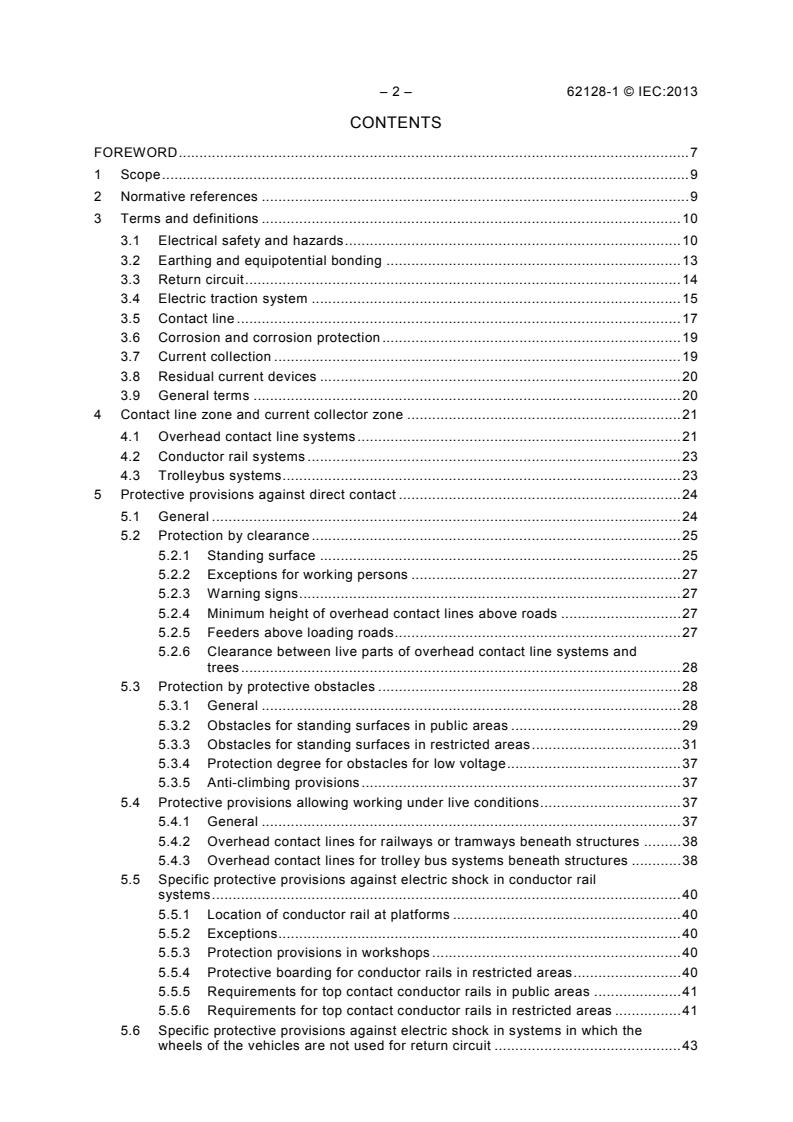
– 2 – 62128-1 © IEC:2013
CONTENTS
FOREWORD . 7
1 Scope . 9
2 Normative references . 9
3 Terms and definitions . 10
3.1 Electrical safety and hazards . 10
3.2 Earthing and equipotential bonding . 13
3.3 Return circuit . 14
3.4 Electric traction system . 15
3.5 Contact line . 17
3.6 Corrosion and corrosion protection . 19
3.7 Current collection . 19
3.8 Residual current devices . 20
3.9 General terms . 20
4 Contact line zone and current collector zone . 21
4.1 Overhead contact line systems . 21
4.2 Conductor rail systems . 23
4.3 Trolleybus systems . 23
5 Protective provisions against direct contact . 24
5.1 General . 24
5.2 Protection by clearance . 25
5.2.1 Standing surface . 25
5.2.2 Exceptions for working persons . 27
5.2.3 Warning signs . 27
5.2.4 Minimum height of overhead contact lines above roads . 27
5.2.5 Feeders above loading roads . 27
5.2.6 Clearance between live parts of overhead contact line systems and
trees . 28
5.3 Protection by protective obstacles . 28
5.3.1 General . 28
5.3.2 Obstacles for standing surfaces in public areas . 29
5.3.3 Obstacles for standing surfaces in restricted areas . 31
5.3.4 Protection degree for obstacles for low voltage . 37
5.3.5 Anti-climbing provisions . 37
5.4 Protective provisions allowing working under live conditions . 37
5.4.1 General . 37
5.4.2 Overhead contact lines for railways or tramways beneath structures . 38
5.4.3 Overhead contact lines for trolley bus systems beneath structures . 38
5.5 Specific protective provisions against electric shock in conductor rail
systems . 40
5.5.1 Location of conductor rail at platforms . 40
5.5.2 Exceptions . 40
5.5.3 Protection provisions in workshops . 40
5.5.4 Protective boarding for conductor rails in restricted areas . 40
5.5.5 Requirements for top contact conductor rails in public areas . 41
5.5.6 Requirements for top contact conductor rails in restricted areas . 41
5.6 Specific protective provisions against electric shock in systems in which the
wheels of the vehicles are not used for return circuit . 43
62128-1 © IEC:2013 – 3 –
5.6.1 General . 43
5.6.2 Railway systems . 44
5.6.3 Trolleybus systems . 44
6 Protective provisions against indirect contact . 45
6.1 General . 45
6.2 Protective provisions for exposed conductive parts within the contact line
zone or the current collector zone . 45
6.2.1 AC traction systems . 45
6.2.2 DC traction systems . 45
6.2.3 Exceptions for low voltage traction systems . 46
6.2.4 Anchors of non-conductive masts . 47
6.3 Protective provisions for wholly or partly conductive structures. 47
6.3.1 Structures in the overhead contact line zone or the current collector
zone . 47
6.3.2 Parts in the vicinity of the railways . 48
7 Protective provisions for low voltage non-traction power supplies . 48
7.1 General . 48
7.2 Related provisions . 49
7.3 Protective provisions for electrical installations in the overhead contact line
zone or the current collector zone . 49
7.3.1 Exposed conductive parts . 49
7.3.2 Equipment of protection Class II . 50
7.4 Protective provisions for installations which are endangered by the traction
power supply return circuit. 50
7.4.1 Design of auxiliary power supply. 50
7.4.2 Low voltage power supply by TT system . 51
7.4.3 Low voltage power supply by TN system . 51
7.4.4 Special provisions . 52
8 Protective provisions where track systems, which are utilized for carrying traction
return current, or/and contact line systems pass through hazardous zones . 57
8.1 General . 57
8.2 Equipotential bonding . 58
8.3 Parallel pipework . 58
8.4 Insulating joints . 59
8.5 Surge arrester . 59
8.6 Contact line of loading sidings . 59
9 Limits for touch voltage and protective provisions against the danger of rail
potential . 60
9.1 General . 60
9.1.1 Rail potential . 60
9.1.2 Body voltage and touch voltage . 60
9.1.3 Touch voltage at vehicles . 60
9.1.4 Fault duration condition . 61
9.1.5 Voltage limits and time duration aspects . 61
9.2 Touch voltage limits in a.c. traction systems . 61
9.2.1 General . 61
9.2.2 AC voltage limits for the safety of persons . 61
9.3 Touch voltage limits in d.c. traction systems . 64
9.3.1 General . 64
9.3.2 DC voltage limits for the safety of persons . 65
– 4 – 62128-1 © IEC:2013
9.4 Access control . 67
10 Additional protective provisions . 67
10.1 Traction substations and traction switching stations . 67
10.2 Cables . 67
10.2.1 General requirements . 67
10.2.2 Cables in a.c. traction power supply systems . 67
10.2.3 Cables in d.c. traction power supply systems . 67
10.3 Return circuit connections and earthing conductors . 68
10.3.1 General requirements . 68
10.3.2 Continuity of the return circuit . 68
10.3.3 Cross-bonding of the return circuit . 68
10.3.4 Railway systems in which the traction current is confined within
insulated conductors . 69
10.4 Removing of decommissioned overhead contact lines . 69
10.5 Means of achieving safe isolation between sections . 69
10.5.1 Section insulators . 69
10.5.2 Isolating gaps . 69
10.6 Lightning protection . 69
Annex A (informative) Typical obstacles. 70
Annex B (normative) Warning sign . 72
Annex C (informative) Guiding values for rail potential gradient . 73
Annex D (informative) Effective touch voltage and body voltage with respect to the
body current . 75
Annex E (normative) Measurement methods for effective touch voltages . 81
Annex F (normative) The use of voltage-limiting devices . 82
Annex G (normative) Special national conditions . 84
Annex H (normative) A-deviations . 86
Annex I (informative) Principles for the return circuit of a.c. railways . 87
Bibliography . 89
Figure 1 – Overhead contact line zone and current collector zone. 23
Figure 2 – Overhead contact line zone and current collector zone for trolley bus
systems . 24
Figure 3 – Minimum clearances to accessible live parts on the outside of vehicles as
well as to live parts of overhead contact line systems from standing surfaces
accessible to persons for low voltages . 26
Figure 4 – Minimum clearances to accessible live parts on the outside of vehicles as
well as to live parts of overhead contact line systems from standing surfaces
accessible to persons for high voltages . 26
Figure 5 – Standing surfaces for persons providing access to live parts on the outside
of vehicles and to overhead contact line systems . 28
Figure 6 – Standing surfaces for persons providing access to live parts on the outside
of vehicles and to conductor rail systems . 29
Figure 7 – Examples of obstacles for standing surfaces in public areas for protection
against direct contact with adjacent live parts on the outside of vehicles or adjacent
live parts of a contact line system . 30
Figure 8 – Examples of obstacles for standing surfaces in restricted areas for
protection against direct contact with adjacent live parts on the outside of vehicles or
adjacent live parts of a contact line system for low voltages . 33
62128-1 © IEC:2013 – 5 –
Figure 9 – Examples of obstacles for standing surfaces in restricted areas for
protection against direct contact with adjacent live parts on the outside of vehicles or
adjacent live parts of a contact line system for high voltages . 34
Figure 10 – Examples of obstacles for standing surfaces in restricted areas for
protection against direct contact when above live parts on the outside of vehicles or
live parts of a contact line system for low voltage. 36
Figure 11 – Examples of obstacles for standing surfaces in restricted areas for
protection against direct contact when above live parts on the outside of vehicles or
live parts of an overhead contact line system for high voltage . 37
Figure 12 – Example of an insulated obstacle beneath a structure . 38
Figure 13 – Example of an insulated obstacle beneath a structure for an unearthed
trolley bus system . 39
Figure 14 – Example of an insulated obstacle beneath a structure for a trolley bus
system in which the negative contact wire is earthed or connected to the return circuit
of a tramway system . 40
Figure 15 – Public and private level crossings . 41
Figure 16 – Trackside structures . 42
Figure 17 – Signal-post with telephone . 42
Figure 18 – Authorized trackside walking route . 43
Figure 19 – Railway controlled crossing (depots, goods yard, station crossing) . 43
Figure 20 – TT system for a.c. railways . 53
Figure 21 – TN system for a.c. railways . 54
Figure 22 – TT system for d.c. railways . 56
Figure 23 – TN system for d.c. railways . 57
Figure 24 – Disposition of rail-to-rail cross-bonds and track-to-track cross-bonds
(double-rail illustration) and connection of the contact line in case of the loading siding
having a contact line . 58
Figure 25 – Location of a surge arrester outside the overhead contact line zone of a
loading siding if there is a possibility of flashovers of the insulating pieces through
lightning strikes . 59
Figure 26 – Design of return circuit, with regard to permissible effective touch voltage
by checking the rail potential or the effective touch voltage . 64
Figure A.1 – Examples of obstacles along the sides of standing surfaces in public
areas for protection against direct contact when they are above live parts on the
outside of vehicles or live parts of an overhead contact line system for low voltages
(see 5.3.2.2) . 70
Figure A.2 – Examples of obstacles along the sides of standing surfaces in public
areas for protection against direct contact when they are above live parts on the
outside of vehicles or live parts of an overhead contact line system for high voltages
(see 5.3.2.2) . 71
Figure B.1 – Warning sign . 72
Figure C.1 – Guidance values for the rail potential gradient measured at the mast in a
right angle to the track in an a.c. traction system . 73
Figure D.1 – Equivalent circuit for the calculation of the permissible touch voltage . 77
Figure G.1 – Overhead contact line zone at platforms, workshops and similar locations . 85
Figure I.1 – Principle for limited touch voltage by earthing the return circuit (railway
integrated earthing system). 87
Figure I.2 – Principle for limited access. 88
– 6 – 62128-1 © IEC:2013
Table 1 – Maximum dimensions for small conductive parts . 47
Table 2 – Kinds of auxiliary supplies . 50
Table 3 – Maximum permissible body voltages U in a.c. traction systems as a
b, max
function of time duration . 61
Table 4 – Maximum permissible effective touch voltages U in a.c. traction
te, max
systems as a function of time duration . 62
Table 5 – Maximum permissible body voltages U in d.c. traction systems as a
b, max
function of time duration . 65
Table 6 – Maximum permissible effective touch voltages U in d.c. traction
te, max
systems as a function of time duration . 66
Table C.1 – Guidance values for the rail potential gradient (see Figure C.1) . 74
Table D.1 – Body impedance Z and body current I . 76
b b
Table D.2 – Example of the maximum permissible prospective touch voltage for a.c.
railways for short-term conditions and R = 1 150 Ω . 78
a
Table D.3 – Body currents, body voltages and touch voltages as function of time
duration in a.c. traction systems. 79
Table D.4 – Body currents, body voltages and touch voltages as function of time
duration in d.c. traction systems. 80
62128-1 © IEC:2013 – 7 –
INTERNATIONAL ELECTROTECHNICAL COMMISSION
_____________
RAILWAY APPLICATIONS –
FIXED INSTALLATIONS –
ELECTRICAL SAFETY, EARTHING AND THE RETURN CIRCUIT –
Part 1: Protective provisions against electric shock
FOREWORD
1) The International Electrotechnical Commission (IEC) is a worldwide organization for standardization comprising
all national electrotechnical committees (IEC National Committees). The object of IEC is to promote
international co-operation on all questions concerning standardization in the electrical and electronic fields. To
this end and in addition to other activities, IEC publishes International Standards, Technical Specifications,
Technical Reports, Publicly Available Specifications (PAS) and Guides (hereafter referred to as “IEC
Publication(s)”). Their preparation is entrusted to technical committees; any IEC National Committee interested
in the subject dealt with may participate in this preparatory work. International, governmental and non-
governmental organizations liaising with the IEC also participate in this preparation. IEC collaborates closely
with the International Organization for Standardization (ISO) in accordance with conditions determined by
agreement between the two organizations.
2) The formal decisions or agreements of IEC on technical matters express, as nearly as possible, an international
consensus of opinion on the relevant subjects since each technical committee has representation from all
interested IEC National Committees.
3) IEC Publications have the form of recommendations for international use and are accepted by IEC National
Committees in that sense. While all reasonable efforts are made to ensure that the technical content of IEC
Publications is accurate, IEC cannot be held responsible for the way in which they are used or for any
misinterpretation by any end user.
4) In order to promote international uniformity, IEC National Committees undertake to apply IEC Publications
transparently to the maximum extent possible in their national and regional publications. Any divergence
between any IEC Publication and the corresponding national or regional publication shall be clearly indicated in
the latter.
5) IEC itself does not provide any attestation of conformity. Independent certification bodies provide conformity
assessment services and, in some areas, access to IEC marks of conformity. IEC is not responsible for any
services carried out by independent certification bodies.
6) All users should ensure that they have the latest edition of this publication.
7) No liability shall attach to IEC or its directors, employees, servants or agents including individual experts and
members of its technical committees and IEC National Committees for any personal injury, property damage or
other damage of any nature whatsoever, whether direct or indirect, or for costs (including legal fees) and
expenses arising out of the publication, use of, or reliance upon, this IEC Publication or any other IEC
Publications.
8) Attention is drawn to the Normative references cited in this publication. Use of the referenced publications is
indispensable for the correct application of this publication.
9) Attention is drawn to the possibility that some of the elements of this IEC Publication may be the subject of
patent rights. IEC shall not be held responsible for identifying any or all such patent rights.
International Standard IEC 62128-1 has been prepared by IEC technical committee 9:
Electrical equipment and systems for railways.
This second edition cancels and replaces the first edition issued in 2003. It constitutes a
technical revision.
The main technical changes with regard to the previous edition are a consequence of the
revision of the related European Standard, EN 50122-1. Main changes are the restructuring of
all clauses and changes in the touch voltages limits.
– 8 – 62128-1 © IEC:2013
The text of this standard is based on the following documents:
FDIS Report on voting
9/1803/FDIS 9/1837/RVD
Full information on the voting for the approval of this standard can be found in the report on
voting indicated in the above table.
This publication has been drafted in accordance with the ISO/IEC Directives, Part 2.
A list of all parts in the IEC 62128 series, published under the general title Railway
applications – Fixed installations – Electrical safety, earthing and the return circuit, can be
found on the IEC website.
The committee has decided that the contents of this publication will remain unchanged until
the stability date indicated on the IEC web site under "http://webstore.iec.ch" in the data
related to the specific publication. At this date, the publication will be
• reconfirmed,
• withdrawn,
• replaced by a revised edition, or
• amended.
62128-1 © IEC:2013 – 9 –
RAILWAY APPLICATIONS –
FIXED INSTALLATIONS –
ELECTRICAL SAFETY, EARTHING AND THE RETURN CIRCUIT –
Part 1: Protective provisions against electric shock
1 Scope
This part of IEC 62128 specifies requirements for the protective provisions relating to
electrical safety in fixed installations associated with a.c. and/or d.c. traction systems and to
any installations that can be endangered by the traction power supply system.
It also applies to all aspects of fixed installations that are necessary to ensure electrical safety
during maintenance work within electric traction systems.
This standard applies to all new lines and to all major revisions to existing lines for the
following electric traction systems:
a) railways;
b) guided mass transport systems such as
1) tramways,
2) elevated and underground railways,
3) mountain railways,
4) trolleybus systems, and
5) magnetically levitated systems, which use a contact line system,
c) material transportation systems.
This standard does not apply to:
d) mine traction systems in underground mines;
e) cranes, transportable platforms and similar transportation equipment on rails, temporary
structures (e.g. exhibition structures) in so far as these are not supplied directly or via
transformers from the contact line system and are not endangered by the traction power
supply system;
f) suspended cable cars;
g) funicular railways.
This standard does not specify working rules for maintenance.
2 Normative references
The following documents, in whole or in part, are normatively referenced in this document and
are indispensable for its application. For dated references, only the edition cited applies. For
undated references, the latest edition of the referenced document (including any
amendments) applies.
NOTE Normative references are made to IEC standards. For some references the IEC standards do not exist. In
these cases, references are made to European Standards which are normative for Europe. For non-European
countries these references are only informative and therefore listed in the bibliography.
IEC 60050-101, International Electrotechnical Vocabulary (IEV) – Part 101: Mathematics
– 10 – 62128-1 © IEC:2013
IEC 60364-4-41:2005, Low-voltage electrical installations – Part 4-41: Protection for safety –
Protection against electric shock
IEC/TS 60479-1:2005, Effects of current on human beings and livestock – Part 1: General
aspects
IEC 60529:1989, Degrees of protection provided by enclosures (IP code)
Amendment 1:1999
IEC 60850, Railway applications – Supply voltages of traction systems
IEC 60898-1:2002, Electrical accessories – Circuit-breakers for overcurrent protection for
household and similar installations – Part 1: Circuit-breakers for a.c. operation
IEC 60913:2013, Railway applications – Fixed installations – Electric traction overhead
contact lines
IEC 61140:2001, Protection against electric shock – Common aspects for installation and
equipment
Amendment 1:2004
IEC 61936-1:2010, Power installations exceeding 1 kV a.c. – Part 1: Common rules
IEC 61991:2000, Railway applications – Rolling stock – Protective provisions relating to
electrical hazards
IEC 62128-2, Railway applications – Fixed installations – Electrical safety, earthing and the
return circuit – Part 2: Provisions against the effects of stray currents caused by d.c. traction
systems
IEC 62305 (all parts), Protection against lightning
IEC 62497-1:2010, Railway applications – Insulation coordination – Part 1: Basic
requirements – Clearances and creepage distances for all electrical and electronic equipment
IEC 62724: –, Railway applications – Fixed installations – Electric traction – Insulating
synthetic rope assemblies for support of overhead contact lines
ISO 3864-1:2011, Graphical symbols – Safety colours and safety signs – Part 1: Design
principles for safety signs and safety markings
ISO 7010:2011, Graphical symbols – Safety colours and safety signs – Registered safety
signs
3 Terms and definitions
For the purposes of this document, the following terms and definitions apply.
3.1 Electrical safety and hazards
3.1.1
electrical safety
freedom from unacceptable risk of harm caused by electrical systems
____________
To be published.
62128-1 © IEC:2013 – 11 –
3.1.2
electric shock
pathophysiological effect resulting from an electric current passing through a human or animal
body
[SOURCE: IEC 60050-604:1987, 604-04-16]
3.1.3
(effective) touch voltage
U
te
voltage between conductive parts when touched simultaneously by a person or an animal
Note 1 to entry: The value of the effective touch voltage can be appreciably influenced by the impedance of the
person or the animal in electric contact with these conductive parts
Note 2 to entry: The conductive path through the body is conventionally from hand to both feet (horizontal
distance of 1 m) or from hand to hand.
[SOURCE: IEC 60050-195:1998, 195-05-11]
3.1.4
prospective touch voltage
U
tp
voltage between simultaneously accessible conductive parts when those conductive parts are
not being touched by a person or an animal
[SOURCE: IEC 60050-195:1998, 195-05-09]
3.1.5
body voltage
U
b
product of the current through the body and the body impedance
3.1.6
standing surface
any point on a surface where persons may stand or walk about without great effort
3.1.7
protective boarding
non-conducting barrier to protect persons from coming into direct contact with the live
conductor rail
3.1.8
(electrically) protective obstacle
part preventing unintentional direct contact, but not preventing direct contact by deliberate
action
[SOURCE: IEC 60050-195:1998, 195-06-16]
3.1.9
(electrically) protective barrier
part providing protection against direct contact from any usual direction of access
[SOURCE: IEC 60050-195:1998, 195-06-15]
3.1.10
anti-trespassing guard
equipment provided to deter entry to a restricted area, structure or building by an
unauthorized person
– 12 – 62128-1 © IEC:2013
3.1.11
conductive part
part which can carry electric current
[SOURCE: IEC 60050-195:1998, 195-01-06]
3.1.12
exposed conductive part
conductive part of electrical equipment, which can be touched and which is not normally live,
but which can become live when basic insulation fails
Note 1 to entry: A conductive part of electrical equipment which can only become live through contact with an
exposed conductive part which has become live is not considered to be an exposed conductive part itself.
[SOURCE: IEC 60050-442:1998, 442-01-21]
3.1.13
live part
conductor or conductive part intended to be energised in normal use. By convention this does
not include the running rails and parts connected to them
3.1.14
direct contact
electric contact of persons or animals with live parts
[SOURCE: IEC 60050-826:2004, 826-12-03]
3.1.15
indirect contact
electric contact of persons or animals with exposed conductive parts which have become live
under fault conditions
[SOURCE: IEC 60050-826:2004, 826-12-04]
3.1.16
neutral conductor
conductor electrically connected to the neutral point and capable of contributing to the
distribution of electric energy
[SOURCE: IEC 60050-826:2004, 826-14-07]
3.1.17
protective conductor
PE
conductor, required by some measures for protection against electric shock, for electrically
connecting any of the following parts:
– exposed conductive parts;
– extraneous conductive parts;
– main earthing terminal;
– earth electrode;
– earthed point of the source or artificial neutral
3.1.18
PEN conductor
conductor combining the functions of both a protective earthing conductor and a neutral
conductor
62128-1 © IEC:2013 – 13 –
[SOURCE: IEC 60050-826:2004, 826-13-25]
3.1.19
solid-wall design
any kind of construction made of concrete, steel or other material without any holes or gaps
3.1.20
voltage-limiting device
VLD
protective device whose function is to prevent existence of an impermissible high touch
voltage
3.2 Earthing and equipotential bonding
3.2.1
earth
conductive mass of the earth, whose electric potential at any point is conventionally taken as
equal to zero
3.2.2
earthing
connection of conductive parts to an appropriate earth electrode
3.2.3
earth electrode
conductor or a group of conductors in intimate contact with and providing an electrical
connection to earth
[SOURCE: IEC 60050-461:2008, 461-06-18]
3.2.4
structure earth
construction made of metallic parts or construction including interconnected metallic structural
parts, which can be used as an earth electrode
Note 1 to entry: Examples are reinforced railway structures such as bridges, viaducts, tunnels, mast foundations
and reinforced track bed.
3.2.5
rail to earth resistance
electrical resistance between the running rails and the earth or structure earth
3.2.6
equipotential bonding
provision of electric connections between conductive parts, intended to achieve
equipotentiality
[SOURCE: IEC 60050-826:2004, 826-13-19]
3.2.7
main equipotential busbar
MEB
busbar where the equipotential conductors terminate
3.2.8
cross bond
electrical connection intended to connect in parallel the conductors of the return circuit
– 14 – 62128-1 © IEC:2013
3.2.9
rail-to-rail cross bond
electrical bond that interconnects the running rails of the same track
3.2.10
track-to-track cross bond
electrical bond that interconnects tracks
3.2.11
rail joint bond
conductor ensuring the electrical continuity of rails at a joint
[SOURCE: IEC 60050-811:1991, 811-35-07]
3.2.12
open connection
connection of conductive parts to the return circuit by a voltage-limiting device which makes a
conductive connection either temporarily or permanently if the limited value of the voltage is
exceeded
3.2.13
common building
building or structure which contains or supports an a.c. railway and a d.c. railway; furthermore
where some conductive parts of the structure are within the contact line zone or the current
collector zone of the a.c. railway and some conductive parts of the struc
...
Questions, Comments and Discussion
Ask us and Technical Secretary will try to provide an answer. You can facilitate discussion about the standard in here.
Loading comments...