

IEC 62683-2-3:2024
(Main)Low-voltage switchgear and controlgear – Product data and properties for information exchange – Engineering data – Part 2-3: Functional safety and reliability
General Information
- Abstract
IEC 62683-2:2024 specifies the functional safety and reliability data model descriptions for low‑voltage switchgear and controlgear to be used by engineering tools for the design of safety related control systems according to IEC 62061, IEC 61508-2 and ISO 13849-1, and for dependability analysis of electrotechnical systems.
This dictionary is used to facilitate the exchange between computers of data characterizing low-voltage switchgear and controlgear.
Each property has an unambiguously defined meaning and naming, and where relevant, a defined value list, a defined format and a defined unit.
The data models described in this document are intended to complement the product catalogue data defined by IEC 62683-1.
This document does not cover:
- exchange format such as defined in VDMA 66413,
- explosive atmosphere applications,
- manufacturer specific features.
- Status
- Published
- Publication Date
- 14-Nov-2024
- Technical Committee
- TC 121 - Switchgear and controlgear and their assemblies for low voltage
- Drafting Committee
- WG 3 - TC 121/WG 3
- Current Stage
- PPUB - Publication issued
- Start Date
- 15-Nov-2024
- Completion Date
- 06-Dec-2024
Buy Documents
IEC 62683-2-3:2024 - Low-voltage switchgear and controlgear – Product data and properties for information exchange – Engineering data – Part 2-3: Functional safety and reliability Released:11/15/2024
Overview
IEC 62683-2-3:2024 is an international standard from the International Electrotechnical Commission (IEC) that defines structured data models for functional safety and reliability properties of low-voltage switchgear and controlgear. Its purpose is to facilitate reliable information exchange between computers and engineering tools, especially in the context of designing safety-related control systems and performing dependability analysis in electrotechnical systems. This standard supports the automation, design, and assessment processes by providing clear and unambiguous definitions of product properties, value lists, and units, according to recognized IEC and ISO safety standards.
Key Topics
- Functional Safety Data Model: Describes safety-relevant features of switchgear and controlgear used within systems designed per IEC 62061, IEC 61508-2, and ISO 13849-1. Includes properties such as safety integrity level, proof test interval, category, and performance level.
- Reliability Data Model: Provides key parameters for dependability analysis, like mean operating time to failure (MTTF), mean time between failures (MTBF), and useful operational lifetime.
- Standardized Property Definitions: Each property is uniquely defined with its name, purpose, data format, unit, and possible values, enabling precise data mapping.
- Data Interoperability: Structured engineering models are designed to be compatible and complementary with the generic product cataloguing in IEC 62683-1.
- Exclusions: The document does not specify data exchange formats (as defined in VDMA 66413), explosive atmosphere applications, or manufacturer-specific features.
Applications
IEC 62683-2-3:2024 delivers significant practical value to a range of industries involved in automation, electrical engineering, and safety assurance:
- Engineering Design and Automation: Provides essential data models for use in engineering tools when designing and verifying low-voltage control systems and safety-related hardware.
- Functional Safety Assessment: Facilitates compliance verification with leading international standards for machinery and programmable electronic systems, such as IEC 62061, IEC 61508-2, and ISO 13849-1.
- Dependability and Reliability Analysis: Supplies standardized attributes and values for reliability modeling, crucial for lifecycle assessments, predictive maintenance, and risk analysis.
- Digital Product Data Exchange: Enables seamless communication and integration of data between different enterprises, software platforms, and geographies by using harmonized attribute definitions and value lists.
- Global Sourcing and Selection: Assists procurement, specification, and comparison of switchgear by providing clarity and a common language for product safety and reliability attributes.
Related Standards
When applying IEC 62683-2-3:2024, it is important to refer to related international standards for full context and interoperability:
- IEC 62683-1: Defines product catalogue data models for low-voltage switchgear and controlgear.
- IEC 60947-1: Provides general rules for low-voltage switchgear and controlgear.
- IEC 61360-1: Specifies standard data element types and classification schemes, foundational for the property modeling in this standard.
- IEC 61508-2: Covers functional safety of electrical/electronic/programmable electronic safety-related systems.
- IEC 62061: Relates to the functional safety of safety-related control systems for machinery.
- ISO 13849-1: Addresses safety-related parts of control systems and their general design principles.
Summary
IEC 62683-2-3:2024 empowers manufacturers, system integrators, and end-users by defining interoperable, unambiguous functional safety and reliability data models for low-voltage switchgear and controlgear. By streamlining data exchange, standardizing terminology, and supporting compliance with international safety standards, it enhances safety, efficiency, and digitalization across the electrical engineering sector.
Buy Documents
IEC 62683-2-3:2024 - Low-voltage switchgear and controlgear – Product data and properties for information exchange – Engineering data – Part 2-3: Functional safety and reliability Released:11/15/2024
Get Certified
Connect with accredited certification bodies for this standard

IMQ S.p.A. (Certification)
Italian electrical product certification.

SLG Prüf- und Zertifizierungs GmbH
German testing and certification body.

UL Solutions
Global safety science company with testing, inspection and certification.
Sponsored listings
Frequently Asked Questions
IEC 62683-2-3:2024 is a standard published by the International Electrotechnical Commission (IEC). Its full title is "Low-voltage switchgear and controlgear – Product data and properties for information exchange – Engineering data – Part 2-3: Functional safety and reliability". This standard covers: IEC 62683-2:2024 specifies the functional safety and reliability data model descriptions for low‑voltage switchgear and controlgear to be used by engineering tools for the design of safety related control systems according to IEC 62061, IEC 61508-2 and ISO 13849-1, and for dependability analysis of electrotechnical systems. This dictionary is used to facilitate the exchange between computers of data characterizing low-voltage switchgear and controlgear. Each property has an unambiguously defined meaning and naming, and where relevant, a defined value list, a defined format and a defined unit. The data models described in this document are intended to complement the product catalogue data defined by IEC 62683-1. This document does not cover: - exchange format such as defined in VDMA 66413, - explosive atmosphere applications, - manufacturer specific features.
IEC 62683-2:2024 specifies the functional safety and reliability data model descriptions for low‑voltage switchgear and controlgear to be used by engineering tools for the design of safety related control systems according to IEC 62061, IEC 61508-2 and ISO 13849-1, and for dependability analysis of electrotechnical systems. This dictionary is used to facilitate the exchange between computers of data characterizing low-voltage switchgear and controlgear. Each property has an unambiguously defined meaning and naming, and where relevant, a defined value list, a defined format and a defined unit. The data models described in this document are intended to complement the product catalogue data defined by IEC 62683-1. This document does not cover: - exchange format such as defined in VDMA 66413, - explosive atmosphere applications, - manufacturer specific features.
IEC 62683-2-3:2024 is classified under the following ICS (International Classification for Standards) categories: 29.130.20 - Low voltage switchgear and controlgear. The ICS classification helps identify the subject area and facilitates finding related standards.
IEC 62683-2-3:2024 is available in PDF format for immediate download after purchase. The document can be added to your cart and obtained through the secure checkout process. Digital delivery ensures instant access to the complete standard document.
Standards Content (Sample)
IEC 62683-2-3 ®
Edition 1.0 2024-11
INTERNATIONAL
STANDARD
NORME
INTERNATIONALE
Low-voltage switchgear and controlgear – Product data and properties for
information exchange – Engineering data –
Part 2-3: Functional safety and reliability
Appareillages et ensembles d'appareillages à basse tension – Données et
propriétés de produits pour l’échange d’informations – Données d’ingénierie –
Partie 2-3 : Sécurité fonctionnelle et fiabilité
All rights reserved. Unless otherwise specified, no part of this publication may be reproduced or utilized in any form
or by any means, electronic or mechanical, including photocopying and microfilm, without permission in writing from
either IEC or IEC's member National Committee in the country of the requester. If you have any questions about IEC
copyright or have an enquiry about obtaining additional rights to this publication, please contact the address below or
your local IEC member National Committee for further information.
Droits de reproduction réservés. Sauf indication contraire, aucune partie de cette publication ne peut être reproduite ni
utilisée sous quelque forme que ce soit et par aucun procédé, électronique ou mécanique, y compris la photocopie et
les microfilms, sans l'accord écrit de l'IEC ou du Comité national de l'IEC du pays du demandeur. Si vous avez des
questions sur le copyright de l'IEC ou si vous désirez obtenir des droits supplémentaires sur cette publication, utilisez
les coordonnées ci-après ou contactez le Comité national de l'IEC de votre pays de résidence.
IEC Secretariat Tel.: +41 22 919 02 11
3, rue de Varembé info@iec.ch
CH-1211 Geneva 20 www.iec.ch
Switzerland
About the IEC
The International Electrotechnical Commission (IEC) is the leading global organization that prepares and publishes
International Standards for all electrical, electronic and related technologies.
About IEC publications
The technical content of IEC publications is kept under constant review by the IEC. Please make sure that you have the
latest edition, a corrigendum or an amendment might have been published.
IEC publications search - webstore.iec.ch/advsearchform IEC Products & Services Portal - products.iec.ch
The advanced search enables to find IEC publications by a Discover our powerful search engine and read freely all the
variety of criteria (reference number, text, technical publications previews, graphical symbols and the glossary.
committee, …). It also gives information on projects, replaced With a subscription you will always have access to up to date
and withdrawn publications. content tailored to your needs.
IEC Just Published - webstore.iec.ch/justpublished
Electropedia - www.electropedia.org
Stay up to date on all new IEC publications. Just Published
The world's leading online dictionary on electrotechnology,
details all new publications released. Available online and once
containing more than 22 500 terminological entries in English
a month by email.
and French, with equivalent terms in 25 additional languages.
Also known as the International Electrotechnical Vocabulary
IEC Customer Service Centre - webstore.iec.ch/csc
(IEV) online.
If you wish to give us your feedback on this publication or need
further assistance, please contact the Customer Service
Centre: sales@iec.ch.
A propos de l'IEC
La Commission Electrotechnique Internationale (IEC) est la première organisation mondiale qui élabore et publie des
Normes internationales pour tout ce qui a trait à l'électricité, à l'électronique et aux technologies apparentées.
A propos des publications IEC
Le contenu technique des publications IEC est constamment revu. Veuillez vous assurer que vous possédez l’édition la
plus récente, un corrigendum ou amendement peut avoir été publié.
Recherche de publications IEC - IEC Products & Services Portal - products.iec.ch
webstore.iec.ch/advsearchform Découvrez notre puissant moteur de recherche et consultez
La recherche avancée permet de trouver des publications IEC gratuitement tous les aperçus des publications, symboles
en utilisant différents critères (numéro de référence, texte, graphiques et le glossaire. Avec un abonnement, vous aurez
comité d’études, …). Elle donne aussi des informations sur les toujours accès à un contenu à jour adapté à vos besoins.
projets et les publications remplacées ou retirées.
Electropedia - www.electropedia.org
IEC Just Published - webstore.iec.ch/justpublished
Le premier dictionnaire d'électrotechnologie en ligne au monde,
Restez informé sur les nouvelles publications IEC. Just
avec plus de 22 500 articles terminologiques en anglais et en
Published détaille les nouvelles publications parues.
français, ainsi que les termes équivalents dans 25 langues
Disponible en ligne et une fois par mois par email.
additionnelles. Egalement appelé Vocabulaire
Electrotechnique International (IEV) en ligne.
Service Clients - webstore.iec.ch/csc
Si vous désirez nous donner des commentaires sur cette
publication ou si vous avez des questions contactez-nous:
sales@iec.ch.
IEC 62683-2-3 ®
Edition 1.0 2024-11
INTERNATIONAL
STANDARD
NORME
INTERNATIONALE
Low-voltage switchgear and controlgear – Product data and properties for
information exchange – Engineering data –
Part 2-3: Functional safety and reliability
Appareillages et ensembles d'appareillages à basse tension – Données et
propriétés de produits pour l’échange d’informations – Données d’ingénierie –
Partie 2-3 : Sécurité fonctionnelle et fiabilité
INTERNATIONAL
ELECTROTECHNICAL
COMMISSION
COMMISSION
ELECTROTECHNIQUE
INTERNATIONALE
ICS 29.130.20 ISBN 978-2-8327-0006-8
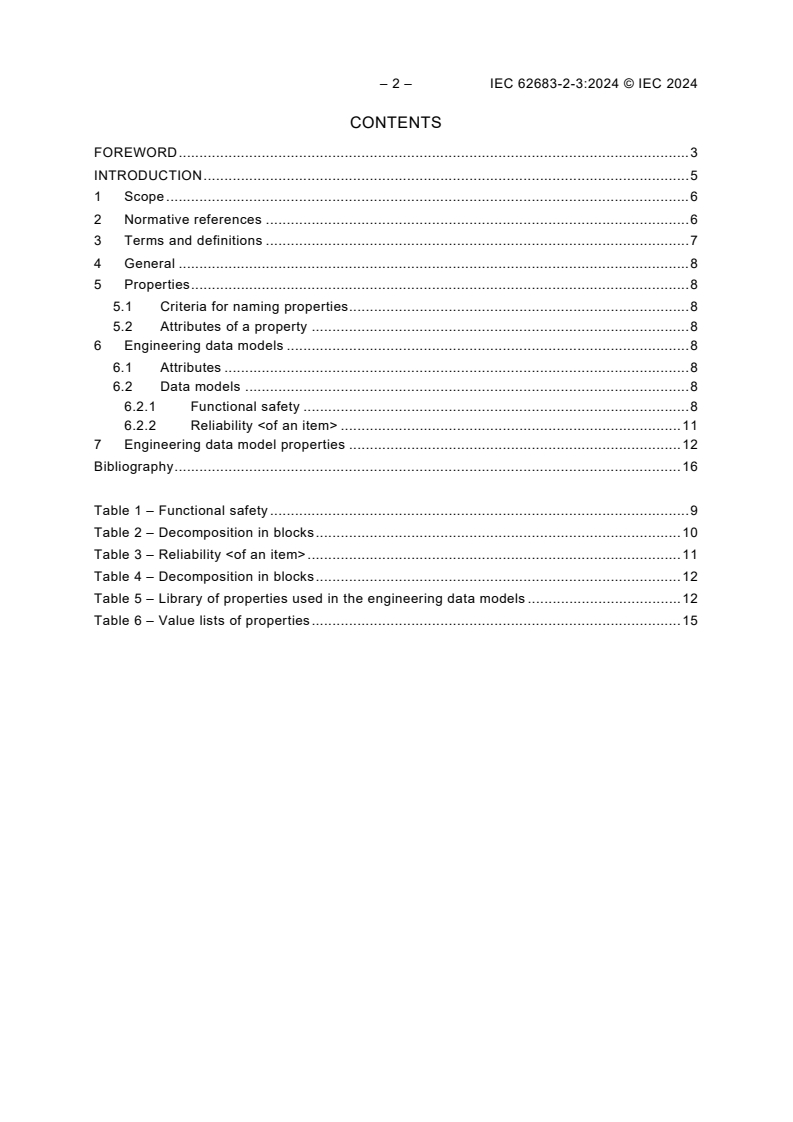
– 2 – IEC 62683-2-3:2024 © IEC 2024
CONTENTS
FOREWORD . 3
INTRODUCTION . 5
1 Scope . 6
2 Normative references . 6
3 Terms and definitions . 7
4 General . 8
5 Properties . 8
5.1 Criteria for naming properties . 8
5.2 Attributes of a property . 8
6 Engineering data models . 8
6.1 Attributes . 8
6.2 Data models . 8
6.2.1 Functional safety . 8
6.2.2 Reliability . 11
7 Engineering data model properties . 12
Bibliography . 16
Table 1 – Functional safety . 9
Table 2 – Decomposition in blocks . 10
Table 3 – Reliability . 11
Table 4 – Decomposition in blocks . 12
Table 5 – Library of properties used in the engineering data models . 12
Table 6 – Value lists of properties . 15
INTERNATIONAL ELECTROTECHNICAL COMMISSION
____________
LOW-VOLTAGE SWITCHGEAR AND CONTROLGEAR –
PRODUCT DATA AND PROPERTIES FOR INFORMATION EXCHANGE –
ENGINEERING DATA –
Part 2-3: Functional safety and reliability
FOREWORD
1) The International Electrotechnical Commission (IEC) is a worldwide organization for standardization comprising
all national electrotechnical committees (IEC National Committees). The object of IEC is to promote international
co-operation on all questions concerning standardization in the electrical and electronic fields. To this end and
in addition to other activities, IEC publishes International Standards, Technical Specifications, Technical Reports,
Publicly Available Specifications (PAS) and Guides (hereafter referred to as "IEC Publication(s)"). Their
preparation is entrusted to technical committees; any IEC National Committee interested in the subject dealt with
may participate in this preparatory work. International, governmental and non-governmental organizations liaising
with the IEC also participate in this preparation. IEC collaborates closely with the International Organization for
Standardization (ISO) in accordance with conditions determined by agreement between the two organizations.
2) The formal decisions or agreements of IEC on technical matters express, as nearly as possible, an international
consensus of opinion on the relevant subjects since each technical committee has representation from all
interested IEC National Committees.
3) IEC Publications have the form of recommendations for international use and are accepted by IEC National
Committees in that sense. While all reasonable efforts are made to ensure that the technical content of IEC
Publications is accurate, IEC cannot be held responsible for the way in which they are used or for any
misinterpretation by any end user.
4) In order to promote international uniformity, IEC National Committees undertake to apply IEC Publications
transparently to the maximum extent possible in their national and regional publications. Any divergence between
any IEC Publication and the corresponding national or regional publication shall be clearly indicated in the latter.
5) IEC itself does not provide any attestation of conformity. Independent certification bodies provide conformity
assessment services and, in some areas, access to IEC marks of conformity. IEC is not responsible for any
services carried out by independent certification bodies.
6) All users should ensure that they have the latest edition of this publication.
7) No liability shall attach to IEC or its directors, employees, servants or agents including individual experts and
members of its technical committees and IEC National Committees for any personal injury, property damage or
other damage of any nature whatsoever, whether direct or indirect, or for costs (including legal fees) and
expenses arising out of the publication, use of, or reliance upon, this IEC Publication or any other IEC
Publications.
8) Attention is drawn to the Normative references cited in this publication. Use of the referenced publications is
indispensable for the correct application of this publication.
9) IEC draws attention to the possibility that the implementation of this document may involve the use of (a)
patent(s). IEC takes no position concerning the evidence, validity or applicability of any claimed patent rights in
respect thereof. As of the date of publication of this document, IEC had not received notice of (a) patent(s), which
may be required to implement this document. However, implementers are cautioned that this may not represent
the latest information, which may be obtained from the patent database available at https://patents.iec.ch. IEC
shall not be held responsible for identifying any or all such patent rights.
IEC 62683-2-3 has been prepared by IEC technical committee 121: Switchgear and controlgear
and their assemblies for low voltage. It is an International Standard.
The text of this International Standard is based on the following documents:
Draft Report on voting
121/174/FDIS 121/182/RVD
Full information on the voting for its approval can be found in the report on voting indicated in
the above table.
The language used for the development of this International Standard is English.
– 4 – IEC 62683-2-3:2024 © IEC 2024
This document was drafted in accordance with ISO/IEC Directives, Part 2, and developed in
accordance with ISO/IEC Directives, Part 1 and ISO/IEC Directives, IEC Supplement, available
at www.iec.ch/members_experts/refdocs. The main document types developed by IEC are
described in greater detail at www.iec.ch/publications.
A list of all parts in the IEC 62683 series, published under the general title Low-voltage
switchgear and controlgear – Product data and properties for information exchange –
Engineering data, can be found on the IEC website.
The committee has decided that the contents of this document will remain unchanged until the
stability date indicated on the IEC website under webstore.iec.ch in the data related to the
specific document. At this date, the document will be
• reconfirmed,
• withdrawn, or
• revised.
INTRODUCTION
Engineering tools used for the design of safety control system of machinery and similar control
systems require functional safety and reliability data.
The purpose of this document is to:
• define the structure of the engineering data model classes and properties of low-voltage
switchgear and controlgear suitable for use in functional safety applications based on VDMA
66413 and other applications including dependability analysis.
• describe the method on how to provide and use these properties in typical applications.
The intended benefits of this document are to:
• reduce the costs, time and efforts of mapping data for each customer request;
• optimize the workflow of information exchange with engineering tools;
• facilitate the selection of a product, especially regarding reliability and safety;
• give access to product data everywhere regardless of country, language and culture.
This document consists of a reference dictionary of low-voltage switchgear and controlgear
using existing terms from IEC standards.
For this project, the introduction of low-voltage switchgear and controlgear within the IEC 61360
database addresses the following technical aspects:
• IEC 61360 requires mandatory attributes. The complete set of mandatory attributes with
additional relevant attributes for low-voltage switchgear and controlgear will be available
within the IEC 61360 database. The CDD 62683 database is available at the following
address:
https://cdd.iec.ch/cdd/iec62683/iec62683.nsf/TreeFrameset?OpenFrameSet&ongletactif=1
. Within the present document, only the most useful attributes will be presented;
• The switchgear and controlgear dictionary is implemented in an appropriate domain of the
IEC Component Data Dictionary (CDD), IEC 61360, by creating dictionaries of blocks,
classes and properties.
– 6 – IEC 62683-2-3:2024 © IEC 2024
LOW-VOLTAGE SWITCHGEAR AND CONTROLGEAR –
PRODUCT DATA AND PROPERTIES FOR INFORMATION EXCHANGE –
ENGINEERING DATA –
Part 2-3: Functional safety and reliability
1 Scope
This document specifies the functional safety and reliability data model descriptions for
low-voltage switchgear and controlgear to be used by engineering tools for the design of safety
related control systems according to IEC 62061, IEC 61508-2 and ISO 13849-1, and for
dependability analysis of electrotechnical systems.
This dictionary is used to facilitate the exchange between computers of data characterizing low-
voltage switchgear and controlgear.
Each property has an unambiguously defined meaning and naming, and where relevant, a
defined value list, a defined format and a defined unit.
The data models described in this document are intended to complement the product catalogue
data defined by IEC 62683-1.
This document does not cover:
– exchange format such as defined in VDMA 66413,
– explosive atmosphere applications,
– manufacturer specific features.
2 Normative references
The following documents are referred to in the text in such a way that some or all of their content
constitutes requirements of this document. For dated references, only the edition cited applies.
For undated references, the latest edition of the referenced document (including any
amendments) applies.
IEC 60947-1, Low-voltage switchgear and controlgear – Part 1: General rules
IEC 61360-1, Standard data element types with associated classification scheme – Part 1:
Definitions – Principles and methods
IEC 61508-2, Functional safety of electrical/electronic/programmable electronic safety-related
systems – Part 2: Requirements for electrical/electronic/programmable electronic safety-related
systems
IEC 62061, Safety of machinery – Functional safety of safety-related control systems
IEC 62683-1, Low-voltage switchgear and controlgear – Product data and properties for
information exchange – Part 1: Catalogue data
ISO 13849-1, Safety of machinery – Safety-related parts of control systems – Part 1: General
principles for design
3 Terms and definitions
For the purposes of this document, the terms and definitions given in IEC 60947-1 and the
following apply.
ISO and IEC maintain terminology databases for use in standardization at the following
addresses:
• IEC Electropedia: available at https://www.electropedia.org/
• ISO Online browsing platform: available at https://www.iso.org/obp
3.1
attribute
data element for description of a property, a relation or a device class
EXAMPLE The name of a property, the code of a class, the measure unit of a property.
3.2
block
collection of properties describing one common aspect of the device class
Note 1 to entry: A block is a feature class in the sense of IEC 61360-1 and ISO 13584-42.
EXAMPLE Diagnostic functions, control circuit.
3.3
cardinality
pattern defining the number of times a concept reoccurs within a description
Note 1 to entry: Cardinality allows a block of properties contained in a list of properties to be used more than once
for a particular transaction in order to describe, for example, a device with several different outputs or more than one
process cases.
[SOURCE: IEC 61987-10:2009, 3.1.5, modified – Notes 1, 2, 3, and 5 have been omitted.]
3.4
device
material element or assembly of such elements intended to perform a required function
Note 1 to entry: In this document, a device corresponds to a low voltage switchgear and controlgear.
[SOURCE: IEC 60050-151:2001, 151-11-20, modified – the note to entry has been omitted and
a new note has been added]
3.5
device class
set of properties which gives a description of a device
3.6
polymorphism
pattern that allows substitution of a single concept in the same context by a different more
specific (specialized) concept
Note 1 to entry: A specialised polymorphic block of properties can replace a more generic one in the same context.
Note 2 to entry: A polymorphic operator (control property) can act in selecting between of various specialisations.
[SOURCE: IEC 61987-10:2009, 3.1.21]
– 8 – IEC 62683-2-3:2024 © IEC 2024
3.7
property
defined parameter suitable for the description and differentiation of device class specific
characteristic describing an aspect of device class
4 General
The engineering data models are intended to be used as complementary to the product class
descriptions of IEC 62683-1.
The attributes shall follow IEC 61360-1. Based on IEC 61360-1 data model, the structured data
called cardinality and polymorphism may be used.
5 Properties
5.1 Criteria for naming properties
In order to maintain consistency and clarity in the naming of properties, terms from product
standards shall be used when there are available.
Synonymous names may be associated with the property name when well established terms
are used on the market.
5.2 Attributes of a property
The following attributes of a property are considered in this document: identifier, preferred name,
definition, source document, data type, unit of measure, value format, value list.
6 Engineering data models
6.1 Attributes
The attributes of the engineering data models shall follow IEC 61360-1.
The following attributes of a device class are considered in this document: identifier,
preferred name, definition, synonymous name and source document.
NOTE The synonymous names are limited to those necessary to avoid confusion when selecting a device class.
6.2 Data models
6.2.1 Functional safety
6.2.1.1 General structure
The functional safety model defined in Table 1 is to be used as an additional feature block of
an existing product class defined in IEC 62683-1 when the product is intended for use as a part
of a safety control system according to IEC 62061, IEC 61508-2 or ISO 13849-1.
Table 1 – Functional safety
Properties of each class Class ID Property ID
Functional safety for machinery ACC007
number of functional safety sets of characteristics ACE005
Operating conditions of functional safety characteristics ACG057
rated operational voltage ACE455
rated operational current, AC ACE533
rated operational current, DC ACE534
type of interlocking device ACE053
other operating conditions ACE070
useful life in number of operations ACE055
useful life in time interval ACE054
Safety device types ACG070
functional safety device type ACE071
Safety subsystem ACG065
safety integrity level ACE051
average frequency of dangerous failure ACE052
proof test interval ACE058
performance level ACE060
category ACE063
Electronic element ACG066
mean time to dangerous failure ACE057
proof test interval ACE058
Electromechanical element ACG067
number of operations until ten percent dangerous failure ACE056
proof test interval ACE058
Inherently safe subsystem ACG069
safety integrity level ACE051
proof test interval ACE058
performance level ACE060
category ACE063
6.2.1.2 Polymorphism device type
Depending on the functional safety capabilities of the device, its type shall be selected among
one of the four types:
a) Safety subsystem (device type 1).
b) Electronic element (device type 2).
c) Electromechanical element (device type 3).
d) Inherently safe subsystem (device type 4).
The device types 1 and 4 can be incorporated directly as a complete subsystem at the top level
of the architecture of the safety control system according to IEC 62061 (SCS) or ISO 13849-1
(SRP/CS). The device type 2 and 3 are only subsystem elements to be combined with other
subsystem elements in order to form a subsystem.
– 10 – IEC 62683-2-3:2024 © IEC 2024
The selection of the applicable device type is defined by the value selected in the value list
ACI142 of the polymorphic property ACE071 functional safety device type. This is controlling
the creation of an instance of the block ACG070 Safety device types using the selected device
type list of properties.
6.2.1.3 Decomposition in blocks
Table 2 gives the decomposition of the class and blocks of properties. The class name column
is structured in three levels of class hierarchy using vertical indent alignments.
NOTE The class hierarchy is shown on the left end side of the graphical user interface of IEC CDD.
Table 2 – Decomposition in blocks
Class name Synonymous Definition Source Class ID
Functional safety of part of the overall safety of machinery IEC 60050:2013, ACC007
machinery that depends on functional and 351-57-06,
physical units operating correctly in modified with "of
response to their inputs machinery"
Operating operating condition limits for which the ACG057
conditions of functional safety characteristics are
functional safety valid
characteristics
Safety device selected device type depending on its ACG070
types safety related characteristics and its
capability as subsystem or subsystem
element
Safety device type 1, entity of the top-level architectural IEC 62061:2021, ACG065
design of a safety-related system
subsystem subsystem 3.2.4
where a dangerous failure of the
subsystem results in dangerous failure
of a safety function
Note 1 to entry: This differs from
common language where "subsystem"
may mean any sub-divided part of an
entity, the term "subsystem" is used in
this document within a strongly
defined hierarchy of terminology:
"subsystem" is the first level
subdivision of a system. The parts
resulting from further subdivision of a
subsystem are called "subsystem
elements".
Note 2 to entry: A complete
subsystem can be made up from a
number of identifiable and separate
subsystem elements.
Note 3 to entry: The subsystem
specification includes its role in the
safety function and its interface with
the other subsystems of the SCS.
Note 4 to entry: One subsystem can
be part of several safety functions,
e.g. the same combination of
contactors can be used to de-energise
a motor either in the event of
detection of a person in a danger zone
or also in the event of opening an
interlock guard.
Electronic device type 2 element of electronic technology non derived from ACG066
element evaluated according to a functional ISO 13849:2022,
safety standard, provided with O.1.3
reliability data and which is necessary
to be integrated specifically into a
subsystem
Class name Synonymous Definition Source Class ID
Electromec device type 3 electromechanical element subject to derived from ACG067
hanical wearing provided with functional ISO 13849:2022,
element safety characteristics O.1.4
Inherently device type 4 subsystem without dangerous failure derived from ACG069
safe mode ISO 13849:2022,
subsystem O.1.5
Note 1 to entry: The absence of
dangerous failure mode is called also
fault exclusion.
6.2.2 Reliability
6.2.2.1 General structure
The reliability data of switchgear and controlgear used in general dependability analysis are
given in Table 3.
Table 3 – Reliability
Properties of each class Class ID Property ID
Reliability ACC008
number of reliability sets of characteristics ACE006
Operating conditions of reliability characteristics ACG071
rated operational voltage ACE455
rated operational current, AC ACE533
rated operational current, DC ACE534
other operating conditions ACE070
useful life in number of operations ACE055
useful life in time interval ACE054
Reliability characteristics ACC080
mean operating time to failure ACE061
mean operating time between failure ACE062
6.2.2.2 Decomposition in blocks
Table 4 gives the decomposition of the classes and blocks of properties. The class name
column is structured in two levels of class hierarchy using vertical indent alignments.
NOTE The class hierarchy is shown on the left end side of the graphical user interface of IEC CDD.
– 12 – IEC 62683-2-3:2024 © IEC 2024
Table 4 – Decomposition in blocks
Class name Synonymous Definition Source Class ID
ability to perform as required,
without failure, for a given time
interval, under given conditions
Note 1 to entry: The time
interval duration may be
expressed in units appropriate
to the item concerned, e.g.
calendar time, operating
cycles, distance run, etc. and
the units should always be
IEC 60050:2015,
Reliability ACC008
clearly stated.
192-01-24
Note 2 to entry: Given
conditions include aspects that
affect reliability, such as: mode
of operation, stress levels,
environmental conditions and
maintenance.
Note 3 to entry: Reliability
may be quantified using
appropriate measures.
Operating conditions operating condition limits for
of reliability which the reliability ACG071
characteristics characteristics are valid
characteristics of a subsystem
or a subsystem element
derived from
Reliability intended for evaluating its
IEC 60050:2015, ACC080
characteristics ability to perform as required,
192-01-24
without failure, for a given time
interval, under given conditions
7 Engineering data model properties
The properties listed in Table 5 are depicted with only eight attributes. More attributes are given
in the IEC CDD. The lists of values for each value list code are given in Table 6.
Table 5 – Library of properties used in the engineering data models
Preferred Definition Source Symbol Unit Data type Value
Property
name format
ID
cardinality property
ACE005 number of INT_TYPE NR1.2
for the number of
functional
sets of
safety sets of
characteristics of a
characteristics
product for use in
functional safety
assessment
classification of derived from
ACE053 type of ENUM_STRING_ X.6
device which ISO 14119:2023, 3.1
interlocking TYPE(ACI139)
prevent the
device
hazardous operation
of machine, under
specified conditions
(generally as long as
a guard is not
closed)
other limits of
ACE070 other operating STRING_TYPE X.256
operation related to
conditions
functional safety
characteristics
discrete level (one IEC 62061:2021,
ACE051 safety integrity ENUM_CODE_ X.5
out of a possible 3.2.24
level TYPE(ACI138)
three) for describing
the capability to
perform a safety
Preferred Definition Source Symbol Unit Data type Value
Property
name format
ID
function where
safety integrity level
three has the
highest level of
safety integrity and
safety integrity level
one has the lowest
average frequency IEC 62061:2021, 1/h
ACE052 average PFH REAL_MEASURE_ NR3.2.2
of dangerous failure 3.2.29
frequency of a TYPE ES2
of a safety-related
dangerous
control system to
failure per hour
perform a specified
safety function over
a given period of
time
Note 1 to entry:
Both terms PFH and
PFH correspond to
D
the probability of
dangerous failures
per hour.
Note 2 to entry:
The term "average
probability of
dangerous failure
per hour" is not used
in this edition
anymore but the
acronym PFH has
been retained but
when it is used it
means "average
frequency of
dangerous failure
[h]".
under given IEC 60947-1:2020, y
ACE054 useful life in REAL_MEASURE_ NR2.2.1
conditions, the time K.2.1.2, modified by
time interval TYPE
interval beginning at adding "in time
a given instant of interval" to the term
time, and ending
when the failure rate
becomes
unacceptable
under given
ACE055 useful life in REAL_TYPE NR3.1.2
conditions, the
number of E1
number of
operations
operations for which
the failure rate
becomes
unacceptable
mean number of derived from
number of B NR3.1.2
ACE056 REAL_TYPE
10D
operating cycles at IEC 61649:2008,
operations until E1
which ten percent of 3.1.11
ten percent
the components fail
dangerous
dangerously
failure
Note 1 to entry:
Data obtain from the
Weibull analysis.
expectation of the IEC 62061:2021, y
MTTF
ACE057 mean time to INT_MEASURE_ NR1.7
D
mean time to 3.2.38
dangerous TYPE
dangerous failure
failure
time interval derived from y
ACE058 proof test T REAL_MEASURE_ NR2.2.1
between tests IEC 61508-4:2010,
interval TYPE
performed to detect 3.8.5
dangerous hidden
failures in a safety-
related system
discrete level used ISO 13849-1:2023
ACE060 performance ENUM_STRING_ X.4
to specify the ability 3.1.5
level TYPE(ACI140)
of safety-related
parts of control
systems to perform
a safety function
– 14 – IEC 62683-2-3:2024 © IEC 2024
Preferred Definition Source Symbol Unit Data type Value
Property
name format
ID
under foreseeable
conditions
classification of the ISO 13849-1:2023
ACE063 category ENUM_STRING_ X10
subsystem in
3.1.4
TYPE(ACI141)
respect to its
resistance to faults
and its subsequent
behaviour in the
fault condition, and
which is achieved by
the structural
arrangement of the
parts, fault detection
and/or by their
reliability
classification of derived from
ACE071 functional ENUM_STRING_
X35
device depending on ISO 13849-1:2023,
safety device TYPE(ACI142)
their safety related Annex O.1
type
characteristics and
their capability as
subsystem or
subsystem element
cardinality property
ACE006 number of INT_TYPE NR1.2
for the number of
reliability sets
sets of
of
characteristics of a
characteristics
product for use in
reliability
assessment
expectation of the IEC 60050-192:2015, y
ACE061 mean MTTF INT_TYPE NR1.7
operating time to 192-05-11
operating time
failure
to failure
Note 1 to entry: In
the case of non-
repairable items with
an exponential
distribution of
operating times to
failure (i.e. a
constant failure rate)
the MTTF is
numerically equal to
the reciprocal of the
failure rate. This is
also true for
repairable items if
after restoration they
can be considered
to be "as-good-as-
new"
expectation of the IEC 60050-192:2015, y
ACE062 mean MTBF INT_TYPE NR1.7
duration of the 192-05-13
operating time
operating time
between
between failures
failures
Note 1 to entry:
Mean operating time
between failures
should only be
applied to repairable
items. For non-
repairable items,
see mean operating
time to failure.
Table 6 – Value lists of properties
Enum. ID Preferred name Value list Source
ACI138 safety integrity level SIL 1, SIL 2, SIL 3
ACI139 type of interlocking device type 1, type 2, type 3, type 4, type 5 ISO 14119:2023, 3.1
ACI140 performance level PL a, PL b, PL c, PL d, PL e
ACI141 category category B, category 1, category 2, ISO 13849-1:2023,
category 3, category 4 Table 5
ACI142 functional safety device type safety subsystem, electronic element,
electromechanical element, inherently safe
subsystem
– 16 – IEC 62683-2-3:2024 © IEC 2024
Bibliography
IEC 60050-151:2001, International Electrotechnical Vocabulary (IEV) – Part 151: Electrical
and magnetic devices
IEC 60050-151:2001/AMD1:2013
IEC 60050-151:2001/AMD2:2014
IEC 60050-151:2001/AMD3:2019
IEC 60050-151:2001/AMD4:2020
IEC 60050-151:2001/AMD5:2021
IEC 60050-192:2015, International Electrotechnical Vocabulary (IEV) – Part 192: Dependability
IEC 60050-192:2015/AMD1:2016
IEC 60050-441, International Electrotechnical Vocabulary (IEV) – Part 441: Switchgear,
controlgear and fuses
IEC 60050-603, International Electrotechnical Vocabulary (IEV) – Part 603: Generation,
transmission and distribution of electricity – Power systems planning and management
IEC 60050-716-1, International Electrotechnical Vocabulary (IEV) – Part 716-1: Integrated
services digital network (ISDN) – Part 1: General aspects
IEC 61508-4:2010, Functional safety of electrical/electronic/programmable electronic
safety-related systems – Part 4: Definitions and abbreviations (see Functional Safety and
IEC 61508)
IEC 61649:2008, Weibull analysis
IEC 61987-10:2009, Industrial-process measurement and control – Data structures and
elements in process equipment catalogues – Part 10: List of Properties (LOPs) for Industrial-
Process Measurement and Control for Electronic Data Exchange – Fundamentals
IEC 62061:2021, Safety of machinery – Functional safety of safety-related control systems
ISO 13584-42, Industrial automation systems and integration – Parts library – Part 42:
Description methodology: Methodology for structuring parts families
ISO 14119:2023, Safety of machinery – Interlocking devices associated with guards – Principles
for design and selection
VDMA 66413, Functional Safety – Universal data format for safety-related values of
components or parts of control systems
___________
– 18 – IEC 62683-2-3:2024 © IEC 2024
SOMMAIRE
AVANT-PROPOS . 19
INTRODUCTION . 21
1 Domaine d’application . 22
2 Références normatives . 22
3 Termes et définitions . 23
4 Généralités . 24
5 Propriétés . 24
5.1 Critères de dénomination des propriétés . 24
5.2 Attributs d’une propriété . 24
6 Modèles de données d’ingénierie . 24
6.1 Attributs . 24
6.2 Modèles de données . 25
6.2.1 Sécurité fonctionnelle . 25
6.2.2 Fiabilité . 27
7 Propriétés des modèles de données d’ingénierie . 29
Bibliographie . 35
Tableau 1 – Sécurité fonctionnelle . 25
Tableau 2 – Décomposition en blocs . 26
Tableau 3 – Fiabilité . 28
Tableau 4 – Décomposition en blocs . 28
Tableau 5 – Bibliothèque des propriétés utilisées dans les modèles de données
d’ingénierie . 30
Tableau 6 – Listes de valeurs des propriétés . 34
COMMISSION ÉLECTROTECHNIQUE INTERNATIONALE
____________
APPAREILLAGES ET ENSEMBLES D’APPAREILLAGES À BASSE
TENSION – DONNÉES ET PROPRIÉTÉS DE PRODUITS POUR
L’ÉCHANGE D’INFORMATIONS – DONNÉES D’INGÉNIERIE –
Partie 2-3: Sécurité fonctionnelle et fiabilité
AVANT-PROPOS
1) La Commission Électrotechnique Internationale (IEC) est une organisation mondiale de normalisation composée
de l’ensemble des comités électrotechniques nationaux (Comités nationaux de l’IEC). L’IEC a pour objet de
favoriser la coopération internationale pour toutes les questions de normalisation dans les domaines de
l’électricité et de l’électronique. À cet effet, l’IEC – entre autres activités – publie des Normes internationales,
des Spécifications techniques, des Rapports techniques, des Spécifications accessibles au public (PAS) et des
Guides (ci-après dénommés "Publication(s) de l’IEC"). Leur élaboration est confiée à des comités d’études, aux
travaux desquels tout Comité national intéressé par le sujet traité peut participer. Les organisations
internationales, gouvernementales et non gouvernementales, en liaison avec l’IEC, participent également aux
travaux. L’IEC collabore étroitement avec l’Organisation Internationale de Normalisation (ISO), selon des
conditions fixées par accord entre les deux organisations.
2) Les décisions ou accords officiels de l’IEC concernant les questions techniques représentent, dans la mesure du
possible, un accord international sur les sujets étudiés, étant donné que les Comités nationaux de l’IEC intéressés
sont représentés dans chaque comité d’études.
3) Les Publications de l’IEC se présentent sous la forme de recommandations internationales et sont agréées
comme telles par les Comités nationaux de l’IEC. Tous les efforts raisonnables sont entrepris afin que l’IEC
s’assure de l’exactitude du contenu technique de ses publications; l’IEC ne peut pas être tenue responsable de
l’éventuelle mauvaise utilisation ou interprétation qui en est faite par un quelconque utilisateur final.
4) Dans le but d’encourager l’uniformité internationale, les Comités nationaux de l’IEC s’engagent, dans toute la
mesure possible, à appliquer de façon transparente les Publications de l’IEC dans leurs publications nationales
et régionales. Toutes divergences entre toutes Publications de l’IEC et toutes publications nationales ou
régionales correspondantes doivent être indiquées en termes clairs dans ces dernières.
5) L’IEC elle-même ne fournit aucune attestation de conformité. Des organismes de certification indépendants
fournissent des services d’évaluation de conformité et, dans certains secteurs, accèdent aux marques de
conformité de l’IEC. L’IEC n’est responsable d’aucun des services effectués par les organismes de certification
indépendants.
6) Tous les utilisateurs doivent s’assurer qu’ils sont en possession de la dernière édition de cette publication.
7) Aucune responsabilité ne doit être imputée à l’IEC, à ses administrateurs, employés, auxiliaires ou mandataires,
y compris ses experts particuliers et les membres de ses comités d’études et des Comités nationaux de l’IEC,
pour tout préjudice causé en cas de dommages corporels et matériels, ou de tout autre dommage de quelque
nature que ce soit, directe ou indirecte, ou pour supporter les coûts (y compris les frais de justice) et les dépenses
découlant de la publication ou de l’utilisation de cette Publication de l’IEC ou de toute autre Publication de l’IEC,
ou au crédit qui lui est accordé.
8) L’attention est attirée sur les références normatives citées dans cette publication. L’utilisation de publications
référencées est obligatoire pour une application correcte de la présente publication.
9) L’IEC attire l’attention sur le fait que la mise en application du présent document peut entraîner l’utilisation d
...