


IEC 60601-2-47:2012
(Main)Medical electrical equipment - Part 2-47: Particular requirements for the basic safety and essential performance of ambulatory electrocardiographic systems
Medical electrical equipment - Part 2-47: Particular requirements for the basic safety and essential performance of ambulatory electrocardiographic systems
IEC 60601-2-47:2012 concerns the basic safety and essential performance of AMBULATORY ELECTROCARDIOGRAPHIC SYSTEMS. It amends and supplements the general standard IEC 60601-1 (third edition 2005). The requirements of this particular standard take priority over those of the general standard. Within the scope of this standard are systems of the following types:
a) systems that provide continuous recording and continuous analysis of the ECG allowing full re-analysis giving essentially similar results.
b) systems that provide continuous analysis and only partial or limited recording not allowing a full re-analysis of the ECG.
The safety aspects of this standard apply to all types of systems falling in one of the above- mentioned categories. If the AMBULATORY ELECTROCARDIOGRAPHIC SYSTEM offers automatic ECG analysis, minimal performance requirements for measurement and analysis functions apply. MEDICAL ELECTRICAL EQUIPMENT covered by IEC 60601-2-25 and IEC 60601-2-27 are excluded from the scope of this standard. This standard does not apply to systems that do not continuously record and analyse the ECG (for example, 'intermittent event recorders'). This second edition cancels and replaces the first edition published in 2001. It constitutes a technical revision. This edition was revised to align structurally with the 2005 edition of IEC 60601-1.
Appareils électromédicaux - Partie 2-47: Exigences particulières pour la sécurité de base et les performances essentielles des systèmes d'électrocardiographie ambulatoires
La CEI 60601-2-47:2012 concerne la sécurité de base et les performances essentielles des SYSTEMES D'ELECTROCARDIOGRAPHIE AMBULATOIRES. Elle amende et complète la norme générale CEI 60601-1 (troisième édition 2005). Les exigences de la présente norme particulière prévalent sur celles de la norme générale. Les systèmes des types suivants relèvent du domaine d'application de la présente norme:
a) systèmes qui assurent un enregistrement en continu et une analyse en continu de l'ECG permettant une nouvelle analyse globale donnant des résultats essentiellement similaires.
b) systèmes qui assurent une analyse en continu et seulement un enregistrement partiel ou limité ne permettant pas de nouvelle analyse globale de l'ECG.
Les aspects de sécurité de la présente norme s'appliquent à tous les types de systèmes appartenant à l'une des catégories mentionnées ci-dessus. Si le SYSTEME D'ELECTROCARDIOGRAPHIE AMBULATOIRE offre une analyse automatique de l'ECG, des exigences minimales de performances s'appliquent pour les fonctions de mesurage et d'analyse. Les APPAREILS EM couverts par les normes CEI 60601-2-25 et CEI 60601-2-27 sont exclus du domaine d'application de la présente norme. La présente norme ne s'applique pas aux systèmes qui n'enregistrent pas et n'analysent pas l'ECG en continu (par exemple, "Enregistreurs d'événements intermittents"). Cette deuxième édition annule et remplace la première édition publiée en 2001. Elle constitue une révision technique. Cette édition a été révisée pour l'alignement structurel à l'édition 2005 de la CEI 60601-1.
General Information
- Status
- Published
- Publication Date
- 15-Feb-2012
- Technical Committee
- SC 62D - Particular medical equipment, software, and systems
- Current Stage
- PPUB - Publication issued
- Start Date
- 16-Feb-2012
- Completion Date
- 15-Mar-2012
Relations
- Effective Date
- 05-Sep-2023
Overview
IEC 60601-2-47:2012 is an international standard published by the International Electrotechnical Commission (IEC) that specifies the particular requirements for the basic safety and essential performance of ambulatory electrocardiographic systems (AECG systems). This standard is a specialized extension of the general medical electrical equipment standard IEC 60601-1 (third edition, 2005), and it takes precedence over general safety requirements when applied to AECG systems.
The standard addresses systems used for continuous ECG monitoring, either by continuous recording and full analysis allowing comprehensive re-analysis or through continuous analysis with limited or partial recording. It excludes equipment regulated under IEC 60601-2-25 and IEC 60601-2-27, as well as systems that do not perform continuous recording and analysis, such as intermittent event recorders. This second edition revises and replaces the 2001 edition, aligning it structurally with the 2005 edition of IEC 60601-1.
Key Topics
- Scope and Definitions: Covers ambulatory electrocardiographic systems that continuously record and/or analyze ECG data, clarifying which types of systems are included and excluded.
- Safety Requirements: Details protection measures against electrical, mechanical, radiation, and thermal hazards, including specific performance tests.
- Performance Requirements: Sets essential performance criteria for ECG measurement accuracy and automatic analysis capabilities when applicable.
- Testing and Classification: Specifies methodologies for performance and safety testing to ensure compliance with the standard, along with classification criteria for medical electrical equipment and systems.
- Electromagnetic Compatibility (EMC): Establishes EMC requirements and tests to minimize interference and ensure stable operation.
- Documentation and Identification: Requires clear marking, labeling, and documentation for effective use and traceability.
- Programmable Systems: Addresses particular considerations for programmable electrical medical systems (PEMS) used in AECG devices.
- Annexes for Guidance: Includes informative annexes offering rationale, test records, and performance evaluation examples to aid in implementation and assessment.
Applications
IEC 60601-2-47:2012 is crucial for manufacturers, designers, and regulatory bodies involved in the development, certification, and deployment of ambulatory electrocardiographic systems. Its application ensures:
- Patient Safety: Reliable protection against hazards related to electrical shock, mechanical failure, and environmental risks during continuous cardiac monitoring outside clinical settings.
- Device Performance: High-accuracy ECG measurement and data analysis to support accurate clinical diagnostics based on extended ambulatory monitoring.
- Regulatory Compliance: Adherence to international safety and performance standards facilitating global market access and compliance with medical device regulations.
- Clinical Utility: Systems capable of continuous ECG recording and analysis enhancing patient monitoring in ambulatory and outpatient environments.
- Interoperability and Quality Assurance: Standardized requirements promoting system reliability, quality control, and interoperability in healthcare settings.
Related Standards
- IEC 60601-1 (2005): General requirements for basic safety and essential performance of medical electrical equipment, which IEC 60601-2-47 supplements and modifies for AECG systems.
- IEC 60601-2-25: Particular requirements for the basic safety and essential performance of electrocardiographs.
- IEC 60601-2-27: Particular requirements for the basic safety and essential performance of electrocardiographic monitoring equipment.
- ISO/IEC Directives, Part 2: Guidelines for the preparation and presentation of international standards, followed in drafting IEC 60601-2-47.
- Electropedia and IEC Webstore: Resources for related terminology and up-to-date publications critical for implementing IEC 60601 series standards.
Keywords: IEC 60601-2-47, ambulatory electrocardiographic systems, AECG, medical electrical equipment, ECG safety standards, continuous ECG monitoring, medical device performance, ECG system testing, electromagnetic compatibility, medical electrical safety.
Get Certified
Connect with accredited certification bodies for this standard

BSI Group
BSI (British Standards Institution) is the business standards company that helps organizations make excellence a habit.

TÜV Rheinland
TÜV Rheinland is a leading international provider of technical services.

TÜV SÜD
TÜV SÜD is a trusted partner of choice for safety, security and sustainability solutions.
Sponsored listings
Frequently Asked Questions
IEC 60601-2-47:2012 is a standard published by the International Electrotechnical Commission (IEC). Its full title is "Medical electrical equipment - Part 2-47: Particular requirements for the basic safety and essential performance of ambulatory electrocardiographic systems". This standard covers: IEC 60601-2-47:2012 concerns the basic safety and essential performance of AMBULATORY ELECTROCARDIOGRAPHIC SYSTEMS. It amends and supplements the general standard IEC 60601-1 (third edition 2005). The requirements of this particular standard take priority over those of the general standard. Within the scope of this standard are systems of the following types: a) systems that provide continuous recording and continuous analysis of the ECG allowing full re-analysis giving essentially similar results. b) systems that provide continuous analysis and only partial or limited recording not allowing a full re-analysis of the ECG. The safety aspects of this standard apply to all types of systems falling in one of the above- mentioned categories. If the AMBULATORY ELECTROCARDIOGRAPHIC SYSTEM offers automatic ECG analysis, minimal performance requirements for measurement and analysis functions apply. MEDICAL ELECTRICAL EQUIPMENT covered by IEC 60601-2-25 and IEC 60601-2-27 are excluded from the scope of this standard. This standard does not apply to systems that do not continuously record and analyse the ECG (for example, 'intermittent event recorders'). This second edition cancels and replaces the first edition published in 2001. It constitutes a technical revision. This edition was revised to align structurally with the 2005 edition of IEC 60601-1.
IEC 60601-2-47:2012 concerns the basic safety and essential performance of AMBULATORY ELECTROCARDIOGRAPHIC SYSTEMS. It amends and supplements the general standard IEC 60601-1 (third edition 2005). The requirements of this particular standard take priority over those of the general standard. Within the scope of this standard are systems of the following types: a) systems that provide continuous recording and continuous analysis of the ECG allowing full re-analysis giving essentially similar results. b) systems that provide continuous analysis and only partial or limited recording not allowing a full re-analysis of the ECG. The safety aspects of this standard apply to all types of systems falling in one of the above- mentioned categories. If the AMBULATORY ELECTROCARDIOGRAPHIC SYSTEM offers automatic ECG analysis, minimal performance requirements for measurement and analysis functions apply. MEDICAL ELECTRICAL EQUIPMENT covered by IEC 60601-2-25 and IEC 60601-2-27 are excluded from the scope of this standard. This standard does not apply to systems that do not continuously record and analyse the ECG (for example, 'intermittent event recorders'). This second edition cancels and replaces the first edition published in 2001. It constitutes a technical revision. This edition was revised to align structurally with the 2005 edition of IEC 60601-1.
IEC 60601-2-47:2012 is classified under the following ICS (International Classification for Standards) categories: 11.040.55 - Diagnostic equipment. The ICS classification helps identify the subject area and facilitates finding related standards.
IEC 60601-2-47:2012 has the following relationships with other standards: It is inter standard links to IEC 60601-2-47:2001. Understanding these relationships helps ensure you are using the most current and applicable version of the standard.
IEC 60601-2-47:2012 is available in PDF format for immediate download after purchase. The document can be added to your cart and obtained through the secure checkout process. Digital delivery ensures instant access to the complete standard document.
Standards Content (Sample)
IEC 60601-2-47 ®
Edition 2.0 2012-02
INTERNATIONAL
STANDARD
NORME
INTERNATIONALE
Medical electrical equipment –
Part 2-47: Particular requirements for the basic safety and essential performance
of ambulatory electrocardiographic systems
Appareils électromédicaux –
Partie 2-47: Exigences particulières pour la sécurité de base et les performances
essentielles des systèmes d’électrocardiographie ambulatoires
All rights reserved. Unless otherwise specified, no part of this publication may be reproduced or utilized in any form
or by any means, electronic or mechanical, including photocopying and microfilm, without permission in writing from
either IEC or IEC's member National Committee in the country of the requester.
If you have any questions about IEC copyright or have an enquiry about obtaining additional rights to this publication,
please contact the address below or your local IEC member National Committee for further information.
Droits de reproduction réservés. Sauf indication contraire, aucune partie de cette publication ne peut être reproduite ni
utilisée sous quelque forme que ce soit et par aucun procédé, électronique ou mécanique, y compris la photocopie et les
microfilms, sans l'accord écrit de la CEI ou du Comité national de la CEI du pays du demandeur.
Si vous avez des questions sur le copyright de la CEI ou si vous désirez obtenir des droits supplémentaires sur cette
publication, utilisez les coordonnées ci-après ou contactez le Comité national de la CEI de votre pays de résidence.
IEC Central Office Tel.: +41 22 919 02 11
3, rue de Varembé Fax: +41 22 919 03 00
CH-1211 Geneva 20 info@iec.ch
Switzerland www.iec.ch
About the IEC
The International Electrotechnical Commission (IEC) is the leading global organization that prepares and publishes
International Standards for all electrical, electronic and related technologies.
About IEC publications
The technical content of IEC publications is kept under constant review by the IEC. Please make sure that you have the
latest edition, a corrigenda or an amendment might have been published.
Useful links:
IEC publications search - www.iec.ch/searchpub Electropedia - www.electropedia.org
The advanced search enables you to find IEC publications The world's leading online dictionary of electronic and
by a variety of criteria (reference number, text, technical electrical terms containing more than 30 000 terms and
committee,…). definitions in English and French, with equivalent terms in
It also gives information on projects, replaced and additional languages. Also known as the International
withdrawn publications. Electrotechnical Vocabulary (IEV) on-line.
IEC Just Published - webstore.iec.ch/justpublished Customer Service Centre - webstore.iec.ch/csc
Stay up to date on all new IEC publications. Just Published If you wish to give us your feedback on this publication
details all new publications released. Available on-line and or need further assistance, please contact the
also once a month by email. Customer Service Centre: csc@iec.ch.
A propos de la CEI
La Commission Electrotechnique Internationale (CEI) est la première organisation mondiale qui élabore et publie des
Normes internationales pour tout ce qui a trait à l'électricité, à l'électronique et aux technologies apparentées.
A propos des publications CEI
Le contenu technique des publications de la CEI est constamment revu. Veuillez vous assurer que vous possédez
l’édition la plus récente, un corrigendum ou amendement peut avoir été publié.
Liens utiles:
Recherche de publications CEI - www.iec.ch/searchpub Electropedia - www.electropedia.org
La recherche avancée vous permet de trouver des Le premier dictionnaire en ligne au monde de termes
publications CEI en utilisant différents critères (numéro de électroniques et électriques. Il contient plus de 30 000
référence, texte, comité d’études,…). termes et définitions en anglais et en français, ainsi que
Elle donne aussi des informations sur les projets et les les termes équivalents dans les langues additionnelles.
publications remplacées ou retirées. Egalement appelé Vocabulaire Electrotechnique
International (VEI) en ligne.
Just Published CEI - webstore.iec.ch/justpublished
Service Clients - webstore.iec.ch/csc
Restez informé sur les nouvelles publications de la CEI.
Just Published détaille les nouvelles publications parues. Si vous désirez nous donner des commentaires sur
Disponible en ligne et aussi une fois par mois par email. cette publication ou si vous avez des questions
contactez-nous: csc@iec.ch.
IEC 60601-2-47 ®
Edition 2.0 2012-02
INTERNATIONAL
STANDARD
NORME
INTERNATIONALE
Medical electrical equipment –
Part 2-47: Particular requirements for the basic safety and essential performance
of ambulatory electrocardiographic systems
Appareils électromédicaux –
Partie 2-47: Exigences particulières pour la sécurité de base et les performances
essentielles des systèmes d’électrocardiographie ambulatoires
INTERNATIONAL
ELECTROTECHNICAL
COMMISSION
COMMISSION
ELECTROTECHNIQUE
PRICE CODE
INTERNATIONALE
CODE PRIX XB
ICS 11.040.55 ISBN 978-2-88912-911-9
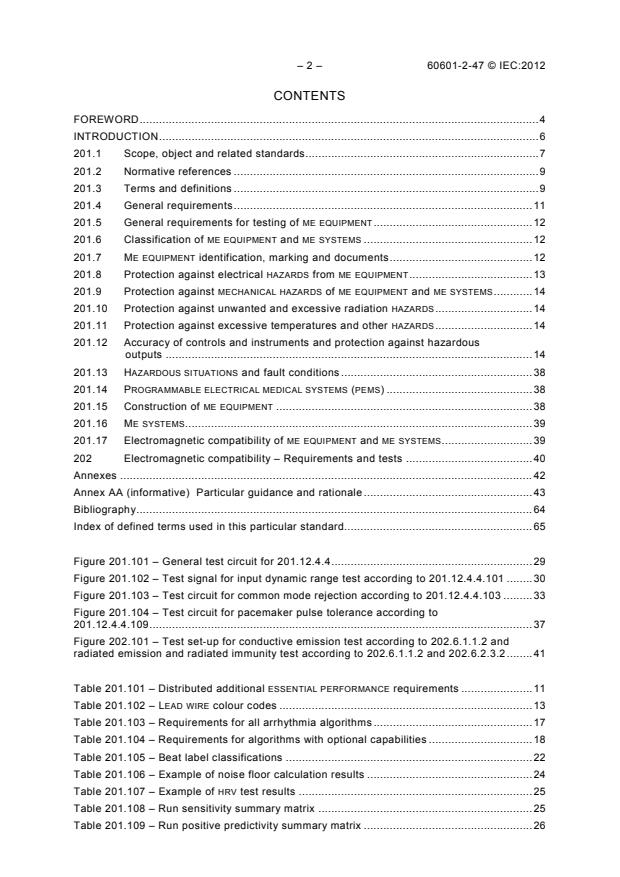
– 2 – 60601-2-47 © IEC:2012
CONTENTS
FOREWORD . 4
INTRODUCTION . 6
201.1 Scope, object and related standards. 7
201.2 Normative references . 9
201.3 Terms and definitions . 9
201.4 General requirements . 11
201.5 General requirements for testing of ME EQUIPMENT . 12
201.6 Classification of ME EQUIPMENT and ME SYSTEMS . 12
201.7 ME EQUIPMENT identification, marking and documents . 12
201.8 Protection against electrical HAZARDS from ME EQUIPMENT . 13
201.9 Protection against MECHANICAL HAZARDS of ME EQUIPMENT and ME SYSTEMS . 14
201.10 Protection against unwanted and excessive radiation HAZARDS . 14
201.11 Protection against excessive temperatures and other HAZARDS . 14
201.12 Accuracy of controls and instruments and protection against hazardous
outputs . 14
201.13 HAZARDOUS SITUATIONS and fault conditions . 38
201.14 PROGRAMMABLE ELECTRICAL MEDICAL SYSTEMS (PEMS) . 38
201.15 Construction of ME EQUIPMENT . 38
201.16 ME SYSTEMS. 39
201.17 Electromagnetic compatibility of ME EQUIPMENT and ME SYSTEMS . 39
202 Electromagnetic compatibility – Requirements and tests . 40
Annexes . 42
Annex AA (informative) Particular guidance and rationale . 43
Bibliography . 64
Index of defined terms used in this particular standard. 65
Figure 201.101 – General test circuit for 201.12.4.4 . 29
Figure 201.102 – Test signal for input dynamic range test according to 201.12.4.4.101 . 30
Figure 201.103 – Test circuit for common mode rejection according to 201.12.4.4.103 . 33
Figure 201.104 – Test circuit for pacemaker pulse tolerance according to
201.12.4.4.109 . 37
Figure 202.101 – Test set-up for conductive emission test according to 202.6.1.1.2 and
radiated emission and radiated immunity test according to 202.6.1.1.2 and 202.6.2.3.2 . 41
Table 201.101 – Distributed additional ESSENTIAL PERFORMANCE requirements . 11
Table 201.102 – LEAD WIRE colour codes . 13
Table 201.103 – Requirements for all arrhythmia algorithms . 17
Table 201.104 – Requirements for algorithms with optional capabilities . 18
Table 201.105 – Beat label classifications . 22
Table 201.106 – Example of noise floor calculation results . 24
Table 201.107 – Example of HRV test results . 25
Table 201.108 – Run sensitivity summary matrix . 25
Table 201.109 – Run positive predictivity summary matrix . 26
60601-2-47 © IEC:2012 – 3 –
Table AA.1 – Records to be included in a complete test . 44
Table AA.2 – Example of a line-format, beat-by-beat performance report . 48
Table AA.3 – Condensed beat-by-beat summary matrix containing 11 elements . 49
Table AA.4 – Summary table (matrix format) of beat-by-beat comparison . 49
Table AA.5 – Example of a line-format SHUTDOWN report . 50
Table AA.6 – Example of a line-format report . 51
Table AA.7 – Example of VF performance report . 51
Table AA.8 – Example of false VF performance report . 51
Table AA.9 – Example of a line-format couplet and run performance report . 52
Table AA.10 – Example of device measurements of synthetic test patterns . 53
Table AA.11 – Example of predicted ideal values for synthetic test patterns . 54
Table AA.12 – Example of choice of test patterns . 54
Table AA.13 – Example of RMS interval differences . 57
Table AA.14 – Example of summary of frequency components . 58
– 4 – 60601-2-47 © IEC:2012
INTERNATIONAL ELECTROTECHNICAL COMMISSION
___________
MEDICAL ELECTRICAL EQUIPMENT –
Part 2-47: Particular requirements for the basic safety and essential
performance of ambulatory electrocardiographic systems
FOREWORD
1) The International Electrotechnical Commission (IEC) is a worldwide organization for standardization comprising
all national electrotechnical committees (IEC National Committees). The object of IEC is to promote
international co-operation on all questions concerning standardization in the electrical and electronic fields. To
this end and in addition to other activities, IEC publishes International Standards, Technical Specifications,
Technical Reports, Publicly Available Specifications (PAS) and Guides (hereafter referred to as “IEC
Publication(s)”). Their preparation is entrusted to technical committees; any IEC National Committee interested
in the subject dealt with may participate in this preparatory work. International, governmental and non-
governmental organizations liaising with the IEC also participate in this preparation. IEC collaborates closely
with the International Organization for Standardization (ISO) in accordance with conditions determined by
agreement between the two organizations.
2) The formal decisions or agreements of IEC on technical matters express, as nearly as possible, an international
consensus of opinion on the relevant subjects since each technical committee has representation from all
interested IEC National Committees.
3) IEC Publications have the form of recommendations for international use and are accepted by IEC National
Committees in that sense. While all reasonable efforts are made to ensure that the technical content of IEC
Publications is accurate, IEC cannot be held responsible for the way in which they are used or for any
misinterpretation by any end user.
4) In order to promote international uniformity, IEC National Committees undertake to apply IEC Publications
transparently to the maximum extent possible in their national and regional publications. Any divergence
between any IEC Publication and the corresponding national or regional publication shall be clearly indicated in
the latter.
5) IEC itself does not provide any attestation of conformity. Independent certification bodies provide conformity
assessment services and, in some areas, access to IEC marks of conformity. IEC is not responsible for any
services carried out by independent certification bodies.
6) All users should ensure that they have the latest edition of this publication.
7) No liability shall attach to IEC or its directors, employees, servants or agents including individual experts and
members of its technical committees and IEC National Committees for any personal injury, property damage or
other damage of any nature whatsoever, whether direct or indirect, or for costs (including legal fees) and
expenses arising out of the publication, use of, or reliance upon, this IEC Publication or any other IEC
Publications.
8) Attention is drawn to the Normative references cited in this publication. Use of the referenced publications is
indispensable for the correct application of this publication.
9) Attention is drawn to the possibility that some of the elements of this IEC Publication may be the subject of
patent rights. IEC shall not be held responsible for identifying any or all such patent rights.
International standard IEC 60601-2-47 has been prepared by subcommittee 62D:
Electromedical equipment, of IEC technical committee 62: Electrical equipment in medical
practice.
This second edition cancels and replaces the first edition published in 2001. It constitutes a
technical revision. This edition was revised to align structurally with the 2005 edition of
IEC 60601-1.
The text of this particular standard is based on the following documents:
FDIS Report on voting
62D/963/FDIS 62D/980/RVD
Full information on the voting for the approval of this particular standard can be found in the
report on voting indicated in the above table.
60601-2-47 © IEC:2012 – 5 –
This publication has been drafted in accordance with the ISO/IEC Directives, Part 2.
In this standard, the following print types are used:
– Requirements and definitions: roman type.
– Test specifications: italic type.
– Informative material appearing outside of tables, such as notes, examples and references: in smaller type.
Normative text of tables is also in a smaller type.
– TERMS DEFINED IN CLAUSE 3 OF THE GENERAL STANDARD, IN THIS PARTICULAR STANDARD OR AS
NOTED: SMALL CAPITALS.
In referring to the structure of this standard, the term
– “clause” means one of the seventeen numbered divisions within the table of contents,
inclusive of all subdivisions (e.g. Clause 7 includes subclauses 7.1, 7.2, etc.);
– “subclause” means a numbered subdivision of a clause (e.g. 7.1, 7.2 and 7.2.1 are all
subclauses of Clause 7).
References to clauses within this standard are preceded by the term “Clause” followed by the
clause number. References to subclauses within this particular standard are by number only.
In this standard, the conjunctive “or” is used as an “inclusive or” so a statement is true if any
combination of the conditions is true.
The verbal forms used in this standard conform to usage described in Annex H of the ISO/IEC
Directives, Part 2. For the purposes of this standard, the auxiliary verb:
– “shall” means that compliance with a requirement or a test is mandatory for compliance
with this standard;
– “should” means that compliance with a requirement or a test is recommended but is not
mandatory for compliance with this standard;
– “may” is used to describe a permissible way to achieve compliance with a requirement or
test.
An asterisk (*) as the first character of a title or at the beginning of a paragraph or table title
indicates that there is guidance or rationale related to that item in Annex AA.
A list of all parts of the IEC 60601 series, published under the general title Medical electrical
equipment, can be found on the IEC website.
The committee has decided that the contents of this publication will remain unchanged until
the stability date indicated on the IEC web site under "http://webstore.iec.ch" in the data
related to the specific publication. At this date, the publication will be
• reconfirmed,
• withdrawn,
• replaced by a revised edition, or
• amended.
– 6 – 60601-2-47 © IEC:2012
INTRODUCTION
This particular standard concerns the basic safety and essential performance of AMBULATORY
ELECTROCARDIOGRAPHIC SYSTEMS. It amends and supplements IEC 60601-1 (third edition
2005): Medical electrical equipment – Part 1: General requirements for basic safety and
essential performance, hereinafter referred to as the general standard. The requirements of
this particular standard take priority over those of the general standard.
A “General guidance and rationale” for the requirements of this particular standard is included
in Annex AA.
It is considered that a knowledge of the reasons for these requirements will not only facilitate
the proper application of the standard but will, in due course, expedite any revision
necessitated by changes in clinical practice or as a result of developments in technology.
However, this annex does not form part of the requirements of this standard.
60601-2-47 © IEC:2012 – 7 –
MEDICAL ELECTRICAL EQUIPMENT –
Part 2-47: Particular requirements for the basic safety and essential
performance of ambulatory electrocardiographic systems
201.1 Scope, object and related standards
Clause 1 of the general standard applies, except as follows:
201.1.1 Scope
Replacement:
This International Standard applies to the BASIC SAFETY and ESSENTIAL PERFORMANCE of
AMBULATORY ELECTROCARDIOGRAPHIC SYSTEMS, hereafter referred to as ME SYSTEMS
If a clause or subclause is specifically intended to be applicable to ME EQUIPMENT only, or to
ME SYSTEMS only, the title and content of that clause or subclause will say so. If that is not the
case, the clause or subclause applies both to ME EQUIPMENT and to ME SYSTEMS, as relevant.
HAZARDS inherent in the intended physiological function of ME EQUIPMENT or ME SYSTEMS
within the scope of this standard are not covered by specific requirements in this standard
except in 7.2.13 and 8.4.1 of the general standard.
NOTE See also 4.2 of the general standard.
Within the scope of this standard are systems of the following types:
a) systems that provide continuous recording and continuous analysis of the ECG allowing full
re-analysis giving essentially similar results. The systems may first record and store the
ECG and analyse it later on a separate unit, or record and analyse the ECG simultaneously.
The type of storage media used is irrelevant with regard to this standard;
b) systems that provide continuous analysis and only partial or limited recording not allowing
a full re-analysis of the ECG.
The safety aspects of this standard apply to all types of systems falling in one of the above-
mentioned categories.
If the AMBULATORY ELECTROCARDIOGRAPHIC SYSTEM offers automatic ECG analysis, minimal
performance requirements for measurement and analysis functions apply. MEDICAL ELECTRICAL
EQUIPMENT covered by IEC 60601-2-25 and IEC 60601-2-27 are excluded from the scope of
this standard.
ECG
This standard does not apply to systems that do not continuously record and analyse the
(for example, ‘intermittent event recorders’).
201.1.2 Object
Replacement:
—————————
The general standard is IEC 60601-1:2005, Medical electrical equipment – Part 1: General requirements for
basic safety and essential performance.
– 8 – 60601-2-47 © IEC:2012
The object of this particular standard is to establish particular BASIC SAFETY and ESSENTIAL
PERFORMANCE requirements for AMBULATORY ELECTROCARDIOGRAPHIC SYSTEMS.
201.1.3 Collateral Standards
Addition:
This particular standard refers to those applicable collateral standards that are listed in
Clause 2 of the general standard and Clause 201.2 of this particular standard.
IEC 60601-1-2 applies as modified in Clause 202. IEC 60601-1-3, IEC 60601-1-8 and
IEC 60601-1-10 do not apply. All other published collateral standards in the IEC 60601-1
series apply as published.
201.1.4 Particular standards
Replacement:
In the IEC 60601 series, particular standards may modify, replace or delete requirements
contained in the general standard and collateral standards as appropriate for the particular
ME EQUIPMENT under consideration, and may add other BASIC SAFETY and ESSENTIAL
PERFORMANCE requirements.
A requirement of a particular standard takes priority over the general standard.
For brevity, IEC 60601-1 is referred to in this particular standard as the general standard.
Collateral standards are referred to by their document number.
The numbering of clauses and subclauses of this particular standard corresponds to that of
the general standard with the prefix “201” (e.g. 201.1 in this standard addresses the content
of Clause 1 of the general standard) or applicable collateral standard with the prefix “20x”
where x is the final digit(s) of the collateral standard document number (e.g. 202.4 in this
particular standard addresses the content of Clause 4 of the IEC 60601-1-2 collateral
standard, 203.4 in this particular standard addresses the content of Clause 4 of the
IEC 60601-1-3 collateral standard, etc.). The changes to the text of the general standard are
specified by the use of the following words:
"Replacement" means that the clause or subclause of the general standard or applicable
collateral standard is replaced completely by the text of this particular standard.
"Addition" means that the text of this particular standard is additional to the requirements of
the general standard or applicable collateral standard.
"Amendment" means that the clause or subclause of the general standard or applicable
collateral standard is amended as indicated by the text of this particular standard.
Subclauses, figures or tables which are additional to those of the general standard are
numbered starting from 201.101. However, due to the fact that definitions in the general
standard are numbered 3.1 through 3.139, additional definitions in this standard are
numbered beginning from 201.3.201. Additional annexes are lettered AA, BB, etc., and
additional items aa), bb), etc.
Subclauses, figures or tables which are additional to those of a collateral standard are
numbered starting from 20x, where “x” is the number of the collateral standard, e.g. 202 for
IEC 60601-1-2, 203 for IEC 60601-1-3, etc.
The term "this standard" is used to make reference to the general standard, any applicable
collateral standards and this particular standard taken together.
60601-2-47 © IEC:2012 – 9 –
Where there is no corresponding clause or subclause in this particular standard, the clause or
subclause of the general standard or applicable collateral standard, although possibly not
relevant, applies without modification; where it is intended that any part of the general
standard or applicable collateral standard, although possibly relevant, is not to be applied, a
statement to that effect is given in this particular standard.
201.2 Normative references
Clause 2 of the general standard applies, except as follows:
Amendment:
IEC 60601-1-2:2007, Medical electrical equipment – Part 1-2: General requirements for basic
safety and essential performance – Collateral standard: Electromagnetic compatibility –
Requirements and tests.
201.3 Terms and definitions
For the purposes of this document, the terms and definitions given in IEC 60601-1:2005,
apply, except as follows:
NOTE An index of defined terms is found beginning on page 64.
Additional definitions:
201.3.201
AF
ATRIAL FIBRILLATION
ATRIAL FLUTTER
ECG rhythm involving either no P-waves and irregular RR intervals (atrial fibrillation) or high
frequency flutter waves and regular or irregular RR intervals (atrial flutter)
201.3.202
AMBULATORY ELECTROCARDIOGRAPHIC SYSTEM
ME SYSTEM, AMBULATORY RECORDER and a PLAYBACK EQUIPMENT, both of which may contain an
analysis function
Note 1 to entry: This ME SYSTEM is often referred to as Holter monitoring system after its inventor
Dr. Norman Holter.
201.3.203
AMBULATORY RECORDER
recording ME EQUIPMENT worn or carried by the PATIENT including associated ELECTRODES and
cables for recording heart action potentials
Note 1 to entry: An AMBULATORY RECORDER may also analyse the heart action potentials. It may record selectively
when significant events are detected, or continuously.
201.3.204
CONTINUOUS RECORDER
ME EQUIPMENT, which performs continuous recording of the ECG
201.3.205
DATABASE
DB
sampled ECGs or artificial signals of one or more channels together with descriptive (clinical)
information
– 10 – 60601-2-47 © IEC:2012
201.3.206
ELECTROCARDIOGRAM
ECG
graphical presentation of one or more LEADs over time
201.3.207
ELECTRODE
sensor in contact with a specific part of the body that is used to detect electrical activity
201.3.208
GAIN
ratio of the amplitude of the output signal (usually on the PLAYBACK EQUIPMENT) to the
amplitude of the AMBULATORY RECORDER input signal
Note 1 to entry: GAIN is expressed in mm/mV.
201.3.209
HEART RATE VARIABILITY
HRV
statistical results calculated from consecutive RR intervals
201.3.210
LEAD
voltage between ELECTRODES
201.3.211
LEAD WIRE(S)
cable(s) connected between ELECTRODES and either a PATIENT CABLE or the ME EQUIPMENT
201.3.212
NEUTRAL ELECTRODE
reference point for differential amplifiers and/or interference suppression circuits, not intended
to be used to calculate any LEAD
201.3.213
PATIENT CABLE
multiwire cable and associated connector(s) used to connect the LEAD WIRE(S) to the
AMBULATORY RECORDER
201.3.214
PAUSE
absence of a heart action potential for a prolonged time interval
201.3.215
PLAYBACK EQUIPMENT
equipment with monitoring and documenting functions into which ECG and measurements
derived from the AMBULATORY RECORDER are fed
Note 1 to entry: This ME EQUIPMENT is usually stationary and commonly includes computing facilities.
201.3.216
QRS COMPLEX
QRS
the waveform presented in an ECG during ventricular depolarization
201.3.217
ROOT-MEAN SQUARED
RMS
root of the average of the squares of the original values
60601-2-47 © IEC:2012 – 11 –
201.3.218
RR INTERVAL VARIABILITY
RRV
statistical results calculated from consecutive RR intervals
201.3.219
SHUTDOWN
period of time when detection/classification function are not performed
201.3.220
ST SEGMENT
segment of the ECG between the end of the QRS complex and the start of the T-wave
201.3.221
SUPRAVENTRICULAR ECTOPIC BEAT
SVEB
a premature or an escape (late) beat with a shape similar to that of normal beats
201.3.222
SUPRAVENTRICULAR TACHYCARDIA
SVTA
sustained or not sustained chain of consecutive supraventricular ectopic beats
201.3.223
VENTRICULAR ECTOPIC BEAT
VEB
a premature or an escape (late) beat with a wider shape than that of normal beats
201.3.224
VF
VENTRICULAR FIBRILLATION or VENTRICULAR FLUTTER
life-threatening ECG rhythm irregular in shape and frequency
201.4 General requirements
Clause 4 of the general standard applies, except as follows:
201.4.3 ESSENTIAL PERFORMANCE
Addition:
201.4.101 Additional ESSENTIAL PERFORMANCE requirements
Additional ESSENTIAL PERFORMANCE requirements are found in the subclauses listed in Table
201.101.
Table 201.101 – Distributed additional ESSENTIAL PERFORMANCE requirements
Requirement Subclause
Heart rate 201.12.1.101.3.1
Supraventricular ectopy 201.12.1.101.3.2
Ventricular ectopy 201.12.1.101.3.3
Bradycardia data 201.12.1.101.3.4
PAUSES 201.12.1.101.3.5
ST SEGMENT shifts 201.12.1.101.3.6
ECG hard copy 201.12.1.101.3.7
– 12 – 60601-2-47 © IEC:2012
201.5 General requirements for testing of ME EQUIPMENT
Clause 5 of the general standard applies, except as follows:
201.5.3 Ambient temperature, humidity, atmospheric pressure
Addition to item a):
The AMBULATORY RECORDER shall fulfil the requirements of this standard under the
following ambient conditions:
– an ambient temperature range of 10 °C to 45 °C;
– a relative humidity of 10 % to 95 %, without condensation.
201.6 Classification of ME EQUIPMENT and ME SYSTEMS
Clause 6 of the general standard applies, except as follows:
201.6.2 Protection against electrical shock
Replacement:
Applied parts shall be classified as TYPE BF APPLIED PARTS or TYPE CF APPLIED PARTS (see
7.2.10 and 8.3).
201.6.6 Mode of operation
Replacement:
ME EQUIPMENT shall be classified for CONTINUOUS OPERATION.
201.7 ME EQUIPMENT identification, marking and documents
Clause 7 of the general standard applies, except as follows:
201.7.2 Marking on the outside of ME EQUIPMENT or ME EQUIPMENT parts
Additional subclause:
201.7.2.101 LEAD WIRE identification
The LEAD WIRE(S) shall be permanently marked in such a manner that the proper LEAD WIRE
can be directly determined at both the ELECTRODE attachment ends, and so constructed or
marked as to avoid incorrect connection to the ME EQUIPMENT.
If independent bipolar LEADs are being used, the channel assignment shall be clearly
annotated on the ME EQUIPMENT for reference. Also, the LEAD WIRE(S) shall be colour coded
according to one of the colour coding schemes of Table 201.102
60601-2-47 © IEC:2012 – 13 –
Table 201.102 – LEAD WIRE colour codes
a b
ELECTRODE Code 1 Code 2
Channel 1 Positive ELECTRODE green red
Negative ELECTRODE red white
Channel 2 Positive ELECTRODE white brown
Negative ELECTRODE yellow black
Channel 3 Positive ELECTRODE orange orange
Negative ELECTRODE blue blue
NEUTRAL ELECTRODE black green
a
Code 1 shall be used in Europe and internationally.
b
Code 2 shall be used in North America – see AHA guidelines of 1985.
201.7.9.2 Instructions for use
Additional subclause:
201.7.9.2.101 *Additional instructions for use
a) Advice shall be given on the following:
1) the type of electrical installation to which the ME EQUIPMENT may be safely connected,
including the connection to any POTENTIAL EQUALIZATION CONDUCTOR;
2) that conductive parts of ELECTRODES and associated connectors for TYPE BF APPLIED
PARTS or TYPE CF APPLIED PARTS, including the NEUTRAL ELECTRODE, should not
contact other conductive parts including earth;
b) Clear instructions shall be provided if a specific type of battery or battery charging
procedure has to be used in order to fulfil the requirements of this particular standard.
c) Clear instructions shall be provided for any use of the AMBULATORY RECORDER in wet
environments.
d) The ME EQUIPMENT labelling shall clearly indicate whether or not its use is intended for
infants weighing less than 10 kg.
e) The manufacturer shall disclose the method for calculating the heart rate.
f) The manufacturer shall disclose the method for determining a PAUSE.
g) If the ME EQUIPMENT is designed to detect and/or measure ST SEGMENT shifts, the manu-
facturer shall disclose in the operating manual or physician's guide the following:
– whether the ST SEGMENT analysis is performed on all LEADS or only some LEADS,
– whether there are OPERATOR selectable detection criteria for ST SEGMENT shifts (such
as displacement and slope parameters),
– how frequently ST SEGMENT shifts are summarised in the clinical report (e.g., hourly)
and whether numbers of episodes, types of episodes (elevation or depression), and
durations of episodes are reported, or whether the clinical report presents this
information episode by episode,
– whether ranges of heart rates, ranges of displacements and/or slope values during
each episode are reported.
201.8 Protection against electrical HAZARDS from ME EQUIPMENT
Clause 8 of the general standard applies.
– 14 – 60601-2-47 © IEC:2012
201.9 Protection against MECHANICAL HAZARDS of ME EQUIPMENT and
ME SYSTEMS
Clause 9 of the general standard applies.
201.10 Protection against unwanted and excessive radiation HAZARDS
Clause 10 of the general standard applies.
201.11 Protection against excessive temperatures and other HAZARDS
Clause 11 of the general standard applies.
201.12 Accuracy of controls and instruments and protection against
hazardous outputs
Clause 12 of the general standard applies, except as follows:
201.12.1 Accuracy of controls and instruments
Addition:
201.12.1.101 *Algorithm testing
201.12.1.101.1 General
This subclause describes what constitutes a complete test of an algorithm. The term “test
report” refers to the evaluation procedure described in this subclause and not to the clinical
report that the physician receives.
201.12.1.101.1.1 *Databases
201.12.1.101.1.1.1 General description of available databases
At the time this document was developed, five databases were available for evaluation of
cardiac arrhythmia and ST algorithms:
– AHA: The American Heart Association Database for Evaluation of Ventricular
Arrhythmia Detectors (80 records of 35 min each);
– MIT–BIH: The Massachusetts Institute of Technology – Beth Israel Hospital Arrhythmia
Database (48 records of 30 min each);
– ESC: The European Society of Cardiology ST-T Database
(90 records of 2 h each);
– NST: The Noise Stress Test Database (12 ECG records of 30 min each plus
3 records of noise only supplied with the MIT–BIH database);
– CU: The Creighton University Sustained Ventricular Arrhythmia Database
(35 records of 8 mins each – supplied with the MIT–BIH database with
incomplete annotations).
Sources for these databases are:
– ECRI, 5200 Butler Pike, Plymouth Meeting, PA 19462, USA (AHA database);
– MIT–BIH Database Distribution, MIT Room E25-505, Cambridge, MA 02139, USA (MIT–
BIH, NST, CU databases and the ESC database inside North America—Internet site:
http://ecg.mit.edu);
60601-2-47 © IEC:2012 – 15 –
– CNR Institute of Clinical Physiology, Computer Laboratory, via Trieste, 41 56100 Pisa,
Italy (ESC database outside North America).
The first four of these databases (AHA, MIT–BIH, ESC, and NST) consist of digitized excerpts
of two-channel Holter type recordings, with each beat labelled. This set of annotation files, in
which each beat has been identified by expert cardiologist-annotators, are referred to as
“reference” annotations. The CU database contains digitized single channel ECG recordings
with rhythm changes labelled.
Database elements have been referred to as tapes and records. For the purpose of this
document, the term “tapes” refers only to physical taped recordings of ECGs. Database
elements are referred to as “records.”
This list of standard databases is not intended to exclude others, which may become available
in the future. It is, however, a list of those that were both adequate and available at the time
of this document’s publication.
Databases should be:
• fully described (standard digital format);
• clearly identifiable by name, version, date, etc.; and
• annexed with utilities and instructions for use.
If any records from a given database are used to fulfil the requirements of 201.12.1.101.1.5,
device performance shall be tested and reported on a record-by-record basis for all records
from that database except as excluded by 201.12.1.101.1.1.2. The first 5 min of each record
are designated as a learning period. The remainder of each record is the test period. Device
performance is measured only during the test period of each record; the entire test period
shall be used for this purpose, except as noted in 201.12.1.101.1.1.2
201.12.1.101.1.1.2 *Records to be excluded during testing
Of the 80 available records in the AHA database, two are recorded from patients with
pacemakers. Of the 48 records in the MIT–BIH database, four are from patients with
pacemakers. In these databases, records with paced beats do not retain sufficient signal
quality for reliable processing by systems for pace artifact detection or enhancement,
optimized on live signals. For such systems, testing shall exclude these six records containing
paced beats from the reporting requirements. Performance on these records shall be reported
for devices that are intended to analyze paced analogue ECG recordings made without pacer
artifact detection or enhancement, but aggregate performance statistics shall exclude these
records in all cases. This exclusion of records with paced beats applies to arrhythmia
algorithms as well as to ST SEGMENT measurement algorithms.
The NST database contains three records (BW, EM, and MA) that are noise recordings only
and are not intended for use in standard tests. The remaining 12 records are those on which
device performance shall be tested and reported.
VF) is present are excluded from
Segments of data in which ventricular flutter or fibrillation (
beat-by-beat comparisons (for QRS and VEB detection) only. Well-defined QRS complexes
necessary for a beat-by-beat comparison are not present during these segments, which are
marked by rhythm labels in the database annotation files. These segments are included,
however, in the tests of consecutive VEB detection and VF detection. Other segments of these
records (i.e. those that do contain labeled beats) shall be included in the beat-by-beat
comparisons.
201.12.1.101.1.2 *Testing requirements
201.12.1.101.1.2.1 The accuracy of QRS detection shall be tested using the AHA DB, the
MIT–BIH DB, and the NST DB at a minimum.
– 16 – 60601-2-47 © IEC:2012
201.12.1.101.1.2.2 The accuracy of heart rate measurements shall be tested using the AHA
DB, the MIT–BIH DB, and the NST DB.
201.12.1.101.1.2.3 The accuracy of VEB detection shall be tested using the AHA DB, the
MIT–BIH DB, and the NST DB at a minimum.
201.12.1.101.1.2.4 If the device is claimed to detect ventricular flutter or fibrillation (VF), its
ability to do so shall be tested using the CU DB, the AHA DB, and the MIT–BIH DB at a
minimum.
201.12.1.101.1.2.5 If the device is claimed to detect supraventricular ectopic beats, or atrial
flutter or fibrillation (AF), its ability to do so shall be tested using the MIT–BIH DB and the NST
DB at a minimum. If the device is claimed to measure ST SEGMENT deviations or to detect ST
SEGMENT changes, its ability to do so shall be tested using the ESC DB at a minimum, unless
the characteristics of the database conflict with the algorithm under test.
201.12.1.101.1.3 *Test environment
Algorithm testing using standardized digital databases occurs, by definition, outside the
context of the complete monitoring device’s clinical setting. Yet, a correlation between
algorithm performance and the device’s actual clinical performance shall be ensured for the
results to be meaningful.
To conduct an evaluation that accurately reflects the capabilities of the algorithm as
implemented in a monitoring device, it is preferable to perform the test using hardware
comparable to the monitoring device although it is recognized that the nature of the algorithm
testing process might require modifications of the hardware or software. Additionally, signals
should be presented to the algorithm in a method comparable to the method employed in
clinical settings. The computational environment used to perform algorithm testing shall be
disclosed.
When algorithm evaluations are conducted under conditions or constraints grossly different
from those encountered by the monitoring device in an actual clinical setting, the algorithm
results might not represent the true performance of the device. Actual devices can have
limited processor speed, computational precision, filtering, etc. Testing or analysis shall be
performed indicating that the algorithm performance in an actual monitoring device can
reasonably be expected to correlate with performance in the simulated test environment. This
validation shall be disclosed.
201.12.1.101.1.4 Multiple-lead analysis
For any database, which has more leads available than can be simultaneously analyzed, the
actual combination of channels used shall be disclosed. For any system that can analyze
more channels than are available in the database, the disclosure shall state how the data
were entered. At no time during the processing of the entire database is the operator allowed
to change the combination of leads used. Results shall be reported on a record-by-record
basis.
201.12.1.101.1.5 *Requirements for the evaluation report
201.12.1.101.1.5.1 *Required statistics
For each record, the statistics below shall be reported as required in 201.12.1.101.1.5.2 and
201.12.1.101.1.5.3. Aggregate statistics based on the record-by-record reports summarizing
the performance of the algorithm under test for each of the databases employed shall be
reported as required. Formal definitions of the statistics are provided in the annex as noted.
The following symbols and abbreviations are used in the following tables:
• R = required reporting of this statistic from this database;
60601-2-47 © IEC:2012 – 17 –
• O = optional reporting of this statistic from this database;
• – = no reporting of this statistic required from this database;
• V = aggregate statistic required.
201.12.1.101.1.5.2 *Requirements for all arrhythmia algorithms
The requirements for all algorithms are given in Table 201.103.
Table 201.103 – Requirements for all arrhythmia algorithms
Record-by-record Rationale in Annex Gross Average AHA MIT–BIH NST CU ESC
statistics required for AA statistic statistic DB DB DB DB DB
each record
QRS sensitivity 201.12.1.101.1.5.2 V V R R R – O
QRS positive predictivity 201.12.1.101.1.5.2 V V R R R – O
...
Questions, Comments and Discussion
Ask us and Technical Secretary will try to provide an answer. You can facilitate discussion about the standard in here.
Loading comments...