

IEC 61196-1-104:2015
(Main)Coaxial communication cables - Part 1-104: Electrical test methods - Test for the stability of the capacitance of cable versus temperature
General Information
- Abstract
IEC 61196-1-104:2015(E) applies to coaxial communications cables. It specifies test methods for determining the capacitance stability of the cable when subjected to temperature change. This edition includes the following significant technical changes with respect to the previous edition:
a) Subclause 4.2, Requirements for the test sample;
b) Change in the title of Part 1-104.
- Status
- Published
- Publication Date
- 17-Aug-2015
- Technical Committee
- SC 46A - Coaxial cables
- Drafting Committee
- WG 3 - TC 46/SC 46A/WG 3
- Current Stage
- PPUB - Publication issued
- Start Date
- 18-Aug-2015
- Completion Date
- 30-Sep-2015
Overview
IEC 61196-1-104:2015 is an international standard developed by the International Electrotechnical Commission (IEC) focusing on coaxial communication cables. This part of the IEC 61196 series specifies electrical test methods to evaluate the stability of the capacitance of coaxial cables when subjected to temperature variations. Accurate capacitance stability testing is crucial for ensuring reliable performance in communications infrastructure, particularly for cables used in fluctuating environments.
This edition updates prior versions with improved test sample requirements and a revised title, reinforcing its role as a key reference for manufacturers, testing laboratories, and engineers specializing in coaxial cable performance and quality control.
Key Topics
Scope and Applicability
IEC 61196-1-104 applies strictly to coaxial communication cables and outlines standardized procedures for capacitance measurement under varied temperature conditions.Test Equipment and Samples
Testing requires an environmental chamber capable of simulating precise temperature cycling and electronic capacitance measurement devices compliant with IEC 61196-1-103 standards. Cable samples must meet specific criteria defined in the same reference.Temperature Cycling Procedure
The cable under test (CUT) undergoes temperature cycling including low, ambient, and high temperatures, with defined dwell times at each step to simulate real-world thermal stress. Typical cycling steps include:- Initial measurement at 20 ± 2 °C
- Elevated temperature exposure (+65 °C to +250 °C depending on dielectric type)
- Return to 20 °C
- Low temperature exposure (-40 °C to -55 °C)
Each step ensures evaluation of capacitance stability during thermal expansion and contraction.
Capacitance Measurement and Expression of Results
Capacitance is measured at each temperature step and normalized per meter length (pF/m). Deviations from initial values assess cable stability and compliance.Documentation and Compliance
Test reports must record test conditions, including temperature, cycle count, sample length, frequency, and capacitance results. Compliance is checked against detailed specifications specific to cable design.
Applications
Quality Assurance for Coaxial Cables
Manufacturers utilize this standard to verify the thermal stability of cable capacitance, ensuring reliable signal transmission and minimizing loss or distortion in communication networks.Environmental Testing in R&D
Research and development teams apply IEC 61196-1-104 testing during material selection and cable design optimization, addressing performance requirements amid environmental temperature fluctuations.Certification and Regulatory Compliance
Testing laboratories leverage the standard to provide certification services and confirm compliance with international cable performance benchmarks, facilitating global market access.Troubleshooting and Maintenance
Field engineers may refer to capacitance stability data from this standard to diagnose cable performance issues related to temperature stresses in installation environments.
Related Standards
IEC 61196-1: Generic Specification for Coaxial Communication Cables
Provides foundational definitions, general requirements, and test specifications critical to understanding the broader coaxial cable testing framework.IEC 61196-1-103: Electrical Test Methods – Test for Capacitance of Cable
Details the methodology and equipment specifically for measuring cable capacitance, directly referenced for testing procedures in IEC 61196-1-104.IEC 60050: International Electrotechnical Vocabulary
Supplies standardized terminology essential for consistent interpretation of terms used in coaxial cable testing and measurements.
By adhering to IEC 61196-1-104:2015, industry professionals ensure coaxial communication cables meet stringent performance criteria for capacitance stability under temperature variations-critical for maintaining high-quality, reliable communication systems worldwide.
Relations
- Effective Date
- 05-Sep-2023
Get Certified
Connect with accredited certification bodies for this standard

ANCE
Mexican certification and testing association.

Intertek Slovenia
Intertek testing, inspection, and certification services in Slovenia.

LNE (Laboratoire National de Métrologie et d'Essais)
French national laboratory for metrology and testing.
Sponsored listings
Frequently Asked Questions
IEC 61196-1-104:2015 is a standard published by the International Electrotechnical Commission (IEC). Its full title is "Coaxial communication cables - Part 1-104: Electrical test methods - Test for the stability of the capacitance of cable versus temperature". This standard covers: IEC 61196-1-104:2015(E) applies to coaxial communications cables. It specifies test methods for determining the capacitance stability of the cable when subjected to temperature change. This edition includes the following significant technical changes with respect to the previous edition: a) Subclause 4.2, Requirements for the test sample; b) Change in the title of Part 1-104.
IEC 61196-1-104:2015(E) applies to coaxial communications cables. It specifies test methods for determining the capacitance stability of the cable when subjected to temperature change. This edition includes the following significant technical changes with respect to the previous edition: a) Subclause 4.2, Requirements for the test sample; b) Change in the title of Part 1-104.
IEC 61196-1-104:2015 is classified under the following ICS (International Classification for Standards) categories: 33.120.10 - Coaxial cables. Waveguides. The ICS classification helps identify the subject area and facilitates finding related standards.
IEC 61196-1-104:2015 has the following relationships with other standards: It is inter standard links to IEC 61196-1-104:2005. Understanding these relationships helps ensure you are using the most current and applicable version of the standard.
IEC 61196-1-104:2015 is available in PDF format for immediate download after purchase. The document can be added to your cart and obtained through the secure checkout process. Digital delivery ensures instant access to the complete standard document.
Standards Content (Sample)
IEC 61196-1-104 ®
Edition 2.0 2015-08
INTERNATIONAL
STANDARD
Coaxial communication cables –
Part 1-104: Electrical test methods – Test for the stability of the capacitance of
cable versus temperature
All rights reserved. Unless otherwise specified, no part of this publication may be reproduced or utilized in any form
or by any means, electronic or mechanical, including photocopying and microfilm, without permission in writing from
either IEC or IEC's member National Committee in the country of the requester. If you have any questions about IEC
copyright or have an enquiry about obtaining additional rights to this publication, please contact the address below or
your local IEC member National Committee for further information.
IEC Central Office Tel.: +41 22 919 02 11
3, rue de Varembé Fax: +41 22 919 03 00
CH-1211 Geneva 20 info@iec.ch
Switzerland www.iec.ch
About the IEC
The International Electrotechnical Commission (IEC) is the leading global organization that prepares and publishes
International Standards for all electrical, electronic and related technologies.
About IEC publications
The technical content of IEC publications is kept under constant review by the IEC. Please make sure that you have the
latest edition, a corrigenda or an amendment might have been published.
IEC Catalogue - webstore.iec.ch/catalogue Electropedia - www.electropedia.org
The stand-alone application for consulting the entire The world's leading online dictionary of electronic and
bibliographical information on IEC International Standards, electrical terms containing more than 30 000 terms and
Technical Specifications, Technical Reports and other definitions in English and French, with equivalent terms in 15
documents. Available for PC, Mac OS, Android Tablets and additional languages. Also known as the International
iPad. Electrotechnical Vocabulary (IEV) online.
IEC publications search - www.iec.ch/searchpub IEC Glossary - std.iec.ch/glossary
The advanced search enables to find IEC publications by a More than 60 000 electrotechnical terminology entries in
variety of criteria (reference number, text, technical English and French extracted from the Terms and Definitions
committee,…). It also gives information on projects, replaced clause of IEC publications issued since 2002. Some entries
and withdrawn publications. have been collected from earlier publications of IEC TC 37,
77, 86 and CISPR.
IEC Just Published - webstore.iec.ch/justpublished
Stay up to date on all new IEC publications. Just Published IEC Customer Service Centre - webstore.iec.ch/csc
details all new publications released. Available online and If you wish to give us your feedback on this publication or
also once a month by email. need further assistance, please contact the Customer Service
Centre: csc@iec.ch.
IEC 61196-1-104 ®
Edition 2.0 2015-08
INTERNATIONAL
STANDARD
Coaxial communication cables –
Part 1-104: Electrical test methods – Test for the stability of the capacitance of
cable versus temperature
INTERNATIONAL
ELECTROTECHNICAL
COMMISSION
ICS 33.120.10 ISBN 978-2-8322-2854-8
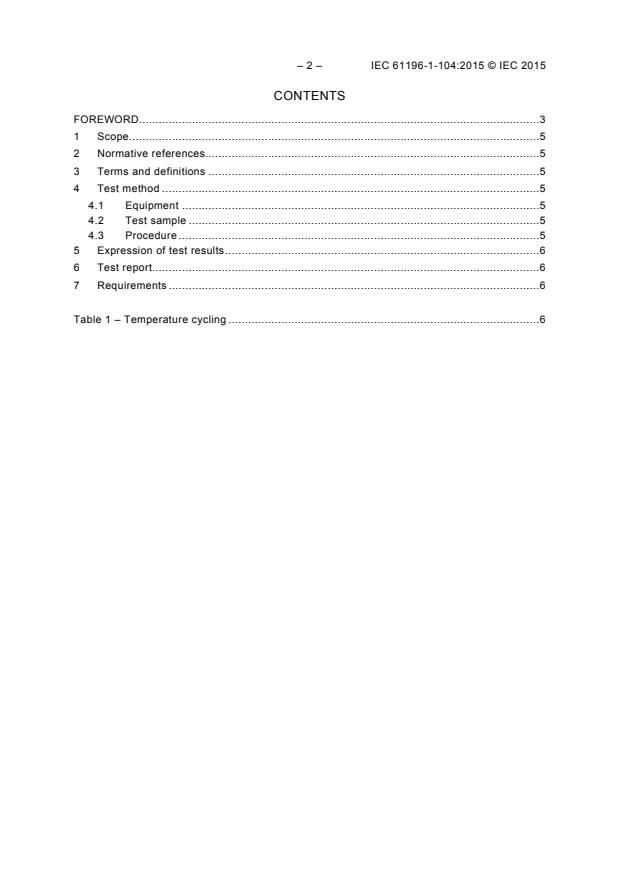
– 2 – IEC 61196-1-104:2015 © IEC 2015
CONTENTS
FOREWORD . 3
1 Scope . 5
2 Normative references. 5
3 Terms and definitions . 5
4 Test method . 5
4.1 Equipment . 5
4.2 Test sample . 5
4.3 Procedure . 5
5 Expression of test results . 6
6 Test report. 6
7 Requirements . 6
Table 1 – Temperature cycling . 6
INTERNATIONAL ELECTROTECHNICAL COMMISSION
____________
COAXIAL COMMUNICATION CABLES –
Part 1-104: Electrical test methods –
Test for the stability of the capacitance of cable versus temperature
FOREWORD
1) The International Electrotechnical Commission (IEC) is a worldwide organization for standardization comprising
all national electrotechnical committees (IEC National Committees). The object of IEC is to promote
international co-operation on all questions concerning standardization in the electrical and electronic fields. To
this end and in addition to other activities, IEC publishes International Standards, Technical Specifications,
Technical Reports, Publicly Available Specifications (PAS) and Guides (hereafter referred to as “IEC
Publication(s)”). Their preparation is entrusted to technical committees; any IEC National Committee interested
in the subject dealt with may participate in this preparatory work. International, governmental and non-
governmental organizations liaising with the IEC also participate in this preparation. IEC collaborates closely
with the International Organization for Standardization (ISO) in accordance with conditions determined by
agreement between the two organizations.
2) The formal decisions or agreements of IEC on technical matters express, as nearly as possible, an international
consensus of opinion on the relevant subjects since each technical committee has representation from all
interested IEC National Committees.
3) IEC Publications have the form of recommendations for international use and are accepted by IEC Na
...