

IEC 60691:2023
(Main)Thermal-links - Requirements and application guide
General Information
- Abstract
IEC 60691:2023 is applicable to thermal-links intended for incorporation in electrical appliances, electronic equipment and component parts thereof, normally intended for use indoors, in order to protect them against excessive temperatures under abnormal conditions.
NOTE 1 The equipment is not designed to generate heat.
NOTE 2 The effectiveness of the protection against excessive temperatures logically depends upon the position and method of mounting of the thermal-link, as well as upon the current which it is carrying.
This document may be applicable to thermal-links for use under conditions other than indoors, provided that the climatic and other circumstances in the immediate surroundings of such thermal-links are comparable with those in this standard.
This document may be applicable to thermal-links in their simplest forms (e.g. melting strips or wires), provided that molten materials expelled during function cannot adversely interfere with the safe use of the equipment, especially in the case of hand-held or portable equipment, irrespective of its position.
- Status
- Published
- Publication Date
- 08-Feb-2026
- Technical Committee
- SC 32C - Miniature fuses
- Drafting Committee
- MT 9 - TC 32/SC 32C/MT 9
- Current Stage
- PPUB - Publication issued
- Start Date
- 06-Mar-2023
- Completion Date
- 17-Mar-2023
Buy Documents
IEC 60691:2023+AMD1:2024 CSV - Thermal-links - Requirements and application guide Released:10/28/2024
IEC 60691:2023 RLV - Thermal-links - Requirements and application guide Released:3/6/2023
IEC 60691:2023+AMD1:2024+AMD2:2026 CSV - Thermal-links - Requirements and application guide/9/2026
IEC 60691:2023 - Thermal-links - Requirements and application guide Released:3/6/2023
Overview
IEC 60691:2023, published by the International Electrotechnical Commission (IEC), specifies the requirements and application guidelines for thermal-links. Thermal-links are non-resettable safety devices designed to protect electrical appliances, electronic equipment, and component parts against excessive temperatures due to abnormal conditions. These devices are essential for ensuring thermal protection in equipment that is not intended to generate heat during normal operation.
IEC 60691:2023 applies to thermal-links used primarily in indoor environments, but also covers other settings if similar climatic conditions exist. The standard addresses the effectiveness of thermal-link protection, which depends greatly on proper mounting and the amount of electrical current carried. This international standard is especially important for manufacturers, design engineers, and testing laboratories seeking uniform compliance and reliable safety performance for over-temperature protection components.
Key Topics
IEC 60691:2023 covers the following essential subjects:
- Scope and Purpose: Defines applicability to thermal-links in equipment for preventing damage from overheating.
- Classification: Details classification based on electrical, thermal, and material resistance conditions.
- Terminology: Provides clear definitions for technical terms such as holding temperature, rated functioning temperature, and interrupting current.
- Marking and Documentation: Stipulates requirements for labeling thermal-links and supplying critical product information.
- Constructional Requirements: Outlines standards for the mechanical strength, dielectric properties, and safety of the thermal-link design.
- Testing Methods: Specifies detailed test procedures, including tensile, thrust, bending, insulation, dielectric, and thermal cycling tests.
- Temperature Performance: Addresses tests and evaluations for rated functioning temperature, holding temperature, and ageing.
- Packaged Assemblies: Introduces requirements for thermal-links supplied in housing assemblies, with added guidance in Annex H.
- Resistance to Tracking and Rusting: Includes evaluation of insulation materials and corrosion resistance.
Applications
Thermal-links governed by IEC 60691:2023 are widely used in:
- Electrical appliances: Ensuring over-temperature protection in products such as fans, lighting fixtures, and small household appliances.
- Electronic equipment: Providing safety in consumer electronics, power supplies, and industrial control units.
- Component parts: Integrating thermal-links into subassemblies or modules where overheat protection is critical.
- Portable and hand-held devices: Safeguarding user safety in equipment that can be moved or repositioned during operation.
- Packaged assemblies: Using thermal-links in built-up assemblies for simplified installation and enhanced reliability.
The standard is indispensable for manufacturers designing compliant products, test labs conducting conformity assessment, OEMs sourcing reliable components, and certification bodies verifying product safety. Proper application of IEC 60691:2023 helps prevent electric shock, fire hazards, and equipment failure due to thermal overload.
Related Standards
For comprehensive compliance and safety, IEC 60691:2023 is frequently used together with:
- IEC 60065: Safety requirements for audio, video, and similar electronic apparatus.
- IEC 60112: Testing of the tracking index for solid insulating materials.
- IEC 60127-2: Cartridge fuse-links for miniature fuses.
- IEC 60664-1: Insulation coordination principles and tests for low-voltage equipment.
- IEC 60695 series: Fire hazard testing, including glow-wire and ball pressure tests.
- IEC 60730-1: General requirements for automatic electrical controls.
- IEC 61210: Connecting devices and safety requirements for electrical copper conductors.
Manufacturers and engineers should reference these associated standards to ensure comprehensive safety, compatibility, and quality in the design and certification of electrical and electronic products.
By adhering to IEC 60691:2023, organizations help guarantee the safety and reliability of products worldwide, maintaining essential compliance with international thermal-link requirements.
Relations
- Amended By
IEC 60691:2023/AMD2:2026 - Amendment 2 - Thermal-links - Requirements and application guide - Effective Date
- 26-Oct-2025
- Amended By
IEC 60691:2023/AMD1:2024 - Amendment 1 - Thermal-links - Requirements and application guide - Effective Date
- 05-Sep-2023
- Effective Date
- 05-Sep-2023
- Revises
IEC 60691:2015/COR1:2016 - Corrigendum 1 - Thermal-links - Requirements and application guide - Effective Date
- 05-Sep-2023
- Effective Date
- 05-Sep-2023
Buy Documents
IEC 60691:2023+AMD1:2024 CSV - Thermal-links - Requirements and application guide Released:10/28/2024
IEC 60691:2023 RLV - Thermal-links - Requirements and application guide Released:3/6/2023
IEC 60691:2023+AMD1:2024+AMD2:2026 CSV - Thermal-links - Requirements and application guide/9/2026
IEC 60691:2023 - Thermal-links - Requirements and application guide Released:3/6/2023
Get Certified
Connect with accredited certification bodies for this standard

IMQ S.p.A. (Certification)
Italian electrical product certification.

SLG Prüf- und Zertifizierungs GmbH
German testing and certification body.

UL Solutions
Global safety science company with testing, inspection and certification.
Sponsored listings
Frequently Asked Questions
IEC 60691:2023 is a standard published by the International Electrotechnical Commission (IEC). Its full title is "Thermal-links - Requirements and application guide". This standard covers: IEC 60691:2023 is applicable to thermal-links intended for incorporation in electrical appliances, electronic equipment and component parts thereof, normally intended for use indoors, in order to protect them against excessive temperatures under abnormal conditions. NOTE 1 The equipment is not designed to generate heat. NOTE 2 The effectiveness of the protection against excessive temperatures logically depends upon the position and method of mounting of the thermal-link, as well as upon the current which it is carrying. This document may be applicable to thermal-links for use under conditions other than indoors, provided that the climatic and other circumstances in the immediate surroundings of such thermal-links are comparable with those in this standard. This document may be applicable to thermal-links in their simplest forms (e.g. melting strips or wires), provided that molten materials expelled during function cannot adversely interfere with the safe use of the equipment, especially in the case of hand-held or portable equipment, irrespective of its position.
IEC 60691:2023 is applicable to thermal-links intended for incorporation in electrical appliances, electronic equipment and component parts thereof, normally intended for use indoors, in order to protect them against excessive temperatures under abnormal conditions. NOTE 1 The equipment is not designed to generate heat. NOTE 2 The effectiveness of the protection against excessive temperatures logically depends upon the position and method of mounting of the thermal-link, as well as upon the current which it is carrying. This document may be applicable to thermal-links for use under conditions other than indoors, provided that the climatic and other circumstances in the immediate surroundings of such thermal-links are comparable with those in this standard. This document may be applicable to thermal-links in their simplest forms (e.g. melting strips or wires), provided that molten materials expelled during function cannot adversely interfere with the safe use of the equipment, especially in the case of hand-held or portable equipment, irrespective of its position.
IEC 60691:2023 is classified under the following ICS (International Classification for Standards) categories: 29.120.50 - Fuses and other overcurrent protection devices. The ICS classification helps identify the subject area and facilitates finding related standards.
IEC 60691:2023 has the following relationships with other standards: It is inter standard links to IEC 60691:2023/AMD2:2026, IEC 60691:2023/AMD1:2024, IEC 60691:2015, IEC 60691:2015/COR1:2016, IEC 60691:2015/AMD1:2019. Understanding these relationships helps ensure you are using the most current and applicable version of the standard.
IEC 60691:2023 is available in PDF format for immediate download after purchase. The document can be added to your cart and obtained through the secure checkout process. Digital delivery ensures instant access to the complete standard document.
Standards Content (Sample)
IEC 60691 ®
Edition 5.1 2024-10
CONSOLIDATED VERSION
INTERNATIONAL
STANDARD
colour
inside
Thermal-links – Requirements and application guide
All rights reserved. Unless otherwise specified, no part of this publication may be reproduced or utilized in any form
or by any means, electronic or mechanical, including photocopying and microfilm, without permission in writing from
either IEC or IEC's member National Committee in the country of the requester. If you have any questions about IEC
copyright or have an enquiry about obtaining additional rights to this publication, please contact the address below or
your local IEC member National Committee for further information.
IEC Secretariat Tel.: +41 22 919 02 11
3, rue de Varembé info@iec.ch
CH-1211 Geneva 20 www.iec.ch
Switzerland
About the IEC
The International Electrotechnical Commission (IEC) is the leading global organization that prepares and publishes
International Standards for all electrical, electronic and related technologies.
About IEC publications
The technical content of IEC publications is kept under constant review by the IEC. Please make sure that you have the
latest edition, a corrigendum or an amendment might have been published.
IEC publications search - webstore.iec.ch/advsearchform IEC Products & Services Portal - products.iec.ch
The advanced search enables to find IEC publications by a Discover our powerful search engine and read freely all the
variety of criteria (reference number, text, technical publications previews, graphical symbols and the glossary.
committee, …). It also gives information on projects, replaced With a subscription you will always have access to up to date
and withdrawn publications. content tailored to your needs.
IEC Just Published - webstore.iec.ch/justpublished
Electropedia - www.electropedia.org
Stay up to date on all new IEC publications. Just Published
The world's leading online dictionary on electrotechnology,
details all new publications released. Available online and once
containing more than 22 500 terminological entries in English
a month by email.
and French, with equivalent terms in 25 additional languages.
Also known as the International Electrotechnical Vocabulary
IEC Customer Service Centre - webstore.iec.ch/csc
(IEV) online.
If you wish to give us your feedback on this publication or need
further assistance, please contact the Customer Service
Centre: sales@iec.ch.
IEC 60691 ®
Edition 5.1 2024-10
CONSOLIDATED VERSION
INTERNATIONAL
STANDARD
colour
inside
Thermal-links – Requirements and application guide
INTERNATIONAL
ELECTROTECHNICAL
COMMISSION
ICS 29.120.50 ISBN 978-2-8322-9972-2
REDLINE VERSION – 2 – IEC 60691:2023+AMD1:2024 CSV
© IEC 2024
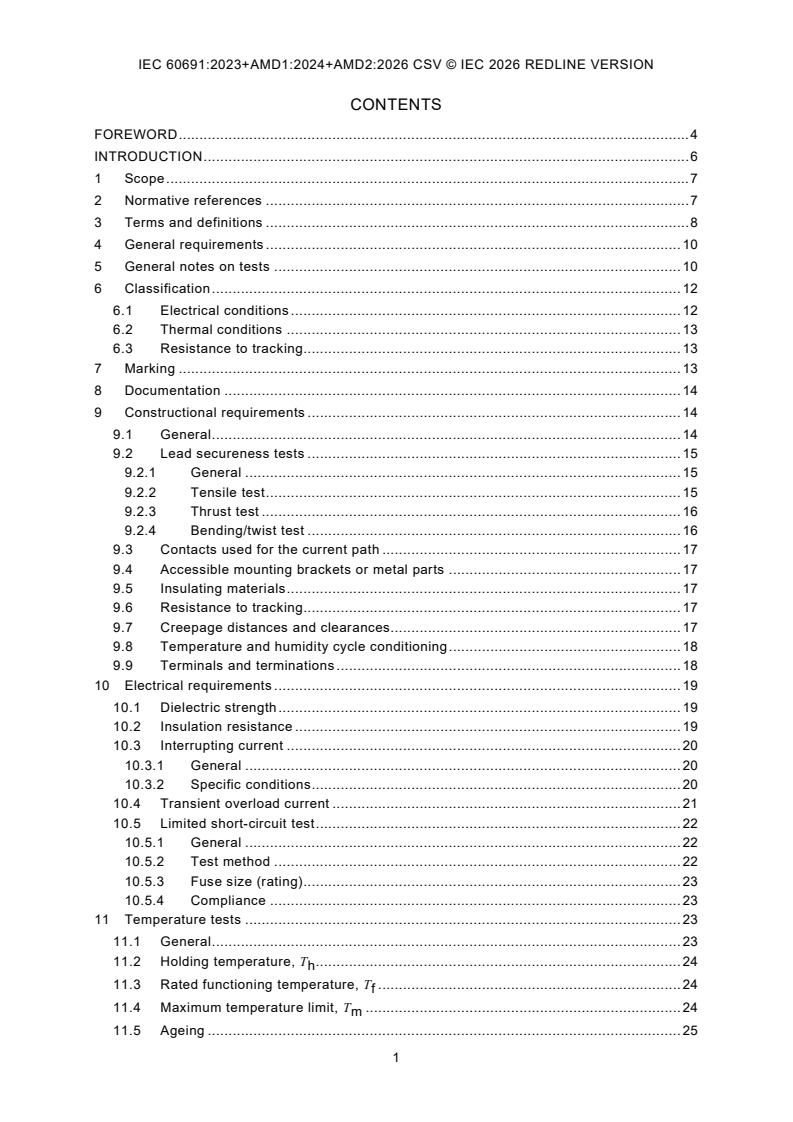
CONTENTS
FOREWORD . 5
INTRODUCTION . 7
1 Scope . 8
2 Normative references . 8
3 Terms and definitions . 9
4 General requirements . 11
5 General notes on tests . 12
6 Classification . 14
6.1 Electrical conditions . 14
6.2 Thermal conditions. 14
6.3 Resistance to tracking . 14
7 Marking . 14
8 Documentation . 15
9 Constructional requirements . 16
9.1 General . 16
9.2 Lead secureness tests . 17
9.2.1 General . 17
9.2.2 Tensile test . 17
9.2.3 Thrust test . 17
9.2.4 Bending/twist test . 17
9.3 Contacts used for the current path . 18
9.4 Accessible mounting brackets or metal parts . 19
9.5 Insulating materials . 19
9.6 Resistance to tracking . 19
9.7 Creepage distances and clearances . 19
9.8 Temperature and humidity cycle conditioning . 20
9.9 Terminals and terminations . 20
10 Electrical requirements . 21
10.1 Dielectric strength . 21
10.2 Insulation resistance . 21
10.3 Interrupting current . 22
10.3.1 General . 22
10.3.2 Specific conditions . 22
10.4 Transient overload current . 23
10.5 Limited short-circuit test . 24
10.5.1 General . 24
10.5.2 Test method . 24
10.5.3 Fuse size (rating) . 25
10.5.4 Compliance . 25
11 Temperature tests . 25
11.1 General . 25
11.2 Holding temperature, T . 26
h
11.3 Rated functioning temperature, T . 26
f
11.4 Maximum temperature limit, T . 26
m
11.5 Ageing . 27
© IEC 2024
12 Resistance to rusting . 27
13 Manufacturer’s validation programme . 28
Annex A (normative) Application guide. 29
Annex B (normative) Alternative ageing test for thermal-links with T greater than
h
250 °C for use in electric irons . 30
Annex C (normative) Conductive heat ageing test . 31
C.1 Conductive heat ageing test . 31
C.2 Method . 31
C.2.1 General . 31
C.2.2 Typical test fixture assembly . 31
C.2.3 Temperature setting. 31
C.2.4 Temperature behaviour . 31
C.2.5 Temperature monitoring . 32
C.3 Ageing . 32
C.3.1 General . 32
C.3.2 Cooling operation . 32
C.3.3 Premature operation . 32
C.4 Results . 33
C.5 Dielectric strength test . 33
C.6 Test oven . 33
Annex D (informative) Extended holding temperature evaluation . 35
D.1 Extended holding temperature conditioning test . 35
D.2 Load current interrupt test . 35
Annex E (normative) Seal ageing test . 37
Annex F (normative) Identification requirements . 39
Annex G (normative) Indelibility of markings . 40
Annex H (normative) Requirements for thermal-link packaged assemblies . 41
Annex I (informative) Holding temperature . 45
Bibliography . 46
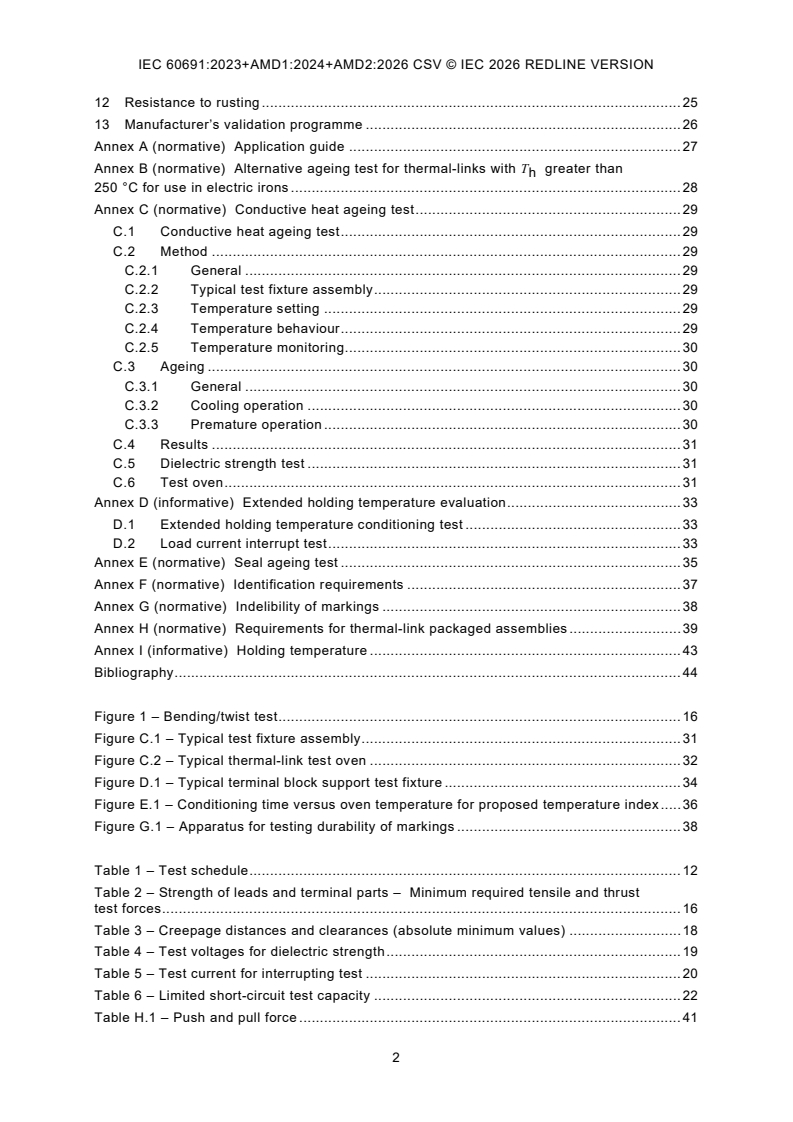
Figure 1 – Bending/twist test . 18
Figure C.1 – Typical test fixture assembly . 33
Figure C.2 – Typical thermal-link test oven . 34
Figure D.1 – Typical terminal block support test fixture . 36
Figure E.1 – Conditioning time versus oven temperature for proposed temperature index . 38
Figure G.1 – Apparatus for testing durability of markings . 40
Table 1 – Test schedule . 13
Table 2 – Strength of leads and terminal parts – Minimum required tensile and thrust
test forces . 18
Table 3 – Creepage distances and clearances (absolute minimum values) . 20
Table 4 – Test voltages for dielectric strength . 21
Table 5 – Test current for interrupting test . 22
Table 6 – Limited short-circuit test capacity . 24
Table H.1 – Push and pull force . 43
REDLINE VERSION – 4 – IEC 60691:2023+AMD1:2024 CSV
© IEC 2024
Table H.2 – Minimum nominal cross-sectional area of conductor . 43
Table H.3 – Allowed values for the materials used in the thermal-link package . 44
© IEC 2024
INTERNATIONAL ELECTROTECHNICAL COMMISSION
____________
THERMAL-LINKS –
REQUIREMENTS AND APPLICATION GUIDE
FOREWORD
1) The International Electrotechnical Commission (IEC) is a worldwide organization for standardization comprising
all national electrotechnical committees (IEC National Committees). The object of IEC is to promote international
co-operation on all questions concerning standardization in the electrical and electronic fields. To this end and
in addition to other activities, IEC publishes International Standards, Technical Specifications, Technical Reports,
Publicly Available Specifications (PAS) and Guides (hereafter referred to as "IEC Publication(s)"). Their
preparation is entrusted to technical committees; any IEC National Committee interested in the subject dealt with
may participate in this preparatory work. International, governmental and non-governmental organizations liaising
with the IEC also participate in this preparation. IEC collaborates closely with the International Organization for
Standardization (ISO) in accordance with conditions determined by agreement between the two organizations.
2) The formal decisions or agreements of IEC on technical matters express, as nearly as possible, an international
consensus of opinion on the relevant subjects since each technical committee has representation from all
interested IEC National Committees.
3) IEC Publications have the form of recommendations for international use and are accepted by IEC National
Committees in that sense. While all reasonable efforts are made to ensure that the technical content of IEC
Publications is accurate, IEC cannot be held responsible for the way in which they are used or for any
misinterpretation by any end user.
4) In order to promote international uniformity, IEC National Committees undertake to apply IEC Publications
transparently to the maximum extent possible in their national and regional publications. Any divergence between
any IEC Publication and the corresponding national or regional publication shall be clearly indicated in the latter.
5) IEC itself does not provide any attestation of conformity. Independent certification bodies provide conformity
assessment services and, in some areas, access to IEC marks of conformity. IEC is not responsible for any
services carried out by independent certification bodies.
6) All users should ensure that they have the latest edition of this publication.
7) No liability shall attach to IEC or its directors, employees, servants or agents including individual experts and
members of its technical committees and IEC National Committees for any personal injury, property damage or
other damage of any nature whatsoever, whether direct or indirect, or for costs (including legal fees) and
expenses arising out of the publication, use of, or reliance upon, this IEC Publication or any other IEC
Publications.
8) Attention is drawn to the Normative references cited in this publication. Use of the referenced publications is
indispensable for the correct application of this publication.
9) IEC draws attention to the possibility that the implementation of this document may involve the use of (a)
patent(s). IEC takes no position concerning the evidence, validity or applicability of any claimed patent rights in
respect thereof. As of the date of publication of this document, IEC had not received notice of (a) patent(s), which
may be required to implement this document. However, implementers are cautioned that this may not represent
the latest information, which may be obtained from the patent database available at https://patents.iec.ch or
www.iso.org/patents. IEC shall not be held responsible for identifying any or all such patent rights.
This consolidated version of the official IEC Standard and its amendment has been
prepared for user convenience.
IEC 60691 edition 5.1 contains the fifth edition (2023-03) [documents 32C/604/FDIS and
32C/605/RVD] and its amendment 1 (2024-10) [documents 32C/645/FDIS and 32C/648/RVD].
In this Redline version, a vertical line in the margin shows where the technical content is
modified by amendment 1. Additions are in green text, deletions are in strikethrough red
text. A separate Final version with all changes accepted is available in this publication.
REDLINE VERSION – 6 – IEC 60691:2023+AMD1:2024 CSV
© IEC 2024
IEC 60691 has been prepared by subcommittee 32C: Miniature fuses, of IEC technical
committee 32: Fuses. It is an International Standard.
This fifth edition cancels and replaces the fourth edition published in 2015 and
Amendment 1:2019. This edition constitutes a technical revision.
This fifth edition includes the following significant technical changes with respect to the previous
edition:
a) requirements for thermal-link packaged assemblies;
b) renew the requirements and definitions for T -test;
h
The harmonization of the USA national standard, UL 1020, fifth edition (withdrawn 2003), and
IEC 60691:1993, together with its Amendment 1:1995 and Amendment 2:2000 have served as
a basis for the elaboration of this standard.
The language used for the development of this International Standard is English.
This document was drafted in accordance with ISO/IEC Directives, Part 2, and developed in
accordance with ISO/IEC Directives, Part 1 and ISO/IEC Directives, IEC Supplement, available
at www.iec.ch/members_experts/refdocs. The main document types developed by IEC are
described in greater detail at www.iec.ch/publications.
The following differing practices of a less permanent nature exist in the country indicated below:
– Annex C is required to be declared in the USA;
– Annex E is required in the USA, if applicable;
– Annex F is required to be declared in the USA.
In this standard, the following type is used:
– compliance statements: in italic type.
The committee has decided that the contents of this document and its amendment will remain
unchanged until the stability date indicated on the IEC website under webstore.iec.ch in the
data related to the specific document. At this date, the document will be
• reconfirmed,
• withdrawn, or
• revised.
IMPORTANT – The 'colour inside' logo on the cover page of this publication indicates
that it contains colours which are considered to be useful for the correct understanding
of its contents. Users should therefore print this document using a colour printer.
© IEC 2024
INTRODUCTION
Thermal-links, defined as non-resettable devices functioning once only without refunctioning,
are widely applied for the thermal protection of equipment in which, under fault (abnormal)
conditions, one or more parts may reach hazardous temperatures.
As these devices have several aspects in common with miniature fuse-links and are used for
obtaining a comparable degree of protection, this standard has endeavoured to lay down a
number of basic requirements for such devices.
REDLINE VERSION – 8 – IEC 60691:2023+AMD1:2024 CSV
© IEC 2024
THERMAL-LINKS –
REQUIREMENTS AND APPLICATION GUIDE
1 Scope
This International Standard is applicable to thermal-links intended for incorporation in electrical
appliances, electronic equipment and component parts thereof, normally intended for use
indoors, in order to protect them against excessive temperatures under abnormal conditions.
NOTE 1 The equipment is not designed to generate heat.
NOTE 2 The effectiveness of the protection against excessive temperatures logically depends upon the position
and method of mounting of the thermal-link, as well as upon the current which it is carrying.
This document may be applicable to thermal-links for use under conditions other than indoors,
provided that the climatic and other circumstances in the immediate surroundings of such
thermal-links are comparable with those in this standard.
This document may be applicable to thermal-links in their simplest forms (e.g. melting strips or
wires), provided that molten materials expelled during function cannot adversely interfere with
the safe use of the equipment, especially in the case of hand-held or portable equipment,
irrespective of its position.
Annex H of this document is applicable to thermal-link packaged assemblies where the thermal-
link(s) has already been approved to this standard but packaged in a metallic or non-metallic
housing and provided with terminals/wiring leads.
This document is applicable to thermal-links with a rated voltage not exceeding 690 V AC or
DC and a rated current not exceeding 63 A.
The objectives of this document are:
a) to establish uniform requirements for thermal-links,
b) to define methods of test, and
c) to provide useful information for the application of thermal-links in equipment.
This document is not applicable to thermal-links used under extreme conditions such as
corrosive or explosive atmospheres.
This document is not applicable to thermal-links to be used in circuits on AC with a frequency
lower than 45 Hz or higher than 62 Hz.
2 Normative references
The following documents are referred to in the text in such a way that some or all of their content
constitutes requirements of this document. For dated references, only the edition cited applies.
For undated references, the latest edition of the referenced document (including any
amendments) applies.
IEC 60065:2014, Audio, video and similar electronic apparatus – Safety requirements
IEC 60112:2020, Method for the determination of the proof and the comparative tracking indices
of solid insulating materials
© IEC 2024
IEC 60127-2:2014, Miniature fuses – Part 2: Cartridge fuse-links
IEC 60216-5:2008, Electrical insulating materials – Thermal endurance properties – Part 5:
Determination of relative thermal endurance index (RTE) of an insulating material
IEC 60664-1:2020, Insulation coordination for equipment within low-voltage supply systems –
Part 1: Principles, requirements and tests
IEC 60695-2-12:2021, Fire hazard testing – Part 2-12: Glowing/hot-wire based test methods –
Glow-wire flammability index (GWFI) test method for materials
IEC 60695-2-13:2021, Fire hazard testing – Part 2-13: Glowing/hot-wire based test methods –
Glow-wire ignition temperature (GWIT) test method for materials
IEC 60695-10-2:2014, Fire hazard testing – Part 10-2: Abnormal heat – Ball pressure test
method
IEC 60695-11-10:2013, Fire hazard testing – Part 11-10: Test flames – 50 W horizontal and
vertical flame test methods
IEC 60730-1:2013, Automatic electrical controls – Part 1: General requirements
IEC 60730-1:2013/AMD1:2015
IEC 60730-1:2013/AMD2:2020
IEC 61210:2010, Connecting devices – Flat quick-connect terminations for electrical copper
conductors – Safety requirements
3 Terms and definitions
For the purposes of this document, the following terms and definitions apply.
ISO and IEC maintain terminological databases for use in standardization at the following
addresses:
• IEC Electropedia: available at http://www.electropedia.org/
• ISO Online browsing platform: available at http://www.iso.org/obp
3.1
clearance
shortest distance in air between two conductive parts
3.2
creepage distance
shortest distance along the surface of insulating material between two conductive parts
3.3
holding temperature
T
h
maximum ambient temperature of the thermal-link at which it will not change its state of
conductivity during a specified time at a specified rated current
REDLINE VERSION – 10 – IEC 60691:2023+AMD1:2024 CSV
© IEC 2024
3.4
homogeneous series
series of thermal-links having the same external dimensions and common overall construction,
deviating from each other only in such characteristics (including ratings) that, for a given test,
the testing of one or a reduced number of particular thermal-links of that series shall be taken
as representative for all the thermal-links of the series
3.5
interrupting current
I
b
value of the current that the thermal-link is capable of interrupting at rated voltage and under
specified circuit conditions
3.6
maximum temperature limit
T
m
temperature of the thermal-link stated by the manufacturer, up to which the mechanical and
electrical properties of the thermal-link, having changed its state of conductivity, will not be
impaired for a given time
3.7
pilot duty
rating assigned to a switching device that controls the coil of another electro-mechanical device
such as a solenoid, relay or contactor
3.8
portable equipment
equipment which is moved while in operation or which can easily be moved from one place to
another while connected to the supply
3.9
rated current
I
r
current used to classify a thermal-link
3.10
rated functioning temperature
T
f
temperature of the thermal-link which causes it to change its state of conductivity with a
detection current up to 10 mA as the only load
3.11
rated voltage
U
r
voltage used to classify a thermal-link
3.12
thermal element
metallic or non-metallic fusible material that is part of a thermal-link and is responsive to
temperature by a change of state such as from solid to liquid at the temperature for which it is
calibrated
3.13
thermal-link
non-resettable device incorporating a thermal element, which will open a circuit once only when
exposed for a sufficient length of time to a temperature in excess of that for which it has been
designed
© IEC 2024
3.14
transient overload current
I
p
direct current pulse train which the thermal-link is able to withstand without impairing its
characteristics
3.15
extended holding temperature
T
h-100
maximum temperature at which a thermal-link can be maintained while conducting the rated
current at the rated voltage for a period of 100 weeks which will not cause the thermal-link to
open circuit in accordance with extended holding temperature evaluation
Note 1 to entry: This is a rating for user consideration during the investigation of the end product.
Note 2 to entry: Annex D specifies the extended holding temperature evaluation.
3.16
conductive heat ageing test
CHAT
test to evaluate a thermal-link for use in an appliance
Note 1 to entry: If it performs satisfactorily, the thermal-link will be assigned a CHAT rating. This rating is for end-
product user consideration during the investigation of the end-use product.
Note 2 to entry: Annex C specifies the conductive heat ageing test.
4 General requirements
4.1 Adequate protection of the equipment against excessive temperatures not only depends
upon the properties of the thermal-link but also to a large extent upon the mounting of the
thermal-link in the equipment. Therefore the requirements of the application guide in Annex A
shall be considered.
4.2 Thermal-links shall have adequate electrical and mechanical strength and shall be
constructed so as to withstand all conditions of handling likely to be encountered during
mounting and normal use, when used within the requirements of this document.
4.3 When a thermal-link changes its state of conductivity, no arc or flame shall be maintained,
nor material expelled, that might impair the surrounding area or otherwise create a risk of
electric shock or fire. In addition, there shall be no emission of substances (e.g. gases, liquids,
dust, mist, vapour) which could cause a hazard.
For thermal-links using melting strips or wires, care should be taken to prevent molten material
from short-circuiting or bridging creepage distances and clearances in air, so as to reduce the
risk of impairing the insulation system of the equipment.
After it has functioned, the thermal-link shall not be damaged when subjected to temperatures
not exceeding T , in such a way that the safety of the equipment with regard to risk of electric
m
shock hazard and electrical breakdown is impaired. The thermal-link shall not reclose after it
has operated.
4.4 For requirements for thermal-link packaged assemblies, see Annex H.
REDLINE VERSION – 12 – IEC 60691:2023+AMD1:2024 CSV
© IEC 2024
5 General notes on tests
5.1 The test conditions are as follows.
5.1.1 Unless otherwise specified, only tests that are not required to be performed inside an
environmental chamber and/or test oven shall be carried out under the following atmospheric
conditions:
– temperature: 15 °C to 35 °C,
– relative humidity: 25 % to 75 %,
4 5
– air pressure: 8,6 × 10 Pa to 1,06 × 10 Pa.
The required atmospheric conditions during testing can be controlled when carrying out the
tests and during the duration of the tests. The required atmospheric conditions do not have to
be maintained in a test laboratory when tests are not performed.
5.1.2 Where the conditions given in 5.1.1 have a significant influence, they shall be kept
substantially constant during the tests.
5.1.3 If the temperature limits given in 5.1.1 are too wide for certain tests, these shall be
repeated, in case of doubt, at a temperature of (23 ± 1) °C.
5.2 In every test report, the ambient temperature shall be stated. If the standard conditions
for relative humidity or pressure are not fulfilled during the tests, a note to this effect shall be
added to the report.
5.3 If the result of a test is influenced, to an appreciable extent, by the position and method
of mounting of the specimen, the most unfavourable condition shall be chosen for the relevant
tests and recorded.
5.4 If a thermal-link has been specifically designed for use in a special type of equipment
and cannot be tested separately, the tests of this standard shall be performed in that equipment
or in the relevant part of it, or similar.
5.5 When testing a homogeneous series of thermal-links, all the tests shall be applied to
thermal-links with the lowest and highest T . Thermal-links with intermediate rated functioning
f
temperatures need only be subjected to tests according to 10.3, 11.3, 11.4 and 11.5.
5.6 The number of specimens is as follows.
5.6.1 The total number of specimens required is 48. Out of a total of 48 specimens, 15 are
kept as spares in case some of the tests have to be repeated. Out of a total of 48 specimens,
33 are divided into 11 groups assigned by alphabetical letters from A to K. Each group consists
of three specimens. Tests shall be performed in the order indicated in Table 1 but, if so required,
tests may be repeated, for example the test on marking (see Clause 7). Additional specimens
may be needed according to the requirement of Table 1.
For optional tests, additional specimens should be required as per the applicable annexes.
5.6.2 If, in any of the tests carried out in accordance with any relevant test clause, a failure
is reported, the cause of the failure will be identified and corrective action taken. Based on the
failure analysis report and the corrective action, as a minimum, the test sequence shall be
repeated on twice the number of revised specimens, and no further failures are allowed.
If no corrective actions are necessary, the test should be repeated with double the same size
and no further deviation is allowed.
© IEC 2024
5.6.3 For requirements for thermal-link packaged assemblies, see Annex H.
5.7 The conductive heat ageing test of Annex C is applicable when declared by the
manufacturer.
The conductive heat ageing test may be omitted if the thermal-link is constructed without
contacts.
NOTE In the USA the conductive heat ageing test is required to be declared.
Table 1 – Test schedule
Clause or Test Specimen groups
Sub-clause
A B C D E F G H I J K
a
Marking (Rub test) X X
a
Marking (visual inspection only) X X
9 Constructional requirements
a
Tensile forces X
9.2.2
a
Thrust force X
9.2.3
a
Bending/twist force X
9.2.4
a
Resistance to tracking X
9.6
a
Creepage distances and clearances X X
9.7
9.8 Temperature and humidity cycle X X X X X
conditioning
10 Electrical requirements
10.1 Dielectric strength (if applicable) X X X X X
10.2 Insulation resistance (if applicable) X X X X X
10.3 Interrupting current X X
10.4 Transient overload current X X X
11 Temperature tests
b
11.2 X
Check on T
h
11.3 Check on T X X
f
11.4 Check on T followed by dielectric
X X
m
test and insulation resistance
11.5 Ageing X X X X X
step 1 (optional) 21 days
step 2 (mandatory) 21 days
step 3 (mandatory) 14 days
step 4 (mandatory) 7 days
step 5 (mandatory) 7 days
step 6 (mandatory) 24 hours
10.1 Dielectric strength X X X X X X X X
10.2 Insulation resistance X X X X X X X X
12 Resistance to rusting
a
Resistance to rusting (ferrous parts) X X X
REDLINE VERSION – 14 – IEC 60691:2023+AMD1:2024 CSV
© IEC 2024
If the conditions of voltage, power and current in 10.3.2.3, 10.3.2.4 and 10.3.2.5 are not covered by one test, a
minimum of three specimens should be tested for each condition.
a
For homogeneous series, these tests may be omitted for intermediate ratings.
b
When declared by the manufacturer.
6 Classification
6.1 Electrical conditions
With regard to electrical conditions, the following terms are used:
a) Voltage: AC and /or DC.
b) Current: AC and/ or DC.
c) Resistive load
d) Inductive load
e) Motor load
f) Pilot duty load
g) Electric discharge lamp load.
h) Special load
6.2 Thermal conditions
With regard to thermal conditions, the following symbols and abbreviations are used:
a) T
f
b) T
h
c) T
m
d) CHAT
e) T
h-100
6.3 Resistance to tracking
With regard to resistance to tracking, the following ranges are used:
a) proof tracking index from 175 to 249;
b) proof tracking index greater than or equal to 250.
NOTE These ranges are based on test methods for surface tracking laid down in IEC 60112.
7 Marking
7.1 Each thermal-link shall be marked with the following:
a) type or catalogue reference;
b) manufacturer’s name or trade mark;
c) rated functioning temperature T with or without the symbol T followed by the number of
f f
degrees Celsius (marked with °C or C);
d) date code which identifies the date of manufacture and which does not repeat for at least
10 years, and a factory location or code, stamped on the thermal-link or the smallest
packaging.
© IEC 2024
If there is only one factory, the factory location may be omitted.
Catalogue or reference numbers should define those parameters such as temperature, current
and voltage, which together classify a thermal-link.
7.2 The rated functioning temperature T may be omitted if a different type or catalogue
f
reference is employed for each different functioning temperature.
7.3 Marking shall be indelible and legible.
Compliance with the requirements for indelibility of markings is checked by the test in Annex G
using the apparatus shown in Figure G.1. Legibility is checked by inspection. After the ageing
tests of 11.4, compliance is checked by inspection.
7.4 The marking in accordance with a), b), c) and d) in 7.1 shall be printed additionally on
the packing, together with a reference to this document.
7.5 If the thermal-link is small in size, and not intended to be replaced, the thermal-link shall
be marked with only item a) in 7.1 and the markings in accordance with b) to d) in 7.1 shall be
printed on the packaging, together with a reference to this document.
Compliance is checked by inspection.
8 Documentation
The manufacturer shall provide in the technical documentation, catalogues or instructional
leaflets the following information, in addition to that required in Clause 7:
a) classification in accordance with Clause 6;
b) for each of the classifications;
1) characteristic temperatures T , T (if declared by manufacturer), T ;
f h m
2) characteristic currents I , I , I ;
r b p
3) rated voltage U ;
r
c) suitability for sealing in, or use with impregnating fluids or cleaning solvents;
d) information for mounting the thermal-link in the equipment;
e) thermal-links small in size and not intended to be replaced.
For reasons of safety, it should be made clear in the documentation that a thermal-link is a non-
repairable item and that, in case of replacement, an equivalent thermal-link from the same
manufacturer and having the same catalogue reference should be used, mounted in exactly the
same way.
f) the position of the metal screen, if it is located at a distance other than 12,7 mm away from
the live parts in the case of a thermal-link having an exposed element;
g) Application instructions on how to mount the device in equipment for for thermal-links with
leads cross sectional area smaller than 0,21 mm .
The device's temperature response should be taken into consideration.
REDLINE VERSION – 16 – IEC 60691:2023+AMD1:2024 CSV
© IEC 2024
9 Constructional requirements
9.1 General
9.1.1 Thermal-links shall have adequate mechanical strength and stability so as to withstand
the stresses likely to be encountered during handling, normal use and fault conditions of the
relevant end-use equipment.
9.1.2 Tab terminals shall be constructed in accordance with IEC 61210 and the maximum
permissible temperature of the used Tab materials shall be in accordance with Table A.1 of
IEC 61210:2010 (Tabs / Integrated).
9.1.3 Current-carrying parts shall be constructed in such a way that contact pressure is not
transmitted through non-metallic material other than ceramic, or any material considered as
having sufficient dimensional stability over the range of temperatures to be expected, unless
there is sufficient resilience in the corresponding metal parts to compensate for any shrinkage
or distortion of the non-metallic material.
Current-carrying parts shall have the necessary mechanical strength, be capable of carrying
the rated current and shall be of a material that is acceptable for the particular application.
For current-carrying parts, temperature limits shall be considered according to Table 13 of
IEC 60730-1:2013.
9.1.4 Friction shall not be used to secure uninsulated live parts (including terminals) to
supporting surfaces if there is a risk of such parts turning or shifting their position, resulting in
the reduction of creepage distances and clearances to less than those required elsewhere in
this standard. The security of contact assemblies shall be such that alignment of contacts is
maintained.
9.1.5 Leads and terminal parts shall be secured so that stress on them during installation
and normal use does not impair operation of the thermal-link. Thermal-links using seals with
formed leads for use in appliances or components shall not be bent less than 3 mm from the
thermal-link seal.
Leads may be bent less than 3 mm from the seal if:
a) the thermal-link manufacturer's bending fixture and procedure does not transmit stress to
the thermal-link operating mechanism, and if;
b) formed test specimens shall be subjected to the bending/twist lead secureness test of 9.2.4
and the rated functioning temperature test of 11.3.
9.1.6 Thermal-links with leads smaller than 0,21 mm shall be provided with application
instructions that instruct the user how to mount the device in equipment, taking into
consideration the device's temperature response. The instructions shall also include guidance
on the effects that movement and vibration in the equipment may have on the thermal-link's
terminals, connections and other mounting components.
9.1.7 A terminal for a soldered connection shall have provision, such as a hole, for holding
the conductor independently of solder.
9.1.8 When applicable, provision shall be made for securely mounting a thermal-link in
position.
9.1.9 Thermal-links intended to be embedded in windings and the like need not have
provision for mounting.
© IEC 2024
9.1.10 Bolts, screws, or other parts used for mounting an assembly having a thermal-link shall
be independent of those used for securing component parts of the assembly.
9.1.11 Compliance is checked by the lead secureness tests of 9.2. Mounting and securement
instructions shall be provided with thermal-links for the manufacturer of the end-product in
accordance with Annex A.
9.2 Lead secureness tests
9.2.1 General
If force applied to thermal-link wire leads causes breakdown of one or more parts leading
directly or indirectly to stress being applied to the operating mechanism, the tests described in
9.2.2, 9.2.3 and 9.2.4 shall be conducted. There shall be no displacement of parts that would
tend to reclose a thermal-link or reduce creepage distances or clearances as a result of the
tests specified in 9.2.2 and 9.2.3. There shall be no displacement of parts other than the wire
leads as a result of the test specified in 9.2.4.
9.2.2 Tensile test
The thermal-link shall be supported in any convenient manner in order not to damage it and a
tensile force as specified in Table 2 shall be applied to each lead for 1 min.
9.2.3 Thrust test
The thermal-link shall be supported using any convenient means such that it is not damaged
and a thrust force as specified in Table 2 shall be applied to each lead for 1 min at a distance
of 2 mm from the thermal-link.
9.2.4 Bending/twist
...
IEC 60691 ®
Edition 5.0 2023-03
REDLINE VERSION
INTERNATIONAL
STANDARD
colour
inside
Thermal-links – Requirements and application guide
All rights reserved. Unless otherwise specified, no part of this publication may be reproduced or utilized in any form
or by any means, electronic or mechanical, including photocopying and microfilm, without permission in writing from
either IEC or IEC's member National Committee in the country of the requester. If you have any questions about IEC
copyright or have an enquiry about obtaining additional rights to this publication, please contact the address below or
your local IEC member National Committee for further information.
IEC Secretariat Tel.: +41 22 919 02 11
3, rue de Varembé info@iec.ch
CH-1211 Geneva 20 www.iec.ch
Switzerland
About the IEC
The International Electrotechnical Commission (IEC) is the leading global organization that prepares and publishes
International Standards for all electrical, electronic and related technologies.
About IEC publications
The technical content of IEC publications is kept under constant review by the IEC. Please make sure that you have the
latest edition, a corrigendum or an amendment might have been published.
IEC publications search - webstore.iec.ch/advsearchform IEC Products & Services Portal - products.iec.ch
The advanced search enables to find IEC publications by a
Discover our powerful search engine and read freely all the
variety of criteria (reference number, text, technical publications previews. With a subscription you will always have
committee, …). It also gives information on projects, replaced access to up to date content tailored to your needs.
and withdrawn publications.
Electropedia - www.electropedia.org
IEC Just Published - webstore.iec.ch/justpublished
The world's leading online dictionary on electrotechnology,
Stay up to date on all new IEC publications. Just Published
containing more than 22 300 terminological entries in English
details all new publications released. Available online and once
and French, with equivalent terms in 19 additional languages.
a month by email.
Also known as the International Electrotechnical Vocabulary
(IEV) online.
IEC Customer Service Centre - webstore.iec.ch/csc
If you wish to give us your feedback on this publication or need
further assistance, please contact the Customer Service
Centre: sales@iec.ch.
IEC 60691 ®
Edition 5.0 2023-03
REDLINE VERSION
INTERNATIONAL
STANDARD
colour
inside
Thermal-links – Requirements and application guide
INTERNATIONAL
ELECTROTECHNICAL
COMMISSION
ICS 29.120.50 ISBN 978-2-8322-6617-5
– 2 – IEC 60691:2023 RLV © IEC 2023
CONTENTS
FOREWORD .5
INTRODUCTION .2
1 Scope .8
2 Normative references .8
3 Terms and definitions .9
4 General requirements . 11
5 General notes on tests . 12
6 Classification . 14
6.1 Electrical conditions . 14
6.2 Thermal conditions . 14
6.3 Resistance to tracking . 14
7 Marking . 14
8 Documentation . 15
9 Constructional requirements . 16
9.1 General . 16
9.2 Lead secureness tests . 17
9.2.1 General . 17
9.2.2 Tensile test . 17
9.2.3 Thrust test . 17
9.2.4 Bending/twist test . 17
9.3 Contacts used for the current path . 18
9.4 Accessible mounting brackets or metal parts . 19
9.5 Insulating materials . 19
9.6 Resistance to tracking . 19
9.7 Creepage distances and clearances . 19
9.8 Temperature and humidity cycle conditioning . 20
9.9 Terminals and terminations . 20
10 Electrical requirements . 21
10.1 Dielectric strength. 21
10.2 Insulation resistance . 21
10.3 Interrupting current . 22
10.3.1 General . 22
10.3.2 Specific conditions. 22
10.4 Transient overload current . 24
10.5 Limited short-circuit test . 24
10.5.1 General . 24
10.5.2 Test method . 24
10.5.3 Fuse size (rating) . 25
10.5.4 Compliance . 25
11 Temperature tests . 25
11.1 General . 25
11.2 Holding temperature, T . 26
h
11.3 Rated functioning temperature, T . 26
f
11.4 Maximum temperature limit, T . 27
m
11.5 Ageing . 27
12 Resistance to rusting. 28
13 Manufacturer’s validation programme . 28
Annex A (normative) Application guide . 29
Annex B (normative) Alternative ageing test for thermal-links with T greater than
h
250 °C for use in electric irons . 30
Annex C (normative) Conductive heat ageing test . 31
C.1 Conductive heat ageing test . 31
C.2 Method . 31
C.2.1 General . 31
C.2.2 Typical test fixture assembly . 31
C.2.3 Temperature setting . 31
C.2.4 Temperature behaviour . 31
C.2.5 Temperature monitoring . 32
C.3 Ageing . 32
C.3.1 General . 32
C.3.2 Cooling operation . 32
C.3.3 Premature operation . 32
C.4 Results . 33
C.5 Dielectric strength test . 33
C.6 Test oven . 35
Annex D (informative) Extended holding temperature evaluation . 37
D.1 Extended holding temperature conditioning test . 37
D.2 Load current interrupt test . 37
Annex E (normative) Seal ageing test . 39
Annex F (normative) Identification requirements . 41
Annex G (normative) Indelibility of markings . 42
Annex H (normative) Requirements for thermal-link packaged assemblies . 43
Annex I (informative) Holding temperature . 48
Bibliography . 49
Figure 1 – Bending/twist test . 18
Figure C.1 – Typical test fixture assembly . 34
Figure C.2 – Typical thermal-link test oven. 36
Figure D.1 – Typical terminal block support test fixture . 38
Figure E.1 – Conditioning time versus oven temperature for proposed temperature index . 40
Figure G.1 – Apparatus for testing durability of markings . 42
Table 1 – Test schedule . 13
Table 2 – Strength of leads and terminal parts – Minimum required tensile and thrust
test forces . 18
Table 3 – Creepage distances and clearances (absolute minimum values) . 20
Table 4 – Test voltages for dielectric strength . 21
Table 5 – Test current for interrupting test . 22
Table 6 – Limited short-circuit test capacity. 25
– 4 – IEC 60691:2023 RLV © IEC 2023
Table H.1 – Push and pull force . 45
Table H.2 – Minimum nominal cross-sectional area of conductor . 45
Table H.3 – Allowed values for the materials used in the thermal-link package . 47
INTERNATIONAL ELECTROTECHNICAL COMMISSION
____________
THERMAL-LINKS –
REQUIREMENTS AND APPLICATION GUIDE
FOREWORD
1) The International Electrotechnical Commission (IEC) is a worldwide organization for standardization comprising
all national electrotechnical committees (IEC National Committees). The object of IEC is to promote international
co-operation on all questions concerning standardization in the electrical and electronic fields. To this end and
in addition to other activities, IEC publishes International Standards, Technical Specifications, Technical Reports,
Publicly Available Specifications (PAS) and Guides (hereafter referred to as "IEC Publication(s)"). Their
preparation is entrusted to technical committees; any IEC National Committee interested in the subject dealt with
may participate in this preparatory work. International, governmental and non-governmental organizations liaising
with the IEC also participate in this preparation. IEC collaborates closely with the International Organization for
Standardization (ISO) in accordance with conditions determined by agreement between the two organizations.
2) The formal decisions or agreements of IEC on technical matters express, as nearly as possible, an international
consensus of opinion on the relevant subjects since each technical committee has representation from all
interested IEC National Committees.
3) IEC Publications have the form of recommendations for international use and are accepted by IEC National
Committees in that sense. While all reasonable efforts are made to ensure that the technical content of IEC
Publications is accurate, IEC cannot be held responsible for the way in which they are used or for any
misinterpretation by any end user.
4) In order to promote international uniformity, IEC National Committees undertake to apply IEC Publications
transparently to the maximum extent possible in their national and regional publications. Any divergence between
any IEC Publication and the corresponding national or regional publication shall be clearly indicated in the latter.
5) IEC itself does not provide any attestation of conformity. Independent certification bodies provide conformity
assessment services and, in some areas, access to IEC marks of conformity. IEC is not responsible for any
services carried out by independent certification bodies.
6) All users should ensure that they have the latest edition of this publication.
7) No liability shall attach to IEC or its directors, employees, servants or agents including individual experts and
members of its technical committees and IEC National Committees for any personal injury, property damage or
other damage of any nature whatsoever, whether direct or indirect, or for costs (including legal fees) and
expenses arising out of the publication, use of, or reliance upon, this IEC Publication or any other IEC
Publications.
8) Attention is drawn to the Normative references cited in this publication. Use of the referenced publications is
indispensable for the correct application of this publication.
9) Attention is drawn to the possibility that some of the elements of this IEC Publication may be the subject of patent
rights. IEC shall not be held responsible for identifying any or all such patent rights.
This redline version of the official IEC Standard allows the user to identify the changes
made to the previous edition IEC 60691:2015+AMD1:2019 CSV. A vertical bar appears in
the margin wherever a change has been made. Additions are in green text, deletions are
in strikethrough red text.
– 6 – IEC 60691:2023 RLV © IEC 2023
IEC 60691 has been prepared by subcommittee 32C: Miniature fuses, of IEC technical
committee 32: Fuses. It is an International Standard.
This fifth edition cancels and replaces the fourth edition published in 2015 and
Amendment 1:2019. This edition constitutes a technical revision.
This fifth edition includes the following significant technical changes with respect to the previous
edition:
a) requirements for thermal-link packaged assemblies;
b) renew the requirements and definitions for T -test;
h
The harmonization of the USA national standard, UL 1020, fifth edition (withdrawn 2003), and
IEC 60691:1993, together with its Amendment 1:1995 and Amendment 2:2000 have served as
a basis for the elaboration of this standard.
The text of this International Standard is based on the following documents:
Draft Report on voting
32C/604/FDIS 32C/605/RVD
Full information on the voting for its approval can be found in the report on voting indicated in
the above table.
The language used for the development of this International Standard is English.
This document was drafted in accordance with ISO/IEC Directives, Part 2, and developed in
accordance with ISO/IEC Directives, Part 1 and ISO/IEC Directives, IEC Supplement, available
at www.iec.ch/members_experts/refdocs. The main document types developed by IEC are
described in greater detail at www.iec.ch/publications.
The following differing practices of a less permanent nature exist in the country indicated below:
– Annex C is required to be declared in the USA;
– Annex E is required in the USA, if applicable;
– Annex F is required to be declared in the USA.
In this standard, the following type is used:
– compliance statements: in italic type.
The committee has decided that the contents of this document will remain unchanged until the
stability date indicated on the IEC website under webstore.iec.ch in the data related to the
specific document. At this date, the document will be
• reconfirmed,
• withdrawn,
• replaced by a revised edition, or
• amended.
IMPORTANT – The "colour inside" logo on the cover page of this document indicates that it
contains colours which are considered to be useful for the correct understanding of its
contents. Users should therefore print this document using a colour printer.
INTRODUCTION
Thermal-links, defined as non-resettable devices functioning once only without refunctioning,
are widely applied for the thermal protection of equipment in which, under fault (abnormal)
conditions, one or more parts may reach hazardous temperatures.
As these devices have several aspects in common with miniature fuse-links and are used for
obtaining a comparable degree of protection, this standard has endeavoured to lay down a
number of basic requirements for such devices.
– 8 – IEC 60691:2023 RLV © IEC 2023
THERMAL-LINKS –
REQUIREMENTS AND APPLICATION GUIDE
1 Scope
This International Standard is applicable to thermal-links intended for incorporation in electrical
appliances, electronic equipment and component parts thereof, normally intended for use
indoors, in order to protect them against excessive temperatures under abnormal conditions.
NOTE 1 The equipment is not designed to generate heat.
NOTE 2 The effectiveness of the protection against excessive temperatures logically depends upon the position
and method of mounting of the thermal-link, as well as upon the current which it is carrying.
This document may be applicable to thermal-links for use under conditions other than indoors,
provided that the climatic and other circumstances in the immediate surroundings of such
thermal-links are comparable with those in this standard.
This document may be applicable to thermal-links in their simplest forms (e.g. melting strips or
wires), provided that molten materials expelled during function cannot adversely interfere with
the safe use of the equipment, especially in the case of hand-held or portable equipment,
irrespective of its position.
Annex H of this document is applicable to thermal-link packaged assemblies where the thermal-
link(s) has already been approved to this standard but packaged in a metallic or non-metallic
housing and provided with terminals/wiring leads.
This document is applicable to thermal-links with a rated voltage not exceeding 690 V AC or
DC and a rated current not exceeding 63 A.
The objectives of this document are:
a) to establish uniform requirements for thermal-links,
b) to define methods of test, and
c) to provide useful information for the application of thermal-links in equipment.
This document is not applicable to thermal-links used under extreme conditions such as
corrosive or explosive atmospheres.
This document is not applicable to thermal-links to be used in circuits on AC with a frequency
lower than 45 Hz or higher than 62 Hz.
2 Normative references
The following documents are referred to in the text in such a way that some or all of their content
constitutes requirements of this document. For dated references, only the edition cited applies.
For undated references, the latest edition of the referenced document (including any
amendments) applies.
IEC 60065:2014, Audio, video and similar electronic apparatus – Safety requirements
IEC 60112:20032020, Method for the determination of the proof and the comparative tracking
indices of solid insulating materials
IEC 60112:2003/AMD1:2009
IEC 60127-2:2014, Miniature fuses – Part 2: Cartridge fuse-links
IEC 60216-5:2008, Electrical insulating materials – Thermal endurance properties – Part 5:
Determination of relative thermal endurance index (RTE) of an insulating material
020, Insulation coordination for equipment within low-voltage supply
IEC 60664-1:20072
systems – Part 1: Principles, requirements and tests
IEC 60695-2-12:20102021, Fire hazard testing – Part 2-12: Glowing/hot-wire based test
methods – Glow-wire flammability index (GWFI) test method for materials
IEC 60695-2-12:2010/AMD1:2014
IEC 60695-2-13:20102021, Fire hazard testing – Part 2-13: Glowing/hot-wire based test
methods – Glow-wire ignition temperature (GWIT) test method for materials
IEC 60695-2-13:2010/AMD1:2014
IEC 60695-10-2:2014, Fire hazard testing – Part 10-2: Abnormal heat – Ball pressure test
method
IEC 60695-11-10:2013, Fire hazard testing – Part 11-10: Test flames – 50 W horizontal and
vertical flame test methods
IEC 60730-1:2013, Automatic electrical controls – Part 1: General requirements
IEC 60730-1:2013/AMD1:2015
IEC 60730-1:2013/AMD2:2020
IEC 61210:2010, Connecting devices – Flat quick-connect terminations for electrical copper
conductors – Safety requirements
3 Terms and definitions
For the purposes of this document, the following terms and definitions apply.
ISO and IEC maintain terminological databases for use in standardization at the following
addresses:
• IEC Electropedia: available at http://www.electropedia.org/
• ISO Online browsing platform: available at http://www.iso.org/obp
3.1
clearance
shortest distance in air between two conductive parts
3.2
creepage distance
shortest distance along the surface of insulating material between two conductive parts
3.3
holding temperature
T
h
maximum ambient temperature of the thermal-link at which it will not change its state of
conductivity during a specified time at the a specified rated current
Note 1 to entry: The minimum permissible value of T is 35 °C.
h
– 10 – IEC 60691:2023 RLV © IEC 2023
3.4
homogeneous series
series of thermal-links having the same external dimensions and common overall construction,
deviating from each other only in such characteristics (including ratings) that, for a given test,
the testing of one or a reduced number of particular thermal-links of that series shall be taken
as representative for all the thermal-links of the series
3.5
interrupting current
I
b
value of the current that the thermal-link is capable of interrupting at rated voltage and under
specified circuit conditions
3.6
maximum temperature limit
T
m
temperature of the thermal-link stated by the manufacturer, up to which the mechanical and
electrical properties of the thermal-link, having changed its state of conductivity, will not be
impaired for a given time
3.7
pilot duty
rating assigned to a switching device that controls the coil of another electro-mechanical device
such as a solenoid, relay or contactor
3.8
portable equipment
equipment which is moved while in operation or which can easily be moved from one place to
another while connected to the supply
3.9
rated current
I
r
current used to classify a thermal-link
3.10
rated functioning temperature
T
f
temperature of the thermal-link which causes it to change its state of conductivity with a
detection current up to 10 mA as the only load
3.11
rated voltage
U
r
voltage used to classify a thermal-link
3.12
thermal element
metallic or non-metallic fusible material that is part of a thermal-link and is responsive to
temperature by a change of state such as from solid to liquid at the temperature for which it is
calibrated
3.13
thermal-link
non-resettable device incorporating a thermal element, which will open a circuit once only when
exposed for a sufficient length of time to a temperature in excess of that for which it has been
designed
3.14
transient overload current
I
p
direct current pulse train which the thermal-link is able to withstand without impairing its
characteristics
3.15
type test
conformity testing on the basis of one or more specimens of a product representative of the
production
3.15
extended holding temperature
T
h-100
maximum temperature at which a thermal-link can be maintained while conducting the rated
load current at the rated voltage for a period of 100 weeks which will not cause the thermal-link
to open circuit in accordance with extended holding temperature evaluation
Note 1 to entry: This is a rating for user consideration during the investigation of the end product.
Note 2 to entry: Annex D specifies the extended holding temperature evaluation.
3.16
conductive heat ageing test
CHAT
test to evaluate a thermal-link for use in an appliance
Note 1 to entry: If it performs satisfactorily, the thermal-link will be assigned a CHAT rating. This rating is for end-
product user consideration during the investigation of the end-use product.
Note 2 to entry: Annex C specifies the conductive heat ageing test.
4 General requirements
4.1 Adequate protection of the equipment against excessive temperatures not only depends
upon the properties of the thermal-link but also to a large extent upon the mounting of the
thermal-link in the equipment. Therefore, in addition to good engineering practice, the
requirements of the application guide in Annex A shall be considered.
4.2 Thermal-links shall have adequate electrical and mechanical strength and shall be
constructed so as to withstand all conditions of handling likely to be encountered during
mounting and normal use, when used within the requirements of this document.
4.3 When a thermal-link changes its state of conductivity, no arc or flame shall be maintained,
nor material expelled, that might impair the surrounding area or otherwise create a risk of
electric shock or fire. In addition, there shall be no emission of substances (e.g. gases, liquids,
dust, mist, vapour) which could cause a hazard.
For thermal-links using melting strips or wires, care should be taken to prevent molten material
from short-circuiting or bridging creepage distances and clearances in air, so as to reduce the
risk of impairing the insulation system of the equipment.
After it has functioned, the thermal-link shall not be damaged when subjected to temperatures
not exceeding T , in such a way that the safety of the equipment with regard to risk of electric
m
shock hazard and electrical breakdown is impaired. The thermal-link shall not reclose after it
has operated.
4.4 For requirements for thermal-link packaged assemblies, see Annex H.
– 12 – IEC 60691:2023 RLV © IEC 2023
5 General notes on tests
5.1 The test conditions are as follows.
5.1.1 Unless otherwise specified, only tests that are not required to be performed inside an
environmental chamber and/or test oven shall be carried out under the following atmospheric
conditions:
– temperature: 15 °C to 35 °C,
– relative humidity: 25 % to 75 %,
4 5
– air pressure: 8,6 × 10 Pa to 1,06 × 10 Pa.
The required atmospheric conditions during testing can be controlled when carrying out the
tests and during the duration of the tests. The required atmospheric conditions do not have to
be maintained in a test laboratory when tests are not performed.
5.1.2 Where the conditions given in 5.1.1 have a significant influence, they shall be kept
substantially constant during the tests.
5.1.3 If the temperature limits given in 5.1.1 are too wide for certain tests, these shall be
repeated, in case of doubt, at a temperature of (23 ± 1) °C.
5.2 In every test report, the ambient temperature shall be stated. If the standard conditions
for relative humidity or pressure are not fulfilled during the tests, a note to this effect shall be
added to the report.
5.3 If the result of a test is influenced, to an appreciable extent, by the position and method
of mounting of the specimen, the most unfavourable condition shall be chosen for the relevant
tests and recorded.
5.4 If a thermal-link has been specifically designed for use in a special type of equipment
and cannot be tested separately, the tests of this standard shall be performed in that equipment
or in the relevant part of it, or similar.
5.5 When testing a homogeneous series of thermal-links, all the tests shall be applied to
thermal-links with the lowest and highest T . Thermal-links with intermediate rated functioning
f
temperatures need only be subjected to tests according to 10.3, 11.3, 11.4 and 11.5.
5.6 The number of specimens is as follows.
5.6.1 The total number of specimens required is 48. Out of a total of 48 specimens, 15 are
kept as spares in case some of the tests have to be repeated. Out of a total of 48 specimens,
33 are divided into 11 groups assigned by alphabetical letters from A to K. Each group consists
of three specimens. Tests shall be performed in the order indicated in Table 1 but, if so required,
tests may be repeated, for example the test on marking (see Clause 7). Additional samples
specimens may be needed according to Note 2 the requirement of Table 1.
For optional tests, additional samples specimens should be required as per the applicable
annexes.
5.6.2 If, in any of the tests carried out in accordance with any relevant test clause, a failure
is reported, the cause of the failure will be identified and corrective action taken. Based on the
failure analysis report and the corrective action, as a minimum, the test sequence shall be
repeated on twice the number of revised specimens, and no further failures are allowed.
If no corrective actions are necessary, the test should be repeated with double the same size
and no further deviation is allowed.
5.6.3 For requirements for thermal-link packaged assemblies, see Annex H.
5.7 The conductive heat ageing test of Annex C is applicable when declared by the
manufacturer.
The conductive heat ageing test may be omitted if the thermal-link is constructed without
contacts.
NOTE In the USA the conductive heat ageing test is required to be declared.
Table 1 – Test schedule
Clause or Test Specimen groups
Sub-clause
A B C D E F G H I J K
a
Marking (Rub test) X X
a
Marking (visual inspection only) X X
9 Constructional requirements
a
Tensile forces X
9.2.2
a
Thrust force X
9.2.3
a
Bending/twist force X
9.2.4
a
Resistance to tracking X
9.6
a
Creepage distances and clearances X X
9.7
9.8 Temperature and humidity cycle X X X X X
conditioning
10 Electrical requirements
10.1 Dielectric strength (if applicable) X X X X X
10.2 Insulation resistance (if applicable) X X X X X
10.3 Interrupting current X X
10.4 Transient overload current X X X
11 Temperature tests
b
11.2 X
Check on T
h
11.3 Check on T X X
f
11.4 Check on T followed by dielectric X X
m
test and insulation resistance
11.5 Ageing X X X X X
step 1 (optional) 21 days
step 2 (mandatory) 21 days
step 3 (mandatory) 14 days
step 4 (mandatory) 7 days
step 5 (mandatory) 7 days
step 6 (mandatory) 24 hours
10.1 Dielectric strength X X X X X X X X
10.2 Insulation resistance X X X X X X X X
12 Resistance to rusting
a
Resistance to rusting (ferrous parts) X X X
– 14 – IEC 60691:2023 RLV © IEC 2023
If the conditions of voltage, power and current in 10.3.2.3, 10.3.2.4 and 10.3.2.5 are not covered by one test, a
minimum of three samples specimens should be tested for each condition.
a
For homogeneous series, these tests may be omitted for intermediate ratings.
b
When declared by the manufacturer.
6 Classification
6.1 Electrical conditions
With regard to electrical conditions, the following terms are used:
a) Voltage: AC and /or DC.
1) AC
2) DC
b) Current: AC and/ or DC.
1) resistive
2) inductive
c) Resistive load
d) Inductive load
e) Motor load
f) Pilot duty load
g) Electric discharge lamp load.
h) Special load
6.2 Thermal conditions
With regard to thermal conditions, the following symbols and abbreviations are used:
a) T
f
b) T
h
c) T
m
d) CHAT
e) T
h-100
6.3 Resistance to tracking
With regard to resistance to tracking, the following ranges are used:
a) proof tracking index from 175 to 249;
b) proof tracking index greater than or equal to 250.
NOTE These ranges are based on test methods for surface tracking laid down in IEC 60112.
7 Marking
7.1 Each thermal-link shall be marked with the following:
a) type or catalogue reference;
b) manufacturer’s name or trade mark;
c) rated functioning temperature T with or without the symbol T followed by the number of
f f
degrees Celsius (marked with °C or C);
d) date code which identifies the date of manufacture and which does not repeat for at least
10 years, and a factory location or code, stamped on the thermal-link or the smallest
packaging.
If there is only one factory, the factory location may be omitted.
Catalogue or reference numbers should define those parameters such as temperature, current
and voltage, which together classify a thermal-link.
7.2 The rated functioning temperature T may be omitted if a different type or catalogue
f
reference is employed for each different functioning temperature.
7.3 Marking shall be indelible and legible.
Compliance with the requirements for indelibility of markings is checked by the test in Annex G
using the apparatus shown in Figure G.1. Legibility is checked by inspection. After the ageing
tests of 11.4, compliance is checked by inspection.
7.4 The marking in accordance with a), b), c) and d) in 7.1 shall be printed additionally on
the packing, together with a reference to this document.
7.5 If the thermal-link is small in size, and not intended to be replaced, the thermal-link shall
be marked with only item a) in 7.1 and the markings in accordance with b) to d) in 7.1 shall be
printed on the packaging, together with a reference to this document.
Compliance is checked by inspection.
8 Documentation
The manufacturer shall provide in the technical documentation, catalogues or instructional
leaflets the following information, in addition to that required in Clause 7:
a) classification in accordance with Clause 6;
b) for each of the classifications;
1) characteristic temperatures T , T (if declared by manufacturer), T ;
f h m
2) characteristic currents I , I , I ;
r b p
3) rated voltage U ;
r
c) suitability for sealing in, or use with impregnating fluids or cleaning solvents;
d) information for mounting the thermal-link in the equipment;
e) thermal-links small in size and not intended to be replaced.
For reasons of safety, it should be made clear in the documentation that a thermal-link is a non-
repairable item and that, in case of replacement, an equivalent thermal-link from the same
manufacturer and having the same catalogue reference should be used, mounted in exactly the
same way.
f) the position of the metal screen, if it is located at a distance other than 12,7 mm away from
the live parts in the case of a thermal-link having an exposed element;
g) Application instructions on how to mount the device in equipment for for thermal-links with
leads cross sectional area smaller than 0,21 mm .
The device's temperature response should be taken into consideration.
– 16 – IEC 60691:2023 RLV © IEC 2023
9 Constructional requirements
9.1 General
9.1.1 Thermal-links shall have adequate mechanical strength and stability so as to withstand
the stresses likely to be encountered during handling, normal use and fault conditions of the
relevant end-use equipment.
9.1.2 Tab terminals shall be constructed in accordance with IEC 61210 and the maximum
permissible temperature of the used Tab materials shall be in accordance with Table A.1 of
IEC 61210:2010 (Tabs / Integrated).
9.1.3 Current-carrying parts shall be constructed in such a way that contact pressure is not
transmitted through non-metallic material other than ceramic, or any material considered as
having sufficient dimensional stability over the range of temperatures to be expected, unless
there is sufficient resilience in the corresponding metal parts to compensate for any shrinkage
or distortion of the non-metallic material.
Current-carrying parts shall have the necessary mechanical strength, be capable of carrying
the rated current and shall be of a material that is acceptable for the particular application.
For current-carrying parts, temperature limits shall be considered according to Table 13 of
IEC 60730-1:2013.
9.1.4 Friction shall not be used to secure uninsulated live parts (including terminals) to
supporting surfaces if there is a risk of such parts turning or shifting their position, resulting in
the reduction of creepage distances and clearances to less than those required elsewhere in
this standard. The security of contact assemblies shall be such that alignment of contacts is
maintained.
9.1.5 Leads and terminal parts shall be secured so that stress on them during installation
and normal use does not impair operation of the thermal-link. Thermal-links using seals with
formed leads for use in appliances or components shall not be bent less than 3 mm from the
thermal-link seal.
Leads may be bent less than 3 mm from the seal if:
a) the thermal-link manufacturer's bending fixture and procedure does not transmit stress to
the thermal-link operating mechanism, and if;
b) formed test samples specimens shall be subjected to the bending/twist lead secureness test
of 9.2.4 and the rated functioning temperature test of 11.3.
9.1.6 Thermal-links with leads smaller than 0,21 mm shall be provided with application
instructions that instruct the user how to mount the device in equipment, taking into
consideration the device's temperature response. The instructions shall also include guidance
on the effects that movement and vibration in the equipment may have on the thermal-link's
terminals, connections and other mounting components.
9.1.7 A terminal for a soldered connection shall have provision, such as a hole, for holding
the conductor independently of solder.
9.1.8 When applicable, provision shall be made for securely mounting a thermal-link in
position.
9.1.9 Thermal-links intended to be embedded in windings and the like need not have
provision for mounting.
9.1.10 Bolts, screws, or other parts used for mounting an assembly having a thermal-link shall
be independent of those used for securing component parts of the assembly.
9.1.11 Compliance is checked by the lead secureness tests of 9.2. Mounting and securement
instructions shall be provided with thermal-links for the manufacturer of the end-product in
accordance with Annex A.
9.2 Lead secureness tests
9.2.1 General
If force applied to thermal-link wire leads causes breakdown of one or more parts leading
directly or indirectly to stress being applied to the operating mechanism, the tests described in
9.2.2, 9.2.3 and 9.2.4 shall be conducted. There shall be no displacement of parts that would
tend to reclose a thermal-link or reduce creepage distances or clearances as a result of the
tests specified in 9.2.2 and 9.2.3. There shall be no displacement of parts other than the wire
leads as a result of the test specified in 9.2.4.
9.2.2 Tensile test
The thermal-link shall be supported in any convenient manner in order not to damage it and a
tensile force as specified in Table 2 shall be applied to each lead for 1 min.
9.2.3 Thrust test
The thermal-link shall be supported using any convenient means such that it is not damaged
and a thrust force as specified in Table 2 shall be applied to each lead for 1 min at a distance
of 2 mm from the thermal-link.
9.2.4 Bending/twist test
The thermal-link shall be rigidly supported such that it is not damaged. Each lead shall be bent
through 90° at a location 10 mm from the body of the thermal-link and then twisted through 180°
as shown in Figure 1.
– 18 – IEC 60691:2023 RLV © IEC 2023
Dimensions in millimetres
Step 1: Bend
Step 2: Twist
Figure 1 – Bending/twist test
Table 2 – Strength of leads and terminal parts –
Minimum required tensile and thrust test forces
Nominal cross-sectional area of the lead, A, Tensile force Thrust force
N N
mm
Up to and including 0,05 1 0,25
Over 0,05 up to and including 1,2 20 × A 5 × A
Over 1,2 40 8
NOTE A is the nominal cross-sectional area of the ter
...
IEC 60691 ®
Edition 5.2 2026-02
INTERNATIONAL
STANDARD
CONSOLIDATED VERSION
Thermal-links - Requirements and application guide
ICS 29.120.50 ISBN 978-2-8327-1074-6
All rights reserved. Unless otherwise specified, no part of this publication may be reproduced or utilized in any form or
by any means, electronic or mechanical, including photocopying and microfilm, without permission in writing from either
IEC or IEC's member National Committee in the country of the requester. If you have any questions about IEC copyright
or have an enquiry about obtaining additional rights to this publication, please contact the address below or your local
IEC member National Committee for further information.
IEC Secretariat Tel.: +41 22 919 02 11
3, rue de Varembé info@iec.ch
CH-1211 Geneva 20 www.iec.ch
Switzerland
About the IEC
The International Electrotechnical Commission (IEC) is the leading global organization that prepares and publishes
International Standards for all electrical, electronic and related technologies.
About IEC publications
The technical content of IEC publications is kept under constant review by the IEC. Please make sure that you have the
latest edition, a corrigendum or an amendment might have been published.
IEC publications search - IEC Products & Services Portal - products.iec.ch
webstore.iec.ch/advsearchform Discover our powerful search engine and read freely all the
The advanced search enables to find IEC publications by a publications previews, graphical symbols and the glossary.
variety of criteria (reference number, text, technical With a subscription you will always have access to up to date
committee, …). It also gives information on projects, content tailored to your needs.
replaced and withdrawn publications.
Electropedia - www.electropedia.org
The world's leading online dictionary on electrotechnology,
IEC Just Published - webstore.iec.ch/justpublished
Stay up to date on all new IEC publications. Just Published containing more than 22 500 terminological entries in English
details all new publications released. Available online and and French, with equivalent terms in 25 additional languages.
once a month by email. Also known as the International Electrotechnical Vocabulary
(IEV) online.
IEC Customer Service Centre - webstore.iec.ch/csc
If you wish to give us your feedback on this publication or
need further assistance, please contact the Customer
Service Centre: sales@iec.ch.
CONTENTS
FOREWORD . 4
INTRODUCTION . 6
1 Scope . 7
2 Normative references . 7
3 Terms and definitions . 8
4 General requirements . 10
5 General notes on tests . 10
6 Classification . 12
6.1 Electrical conditions . 12
6.2 Thermal conditions . 13
6.3 Resistance to tracking. 13
7 Marking . 13
8 Documentation . 14
9 Constructional requirements . 14
9.1 General . 14
9.2 Lead secureness tests . 15
9.2.1 General . 15
9.2.2 Tensile test . 15
9.2.3 Thrust test . 16
9.2.4 Bending/twist test . 16
9.3 Contacts used for the current path . 17
9.4 Accessible mounting brackets or metal parts . 17
9.5 Insulating materials . 17
9.6 Resistance to tracking. 17
9.7 Creepage distances and clearances. 17
9.8 Temperature and humidity cycle conditioning . 18
9.9 Terminals and terminations . 18
10 Electrical requirements . 19
10.1 Dielectric strength . 19
10.2 Insulation resistance . 19
10.3 Interrupting current . 20
10.3.1 General . 20
10.3.2 Specific conditions . 20
10.4 Transient overload current . 21
10.5 Limited short-circuit test . 22
10.5.1 General . 22
10.5.2 Test method . 22
10.5.3 Fuse size (rating). 23
10.5.4 Compliance . 23
11 Temperature tests . 23
11.1 General . 23
11.2 Holding temperature, T . 24
h
11.3 Rated functioning temperature, T . 24
f
11.4 Maximum temperature limit, T . 24
m
11.5 Ageing . 25
12 Resistance to rusting . 25
13 Manufacturer’s validation programme . 26
Annex A (normative) Application guide . 27
Annex B (normative) Alternative ageing test for thermal-links with T greater than
h
250 °C for use in electric irons . 28
Annex C (normative) Conductive heat ageing test . 29
C.1 Conductive heat ageing test . 29
C.2 Method . 29
C.2.1 General . 29
C.2.2 Typical test fixture assembly . 29
C.2.3 Temperature setting . 29
C.2.4 Temperature behaviour . 29
C.2.5 Temperature monitoring . 30
C.3 Ageing . 30
C.3.1 General . 30
C.3.2 Cooling operation . 30
C.3.3 Premature operation . 30
C.4 Results . 31
C.5 Dielectric strength test . 31
C.6 Test oven . 31
Annex D (informative) Extended holding temperature evaluation . 33
D.1 Extended holding temperature conditioning test . 33
D.2 Load current interrupt test . 33
Annex E (normative) Seal ageing test . 35
Annex F (normative) Identification requirements . 37
Annex G (normative) Indelibility of markings . 38
Annex H (normative) Requirements for thermal-link packaged assemblies . 39
Annex I (informative) Holding temperature . 43
Bibliography . 44
Figure 1 – Bending/twist test . 16
Figure C.1 – Typical test fixture assembly . 31
Figure C.2 – Typical thermal-link test oven . 32
Figure D.1 – Typical terminal block support test fixture . 34
Figure E.1 – Conditioning time versus oven temperature for proposed temperature index . 36
Figure G.1 – Apparatus for testing durability of markings . 38
Table 1 – Test schedule . 12
Table 2 – Strength of leads and terminal parts – Minimum required tensile and thrust
test forces . 16
Table 3 – Creepage distances and clearances (absolute minimum values) . 18
Table 4 – Test voltages for dielectric strength . 19
Table 5 – Test current for interrupting test . 20
Table 6 – Limited short-circuit test capacity . 22
Table H.1 – Push and pull force . 41
Table H.2 – Minimum nominal cross-sectional area of conductor . 41
Table H.3 – Allowed values for the materials used in the thermal-link package . 42
INTERNATIONAL ELECTROTECHNICAL COMMISSION
____________
Thermal-links -
Requirements and application guide
FOREWORD
1) The International Electrotechnical Commission (IEC) is a worldwide organization for standardization comprising
all national electrotechnical committees (IEC National Committees). The object of IEC is to promote international
co-operation on all questions concerning standardization in the electrical and electronic fields. To this end and
in addition to other activities, IEC publishes International Standards, Technical Specifications, Technical Reports,
Publicly Available Specifications (PAS) and Guides (hereafter referred to as “IEC Publication(s)”). Their
preparation is entrusted to technical committees; any IEC National Committee interested in the subject dealt with
may participate in this preparatory work. International, governmental and non-governmental organizations liaising
with the IEC also participate in this preparation. IEC collaborates closely with the International Organization for
Standardization (ISO) in accordance with conditions determined by agreement between the two organizations.
2) The formal decisions or agreements of IEC on technical matters express, as nearly as possible, an international
consensus of opinion on the relevant subjects since each technical committee has representation from all
interested IEC National Committees.
3) IEC Publications have the form of recommendations for international use and are accepted by IEC National
Committees in that sense. While all reasonable efforts are made to ensure that the technical content of IEC
Publications is accurate, IEC cannot be held responsible for the way in which they are used or for any
misinterpretation by any end user.
4) In order to promote international uniformity, IEC National Committees undertake to apply IEC Publications
transparently to the maximum extent possible in their national and regional publications. Any divergence between
any IEC Publication and the corresponding national or regional publication shall be clearly indicated in the latter.
5) IEC itself does not provide any attestation of conformity. Independent certification bodies provide conformity
assessment services and, in some areas, access to IEC marks of conformity. IEC is not responsible for any
services carried out by independent certification bodies.
6) All users should ensure that they have the latest edition of this publication.
7) No liability shall attach to IEC or its directors, employees, servants or agents including individual experts and
members of its technical committees and IEC National Committees for any personal injury, property damage or
other damage of any nature whatsoever, whether direct or indirect, or for costs (including legal fees) and
expenses arising out of the publication, use of, or reliance upon, this IEC Publication or any other IEC
Publications.
8) Attention is drawn to the Normative references cited in this publication. Use of the referenced publications is
indispensable for the correct application of this publication.
9) IEC draws attention to the possibility that the implementation of this document may involve the use of (a)
patent(s). IEC takes no position concerning the evidence, validity or applicability of any claimed patent rights in
respect thereof. As of the date of publication of this document, IEC had not received notice of (a) patent(s), which
may be required to implement this document. However, implementers are cautioned that this may not represent
the latest information, which may be obtained from the patent database available at https://patents.iec.ch [and/or]
www.iso.org/patents. IEC shall not be held responsible for identifying any or all such patent rights.
This consolidated version of the official IEC Standard and its amendments has been prepared
for user convenience.
IEC 60691 edition 5.2 contains the fifth edition (2023-03) [documents 32C/604/FDIS and
32C/605/RVD], its amendment 1 (2024-10) [documents 32C/645/FDIS and 32C/648/RVD] and
its amendment 2 (2026-02) [documents 32C/677/FDIS and 32C/678/RVD].
In this Redline version, a vertical line in the margin shows where the technical content is
modified by amendments 1 and 2. Additions are in green text, deletions are in strikethrough red
text. A separate Final version with all changes accepted is available in this publication.
IEC 60691 has been prepared by subcommittee 32C: Miniature fuses, of IEC technical
committee 32: Fuses. It is an International Standard.
This fifth edition cancels and replaces the fourth edition published in 2015 and
Amendment 1:2019. This edition constitutes a technical revision.
This fifth edition includes the following significant technical changes with respect to the previous
edition:
a) requirements for thermal-link packaged assemblies;
b) renew the requirements and definitions for T -test;
h
The harmonization of the USA national standard, UL 1020, fifth edition (withdrawn 2003), and
IEC 60691:1993, together with its Amendment 1:1995 and Amendment 2:2000 have served as
a basis for the elaboration of this standard.
The language used for the development of this International Standard is English.
This document was drafted in accordance with ISO/IEC Directives, Part 2, and developed in
accordance with ISO/IEC Directives, Part 1 and ISO/IEC Directives, IEC Supplement, available
at www.iec.ch/members_experts/refdocs. The main document types developed by IEC are
described in greater detail at www.iec.ch/publications.
The following differing practices of a less permanent nature exist in the country indicated below:
– Annex C is required to be declared in the USA;
– Annex E is required in the USA, if applicable;
– Annex F is required to be declared in the USA.
In this standard, the following type is used:
– compliance statements: in italic type.
The committee has decided that the contents of this document and its amendments will remain
unchanged until the stability date indicated on the IEC website under webstore.iec.ch in the
data related to the specific document. At this date, the document will be
– reconfirmed,
– withdrawn, or
– revised.
INTRODUCTION
Thermal-links, defined as non-resettable devices functioning once only without refunctioning,
are widely applied for the thermal protection of equipment in which, under fault (abnormal)
conditions, one or more parts may reach hazardous temperatures.
As these devices have several aspects in common with miniature fuse-links and are used for
obtaining a comparable degree of protection, this standard has endeavoured to lay down a
number of basic requirements for such devices.
1 Scope
This International Standard is applicable to thermal-links intended for incorporation in electrical
appliances, electronic equipment and component parts thereof, normally intended for use
indoors, in order to protect them against excessive temperatures under abnormal conditions.
NOTE 1 The equipment is not designed to generate heat.
NOTE 2 The effectiveness of the protection against excessive temperatures logically depends upon the position
and method of mounting of the thermal-link, as well as upon the current which it is carrying.
This document may be applicable to thermal-links for use under conditions other than indoors,
provided that the climatic and other circumstances in the immediate surroundings of such
thermal-links are comparable with those in this standard.
This document may be applicable to thermal-links in their simplest forms (e.g. melting strips or
wires), provided that molten materials expelled during function cannot adversely interfere with
the safe use of the equipment, especially in the case of hand-held or portable equipment,
irrespective of its position.
Annex H of this document is applicable to thermal-link packaged assemblies where the thermal-
link(s) has already been approved to this standard but packaged in a metallic or non-metallic
housing and provided with terminals/wiring leads.
This document is applicable to thermal-links with a rated voltage not exceeding 690 V AC or
DC and a rated current not exceeding 63 A.
The objectives of this document are:
a) to establish uniform requirements for thermal-links,
b) to define methods of test, and
c) to provide useful information for the application of thermal-links in equipment.
This document is not applicable to thermal-links used under extreme conditions such as
corrosive or explosive atmospheres.
This document is not applicable to thermal-links to be used in circuits on AC with a frequency
lower than 45 Hz or higher than 62 Hz.
2 Normative references
The following documents are referred to in the text in such a way that some or all of their content
constitutes requirements of this document. For dated references, only the edition cited applies.
For undated references, the latest edition of the referenced document (including any
amendments) applies.
IEC 60065:2014, Audio, video and similar electronic apparatus – Safety requirements
IEC 60112:2020, Method for the determination of the proof and the comparative tracking indices
of solid insulating materials
IEC 60127-2:2014, Miniature fuses – Part 2: Cartridge fuse-links
IEC 60216-5:2008, Electrical insulating materials – Thermal endurance properties – Part 5:
Determination of relative thermal endurance index (RTE) of an insulating material
IEC 60664-1:2020, Insulation coordination for equipment within low-voltage supply systems –
Part 1: Principles, requirements and tests
IEC 60695-2-12:2021, Fire hazard testing – Part 2-12: Glowing/hot-wire based test methods –
Glow-wire flammability index (GWFI) test method for materials
IEC 60695-2-13:2021, Fire hazard testing – Part 2-13: Glowing/hot-wire based test methods –
Glow-wire ignition temperature (GWIT) test method for materials
IEC 60695-10-2:2014, Fire hazard testing – Part 10-2: Abnormal heat – Ball pressure test
method
IEC 60695-11-10:2013, Fire hazard testing – Part 11-10: Test flames – 50 W horizontal and
vertical flame test methods
IEC 60730-1:2013, Automatic electrical controls – Part 1: General requirements
IEC 60730-1:2013/AMD1:2015
IEC 60730-1:2013/AMD2:2020
IEC 61210:2010, Connecting devices – Flat quick-connect terminations for electrical copper
conductors – Safety requirements
3 Terms and definitions
For the purposes of this document, the following terms and definitions apply.
ISO and IEC maintain terminological databases for use in standardization at the following
addresses:
• IEC Electropedia: available at http://www.electropedia.org/
• ISO Online browsing platform: available at http://www.iso.org/obp
3.1
clearance
shortest distance in air between two conductive parts
3.2
creepage distance
shortest distance along the surface of insulating material between two conductive parts
3.3
holding temperature
T
h
maximum ambient temperature of the thermal-link at which it will not change its state of
conductivity during a specified time at a specified rated current
3.4
homogeneous series
series of thermal-links having the same external dimensions and common overall construction,
deviating from each other only in such characteristics (including ratings) that, for a given test,
the testing of one or a reduced number of particular thermal-links of that series shall be taken
as representative for all the thermal-links of the series
3.5
interrupting current
I
b
value of the current that the thermal-link is capable of interrupting at rated voltage and under
specified circuit conditions
3.6
maximum temperature limit
T
m
temperature of the thermal-link stated by the manufacturer, up to which the mechanical and
electrical properties of the thermal-link, having changed its state of conductivity, will not be
impaired for a given time
3.7
pilot duty
rating assigned to a switching device that controls the coil of another electro-mechanical device
such as a solenoid, relay or contactor
3.8
portable equipment
equipment which is moved while in operation or which can easily be moved from one place to
another while connected to the supply
3.9
rated current
I
r
current used to classify a thermal-link
3.10
rated functioning temperature
T
f
temperature of the thermal-link which causes it to change its state of conductivity with a
detection current up to 10 mA as the only load
3.11
rated voltage
U
r
voltage used to classify a thermal-link
3.12
thermal element
metallic or non-metallic fusible material that is part of a thermal-link and is responsive to
temperature by a change of state such as from solid to liquid at the temperature for which it is
calibrated
3.13
thermal-link
non-resettable device incorporating a thermal element, which will open a circuit once only when
exposed for a sufficient length of time to a temperature in excess of that for which it has been
designed
3.14
transient overload current
I
p
direct current pulse train which the thermal-link is able to withstand without impairing its
characteristics
3.15
extended holding temperature
T
h-100
maximum temperature at which a thermal-link can be maintained while conducting the rated
current at the rated voltage for a period of 100 weeks which will not cause the thermal-link to
open circuit in accordance with extended holding temperature evaluation
Note 1 to entry: This is a rating for user consideration during the investigation of the end product.
Note 2 to entry: Annex D specifies the extended holding temperature evaluation.
3.16
conductive heat ageing test
CHAT
test to evaluate a thermal-link for use in an appliance
Note 1 to entry: If it performs satisfactorily, the thermal-link will be assigned a CHAT rating. This rating is for end-
product user consideration during the investigation of the end-use product.
Note 2 to entry: Annex C specifies the conductive heat ageing test.
4 General requirements
4.1 Adequate protection of the equipment against excessive temperatures not only depends
upon the properties of the thermal-link but also to a large extent upon the mounting of the
thermal-link in the equipment. Therefore the requirements of the application guide in Annex A
shall be considered.
4.2 Thermal-links shall have adequate electrical and mechanical strength and shall be
constructed so as to withstand all conditions of handling likely to be encountered during
mounting and normal use, when used within the requirements of this document.
4.3 When a thermal-link changes its state of conductivity, no arc or flame shall be maintained,
nor material expelled, that might impair the surrounding area or otherwise create a risk of
electric shock or fire. In addition, there shall be no emission of substances (e.g. gases, liquids,
dust, mist, vapour) which could cause a hazard.
For thermal-links using melting strips or wires, care should be taken to prevent molten material
from short-circuiting or bridging creepage distances and clearances in air, so as to reduce the
risk of impairing the insulation system of the equipment.
After it has functioned, the thermal-link shall not be damaged when subjected to temperatures
, in such a way that the safety of the equipment with regard to risk of electric
not exceeding T
m
shock hazard and electrical breakdown is impaired. The thermal-link shall not reclose after it
has operated.
4.4 For requirements for thermal-link packaged assemblies, see Annex H.
5 General notes on tests
5.1 The test conditions are as follows.
5.1.1 Unless otherwise specified, only tests that are not required to be performed inside an
environmental chamber and/or test oven shall be carried out under the following atmospheric
conditions:
– temperature: 15 °C to 35 °C,
– relative humidity: 25 % to 75 %,
4 5
– air pressure: 8,6 × 10 Pa to 1,06 × 10 Pa.
The required atmospheric conditions during testing can be controlled when carrying out the
tests and during the duration of the tests. The required atmospheric conditions do not have to
be maintained in a test laboratory when tests are not performed.
5.1.2 Where the conditions given in 5.1.1 have a significant influence, they shall be kept
substantially constant during the tests.
5.1.3 If the temperature limits given in 5.1.1 are too wide for certain tests, these shall be
repeated, in case of doubt, at a temperature of (23 ± 1) °C.
5.2 In every test report, the ambient temperature shall be stated. If the standard conditions
for relative humidity or pressure are not fulfilled during the tests, a note to this effect shall be
added to the report.
5.3 If the result of a test is influenced, to an appreciable extent, by the position and method
of mounting of the specimen, the most unfavourable condition shall be chosen for the relevant
tests and recorded.
5.4 If a thermal-link has been specifically designed for use in a special type of equipment
and cannot be tested separately, the tests of this standard shall be performed in that equipment
or in the relevant part of it, or similar.
5.5 When testing a homogeneous series of thermal-links, all the tests shall be applied to
thermal-links with the lowest and highest T . Thermal-links with intermediate rated functioning
f
temperatures need only be subjected to tests according to 10.3, 11.3, 11.4 and 11.5.
5.6 The number of specimens is as follows.
5.6.1 The total number of specimens required is 48. Out of a total of 48 specimens, 15 are
kept as spares in case some of the tests have to be repeated. Out of a total of 48 specimens,
33 are divided into 11 groups assigned by alphabetical letters from A to K. Each group consists
of three specimens. Tests shall be performed in the order indicated in Table 1 but, if so required,
tests may be repeated, for example the test on marking (see Clause 7). Additional specimens
may be needed according to the requirement of Table 1.
For optional tests, additional specimens should be required as per the applicable annexes.
5.6.2 If, in any of the tests carried out in accordance with any relevant test clause, a failure
is reported, the cause of the failure will be identified and corrective action taken. Based on the
failure analysis report and the corrective action, as a minimum, the test sequence shall be
repeated on twice the number of revised specimens, and no further failures are allowed.
If no corrective actions are necessary, the test should be repeated with double the same size
and no further deviation is allowed.
5.6.3 For requirements for thermal-link packaged assemblies, see Annex H.
5.7 The conductive heat ageing test of Annex C is applicable when declared by the
manufacturer.
The conductive heat ageing test may be omitted if the thermal-link is constructed without
contacts.
NOTE In the USA the conductive heat ageing test is required to be declared.
Table 1 – Test schedule
Clause or Test Specimen groups
Sub-clause
A B C D E F G H I J K
a
Marking (Rub test) X X
a
Marking (visual inspection only) X X
9 Constructional requirements
a
Tensile forces X
9.2.2
a
Thrust force X
9.2.3
a
Bending/twist force X
9.2.4
a
Resistance to tracking X
9.6
a
Creepage distances and clearances X X
9.7
9.8 Temperature and humidity cycle X X X X X
conditioning
10 Electrical requirements
10.1 Dielectric strength (if applicable) X X X X X
10.2 Insulation resistance (if applicable) X X X X X
10.3 Interrupting current X X
10.4 Transient overload current X X X
11 Temperature tests
b
11.2
X
Check on T
h
11.3 Check on T X X
f
11.4 Check on T followed by dielectric X X
m
test and insulation resistance
11.5 Ageing X X X X X
step 1 (optional) 21 days
step 2 (mandatory) 21 days
step 3 (mandatory) 14 days
step 4 (mandatory) 7 days
step 5 (mandatory) 7 days
step 6 (mandatory) 24 hours
10.1 Dielectric strength X X X X X X X X
10.2 Insulation resistance X X X X X X X X
12 Resistance to rusting
a
Resistance to rusting (ferrous parts) X X X
If the conditions of voltage, power and current in 10.3.2.3, 10.3.2.4 and 10.3.2.5 are not covered by one test, a
minimum of three specimens should be tested for each condition.
a
For homogeneous series, these tests may be omitted for intermediate ratings.
b
When declared by the manufacturer.
6 Classification
6.1 Electrical conditions
With regard to electrical conditions, the following terms are used:
a) Voltage: AC and /or DC.
b) Current: AC and/ or DC.
c) Resistive load
d) Inductive load
e) Motor load
f) Pilot duty load
g) Electric discharge lamp load.
h) Special load
6.2 Thermal conditions
With regard to thermal conditions, the following symbols and abbreviations are used:
a) T
f
b) T
h
c) T
m
d) CHAT
e) T
h-100
6.3 Resistance to tracking
With regard to resistance to tracking, the following ranges are used:
a) proof tracking index from 175 to 249;
b) proof tracking index greater than or equal to 250.
NOTE These ranges are based on test methods for surface tracking laid down in IEC 60112.
7 Marking
7.1 Each thermal-link shall be marked with the following:
a) type or catalogue reference;
b) manufacturer’s name or trade mark;
c) rated functioning temperature T with or without the symbol T followed by the number of
f f
degrees Celsius (marked with °C or C);
d) date code which identifies the date of manufacture and which does not repeat for at least
10 years, and a factory location or code, stamped on the thermal-link or the smallest
packaging.
If there is only one factory, the factory location may be omitted.
Catalogue or reference numbers should define those parameters such as temperature, current
and voltage, which together classify a thermal-link.
7.2 The rated functioning temperature T may be omitted if a different type or catalogue
f
reference is employed for each different functioning temperature.
7.3 Marking shall be indelible and legible.
Compliance with the requirements for indelibility of markings is checked by the test in Annex G
using the apparatus shown in Figure G.1. Legibility is checked by inspection. After the ageing
tests of 11.4, compliance is checked by inspection.
7.4 The marking in accordance with a), b), c) and d) in 7.1 shall be printed additionally on
the packing, together with a reference to this document.
7.5 If the thermal-link is small in size, and not intended to be replaced, the thermal-link shall
be marked with only item a) in 7.1 and the markings in accordance with b) to d) in 7.1 shall be
printed on the packaging, together with a reference to this document.
Compliance is checked by inspection.
8 Documentation
The manufacturer shall provide in the technical documentation, catalogues or instructional
leaflets the following information, in addition to that required in Clause 7:
a) classification in accordance with Clause 6;
b) for each of the classifications;
, T (if declared by manufacturer), T ;
1) characteristic temperatures T
f h m
2) characteristic currents I , I , I ;
r b p
3) rated voltage U ;
r
c) suitability for sealing in, or use with impregnating fluids or cleaning solvents;
d) information for mounting the thermal-link in the equipment;
e) thermal-links small in size and not intended to be replaced.
For reasons of safety, it should be made clear in the documentation that a thermal-link is a non-
repairable item and that, in case of replacement, an equivalent thermal-link from the same
manufacturer and having the same catalogue reference should be used, mounted in exactly the
same way.
f) the position of the metal screen, if it is located at a distance other than 12,7 mm away from
the live parts in the case of a thermal-link having an exposed element;
g) Application instructions on how to mount the device in equipment for for thermal-links with
leads cross sectional area smaller than 0,21 mm .
The device's temperature response should be taken into consideration.
9 Constructional requirements
9.1 General
9.1.1 Thermal-links shall have adequate mechanical strength and stability so as to withstand
the stresses likely to be encountered during handling, normal use and fault conditions of the
relevant end-use equipment.
9.1.2 Tab terminals shall be constructed in accordance with IEC 61210 and the maximum
permissible temperature of the used Tab materials shall be in accordance with Table A.1 of
IEC 61210:2010 (Tabs / Integrated).
9.1.3 Current-carrying parts shall be constructed in such a way that contact pressure is not
transmitted through non-metallic material other than ceramic, or any material considered as
having sufficient dimensional stability over the range of temperatures to be expected, unless
there is sufficient resilience in the corresponding metal parts to compensate for any shrinkage
or distortion of the non-metallic material.
Current-carrying parts shall have the necessary mechanical strength, be capable of carrying
the rated current and shall be of a material that is acceptable for the particular application.
For current-carrying parts, temperature limits shall be considered according to Table 13 of
IEC 60730-1:2013.
9.1.4 Friction shall not be used to secure uninsulated live parts (including terminals) to
supporting surfaces if there is a risk of such parts turning or shifting their position, resulting in
the reduction of creepage distances and clearances to less than those required elsewhere in
this standard. The security of contact assemblies shall be such that alignment of contacts is
maintained.
9.1.5 Leads and terminal parts shall be secured so that stress on them during installation
and normal use does not impair operation of the thermal-link. Thermal-links using seals with
formed leads for use in appliances or components shall not be bent less than 3 mm from the
thermal-link seal.
Leads may be bent less than 3 mm from the seal if:
a) the thermal-link manufacturer's bending fixture and procedure does not transmit stress to
the thermal-link operating mechanism, and if;
b) formed test specimens shall be subjected to the bending/twist lead secureness test of 9.2.4
and the rated functioning temperature test of 11.3.
9.1.6 Thermal-links with leads smaller than 0,21 mm shall be provided with application
instructions that instruct the user how to mount the device in equipment, taking into
consideration the device's temperature response. The instructions shall also include guidance
on the effects that movement and vibration in the equipment may have on the thermal-link's
terminals, connections and other mounting components.
9.1.7 A terminal for a soldered connection shall have provision, such as a hole, for holding
the conductor independently of solder.
9.1.8 When applicable, provision shall be made for securely mounting a thermal-link in
position.
9.1.9 Thermal-links intended to be embedded in windings and the like need not have
provision for mounting.
9.1.10 Bolts, screws, or other parts used for mounting an assembly having a thermal-link shall
be independent of those used for securing component parts of the assembly.
9.1.11 Compliance is checked by the lead secureness tests of 9.2. Mounting and securement
instructions shall be provided with thermal-links for the manufacturer of the end-product in
accordance with Annex A.
9.2 Lead secureness tests
9.2.1 General
If force applied to thermal-link wire leads causes breakdown of one or more parts leading
directly or indirectly to stress being applied to the operating mechanism, the tests described in
9.2.2, 9.2.3 and 9.2.4 shall be conducted. There shall be no displacement of parts that would
tend to reclose a thermal-link or reduce creepage distances or clearances as a result of the
tests specified in 9.2.2 and 9.2.3. There shall be no displacement of parts other than the wire
leads as a result of the test specified in 9.2.4.
9.2.2 Tensile test
The thermal-link shall be supported in any convenient manner in order not to damage it and a
tensile force as specified in Table 2 shall be applied to each lead for 1 min.
9.2.3 Thrust test
The thermal-link shall be supported using any convenient means such that it is not damaged
and a thrust force as specified in Table 2 shall be applied to each lead for 1 min at a distance
of 2 mm from the thermal-link.
9.2.4 Bending/twist test
The thermal-link shall be rigidly supported such that it is not damaged. Each lead shall be bent
through 90° at a location 10 mm from the body of the thermal-link and then twisted through 180°
as shown in Figure 1.
Dimensions in millimetres
Step 1: Bend
Step 2: Twist
Figure 1 – Bending/twist test
Table 2 – Strength of leads and terminal parts –
Minimum required tensile and thrust test forces
Nominal cross-sectional area of the lead, A, Tensile force Thrust force
N N
mm
Up
...
IEC 60691 ®
Edition 5.0 2023-03
INTERNATIONAL
STANDARD
NORME
INTERNATIONALE
Thermal-links – Requirements and application guide
Protecteurs thermiques – Exigences et guide d'application
All rights reserved. Unless otherwise specified, no part of this publication may be reproduced or utilized in any form
or by any means, electronic or mechanical, including photocopying and microfilm, without permission in writing from
either IEC or IEC's member National Committee in the country of the requester. If you have any questions about IEC
copyright or have an enquiry about obtaining additional rights to this publication, please contact the address below or
your local IEC member National Committee for further information.
Droits de reproduction réservés. Sauf indication contraire, aucune partie de cette publication ne peut être reproduite ni
utilisée sous quelque forme que ce soit et par aucun procédé, électronique ou mécanique, y compris la photocopie et
les microfilms, sans l'accord écrit de l'IEC ou du Comité national de l'IEC du pays du demandeur. Si vous avez des
questions sur le copyright de l'IEC ou si vous désirez obtenir des droits supplémentaires sur cette publication, utilisez
les coordonnées ci-après ou contactez le Comité national de l'IEC de votre pays de résidence.
IEC Secretariat Tel.: +41 22 919 02 11
3, rue de Varembé info@iec.ch
CH-1211 Geneva 20 www.iec.ch
Switzerland
About the IEC
The International Electrotechnical Commission (IEC) is the leading global organization that prepares and publishes
International Standards for all electrical, electronic and related technologies.
About IEC publications
The technical content of IEC publications is kept under constant review by the IEC. Please make sure that you have the
latest edition, a corrigendum or an amendment might have been published.
IEC publications search - webstore.iec.ch/advsearchform IEC Products & Services Portal - products.iec.ch
The advanced search enables to find IEC publications by a Discover our powerful search engine and read freely all the
variety of criteria (reference number, text, technical publications previews. With a subscription you will always have
committee, …). It also gives information on projects, replaced access to up to date content tailored to your needs.
and withdrawn publications.
Electropedia - www.electropedia.org
IEC Just Published - webstore.iec.ch/justpublished
The world's leading online dictionary on electrotechnology,
Stay up to date on all new IEC publications. Just Published
containing more than 22 300 terminological entries in English
details all new publications released. Available online and once
and French, with equivalent terms in 19 additional languages.
a month by email.
Also known as the International Electrotechnical Vocabulary
(IEV) online.
IEC Customer Service Centre - webstore.iec.ch/csc
If you wish to give us your feedback on this publication or need
further assistance, please contact the Customer Service
Centre: sales@iec.ch.
A propos de l'IEC
La Commission Electrotechnique Internationale (IEC) est la première organisation mondiale qui élabore et publie des
Normes internationales pour tout ce qui a trait à l'électricité, à l'électronique et aux technologies apparentées.
A propos des publications IEC
Le contenu technique des publications IEC est constamment revu. Veuillez vous assurer que vous possédez l’édition la
plus récente, un corrigendum ou amendement peut avoir été publié.
Recherche de publications IEC - Découvrez notre puissant moteur de recherche et consultez
webstore.iec.ch/advsearchform gratuitement tous les aperçus des publications. Avec un
La recherche avancée permet de trouver des publications IEC abonnement, vous aurez toujours accès à un contenu à jour
en utilisant différents critères (numéro de référence, texte, adapté à vos besoins.
comité d’études, …). Elle donne aussi des informations sur les
projets et les publications remplacées ou retirées. Electropedia - www.electropedia.org
Le premier dictionnaire d'électrotechnologie en ligne au monde,
IEC Just Published - webstore.iec.ch/justpublished
avec plus de 22 300 articles terminologiques en anglais et en
Restez informé sur les nouvelles publications IEC. Just
français, ainsi que les termes équivalents dans 19 langues
Published détaille les nouvelles publications parues.
additionnelles. Egalement appelé Vocabulaire
Disponible en ligne et une fois par mois par email.
Electrotechnique International (IEV) en ligne.
Service Clients - webstore.iec.ch/csc
Si vous désirez nous donner des commentaires sur cette
publication ou si vous avez des questions contactez-nous:
sales@iec.ch.
IEC Products & Services Portal - products.iec.ch
IEC 60691 ®
Edition 5.0 2023-03
INTERNATIONAL
STANDARD
NORME
INTERNATIONALE
Thermal-links – Requirements and application guide
Protecteurs thermiques – Exigences et guide d'application
INTERNATIONAL
ELECTROTECHNICAL
COMMISSION
COMMISSION
ELECTROTECHNIQUE
INTERNATIONALE
ICS 29.120.50 ISBN 978-2-8322-6469-0
– 2 – IEC 60691:2023 © IEC 2023
CONTENTS
FOREWORD . 5
INTRODUCTION . 7
1 Scope . 8
2 Normative references . 8
3 Terms and definitions . 9
4 General requirements . 11
5 General notes on tests . 12
6 Classification . 14
6.1 Electrical conditions . 14
6.2 Thermal conditions. 14
6.3 Resistance to tracking . 14
7 Marking . 14
8 Documentation . 15
9 Constructional requirements . 16
9.1 General . 16
9.2 Lead secureness tests . 17
9.2.1 General . 17
9.2.2 Tensile test . 17
9.2.3 Thrust test . 17
9.2.4 Bending/twist test . 17
9.3 Contacts used for the current path . 18
9.4 Accessible mounting brackets or metal parts . 19
9.5 Insulating materials . 19
9.6 Resistance to tracking . 19
9.7 Creepage distances and clearances . 19
9.8 Temperature and humidity cycle conditioning . 20
9.9 Terminals and terminations . 20
10 Electrical requirements . 21
10.1 Dielectric strength . 21
10.2 Insulation resistance . 21
10.3 Interrupting current . 22
10.3.1 General . 22
10.3.2 Specific conditions . 22
10.4 Transient overload current . 23
10.5 Limited short-circuit test . 24
10.5.1 General . 24
10.5.2 Test method . 24
10.5.3 Fuse size (rating) . 25
10.5.4 Compliance . 25
11 Temperature tests . 25
11.1 General . 25
11.2 Holding temperature, T . 26
h
11.3 Rated functioning temperature, T . 26
f
11.4 Maximum temperature limit, T . 26
m
11.5 Ageing . 27
12 Resistance to rusting . 27
13 Manufacturer’s validation programme . 28
Annex A (normative) Application guide. 29
Annex B (normative) Alternative ageing test for thermal-links with T greater than
h
250 °C for use in electric irons . 30
Annex C (normative) Conductive heat ageing test . 31
C.1 Conductive heat ageing test . 31
C.2 Method . 31
C.2.1 General . 31
C.2.2 Typical test fixture assembly . 31
C.2.3 Temperature setting. 31
C.2.4 Temperature behaviour . 31
C.2.5 Temperature monitoring . 32
C.3 Ageing . 32
C.3.1 General . 32
C.3.2 Cooling operation . 32
C.3.3 Premature operation . 32
C.4 Results . 33
C.5 Dielectric strength test . 33
C.6 Test oven . 33
Annex D (informative) Extended holding temperature evaluation . 35
D.1 Extended holding temperature conditioning test . 35
D.2 Load current interrupt test . 35
Annex E (normative) Seal ageing test . 37
Annex F (normative) Identification requirements . 39
Annex G (normative) Indelibility of markings . 40
Annex H (normative) Requirements for thermal-link packaged assemblies . 41
Annex I (informative) Holding temperature . 45
Bibliography . 46
Figure 1 – Bending/twist test . 18
Figure C.1 – Typical test fixture assembly . 33
Figure C.2 – Typical thermal-link test oven . 34
Figure D.1 – Typical terminal block support test fixture . 36
Figure E.1 – Conditioning time versus oven temperature for proposed temperature index . 38
Figure G.1 – Apparatus for testing durability of markings . 40
Table 1 – Test schedule . 13
Table 2 – Strength of leads and terminal parts – Minimum required tensile and thrust
test forces . 18
Table 3 – Creepage distances and clearances (absolute minimum values) . 20
Table 4 – Test voltages for dielectric strength . 21
Table 5 – Test current for interrupting test . 22
Table 6 – Limited short-circuit test capacity . 24
Table H.1 – Push and pull force . 43
– 4 – IEC 60691:2023 © IEC 2023
Table H.2 – Minimum nominal cross-sectional area of conductor . 43
Table H.3 – Allowed values for the materials used in the thermal-link package . 44
INTERNATIONAL ELECTROTECHNICAL COMMISSION
____________
THERMAL-LINKS –
REQUIREMENTS AND APPLICATION GUIDE
FOREWORD
1) The International Electrotechnical Commission (IEC) is a worldwide organization for standardization comprising
all national electrotechnical committees (IEC National Committees). The object of IEC is to promote international
co-operation on all questions concerning standardization in the electrical and electronic fields. To this end and
in addition to other activities, IEC publishes International Standards, Technical Specifications, Technical Reports,
Publicly Available Specifications (PAS) and Guides (hereafter referred to as "IEC Publication(s)"). Their
preparation is entrusted to technical committees; any IEC National Committee interested in the subject dealt with
may participate in this preparatory work. International, governmental and non-governmental organizations liaising
with the IEC also participate in this preparation. IEC collaborates closely with the International Organization for
Standardization (ISO) in accordance with conditions determined by agreement between the two organizations.
2) The formal decisions or agreements of IEC on technical matters express, as nearly as possible, an international
consensus of opinion on the relevant subjects since each technical committee has representation from all
interested IEC National Committees.
3) IEC Publications have the form of recommendations for international use and are accepted by IEC National
Committees in that sense. While all reasonable efforts are made to ensure that the technical content of IEC
Publications is accurate, IEC cannot be held responsible for the way in which they are used or for any
misinterpretation by any end user.
4) In order to promote international uniformity, IEC National Committees undertake to apply IEC Publications
transparently to the maximum extent possible in their national and regional publications. Any divergence between
any IEC Publication and the corresponding national or regional publication shall be clearly indicated in the latter.
5) IEC itself does not provide any attestation of conformity. Independent certification bodies provide conformity
assessment services and, in some areas, access to IEC marks of conformity. IEC is not responsible for any
services carried out by independent certification bodies.
6) All users should ensure that they have the latest edition of this publication.
7) No liability shall attach to IEC or its directors, employees, servants or agents including individual experts and
members of its technical committees and IEC National Committees for any personal injury, property damage or
other damage of any nature whatsoever, whether direct or indirect, or for costs (including legal fees) and
expenses arising out of the publication, use of, or reliance upon, this IEC Publication or any other IEC
Publications.
8) Attention is drawn to the Normative references cited in this publication. Use of the referenced publications is
indispensable for the correct application of this publication.
9) Attention is drawn to the possibility that some of the elements of this IEC Publication may be the subject of patent
rights. IEC shall not be held responsible for identifying any or all such patent rights.
IEC 60691 has been prepared by subcommittee 32C: Miniature fuses, of IEC technical
committee 32: Fuses. It is an International Standard.
This fifth edition cancels and replaces the fourth edition published in 2015 and
Amendment 1:2019. This edition constitutes a technical revision.
This fifth edition includes the following significant technical changes with respect to the previous
edition:
a) requirements for thermal-link packaged assemblies;
b) renew the requirements and definitions for T -test;
h
The harmonization of the USA national standard, UL 1020, fifth edition (withdrawn 2003), and
IEC 60691:1993, together with its Amendment 1:1995 and Amendment 2:2000 have served as
a basis for the elaboration of this standard.
– 6 – IEC 60691:2023 © IEC 2023
The text of this International Standard is based on the following documents:
Draft Report on voting
32C/604/FDIS 32C/605/RVD
Full information on the voting for its approval can be found in the report on voting indicated in
the above table.
The language used for the development of this International Standard is English.
This document was drafted in accordance with ISO/IEC Directives, Part 2, and developed in
accordance with ISO/IEC Directives, Part 1 and ISO/IEC Directives, IEC Supplement, available
at www.iec.ch/members_experts/refdocs. The main document types developed by IEC are
described in greater detail at www.iec.ch/publications.
The following differing practices of a less permanent nature exist in the country indicated below:
– Annex C is required to be declared in the USA;
– Annex E is required in the USA, if applicable;
– Annex F is required to be declared in the USA.
In this standard, the following type is used:
– compliance statements: in italic type.
The committee has decided that the contents of this document will remain unchanged until the
stability date indicated on the IEC website under webstore.iec.ch in the data related to the
specific document. At this date, the document will be
• reconfirmed,
• withdrawn,
• replaced by a revised edition, or
• amended.
INTRODUCTION
Thermal-links, defined as non-resettable devices functioning once only without refunctioning,
are widely applied for the thermal protection of equipment in which, under fault (abnormal)
conditions, one or more parts may reach hazardous temperatures.
As these devices have several aspects in common with miniature fuse-links and are used for
obtaining a comparable degree of protection, this standard has endeavoured to lay down a
number of basic requirements for such devices.
– 8 – IEC 60691:2023 © IEC 2023
THERMAL-LINKS –
REQUIREMENTS AND APPLICATION GUIDE
1 Scope
This International Standard is applicable to thermal-links intended for incorporation in electrical
appliances, electronic equipment and component parts thereof, normally intended for use
indoors, in order to protect them against excessive temperatures under abnormal conditions.
NOTE 1 The equipment is not designed to generate heat.
NOTE 2 The effectiveness of the protection against excessive temperatures logically depends upon the position
and method of mounting of the thermal-link, as well as upon the current which it is carrying.
This document may be applicable to thermal-links for use under conditions other than indoors,
provided that the climatic and other circumstances in the immediate surroundings of such
thermal-links are comparable with those in this standard.
This document may be applicable to thermal-links in their simplest forms (e.g. melting strips or
wires), provided that molten materials expelled during function cannot adversely interfere with
the safe use of the equipment, especially in the case of hand-held or portable equipment,
irrespective of its position.
Annex H of this document is applicable to thermal-link packaged assemblies where the thermal-
link(s) has already been approved to this standard but packaged in a metallic or non-metallic
housing and provided with terminals/wiring leads.
This document is applicable to thermal-links with a rated voltage not exceeding 690 V AC or
DC and a rated current not exceeding 63 A.
The objectives of this document are:
a) to establish uniform requirements for thermal-links,
b) to define methods of test, and
c) to provide useful information for the application of thermal-links in equipment.
This document is not applicable to thermal-links used under extreme conditions such as
corrosive or explosive atmospheres.
This document is not applicable to thermal-links to be used in circuits on AC with a frequency
lower than 45 Hz or higher than 62 Hz.
2 Normative references
The following documents are referred to in the text in such a way that some or all of their content
constitutes requirements of this document. For dated references, only the edition cited applies.
For undated references, the latest edition of the referenced document (including any
amendments) applies.
IEC 60065:2014, Audio, video and similar electronic apparatus – Safety requirements
IEC 60112:2020, Method for the determination of the proof and the comparative tracking indices
of solid insulating materials
IEC 60127-2:2014, Miniature fuses – Part 2: Cartridge fuse-links
IEC 60216-5:2008, Electrical insulating materials – Thermal endurance properties – Part 5:
Determination of relative thermal endurance index (RTE) of an insulating material
IEC 60664-1:2020, Insulation coordination for equipment within low-voltage supply systems –
Part 1: Principles, requirements and tests
IEC 60695-2-12:2021, Fire hazard testing – Part 2-12: Glowing/hot-wire based test methods –
Glow-wire flammability index (GWFI) test method for materials
IEC 60695-2-13:2021, Fire hazard testing – Part 2-13: Glowing/hot-wire based test methods –
Glow-wire ignition temperature (GWIT) test method for materials
IEC 60695-10-2:2014, Fire hazard testing – Part 10-2: Abnormal heat – Ball pressure test
method
IEC 60695-11-10:2013, Fire hazard testing – Part 11-10: Test flames – 50 W horizontal and
vertical flame test methods
IEC 60730-1:2013, Automatic electrical controls – Part 1: General requirements
IEC 60730-1:2013/AMD1:2015
IEC 60730-1:2013/AMD2:2020
IEC 61210:2010, Connecting devices – Flat quick-connect terminations for electrical copper
conductors – Safety requirements
3 Terms and definitions
For the purposes of this document, the following terms and definitions apply.
ISO and IEC maintain terminological databases for use in standardization at the following
addresses:
• IEC Electropedia: available at http://www.electropedia.org/
• ISO Online browsing platform: available at http://www.iso.org/obp
3.1
clearance
shortest distance in air between two conductive parts
3.2
creepage distance
shortest distance along the surface of insulating material between two conductive parts
3.3
holding temperature
T
h
maximum ambient temperature of the thermal-link at which it will not change its state of
conductivity during a specified time at a specified rated current
– 10 – IEC 60691:2023 © IEC 2023
3.4
homogeneous series
series of thermal-links having the same external dimensions and common overall construction,
deviating from each other only in such characteristics (including ratings) that, for a given test,
the testing of one or a reduced number of particular thermal-links of that series shall be taken
as representative for all the thermal-links of the series
3.5
interrupting current
I
b
value of the current that the thermal-link is capable of interrupting at rated voltage and under
specified circuit conditions
3.6
maximum temperature limit
T
m
temperature of the thermal-link stated by the manufacturer, up to which the mechanical and
electrical properties of the thermal-link, having changed its state of conductivity, will not be
impaired for a given time
3.7
pilot duty
rating assigned to a switching device that controls the coil of another electro-mechanical device
such as a solenoid, relay or contactor
3.8
portable equipment
equipment which is moved while in operation or which can easily be moved from one place to
another while connected to the supply
3.9
rated current
I
r
current used to classify a thermal-link
3.10
rated functioning temperature
T
f
temperature of the thermal-link which causes it to change its state of conductivity with a
detection current up to 10 mA as the only load
3.11
rated voltage
U
r
voltage used to classify a thermal-link
3.12
thermal element
metallic or non-metallic fusible material that is part of a thermal-link and is responsive to
temperature by a change of state such as from solid to liquid at the temperature for which it is
calibrated
3.13
thermal-link
non-resettable device incorporating a thermal element, which will open a circuit once only when
exposed for a sufficient length of time to a temperature in excess of that for which it has been
designed
3.14
transient overload current
I
p
direct current pulse train which the thermal-link is able to withstand without impairing its
characteristics
3.15
extended holding temperature
T
h-100
maximum temperature at which a thermal-link can be maintained while conducting the rated
current at the rated voltage for a period of 100 weeks which will not cause the thermal-link to
open circuit in accordance with extended holding temperature evaluation
Note 1 to entry: This is a rating for user consideration during the investigation of the end product.
Note 2 to entry: Annex D specifies the extended holding temperature evaluation.
3.16
conductive heat ageing test
CHAT
test to evaluate a thermal-link for use in an appliance
Note 1 to entry: If it performs satisfactorily, the thermal-link will be assigned a CHAT rating. This rating is for end-
product user consideration during the investigation of the end-use product.
Note 2 to entry: Annex C specifies the conductive heat ageing test.
4 General requirements
4.1 Adequate protection of the equipment against excessive temperatures not only depends
upon the properties of the thermal-link but also to a large extent upon the mounting of the
thermal-link in the equipment. Therefore the requirements of the application guide in Annex A
shall be considered.
4.2 Thermal-links shall have adequate electrical and mechanical strength and shall be
constructed so as to withstand all conditions of handling likely to be encountered during
mounting and normal use, when used within the requirements of this document.
4.3 When a thermal-link changes its state of conductivity, no arc or flame shall be maintained,
nor material expelled, that might impair the surrounding area or otherwise create a risk of
electric shock or fire. In addition, there shall be no emission of substances (e.g. gases, liquids,
dust, mist, vapour) which could cause a hazard.
For thermal-links using melting strips or wires, care should be taken to prevent molten material
from short-circuiting or bridging creepage distances and clearances in air, so as to reduce the
risk of impairing the insulation system of the equipment.
After it has functioned, the thermal-link shall not be damaged when subjected to temperatures
not exceeding T , in such a way that the safety of the equipment with regard to risk of electric
m
shock hazard and electrical breakdown is impaired. The thermal-link shall not reclose after it
has operated.
4.4 For requirements for thermal-link packaged assemblies, see Annex H.
– 12 – IEC 60691:2023 © IEC 2023
5 General notes on tests
5.1 The test conditions are as follows.
5.1.1 Unless otherwise specified, only tests that are not required to be performed inside an
environmental chamber and/or test oven shall be carried out under the following atmospheric
conditions:
– temperature: 15 °C to 35 °C,
– relative humidity: 25 % to 75 %,
4 5
– air pressure: 8,6 × 10 Pa to 1,06 × 10 Pa.
The required atmospheric conditions during testing can be controlled when carrying out the
tests and during the duration of the tests. The required atmospheric conditions do not have to
be maintained in a test laboratory when tests are not performed.
5.1.2 Where the conditions given in 5.1.1 have a significant influence, they shall be kept
substantially constant during the tests.
5.1.3 If the temperature limits given in 5.1.1 are too wide for certain tests, these shall be
repeated, in case of doubt, at a temperature of (23 ± 1) °C.
5.2 In every test report, the ambient temperature shall be stated. If the standard conditions
for relative humidity or pressure are not fulfilled during the tests, a note to this effect shall be
added to the report.
5.3 If the result of a test is influenced, to an appreciable extent, by the position and method
of mounting of the specimen, the most unfavourable condition shall be chosen for the relevant
tests and recorded.
5.4 If a thermal-link has been specifically designed for use in a special type of equipment
and cannot be tested separately, the tests of this standard shall be performed in that equipment
or in the relevant part of it, or similar.
5.5 When testing a homogeneous series of thermal-links, all the tests shall be applied to
thermal-links with the lowest and highest T . Thermal-links with intermediate rated functioning
f
temperatures need only be subjected to tests according to 10.3, 11.3, 11.4 and 11.5.
5.6 The number of specimens is as follows.
5.6.1 The total number of specimens required is 48. Out of a total of 48 specimens, 15 are
kept as spares in case some of the tests have to be repeated. Out of a total of 48 specimens,
33 are divided into 11 groups assigned by alphabetical letters from A to K. Each group consists
of three specimens. Tests shall be performed in the order indicated in Table 1 but, if so required,
tests may be repeated, for example the test on marking (see Clause 7). Additional specimens
may be needed according to the requirement of Table 1.
For optional tests, additional specimens should be required as per the applicable annexes.
5.6.2 If, in any of the tests carried out in accordance with any relevant test clause, a failure
is reported, the cause of the failure will be identified and corrective action taken. Based on the
failure analysis report and the corrective action, as a minimum, the test sequence shall be
repeated on twice the number of revised specimens, and no further failures are allowed.
If no corrective actions are necessary, the test should be repeated with double the same size
and no further deviation is allowed.
5.6.3 For requirements for thermal-link packaged assemblies, see Annex H.
5.7 The conductive heat ageing test of Annex C is applicable when declared by the
manufacturer.
The conductive heat ageing test may be omitted if the thermal-link is constructed without
contacts.
NOTE In the USA the conductive heat ageing test is required to be declared.
Table 1 – Test schedule
Clause or Test Specimen groups
Sub-clause
A B C D E F G H I J K
a
Marking (Rub test) X X
a
Marking (visual inspection only) X X
9 Constructional requirements
a
Tensile forces X
9.2.2
a
Thrust force X
9.2.3
a
Bending/twist force X
9.2.4
a
Resistance to tracking X
9.6
a
Creepage distances and clearances X X
9.7
9.8 Temperature and humidity cycle X X X X X
conditioning
10 Electrical requirements
10.1 Dielectric strength (if applicable) X X X X X
10.2 Insulation resistance (if applicable) X X X X X
10.3 Interrupting current X X
10.4 Transient overload current X X X
11 Temperature tests
b
11.2 X
Check on T
h
11.3 Check on T X X
f
11.4 Check on T followed by dielectric
X X
m
test and insulation resistance
11.5 Ageing X X X X X
step 1 (optional) 21 days
step 2 (mandatory) 21 days
step 3 (mandatory) 14 days
step 4 (mandatory) 7 days
step 5 (mandatory) 7 days
step 6 (mandatory) 24 hours
10.1 Dielectric strength X X X X X X X X
10.2 Insulation resistance X X X X X X X X
12 Resistance to rusting
a
Resistance to rusting (ferrous parts) X X X
– 14 – IEC 60691:2023 © IEC 2023
If the conditions of voltage, power and current in 10.3.2.3, 10.3.2.4 and 10.3.2.5 are not covered by one test, a
minimum of three specimens should be tested for each condition.
a
For homogeneous series, these tests may be omitted for intermediate ratings.
b
When declared by the manufacturer.
6 Classification
6.1 Electrical conditions
With regard to electrical conditions, the following terms are used:
a) Voltage: AC and /or DC.
b) Current: AC and/ or DC.
c) Resistive load
d) Inductive load
e) Motor load
f) Pilot duty load
g) Electric discharge lamp load.
h) Special load
6.2 Thermal conditions
With regard to thermal conditions, the following symbols and abbreviations are used:
a) T
f
b) T
h
c) T
m
d) CHAT
e) T
h-100
6.3 Resistance to tracking
With regard to resistance to tracking, the following ranges are used:
a) proof tracking index from 175 to 249;
b) proof tracking index greater than or equal to 250.
NOTE These ranges are based on test methods for surface tracking laid down in IEC 60112.
7 Marking
7.1 Each thermal-link shall be marked with the following:
a) type or catalogue reference;
b) manufacturer’s name or trade mark;
c) rated functioning temperature T with or without the symbol T followed by the number of
f f
degrees Celsius (marked with °C or C);
d) date code which identifies the date of manufacture and which does not repeat for at least
10 years, and a factory location or code, stamped on the thermal-link or the smallest
packaging.
If there is only one factory, the factory location may be omitted.
Catalogue or reference numbers should define those parameters such as temperature, current
and voltage, which together classify a thermal-link.
7.2 The rated functioning temperature T may be omitted if a different type or catalogue
f
reference is employed for each different functioning temperature.
7.3 Marking shall be indelible and legible.
Compliance with the requirements for indelibility of markings is checked by the test in Annex G
using the apparatus shown in Figure G.1. Legibility is checked by inspection. After the ageing
tests of 11.4, compliance is checked by inspection.
7.4 The marking in accordance with a), b), c) and d) in 7.1 shall be printed additionally on
the packing, together with a reference to this document.
7.5 If the thermal-link is small in size, and not intended to be replaced, the thermal-link shall
be marked with only item a) in 7.1 and the markings in accordance with b) to d) in 7.1 shall be
printed on the packaging, together with a reference to this document.
Compliance is checked by inspection.
8 Documentation
The manufacturer shall provide in the technical documentation, catalogues or instructional
leaflets the following information, in addition to that required in Clause 7:
a) classification in accordance with Clause 6;
b) for each of the classifications;
1) characteristic temperatures T , T (if declared by manufacturer), T ;
f h m
2) characteristic currents I , I , I ;
r b p
3) rated voltage U ;
r
c) suitability for sealing in, or use with impregnating fluids or cleaning solvents;
d) information for mounting the thermal-link in the equipment;
e) thermal-links small in size and not intended to be replaced.
For reasons of safety, it should be made clear in the documentation that a thermal-link is a non-
repairable item and that, in case of replacement, an equivalent thermal-link from the same
manufacturer and having the same catalogue reference should be used, mounted in exactly the
same way.
f) the position of the metal screen, if it is located at a distance other than 12,7 mm away from
the live parts in the case of a thermal-link having an exposed element;
g) Application instructions on how to mount the device in equipment for for thermal-links with
leads cross sectional area smaller than 0,21 mm .
The device's temperature response should be taken into consideration.
– 16 – IEC 60691:2023 © IEC 2023
9 Constructional requirements
9.1 General
9.1.1 Thermal-links shall have adequate mechanical strength and stability so as to withstand
the stresses likely to be encountered during handling, normal use and fault conditions of the
relevant end-use equipment.
9.1.2 Tab terminals shall be constructed in accordance with IEC 61210 and the maximum
permissible temperature of the used Tab materials shall be in accordance with Table A.1 of
IEC 61210:2010 (Tabs / Integrated).
9.1.3 Current-carrying parts shall be constructed in such a way that contact pressure is not
transmitted through non-metallic material other than ceramic, or any material considered as
having sufficient dimensional stability over the range of temperatures to be expected, unless
there is sufficient resilience in the corresponding metal parts to compensate for any shrinkage
or distortion of the non-metallic material.
Current-carrying parts shall have the necessary mechanical strength, be capable of carrying
the rated current and shall be of a material that is acceptable for the particular application.
For current-carrying parts, temperature limits shall be considered according to Table 13 of
IEC 60730-1:2013.
9.1.4 Friction shall not be used to secure uninsulated live parts (including terminals) to
supporting surfaces if there is a risk of such parts turning or shifting their position, resulting in
the reduction of creepage distances and clearances to less than those required elsewhere in
this standard. The security of contact assemblies shall be such that alignment of contacts is
maintained.
9.1.5 Leads and terminal parts shall be secured so that stress on them during installation
and normal use does not impair operation of the thermal-link. Thermal-links using seals with
formed leads for use in appliances or components shall not be bent less than 3 mm from the
thermal-link seal.
Leads may be bent less than 3 mm from the seal if:
a) the thermal-link manufacturer's bending fixture and procedure does not transmit stress to
the thermal-link operating mechanism, and if;
b) formed test specimens shall be subjected to the bending/twist lead secureness test of 9.2.4
and the rated functioning temperature test of 11.3.
9.1.6 Thermal-links with leads smaller than 0,21 mm shall be provided with application
instructions that instruct the user how to mount the device in equipment, taking into
consideration the device's temperature response. The instructions shall also include guidance
on the effects that movement and vibration in the equipment may have on the thermal-link's
terminals, connections and other mounting components.
9.1.7 A terminal for a soldered connection shall have provision, such as a hole, for holding
the conductor independently of solder.
9.1.8 When applicable, provision shall be made for securely mounting a thermal-link in
position.
9.1.9 Thermal-links intended to be embedded in windings and the like need not have
provision for mounting.
9.1.10 Bolts, screws, or other parts used for mounting an assembly having a thermal-link shall
be independent of those used for securing component parts of the assembly.
9.1.11 Compliance is checked by the lead secureness tests of 9.2. Mounting and securement
instructions shall be provided with thermal-links for the manufacturer of the end-product in
accordance with Annex A.
9.2 Lead secureness tests
9.2.1 General
...