

IEC 60601-2-36:1997
(Main)Medical electrical equipment - Part 2: Particular requirements for the safety of equipment for extracorporeally induced lithotripsy
- Abstract
Applies to the safety of equipment for extracorporeally induced lithotripsy, i.e. device for treatment with extracorporeally generated pressure pulses. The applicability of this standard is limited to components directly involved in the lithotripsy treatment, such as, but not limited to, the generator of the pressure pulse, patient support device, and their interactions with imaging and monitoring devices.
- Status
- Published
- Publication Date
- 20-Mar-1997
- Technical Committee
- SC 62D - Particular medical equipment, software, and systems
- Drafting Committee
- WG 3 - TA 5/WG 3
- Current Stage
- DELPUB - Deleted publication - 99 Deleted
- Start Date
- 10-Apr-2014


Overview
IEC 60601-2-36:1997 sets forth international requirements for the safety of medical electrical equipment used for extracorporeally induced lithotripsy. Published by the International Electrotechnical Commission (IEC), this standard addresses the unique safety concerns for devices treating patients with pressure pulses generated outside the body. Its scope covers key components directly involved in lithotripsy, such as the pressure pulse generator and patient support system, as well as their interactions with imaging and monitoring systems.
This standard supplements IEC 601-1 (now IEC 60601-1), which establishes general safety requirements for medical electrical equipment, by adding specific provisions tailored to extracorporeal lithotripsy devices. Compliance with IEC 60601-2-36 is crucial for manufacturers aiming to market safe, effective lithotripsy equipment internationally.
Key Topics
IEC 60601-2-36:1997 addresses the following safety requirements and considerations:
- Electrical Safety: Protection against electric shock, including limitations for patient leakage currents and dielectric strength.
- Mechanical Safety: Requirements for mechanical strength, moving parts, stability in normal use, vibration and noise, and suspended masses.
- Radiation Hazards: Safeguards against unwanted or excessive radiation, focusing on acoustical energy (including ultrasonics) and electromagnetic compatibility.
- Temperature and Operational Hazards: Preventing excessive temperatures and hazards related to interruption of power supply.
- Accuracy and Performance: Ensuring accuracy of operating data and protection against potentially hazardous output.
- Identification and Documentation: Specific requirements for marking controls, especially in the case of wireless remote controls, and detailed technical documentation for safe operation and maintenance.
- Terminology: Defines key terms such as "pressure pulse," "focal volume," "localization device," and others crucial for proper understanding and application of the standard.
Applications
IEC 60601-2-36:1997 is relevant for:
- Medical Device Manufacturers: Ensuring the safety and regulatory compliance of extracorporeal lithotripsy equipment prior to market entry.
- Regulatory Authorities: Assessing conformity of submitted devices for certification and approval.
- Clinical Engineers and Hospital Biomedical Departments: Reviewing device safety features, installation environments, and maintenance practices.
- Quality and Safety Auditors: Conducting risk assessments and verifying that devices remain compliant throughout their lifecycle.
Typical equipment applying this standard includes:
- Extracorporeal Shock Wave Lithotripsy (ESWL) devices
- Patient positioning and support systems used during lithotripsy
- Pressure pulse generators with integrated or interfacing imaging and monitoring devices
Related Standards
For comprehensive compliance and interoperability, reference to related IEC standards is recommended:
- IEC 60601-1: Medical electrical equipment - General requirements for basic safety and essential performance
- IEC 60601-2-XX: Other particular requirements for the safety of various categories of medical electrical equipment and systems
- IEC 60601-2-7 / IEC 60601-2-8: For diagnostic ultrasounds and radiological equipment
- IEC 60529: Degrees of protection provided by enclosures (IP Code)
- IEC 60601-1-2: Electromagnetic compatibility requirements for medical electrical equipment
Consulting these related standards alongside IEC 60601-2-36 contributes to the safe development, installation, and operation of medical devices intended for the fragmentation of kidney stones and similar calculi using non-invasive extracorporeal shock waves.
Keywords: IEC 60601-2-36, medical electrical equipment, extracorporeal lithotripsy, safety requirements, pressure pulse generator, patient support, medical device compliance, healthcare technology standards, IEC 60601-1.
Relations
- Effective Date
- 05-Sep-2023
Get Certified
Connect with accredited certification bodies for this standard

BSI Group
BSI (British Standards Institution) is the business standards company that helps organizations make excellence a habit.

TÜV Rheinland
TÜV Rheinland is a leading international provider of technical services.

TÜV SÜD
TÜV SÜD is a trusted partner of choice for safety, security and sustainability solutions.
Sponsored listings
Frequently Asked Questions
IEC 60601-2-36:1997 is a standard published by the International Electrotechnical Commission (IEC). Its full title is "Medical electrical equipment - Part 2: Particular requirements for the safety of equipment for extracorporeally induced lithotripsy". This standard covers: Applies to the safety of equipment for extracorporeally induced lithotripsy, i.e. device for treatment with extracorporeally generated pressure pulses. The applicability of this standard is limited to components directly involved in the lithotripsy treatment, such as, but not limited to, the generator of the pressure pulse, patient support device, and their interactions with imaging and monitoring devices.
Applies to the safety of equipment for extracorporeally induced lithotripsy, i.e. device for treatment with extracorporeally generated pressure pulses. The applicability of this standard is limited to components directly involved in the lithotripsy treatment, such as, but not limited to, the generator of the pressure pulse, patient support device, and their interactions with imaging and monitoring devices.
IEC 60601-2-36:1997 is classified under the following ICS (International Classification for Standards) categories: 11.040.01 - Medical equipment in general. The ICS classification helps identify the subject area and facilitates finding related standards.
IEC 60601-2-36:1997 has the following relationships with other standards: It is inter standard links to IEC 60601-2-36:2014. Understanding these relationships helps ensure you are using the most current and applicable version of the standard.
IEC 60601-2-36:1997 is available in PDF format for immediate download after purchase. The document can be added to your cart and obtained through the secure checkout process. Digital delivery ensures instant access to the complete standard document.
Standards Content (Sample)
NORME CEI
INTERNATIONALE
IEC
60601-2-36
INTERNATIONAL
Première édition
STANDARD
First edition
1997-03
Appareils électromédicaux –
Partie 2:
Règles particulières de sécurité des appareils
pour lithotritie créée de façon extra-corporelle
Medical electrical equipment –
Part 2:
Particular requirements for the safety of equipment
for extracorporeally induced lithotripsy
Numéro de référence
Reference number
CEI/IEC 60601-2-36: 1997
Validité de la présente publication Validity of this publication
Le contenu technique des publications de la CEI est cons- The technical content of IEC publications is kept under
tamment revu par la CEI afin qu'il reflète l'état actuel de constant review by the IEC, thus ensuring that the content
la technique. reflects current technology.
Des renseignements relatifs à la date de reconfirmation de Information relating to the date of the reconfirmation of the
la publication sont disponibles auprès du Bureau Central de publication is available from the IEC Central Office.
la CEI.
Les renseignements relatifs à ces révisions, à l'établis- Information on the revision work, the issue of revised
sement des éditions révisées et aux amendements peuvent editions and amendments may be obtained from IEC
être obtenus auprès des Comités nationaux de la CEI et National Committees and from the following IEC
dans les documents ci-dessous: sources:
• Bulletin de la CEI • IEC Bulletin
• Annuaire de la CEI • IEC Yearbook
Publié annuellement Published yearly
• Catalogue des publications de la CEI • Catalogue of IEC publications
Publié annuellement et mis à jour régulièrement Published yearly with regular updates
Terminologie Terminology
En ce qui concerne la terminologie générale, le lecteur se For general terminology, readers are referred to IEC 50:
reportera à la CEI 50: Vocabulaire Electrotechnique Inter- International Electrotechnical Vocabulary (IEV), which is
national (VEI), qui se présente sous forme de chapitres issued in the form of separate chapters each dealing
séparés traitant chacun d'un sujet défini. Des détails with a specific field. Full details of the IEV will be
complets sur le VEI peuvent être obtenus sur demande. supplied on request. See also the IEC Multilingual
Voir également le dictionnaire multilingue de la CEI. Dictionary.
Les termes et définitions figurant dans la présente publi- The terms and definitions contained in the present publi-
cation ont été soit tirés du VEI, soit spécifiquement cation have either been taken from the IEV or have been
approuvés aux fins de cette publication. specifically approved for the purpose of this publication.
Symboles graphiques et littéraux Graphical and letter symbols
Pour les symboles graphiques, les symboles littéraux et les For graphical symbols, and letter symbols and signs
signes d'usage général approuvés par la CEI, le lecteur approved by the IEC for general use, readers are referred to
consultera: publications:
– la CEI 27: Symboles littéraux à utiliser en – IEC 27: Letter symbols to be used in electrical
électrotechnique; technology;
– la CEI 417: Symboles graphiques utilisables – IEC 417: Graphical symbols for use on
sur le matériel. Index, relevé et compilation des equipment. Index, survey and compilation of the
feuilles individuelles; single sheets;
– la CEI 617: Symboles graphiques pour schémas; – IEC 617: Graphical symbols for diagrams;
et pour les appareils électromédicaux, and for medical electrical equipment,
– la CEI 878: Symboles graphiques pour – IEC 878: Graphical symbols for electromedical
équipements électriques en pratique médicale. equipment in medical practice.
Les symboles et signes contenus dans la présente publi- The symbols and signs contained in the present publication
cation ont été soit tirés de la CEI 27, de la CEI 417, de la have either been taken from IEC 27, IEC 417, IEC 617
CEI 617 et/ou de la CEI 878, soit spécifiquement approuvés and/or IEC 878, or have been specifically approved for the
aux fins de cette publication. purpose of this publication.
Publications de la CEI établies par le IEC publications prepared by the same
même comité d'études technical committee
L'attention du lecteur est attirée sur les listes figurant à la fin The attention of readers is drawn to the end pages of this
de cette publication, qui énumèrent les publications de la publication which list the IEC publications issued by the
CEI préparées par le comité d'études qui a établi la technical committee which has prepared the present
présente publication. publication.
NORME
CEI
INTERNATIONALE
IEC
60601-2-36
INTERNATIONAL
Première édition
STANDARD
First edition
1997-03
Appareils électromédicaux –
Partie 2:
Règles particulières de sécurité des appareils
pour lithotritie créée de façon extra-corporelle
Medical electrical equipment –
Part 2:
Particular requirements for the safety of equipment
for extracorporeally induced lithotripsy
IEC 1997 Droits de reproduction réservés Copyright - all rights reserved
Aucune partie de cette publication ne peut être reproduite ni utilisée No part of this publication may be reproduced or utilized in
sous quelque forme que ce soit et par aucun procédé, électronique any form or by any means, electronic or mechanical, including
ou mécanique, y compris la photocopie et les microfilms, sans photocopying and microfilm, without permission in writing from
l'accord écrit de l'éditeur. the publisher.
International Electrotechnical Commission 3, rue de Varembé Geneva, Switzerland
Telefax: +41 22 919 0300 e-mail: inmail@iec.ch IEC web site http: //www.iec.ch
CODE PRIX
Commission Electrotechnique Internationale
PRICE CODE Q
International Electrotechnical Commission
Pour prix, voir catalogue en vigueur
For price, see current catalogue
– 2 – 60601-2-36 © CEI:1997
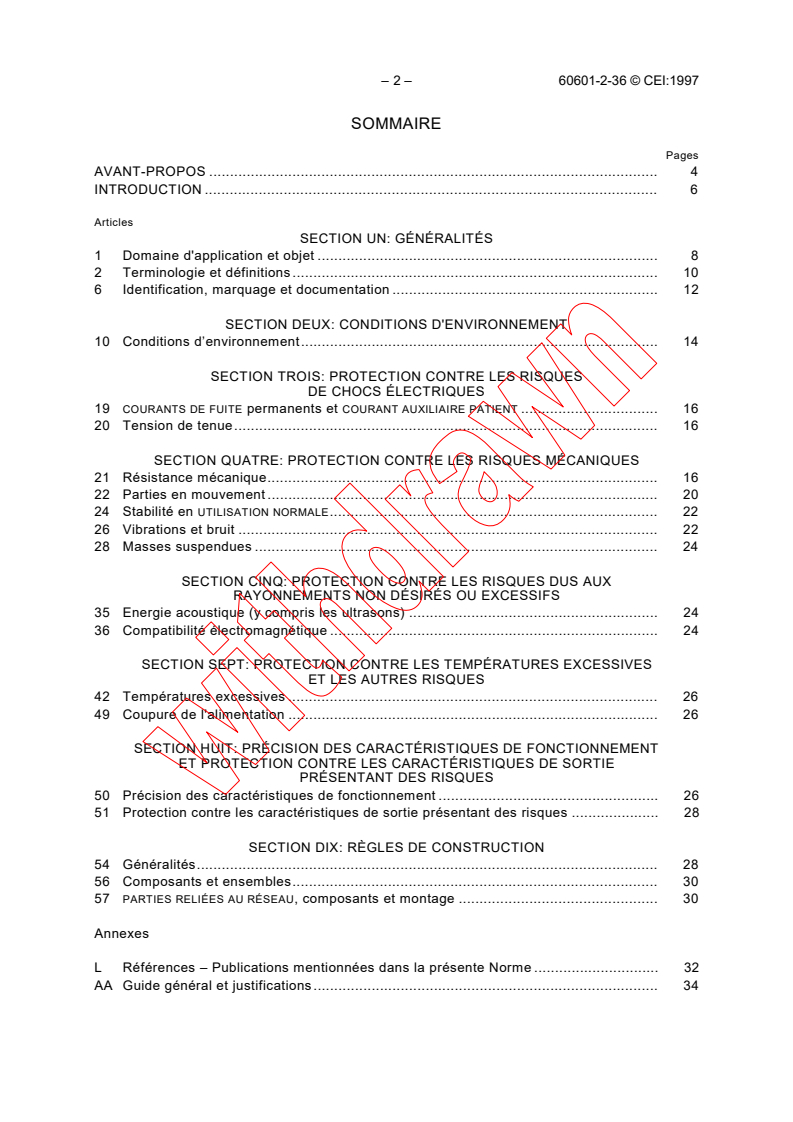
SOMMAIRE
Pages
AVANT-PROPOS . 4
INTRODUCTION . 6
Articles
SECTION UN: GÉNÉRALITÉS
1 Domaine d'application et objet . 8
2 Terminologie et définitions . 10
6 Identification, marquage et documentation . 12
SECTION DEUX: CONDITIONS D'ENVIRONNEMENT
10 Conditions d’environnement. 14
SECTION TROIS: PROTECTION CONTRE LES RISQUES
DE CHOCS ÉLECTRIQUES
19 COURANTS DE FUITE permanents et COURANT AUXILIAIRE PATIENT . 16
20 Tension de tenue. 16
SECTION QUATRE: PROTECTION CONTRE LES RISQUES MÉCANIQUES
21 Résistance mécanique. 16
22 Parties en mouvement . 20
24 Stabilité en UTILISATION NORMALE. 22
26 Vibrations et bruit . 22
28 Masses suspendues . 24
SECTION CINQ: PROTECTION CONTRE LES RISQUES DUS AUX
RAYONNEMENTS NON DÉSIRÉS OU EXCESSIFS
35 Energie acoustique (y compris les ultrasons) . 24
36 Compatibilité électromagnétique . 24
SECTION SEPT: PROTECTION CONTRE LES TEMPÉRATURES EXCESSIVES
ET LES AUTRES RISQUES
42 Températures excessives . 26
49 Coupure de l'alimentation . 26
SECTION HUIT: PRÉCISION DES CARACTÉRISTIQUES DE FONCTIONNEMENT
ET PROTECTION CONTRE LES CARACTÉRISTIQUES DE SORTIE
PRÉSENTANT DES RISQUES
50 Précision des caractéristiques de fonctionnement . 26
51 Protection contre les caractéristiques de sortie présentant des risques . 28
SECTION DIX: RÈGLES DE CONSTRUCTION
54 Généralités. 28
56 Composants et ensembles. 30
57 PARTIES RELIÉES AU RÉSEAU, composants et montage . 30
Annexes
L Références – Publications mentionnées dans la présente Norme . 32
AA Guide général et justifications. 34
60601-2-36 © IEC:1997 – 3 –
CONTENTS
Page
FOREWORD . 5
INTRODUCTION . 7
Clause
SECTION ONE: GENERAL
1 Scope and object. 9
2 Terminology and definitions . 11
6 Identification, marking and documents . 13
SECTION TWO: ENVIRONMENTAL CONDITIONS
10 Environmental conditions . 15
SECTION THREE: PROTECTION AGAINST ELECTRIC SHOCK HAZARDS
19 Continuous LEAKAGE CURRENTS and PATIENT AUXILIARY CURRENTS . 17
20 Dielectric strength. 17
SECTION FOUR: PROTECTION AGAINST MECHANICAL HAZARDS
21 Mechanical strength. 17
22 Moving parts. 21
24 Stability in NORMAL USE . 23
26 Vibration and noise. 23
28 Suspended masses. 25
SECTION FIVE: PROTECTION AGAINST HAZARDS FROM UNWANTED
OR EXCESSIVE RADIATION
35 Acoustical energy (including ultrasonics) . 25
36 Electromagnetic compatibility. 25
SECTION SEVEN: PROTECTION AGAINST EXCESSIVE TEMPERATURES
AND OTHER SAFETY HAZARDS
42 Excessive temperatures. 27
49 Interruption of the power supply . 27
SECTION EIGHT: ACCURACY OF OPERATING DATA AND PROTECTION
AGAINST HAZARDOUS OUTPUT
50 Accuracy of operating data . 27
51 Protection against hazardous output . 29
SECTION TEN: CONSTRUCTIONAL REQUIREMENTS
54 General. 29
56 Components and general assembly. 31
57 MAINS PARTS, components and layout . 31
Annexes
L References – Publications mentioned in this Standard . 33
AA General guidance and rationale . 35
– 4 – 60601-2-36 © CEI:1997
COMMISSION ÉLECTROTECHNIQUE INTERNATIONALE
_________
APPAREILS ÉLECTROMÉDICAUX –
Partie 2: Règles particulières de sécurité des appareils pour
lithotritie créée de façon extra-corporelle
AVANT-PROPOS
1) La CEI (Commission Electrotechnique Internationale) est une organisation mondiale de normalisation
composée de l'ensemble des comités électrotechniques nationaux (Comités nationaux de la CEI). La CEI a
pour objet de favoriser la coopération internationale pour toutes les questions de normalisation dans les
domaines de l'électricité et de l'électronique. A cet effet, la CEI, entre autres activités, publie des Normes
Internationales. Leur élaboration est confiée à des comités d'études, aux travaux desquels tout Comité
national intéressé par le sujet traité peut participer. Les organisations internationales, gouvernementales et
non gouvernementales, en liaison avec la CEI, participent également aux travaux. La CEI collabore
étroitement avec l'Organisation Internationale de Normalisation (ISO), selon des conditions fixées par accord
entre les deux organisations.
2) Les décisions ou accords officiels de la CEI concernant les questions techniques, représentent, dans la
mesure du possible un accord international sur les sujets étudiés, étant donné que les Comités nationaux
intéressés sont représentés dans chaque comité d’études.
3) Les documents produits se présentent sous la forme de recommandations internationales. Ils sont publiés
comme normes, rapports techniques ou guides et agréés comme tels par les Comités nationaux.
4) Dans le but d'encourager l'unification internationale, les Comités nationaux de la CEI s'engagent à appliquer
de façon transparente, dans toute la mesure possible, les Normes internationales de la CEI dans leurs normes
nationales et régionales. Toute divergence entre la norme de la CEI et la norme nationale ou régionale
correspondante doit être indiquée en termes clairs dans cette dernière.
5) La CEI n’a fixé aucune procédure concernant le marquage comme indication d’approbation et sa
responsabilité n’est pas engagée quand un matériel est déclaré conforme à l’une de ses normes.
6) L’attention est attirée sur le fait que certains des éléments de la présente Norme internationale peuvent faire
l’objet de droits de propriété intellectuelle ou de droits analogues. La CEI ne saurait être tenue pour
responsable de ne pas avoir identifié de tels droits de propriété et de ne pas avoir signalé leur existence.
La Norme internationale CEI 60601-2-36 a été établie par le sous-comité 62D: Appareils
électromédicaux, du comité d’études 62 de la CEI: Equipements électriques dans la pratique
médicale.
Le texte de cette norme est issu des documents suivants:
FDIS Rapport de vote
62D/211/FDIS 62D/231/RVD
Le rapport de vote indiqué dans le tableau ci-dessus donne toute information sur le vote ayant
abouti à l'approbation de cette Norme particulière.
L’annexe AA est donnée uniquement à titre d’information.
Dans la présente Norme Particulière, les caractères d’imprimerie suivants sont utilisés:
– prescriptions dont la conformité peut être établie et définitions: caractères romains;
– notes, explications, conseils, introductions, énoncés de portée générale, exceptions et références: petits
caractères romains;
– spécifications d’essai: caractères italiques;
– TERMES EMPLOYÉS DANS CETTE NORME PARTICULIÈRE QUI SONT DÉFINIS À L’ARTICLE 2 ET
DANS LA CEI 601-1: PETITES CAPITALES.
60601-2-36 © IEC:1997 – 5 –
INTERNATIONAL ELECTROTECHNICAL COMMISSION
___________
MEDICAL ELECTRICAL EQUIPMENT –
Part 2: Particular requirements for the safety of equipment
for extracorporeally induced lithotripsy
FOREWORD
1) The IEC (International Electrotechnical Commission) is a worldwide organization for standardization
comprising all national electrotechnical committees (IEC National Committees). The object of the IEC is to
promote international co-operation on all questions concerning standardization in the electrical and electronic
fields. To this end and in addition to other activities, the IEC publishes International Standards. Their
preparation is entrusted to technical committees; any IEC National Committee interested in the subject dealt
with may participate in this preparatory work. International, governmental and non-governmental organizations
liaising with the IEC also participate in this preparation. The IEC collaborates closely with the International
Organization for Standardization (ISO) in accordance with conditions determined by agreement between the
two organizations.
2) The formal decisions or agreements of the IEC on technical matters express, as nearly as possible, an
international consensus of opinion on the relevant subjects since each technical committee has representation
from all interested National Committees.
3) The documents produced have the form of recommendations for international use and are published in the
form of standards, technical reports or guides and they are accepted by the National Committees in that
sense.
4) In order to promote international unification, IEC National Committees undertake to apply IEC International
Standards transparently to the maximum extent possible in their national and regional standards. Any
divergence between the IEC Standard and the corresponding national or regional standard shall be clearly
indicated in the latter.
5) The IEC provides no marking procedure to indicate its approval and cannot be rendered responsible for any
equipment declared to be in conformity with one of its standards.
6) Attention is drawn to the possibility that some of the elements of this International Standard may be the
subject of patent rights. The IEC shall not be held responsible for identifying any or all such patent rights.
International Standard IEC 60601-2-36 has been prepared by subcommittee 62D:
Electromedical equipment, of IEC technical committee 62: Electrical equipment in medical
practice.
The text of this Particular Standard is based on the following documents:
FDIS Report on voting
62D/211/FDIS 62D/231/RVD
Full information on the voting for the approval of this Particular Standard can be found in the
report on voting indicated in the above table.
Annex AA is for information only.
In this Particular Standard the following print types are used:
– requirements, compliance with which can be tested, and definitions: in roman type;
– notes, explanations, advice, introductions, general statements, exceptions and references: in smaller type;
– test specifications: in italic type;
– TERMS USED THROUGHOUT THIS PARTICULAR STANDARD WHICH HAVE BEEN DEFINED IN
CLAUSE 2 AND IN IEC 601-1: SMALL CAPITALS.
– 6 – 60601-2-36 © CEI:1997
INTRODUCTION
La présente Norme particulière modifie et complète la CEI 601-1 (deuxième édition, 1988)
Appareils électromédicaux – Première partie: Règles générales de sécurité et ses amende-
ments 1 (1991) et 2 (1995), appelée Norme Générale dans la présente Norme Particulière (voir
1.3).
Les prescriptions sont suivies de spécifications relatives aux essais correspondants.
Conformément à la décision prise par le sous-comité 62D lors de sa réunion tenue à
Washington en 1979, une section «Guide général et justifications» contenant, le cas échéant,
des notes explicatives concernant les prescriptions les plus importantes figure à l’annexe AA.
Les articles et paragraphes comportant des notes explicatives dans l’annexe AA sont marqués
d’un astérisque (*).
On considère que la connaissance des raisons qui ont conduit à énoncer ces prescriptions non
seulement facilitera l’application correcte de la Norme, mais accélérera en son temps toute
révision rendue nécessaire par suite de changements dans la pratique clinique ou d’évolutions
technologiques. Les justifications contenues dans cette annexe ne font cependant pas partie
des prescriptions de la présente Norme.
60601-2-36 © IEC:1997 – 7 –
INTRODUCTION
This Particular Standard supplements IEC 601-1 (second edition, 1988) Medical electrical
equipment – Part 1: General requirements for safety, and its amendments 1 (1991) and
2 (1995), hereinafter referred to as the General Standard (see 1.3).
The requirements are followed by specifications for the relevant tests.
Following the decision taken by subcommittee 62D at the meeting in Washington in 1979, a
"General guidance and rationale" section giving some explanatory notes, where appropriate,
about the more important requirements is included in annex AA.
Clauses or subclauses for which there are explanatory notes in annex AA are marked with an
asterisk (*).
It is considered that a knowledge of the reasons for these requirements will not only facilitate
the proper application of the Standard but will, in due course, expedite any revision
necessitated by changes in clinical practice or as a result of developments in technology.
However, this annex does not form part of the requirements of this Standard.
– 8 – 60601-2-36 © CEI:1997
APPAREILS ÉLECTROMÉDICAUX –
Partie 2: Règles particulières de sécurité des appareils pour
lithotritie créée de façon extra-corporelle
SECTION UN: GÉNÉRALITÉS
Les articles et paragraphes de la section correspondante de la Norme Générale s'appliquent
avec les exceptions suivantes:
1 Domaine d'application et objet
L’article correspondant de la Norme Générale s’applique avec les exceptions suivantes:
1.1 Domaine d'application
Complément:
La présente Norme Particulière s'applique à la sécurité des APPAREILS POUR LITHOTRITIE CRÉÉE
DE FAÇON EXTRA-CORPORELLE telle qu'elle est définie en 2.1.101.
La possibilité d'appliquer la présente Norme Particulière est limitée aux éléments directement
en cause dans le traitement par LITHOTRITIE tels que, sans être exclusif, le générateur
D'IMPULSIONS DE PRESSION, le dispositif supportant le PATIENT, et leurs interactions avec les
dispositifs d'imagerie et de surveillance. D'autres dispositifs, tels que les calculateurs
organisant le traitement du PATIENT, les dispositifs à rayonnement X et à ultrasons, sont exclus
de la présente Norme car ils font l'objet d'autres normes de la CEI.
Quoique la présente Norme Particulière ait été conçue pour des APPAREILS
destinés à être
utilisés pour la LITHOTRITIE, on l'a conçue de manière que, tant que d'autres normes
spécifiques ne seront pas disponibles concernant d'autres applications médicales d'appareils
thérapeutiques à IMPULSIONS DE PRESSION extra-corporelles, la présente Norme pourra être
utilisée comme guide.
1.2 Objet
Complément:
La présente Norme Particulière précise les règles de sécurité des APPAREILS POUR LITHOTRITIE
CRÉÉE DE FAÇON EXTRA-CORPORELLE.
1.3 Normes Particulières
Complément:
La présente Norme Particulière se rapporte à la CEI 601-1 (1988): Appareils électromédicaux –
Première partie: Règles générales de sécurité, et à ses amendements 1 (1991) et 2 (1995).
Pour plus de concision, cette première partie est désignée dans la présente Norme Particulière
soit comme «Norme Générale», soit comme «Prescription(s) Générale(s)».
La numérotation des sections, articles et paragraphes de la présente Norme Particulière
correspond à celle de la Norme Générale. Les modifications apportées au texte de la Norme
Générale sont indiquées par l’emploi des mots suivants:
60601-2-36 © IEC:1997 – 9 –
MEDICAL ELECTRICAL EQUIPMENT –
Part 2: Particular requirements for the safety of equipment
for extracorporeally induced lithotripsy
SECTION ONE: GENERAL
The clauses and subclauses of this section of the General Standard apply except as follows:
1 Scope and object
This clause of the General Standard applies except as follows:
1.1 Scope
Addition:
This Particular Standard applies to the safety of EQUIPMENT FOR EXTRACORPOREALLY INDUCED
LITHOTRIPSY
as defined in 2.1.101.
The applicability of this Particular Standard is limited to components directly involved in the
LITHOTRIPSY treatment, such as, but not limited to, the generator of the PRESSURE PULSE,
PATIENT support device, and their interactions with imaging and monitoring devices. Other
devices, such as PATIENT treatment planning computers, X-ray and ultrasonic devices, are
excluded from this Standard, because they are treated in other applicable IEC standards.
While this Particular Standard has been developed for EQUIPMENT intended for use in
LITHOTRIPSY, it has been developed such that, as long as no other specific standards are
available to be used for other medical applications of therapeutic extracorporeal PRESSURE
PULSE equipment, this Standard may be used as a guideline.
1.2 Object
Addition:
This Particular Standard specifies requirements for the safety of EQUIPMENT for EXTRA-
CORPOREALLY INDUCED LITHOTRIPSY.
1.3 Particular Standards
Addition:
This Particular Standard refers to IEC 601-1 (1988): Medical electrical equipment – Part 1:
General requirements for safety, and its amendments 1 (1991) and 2 (1995).
For brevity, Part 1 is referred to in this Particular Standard either as the "General Standard" or
as the "General Requirement(s)".
The numbering of sections, clauses and subclauses of this Particular Standard corresponds to
that of the General Standard. The changes to the text of the General Standard are specified by
the use of the following words:
– 10 – 60601-2-36 © CEI:1997
«Remplacement» signifie que l’article ou le paragraphe correspondant de la Norme Générale
est complètement remplacé par le texte de la présente Norme Particulière.
«Complément» signifie que le texte de la présente Norme Particulière doit être ajouté aux
prescriptions de la Norme Générale.
«Modification» signifie que l’article ou le paragraphe de la Norme Générale est modifié comme
indiqué dans la présente Norme Particulière.
Les paragraphes ou figures complémentaires à ceux de la Norme Générale sont numérotés à
partir de 101, les annexes complémentaires sont identifiées AA, BB, etc., et les points
complémentaires sont identifiés aa), bb), etc.
L’expression «cette Norme» est utilisée pour se référer à la Norme Générale et à cette Norme
Particulière considérées ensemble.
Les prescriptions de cette Norme Particulière ont priorité sur celles de la Norme Générale.
Une section, un article ou un paragraphe de la Norme Générale, s’applique sans modification,
s’il n’existe pas de section, d’article ou de paragraphe correspondant dans la présente Norme
Particulière.
Là où il est prévu qu'une partie de la Norme Générale, bien qu'en principe applicable, ne
s'appliquera pas aux APPAREILS POUR LITHOTRITIE CRÉÉE DE FAÇON EXTRA-CORPORELLE, cela est
indiqué dans la présente Norme Particulière.
Si des appareils tels que les lasers ou des dispositifs brisants sont utilisés pour créer des
IMPULSIONS DE PRESSION créées de façon extra-corporelle, un complément de référence aux
Normes Particulières applicables est donné.
2 Terminologie et définitions
L’article correspondant de la Norme Générale s’applique avec les exceptions suivantes:
2.1 Parties d'APPAREILS, aides et ACCESSOIRES
Définition complémentaire:
APPAREIL POUR LITHOTRITIE CRÉÉE DE FAÇON EXTRA-CORPORELLE
2.1.101
APPAREIL
(désigné ci-dessous par )
Dispositif pour la lithotritie à IMPULSIONS DE PRESSION créées de façon extra-corporelle.
2.12 Divers
Définitions complémentaires:
2.12.101 LITHOTRITIE
Pulvérisation ou fragmentation des calculs.
2.12.102 LITHOTRITIE CRÉÉE DE FAÇON EXTRA-CORPORELLE
LITHOTRITIE interne par IMPULSIONS DE PRESSION créées hors du PATIENT.
60601-2-36 © IEC:1997 – 11 –
"Replacement" means that the clause or subclause of the General Standard is replaced
completely by the text of this Particular Standard.
"Addition" means that the text of this Particular Standard is additional to the requirements of
the General Standard.
"Amendment" means that the clause or subclause of the General Standard is amended as
indicated by the text of this Particular Standard.
Subclauses or figures which are additional to those of the General Standard are numbered
starting from 101, additional annexes are lettered AA, BB, etc., and additional items aa), bb),
etc.
The term "this Standard" is used to make reference to the General Standard and this Particular
Standard taken together.
The requirements of this Particular Standard take priority over those of the General Standard.
Where there is no corresponding section, clause or subclause in this Particular Standard, the
section, clause or subclause of the General Standard applies without modification.
Where it is intended that part of the General Standard, although possibly applicable, should not
apply to EQUIPMENT FOR EXTRACORPOREALLY INDUCED LITHOTRIPSY, this is indicated in this
Particular Standard.
If equipment such as lasers or explosive agents are used for the generation of extracorporeally
induced PRESSURE PULSES, additional reference is made to the applicable Particular Standards.
2 Terminology and definitions
This clause of the General Standard applies except as follows:
2.1 EQUIPMENT parts, auxiliaries and ACCESSORIES
Additional definition:
2.1.101 EQUIPMENT FOR EXTRACORPOREALLY INDUCED LITHOTRIPSY
(hereinafter referred to as EQUIPMENT)
Device for treatment with extracorporeally generated PRESSURE PULSES.
2.12 Miscellaneous
Additional definitions:
2.12.101 LITHOTRIPSY
Comminution or fragmentation of calculi.
2.12.102 EXTRACORPOREALLY INDUCED LITHOTRIPSY
LITHOTRIPSY inside the PATIENT by PRESSURE PULSES generated outside the PATIENT.
– 12 – 60601-2-36 © CEI:1997
2.12.103 IMPULSION DE PRESSION
Onde acoustique émise par un APPAREIL de LITHOTRITIE.
2.12.104 APPLICATION DES IMPULSIONS DE PRESSION
Ensemble des procédés permettant le transfert des IMPULSIONS DE PRESSION de l’ÉQUIPEMENT
dans le PATIENT.
2.12.105 VOLUME DE FOCALISATION
Volume ayant pour base la surface définie par l’isobare –6 dB de la compression maximale du
pic de pression acoustique.
* 2.12.106 DISPOSITIF DE LOCALISATION
Appareil utilisé pour déterminer la position des calculs dans un espace (à trois dimensions).
2.12.107 EMPLACEMENT DE CIBLE
Emplacement dans l'espace que le CONSTRUCTEUR détermine pour que l’OPÉRATEUR situe les
calculs.
2.12.108 DISPOSITIF DE POSITIONNEMENT
Appareil qui assure la coïncidence entre les calculs et l'EMPLACEMENT DE CIBLE.
2.12.109 MARQUEUR DE CIBLE
Marqueur utilisé pour indiquer l'EMPLACEMENT DE CIBLE.
6 Identification, marquage et documentation
L’article correspondant de la Norme Générale s'applique avec les exceptions suivantes:
6.3 Marquage des organes de commande et des instruments
Paragraphe complémentaire:
6.3.101 Commande à distance sans fil
Si l'APPAREIL comporte un dispositif de commande à distance sans fil, ce dispositif doit porter
un marquage indiquant clairement son rôle et sa fonction.
6.8 DOCUMENTS D'ACCOMPAGNEMENT
6.8.2 Instructions d'utilisation
* 6.8.2 a) Informations générales
Complément:
• Les intervalles de temps entre les opérations de maintenance n'ont pas besoin d'être
spécifiés dans les instructions d'utilisation si l'APPAREIL comporte des moyens d'affichage
(par exemple un compteur de décharges) et si le rôle de ces moyens d'affichage est
expliqué dans les instructions d'utilisation.
60601-2-36 © IEC:1997 – 13 –
2.12.103 PRESSURE PULSE
Acoustic wave emitted by the LITHOTRIPSY EQUIPMENT.
2.12.104 PRESSURE PULSE COUPLING
Any means allowing transition of the PRESSURE PULSE from the EQUIPMENT into the PATIENT.
2.12.105 FOCAL VOLUME
Volume in space contained within the surface defined by the –6 dB isobar of the maximum
peak compressional acoustic pressure.
* 2.12.106 LOCALIZATION DEVICE
Device used to determine the position of the calculi in (three-dimensional) space.
2.12.107 TARGET LOCATION
Location in space where the MANUFACTURER intends the OPERATOR to locate the calculi.
2.12.108 POSITIONING DEVICE
Device which brings the calculi into coincidence with the TARGET LOCATION.
2.12.109 TARGET MARKER
Marker which is used to indicate the TARGET LOCATION.
6 Identification, marking and documents
This clause of the General Standard applies except as follows:
6.3 Marking of controls and instruments
Additional subclause:
6.3.101 Wireless remote control
If the EQUIPMENT is provided with a wireless remote control device, such device shall be clearly
marked as to its purpose and function.
6.8 ACCOMPANYING DOCUMENTS
6.8.2
Instructions for use
*6.8.2 a) General information
Addition:
• Time intervals for maintenance purposes need not be specified in the instructions for use
if indication means (e.g. discharge counter) are provided on the EQUIPMENT and the purpose
of these indication means is explained in the instructions for use.
– 14 – 60601-2-36 © CEI:1997
• En particulier, on doit donner, le cas échéant, des indications sur les points suivants:
1) Description des mesures de sécurité adéquates à prendre pour éviter des RISQUES
POUR LA SÉCURITÉ, par exemple danger provenant de la transmission d'IMPULSIONS DE
PRESSION aux organes contenant du gaz.
2) Attention au fait que les IMPULSIONS DE PRESSION peuvent provoquer une activité
cardiaque non désirée.
3) Quand on utilise un appareil de surveillance d'électrocardiographie pour déclencher
l'IMPULSION DE PRESSION, seuls les appareils de surveillance spécifiés par le
CONSTRUCTEUR de l’APPAREIL doivent être employés.
4) Attention au fait que l'OPÉRATEUR doit contrôler la position des calculs aussi souvent
que nécessaire pour s'assurer que le traitement convient.
* 5) Description du plan d'exécution et des mesures à prendre dans le domaine d'un
contrôle périodique des performances.
6) Description concernant l’utilisation correcte de l'APPLICATION DES IMPULSIONS DE
PRESSION, y compris un rappel que cela doit se faire sans bulles.
7) Rappeler que l'IMPULSION DE PRESSION
est atténuée lors du passage à travers les
tissus et que les os absorbent une énergie supplémentaire.
8) Rappeler que, même si on installe des dispositifs anti-collision, l'OPÉRATEUR doit
toujours surveiller tous les mouvements susceptibles de mettre en danger le PATIENT ou
l'OPÉRATEUR.
* 6.8.3 Description technique
Complément:
La description technique minimale de l'APPAREIL devrait traiter, par exemple, des points
suivants:
a) précision de la position du MARQUEUR DE CIBLE par rapport à l'EMPLACEMENT DE CIBLE,
b) position et dimension du VOLUME DE FOCALISATION par rapport à l'EMPLACEMENT DE CIBLE,
c) compression acoustique de crête et dépression maximale,
d) énergie par impulsion.
SECTION DEUX: CONDITIONS D'ENVIRONNEMENT
Les articles et paragraphes de la section correspondante de la Norme Générale s'appliquent
avec l’exception suivante:
10 Conditions d’environnement
L’article correspondant de la Norme Générale s’applique avec l’exception suivante:
10.2.1 Environnement
Remplacement:
* a) Une plage de températures ambiantes de +10 °C à +30 °C.
60601-2-36 © IEC:1997 – 15 –
• In particular, advice, when appropriate, shall be given on the following:
1) Description of the relevant safety precautions to be used to avoid SAFETY HAZARDS,
e.g. the danger resulting from delivering PRESSURE PULSES to organs which contain gas.
2) Caution that PRESSURE PULSES may cause unwanted cardiac activity.
3) When using ECG monitoring equipment to trigger the generation of the PRESSURE
PULSE, only those ECG monitors specified by the MANUFACTURER of the EQUIPMENT shall
be used.
4) Caution that the OPERATOR shall check the position of the calculi as often as
necessary to ensure proper treatment.
* 5) Description of the schedule and measures to be performed within the scope of a
regular performance check.
6) Description concerning the correct use of the PRESSURE PULSE COUPLING including a
reminder that it shall be free of bubbles.
7) Reminder that the PRESSURE PULSE is attenuated during passage through tissue, and
that additional energy is absorbed by bone.
8) Reminder that, even if anti-collision devices are installed, the OPERATOR shall always
watch for any movements that may cause danger to the PATIENT or OPERATOR.
* 6.8.3 Technical description
Addition:
The minimum technical description of the EQUIPMENT should contain, for example:
a) positional precision of the TARGET MARKER with respect to the TARGET LOCATION;
b) position and size of the FOCAL VOLUME with respect to the TARGET LOCATION;
c) peak compressional and rarefactional acoustic pressures;
d) energy per pulse.
SECTION TWO: ENVIRONMENTAL CONDITIONS
The clauses and subclauses of this section of the General Standard apply except as follows:
10 Environmental conditions
This clause of the General Standard applies except as follows:
10.2.1 Environment
Replacement:
* a) An ambient temperature range of +10 °C to +30 °C.
– 16 – 60601-2-36 © CEI:1997
SECTION TROIS: PROTECTION CONTRE LES RISQUES DE CHOCS ÉLECTRIQUES
Les articles et paragraphes de la section correspondante de la Norme Générale s'appliquent
avec les exceptions suivantes:
19 COURANTS DE FUITE permanents et COURANT AUXILIAIRE PATIENT
L’article correspondant de la Norme Générale s’applique avec les exceptions suivantes:
19.1 Prescriptions générales
* 19.1 b) Complément au troisième tiret:
Le COURANT DE FUITE PATIENT ne doit pas être mesuré pendant le déclenchement de l'IMPULSION
DE PRESSION.
19.3 Valeurs admissibles
Complément à la note 3) du tableau IV:
APPAREIL POUR LITHOTRITIE CRÉÉE DE FAÇON EXTRA-CORPORELLE
• Un APPAREIL dont l'alimentation est assurée par un connecteur et qui est protégé de
façon mécanique contre une déconnexion accidentelle sera considéré comme un APPAREIL
connecté en permanence.
20 Tension de tenue
L’article correspondant de la Norme Générale s’applique avec l’exception suivante:
20.3 Valeurs des tensions d’essai
Complément au tableau V:
Les tensions supérieures à 10 000 V doivent être essayées avec un facteur de 1,2.
SECTION QUATRE: PROTECTION CONTRE LES RISQUES MÉCANIQUES
Les articles et paragraphes de la section correspondante de la Norme Générale s'appliquent
avec les exceptions suivantes:
21 Résistance mécanique
L’article correspondant de la Norme Générale s’applique avec les exceptions suivantes:
21.3 Complément:
Des extensions de la table ou du support du PATIENT telles que des supports ajustables pour
les pieds doivent être à auto-verrouillage pour tous les angles d'inclinaison de la table ou du
support du PATIENT, comme précisé par le CONSTRUCTEUR.
La conformité à cette prescription est vérifiée par examen.
60601-2-36 © IEC:1997 – 17 –
SECTION THREE: PROTECTION AGAINST ELECTRIC SHOCK HAZARDS
The clauses and subclauses of this section of the General Standard apply except as follows:
19 Continuous LEAKAGE CURRENTS and PATIENT AUXILIARY CURRENTS
This clause of the General Standard applies except as follows:
19.1 General requirements
* 19.1 b) Addition to the third dash:
The PATIENT LEAKAGE CURRENT shall not be measured during the PRESSURE PULSE release.
19.3 Allowable values
Addition to note 3) of table IV:
EQUIPMENT FOR EXTRACORPOREALLY INDUCED LITHOTRIPSY
• EQUIPMENT whose power supply is ensured via an industrial plug-in device and which is
mechanically protected against unintentional disconnection should be regarded as
permanently connected EQUIPMENT.
20 Dielectric strength
This clause of the General Standard applies except as follows:
20.3 Values of test voltages
Addition to table V:
Voltages higher than 10 000 V shall be tested with a factor of 1,2.
SECTION FOUR: PROTECTION AGAINST MECHANICAL HAZARDS
The clauses and subclauses of this section of the General Standard apply except as follows:
21 Mechanical strength
This clause of the General Standard applies except as follows:
21.3 Addition:
Table or PATIENT support extensions such as adjustable footboards shall be self-locking at all
table or PATIENT support tilt angles, as specified by the MANUFACTURER.
Compliance with this requirement is checked by inspection.
– 18 – 60601-2-36 © CEI:1997
Paragraphe complémentaire:
* 21.3.101 Facteur de sécurité
Le facteur de sécurité donne le rapport d'un effort limité à l'effort maximal se produisant en
fonctionnement. Le facteur de sécurité doit toujours être supérieur ou égal aux valeurs
spécifiées dans les tableaux 1 à 3.
Lors du calcul de la résistance des composants chargés dynamiquement, tous les facteurs
d'affaiblissement tels que la présence d'encoches, la qualité des surfaces etc., doivent être
pris en compte.
Le facteur de sécurité sera choisi en fonction des conséquences possibles d'une défaillance
d'un composant conformément à 21.3.101.1.
* 21.3.101.1 Détermination du facteur de sécurité
Le facteur de sécurité sera choisi en fonction des aspects suivants.
Construction de classe A: La défaillance d'un composant entraîne un danger pour la vie et la
santé des personnes.
Construction de classe B: La défaillance d'un composant provoque un arrêt de fonction-
nement du système. Il n'y a pas de danger pour les personnes.
Construction de classe C: La défaillance d'un composant provoque un mauvais fonction-
nement relativement peu important auquel on peut remédier
rapidement et facilement. Il n'y a pas d'arrêt de fonctionnement du
système. Il n'y a pas de danger pour les personnes.
De plus, les classes de construction A, B et C sont subdivisées comme suit, dans le cas
d'efforts statiques:
a) Effort vérifiable
NOTE – Les valeurs des forces externes ou des efforts attendus sont connues.
b) Effort non vérifiable avec précision
NOTE – Les valeurs des forces externes ou des efforts attendus peuvent être estimées.
Tableau 1 – Effort statique
Facteurs de sécurité pour les classes de construction
Hypothèse de chargement Sécurité contre C B A
a babab
Au repos Déformation 1,1 1,3 1,4 1,6 1,7 2,2
(Rp 0,2 ou Rp)
Rupture par surcharge 1,7 2,0 2,0 2,3 2,5 3,5
(Rm)
Le tableau 1 ne s'applique qu'à des matériaux métalliques.
60601-2-36 © IEC:1997 – 19 –
Additional subclause:
* 21.3.101 Safety factor
The safety factor indicates the ratio of a limit stress to the maximum stress occurring in
operation. The safety factor shall always be equal to or greater than the values specified in
tables 1 to 3.
When calculating the strength of dynamically loaded components, all impairing influences, such
as notch effects, surface quality etc., have to be allowed for.
The safety factor should be selected according to the possible consequences of a component
failure according to 21.3.101.1.
*21.3.101.1 Determination of the safety factor
The safety factor should be selected according to the following aspects:
Construction class A: Failure of a component entails danger to the lives and health of
persons.
Construction class B: Failure of a component results in functional breakdown of the system.
There is no danger to persons.
Construction class C: Failure of a component results in a relatively slight malfunction which
can be eliminated quickly and easily. There is no functional breakdown
of the system. There is no danger to persons.
Moreover, the construction classes A, B and C are subdivided as follows, in the case of static
stress:
a) Ascertainable stress
NOTE – The values of the external forces or the stress to be expected are known.
b) Not accurately ascertainable stress
NOTE – The values of the external forces or the stress to be expected can be estimated.
Table 1 – Static stress
Safety factors for construction classes
Loading case Safety against C B A
ab aba b
At rest Form change 1,1 1,3 1,4 1,6 1,7 2,2
(Rp 0,2 or Rp)
Overload breakage 1,7 2,0 2,0 2,3 2,5 3,5
(Rm)
Table 1 applies only f
...