


IEC 60601-1-1:2000
(Main)Medical electrical equipment - Part 1-1: General requirements for safety - Collateral standard: Safety requirements for medical electrical systems
General Information
- Abstract
Applies to the safety of medical electrical systems, as defined as follows: combination of items of equipment, at least one of which must be medical electrical equipment and inter-connected by functional connection or use of a multiple portable socket-outlet. Describes the safety requirements necessary to provide protection for the patient, the operator and surroundings. Cancels and replaces the first edition published in 1992 and its amendment 1 (1995) and constitutes a technical revision.
- Status
- Withdrawn
- Publication Date
- 13-Dec-2000
- Withdrawal Date
- 02-May-2013
- Technical Committee
- SC 62A - Common aspects of medical equipment, software, and systems
- Current Stage
- WPUB - Publication withdrawn
- Start Date
- 03-May-2013
- Completion Date
- 28-Aug-2026
Buy Documents
IEC 60601-1-1:2000 - Medical electrical equipment - Part 1-1: General requirements for safety - Collateral standard: Safety requirements for medical electrical systems Released:12/14/2000
IEC 60601-1-1:2000 - Appareils électromédicaux - Partie 1-1: Regles générales de sécurité - Norme collatérale: Regles de sécurité pour systemes électromédicaux Released:12/14/2000
IEC 60601-1-1:2000 - Medical electrical equipment - Part 1-1: General requirements for safety - Collateral standard: Safety requirements for medical electrical systems Released:12/14/2000
Relations
- Effective Date
- 25-Aug-2026
- Effective Date
- 25-Aug-2026
- Effective Date
- 25-Aug-2026
- Effective Date
- 25-Aug-2026
- Effective Date
- 25-Aug-2026
- Effective Date
- 25-Aug-2026
- Effective Date
- 25-Aug-2026
Buy Documents
IEC 60601-1-1:2000 - Medical electrical equipment - Part 1-1: General requirements for safety - Collateral standard: Safety requirements for medical electrical systems Released:12/14/2000
IEC 60601-1-1:2000 - Appareils électromédicaux - Partie 1-1: Regles générales de sécurité - Norme collatérale: Regles de sécurité pour systemes électromédicaux Released:12/14/2000
IEC 60601-1-1:2000 - Medical electrical equipment - Part 1-1: General requirements for safety - Collateral standard: Safety requirements for medical electrical systems Released:12/14/2000
Get Certified
Connect with accredited certification bodies for this standard

BSI Group
BSI (British Standards Institution) is the business standards company that helps organizations make excellence a habit.

TÜV Rheinland
TÜV Rheinland is a leading international provider of technical services.

TÜV SÜD
TÜV SÜD is a trusted partner of choice for safety, security and sustainability solutions.
Sponsored listings
Frequently Asked Questions
IEC 60601-1-1:2000 is a standard published by the International Electrotechnical Commission (IEC). Its full title is "Medical electrical equipment - Part 1-1: General requirements for safety - Collateral standard: Safety requirements for medical electrical systems". This standard covers: Applies to the safety of medical electrical systems, as defined as follows: combination of items of equipment, at least one of which must be medical electrical equipment and inter-connected by functional connection or use of a multiple portable socket-outlet. Describes the safety requirements necessary to provide protection for the patient, the operator and surroundings. Cancels and replaces the first edition published in 1992 and its amendment 1 (1995) and constitutes a technical revision.
Applies to the safety of medical electrical systems, as defined as follows: combination of items of equipment, at least one of which must be medical electrical equipment and inter-connected by functional connection or use of a multiple portable socket-outlet. Describes the safety requirements necessary to provide protection for the patient, the operator and surroundings. Cancels and replaces the first edition published in 1992 and its amendment 1 (1995) and constitutes a technical revision.
IEC 60601-1-1:2000 is classified under the following ICS (International Classification for Standards) categories: 11.040.01 - Medical equipment in general. The ICS classification helps identify the subject area and facilitates finding related standards.
IEC 60601-1-1:2000 has the following relationships with other standards: It is inter standard links to EN ISO 80601-2-61:2011, EN ISO 17510-2:2009, EN ISO 15254:2009, EN ISO 21649:2009, EN ISO 17510-1:2009, EN ISO 16201:2006, EN ISO 11608-4:2007. Understanding these relationships helps ensure you are using the most current and applicable version of the standard.
IEC 60601-1-1:2000 is available in PDF format for immediate download after purchase. The document can be added to your cart and obtained through the secure checkout process. Digital delivery ensures instant access to the complete standard document.
Standards Content (Sample)
INTERNATIONAL IEC
STANDARD
60601-1-1
Second edition
2000-12
Medical electrical equipment –
Part 1-1:
General requirements for safety –
Collateral standard: Safety requirements
for medical electrical systems
This English-language version is derived from the original
bilingual publication by leaving out all French-language
pages. Missing page numbers correspond to the French-
language pages.
Reference number
Publication numbering
As from 1 January 1997 all IEC publications are issued with a designation in the
60000 series. For example, IEC 34-1 is now referred to as IEC 60034-1.
Consolidated editions
The IEC is now publishing consolidated versions of its publications. For example,
edition numbers 1.0, 1.1 and 1.2 refer, respectively, to the base publication, the base
publication incorporating amendment 1 and the base publication incorporating
amendments 1 and 2.
Further information on IEC publications
The technical content of IEC publications is kept under constant review by the IEC,
thus ensuring that the content reflects current technology. Information relating to this
publication, including its validity, is available in the IEC Catalogue of publications
(see below) in addition to new editions, amendments and corrigenda. Information on
the subjects under consideration and work in progress undertaken by the technical
committee which has prepared this publication, as well as the list of publications
issued, is also available from the following:
• IEC Web Site (www.iec.ch)
• Catalogue of IEC publications
The on-line catalogue on the IEC web site (www.iec.ch/searchpub) enables you to
search by a variety of criteria including text searches, technical committees and
date of publication. On-line information is also available on recently issued
publications, withdrawn and replaced publications, as well as corrigenda.
• IEC Just Published
This summary of recently issued publications (www.iec.ch/online_news/ justpub) is
also available by email. Please contact the Customer Service Centre (see below)
for further information.
• Customer Service Centre
If you have any questions regarding this publication or need further assistance,
please contact the Customer Service Centre:
Email: custserv@iec.ch
Tel: +41 22 919 02 11
Fax: +41 22 919 03 00
INTERNATIONAL IEC
STANDARD
60601-1-1
Second edition
2000-12
Medical electrical equipment –
Part 1-1:
General requirements for safety –
Collateral standard: Safety requirements
for medical electrical systems
IEC 2000 Copyright - all rights reserved
No part of this publication may be reproduced or utilized in any form or by any means, electronic or mechanical,
including photocopying and microfilm, without permission in writing from the publisher.
International Electrotechnical Commission, 3, rue de Varembé, PO Box 131, CH-1211 Geneva 20, Switzerland
Telephone: +41 22 919 02 11 Telefax: +41 22 919 03 00 E-mail: inmail@iec.ch Web: www.iec.ch
PRICE CODE
U
Commission Electrotechnique Internationale
International Electrotechnical Commission
Международная Электротехническая Комиссия
For price, see current catalogue
60601-1-1 © IEC:2000 – 3 –
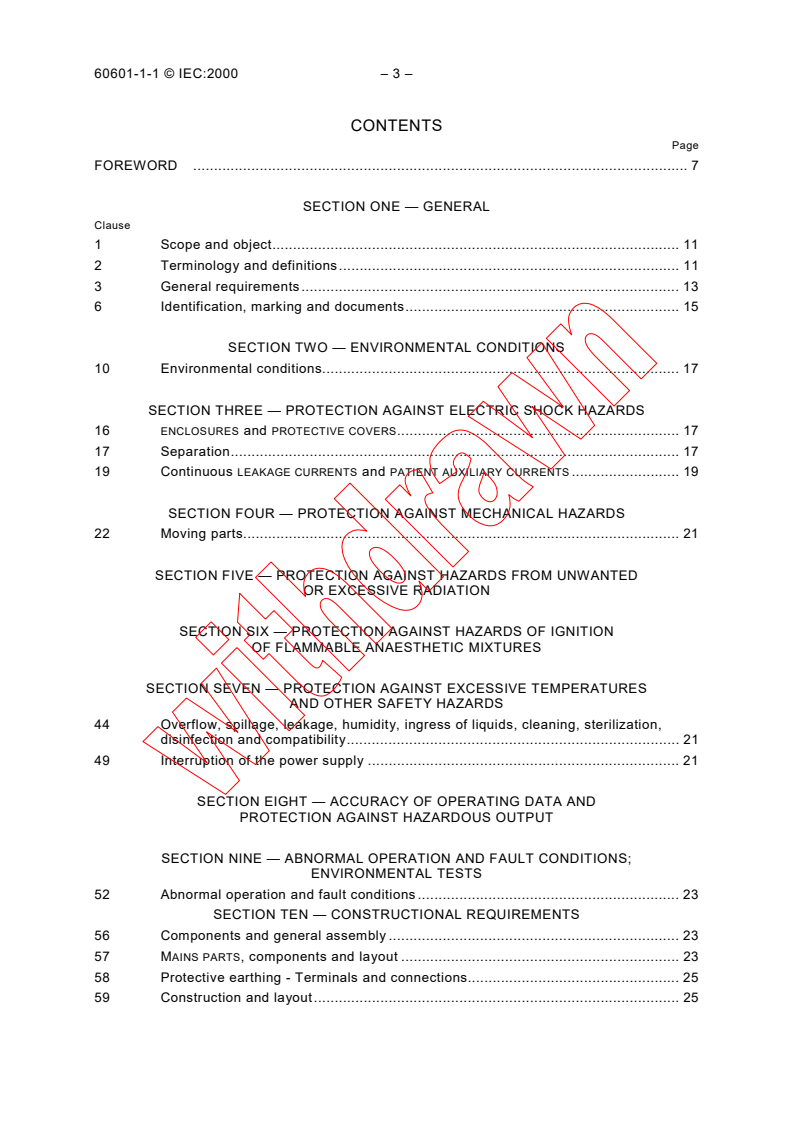
CONTENTS
Page
FOREWORD . 7
SECTION ONE — GENERAL
Clause
1 Scope and object. 11
2 Terminology and definitions. 11
3 General requirements. 13
6 Identification, marking and documents. 15
SECTION TWO — ENVIRONMENTAL CONDITIONS
10 Environmental conditions. 17
SECTION THREE — PROTECTION AGAINST ELECTRIC SHOCK HAZARDS
16 ENCLOSURES and PROTECTIVE COVERS. 17
17 Separation. 17
19 Continuous LEAKAGE CURRENTS and PATIENT AUXILIARY CURRENTS . 19
SECTION FOUR — PROTECTION AGAINST MECHANICAL HAZARDS
22 Moving parts. 21
SECTION FIVE — PROTECTION AGAINST HAZARDS FROM UNWANTED
OR EXCESSIVE RADIATION
SECTION SIX — PROTECTION AGAINST HAZARDS OF IGNITION
OF FLAMMABLE ANAESTHETIC MIXTURES
SECTION SEVEN — PROTECTION AGAINST EXCESSIVE TEMPERATURES
AND OTHER SAFETY HAZARDS
44 Overflow, spillage, leakage, humidity, ingress of liquids, cleaning, sterilization,
disinfection and compatibility. 21
49 Interruption of the power supply . 21
SECTION EIGHT — ACCURACY OF OPERATING DATA AND
PROTECTION AGAINST HAZARDOUS OUTPUT
SECTION NINE — ABNORMAL OPERATION AND FAULT CONDITIONS;
ENVIRONMENTAL TESTS
52 Abnormal operation and fault conditions . 23
SECTION TEN — CONSTRUCTIONAL REQUIREMENTS
56 Components and general assembly . 23
57 MAINS PARTS
, components and layout . 23
58 Protective earthing - Terminals and connections. 25
59 Construction and layout. 25
60601-1-1 © IEC:2000 – 5 –
Pages
Figure 201 Example of PATIENT ENVIRONMENT . 27
Annex AAA (informative) General guidance and rationale. 29
Annex BBB (informative) Examples of combinations of MEDICAL ELECTRICAL EQUIPMENT and
non-medical electrical equipment . 41
Annex CCC (normative) Normative references . 47
Annex DDD (informative) Bibliography. 49
Annex EEE (normative) Requirements for MULTIPLE PORTABLE SOCKET-OUTLETS . 51
Annex FFF (informative) Examples of application of MULTIPLE PORTABLE SOCKET-OUTLETS. 55
60601-1-1 © IEC:2000 – 7 –
INTERNATIONAL ELECTROTECHNICAL COMMISSION
___________
MEDICAL ELECTRICAL EQUIPMENT –
Part 1-1: General requirements for safety –
Collateral standard:
Safety requirements for medical electrical systems
FOREWORD
1) The IEC (International Electrotechnical Commission) is a world-wide organisation for standardisation
comprising all national electrotechnical committees (IEC National Committees). The object of the IEC is to
promote international co-operation on all questions concerning standardisation in the electrical and electronic
fields. To this end and in addition to other activities, the IEC publishes International Standards. Their
preparation is entrusted to technical committees; any IEC National Committee interested in the subject dealt
with may participate in this preparatory work. International, governmental and non-governmental organisations
liaising with the IEC also participate in this preparation. The IEC collaborates closely with the International
Organisation for Standardisation (ISO) in accordance with conditions determined by agreement between the
two organisations.
2) The formal decisions or agreements of the IEC on technical matters, prepared by technical committees on
which all the National Committees having a special interest therein are represented, express, as nearly as
possible, an international consensus of opinion on the subjects dealt with.
3) They have the form of recommendations for international use published in the form of standards, technical
specifications, technical reports or guides and they are accepted by the National Committees in that sense.
4) In order to promote international unification, IEC National Committees undertake to apply IEC International
Standards transparently to the maximum extent possible in their national and regional standards. Any
divergence between the IEC Standard and the corresponding national or regional standard shall be clearly
indicated in the latter.
5) The IEC provides no marking procedure to indicate its approval and cannot be rendered responsible for any
equipment declared to be in conformity with one of its standards.
6) Attention is drawn to the possibility that some of the elements of this International Standard may be the subject
of patent rights. The IEC shall not be held responsible for identifying any or all such patent rights.
International Standard IEC 60601-1-1 has been prepared by subcommittee 62A: Common
aspects of electrical equipment used in medical practice, of IEC technical committee 62:
Electrical equipment in medical practice.
This second edition of 60601-1-1 cancels and replaces the first edition published in 1992 and
its amendment 1(1995) and constitutes a technical revision.
This second edition is a Collateral Standard to IEC 60601-1: Medical electrical equipment –
Part 1: General requirements for safety, hereinafter referred to as the General Standard, and
is the first of a series of Collateral Standards amplifying the General Standard.
The text of this Collateral Standard is based on the following documents:
FDIS Report on voting
62A/312/FDIS 62A/318/RVD
Full information on the voting for the approval of this Collateral Standard can be found in the
report on voting indicated in the above table.
60601-1-1 © IEC:2000 – 9 –
In the 60601 series of publications, Collateral Standards specify general requirements for
safety applicable to
– a group of MEDICAL ELECTRICAL EQUIPMENT (for example, radiological equipment);
– a specific characteristic of all MEDICAL ELECTRICAL EQUIPMENT, not fully addressed in the
General Standard (for example, electromagnetic compatibility).
The numbering of sections, clauses and subclauses of this Collateral Standard corresponds
with that of the General Standard.
Subclauses and figures which are additional to those of the General Standard are numbered
starting from 201; additional annexes are lettered AAA, BBB, etc.
In this Collateral Standard, the following print types are used:
– requirements, compliance with which can be tested and definitions: in roman type;
– explanations, advice, general statements, exceptions and references: in smaller roman type;
– test specifications: in italic type;
– TERMS DEFINED IN CLAUSE 2 OF THE GENERAL STANDARD OR OF THIS COLLATERAL STANDARD:
SMALL CAPITALs.
The requirements are followed by specifications for the relevant tests.
Some provisions or statements in the body of this Collateral Standard require additional
information. Such information is presented in the informative annex AAA, General guidance
and rationale. An asterisk (*) at the left margin of a clause or subclause indicates the
presence of additional information.
Annexes AAA, BBB, DDD and FFF are for information only.
Annexes CCC and EEE form an integral part of this Collateral Standard.
The committee has decided that the contents of this publication will remain unchanged until
2005. At this date, the publication will be
– reconfirmed;
– withdrawn;
– replaced by a revised edition, or
– amended.
60601-1-1 © IEC:2000 – 11 –
MEDICAL ELECTRICAL EQUIPMENT –
Part 1-1: General requirements for safety –
Collateral Standard:
Safety requirements for medical electrical systems
SECTION ONE — GENERAL
1 Scope and object
*1.201 Scope
This standard applies to the safety of MEDICAL ELECTRICAL SYSTEMS, as defined in 2.201. It
PATIENT
describes the safety requirements necessary to provide protection for the , the
OPERATOR and surroundings.
2 Terminology and definitions
In this Collateral Standard, terms printed in small capitals are used in accordance with their
definitions in IEC 60601-1.
Where the terms "voltage" and "current" are used, they mean the r.m.s. values of an
alternating, direct or composite voltage or current.
For the purpose of this standard the following additional definitions apply:
2.201
MEDICAL ELECTRICAL SYSTEM (hereinafter referred to as SYSTEM)
combination of items of equipment, at least one of which must be MEDICAL ELECTRICAL
EQUIPMENT and inter-connected by FUNCTIONAL CONNECTION or use of a MULTIPLE PORTABLE
SOCKET-OUTLET
NOTE Equipment, when mentioned in connection with a SYSTEM, should be taken to include EQUIPMENT. (See also
examples given in annexes BBB and FFF.)
*2.202
PATIENT ENVIRONMENT
any volume in which intentional or unintentional contact can occur between PATIENT and parts
of the SYSTEM or between PATIENT and other persons touching parts of the SYSTEM (see
figure 201)
*2.203
SEPARATION DEVICE
a component or arrangement of components with input parts and output parts that, for safety
reasons, prevent a transfer of unwanted voltage or current between parts of a SYSTEM
*2.204
MULTIPLE PORTABLE SOCKET-OUTLET
a combination of two or more socket-outlets intended to be connected to, or integral with,
flexible cables or cords, and which can easily be moved from one place to another while
connected to the supply
MULTIPLE PORTABLE SOCKET OUTLET
NOTE A - may be a separate item or an integral part of medical or non-medical
equipment
60601-1-1 © IEC:2000 – 13 –
*2.205
FUNCTIONAL CONNECTION
connection, electrical or otherwise, including those intended to transfer signals and/or power
and/or substances
3 General requirements
*3.201 General requirements for the SYSTEM
After installation or subsequent modification, a SYSTEM shall not cause a SAFETY HAZARD.
A SYSTEM shall provide:
– within the PATIENT ENVIRONMENT, a level of safety comparable to that provided by MEDICAL
ELECTRICAL EQUIPMENT complying with IEC 60601-1, and
– outside the PATIENT ENVIRONMENT, the level of safety appropriate for non-medical electrical
equipment complying with other IEC or ISO safety standards.
Compliance is considered to exist if the requirements of 3.201.1, 3.201.2, 3.201.3 and 3.201.4
are met. A SYSTEM incorporating equipment or parts, which use materials or have forms of
construction different from those detailed in relevant standards as mentioned in 3.201.1 and
3.201.2, shall be accepted if it can be demonstrated that an equivalent degree of safety is
obtained.
3.201.1 MEDICAL ELECTRICAL EQUIPMENT
MEDICAL ELECTRICAL EQUIPMENT shall comply with the requirements of IEC 60601-1 and its
relevant particular standards.
Compliance is checked by inspection of appropriate documents or certificates.
3.201.2 Non-medical electrical equipment
Non-medical electrical equipment shall comply with IEC and ISO safety standards that are
relevant to that equipment. See also annex DDD.
Equipment in which protection against electric shock relies on BASIC INSULATION only shall not
be used in a SYSTEM.
Compliance is checked by inspection of appropriate documents or certificates.
*3.201.3. Specified power supply
A specified power supply according to 10.2.2.201 shall be in accordance with IEC 60601-1 or
shall demonstrate an equivalent degree of safety.
NOTE The party assembling or modifying the SYSTEM should calculate the power consumption of the SYSTEM,
make sure that this consumption is consistent with the power that the MULTIPLE PORTABLE SOCKET-OUTLET(S) can
support and document it.
Compliance is checked by inspection of appropriate documents or certificates.
60601-1-1 © IEC:2000 – 15 –
*3.201.4. SYSTEM
After installation or subsequent modification, the SYSTEM shall be in compliance with the
requirements of this Collateral Standard.
Compliance is checked by inspection, by testing or by analysis, as specified in the relevant
subclause.
Only hazards arising from the interconnection of various equipment to constitute a SYSTEM
shall be considered.
Safety tests which have already been carried out on individual equipment of the SYSTEM
according to relevant standards shall not be repeated.
Tests shall be carried out:
in NORMAL CONDITION unless otherwise specified in this standard, and
under the operating conditions specified by the manufacturer of the SYSTEM.
6 Identification, marking and documents
*6.8.201 ACCOMPANYING DOCUMENTS of a SYSTEM
A SYSTEM (including a modified SYSTEM) shall be accompanied by documents containing all
the data necessary for safe and intended use.
These documents shall include:
a) the ACCOMPANYING DOCUMENTS for each item of MEDICAL ELECTRICAL EQUIPMENT (see 6.8 of
IEC 60601-1);
b) the equivalent documents for each item of non-medical electrical equipment;
c) the following information:
– instructions for cleaning and, where applicable, sterilizing and disinfecting each item of
equipment forming part of the SYSTEM;
SYSTEM
– additional safety measures which should be applied, during installation of the ;
– which parts of the SYSTEM are suitable for use within the PATIENT ENVIRONMENT;
– additional measures which should be applied during preventive maintenance;
– a warning that MULTIPLE PORTABLE SOCKET-OUTLETS shall not be placed on the floor;
– a warning that an additional MULTIPLE PORTABLE SOCKET-OUTLET or extension cord shall
not be connected to the system;
– a warning not to connect items which are not specified as part of the SYSTEM;
– the maximum permitted load for any MULTIPLE PORTABLE SOCKET-OUTLET(S) used with
the SYSTEM;
– an instruction that MULTIPLE PORTABLE SOCKET-OUTLETS provided with the SYSTEM shall
only be used for supplying power to equipment which is intended to form part of the
SYSTEM;
– an explanation of the risks of connecting a non-medical electrical equipment, which
has been supplied as a part of the SYSTEM, directly to the wall outlet when the non-
medical equipment is intended to be supplied via a MULTIPLE PORTABLE SOCKET-OUTLET
with a separating transformer;
60601-1-1 © IEC:2000 – 17 –
– an explanation of the risks of connecting electrical equipment, which has not been
supplied as a part of the SYSTEM, to the MULTIPLE PORTABLE SOCKET-OUTLET;
– any restrictions in the environmental conditions to ensure safety (see clause 10 of the
General Standard);
– instructions to the OPERATOR not to touch parts referred to in 16.201 and the PATIENT
simultaneously;
d) advice to
– the installer, recommending that the SYSTEM be installed in a way that enables the
USER to achieve optimal use, and
– the USER, to carry out all cleaning, adjustment, sterilization and disinfection procedures
specified herein.
Compliance is checked by inspection.
SECTION TWO — ENVIRONMENTAL CONDITIONS
10 Environmental conditions
*10.2.2.201 Power supply
A power supply from another equipment for EQUIPMENT in a SYSTEM shall be specified by the
manufacturer.
SECTION THREE — PROTECTION AGAINST ELECTRIC SHOCK HAZARDS
16 ENCLOSURES and PROTECTIVE COVERS
16.201 ENCLOSURES
Parts of non-medical electrical equipment in the PATIENT ENVIRONMENT that, after removal of
covers, connectors, etc., without the use of a TOOL, may be contacted by the OPERATOR during
routine maintenance, calibration, etc., shall operate at a voltage not exceeding 25 V a.c. or
60 V d.c. or peak value supplied from a source which is separated from the SUPPLY MAINS by
one of the methods described in 17 g) 1) to 5) of IEC 60601-1.
Compliance is checked by inspection.
17 Separation
*17.201 Electrical separation
If the allowable values of LEAKAGE CURRENTS can be exceeded – caused by FUNCTIONAL
CONNECTION between different items of equipment of a SYSTEM and other systems, for
example, an emergency calling system or a data processing system – then safety measures
incorporating a SEPARATION DEVICE shall be applied.
Such safety measures provide suitable electrical separation between the equipment and/or
between the SYSTEM and other systems and shall have the dielectric strength, CREEPAGE
60601-1-1 © IEC:2000 – 19 –
DISTANCES and AIR CLEARANCES appropriate for the highest voltage occurring across the
SEPARATION DEVICE
during a fault condition.
Compliance is checked as follows:
The SEPARATION DEVICE shall withstand the dielectric strength test for BASIC INSULATION
according to clause 20 of IEC 60601-1 between input parts and output parts. The terminals of
each of these parts are connected together during the test.
The test voltage is chosen from table V of IEC 60601-1.
The reference voltage (U) is the highest RATED supply voltage or, for polyphase equipment,
the phase-to-neutral supply voltage. For INTERNALLY POWERED EQUIPMENT, U is 250 V a.c.
19 Continuous LEAKAGE CURRENTS and PATIENT AUXILIARY CURRENTS
*19.201 LEAKAGE CURRENTS
19.201.1 ENCLOSURE LEAKAGE CURRENT
In NORMAL CONDITION, the ENCLOSURE LEAKAGE CURRENT from or between parts of the SYSTEM
within the PATIENT ENVIRONMENT shall not exceed 0,1 mA.
NOTE For the purpose of this standard, the LEAKAGE CURRENT from accessible outer surfaces of equipment is also
considered to be ENCLOSURE LEAKAGE CURRENT.
In the event of the interruption of any non-permanently installed PROTECTIVE EARTH
CONDUCTOR or the equivalent conductor of a MULTIPLE PORTABLE SOCKET-OUTLET or of an
equipment, the ENCLOSURE LEAKAGE CURRENT from or between parts of a SYSTEM within the
PATIENT ENVIRONMENT shall not exceed 0,5 mA.
If the SYSTEM or part of the SYSTEM is supplied from a MULTIPLE PORTABLE SOCKET-OUTLET, then
the current in the PROTECTIVE EARTH CONDUCTOR of the MULTIPLE PORTABLE SOCKET-OUTLET
shall not exceed 0,5 mA.
19.201.2 PATIENT LEAKAGE CURRENT
In NORMAL CONDITION, the PATIENT LEAKAGE CURRENT shall not exceed 0,1 mA for TYPE B and BF
APPLIED PARTS and 0,01 mA for TYPE CF APPLIED PARTS.
Compliance with the requirements of 19.201.1 and 19.201.2 is checked by inspection and
measurement of LEAKAGE CURRENTS using a measuring device as specified in 19.4e) of
IEC 60601-1.
19.201.3 Connection of SIGNAL INPUT PARTS or SIGNAL OUTPUT PARTS
If compliance of the MEDICAL ELECTRICAL EQUIPMENT with 19.2 b) first dash and/or 19.2 c) of
IEC 60601-1 is achieved by specifying that the SIGNAL INPUT PART and/or SIGNAL OUTPUT PART
is for exclusive connection to equipment as specified in the ACCOMPANYING DOCUMENTS, then
the SIGNAL INPUT PART and/or SIGNAL OUTPUT PART shall be connected to the specified
equipment. However, for CLASS I EQUIPMENT, if the specified equipment is not connected to the
common protective earth of the SYSTEM, then a SEPARATION DEVICE shall be used (see
situation 3 of table BBB.201).
Compliance is checked by inspection.
60601-1-1 © IEC:2000 – 21 –
SECTION FOUR — PROTECTION AGAINST MECHANICAL HAZARDS
22 Moving parts
22.7.201 Protective means
When movement of parts of a SYSTEM can cause a SAFETY HAZARD, the SYSTEM shall be
provided with a protective means, for example, an emergency stopping device, in accordance
with 22.7 of IEC 60601-1.
Compliance is checked by inspection.
SECTION FIVE — PROTECTION AGAINST HAZARDS FROM UNWANTED
OR EXCESSIVE RADIATION
SECTION SIX — PROTECTION AGAINST HAZARDS OF IGNITION
OF FLAMMABLE ANAESTHETIC MIXTURES
NOTE See 44.7.201
.
SECTION SEVEN — PROTECTION AGAINST EXCESSIVE TEMPERATURES
AND OTHER SAFETY HAZARDS
44 Overflow, spillage, leakage, humidity, ingress of liquids, cleaning,
sterilization, disinfection and compatibility
*44.7.201 Cleaning, sterilization and disinfection
See informative note in annex AAA.
49 Interruption of the power supply
*49.201 Interruption of the power supply
A SYSTEM shall be so designed that an interruption and restoration of the power supply to any
EQUIPMENT or non-medical equipment of the SYSTEM shall not result in a SAFETY HAZARD other
than interruption or cessation of its intended function.
Compliance is checked by interruption and restoration of relevant power supplies one at a
time.
SECTION EIGHT — ACCURACY OF OPERATING DATA AND PROTECTION
AGAINST HAZARDOUS OUTPUT
SECTION NINE — ABNORMAL OPERATION AND FAULT CONDITIONS;
ENVIRONMENTAL TESTS
60601-1-1 © IEC:2000 – 23 –
52 Abnormal operation and fault conditions
52.1.201
NOTE Requirements for prevention of functional hazards arising from programmable electrical medical systems
are specified in IEC 60601-1-4. Attention should be paid to the possible impact of, for example, telematics.
SECTION TEN — CONSTRUCTIONAL REQUIREMENTS
56 Components and general assembly
56.3.201 Connections
Design and construction of electrical, hydraulic, pneumatic and gas connection terminals and
connectors shall be such that incorrect connection of accessible connectors, removable
without the use of a TOOL, shall be prevented where a SAFETY HAZARD can be caused.
– Connectors shall comply with 17 g) of the General Standard.
– Plugs for connection of PATIENT CIRCUIT leads shall be so designed that they cannot be
connected to other outlets of the same SYSTEM, which are likely to be located in the
PATIENT ENVIRONMENT, unless it can be proven that no SAFETY HAZARD can result.
Compliance is checked by inspection, if possible by interchanging connectors, to establish the
absence of a SAFETY HAZARD (LEAKAGE CURRENT exceeding the values in NORMAL CONDITION,
movement, temperature, radiation, etc.).
57 MAINS PARTS, components and layout
57.2 MAINS CONNECTORS, APPLIANCE INLETS and the like
NOTE The MAINS CONNECTOR is not required to be fixed since the intent is to prevent unintentional connection of
other equipment which may adversely effect the safety of the system. Reassignment of system wiring is a
dangerous practice and beyond the scope of this Collateral Standard. Warnings are already provided in 6.8.201.
*57.2.201 MULTIPLE PORTABLE SOCKET-OUTLET
Connection of equipment used in medical practice to a MULTIPLE PORTABLE SOCKET-OUTLET
shall only be possible by using a TOOL, or the MULTIPLE PORTABLE SOCKET-OUTLET shall be
supplied via a separating transformer.
Compliance is checked by inspection.
The separating transformer and the MULTIPLE PORTABLE SOCKET-OUTLET shall comply with the
requirements as given in annex EEE.
60601-1-1 © IEC:2000 – 25 –
57.10 CREEPAGE DISTANCES and AIR CLEARANCES
57.10.201 SEPARATION DEVICE
The SEPARATION DEVICE shall have CREEPAGE DISTANCES and AIR CLEARANCES according to
Table 201.
The reference voltage (U) is the highest RATED supply voltage or, for polyphase equipment,
the phase-to-neutral supply voltage. For INTERNALLY POWERED EQUIPMENT, U is 250 V a.c.
Table 201 – CREEPAGE DISTANCE and AIR CLEARANCES for SEPARATION DEVICE in millimetres
U d.c. 15 36 75 150 300 450 600 800 900 1 200
V a.c. 12 30 60 125 250 400 500 660 750 1 000
AIR CLEARANCES 0,8 1 1,2 1,6 2,5 3,5 4,5 6 6,5 9
CREEPAGE DISTANCES
1,7 2 2,3 3468 10,5 12 16
NOTE The origin of this table is table XVI for BASIC INSULATION or SUPPLEMENTARY INSULATION of IEC 60601-1, and
amendments 1 and 2.
Compliance is checked by inspection.
58 Protective earthing – Terminals and connection
*58.201 Protective earthing of SYSTEMS
The connection for protective earthing shall be made so that the removal of any single item of
equipment in the SYSTEM will not interrupt the protective earthing of any part of the SYSTEM,
without at the same time disconnecting the electrical supply to that part.
All PROTECTIVE EARTH CONDUCTORS and the power supply cord shall be routed together.
Any additional PROTECTIVE EARTH CONDUCTOR shall be permanently connected to a non-mobile
item of the SYSTEM and only detachable by use of a TOOL.
Compliance is checked by inspection.
59 Construction and layout
59.201 Protection of wiring
Conductors, which connect different items of equipment within a SYSTEM shall be protected
against mechanical damage.
Compliance is checked by inspection.
60601-1-1 © IEC:2000 – 27 –
IEC 2513/2000
NOTE Dimensions shown are not prescriptive.
FIGURE 201 – Example of PATIENT ENVIRONMENT
60601-1-1 © IEC:2000 – 29 –
Annex AAA
(informative)
General guidance and rationale
Subclause 1.201 Scope
This standard is intended to be used by manufacturers who assemble and offer for sale a
combination of electrical equipment which includes one or more items of MEDICAL ELECTRICAL
EQUIPMENT
. The equipment may be separate
...
NORME CEI
INTERNATIONALE
60601-1-1
Deuxième édition
2000-12
Appareils électromédicaux –
Partie 1-1:
Règles générales de sécurité –
Norme collatérale: Règles de sécurité
pour systèmes électromédicaux
Cette version française découle de la publication d’origine
bilingue dont les pages anglaises ont été supprimées.
Les numéros de page manquants sont ceux des pages
supprimées.
Numéro de référence
CEI 60601-1-1:2000(F)
Numérotation des publications
Depuis le 1er janvier 1997, les publications de la CEI sont numérotées à partir de
60000. Ainsi, la CEI 34-1 devient la CEI 60034-1.
Editions consolidées
Les versions consolidées de certaines publications de la CEI incorporant les
amendements sont disponibles. Par exemple, les numéros d’édition 1.0, 1.1 et 1.2
indiquent respectivement la publication de base, la publication de base incorporant
l’amendement 1, et la publication de base incorporant les amendements 1 et 2
Informations supplémentaires sur les publications de la CEI
Le contenu technique des publications de la CEI est constamment revu par la CEI
afin qu'il reflète l'état actuel de la technique. Des renseignements relatifs à cette
publication, y compris sa validité, sont disponibles dans le Catalogue des
publications de la CEI (voir ci-dessous) en plus des nouvelles éditions, amende-
ments et corrigenda. Des informations sur les sujets à l’étude et l’avancement des
travaux entrepris par le comité d’études qui a élaboré cette publication, ainsi que la
liste des publications parues, sont également disponibles par l’intermédiaire de:
• Site web de la CEI (www.iec.ch)
• Catalogue des publications de la CEI
Le catalogue en ligne sur le site web de la CEI (www.iec.ch/searchpub) vous permet
de faire des recherches en utilisant de nombreux critères, comprenant des
recherches textuelles, par comité d’études ou date de publication. Des informations
en ligne sont également disponibles sur les nouvelles publications, les publications
remplacées ou retirées, ainsi que sur les corrigenda.
• IEC Just Published
Ce résumé des dernières publications parues (www.iec.ch/online_news/justpub)
est aussi disponible par courrier électronique. Veuillez prendre contact avec le
Service client (voir ci-dessous) pour plus d’informations.
• Service clients
Si vous avez des questions au sujet de cette publication ou avez besoin de
renseignements supplémentaires, prenez contact avec le Service clients:
Email: custserv@iec.ch
Tél: +41 22 919 02 11
Fax: +41 22 919 03 00
NORME CEI
INTERNATIONALE
60601-1-1
Deuxième édition
2000-12
Appareils électromédicaux –
Partie 1-1:
Règles générales de sécurité –
Norme collatérale: Règles de sécurité
pour systèmes électromédicaux
IEC 2000 Droits de reproduction réservés
Aucune partie de cette publication ne peut être reproduite ni utilisée sous quelque forme que ce soit et par aucun
procédé, électronique ou mécanique, y compris la photocopie et les microfilms, sans l'accord écrit de l'éditeur.
International Electrotechnical Commission, 3, rue de Varembé, PO Box 131, CH-1211 Geneva 20, Switzerland
Telephone: +41 22 919 02 11 Telefax: +41 22 919 03 00 E-mail: inmail@iec.ch Web: www.iec.ch
CODE PRIX
U
Commission Electrotechnique Internationale
International Electrotechnical Commission
Международная Электротехническая Комиссия
Pour prix, voir catalogue en vigueur
– 2 – 60601-1-1 CEI:2000
SOMMAIRE
Pages
AVANT-PROPOS . 6
SECTION UN – GÉNÉRALITÉS
Articles
1 Domaine d'application et objet . 10
2 Terminologie et définition. 10
3 Prescriptions générales . 12
6 Identification, marquage et documentation . 14
SECTION DEUX – CONDITIONS D'ENVIRONNEMENT
10 Conditions d'environnement . 16
SECTION TROIS – PROTECTION CONTRE LES RISQUES DE CHOCS ÉLECTRIQUES
16 ENVELOPPES et CAPOTS DE PROTECTION . 16
17 Séparation. 16
19 COURANTS DE FUITE permanents et COURANT AUXILIAIRE PATIENT . 18
SECTION QUATRE – PROTECTION CONTRE LES RISQUES MÉCANIQUES
22 Parties en mouvement . 20
SECTION CINQ – PROTECTION CONTRE LES RISQUES DUS AUX RAYONNEMENTS
NON DÉSIRÉS OU EXCESSIFS
SECTION SIX – PROTECTION CONTRE LES RISQUES D'IGNITION
DE MÉLANGES ANESTHÉSIQUES INFLAMMABLES
SECTION SEPT – PROTECTION CONTRE LES TEMPÉRATURES EXCESSIVES
ET AUTRES RISQUES
44 Débordements, renversement, fuite, humidité, pénétration de liquides, nettoyage,
stérilisation, désinfection et compatibilité . 20
49 Coupure de l'alimentation . 20
SECTION HUIT – PRÉCISION DES CARACTÉRISTIQUES DE FONCTIONNEMENT
ET PROTECTION CONTRE LES CARACTÉRISTIQUES DE SORTIE
PRÉSENTANT DES RISQUES
SECTION NEUF – FONCTIONNEMENT ANORMAL ET CONDITIONS DE DÉFAUT;
ESSAIS D'ENVIRONNEMENT
52 Fonctionnement anormal et conditions de défaut. 22
SECTION DIX – RÈGLES DE CONSTRUCTION
56 Composants et ensembles. 22
57 PARTIES RELIEES AU RESEAU, composants et montage. 22
58 Mise à la terre de protection – Bornes et raccordement . 24
59 Construction et montage. 24
– 4 – 60601-1-1 CEI:2000
Page
Figure 201 Exemple d'ENVIRONNEMENT DU PATIENT . 26
Annexe AAA (informative) Guide général et justification . 28
APPAREILS ELECTROMEDICAUX
Annexe BBB (informative) Exemples d'associations d' et
d'appareils électriques non médicaux. 40
Annexe CCC (normative) Références normatives. 46
Annexe DDD (informative) Bibliographie . 48
Annexe EEE (normative) Prescriptions relatives aux SOCLES MOBILES A PRISES MULTIPLES . 50
Annexe FFF (informative) Exemples d'application des SOCLES MOBILES A PRISES MULTIPLES . 54
– 6 – 60601-1-1 CEI:2000
COMMISSION ÉLECTROTECHNIQUE INTERNATIONALE
___________
APPAREILS ÉLECTROMÉDICAUX –
Partie 1-1: Règles générales de sécurité –
Norme collatérale:
Règles de sécurité pour systèmes électromédicaux
AVANT-PROPOS
1) La CEI (Commission Electrotechnique Internationale) est une organisation mondiale de normalisation composée de
l'ensemble des comités électrotechniques nationaux (Comités nationaux de la CEI). La CEI a pour objet de favoriser
la coopération internationale pour toutes les questions de normalisation dans les domaines de l'électricité et de
l'électronique. A cet effet, la CEI, entre autres activités, publie des Normes internationales. Leur élaboration est
confiée à des comités d'études, aux travaux desquels tout Comité national intéressé par le sujet traité peut participer.
Les organisations internationales, gouvernementales et non gouvernementales, en liaison avec la CEI, participent
également aux travaux. La CEI collabore étroitement avec l'Organisation Internationale de Normalisation (ISO), selon
des conditions fixées par accord entre les deux organisations.
2) Les décisions ou accords officiels de la CEI concernant les questions techniques représentent, dans la mesure du
possible un accord international sur les sujets étudiés, étant donné que les Comités nationaux intéressés sont
représentés dans chaque comité d’études.
3) Les documents produits se présentent sous la forme de recommandations internationales. Ils sont publiés comme
normes, spécifications techniques, rapports techniques ou guides et agréés comme tels par les Comités nationaux.
4) Dans le but d'encourager l'unification internationale, les Comités nationaux de la CEI s'engagent à appliquer de façon
transparente, dans toute la mesure possible, les Normes internationales de la CEI dans leurs normes nationales et
régionales. Toute divergence entre la norme de la CEI et la norme nationale ou régionale correspondante doit être
indiquée en termes clairs dans cette dernière.
5) La CEI n’a fixé aucune procédure concernant le marquage comme indication d’approbation et sa responsabilité n’est
pas engagée quand un matériel est déclaré conforme à l’une de ses normes.
6) L’attention est attirée sur le fait que certains des éléments de la présente Norme internationale peuvent faire l’objet
de droits de propriété intellectuelle ou de droits analogues. La CEI ne saurait être tenue pour responsable de ne pas
avoir identifié de tels droits de propriété et de ne pas avoir signalé leur existence.
La Norme internationale CEI 60601-1-1 a été établie par le sous-comité 62A: Aspects généraux
des équipements électriques utilisés en pratique médicale, du comité d'études 62 de la CEI:
Équipements électriques en pratique médicale.
Cette deuxième édition de 60601-1-1 annule et remplace la première édition publiée en 1992 et
son amendement 1 (1995); elle constitue une révision technique.
Cette deuxième édition est une norme collatérale à la CEI 60601-1: Appareils électromédicaux –
Première partie: Règles générales de sécurité, désignée ci-après sous le nom de Norme générale,
et est la première d’une série de normes collatérales complétant la Norme générale.
Le texte de cette norme collatérale est issu des documents suivants:
FDIS Rapport de vote
62A/312/FDIS 62A/318/RVD
Le rapport de vote indiqué dans le tableau ci-dessus donne toute information sur le vote ayant
abouti à l'approbation de cette norme.
– 8 – 60601-1-1 CEI:2000
Dans la série des publications 60601, les normes collatérales spécifient les prescriptions
générales de sécurité applicables à
– un groupe d'APPAREILS ÉLECTROMÉDICAUX (par exemple, les appareils de radiologie);
– une caractéristique commune à tous les APPAREILS ÉLECTROMÉDICAUX, non traitée
complètement dans la norme générale (par exemple, la compatibilité électromagnétique).
La numérotation des sections, articles, paragraphes de cette norme collatérale correspond à celle
de la norme générale.
Les paragraphes et figures complémentaires à ceux de la Norme générale sont numérotés à partir
de 201; les annexes complémentaires sont numérotées AAA, BBB, etc.
Dans cette Norme collatérale, les caractères d'imprimerie suivants sont utilisés:
– prescriptions, dont la conformité peut être vérifiée par des essais, et définitions: caractères
romains;
explications, conseils, énoncés de portée générale, exceptions et références: petits caractères romains;
–
– spécifications d'essai: caractères italiques;
– TERMES DÉFINIS DANS L'ARTICLE 2 DE LA NORME GÉNÉRALE OU DE LA PRÉSENTE NORME COLLATÉRALE:
PETITES MAJUSCULES.
Les prescriptions sont suivies des spécifications des essais correspondants.
Certaines dispositions figurant dans le corps de la présente Norme collatérale nécessitent des
informations complémentaires. Ces informations sont présentées en annexe AAA, Guide général
et justification. Un astérisque (*) dans la marge de gauche d'un article ou paragraphe indique la
présence d'informations complémentaires.
Ces annexes AAA, BBB, DDD et FFF sont données uniquement à titre d’information.
Les annexes CCC et EEE font partie intégrante de cette Norme collatérale.
Le comité a décidé que le contenu de cette publication ne sera pas modifié avant 2005. A cette
date, la publication sera:
reconduite;
supprimée;
remplacée par une édition révisée, ou
amendée.
– 10 – 60601-1-1 CEI:2000
APPAREILS ÉLECTROMÉDICAUX –
Partie 1-1: Règles générales de sécurité –
Norme collatérale:
Règles de sécurité pour systèmes électromédicaux
SECTION UN – GÉNÉRALITÉS
1 Domaine d'application et objet
*1.201 Domaine d'application
La présente norme s'applique à la sécurité des SYSTEMES ELECTROMEDICAUX, tels qu'ils sont définis
PATIENT
en 2.201. Elle décrit les règles de sécurité nécessaires pour assurer la protection du , de
l'OPERATEUR et de l'environnement.
2 Terminologie et définitions
Dans cette Norme collatérale, les termes imprimés en petites majuscules sont utilisés confor-
mément à leur définition figurant dans la CEI 60601-1.
Les termes «tension» et «courant», lorsqu'ils sont employés, recouvrent les valeurs efficaces des
tensions ou des courants alternatifs, complexes ou continus.
Dans le contexte de la présente norme, les définitions supplémentaires suivantes s'appliquent:
2.201
SYSTEME ELECTROMEDICAL (désigné ci-après SYSTEME)
combinaison d'appareils, dont au moins un est un APPAREIL ELECTROMEDICAL, et qui sont raccordés
entre eux par CONNEXION FONCTIONNELLE ou utilisation d'un SOCLE MOBILE A PRISES MULTIPLES
NOTE Un appareil, lorsqu'il est mentionné en relation avec un SYSTÈME, doit de préférence être pris pour inclure
l'APPAREIL. (Voir également les exemples fournis en annexes BBB et FFF.)
*2.202
ENVIRONNEMENT DU PATIENT
tout volume dans lequel peut se produire un contact voulu ou non voulu entre le PATIENT et des
parties du SYSTEME ou d'autres personnes elles-mêmes en contact avec des parties du SYSTEME
(voir figure 201)
*2.203
DISPOSITIF DE SEPARATION
composant ou configuration de composants avec des entrées et des sorties qui, pour des raisons
de sécurité, empêchent un transfert de tension non voulue ou de courant non voulu entre les
SYSTEME
parties d'un
*2.204
SOCLE MOBILE A PRISES MULTIPLES
combinaison de deux ou plusieurs socles destinés à être reliés à des câbles souples ou à des
cordons, ou à en être une partie intégrante, et qui peuvent être déplacés facilement d'un endroit
à un autre tout en restant reliés à l'alimentation
NOTE Un SOCLE MOBILE A PRISES MULTIPLES peut constituer une entité séparée ou une partie intégrante d'un appareil
médical ou non médical.
– 12 – 60601-1-1 CEI:2000
*2.205
CONNEXION FONCTIONNELLE
tout raccordement, électrique ou autre, y compris ceux qui sont destinés à transférer des signaux
et/ou de la puissance et/ou des substances
3 Prescriptions générales
SYSTEMES
*3.201 Prescriptions générales relatives aux
Après installation ou modification ultérieure, un SYSTEME ne doit pas occasionner de RISQUE.
SYSTEME
Un doit fournir
– dans l'ENVIRONNEMENT DU PATIENT, un niveau de sécurité comparable à celui qui est fourni par
l'APPAREIL ELECTROMEDICAL conforme à la CEI 60601-1, et
– en dehors de l'ENVIRONNEMENT DU PATIENT, le niveau de sécurité approprié pour un appareil
électrique non médical conforme à d'autres normes de sécurité CEI ou ISO.
La conformité est considérée comme acquise si les prescriptions des paragraphes 3.201.1,
3.201.2, 3.201.3 et 3.201.4 sont satisfaites. Un SYSTEME intégrant un appareil ou des parties qui
utilisent des matériaux ou des modes de construction différents de ceux précisés dans les normes
correspondantes mentionnées en 3.201.1 et 3.201.2 doit être accepté s'il est possible de
démontrer que l’on obtient un degré de sécurité équivalent.
PPAREIL ELECTROMEDICAL
3.201.1 A
L'APPAREIL ELECTROMEDICAL doit être conforme aux prescriptions générales de sécurité de la
CEI 60601-1 et de ses normes particulières correspondantes.
La conformité est vérifiée par examen des documents ou certificats appropriés.
*3.201.2 Appareil électrique non médical
L'appareil électrique non médical doit être conforme aux normes de sécurité CEI et ISO qui sont
applicables à cet appareil. Voir aussi l'annexe DDD.
Un appareil dans lequel la protection contre les chocs électriques repose seulement sur
L’ISOLATION PRINCIPALE ne doit pas être utilisé dans un SYSTEME.
La conformité est vérifiée par examen des documents ou certificats appropriés.
*3.201.3 Alimentation spécifiée
Une alimentation spécifiée conformément à 10.2.2.201 doit être conforme à la CEI 60601-1 ou doit
démontrer un degré de sécurité équivalent.
NOTE Il convient que la partie qui réalise l'assemblage du SYSTEME ou qui le modifie calcule la consommation
électrique du SYSTEME, s'assure que cette consommation est compatible avec la puissance que le ou les SOCLES MOBILES
A PRISES MULTIPLES peuvent supporter et le documenter.
La conformité est vérifiée par examen des documents ou certificats appropriés.
– 14 – 60601-1-1 CEI:2000
*3.201.4 SYSTEME
Après installation ou modification ultérieure, le SYSTEME doit être conforme aux prescriptions de
la présente Norme collatérale.
La conformité est vérifiée par examen, essai ou analyse, comme spécifié dans le paragraphe
correspondant.
SYSTEME
Seuls les risques provenant de l'interconnexion de différents appareils pour former un
doivent être pris en considération.
Les essais de sécurité déjà effectués sur les appareils du SYSTEME pris individuellement en
fonction des normes correspondantes ne doivent pas être répétés.
Les essais doivent être effectués
en CONDITION NORMALE sauf spécification contraire figurant dans la présente norme, et
dans des conditions de fonctionnement spécifiées par le fabricant du SYSTEME.
6 Identification, marquage et documentation
*6.8.201 DOCUMENTS D'ACCOMPAGNEMENT D’UN SYSTEME
Un SYSTEME (y compris un SYSTEME modifié) doit être accompagné de documents contenant toutes
les données nécessaires pour une utilisation conforme à celle qui est prévue, et sûre.
Ces documents doivent comprendre:
a) les DOCUMENTS D'ACCOMPAGNEMENT pour chaque entité de l'APPAREIL ELECTROMEDICAL (voir 6.8
de la CEI 60601-1);
b) les documents équivalents pour chaque entité de l'appareil électrique non médical;
c) les informations suivantes:
– des instructions de nettoyage et, si applicable, de stérilisation et de désinfection de chaque
entité de l'appareil faisant partie du SYSTEME;
– les mesures supplémentaires de sécurité qu'il convient d'appliquer, au cours de
l'installation du SYSTEME;
SYSTEME ENVIRONNEMENT DU
– quelles parties du sont appropriées pour une utilisation dans l'
PATIENT;
– les mesures supplémentaires qu'il convient de prendre lors de la maintenance préventive;
– un avertissement précisant que les SOCLES MOBILES A PRISES MULTIPLES ne doivent pas être
posés sur le sol;
– un avertissement précisant qu’un SOCLE MOBILE A PRISES MULTIPLES additionnel ou un fil
prolongateur ne doit pas être connecté au SYSTEME;
SYSTEME
– un avertissement demandant de ne pas connecter au des parties non spécifiées;
– la charge maximale autorisée pour le ou les SOCLES MOBILES A PRISES MULTIPLES;
– une instruction précisant que les SOCLES MOBILES A PRISES MULTIPLES fournis avec le
SYSTEME ne doivent être utilisés que pour alimenter un appareil prévu pour constituer une
partie du SYSTEME;
– une explication sur les risques encourus lorsqu’un appareil électrique non médical qui fait
partie du SYSTEME est raccordé directement à une prise de courant murale, quand le
SOCLE MOBILE A PRISES MULTIPLES
système est alimenté via un avec un transformateur de
séparation;
– 16 – 60601-1-1 CEI:2000
– une explication sur les risques encourus lorsqu’un appareil électrique qui ne fait pas partie
du SYSTEME est relié au SOCLE MOBILE A PRISES MULTIPLES;
– toutes les restrictions dans les conditions d'environnement destinées à assurer la sécurité
(voir l'article 10 de la Norme générale);
OPERATEUR
– les instructions pour l' de ne pas toucher simultanément les parties auxquelles
il est fait référence en 16.201 et le PATIENT.
d) les conseils pour
– l'installateur, à savoir des recommandations visant à une installation du SYSTEME d'une
manière permettant à l'UTILISATEUR une utilisation optimale, et pour
– l'UTILISATEUR, portant sur la mise en oeuvre de toutes les procédures de nettoyage, de
réglage, de stérilisation et de désinfection spécifiées.
La conformité est vérifiée par examen.
SECTION DEUX – CONDITIONS D'ENVIRONNEMENT
10 Conditions d'environnement
*10.2.2.201 Alimentation électrique
APPAREIL SYSTEME
Une alimentation provenant d'un autre appareil pour l' inclus dans un doit être
spécifiée par le fabricant.
SECTION TROIS – PROTECTION CONTRE LES RISQUES DE CHOCS ÉLECTRIQUES
16 ENVELOPPES et CAPOTS DE PROTECTION
16.201 ENVELOPPES
Les parties d'un appareil électrique non médical dans l'ENVIRONNEMENT DU PATIENT qui, après
enlèvement des capots, des connecteurs etc., peuvent être touchées par l'OPERATEUR, sans
l'utilisation d'un OUTIL, au cours d’une opération d'entretien, d'étalonnage, ou autre, doivent
fonctionner avec une tension ne dépassant pas 25 V en courant alternatif ou 60 V en courant
continu ou valeur de crête, fournie par une source séparée du RESEAU D'ALIMENTATION au moyen
de l'une des méthodes décrites en 17 g) 1) à 5) de la CEI 60601-1.
La conformité est vérifiée par examen.
17 Séparation
*17.201 Séparation électrique
Si les valeurs admissibles des COURANTS DE FUITE peuvent être dépassées – à cause de la
CONNEXION FONCTIONNELLE SYSTEME
entre les différents appareils d'un et d'autres systèmes, par
exemple un signal d'appel lumineux ou un système de traitement de l'information – des mesures
de sécurité comprenant un DISPOSITIF DE SEPARATION doivent alors être appliquées.
De telles mesures de sécurité procurent une séparation électrique adéquate entre les appareils
et/ou entre le SYSTEME et d'autres systèmes, et doivent présenter une tension de tenue, des LIGNES
– 18 – 60601-1-1 CEI:2000
DE FUITE et des DISTANCES DANS L'AIR en rapport avec la tension la plus élevée survenant à travers
le DISPOSITIF DE SEPARATION en condition de défaut.
La conformité est vérifiée comme suit:
Le DISPOSITIF DE SEPARATION doit résister à l'essai de tension de tenue pour l'ISOLATION PRINCIPALE
conformément à l’article 20 de la CEI 60601-1, entre entrées et sorties. Les bornes de chacune
de ces parties sont reliées ensemble pendant l'essai.
La tension d'essai est choisie dans le tableau V de la CEI 60601-1.
La tension de référence (U) est la tension d'alimentation ASSIGNEE la plus élevée ou, pour les
appareils polyphasés, la tension d'alimentation entre phase et neutre. Pour un APPAREIL A SOURCE
ELECTRIQUE INTERNE, U est prise égale à 250 V c.a.
19 COURANTS DE FUITE permanents et COURANT AUXILIAIRE PATIENT
*19.201 COURANTS DE FUITE
19.201.1 COURANT DE FUITE A TRAVERS L'ENVELOPPE
En condition NORMALE, le COURANT DE FUITE A TRAVERS L'ENVELOPPE, provenant de ou circulant entre
les parties du SYSTEME dans l'ENVIRONNEMENT DU PATIENT, ne doit pas dépasser 0,1 mA.
NOTE Pour les besoins de cette norme, le COURANT DE FUITE à partir de la surface externe de l’appareil est aussi
considéré comme COURANT DE FUITE A TRAVERS L’ENVELOPPE.
Dans le cas d’une interruption de tout CONDUCTEUR DE TERRE DE PROTECTION installé de façon non
permanente, ou du conducteur équivalent pour UN SOCLE A PRISES MULTIPLES, ou d’un appareil, le
COURANT DE FUITE A TRAVERS L'ENVELOPPE circulant entre ou provenant des parties d'un SYSTEME
dans l'ENVIRONNEMENT DU PATIENT, ne doit pas dépasser 0,5 mA.
SYSTEME SYSTEME SOCLE MOBILE A PRISES
Si le , ou une partie du , est alimenté à partir d'un
MULTIPLES, le courant dans le conducteur de protection du SOCLE MOBILE A PRISES MULTIPLES ne doit
pas dépasser 0,5 mA.
19.201.2 COURANT DE FUITE PATIENT
En CONDITION NORMALE, le COURANT DE FUITE PATIENT ne doit pas dépasser 0,1 mA pour les
PARTIES APPLIQUEES DE TYPES B et BF et 0,01 mA pour les PARTIES APPLIQUEES DE TYPE CF.
La conformité avec les prescriptions données en 19.201.1 et 19.201.2 est vérifiée par examen et
la mesure des COURANTS DE FUITE est effectuée en utilisant un dispositif de mesure, ainsi que le
spécifie la CEI 60601-1, en 19.4 e).
19.201.3 Connexion des ENTREES DE SIGNAL ou SORTIES DE SIGNAL
Si la conformité de l'APPAREIL ELECTROMEDICAL avec 19.2 b), premier tiret, et/ou 19.2 c) de la
ENTREE DE SIGNAL SORTIE DE SIGNAL
CEI 60601-1 est réalisée en spécifiant que l' et/ou la est
exclusivement connectée aux appareils spécifiés dans les DOCUMENTS D'ACCOMPAGNEMENT, alors
l'ENTREE et/ou la SORTIE DE SIGNAL doit être reliée à l’équipement spécifié. Cependant, pour un
APPAREIL de CLASSE I, si l’appareil spécifié n’est pas raccordé à la TERRE DE PROTECTION commune
du SYSTEME, alors un DISPOSITIF DE SEPARATION doit être utilisé. (Voir situation 3 du tableau
BBB.201.)
La conformité est vérifiée par examen.
– 20 – 60601-1-1 CEI:2000
SECTION QUATRE – PROTECTION CONTRE LES RISQUES MÉCANIQUES
22 Parties en mouvement
22.7.201 Moyens de protection
Lorsque le mouvement des parties d'un SYSTEME peut créer un RISQUE, le SYSTEME doit être muni
de moyens de protection, par exemple un dispositif d'arrêt d'urgence, conformément au
paragraphe 22.7 de la CEI 60601-1.
La conformité est vérifiée par examen.
SECTION CINQ – PROTECTION CONTRE LES RISQUES DUS AUX RAYONNEMENTS
NON DÉSIRÉS OU EXCESSIFS
SECTION SIX – PROTECTION CONTRE LES RISQUES D'IGNITION
DE MÉLANGES ANESTHÉSIQUES INFLAMMABLES
NOTE Voir 44.7.201.
SECTION SEPT – PROTECTION CONTRE LES TEMPÉRATURES EXCESSIVES
ET AUTRES RISQUES
44 Débordements, renversements, fuites, humidité, pénétration de liquides,
nettoyage, stérilisation, désinfection et compatibilité
*44.7.201 Nettoyage, stérilisation et désinfection
Voir la note informative à l’annexe AAA.
49 Coupure de l'alimentation électrique
*49.201 Interruption de l'alimentation électrique
Un SYSTEME doit être conçu de telle manière qu'une interruption et un rétablissement de
l'alimentation pour tout APPAREIL ou appareil non médical du SYSTEME n’entraînent pas de RISQUE
autre que l'interruption ou la cessation de la fonction prévue.
La conformité est vérifiée par l'interruption et le rétablissement des alimentations électriques
correspondantes, une par une.
SECTION HUIT – PRÉCISION DES CARACTÉRISTIQUES DE FONCTIONNEMENT
ET PROTECTION CONTRE LES CARACTÉRISTIQUES DE SORTIE
PRÉSENTANT DES RISQUES
SECTION NEUF – FONCTIONNEMENT ANORMAL ET CONDITIONS DE DÉFAUT;
ESSAIS D'ENVIRONNEMENT
– 22 – 60601-1-1 CEI:2000
52 Fonctionnement anormal et conditions de défaut
52.1.201
NOTE Les prescriptions destinées à la prévention contre les risques fonctionnels provenant des systèmes
électromédicaux programmables sont spécifiées dans la CEI 60601-1-4. Il convient de porter l’attention sur l'impact
probable de l'accès télématique.
SECTION DIX – RÈGLES DE CONSTRUCTION
56 Composants et ensembles
56.3.201 Connexions
La conception et la construction des bornes de branchements électriques, hydrauliques,
pneumatiques et pour le gaz ainsi que des prises doivent être telles que le branchement incorrect
des prises accessibles, pouvant être enlevées sans l'aide d'un OUTIL, soit impossible, lorsqu’une
telle manœuvre peut constituer un risque.
– Les prises doivent être conformes au point g) de l’article 17 de la Norme générale.
– Les fiches destinées au branchement des conducteurs CIRCUIT PATIENT doivent être conçues
SYSTEME
de sorte qu'elles ne puissent pas être reliées à d'autres socles du même , qui sont
susceptibles d'être situés dans l'ENVIRONNEMENT DU PATIENT, sauf s'il est démontré que cette
possibilité ne présente aucun RISQUE.
La conformité est vérifiée par examen, si possible en permutant les prises, afin d'établir l'absence
d'un RISQUE (COURANT DE FUITE dépassant les valeurs requises en CONDITION NORMALE,
déplacement, température, rayonnement, etc.).
ARTIES RELIEES AU RESEAU
57 P , composants et montage
57.2 PRISES RESEAU; SOCLES DE CONNECTEUR et dispositifs similaires
NOTE La PRISE RESEAU ne doit pas nécessairement être fixe, étant donné que l'objectif est de prévenir la connexion
involontaire d'autres appareils qui peuvent avoir un effet préjudiciable sur la sécurité du système. La réaffectation du
câblage du système est une pratique dangereuse et elle ne fait pas partie du domaine d'application de cette norme
collatérale. Des mises en garde sont déjà fournies au 6.8.201.
*57.2.201 SOCLE MOBILE A PRISES MULTIPLES
Le raccordement d’un appareil utilisé en pratique médicale à un SOCLE MOBILE A PRISES MULTIPLES
ne doit être possible qu'en utilisant un OUTIL, faute de quoi le SOCLE MOBILE A PRISES MULTIPLES doit
être alimenté via un transformateur de séparation.
La conformité est vérifiée par examen.
Le transformateur de séparation et le SOCLE MOBILE A PRISES MULTIPLES doivent être conformes aux
prescriptions figurant dans l'annexe EEE.
– 24 – 60601-1-1 CEI:2000
57.10 LIGNES DE FUITE et DISTANCES DANS L'AIR
57.10.201 DISPOSITIF DE SEPARATION
Le DISPOSITIF DE SEPARATION doit avoir des LIGNES DE FUITE et DISTANCES DANS L'AIR conformes au
tableau 201.
La tension de référence (U) est la tension d'alimentation ASSIGNEE la plus élevée ou, pour un
appareil polyphasé, la tension d'alimentation entre phase et neutre. Pour un APPAREIL A SOURCE
ELECTRIQUE INTERNE, U est prise égale à 250 V c.a.
Tableau 201 – LIGNES DE FUITE et DISTANCES DANS L'AIR pour DISPOSITIF DE SEPARATION
valeurs en millimètres
U c.c. 15 36 75 150 300 450 600 800 900 1 200
V
c.a. 12 30 60 125 250 400 500 660 750 1 000
DISTANCES DANS L'AIR 0,8 1 1,2 1,6 2,5 3,5 4,5 6 6,5 9
LIGNES DE FUITE 1,7 2 2,3 3 4 6 8 10,5 12 16
NOTE Ce tableau provient du tableau XVI pour l'ISOLATION PRINCIPALE ou l'ISOLATION RENFORCEE de la CEI 60601-1 et
de ses amendements 1 et 2.
La conformité est vérifiée par examen.
58 Mise à la terre de protection – Bornes et raccordement
*58.201 Mise à la terre des SYSTEMES
La connexion pour la mise à la terre doit être effectuée de manière telle qu'en enlevant un seul
appareil du SYSTEME, on n'interrompe pas la connexion de mise à la terre d’une autre partie
du SYSTEME quelle qu’elle soit, sans déconnecter en même temps l'alimentation électrique de
cette partie.
Le ou les CONDUCTEURs DE PROTECTION et le cordon d'alimentation électrique doivent cheminer
ensemble.
CONDUCTEUR DE PROTECTION
Tout supplémentaire doit être raccordé de manière permanente à un
appareil non mobile du SYSTEME et ne doit être amovible qu’au moyen d'un OUTIL.
La conformité est vérifiée par examen.
59 Construction et montage
59.201 Protection du câblage
Les conducteurs reliant différents appareils dans un SYSTEME doivent être protégés contre les
dommages mécaniques.
La conformité est vérifiée par examen.
– 26 – 60601-1-1 CEI:2000
IEC 2513/2000
NOTE Les dimensions sont données à titre indicatif.
Figure 201 – Exemple d'ENVIRONNEMENT DU PATIENT
– 28 – 60601-1-1 CEI:2000
Annexe AAA
(informative)
Guide général et justification
Paragraphe 1.201 Domaine d'application
Cette norme est destinée aux constructeurs qui assemblent et offrent à la vente une combinaison
APPAREILS ELECTROMEDICAUX
d'appareils électriques comprenant un ou plusieurs . L'appareil peut
être constitué d'entités séparées ou peut se trouver dans une seule enveloppe ou encore être une
association des deux.
Cette norme est aussi destinée au personnel des hôpitaux qui fait l'assemblage de systèmes
similaires. Dans ce cas, une compétence technique concernant l'application des normes de
SYSTEME
conception d’appareils électriques peut être requise pour s'assurer que le est conforme
à toutes les prescriptions de la présente norme.
L'emploi et le développement rapide des technologies électroniques et biomédicales modernes
dans la pratique médicale ont déjà conduit à des situations telles qu’au lieu d'un seul APPAREIL
ELECTROMEDICAL, des SYSTEMES relativement complexes et vastes d'appareils électriques sont
PATIENTS
utilisés pour le diagnostic, l
...
IEC 60601-1-1
Edition 2.0 2000-12
INTERNATIONAL
STANDARD
NORME
INTERNATIONALE
Medical electrical equipment –
Part 1-1: General requirements for safety – Collateral standard: Safety
requirements for medical electrical systems
Appareils électromédicaux –
Partie 1-1: Règles générales de sécurité – Norme collatérale: Règles de sécurité
pour systèmes électromédicaux
All rights reserved. Unless otherwise specified, no part of this publication may be reproduced or utilized in any form or by
any means, electronic or mechanical, including photocopying and microfilm, without permission in writing from either IEC or
IEC's member National Committee in the country of the requester.
If you have any questions about IEC copyright or have an enquiry about obtaining additional rights to this publication,
please contact the address below or your local IEC member National Committee for further information.
Droits de reproduction réservés. Sauf indication contraire, aucune partie de cette publication ne peut être reproduite
ni utilisée sous quelque forme que ce soit et par aucun procédé, électronique ou mécanique, y compris la photocopie
et les microfilms, sans l'accord écrit de la CEI ou du Comité national de la CEI du pays du demandeur.
Si vous avez des questions sur le copyright de la CEI ou si vous désirez obtenir des droits supplémentaires sur cette
publication, utilisez les coordonnées ci-après ou contactez le Comité national de la CEI de votre pays de résidence.
IEC Central Office
3, rue de Varembé
CH-1211 Geneva 20
Switzerland
Email: inmail@iec.ch
Web: www.iec.ch
About the IEC
The International Electrotechnical Commission (IEC) is the leading global organization that prepares and publishes
International Standards for all electrical, electronic and related technologies.
About IEC publications
The technical content of IEC publications is kept under constant review by the IEC. Please make sure that you have the
latest edition, a corrigenda or an amendment might have been published.
ƒ Catalogue of IEC publications: www.iec.ch/searchpub
The IEC on-line Catalogue enables you to search by a variety of criteria (reference number, text, technical committee,…).
It also gives information on projects, withdrawn and replaced publications.
ƒ IEC Just Published: www.iec.ch/online_news/justpub
Stay up to date on all new IEC publications. Just Published details twice a month all new publications released. Available
on-line and also by email.
ƒ Electropedia: www.electropedia.org
The world's leading online dictionary of electronic and electrical terms containing more than 20 000 terms and definitions
in English and French, with equivalent terms in additional languages. Also known as the International Electrotechnical
Vocabulary online.
ƒ Customer Service Centre: www.iec.ch/webstore/custserv
If you wish to give us your feedback on this publication or need further assistance, please visit the Customer Service
Centre FAQ or contact us:
Email: csc@iec.ch
Tel.: +41 22 919 02 11
Fax: +41 22 919 03 00
A propos de la CEI
La Commission Electrotechnique Internationale (CEI) est la première organisation mondiale qui élabore et publie des
normes internationales pour tout ce qui a trait à l'électricité, à l'électronique et aux technologies apparentées.
A propos des publications CEI
Le contenu technique des publications de la CEI est constamment revu. Veuillez vous assurer que vous possédez
l’édition la plus récente, un corrigendum ou amendement peut avoir été publié.
ƒ Catalogue des publications de la CEI: www.iec.ch/searchpub/cur_fut-f.htm
Le Catalogue en-ligne de la CEI vous permet d’effectuer des recherches en utilisant différents critères (numéro de référence,
texte, comité d’études,…). Il donne aussi des informations sur les projets et les publications retirées ou remplacées.
ƒ Just Published CEI: www.iec.ch/online_news/justpub
Restez informé sur les nouvelles publications de la CEI. Just Published détaille deux fois par mois les nouvelles
publications parues. Disponible en-ligne et aussi par email.
ƒ Electropedia: www.electropedia.org
Le premier dictionnaire en ligne au monde de termes électroniques et électriques. Il contient plus de 20 000 termes et
définitions en anglais et en français, ainsi que les termes équivalents dans les langues additionnelles. Egalement appelé
Vocabulaire Electrotechnique International en ligne.
ƒ Service Clients: www.iec.ch/webstore/custserv/custserv_entry-f.htm
Si vous désirez nous donner des commentaires sur cette publication ou si vous avez des questions, visitez le FAQ du
Service clients ou contactez-nous:
Email: csc@iec.ch
Tél.: +41 22 919 02 11
Fax: +41 22 919 03 00
IEC 60601-1-1
Edition 2.0 2000-12
INTERNATIONAL
STANDARD
NORME
INTERNATIONALE
Medical electrical equipment –
Part 1-1: General requirements for safety – Collateral standard: Safety
requirements for medical electrical systems
Appareils électromédicaux –
Partie 1-1: Règles générales de sécurité – Norme collatérale: Règles de sécurité
pour systèmes électromédicaux
INTERNATIONAL
ELECTROTECHNICAL
COMMISSION
COMMISSION
ELECTROTECHNIQUE
PRICE CODE
INTERNATIONALE
U
CODE PRIX
ICS 11.040.01 ISBN 2-8318-5546-2
60601-1-1 © IEC:2000 – 3 –
– 2 – 60601-1-1 © IEC:2000
CONTENTS
Page
FOREWORD . 4
SECTION ONE — GENERAL
Clause
1 Scope and object. 6
2 Terminology and definitions. 6
3 General requirements. 7
6 Identification, marking and documents. 8
SECTION TWO — ENVIRONMENTAL CONDITIONS
10 Environmental conditions. 9
SECTION THREE — PROTECTION AGAINST ELECTRIC SHOCK HAZARDS
16 ENCLOSURES and PROTECTIVE COVERS. 9
17 Separation. 9
19 Continuous LEAKAGE CURRENTS and PATIENT AUXILIARY CURRENTS . 10
SECTION FOUR — PROTECTION AGAINST MECHANICAL HAZARDS
22 Moving parts. 11
SECTION FIVE — PROTECTION AGAINST HAZARDS FROM UNWANTED
OR EXCESSIVE RADIATION
SECTION SIX — PROTECTION AGAINST HAZARDS OF IGNITION
OF FLAMMABLE ANAESTHETIC MIXTURES
SECTION SEVEN — PROTECTION AGAINST EXCESSIVE TEMPERATURES
AND OTHER SAFETY HAZARDS
44 Overflow, spillage, leakage, humidity, ingress of liquids, cleaning, sterilization,
disinfection and compatibility. 11
49 Interruption of the power supply . 11
SECTION EIGHT — ACCURACY OF OPERATING DATA AND
PROTECTION AGAINST HAZARDOUS OUTPUT
SECTION NINE — ABNORMAL OPERATION AND FAULT CONDITIONS;
ENVIRONMENTAL TESTS
52 Abnormal operation and fault conditions .12
SECTION TEN — CONSTRUCTIONAL REQUIREMENTS
56 Components and general assembly . 12
57 MAINS PARTS, components and layout . 12
58 Protective earthing - Terminals and connections. 13
59 Construction and layout. 13
60601-1-1 © IEC:2000 – 5 –
60601-1-1 © IEC:2000 – 3 –
Pages
Figure 201 Example of PATIENT ENVIRONMENT . 14
Annex AAA (informative) General guidance and rationale.15
Annex BBB (informative) Examples of combinations of MEDICAL ELECTRICAL EQUIPMENT and
non-medical electrical equipment .21
Annex CCC (normative) Normative references .24
Annex DDD (informative) Bibliography.25
Annex EEE (normative) Requirements for MULTIPLE PORTABLE SOCKET-OUTLETS .26
Annex FFF (informative) Examples of application of MULTIPLE PORTABLE SOCKET-OUTLETS.28
60601-1-1 © IEC:2000 – 7 –
– 4 – 60601-1-1 © IEC:2000
INTERNATIONAL ELECTROTECHNICAL COMMISSION
___________
MEDICAL ELECTRICAL EQUIPMENT –
Part 1-1: General requirements for safety –
Collateral standard:
Safety requirements for medical electrical systems
FOREWORD
1) The IEC (International Electrotechnical Commission) is a world-wide organisation for standardisation
comprising all national electrotechnical committees (IEC National Committees). The object of the IEC is to
promote international co-operation on all questions concerning standardisation in the electrical and electronic
fields. To this end and in addition to other activities, the IEC publishes International Standards. Their
preparation is entrusted to technical committees; any IEC National Committee interested in the subject dealt
with may participate in this preparatory work. International, governmental and non-governmental organisations
liaising with the IEC also participate in this preparation. The IEC collaborates closely with the International
Organisation for Standardisation (ISO) in accordance with conditions determined by agreement between the
two organisations.
2) The formal decisions or agreements of the IEC on technical matters, prepared by technical committees on
which all the National Committees having a special interest therein are represented, express, as nearly as
possible, an international consensus of opinion on the subjects dealt with.
3) They have the form of recommendations for international use published in the form of standards, technical
specifications, technical reports or guides and they are accepted by the National Committees in that sense.
4) In order to promote international unification, IEC National Committees undertake to apply IEC International
Standards transparently to the maximum extent possible in their national and regional standards. Any
divergence between the IEC Standard and the corresponding national or regional standard shall be clearly
indicated in the latter.
5) The IEC provides no marking procedure to indicate its approval and cannot be rendered responsible for any
equipment declared to be in conformity with one of its standards.
6) Attention is drawn to the possibility that some of the elements of this International Standard may be the subject
of patent rights. The IEC shall not be held responsible for identifying any or all such patent rights.
International Standard IEC 60601-1-1 has been prepared by subcommittee 62A: Common
aspects of electrical equipment used in medical practice, of IEC technical committee 62:
Electrical equipment in medical practice.
This second edition of 60601-1-1 cancels and replaces the first edition published in 1992 and
its amendment 1(1995) and constitutes a technical revision.
This second edition is a Collateral Standard to IEC 60601-1: Medical electrical equipment –
Part 1: General requirements for safety, hereinafter referred to as the General Standard, and
is the first of a series of Collateral Standards amplifying the General Standard.
The text of this Collateral Standard is based on the following documents:
FDIS Report on voting
62A/312/FDIS 62A/318/RVD
Full information on the voting for the approval of this Collateral Standard can be found in the
report on voting indicated in the above table.
60601-1-1 © IEC:2000 – 9 –
60601-1-1 © IEC:2000 – 5 –
In the 60601 series of publications, Collateral Standards specify general requirements for
safety applicable to
– a group of MEDICAL ELECTRICAL EQUIPMENT (for example, radiological equipment);
– a specific characteristic of all MEDICAL ELECTRICAL EQUIPMENT, not fully addressed in the
General Standard (for example, electromagnetic compatibility).
The numbering of sections, clauses and subclauses of this Collateral Standard corresponds
with that of the General Standard.
Subclauses and figures which are additional to those of the General Standard are numbered
starting from 201; additional annexes are lettered AAA, BBB, etc.
In this Collateral Standard, the following print types are used:
– requirements, compliance with which can be tested and definitions: in roman type;
– explanations, advice, general statements, exceptions and references: in smaller roman type;
– test specifications: in italic type;
– TERMS DEFINED IN CLAUSE 2 OF THE GENERAL STANDARD OR OF THIS COLLATERAL STANDARD:
SMALL CAPITALs.
The requirements are followed by specifications for the relevant tests.
Some provisions or statements in the body of this Collateral Standard require additional
information. Such information is presented in the informative annex AAA, General guidance
and rationale. An asterisk (*) at the left margin of a clause or subclause indicates the
presence of additional information.
Annexes AAA, BBB, DDD and FFF are for information only.
Annexes CCC and EEE form an integral part of this Collateral Standard.
The committee has decided that the contents of this publication will remain unchanged until
2005. At this date, the publication will be
– reconfirmed;
– withdrawn;
– replaced by a revised edition, or
– amended.
60601-1-1 © IEC:2000 – 11 –
– 6 – 60601-1-1 © IEC:2000
MEDICAL ELECTRICAL EQUIPMENT –
Part 1-1: General requirements for safety –
Collateral Standard:
Safety requirements for medical electrical systems
SECTION ONE — GENERAL
1 Scope and object
*1.201 Scope
This standard applies to the safety of MEDICAL ELECTRICAL SYSTEMS, as defined in 2.201. It
describes the safety requirements necessary to provide protection for the PATIENT, the
OPERATOR and surroundings.
2 Terminology and definitions
In this Collateral Standard, terms printed in small capitals are used in accordance with their
definitions in IEC 60601-1.
Where the terms "voltage" and "current" are used, they mean the r.m.s. values of an
alternating, direct or composite voltage or current.
For the purpose of this standard the following additional definitions apply:
2.201
MEDICAL ELECTRICAL SYSTEM (hereinafter referred to as SYSTEM)
combination of items of equipment, at least one of which must be MEDICAL ELECTRICAL
EQUIPMENT and inter-connected by FUNCTIONAL CONNECTION or use of a MULTIPLE PORTABLE
SOCKET-OUTLET
NOTE Equipment, when mentioned in connection with a SYSTEM, should be taken to include EQUIPMENT. (See also
examples given in annexes BBB and FFF.)
*2.202
PATIENT ENVIRONMENT
any volume in which intentional or unintentional contact can occur between PATIENT and parts
of the SYSTEM or between PATIENT and other persons touching parts of the SYSTEM (see
figure 201)
*2.203
SEPARATION DEVICE
a component or arrangement of components with input parts and output parts that, for safety
reasons, prevent a transfer of unwanted voltage or current between parts of a SYSTEM
*2.204
MULTIPLE PORTABLE SOCKET-OUTLET
a combination of two or more socket-outlets intended to be connected to, or integral with,
flexible cables or cords, and which can easily be moved from one place to another while
connected to the supply
NOTE A MULTIPLE PORTABLE SOCKET-OUTLET may be a separate item or an integral part of medical or non-medical
equipment
60601-1-1 © IEC:2000 – 13 –
60601-1-1 © IEC:2000 – 7 –
*2.205
FUNCTIONAL CONNECTION
connection, electrical or otherwise, including those intended to transfer signals and/or power
and/or substances
3 General requirements
*3.201 General requirements for the SYSTEM
After installation or subsequent modification, a SYSTEM shall not cause a SAFETY HAZARD.
A SYSTEM shall provide:
– within the PATIENT ENVIRONMENT, a level of safety comparable to that provided by MEDICAL
ELECTRICAL EQUIPMENT complying with IEC 60601-1, and
– outside the PATIENT ENVIRONMENT, the level of safety appropriate for non-medical electrical
equipment complying with other IEC or ISO safety standards.
Compliance is considered to exist if the requirements of 3.201.1, 3.201.2, 3.201.3 and 3.201.4
are met. A SYSTEM incorporating equipment or parts, which use materials or have forms of
construction different from those detailed in relevant standards as mentioned in 3.201.1 and
3.201.2, shall be accepted if it can be demonstrated that an equivalent degree of safety is
obtained.
3.201.1 MEDICAL ELECTRICAL EQUIPMENT
MEDICAL ELECTRICAL EQUIPMENT shall comply with the requirements of IEC 60601-1 and its
relevant particular standards.
Compliance is checked by inspection of appropriate documents or certificates.
3.201.2 Non-medical electrical equipment
Non-medical electrical equipment shall comply with IEC and ISO safety standards that are
relevant to that equipment. See also annex DDD.
Equipment in which protection against electric shock relies on BASIC INSULATION only shall not
be used in a SYSTEM.
Compliance is checked by inspection of appropriate documents or certificates.
*3.201.3. Specified power supply
A specified power supply according to 10.2.2.201 shall be in accordance with IEC 60601-1 or
shall demonstrate an equivalent degree of safety.
NOTE The party assembling or modifying the SYSTEM should calculate the power consumption of the SYSTEM,
make sure that this consumption is consistent with the power that the MULTIPLE PORTABLE SOCKET-OUTLET(S) can
support and document it.
Compliance is checked by inspection of appropriate documents or certificates.
60601-1-1 © IEC:2000 – 15 –
– 8 – 60601-1-1 © IEC:2000
*3.201.4. SYSTEM
After installation or subsequent modification, the SYSTEM shall be in compliance with the
requirements of this Collateral Standard.
Compliance is checked by inspection, by testing or by analysis, as specified in the relevant
subclause.
Only hazards arising from the interconnection of various equipment to constitute a SYSTEM
shall be considered.
Safety tests which have already been carried out on individual equipment of the SYSTEM
according to relevant standards shall not be repeated.
Tests shall be carried out:
in NORMAL CONDITION unless otherwise specified in this standard, and
under the operating conditions specified by the manufacturer of the SYSTEM.
6 Identification, marking and documents
*6.8.201 ACCOMPANYING DOCUMENTS of a SYSTEM
A SYSTEM (including a modified SYSTEM) shall be accompanied by documents containing all
the data necessary for safe and intended use.
These documents shall include:
a) the ACCOMPANYING DOCUMENTS for each item of MEDICAL ELECTRICAL EQUIPMENT (see 6.8 of
IEC 60601-1);
b) the equivalent documents for each item of non-medical electrical equipment;
c) the following information:
– instructions for cleaning and, where applicable, sterilizing and disinfecting each item of
equipment forming part of the SYSTEM;
– additional safety measures which should be applied, during installation of the SYSTEM;
– which parts of the SYSTEM are suitable for use within the PATIENT ENVIRONMENT;
– additional measures which should be applied during preventive maintenance;
– a warning that MULTIPLE PORTABLE SOCKET-OUTLETS shall not be placed on the floor;
– a warning that an additional MULTIPLE PORTABLE SOCKET-OUTLET or extension cord shall
not be connected to the system;
– a warning not to connect items which are not specified as part of the SYSTEM;
– the maximum permitted load for any MULTIPLE PORTABLE SOCKET-OUTLET(S) used with
the SYSTEM;
– an instruction that MULTIPLE PORTABLE SOCKET-OUTLETS provided with the SYSTEM shall
only be used for supplying power to equipment which is intended to form part of the
SYSTEM;
– an explanation of the risks of connecting a non-medical electrical equipment, which
has been supplied as a part of the SYSTEM, directly to the wall outlet when the non-
medical equipment is intended to be supplied via a MULTIPLE PORTABLE SOCKET-OUTLET
with a separating transformer;
60601-1-1 © IEC:2000 – 17 –
60601-1-1 © IEC:2000 – 9 –
– an explanation of the risks of connecting electrical equipment, which has not been
supplied as a part of the SYSTEM, to the MULTIPLE PORTABLE SOCKET-OUTLET;
– any restrictions in the environmental conditions to ensure safety (see clause 10 of the
General Standard);
– instructions to the OPERATOR not to touch parts referred to in 16.201 and the PATIENT
simultaneously;
d) advice to
SYSTEM be installed in a way that enables the
– the installer, recommending that the
USER to achieve optimal use, and
–the USER, to carry out all cleaning, adjustment, sterilization and disinfection procedures
specified herein.
Compliance is checked by inspection.
SECTION TWO — ENVIRONMENTAL CONDITIONS
10 Environmental conditions
*10.2.2.201 Power supply
A power supply from another equipment for EQUIPMENT in a SYSTEM shall be specified by the
manufacturer.
SECTION THREE — PROTECTION AGAINST ELECTRIC SHOCK HAZARDS
16 ENCLOSURES and PROTECTIVE COVERS
16.201 ENCLOSURES
Parts of non-medical electrical equipment in the PATIENT ENVIRONMENT that, after removal of
covers, connectors, etc., without the use of a TOOL, may be contacted by the OPERATOR during
routine maintenance, calibration, etc., shall operate at a voltage not exceeding 25 V a.c. or
60 V d.c. or peak value supplied from a source which is separated from the SUPPLY MAINS by
one of the methods described in 17 g) 1) to 5) of IEC 60601-1.
Compliance is checked by inspection.
17 Separation
*17.201 Electrical separation
If the allowable values of LEAKAGE CURRENTS can be exceeded – caused by FUNCTIONAL
CONNECTION between different items of equipment of a SYSTEM and other systems, for
example, an emergency calling system or a data processing system – then safety measures
incorporating a SEPARATION DEVICE shall be applied.
Such safety measures provide suitable electrical separation between the equipment and/or
between the SYSTEM and other systems and shall have the dielectric strength, CREEPAGE
60601-1-1 © IEC:2000 – 19 –
– 10 – 60601-1-1 © IEC:2000
DISTANCES and AIR CLEARANCES appropriate for the highest voltage occurring across the
SEPARATION DEVICE during a fault condition.
Compliance is checked as follows:
SEPARATION DEVICE BASIC INSULATION
The shall withstand the dielectric strength test for
according to clause 20 of IEC 60601-1 between input parts and output parts. The terminals of
each of these parts are connected together during the test.
The test voltage is chosen from table V of IEC 60601-1.
The reference voltage (U) is the highest RATED supply voltage or, for polyphase equipment,
the phase-to-neutral supply voltage. For INTERNALLY POWERED EQUIPMENT, U is 250 V a.c.
19 Continuous LEAKAGE CURRENTS and PATIENT AUXILIARY CURRENTS
*19.201 LEAKAGE CURRENTS
19.201.1 ENCLOSURE LEAKAGE CURRENT
In NORMAL CONDITION, the ENCLOSURE LEAKAGE CURRENT from or between parts of the SYSTEM
PATIENT ENVIRONMENT
within the shall not exceed 0,1 mA.
NOTE For the purpose of this standard, the LEAKAGE CURRENT from accessible outer surfaces of equipment is also
considered to be ENCLOSURE LEAKAGE CURRENT.
In the event of the interruption of any non-permanently installed PROTECTIVE EARTH
CONDUCTOR or the equivalent conductor of a MULTIPLE PORTABLE SOCKET-OUTLET or of an
equipment, the ENCLOSURE LEAKAGE CURRENT from or between parts of a SYSTEM within the
PATIENT ENVIRONMENT shall not exceed 0,5 mA.
If the SYSTEM or part of the SYSTEM is supplied from a MULTIPLE PORTABLE SOCKET-OUTLET, then
the current in the PROTECTIVE EARTH CONDUCTOR of the MULTIPLE PORTABLE SOCKET-OUTLET
shall not exceed 0,5 mA.
19.201.2 PATIENT LEAKAGE CURRENT
In NORMAL CONDITION, the PATIENT LEAKAGE CURRENT shall not exceed 0,1 mA for TYPE B and BF
APPLIED PARTS and 0,01 mA for TYPE CF APPLIED PARTS.
Compliance with the requirements of 19.201.1 and 19.201.2 is checked by inspection and
LEAKAGE CURRENTS
measurement of using a measuring device as specified in 19.4e) of
IEC 60601-1.
19.201.3 Connection of SIGNAL INPUT PARTS or SIGNAL OUTPUT PARTS
If compliance of the MEDICAL ELECTRICAL EQUIPMENT with 19.2 b) first dash and/or 19.2 c) of
IEC 60601-1 is achieved by specifying that the SIGNAL INPUT PART and/or SIGNAL OUTPUT PART
is for exclusive connection to equipment as specified in the ACCOMPANYING DOCUMENTS, then
SIGNAL INPUT PART SIGNAL OUTPUT PART
the and/or shall be connected to the specified
equipment. However, for CLASS I EQUIPMENT, if the specified equipment is not connected to the
SYSTEM SEPARATION DEVICE
common protective earth of the , then a shall be used (see
situation 3 of table BBB.201).
Compliance is checked by inspection.
60601-1-1 © IEC:2000 – 21 –
60601-1-1 © IEC:2000 – 11 –
SECTION FOUR — PROTECTION AGAINST MECHANICAL HAZARDS
22 Moving parts
22.7.201 Protective means
When movement of parts of a SYSTEM can cause a SAFETY HAZARD, the SYSTEM shall be
provided with a protective means, for example, an emergency stopping device, in accordance
with 22.7 of IEC 60601-1.
Compliance is checked by inspection.
SECTION FIVE — PROTECTION AGAINST HAZARDS FROM UNWANTED
OR EXCESSIVE RADIATION
SECTION SIX — PROTECTION AGAINST HAZARDS OF IGNITION
OF FLAMMABLE ANAESTHETIC MIXTURES
NOTE See 44.7.201
.
SECTION SEVEN — PROTECTION AGAINST EXCESSIVE TEMPERATURES
AND OTHER SAFETY HAZARDS
44 Overflow, spillage, leakage, humidity, ingress of liquids, cleaning,
sterilization, disinfection and compatibility
*44.7.201 Cleaning, sterilization and disinfection
See informative note in annex AAA.
49 Interruption of the power supply
*49.201 Interruption of the power supply
A SYSTEM shall be so designed that an interruption and restoration of the power supply to any
EQUIPMENT or non-medical equipment of the SYSTEM shall not result in a SAFETY HAZARD other
than interruption or cessation of its intended function.
Compliance is checked by interruption and restoration of relevant power supplies one at a
time.
SECTION EIGHT — ACCURACY OF OPERATING DATA AND PROTECTION
AGAINST HAZARDOUS OUTPUT
SECTION NINE — ABNORMAL OPERATION AND FAULT CONDITIONS;
ENVIRONMENTAL TESTS
60601-1-1 © IEC:2000 – 23 –
– 12 – 60601-1-1 © IEC:2000
52 Abnormal operation and fault conditions
52.1.201
NOTE Requirements for prevention of functional hazards arising from programmable electrical medical systems
are specified in IEC 60601-1-4. Attention should be paid to the possible impact of, for example, telematics.
SECTION TEN — CONSTRUCTIONAL REQUIREMENTS
56 Components and general assembly
56.3.201 Connections
Design and construction of electrical, hydraulic, pneumatic and gas connection terminals and
connectors shall be such that incorrect connection of accessible connectors, removable
without the use of a TOOL, shall be prevented where a SAFETY HAZARD can be caused.
– Connectors shall comply with 17 g) of the General Standard.
– Plugs for connection of PATIENT CIRCUIT leads shall be so designed that they cannot be
connected to other outlets of the same SYSTEM, which are likely to be located in the
PATIENT ENVIRONMENT, unless it can be proven that no SAFETY HAZARD can result.
Compliance is checked by inspection, if possible by interchanging connectors, to establish the
absence of a SAFETY HAZARD (LEAKAGE CURRENT exceeding the values in NORMAL CONDITION,
movement, temperature, radiation, etc.).
57 MAINS PARTS, components and layout
57.2 MAINS CONNECTORS, APPLIANCE INLETS and the like
NOTE The MAINS CONNECTOR is not required to be fixed since the intent is to prevent unintentional connection of
other equipment which may adversely effect the safety of the system. Reassignment of system wiring is a
dangerous practice and beyond the scope of this Collateral Standard. Warnings are already provided in 6.8.201.
*57.2.201 MULTIPLE PORTABLE SOCKET-OUTLET
Connection of equipment used in medical practice to a MULTIPLE PORTABLE SOCKET-OUTLET
shall only be possible by using a TOOL, or the MULTIPLE PORTABLE SOCKET-OUTLET shall be
supplied via a separating transformer.
Compliance is checked by inspection.
The separating transformer and the MULTIPLE PORTABLE SOCKET-OUTLET shall comply with the
requirements as given in annex EEE.
60601-1-1 © IEC:2000 – 25 –
60601-1-1 © IEC:2000 – 13 –
57.10 CREEPAGE DISTANCES and AIR CLEARANCES
57.10.201 SEPARATION DEVICE
The SEPARATION DEVICE shall have CREEPAGE DISTANCES and AIR CLEARANCES according to
Table 201.
The reference voltage (U) is the highest RATED supply voltage or, for polyphase equipment,
the phase-to-neutral supply voltage. For INTERNALLY POWERED EQUIPMENT, U is 250 V a.c.
Table 201 – C and for in millimetres
REEPAGE DISTANCE AIR CLEARANCES SEPARATION DEVICE
U
d.c. 15 36 75 150 300 450 600 800 900 1 200
V
a.c. 12 30 60 125 250 400 500 660 750 1 000
AIR CLEARANCES 0,8 1 1,2 1,6 2,5 3,5 4,5 6 6,5 9
CREEPAGE DISTANCES 1,7 2 2,3 3468 10,5 12 16
NOTE The origin of this table is table XVI for BASIC INSULATION or SUPPLEMENTARY INSULATION of IEC 60601-1, and
amendments 1 and 2.
Compliance is checked by inspection.
58 Protective earthing – Terminals and connection
*58.201 Protective earthing of SYSTEMS
The connection for protective earthing shall be made so that the removal of any single item of
equipment in the SYSTEM will not interrupt the protective earthing of any part of the SYSTEM,
without at the same time disconnecting the electrical supply to that part.
All PROTECTIVE EARTH CONDUCTORS and the power supply cord shall be routed together.
Any additional PROTECTIVE EARTH CONDUCTOR shall be permanently connected to a non-mobile
item of the SYSTEM and only detachable by use of a TOOL.
Compliance is checked by inspection.
59 Construction and layout
59.201 Protection of wiring
Conductors, which connect different items of equipment within a SYSTEM shall be protected
against mechanical damage.
Compliance is checked by inspection.
60601-1-1 © IEC:2000 – 27 –
– 14 – 60601-1-1 © IEC:2000
IEC 2513/2000
NOTE Dimensions shown are not prescriptive.
FIGURE 201 – Example of PATIENT ENVIRONMENT
60601-1-1 © IEC:2000 – 29 –
60601-1-1 © IEC:2000 – 15 –
Annex AAA
(informative)
General guidance and rationale
Subclause 1.201 Scope
This standard is intended to be used by manufacturers who assemble and offer for sale a
combination of electrical equipment which includes one or more items of MEDICAL ELECTRICAL
EQUIPMENT. The equipment may be separate items or may be in a single enclosure or a
combination of these cases.
This standard is also intended to be used by personnel from institutions for medical practice
who assemble such systems. In this case, engineering expertise in the application of the
electrical equipment design standards may be required to ensure that the SYSTEM complies
with all requirements of this standard.
The application and rapid development of modern electronic and biomedical technologies in
medical practice have already led to a situation that instead of a single item of MEDICAL
ELECTRICAL EQUIPMENT, rather complex and extensive SYSTEMS of electrical equipment are
applied for the diagnosis, therapy and monitoring of PATIENTS.
More and more such SYSTEMS comprise equipment originally manufactured for use in different
specific application fields, not necessarily medical, and that are connected with each other in
EDICAL ELECTRICAL EQUIPMENT complying with IEC 60601-1 may be
a direct or indirect way. M
connected with other, non-medical electrical equipment. The latter equipment may, each
individually, fully meet the requirements as mentioned in safety standards applicable in their
specific application field. They do not always comply with the safety requirements for MEDICAL
ELECTRICAL EQUIPMENT and, thereby, influence the safety of the whole SYSTEM.
The electrical equipment may be situated either in a medically used room that is intended for
diagnosis, treatment or monitoring of PATIENTS, or in a non-medically used room where no
medical practice is carried out. Within a medically used room, electrical equipment may be
placed inside or outside a volume that is defined as PATIENT ENVIRONMENT.
There are two situations possible in medical practice.
a) Where this Collateral Standard does not apply
Simultaneously operated MEDICAL ELECTRICAL EQUIPMENT, i.e., different MEDICAL ELECTRICAL
EQUIPMENT connected at the same time to a PATIENT but not connected to each other. Such
MEDICAL ELECTRICAL EQUIPMENT can influence each other for example, high-frequency surgical
equipment in the operating theatre may influence PATIENT monitoring.
NOTE Assistance can be available from the instructions for use for each MEDICAL ELECTRICAL EQUIPMENT.
60601-1-1 © IEC:2000 – 31 –
– 16 – 60601-1-1 © IEC:2000
b) Where this Collateral Standard applies
SYSTEMS, consisting of MEDICAL ELECTRICAL EQUIPMENT and possibly also non-medical
electrical equipment, interconnected permanently or temporarily for a certain purpose such as
diagnosis or treatment of a PATIENT. Examples: SYSTEMS for diagnostic X-ray examination,
endoscopes with video camera, PATIENT monitoring, ultrasound equipment with a personal
computer, computed tomography or magnetic resonance imaging.
The various parts of such a SYSTEM may be situated within the PATIENT ENVIRONMENT or
outside it but still within a medically used room or may be located in a non-medically used
room containing, for example, electrical power distribution or data processing equipment.
Subclause 2.201 MEDICAL ELECTRICAL SYSTEM
Rationale for permitting the use of a MULTIPLE PORTABLE SOCKET-OUTLET in a SYSTEM.
MULTIPLE
To minimize the impairment of the safety level of IEC 60601-1, the connection of
PORTABLE SOCKET-OUTLET to the SUPPLY MAINS is subject to certain conditions. An additional
subclause 57.2.201 requires that MULTIPLE PORTABLE SOCKET-OUTLETS are constructed to
comply with the IEC 60601-1 requirements applying to MEDICAL ELECTRICAL EQUIPMENT.
Subclause 2.202 PATIENT ENVIRONMENT
It is difficult to apply unique dimensions to the volume in which diagnosis, monitoring or
treatment occurs. The dimensions for the PATIENT ENVIRONMENT given in figure 201 have been
justified in practice.
Subclause 2.203 SEPARATION DEVICE
Assembly of equipment into a SYSTEM may involve connections which transfer power and/or
signals. In such a case the same separation requirements are needed.
Subclause 2.204 MULTIPLE PORTABLE SOCKET-OUTLETS
The definition is derived from IEC 60884-1.
MULTIPLE PORTABLE SOCKET-OUTLETS are sometimes necessary and offer advantages and
disadvantages, which have to be investigated in order to establish a balance.
MULTIPLE PORTABLE SOCKET-OUTLETS may be necessary for the following reasons:
– to minimize the number of power supply cords Iying on the floor;
– to allow all the equipment necessary for proper treatment or diagnosis to be used despite
an insufficient number of FIXED MAINS SOCKET-OUTLETS;
– to improve mobility having all equipment on one trolley;
– to reduce potential differences within the protective earth wiring to below those which
occur in some fixed installations.
60601-1-1 © IEC:2000 – 33 –
60601-1-1 © IEC:2000 – 17 –
The use of MULTIPLE PORTABLE SOCKET-OUTLETS should be avoided as far as possible for the
following reasons:
– combined EARTH LEAKAGE CURRENTS may result in
• excessive earth leakage current in normal condition,
• excessive enclosure leakage current in the single fault condition of the broken
protective earth conductor of the multiple portable socket-outlet supply cable;
– availability of the SUPPLY MAINS depends on the reliability of a single FIXED MAINS SOCKET-
OUTLET;
– a complete interruption of electrical supply is possible and may require a long set-up time
to reactivate the complete SYSTEM;
– only one protective earth connection to the electrical installation is provided; this is less
reliable than when each part of the SYSTEM is directly earthed;
– the protective earth resistance is increased.
The optimum solution is, obviously, to install an adequate number of FIXED MAINS SOCKET-
OUTLETS according to appropriate installation rules.
Subclause 2.205 FUNCTIONAL CONNECTION
In the definition of a MEDICAL ELECTRICAL SYSTEM, the FUNCTIONAL CONNECTION is included to
allow non-medical electrical equipment to supply power to MEDICAL ELECTRICAL EQUIPMENT.
This power supply is restricted by the requirements in this Collateral Standard (see 3.201.3
and 10.2.2.201).
The phrase “or otherwise” may include mechanical, optical or wireless connections, for
example.
Subclause 3.201 General requirements for the SYSTEM
Appropriate documentation concerning the standards compliance may be a declaration of
conformity by the manufacturer or a certificate from a test house.
Subclause 3.201.3 Specified power supply
Safety after assembly is maintained, for example, by one or more of the following measures:
– measures that are built-in within the MEDICAL ELECTRICAL EQUIPMENT, for example,
separation of relevant circuits;
– SEPARATION DEVICES provided as ACCESSORIES to the MEDICAL ELECTRICAL EQUIPMENT (see
17.201);
– SEPARATION DEVICES provided as ACCESSORIES to the SYSTEM;
– separation transformer;
– additional PROTECTIVE EARTH CONDUCTORS.
Non-medical electrical equipment may provide the specified power supply for MEDICAL
ELECTRICAL EQUIPMENT in accordance with 4.7g), 6.8.2h), 19.1c) and figure 17 of IEC 60601-1.
The specified power supply must fulfil the requirements of IEC 60601-1 or demonstrate an
equivalent degree of safety is obtained as accepted by 3.4 of IEC 60601-1. See IEC 60513 for
guidance.
60601-1-1 © IEC:2000 – 35 –
– 18 – 60601-1-1 © IEC:2000
Subclause 3.201.4 SYSTEM
SYSTEMS, by their nature, are frequently modified; this Collateral Standard does not include
the modification of individual items in a SYSTEM.
Subclause 6.8.201 ACCOMPANYING DOCUMENTS of a SYSTEM
The documents that accompany a SYSTEM intended for DIRECT CARDIAC APPLICATION should
provide data on such items as
– use of rubber gloves;
– use of stopcocks made of insulating material;
– minimum distances between PATIENT and equipment being part of the SYSTEM (PATIENT
ENVIRONMENT);
– instructions about how to use the MEDICAL ELECTRICAL EQUIPMENT in the typical medical
application, for example, use of a catheter.
For safety reasons, particular attention should be paid to the different levels of hazards when,
within the PATIENT ENVIRONMENT, electrodes or other body sensors are used on the PATIENT,
externally and internally, including direct connections to the heart.
Possible connections to the heart of a PATIENT should be kept isolated from the equipment.
The warning not to place MULTIPLE PORTABLE SOCKET-OUTLETS on the floor is to prevent the
ingress of liquids and to prevent mechanical damage.
Furthermore, measures should be taken to ensure that, when assembling or modifying a
SYSTEM incorporating MULTIPLE PORTABLE SOCKET-OUTLETS, these are mounted in such a way
as to prevent ingress of liquids and to avoid mechanical damage during NORMAL USE and
transportation.
Relevant safety standards for non-medical electrical equipment may require smaller ranges of
environmental conditions than those defined in 10.2 of IEC 60601-1. If such non-medical
electrical equipment in a SYSTEM operates under the wider environmental ranges of 10.2, a
SAFETY HAZARD can arise and restrictions to the environmental conditions for the SYSTEM or
part of the SYSTEM compared with IEC 60601-1 should be described in the documents which
accompany the SYSTEM.
Subclause 10.2.2.201 Power supply
This requirement is to ensure the safety level according to IEC 60601-1 at the SYSTEM level.
Subclause 17.201 Electrical separation
The safety of some MEDICAL ELECTRICAL EQUIPMENT depends on the precondition that any
SIGNAL INPUT PARTS or SIGNAL OUTPUT PARTS are connected only to equipment which is
specified for this purpose, otherwise LEAKAGE CURRENTS may be increased by unwanted
currents flowing through signal cables.
Hazardous situations may occur if the SIGNAL INPUT PART or SIGNAL OUTPUT PART of MEDICAL
ELECTRICAL EQUIPMENT is connected to equipment outside the medically used room, possibly in
another building and therefore connected to another mains supply branch circuit.
60601-1-1 © IEC:2000 – 37 –
60601-1-1 © IEC:2000 – 19 –
A SEPARATION DEVICE prevents a hazard to the PATIENT or OPERATOR. It should be placed as
near as practicable to the MEDICAL ELECTRICAL EQUIPMENT. Additionally, the inclusion of the
SEPARATION DEVICE helps to avoid hazards through malfunction of equipment caused by
unwanted currents flowing through cables.
The need for a SEPARATION DEVICE depends on the configuration of the SYSTEM.
Subclause 19.201 LEAKAGE CURRENTS
Relevant standards for some non-medical electrical equipment may have limits for ENCLOSURE
LEAKAGE CURRENTS higher than required by this Collateral Standard; these higher limits are
acceptable only outside the PATIENT ENVIRONMENT. It is essential to reduce ENCLOSURE
LEAKAGE CURRENTS PATIENT
when non-medical electrical equipment is to be used within the
ENVIRONMENT. LEAKAGE CURRENT reduction measures may include
– additional protectively earthed parts;
– a separating transformer;
– an additional non-conductive ENCLOSURE.
Interconnecting cables and their connector housings are parts of the ENCLOSURE and therefore
the leakage current limits within the PATIENT ENVIRONMENT, as required in 19.201.1, are
applicable.
If a MULTIPLE PORTABLE SOCKET-OUTLET without a separation transformer is used, the
interruption of its protective earthing may result in ENCLOSURE LEAKAGE CURRENTS equal to the
sum of the individual EARTH LEAKAGE CURRENTS.
Subclause 44.7.201 Cleaning, sterilization and disinfection
SYSTEMS should be installed in such a way that the USER is able to carry out the necessary
cleaning and, where applicable, the sterilization and disinfection measures as specified in the
documents which accompany the SYSTEM. National authorities may require the use of certain
sterilization or disinfection methods and measures for protection against hazards of ignition of
flammable anaesthetic mixtures.
Subclause 49.201 Interruption of the power supply
Attention should be paid to the effects of interruptions causing unplanned movements,
removal of compression forces, and the safe removal of PATIENTS from the PATIENT
ENVIRONMENT when a hazardous situation occurs.
Subclause 57.2.201 MULTIPLE PORTABLE SOCKET-OUTLET
Excessive ENCLOSURE LEAKAGE CURRENTS can occur unless casual access for additional
equipment connections is impeded or prevented.
Subclause 58.201 Protective earthing of SYSTEMS
Within the PATIENT ENVIRONMENT it is important to limit potential differences between different
parts of a SYSTEM, and an adequate connection with a protective earthing system plays an
important role in limiting that potential difference. It is therefore important to prevent
interruption of that protective means to any part of the SYSTEM.
– The additional protective earthing could be used when the ENCLOSURE LEAKAGE CURRENT in
SINGLE FAULT CONDITION exceeds the allowable limits.
60601-1-1 © IEC:2000 – 39 –
– 20 – 60601-1-1 © IEC:2000
– The additional prot
...