

IEC 62087-4:2015
(Main)Audio, video, and related equipment - Determination of power consumption - Part 4: Video recording equipment
General Information
- Abstract
IEC 62087-4:2015 specifies methods of measurement for the power consumption of video recording equipment with removable media. It specifies the different modes of operation which are relevant for measuring power consumption. This first edition of IEC 62087-4 cancels and replaces Clause 7 of IEC 62087:2011. This standard together with IEC 62087-1 to IEC 62087-3 and IEC 62087-5 to IEC 62087-6 cancels and replaces IEC 62087:2011. This International Standard constitutes a technical revision. This edition includes significant technical changes with respect to Clause 7 of IEC 62087:2011. The changes include fundamental and extensive revisions to cover video recorders such as DVD and BD types as well as recorders with removable solid state memory. Clause 7 has been revised in its entirety.
- Status
- Published
- Publication Date
- 04-Jun-2015
- Drafting Committee
- MT 62087 - TC 100/TA 19/MT 62087
- Current Stage
- PPUB - Publication issued
- Start Date
- 05-Jun-2015
- Completion Date
- 15-Jun-2015
Buy Documents
IEC 62087-4:2015 - Audio, video, and related equipment - Determination of power consumption - Part 4: Video recording equipment Released:6/5/2015
IEC 62087-4:2015 - Audio, video, and related equipment - Determination of power consumption - Part 4: Video recording equipment Released:2/20/2018
Overview - IEC 62087-4:2015 (Power consumption measurement for video recording equipment)
IEC 62087-4:2015 specifies standardized methods of measurement for the power consumption of consumer video recording equipment with removable media. This first edition replaces Clause 7 of IEC 62087:2011 and forms part of the IEC 62087 series that defines power measurement methods for audio‑video devices. The standard applies to mains‑powered video recorders (examples: DVD, Blu‑ray (BD) recorders and players, and recorders using removable solid‑state memory) and defines relevant operating modes and measuring conditions that represent normal use.
Key topics and technical requirements
- Operating modes and functions: clear definitions of Off, Partial On (standby passive/active), On (On‑play, On‑broadcast, On‑record, On‑multifunction) and how these modes are used to measure consumption.
- Auto power down: characterization of auto power down features that transition devices into Partial On modes after predefined conditions.
- Measurement conditions: standardized procedures covering:
- Input signals (RF, broadband) and specific input terminals (analogue terrestrial, cable, digital terrestrial, satellite).
- Measurement setup and stabilization requirements before recording power data.
- Environmental conditions to ensure repeatable, comparable results.
- Power measurement procedures for capturing consumption in each mode.
- Device scope: covers devices with removable media (optical discs, memory cards, etc.) and includes playback‑only equipment.
- Technical revision focus: extensive updates to encompass DVD and BD recorders and removable solid‑state memory devices, revising the previous Clause 7 entirely.
Applications - who uses IEC 62087-4:2015
- Manufacturers and product designers: to design energy‑efficient video recorders and validate power budgets across operating modes.
- Test laboratories and certification bodies: for consistent, repeatable power measurements used in compliance testing and energy labeling.
- Regulators and energy program managers: to define or verify appliance energy performance claims.
- Compliance engineers and procurement teams: to compare devices on a like‑for‑like basis using standardized measurement data.
Related standards
- IEC 62087-1:2015 - Audio, video and related equipment: Methods of measurement for power consumption - Part 1: General.
- IEC 60107-1:1997 - Methods of measurement on receivers for television broadcast transmissions.
- IEC 62216:2009 - Digital terrestrial television receivers for the DVB‑T system.
- Other parts of the IEC 62087 series (Parts 2–6) for signals, TV sets, set‑top boxes and audio equipment.
Keywords: IEC 62087-4:2015, power consumption measurement, video recording equipment, removable media, DVD, Blu‑ray, solid‑state memory, operating modes, auto power down, measurement procedures.
Buy Documents
IEC 62087-4:2015 - Audio, video, and related equipment - Determination of power consumption - Part 4: Video recording equipment Released:6/5/2015
IEC 62087-4:2015 - Audio, video, and related equipment - Determination of power consumption - Part 4: Video recording equipment Released:2/20/2018
Get Certified
Connect with accredited certification bodies for this standard

ANCE
Mexican certification and testing association.

Intertek Slovenia
Intertek testing, inspection, and certification services in Slovenia.

LNE (Laboratoire National de Métrologie et d'Essais)
French national laboratory for metrology and testing.
Sponsored listings
Frequently Asked Questions
IEC 62087-4:2015 is a standard published by the International Electrotechnical Commission (IEC). Its full title is "Audio, video, and related equipment - Determination of power consumption - Part 4: Video recording equipment". This standard covers: IEC 62087-4:2015 specifies methods of measurement for the power consumption of video recording equipment with removable media. It specifies the different modes of operation which are relevant for measuring power consumption. This first edition of IEC 62087-4 cancels and replaces Clause 7 of IEC 62087:2011. This standard together with IEC 62087-1 to IEC 62087-3 and IEC 62087-5 to IEC 62087-6 cancels and replaces IEC 62087:2011. This International Standard constitutes a technical revision. This edition includes significant technical changes with respect to Clause 7 of IEC 62087:2011. The changes include fundamental and extensive revisions to cover video recorders such as DVD and BD types as well as recorders with removable solid state memory. Clause 7 has been revised in its entirety.
IEC 62087-4:2015 specifies methods of measurement for the power consumption of video recording equipment with removable media. It specifies the different modes of operation which are relevant for measuring power consumption. This first edition of IEC 62087-4 cancels and replaces Clause 7 of IEC 62087:2011. This standard together with IEC 62087-1 to IEC 62087-3 and IEC 62087-5 to IEC 62087-6 cancels and replaces IEC 62087:2011. This International Standard constitutes a technical revision. This edition includes significant technical changes with respect to Clause 7 of IEC 62087:2011. The changes include fundamental and extensive revisions to cover video recorders such as DVD and BD types as well as recorders with removable solid state memory. Clause 7 has been revised in its entirety.
IEC 62087-4:2015 is classified under the following ICS (International Classification for Standards) categories: 33.160.10 - Amplifiers. The ICS classification helps identify the subject area and facilitates finding related standards.
IEC 62087-4:2015 is available in PDF format for immediate download after purchase. The document can be added to your cart and obtained through the secure checkout process. Digital delivery ensures instant access to the complete standard document.
Standards Content (Sample)
IEC 62087-4 ®
Edition 1.0 2015-06
INTERNATIONAL
STANDARD
colour
inside
Audio, video and related equipment – Determination of power consumption –
Part 4: Video recording equipment
All rights reserved. Unless otherwise specified, no part of this publication may be reproduced or utilized in any form
or by any means, electronic or mechanical, including photocopying and microfilm, without permission in writing from
either IEC or IEC's member National Committee in the country of the requester. If you have any questions about IEC
copyright or have an enquiry about obtaining additional rights to this publication, please contact the address below or
your local IEC member National Committee for further information.
IEC Central Office Tel.: +41 22 919 02 11
3, rue de Varembé Fax: +41 22 919 03 00
CH-1211 Geneva 20 info@iec.ch
Switzerland www.iec.ch
About the IEC
The International Electrotechnical Commission (IEC) is the leading global organization that prepares and publishes
International Standards for all electrical, electronic and related technologies.
About IEC publications
The technical content of IEC publications is kept under constant review by the IEC. Please make sure that you have the
latest edition, a corrigenda or an amendment might have been published.
IEC Catalogue - webstore.iec.ch/catalogue Electropedia - www.electropedia.org
The stand-alone application for consulting the entire The world's leading online dictionary of electronic and
bibliographical information on IEC International Standards, electrical terms containing more than 30 000 terms and
Technical Specifications, Technical Reports and other definitions in English and French, with equivalent terms in 15
documents. Available for PC, Mac OS, Android Tablets and additional languages. Also known as the International
iPad. Electrotechnical Vocabulary (IEV) online.
IEC publications search - www.iec.ch/searchpub IEC Glossary - std.iec.ch/glossary
The advanced search enables to find IEC publications by a More than 60 000 electrotechnical terminology entries in
variety of criteria (reference number, text, technical English and French extracted from the Terms and Definitions
committee,…). It also gives information on projects, replaced clause of IEC publications issued since 2002. Some entries
and withdrawn publications. have been collected from earlier publications of IEC TC 37,
77, 86 and CISPR.
IEC Just Published - webstore.iec.ch/justpublished
Stay up to date on all new IEC publications. Just Published IEC Customer Service Centre - webstore.iec.ch/csc
details all new publications released. Available online and If you wish to give us your feedback on this publication or
also once a month by email. need further assistance, please contact the Customer Service
Centre: csc@iec.ch.
IEC 62087-4 ®
Edition 1.0 2015-06
INTERNATIONAL
STANDARD
colour
inside
Audio, video and related equipment – Determination of power consumption –
Part 4: Video recording equipment
INTERNATIONAL
ELECTROTECHNICAL
COMMISSION
ICS 33.160.10 ISBN 978-2-8322-2684-1
– 2 – IEC 62087-4:2015 © IEC 2015
CONTENTS
FOREWORD . 3
INTRODUCTION . 5
1 Scope . 6
2 Normative references . 6
3 Terms, definitions and abbreviations . 6
3.1 Terms and definitions . 6
3.2 Abbreviations . 7
4 Specification of operating modes and functions . 7
4.1 General . 7
4.2 Auto power down function . 8
5 Measuring conditions for video recorders . 9
5.1 Input signal . 9
5.1.1 General . 9
5.1.2 RF test signal . 9
5.1.3 Broadband input signal . 9
5.2 Input terminals . 9
5.2.1 Analogue terrestrial input terminal . 9
5.2.2 Cable television input terminal . 10
5.2.3 Digital terrestrial input terminal . 10
5.2.4 Satellite input terminal . 10
5.3 Measurement procedure . 10
5.3.1 General measuring conditions . 10
5.3.2 Stabilization . 10
5.3.3 Environmental conditions . 10
5.3.4 Setup . 10
5.3.5 Power measurements . 11
Bibliography . 15
Figure 1 – Auto power down function . 14
Table 1 – Operating modes and functions . 8
Table 2 – Matrix for multituner VRs . 12
INTERNATIONAL ELECTROTECHNICAL COMMISSION
____________
AUDIO, VIDEO AND RELATED EQUIPMENT –
DETERMINATION OF POWER CONSUMPTION –
Part 4: Video recording equipment
FOREWORD
1) The International Electrotechnical Commission (IEC) is a worldwide organization for standardization comprising
all national electrotechnical committees (IEC National Committees). The object of IEC is to promote
international co-operation on all questions concerning standardization in the electrical and electronic fields. To
this end and in addition to other activities, IEC publishes International Standards, Technical Specifications,
Technical Reports, Publicly Available Specifications (PAS) and Guides (hereafter referred to as “IEC
Publication(s)”). Their preparation is entrusted to technical committees; any IEC National Committee interested
in the subject dealt with may participate in this preparatory work. International, governmental and non-
governmental organizations liaising with the IEC also participate in this preparation. IEC collaborates closely
with the International Organization for Standardization (ISO) in accordance with conditions determined by
agreement between the two organizations.
2) The formal decisions or agreements of IEC on technical matters express, as nearly as possible, an international
consensus of opinion on the relevant subjects since each technical committee has representation from all
interested IEC National Committees.
3) IEC Publications have the form of recommendations for international use and are accepted by IEC National
Committees in that sense. While all reasonable efforts are made to ensure that the technical content of IEC
Publications is accurate, IEC cannot be held responsible for the way in which they are used or for any
misinterpretation by any end user.
4) In order to promote international uniformity, IEC National Committees undertake to apply IEC Publications
transparently to the maximum extent possible in their national and regional publications. Any divergence
between any IEC Publication and the corresponding national or regional publication shall be clearly indicated in
the latter.
5) IEC itself does not provide any attestation of conformity. Independent certification bodies provide conformity
assessment services and, in some areas, access to IEC marks of conformity. IEC is not responsible for any
services carried out by independent certification bodies.
6) All users should ensure that they have the latest edition of this publication.
7) No liability shall attach to IEC or its directors, employees, servants or agents including individual experts and
members of its technical committees and IEC National Committees for any personal injury, property damage or
other damage of any nature whatsoever, whether direct or indirect, or for costs (including legal fees) and
expenses arising out of the publication, use of, or reliance upon, this IEC Publication or any other IEC
Publications.
8) Attention is drawn to the Normative references cited in this publication. Use of the referenced publications is
indispensable for the correct application of this publication.
9) Attention is drawn to the possibility that some of the elements of this IEC Publication may be the subject of
patent rights. IEC shall not be held responsible for identifying any or all such patent rights.
International Standard IEC 62087-4 has been prepared by technical area 12: AV energy
efficiency and smart grid applications, of IEC technical committee 100: Audio, video and
multimedia systems and equipment.
This first edition of IEC 62087-4 cancels and replaces Clause 7 of IEC 62087:2011. This
standard together with IEC 62087-1 to IEC 62087-3 and IEC 62087-5 to IEC 62087-6 cancels
and replaces IEC 62087:2011. This International Standard constitutes a technical revision.
This edition includes significant technical changes with respect to Clause 7 of
IEC 62087:2011. The changes include fundamental and extensive revisions to cover video
recorders such as DVD and BD types as well as recorders with removable solid state memory.
Clause 7 has been revised in its entirety.
– 4 – IEC 62087-4:2015 © IEC 2015
The text of this standard is based on the following documents:
FDIS Report on voting
100/2469/FDIS 100/2499/RVD
Full information on the voting for the approval of this standard can be found in the report on
voting indicated in the above table.
A list of all parts in the IEC 62087 series, published under the general title Audio, video, and
related equipment – Determination of power consumption, can be found on the IEC website.
This publication has been drafted in accordance with the ISO/IEC Directives, Part 2.
The committee has decided that the contents of this publication will remain unchanged until
the stability date indicated on the IEC website under "http://webstore.iec.ch" in the data
related to the specific publication. At this date, the publication will be
• reconfirmed,
• withdrawn,
• replaced by a revised edition, or
• amended.
A bilingual version of this publication may be issued at a later date.
INTRODUCTION
This part of IEC 62087 specifies methods of measurement for the power consumption of video
recording equipment for consumer use.
IEC 62087:2011 revises methods for measuring power consumption of set top boxes mainly in
the modes of On mode and Standby-active, high mode. These modes correspond to the active
modes which are defined in IEC 62542:2013.
This standard has been divided into multiple parts. At the time of publication of this part, the
following parts are planned or published:
– Part 1: General
– Part 2: Signals and media
– Part 3: Television sets
– Part 4: Video recording equipment
– Part 5: Set-top boxes (STB)
– Part 6: Audio equipment
– 6 – IEC 62087-4:2015 © IEC 2015
AUDIO, VIDEO AND RELATED EQUIPMENT –
DETERMINATION OF POWER CONSUMPTION –
Part 4: Video recording equipment
1 Scope
This part of IEC 62087 specifies methods of measurement for the power consumption of video
recording equipment with removable media. It specifies the different modes of operation which
are relevant for measuring power consumption.
The methods of measurement are applicable only for equipment which can be connected to
the mains.
The measuring conditions in this standard represent the normal use of the equipment and
may differ from specific conditions, as specified, for example, in safety standards.
2 Normative references
The following documents, in whole or in part, are normatively referenced in this document and
are indispensable for its application. For dated references, only the edition cited applies. For
undated references, the latest edition of the referenced document (including any
amendments) applies.
IEC 60107-1:1997, Methods of measurement on receivers for television broadcast trans-
missions – Part 1: General considerations – Measurements at radio and video frequencies
IEC 62087-1:2015, Audio, video, and related equipment – Methods of measurement for
power consumption – Part 1: General
IEC 62216:2009, Digital terrestrial television receivers for the DVB-T system
3 Terms, definitions and abbreviations
3.1 Terms and definitions
For the purposes of this document, the terms and definitions given in IEC 62087-1:2015, as
well as the following apply.
3.1.1
additional functions
functions that are not required for the basic operation of the equipment
3.1.2
buffering
temporary storage of video and audio streams in some form of memory in order to perform
time shifting functions
3.1.3
hard disk drive
non removable media with a spinning disk for recording video and audio
3.1.4
removable media
write-once or rewritable device to store audio, video or other data via a standardized
read/write interface usable in all devices with the respective interface
Note 1 to entry: Examples include optical discs (DVD, BD), memory cards, video tape cassettes.
3.1.5
television set
TV
equipment for the reception and display of television broadcast and similar services for
terrestrial, cable, satellite and broadband network transmission of analogue and/or digital
signals
Note 1 to entry: A television set may include additional functions that are not required for its basic operation.
3.1.6
time shifting
capability of a device to allow playback type functions with real time broadcast
Note 1 to entry: Such functions may include fast forward, review (rewind), pause and slow motion.
3.1.7
video recording equipment
equipment for the recording and reproduction of video and audio signals on a recording
medium
Note 1 to entry: Equipment with only playback function are included as well.
Note 2 to entry: Examples are video cassette recorder (VCR) or a digital versatile disc (DVD) player or recorder.
3.2 Abbreviations
′ Prime
BD Blu-ray Disc™
DVD Digital Versatile Disc
EPG Electronic Program Guide
IP Internet Protocol
HD High Definition (720 p or better)
LNB Low Noise Block converter
PF Picture Failure point
RF Radio Frequency
SD Standard Definition
TV TeleVision set
VCR Video Cassette Recorder
VR Video Recorder
4 Specification of operating modes and functions
4.1 General
Table 1 contains the operating modes and functions for video recorders.
___________
Blu-ray Disc™ is a trade mark of the Blue-ray Disc Association. Th
...
IEC 62087-4 ®
Edition 1.0 2015-06
INTERNATIONAL
STANDARD
NORME
INTERNATIONALE
Audio, video and related equipment – Determination of power consumption –
Part 4: Video recording equipment
Appareils audio, vidéo et matériel connexe – Détermination de la consommation
de puissance –
Partie 4: Matériel d'enregistrement vidéo
All rights reserved. Unless otherwise specified, no part of this publication may be reproduced or utilized in any form
or by any means, electronic or mechanical, including photocopying and microfilm, without permission in writing from
either IEC or IEC's member National Committee in the country of the requester. If you have any questions about IEC
copyright or have an enquiry about obtaining additional rights to this publication, please contact the address below or
your local IEC member National Committee for further information.
Droits de reproduction réservés. Sauf indication contraire, aucune partie de cette publication ne peut être reproduite
ni utilisée sous quelque forme que ce soit et par aucun procédé, électronique ou mécanique, y compris la photocopie
et les microfilms, sans l'accord écrit de l'IEC ou du Comité national de l'IEC du pays du demandeur. Si vous avez des
questions sur le copyright de l'IEC ou si vous désirez obtenir des droits supplémentaires sur cette publication, utilisez
les coordonnées ci-après ou contactez le Comité national de l'IEC de votre pays de résidence.
IEC Central Office Tel.: +41 22 919 02 11
3, rue de Varembé info@iec.ch
CH-1211 Geneva 20 www.iec.ch
Switzerland
About the IEC
The International Electrotechnical Commission (IEC) is the leading global organization that prepares and publishes
International Standards for all electrical, electronic and related technologies.
About IEC publications
The technical content of IEC publications is kept under constant review by the IEC. Please make sure that you have the
latest edition, a corrigenda or an amendment might have been published.
IEC Catalogue - webstore.iec.ch/catalogue Electropedia - www.electropedia.org
The stand-alone application for consulting the entire The world's leading online dictionary of electronic and
bibliographical information on IEC International Standards, electrical terms containing 21 000 terms and definitions in
Technical Specifications, Technical Reports and other English and French, with equivalent terms in 16 additional
documents. Available for PC, Mac OS, Android Tablets and languages. Also known as the International Electrotechnical
iPad. Vocabulary (IEV) online.
IEC publications search - webstore.iec.ch/advsearchform IEC Glossary - std.iec.ch/glossary
The advanced search enables to find IEC publications by a 67 000 electrotechnical terminology entries in English and
variety of criteria (reference number, text, technical French extracted from the Terms and Definitions clause of
committee,…). It also gives information on projects, replaced IEC publications issued since 2002. Some entries have been
and withdrawn publications. collected from earlier publications of IEC TC 37, 77, 86 and
CISPR.
IEC Just Published - webstore.iec.ch/justpublished
Stay up to date on all new IEC publications. Just Published IEC Customer Service Centre - webstore.iec.ch/csc
details all new publications released. Available online and If you wish to give us your feedback on this publication or
also once a month by email. need further assistance, please contact the Customer Service
Centre: sales@iec.ch.
A propos de l'IEC
La Commission Electrotechnique Internationale (IEC) est la première organisation mondiale qui élabore et publie des
Normes internationales pour tout ce qui a trait à l'électricité, à l'électronique et aux technologies apparentées.
A propos des publications IEC
Le contenu technique des publications IEC est constamment revu. Veuillez vous assurer que vous possédez l’édition la
plus récente, un corrigendum ou amendement peut avoir été publié.
Catalogue IEC - webstore.iec.ch/catalogue Electropedia - www.electropedia.org
Application autonome pour consulter tous les renseignements
Le premier dictionnaire en ligne de termes électroniques et
bibliographiques sur les Normes internationales,
électriques. Il contient 21 000 termes et définitions en anglais
Spécifications techniques, Rapports techniques et autres
et en français, ainsi que les termes équivalents dans 16
documents de l'IEC. Disponible pour PC, Mac OS, tablettes
langues additionnelles. Egalement appelé Vocabulaire
Android et iPad.
Electrotechnique International (IEV) en ligne.
Recherche de publications IEC -
Glossaire IEC - std.iec.ch/glossary
webstore.iec.ch/advsearchform
67 000 entrées terminologiques électrotechniques, en anglais
La recherche avancée permet de trouver des publications IEC et en français, extraites des articles Termes et Définitions des
en utilisant différents critères (numéro de référence, texte, publications IEC parues depuis 2002. Plus certaines entrées
comité d’études,…). Elle donne aussi des informations sur les antérieures extraites des publications des CE 37, 77, 86 et
projets et les publications remplacées ou retirées. CISPR de l'IEC.
IEC Just Published - webstore.iec.ch/justpublished Service Clients - webstore.iec.ch/csc
Restez informé sur les nouvelles publications IEC. Just Si vous désirez nous donner des commentaires sur cette
Published détaille les nouvelles publications parues. publication ou si vous avez des questions contactez-nous:
Disponible en ligne et aussi une fois par mois par email. sales@iec.ch.
IEC 62087-4 ®
Edition 1.0 2015-06
INTERNATIONAL
STANDARD
NORME
INTERNATIONALE
Audio, video and related equipment – Determination of power consumption –
Part 4: Video recording equipment
Appareils audio, vidéo et matériel connexe – Détermination de la consommation
de puissance –
Partie 4: Matériel d'enregistrement vidéo
INTERNATIONAL
ELECTROTECHNICAL
COMMISSION
COMMISSION
ELECTROTECHNIQUE
INTERNATIONALE
ICS 33.160.10 ISBN 978-2-8322-5399-1
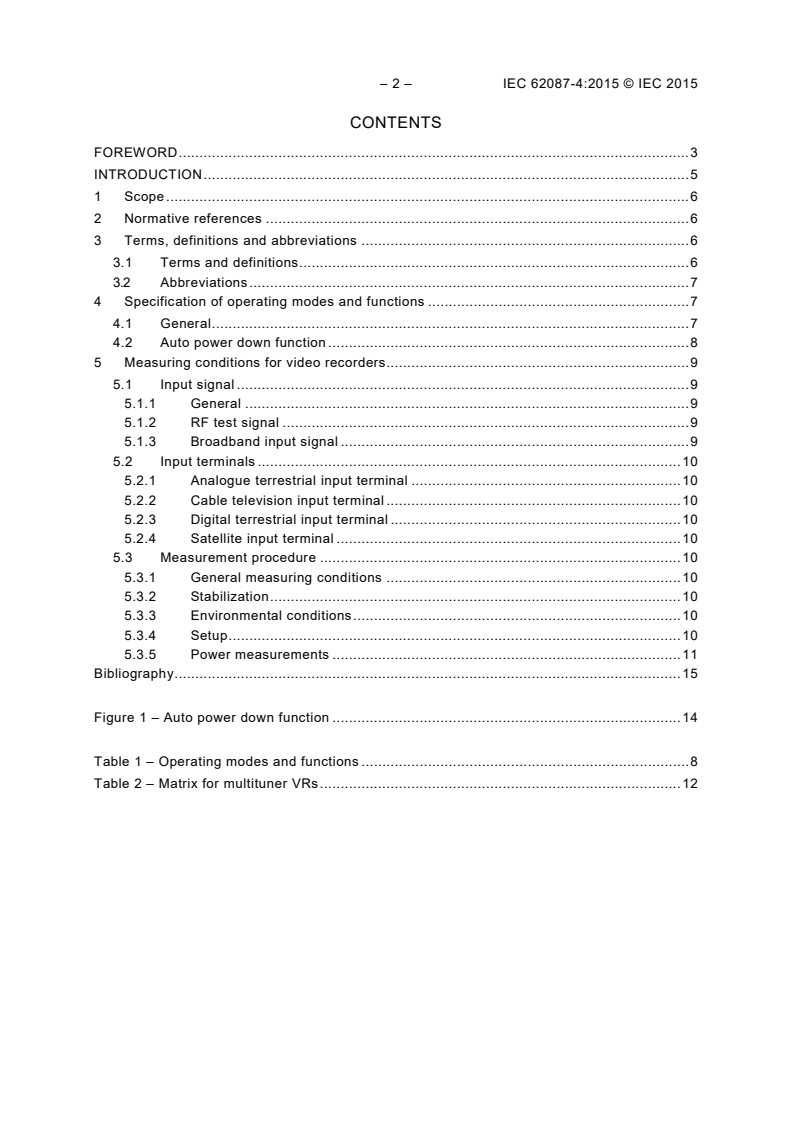
– 2 – IEC 62087-4:2015 © IEC 2015
CONTENTS
FOREWORD . 3
INTRODUCTION . 5
1 Scope . 6
2 Normative references . 6
3 Terms, definitions and abbreviations . 6
3.1 Terms and definitions . 6
3.2 Abbreviations . 7
4 Specification of operating modes and functions . 7
4.1 General . 7
4.2 Auto power down function . 8
5 Measuring conditions for video recorders . 9
5.1 Input signal . 9
5.1.1 General . 9
5.1.2 RF test signal . 9
5.1.3 Broadband input signal . 9
5.2 Input terminals . 10
5.2.1 Analogue terrestrial input terminal . 10
5.2.2 Cable television input terminal . 10
5.2.3 Digital terrestrial input terminal . 10
5.2.4 Satellite input terminal . 10
5.3 Measurement procedure . 10
5.3.1 General measuring conditions . 10
5.3.2 Stabilization . 10
5.3.3 Environmental conditions . 10
5.3.4 Setup . 10
5.3.5 Power measurements . 11
Bibliography . 15
Figure 1 – Auto power down function . 14
Table 1 – Operating modes and functions . 8
Table 2 – Matrix for multituner VRs . 12
INTERNATIONAL ELECTROTECHNICAL COMMISSION
____________
AUDIO, VIDEO AND RELATED EQUIPMENT –
DETERMINATION OF POWER CONSUMPTION –
Part 4: Video recording equipment
FOREWORD
1) The International Electrotechnical Commission (IEC) is a worldwide organization for standardization comprising
all national electrotechnical committees (IEC National Committees). The object of IEC is to promote
international co-operation on all questions concerning standardization in the electrical and electronic fields. To
this end and in addition to other activities, IEC publishes International Standards, Technical Specifications,
Technical Reports, Publicly Available Specifications (PAS) and Guides (hereafter referred to as “IEC
Publication(s)”). Their preparation is entrusted to technical committees; any IEC National Committee interested
in the subject dealt with may participate in this preparatory work. International, governmental and non-
governmental organizations liaising with the IEC also participate in this preparation. IEC collaborates closely
with the International Organization for Standardization (ISO) in accordance with conditions determined by
agreement between the two organizations.
2) The formal decisions or agreements of IEC on technical matters express, as nearly as possible, an international
consensus of opinion on the relevant subjects since each technical committee has representation from all
interested IEC National Committees.
3) IEC Publications have the form of recommendations for international use and are accepted by IEC National
Committees in that sense. While all reasonable efforts are made to ensure that the technical content of IEC
Publications is accurate, IEC cannot be held responsible for the way in which they are used or for any
misinterpretation by any end user.
4) In order to promote international uniformity, IEC National Committees undertake to apply IEC Publications
transparently to the maximum extent possible in their national and regional publications. Any divergence
between any IEC Publication and the corresponding national or regional publication shall be clearly indicated in
the latter.
5) IEC itself does not provide any attestation of conformity. Independent certification bodies provide conformity
assessment services and, in some areas, access to IEC marks of conformity. IEC is not responsible for any
services carried out by independent certification bodies.
6) All users should ensure that they have the latest edition of this publication.
7) No liability shall attach to IEC or its directors, employees, servants or agents including individual experts and
members of its technical committees and IEC National Committees for any personal injury, property damage or
other damage of any nature whatsoever, whether direct or indirect, or for costs (including legal fees) and
expenses arising out of the publication, use of, or reliance upon, this IEC Publication or any other IEC
Publications.
8) Attention is drawn to the Normative references cited in this publication. Use of the referenced publications is
indispensable for the correct application of this publication.
9) Attention is drawn to the possibility that some of the elements of this IEC Publication may be the subject of
patent rights. IEC shall not be held responsible for identifying any or all such patent rights.
International Standard IEC 62087-4 has been prepared by technical area 12: AV energy
efficiency and smart grid applications, of IEC technical committee 100: Audio, video and
multimedia systems and equipment.
This bilingual version (2018-02) corresponds to the monolingual English version, published in
2015-06.
This first edition of IEC 62087-4 cancels and replaces Clause 7 of IEC 62087:2011. This
standard together with IEC 62087-1 to IEC 62087-3 and IEC 62087-5 to IEC 62087-6 cancels
and replaces IEC 62087:2011. This International Standard constitutes a technical revision.
This edition includes significant technical changes with respect to Clause 7 of
IEC 62087:2011. The changes include fundamental and extensive revisions to cover video
recorders such as DVD and BD types as well as recorders with removable solid state memory.
Clause 7 has been revised in its entirety.
– 4 – IEC 62087-4:2015 © IEC 2015
The text of this standard is based on the following documents:
FDIS Report on voting
100/2469/FDIS 100/2499/RVD
Full information on the voting for the approval of this standard can be found in the report on
voting indicated in the above table.
The French version of this standard has not been voted upon.
A list of all parts in the IEC 62087 series, published under the general title Audio, video, and
related equipment – Determination of power consumption, can be found on the IEC website.
This publication has been drafted in accordance with the ISO/IEC Directives, Part 2.
The committee has decided that the contents of this publication will remain unchanged until
the stability date indicated on the IEC website under "http://webstore.iec.ch" in the data
related to the specific publication. At this date, the publication will be
• reconfirmed,
• withdrawn,
• replaced by a revised edition, or
• amended.
INTRODUCTION
This part of IEC 62087 specifies methods of measurement for the power consumption of video
recording equipment for consumer use.
IEC 62087:2011 revises methods for measuring power consumption of set top boxes mainly in
the modes of On mode and Standby-active, high mode. These modes correspond to the active
modes which are defined in IEC 62542:2013.
This standard has been divided into multiple parts. At the time of publication of this part, the
following parts are planned or published:
– Part 1: General
– Part 2: Signals and media
– Part 3: Television sets
– Part 4: Video recording equipment
– Part 5: Set-top boxes (STB)
– Part 6: Audio equipment
– 6 – IEC 62087-4:2015 © IEC 2015
AUDIO, VIDEO AND RELATED EQUIPMENT –
DETERMINATION OF POWER CONSUMPTION –
Part 4: Video recording equipment
1 Scope
This part of IEC 62087 specifies methods of measurement for the power consumption of video
recording equipment with removable media. It specifies the different modes of operation which
are relevant for measuring power consumption.
The methods of measurement are applicable only for equipment which can be connected to
the mains.
The measuring conditions in this standard represent the normal use of the equipment and
may differ from specific conditions, as specified, for example, in safety standards.
2 Normative references
The following documents, in whole or in part, are normatively referenced in this document and
are indispensable for its application. For dated references, only the edition cited applies. For
undated references, the latest edition of the referenced document (including any
amendments) applies.
IEC 60107-1:1997, Methods of measurement on receivers for television broadcast trans-
missions – Part 1: General considerations – Measurements at radio and video frequencies
IEC 62087-1:2015, Audio, video, and related equipment – Methods of measurement for
power consumption – Part 1: General
IEC 62216:2009, Digital terrestrial television receivers for the DVB-T system
3 Terms, definitions and abbreviations
3.1 Terms and definitions
For the purposes of this document, the terms and definitions given in IEC 62087-1:2015, as
well as the following apply.
3.1.1
additional functions
functions that are not required for the basic operation of the equipment
3.1.2
buffering
temporary storage of video and audio streams in some form of memory in order to perform
time shifting functions
3.1.3
hard disk drive
non removable media with a spinning disk for recording video and audio
3.1.4
removable media
write-once or rewritable device to store audio, video or other data via a standardized
read/write interface usable in all devices with the respective interface
Note 1 to entry: Examples include optical discs (DVD, BD), memory cards, video tape cassettes.
3.1.5
television set
TV
equipment for the reception and display of television broadcast and similar services for
terrestrial, cable, satellite and broadband network transmission of analogue and/or digital
signals
Note 1 to entry: A television set may include additional functions that are not required for its basic operation.
3.1.6
time shifting
capability of a device to allow playback type functions with real time broadcast
Note 1 to entry: Such functions may include fast forward, review (rewind), pause and slow motion.
3.1.7
video recording equipment
equipment for the recording and reproduction of video and audio signals on a recording
medium
Note 1 to entry: Equipment with only playback function are included as well.
Note 2 to entry: Examples are video cassette recorder (VCR) or a digital versatile disc (DVD) player or recorder.
3.2 Abbreviations
′ Prime
BD Blu-ray Disc™
DVD Digital Versatile Disc
EPG Electronic Program Guide
IP Internet Protocol
HD High Definition (720 p or better)
LNB Low Noise Block converter
PF Picture Failure point
RF Radio Frequency
SD Standard Definition
TV TeleVision set
VCR Video Cassette Recorder
VR Video Recorder
4 Specification of operating modes and functions
4.1 General
Table 1 contains the operating modes and functions for video recorders.
___________
1 Blu-ray Disc™ is a trade mark of the Blue-ray Disc Association. This information is given for the convenience of
users of this document and does not constitute an endorsement by IEC of the product named.
– 8 – IEC 62087-4:2015 © IEC 2015
4.2 Auto power down function
An auto power down feature may be implemented on a VR to power down into a Partial On
mode after a predetermined time and possibly predetermined conditions. Such a feature
should be referred to as auto power down.
Table 1 – Operating modes and functions
Power Mode Sub-mode Function(s) Description
0 W Disconnected Disconnected Disconnect The equipment is disconnected from
all external power sources.
Off Off Off The equipment is connected to an
≥0 W
external power source and provides
no functions that depend on a
power source. The equipment
cannot be switched into any other
mode with the remote control unit,
or an external or internal signal.
Note that some power may be
consumed if an EMC filter or other
components exist on the source
side of the power switch.
Partial On Standby-passive – Wake on The equipment is connected to an
>0 W
external power source and does not
– remote control
provide its primary functions. The
equipment can be switched into
– internal signal
another mode with the remote
control unit or an internal signal, but
not with an external signal.
Standby-active, – Wake on The equipment is connected to an
low external power source and does not
– remote control
provide its primary functions. The
equipment can be switched into
– internal signal
another mode with the remote
– external signal control unit, an internal signal, or an
external signal.
Standby-active, – Wake on The equipment is connected to an
high external power source and does not
– remote control
provide its primary functions. The
equipment can be switched into
– internal signal
another mode with the remote
– external signal
control unit, an internal signal, or an
external signal. Additionally, the
– Data
equipment is exchanging/receiving
communications
data with/from an external source.
On On-play Playing a programme Playing content from a build in
storage device, from removable
media or streamed via a device
port.
On-broadcast Pictures and sound from The equipment is performing the
a broadcast function of providing a viewer with
video and audio from a broadcast.
On-record Recording a programme The equipment is connected to a
from a broadcast power source and records a signal
from an external or internal source.
On-multifunction Recording The equipment is performing
multifunction “On-play” and/or “On-
Playing back
record” simultaneously.
5 Measuring conditions for video recorders
5.1 Input signal
5.1.1 General
In general terms, input signals shall be of the strength and quality for the type of broadcast
system on which the VR is intended to be used. Where a VR supports multiple broadcast
systems, it shall be tested for each broadcast system in which it operates. Each measured
result shall be described in the report.
5.1.2 RF test signal
5.1.2.1 General
For digital terrestrial, satellite and cable VRs, the test signal shall be a signal representative
of those present in the typical environment in which the VR is intended to be used. The video
and audio components of the transport stream shall be as described in 5.1.2.2 and 5.1.2.3.
For analogue terrestrial, satellite and cable VRs, the signal should be typical of the type of
signal the VR is designed to receive.
5.1.2.2 Video test signal
The VR shall be tested using an appropriate input signal. This signal should be at the highest
resolution that the VR is capable of decoding using the most processing intensive advanced
decoding standard of the intended broadcast system(s) that the VR will be used on. A
description of the signal used for the test shall be included in the test report. This description
shall include at a minimum, resolution, frame rate and bit rate.
If the VR under test is an HD decoder, additional testing may also be conducted with an SD
input signal.
Where the VR is operating in a download or recording mode, the input signal should contain
content that simulates material that would typically be downloaded or recorded.
Where a VR has a conditional access system, it should be tested whilst decoding encrypted
content.
Where a VR can record other services than the one being watched, the test signal should
contain sufficient services to enable this feature to be tested.
5.1.2.3 Audio test signal
The VR shall be tested using an appropriate input signal. The audio test signal should have
the maximum data rate (bit/s).
The audio format used during the power measurement shall be described in the report.
5.1.3 Broadband input signal
An input signal that provides the equivalent multiplexed transport stream as an appropriate
internet protocol (IP) broadband signal conforming to 5.1.2.2 and 5.1.2.3.
– 10 – IEC 62087-4:2015 © IEC 2015
5.2 Input terminals
5.2.1 Analogue terrestrial input terminal
If the VR is being tested with an analogue terrestrial RF input signal, the signals used shall
conform to IEC 60107-1:1997, 3.3, and shall have the input signal level set at –39 dB(mW)
when terminated with a 75 Ω resistor or at a level to provide a perceptually noise free or error
free picture.
NOTE 39 dB(mW) corresponds to 70 dB(µV).
5.2.2 Cable television input terminal
If the VR is being tested with a cable television RF input signal, the signals used shall
conform to the cable television specifications for the region, and shall have the input signal
level set at –49 dB(mW) with a termination of 75 Ω resistor or at a level to provide better than
the picture failure point (PF) as defined in IEC 62216 for digital signals or a perceptually noise
free picture or error free for analogue signals.
NOTE 49 dB(mW) corresponds to 60 dB(µV).
5.2.3 Digital terrestrial input terminal
If the VR is being tested with a digital terrestrial RF input signal, the signals used shall
conform to the broadcast specifications for the region, and shall have the input signal level set
at –49 dB(mW) with a termination of 75 Ω resistor or at a level to provide better than the
picture failure point (PF) as defined in IEC 62216 or a perceptually noise free picture.
5.2.4 Satellite input terminal
If the television set is being tested with a satellite input signal, the input signal level shall be
set at −49 dB(mW) with a termination of 75 Ω resistor or at a level to provide better than the
picture failure point (PF) as defined in IEC 62216 for digital signals or a perceptually noise
free picture or error free for analogue signals.
5.3 Measurement procedure
5.3.1 General measuring conditions
The general measuring conditions including the type of power meters to be used is as per
IEC 62087-1:2015 except where conditions are otherwise specified in this subclause.
5.3.2 Stabilization
The measurements shall be performed after the VR has achieved a stable condition with
respect to power consumption. Refer also to IEC 62087-1:2015.
NOTE There are several ways to consider a VR stable. For example, a VR can be considered stable between
15 min and 30 min after entering into each operation mode. In this case, the time used to stabilize the VR shall be
recorded in the test report. A VR can be also considered stable when any of the results of the same test repeated
are within 2 %.
5.3.3 Environmental conditions
The ambient temperature shall be 23 ºC ± 5 ºC. Refer also to IEC 62087-1:2015.
5.3.4 Setup
The VR shall be set up in a manner to simulate a normal operating environment. In this
condition, the measurement shall be made without optional peripheral devices attached to the
device. The input signals to the VRs may be either live signals or generated test streams that
simulate live signals that the VR is designed to receive and decode.
Where a VR can power an LNB of an antenna amplifier this power shall not be included in the
measurement. Where possible this power supply should be disabled. Where it cannot be
disabled isolation connectors should be used to isolate the power supply.
If required the LNB or antenna amplifier should be powered from an external power source to
the VR.
If possible, any function which may work in background of any On mode function should be
disabled (turned off). If possible, any function which may cause the interruption of any On
mode function should also be disabled (turned off). If they cannot be disabled the
measurement should be scheduled so as to avoid working such background functions during
the measurement.
NOTE Examples of background and/or interrupt functions for any On mode function are:
– background software download/install;
– timer recording;
– automatic deletion of an old TV programme which was recorded.
5.3.5 Power measurements
5.3.5.1 General
The VR under test shall be measured in each applicable mode as specified below. In the case
of HD VRs, testing shall be with an HD input signal. Testing with an SD input signal may also
be conducted. Where the SD test is conducted on an HD VR, the result shall be recorded as
P . If possible disable the time shifting function.
AV_ON_SD
Unless the power measurement is being made with removable media any other removable
media not being used shall be removed.
5.3.5.2 On-broadcast
Measure the average power consumed for at least 2 min. Record this as P . Record the
AV_ON
time used to measure the average power.
5.3.5.3 On-play
Start a playback of a previously recorded programme on the VR and measure the average
power consumed for at least 2 min. Record this as P . Record the time used to measure the
PL
average power.
Start a playback of a programme on the removable media inserted into the VR and measure
the average power consumed for at least 2 min. Record this as P . Record the time used to
RPL
measure the average power.
5.3.5.4 On-record
Start or schedule a recording. With the VR recording the programme, measure the average
. Record the time used to
power consumed for at least 2 min. Record this as P
REC_ON
measure the average power.
Start or schedule a recording. With the VR recording the programme to the inserted
removable media measure the average power consumed for at least 2 min. Record this as
P . Record the time used to measure the average power.
REC_RM_ON
– 12 – IEC 62087-4:2015 © IEC 2015
5.3.5.5 On-multifunction with a single tuner
Set the VR to record a programme while simultaneously playing back a previously recorded
programme and measure the average power consumed for at least 2 min. Record this as
P . Record the time used to measure the average power. Time shifting is covered in this
MF_ST
measurement as this is the case when the VR is playing back the same program as it is
recording.
NOTE The mechanism for multifunction with a single tuner is the same as for time shift or recording.
5.3.5.6 On-multifunction with a multituner
Table 2 shows the matrix that shall be used to characterize a multituner VR.
Table 2 – Matrix for multituner VRs
nd rd th
Add 2 Add 3 Add 4 Add nth
tuner tuner tuner tuner
Tuner Viewing
recording recording recording recording
a a a
HD or SD HD or SD HD or SD HD or SD
Sequence 1 P SD P P P P
MFA_SD_n MFA_SD_2 MFA_SD_3 MFA_SD_4 MFA_SD_n
Sequence 2 P HD P P P P
MFA_HD_n MFA_HD_2 MFA_HD_3 MFA_HD_4 MFA_HD_n
a
If fitted.
Measure the average power for at least 2 min for each of the modes in the matrix. Record the
time used to measure the average power.
For SD VRs, only sequence 1 shall be performed. For HD VRs, both sequence 1 and
sequence 2 shall be performed.
5.3.5.7 Standby-active, high
If possible, activate a download mode from the primary service and measure the average
power consumed for at least 2 min. This measurement may require information from the
manufacturer and/or service provider to ensure the transport stream contains a suitable
download and instructions on how to set the VR to receive the download. Record this value as
P . Record the time used to measure the average power.
SAH
NOTE It may not be possible to place the VR into this mode. If this is the case and the value is still required, it
may have to be provided by a manufacturer’s declaration.
5.3.5.8 Standby-active, low
To ensure that the VR is in standby active and not performing any downloading or recording
function, the following procedure should be used.
a) Put the VR into its on mode.
b) If the VR is capable of scheduling a recording then schedule a recording 2 or more hours
in the future.
c) After 5 min in this mode, press the standby or off button on the remote control.
d) Leave the VR for a minimum of 30 min or until higher power mode maintenance activities
within the UUT have been completed.
Measure the average power consumed for at least 2 min. Record this as P . Record the
SAL
time used to measure the average power. Record the time taken to switch to standby active,
low.
5.3.5.9 Standby-passive
To ensure that the VR is in standby passive, the following procedure should be used.
a) Put the VR into its On mode.
b) If the VR is capable of scheduling a recording then schedule a recording 2 or more hours
in the future.
c) After 5 min in this mode, press the standby or off button on the remote control.
d) Leave the VR for a minimum of 30 min or until higher power mode maintenance activities
within the UUT activities have been completed.
Measure the average power consumed for at least 2 min. Record this as P . Record the time
SP
used to measure the average power. Record the time taken to switch to Standby- passive.
NOTE The method for determining standby-active, low and standby-passive are identical as the switching into
either one of these modes is the same. Which mode the VR actually switches to is actually determined by the
platform in which the VR is operating. A VR with a terrestrial tuner will be more likely to be in a passive mode and a
VR with a cable or satellite tuner will be more likely to be in a standby-active, low mode. Both methods are
specified here to be consistent with the definitions in Table 1.
5.3.5.10 Off
Turn the VR off using the power switch, if available, and measure the average power
consumed for at least 2 min. Record this as P . Record the time used to measure the
_OFF
average power.
5.3.5.11 Auto power down
If the UUT includes an auto power down feature, use the following procedure to determine the
auto power down interval and the power consumption after auto power down is completed.
(See Figure 1.)
a) Place the UUT in the On mode with the auto power down function enabled. The auto
power down interval is specified by the manufacturer. The auto power down interval
should be reported.
b) Stop any main functions of the UUT and start a timer to determine the auto power down
interval.
c) Allow the UUT to automatically power down.
d) Monitor the power consumption of the UUT until the power consumption stabilizes.
e) Stop the timer and report the auto power down interval.
f) Measure the average power consumed for a 2 min. Record this as P .
APD
– 14 – IEC 62087-4:2015 © IEC 2015
Auto power down function
Auto power down interval
(determined by the manufacturer)
On mode
power consumption
Possible maintenance
functions in progress
Auto power down
power consumption
Stop any main Auto power Auto power
down starts down completed
functions
Elapsed time
IEC
Figure 1 – Auto power down function
Power consumption
Bibliography
IEC 61938:2013, Multimedia systems – Guide to the recommended characteristics of
analogue interfaces to achieve interoperability
IEC 62087 (all parts), Audio, video, and related equipment – Determination of power
consumption
IEC 62087-2:2015, Audio, video, and related equipment – Methods of measurement for power
consumption – Part 2: Signals and media
IEC 62301:2011, Household electrical appliances – Measurement of standby power
IEC 62542:2013, Environmental standardization for electrical and electronic products and
systems – Glossary of terms
EN 50049-1:1998, Domestic and Similar Electronic Equipment Interconnection Requirements:
Peritelevision Connector
SMPTE EG 1-1990 (Archived 2004), Alignment Color Bar Test Signal for Television Picture
Monitors
_____________
– 16 – IEC 62087-4:2015 © IEC 2015
SOMMAIRE
AVANT-PROPOS . 17
INTRODUCTION . 19
1 Domaine d'application . 20
2 Références normatives . 20
3 Termes, définitions et abréviations . 20
3.1 Termes et définitions . 20
3.2 Abréviations . 21
4 Spécification des modes de fonctionnement et fonctions . 22
4.1 Généralités . 22
4.2 Fonction d’extinction automatique . 22
5 Conditions de mesure pour les enregistreurs vidéo . 23
5.1 Signal d'entrée . 23
5.1.1 Généralités . 23
5.1.2 Signal d'essai RF . 23
5.1.3 Signal d'entrée large bande . 24
5.2 Connecteurs d'entrée . 24
5.2.1 Connecteur d'entrée analogique terrestre . 24
5.2.2 Connecteur d'entrée de télévision par câble . 24
5.2.3 Connecteur d'entrée numérique terrestre . 24
5.2.4 Connecteur d'entrée satellite . 24
5.3 Procédure de mesure . 24
5.3.1 Conditions générales de mesure . 24
5.3.2 Stabilisation . 25
5.3.3 Conditions liées à l'environnement . 25
5.3.4 Paramétrage . 25
5.3.5 Mesures de puissance . 25
Bibliographie . 29
Figure 1 – Fonction d’extinction automatique . 28
Tableau 1 – Modes de fonctionnement et fonctions . 22
Tableau 2 – Matrice pour enregistreurs vidéo à syntoniseur multiple . 26
COMMISSION ÉLECTROTECHNIQUE INTERNATIONALE
____________
APPAREILS AUDIO, VIDÉO ET MATÉRIEL CONNEXE –
DÉTERMINATION DE LA CONSOMMATION DE PUISSANCE –
Partie 4: Matériel d'enregistrement vidéo
AVANT-PROPOS
1) La Commission Electrotechnique Internationale (IEC) est une organisation mondiale de normalisation
composée de l'ensemble des comités électrotechniques nationaux (Comités nationaux de l’IEC). L’IEC a pour
objet de favoriser la coopération internationale pour toutes les questions de normalisation dans les domaines
de l'électricité et de l'électronique. A cet effet, l’IEC – entre autres activités – publie des Normes internationales,
des Spécifications techniques, des Rapports techniques, des Spécifications accessibles au public (PAS) et des
Guides (ci-après dénommés "Publication(s) de l’IEC"). Leur élaboration est confiée à des comités d'études, aux
travaux desquels tout Comité national intéressé par le sujet traité peut participer. Les organisations
internationales, gouvernementales et non gouvernementales, en liaison avec l’IEC, participent également aux
travaux. L’IEC collabore étroitement avec l'Organisation Internationale de Normalisation (ISO), selon des
conditions fixées par accord entre les deux organisations.
2) Les décisions ou accords officiels de l’IEC concernant les questions techniques représentent, dans la mesure
du possible, un accord international sur les sujets étudiés, étant donné que les Comités nationaux de l’IEC
intéressés sont représentés dans chaque comité d’études.
3) Les Publications de l’IEC se présentent sous la forme de recommandations internationales et sont agréées
comme telles par les Comités nationaux de l’IEC. Tous les efforts raisonnables sont entrepris afin que l’IEC
s'assure de l'exactitude du contenu technique de ses publications; l’IEC ne peut pas être tenue responsable de
l'éventuelle mauvaise utilisation ou interprétation qui en est faite par un quelconque utilisateur final.
4) Dans le but d'encourager l'uniformité internationale, les Comités nationaux de l’IEC s'engagent, dans toute la
mesure possible, à appliquer de façon transparente les Publications de l’IEC dans leurs publications nationales
et régionales. Toutes divergences entre toutes Publications de l’IEC et toutes publications nationales ou
régionales correspondantes doivent être indiquées en termes clairs dans ces dernières.
5) L’IEC elle-même ne fournit aucune attestation de conformité. Des organismes de certification indépendants
fournissent des services d'évaluation de conformité et, dans certains secteurs, accèdent aux marques de
conformité de l’IEC. L’IEC n'est responsable d'aucun des services effectués par les organismes de certification
indépendants.
6) Tous les utilisateurs doivent s'assurer qu'ils sont en possession de la dernière édition de cette publication.
7) Aucune responsabilité ne doit être imputée à l’IEC, à ses administrateurs, employés, auxiliaires ou mandataires,
y compris ses experts particuliers et les membres de ses comités d'études et des Comités nationaux de l’IEC,
pour tout préjudice causé en cas de dommages corporels et matériels, ou de tout autre dommage de quelque
nature que ce soit, directe ou indirecte, ou pour supporter les coûts (y compris les frais de justice) et les
dépenses découlant de la publication ou de l'utilisation de cette Publication de l’IEC ou de toute autre
Publication de l’IEC, ou au crédit qui lui est accordé.
8) L'attention est attirée sur les références normatives citées dans cette publication. L'utilisation de publications
référencées est obligatoire pour une application correcte de la présente publication.
9) L’attention est attirée sur le fait que certains des élément
...