

IEC 62788-6-2:2020
(Main)Measurement procedures for materials used in photovoltaic modules - Part 6-2: General tests - Moisture permeation testing of polymeric materials
General Information
- Abstract
IEC 62788-6-2:2020 provides methods for measuring the steady-state water vapour transmission rate (WVTR), water vapour permeability (P), diffusivity (D), solubility (S), and moisture breakthrough time (Ƭ10) (defined as the time to reach 10 % of the steady state WVTR) for polymeric materials such as encapsulants, edge seals, frontsheets and backsheets. These measurements can be made at selected temperatures and humidity levels as deemed appropriate for evaluation of their performance in PV modules. Measurement is accomplished by inspection of the transient WVTR curve and by fitting it to a theoretical Fickian model. This document is best applied to monolithic films. If multilayer films are used, the D and S values are only apparent values, but the steady-state values can still be measured.
- Status
- Published
- Publication Date
- 18-Mar-2020
- Technical Committee
- TC 82 - Solar photovoltaic energy systems
- Drafting Committee
- WG 2 - TC 82/WG 2
- Current Stage
- PPUB - Publication issued
- Start Date
- 19-Mar-2020
- Completion Date
- 20-Mar-2020
Buy Documents
IEC 62788-6-2:2020 - Measurement procedures for materials used in photovoltaic modules - Part 6-2: General tests - Moisture permeation testing of polymeric materials Released:3/19/2020
Overview
IEC 62788-6-2:2020 is an international standard published by the International Electrotechnical Commission (IEC) that specifies measurement procedures for moisture permeation testing of polymeric materials used in photovoltaic (PV) modules. This part of the IEC 62788 series focuses on general test methods to evaluate the water vapor transmission rate (WVTR), water vapor permeability (P), diffusivity (D), solubility (S), and moisture breakthrough time (Ƭ10) of common polymeric materials such as encapsulants, edge seals, frontsheets, and backsheets in PV module construction. The standard outlines procedures for testing these materials under various temperatures and humidity levels to assess their performance and durability against moisture ingress, which is critical for PV module longevity.
IEC 62788-6-2 employs a model based on Fickian diffusion theory to analyze transient water vapor transmission data, making it especially relevant for monolithic polymer films. For multilayer films, only apparent values of diffusivity and solubility are derived, albeit accurate steady-state permeation properties are still attainable.
Key Topics
- Water Vapor Transmission Rate (WVTR): Measurement of the rate at which water vapor permeates through polymeric films, expressed in g·m⁻²·day⁻¹.
- Permeability (P): The inherent ability of a polymeric material to allow moisture to permeate through it.
- Diffusivity (D): Quantifies how fast moisture molecules diffuse through a polymer, a critical factor in understanding moisture ingress kinetics.
- Solubility (S): Represents the amount of moisture a polymeric material can absorb.
- Moisture Breakthrough Time (Ƭ10): Time required for the water vapor transmission rate to reach 10% of its steady-state value-essential for predicting early moisture exposure.
- Fickian Diffusion Analysis: A modeling approach assuming constant diffusivity, facilitating the interpretation of transient WVTR curves.
- Testing Conditions: Procedures allow for measurements at different temperature and humidity settings to simulate various environmental exposures.
- Applicability to Other Gases: While primarily targeting water vapor, the standard's methodologies also apply to other permeants like oxygen (O₂).
Applications
- Photovoltaic Module Material Evaluation: Ensuring that encapsulants, edge seals, and backsheets meet moisture resistance requirements for long-term outdoor exposure.
- Product Development: Guiding manufacturers in selecting and optimizing polymeric materials with superior moisture barrier properties to enhance module reliability.
- Quality Control: Standardizing moisture permeation testing in production to detect potential defects or variability.
- Lifetime Prediction: Using breakthrough time and permeation data to model degradation pathways influenced by moisture ingress.
- Research and Innovation: Supporting innovation in new polymeric materials and multilayer films with advanced moisture barrier characteristics.
The standard is vital for manufacturers, testing laboratories, and researchers dealing with moisture ingress, polymeric film assessment, and photovoltaic module durability.
Related Standards
IEC 62788-6-2 references and aligns with international standards and test methods relevant to moisture permeation and polymer testing, including:
- IEC TS 61836 - Solar Photovoltaic Energy Systems – Terms, Definitions, and Symbols.
- ISO 2528 - Determination of Water Vapour Transmission Rate (WVTR) by Gravimetric Method.
- ISO 9932 - Water Vapour Transmission Rate of Sheet Materials by Dynamic and Static Gas Methods.
- ISO 15106 Series - Water Vapour Transmission Rate Determinations using various sensor methods (humidity detection, infrared, electrolytic, and gas chromatographic).
- ASTM F1249-06 - Standard Test Method for WVTR through Plastic Films via Modulated Infrared Sensor.
These standards complement IEC 62788-6-2, ensuring comprehensive, harmonized approaches for evaluating polymeric films used in photovoltaic applications.
By following IEC 62788-6-2:2020, stakeholders gain a scientifically rigorous, internationally recognized procedure to assess moisture permeation in PV module materials-crucial for optimizing module reliability, reducing corrosion risks, and enhancing photovoltaic system performance over decades.
Buy Documents
IEC 62788-6-2:2020 - Measurement procedures for materials used in photovoltaic modules - Part 6-2: General tests - Moisture permeation testing of polymeric materials Released:3/19/2020
Get Certified
Connect with accredited certification bodies for this standard

DNV
DNV is an independent assurance and risk management provider.

Lloyd's Register
Lloyd's Register is a global professional services organisation specialising in engineering and technology.
DNV Energy Systems
Energy and renewable energy certification.
Sponsored listings
Frequently Asked Questions
IEC 62788-6-2:2020 is a standard published by the International Electrotechnical Commission (IEC). Its full title is "Measurement procedures for materials used in photovoltaic modules - Part 6-2: General tests - Moisture permeation testing of polymeric materials". This standard covers: IEC 62788-6-2:2020 provides methods for measuring the steady-state water vapour transmission rate (WVTR), water vapour permeability (P), diffusivity (D), solubility (S), and moisture breakthrough time (Ƭ10) (defined as the time to reach 10 % of the steady state WVTR) for polymeric materials such as encapsulants, edge seals, frontsheets and backsheets. These measurements can be made at selected temperatures and humidity levels as deemed appropriate for evaluation of their performance in PV modules. Measurement is accomplished by inspection of the transient WVTR curve and by fitting it to a theoretical Fickian model. This document is best applied to monolithic films. If multilayer films are used, the D and S values are only apparent values, but the steady-state values can still be measured.
IEC 62788-6-2:2020 provides methods for measuring the steady-state water vapour transmission rate (WVTR), water vapour permeability (P), diffusivity (D), solubility (S), and moisture breakthrough time (Ƭ10) (defined as the time to reach 10 % of the steady state WVTR) for polymeric materials such as encapsulants, edge seals, frontsheets and backsheets. These measurements can be made at selected temperatures and humidity levels as deemed appropriate for evaluation of their performance in PV modules. Measurement is accomplished by inspection of the transient WVTR curve and by fitting it to a theoretical Fickian model. This document is best applied to monolithic films. If multilayer films are used, the D and S values are only apparent values, but the steady-state values can still be measured.
IEC 62788-6-2:2020 is classified under the following ICS (International Classification for Standards) categories: 27.160 - Solar energy engineering. The ICS classification helps identify the subject area and facilitates finding related standards.
IEC 62788-6-2:2020 is available in PDF format for immediate download after purchase. The document can be added to your cart and obtained through the secure checkout process. Digital delivery ensures instant access to the complete standard document.
Standards Content (Sample)
IEC 62788-6-2 ®
Edition 1.0 2020-03
INTERNATIONAL
STANDARD
NORME
INTERNATIONALE
colour
inside
Measurement procedures for materials used in photovoltaic modules –
Part 6-2: General tests – Moisture permeation testing of polymeric materials
Procédures de mesure des matériaux utilisés dans les modules
photovoltaïques –
Partie 6-2: Essais génériques – Essais de perméation à l’humidité des matériaux
polymères
All rights reserved. Unless otherwise specified, no part of this publication may be reproduced or utilized in any form
or by any means, electronic or mechanical, including photocopying and microfilm, without permission in writing from
either IEC or IEC's member National Committee in the country of the requester. If you have any questions about IEC
copyright or have an enquiry about obtaining additional rights to this publication, please contact the address below or
your local IEC member National Committee for further information.
Droits de reproduction réservés. Sauf indication contraire, aucune partie de cette publication ne peut être reproduite
ni utilisée sous quelque forme que ce soit et par aucun procédé, électronique ou mécanique, y compris la photocopie
et les microfilms, sans l'accord écrit de l'IEC ou du Comité national de l'IEC du pays du demandeur. Si vous avez des
questions sur le copyright de l'IEC ou si vous désirez obtenir des droits supplémentaires sur cette publication, utilisez
les coordonnées ci-après ou contactez le Comité national de l'IEC de votre pays de résidence.
IEC Central Office Tel.: +41 22 919 02 11
3, rue de Varembé info@iec.ch
CH-1211 Geneva 20 www.iec.ch
Switzerland
About the IEC
The International Electrotechnical Commission (IEC) is the leading global organization that prepares and publishes
International Standards for all electrical, electronic and related technologies.
About IEC publications
The technical content of IEC publications is kept under constant review by the IEC. Please make sure that you have the
latest edition, a corrigendum or an amendment might have been published.
IEC publications search - webstore.iec.ch/advsearchform Electropedia - www.electropedia.org
The advanced search enables to find IEC publications by a The world's leading online dictionary on electrotechnology,
variety of criteria (reference number, text, technical containing more than 22 000 terminological entries in English
committee,…). It also gives information on projects, replaced and French, with equivalent terms in 16 additional languages.
and withdrawn publications. Also known as the International Electrotechnical Vocabulary
(IEV) online.
IEC Just Published - webstore.iec.ch/justpublished
Stay up to date on all new IEC publications. Just Published IEC Glossary - std.iec.ch/glossary
details all new publications released. Available online and 67 000 electrotechnical terminology entries in English and
once a month by email. French extracted from the Terms and Definitions clause of
IEC publications issued since 2002. Some entries have been
IEC Customer Service Centre - webstore.iec.ch/csc collected from earlier publications of IEC TC 37, 77, 86 and
If you wish to give us your feedback on this publication or CISPR.
need further assistance, please contact the Customer Service
Centre: sales@iec.ch.
A propos de l'IEC
La Commission Electrotechnique Internationale (IEC) est la première organisation mondiale qui élabore et publie des
Normes internationales pour tout ce qui a trait à l'électricité, à l'électronique et aux technologies apparentées.
A propos des publications IEC
Le contenu technique des publications IEC est constamment revu. Veuillez vous assurer que vous possédez l’édition la
plus récente, un corrigendum ou amendement peut avoir été publié.
Recherche de publications IEC - Electropedia - www.electropedia.org
webstore.iec.ch/advsearchform Le premier dictionnaire d'électrotechnologie en ligne au
La recherche avancée permet de trouver des publications IEC monde, avec plus de 22 000 articles terminologiques en
en utilisant différents critères (numéro de référence, texte, anglais et en français, ainsi que les termes équivalents dans
comité d’études,…). Elle donne aussi des informations sur les 16 langues additionnelles. Egalement appelé Vocabulaire
projets et les publications remplacées ou retirées. Electrotechnique International (IEV) en ligne.
IEC Just Published - webstore.iec.ch/justpublished Glossaire IEC - std.iec.ch/glossary
Restez informé sur les nouvelles publications IEC. Just 67 000 entrées terminologiques électrotechniques, en anglais
Published détaille les nouvelles publications parues. et en français, extraites des articles Termes et Définitions des
Disponible en ligne et une fois par mois par email. publications IEC parues depuis 2002. Plus certaines entrées
antérieures extraites des publications des CE 37, 77, 86 et
Service Clients - webstore.iec.ch/csc CISPR de l'IEC.
Si vous désirez nous donner des commentaires sur cette
publication ou si vous avez des questions contactez-nous:
sales@iec.ch.
IEC 62788-6-2 ®
Edition 1.0 2020-03
INTERNATIONAL
STANDARD
NORME
INTERNATIONALE
colour
inside
Measurement procedures for materials used in photovoltaic modules –
Part 6-2: General tests – Moisture permeation testing of polymeric materials
Procédures de mesure des matériaux utilisés dans les modules
photovoltaïques –
Partie 6-2: Essais génériques – Essais de perméation à l’humidité des matériaux
polymères
INTERNATIONAL
ELECTROTECHNICAL
COMMISSION
COMMISSION
ELECTROTECHNIQUE
INTERNATIONALE
ICS 27.160 ISBN 978-2-8322-7921-2
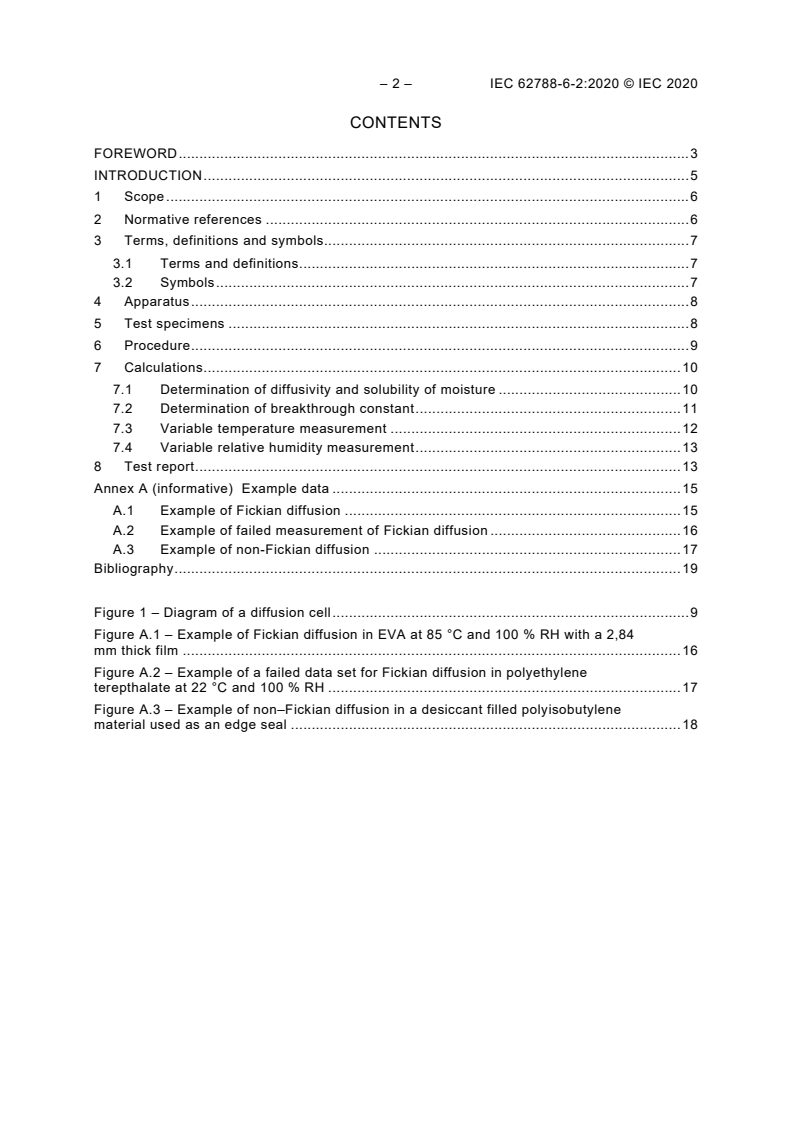
– 2 – IEC 62788-6-2:2020 © IEC 2020
CONTENTS
FOREWORD . 3
INTRODUCTION . 5
1 Scope . 6
2 Normative references . 6
3 Terms, definitions and symbols. 7
3.1 Terms and definitions . 7
3.2 Symbols . 7
4 Apparatus . 8
5 Test specimens . 8
6 Procedure . 9
7 Calculations . 10
7.1 Determination of diffusivity and solubility of moisture . 10
7.2 Determination of breakthrough constant . 11
7.3 Variable temperature measurement . 12
7.4 Variable relative humidity measurement . 13
8 Test report . 13
Annex A (informative) Example data . 15
A.1 Example of Fickian diffusion . 15
A.2 Example of failed measurement of Fickian diffusion . 16
A.3 Example of non-Fickian diffusion . 17
Bibliography . 19
Figure 1 – Diagram of a diffusion cell . 9
Figure A.1 – Example of Fickian diffusion in EVA at 85 °C and 100 % RH with a 2,84
mm thick film . 16
Figure A.2 – Example of a failed data set for Fickian diffusion in polyethylene
terepthalate at 22 °C and 100 % RH . 17
Figure A.3 – Example of non–Fickian diffusion in a desiccant filled polyisobutylene
material used as an edge seal . 18
INTERNATIONAL ELECTROTECHNICAL COMMISSION
____________
MEASUREMENT PROCEDURES FOR MATERIALS
USED IN PHOTOVOLTAIC MODULES –
Part 6-2: General tests –
Moisture permeation testing of polymeric materials
FOREWORD
1) The International Electrotechnical Commission (IEC) is a worldwide organization for standardization comprising
all national electrotechnical committees (IEC National Committees). The object of IEC is to promote international
co–operation on all questions concerning standardization in the electrical and electronic fields. To this end and
in addition to other activities, IEC publishes International Standards, Technical Specifications, Technical Reports,
Publicly Available Specifications (PAS) and Guides (hereafter referred to as “IEC Publication(s)”). Their
preparation is entrusted to technical committees; any IEC National Committee interested in the subject dealt with
may participate in this preparatory work. International, governmental and non–governmental organizations
liaising with the IEC also participate in this preparation. IEC collaborates closely with the International
Organization for Standardization (ISO) in accordance with conditions determined by agreement between the two
organizations.
2) The formal decisions or agreements of IEC on technical matters express, as nearly as possible, an international
consensus of opinion on the relevant subjects since each technical committee has representation from all
interested IEC National Committees.
3) IEC Publications have the form of recommendations for international use and are accepted by IEC National
Committees in that sense. While all reasonable efforts are made to ensure that the technical content of IEC
Publications is accurate, IEC cannot be held responsible for the way in which they are used or for any
misinterpretation by any end user.
4) In order to promote international uniformity, IEC National Committees undertake to apply IEC Publications
transparently to the maximum extent possible in their national and regional publications. Any divergence between
any IEC Publication and the corresponding national or regional publication shall be clearly indicated in the latter.
5) IEC itself does not provide any attestation of conformity. Independent certification bodies provide conformity
assessment services and, in some areas, access to IEC marks of conformity. IEC is not responsible for any
services carried out by independent certification bodies.
6) All users should ensure that they have the latest edition of this publication.
7) No liability shall attach to IEC or its directors, employees, servants or agents including individual experts and
members of its technical committees and IEC National Committees for any personal injury, property damage or
other damage of any nature whatsoever, whether direct or indirect, or for costs (including legal fees) and
expenses arising out of the publication, use of, or reliance upon, this IEC Publication or any other IEC
Publications.
8) Attention is drawn to the Normative references cited in this publication. Use of the referenced publications is
indispensable for the correct application of this publication.
9) Attention is drawn to the possibility that some of the elements of this IEC Publication may be the subject of patent
rights. IEC shall not be held responsible for identifying any or all such patent rights.
International Standard IEC 62788-6-2 has been prepared by IEC technical committee 82: Solar
photovoltaic energy systems.
The text of this International Standard is based on the following documents:
FDIS Report on voting
82/1659/FDIS 82/1690/RVD
Full information on the voting for the approval of this International Standard can be found in the
report on voting indicated in the above table.
This document has been drafted in accordance with the ISO/IEC Directives, Part 2.
– 4 – IEC 62788-6-2:2020 © IEC 2020
A list of all parts in the IEC 62788 series, published under the general title Measurement
procedures for materials used in photovoltaic modules, can be found on the IEC website.
The committee has decided that the contents of this document will remain unchanged until the
stability date indicated on the IEC website under "http://webstore.iec.ch" in the data related to
the specific document. At this date, the document will be
• reconfirmed,
• withdrawn,
• replaced by a revised edition, or
• amended.
IMPORTANT – The 'colour inside' logo on the cover page of this publication indicates
that it contains colours which are considered to be useful for the correct understanding
of its contents. Users should therefore print this document using a colour printer.
INTRODUCTION
This part of IEC 62788 describes methods to measure the permeation properties of polymeric
materials. The degradation of PV modules is known to go through many different corrosion
processes. These degradation processes may depend upon moisture ingress into the
encapsulant, edge seal, frontsheet, or backsheet materials. Typical polymeric materials used
include (amongst other polymers) ethylene-vinyl acetate (EVA) and polyolefins for
encapsulants, polyisobutylene (PIB) for edge seals, and polyethylene terephthalate (PET),
polyvinyl fluoride (PVF), or polyvinylidine fluoride (PVDF) for backsheets. Therefore, knowing
the moisture permeation characteristics of polymeric materials is relevant for module design.
These properties can be determined as a function of temperature and relative humidity. With
these parameters, simple scaling rules for time and distance can be used to extrapolate to the
use environments.
– 6 – IEC 62788-6-2:2020 © IEC 2020
MEASUREMENT PROCEDURES FOR MATERIALS
USED IN PHOTOVOLTAIC MODULES –
Part 6-2: General tests –
Moisture permeation testing of polymeric materials
1 Scope
This document provides methods for measuring the steady-state water vapour transmission
rate (WVTR), water vapour permeability (P), diffusivity (D), solubility (S), and moisture
breakthrough time (Ƭ ) (defined as the time to reach 10 % of the steady state WVTR) for
polymeric materials such as encapsulants, edge seals, frontsheets and backsheets. These
measurements can be made at selected temperatures and humidity levels as deemed
appropriate for evaluation of their performance in PV modules. Measurement is accomplished
by inspection of the transient WVTR curve and by fitting it to a theoretical Fickian model. This
document is best applied to monolithic films. If multilayer films are used, the D and S values are
only apparent values, but the steady-state values can still be measured.
This document was written for the measurement of water permeation, but it can equally be used
for other permeants such as O . In this case the same diffusion equations, fitting procedures,
and scaling arguments are used.
2 Normative references
The following documents are referred to in the text in such a way that some or all of their content
constitutes requirements of this document. For dated references, only the edition cited applies.
For undated references, the latest edition of the referenced document (including any
amendments) applies.
IEC TS 61836, Solar photovoltaic energy systems – Terms, definitions and symbols
ISO 2528, Sheet materials – Determination of water vapour transmission rate (WVTR) –
Gravimetric (dish) method
ISO 9932, Paper and board – Determination of water vapour transmission rate of sheet
materials – Dynamic sweep and static gas methods
ISO 15106-1, Plastics – Film and sheeting – Determination of water vapour transmission Rate
– Part 1: Humidity detection sensor method
ISO 15106-2, Plastics – Film and sheeting – Determination of water vapour transmission Rate
– Part 2: Infrared detection sensor method
ISO 15106-3, Plastics – Film and sheeting – Determination of water vapour transmission Rate
– Part 3: Electrolytic detection sensor method
ISO 15106-4, Plastics – Film and sheeting – Determination of water vapour transmission Rate
– Part 4: Gas-chromatographic detection sensor method
ASTM F1249-06, Standard test method for water vapour transmission rate through plastic film
and sheeting using a modulated infrared sensor
3 Terms, definitions and symbols
For the purposes of this document, the terms and definitions the terms and definitions given in
IEC TS 61836 and the following apply.
ISO and IEC maintain terminological databases for use in standardization at the following
addresses:
• IEC Electropedia: available at http://www.electropedia.org/
• ISO Online browsing platform: available at http://www.iso.org/obp
3.1 Terms and definitions
3.1.1
edge seal
polymeric material designed to be placed between two impermeable (or with extremely low
permeability) frontsheet and backsheet materials to restrict moisture ingress from the sides
3.1.2
Fickian
material for which the diffusivity is constant, independent of concentration of the permeant
within the experimental uncertainty
3.1.3
permeability
state or quality of a material or membrane that causes it to allow liquids or gases to pass through
it
3.1.4
diffusivity
measure of the capability of a substance to be diffused or to allow something to pass by diffusion
3.2 Symbols
T temperature [°C] or [K]
t time from application of moisture or the start of the experiment [h]
instrumental delay time [h]
Ƭ
delay
Ƭ time for WVTR to reach 10 % of its steady-state value [h]
Ƭ time for WVTR to reach 50 % of its steady-state value [h]
1/2
l sample thickness [mm]
H relative humidity [%]
−2 −1
T water vapour transmission rate [g·m ·day ]
R
−2 −1
P water permeability [g·mm·m ·day ]
2 −1
D water diffusivity [cm ·s ]
−3
S water solubility [g·cm ]
−0,5
K moisture ingress breakthrough constant [cm·h ]
−2 −1
P Arrhenius permeability prefactor [g·mm·m ·day ]
o
−1
Ea Arrhenius permeability activation energy [kJ·mol ]
P
2 −1
D Arrhenius diffusivity prefactor [cm ·s ]
o
−1
Ea Arrhenius diffusivity activation energy [kJ·mol ]
D
– 8 – IEC 62788-6-2:2020 © IEC 2020
−3
S Arrhenius solubility prefactor [g·cm ]
o
−1
Ea Arrhenius solubility activation energy [kJ·mol ]
S
−0,5
K Arrhenius moisture ingress breakthrough constant prefactor [cm·h ]
o,10
−1
Ea Arrhenius moisture ingress breakthrough constant activation energy [kJ·mol ]
K10
4 Apparatus
Any instrument capable of measuring the transient permeation through a membrane shall be
used. Many examples of apparatus that are suitable for these measurements are described in
ASTM F1249-06, ISO 2528, ISO 9932, ISO 15106-1, ISO 15106-2, ISO 15106-3, and
ISO 15106-4. The key characteristics to look for are high precision and small timescales for the
response to changes. At low permeation rates, the amount of moisture adsorbed onto
instrument surfaces becomes a problem, because it limits the useful precision of some
instruments.
5 Test specimens
The suitable polymer film sample thickness will depend on the transient WVTR and the
instrumental setup. Typically, samples are between 0,25 mm and 2 mm thick, but other
thicknesses may be used. Very low-permeability materials, such as polychlorotrifluoroethylene
(PCTFE) may require much thinner films so that permeated water is detectable at low
temperatures. Conversely, high-diffusivity materials (such as silicones) may need to be several
millimetres thick to accurately separate the lag time, associated with transient diffusion in the
polymer, from the instrumental delay. For very thick samples, care shall be taken to assess
and/or minimize moisture ingress from, or egress to, the external environment from the sides
of the sample. Thickness variation shall be less than ±5 % over the sample area of interest.
2 2
The suggested sample test area is between 5 cm to 100 cm , but other areas may be used if
desired.
NOTE Masks can be provided by permeation equipment manufacturers and are typically made of an Al foil with an
2 2
adhesive on one side. These masks are typically designed to reduce the transmission area from 50 cm to 5 cm .
Samples shall be processed or cured (if applicable) in accordance with the manufacturer’s
specification. Verify that the sample does not change during measurement through loss of
volatiles or other chemical degradation processes in a way that could change the permeation
properties relative to the intended use environment. This can be verified by comparing initial
measurements with another set of measurements, made under the same conditions, on the
same film, at a later date. If permeation changes with aging, one shall either only use fresh
samples or aged samples and note the sample history in the test report.
Sample surfaces shall be smooth and flat with uniform thickness (< 5 % variation in thickness).
This can require curing (or thermal treatment) while being held between flat, planar surfaces.
Masking the samples or supporting them with a mesh can be necessary during testing at higher
temperatures to prevent sag or other deformations of the sample.
Some materials, particularly polyisobutylene-based edge seals, are very tacky and prone to
stick to the surfaces of the measurement instrument. In this case, a thin (preferably < 0,05 mm),
−2 −1
highly permeable (50 g·m ·day ), non–stick supporting film may be used. If a film like this is
used, verify that it does not impact the results by measuring films of at least two different
thicknesses. If the films do not impact the measurement, the steady-state WVTR will scale as
1/l and the transient time should scale as 1/l , where l is the sample thickness.
If a thicker specimen is needed, multiple layers of film may be simply stacked together in the
test fixture as long as the air gap between layers is minimized. It is recommended that the
laminate be run through a roll laminator or some other means to create good contact between
films. This method yields acceptable results because the volume of the air gap is very low, the
mole fraction of water in air is typically low, and the diffusivity of moisture in air is very high. If
applying this method to other permeants, such as oxygen, small gaps between layers are likely
−1
to affect the results. Here, one shall verify the WVTR and the transient time scale as l and
−2
l respectively.
When measuring multilayer laminate films containing layers of different materials (e.g. a
backsheet consisting of a fluoropolymer/polyethylene terephthalate/ethylene vinyl acetate), this
film layering procedure shall not be used to increase the delay time for moisture ingress to
determine diffusivity and solubility. Provided sufficient instrument sensitivity is present in
accordance with the restrictions outlined in Clause 7, the steady-state values for WVTR and
permeability can still be obtained without layering, but, in some cases, estimates of the apparent
diffusivity and solubility might not be possible for a given instrument with the restrictions
outlined for the time scales on the transient curves.
6 Procedure
For moisture ingress testing, sample drying in a desiccated atmosphere (RH < 1 %) prior to
testing can be used to reduce the equilibration drying time in the instrument. The required drying
time and temperature will depend on the sample diffusivity. A drying temperature of 40 °C to
50 °C is recommended for at least 48 h to 72 h for most materials. Thicker samples, or samples
with low D, can take longer to dry. For samples such as edge seals with desiccants, drying
might not be possible. In this case, the materials shall be used as received while taking
precautions to minimize the exposure to moisture prior to testing. While being conditioned,
samples should not be stacked flat on top of each other, but air should be allowed to circulate
between them. Keep the sample dry until it is placed in the diffusion cell, which has been
previously dried by removing residual moisture and/or purging with dry nitrogen or similar dry
gas. After placing the sample in the diffusion cell, allow time for equilibration of the diffusion
cell to the desired temperature.
Pass dry gas (e.g. N ) over both sides of the sample to remove any residual moisture. Care
should be taken to ensure that the gas is at the desired temperature before passing it over the
film. When the cell is within ±0,5 °C of the desired temperature and the WVTR is at a steady
state near zero, within the detection limits of the instrument, turn off the external purge gas on
the permeant source side and start monitoring moisture permeation on the detector side (see
Figure 1).
Figure 1 – Diagram of a diffusion cell
– 10 – IEC 62788-6-2:2020 © IEC 2020
For testing at 100 % RH, inject (or otherwise apply moisture as a step change) 3 ml to 10 ml of
H O into the permeant source chamber of the cell and monitor the WVTR over time noting the
time H O was added. Water shall not be added to the point of filling up the chamber and
contacting the sample. The water should be equilibrated to the desired temperature within
±10 °C. More than 10 ml of water may be necessary for larger films so that there is enough
liquid to cover the bottom of the chamber. When the WVTR has reached steady state, the
experiment can be terminated.
Experiments may also be conducted at humidity levels below 100 %. Any method that can
produce a step change in humidity may be used. The step change in humidity shall be short
enough to reach at least 90 % of the desired value in a time less than 0,05 ∙ Ƭ , where Ƭ is
1/2 1/2
the time at which WVTR (Ƭ ) is half of the WVTR at steady state.
1/2
EXAMPLE Controlled humidity step change can be accomplished by placing the test cell in a chamber with
controlled temperature and humidity. Dry nitrogen or air is blown through the side of the film where the water will be
sourced. Care is taken such that the tubes go through the chamber for a sufficient length of time to thermally
equilibrate the gas before it contacts the test cell. This could require one to place a thermocouple in the N flow to
make this determination. Once thermal equilibration is achieved, and the permeated moisture rate is below detection,
air is pulled out of the water source side using a pump allowing the humidified air in the chamber to enter the test
cell. The vacuum pressure must be low enough that it will not deform the sample.
The time to be considered adequately close to the steady state shall be at least 4 ∙ Ƭ , but
1/2
preferably greater than 8 ∙ Ƭ for Fickian materials. For non-Fickian materials (e.g. edge seal
1/2
materials loaded with desiccant), this steady-state time may not need to be as long because a
more abrupt curve is typically obtained. For non-Fickian materials, a duration of at least 4 ∙ Ƭ
1/2
shall elapse, or alternatively if the WVTR has not changed by more than 5 % over a time period
of 0,5 Ƭ , then sufficient data has been collected and the test can be terminated.
1/2
The diffusivity and solubility of moisture in the material, along with the instrument capabilities
affect the thickness of the sample needed for measurement. The half-time Ƭ shall be 10 times
1/2
greater than the instrument delay time (Ƭ ) to determine the diffusion coefficient or the
delay
breakthrough time Ƭ . If the half-time Ƭ < 10 Ƭ , then increase the sample thickness and
10 1/2 delay
retest. The Ƭ should vary with the square of the sample thickness so a fourfold increase in
1/2
Ƭ should be obtained for a doubling of the sample thickness. Conversely, the sample
1/2
thickness may need to be reduced if the permeation rate is below the detection limit of the
instrument or if adsorption of moisture on instrument surfaces contributes unpredictably to the
instrumental delay time (Ƭ ).
delay
7 Calculations
7.1 Determination of diffusivity and solubility of moisture
An example of how to calculate diffusivity and solubility is given in Annex A. The instrument
delay time Ƭ accounts for the fact that for a specific instrument, with a specified flow rate,
delay
at a given permeation rate, there will be a delay between when moisture permeates a film and
when it is detected. This value should vary approximately inversely with the carrier gas flow
rate, and typically (but not always) is independent of sample thickness and permeation
properties. For very low permeation rates, Ƭ may further be affected by adsorption on the
delay
instrument surfaces. This value shall be determined using one of several methods: as a
constant for an instrumental configuration by measuring two samples of a material with different
thicknesses (l) at the same conditions and fitting the same set of values for D, S, and Ƭ to
delay
the two data sets. Alternatively, Ƭ may be determined by measuring the same Fickian film
delay
after fitting to an
at several temperatures and fitting them using the same value for Ƭ
delay
Arrhenius curve to obtain a straight line. An upper limit for Ƭ can be determined by
delay
measurement of a thin film with a very short transient.
The diffusion shall be considered Fickian if (ignoring instrumental re-zeroing or similar noise)
the WVTR (T ) data closely fits Equation (1),
R
Dnπ t
∞ −
DS
n
l
T t= 12+ −1 e
() ( )
∑
R
(1)
l
n=1
where l is the film thickness and t is the time defined as the difference between the time the
moisture was added and Ƭ .
delay
When using Equation (1), the terms for n shall be used up to at least n = 15, but values of 50 to
100 are recommended. This equation is only applicable for Fickian materials where the diffusion
constant is independent from concentration.
The best–fit to Equation (1) can be determined by minimizing the sum of the square residuals,
Σ{[measured T (t)] – [T (t) from Equation 1]} . A visual fit only of the data is acceptable also.
R R
Either of these methods is easily accomplished by using a spreadsheet. It is suggested that the
spreadsheet be set up allowing the data to be fitted by adjusting the parameters D · S / l and
D / l . These parameters can be independently and visually fit to the equation more easily. The
quantity D · S / l is the steady-state WVTR and is fitted first. This is followed by fitting the
quantity D / l , which is the characteristic diffusion time and is adjusted to match the lag in
permeation.
Values for D and S shall only be determined with this method for Fickian materials. When making
this determination, a minimum of 10 data points shall be taken, at even intervals, before 4 ∙ Ƭ .
1/2
A material is considered Fickian if the difference between the measured and calculated values
has an error that is less than 5 % of the steady-state WVTR at all points (instrumental transients,
such as those caused by re-zeroing, may be ignored in this determination) (see Figure A.1 and
Figure A.2 for examples). Often, a laminate material may have a single low-permeability layer
that dominates the transient permeation resulting in a composite structure with the appearance
of being Fickian. In the case of any laminate film, the diffusivity and solubility shall be reported
as being only apparent properties (D , and S ).
app app
Permeability (P), or specific T , is defined as P = D · S = T · l. Because this quantity is not
R R
dependent on sample thickness, on the transient permeation time, or on the non–Fickian nature
of a material, it can often be a better property (than WVTR) for intercomparison of different
materials. Permeability values shall be reported after the material has reached steady state.
7.2 Determination of breakthrough constant
Examples of how to calculate the breakthrough time are given in Annex A. For materials used
as edge seals, or for low-diffusivity encapsulants intended to be used to similarly reduce
moisture ingress, the 10 % breakthrough constant K , relates the distance, X, for moisture
permeation at a constant temperature and relative humidity to elapsed time as,
XK= τ (2)
This value is determined by substituting the film thickness l for X as
– 12 – IEC 62788-6-2:2020 © IEC 2020
l
K =
10%
(3)
τ
where τ is the time where the transient WVTR reaches 10 % of its steady-state value (see
Clause A.3). Substitution of X and l is a good approximation for the case of a low-diffusivity
edge seal used with a high-diffusivity and/or high-solubility encapsulant, because once moisture
gets through the edge seal it will be quickly diffused away making the concentration on the
other side of the edge seal effectively zero. This situation is well represented by the transient
diffusion through a film as they are both one-dimensional diffusion situations. For the case of
an encapsulant without an edge seal, this relationship is only approximate and intended to give
a rough relative estimate of how far moisture would be expected to permeate.
The value of K can be computed for fickian or non-Fickian materials, see Figure A.1 and
0,5
Figure A.3. For Fickian materials, K = 3,89 · D .
7.3 Variable temperature measurement
With permeation equipment designed to operate at variable temperatures, an Arrhenius
activation energy may be computed for the moisture permeation parameters, including a
prefactor and an activation energy as:
−Ea
D
−Ea 1
RT D
D T D e or ln D + ln D
( ) ( ) ( ) (4)
oo
R T
−Ea
S
−Ea 1
RT S
S T Se or ln S + ln S (5)
( ) ( ) ( )
oo
RT
−Ea
P
−Ea 1
RT P
P T Pe or ln P + ln P
( ) ( ) ( ) (6)
oo
RT
−Ea
K10
−Ea 1
RT K10
KT K e or ln K + ln K (7)
( ) ( ) ( )
10 o,10 10 o,10
RT
In Equations (4) to (7), Ea , Ea , Ea , and Ea are the activation energies, and D , S , P ,
D S P K10 o o o
are the prefactors for diffusivity, solubility, permeability, and the 10 % breakthrough
K
o,10
−1 −1
constant, respectively. Plot the natural logarithm of the relevant parameter vs T in K and
compute the least squares fit slope of the line. A minimum of three temperatures spanning at
least 30 °C shall be used. The activation energy is thus calculated as the slope multiplied by
−1 −1
the universal gas constant, R = 8,314 J·mol ·K and the prefactor as the exponent of the
intercept. The uncertainty in these factors shall be calculated accounting for the uncertainty in
the individual data points and in the fit of the line on the Arrhenius plot.
Some materials can have a different Arrhenius curve above and below a phase transition. This
is especially likely if the material goes through a melt transition. In this case, the relevant
temperature range of applicability shall be reported.
= =
= =
= =
= =
0,5
NOTE For a Fickian material, the activation energy Ea = 0,5 ∙ Ea .and K = 3,89 ∙ D . But, for a desiccant-
K10 D o,10 o
filled material (e.g. a typical edge seal material) where the amount of water adsorbed in the desiccant is much greater
than the amount of water dissolved in the polymer matrix, Ea = 0,5∙Ea [2] .
K10 P
7.4 Variable relative humidity measurement
Some instruments may be equipped to expose samples to variable controlled humidity levels.
For Fickian materials, this will also allow one to determine the solubility as a function of relative
humidity. When fitting variable humidity data, the diffusivity measurements shall be constant for
a given temperature, otherwise the material is not considered Fickian even if Equation (1) can
be fitted within an uncertainty of 5 % of the WVTR for each individual data set. For a given
temperature, the measured diffusivity shall not vary by more than 10 % over a humidity change
of 50 % RH to be considered Fickian. To report as Fickian, measurements shall be made over
an RH span of at least 50 % with at least 3 measurement points.
If the solubility is linear with relative humidity, one can simply state so. Otherwise, the solubility
values for each relative humidity at a given temperature shall be individually reported or if
another functional form fits the data, it may be provided with the appropriate constants. A typical
functional form is a power law relationship between solubility and RH. It is possibly, though less
likely, that a material with a non-linear solubility with RH could be Fickian. If a material is
determined to not be Fickian, only the individual measurements from each condition of T and
RH shall be reported.
8 Test report
A report of the tests, with measured performance characteristics, shall be prepared by the test
agency. Each test report shall include at least the following information:
a) a title;
b) name and address of the test laboratory and location where the tests were carried out;
c) unique identification of the report and of each page;
d) name and address of client, where appropriate;
e) description of the sample construction and identification of the item tested, including
specimen thickness, temperature and humidity setpoints used;
f) characterization and condition of the test item; including the method and details of specimen
preparation (including, if applicable, curing, lamination, sample history or similar
processing) and any preconditioning;
g) date of receipt of test item and date(s) of test, where appropriate;
h) identification of test instrument used;
i) reference to sampling procedure, where relevant;
j) any deviations from, additions to, or exclusions from, the test method and any other
information relevant to a specific test (e.g. sample preparation or permeant type);
k) measurements, examinations and derived results supported by tables, graphs, sketches and
photographs as appropriate (e.g. Arrhenius plots or plots of reported parameters as a
function of temperature or humidity);
l) calculated, or measured values of the following parameters and constants with calculated
uncertainties as applicable:
1) for individual measurements report as applicable:
i) T [°C]
ii) RH [%]
____________
Numbers in square brackets refer to the Bibliography.
– 14 – IEC 62788-6-2:2020 © IEC 2020
−2 -1
iii) T [g·m ·day ]
R
−2 -1
iv) P [g·mm·m ·day ]
2 -1
v) D [cm ·s ]
-3
vi) S [g·cm ]
-0,5
vii) K [cm·h ]
2) for a series of measurements, report the temperature and RH range used, and as
applicable:
−2 -1
i) P [g·mm·m ·day ]
o
-1
ii) Ea [kJ·mol ]
P
2 -1
iii) D [cm ·s ]
o
-1
iv) Ea [kJ·mol ]
D
-3
v) S [g·cm ]
o
-1
vi) Ea [kJ·mol ]
S
-0,5
vii) K [cm·h ]
o,10
-1
viii) Ea [kJ·mol ]
K10
m) for specimens composed of multiple layers, indicate that the measured permeation
” attached to all symbols
parameters are apparent values only using the subscript “
eff
(e.g. D );
eff
n) a statement as to whether or not the material is considered Fickian;
o) a statement of the estimated uncertainty of the test results (where relevant);
p) a signature and title, or equivalent identification of the person(s) accepting responsibility for
the content of the report, and the date of issue;
q) where relevant, a statement to the effect that the results relate only to the items tested;
r) a statement that the report shall not be reproduced except in full, without the written
approval of the laboratory.
Annex A
(informative)
Example data
A.1 Example of Fickian diffusion
EVA follows the Fickian model:
T = 85 °C
RH = 100 %
l = 2,84 mm
−2 −1
T = 114 g·m ·day
R
−6 2 −1
D = 6,1 × 10 cm ·s
−3
S = 0,006 1 g·cm
−2 −1
P = 324 g·mm·m ·day
−0,5
K = 0,634 cm·h
Report the range of temperature used for the Arrhenius fit [=] °C:
10 −2 −1
P = 4,1∙10 g·mm·m ·day
o
−1
Ea = 55 kJ·mol
P
2 −1
D = 2,3 cm ·s
o
−1
Ea = 38 kJ·mol
D
−3
S = 1,8 g·cm
o
−1
Ea = 17 kJ·mol
S
– 16 – IEC 62788-6-2:2020 © IEC 2020
NOTE There is an instrument re-zero event at 185 min.
Figure A.1 – Example of Fickian diffusion in EVA at 85 °C
and 100 % RH with a 2,84 mm thick film
A.2 Example of failed measurement of Fickian diffusion
This measurement of a polyethylene terephthalate (PET) film failed to enable measurement of
diffusivity and solubility. There was an insufficient amount of data taken, and there are a large
number of data points that lie outside of the ±5 % of the T limit. However, the instrumental
R,SS
delay of 80 s was well within the maximum of 0,05 · Ƭ = 0,05 · 16 000 h =
1/2
800 h. The large amount of instrumental noise also results in a significantly different measured
Ƭ compared to that obtained with the theoretical calculation.
1/2
More data is needed to get up to a total time of 4 · Ƭ , and there are data points that deviate by more than
1/2
0,05 · T from the calculated curve.
R,SS
Figure A.2 – Example of a failed data set for Fickian diffusion
in polyethylene terepthalate at 22 °C and 100 % RH
A.3 Example of non-Fickian diffusion
Filled PIB film:
T = 38 °C
RH = 100 %
l = 0,10 mm
−2 −1
T = 0,29 g·m ·day
R
−2 −1
P = 0,29 g·mm·m ·day
9 −2 −1
P = 4,11 ∙ 10 g·mm·m ·day
o
−1
Ea = 60,4 kJ·mol
P
−0,5
K = 0,002 04 cm·h
−0,5
K = 2 500 cm·h
o,10
−1
Ea = 35 kJ·mol
K10
– 18 – IEC 62788-6-2:2020 © IEC 2020
Figure A.3 – Example of non–Fickian diffusion in a desiccant filled
polyisobutylene material used as an edge seal
Bibliography
[1] Crank, J, 1975, The mathematics of diffusion, Oxford [England]: Clarendon Press, 1975
[2] Kempe, Michael, Panchagade, Dhananjay, Reese, Matthew, and Dameron, Arrelaine,
2014 Modeling moisture ingress through polyisobutylene–based edge–seals. Progress
in Photovoltaics: Research and Applications, p. DOI: 10.102/pip.2465
[3] IEC 61730-1, Photovoltaic (PV) module safety qualification – Part 1: Requirements for
construction
______________
------------
...