

IEC 62282-7-2:2025
(Main)Fuel cell technologies - Part 7-2: Test methods - Single cell and stack performance tests for solid oxide fuel cells (SOFCs)
General Information
- Abstract
IEC 62282-7-2:2025 applies to SOFC cell/stack assembly units, testing systems, instruments and measuring methods, and specifies test methods to test the performance of SOFC cells and stacks. This document is not applicable to small button cells that are designed for SOFC material testing and provide no practical means of fuel utilization measurement. This document is used based on the recommendation of the entity that provides the cell performance specification or for acquiring data on a cell or stack in order to estimate the performance of a system based on it. Users of this document can selectively execute test items suitable for their purposes from those described in this document.
- Status
- Published
- Publication Date
- 06-Mar-2025
- Technical Committee
- TC 105 - Fuel cell technologies
- Drafting Committee
- MT 104 - TC 105/MT 104
- Current Stage
- PPUB - Publication issued
- Start Date
- 07-Mar-2025
- Completion Date
- 21-Mar-2025
Buy Documents
REDLINE IEC 62282-7-2:2025 RLV - Fuel cell technologies - Part 7-2: Test methods - Single cell and stack performance tests for solid oxide fuel cells (SOFCs)/7/2025
IEC 62282-7-2:2025 - Fuel cell technologies - Part 7-2: Test methods - Single cell and stack performance tests for solid oxide fuel cells (SOFCs) Released:3/7/2025
Overview
The IEC 62282-7-2:2025 standard titled Fuel cell technologies - Part 7-2: Test methods - Single cell and stack performance tests for solid oxide fuel cells (SOFCs) provides comprehensive guidelines for evaluating the performance of SOFC cells and stacks. Published by the International Electrotechnical Commission (IEC), this standard focuses on test methods, instrumentation, and procedures to accurately assess SOFC functionality. It excludes small button cells designed solely for material testing that do not provide practical outcomes for fuel utilization.
This international standard supports manufacturers, researchers, and system developers by establishing uniform testing protocols. It ensures reliable data acquisition on fuel cell efficiency, durability, and operational characteristics, thereby facilitating product validation and system optimization.
Key Topics
Testing Systems and Subsystems
IEC 62282-7-2:2025 defines the architecture of test systems required for SOFC evaluation, including:
- Anode and cathode gas control subsystems: Managing gas flow, composition, temperature, and pressure.
- Temperature control of cell/stack units: Precise thermal regulation to mimic operational environments.
- Output power and mechanical load control: Simulating electrical demand and mechanical stresses.
- Measurement and data acquisition: Reliable recording of electrical parameters, gas properties, and environmental conditions.
- Safety and control subsystems: Ensuring secure testing procedures.
Instruments and Measurement Methods
The standard specifies instruments with defined uncertainty limits for measuring:
- Gas flow rates and compositions (anode and cathode sides)
- Gas and cell/stack temperatures and pressures
- Electrical output voltage, current, and impedance
- Ambient environmental conditions
Test Procedures and Performance Evaluation
Test procedures include:
- Rated power test: Validation under operational power conditions.
- Current-voltage (I-V) characteristics: Understanding electrical performance curves.
- Effective fuel utilization dependency test: Assessing fuel consumption efficiency.
- Long-term durability and thermal cycling: Examining aging and thermal stress resistance.
- Internal reforming performance: Evaluating fuel conversion within the cell.
- Resistance components identification: Analyzing electrical losses.
Each test outlines objective, method, and presentation of results to ensure repeatability and clarity.
Test Preparation and Reporting
Prerequisites for testing include the establishment of stable operating conditions and the use of standardized test gases with specified purity levels. Test reports must detail unit descriptions, test conditions, measured data, and uncertainty analyses to maintain transparency and comparability across testing entities.
Applications
IEC 62282-7-2:2025 applies to various practical scenarios involving SOFC technology, such as:
- Fuel cell stack manufacturers seeking standardized methods to validate product performance before market release.
- Research laboratories engaged in SOFC materials, designs, and operational studies.
- Energy system integrators estimating system-level performance based on cell or stack test data.
- Quality control and certification bodies requiring uniform assessment criteria for SOFCs.
- Product development teams conducting durability and performance benchmarking under real-world conditions.
This standard helps accelerate SOFC commercialization by ensuring consistent evaluation frameworks and supporting advancements in clean energy fuel cell technologies.
Related Standards
To complement IEC 62282-7-2:2025, consider the following standards relevant to fuel cell technologies:
- IEC 62282 series: Covering broader fuel cell technology topics including terminology, safety, and system performance.
- ISO 14687: Specifies hydrogen fuel quality requirements relevant to fuel cell testing.
- IEC 62619: For safety considerations in testing electrical energy storage related to fuel cells.
- IEC 60904: For photovoltaic test methods, relevant when integrating SOFCs in hybrid energy systems.
By aligning performance testing with these related international standards, stakeholders can ensure interoperability, safety, and compliance in fuel cell applications.
Keywords: IEC 62282-7-2, SOFC performance test, solid oxide fuel cells, fuel cell test methods, fuel cell stack testing, anode cathode gas control, fuel utilization measurement, SOFC durability test, fuel cell standard IEC, fuel cell system performance.
Relations
- Effective Date
- 14-Mar-2025
- Effective Date
- 05-Sep-2023
Buy Documents
REDLINE IEC 62282-7-2:2025 RLV - Fuel cell technologies - Part 7-2: Test methods - Single cell and stack performance tests for solid oxide fuel cells (SOFCs)/7/2025
IEC 62282-7-2:2025 - Fuel cell technologies - Part 7-2: Test methods - Single cell and stack performance tests for solid oxide fuel cells (SOFCs) Released:3/7/2025
Get Certified
Connect with accredited certification bodies for this standard

DNV
DNV is an independent assurance and risk management provider.

Lloyd's Register
Lloyd's Register is a global professional services organisation specialising in engineering and technology.
DNV Energy Systems
Energy and renewable energy certification.
Sponsored listings
Frequently Asked Questions
IEC 62282-7-2:2025 is a standard published by the International Electrotechnical Commission (IEC). Its full title is "Fuel cell technologies - Part 7-2: Test methods - Single cell and stack performance tests for solid oxide fuel cells (SOFCs)". This standard covers: IEC 62282-7-2:2025 applies to SOFC cell/stack assembly units, testing systems, instruments and measuring methods, and specifies test methods to test the performance of SOFC cells and stacks. This document is not applicable to small button cells that are designed for SOFC material testing and provide no practical means of fuel utilization measurement. This document is used based on the recommendation of the entity that provides the cell performance specification or for acquiring data on a cell or stack in order to estimate the performance of a system based on it. Users of this document can selectively execute test items suitable for their purposes from those described in this document.
IEC 62282-7-2:2025 applies to SOFC cell/stack assembly units, testing systems, instruments and measuring methods, and specifies test methods to test the performance of SOFC cells and stacks. This document is not applicable to small button cells that are designed for SOFC material testing and provide no practical means of fuel utilization measurement. This document is used based on the recommendation of the entity that provides the cell performance specification or for acquiring data on a cell or stack in order to estimate the performance of a system based on it. Users of this document can selectively execute test items suitable for their purposes from those described in this document.
IEC 62282-7-2:2025 is classified under the following ICS (International Classification for Standards) categories: 27.070 - Fuel cells. The ICS classification helps identify the subject area and facilitates finding related standards.
IEC 62282-7-2:2025 has the following relationships with other standards: It is inter standard links to IEC TS 62282-7-2:2014, IEC 62282-7-2:2021. Understanding these relationships helps ensure you are using the most current and applicable version of the standard.
IEC 62282-7-2:2025 is available in PDF format for immediate download after purchase. The document can be added to your cart and obtained through the secure checkout process. Digital delivery ensures instant access to the complete standard document.
Standards Content (Sample)
IEC 62282-7-2 ®
Edition 2.0 2025-03
REDLINE VERSION
INTERNATIONAL
STANDARD
Fuel cell technologies –
Part 7-2: Test methods – Single cell and stack performance tests for solid oxide
fuel cells (SOFCs)
All rights reserved. Unless otherwise specified, no part of this publication may be reproduced or utilized in any form
or by any means, electronic or mechanical, including photocopying and microfilm, without permission in writing from
either IEC or IEC's member National Committee in the country of the requester. If you have any questions about IEC
copyright or have an enquiry about obtaining additional rights to this publication, please contact the address below or
your local IEC member National Committee for further information.
IEC Secretariat Tel.: +41 22 919 02 11
3, rue de Varembé info@iec.ch
CH-1211 Geneva 20 www.iec.ch
Switzerland
About the IEC
The International Electrotechnical Commission (IEC) is the leading global organization that prepares and publishes
International Standards for all electrical, electronic and related technologies.
About IEC publications
The technical content of IEC publications is kept under constant review by the IEC. Please make sure that you have the
latest edition, a corrigendum or an amendment might have been published.
IEC publications search - webstore.iec.ch/advsearchform IEC Products & Services Portal - products.iec.ch
The advanced search enables to find IEC publications by a Discover our powerful search engine and read freely all the
variety of criteria (reference number, text, technical publications previews, graphical symbols and the glossary.
committee, …). It also gives information on projects, replaced With a subscription you will always have access to up to date
and withdrawn publications. content tailored to your needs.
IEC Just Published - webstore.iec.ch/justpublished
Electropedia - www.electropedia.org
Stay up to date on all new IEC publications. Just Published
The world's leading online dictionary on electrotechnology,
details all new publications released. Available online and once
containing more than 22 500 terminological entries in English
a month by email.
and French, with equivalent terms in 25 additional languages.
Also known as the International Electrotechnical Vocabulary
IEC Customer Service Centre - webstore.iec.ch/csc
(IEV) online.
If you wish to give us your feedback on this publication or need
further assistance, please contact the Customer Service
Centre: sales@iec.ch.
IEC 62282-7-2 ®
Edition 2.0 2025-03
REDLINE VERSION
INTERNATIONAL
STANDARD
Fuel cell technologies –
Part 7-2: Test methods – Single cell and stack performance tests for solid oxide
fuel cells (SOFCs)
INTERNATIONAL
ELECTROTECHNICAL
COMMISSION
ICS 27.070 ISBN 978-2-8327-0306-9
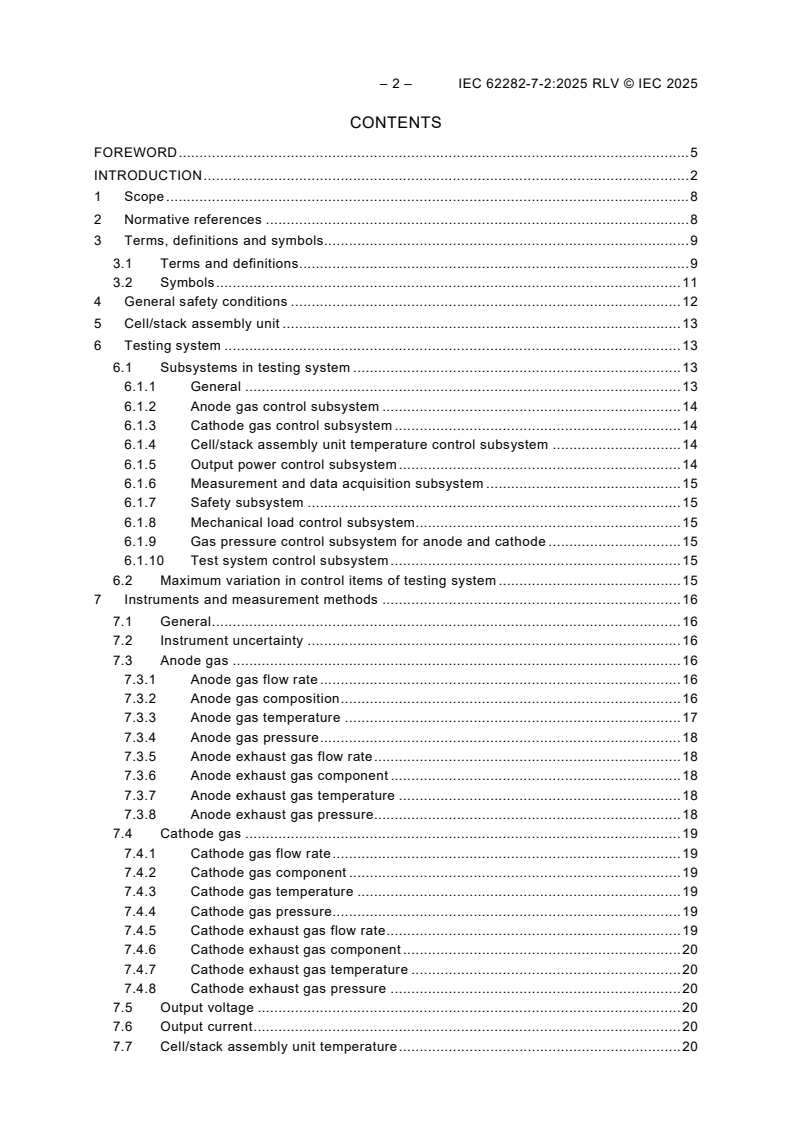
– 2 – IEC 62282-7-2:2025 RLV © IEC 2025
CONTENTS
FOREWORD . 5
INTRODUCTION . 2
1 Scope . 8
2 Normative references . 8
3 Terms, definitions and symbols. 9
3.1 Terms and definitions . 9
3.2 Symbols . 11
4 General safety conditions . 12
5 Cell/stack assembly unit . 13
6 Testing system . 13
6.1 Subsystems in testing system . 13
6.1.1 General . 13
6.1.2 Anode gas control subsystem . 14
6.1.3 Cathode gas control subsystem . 14
6.1.4 Cell/stack assembly unit temperature control subsystem . 14
6.1.5 Output power control subsystem . 14
6.1.6 Measurement and data acquisition subsystem . 15
6.1.7 Safety subsystem . 15
6.1.8 Mechanical load control subsystem. 15
6.1.9 Gas pressure control subsystem for anode and cathode . 15
6.1.10 Test system control subsystem . 15
6.2 Maximum variation in control items of testing system . 15
7 Instruments and measurement methods . 16
7.1 General . 16
7.2 Instrument uncertainty . 16
7.3 Anode gas . 16
7.3.1 Anode gas flow rate . 16
7.3.2 Anode gas composition . 16
7.3.3 Anode gas temperature . 17
7.3.4 Anode gas pressure . 18
7.3.5 Anode exhaust gas flow rate . 18
7.3.6 Anode exhaust gas component . 18
7.3.7 Anode exhaust gas temperature . 18
7.3.8 Anode exhaust gas pressure. 18
7.4 Cathode gas . 19
7.4.1 Cathode gas flow rate . 19
7.4.2 Cathode gas component . 19
7.4.3 Cathode gas temperature . 19
7.4.4 Cathode gas pressure. 19
7.4.5 Cathode exhaust gas flow rate . 19
7.4.6 Cathode exhaust gas component . 20
7.4.7 Cathode exhaust gas temperature . 20
7.4.8 Cathode exhaust gas pressure . 20
7.5 Output voltage . 20
7.6 Output current . 20
7.7 Cell/stack assembly unit temperature . 20
7.8 Mechanical load . 20
7.9 Total impedance . 21
7.10 Ambient conditions. 21
8 Test preparation . 21
8.1 General . 21
8.2 Standard test conditions and test range . 21
8.3 Components and impurities of anode gas and cathode gas . 22
8.4 Basis of the test procedure . 22
8.5 Confirmation of aging conditions of unit . 22
8.6 Confirmation of criteria of stable state . 22
8.7 Data acquisition method . 22
9 Test procedure . 23
9.1 Set-up . 23
9.2 Initial conditioning . 23
9.3 Shutdown . 23
10 Performance test . 23
10.1 Rated power test . 23
10.1.1 Objective . 23
10.1.2 Test method . 24
10.1.3 Presentation of results . 24
10.2 Current-voltage characteristics test . 24
10.2.1 Objective . 24
10.2.2 Test method . 24
10.2.3 Presentation of results . 25
10.3 Effective fuel utilization dependency test . 25
10.3.1 Objective . 25
10.3.2 Test method . 25
10.3.3 Presentation of results . 26
10.4 Long term durability test . 26
10.4.1 Objective . 26
10.4.2 Test method . 26
10.4.3 Presentation of results . 27
10.5 Thermal cycling durability test . 27
10.5.1 Objective . 27
10.5.2 Test method . 27
10.5.3 Presentation of results . 28
10.6 Internal reforming performance test . 28
10.6.1 Objective . 28
10.6.2 Test method . 28
10.6.3 Presentation of results . 29
10.7 Resistance components identification test . 29
10.7.1 Objective . 29
10.7.2 Test method . 29
10.7.3 Presentation of results . 30
11 Test report . 31
11.1 General . 31
11.2 Report items . 31
11.3 Test unit data description . 32
– 4 – IEC 62282-7-2:2025 RLV © IEC 2025
11.4 Test conditions description. 32
11.5 Test data description . 32
11.6 Uncertainty evaluation . 32
Annex A (informative) Example of cell assembly unit . 33
Annex B (informative) Calculation of effective fuel utilization . 34
B.1 General . 34
B.2 Calculation method . 34
B.3 Calculation examples . 36
B.3.1 Calculation from anode gas composition and flow rate . 36
B.3.2 Calculation from supplied H and H O flow rate . 36
2 2
Annex C (informative) Calculation of effective oxygen utilization . 37
C.1 General . 37
C.2 Calculation method . 37
C.3 Calculation example . 38
Annex D (informative) Maximum width of the voltage hysteresis in I‑V characteristics
test . 39
Annex E (informative) Current-voltage characteristics test under constant effective
fuel utilization . 40
Annex F (informative) Test report (template) . 41
F.1 Overview. 41
F.2 General information . 41
F.3 Test unit data description . 41
F.4 Test conditions . 42
F.5 Rated power test . 42
F.6 Current-voltage characteristics test . 42
F.7 Effective fuel utilization dependency test . 43
F.8 Long-term durability test . 44
F.9 Thermal cycling durability test . 45
F.10 Internal reforming performance test . 46
F.11 Resistance components identification test . 46
Annex G (informative) Method for determining instrument expanded uncertainty . 47
Bibliography . 49
Figure 1 – Testing system . 14
Figure 2 – Typical diagram of complex impedance plot for SOFC . 31
Figure A.1 – Example of cell assembly unit . 33
Figure D.1 – Voltage hysteresis at a given sweep rate in I-V characteristics test . 39
Figure E.1 – Example of the record in current-voltage characteristics test under
constant effective fuel utilization at increasing steps in current . 40
Table 1 – Symbols . 12
Table B.1 − n for representative fuels . 35
j
Table B.2 − Anode gas composition, flow rate of each fuel component q , and n q . 36
j j j
Table C.1 − Cathode gas composition, q , and I . 38
O2 theory
INTERNATIONAL ELECTROTECHNICAL COMMISSION
____________
FUEL CELL TECHNOLOGIES –
Part 7-2: Test methods – Single cell and stack performance tests
for solid oxide fuel cells (SOFCs)
FOREWORD
1) The International Electrotechnical Commission (IEC) is a worldwide organization for standardization comprising
all national electrotechnical committees (IEC National Committees). The object of IEC is to promote international
co-operation on all questions concerning standardization in the electrical and electronic fields. To this end and
in addition to other activities, IEC publishes International Standards, Technical Specifications, Technical Reports,
Publicly Available Specifications (PAS) and Guides (hereafter referred to as “IEC Publication(s)”). Their
preparation is entrusted to technical committees; any IEC National Committee interested in the subject dealt with
may participate in this preparatory work. International, governmental and non-governmental organizations liaising
with the IEC also participate in this preparation. IEC collaborates closely with the International Organization for
Standardization (ISO) in accordance with conditions determined by agreement between the two organizations.
2) The formal decisions or agreements of IEC on technical matters express, as nearly as possible, an international
consensus of opinion on the relevant subjects since each technical committee has representation from all
interested IEC National Committees.
3) IEC Publications have the form of recommendations for international use and are accepted by IEC National
Committees in that sense. While all reasonable efforts are made to ensure that the technical content of IEC
Publications is accurate, IEC cannot be held responsible for the way in which they are used or for any
misinterpretation by any end user.
4) In order to promote international uniformity, IEC National Committees undertake to apply IEC Publications
transparently to the maximum extent possible in their national and regional publications. Any divergence between
any IEC Publication and the corresponding national or regional publication shall be clearly indicated in the latter.
5) IEC itself does not provide any attestation of conformity. Independent certification bodies provide conformity
assessment services and, in some areas, access to IEC marks of conformity. IEC is not responsible for any
services carried out by independent certification bodies.
6) All users should ensure that they have the latest edition of this publication.
7) No liability shall attach to IEC or its directors, employees, servants or agents including individual experts and
members of its technical committees and IEC National Committees for any personal injury, property damage or
other damage of any nature whatsoever, whether direct or indirect, or for costs (including legal fees) and
expenses arising out of the publication, use of, or reliance upon, this IEC Publication or any other IEC
Publications.
8) Attention is drawn to the Normative references cited in this publication. Use of the referenced publications is
indispensable for the correct application of this publication.
9) IEC draws attention to the possibility that the implementation of this document may involve the use of (a)
patent(s). IEC takes no position concerning the evidence, validity or applicability of any claimed patent rights in
respect thereof. As of the date of publication of this document, IEC had not received notice of (a) patent(s), which
may be required to implement this document. However, implementers are cautioned that this may not represent
the latest information, which may be obtained from the patent database available at https://patents.iec.ch. IEC
shall not be held responsible for identifying any or all such patent rights.
This redline version of the official IEC Standard allows the user to identify the changes
made to the previous edition IEC 62282-7-2:2021. A vertical bar appears in the margin
wherever a change has been made. Additions are in green text, deletions are in
strikethrough red text.
– 6 – IEC 62282-7-2:2025 RLV © IEC 2025
IEC 62282-7-2 has been prepared by IEC technical committee 105: Fuel cell technologies. It is
an International Standard.
This second edition cancels and replaces the first edition published in 2021. This edition
constitutes a technical revision.
This edition includes the following significant technical changes with respect to the previous
edition:
a) Table 1 has been revised to specify the units missing for some terms;
b) bibliographical entries (ISO/TR 15916, SOCTESQA test modules and ISO/IEC Guide 98-
6:2021) have been added to provide further information.
The text of this International Standard is based on the following documents:
Draft Report on voting
105/1093/FDIS 105/1099/RVD
Full information on the voting for its approval can be found in the report on voting indicated in
the above table.
The language used for the development of this International Standard is English.
This document was drafted in accordance with ISO/IEC Directives, Part 2, and developed in
accordance with ISO/IEC Directives, Part 1 and ISO/IEC Directives, IEC Supplement, available
at www.iec.ch/members_experts/refdocs. The main document types developed by IEC are
described in greater detail at www.iec.ch/publications.
A list of all parts in the IEC 62282 series, published under the general title Fuel cell technologies,
can be found on the IEC website.
The committee has decided that the contents of this document will remain unchanged until the
stability date indicated on the IEC website under webstore.iec.ch in the data related to the
specific document. At this date, the document will be
• reconfirmed,
• withdrawn, or
• revised.
INTRODUCTION
This part of IEC 62282 specifies test methods for a single cell and stack (denoted as "cell/stack"
hereafter) that is required in power generation systems using Solid oxide fuel cells (SOFCs)
have a broad range of geometry and size. As such, in general, peripherals like current collectors
and gas manifolds are unique to each cell or stack and are often incorporated into a cell or
stack to form one integrated unit. In addition, they tend to have a significant effect on the power
generation characteristics of the cell or stack. This document therefore introduces as its subject
"cell/stack assembly units", which are defined as those units containing not only a cell or stack
but also peripherals.
– 8 – IEC 62282-7-2:2025 RLV © IEC 2025
FUEL CELL TECHNOLOGIES –
Part 7-2: Test methods – Single cell and stack performance tests
for solid oxide fuel cells (SOFCs)
1 Scope
This part of IEC 62282 applies to SOFC cell/stack assembly units, testing systems, instruments
and measuring methods, and specifies test methods to test the performance of SOFC cells and
stacks.
This document is not applicable to small button cells that are designed for SOFC material testing
and provide no practical means of fuel utilization measurement.
This document is used based on the recommendation of the entity that provides the cell
performance specification or for acquiring data on a cell or stack in order to estimate the
performance of a system based on it. Users of this document can selectively execute test items
suitable for their purposes from those described in this document.
Users can substitute selected test methods of this document with equivalent test methods of
IEC 62282-8-101 for solid oxide cell (SOC) operation for energy storage purposes, operated in
reverse or reversible mode.
2 Normative references
The following documents are referred to in the text in such a way that some or all of their content
constitutes requirements of this document. For dated references, only the edition cited applies.
For undated references, the latest edition of the referenced document (including any
amendments) applies.
IEC 60050-485, International Electrotechnical Vocabulary (IEV) – Part 485: Fuel cell
technologies, available at https://www.electropedia.org
IEC 60584-1, Thermocouples – Part 1: EMF specifications and tolerances
IEC 60584-3, Thermocouples – Part 3: Extension and compensating cables – Tolerances and
identification system
IEC 61515, Mineral insulated metal-sheathed thermocouple cables and thermocouples
ISO 5168, Measurement of fluid flow – Procedures for the evaluation of uncertainties
ISO 6141, Gas analysis – Contents of certificates for calibration gas mixtures
ISO 6142-1, Gas analysis – Preparation of calibration gas mixtures – Gravimetric method for
Class I mixtures
ISO 6143, Gas analysis – Comparison methods for determining and checking the composition
of calibration gas mixtures
ISO 6145-7, Gas analysis – Preparation of calibration gas mixtures using dynamic methods –
Part 7: Thermal mass-flow controllers
ISO 6974 (all parts), Natural gas – Determination of composition with defined uncertainty by
gas chromatography
ISO 7066-2, Assessment of uncertainty in the calibration and use of flow measurement devices
– Part 2: Non-linear calibration relationships
ISO 8573-1, Compressed air – Part 1: Contaminants and purity classes
ISO 8756, Air quality – Handling of temperature, pressure and humidity data
ISO 12185, Crude petroleum, petroleum products and related products – Determination of
density – Laboratory density meter with an oscillating U-tube method sensor
3 Terms, definitions and symbols
3.1 Terms and definitions
For the purposes of this document, the terms and definitions given in IEC 60050-485 and the
following apply.
ISO and IEC maintain terminology databases for use in standardization at the following
addresses:
• IEC Electropedia: available at https://www.electropedia.org/
• ISO Online browsing platform: available at https://www.iso.org/obp
3.1.1
cell/stack assembly unit
unit including a single cell or stack, as well as gas supply parts, current collector parts, and any
other peripherals as required for used in power generation tests
3.1.2
active electrode area
geometric electrode area upon which an electrochemical reaction occurs
Note 1 to entry: Usually the active electrode area is the smaller of the anode and cathode areas.
3.1.3
current density
current divided by the active electrode area
3.1.4
average repeating unit voltage
cell/stack assembly unit voltage divided by the number of the cells in a series connection in the
unit
3.1.5
standard temperature and pressure
STP
temperature of 0 °C and an absolute pressure of 101,325 kPa, respectively
– 10 – IEC 62282-7-2:2025 RLV © IEC 2025
3.1.5
anode gas
gas that is supplied to the inlet of the anode of a single cell/stack assembly unit
Note 1 to entry: Such a gas belongs to one of the following categories:
a) pure hydrogen or mixture that contains hydrogen as a principal component with water vapour or nitrogen;
b) reformed gas of raw fuel of SOFC such as methane or kerosene premixed with water vapour or air as oxidant;
c) simulated gas of reformate that contains hydrogen, water vapour, carbon monoxide, carbon dioxide, methane,
nitrogen, etc., as main components;
d) methane, alcohols and other raw fuels directly supplied in pure form or mixed with water vapour or air, or both.
e) condensable gas operating in gas phase such as anhydrous ammonia (NH ) as raw input fuel or in cracked form.
3.1.6
cathode gas
gas that is supplied to the inlet of the cathode of a single cell/stack assembly unit
Note 1 to entry: Oxygen and nitrogen are its main components.
3.1.7
current collector
conductive material in a fuel cell/stack assembly unit that collects electrons from the anode side
or conducts electrons to the cathode side
3.1.8
stable state
condition of a cell/stack assembly unit at which the unit is stable enough for any controlling
parameter and the output voltage or output current of the unit to remain within its tolerance
range of variation
3.1.9
theoretical current
current when the supplied anode gas or cathode gas is completely consumed in electrochemical
reactions divided by the number of cells in a series connection
3.1.10
effective fuel utilization
ratio of the actual output current of the cell/stack assembly unit to the theoretical current that is
calculated for the supplied fuel
Note 1 to entry: The effective utilization is the utilization of reactants in the electrochemical reaction at the anode
due to the actual current. This may can be less than the actual or total utilization if there are gas inlet and cross
leaks.
Note 2 to entry: Causes of less-than-optimal currents include losses due to electronic conduction within the
cell/stack assembly, gas leaks and anode gas pass-through.
Note 3 to entry: A calculation method of effective fuel utilization is given in Annex B.
3.1.11
effective oxygen utilization
ratio of the actual output current of the cell/stack assembly unit to the theoretical current that is
calculated for the supplied oxygen
Note 1 to entry: The effective utilization is the utilization of reactants in the electrochemical reaction at the cathode
due to the actual current. This may can be less than the actual or total utilization if there are gas inlet and cross
leaks.
Note 2 to entry: A calculation method of effective oxygen utilization is given in Annex C.
3.1.12
maximum effective fuel utilization
highest effective fuel utilization that the cell/stack assembly unit can operate at, without causing
unacceptable degradation
Note 1 to entry: The acceptable degradation rate is usually obtained from the developer.
3.1.13
minimum cell/stack assembly unit voltage
lowest cell/stack assembly unit voltage specified by the manufacturer
3.1.14
open circuit voltage
OCV
voltage across the terminals of a fuel cell/stack assembly unit with cathode and anode gases
present and in the absence of external current flow
Note 1 to entry: Also known as "no-load voltage".
3.1.16
power density
ratio of the power to the active electrode area of a cell/stack assembly unit
Note 1 to entry: Power density is calculated from the voltage multiplied by the current density (P = V × J, where J
d
is current density).
3.1.15
total impedance
frequency-dependent losses due to ohmic, activation, diffusion, concentration effects, stray
(parasitic) capacitance and inductances
3.1.16
total resistance
real part of the low-frequency limit of total impedance
3.1.17
stoichiometric ratio
ratio between the number of moles of reactant gas flowing per unit time to that needed used by
the electrochemical reaction
Note 1 to entry: The terms, "stoichiometric ratio" and "reactant gas utilization," are related. The reciprocal of the
fraction of the gas utilized is the stoichiometric ratio.
3.2 Symbols
Table 1 lists the symbols and units that are used in this document.
– 12 – IEC 62282-7-2:2025 RLV © IEC 2025
Table 1 – Symbols
Symbol Term Unit
a
a Error limit specified from specification of instrument
I Current A
J Current density A/cm
A Active electrode area
cm
Z Total impedance
Ω cm
n Number of transferred electrons
N Number of cells in a series connection in the cell/stack assembly unit
p
Absolute pressure of anode gas kPa
a
p
Absolute pressure of cathode gas kPa
c
P Output power W
P
Output power density
W/cm
d
b
q
Flow rate of anode gas l/min (STP )
a
q
Flow rate of cathode gas l/min (STP)
c
q
Flow rate of fuel component j in anode gas l/min (STP)
j
t Time s, min, h
T
Cell/stack assembly unit operating temperature °C or K
op
u u a
Combined standard uncertainty for instruments
I c
u a
Standard uncertainty for instrument i
I,i
U
Effective fuel utilization %
f
U
Effective oxygen utilization %
O2
U a
Extended instrument Instrument expanded uncertainty
I
V Voltage V
bc
x
Molar fraction of component i or mole percent of component i
mol/mol or mol %
i
c
Concentration of component i
mol/m
i
ξ
Hydrocarbon conversion rate for hydrocarbon component j %
j
a
Denotes where the unit varies depending on the specification.
b
Abbreviation for standard temperature and pressure
bc
Mole percent expressed as one hundred times mole fraction.
4 General safety conditions
An operating fuel cell uses oxidizing and combustible gases. Typically, these gases are stored
in high-pressure containers. In some cases, the fuel can be a toxic condensable gas (such as
ammonia). The fuel cell itself may can be operated at pressures greater than atmospheric
pressure. Leaks or outlet flows from cell/stack assembly unit can contain toxic elements (e.g.
when using ammonia as a fuel). Those who carry out cell/stack assembly unit testing shall be
trained and experienced in the operation of test systems and specifically in safety procedures
involving electrical equipment and reactive, compressed gases, and toxic compounds if
applicable (e.g. when using ammonia as a fuel).
The test personnel are responsible for obtaining and following all applicable safety codes and
generally accepted engineering practices related to their test system, facility, fuels (with
particular attention to compressed gases), and exhaust products.
Materials which are compatible with the use and storage of the reactant gases shall be used
during testing. Local safety codes and standards for working with hydrogen, hydrocarbons and
carbon monoxide should be followed.
In summary, safely operating a test station requires appropriate technical training and
experience as well as safety facilities and equipment, all of which are outside the scope of this
document.
5 Cell/stack assembly unit
A cell/stack assembly unit includes a cell or stack, gas supply, current leads, and such other
peripherals as required for power generation tests. It shall be provided with single or multiple
measuring points for temperature and voltage, and one set of current lead points, all to be
specified by the manufacturer.
As shown in Annex A, the boundary of a cell/stack assembly unit goes through the anode gas
supply port, cathode gas supply port, temperature, pressure measuring point, current lead
points, voltage measuring points and mechanical load application points.
Some cell/stack assembly units may can have no exhaust port for the anode gas or cathode
gas because of the configuration of the cells. In such cases, the gas flow field pattern and its
material shall be determined by the method recommended by the manufacturer. The load
application method shall be also based on the recommendation of the manufacturer. The
maximum operating temperature from recommended by the manufacturer shall not be exceeded.
If the components of a cell/stack assembly unit other than a cell/stack are not specified by the
manufacturer, the following shall be described in the test report, as a minimum:
a) materials and geometry of the peripheral components to be used for testing;
b) flow patterns and directions of anode and cathode gases;
c) locations of temperature measurement, mechanical load application, voltage measurement
and current leads;
d) magnitude of the mechanical load;
e) configuration of assembly unit and its assembling method.
6 Testing system
6.1 Subsystems in testing system
6.1.1 General
As shown in Figure 1, a testing system consists of an anode gas control subsystem, cathode
gas control subsystem, cell/stack assembly unit temperature control subsystem, output power
control subsystem, measurement and data acquisition subsystem and safety subsystem. It may
can also include a mechanical load control subsystem, anode gas and cathode gas pressure
control subsystem or a test system control subsystem that controls the whole testing system,
or both, if necessary.
– 14 – IEC 62282-7-2:2025 RLV © IEC 2025
Figure 1 – Testing system
6.1.2 Anode gas control subsystem
The anode gas control subsystem controls the flow rate, composition and temperature of the
anode gas supplied to the cell/stack assembly unit. If the gas composition is to be maintained
throughout the piping, then attention shall be paid to the materials, temperature, inner diameter
and length of the piping shall be selected such as to ensure that any changes the gas
composition can have within the piping are insignificant. Where necessary, the piping shall be
heated or thermally insulated, or both in order to prevent condensation of water vapour.
Care should be taken to avoid other phenomena, such as carbon deposits, and the evaporation
and transport of undesired materials in the gas streams, such as chromium species.
6.1.3 Cathode gas control subsystem
The cathode gas control subsystem controls the flow rate, composition and temperature of the
cathode gas supplied to the cell/stack assembly unit.
6.1.4 Cell/stack assembly unit temperature control subsystem
The cell/stack assembly unit temperature control subsystem controls, at least, the electric
furnace or the unit temperature. It maintains the operating temperature. The electric furnace
shall be selected to maintain the temperature distribution within the specified tolerance level.
Efforts should be made to minimize the electrical noise that the electric furnace generates while
providing heat. It is assumed that all the test systems will use an electrical furnace for simplicity
and safety reasons.
6.1.5 Output power control subsystem
The output power control subsystem controls the output current or output voltage of the
cell/stack assembly unit.
6.1.6 Measurement and data acquisition subsystem
The measurement and data acquisition subsystem acquires and records the cell/stack assembly
unit temperature, current, voltage, anode gas flow rate, cathode gas flow rate, and optionally,
environmental conditions (ambient temperature, relative humidity, and atmospheric pressure)
in accordance with the specified method. If necessary, it also acquires and records the
mechanical load applied to the cell; the temperature, composition and pressure of the cathode
gas and the anode gas; the flow rate, composition, temperature and pressure of anode and
cathode exhaust gases; and cell/stack assembly unit impedance data, etc., in accordance with
the specified method.
6.1.7 Safety subsystem
The safety subsystem functions as a detector and alarm system for malfunctioning of the test
system based on predefined parameters and criteria. If it detects a serious fault, then it shall
automatically establish a safe state in the test system. The anode should be purged with an
inert gas, such as nitrogen, which could can also contain hydrogen at concentrations below the
lower flammability limit.
6.1.8 Mechanical load control subsystem
The optional mechanical load control subsystem regulates the mechanical load that is applied
to increase the contact among components in the cell/stack assembly unit. The subsystem
should be strong enough to apply the required mechanical load under the test conditions and
to maintain the load for long term operation.
6.1.9 Gas pressure control subsystem for anode and cathode
The optional gas pressure control subsystem for anode and cathode gases regulates the
pressure of these gases by the use of a back pressure control valve, etc.
6.1.10 Test system control subsystem
The test system control subsystem provides the integrated control for each control subsystem
and data acquisition subsystem.
6.2 Maximum variation in control items of testing system
The tolerable variation of each control item in the testing system shall fall within the following
ranges:
in the case of current control: current: ±1 % relative to rated value point;
in the case of voltage control: voltage: ±1 % relative to set point;
temperature: ±1,0 % relative to set point;
NOTE 1 Temperature variation at the set point of less than ±5 K will increase reproducibility.
anode and cathode gas flow rates: ±1 % relative to rated;
anode gas composition: ±2,0 mol % for H , N ;
2 2
±2,0 mol % for CO, CO , CH NH3;
2 4,
±5,0 mol % for H O (water vapour concentration);
in case of bubbler or sparger humidification: dew point temperature: ±1 °C;
NOTE 2 At water vapour concentrations greater than 10 mo
...
IEC 62282-7-2 ®
Edition 2.0 2025-03
INTERNATIONAL
STANDARD
NORME
INTERNATIONALE
Fuel cell technologies –
Part 7-2: Test methods – Single cell and stack performance tests for solid oxide
fuel cells (SOFCs)
Technologies des piles à combustible –
Partie 7-2: Méthodes d’essai – Essais de performance de cellule élémentaire et
de pile pour les piles à combustible à oxyde solide (SOFC)
All rights reserved. Unless otherwise specified, no part of this publication may be reproduced or utilized in any form
or by any means, electronic or mechanical, including photocopying and microfilm, without permission in writing from
either IEC or IEC's member National Committee in the country of the requester. If you have any questions about IEC
copyright or have an enquiry about obtaining additional rights to this publication, please contact the address below or
your local IEC member National Committee for further information.
Droits de reproduction réservés. Sauf indication contraire, aucune partie de cette publication ne peut être reproduite ni
utilisée sous quelque forme que ce soit et par aucun procédé, électronique ou mécanique, y compris la photocopie et
les microfilms, sans l'accord écrit de l'IEC ou du Comité national de l'IEC du pays du demandeur. Si vous avez des
questions sur le copyright de l'IEC ou si vous désirez obtenir des droits supplémentaires sur cette publication, utilisez
les coordonnées ci-après ou contactez le Comité national de l'IEC de votre pays de résidence.
IEC Secretariat Tel.: +41 22 919 02 11
3, rue de Varembé info@iec.ch
CH-1211 Geneva 20 www.iec.ch
Switzerland
About the IEC
The International Electrotechnical Commission (IEC) is the leading global organization that prepares and publishes
International Standards for all electrical, electronic and related technologies.
About IEC publications
The technical content of IEC publications is kept under constant review by the IEC. Please make sure that you have the
latest edition, a corrigendum or an amendment might have been published.
IEC publications search - webstore.iec.ch/advsearchform IEC Products & Services Portal - products.iec.ch
The advanced search enables to find IEC publications by a Discover our powerful search engine and read freely all the
variety of criteria (reference number, text, technical publications previews, graphical symbols and the glossary.
committee, …). It also gives information on projects, replaced With a subscription you will always have access to up to date
and withdrawn publications. content tailored to your needs.
IEC Just Published - webstore.iec.ch/justpublished
Electropedia - www.electropedia.org
Stay up to date on all new IEC publications. Just Published
The world's leading online dictionary on electrotechnology,
details all new publications released. Available online and once
containing more than 22 500 terminological entries in English
a month by email.
and French, with equivalent terms in 25 additional languages.
Also known as the International Electrotechnical Vocabulary
IEC Customer Service Centre - webstore.iec.ch/csc
(IEV) online.
If you wish to give us your feedback on this publication or need
further assistance, please contact the Customer Service
Centre: sales@iec.ch.
A propos de l'IEC
La Commission Electrotechnique Internationale (IEC) est la première organisation mondiale qui élabore et publie des
Normes internationales pour tout ce qui a trait à l'électricité, à l'électronique et aux technologies apparentées.
A propos des publications IEC
Le contenu technique des publications IEC est constamment revu. Veuillez vous assurer que vous possédez l’édition la
plus récente, un corrigendum ou amendement peut avoir été publié.
Recherche de publications IEC - IEC Products & Services Portal - products.iec.ch
webstore.iec.ch/advsearchform Découvrez notre puissant moteur de recherche et consultez
La recherche avancée permet de trouver des publications IEC gratuitement tous les aperçus des publications, symboles
en utilisant différents critères (numéro de référence, texte, graphiques et le glossaire. Avec un abonnement, vous aurez
comité d’études, …). Elle donne aussi des informations sur les toujours accès à un contenu à jour adapté à vos besoins.
projets et les publications remplacées ou retirées.
Electropedia - www.electropedia.org
IEC Just Published - webstore.iec.ch/justpublished
Le premier dictionnaire d'électrotechnologie en ligne au monde,
Restez informé sur les nouvelles publications IEC. Just
avec plus de 22 500 articles terminologiques en anglais et en
Published détaille les nouvelles publications parues.
français, ainsi que les termes équivalents dans 25 langues
Disponible en ligne et une fois par mois par email.
additionnelles. Egalement appelé Vocabulaire
Electrotechnique International (IEV) en ligne.
Service Clients - webstore.iec.ch/csc
Si vous désirez nous donner des commentaires sur cette
publication ou si vous avez des questions contactez-nous:
sales@iec.ch.
IEC 62282-7-2 ®
Edition 2.0 2025-03
INTERNATIONAL
STANDARD
NORME
INTERNATIONALE
Fuel cell technologies –
Part 7-2: Test methods – Single cell and stack performance tests for solid oxide
fuel cells (SOFCs)
Technologies des piles à combustible –
Partie 7-2: Méthodes d’essai – Essais de performance de cellule élémentaire et
de pile pour les piles à combustible à oxyde solide (SOFC)
INTERNATIONAL
ELECTROTECHNICAL
COMMISSION
COMMISSION
ELECTROTECHNIQUE
INTERNATIONALE
ICS 27.070 ISBN 978-2-8327-0241-3
– 2 – IEC 62282-7-2:2025 © IEC 2025
CONTENTS
FOREWORD . 5
INTRODUCTION . 7
1 Scope . 8
2 Normative references . 8
3 Terms, definitions and symbols. 9
3.1 Terms and definitions . 9
3.2 Symbols . 11
4 General safety conditions . 12
5 Cell/stack assembly unit . 12
6 Testing system . 12
6.1 Subsystems in testing system . 12
6.1.1 General . 12
6.1.2 Anode gas control subsystem . 13
6.1.3 Cathode gas control subsystem . 13
6.1.4 Cell/stack assembly unit temperature control subsystem . 13
6.1.5 Output power control subsystem . 13
6.1.6 Measurement and data acquisition subsystem . 14
6.1.7 Safety subsystem . 14
6.1.8 Mechanical load control subsystem. 14
6.1.9 Gas pressure control subsystem for anode and cathode . 14
6.1.10 Test system control subsystem . 14
6.2 Maximum variation in control items of testing system . 14
7 Instruments and measurement methods . 15
7.1 General . 15
7.2 Instrument uncertainty . 15
7.3 Anode gas . 15
7.3.1 Anode gas flow rate . 15
7.3.2 Anode gas composition . 15
7.3.3 Anode gas temperature . 16
7.3.4 Anode gas pressure . 17
7.3.5 Anode exhaust gas flow rate . 17
7.3.6 Anode exhaust gas component . 17
7.3.7 Anode exhaust gas temperature . 17
7.3.8 Anode exhaust gas pressure. 17
7.4 Cathode gas . 18
7.4.1 Cathode gas flow rate . 18
7.4.2 Cathode gas component . 18
7.4.3 Cathode gas temperature . 18
7.4.4 Cathode gas pressure. 18
7.4.5 Cathode exhaust gas flow rate . 18
7.4.6 Cathode exhaust gas component . 19
7.4.7 Cathode exhaust gas temperature . 19
7.4.8 Cathode exhaust gas pressure . 19
7.5 Output voltage . 19
7.6 Output current . 19
7.7 Cell/stack assembly unit temperature . 19
7.8 Mechanical load . 19
7.9 Total impedance . 20
7.10 Ambient conditions. 20
8 Test preparation . 20
8.1 General . 20
8.2 Standard test conditions and test range . 20
8.3 Components and impurities of anode gas and cathode gas . 21
8.4 Basis of the test procedure . 21
8.5 Confirmation of aging conditions of unit . 21
8.6 Confirmation of criteria of stable state . 21
8.7 Data acquisition method . 21
9 Test procedure . 22
9.1 Set-up . 22
9.2 Initial conditioning . 22
9.3 Shutdown . 22
10 Performance test . 22
10.1 Rated power test . 22
10.1.1 Objective . 22
10.1.2 Test method . 23
10.1.3 Presentation of results . 23
10.2 Current-voltage characteristics test . 23
10.2.1 Objective . 23
10.2.2 Test method . 23
10.2.3 Presentation of results . 24
10.3 Effective fuel utilization dependency test . 24
10.3.1 Objective . 24
10.3.2 Test method . 24
10.3.3 Presentation of results . 25
10.4 Long term durability test . 25
10.4.1 Objective . 25
10.4.2 Test method . 25
10.4.3 Presentation of results . 26
10.5 Thermal cycling durability test . 26
10.5.1 Objective . 26
10.5.2 Test method . 26
10.5.3 Presentation of results . 27
10.6 Internal reforming performance test . 27
10.6.1 Objective . 27
10.6.2 Test method . 27
10.6.3 Presentation of results . 28
10.7 Resistance components identification test . 28
10.7.1 Objective . 28
10.7.2 Test method . 28
10.7.3 Presentation of results . 29
11 Test report . 30
11.1 General . 30
11.2 Report items . 30
11.3 Test unit data description . 30
– 4 – IEC 62282-7-2:2025 © IEC 2025
11.4 Test conditions description. 30
11.5 Test data description . 31
11.6 Uncertainty evaluation . 31
Annex A (informative) Example of cell assembly unit . 32
Annex B (informative) Calculation of effective fuel utilization . 33
B.1 General . 33
B.2 Calculation method . 33
B.3 Calculation examples . 35
B.3.1 Calculation from anode gas composition and flow rate . 35
B.3.2 Calculation from supplied H and H O flow rate . 35
2 2
Annex C (informative) Calculation of effective oxygen utilization . 36
C.1 General . 36
C.2 Calculation method . 36
C.3 Calculation example . 37
Annex D (informative) Maximum width of the voltage hysteresis in I‑V characteristics
test . 38
Annex E (informative) Current-voltage characteristics test under constant effective
fuel utilization . 39
Annex F (informative) Test report (template) . 40
F.1 Overview. 40
F.2 General information . 40
F.3 Test unit data description . 40
F.4 Test conditions . 41
F.5 Rated power test . 41
F.6 Current-voltage characteristics test . 41
F.7 Effective fuel utilization dependency test . 42
F.8 Long-term durability test . 43
F.9 Thermal cycling durability test . 44
F.10 Internal reforming performance test . 45
F.11 Resistance components identification test . 45
Annex G (informative) Method for determining instrument expanded uncertainty . 46
Bibliography . 47
Figure 1 – Testing system . 13
Figure 2 – Typical diagram of complex impedance plot for SOFC . 29
Figure A.1 – Example of cell assembly unit . 32
Figure D.1 – Voltage hysteresis at a given sweep rate in I-V characteristics test . 38
Figure E.1 – Example of the record in current-voltage characteristics test under
constant effective fuel utilization at increasing steps in current . 39
Table 1 – Symbols . 11
Table B.1 − n for representative fuels . 34
j
Table B.2 − Anode gas composition, flow rate of each fuel component q , and n q . 35
j j j
Table C.1 − Cathode gas composition, q , and I . 37
O2 theory
INTERNATIONAL ELECTROTECHNICAL COMMISSION
____________
FUEL CELL TECHNOLOGIES –
Part 7-2: Test methods – Single cell and stack performance tests
for solid oxide fuel cells (SOFCs)
FOREWORD
1) The International Electrotechnical Commission (IEC) is a worldwide organization for standardization comprising
all national electrotechnical committees (IEC National Committees). The object of IEC is to promote international
co-operation on all questions concerning standardization in the electrical and electronic fields. To this end and
in addition to other activities, IEC publishes International Standards, Technical Specifications, Technical Reports,
Publicly Available Specifications (PAS) and Guides (hereafter referred to as “IEC Publication(s)”). Their
preparation is entrusted to technical committees; any IEC National Committee interested in the subject dealt with
may participate in this preparatory work. International, governmental and non-governmental organizations liaising
with the IEC also participate in this preparation. IEC collaborates closely with the International Organization for
Standardization (ISO) in accordance with conditions determined by agreement between the two organizations.
2) The formal decisions or agreements of IEC on technical matters express, as nearly as possible, an international
consensus of opinion on the relevant subjects since each technical committee has representation from all
interested IEC National Committees.
3) IEC Publications have the form of recommendations for international use and are accepted by IEC National
Committees in that sense. While all reasonable efforts are made to ensure that the technical content of IEC
Publications is accurate, IEC cannot be held responsible for the way in which they are used or for any
misinterpretation by any end user.
4) In order to promote international uniformity, IEC National Committees undertake to apply IEC Publications
transparently to the maximum extent possible in their national and regional publications. Any divergence between
any IEC Publication and the corresponding national or regional publication shall be clearly indicated in the latter.
5) IEC itself does not provide any attestation of conformity. Independent certification bodies provide conformity
assessment services and, in some areas, access to IEC marks of conformity. IEC is not responsible for any
services carried out by independent certification bodies.
6) All users should ensure that they have the latest edition of this publication.
7) No liability shall attach to IEC or its directors, employees, servants or agents including individual experts and
members of its technical committees and IEC National Committees for any personal injury, property damage or
other damage of any nature whatsoever, whether direct or indirect, or for costs (including legal fees) and
expenses arising out of the publication, use of, or reliance upon, this IEC Publication or any other IEC
Publications.
8) Attention is drawn to the Normative references cited in this publication. Use of the referenced publications is
indispensable for the correct application of this publication.
9) IEC draws attention to the possibility that the implementation of this document may involve the use of (a)
patent(s). IEC takes no position concerning the evidence, validity or applicability of any claimed patent rights in
respect thereof. As of the date of publication of this document, IEC had not received notice of (a) patent(s), which
may be required to implement this document. However, implementers are cautioned that this may not represent
the latest information, which may be obtained from the patent database available at https://patents.iec.ch. IEC
shall not be held responsible for identifying any or all such patent rights.
IEC 62282-7-2 has been prepared by IEC technical committee 105: Fuel cell technologies. It is
an International Standard.
This second edition cancels and replaces the first edition published in 2021. This edition
constitutes a technical revision.
This edition includes the following significant technical changes with respect to the previous
edition:
a) Table 1 has been revised to specify the units missing for some terms;
b) bibliographical entries (ISO/TR 15916, SOCTESQA test modules and ISO/IEC Guide 98-
6:2021) have been added to provide further information.
– 6 – IEC 62282-7-2:2025 © IEC 2025
The text of this International Standard is based on the following documents:
Draft Report on voting
105/1093/FDIS 105/1099/RVD
Full information on the voting for its approval can be found in the report on voting indicated in
the above table.
The language used for the development of this International Standard is English.
This document was drafted in accordance with ISO/IEC Directives, Part 2, and developed in
accordance with ISO/IEC Directives, Part 1 and ISO/IEC Directives, IEC Supplement, available
at www.iec.ch/members_experts/refdocs. The main document types developed by IEC are
described in greater detail at www.iec.ch/publications.
A list of all parts in the IEC 62282 series, published under the general title Fuel cell technologies,
can be found on the IEC website.
The committee has decided that the contents of this document will remain unchanged until the
stability date indicated on the IEC website under webstore.iec.ch in the data related to the
specific document. At this date, the document will be
• reconfirmed,
• withdrawn, or
• revised.
INTRODUCTION
Solid oxide fuel cells (SOFCs) have a broad range of geometry and size. As such, in general,
peripherals like current collectors and gas manifolds are unique to each cell or stack and are
often incorporated into a cell or stack to form one integrated unit. In addition, they tend to have
a significant effect on the power generation characteristics of the cell or stack. This document
therefore introduces as its subject "cell/stack assembly units", which are defined as those units
containing not only a cell or stack but also peripherals.
– 8 – IEC 62282-7-2:2025 © IEC 2025
FUEL CELL TECHNOLOGIES –
Part 7-2: Test methods – Single cell and stack performance tests
for solid oxide fuel cells (SOFCs)
1 Scope
This part of IEC 62282 applies to SOFC cell/stack assembly units, testing systems, instruments
and measuring methods, and specifies test methods to test the performance of SOFC cells and
stacks.
This document is not applicable to small button cells that are designed for SOFC material testing
and provide no practical means of fuel utilization measurement.
This document is used based on the recommendation of the entity that provides the cell
performance specification or for acquiring data on a cell or stack in order to estimate the
performance of a system based on it. Users of this document can selectively execute test items
suitable for their purposes from those described in this document.
Users can substitute selected test methods of this document with equivalent test methods of
IEC 62282-8-101 for solid oxide cell (SOC) operation for energy storage purposes, operated in
reverse or reversible mode.
2 Normative references
The following documents are referred to in the text in such a way that some or all of their content
constitutes requirements of this document. For dated references, only the edition cited applies.
For undated references, the latest edition of the referenced document (including any
amendments) applies.
IEC 60050-485, International Electrotechnical Vocabulary (IEV) – Part 485: Fuel cell
technologies, available at https://www.electropedia.org
IEC 60584-1, Thermocouples – Part 1: EMF specifications and tolerances
IEC 60584-3, Thermocouples – Part 3: Extension and compensating cables – Tolerances and
identification system
IEC 61515, Mineral insulated metal-sheathed thermocouple cables and thermocouples
ISO 5168, Measurement of fluid flow – Procedures for the evaluation of uncertainties
ISO 6974 (all parts), Natural gas – Determination of composition with defined uncertainty by
gas chromatography
ISO 7066-2, Assessment of uncertainty in the calibration and use of flow measurement devices
– Part 2: Non-linear calibration relationships
ISO 8573-1, Compressed air – Part 1: Contaminants and purity classes
ISO 8756, Air quality – Handling of temperature, pressure and humidity data
ISO 12185, Crude petroleum, petroleum products and related products – Determination of
density – Laboratory density meter with an oscillating U-tube sensor
3 Terms, definitions and symbols
3.1 Terms and definitions
For the purposes of this document, the terms and definitions given in IEC 60050-485 and the
following apply.
ISO and IEC maintain terminology databases for use in standardization at the following
addresses:
• IEC Electropedia: available at https://www.electropedia.org/
• ISO Online browsing platform: available at https://www.iso.org/obp
3.1.1
cell/stack assembly unit
unit including a single cell or stack, as well as gas supply parts, current collector parts, and any
other peripherals used in power generation tests
3.1.2
active electrode area
geometric electrode area upon which an electrochemical reaction occurs
Note 1 to entry: Usually the active electrode area is the smaller of the anode and cathode areas.
3.1.3
current density
current divided by the active electrode area
3.1.4
average repeating unit voltage
cell/stack assembly unit voltage divided by the number of the cells in a series connection in the
unit
3.1.5
anode gas
gas that is supplied to the inlet of the anode of a single cell/stack assembly unit
Note 1 to entry: Such a gas belongs to one of the following categories:
a) pure hydrogen or mixture that contains hydrogen as a principal component with water vapour or nitrogen;
b) reformed gas of raw fuel of SOFC such as methane or kerosene premixed with water vapour or air as oxidant;
c) simulated gas of reformate that contains hydrogen, water vapour, carbon monoxide, carbon dioxide, methane,
nitrogen, etc., as main components;
d) methane, alcohols and other raw fuels directly supplied in pure form or mixed with water vapour or air, or both.
e) condensable gas operating in gas phase such as anhydrous ammonia (NH ) as raw input fuel or in cracked form.
3.1.6
cathode gas
gas that is supplied to the inlet of the cathode of a single cell/stack assembly unit
Note 1 to entry: Oxygen and nitrogen are its main components.
3.1.7
current collector
conductive material in a cell/stack assembly unit that collects electrons from the anode side or
conducts electrons to the cathode side
– 10 – IEC 62282-7-2:2025 © IEC 2025
3.1.8
stable state
condition of a cell/stack assembly unit at which the unit is stable enough for any controlling
parameter and the output voltage or output current of the unit to remain within its tolerance
range of variation
3.1.9
theoretical current
current when the supplied anode gas or cathode gas is completely consumed in electrochemical
reactions divided by the number of cells in a series connection
3.1.10
effective fuel utilization
ratio of the actual output current of the cell/stack assembly unit to the theoretical current that is
calculated for the supplied fuel
Note 1 to entry: The effective utilization is the utilization of reactants in the electrochemical reaction at the anode
due to the actual current. This can be less than the actual or total utilization if there are gas inlet and cross leaks.
Note 2 to entry: Causes of less-than-optimal currents include losses due to electronic conduction within the
cell/stack assembly, gas leaks.
Note 3 to entry: A calculation method of effective fuel utilization is given in Annex B.
3.1.11
effective oxygen utilization
ratio of the actual output current of the cell/stack assembly unit to the theoretical current that is
calculated for the supplied oxygen
Note 1 to entry: The effective utilization is the utilization of reactants in the electrochemical reaction at the cathode
due to the actual current. This can be less than the actual or total utilization if there are gas inlet and cross leaks.
Note 2 to entry: A calculation method of effective oxygen utilization is given in Annex C.
3.1.12
maximum effective fuel utilization
highest effective fuel utilization that the cell/stack assembly unit can operate at, without causing
unacceptable degradation
Note 1 to entry: The acceptable degradation rate is usually obtained from the developer.
3.1.13
minimum cell/stack assembly unit voltage
lowest cell/stack assembly unit voltage specified by the manufacturer
3.1.14
open circuit voltage
OCV
voltage across the terminals of a cell/stack assembly unit with cathode and anode gases present
and in the absence of external current flow
Note 1 to entry: Also known as "no-load voltage".
3.1.15
total impedance
frequency-dependent losses due to ohmic, activation, diffusion, concentration effects, stray
(parasitic) capacitance and inductances
3.1.16
total resistance
real part of the low-frequency limit of total impedance
3.1.17
stoichiometric ratio
ratio between the number of moles of reactant gas flowing per unit time to that used by the
electrochemical reaction
Note 1 to entry: The terms, "stoichiometric ratio" and "reactant gas utilization," are related. The reciprocal of the
fraction of the gas utilized is the stoichiometric ratio.
3.2 Symbols
Table 1 lists the symbols and units that are used in this document.
Table 1 – Symbols
Symbol Term Unit
a
a Error limit specified from specification of instrument
I Current A
J Current density
A/cm
A Active electrode area
cm
Z Total impedance Ω cm
n Number of transferred electrons
N Number of cells in a series connection in the cell/stack assembly unit
p
Absolute pressure of anode gas kPa
a
p
Absolute pressure of cathode gas kPa
c
P Output power W
P
Output power density W/cm
d
b
q
Flow rate of anode gas
l/min (STP )
a
q
Flow rate of cathode gas l/min (STP)
c
q
Flow rate of fuel component j in anode gas l/min (STP)
j
t Time s, min, h
T
Cell/stack assembly unit operating temperature °C or K
op
u a
Combined standard uncertainty for instruments
c
u a
Standard uncertainty for instrument i
I,i
U
Effective fuel utilization %
f
U
Effective oxygen utilization %
O2
U a
Instrument expanded uncertainty
I
V Voltage V
c
x
Molar fraction of component i or mole percent of component i mol/mol or mol %
i
c
Concentration of component i mol/m
i
ξ
Hydrocarbon conversion rate for hydrocarbon component j %
j
a
Denotes where the unit varies depending on the specification.
b
Abbreviation for standard temperature and pressure
c
Mole percent expressed as one hundred times mole fraction.
– 12 – IEC 62282-7-2:2025 © IEC 2025
4 General safety conditions
An operating fuel cell uses oxidizing and combustible gases. Typically, these gases are stored
in high-pressure containers. In some cases, the fuel can be a toxic condensable gas (such as
ammonia). The fuel cell itself can be operated at pressures greater than atmospheric pressure.
Leaks or outlet flows from cell/stack assembly unit can contain toxic elements (e.g. when using
ammonia as a fuel). Those who carry out cell/stack assembly unit testing shall be trained and
experienced in the operation of test systems and specifically in safety procedures involving
electrical equipment and reactive, compressed gases, and toxic compounds if applicable (e.g.
when using ammonia as a fuel).
Materials which are compatible with the use and storage of the reactant gases shall be used
during testing.
In summary, safely operating a test station requires appropriate technical training and
experience as well as safety facilities and equipment, all of which are outside the scope of this
document.
5 Cell/stack assembly unit
A cell/stack assembly unit includes a cell or stack, gas supply, current leads, and such other
peripherals as required for power generation. It shall be provided with single or multiple
measuring points for temperature and voltage, and one set of current lead points, all to be
specified by the manufacturer.
As shown in Annex A, the boundary of a cell assembly unit goes through the anode gas supply
port, cathode gas supply port, temperature, pressure measuring point, current lead points,
voltage measuring points and mechanical load application points.
Some cell/stack assembly units can have no exhaust port for the anode gas or cathode gas
because of the configuration of the cells. In such cases, the gas flow field pattern and its
material shall be determined by the method recommended by the manufacturer. The load
application method shall be also based on the recommendation of the manufacturer. The
maximum operating temperature recommended by the manufacturer shall not be exceeded.
If the components of a cell/stack assembly unit other than a cell/stack are not specified by the
manufacturer, the following shall be described in the test report, as a minimum:
a) materials and geometry of the peripheral components to be used for testing;
b) flow patterns and directions of anode and cathode gases;
c) locations of temperature measurement, mechanical load application, voltage measurement
and current leads;
d) magnitude of the mechanical load;
e) configuration of assembly unit and its assembling method.
6 Testing system
6.1 Subsystems in testing system
6.1.1 General
As shown in Figure 1, a testing system consists of an anode gas control subsystem, cathode
gas control subsystem, cell/stack assembly unit temperature control subsystem, output power
control subsystem, measurement and data acquisition subsystem and safety subsystem. It can
also include a mechanical load control subsystem, anode gas and cathode gas pressure control
subsystem or a test system control subsystem that controls the whole testing system, or both,
if necessary.
Figure 1 – Testing system
6.1.2 Anode gas control subsystem
The anode gas control subsystem controls the flow rate, composition and temperature of the
anode gas supplied to the cell/stack assembly unit. If the gas composition is to be maintained
throughout the piping, then the materials, temperature, inner diameter and length of the piping
shall be selected such as to ensure that any changes the gas composition can have within the
piping are insignificant. Where necessary, the piping shall be heated or thermally insulated, or
both in order to prevent condensation of water vapour.
Care should be taken to avoid other phenomena, such as carbon deposits, and the evaporation
and transport of undesired materials in the gas streams, such as chromium species.
6.1.3 Cathode gas control subsystem
The cathode gas control subsystem controls the flow rate, composition and temperature of the
cathode gas supplied to the cell/stack assembly unit.
6.1.4 Cell/stack assembly unit temperature control subsystem
The cell/stack assembly unit temperature control subsystem controls, at least, the electric
furnace or the unit temperature. It maintains the operating temperature. The electric furnace
shall be selected to maintain the temperature distribution within the specified tolerance level.
Efforts should be made to minimize the electrical noise that the electric furnace generates while
providing heat. It is assumed that all the test systems will use an electrical furnace for simplicity
and safety reasons.
6.1.5 Output power control subsystem
The output power control subsystem controls the output current or output voltage of the
cell/stack assembly unit.
– 14 – IEC 62282-7-2:2025 © IEC 2025
6.1.6 Measurement and data acquisition subsystem
The measurement and data acquisition subsystem acquires and records the cell/stack assembly
unit temperature, current, voltage, anode gas flow rate, cathode gas flow rate, and optionally,
environmental conditions (ambient temperature, relative humidity, and atmospheric pressure)
in accordance with the specified method. If necessary, it also acquires and records the
mechanical load applied to the cell; the temperature, composition and pressure of the cathode
gas and the anode gas; the flow rate, composition, temperature and pressure of anode and
cathode exhaust gases; and cell/stack assembly unit impedance data, etc., in accordance with
the specified method.
6.1.7 Safety subsystem
The safety subsystem functions as a detector and alarm system for malfunctioning of the test
system based on predefined parameters and criteria. If it detects a serious fault, then it shall
automatically establish a safe state in the test system. The anode should be purged with an
inert gas, such as nitrogen, which can also contain hydrogen at concentrations below the lower
flammability limit.
6.1.8 Mechanical load control subsystem
The optional mechanical load control subsystem regulates the mechanical load that is applied
to increase the contact among components in the cell/stack assembly unit. The subsystem
should be strong enough to apply the required mechanical load under the test conditions and
to maintain the load for long term operation.
6.1.9 Gas pressure control subsystem for anode and cathode
...