

IEC 62862-1-6:2024
(Main)Solar thermal electric plants - Part 1-6: Silicone-based heat transfer fluids for use in line-focus concentrated solar power applications
General Information
- Abstract
IEC 628621-6:2024 specifies the technical requirements (safety and physical parameters), test methods, inspection rules and intervals, sampling, judgment, marking, labelling and accompanying documents, packaging, transportation and storage, recycling and disposal of silicone-based heat transfer fluids (SiHTF) for use in line-focusing solar thermal power plants.
The application of polydimethylsiloxane-based heat transfer fluids for this type of installation is covered in this document. Owing to their chemical nature and composition, the introduction of new test methods to determine the applicability and the thermal stability of SiHTF is included in this document.
- Status
- Published
- Publication Date
- 07-May-2024
- Technical Committee
- TC 117 - Solar thermal electric plants
- Drafting Committee
- PT 62862-1-6 - TC 117/PT 62862-1-6
- Current Stage
- PPUB - Publication issued
- Start Date
- 08-May-2024
- Completion Date
- 17-May-2024
Overview
IEC 62862-1-6:2024 is an International Electrotechnical Commission (IEC) standard that establishes technical requirements, test methods, inspection procedures, and recommended practices for silicone-based heat transfer fluids (SiHTF), specifically for use in line-focus concentrated solar power (CSP) plants. This document is essential for stakeholders in the solar thermal power sector, providing guidelines for safety, quality, environmental considerations, and operational management of polydimethylsiloxane-based heat transfer fluids in solar thermal electric plants.
Key Topics
- Technical Requirements: IEC 62862-1-6:2024 details parameters such as appearance, chemical composition, water content, acid number, chlorine and sulfur content, viscosity, density, pour point, boiling range, thermal stability, and more for silicone-based heat transfer fluids. These requirements help ensure fluid suitability and long-term performance in CSP systems.
- Test Methods: The standard specifies accepted test methods for evaluating SiHTF properties. This includes internationally recognized methods for chemical analysis, physical testing, and performance verification. It introduces new techniques to determine the applicability and thermal stability of polydimethylsiloxane-based fluids.
- Inspection and Sampling: Guidance is provided on inspection intervals, fluid sampling techniques, and documentation to maintain operational safety and fluid integrity throughout the lifespan of a solar thermal plant.
- Labelling and Documentation: Requirements for product marking, labelling, safety data, and accompanying documentation are addressed to support traceability, safe handling, and regulatory compliance.
- Recycling, Disposal, and Replacement: The standard sets forth rules for environmentally responsible recycling, disposal, and replacement of used SiHTF, helping operators manage end-of-life fluids reliably and sustainably.
Applications
IEC 62862-1-6:2024 is directly applicable to:
- Line-Focus CSP Plants: The standard is focused on systems using line-focusing mirrors (such as parabolic trough collectors), where silicone-based heat transfer fluids are used to collect and transport thermal energy.
- Solar Thermal Power Installations: Facilities using polydimethylsiloxane fluids for heat transfer benefit from standardized guidelines covering safety requirements, physical properties, and quality control.
- Manufacturers and Suppliers: Producers and distributors of SiHTF can reference this standard to ensure product quality and regulatory alignment, improving customer confidence and market access.
- O&M Teams and Inspectors: Operators, maintenance personnel, and plant inspectors gain practical criteria for routine monitoring, testing, and fluid management, supporting efficient and safe CSP plant operation.
- Environmental Compliance and Safety Professionals: The standard supports sustainable practices in recycling, disposal, and safe handling across the CSP industry.
Related Standards
For comprehensive application and implementation, IEC 62862-1-6 should be used in conjunction with the following references and related documents:
- IEC TS 62862-1-1: Terminology for solar thermal electric plants
- UNE 206015: Heat transfer fluids requirements for solar thermal power plants
- DIN 4754-1: Safety requirements for thermal installations with organic heat transfer fluids
- ISO 2049, ISO 2160, ISO 2719, ISO 3016, ISO 3104, ISO 3405, ISO 3675: International standards covering testing methods for petroleum and thermal fluids
- ISO 12937, ISO 15597, ISO 20846: Methods for determination of water, chlorine, and sulfur content in fluids
Practical Value
Adopting IEC 62862-1-6:2024 enhances:
- System Efficiency: By ensuring only fluids meeting defined standards are used, the operational efficiency and longevity of CSP plants is increased.
- Operational Safety: Clear procedures for handling, labelling, and monitoring help maintain worker and plant safety.
- Regulatory Compliance: Organizations can more easily comply with international and national regulations regarding solar thermal installations and chemical safety.
- Environmental Stewardship: Guidance on recycling and disposal supports sustainable practices and minimizes environmental impact.
IEC 62862-1-6:2024 is fundamental for anyone involved in line-focus concentrated solar power projects using silicone-based heat transfer fluids, setting the benchmark for quality, safety, and sustainable management.
Get Certified
Connect with accredited certification bodies for this standard

DNV
DNV is an independent assurance and risk management provider.

Lloyd's Register
Lloyd's Register is a global professional services organisation specialising in engineering and technology.
DNV Energy Systems
Energy and renewable energy certification.
Sponsored listings
Frequently Asked Questions
IEC 62862-1-6:2024 is a standard published by the International Electrotechnical Commission (IEC). Its full title is "Solar thermal electric plants - Part 1-6: Silicone-based heat transfer fluids for use in line-focus concentrated solar power applications". This standard covers: IEC 628621-6:2024 specifies the technical requirements (safety and physical parameters), test methods, inspection rules and intervals, sampling, judgment, marking, labelling and accompanying documents, packaging, transportation and storage, recycling and disposal of silicone-based heat transfer fluids (SiHTF) for use in line-focusing solar thermal power plants. The application of polydimethylsiloxane-based heat transfer fluids for this type of installation is covered in this document. Owing to their chemical nature and composition, the introduction of new test methods to determine the applicability and the thermal stability of SiHTF is included in this document.
IEC 628621-6:2024 specifies the technical requirements (safety and physical parameters), test methods, inspection rules and intervals, sampling, judgment, marking, labelling and accompanying documents, packaging, transportation and storage, recycling and disposal of silicone-based heat transfer fluids (SiHTF) for use in line-focusing solar thermal power plants. The application of polydimethylsiloxane-based heat transfer fluids for this type of installation is covered in this document. Owing to their chemical nature and composition, the introduction of new test methods to determine the applicability and the thermal stability of SiHTF is included in this document.
IEC 62862-1-6:2024 is classified under the following ICS (International Classification for Standards) categories: 27.160 - Solar energy engineering. The ICS classification helps identify the subject area and facilitates finding related standards.
IEC 62862-1-6:2024 is available in PDF format for immediate download after purchase. The document can be added to your cart and obtained through the secure checkout process. Digital delivery ensures instant access to the complete standard document.
Standards Content (Sample)
IEC 62862-1-6 ®
Edition 1.0 2024-05
INTERNATIONAL
STANDARD
Solar thermal electric plants –
Part 1-6: Silicone-based heat transfer fluids for use in line-focus concentrated
solar power applications
All rights reserved. Unless otherwise specified, no part of this publication may be reproduced or utilized in any form
or by any means, electronic or mechanical, including photocopying and microfilm, without permission in writing from
either IEC or IEC's member National Committee in the country of the requester. If you have any questions about IEC
copyright or have an enquiry about obtaining additional rights to this publication, please contact the address below or
your local IEC member National Committee for further information.
IEC Secretariat Tel.: +41 22 919 02 11
3, rue de Varembé info@iec.ch
CH-1211 Geneva 20 www.iec.ch
Switzerland
About the IEC
The International Electrotechnical Commission (IEC) is the leading global organization that prepares and publishes
International Standards for all electrical, electronic and related technologies.
About IEC publications
The technical content of IEC publications is kept under constant review by the IEC. Please make sure that you have the
latest edition, a corrigendum or an amendment might have been published.
IEC publications search - webstore.iec.ch/advsearchform IEC Products & Services Portal - products.iec.ch
The advanced search enables to find IEC publications by a Discover our powerful search engine and read freely all the
variety of criteria (reference number, text, technical publications previews, graphical symbols and the glossary.
committee, …). It also gives information on projects, replaced With a subscription you will always have access to up to date
and withdrawn publications. content tailored to your needs.
IEC Just Published - webstore.iec.ch/justpublished
Electropedia - www.electropedia.org
Stay up to date on all new IEC publications. Just Published
The world's leading online dictionary on electrotechnology,
details all new publications released. Available online and once
containing more than 22 500 terminological entries in English
a month by email.
and French, with equivalent terms in 25 additional languages.
Also known as the International Electrotechnical Vocabulary
IEC Customer Service Centre - webstore.iec.ch/csc
(IEV) online.
If you wish to give us your feedback on this publication or need
further assistance, please contact the Customer Service
Centre: sales@iec.ch.
IEC 62862-1-6 ®
Edition 1.0 2024-05
INTERNATIONAL
STANDARD
Solar thermal electric plants –
Part 1-6: Silicone-based heat transfer fluids for use in line-focus concentrated
solar power applications
INTERNATIONAL
ELECTROTECHNICAL
COMMISSION
ICS 27.160 ISBN 978-2-8322-8825-2
– 2 – IEC 62862-1-6:2024 © IEC 2024
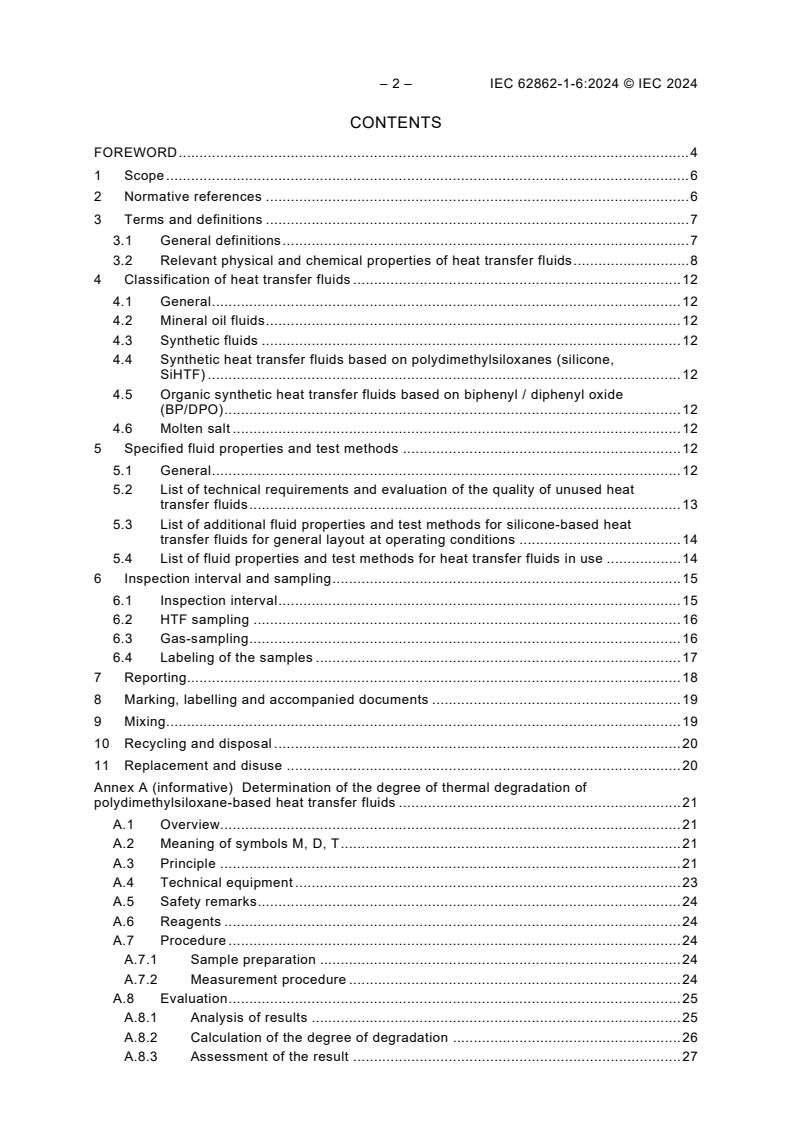
CONTENTS
FOREWORD . 4
1 Scope . 6
2 Normative references . 6
3 Terms and definitions . 7
3.1 General definitions . 7
3.2 Relevant physical and chemical properties of heat transfer fluids . 8
4 Classification of heat transfer fluids . 12
4.1 General . 12
4.2 Mineral oil fluids . 12
4.3 Synthetic fluids . 12
4.4 Synthetic heat transfer fluids based on polydimethylsiloxanes (silicone,
SiHTF) . 12
4.5 Organic synthetic heat transfer fluids based on biphenyl / diphenyl oxide
(BP/DPO) . 12
4.6 Molten salt . 12
5 Specified fluid properties and test methods . 12
5.1 General . 12
5.2 List of technical requirements and evaluation of the quality of unused heat
transfer fluids . 13
5.3 List of additional fluid properties and test methods for silicone-based heat
transfer fluids for general layout at operating conditions . 14
5.4 List of fluid properties and test methods for heat transfer fluids in use . 14
6 Inspection interval and sampling . 15
6.1 Inspection interval . 15
6.2 HTF sampling . 16
6.3 Gas-sampling . 16
6.4 Labeling of the samples . 17
7 Reporting. 18
8 Marking, labelling and accompanied documents . 19
9 Mixing. 19
10 Recycling and disposal . 20
11 Replacement and disuse . 20
Annex A (informative) Determination of the degree of thermal degradation of
polydimethylsiloxane-based heat transfer fluids . 21
A.1 Overview. 21
A.2 Meaning of symbols M, D, T . 21
A.3 Principle . 21
A.4 Technical equipment . 23
A.5 Safety remarks . 24
A.6 Reagents . 24
A.7 Procedure . 24
A.7.1 Sample preparation . 24
A.7.2 Measurement procedure . 24
A.8 Evaluation . 25
A.8.1 Analysis of results . 25
A.8.2 Calculation of the degree of degradation . 26
A.8.3 Assessment of the result . 27
A.9 Accuracy . 27
A.9.1 General . 27
A.9.2 Addition of TM as external standard . 27
A.9.3 Repeatability . 27
A.9.4 Reproducibility . 27
A.10 Example with TM as reference substance . 27
Annex B (informative) Safety instructions and recommendations for handling
polydimethylsiloxane-based heat transfer fluids at temperatures up to 450 °C . 29
B.1 Safety information . 29
B.2 Safety instructions and recommendations . 29
B.2.1 General recommendations . 29
B.2.2 Hazardous ingredients of polydimethylsiloxane-based heat transfer
fluids under operating conditions . 30
B.2.3 Exposure controls and personal protection . 30
B.2.4 General protection and hygiene measures . 31
B.2.5 Personal protection equipment . 31
B.2.6 First aid measures after contact . 31
B.2.7 Firefighting measures . 32
Bibliography . 33
Figure 1 – Example of an aluminum bottle for sampling (new) . 16
Figure 2 – Example of a cylinder mounted with two valves (before use) e.g. for
sampling at 425 °C and 20 bar . 17
Figure A.1 – Representation of the molecular structure of M-, D-, and T-units in
polydimethylsiloxanes (PDMS) . 21
Figure A.2 – Representation of the molecular structure of polydimethylsiloxanes
(PDMS, left) and the thermally induced equilibration reaction of linear
polydimethylsiloxanes . 22
Figure A.3 – Thermally induced disproportionation of D-units in linear
polydimethylsiloxanes, into T and M units . 22
Figure A.4 – Theoretical model for describing the long-term increase in viscosity of
polydimethylsiloxane-based fluids by thermal aging . 23
Figure A.5 – Representation of a Si NMR spectrum indicating the different shift
regions . 26
Figure A.6 – Si NMR spectrum (99,3 MHz, CD Cl ) of TM with TMS as internal
2 2 3
standard . 28
Table 1 – Properties and test methods for unused heat transfer fluids . 13
Table 2 – Additional fluid properties at specified operating conditions . 14
Table 3 –Test methods for heat transfer fluids in use (basic program) . 15
Table 4 – Test methods for heat transfer fluids in use (additional program) . 15
Table A.1 – Shift regions and assignment . 25
Table B.1 – Possible hazardous ingredients of polydimethylsiloxane-based heat
transfer fluids in use . 30
Table B.2 – The product can contain the following substances of very high concern
(Regulation (EC) No. 1907/2006 (REACH), Article 57) in amounts ≥ 0,1 % . 30
– 4 – IEC 62862-1-6:2024 © IEC 2024
INTERNATIONAL ELECTROTECHNICAL COMMISSION
____________
SOLAR THERMAL ELECTRIC PLANTS –
Part 1-6: Silicone-based heat transfer fluids for use in
line-focus concentrated solar power applications
FOREWORD
1) The International Electrotechnical Commission (IEC) is a worldwide organization for standardization comprising
all national electrotechnical committees (IEC National Committees). The object of IEC is to promote international
co-operation on all questions concerning standardization in the electrical and electronic fields. To this end and
in addition to other activities, IEC publishes International Standards, Technical Specifications, Technical Reports,
Publicly Available Specifications (PAS) and Guides (hereafter referred to as “IEC Publication(s)”). Their
preparation is entrusted to technical committees; any IEC National Committee interested in the subject dealt with
may participate in this preparatory work. International, governmental and non-governmental organizations liaising
with the IEC also participate in this preparation. IEC collaborates closely with the International Organization for
Standardization (ISO) in accordance with conditions determined by agreement between the two organizations.
2) The formal decisions or agreements of IEC on technical matters express, as nearly as possible, an international
consensus of opinion on the relevant subjects since each technical committee has representation from all
interested IEC National Committees.
3) IEC Publications have the form of recommendations for international use and are accepted by IEC National
Committees in that sense. While all reasonable efforts are made to ensure that the technical content of IEC
Publications is accurate, IEC cannot be held responsible for the way in which they are used or for any
misinterpretation by any end user.
4) In order to promote international uniformity, IEC National Committees undertake to apply IEC Publications
transparently to the maximum extent possible in their national and regional publications. Any divergence between
any IEC Publication and the corresponding national or regional publication shall be clearly indicated in the latter.
5) IEC itself does not provide any attestation of conformity. Independent certification bodies provide conformity
assessment services and, in some areas, access to IEC marks of conformity. IEC is not responsible for any
services carried out by independent certification bodies.
6) All users should ensure that they have the latest edition of this publication.
7) No liability shall attach to IEC or its directors, employees, servants or agents including individual experts and
members of its technical committees and IEC National Committees for any personal injury, property damage or
other damage of any nature whatsoever, whether direct or indirect, or for costs (including legal fees) and
expenses arising out of the publication, use of, or reliance upon, this IEC Publication or any other IEC
Publications.
8) Attention is drawn to the Normative references cited in this publication. Use of the referenced publications is
indispensable for the correct application of this publication.
9) IEC draws attention to the possibility that the implementation of this document may involve the use of (a)
patent(s). IEC takes no position concerning the evidence, validity or applicability of any claimed patent rights in
respect thereof. As of the date of publication of this document, IEC had not received notice of (a) patent(s), which
may be required to implement this document. However, implementers are cautioned that this may not represent
the latest information, which may be obtained from the patent database available at https://patents.iec.ch. IEC
shall not be held responsible for identifying any or all such patent rights.
IEC 62862-1-6 has been prepared by IEC technical committee TC 117: Solar thermal electric
plants. It is an International Standard.
The text of this International Standard is based on the following documents:
Draft Report on voting
117/199/FDIS 117/202/RVD
Full information on the voting for its approval can be found in the report on voting indicated in
the above table.
The language used for the development of this International Standard is English.
This document was drafted in accordance with ISO/IEC Directives, Part 2, and developed in
accordance with ISO/IEC Directives, Part 1 and ISO/IEC Directives, IEC Supplement, available
at www.iec.ch/members_experts/refdocs. The main document types developed by IEC are
described in greater detail at http://www.iec.ch/standardsdev/publications.
A list of all parts in the IEC 62862 series, published under the general title Solar thermal electric
plants, can be found on the IEC website.
The committee has decided that the contents of this document will remain unchanged until the
stability date indicated on the IEC website under webstore.iec.ch in the data related to the
specific document. At this date, the document will be
• reconfirmed,
• withdrawn, or
• revised.
IMPORTANT – The "colour inside" logo on the cover page of this document indicates
that it contains colours which are considered to be useful for the correct understanding
of its contents. Users should therefore print this document using a colour printer.
– 6 – IEC 62862-1-6:2024 © IEC 2024
SOLAR THERMAL ELECTRIC PLANTS –
Part 1-6: Silicone-based heat transfer fluids for use in
line-focus concentrated solar power applications
1 Scope
This part of IEC 62862 specifies the technical requirements (safety and physical parameters),
test methods, inspection rules and intervals, sampling, judgment, marking, labelling and
accompanying documents, packaging, transportation and storage, recycling and disposal of
silicone-based heat transfer fluids (SiHTF) for use in line-focusing solar thermal power plants.
The application of polydimethylsiloxane-based heat transfer fluids for this type of installation is
covered in this document. Owing to their chemical nature and composition, the introduction of
new test methods to determine the applicability and the thermal stability of SiHTF is included
in this document.
2 Normative references
The following documents are referred to in the text in such a way that some or all of their content
constitutes requirements of this document. For dated references, only the edition cited applies.
For undated references, the latest edition of the referenced document (including any
amendments) applies.
IEC TS 62862-1-1, Solar thermal electric plants – Part 1-1: Terminology
ISO 2049, Petroleum products – Determination of colour (ASTM scale)
ISO 2160, Petroleum products – Corrosiveness to copper – Copper strip test
ISO 2719, Determination of flash point – Pensky-Martens closed cup method
ISO 3016, Petroleum and related products from natural or synthetic sources – Determination of
pour point
ISO 3104, Petroleum products – Transparent and opaque liquids – Determination of kinematic
viscosity and calculation of dynamic viscosity
ISO 3405, Petroleum and related products from natural or synthetic sources – Determination of
distillation characteristics at atmospheric pressure
ISO 3675, Crude petroleum and liquid petroleum products – Laboratory determination of density
– Hydrometer method
ISO 6618, Petroleum products and lubricants – Determination of acid or base number – Colour-
indicator titration method
ISO 11885, Water quality – Determination of selected elements by inductively coupled plasma
optical emission spectrometry (ICP-OES)
ISO 12185, Crude petroleum and petroleum products – Determination of density – Oscillating
U-tube method
ISO 12937, Petroleum products – Determination of water – Coulometric Karl Fischer titration
method
ISO 15597, Petroleum and related products – Determination of chlorine and bromine content –
Wavelength-dispersive X-ray fluorescence spectrometry
ISO 20846, Petroleum products – Determination of sulfur content of automotive fuels –
Ultraviolet fluorescence method
UNE 206015, Heat transfer fluids for solar thermal power plants with parabolic trough collector
technology. Requirements and tests
DIN 4754-1, Wärmeübertragungsanlagen mit organischen Wärmeträgern – Teil 1:
Sicherheitstechnische Anforderungen, Prüfung (in German) [Heat transfer installations working
with organic heat transfer fluids – Part 1: Safety requirements, test]
DIN 51529, Prüfung von Mineralölen und verwandten Erzeugnissen – Prüfung und Beurteilung
gebrauchter Wärmeträgermedien (in German) [Testing of mineral oils and related products –
Testing and evaluation of used heat transfer fluids]
DIN 51794-2003-05, Prüfung von Mineralölkohlenwasserstoffen – Bestimmung der
Zündtemperatur (in German) [Testing of mineral oil hydrocarbons – Determination of ignition
temperature]
3 Terms and definitions
For the purposes of this document, the terms and definitions given in IEC TS 62862-1-1 and
the following apply.
ISO and IEC maintain terminological databases for use in standardization at the following
addresses:
• IEC Electropedia: available at http://www.electropedia.org/
• ISO Online browsing platform: available at http://www.iso.org/obp
3.1 General definitions
3.1.1
heat transfer fluid
HTF
substances in the liquid or gaseous phase that are used for heat transfer
3.1.2
unused heat transfer fluid
heat transfer fluid which has not been introduced into the heat transfer system, e.g. the solar
field
3.1.3
heat transfer fluid in use
heat transfer fluid which has been introduced into the heat transfer system at least once
3.1.4
heat transfer fluid at operating conditions
heat transfer fluid which is operated at the specified working temperature, after reaching a
chemical equilibrium state
– 8 – IEC 62862-1-6:2024 © IEC 2024
3.1.5
equilibration
process of reaching equilibrium composition under specific temperature and pressure
parameters
Note 1 to entry: In a chemical reaction, equilibrium is the state in which both the reactants and products are present
in concentrations which have no further tendency to change with time, so that there is no observable change in the
properties of the system. Typically, silicone-based heat transfer fluids at a given temperature and pressure
experience changes of their physical properties until a chemical equilibrium is established. Afterwards, the physical
properties and chemical composition of the fluid remain stable.
3.1.6
maximum working temperature
maximum bulk temperature of the heat transfer fluid permitted at any location in the heat
transfer fluid system
3.1.7
maximum bulk temperature
highest average temperature of the heat transfer fluid in a specified section of the installation
Note 1 to entry: The location of the section of the installation with the maximum bulk temperature is usually directly
after the exit of the hot collector outlet or at the exit of a fluid heater.
3.1.8
film temperature
temperature at the contact between heat transfer fluid and heating surface of the solar receiver,
heater, or other components
3.1.9
zeotropic mixture
complex mixture with liquid components that have different boiling points
Note 1 to entry: Individual substances in the mixture do not evaporate or condense at the same temperature as a
pure substance.
3.2 Relevant physical and chemical properties of heat transfer fluids
3.2.1
appearance
parameter describing the purity of a heat transfer fluid, referring to the
absence or presence of turbidity, emulsion, particles or visible water in the heat transfer fluid
Note 1 to entry: The appearance and color of a heat transfer fluid can be useful for a comparative assessment. A
change in color, or the appearance of particles, may indicate degradation or contamination of the liquid.
3.2.2
composition
information on the chemical identity of the medium or its individual
components
Note 1 to entry: For complex mixtures information on the chemical identity can be also the chemical family instead
of individual compounds. The physical and chemicals properties of the HTF are very relevant for concentrated solar
power (CSP) application. These properties and the health, safety and environment (HSE) classification is determined
by the type of chemistry of the HTF. The chemical composition of siloxanes can be determined by gas
chromatography–mass spectrometry (GC-MS).
3.2.3
water content
amount of water in the heat transfer fluid, given on a mass (gravimetric)
basis
Note 1 to entry: High water content leads to higher vapor pressure. It may also impact the corrosivity and other
parameters like aging rate of an HTF and hydrogen formation rate and thus the concentration of particles or
degradation products. Concerning SiHTFs, high amounts of water may also lead to water-induced degradation
reactions. In consequence fluid viscosity may increase significantly faster and shorten shelf-life. The occurrence of
water in the heat transfer fluid is usually due to a defective point in the heat exchange system.
3.2.4
chlorine content
amount of chlorine in the heat transfer fluid, given on a mass
(gravimetric) basis
Note 1 to entry: Corrosiveness and the degradation rate of the HTF may increase with increasing chlorine
concentration, thus the chlorine content of the heat transfer medium shall be known.
3.2.5
sulphur content
amount of sulphur in the heat transfer fluid, given on a mass
(gravimetric) basis
Note 1 to entry: The corrosiveness and the degradation rate of the HTF may increase with increasing sulphur
concentration, thus the sulphur content of the heat transfer medium shall be known.
3.2.6
acid number
neutralization number
required basic amount (shown in milligrams of potassium hydroxide)
to neutralize the acid content in one gram of the heat transfer fluid sample (mg KOH/g HTF)
3.2.7
copper corrosion
corrosion of materials made of copper or copper alloys when exposed to the HTF itself or any
other compounds in the HTF
Note 1 to entry: The relative degree of corrosiveness can be determined by the copper strip test.
3.2.8
flash point
minimum temperature at which a flame on the surface of a heat transfer fluid triggers the ignition
of the liquid's vapor (°C)
Note 1 to entry: The flash point determines the flammability classification of the liquid and thus the transport
regulations (hazardous goods), as well as measures for occupational and plant safety. During operation of a CSP
plant the fluid is typically operated significantly above the flash point temperature. Accordingly, the system is
designed for it, and all surfaces of the fluid are covered with inert gas (nitrogen).
3.2.9
auto-ignition temperature
temperature at which a heat transfer fluid self-ignites in the presence of air but in the absence
of flames or sparks that could trigger combustion (°C)
Note 1 to entry: The auto-ignition temperature of a medium is required to specify equipment suitable for the use in
potentially explosive atmospheres (areas prone to leakages). The surface temperatures shall either be limited to a
safe value below the auto-ignition temperature, or other measures to prevent fire in accordance with the results of a
hazard analysis have to be taken.
3.2.10
heat of combustion
amount of energy released when a unit of mass of a heat transfer fluid is burned in the presence
of oxygen (J/kg)
– 10 – IEC 62862-1-6:2024 © IEC 2024
3.2.11
viscosity
resistance of a liquid to flow under the action of gravity, which arises from the internal friction
of a fluid
Note 1 to entry: The kinematic viscosity is related to the dynamic viscosity by dividing with the density. The dynamic
viscosity is usually given in Pa∙s, while the value of the kinetic viscosity is given in mm /s. This is a
temperature-dependent physical quantity. The kinematic viscosity is a relevant parameter for the evaluation of the
flowing and pumping behavior of the HTF. It influences the pressure losses. Aging and oxidation of the fluid tend to
change the fluid viscosity.
3.2.12
density
mass per unit volume (kg/m ); a temperature- and pressure-dependent physical quantity
3.2.13
pour point
temperature below which the liquid loses its flow characteristics
Note 1 to entry: The pour point is the parameter to define the lowest operating temperature. If the pour point of the
HTF is above ambient temperature, special technical precautions for HTF heating shall be taken, especially during
commissioning and longer standstills of the plant or parts of the plant.
3.2.14
cloud point
temperature below which a transparent solution undergoes either a liquid-liquid
phase separation to form an emulsion or a liquid-solid phase transition to form either a stable
solution or a suspension that settles a precipitate (cloudy appearance)
Note 1 to entry: The presence of solidified particles thickens the fluid and may clog filters in the system. The
solidified particles may also accumulate on cold surfaces.
3.2.15
normal boiling point
temperature at which the vapor pressure of the liquid (azeotropic mixtures) equals the
atmospheric pressure at sea level
Note 1 to entry: The boiling temperature at ambient pressure influences in particular the handling of the heat
transfer medium during commissioning.
3.2.16
boiling range
temperature range involved in the distillation of zeotropic mixtures, from the start to the
temperature when the component with the highest boiling point evaporates
Note 1 to entry: During operation, a fluid pressure above the vapor pressure of the heat transfer medium at any
point of the system is required.
3.2.17
heat of evaporation
amount of energy (heat) that has to be absorbed by a unit of mass of a heat transfer fluid in
order to evaporate at a given temperature and pressure (J/kg)
3.2.18
maximum film temperature
maximum permitted temperature in the heat transfer system at the contact between the heat
transfer fluid and the heating surface of the solar receiver, heater, or other components
3.2.19
insoluble product
content of inorganic particles and insoluble degradation products, e.g., solid waste materials
like coke in a heat transfer fluid sample
Note 1 to entry: This parameter analyses the possible change in the composition of the heat transfer fluid due to
degradation and/or contamination.
Note 2 to entry: Insoluble products can be defined by lack of solubility of solid compounds in specific solvents like
e.g., acetone, toluene or pentane. Another definition is lack of solubility of solid compounds in the HTF at a specific
temperature.
Note 3 to entry: Insoluble compounds can be caused by degradation products of the HTF, by corrosion products of
steel or by contamination with dirt, e.g., from welding processes. Hence, the kind of insoluble products may indicate
contamination by dirt, corrosion products e.g., due to enhanced humidity, or significant thermal stress of the HTF.
Insoluble products may decrease heat transfer on surfaces. They may also cause clogging or blockage of pipelines
e.g., in cases of prolonged overheating or wear and clogging of seals and valves.
3.2.20
metal content
amount of metals in the heat transfer fluid
Note 1 to entry: The metal content is relevant because high contents e.g. of chromium can generate environmental
and health risks. Furthermore, heat transfer oils could contain traces of metals, either caused by corrosion processes
in case of high-water levels in the HTF system, abrasion in the production process or by ongoing operation in heat
transfer systems. Some metals could have a catalytic effect on the degradation of the HTF itself or could clog filters.
3.2.21
heat conductivity
ability of a heat transfer fluid to transfer heat (W/(m K))
Note 1 to entry: The thermal conductivity affects the Prandtl number which, in turn, affects the heat transfer
coefficient. The Prandtl number describes the heat transport by momentum exchange in relation to the heat transport
by heat conduction within a fluid. This means that a high thermal conductivity increases the heat transport (at the
same flow velocity) and ensures a low temperature gradient in the laminar boundary layer (from the core temperature
to the film temperature of the flow).
Note 2 to entry: Heat conductivity is a temperature-dependent quantity.
3.2.22
heat capacity
energy required to increase the temperature of a specific amount of heat transfer fluid (J/(gK))
Note 1 to entry: Heat capacity is a thermodynamic property of the liquid that is related to the energy transport from
the solar field. The higher the value, the more energy the liquid takes up on the increase in temperature.
Note 2 to entry: Heat capacity is a temperature-dependent variable.
3.2.23
vapor pressure
pressure exerted by the gaseous phase of a heat transfer fluid that is in equilibrium with the
liquid phase at a given temperature (Ρa)
Note 1 to entry: The vapor pressure of the HTF together with the pressure losses (and additional safety measures)
determines the design pressure of the CSP subsystems. High vapor pressures lead to increased plant costs. If the
medium in its area of application has a vapor pressure above the ambient pressure, pressure vessels are required
which cause considerable costs.
3.2.24
thermal degradation
degradation where damaging chemical changes on a molecular level take place at elevated
temperatures, without the simultaneous involvement of other compounds such as oxygen
Note 1 to entry: Even in the absence of air, molecular compounds (like polydimethylsiloxanes) will begin to degrade
if the temperature is high enough.
– 12 – IEC 62862-1-6:2024 © IEC 2024
3.2.25
thermal stability
resistance of a heat transfer fluid to thermal degradation within a temperature range for which
it is specified
Note 1 to entry: The thermal stability of an HTF typically limits and thus determines the maximum working
temperature of parabolic trough power plants. This value is also used to estimate the life span and exchange rate (if
needed) of the heat transfer fluid at operating conditions.
4 Classification of heat transfer fluids
4.1 General
For the purposes of this document, the heat transfer fluids are classified as follows in 4.2 to 4.6.
4.2 Mineral oil fluids
Oil obtained from crude oil by refining processes.
4.3 Synthetic fluids
Liquid obtained mainly from the synthesis of various organic compounds.
4.4 Synthetic heat transfer fluids based on polydimethylsiloxanes (silicone, SiHTF)
Liquid composed of polydimethylsiloxanes (CAS No. 63148-62-9, CH [Si(CH ) O] Si(CH ) );
3 3 2 n 3 3
depending on the composition stable above 400 °C.
4.5 Organic synthetic heat transfer fluids based on biphenyl / diphenyl oxide
(BP/DPO)
Liquid from the eutectic mixture of biphenyl (CAS No. 92-52-4, C Η ) and diphenyl oxide
12 10
(CAS No. 101-84-8, C Η O).
12 10
4.6 Molten salt
Inorganic salt in liquid state usually composed of mixtures of alkali nitrates, carbonates,
chlorides, etc.
5 Specified fluid properties and test methods
5.1 General
The tests listed in this Clause 5 are considered to determine whether the fluid is suitable for
use in solar thermal applications. If the fluid is already in use the test items should ensure that
it can still be safely operated within its design limits.
5.2 List of technical requirements and evaluation of the quality of unused heat
transfer fluids
Table 1 – Properties and test methods for unused heat transfer fluids
Property Test method Alternative test Reference value
method
Appearance ISO 2049 Transparent without suspended
solids
Composition Identity of the Polydimethylsiloxane (material
component class safety data sheet)
GC-MS
Water content ISO 12937 1 < 100 ppm [3]
DIN 51777 [1]
SH/T0246-1992
[2]
Chlorine content ISO 15597 DIN 51408-2 [4] < 10 ppm (UNE 206015)
Sulphur content ISO 20846 SH/T0689-2000 < 10 ppm (UNE 206015)
[5]
ISO 20884 [6]
ISO 14596 [7]
Acid number (water soluble ISO 6618 DIN 51558-2 [8] < 0,2 mg KOH/g (UNE 206015)
acids)
Copper corrosion ISO 2160 < 1 a (UNE 206015)
a
ISO 2719 GB/T261-2008 [9] 110 °C, (UNE 206015)
Flash point (closed cup)
Auto-ignition temperature DIN 51794-2003-05 ASTM Ε659-15 In °C, no general reference
[10] value available
SH/T0642-1997
[11]
Heat of combustion DIN 51900-1 [12] In kJ/kg, no general reference
value available
Kinematic viscosity, at 0 °C ISO 3104 DIN 53019 [13]
In mm/s , no general reference
value available
Kinematic viscosity, at 25 °C GB/T265-1988
[14]
Kinematic viscosity, at 100 °C
Density, at 25 °C ISO 3675 ASTM D1298 [15]
In kg/m , no general reference
value available
ISO 12185 ASTM D4052-22
[16]
DIN 51757 [17]
SH/T0604-2000
[18]
Freeze point, pour point, cloud ISO 3016 GB/T3535-2006 In °C, no general reference
point [19] value available
Normal boiling point/boiling ISO 3405 In °C, no general reference
range value available
b
No method In kJ/kg, no general reference
Normal heat of evaporation
value available
Maximum film temperature No method In °C, product data sheet, no
recommended general reference value
available
Maximum working temperature No method In °C, product data sheet, no
general reference value
available
___________
Numbers in square brackets refer to the Bibliography.
– 14 – IEC 62862-1-6:2024 © IEC 2024
* -6
The term ppm (parts per million) is commonly used for the concentration 10 .
a
The flash point in the closed cup method is conducted inside a closed vessel which is not open to the outside
atmosphere. The lid is sealed, and the ignition source is introduced into the vessel itself, allowing for a closer
approximation to real-life conditions (such as those found inside an HTF tank).
b
There is no standard method available for zeotropic mixtures, thus the value shall be estimated with sufficient
safety margin.
Standard test methods are given in the test method column. The alternative test method may be followed.
Reference values are for the unused liquid. The deviations from these reference values shall be agreed between
the customer and the supplier.
5.3 List of additional fluid properties and test methods for silicone-based heat
transfer fluids for general layout at operating conditions
All parameters mentioned in Table 2 shall be specified for the heat transfer fluid at operating
conditions due to the equilibration of the polydimethylsiloxane-based HTF upon heating above
200 °C (see 3.1.4 and 3.1.5).
Therefore, the properties in Table 2 required for the design of heat transfer systems shall be
specified at operating conditions, together with the intended temperature range, and indicating
the applied test method.
Table 2 – Additional fluid properties at specified operating conditions
Property Unit
Kinematic or dynamic viscosity
mm /s or mPa s
Density
kg/m
Heat conductivity W/(m∙K)
Isobaric heat capacity kJ/(kg∙K)
Vapor pressure kPa
Solubility of nitrogen mmol/kg
Formation of hydrogen µmol/(kg∙h)
Formation of methane µmol/(kg∙h)
At the time of publication, no standard test methods for the parameters at operating conditions given
in this Table 2 are available. The supplier or manufacturer shall therefore specify the test conditions.
5.4 List of fluid properties and test methods for heat transfer fluids in use
The further usability of the heat transfer fluid results from the tests listed in Table 3, if necessary,
from the additional tests listed in Table 4 in connection with the limit values given by the fluid
manufacturer or supplier. The test items in Table 4 are focused on decomposition products and
plant-related impurities. According to DIN 51529, compliance with the limit values
recommended by the manufacturer is crucial for assessing the reusability of the system filling.
The definition of the limit values for the assessment of further usability is based on the general
experience of the manufacturers and suppliers of the heat transfer fluid. If there are special
circumstances and with regard to system-specific features, an overall assessment can only be
made in conjunction with the system operator.
Table 3 –Test methods for heat transfer fluids in use (basic program)
Property Test method Alternative test method
Appearance ISO 2049
Water content ISO 12937 DIN 51777
SH/T0246-1992
Acid number (water soluble acids) ISO 6618 DIN 51558-2
Flash point (closed cup) ISO 2719 GB/T 261-2008
Kinematic viscosity (25 °C) ISO 3104 DIN 53019
GB/T265-1988
Standard test methods are given in the test method column. The alternative test method may be followed.
Table 4 – Test methods for heat transfer fluids in use (additional program)
Alternative test
Property Test method
method
Insoluble products ASTM D 893 [20]
a b
Metal content ISO 11885
c
ISO 15597
Chlorine content
d
ISO 20846 SH/T0689-2000
Sulphur content
Thermal degradation T-group method (Annex A)
Gas concentration (H , Methane) Evaluation of cylinder
samples (6.3)
Standard test methods are given in the test method column. The alternative test method may be followed.
a
Metals can indicate impurities from the system.
b
Metal content shall be transferred into water-soluble components e.g. by closed microwave acid
digestion (HF/HNO ) with subsequent ICP-OES or ICP-MS measurement. [21]
c
Chlorine can indicate impurities from the system.
d
Sulphur can indicate impurities from the system.
6 Inspection interval and sampling
6.1 Inspection interval
Heat transfer fluids in an operating plant shall be checked for their serviceability once a year or
on demand in accordance with DIN 4754-1. Therefore, the heat transfer fluids in use shall be
sampled and inspected at least once a year in accord
...