

IEC 61250:2026
(Main)Nuclear power plants - Instrumentation and control systems important to safety - Detection of leakage in coolant systems
- Abstract
IEC 61250:2026 establishes the requirements for instrumentation necessary to detect leakage from reactor coolant systems of all types of light water and heavy water nuclear reactors. Methods of leakage detection are described and characteristics of different methods of detection and of differentiating between allowable and abnormal leakages are given.
IEC 61250 has been prepared by subcommittee 45A: Instrumentation, control and electrical power systems of nuclear facilities, of IEC technical committee 45: Nuclear instrumentation. It is an International Standard.
This second edition cancels and replaces the first edition published in 1994. This edition constitutes a technical revision.
This edition includes the following significant technical changes with respect to the previous edition:
a) to take into account new advances in leakage detection technology, and to renew general design requirements for leakage detection systems;
b) to align the document with the new revisions of reference standards and documents.
- Status
- Published
- Publication Date
- 11-Nov-2026
- Technical Committee
- SC 45A - Instrumentation, control and electrical power systems of nuclear facilities
- Drafting Committee
- WG 5 - TC 45/SC 45A/WG 5
- Current Stage
- PPUB - Publication issued
- Start Date
- 12-Nov-2026
- Completion Date
- 30-Nov-2026
IEC 61250:2026 is an International Standard published by the International Electrotechnical Commission (IEC) for nuclear power plants. It specifies instrumentation for detecting leakage from reactor coolant systems in light water and heavy water nuclear reactors, including how leakage is detected, classified, displayed and monitored in reactor coolant and associated systems (RCAS). It is intended for plant operators, systems evaluators and licensors who need to choose, qualify and document leakage detection arrangements.
What does IEC 61250:2026 specify?
IEC 61250:2026 covers leakage detection for reactor coolant systems and the associated systems that handle reactor coolant in normal, accident and post-accident conditions. It gives the principles for separating allowable leakage from abnormal leakage, and for presenting leakage information so operators can act quickly.
The document is organized into:
- Clause 4 - leakage classification and likely leakage sources
- Clause 5 - general design and testing requirements
- Clause 6 - specific leakage detection instrument requirements and Table 1
- Clause 7 - system operability provisions
In practice, the standard is about choosing methods, showing that they work, and making sure the output is useful at the control room or emergency control room.
What are the key requirements of IEC 61250:2026?
IEC 61250:2026 sets out a layered approach: identify leakage sources, use more than one detection principle for unidentified leakage, qualify the equipment for the plant environment, and make sure the results are clear enough for operators to use.
Leakage classification and source coverage
Clause 4 separates leakage into identified leakage, unidentified leakage and intersystem leakage. That matters because the plant has to treat collected, quantified leakage differently from leakage that still needs location and interpretation.
Clause 4.3 says probable leakage sources should be identified during plant design and provided with detection, collection or isolation where practicable. In practice, this means seals, relief devices and interface boundaries should be considered early, not added only after leakage appears.
Detection performance and diversity
Clause 5.1 requires at least one detection method for each anticipated leakage source. Clause 5.2 recommends at least two independent instruments based on different methods for unidentified leakage, and at least one method able to identify leak locations.
Clause 5.3 sets performance expectations for unidentified leakage to primary containment: the system should detect, monitor and quantify total flow from 0.19 L/min and respond within 1 h for 4 L/min, excluding transport delay. This gives designers a target for sensitivity and response time instead of relying on vague “early warning” language.
Safety classification, qualification and power
Clause 5.4 ties the leakage detection function to IEC 61226 categories A, B, C or non-categorized, depending on how the signal is used. If the signal starts automatic protection, its classification follows that safety role; if it supports manual action, the classification is different.
Clauses 5.7 and 5.8 require the system to keep its accuracy in expected temperature, humidity and radiation conditions, remain operable after a design-basis seismic event where required, and use separate independent power sources for at least two detection systems. This is what makes the system credible during a real plant event, not only during normal operation.
Design basis and operability
Clause 5.9 requires design basis documentation for the plant technical specifications, the models and assumptions used for sensitivity and response time, the limits and accuracy of each method, calibration and operation procedures, seismic qualification and power-source identification. That documentation is what lets a reviewer trace the design from signal to safety claim.
Clause 7 requires clear displays of leakage status and trends, alarm logic that avoids spurious alarms, volumetric indication or conversion to volumetric units, periodic adjustment for environmental changes, and maintainability during outages. In practical terms, the operator needs a display that supports decisions, not just raw signals.
Detection methods
Clause 6 describes the main detection methods used in practice, including sump monitoring, radiation monitoring, condensate flow, reactor coolant inventory, humidity, acoustic monitoring, fibre-optical cable monitoring, temperature, pressure, tape moisture sensors and visual observation. Table 1 summarizes how well each method can detect leakage, measure it and locate it, which helps with method selection and diversity.
What terms does IEC 61250:2026 define?
IEC 61250:2026 defines the key terms used to describe leakage and its measurement.
- Calibration - the set of operations that establishes the relationship between an indication and a measurement result under specified conditions.
- Reactor coolant - the substance, usually liquid, gas or molten metal, used to cool the part of a nuclear reactor where heat is generated.
- Leak - an opening, however small, that allows undesirable passage of fluid from its boundaries.
- Leakage - the fluid that passes through a leak.
- Abnormal leakage - RCAS leakage that exceeds the safety specification allowance.
- Leakage monitoring instrument - a system that provides information about RCAS leakage conditions so the operator can act.
- Containment - the physical structures or methods intended to prevent or control release and dispersion of radioactive substances.
- Reactor coolant and associated systems (RCAS) - the components that contain reactor coolant for normal, accident and post-accident conditions, including directly associated systems such as emergency core cooling, residual heat removal and coolant inventory control.
Who uses IEC 61250:2026?
IEC 61250:2026 is intended for nuclear power plant operators, systems evaluators and licensors. It is also used by I&C engineers, plant designers, safety assessors, maintenance teams and those who prepare plant technical specifications.
In practice, these users apply the standard when selecting leakage detectors, setting alarm thresholds, documenting design basis, checking qualification and proving that leakage monitoring remains available during operation and after disturbances.
What changed in IEC 61250:2026 from the previous edition?
IEC 61250:2026 cancels and replaces the first edition published in 1994. The foreword says this second edition is a technical revision.
The stated changes are:
- it takes into account new advances in leakage detection technology and renews the general design requirements for leakage detection systems
- it aligns the document with revised reference standards and documents
Which standards are used with IEC 61250:2026?
IEC 61250:2026 uses several other standards directly, and its introduction and bibliography place it within the wider IEC and IAEA framework.
- IEC/IEEE 60780-323 - qualification of electrical equipment important to safety
- IEC 60911 - reactor coolant inventory monitoring for pressurized light water reactors
- IEC/IEEE 60980-344 - seismic qualification of equipment important to safety
- IEC 61225 - static uninterruptible DC and AC power supply systems
- IEC 61226 - categorization of functions and classification of systems
- IEC 62241 - alarm functions and presentation in the main control room
- IEC 63351 - human factors engineering for human-machine interfaces
- IEC 61513 and IEC 63046 - general requirements for nuclear power plant I&C and electrical power systems
- IAEA SSG-56 and IAEA SSG-90 - reactor coolant system leakage design guidance and radiation protection aspects
- IEC 60709, IEC 60964, IEC 62003, IEC 62342, IEC 62645, IEC/IEEE 60880, IEC 62566 and IEC 62443 - supporting topics such as separation, control room design, EMC, ageing, cybersecurity and digital system aspects
What does the IEC 61250:2026 document contain?
IEC 61250:2026 contains the classification of leakage, guidance on likely leakage sources, and a structured set of design and testing requirements for detection systems. It also includes a table that summarizes the capabilities of the main monitoring methods.
The document further provides method-specific guidance for sump monitoring, radiation monitoring, condensate flow, reactor coolant inventory, humidity, acoustic sensing, fibre-optical cable monitoring, temperature, pressure, tape moisture sensors and visual observation. Clause 7 then sets the expectations for displays, alarms, trends, calibration, outage maintenance and ease of repair.
Get Certified
Connect with accredited certification bodies for this standard

DNV
DNV is an independent assurance and risk management provider.

Lloyd's Register
Lloyd's Register is a global professional services organisation specialising in engineering and technology.
DNV Energy Systems
Energy and renewable energy certification.
Sponsored listings
Frequently Asked Questions
IEC 61250:2026 is a standard published by the International Electrotechnical Commission (IEC). Its full title is "Nuclear power plants - Instrumentation and control systems important to safety - Detection of leakage in coolant systems". This standard covers: IEC 61250:2026 establishes the requirements for instrumentation necessary to detect leakage from reactor coolant systems of all types of light water and heavy water nuclear reactors. Methods of leakage detection are described and characteristics of different methods of detection and of differentiating between allowable and abnormal leakages are given. IEC 61250 has been prepared by subcommittee 45A: Instrumentation, control and electrical power systems of nuclear facilities, of IEC technical committee 45: Nuclear instrumentation. It is an International Standard. This second edition cancels and replaces the first edition published in 1994. This edition constitutes a technical revision. This edition includes the following significant technical changes with respect to the previous edition: a) to take into account new advances in leakage detection technology, and to renew general design requirements for leakage detection systems; b) to align the document with the new revisions of reference standards and documents.
IEC 61250:2026 establishes the requirements for instrumentation necessary to detect leakage from reactor coolant systems of all types of light water and heavy water nuclear reactors. Methods of leakage detection are described and characteristics of different methods of detection and of differentiating between allowable and abnormal leakages are given. IEC 61250 has been prepared by subcommittee 45A: Instrumentation, control and electrical power systems of nuclear facilities, of IEC technical committee 45: Nuclear instrumentation. It is an International Standard. This second edition cancels and replaces the first edition published in 1994. This edition constitutes a technical revision. This edition includes the following significant technical changes with respect to the previous edition: a) to take into account new advances in leakage detection technology, and to renew general design requirements for leakage detection systems; b) to align the document with the new revisions of reference standards and documents.
IEC 61250:2026 is classified under the following ICS (International Classification for Standards) categories: 27.120.20 - Nuclear power plants. Safety. The ICS classification helps identify the subject area and facilitates finding related standards.
IEC 61250:2026 is available in PDF format for immediate download after purchase. The document can be added to your cart and obtained through the secure checkout process. Digital delivery ensures instant access to the complete standard document.
Standards Content (Sample)
IEC 61250 ®
Edition 2.0 2026-11
INTERNATIONAL
STANDARD
Nuclear power plants - Instrumentation and control systems important to safety -
Detection of leakage in coolant systems
ICS 27.120.20 ISBN 978-2-8327-1582-6
All rights reserved. Unless otherwise specified, no part of this publication may be reproduced or utilized in any form or
by any means, electronic or mechanical, including photocopying and microfilm, without permission in writing from either
IEC or IEC's member National Committee in the country of the requester. If you have any questions about IEC copyright
or have an enquiry about obtaining additional rights to this publication, please contact the address below or your local
IEC member National Committee for further information.
IEC Secretariat Tel.: +41 22 919 02 11
3, rue de Varembé info@iec.ch
CH-1211 Geneva 20 www.iec.ch
Switzerland
About the IEC
The International Electrotechnical Commission (IEC) is the leading global organization that prepares and publishes
International Standards for all electrical, electronic and related technologies.
About IEC publications
The technical content of IEC publications is kept under constant review by the IEC. Please make sure that you have the
latest edition, a corrigendum or an amendment might have been published.
IEC publications search - IEC Products & Services Portal - products.iec.ch
webstore.iec.ch/advsearchform Discover our powerful search engine and read freely all the
The advanced search enables to find IEC publications by a publications previews, graphical symbols and the glossary.
variety of criteria (reference number, text, technical With a subscription you will always have access to up to date
committee, …). It also gives information on projects, content tailored to your needs.
replaced and withdrawn publications.
Electropedia - www.electropedia.org
The world's leading online dictionary on electrotechnology,
IEC Just Published - webstore.iec.ch/justpublished
Stay up to date on all new IEC publications. Just Published containing more than 22 500 terminological entries in English
details all new publications released. Available online and and French, with equivalent terms in 25 additional languages.
once a month by email. Also known as the International Electrotechnical Vocabulary
(IEV) online.
IEC Customer Service Centre - webstore.iec.ch/csc
If you wish to give us your feedback on this publication or
need further assistance, please contact the Customer
Service Centre: sales@iec.ch.
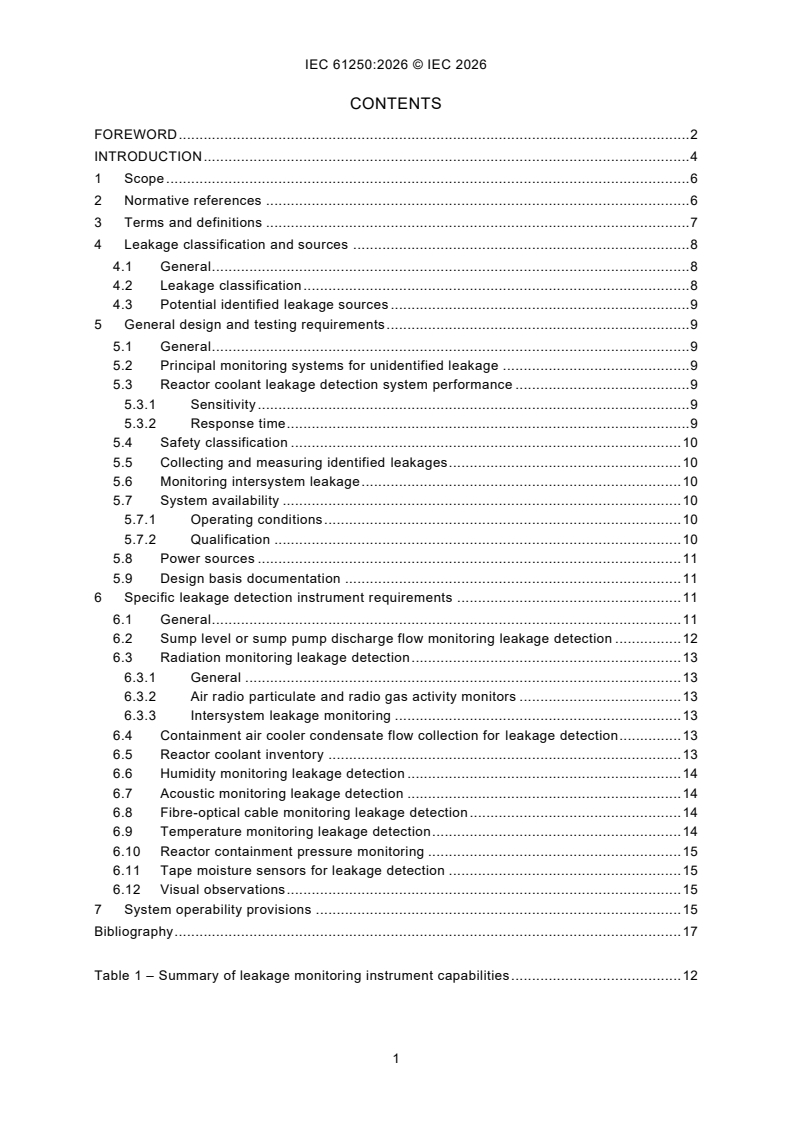
CONTENTS
FOREWORD . 2
INTRODUCTION . 4
1 Scope . 6
2 Normative references . 6
3 Terms and definitions . 7
4 Leakage classification and sources . 8
4.1 General . 8
4.2 Leakage classification . 8
4.3 Potential identified leakage sources . 9
5 General design and testing requirements . 9
5.1 General . 9
5.2 Principal monitoring systems for unidentified leakage . 9
5.3 Reactor coolant leakage detection system performance . 9
5.3.1 Sensitivity . 9
5.3.2 Response time . 9
5.4 Safety classification . 10
5.5 Collecting and measuring identified leakages . 10
5.6 Monitoring intersystem leakage . 10
5.7 System availability . 10
5.7.1 Operating conditions . 10
5.7.2 Qualification . 10
5.8 Power sources . 11
5.9 Design basis documentation . 11
6 Specific leakage detection instrument requirements . 11
6.1 General . 11
6.2 Sump level or sump pump discharge flow monitoring leakage detection . 12
6.3 Radiation monitoring leakage detection . 13
6.3.1 General . 13
6.3.2 Air radio particulate and radio gas activity monitors . 13
6.3.3 Intersystem leakage monitoring . 13
6.4 Containment air cooler condensate flow collection for leakage detection . 13
6.5 Reactor coolant inventory . 13
6.6 Humidity monitoring leakage detection . 14
6.7 Acoustic monitoring leakage detection . 14
6.8 Fibre-optical cable monitoring leakage detection . 14
6.9 Temperature monitoring leakage detection . 14
6.10 Reactor containment pressure monitoring . 15
6.11 Tape moisture sensors for leakage detection . 15
6.12 Visual observations . 15
7 System operability provisions . 15
Bibliography . 17
Table 1 – Summary of leakage monitoring instrument capabilities . 12
INTERNATIONAL ELECTROTECHNICAL COMMISSION
____________
Nuclear power plants -
Instrumentation and control systems important to safety -
Detection of leakage in coolant systems
FOREWORD
1) The International Electrotechnical Commission (IEC) is a worldwide organization for standardization comprising
all national electrotechnical committees (IEC National Committees). The object of IEC is to promote international
co-operation on all questions concerning standardization in the electrical and electronic fields. To this end and
in addition to other activities, IEC publishes International Standards, Technical Specifications, Technical Reports,
Publicly Available Specifications (PAS) and Guides (hereafter referred to as “IEC Publication(s)”). Their
preparation is entrusted to technical committees; any IEC National Committee interested in the subject dealt with
may participate in this preparatory work. International, governmental and non-governmental organizations liaising
with the IEC also participate in this preparation. IEC collaborates closely with the International Organization for
Standardization (ISO) in accordance with conditions determined by agreement between the two organizations.
2) The formal decisions or agreements of IEC on technical matters express, as nearly as possible, an international
consensus of opinion on the relevant subjects since each technical committee has representation from all
interested IEC National Committees.
3) IEC Publications have the form of recommendations for international use and are accepted by IEC National
Committees in that sense. While all reasonable efforts are made to ensure that the technical content of IEC
Publications is accurate, IEC cannot be held responsible for the way in which they are used or for any
misinterpretation by any end user.
4) In order to promote international uniformity, IEC National Committees undertake to apply IEC Publications
transparently to the maximum extent possible in their national and regional publications. Any divergence between
any IEC Publication and the corresponding national or regional publication shall be clearly indicated in the latter.
5) IEC itself does not provide any attestation of conformity. Independent certification bodies provide conformity
assessment services and, in some areas, access to IEC marks of conformity. IEC is not responsible for any
services carried out by independent certification bodies.
6) All users should ensure that they have the latest edition of this publication.
7) No liability shall attach to IEC or its directors, employees, servants or agents including individual experts and
members of its technical committees and IEC National Committees for any personal injury, property damage or
other damage of any nature whatsoever, whether direct or indirect, or for costs (including legal fees) and
expenses arising out of the publication, use of, or reliance upon, this IEC Publication or any other IEC
Publications.
8) Attention is drawn to the Normative references cited in this publication. Use of the referenced publications is
indispensable for the correct application of this publication.
9) IEC draws attention to the possibility that the implementation of this document may involve the use of (a)
patent(s). IEC takes no position concerning the evidence, validity or applicability of any claimed patent rights in
respect thereof. As of the date of publication of this document, IEC had not received notice of (a) patent(s), which
may be required to implement this document. However, implementers are cautioned that this may not represent
the latest information, which may be obtained from the patent database available at https://patents.iec.ch. IEC
shall not be held responsible for identifying any or all such patent rights.
IEC 61250 has been prepared by subcommittee 45A: Instrumentation, control and electrical
power systems of nuclear facilities, of IEC technical committee 45: Nuclear instrumentation.
It is an International Standard.
This second edition cancels and replaces the first edition published in 1994. This edition
constitutes a technical revision.
This edition includes the following significant technical changes with respect to the previous
edition:
a) to take into account new advances in leakage detection technology, and to renew general
design requirements for leakage detection systems;
b) to align the document with the new revisions of reference standards and documents;
The text of this International Standard is based on the following documents:
Draft Report on voting
45A/1633/CDV 45A/1649/RVC
Full information on the voting for its approval can be found in the report on voting indicated in
the above table.
The language used for the development of this International Standard is English.
This document was drafted in accordance with ISO/IEC Directives, Part 2, and developed in
accordance with ISO/IEC Directives, Part 1 and ISO/IEC Directives, IEC Supplement, available
at www.iec.ch/members_experts/refdocs. The main document types developed by IEC are
described in greater detail at www.iec.ch/publications.
The committee has decided that the contents of this document will remain unchanged until the
stability date indicated on the IEC website under webstore.iec.ch in the data related to the
specific document. At this date, the document will be
– reconfirmed,
– withdrawn, or
– revised.
INTRODUCTION
a) Technical background, main issues and organisation of this document
This document specifically focuses on detection of leakage from the reactor coolant and
associated systems (RCAS). Detection of leakage from the RCAS into the reactor containment
of a nuclear power plant is required, in support of the concepts of "leak before break" or “break
preclusion”, and early detection of developing deviation from normal operation. Applicable
international recommendations for RCAS leakage detection are provided in IAEA Safety
Standards Series No. SSG-56.
Leakage detection from pressurized systems is necessary because small leaks can develop
into larger leaks or ruptures.
During reactor operation:
– detection of leakage from non-isolable portions of cooling systems is important to allow early
identification of minor flaws before they can develop into a pipe break or component rupture
in pressurized fluid circuits that could result in a loss of coolant; and
– early detection of leakage from isolable portions permits actions to limit the consequences
of leakage on heat removal from nuclear fuel.
Leakage detection systems may be chosen and designed based on the consequences of
leakage for safety of the plant. Consequences depend on:
– the time to detect leakage and to take countermeasures (automatic or human actions );
– the possibility of isolating the fluid portion and the potential propagation of a pipe break,
regarding pressure within the fluid circuit;
– the consequences of a pipe break on reactivity, heat removal from the core and the load on
circuits and structure ensuring confinement; and
– the impact on the availability of systems important to safety.
The leakage detection system serves to facilitate the detection of small leaks and to meet
physiological requirements for personnel within the containment whilst avoiding spurious
leakage alarms.
It is intended that this document be used by operators of NPPs (utilities), systems evaluators
and by licensors.
b) Situation of this document in the structure of the IEC SC 45A standard series
IEC 61250 is the third level IEC SC 45A document covering the specific issue of leakage
detection in reactor coolant systems.
For more details on the structure of the IEC SC 45A standard series, see item d) of this
Introduction.
c) Recommendations and limitations regarding the application of this document
It is important to note that this document establishes no additional functional requirements for
safety systems.
To ensure that the document will continue to be relevant in future years, the emphasis has been
placed on issues of principle, rather than specific technologies.
d) Description of the structure of the IEC SC 45A standard series and relationships with
other IEC documents and other bodies’ documents (IAEA, ISO)
The IEC SC 45A standard series comprises a consistent set of documents organised in a
hierarchy of four levels. The top-level documents of the IEC SC 45A standard series are
IEC 61513 and IEC 63046, covering respectively general requirements for instrumentation and
control (I&C) systems and general requirements for electrical power systems of NPPs.
IEC 61513 and IEC 63046 adopt an overall system life-cycle framework and constitute, along
with the relevant second-level standards, the nuclear implementation of the basic safety series
IEC 61508. IEC 61513 and IEC 63046 refer to ISO 9001 as well as to IAEA GSR Part 2 and
IAEA GS-G-3.1 and IAEA GS-G-3.5 for topics related to quality assurance (QA).
IEC 61513 and IEC 63046 refer directly to second-level IEC SC 45A standards for general
requirements for specific topics, such as categorization of functions and classification of
systems (IEC 61226), qualification (IEC/IEEE 60780-323), separation (IEC 60709), control
room design (IEC 60964), electromagnetic compatibility (IEC 62003), human factors
engineering (IEC 63351), programmable digital item and hardware aspects for programmable
digital systems (in particular IEC/IEEE 60880 and IEC 62566) and management of ageing
(IEC 62342). For cybersecurity, IEC 62645 builds upon the valid high-level principles and main
concepts of the generic security standards, in particular ISO/IEC 27001 and ISO/IEC 27002; it
adapts them and completes them to fit the nuclear context and coordinates with the IEC 62443
series.
At a third level, standards relate to specific requirements for specific equipment, technical
methods, or activities. Usually, these documents refer to second-level documents for general
requirements and can be used on their own.
A fourth level of the IEC SC 45A standard series comprises Technical Reports, which are not
normative.
The IEC SC 45A standards series consistently implement the safety and cybersecurity
principles and terminology within relevant IAEA safety standards and relevant documents of the
IAEA nuclear security series (NSS). In particular, these include the IAEA requirements
SSR-2/1 (Rev.1), establishing safety requirements related to the design of nuclear power plants
(NPPs), the IAEA safety guide SSG-30 dealing with the safety classification of structures,
systems and components in NPPs, the IAEA safety guide SSG-39 dealing with the design of
instrumentation and control systems for NPPs, the IAEA safety guide SSG -34 dealing with the
design of electrical power systems for NPPs, the IAEA safety guide SSG-51 dealing with human
factors engineering in the design of NPPs, the implementing guide IAEA Nuclear Security Series
No. 42-G and technical guidance IAEA Nuclear Security Series No. 17-T for computer security
at nuclear facilities.
NOTE IEC TR 63400 provides a more comprehensive description of the overall structure of the IEC SC 45A
standards series and of its relationship with other standards bodies and standards.
1 Scope
This document establishes the requirements for instrumentation necessary to detect leakage
from reactor coolant systems of all types of light water and heavy water nuclear reactors.
Methods of leakage detection are described and characteristics of different methods of
detection and of differentiating between allowable and abnormal leakages are given.
The sensitivity of systems required to ensure early detection of developing leaks and to provide
warning of possible leak-before-break situations is considered, and recommendations are given
to reduce spurious alarms. The same requirements apply in the case of the break preclusion
concept and other concepts for the assurance of the integrity of components and pipes.
Recommendations are given for data display that allows data to be presented in a clear and
concise manner to enable operators to take appropriate actions to minimize the risk of hazard
to plant equipment and to personnel. Requirements are given for recording and logging, as well
as for the summation of individual signals for trend detection.
This document specifies requirements for leakage detection data, its logical arrangement and
the display of information that enables the operator to take appropriate action. A secondary
objective is to standardize the criteria, methods and procedures used to demonstrate the design
and operational adequacy of the reactor coolant and associated systems (RCAS) leakage
detection systems used in light water and heavy water nuclear reactors.
2 Normative references
The following documents are referred to in the text in such a way that some or all of their content
constitutes requirements of this document. For dated references, only the edition cited applies.
For undated references, the latest edition of the referenced document (including any
amendments) applies.
IEC/IEEE 60780-323, Nuclear facilities - Electrical equipment important to safety - Qualification
IEC 60911, Nuclear power plants - Instrumentation systems - Measurements for monitoring
adequate cooling within the core of pressurized light water reactors
IEC/IEEE 60980-344, Nuclear facilities - Equipment important to safety - Seismic qualification
IEC 61225, Nuclear power plants - Instrumentation, control and electrical power systems -
Requirements for static uninterruptible DC and AC power supply systems
IEC 61226, Nuclear power plants - Instrumentation, control and electrical power systems
important to safety - Categorization of functions and classification of systems
IEC 62241, Nuclear power plants - Main control room - Alarm functions and presentation
IEC 63351, Nuclear facilities - Human factors engineering - Application to the design of human-
machine interfaces
3 Terms and definitions
For the purposes of this document, the following terms and definitions apply.
ISO and IEC maintain terminology databases for use in standardization at the following
addresses:
– IEC Electropedia: available at https://www.electropedia.org/
– ISO Online browsing platform: available at https://www.iso.org/obp
3.1
calibration
set of operations that establish, by reference to standards, the relationship which exists, under
specified conditions, between an indication and a result of a measurement
Note 1 to entry: This term is based on the “uncertainty” approach.
Note 2 to entry: The relationship between the indications and the results of measurement can be expressed, in
principle, by a calibration diagram.
[SOURCE: IEC 60050-311:2001, 311-01-09]
3.2
reactor coolant
substance, usually a liquid, gas or molten metal, used for cooling any part of a nuclear reactor
in which heat is generated
[SOURCE: IEC 60050-395:2014, 395-07-37]
3.3
leak
opening, however small, that allows undesirable passage of a fluid from its containing
boundaries
3.4
leakage
fluid that passes through a leak
3.5
abnormal leakage
leakage from the RCAS which is considered to be in excess of safety specification allowances
3.6
leakage monitoring instrument
system that provides information about RCAS leakage conditions so that the operator can take
action
3.7
containment
methods or physical structures designed to prevent or control the release and the dispersion of
radioactive substances
[SOURCE: IAEA Nuclear Safety and Security Glossary, 2022 (interim) edition]
3.8
reactor coolant and associated systems
RCAS
set of components containing reactor coolant for normal operation, accident conditions and
post-accident conditions, which are:
a) part of the reactor coolant system (RCS), or
b) part of systems that are directly associated with the RCS and that perform functions such
as:
1) emergency core cooling;
2) residual heat removal;
3) reactor coolant chemical, purity and inventory control;
4) transfer of mass and heat and conversion to steam by the main steam and feedwater
system or emergency feedwater system. For boiling water reactor (BWR) designs, this
is limited to those portions not included in the RCS;
5) transfer of heat by intermediate cooling loops from systems containing reactor coolant
to the ultimate heat sink, and which are connected to the RCS up to and including:
i) the outermost reactor containment isolation valve in system piping which penetrates
the reactor containment;
ii) the second of two valves normally closed during normal operation of the reactor in
system piping which does not penetrate the reactor containment;
iii) the RCS safety and relief valves.
Note 1 to entry: For nuclear power reactors of the direct cycle boiling water type, the reactor coolant system extends
to and includes the outermost containment isolation valve in the main steam and feedwater piping
4 Leakage classification and sources
4.1 General
The significance of leakage from the RCAS depends upon the location of the leak, the leakage
rate, the duration, and the nature of the leakage flow path. Through-wall cracks or flaws are the
most difficult to detect and monitor because they can occur at any RCAS location. This type of
leak is of greatest concern because it can develop from an unpredicted combination of internal
defects and external stresses in a non-isolable portion of the RCAS. Most leakage is in the form
of vapour; therefore suitable means of condensing or trapping can be necessary.
4.2 Leakage classification
A principal concern in leakage monitoring is the capability to discriminate between unidentified
leakage from the RCAS and leakage from identifiable sources into the reactor containment.
This capability is essential for rapid and reliable assessment of plant operating conditions. The
following leakage classification is used in this document to facilitate identification of leakage
sources and interpretation of leakage data:
a) Identified leakage:
1) leakage into collection systems, for example, leakage from pump seals or valve packing
that is collected and measured; or
2) leakage into the reactor containment which meets the following conditions:
i) the leaks have been specifically located and the rate quantified;
ii) the leaks are not cracks or flaws in the RCAS.
An example of 2) is a quantified leak of component cooling water.
b) Unidentified leakage: leakage into the reactor containment which is not classified as
identified leakage.
c) Intersystem leakage: coolant leakage across RCAS passive barriers such as heat
exchanger tubes or tube sheets into other closed systems or across active barriers such as
isolation valves. Such leakage is not normally released to the reactor containment
atmosphere and is a separate class.
4.3 Potential identified leakage sources
Variations in plant design do not allow a single definitive check list of a
...