


CISPR 15:2018/AMD1:2024/ISH1:2026
(Amendment)Interpretation Sheet 1 - Amendment 1 - Limits and methods of measurement of radio disturbance characteristics of electrical lighting and similar equipment
General Information
- Abstract
- Status
- Published
- Publication Date
- 28-May-2026
- Current Stage
- PPUB - Publication issued
- Start Date
- 29-May-2026
- Completion Date
- 26-Jun-2026
Relations
- Effective Date
- 12-Dec-2025
Get Certified
Connect with accredited certification bodies for this standard

ANCE
Mexican certification and testing association.

Intertek Slovenia
Intertek testing, inspection, and certification services in Slovenia.

LNE (Laboratoire National de Métrologie et d'Essais)
French national laboratory for metrology and testing.
Sponsored listings
Frequently Asked Questions
CISPR 15:2018/AMD1:2024/ISH1:2026 is a standard published by the International Electrotechnical Commission (IEC). Its full title is "Interpretation Sheet 1 - Amendment 1 - Limits and methods of measurement of radio disturbance characteristics of electrical lighting and similar equipment". This standard covers: Interpretation Sheet 1 - Amendment 1 - Limits and methods of measurement of radio disturbance characteristics of electrical lighting and similar equipment
Interpretation Sheet 1 - Amendment 1 - Limits and methods of measurement of radio disturbance characteristics of electrical lighting and similar equipment
CISPR 15:2018/AMD1:2024/ISH1:2026 is classified under the following ICS (International Classification for Standards) categories: 33.100.10 - Emission. The ICS classification helps identify the subject area and facilitates finding related standards.
CISPR 15:2018/AMD1:2024/ISH1:2026 has the following relationships with other standards: It is inter standard links to CISPR 15:2018. Understanding these relationships helps ensure you are using the most current and applicable version of the standard.
CISPR 15:2018/AMD1:2024/ISH1:2026 is available in PDF format for immediate download after purchase. The document can be added to your cart and obtained through the secure checkout process. Digital delivery ensures instant access to the complete standard document.
Standards Content (Sample)
INTERNATIONAL ELECTROTECHNICAL COMMISSION
____________
CISPR 15
Edition 9.0 2018-05
Amendment 1 2024-07
Limits and methods of measurement of radio disturbance characteristics
of electrical lighting and similar equipment
INTERPRETATION SHEET 1
This interpretation sheet has been prepared by subcommittee CISPR F: Interference relating to
household appliances, electric tools, electrical lighting equipment, and similar apparatus, of IEC
technical committee CISPR: International special committee on radio interference.
The text of this interpretation sheet is based on the following documents:
DISH Report on voting
CIS/F/926/DISH CIS/F/932/RVDISH
Full information on the voting for the approval of this interpretation sheet can be found in the
report on voting indicated in the above table.
___________
CISPR 15 interpretation sheet on the use of the current probe on wires with high
differential currents
INTRODUCTION
This document is an interpretation sheet to CISPR 15:2018 and CISPR 15:2018/AMD1:2024. It
answers the question how to avoid the measurement of false common mode disturbance
currents in CISPR 15 with the current probe.
This interpretation sheet is an interim solution that will not automatically be included
into future CISPR 15 amendments and editions. A permanent solution will be based on a
future amendment of CISPR 16-2-1.
The proposed measurement procedure is based on investigations and measurements done in
Japan (JLMA), Germany (Bundesnetzagentur BNetzA) and by Manufacturers of electronic LED
drivers. Based on these investigations and discussions within CISPR/F the proposal for an
interpretation sheet has been created.
ICS 33.100.10
CISPR 15:2018-05/AMD1:2024-07ISH1:2026-05(en)
When measuring conducted disturbances according to Clause B.3 (local wired ports), it has
been observed that reproducibility of common mode disturbance measurements performed with
a current probe (see B.3.5 and Table 3, Table 6 for the limits) is under special circumstances
low. This low reproducibility has been observed when measuring the common mode current
with a current clamp on the wires from the electronic control gear or halogen converter (EuT =
Equipment under Test) to the load (LED or halogen lamp).
Various measurements have been done to find out the reason for this low reproducibility.
As a result of these measurements, it has been found that there is a significant impact on the
reading at the receiver depending on the spatial position and orientation of the local wired port
cable within the current probe. The measurement results are showing that the variations in the
readings are large if there are high differential mode currents flowing in these wires (several
amperes).
The typical LED control-gear generates a high (pulse-width-modulated) differential mode output
current.
The reason for this variation in the measurement results seems to be the non-ideal behaviour
of the current probe. An ideal current probe will suppress the differential mode perfectly, no
matter where the two wires of the cable – carrying the differential and common mode current –
are located within the current probe.
However, even according to CISPR 16-1-2:2014, 5.1.3, a current probe is allowed to have an
“influence of orientation” of up to 1 dB up to 30 MHz and 2,5 dB from 30 MHz to 1 000 MHz.
A calculation has been done showing that even this “low” value of 1 dB influence by the
orientation of the wire within the probe hole can cause significant change of readings in a
receiver if high differential mode currents are present (see Figure 1).
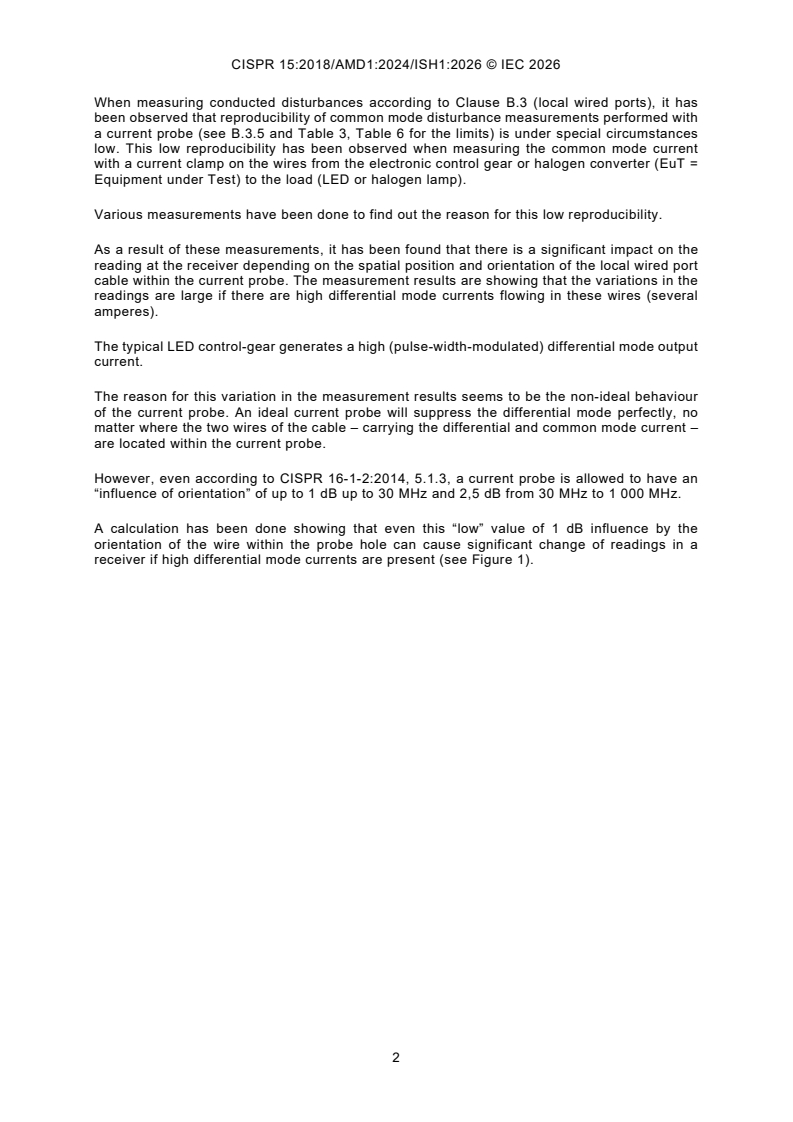
Calculation of the influence of orientation in case of strong differential currents in a CISPR current
Differential current: 1,0 A 1,0 A 0,01 A
Differential current in dBµA: 120 dBµA 120,0 dBµA 80 dBµA
Influence of orientation 1 dB 0,01 dB 0,1 dB
Value (Difference between
the two conductors)
Conductor 1 Current 120 dBµA 120,0 dBµA 80 dBµA
reading:
Conductor 2 Current 119 dBµA 120,0 dBµA 79,9 dBµA
reading:
Conductor 1 Current 1,000 0 A 1,000 0 A 0,010 0 A
reading:
Conductor 2 Current 0,891 3 A 0,998 8 A 0,009 9 A
reading:
Delta (Conductor 1 minus 0,108 7 A 0,001 2 A 0,000 1 A
Conductor 2)
Receiver reading 100,7 dBµA 61,2 dBµA 41,2 dBµA
("Artificial" Signal/false
common mode):
IEC
Table 1 – Calculation of the false common mode current
in case of high differential currents
For the common mode current measured, the 1 dB influence of the orientation is not critical
because the maximum change in the reading at the receiver is only 1 dB. But for the differential
mode current the 1 dB will lead to significant changes in the reading. The calculations in Figure
1 are showing that even with a 0,01 dB influence of variation, which is very low compared to
1 dB, which is currently allowed by CISPR 16-1-2, a reading of 61 dBµA false common mode
current at the receiver input will come up. This is much higher than the limit (Table 3 of CISPR
15:2018) of 40 dBµA at 150 kHz! Thus, a very limited differential mode rejection of the typical
current probes becomes obvious. Also, one can see that a “better” current probe (e.g., having
only 0,01 dB influence of orientation) would not solve the problem.
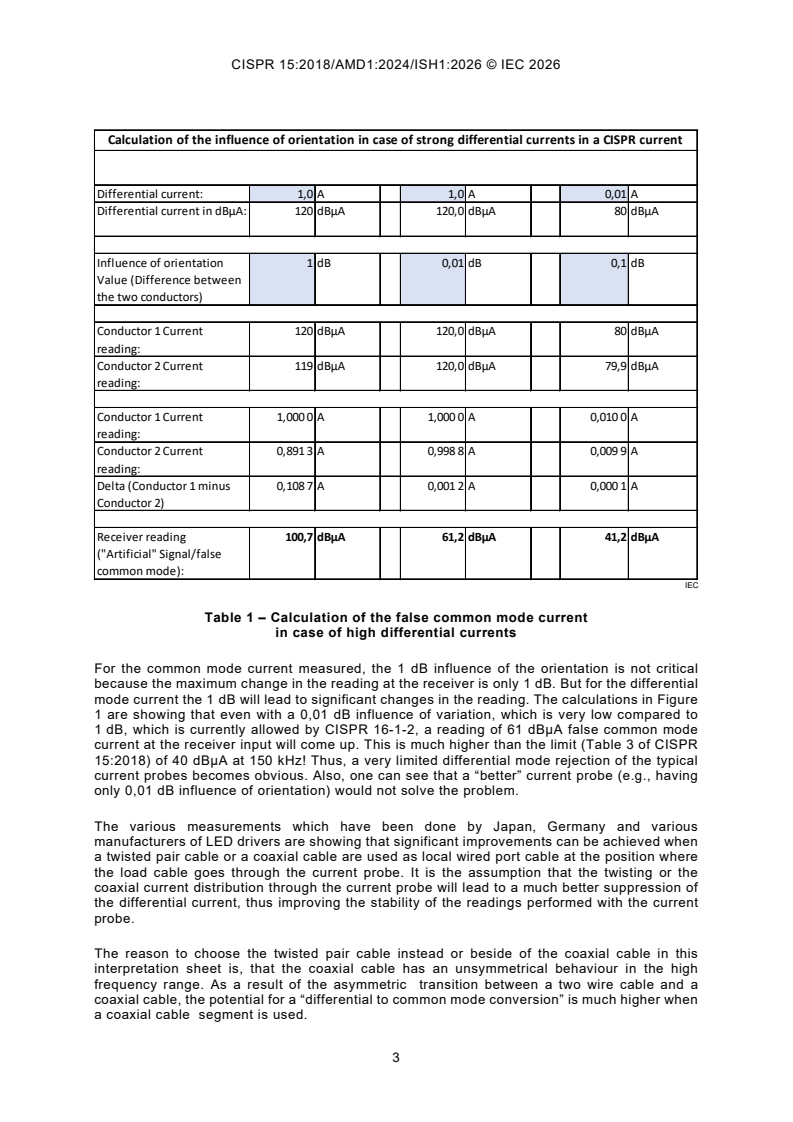
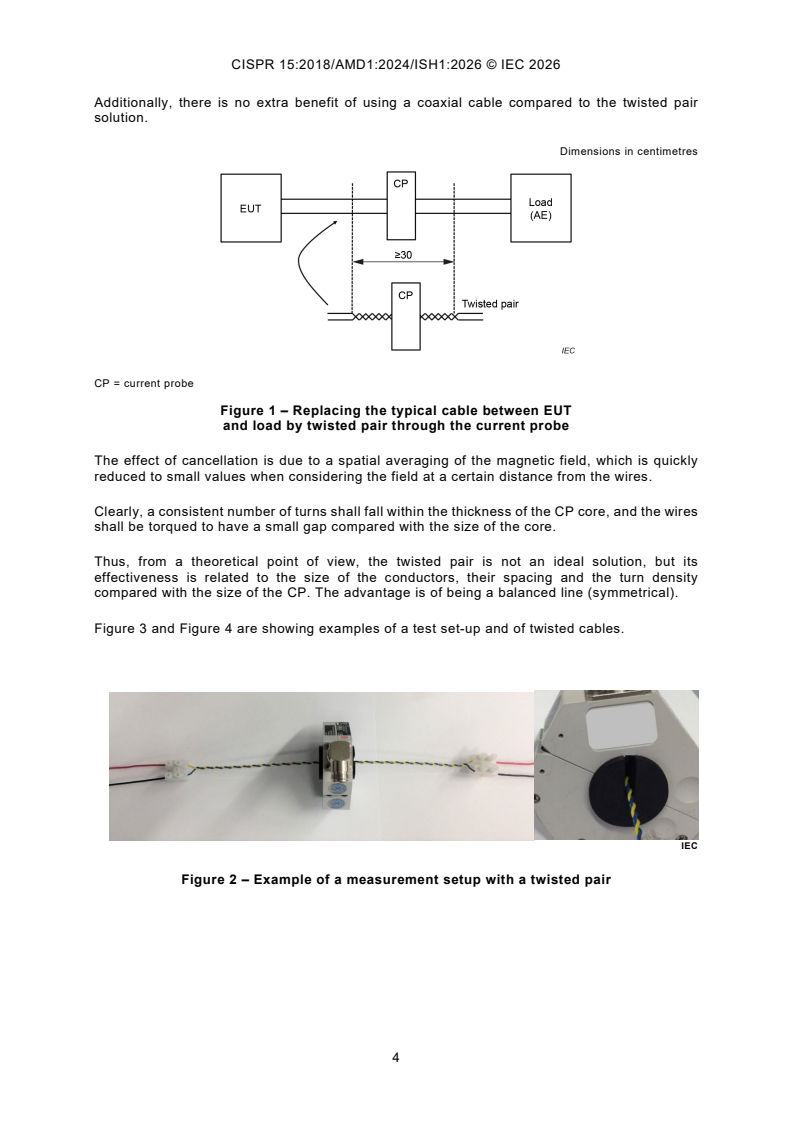
The various measurements which have been done by Japan, Germany and various
manufacturers of LED drivers are showing that significant improvements can be achieved when
a twisted pair cable or a coaxial cable are used as local wired port cable at the position where
the load cable goes through the current probe. It is the assumption that the twisting or the
coaxial current distribution through the cu
...