


ISO/IEC 8802-5:1992
(Main)Information processing systems — Local and metropolitan area networks — Part 5: Token ring access method and physical layer specifications
Information processing systems — Local and metropolitan area networks — Part 5: Token ring access method and physical layer specifications
Technologies de l'information — Réseaux locaux et urbains — Partie 5: Méthode d'accès par anneau à jeton et spécifications pour la couche physique
General Information
- Status
- Withdrawn
- Publication Date
- 26-Aug-1992
- Withdrawal Date
- 26-Aug-1992
- Current Stage
- 9599 - Withdrawal of International Standard
- Start Date
- 27-Dec-1995
- Completion Date
- 12-Feb-2026
Relations
- Effective Date
- 15-Apr-2008
Get Certified
Connect with accredited certification bodies for this standard

BSI Group
BSI (British Standards Institution) is the business standards company that helps organizations make excellence a habit.

NYCE
Mexican standards and certification body.
Sponsored listings
Frequently Asked Questions
ISO/IEC 8802-5:1992 is a standard published by the International Organization for Standardization (ISO). Its full title is "Information processing systems — Local and metropolitan area networks — Part 5: Token ring access method and physical layer specifications". This standard covers: Information processing systems — Local and metropolitan area networks — Part 5: Token ring access method and physical layer specifications
Information processing systems — Local and metropolitan area networks — Part 5: Token ring access method and physical layer specifications
ISO/IEC 8802-5:1992 is classified under the following ICS (International Classification for Standards) categories: 35.110 - Networking. The ICS classification helps identify the subject area and facilitates finding related standards.
ISO/IEC 8802-5:1992 has the following relationships with other standards: It is inter standard links to ISO/IEC 8802-5:1995. Understanding these relationships helps ensure you are using the most current and applicable version of the standard.
ISO/IEC 8802-5:1992 is available in PDF format for immediate download after purchase. The document can be added to your cart and obtained through the secure checkout process. Digital delivery ensures instant access to the complete standard document.
Standards Content (Sample)
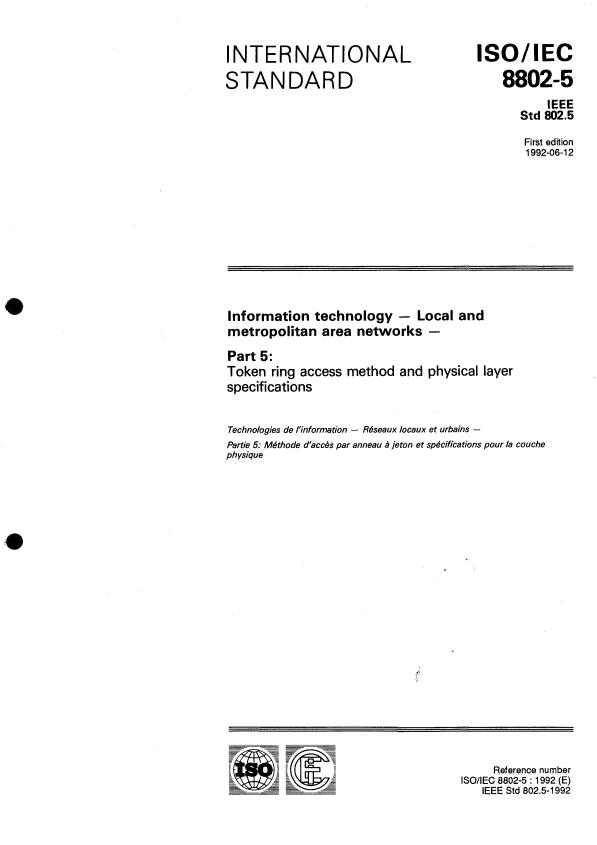
ISOIIEC
I NTER NATIONAL
8802-5
STANDARD
IEEE
Std 802.5
First edition
1992-06-1 2
Information technology - Local and
metropolitan area networks -
Part 5:
Token ring access method and physical layer
specifications
Technologies de I'inforrnation - Réseaux locaux et urbains -
Partie 5: Méthode d'accès par anneau à jeton et spécifications pour la couche
physique
Reference number
ISOAEC 8802-5 : 1992 (E)
IEEE Std 802.5-1992
The Institute of Electrical and Electronics Engineers, Inc.
345 East 47th Street, New York, NY10017-2394, USA
O 1992 by the Institute of Electrical and Electronics Engineers, Inc.
All rights reserved. Published in 1992
Printed in the United States of America
ISBN 1-55937-205-2
No part of this publication may be reproduced in any form,
in an electronic retrieval system or otherwise,
without the prior written permission of the publisher.
SEI15131
June 12,1992
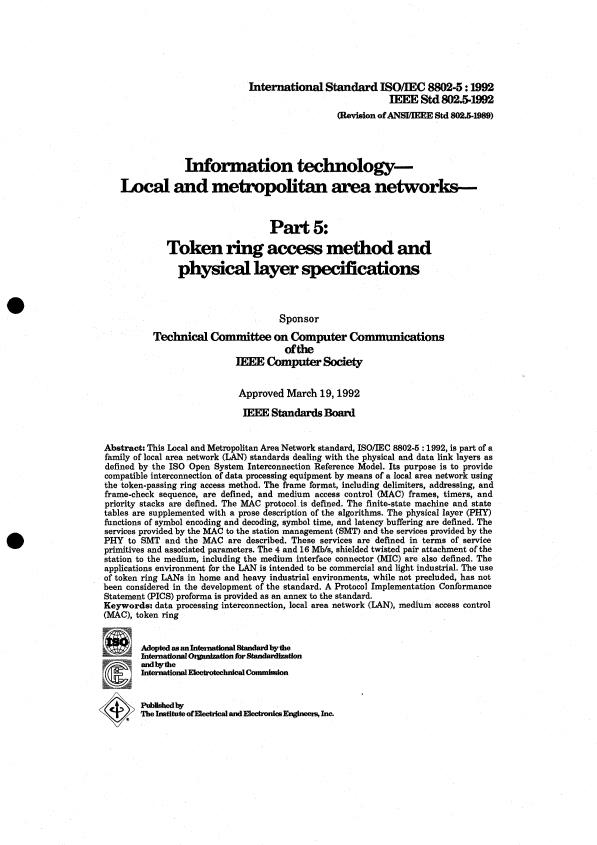
International Standard ISO/IEC 88026 : i992
IEEE std802.51992
(Revision of ANSWIEXE SM 8026-1989)
Informatiori techno10~-
Local andmetropolitaui areanetworks-
Part5
Token ring access method and
physical layer specifications
Sponsor
Technical Committee on Computer commwiications
ofthe
computer society
Approved March 19,1992
Abstract: This Local and Metropolitan Area Network standard, ISO/IEC 8802-5 : 1992, is part of a
family of local area network (LAN) standards dealing with the physical and data link layers as
defined by the IS0 Open System Interconnection Reference Model. Its purpose is to provide
a local area network using
compatible interconnection of data processing equipment by means of
the token-passing ring access method. The frame format, including delimiters, addressing, and
frame-check sequence, are defined, and medium access control (MAC) frames, timers, and
priority stacks are defined. The MAC protocol is defined. The finite-state machine and state
tables are supplemented with a prose description of the algorithms. The physical layer (PHY)
functions of symbol encoding and decoding, symbol time, and latency buffering are defined. The
services provided by the MAC to the station management (SMT) and the services provided by the
PHY to SMT and the MAC are described. These services are defined in terms of service
primitives and associated parameters. The 4 and 16 Mb/s, shielded twisted pair attachment of the
station to the medium, including the medium interface connector (MIC) are also defined. The
applications environment for the LAN is intended to be commercial and light industrial. The use
of token ring LANs in home and heavy industrial environments, while not precluded, has not
been considered in the development of the standard. A Protocol Implementation Conformance
Statement (PICS) proforma is provided as an annex to the standard.
Keywords: data processing interconnection, local area network (LAN), medium access control
(MAC), token ring
AdopteüasanInteiwWationalbytbe
Inteniatonai -On for 15tamlaidieatin
dbythe
InteniationaEiecElectrotecMcalcammission
re
International Standard ISO/IEC 8802-5 : 1992
IS0 (the International Organization for Standardization) and IEC (the
International Electrotechnical Commission) form the specialized system for
worldwide standardization. National bodies that are members of IS0 or IEC
participate in the development of International Standards through technical
committees established by the respective organization to deal with particular
fields of technical activity, IS0 and IEC technical committees collaborate in
fields of mutual interest. Other international organizations, governmental
and non-governmental, in liaison with IS0 and IEC, also take part in the
work.
In the field of information technology, IS0 and IEC have established a joint
technical committee, ISO/IEC JTC 1. Draft International Standards adopted
by the joint technical committee are circulated to national bodies for voting.
Publication as an International Standard requires approval by at least 75% of
the national bodies casting a vote.
In 1985, ANSVIEEE Std 802.5-1985 was adopted by IS0 Technical Committee
97, Information processing systems, as draft International Standard ISO/DIS
8802-5. A further revision was subsequently approved by ISODEC JTC 1 in the
form of this new edition, which is published as International Standard
ISODEC 8802-5 : 1992.
For the purpose of assigning global addresses, the Institute of Electrical and
Electronics Engineers, Inc., USA, has been designated by the IS0 Council as
the Registration Authority. Communications on this subject should be ad-
dressed to
Registration Authority for ISO/IEC 8802-5
c/o The Institute of Electrical and Electronics Engineers, Inc.
445 Hoes Lane
P.O. Box 1331
Piscataway, NJ 08855-1331
USA
During the preparation of this International Standard, information was
gathered on patents upon which application of the standard might depend.
Relevant patents were identified as belonging to Willemijn Holding BV.
However, IS0 cannot give authoritative or comprehensive information about
evidence, validity or scope of patent and like rights. The patent-holder has
stated that licences will be granted under reasonable terms and conditions
and communcations on this subject should be addressed to
Willemijn Holding BV
Weena 723
P.O. Box 29193
3001 GD Rotterdam
The Netherlands
International Organization for Standardizatiodnternational Electrotechnical Commission
Case postale 56 CH-1211 Genève 20 Switzerland
Foeword to International Standard ISOKEC 8802-5 : 1992
This standard is part of a family of standards for Local and Metropolitan
Area Networks. The relationship between this standard and the other
members of the family is shown below. (The numbers in the figure refer to IS0
standard numbers.)
8802-2
DATA
a LINK
a
LINK
Fi
This family of standards deals with the physical and data link layers as
defined by the IS0 Open Systems Interconnection Basic Reference Model (IS0
7498 : 1984). The access standards define four types of medium access tech-
nologies and associated physical media, each appropriate for particular appli-
cations or system objectives. Other types are under investigation.
The standards defining these technologies are as follows:
(1) ISO/IEC 8802-3 [ANSVIEEE Std 802.3, 1992 Edition], a bus utilizing
CSMNCD as the access method,
(2) ISO/IEC 8802-4 [ANSVIEEE Std 802.4-19901, a bus utilizing token pass-
ing as the access method,
(3) ISO/IEC 8802-5 [IEEE Std 802.5-19921, a ring utilizing token passing as
the access method,
(4) IS0 8802-7, a ring utilizing slotted ring as the access method.
IS0 8802-2 [ANSVIEEE Std 802.2-19891, Logical Link Control protocol, is
used in conjunction with the medium access standards.
The reader of this document is urged to become familiar with the complete
family of standards.
IEEE Standards documents are developed within the Technical Committees of
the IEEE Societies and the Standards Coordinating Committees of the IEEE
Standards Board. Members of the committees serve voluntarily and without
compensation. They are not necessarily members of the Institute. The stan-
dards developed within IEEE represent a consensus of the broad expertise on the
subject within the Institute as well as those activities outside of IEEE which have
expressed an interest in participating in the development of the standard.
Use of an IEEE Standard is wholly voluntary. The existence of an IEEE
Standard does not imply that there are no other ways to produce, test, measure,
purchase, market, or provide other goods and services related to the scope of the
IEEE Standard. Furthermore, the viewpoint expressed at the time a standard is
approved and issued is subject to change brought about through developments in
the state of the art and comments received from users of the standard. Every
IEEE Standard is subjected to review at least once every five years for revision
or reaffirmation. When a document is more than five years old, and has not
been reaffirmed, it is reasonable to conclude that its contents, although still of
some value, do not wholly reflect the present state of the art. Users are cautioned
to check to determine that they have the latest edition of any IEEE Standard.
Comments for revision of IEEE Standards are welcome from any interested
party, regardless of membership affiliation with IEEE. Suggestions for changes
in documents should be in the form of a proposed change of text, together with
appropriate supporting comments.
Interpretations: Occasionally questions may arise regarding the meaning of
portions of standards as they relate to specific applications. When the need for
interpretations is brought to the attention of IEEE, the Institute will initiate
action to prepare appropriate responses. Since IE Standards represent a
consensus of all concerned interests, it is importan ensure that any inter-
pretation has also received the concurrence of a balance of interests. For this
reason IEEE and the members of its technical committees are not able to provide
an instant response to interpretation requests except in those cases where the
matter has previously received formal consideration.
Comments on standards and requests for interpretations should be addressed
to:
Secretary, IEEE Standards Board
445 Woes Lane, P.O. Box 1331
Piscataway, NJ 08855-1331
USA
IEEE Standards documents are adopted by the Institute of Electrical and
Electronics Engineers without regard to whether their adoption may involve
patents on articles, materials, or processes. Such adoption does not assume any
liability to any patent owner, nor does it assume any obligation whatever to
parties adopting the standards documents.
Fomword to IEEE Std 8û2.bl.992
(This Foreword is not a part of this International Standard or of IEEE 802.6-1992.)
This standard is part of a family of standards for local and metropolitan
area networks. The relationship between the standard and other members of
the family is shown below. (The numbers in the figure refer to IEEE standard
numbers.)
802.2 LOGICAL LINK
I
I
DATA
802.1 BRIDGING
LINK
802.4 802.5 802.8 802.9
802.3
MEDIUM MEDIUM
MEDIUM MEDIUM MEDIUM
ACCESS ACCESS
ACCESS ACCESS ACCESS
802.3 802.4 802.5 802.6 802.9
PHYSICAL PHYSICAL PHYSICAL PHYSICAL PHYSICAL
* Formerly IEEE Std 802.1A.
This family of standards deals with the physical and data link layers as de-
fined by the IS0 Open Systems Interconnection Basic Reference Model (IS0
7498:1984). The access standards define several types of medium access tech-
nologies and associated physical media, each appropriate for particular
applications or system objectives. Other types are under investigation.
The standards defining these technologies are as follows:
IEEE Std 802t : Overview and Architecture. This
standard provides an overview to the
family of IEEE 802 Standards. This
document forms part of the 802.1
scope of work.
MAC Bridging. Specifies an archi-
IEEE Std 802.1D:
tecture and protocol for the intercon-
I nection of IEEE 802 LANs below the
MAC service boundary.
t The 802 Architecture and Overview Specification, originally known as IEEE Std 802.1A, has
been renumbered as IEEE Std 802. This has been done to accommodate recognition of the base
standard in a family of standards. References to IEEE Std 802.1A should be considered as refer-
ences to IEEE Std 802.
System Load Protocol. Specifies a set
IEEE Std 802.1E:
of services and protocol for those
aspects of management concerned
with the loading of systems on IEEE
802 LANs.
IS0 8802-2 [ANSILEEE Std 802.21: Logical Link Control
ISOLIEC 8802-3 [ANSVIEEE SM 802.33: CSMNCD Access Method and Phys-
sical Layer Specifications
ISOLIEC 8802-4 [ANSILEEE Std 802.41: Token Bus Access Method and Phys-
sical Layer Specifications
ISOLIEC 8802-5 [IEEE Std 802.51: Token Ring Access Method and
Physical Layer Specifications
Metropolitan Area Network Access
IEEE Std 802.6:
Method and Physical Layer Specifi-
cations
In addition to the family of standards are technical advisory groups as
follows:
Broadband Technical Advisory and
IEEE Std 802.7:
Physical Layer Topics and Recom-
mended Practices
Fiber Optic Technical Advisory and
P802.8:
Physical Layer Topics
The reader of this document is urged to become familiar with the complete
family of standards.
confomnance Test Methodology
A new standards series, identified by the number 1802, has been established
to identify the conformance test methodology documents for the 802 family of
standards. This makes the correspondence between the various 802 standards
and their applicable conformance test requirements readily apparent. Thus
the conformance test documents for 802.3 are numbered 1802.3, the confor-
mance test documents for 802.5 will be 1802.5, and so on. Similarly, IS0 will
use .&kWQ to number conformance test standards for 8802 standards.
ISOAEC 88026 : 1992 (JEEE Std 802.6-1992P
This standard specifies that each octet of the information field shall be
transmitted most significant bit (MSB) first. This convention is reversed
from that used in the CSMNCD and Token Bus standards, which are least
significant bit (LSB) first transmission. While the transmission of MSB first
is used for token ring, this does not imply that MSB transmission is preferable
This standard contains the following supplements: IEEE Std 802.6d-1992 (Interconnected
Token Ring LANs) and IEEE Std 802.5.g-1992 (Conformance Testing).
for any other local are network. Anyone considering interconnecting the
token ring with other standard IEEE networks should keep in mind the need to
perform bit reordering in the gateway between networks.
The following are now or have been voting members of the Token Ring
Access Method Working Group (P802.5). Those individuals who have served
as rapporteurs or editors are indicated by an asterisk next to their name:
Robert A. Donnan, Chair
H. Abramowicz
Clarence C. Joh Claire Roden
Don Aelmore Arthur D. Jopling
Bob Ross
Charles Amann Dave Juhre
Floyd Ross
Steven C. Andersen Jiro Kashio
Jacques A. Roth
A. Philip Arneth* Carrell Killebrew
John Rovner*
Floyd Backes Lisa Kelley Chris Roussel
Jarred J. Baker Bryan B. Kim Don Roworth
Rey Bautista Makoto Kuhno Mike Rubera
Nicholas Beale* David M. Kollm Howard Rubin
Alan Beardsley* Stan Kopec Said Saadeh
Steve Belisle William F. Kous Howard Salwen
Daniel Boudreau Robert Krebs Haig A. Sarkissian
Randall Blair Robert Krzyzanowski Gordon Saussy
Charles Brill Eiji Kuje W. L. Schumacker
Philip Brownlee David Laffitte Tim Shafer
Patrik Bulteel
Bob Lapointe Himanshu Shah
Dr. Werner Bux Katie D. Lee* David Sheehy
Robert R. Campbell
Choon Lee Naoshi Shima
Robert L. Carl Laurie Lindsey Marc Shoquist
Claude A. Cartee
Robert D. Love* W. S. Shung
Hsin-Hwai Chen
Carl Madison Somsubhra Sikdar
Ramon Co Alan C. Marshall* Raymond Sit
Michael H. Coden Jeffry V. Marshik*
Bob Smith
Thomas Coradetti Kelly P. McClellan Robert Snyder
Guy Crowels Jerry McKamey Michael J. Sobieski
John DeCramer John Melnick Bob Southard
Rick Downs John Messenger* Louis Stankaitas
Hanoch Eldar Colin Mick Leo Staschover
Mohamed Elrefai Arthur Miller* Ed Sterling
Farzin Firoozmand John E. Montague Tom Swarthout
Gunnar Forsberg Steven Moustakas Richard Sweatt
Nathan Fritts Bila1 Murtaza Andre Szczepanek
Yoshihiko Fujii Narayan Murthy D. T. W. Sze
Ron W. Gibson Shigekatsu Nakao Hidenori Takahashi
Harry Gold* W. B. Neblett Tokio Takai
Richard H. Gompertz James Nelson Marco Tamilia
Lisa Goulet Ollie Nilsson Paul Tan
Andrew Green Andrew Norton V. Tarassov
Fred Greim Brian O'Connel1 Lars Thernsjo
Siegmar Gross Rasoul M. Oskouy Scott Thomas
Robert Grow Kathleen Otis Nathan Tobol
Tom Gulick Atul Pandya Jeff Tong
Lee C. Haas Guy Parker Art Torino
Nubuhiro Hamada Dave Pearce Akihisa Toyooka
Sharam Hakimi Dave Pfahler John Trites
Thanh Pham Paul A. Trudgett
Floyd Halsey
Jeffrey Pickering Bo Viklund
Charles F. Hanes*
Takeshi Harakawa Richard Podgalsky John Q. Walker
James Harrer Kirk Preiss* Chang-Jung Wang
Frank Wang
John Rance
Bryan Hatfield
Ian Watson
Ivan Reede
Car1 G. Hayssen
Kevin White
Francis E. Retnasothie
Tricia Hill
R. O. Westlake
Everett O. Rigsbee III*
J. Paul Hittel
Jim Weisert
Andrew L. RingWald*
Tom Hogan
Phi1 Robinson Kevin White
Tetsuo Isayama
Albert Wong Barzilai Yoram
Ben Wilson
H. A. Zannini
Howard D. Wright
Peter Williams
Marshall Zerbo
Kazuhiko Yamada
Izumi Y. Wilson
Mo Zonoun
Jacalyn Winkler*
The following persons were on the balloting committee that approved IEEE
Std 802.5d-1992 (Interconnected Token Ring LANs), and
Std 802.5-1 992, IEEE
IEEE Std 802.5g-1992 (Conformance Testing) for submission to the IEEE
Standards Board:
Rafat Pirzada
Paul L. Hutton
William B. Adams
Urdo W. Pooch
Raj Jain
Don Aelmore
Thad L. D. Regulinski
Jack R. Johnson
Kit Athul
John P. Riganati
Reijo Juvonen
Yong Myung Baeg
Gary S. Robinson
Robert W. Klessig
Alan L. Bridges
Philip T. Robinson
Jens Kolind
George Carson
Victor Rozentouler
Jon Kramp
Brian J. Casey
Michael Lawler Norman Schneidewind
George C. Chachis
Jeffrey R. Schwab
Jai Yong Lee
Robert A. Ciampa
Donald A. Sheppard
F. C. Lim
Gerald W. Cichanowski
David M. Siefert
Randolph S. Little
Michael H. Coden
Robert K. Southard
Donald S. Little
Robert Crowder
Benjamin J. Stoppe, Jr.
Eduardo G. Marmol
Robert Donnan
Fred J. Strauss
William McDonald
Sourav Dutta
Efstathiois Sykas
Richard H. Miller
John E. Emrich
Steven R. Taylor
Philip H. Enslow David S. Millman
Geoffrey O. Thompson
C. B. Madhar Mishra
Changxin Fan
Robert Tripi
Wen Hsien Lim Moh
John W. Fendrich
James T. Vorhies
John E. Montague
Harold C. Folts
Donald F. Weir
Kinji Mori
Harvey A. Freeman
Raymond Wenig
Gerald Moseley
Patrick Gonia
Michael Willett
Charles E. Neblock
Abraham Grund
Paul A. Willis
Ruth Nelson
Sandor V. Halasz
Jerry A. Wyatt
Arne A. Nilsson
Joseph L. Hammond
Oren Yuen
Donal O'Mahony
Lee A. Hollaar
Stephen Zebrowski
Charles Oestereicher
Ivy P. Hsu
Andreas Pfitzmann
When the IEEE Standards Board approved this standard on March 19, 1992,
it had the following membership:
Donald C. Loughry, Vice Chair
Marco W. Migliam, Chair
Andrew G. Salem, Secretary
Donald T. Michael*
Donald N. Heirman
Dennis Bodson
John L. Rankine
Ben C. Johnson
Paul L. Borrill
Wallace S. Read
Walter J. Karplus
Clyde Camp
Ronald H. Reimer
Ivor N. Knight
Donald C. Fleckenstein
Gary S. Robinson
Joseph L. Koepfinger*
Jay Forster*
Martin V. Schneider
Irving Kolodny
David F. Franklin
Terrance R. Whittemore
D. N. "Jim" Logothetis
Ramiro Garcia
Lawrence V. McCall Donald W. Zipse
Thomas L. Hannan
*Member Emeritus
Also included are the following nonvoting IEEE Standards Board liaisons:
Satish K. Aggarwal
James Beail
Richard B. Engelman
Stanley Warshaw
Paula M. Kelty
IEEE Standards Project Editor
Contents
SECTION PAGE
1 . General . 15
1.1 Scope . 15
1.2 Definitions . 16
1.3 Abbreviations . 19
1.4 References . 21
1.5 Conformance Requirements . 22
1.5.1 Static Conformance Requirements . 22
1.5.2 Dynamic Conformance Requirements . 23
2 . General Description . 25
3 .
Formats and Facilities . 29
3.1 Formats . 29
3.1.1 Token Format . 29
3.1.2 Frame Format . 29
3.1.3 Fill . 30
3.2 Field Descriptions . 30
3.2.1 Starting Delimiter (SD) . 30
3.2.2 Access Control (AC) . 30
3.2.3 Frame Control (FC) . 31
3.2.4 Destination and Source Address (DA and SA) Fields . 32
3.2.5 Routing Information (RI) Field . 35
3.2.6 Information (INFO) Field . 35
3.2.7 Frame-Check Sequence (FCS) . 37
3.2.8 Ending Delimiter (ED) . 37
3.2.9 Frame Status (FS) . 38
3.3 Medium Access Control (MAC) Frames . 38
3.3.1 Vector Description . 39
3.3.2 Subvector Descriptions . 41
3.3.3 Table of MAC Frames . 44
3.4 Timers . 44
3.4.1 Timer, Return to Repeat (TRR) . 44
3.4.2 Timer, Holding Token (THT) . 44
3.4.3 Timer, Queue PDU (TQP) . 44
3.4.4 Timer, Valid Transmission (TVX) . 44
3.4.5 Timer, No Token (TNT) . 44
3.4.6 Timer, Active Monitor (TAM) . 45
3.4.7 Timer, Standby Monitor (TSM) . 45
3.4.8 Timer, Error Report (TER) . 45
....................................................... 45
3.4.9 Timer. BCN Transmit (TBT)
3.4.10 Timer, BCN Receive (TBR) . -45
3.5 Flags . 45
3.5.1 IFlag . 45
3.5.2 SFSFlag . 45
SECTION PAGE
3.5.3 MA Flag . 45
3.5.4 SMPFlag . 45
3.5.5 NN Flag . 45
3.5.6 BRFlag . 45
3.5.7 ETRFlag . 45
3.5.8 NOT-MA Flag . 48
3.6 Priority Registers and Stacks . 48
3.6.1 Pr and Rr Registers . 48
3.6.2 Sr and Sx Stacks . 48
3.7 Latency Buffer . 48
3.8 Counters 48
................................................................................................
3.8.1 Line Error . 48
O 3.8.2 Internal Error . 48
Burst Error . 48
3.8.3
3.8.4 AC Error . 48
3.8.5 Abort Delimiter Transmitted (AD-TRANSI . 49
3.8.6 Lost Frame Error (LOST-FR) . 49
3.8.7 Receive Congestion Error (RCV-CON) . 49
Frame Copied Error (FR-COPIED) . 49
3.8.8
3.8.9 Frequency Error (FREQ) . 49
3.8.10 Token Error . 49
3.8.11 Frame Count (FR-CNT) . 49
Token Ring Protocols . 51
4 .
4.1 Overview . 51
4.1.1 Frame Transmission . 51
4.1.2 Token Transmission . 51
4.1.3 Stripping . 51
4.1.4 Frame Reception . 51
4.1.5 Priority Operation . 52
4.1.6 Beaconing and Neighbor Notification . 53
Error Reporting . 55
4.1.7
O
4.1.8 Administration of Ring Parameters . 55
4.1.9 Configuration Control . 55
4.1.10 Early Token Release (ETR) . 55
4.2 Specification . 55
4.2.1 Receive Actions . 56
Operational Finite-State Machine . 58
4.2.2
Standby Monitor Finite-State Machine . 62
4.2.3
4.2.4 Active Monitor Finite-State Machine . 67
5 . Physical Layer . 71
5.1 Symbol Encoding . 71
5.2 Symbol Decoding . 72
5.3 Data Signaling Rates . 73
5.4 Symbol Timing . 73
SECTION PAGE
5.5 Latency Buffer . 73
5.5.1 Assured Minimum Latency . 73
5.5.2 Phase Jitter Compensation . 73
6 . Service Specifications . 75
6.1 MAC to LLC Service . 75
6.2 PHY to MAC Service . 75
6.2.1 Interactions . 75
6.2.2 Detailed Service Specifications . 76
6.3 MAC to SMT Interaction . 77
6.3.1 Overview of MAC Interaction . 77
6.3.2 MAC Attributes . 78
6.3.3 MAC Transients . 80
6.4 PHY to SMT Interaction . 83
6.4.1 Overview of PHY Management Interaction . 83
6.4.2 PHY Transients . 83
7 . Station Attachment Specifications . 85
7.1 Scope . 85
7.2 Overview . 85
7.3 Coupling of the Station to the Ring . 86
7.4 Ring Access Control . 86
7.4.1 Current and Voltage Limits . 86
7.4.2 InsertiodBypass Transfer Timing . 88
7.5 Signal Characteristics . 88
7.5.1 The Transmitter . 88
7.5.2 The Channel . 89
7.5.3 The Receiver . 90
7.5.4 Error Rate . 92
7.6 Reliability . 93
7.7 Safety Requirements . 93
7.8 Electromagnetic Emanation . 93
7.9 Medium Interface Connector (MIC) . 94
7.9.1 Medium Interface Connector-Contactor Detail . 94
7.9.2 Medium Interface Connector-Locking Mechanism Detail . 94
FIGURES AND TABLE PAGE
Fig 2-1 Relation of OS1 Reference Model to the LAN Model . 25
Fig 2-2 Token Ring Configuration . 26
Fig 2-3 Relationship of Data Stations. Servers. and System Manager . 27
Fig 3-1 MAC Frame Information Field Structure . 35
Fig 4-1 An Example of a Failure Domain . 54
Fig 4-2 Receive Action Table . 57
Fig 4-3 Operational Finite-State Machine . 59
Fig 4-4 Repeat State Loop Table . 60
Fig 4-5 Standby Monitor Finite-State Machine . 64
Fig 4-6 Standby State Transition Loop Table . 66
Fig 4-7 Active Monitor Finite-State Machine . 68
Fig 5-1 Example of Symbol Encoding . 72
Fig 7-1 Partitioning of PHY and Medium . 85
Fig 7-2 Example of Station Connection to the Medium . 87
Fig 7-3 Receive Signal Eye Pattern . 90
Fig 7-4 Medium Interface Connector-Isometric View . 93
Fig 7-5 Medium Interface Connector-Contactor Detail . 95
Fig 7-6 Medium Interface Connector-Locking Mechanism Detail . 96
Table 3-1 MAC Frames . 46
ANNEXES PAGE
Annex A . Address Structuring (Informative) . 97
Annex B . LLC Type 3 Support (Informative) . 98
Annex C . PICS Proforma (Normative) . 99
C1 . Introduction . 99
C2 . Abbreviations and Special Symbols . 99
C2.1 Status Symbols . 99
C2.2 Abbreviations . 99
C3 . Instructions for Completing the PICS Proforma . 100
C3.1 General Structure for the PICS Proforma . 100
C3.2 Additional Information . 100
C3.3 Exception Information . 101
C3.4 Conditional Status . 101
C4 . Identification . 102
C4.1 Implementation Identification . 102
C4.2 Protocol Summary . 102
C5 . Major Capabilities . 103
C6 . PICS Proforma for the MAC Sublayer . 103
C6.1 Frame Formats . 103
C6.2 Destination and Source MAC Address Fields . 103
.................................................................... 104
C6.3 Frame Parameters
C6.4 MAC Frames . 105
C6.5 MAC Frame Subvectors . 106
C6.6 Timers . 108
C6.7 Flags . 109
C6.8 Priority Registers and Stacks . 109
C6.9 Counters . 109
C7 . PICS Proforma for the Physical Layer . 110
C7.1 Symbol Encoding and Decoding . 110
C7.2 Data Signaling Rate . 110
C7.3 Symbol Timing . 110
c7.4 Latency Buffer . 110
C8 . Station Attachment Specifications . 111
C8.1 Coupling of the Station to the Ring . 111
(28.2 Transmitter Characteristics . 111
C8.3 Receiver Characteristics . 111
C8.4 Medium Interface Connector . 111
ISO/IEC 8802-5 : 1992
TOKEN RING IEEE Std 802.5-1992
Information technology-
Local and metropolitan area networks-
Part 5:
Token ring access method and
physical layer specifications
a
1. General
1.1 Scope. For the purpose of compatible interconnection of data processing
equipment via a local area network (LAN) using the token ring access method, this
standard
(1) Defines the frame format, including delimiters, addressing, routing infor-
mation, and frame-check sequence (FCS), to allow operation on a single ring
or on multiple rings connected by source routing or transparent bridges, and
introduces medium access control (MAC) frames, timers, counters, and
priority stacks (see Section 3);
(2) Defines the MAC protocol. The finite-state machine and state tables are
supplemented with a prose description of the algorithms (see Section 4);
(3) Defines the physical layer (PHY) functions of symbol encoding and decod-
ing, symbol timing, and latency buffering (see Section 5);
(4) Describes the services provided by the MAC to the station management
(SMT) and the logical link control sublayer (LLC) and the services provided
a
by the PHY to SMT and the MAC. These services are defined in terms of
service primitives and associated parameters (see Section 6);
(5) Defines the 4 and 16 Mbh, shielded twisted pair attachment of the station to
the medium including the definition of the medium interface connector
(MIC) (see Section 7);
(6) Includes the PICS proforma in compliance with the relevant requirements,
and in accordance with the relevant guidance, given in IS0 9646-2 [711
(see Annex C).
The definition of suitable media (twisted pair, coaxial cable, and optica1fiber)for
connecting stations that meet the attachment standard specified herein is a subject
for future consideration. Until such time as these media are specified, the
The numbers in the brackets correspond to those of the references in 1.4.
ISO/IEC 8802-5 : 1992
IEEE Std 802.5-1992
LOCAL AND METROPOLITAN AREA N'ETWORlfB:
specifications in Section 7 shall define the performance bounds to which an
operating network, including media and trunk coupling unit(s) (TCUS), shall
conform.
Aparticular emphasis of this standard is to specify the homogeneous externally
visible characteristics needed for interconnection compatibility, while avoiding
unnecessary constraints upon and changes to internal design and implementation
of the heterogeneous processing equipment to be interconnected.
The applications environment for the LAN is intended to be commercial and
light industrial. The use of token ring LANs in home and heavy industrial
environments, while not precluded, has not been considered in the development of
this standard.
1.2 Definitions
abort sequence. A sequence that terminates the transmission of a frame
prematurely.
accumulated jitter. The jitter measured against the clock of the active monitor.
Like alignment jitter, this is not a type of jitter but a way to measure total jitter
growth throughout the ring. It is normally used to determine the required size of
the elastic buffer.
alignment jitter. The jitter measured against the clock of the upstream adapter.
This is not a type of jitter per se; rather, it is a way to measure jitter. When "zero
transferred jitter" is specified, the jitter measured is alignment jitter.
broadcast transmission. A transmission addressed to all stations.
channel. The channel is the transmission path from the MIC at the transmitter
to the first MIC at the receiver. It may include TCUs and connectors in addition
to transmission line.
configuration report server (CRS). A function that controls the configuration
of the ring. It receives configuration information from the stations on the ring and
either forwards them to the network manager or uses them to maintain a
configuration of the ring. It can also, when requested by the network manager,
check the status of stations on the ring, change operational parameters of stations
on the ring, and remove stations from the ring.
correlated jitter. The portion ofthe total jitter that is related to the data pattern.
Since every adapter receives the same pattern, this jitter is correlated among all
adapters and therefore grows in a systematic way along the ring. Correlated jitter
is also called pattern jitter or systematic jitter.
differential Manchester encoding. A signaling method used to encode clock
two halves,
and data bit information into bit symbols. Each bit symbol is split into
where the second half is the inverse symbol of the first half. A O bit is represented
by a polarity change at the start of the bit time. A 1 bit is represented by no polarity
change at the start of the bit time. Differential Manchester encoding is polarity-
independent.
ISO/IEC 8802-5 : 1992
TOKEN RING IEEE Std 802.5-1992
fill. A bit sequence that may be either O bits or 1 bits or any combination thereof.
frame. A transmission unit that carries a protocol data unit (PDU) on the ring.
jitter. The time-varying difference between the phase of the recovered clock and
the phase of the source clock. Jitter is measured in fractions of a clock cycle, or unit
interval (VI).
logical link control (sublayer)(LLC). That part of the data link layer that
supports media-independent data link functions, and uses the services ofthe MAC
to provide services to the network layer.
medium. The material on which the data may be represented. Twisted pairs,
coaxial cables, and optical fibers are examples of media.
medium access control (subiayer)(MAC). The portion of the data station that
controls and mediates the access to the ring.
medium interface connector (MIC). The connector between the station and
TCU at which all transmitted and received signals are specified.
monitor. The monitor is that function that recovers from various error situations.
It is contained in each ring station; however, only the monitor in one of the stations
on aring is the active monitor at any point in time. The monitor function in all other
stations on the ring is in standby mode.
multiple frame transmission. A transmission where more than one frame is
transmitted when a token is captured.
physical (layer)(PHY). The layer responsible for interfacing with the medium,
detecting and generating signals on the medium, and converting and processing
signals received from the medium and the MAC.
protocol data unit (PDU). Information delivered as a unit between peer entities
that contains control information and, optionally, data.
protocol implementation conformance statement (PICS). A statement of
which capabilities and options have been implemented for a given Open Systems
Interconnection protocol.
repeat. The action of a station in receivinga bit stream (for example, frame, token,
or fill) from the previous station and placing it on the medium to the next station.
The station repeating the bit stream may copy it into a buffer or modify control bits
as appropriate.
repeater. A device used to extend the length, topology, or interconnectivity of the
transmission medium beyond that imposed by a single transmission segment.
ring error monitor (REM). A function that collects ring error data from ring
stations. The REM may log the received errors, or analyze this data and record
statistics on the errors.
ring latency. In a token ring MAC system, the
...
Questions, Comments and Discussion
Ask us and Technical Secretary will try to provide an answer. You can facilitate discussion about the standard in here.
Loading comments...