

ISO 4669-1:2023
(Main)Document management — Information classification, marking and handling — Part 1: Requirements
General Information
- Abstract
This document specifies requirements for information classification, marking and handling (ICMH). This document also defines how such information can be accessed by users, both inside and outside the organization, who own the information. This document is applicable to, but not limited to, the following: a) organizations of any size that create, store, share or otherwise process information; b) individuals who create, store, share or otherwise process information; c) individuals with responsibilities for document management, information governance and management, information security, data protection, privacy and/or compliance; and d) organizations that create, provide or support tools that enable a) to c). This document addresses information that can be understood by humans and is capable of being shared. Throughout this document such information is referred to as an “information asset” regardless of its media or format. NOTE Information assets can include structured information, unstructured information, text, pictures and audio/video recordings, i.e. anything that contains information, including information that is derived from databases and turned into a tangible asset.
- Status
- Published
- Publication Date
- 09-May-2023
- Technical Committee
- ISO/TC 171/SC 1 - Quality, preservation and integrity of information
- Drafting Committee
- ISO/TC 171/SC 1/WG 11 - Controlled sharing of digital documents
- Current Stage
- 6060 - International Standard published
- Start Date
- 10-May-2023
- Due Date
- 10-Mar-2023
- Completion Date
- 10-May-2023

Overview
ISO 4669-1:2023 - Document management - Information classification, marking and handling - Part 1: Requirements defines a structured, organization‑level approach to information classification, marking and handling (ICMH). The standard applies to any organization or individual that creates, stores, shares or processes information assets (structured or unstructured, text, images, audio/video or rendered database outputs). It sets out requirements for designing ICMH systems so information owners and users can consistently access, protect and share information both inside and outside the organization.
Key topics and technical requirements
ISO 4669-1:2023 covers the full lifecycle of ICMH systems. Major technical topics and requirements include:
- ICMH system design - Establish policies, objectives and interrelated processes for classification, marking and handling.
- Classification scheme design - Define classification criteria, hierarchies, equivalence with other schemes, descriptors, dependencies and default classifications.
- Marking scheme design - Specify marking criteria, placement and style (visible marks and metadata) to indicate classification.
- Handling scheme design - Define handling rules for creation, capture, reuse, editing, aggregation, storage, replication, redaction, distribution, sharing, archiving and disposal.
- Information asset life cycle - Address stages from creation through retention to disposal, ensuring classification follows assets across formats and media.
- Metadata and marking - Use metadata to convey classification where visible marking is not feasible and to support automated workflows.
- Security and access - Align handling requirements with information security, data protection and privacy obligations.
- Evaluation and assurance - Implement monitoring, testing, auditing, incident management, measurement and reporting to verify ICMH effectiveness.
- Revision and change management - Maintain and evolve the ICMH system, manage scheme revision and progressively integrate or extend scope.
Practical applications and users
ISO 4669-1:2023 is practical for:
- Information governance, records management and compliance teams establishing firm rules for sensitive and routine information.
- Information security and data protection professionals who need to align handling rules with confidentiality, integrity and availability goals.
- IT and software vendors building document management, collaboration and DLP tools that must respect classification metadata and markings.
- Small and large organizations across public and private sectors seeking consistent cross‑organizational sharing and interoperability of classified information.
Benefits include improved protection of sensitive data, clearer user guidance on handling, and support for legal, regulatory and enterprise risk management objectives.
Related standards
- ISO 15489-1 (records management)
- ISO 23081-1 (metadata for records)
- ISO 9000 (quality management terminology)
- ISO 13972 (information asset lifecycle concepts)
Keywords: ISO 4669-1:2023, information classification, marking, handling, ICMH, information asset, document management, information governance, metadata, information security.
Frequently Asked Questions
ISO 4669-1:2023 is a standard published by the International Organization for Standardization (ISO). Its full title is "Document management — Information classification, marking and handling — Part 1: Requirements". This standard covers: This document specifies requirements for information classification, marking and handling (ICMH). This document also defines how such information can be accessed by users, both inside and outside the organization, who own the information. This document is applicable to, but not limited to, the following: a) organizations of any size that create, store, share or otherwise process information; b) individuals who create, store, share or otherwise process information; c) individuals with responsibilities for document management, information governance and management, information security, data protection, privacy and/or compliance; and d) organizations that create, provide or support tools that enable a) to c). This document addresses information that can be understood by humans and is capable of being shared. Throughout this document such information is referred to as an “information asset” regardless of its media or format. NOTE Information assets can include structured information, unstructured information, text, pictures and audio/video recordings, i.e. anything that contains information, including information that is derived from databases and turned into a tangible asset.
This document specifies requirements for information classification, marking and handling (ICMH). This document also defines how such information can be accessed by users, both inside and outside the organization, who own the information. This document is applicable to, but not limited to, the following: a) organizations of any size that create, store, share or otherwise process information; b) individuals who create, store, share or otherwise process information; c) individuals with responsibilities for document management, information governance and management, information security, data protection, privacy and/or compliance; and d) organizations that create, provide or support tools that enable a) to c). This document addresses information that can be understood by humans and is capable of being shared. Throughout this document such information is referred to as an “information asset” regardless of its media or format. NOTE Information assets can include structured information, unstructured information, text, pictures and audio/video recordings, i.e. anything that contains information, including information that is derived from databases and turned into a tangible asset.
ISO 4669-1:2023 is classified under the following ICS (International Classification for Standards) categories: 37.080 - Document imaging applications. The ICS classification helps identify the subject area and facilitates finding related standards.
ISO 4669-1:2023 is available in PDF format for immediate download after purchase. The document can be added to your cart and obtained through the secure checkout process. Digital delivery ensures instant access to the complete standard document.
Standards Content (Sample)
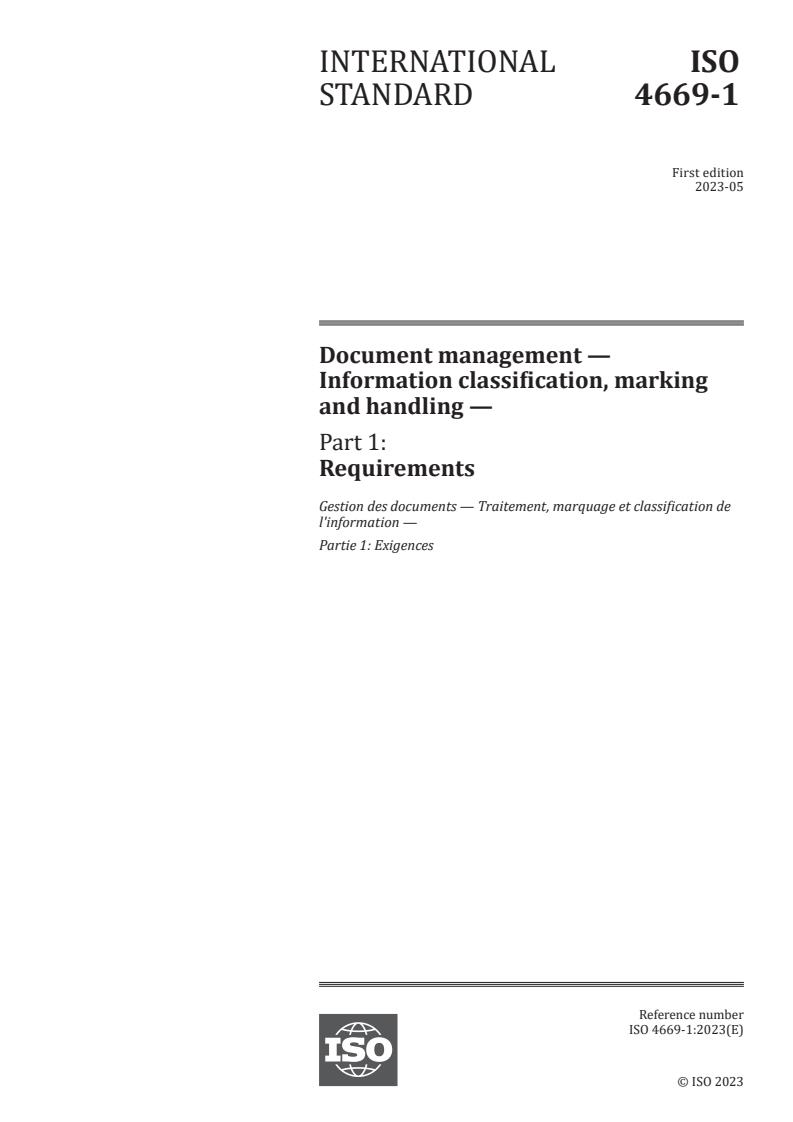
INTERNATIONAL ISO
STANDARD 4669-1
First edition
2023-05
Document management —
Information classification, marking
and handling —
Part 1:
Requirements
Gestion des documents — Traitement, marquage et classification de
l'information —
Partie 1: Exigences
Reference number
© ISO 2023
All rights reserved. Unless otherwise specified, or required in the context of its implementation, no part of this publication may
be reproduced or utilized otherwise in any form or by any means, electronic or mechanical, including photocopying, or posting on
the internet or an intranet, without prior written permission. Permission can be requested from either ISO at the address below
or ISO’s member body in the country of the requester.
ISO copyright office
CP 401 • Ch. de Blandonnet 8
CH-1214 Vernier, Geneva
Phone: +41 22 749 01 11
Email: copyright@iso.org
Website: www.iso.org
Published in Switzerland
ii
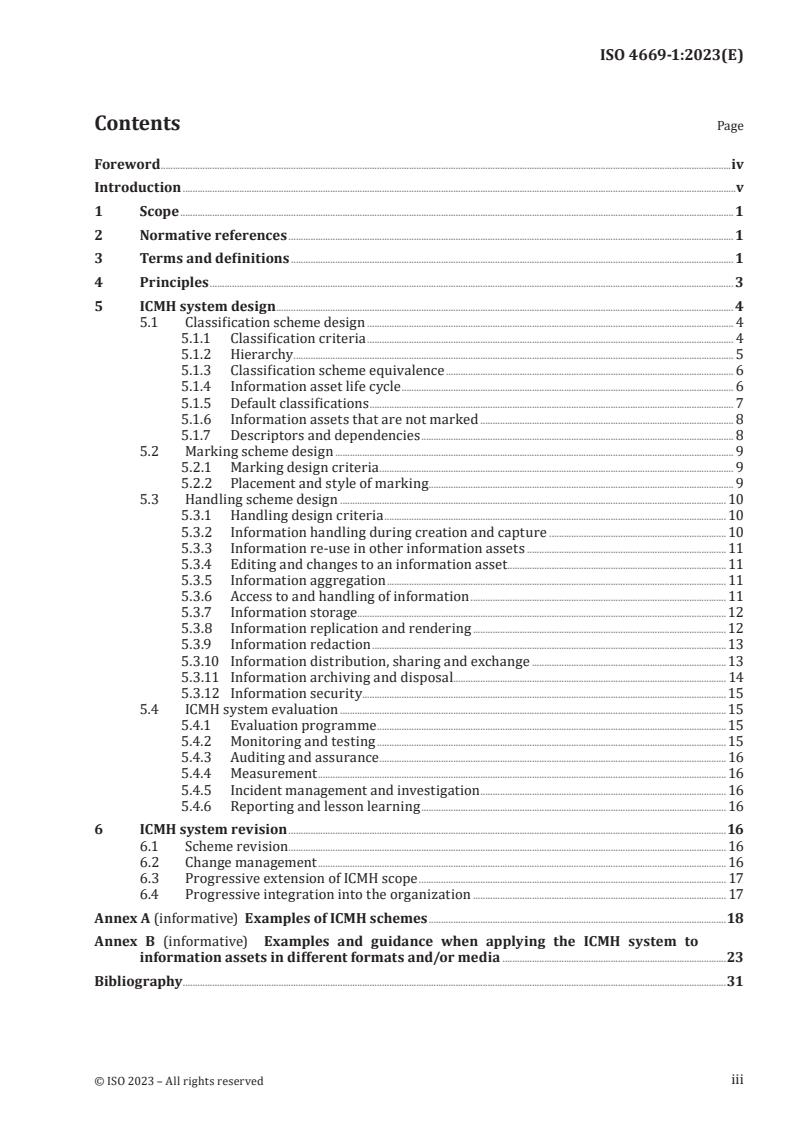
Contents Page
Foreword .iv
Introduction .v
1 Scope . 1
2 Normative references . 1
3 Terms and definitions . 1
4 Principles . 3
5 ICMH system design . 4
5.1 Classification scheme design . 4
5.1.1 Classification criteria . 4
5.1.2 Hierarchy . 5
5.1.3 Classification scheme equivalence . 6
5.1.4 Information asset life cycle . 6
5.1.5 Default classifications . 7
5.1.6 Information assets that are not marked . 8
5.1.7 Descriptors and dependencies . 8
5.2 Marking scheme design . 9
5.2.1 Marking design criteria . 9
5.2.2 Placement and style of marking . 9
5.3 Handling scheme design . 10
5.3.1 Handling design criteria . 10
5.3.2 Information handling during creation and capture . 10
5.3.3 Information re-use in other information assets . 11
5.3.4 Editing and changes to an information asset. 11
5.3.5 Information aggregation . 11
5.3.6 Access to and handling of information . 11
5.3.7 Information storage . . .12
5.3.8 Information replication and rendering .12
5.3.9 Information redaction .13
5.3.10 Information distribution, sharing and exchange .13
5.3.11 Information archiving and disposal. 14
5.3.12 Information security . . 15
5.4 ICMH system evaluation .15
5 .4 .1 E v a lu at ion pr og r a m me .15
5.4.2 M onitoring and testing . 15
5.4.3 Auditing and assurance . 16
5.4.4 Measurement . 16
5.4.5 Incident management and investigation . 16
5.4.6 Reporting and lesson learning . 16
6 ICMH system revision .16
6.1 Scheme revision . 16
6.2 Change management . 16
6.3 Progressive extension of ICMH scope . 17
6.4 Progressive integration into the organization . 17
Annex A (informative) Examples of ICMH schemes .18
Annex B (informative) Examples and guidance when applying the ICMH system to
information assets in different formats and/or media .23
Bibliography .31
iii
Foreword
ISO (the International Organization for Standardization) is a worldwide federation of national standards
bodies (ISO member bodies). The work of preparing International Standards is normally carried out
through ISO technical committees. Each member body interested in a subject for which a technical
committee has been established has the right to be represented on that committee. International
organizations, governmental and non-governmental, in liaison with ISO, also take part in the work.
ISO collaborates closely with the International Electrotechnical Commission (IEC) on all matters of
electrotechnical standardization.
The procedures used to develop this document and those intended for its further maintenance are
described in the ISO/IEC Directives, Part 1. In particular, the different approval criteria needed for the
different types of ISO document should be noted. This document was drafted in accordance with the
editorial rules of the ISO/IEC Directives, Part 2 (see www.iso.org/directives).
ISO draws attention to the possibility that the implementation of this document may involve the use
of (a) patent(s). ISO takes no position concerning the evidence, validity or applicability of any claimed
patent rights in respect thereof. As of the date of publication of this document, ISO had not received
notice of (a) patent(s) which may be required to implement this document. However, implementers are
cautioned that this may not represent the latest information, which may be obtained from the patent
database available at www.iso.org/patents. ISO shall not be held responsible for identifying any or all
such patent rights.
Any trade name used in this document is information given for the convenience of users and does not
constitute an endorsement.
For an explanation of the voluntary nature of standards, the meaning of ISO specific terms and
expressions related to conformity assessment, as well as information about ISO's adherence to
the World Trade Organization (WTO) principles in the Technical Barriers to Trade (TBT), see
www.iso.org/iso/foreword.html.
This document was prepared by Technical Committee ISO/TC 171, Document management applications,
Subcommittee SC 1, Quality, preservation and integrity of information.
Any feedback or questions on this document should be directed to the user’s national standards body. A
complete listing of these bodies can be found at www.iso.org/members.html.
iv
Introduction
Across all business sectors, there are organizations that already identify, classify and distinguish their
own information and electronic communications according to internal rules. This classification is then
used to direct the organization’s staff and partners to take pre-agreed steps to use, protect and share
the information, appropriate to how the organization values that information.
However, there is frequently no agreed equivalence of such classification, marking and handling
among private sector organizations, or across the wider public sector, nor between private sector and
public sector organizations. This can result in the organizations involved handling shared information
differently and sometimes inappropriately.
This document encourages organizations of any size, and in any business sector, to use a managed and
more consistent approach to handling information assets on the basis of their classification and marking.
This approach can deliver a significant improvement in how information, and in particular sensitive
information, is managed, both within the organization and within other organizations with which the
information is shared. It can also contribute to the protection of the organization's investments, income,
reputation and future. For example, technology companies involved in the business of information
creation (e.g. typesetting or email software) that adopt and integrate the specifications in this document
into their solutions will be able to create secure, automated document handling solutions, including
monitoring systems, that detect and act upon the transmission of information assets that have been
classified and marked.
More specifically, this document is intended to support the design of information classification, marking
and handling (ICMH) systems to help organizations:
— meet their strategic objectives, governance obligations and enterprise risk management goals;
— meet legal, regulatory and standards compliance obligations;
— identify, secure, protect, share and track sensitive information appropriately; and
— improve user understanding of the value and significance of information assets and familiarity with
their appropriate handling requirements.
v
INTERNATIONAL STANDARD ISO 4669-1:2023(E)
Document management — Information classification,
marking and handling —
Part 1:
Requirements
1 Scope
This document specifies requirements for information classification, marking and handling (ICMH).
This document also defines how such information can be accessed by users, both inside and outside the
organization, who own the information.
This document is applicable to, but not limited to, the following:
a) organizations of any size that create, store, share or otherwise process information;
b) individuals who create, store, share or otherwise process information;
c) individuals with responsibilities for document management, information governance and
management, information security, data protection, privacy and/or compliance; and
d) organizations that create, provide or support tools that enable a) to c).
This document addresses information that can be understood by humans and is capable of being
shared. Throughout this document such information is referred to as an “information asset” regardless
of its media or format.
NOTE Information assets can include structured information, unstructured information, text, pictures
and audio/video recordings, i.e. anything that contains information, including information that is derived from
databases and turned into a tangible asset.
2 Normative references
There are no normative references in this document.
3 Terms and definitions
For the purposes of this document, the following terms and definitions apply.
ISO and IEC maintain terminology databases for use in standardization at the following addresses:
— ISO Online browsing platform: available at https:// www .iso .org/ obp
— IEC Electropedia: available at https:// www .electropedia .org/
3.1
classification
systematic identification and/or arrangement of information assets (3.7) into categories according to
logically structured conventions, methods and procedural rules
Note 1 to entry: These categories consider issues such as the sensitivity of an information asset to loss or damage,
i.e. confidentiality, integrity and availability and other impacts on the organization(s).
[SOURCE: ISO 15489-1:2016, 3.5, modified — “information assets” has replaced “business activities
and/or records” and Note 1 to entry has been added.]
3.2
document
information (3.6) and the medium on which it is contained
[SOURCE: ISO 9000:2015, 3.8.5, modified — the example and notes to entry have been deleted.]
3.3
handling
required activities relating to information assets (3.7) that have been marked with a specific
classification (3.1)
3.4
information classification, marking and handling scheme
ICMH scheme
respective, specific requirements and arrangements established for the individual activities of
classification (3.1), marking (3.10) or handling (3.3)
3.5
information classification, marking and handling system
ICMH system
set of interrelated or interacting elements to establish information classification (3.1), marking (3.10)
and handling (3.3) policies and objectives with processes to achieve those objectives
3.6
information
meaningful data
Note 1 to entry: Data can be regarded as lacking the context necessary to interpret its meaning. Information is
accurate and timely, specific and organized for a purpose, presented within a context that gives it meaning and
relevance, and can lead to an increase in understanding and decrease in uncertainty. Information is valuable
because it can affect behaviour, a decision or an outcome.
[SOURCE: ISO 9000:2015, 3.8.2, modified — note 1 to entry has been added.]
3.7
information asset
set of information (3.6) that is capable of being shared and can be held in any form, e.g. physical or
digital
3.8
information asset life cycle
sequence of events that mark the development and use of an information asset (3.7)
[SOURCE: ISO 13972:2022, 3.1.40, modified — "information asset" has been added to the term; “asset”
has replaced “resource” in the definition; the note 1 to entry and example have been deleted.]
3.9
information provider
individual or entity that has shared information (3.6) with the organization
Note 1 to entry: This includes workers (3.17) within an organization when, for example, referring to them as
natural persons. Otherwise it relates to third parties.
3.10
marking
process by which a classification (3.1) is documented and indicated for an information asset (3.7)
(usually on the information asset)
3.11
metadata
data about data
Note 1 to entry: Metadata (see ISO 23081-1 for further information) is contained in many information assets
(3.7) and describes the information asset. Information classification (3.1), marking (3.10) and handling (3.3)
technologies and tools commonly use metadata to convey classifications. Without the use of such technologies,
metadata are not always immediately visible and possibly will not be automatically transferred when the
information (3.6) changes format.
3.12
physical storage media
physical device on which information (3.6) can be recorded
3.13
record
information (3.6) created or received and maintained as evidence and as an asset by an organization, in
pursuit of legal obligations or in the course of conducting business
Note 1 to entry: Records are normally used in plural.
[SOURCE: ISO 30300:2020, 3.2.10, modified — note 2 to entry has been deleted.]
3.14
redaction
permanent removal of information (3.6) within a document (3.2)
[SOURCE: ISO/IEC 27038:2014, 2.4]
3.15
replication
digital duplication where there is no change to the information (3.6)
[SOURCE: ISO/TS 21547:2010, 3.1.26]
3.16
storage media
device on which digital information (3.6) can be stored
3.17
worker
individual working under the control of an organization, including employees, temporary staff,
contractors and consultants
4 Principles
The information classification, marking and handling (ICMH) system shall include a definition of a
process that can handle information in a way that is appropriate to its classification and to its marking.
The ICMH system shall:
a) be as simple as the circumstances allow;
NOTE 1 An overly complex process can be difficult for a small company to apply and a simplistic process
does not always suit the complexity required in a large organization.
b) reflect the sensible limits of what can be expected of its workers so that they can obtain an
appropriate balance of what is necessary, recommended and possible to achieve;
c) produce consistent results upon repeated use, regardless of the user;
d) be traceable and capable of verification;
e) be usable by both human and automated systems;
f) be usable for purely manual processes (e.g. paper-based), as well as fully- or partially-automated
processes;
g) address all relevant security attributes;
h) take account of, and where appropriate, replace existing ICMH systems;
i) support compliance with internal and external requirements;
j) be resilient to changes in circumstances, technology and systems;
NOTE 2 The ICMH system tends to augment an original scheme, e.g. with additional descriptors, as the
role or coverage of an ICMH system evolves. This does not necessarily mean changing the entire ICMH
system.
k) take account of changes in the nature and sensitivity of information over time;
l) be applied throughout the lifetime and life cycle of the information asset.
The ICMH system shall be consistent with the organization's overall information management policies
and procedures.
Consideration shall be given to all opportunities to facilitate effective handing which are open to
the organization, to facilitate effective handling, including simplifying the arrangements as much as
possible and supporting them with technology, as appropriate.
5 ICMH system design
5.1 Classification scheme design
5.1.1 Classification criteria
The ICMH system shall include a specification of a classification scheme, detailing how information
shall be classified, and by whom, such that people with authorized access to information can mark and
handle the information in a consistent manner.
Information shall be classified in accordance with:
a) the assessed direct and indirect value of the information for the organization(s) involved;
b) the risk of inappropriate disclosure, corruption, or loss of access to the information asset, and the
organization’s appetite to accept such risk(s);
c) the related costs for the organization of identified risk events which can occur and result in
negative impacts such as harm to members of the public, reputation damage, costs of rectification
and of mitigation;
d) the expectations of stakeholders who are not necessarily directly engaged in the information asset
but whom nonetheless have the authority to impose requirements;
e) the need to control the extent to which the information asset can be accessed throughout its life
cycle;
f) the coherence of the information with, and mapping between, classifications and risk levels of
information used in the organization’s risk management process;
g) the amount of effort required to protect the information asset;
h) the specific expectations of other organizations with which information assets are shared;
i) the general expectations of other parties, such as members of the public and journalists, etc., even
when the information is not being shared;
j) social responsibility obligations and/or aspirations of the organization.
The ICMH system shall specify what action workers shall undertake if they:
— cannot make an assessment of classification;
— cannot comply with the requirements of the classification, e.g. for legal or practical reasons;
— consider the classification assigned to and marked on an information asset to be incorrect.
Consideration shall be given to its decision regarding the impact of classification changes on the
authenticity and/or integrity of the information.
The ICMH system shall define:
— the procedures to mitigate the impact of classification changes on the authenticity and/or integrity
of the information;
— the range and extent of changes to classification that workers may perform on each class of
information asset throughout its life cycle.
The justification for the classification scheme shall be documented and traceable.
NOTE Annex A provides example classification, marking and handling schemes. Annex B provides examples
and detailed guidance when applying the ICMH system to information assets in different formats and/or media.
5.1.2 Hierarchy
Information shall be classified according to a hierarchy. The number of classes in this hierarchy shall be
specified.
NOTE 1 Typically, a hierarchy of access restrictions ranges from “restricted access” to “unrestricted access”.
For a brief example of a hierarchy, see Table 1. For a more detailed example, see Table A.1.
Consideration should be given to the usability of the hierarchy. In general, fewer classes will be simpler
to use and more likely to be used correctly.
The names of the classes in this hierarchy shall be specified.
NOTE 2 One example of a hierarchy can include highly sensitive, sensitive, not sensitive and intended for
publication.
The hierarchical classes should have meaningful names. For example, defining a hierarchy of “not
sensitive” to “highly sensitive” is likely to be more helpful than defining a hierarchy of numbers “1”
to “5”.
NOTE 3 If all information is classified at the highest level, the efficiency of an organization can be reduced. If all
information is classified as having unrestricted access, it is likely that this would cause harm to the organization.
Table 1 — Example of a confidentiality hierarchy
Class Description
Highly sensitive This information is the most sensitive held by an organization and
great care should be taken to avoid it being accessed (accessed rather
than shared because sharing implies a conscious act) inappropriately
as this can cause great harm to the organization.
Sensitive This information is not as sensitive as highly sensitive information
but can nonetheless do harm if accessed inappropriately.
Internal This information is private to an organization but unauthorized ac-
cess to the information within it is unlikely to do significant harm.
Public This information is intended for public dissemination.
Non-sensitive All other information or information assets that are not classified as
the information in them is trivial and access to it poses no danger to
the organization.
5.1.3 Classification scheme equivalence
If, for the purpose of work, the organization shares or exchanges information with a third party, the
ICMH system shall:
a) be explained to the third party so that the third party understands the significance of the system
and associated schemes and the organization’s requirements for classification, whether or not the
third party has a classification scheme;
b) be agreed upon by relevant parties. The equivalence between the schemes of the organization and
the third party shall be documented, whenever possible;
c) include documentation on how exchanged or shared information is classified and consequently
marked and handled by the third party.
When creating or updating a classification scheme, the equivalence of its information classification,
marking and handling (ICMH) schemes with the schemes of third parties with whom they exchange or
share information shall be preserved.
Consideration should be given to how technology can be used to ensure reliable and consistent mapping
between these schemes and enforcement of control rules, and if the rules are conducive to technology
use.
5.1.4 Information asset life cycle
The classification scheme shall be continuously applied throughout the information asset’s life cycle
and shall be managed from creation or capture to eventual disposal, which can be many years later.
NOTE 1 It is not uncommon for there to be changes to the classification of specific information, and
consequently its marking and handling, throughout the information asset life cycle organization (e.g. from a high
degree of control to lower, more relaxed access control).
Where an expected classification change is pre-planned, the triggers, procedures and organizational
rules for such future change shall be preserved. This shall ensure that the information is linked to the
appropriate triggers, procedures and rules.
NOTE 2 Changes to classification can be pre-planned or unforeseen. For pre-planned changes to classification,
there is typically a trigger that initiates the future re-classification; such a trigger is typically a date, a period or a
specific event.
The ICMH system shall define the information to be created and retained for planned and unplanned
changes in classification of information assets, such that evidence of such changes is available when
required.
Where the classification of an information asset is created or changed, the classification history of the
information asset should be retained in an audit trail throughout its life cycle. This can include:
— a new classification:
— date and time of classification;
— information asset classification;
— authority for classification;
— classification time, date and any event-related validity (optional);
— anticipated future classification (optional);
— a changed classification:
— date and time of classification change;
— authority for classification change;
— preceding information classification;
— classification validity (expiration) time;
— any anticipated classification changes:
— trigger for classification change (e.g. time, date, event);
— likely information classification (category, etc.);
— authority required for such a classification change;
— classification (time frame) validity (optional).
The change log information shall be available in a way that preceding and succeeding classifications
can be determined together with the current classification and justification for the classification level
change.
5.1.5 Default classifications
Consideration shall be given to whether to create and use a default classification. Where a default
classification is created, the decision for taking this action shall be documented.
NOTE 1 When creating or using a classification scheme, organizations can find it useful to set a default
classification that is appropriate for their general and most used approach to the sensitivity of information, and
which reflects the nature of their activities. Legal practices expect to handle more sensitive information assets
than retailers. This normally reduces the effort to classify information as only the non-default classification(s)
information warrants individual marking. Such a default becomes the classification that is applied to information
that is not otherwise, or potentially later classified otherwise, under the classification scheme.
NOTE 2 There can be multiple defaults in an organization, e.g. in specific operational units. For example, the
default for the marketing department can be different from that in human resources (HR), where the majority of
information is personal and more sensitive than the majority of the marketing information.
NOTE 3 Information with a default classification still warrants appropriate marking and handling.
In the event of an organization creating or using a default classification, the default shall be explicitly
included in the documented classification scheme.
When adopting the use of a default classification, consideration should be given to the balance between
user convenience and the awareness and accountability that result from users being required to make
a positive choice.
5.1.6 Information assets that are not marked
Where an organization decides that it shall allow information assets to be unmarked, and therefore
without a specific classification, the ICMH system shall specify what the effective classification, and
thus the associated handling, of that information asset shall be.
NOTE 1 The effective classification is frequently the default classification.
NOTE 2 A common alternative to the default classification is typically a “public” classification or similar.
5.1.7 Descriptors and dependencies
The ICMH system shall specify whether descriptors shall be included within their classification scheme
and, if so, whether those descriptors shall appear in the marking scheme (see 5.2).
NOTE 1 In some cases it can be useful to apply a descriptor to information to enable anyone handling it to
understand something about why it has been classified in a particular way. For example, the handling of some
information can be subject to applicable national or international laws, the requirements of a regulatory body, or
the strategic business requirements of the organization.
The following are examples of possible descriptors:
a) PII: This information asset contains personally identifiable information (PII) that is expected to be protected
under applicable national or international law.
b) Legal: This is information that applicable national or international law is expected to be handled in a certain
way, e.g. archived or published.
c) Strategic: This information is of strategic importance to the organization but is not protected under
applicable national or international law.
For example, a document can have a marking in the title or footer with a suffix “Sensitive – legal”
denoting both the sensitivity and the source of the classification.
d) Structural: This information relates to an identifiable unit or element of the organization, e.g. a business
unit, functional activity, project or operation.
The ICMH system shall specify whether dependencies shall be included or addressed within their
classification scheme, and if so, whether those dependencies shall appear in the marking scheme. The
decisions by the organization should be based on considerations of how likely dependencies are to exist
and the outcomes.
NOTE 2 Examples of typical dependencies include the following:
a) Geography: information can have different legal status, significance or security requirements in different
locations; any information that is available to the public online can have no geographic dependency unless
geo-fenced in some way.
b) Time: information can have different status or significance depending on time and date.
c) Events: a particular event such as a disclosure following a statutory request for information that changes
the classification.
d) Aggregation: information can have a different legal status or significance if it is, or can be, aggregated with
other information or with data.
e) Approval: information and its classification can require a further evaluation or “sign off” by another party.
Consideration should be given to the number of descriptors and dependencies it needs, if any, and
should take account of the impact upon its operations that can result from such complexity.
5.2 Marking scheme design
5.2.1 Marking design criteria
The user shall apply the marking as defined for the particular classification of that information, i.e. the
classification shall be shown by a mark.
The mark should be visible to viewers at the point they view it or otherwise experience it and the mark
should continue to be visible if the information is replicated, shared with a third party, or converted in
format.
The mark should be visible, independent of the viewing/access method.
The language of the mark should be appropriate to the context and operational environment of the
ICMH system.
NOTE 1 For example, headers and footers in electronic documents can be suppressed as a default in many
document reader or editor programmes. A marking scheme using only headers and footers is not always visible.
A mark that depends on a particular programme significantly increases the chance that the classification mark
will be “lost” in a change of format of the information.
Where a visible mark is not appropriate, the circumstances for such a decision shall be explicitly defined
and documented.
Except when the information asset is for public consumption, having no visible mark should be
discouraged.
NOTE 2 “Visible” is used here as being able to be immediately understood according to the format of the
information. For example, “heard” for an audio file, “read” for a Braille embosser or “displayed on a screen” for a
document.
Marking shall be reviewed every time classification is reviewed. If the organization decides not to
revisit all previously marked assets when implementing a change in the scheme, it shall document this
decision and communicate the requirements for handling assets classified under the old scheme while
the new scheme is implemented.
Metadata shall not be used as a substitute for a mark, but where it is designed for the purpose of
classification, it shall be consistent with the visible mark.
5.2.2 Placement and style of marking
The ICMH system shall define the style, placement and structure to be used for marking information
assets.
The style, placement and structure of the mark shall be capable of being consistently applied and
suitable for the medium or format.
NOTE 1 This document does not mandate how or where marking is placed on visible, audible or other
information.
The mark shall be apparent on opening an information asset. Where an identifiable marking is not
possible, the circumstances for such a decision shall be defined.
NOTE 2 Not all information is accessed in a strictly linear fashion (e.g. websites). Where such formats and
access methods are used, it is quite common that the marked classification of an accessed information asset is
not obviously apparent.
The marking scheme, while self-consistent, can vary for different classification levels. Information at
the least sensitive level of classification should require the least energy or effort in marking. At the
highest level, marking should be subject to additional effort. For example, highly sensitive information
can benefit from continuous marking, that is, marking that is always visible at any point where the
information is viewed, heard or experienced. This can be through watermarking on documents, an
overlay on video or a continuous tone on audible material. This also ensures that partial views of the
information, e.g. a single page in a printed document, still carry the mark. Low sensitivity information
should not involve such complex marking so that creators or editors avoid marking it.
The marking of information shall, wherever possible, be automated, and such automation shall prevent
the unauthorized deletion, or alteration, of marks on the information.
NOTE 3 Enforcing features can include the mandatory use of permanent ink, marking paper documents and
using digital templates that cannot be changed by users.
5.3 Handling scheme design
5.3.1 Handling design criteria
The ICMH system shall define the specific control measures (such as watermarks) required for each
individual classification which shall be communicated through its mark.
The classification scheme shall enable an information asset, with a particular classification, to be
handled differently when pre-defined conditions exist.
EXAMPLE 1 Such a discrete classification then forms the mechanism for altering the rules surrounding when
or who is allowed to access an information asset or special handling arrangements for a given business partner.
EXAMPLE 2 Where the organization concludes that encryption of information assets is required for some
classifications and marks but not others; this is made clear to those handling such information.
The organization’s handling scheme shall explicitly define which individuals, groups of individuals or
business roles can handle the information as well as how they shall handle it.
NOTE The definition of which individuals are entitled to handle information can be by role, by grade or
individually as circumstances or organization preferences require.
When necessary, the suitability of particular individuals should be verified in accordance with the
organization’s HR policies and procedures. ISO/IEC 27001:2022, Annex A, provides relevant information.
The ICMH system shall specify:
a) what automated processing is allowed for marked information assets;
b) what classifications of information can be created on what collaborative platforms;
c) when working versions of information assets shall be retained, in what form and for how long;
d) a process for documenting and responding to known instances of mishandling information with
regards to its classification, consistent with the organization’s document management system.
5.3.2 Information handling during creation and capture
The ICMH system shall specify what information shall be created, captured and/or modified by which
individuals and what approvals are required, and from whom.
The ICMH system shall specify that information is classified at the point of creation or capture (e.g. by
filming) in accordance with the classification scheme (see 5.1).
The ICMH system shall define the production specifications for all classifications.
EXAMPLE 1 Where the asset is a text document, these specifications typically include page formats and
pagination, page numbering, the style of such numbering, copy numbering, the positioning of such numbering
and handling of blank pages.
Where an information asset is reformatted, held in a different software application or on a different
type of physical storage media, different appropriate specifications should be applied.
If required for any given classification(s), the ICMH system shall maintain a log of the handling of the
classification, as well as the marking and handling of information throughout the information asset’s
life. This typically applies to classifications that relate to particularly sensitive information assets.
NOTE 1 If copy numbering is required, it is likely to be for the purpose of recording the recipients. In such
circumstances, it is appropriate to store this is in the information, in addition to the log.
NOTE 2 The log is therefore initiated at first creation, i.e. the log document is actually the first item created.
When the creation of an information asset is considered to have been completed, the creator shall
reassess the asset’s classification, and consequently if or how the associated marking and handling
shall change.
5.3.3 Information re-use in other information assets
The ICMH system shall create a process for managing the appropriate reuse of an information asset,
parts of information assets or in other information assets. The process shall make clear:
a) the permissions and approvals which are required;
b) how the information is then classified, marked and handled.
5.3.4 Editing and changes to an information asset
When an information asset is edited or changed substantively, the information asset’s classification
shall be reassessed, and consequently any necessary changes to the marking and handling of the
information asset shall be made.
The ICMH system shall define what constitutes a substantive change.
NOTE Changes include the general editing, addition, alteration, substitution or deletion of some or all of the
information in the asset.
5.3.5 Information aggregation
The ICMH system shall specify how inform
...