

ISO/IEC 19369:2014
(Main)Information technology — Telecommunications and information exchange between systems — NFCIP-2 test methods
General Information
- Abstract
ISO/IEC 19369:2014 specifies requirements to verify NFCIP-2 mode selection and initial communication in the selected modes. The Test Management Service Data Units and the interface over which they are exchanged are out of scope.
- Status
- Withdrawn
- Publication Date
- 19-Aug-2014
- Current Stage
- 9599 - Withdrawal of International Standard
- Start Date
- 17-Sep-2024
- Completion Date
- 29-Aug-2026
Buy Documents


ISO/IEC 19369:2014 - Information technology -- Telecommunications and information exchange between systems -- NFCIP-2 test methods
ISO/IEC 19369:2014 - Information technology — Telecommunications and information exchange between systems — NFCIP-2 test methods/20/2014
Overview
ISO/IEC 19369:2014 defines test methods for verifying NFCIP-2 mode selection and initial communication between Near Field Communication (NFC) devices. Published by ISO/IEC and adopted from Ecma (ECMA-403), this standard specifies how to test that an Implementation Under Test (IUT) correctly detects external RF fields, selects and switches operating modes (PICC, PCD, VCD, NFC Initiator/Target), and performs the required initial exchange for the selected mode. The Test Management Service Data Units (TM‑SDUs) and the interface over which they are exchanged are explicitly out of scope.
Key Topics and Requirements
- Test scope and conformance: Conformance requires passing the tests defined in Clause 6 using the test environment and apparatus in Clause 5.
- Test architecture: Uses the ISO/IEC 9646 conformance-testing model and an apparatus composed of an Upper Tester (UT), Lower Tester (LT) and the IUT.
- Major test types:
- External RF field detection - verify IUT does not unintentionally switch on its RF field.
- Mode selection and switching - verify correct selection and switching among PICC, PCD, VCD, and NFC (Initiator/Target) modes.
- PICC/PCD/VCD functional tests - use referenced test methods (ISO/IEC 10373‑6 and 10373‑7) to validate proximity, contactless, and vicinity behaviors.
- NFC Initial exchange - validate ATR_REQ/ATR_RES and Initiator protocols per ISO/IEC 18092 and the timing constraints (e.g., 1 ms reaction window noted for Type A/B alternation).
- Out-of-scope items: TM‑SDUs and the UT–IUT SDU interface are not covered by this standard.
Applications and Who Uses It
ISO/IEC 19369:2014 is intended for:
- NFC device manufacturers and chipset vendors validating mode-selection and initial RF behaviour.
- Conformance and interoperability test laboratories performing formal testing for product certification.
- Standards engineers and QA teams ensuring implementations meet ISO/IEC 21481 (NFCIP-2) initial communication requirements.
- Certification bodies and integrators requiring documented test methods for compliance evidence.
Practical benefits include ensuring interoperable NFC handshakes, predictable mode switching, reliable RF behaviour in mixed Type A/Type B environments, and a repeatable test platform for certification.
Related Standards
- ISO/IEC 21481 (NFCIP-2) - protocol under test
- ISO/IEC 18092 (NFCIP-1) - ATR and initiator/target procedures
- ISO/IEC 10373-6 / 10373-7 - proximity and vicinity card test methods
- ISO/IEC 9646 - conformance testing methodology
- ISO/IEC 23917, 22536 - related NFC test methods
Keywords: ISO/IEC 19369:2014, NFCIP-2 test methods, NFC testing, mode selection, RF field detection, NFC conformance, IUT, UT, LT, ISO/IEC 21481.
Relations
- Effective Date
- 06-Jun-2022
Buy Documents
ISO/IEC 19369:2014 - Information technology -- Telecommunications and information exchange between systems -- NFCIP-2 test methods
ISO/IEC 19369:2014 - Information technology — Telecommunications and information exchange between systems — NFCIP-2 test methods/20/2014
Get Certified
Connect with accredited certification bodies for this standard

BSI Group
BSI (British Standards Institution) is the business standards company that helps organizations make excellence a habit.

NYCE
Mexican standards and certification body.
Sponsored listings
Frequently Asked Questions
ISO/IEC 19369:2014 is a standard published by the International Organization for Standardization (ISO). Its full title is "Information technology — Telecommunications and information exchange between systems — NFCIP-2 test methods". This standard covers: ISO/IEC 19369:2014 specifies requirements to verify NFCIP-2 mode selection and initial communication in the selected modes. The Test Management Service Data Units and the interface over which they are exchanged are out of scope.
ISO/IEC 19369:2014 specifies requirements to verify NFCIP-2 mode selection and initial communication in the selected modes. The Test Management Service Data Units and the interface over which they are exchanged are out of scope.
ISO/IEC 19369:2014 is classified under the following ICS (International Classification for Standards) categories: 35.100.10 - Physical layer. The ICS classification helps identify the subject area and facilitates finding related standards.
ISO/IEC 19369:2014 has the following relationships with other standards: It is inter standard links to ISO/IEC 19369:2024. Understanding these relationships helps ensure you are using the most current and applicable version of the standard.
ISO/IEC 19369:2014 is available in PDF format for immediate download after purchase. The document can be added to your cart and obtained through the secure checkout process. Digital delivery ensures instant access to the complete standard document.
Standards Content (Sample)
INTERNATIONAL ISO/IEC
STANDARD 19369
First edition
2014-08-15
Information technology —
Telecommunications and information
exchange between systems — NFCIP-2
test methods
Technologies de l’information — Téléinformatique — Méthodes
d’essai NFCIP-2
Reference number
©
ISO/IEC 2014
© ISO/IEC 2014
All rights reserved. Unless otherwise specified, no part of this publication may be reproduced or utilized otherwise in any form
or by any means, electronic or mechanical, including photocopying, or posting on the internet or an intranet, without prior
written permission. Permission can be requested from either ISO at the address below or ISO’s member body in the country of
the requester.
ISO copyright office
Case postale 56 • CH-1211 Geneva 20
Tel. + 41 22 749 01 11
Fax + 41 22 749 09 47
E-mail copyright@iso.org
Web www.iso.org
Published in Switzerland
ii © ISO/IEC 2014 – All rights reserved
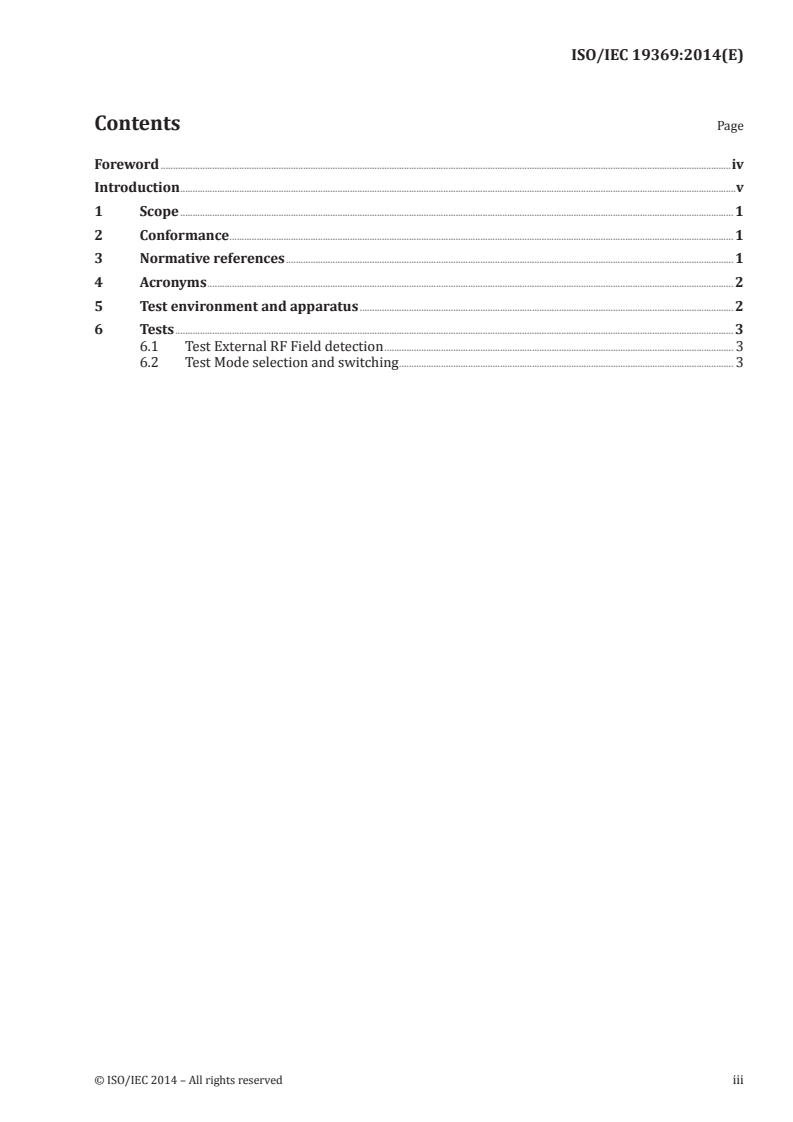
Contents Page
Foreword .iv
Introduction .v
1 Scope . 1
2 Conformance . 1
3 Normative references . 1
4 Acronyms . 2
5 Test environment and apparatus . 2
6 Tests . 3
6.1 Test External RF Field detection . 3
6.2 Test Mode selection and switching . 3
© ISO/IEC 2014 – All rights reserved iii
Foreword
ISO (the International Organization for Standardization) and IEC (the International Electrotechnical
Commission) form the specialized system for worldwide standardization. National bodies that are
members of ISO or IEC participate in the development of International Standards through technical
committees established by the respective organization to deal with particular fields of technical
activity. ISO and IEC technical committees collaborate in fields of mutual interest. Other international
organizations, governmental and non-governmental, in liaison with ISO and IEC, also take part in the
work. In the field of information technology, ISO and IEC have established a joint technical committee,
ISO/IEC JTC 1.
The procedures used to develop this document and those intended for its further maintenance are
described in the ISO/IEC Directives, Part 1. In particular the different approval criteria needed for
the different types of document should be noted. This document was drafted in accordance with the
editorial rules of the ISO/IEC Directives, Part 2 (see www.iso.org/directives).
Attention is drawn to the possibility that some of the elements of this document may be the subject
of patent rights. ISO and IEC shall not be held responsible for identifying any or all such patent rights.
Details of any patent rights identified during the development of the document will be in the Introduction
and/or on the ISO list of patent declarations received (see www.iso.org/patents).
Any trade name used in this document is information given for the convenience of users and does not
constitute an endorsement.
For an explanation on the meaning of ISO specific terms and expressions related to conformity
assessment, as well as information about ISO’s adherence to the WTO principles in the Technical Barriers
to Trade (TBT) see the following URL: Foreword - Supplementary information
ISO/IEC 19369 was prepared by Ecma International (as ECMA-403) and was adopted, under a special
“fast-track procedure”, by Joint Technical Committee ISO/IEC JTC 1, Information technology, in parallel
with its approval by national bodies of ISO and IEC.
iv © ISO/IEC 2014 – All rights reserved
Introduction
This International Sta
...
INTERNATIONAL ISO/IEC
STANDARD 19369
First edition
2014-08-15
Information technology —
Telecommunications and information
exchange between systems — NFCIP-2
test methods
Technologies de l’information — Téléinformatique — Méthodes
d’essai NFCIP-2
Reference number
©
ISO/IEC 2014
© ISO/IEC 2014
All rights reserved. Unless otherwise specified, no part of this publication may be reproduced or utilized otherwise in any form
or by any means, electronic or mechanical, including photocopying, or posting on the internet or an intranet, without prior
written permission. Permission can be requested from either ISO at the address below or ISO’s member body in the country of
the requester.
ISO copyright office
Case postale 56 • CH-1211 Geneva 20
Tel. + 41 22 749 01 11
Fax + 41 22 749 09 47
E-mail copyright@iso.org
Web www.iso.org
Published in Switzerland
ii © ISO/IEC 2014 – All rights reserved
Contents Page
Foreword .iv
Introduction .v
1 Scope . 1
2 Conformance . 1
3 Normative references . 1
4 Acronyms . 2
5 Test environment and apparatus . 2
6 Tests . 3
6.1 Test External RF Field detection . 3
6.2 Test Mode selection and switching . 3
© ISO/IEC 2014 – All rights reserved iii
Foreword
ISO (the International Organization for Standardization) and IEC (the International Electrotechnical
Commission) form the specialized system for worldwide standardization. National bodies that are
members of ISO or IEC participate in the development of International Standards through technical
committees established by the respective organization to deal with particular fields of technical
activity. ISO and IEC technical committees collaborate in fields of mutual interest. Other international
organizations, governmental and non-governmental, in liaison with ISO and IEC, also take part in the
work. In the field of information technology, ISO and IEC have established a joint technical committee,
ISO/IEC JTC 1.
The procedures used to develop this document and those intended for its further maintenance are
described in the ISO/IEC Directives, Part 1. In particular the different approval criteria needed for
the different types of document should be noted. This document was drafted in accordance with the
editorial rules of the ISO/IEC Directives, Part 2 (see www.iso.org/directives).
Attention is drawn to the possibility that some of the elements of this document may be the subject
of patent rights. ISO and IEC shall not be held responsible for identifying any or all such patent rights.
Details of any patent rights identified during the development of the document will be in the Introduction
and/or on the ISO list of patent declarations received (see www.iso.org/patents).
Any trade name used in this document is information given for the convenience of users and does not
constitute an endorsement.
For an explanation on the meaning of ISO specific terms and expressions related to conformity
assessment, as well as information about ISO’s adherence to the WTO principles in the Technical Barriers
to Trade (TBT) see the following URL: Foreword - Supplementary information
ISO/IEC 19369 was prepared by Ecma International (as ECMA-403) and was adopted, under a special
“fast-track procedure”, by Joint Technical Committee ISO/IEC JTC 1, Information technology, in parallel
with its approval by national bodies of ISO and IEC.
iv © ISO/IEC 2014 – All rights reserved
Introduction
This International Sta
...